
Left Brain Right Brain Entering the Debate on
Left Brain / Right Brain: Entering the Debate on Cerebral Asymmetry Paul Greenberg, 2015 Anoka Ramsey Community College
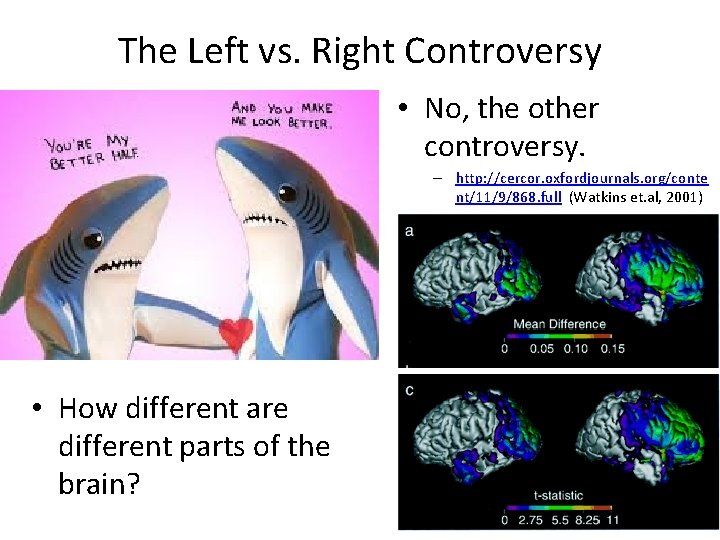
The Left vs. Right Controversy • No, the other controversy. – http: //cercor. oxfordjournals. org/conte nt/11/9/868. full (Watkins et. al, 2001) • How different are different parts of the brain?
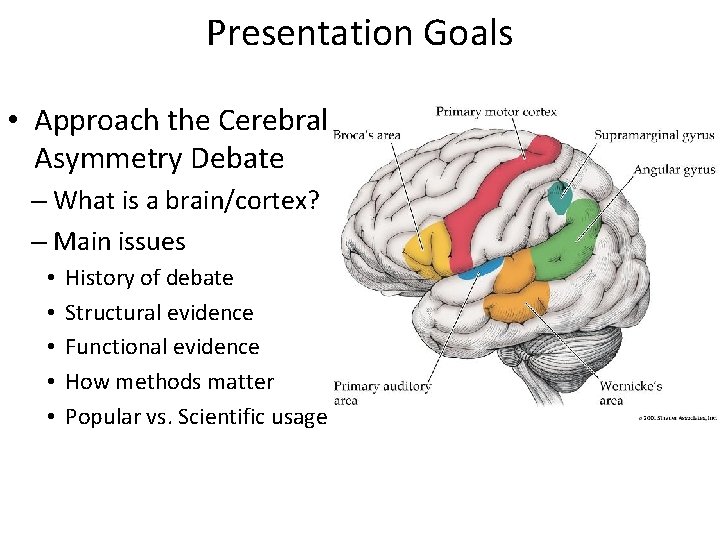
Presentation Goals • Approach the Cerebral Asymmetry Debate – What is a brain/cortex? – Main issues • • • History of debate Structural evidence Functional evidence How methods matter Popular vs. Scientific usage
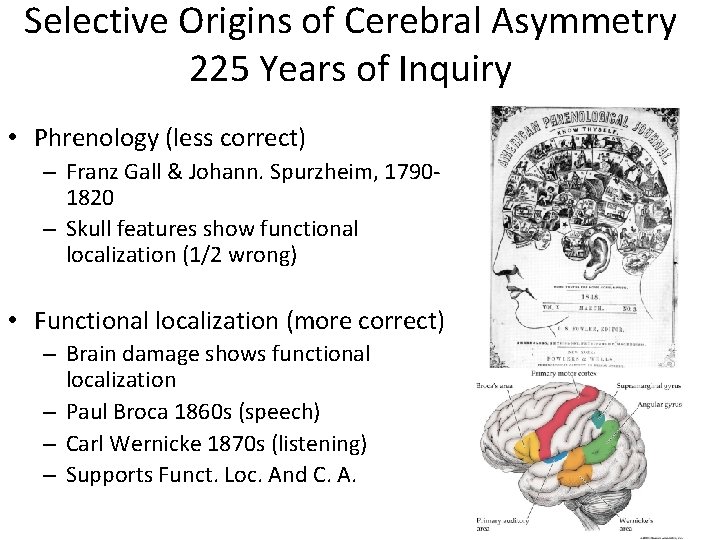
Selective Origins of Cerebral Asymmetry 225 Years of Inquiry • Phrenology (less correct) – Franz Gall & Johann. Spurzheim, 17901820 – Skull features show functional localization (1/2 wrong) • Functional localization (more correct) – Brain damage shows functional localization – Paul Broca 1860 s (speech) – Carl Wernicke 1870 s (listening) – Supports Funct. Loc. And C. A.
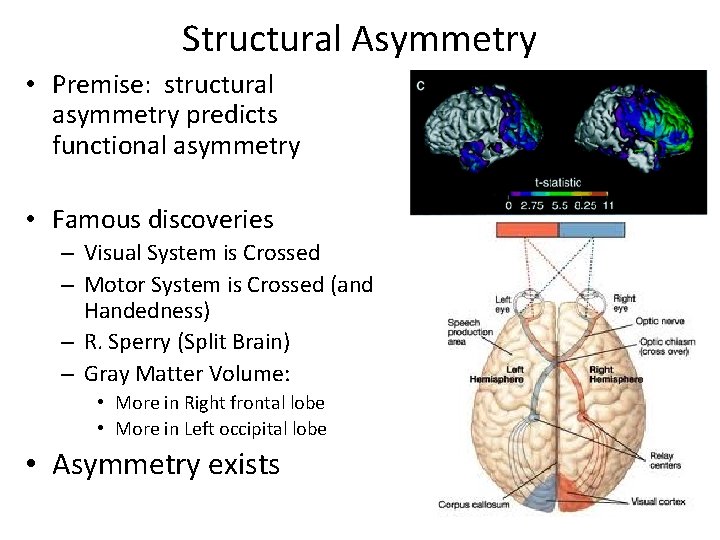
Structural Asymmetry • Premise: structural asymmetry predicts functional asymmetry • Famous discoveries – Visual System is Crossed – Motor System is Crossed (and Handedness) – R. Sperry (Split Brain) – Gray Matter Volume: • More in Right frontal lobe • More in Left occipital lobe • Asymmetry exists
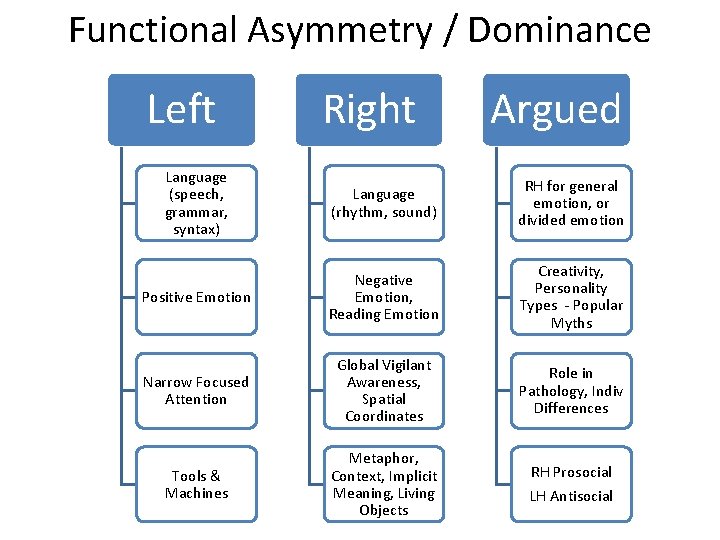
Functional Asymmetry / Dominance Left Right Argued Language (speech, grammar, syntax) Language (rhythm, sound) RH for general emotion, or divided emotion Positive Emotion Negative Emotion, Reading Emotion Creativity, Personality Types - Popular Myths Narrow Focused Attention Global Vigilant Awareness, Spatial Coordinates Role in Pathology, Indiv Differences Tools & Machines Metaphor, Context, Implicit Meaning, Living Objects RH Prosocial LH Antisocial
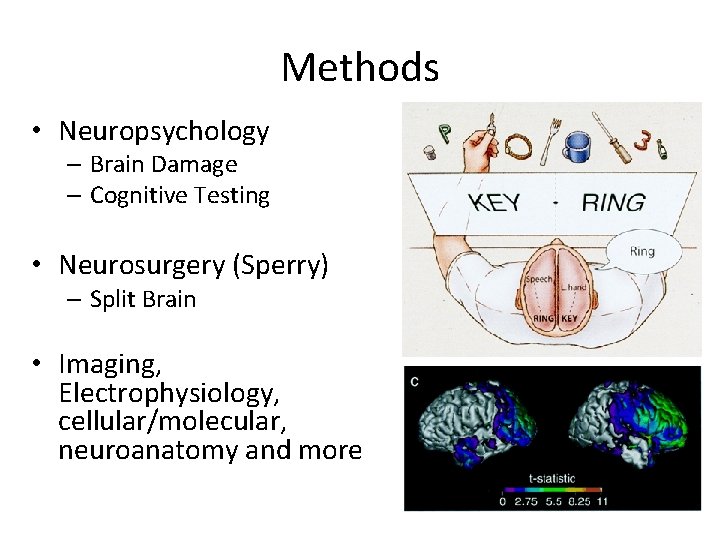
Methods • Neuropsychology – Brain Damage – Cognitive Testing • Neurosurgery (Sperry) – Split Brain • Imaging, Electrophysiology, cellular/molecular, neuroanatomy and more
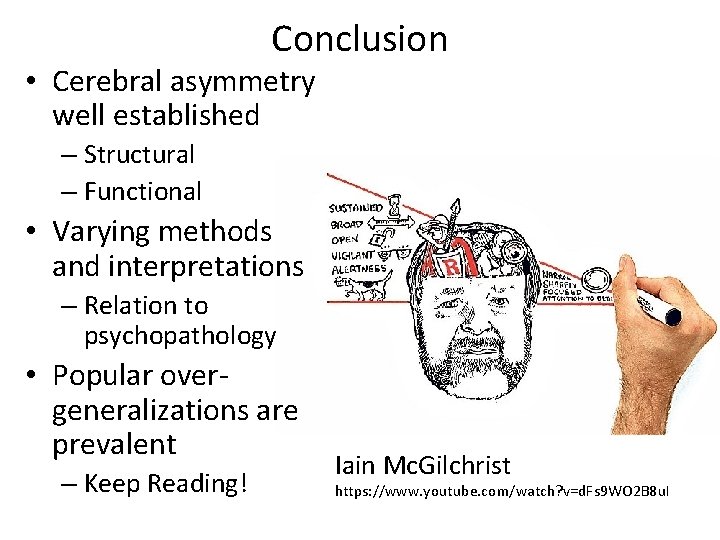
Conclusion • Cerebral asymmetry well established – Structural – Functional • Varying methods and interpretations – Relation to psychopathology • Popular overgeneralizations are prevalent – Keep Reading! Iain Mc. Gilchrist https: //www. youtube. com/watch? v=d. Fs 9 WO 2 B 8 u. I
References • Demaree, H. a, Everhart, D. E. , Youngstrom, E. a, & Harrison, D. W. (2005). Brain lateralization of emotional processing: historical roots and a future incorporating “dominance”. Behavioral and Cognitive Neuroscience Reviews, 4(1), 3– 20. http: //doi. org/10. 1177/1534582305276837 • Fitzakerley, J. (2015, January 1). Lateralization of Cortical Function. Retrieved March 27, 2015. http: //www. d. umn. edu/~jfitzake/Lectures/DMED/Speech. Language/Cortical. S_LAreas/Lateralization. html • Hecht D (2014). Cerebral lateralization of pro- and anti-social tendencies. Experimental Neurobiology , 23(1): 1 -27 • Hervé, P. -Y. , Zago, L. , Petit, L. , Mazoyer, B. , & Tzourio-Mazoyer, N. (2013). Revisiting human hemispheric specialization with neuroimaging. Trends in Cognitive Sciences, 17(2), 69– 80. http: //doi. org/10. 1016/j. tics. 2012. 004 • Kolb, B. , & Whishaw, I. Q. (2009). Fundamentals of human neuropsychology. New York, NY: Worth Publishers. • Nielsen, J. a, Zielinski, B. a, Ferguson, M. a, Lainhart, J. E. , & Anderson, J. S. (2013). An evaluation of the left-brain vs. right-brain hypothesis with resting state functional connectivity magnetic resonance imaging. Plo. S One, 8(8), e 71275. http: //doi. org/10. 1371/journal. pone. 0071275 • Van Whye, J. (1999, January 1). What did phrenologists actually do? Retrieved March 27, 2015. http: //www. historyofphrenology. org. uk/overview. htm • Watkins, K. (2001). Structural Asymmetries in the Human Brain: A Voxel-based Statistical Analysis of 142 MRI Scans. Cerebral Cortex, 11(9), 868 -877.
- Slides: 9