
LEFM and EPFM LEFM In LEFM the crack

- Slides: 16
LEFM and EPFM LEFM • In LEFM, the crack tip stress and displacement field can be uniquely characterized by K, the stress intensity factor. It is neither the magnitude of stress or strain, but a unique parameter that describes the effect of loading at the crack tip region and the resistance of the material. K filed is valid for a small region around the crack tip. It depends on both the values of stress and crack size.
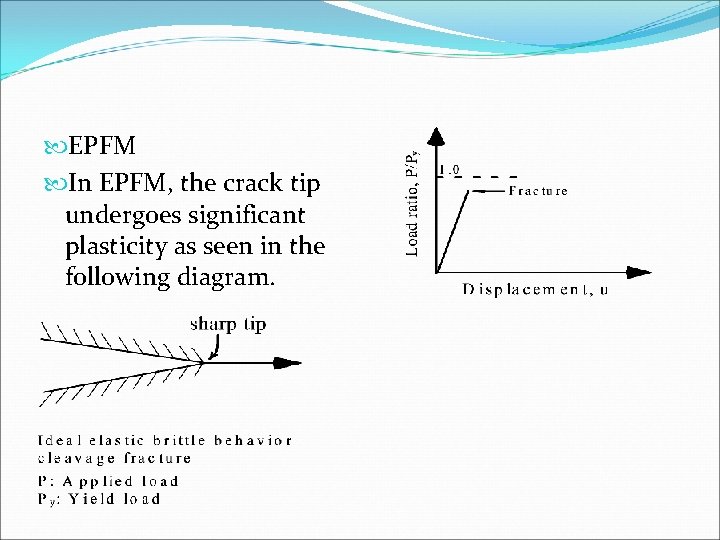
EPFM In EPFM, the crack tip undergoes significant plasticity as seen in the following diagram.
Elastic-Plastic Fracture Mechanics When does one need to use LEFM and EPFM? What is the concept of small-scale and large-scale yielding? Contents of this Chapter The basics of the two criteria used in EPFM: COD (CTOD), and J-Integral (with H-R-R) Concept of K- and J-dominated regions, plastic zones Measurement methods of COD and J-integral Effect of Geometry
CTOD: Before the unstable crack growth, because of the large plastic deformation, the crack has blunt form and the crack tip opens. If the CTOD approahes to the critical value for the system the farcture occurs.
CRACK TIP PLASTIC ZONE Ø All stress values approach to infinity at the tip of the crack when r=0. However, structural materials have the yield stress and at near the crack tip the stress values reach the finite stress that above the yield strength of the materials. Therefore, the plastic zone occur at tip of the crack because the true materials deforms plastically above the yield strength. The fracture occurs in places where the plastic depormation formed. Ø In fully elastic materials, there is a small amount of plastic deformation at the crack tip even though the yield strength value has been reached. The size of the region that is subjected to deformation changes depending on materials.
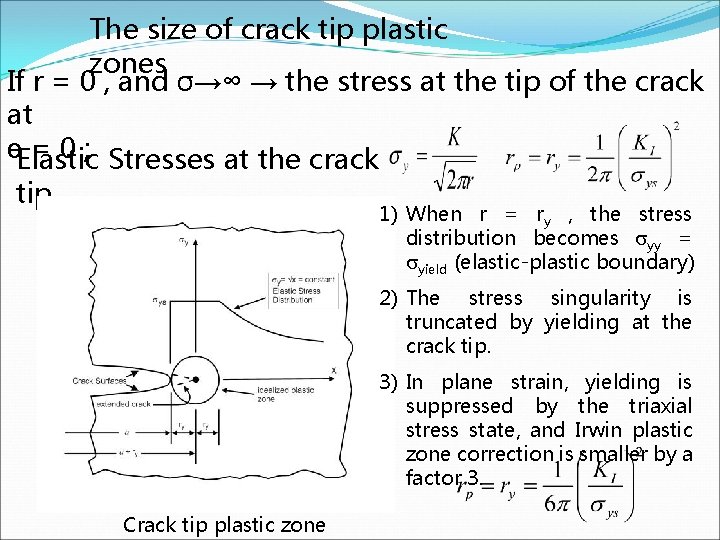
The size of crack tip plastic zones If r = 0 , and σ→∞ → the stress at the tip of the crack at ɵElastic = 0 ; Stresses at the crack tip 1) When r = ry , the stress distribution becomes yy = yield (elastic-plastic boundary) 2) The stress singularity is truncated by yielding at the crack tip. 3) In plane strain, yielding is suppressed by the triaxial stress state, and Irwin plastic zone correction is smaller by a factor 3. Crack tip plastic zone
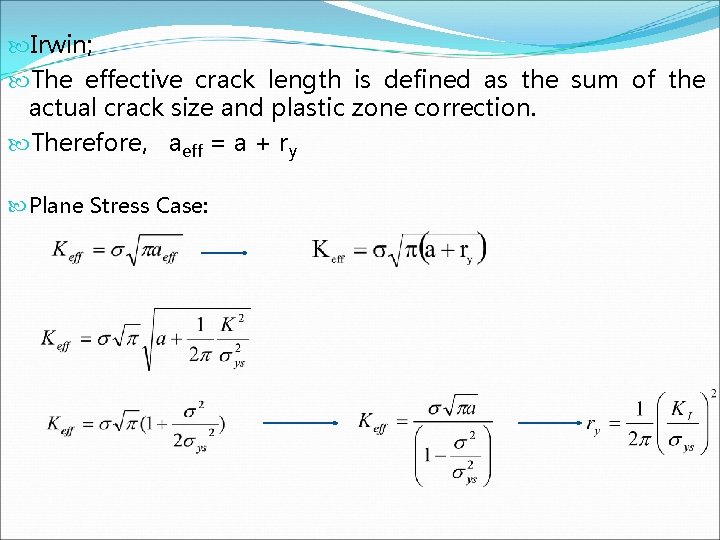
Irwin; The effective crack length is defined as the sum of the actual crack size and plastic zone correction. Therefore, aeff = a + ry Plane Stress Case:
Plane Strain Case: The stress increases up to The Plane Strain Case : Result is : for plastic yield strength.
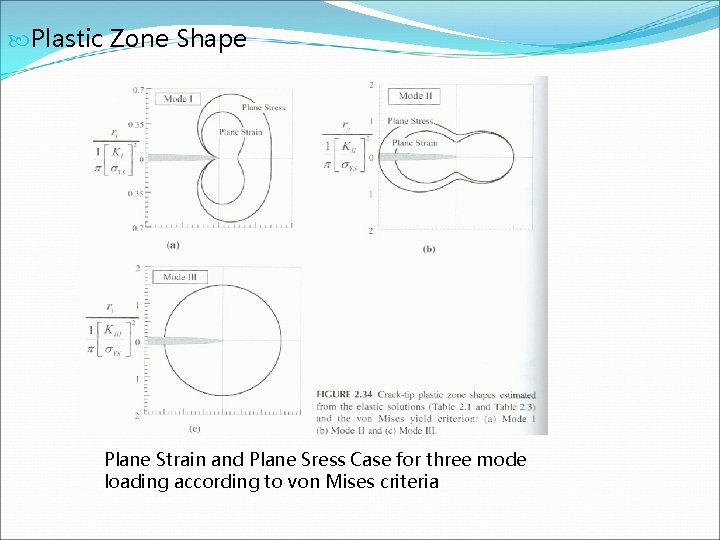
Plastic Zone Shape Plane Sress Case for three mode Plane Strain and loading according to von Mises criteria
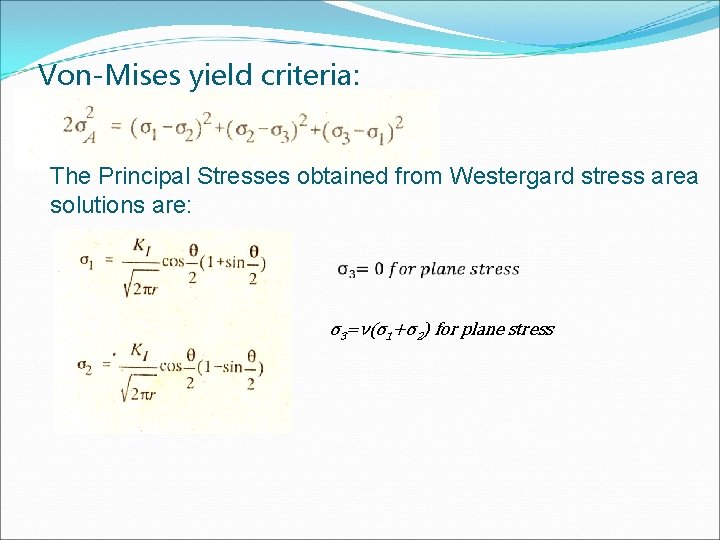
Von-Mises yield criteria: The Principal Stresses obtained from Westergard stress area solutions are: σ3=ν(σ1+σ2) for plane stress
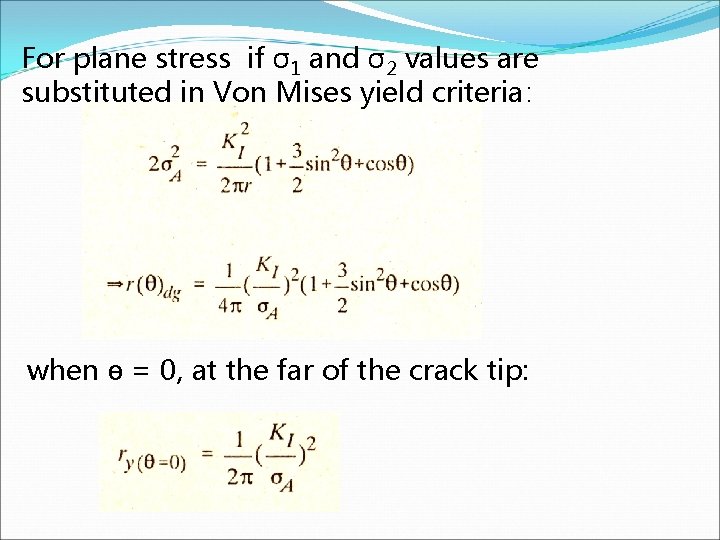
For plane stress if σ1 and σ2 values are substituted in Von Mises yield criteria: when ɵ = 0, at the far of the crack tip:
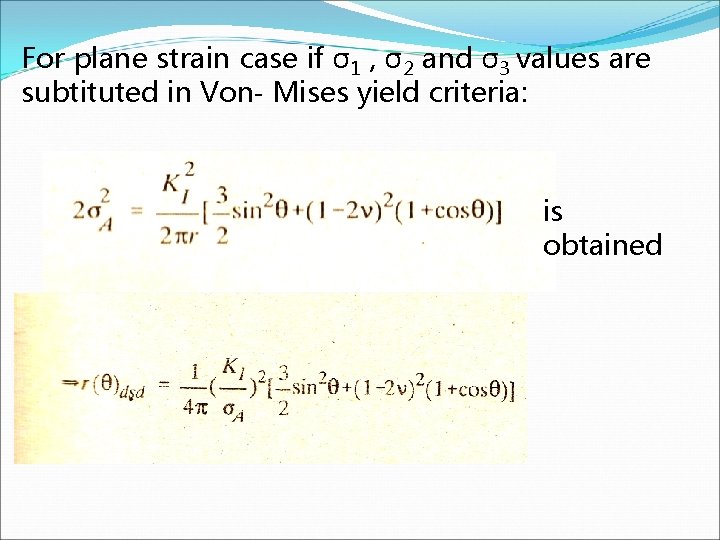
For plane strain case if σ1 , σ2 and σ3 values are subtituted in Von- Mises yield criteria: is obtained
2 - METALLERİN PLASTİK DEFORMASYONU Metallerin plastik deformasyonunda �ile �arasında lineer elastik deformasyonda olduğu gibi doğrusal bir ilişki yoktur. Fakat dizayn konularında malzemede akma olayına meydan vermeden bir cisme uygulanacak max. yük tayini yapılır. Plastik deformasyonda akma olayı söz konusudur. Gerilmeler cinsinden ifade edilebilen genel akma kriteri 2 tanedir.
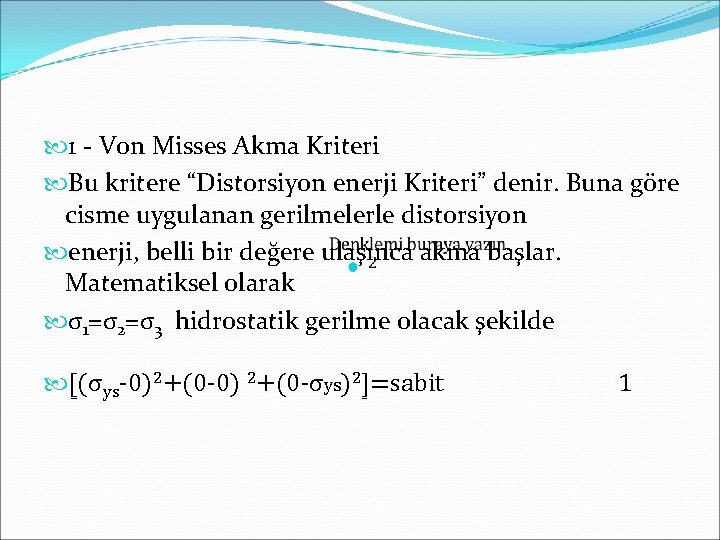
1 - Von Misses Akma Kriteri Bu kritere “Distorsiyon enerji Kriteri” denir. Buna göre cisme uygulanan gerilmelerle distorsiyon enerji, belli bir değere ulaşınca akma başlar. Matematiksel olarak σ1=σ2=σ3 hidrostatik gerilme olacak şekilde ⦋(σys-0)2+(0 -0) 2+(0 -σys)2⦌=sabit 1
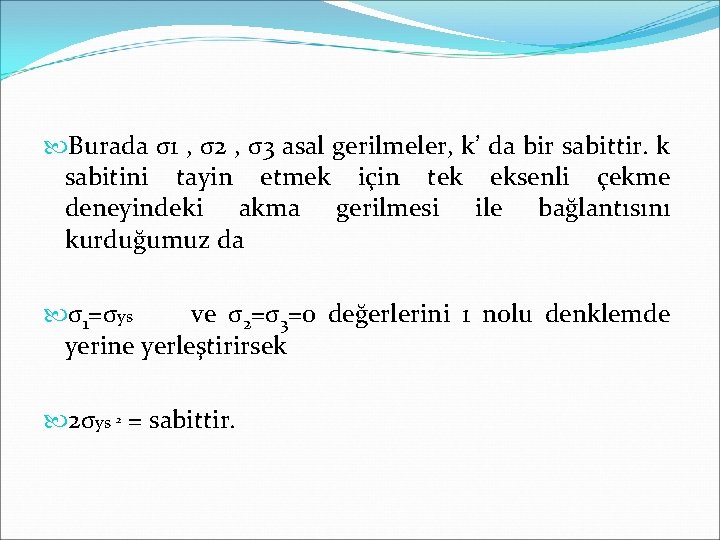
Burada σ1 , σ2 , σ3 asal gerilmeler, k’ da bir sabittir. k sabitini tayin etmek için tek eksenli çekme deneyindeki akma gerilmesi ile bağlantısını kurduğumuz da σ1=σys ve σ2=σ3=0 değerlerini 1 nolu denklemde yerine yerleştirirsek 2σys 2 = sabittir.