
Leech bite Introduction Leeches are Annelids or segmented
Leech bite
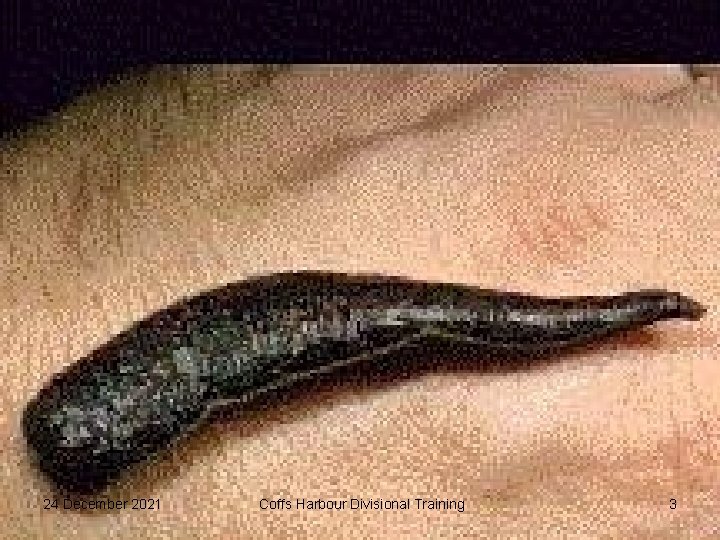
Introduction • Leeches are Annelids (or segmented worms) and are closely related to earthworms. • There are over 100 different leech species in Australia. • They have 34 segments, with a powerful sucker at the end. 24 December 2021 Coffs Harbour Divisional Training 2
24 December 2021 Coffs Harbour Divisional Training 3
Introduction • Australian leeches vary in size from 7 mm up to 200 mm when extended. • They are commonly found in dimly lit places. • Most leeches live in freshwater but some live on land, in damp areas of tropical rainforests. 24 December 2021 Coffs Harbour Divisional Training 4
Biology • They are hermaphrodites (they have both male and female sex organs). • They die after they have reproduced once or twice. • Most leeches don't really rely solely on drinking blood as they are mainly carnivores. • Leeches that suck blood are called Haemophagic (blood/to eat) leeches 24 December 2021 Coffs Harbour Divisional Training 5
24 December 2021 Coffs Harbour Divisional Training 6
24 December 2021 Coffs Harbour Divisional Training 7
24 December 2021 Coffs Harbour Divisional Training 8
24 December 2021 Coffs Harbour Divisional Training 9

Introduction • Leeches need symbiotic bacteria to help digest their blood meals which can take weeks or even months. • Leech bodies are covered with receptors so they can detect warm blooded animals by sight, smell, vibrations, carbon dioxide and temperature. 24 December 2021 Coffs Harbour Divisional Training 10
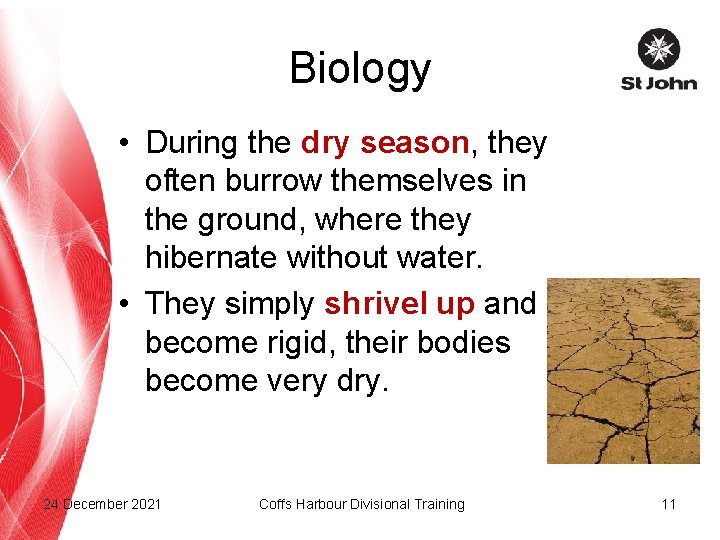
Biology • During the dry season, they often burrow themselves in the ground, where they hibernate without water. • They simply shrivel up and become rigid, their bodies become very dry. 24 December 2021 Coffs Harbour Divisional Training 11
Biology • If you sprinkle them with water, they recover completely within ten minutes. 24 December 2021 Coffs Harbour Divisional Training 12

Behaviour The leech waits in foliage or on the forest floor to attach itself to a passing warm-blooded animal. 24 December 2021 Coffs Harbour Divisional Training 13
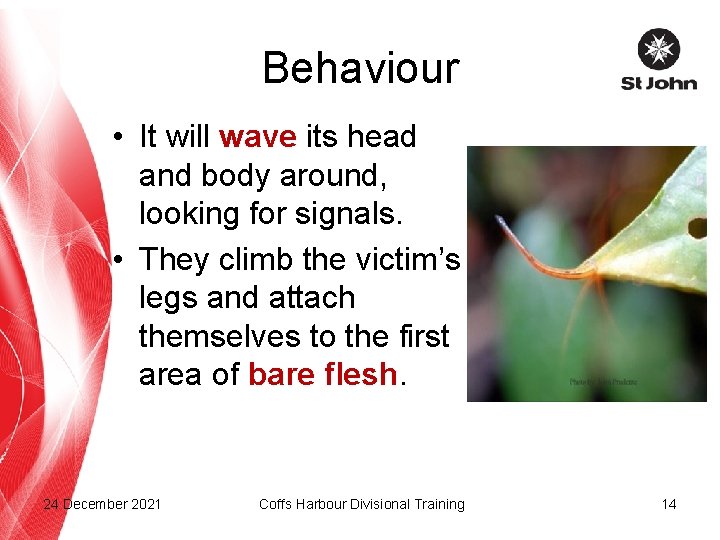
Behaviour • It will wave its head and body around, looking for signals. • They climb the victim’s legs and attach themselves to the first area of bare flesh. 24 December 2021 Coffs Harbour Divisional Training 14
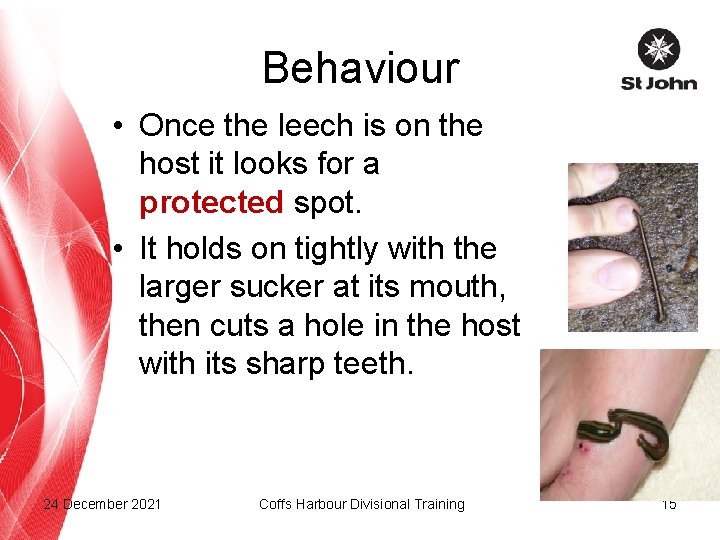
Behaviour • Once the leech is on the host it looks for a protected spot. • It holds on tightly with the larger sucker at its mouth, then cuts a hole in the host with its sharp teeth. 24 December 2021 Coffs Harbour Divisional Training 15
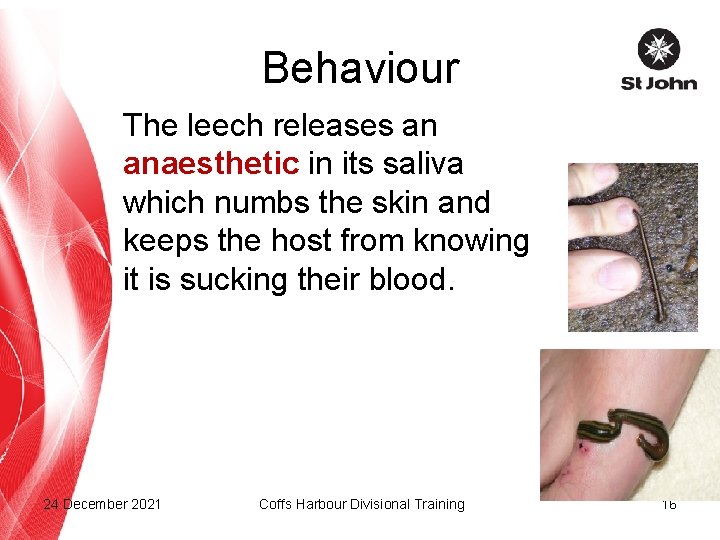
Behaviour The leech releases an anaesthetic in its saliva which numbs the skin and keeps the host from knowing it is sucking their blood. 24 December 2021 Coffs Harbour Divisional Training 16
Anti-coagulant • It also release an anti-coagulant (blood thinner) called hirudin which stops blood from clotting and keeps it flowing for as long as the leech is feeding. • This anti-coagulant also stops the victim’s blood from clotting in the gut of the leech and giving them digestive problems. 24 December 2021 Coffs Harbour Divisional Training 17
Feeding • Leeches can consume several times their own weight in just one meal. • It can be up to five times heavier than it was at the beginning of its meal. 24 December 2021 Coffs Harbour Divisional Training 18
Feeding • When they are full of blood they drop off and find a dark spot to rest and digest it • A leech can survive several months to a year before feeding again if the meal is large. 24 December 2021 Coffs Harbour Divisional Training 19
How to avoid leeches • It is difficult to outwit leeches! • Avoid brushing against low vegetation in damp or wet places. • Cover your socks and shoes with eucalyptus oil or soap to repel them. • You can also wear pantyhose on the outside of socks and long pants to keep leeches off your legs. 24 December 2021 Coffs Harbour Divisional Training 20
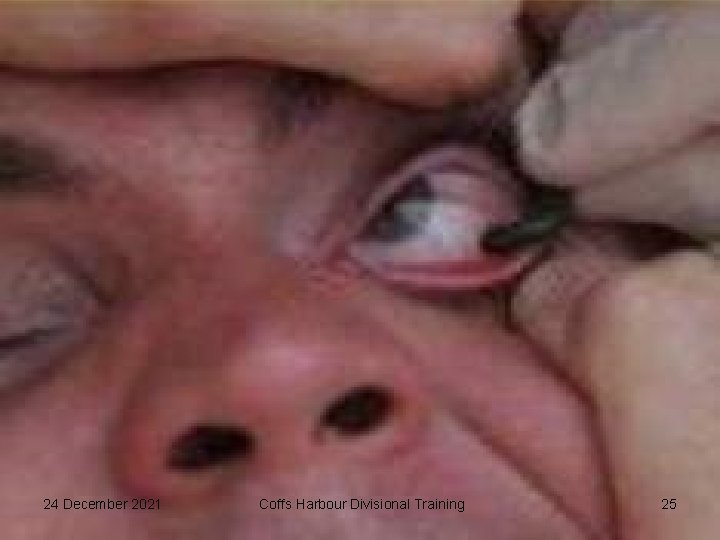
Case study (April 20, 2009) • A woman had been gardening in her suburban backyard when she flicked some moist soil into her left eye. • After multiple attempts at wiping the dirt away, she felt some movement in front of her eye and called for her husband's help. • He saw a leech four to five millimetres long pass across her cornea and under 24 December 2021 Coffslid. Harbour Divisional Training 21 the upper
Case study (April 20, 2009) • He attempted unsuccessfully to remove the leech with salted tap water at home and then took her to the hospital. • Doctors at Royal North Shore Hospital in Sydney successfully removed the leech from the woman's eye and in the process made medical history. 24 December 2021 Coffs Harbour Divisional Training 22
Case study (April 20, 2009) • They said it was the world's first documented case of a leech being removed using a 3 per cent saline solution. • "Removal of leeches using forceps risks secondary infection, and use of undissolved salt crystals is likely to cause abrasion to the eye. 24 December 2021 Coffs Harbour Divisional Training 23

Case study (April 20, 2009) "We believe that our method of removal using three percent saline is achievable in most hospital settings. " 24 December 2021 Coffs Harbour Divisional Training 24
24 December 2021 Coffs Harbour Divisional Training 25
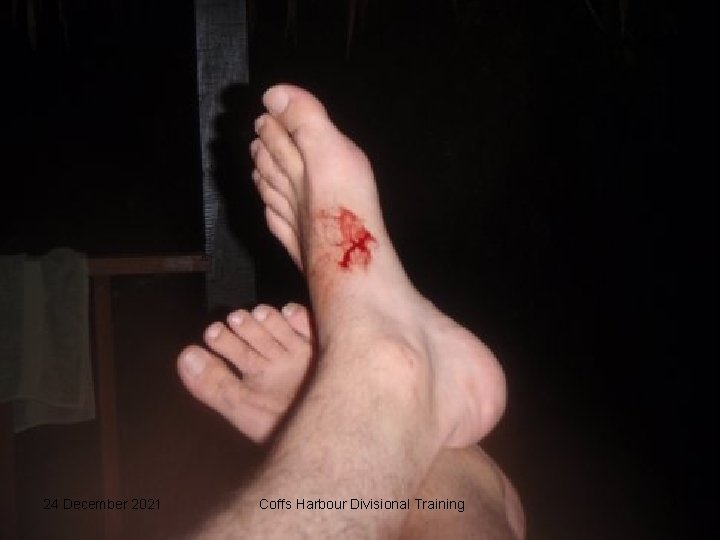
Management • Do not pull leeches off. This can tear the skin and cause a severe wound which may then become infected. • Use salt on leech to help carefully remove. • Treat the wound as a bleeding injury 24 December 2021 Coffs Harbour Divisional Training 26
Note • The hirudin might cause the bite to bleed for hours or days, and the bites are often itchy. • While this may sound bad, being bitten by a leech isn't deadly. 24 December 2021 Coffs Harbour Divisional Training 27
Questions 24 December 2021 Coffs Harbour Divisional Training 28
- Slides: 28