
LED notched fibre distributing system Calibration system for
LED notched fibre distributing system Calibration system for Si. PM Ivo Polák, Jiří Kvasnička polaki@fzu. cz, kvas@fzu. cz 1. 2. 3. 4. 5 July 2010 QMB 6 performance with HBU 0, saturation of Si. PM Toroidal inductor at PCB Notched fibre light distribution systems 3 x 24 Conclusions Ivo Polák, FZU, Prague
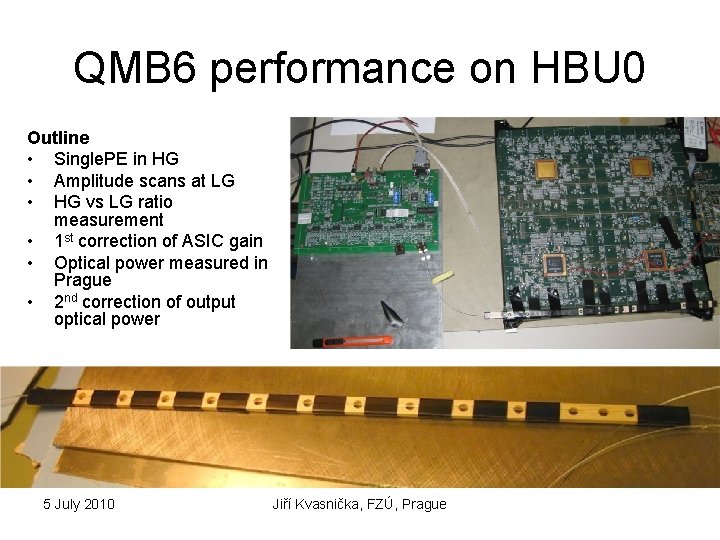
QMB 6 performance on HBU 0 Outline • Single. PE in HG • Amplitude scans at LG • HG vs LG ratio measurement • 1 st correction of ASIC gain • Optical power measured in Prague • 2 nd correction of output optical power 5 July 2010 Jiří Kvasnička, FZÚ, Prague

Single PE spectrum ASIC 1 ASIC 0 Fibre end • • 5 July 2010 HG mode, 100 f. F feedback capacitance Statistics of 50 K events Big spread of single_photon_peak distance [ADC count / pixel] among the channels Si. PM voltage settings? Jiří Kvasnička, FZÚ, Prague

Amplitude scan • • 5 July 2010 Jiří Kvasnička, FZÚ, Prague Scan at LG, 400 f. F ASIC should not be saturated (range up to 4095 bins)

HG vs LG radio measurements • 1 st measurements were measured only in one fixed amplitude. These data were presented in April. Analysis showed, that some channels were saturated in HG mode. • Therefore: we scanned the ratio in several (optical) amplitudes • Data were taken at amplitudes, where Old data 29/4/2010 – Signal is not saturated in HG mode – Signal is still reasonably high in LG mode • Can the radio be measured by charge injection? How does it correspond? • Pedestal shifts during measurements? 5 July 2010 Jiří Kvasnička, FZÚ, Prague

Amplitude scan corrected (1) • From the distance between single photon peaks and from the HG vs. LG ratio, we are able to estimate the number of fired pixels Presented 29/4/2010 Recalculated gain • New recalculation: – delivered optical power from the fibre is much more consistent – Curves are less crossing each other • Next step: convert V 1 value to optical power (energy) 5 July 2010 Jiří Kvasnička, FZÚ, Prague
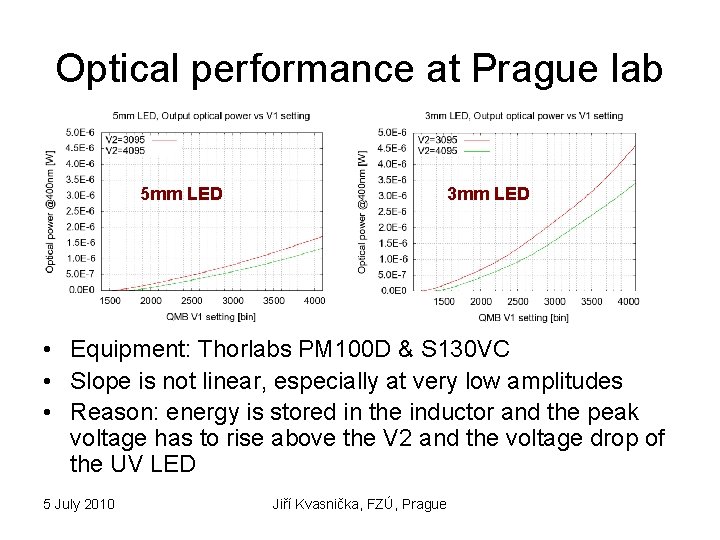
Optical performance at Prague lab 5 mm LED 3 mm LED • Equipment: Thorlabs PM 100 D & S 130 VC • Slope is not linear, especially at very low amplitudes • Reason: energy is stored in the inductor and the peak voltage has to rise above the V 2 and the voltage drop of the UV LED 5 July 2010 Jiří Kvasnička, FZÚ, Prague
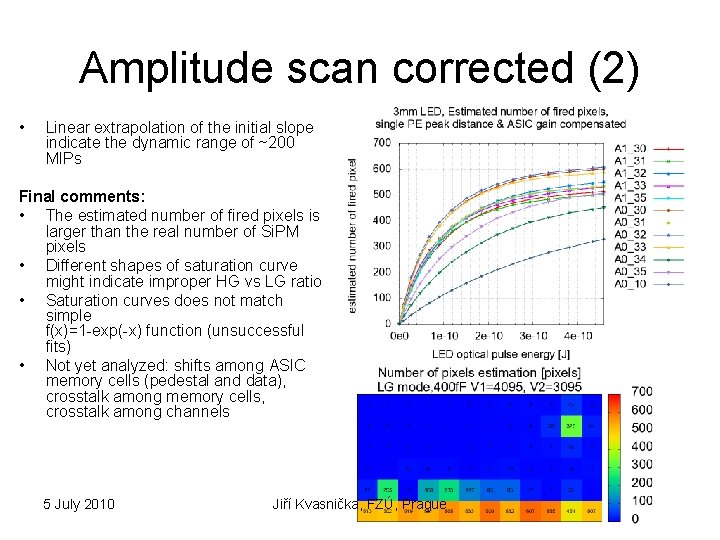
Amplitude scan corrected (2) • Linear extrapolation of the initial slope indicate the dynamic range of ~200 MIPs Final comments: • The estimated number of fired pixels is larger than the real number of Si. PM pixels • Different shapes of saturation curve might indicate improper HG vs LG ratio • Saturation curves does not match simple f(x)=1 -exp(-x) function (unsuccessful fits) • Not yet analyzed: shifts among ASIC memory cells (pedestal and data), crosstalk among memory cells, crosstalk among channels 5 July 2010 Jiří Kvasnička, FZÚ, Prague
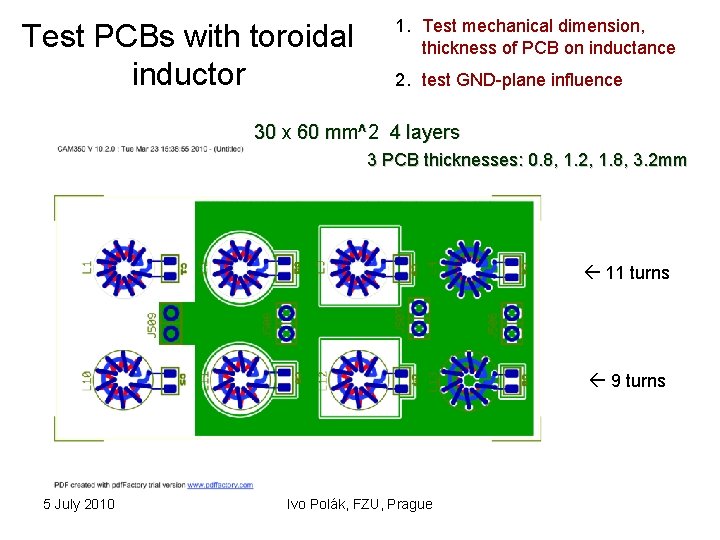
1. Test mechanical dimension, thickness of PCB on inductance Test PCBs with toroidal inductor 2. test GND-plane influence 60 x 30 mm^2 30 x 60 mm^2 4 layers 3 PCB thicknesses: 0. 8, 1. 2, 1. 8, 3. 2 mm Collaboration Meeting 11 turns 9 turns 5 July 2010 Ivo Polák, FZU, Prague
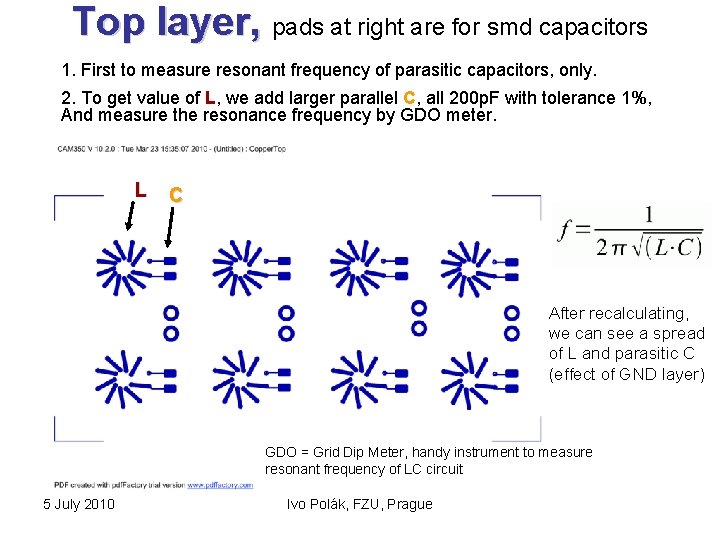
Top layer, pads at right are for smd capacitors 1. First to measure resonant frequency of parasitic capacitors, only. 2. To get value of L, we add larger parallel C, all 200 p. F with tolerance 1%, And measure the resonance frequency by GDO meter. L C C After recalculating, we can see a spread of L and parasitic C (effect of GND layer) GDO = Grid Dip Meter, handy instrument to measure resonant frequency of LC circuit 5 July 2010 Ivo Polák, FZU, Prague
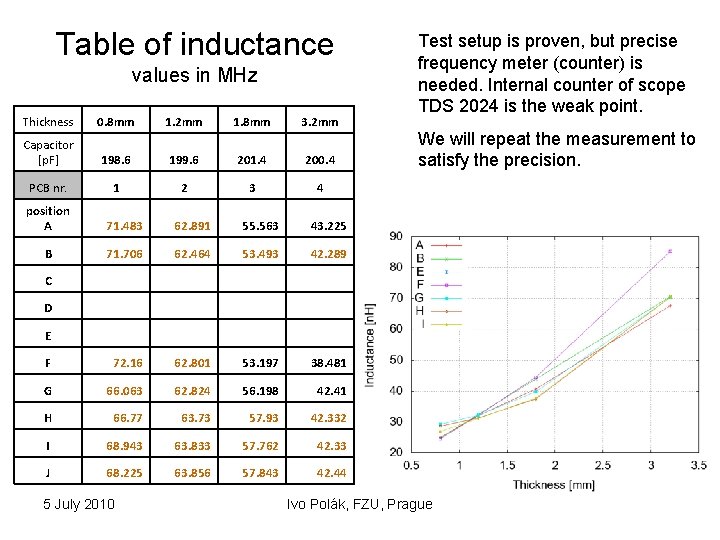
Table of inductance values in MHz Thickness 0. 8 mm 1. 2 mm 1. 8 mm 3. 2 mm Capacitor [p. F] 198. 6 199. 6 201. 4 200. 4 PCB nr. 1 2 3 4 position A 71. 483 62. 891 55. 563 43. 225 B 71. 706 62. 464 53. 493 42. 289 F 72. 16 62. 801 53. 197 38. 481 G 66. 063 62. 824 56. 198 42. 41 H 66. 77 63. 73 57. 93 42. 332 I 68. 943 63. 833 57. 762 42. 33 J 68. 225 63. 856 57. 843 42. 44 Test setup is proven, but precise frequency meter (counter) is needed. Internal counter of scope TDS 2024 is the weak point. We will repeat the measurement to satisfy the precision. C D E 5 July 2010 Ivo Polák, FZU, Prague
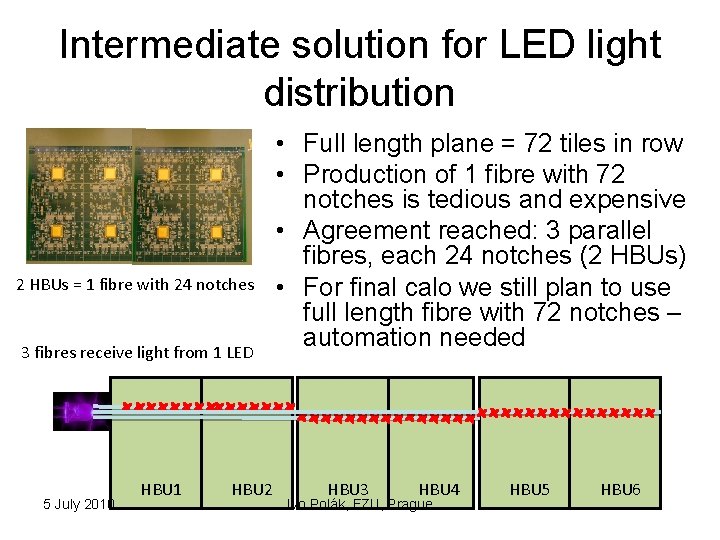
Intermediate solution for LED light distribution 2 HBUs = 1 fibre with 24 notches 3 fibres receive light from 1 LED 5 July 2010 HBU 1 HBU 2 • Full length plane = 72 tiles in row • Production of 1 fibre with 72 notches is tedious and expensive • Agreement reached: 3 parallel fibres, each 24 notches (2 HBUs) • For final calo we still plan to use full length fibre with 72 notches – automation needed HBU 3 HBU 4 Ivo Polák, FZU, Prague HBU 5 HBU 6
Conclusion • We generate optical pulse 250 mip equivalent, from single tap • PCB toroidal inductors partly tested, redo with precise counter – An analyze is ongoing • Preparing intermediate solution of layout: 3 fibres by 24 notches 5 July 2010 Ivo Polák, FZU, Prague
BACK-UP 5 July 2010 Ivo Polák, FZU, Prague
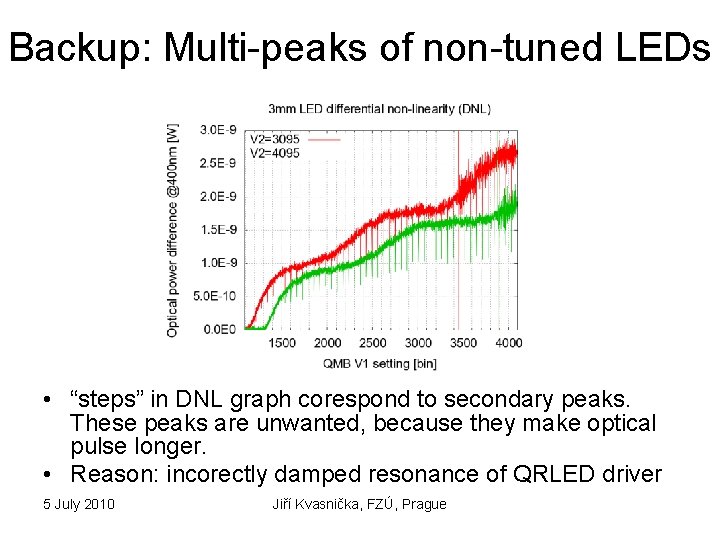
Backup: Multi-peaks of non-tuned LEDs • “steps” in DNL graph corespond to secondary peaks. These peaks are unwanted, because they make optical pulse longer. • Reason: incorectly damped resonance of QRLED driver 5 July 2010 Jiří Kvasnička, FZÚ, Prague
- Slides: 15