
Lectures on ProofCarrying Code Peter Lee Carnegie Mellon

![Elf example So, for example: Can be written in Elf as all([a: pred] all([b:](https://slidetodoc.com/presentation_image_h2/06a4d50d762858c6a8d9d8e7278558f0/image-38.jpg "Elf example So, for example: Can be written in Elf as all([a: pred] all([b:")
![… (impi (/ a b) (/ b a) ([ab: pf(/ a b)] (andi b](https://slidetodoc.com/presentation_image_h2/06a4d50d762858c6a8d9d8e7278558f0/image-45.jpg "… (impi (/ a b) (/ b a) ([ab: pf(/ a b)] (andi b")
- Slides: 46
Lectures on Proof-Carrying Code Peter Lee Carnegie Mellon University Lecture 2 (of 3) June 21 -22, 2003 University of Oregon 2004 Summer School on Software Security
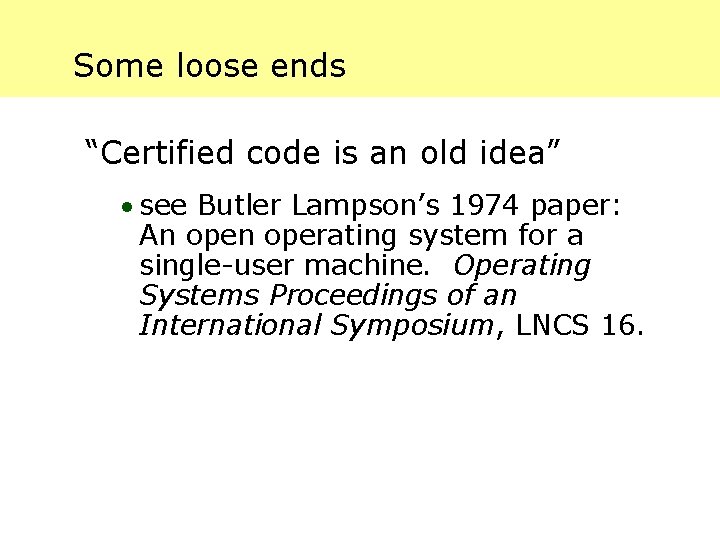
Some loose ends “Certified code is an old idea” · see Butler Lampson’s 1974 paper: An operating system for a single-user machine. Operating Systems Proceedings of an International Symposium, LNCS 16.
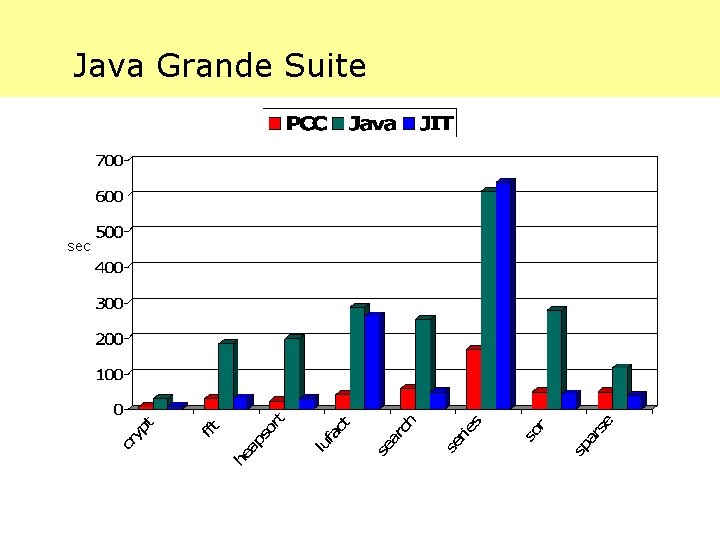
Java Grande Suite sec
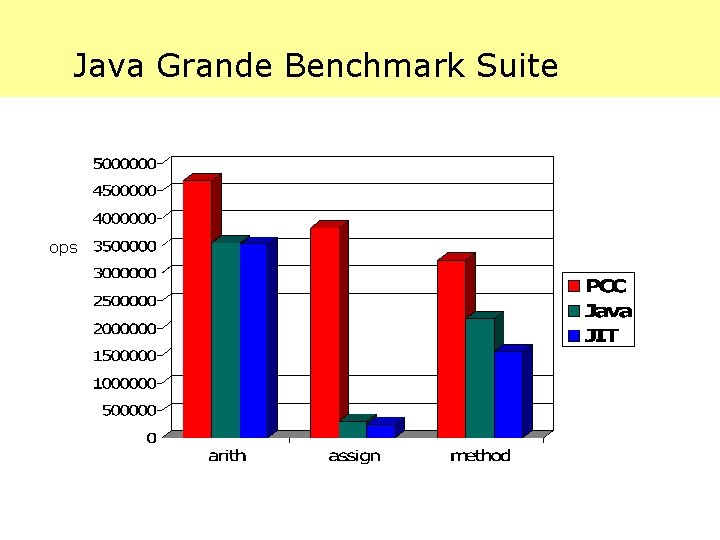
Java Grande Benchmark Suite ops
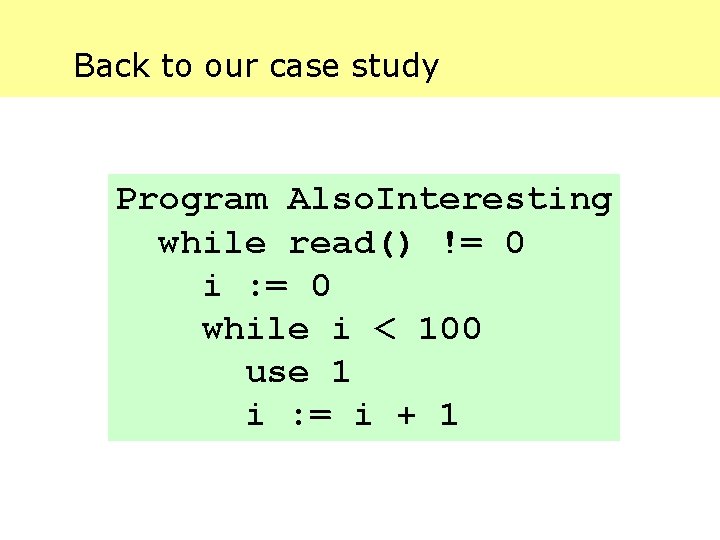
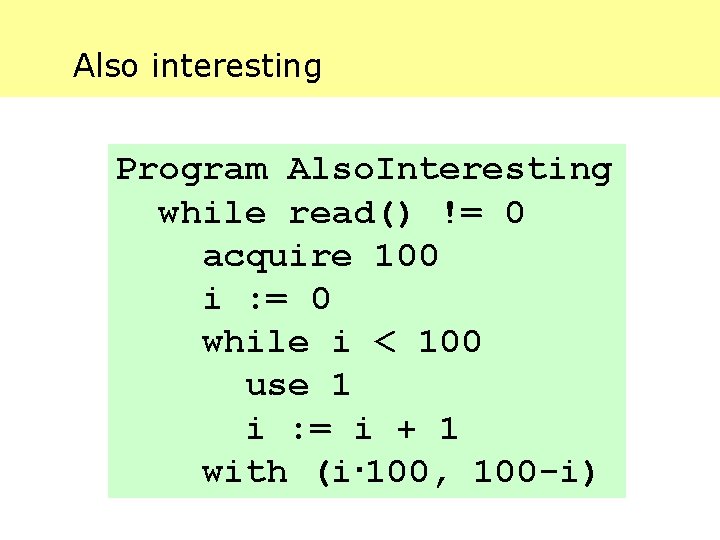
Back to our case study Program Also. Interesting while read() != 0 i : = 0 while i < 100 use 1 i : = i + 1
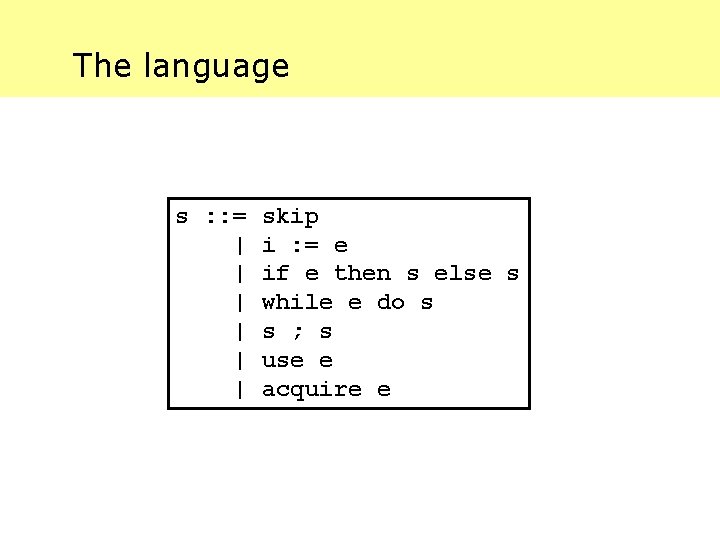
The language s : : = | | | skip i : = e if e then s else s while e do s s ; s use e acquire e
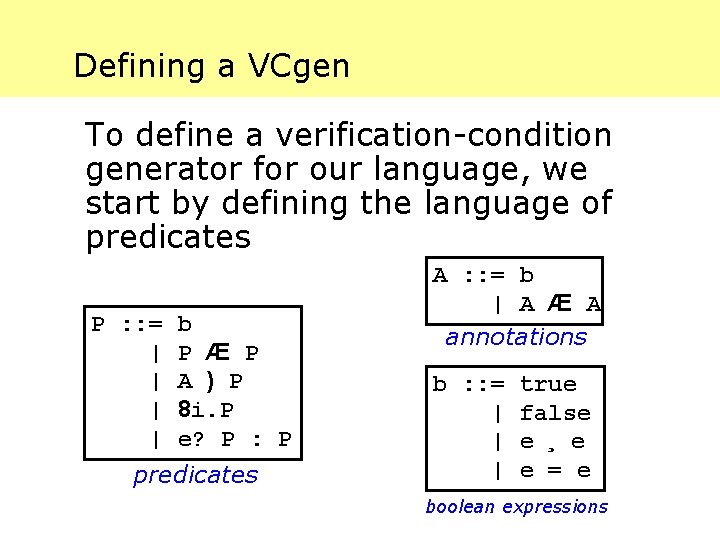
Defining a VCgen To define a verification-condition generator for our language, we start by defining the language of predicates P : : = | | b P Æ P A ) P 8 i. P e? P : P predicates A : : = b | A Æ A annotations b : : = | | | true false e ¸ e e = e boolean expressions
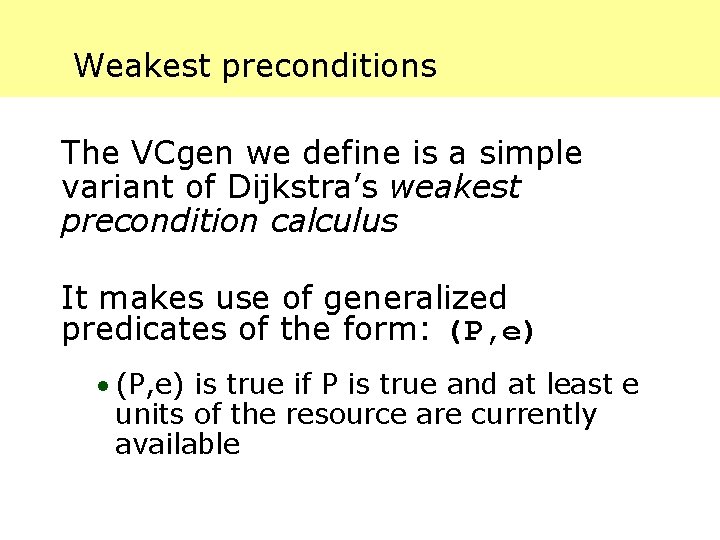
Weakest preconditions The VCgen we define is a simple variant of Dijkstra’s weakest precondition calculus It makes use of generalized predicates of the form: (P, e) · (P, e) is true if P is true and at least e units of the resource are currently available
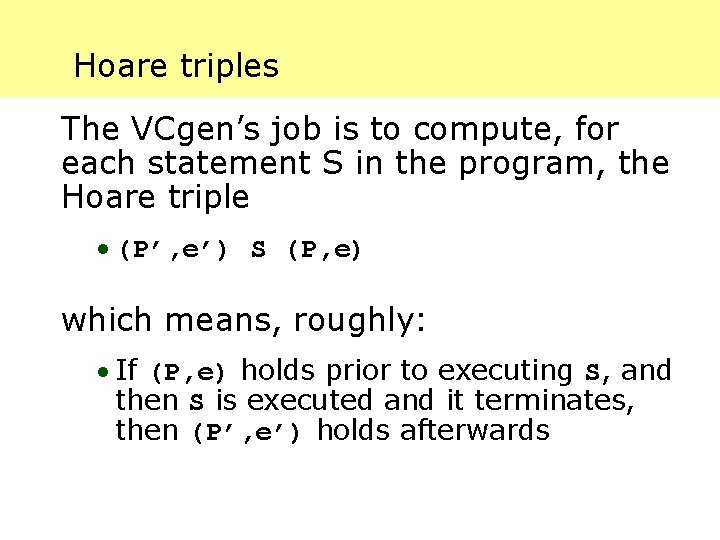
Hoare triples The VCgen’s job is to compute, for each statement S in the program, the Hoare triple · (P’, e’) S (P, e) which means, roughly: · If (P, e) holds prior to executing S, and then S is executed and it terminates, then (P’, e’) holds afterwards
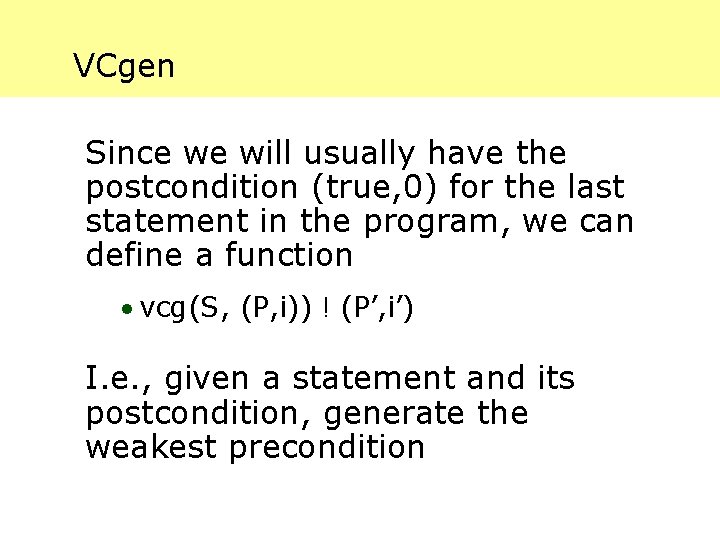
VCgen Since we will usually have the postcondition (true, 0) for the last statement in the program, we can define a function · vcg(S, (P, i)) ! (P’, i’) I. e. , given a statement and its postcondition, generate the weakest precondition
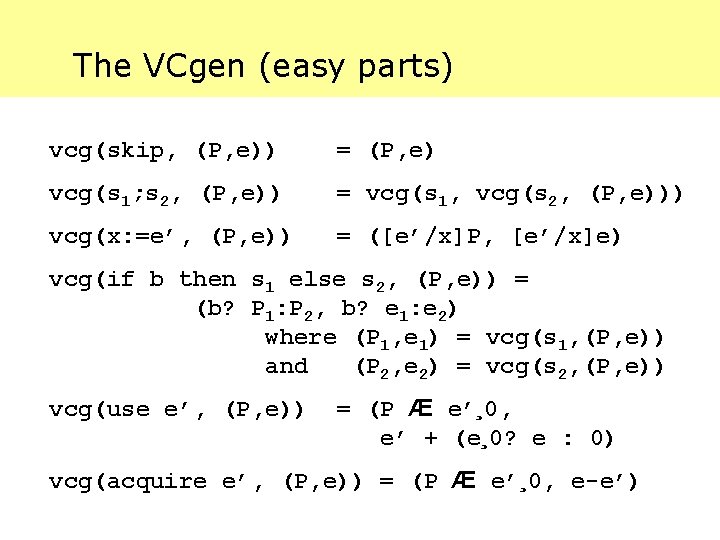
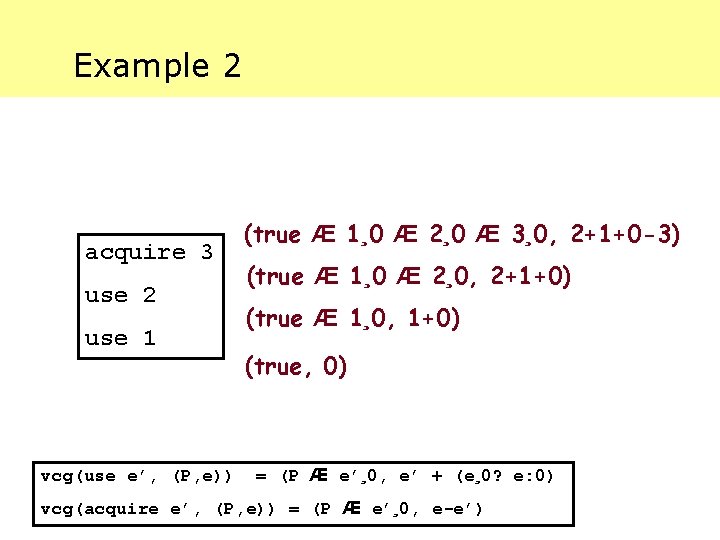
The VCgen (easy parts) vcg(skip, (P, e)) = (P, e) vcg(s 1; s 2, (P, e)) = vcg(s 1, vcg(s 2, (P, e))) vcg(x: =e’, (P, e)) = ([e’/x]P, [e’/x]e) vcg(if b then s 1 else s 2, (P, e)) = (b? P 1: P 2, b? e 1: e 2) where (P 1, e 1) = vcg(s 1, (P, e)) and (P 2, e 2) = vcg(s 2, (P, e)) vcg(use e’, (P, e)) = (P Æ e’¸ 0, e’ + (e¸ 0? e : 0) vcg(acquire e’, (P, e)) = (P Æ e’¸ 0, e-e’)
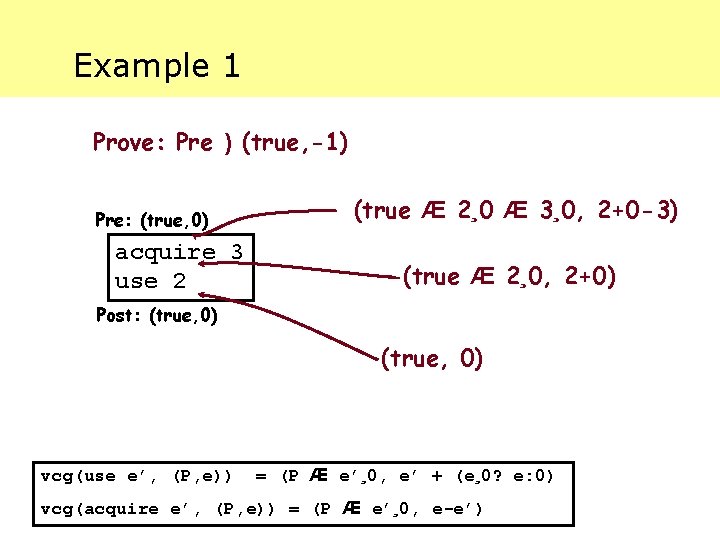
Example 1 Prove: Pre ) (true, -1) Pre: (true, 0) acquire 3 use 2 (true Æ 2¸ 0 Æ 3¸ 0, 2+0 -3) (true Æ 2¸ 0, 2+0) Post: (true, 0) vcg(use e’, (P, e)) = (P Æ e’¸ 0, e’ + (e¸ 0? e: 0) vcg(acquire e’, (P, e)) = (P Æ e’¸ 0, e-e’)
Example 2 acquire 3 use 2 use 1 vcg(use e’, (P, e)) (true Æ 1¸ 0 Æ 2¸ 0 Æ 3¸ 0, 2+1+0 -3) (true Æ 1¸ 0 Æ 2¸ 0, 2+1+0) (true Æ 1¸ 0, 1+0) (true, 0) = (P Æ e’¸ 0, e’ + (e¸ 0? e: 0) vcg(acquire e’, (P, e)) = (P Æ e’¸ 0, e-e’)
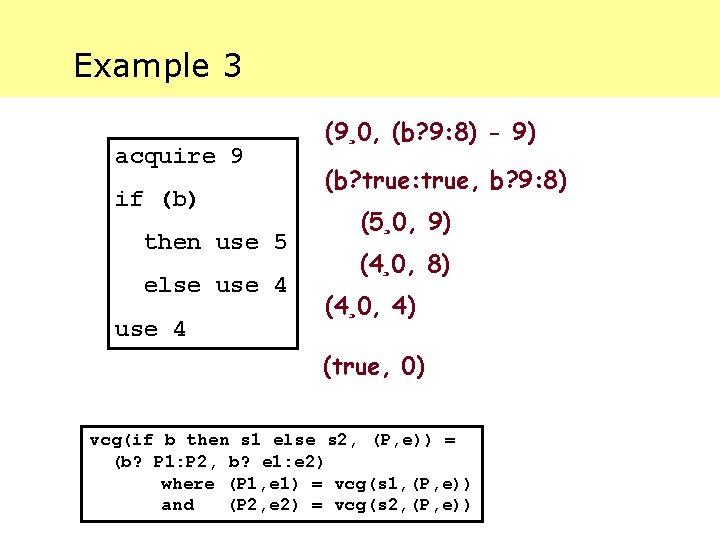
Example 3 acquire 9 if (b) then use 5 else use 4 (9¸ 0, (b? 9: 8) - 9) (b? true: true, b? 9: 8) (5¸ 0, 9) (4¸ 0, 8) (4¸ 0, 4) (true, 0) vcg(if b then s 1 else s 2, (P, e)) = (b? P 1: P 2, b? e 1: e 2) where (P 1, e 1) = vcg(s 1, (P, e)) and (P 2, e 2) = vcg(s 2, (P, e))
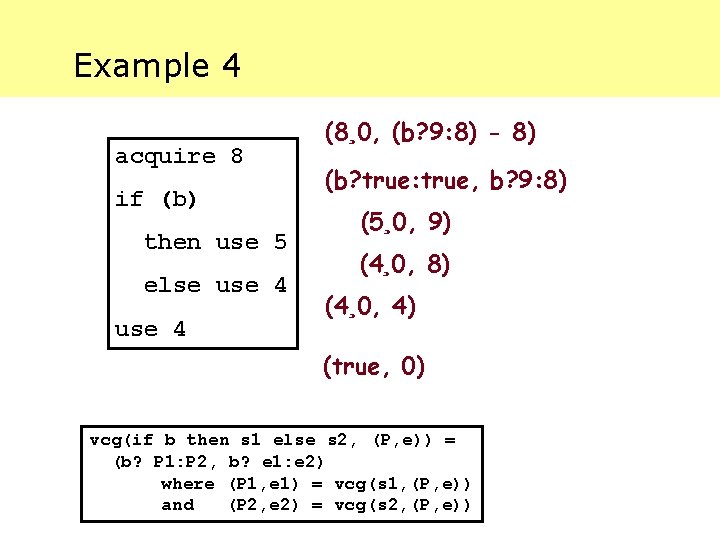
Example 4 acquire 8 if (b) then use 5 else use 4 (8¸ 0, (b? 9: 8) - 8) (b? true: true, b? 9: 8) (5¸ 0, 9) (4¸ 0, 8) (4¸ 0, 4) (true, 0) vcg(if b then s 1 else s 2, (P, e)) = (b? P 1: P 2, b? e 1: e 2) where (P 1, e 1) = vcg(s 1, (P, e)) and (P 2, e 2) = vcg(s 2, (P, e))
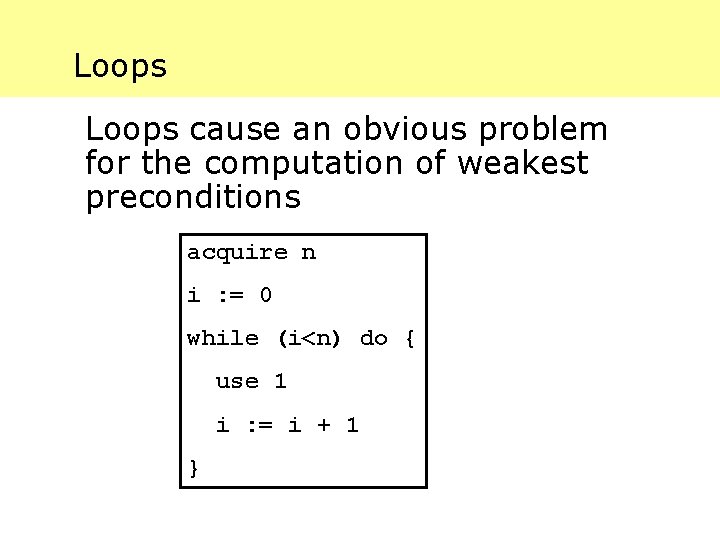
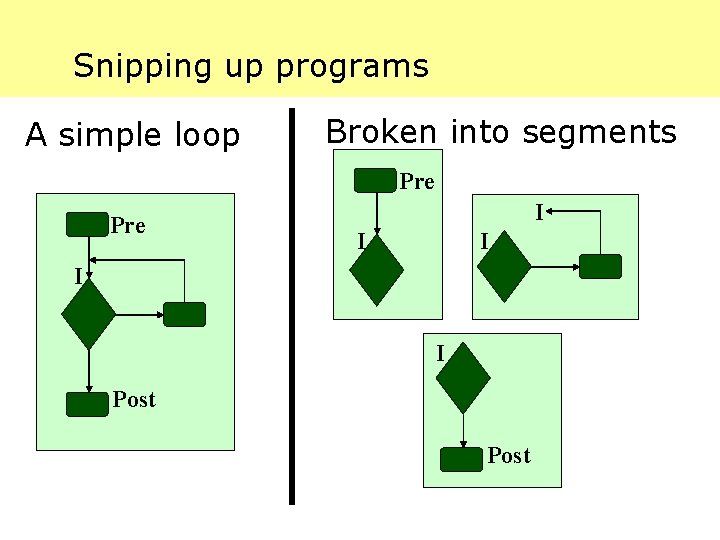
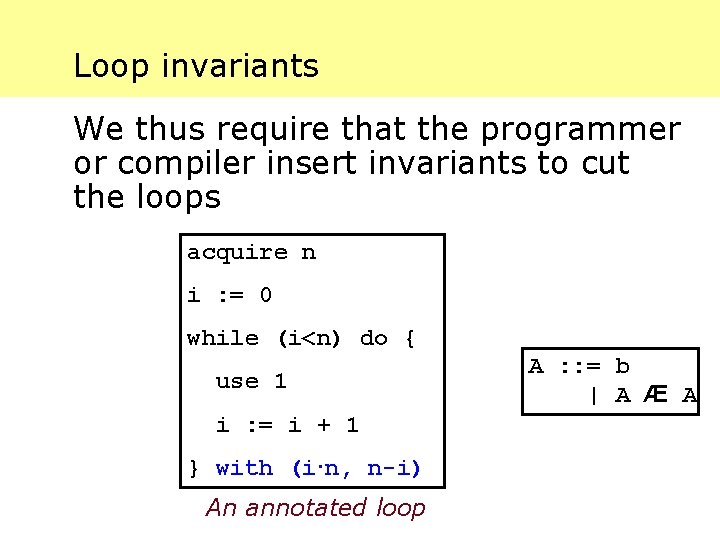
Loops cause an obvious problem for the computation of weakest preconditions acquire n i : = 0 while (i<n) do { use 1 i : = i + 1 }
Snipping up programs A simple loop Broken into segments Pre I I I Post
Loop invariants We thus require that the programmer or compiler insert invariants to cut the loops acquire n i : = 0 while (i<n) do { use 1 i : = i + 1 } with (i·n, n-i) An annotated loop A : : = b | A Æ A
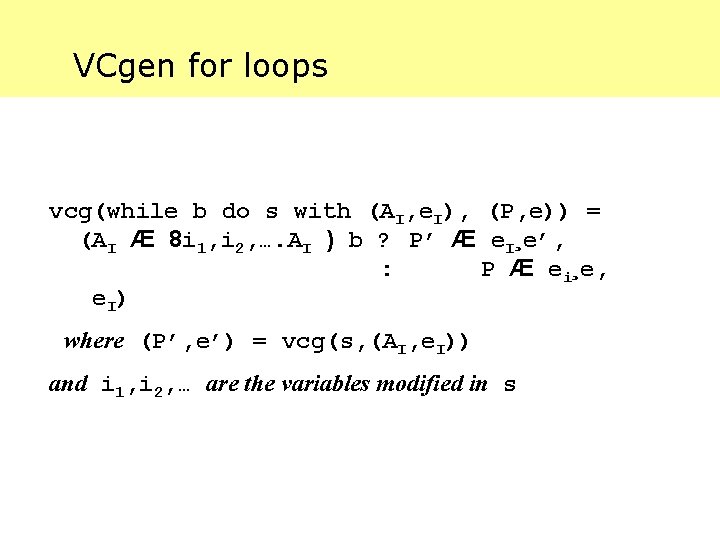
VCgen for loops vcg(while b do s with (AI, e. I), (P, e)) = (AI Æ 8 i 1, i 2, …. AI ) b ? P’ Æ e. I¸e’, : P Æ ei¸e, e I) where (P’, e’) = vcg(s, (AI, e. I)) and i 1, i 2, … are the variables modified in s
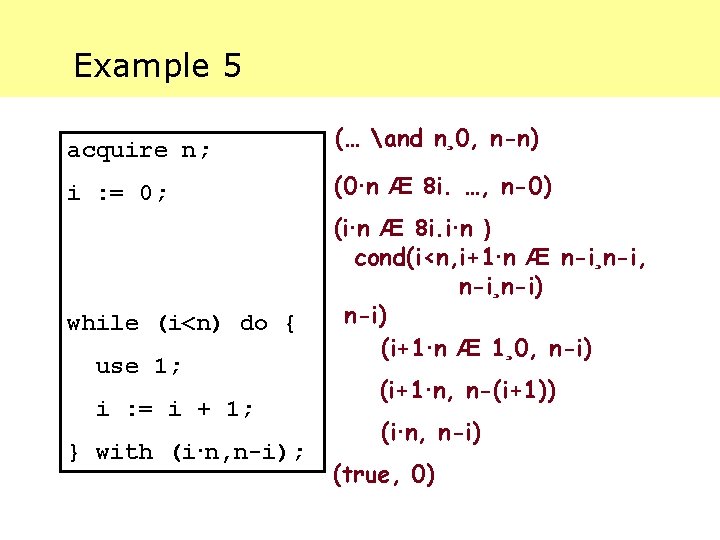
Example 5 acquire n; (… and n¸ 0, n-n) i : = 0; (0·n Æ 8 i. …, n-0) while (i<n) do { use 1; i : = i + 1; } with (i·n, n-i); (i·n Æ 8 i. i·n ) cond(i<n, i+1·n Æ n-i¸n-i, n-i¸n-i) (i+1·n Æ 1¸ 0, n-i) (i+1·n, n-(i+1)) (i·n, n-i) (true, 0)
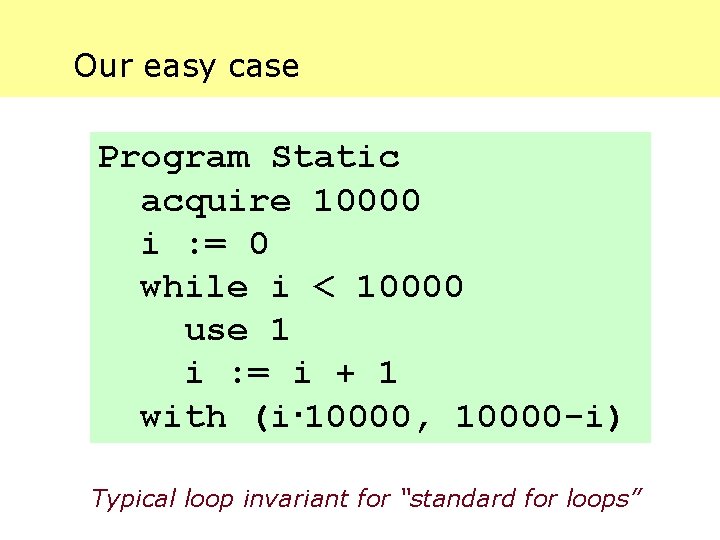
Our easy case Program Static acquire 10000 i : = 0 while i < 10000 use 1 i : = i + 1 with (i· 10000, 10000 -i) Typical loop invariant for “standard for loops”
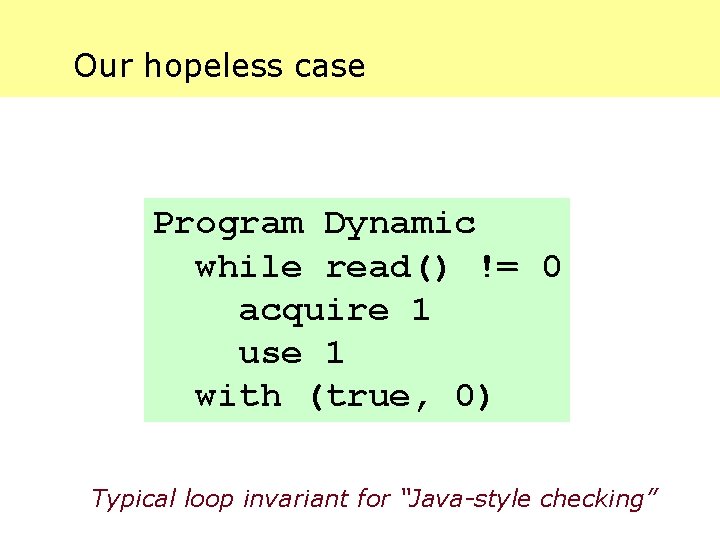
Our hopeless case Program Dynamic while read() != 0 acquire 1 use 1 with (true, 0) Typical loop invariant for “Java-style checking”
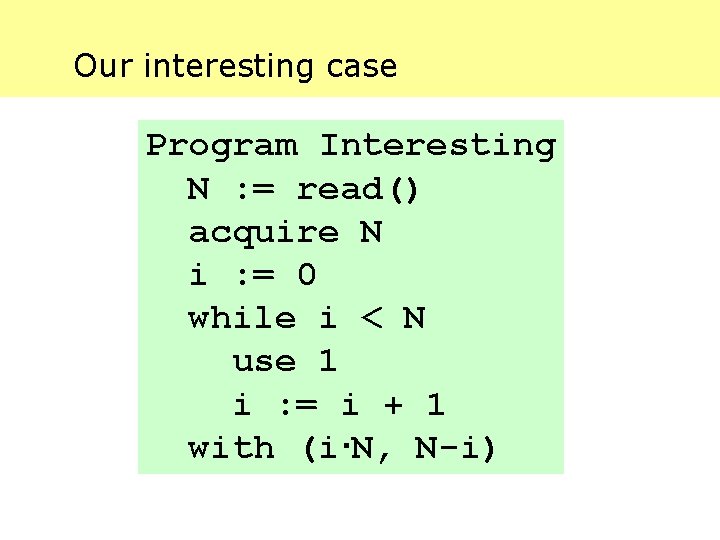
Our interesting case Program Interesting N : = read() acquire N i : = 0 while i < N use 1 i : = i + 1 with (i·N, N-i)
Also interesting Program Also. Interesting while read() != 0 acquire 100 i : = 0 while i < 100 use 1 i : = i + 1 with (i· 100, 100 -i)
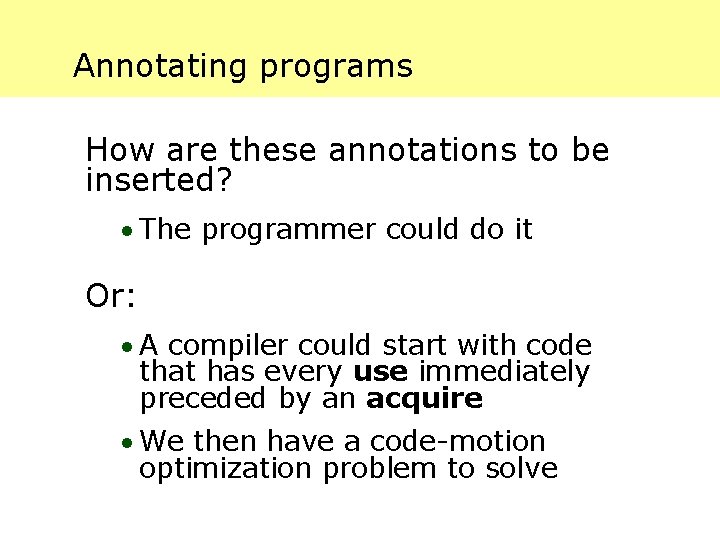
Annotating programs How are these annotations to be inserted? · The programmer could do it Or: · A compiler could start with code that has every use immediately preceded by an acquire · We then have a code-motion optimization problem to solve
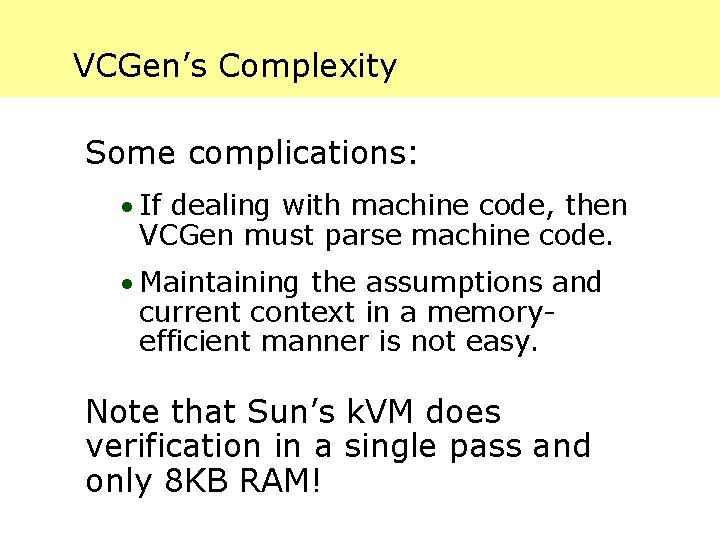
VCGen’s Complexity Some complications: · If dealing with machine code, then VCGen must parse machine code. · Maintaining the assumptions and current context in a memoryefficient manner is not easy. Note that Sun’s k. VM does verification in a single pass and only 8 KB RAM!
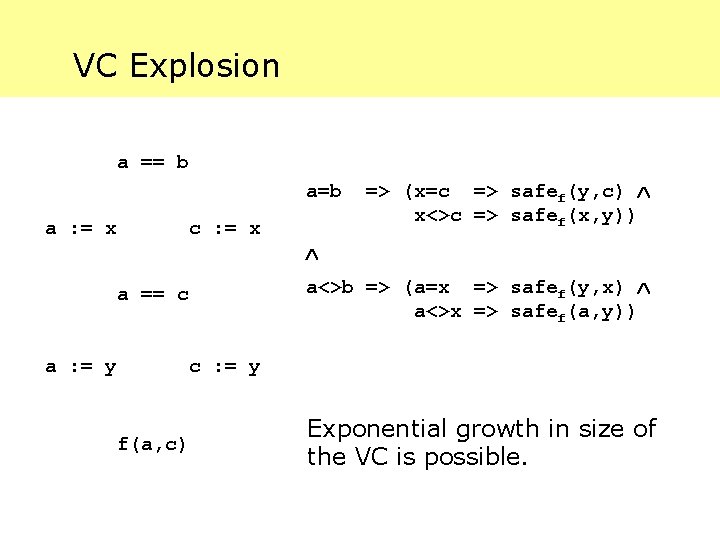
VC Explosion a == b a=b a : = x c : = x f(a, c) a<>b => (a=x => safef(y, x) a<>x => safef(a, y)) a == c a : = y => (x=c => safef(y, c) x<>c => safef(x, y)) c : = y Exponential growth in size of the VC is possible.
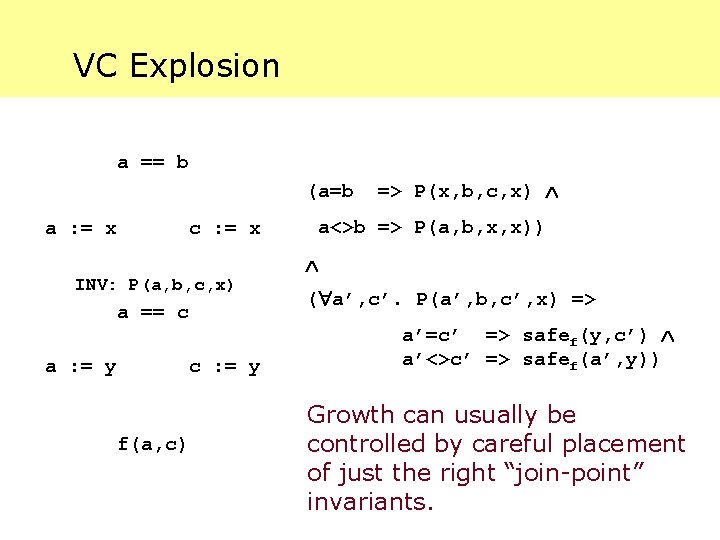
VC Explosion a == b (a=b a : = x c : = x INV: P(a, b, c, x) a == c a : = y f(a, c) c : = y => P(x, b, c, x) a<>b => P(a, b, x, x)) ( a’, c’. P(a’, b, c’, x) => a’=c’ => safef(y, c’) a’<>c’ => safef(a’, y)) Growth can usually be controlled by careful placement of just the right “join-point” invariants.
Proving the Predicates
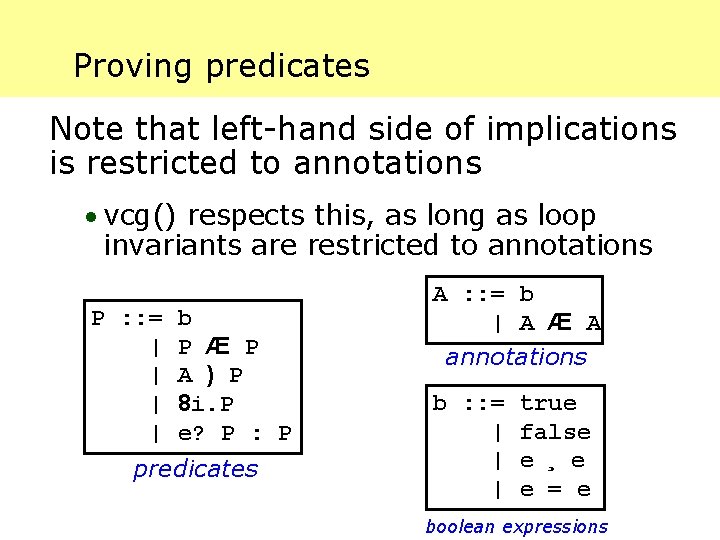
Proving predicates Note that left-hand side of implications is restricted to annotations · vcg() respects this, as long as loop invariants are restricted to annotations P : : = | | b P Æ P A ) P 8 i. P e? P : P predicates A : : = b | A Æ A annotations b : : = | | | true false e ¸ e e = e boolean expressions
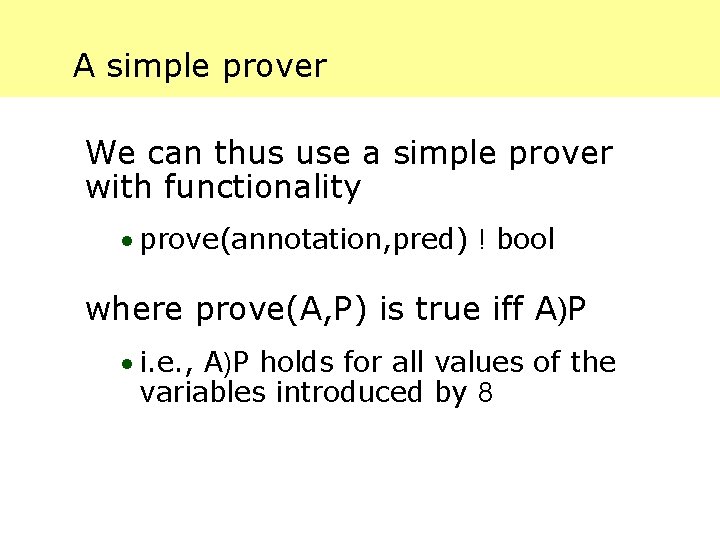
A simple prover We can thus use a simple prover with functionality · prove(annotation, pred) ! bool where prove(A, P) is true iff A)P · i. e. , A)P holds for all values of the variables introduced by 8
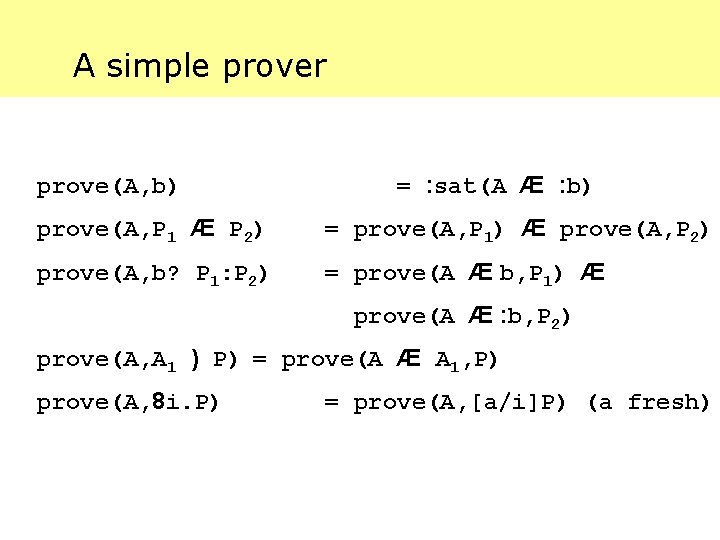
A simple prover prove(A, b) = : sat(A Æ : b) prove(A, P 1 Æ P 2) = prove(A, P 1) Æ prove(A, P 2) prove(A, b? P 1: P 2) = prove(A Æ b, P 1) Æ prove(A Æ : b, P 2) prove(A, A 1 ) P) = prove(A Æ A 1, P) prove(A, 8 i. P) = prove(A, [a/i]P) (a fresh)
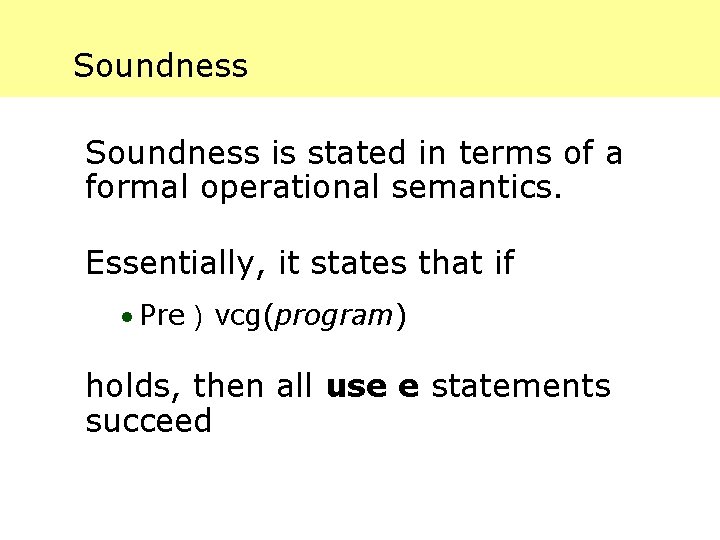
Soundness is stated in terms of a formal operational semantics. Essentially, it states that if · Pre ) vcg(program) holds, then all use e statements succeed
Logical Frameworks
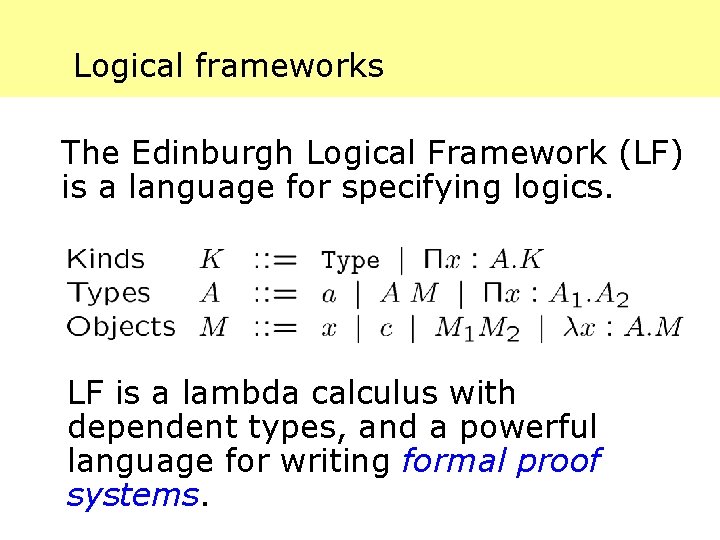
Logical frameworks The Edinburgh Logical Framework (LF) is a language for specifying logics. LF is a lambda calculus with dependent types, and a powerful language for writing formal proof systems.
LF The Edinburgh Logical Framework language, or LF, provides an expressive language for proofs-as -programs. Furthermore, it use of dependent types allows, among other things, the axioms and rules of inference to be specified as well
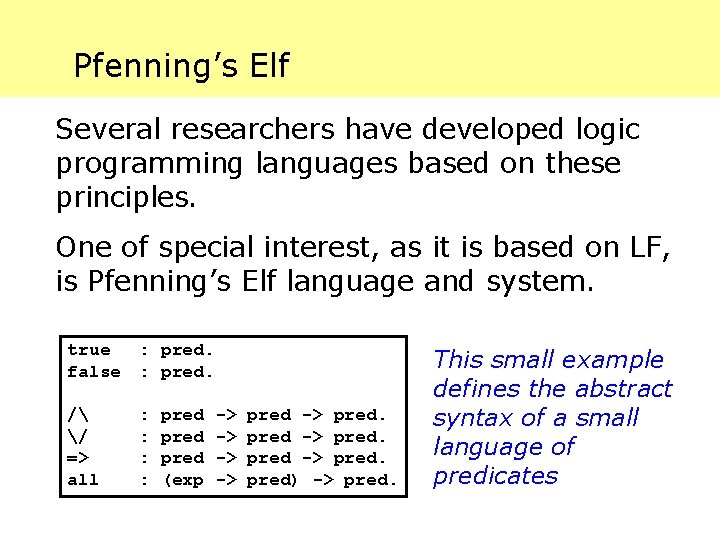
Pfenning’s Elf Several researchers have developed logic programming languages based on these principles. One of special interest, as it is based on LF, is Pfenning’s Elf language and system. true false : pred. / / => all : : pred (exp -> -> pred) -> pred. This small example defines the abstract syntax of a small language of predicates
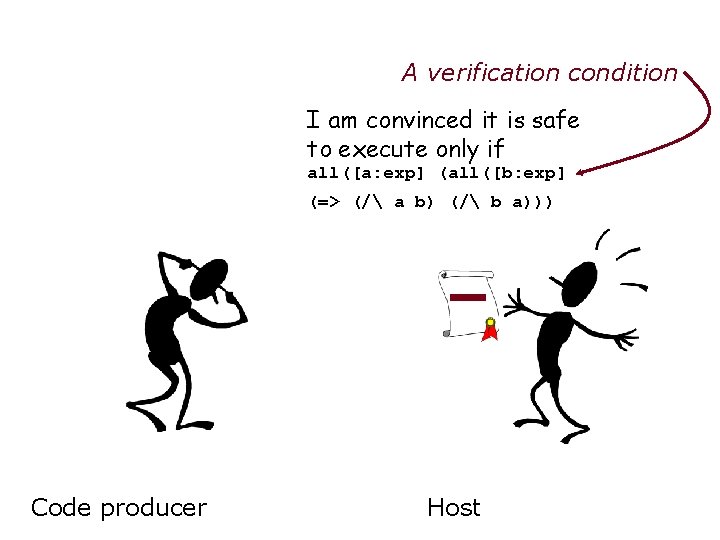
Elf example So, for example: Can be written in Elf as all([a: pred] all([b: pred] => (/ a b) (/ b a))) true false : pred. / / => all : : pred (exp -> -> pred) -> pred.
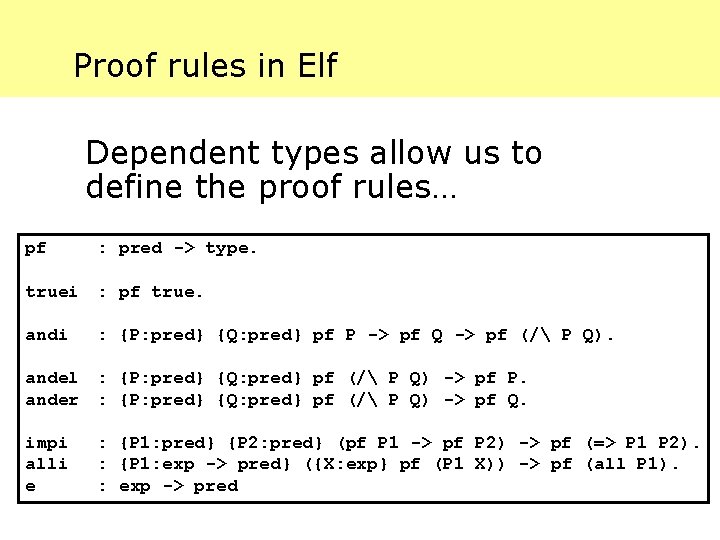
Proof rules in Elf Dependent types allow us to define the proof rules… pf : pred -> type. truei : pf true. andi : {P: pred} {Q: pred} pf P -> pf Q -> pf (/ P Q). andel ander : {P: pred} {Q: pred} pf (/ P Q) -> pf P. : {P: pred} {Q: pred} pf (/ P Q) -> pf Q. impi alli e : {P 1: pred} {P 2: pred} (pf P 1 -> pf P 2) -> pf (=> P 1 P 2). : {P 1: exp -> pred} ({X: exp} pf (P 1 X)) -> pf (all P 1). : exp -> pred
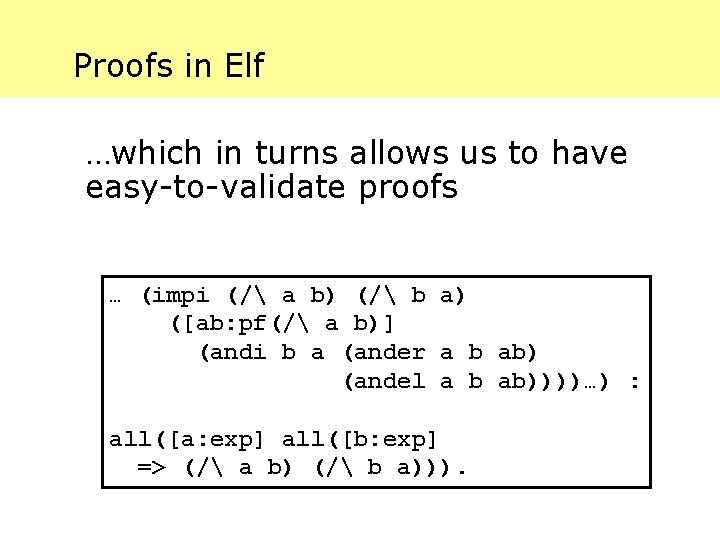
Proofs in Elf …which in turns allows us to have easy-to-validate proofs … (impi (/ a b) (/ b a) ([ab: pf(/ a b)] (andi b a (ander a b ab) (andel a b ab))))…) : all([a: exp] all([b: exp] => (/ a b) (/ b a))).
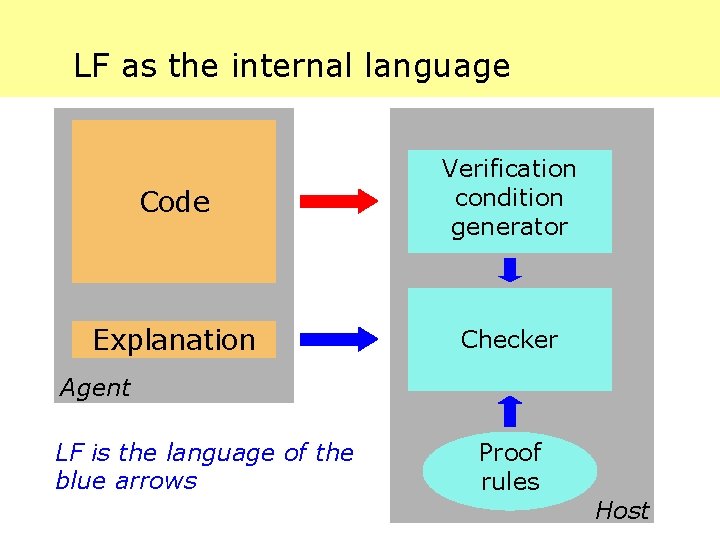
LF as the internal language Code Verification condition generator Explanation Checker Agent LF is the language of the blue arrows Proof rules Host
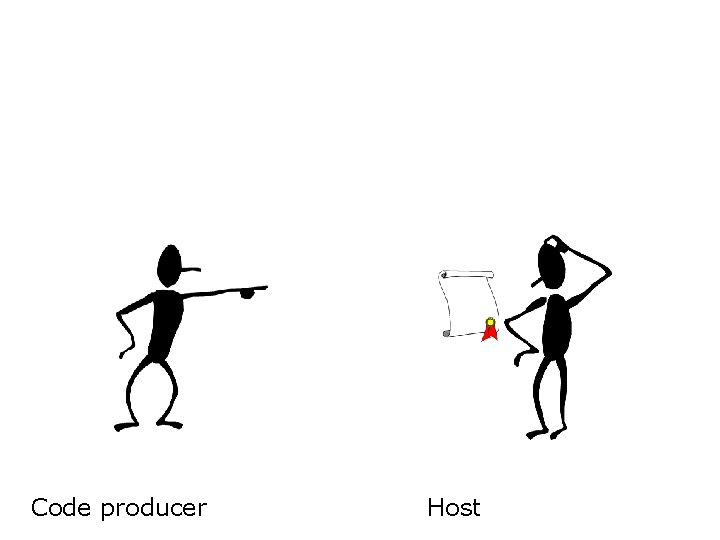
Code producer Host
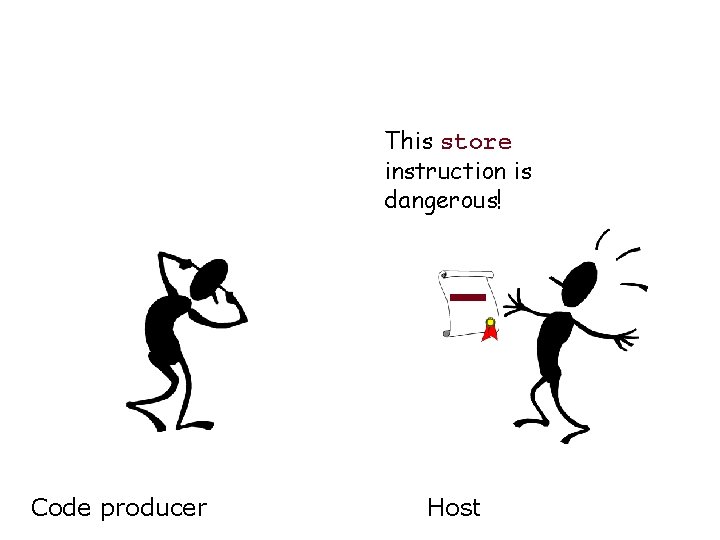
This store instruction is dangerous! Code producer Host
A verification condition I am convinced it is safe to execute only if all([a: exp] (all([b: exp] (=> (/ a b) (/ b a))) Code producer Host
… (impi (/ a b) (/ b a) ([ab: pf(/ a b)] (andi b a (ander a b ab) (andel a b ab))))…) Code producer Host
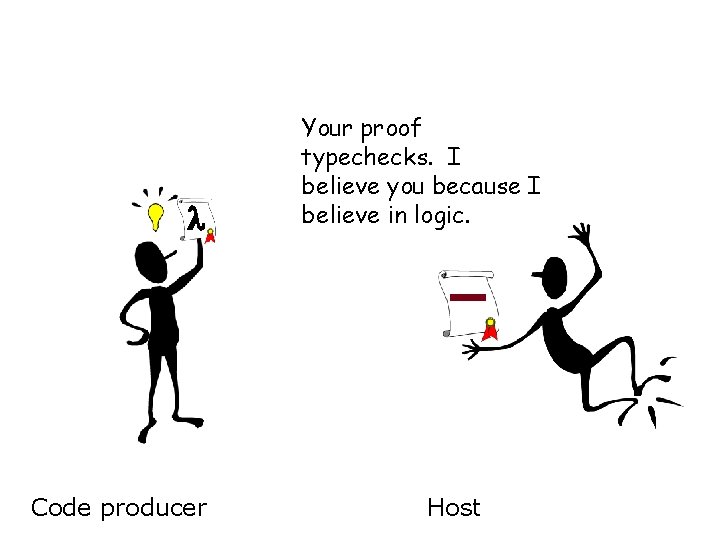
Code producer Your proof typechecks. I believe you because I believe in logic. Host