
Lectures 1 2 Principles of opensource and collaborative
Lectures 1 & 2: Principles of open-source and collaborative scientific programming for energy modelling Open-Source Energy System Modeling TU Wien, VU 370. 062 Dipl. -Ing. Dr. Daniel Huppmann Please consider the environment before printing this slide deck Icon from all-free-download. com, Environmental icons 310835 by BSGstudio, under CC-BY

Required reading and preparation • Preparation for scientific programming exercises in this lecture: create a Git. Hub account know what it means to 'clone' a repository, make a 'commit' and 'push' either get familiar with 'git' using the command line or get familiar with a program for working with git repos (for novice users, try Gitkraken) Install Python (for novice users, try Anaconda) get familiar with the basic Python syntax • Required reading: The FAIR Guiding Principles, Mark Wilkinson et al. Scientific Data 3: 160018 (2016) doi: 10. 1038/sdata. 2016. 18 Greg Wilson et al. Good enough practices in scientific computing. PLOS Computational Biology 13(6), 2017. doi: 10. 1371/journal. pcbi. 1005510 Open-Source Energy System Modeling, Lectures 1 & 2 Daniel Huppmann 2

Background: Climate change mitigation and energy system transformation Following the approval of the IPCC Special Report on Global Warming of 1. 5°C, media & newspapers widely quoted required system transformations The IPCC Special Report on Global Warming of 1. 5°C (SR 15) was published in the fall 2018. www. ipcc. ch/sr 15 Harry Taylor, 6, played with the bones of dead livestock in Australia, which has faced severe drought. Brook Mitchell/Getty Images Where do these numbers come from? Open-Source Energy System Modeling, Lectures 1 & 2 […] To prevent 2. 7 degrees of warming, the report said, greenhouse pollution must be reduced by 45 percent from 2010 levels by 2030, and 100 percent by 2050. It also found that, by 2050, use of coal as an electricity source would have to drop from nearly 40 percent today to between 1 and 7 percent. Renewable energy such as wind and solar, which make up about 20 percent of the electricity mix today, would have to increase to as much as 67 percent. […] www. nytimes. com/2018/10/07/climate / ipcc-climate-report-2040. html Daniel Huppmann 3
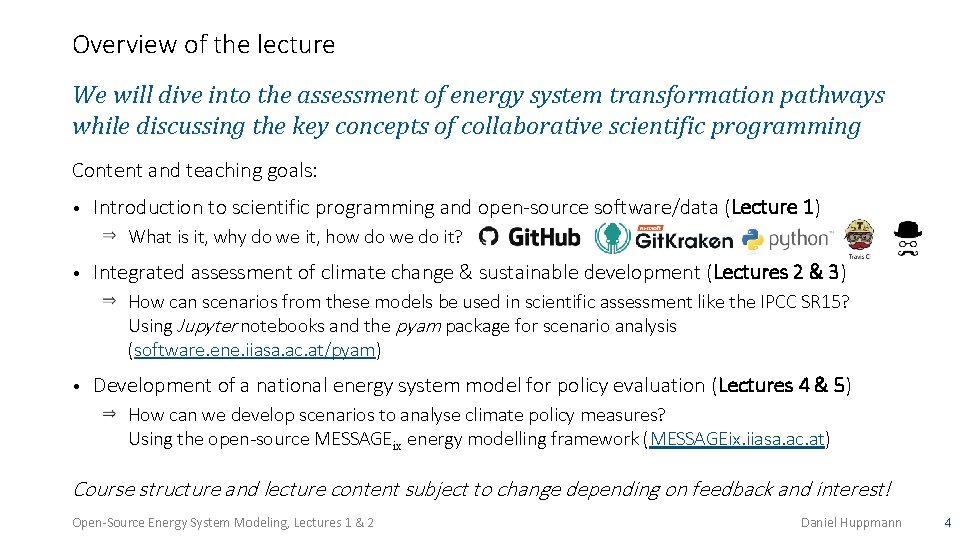
Overview of the lecture We will dive into the assessment of energy system transformation pathways while discussing the key concepts of collaborative scientific programming Content and teaching goals: • Introduction to scientific programming and open-source software/data (Lecture 1) What is it, why do we it, how do we do it? • Integrated assessment of climate change & sustainable development (Lectures 2 & 3) How can scenarios from these models be used in scientific assessment like the IPCC SR 15? Using Jupyter notebooks and the pyam package for scenario analysis (software. ene. iiasa. ac. at/pyam) • Development of a national energy system model for policy evaluation (Lectures 4 & 5) How can we develop scenarios to analyse climate policy measures? Using the open-source MESSAGEix energy modelling framework (MESSAGEix. iiasa. ac. at) Course structure and lecture content subject to change depending on feedback and interest! Open-Source Energy System Modeling, Lectures 1 & 2 Daniel Huppmann 4
About myself: education and research career From mathematics to energy economics and climate policy • Dipl. -Ing. (MSc) in Mathematics at TU Wien, specialization Mathematics in Economics • Researcher at the “German Institute for Economic Research” (DIW Berlin) • Doctorate at TU Berlin in Operations Research, Game Theory and Energy Economics • Postdoctoral Fellowship at Johns Hopkins University, Baltimore • Research Fellow at “Resources for the Future” (think-tank in Washington D. C. ) • Research Scholar (since October 2015) at the Energy Program, International Institute for Applied Systems Analysis, Laxenburg • Contributing Author and Chapter Scientist of the IPCC’s Special Report on Global Warming of 1. 5°C (SR 15) published in October 2018 Open-Source Energy System Modeling, Lectures 1 & 2 Daniel Huppmann 5
Overview of the lecture (II) The correct use of collaborative tools and workflows will be as important as the application to a problem and correct interpretation of the results Requirements: A good understanding of energy systems and climate policy Experience with at least one scientific programming language Mode of exercises: Submit assignments via Git. Hub pull requests and Scenario Explorer workspaces Grade: Submitted assignments (50%) Oral discussion of submitted exercises and related questions (30%) Active participation in class – feel free to ask questions any time (20%) Open-Source Energy System Modeling, Lectures 1 & 2 Daniel Huppmann 6
About you. . . What is your background and experience level with (scientific) programming? Open-Source Energy System Modeling, Lectures 1 & 2 Daniel Huppmann 7
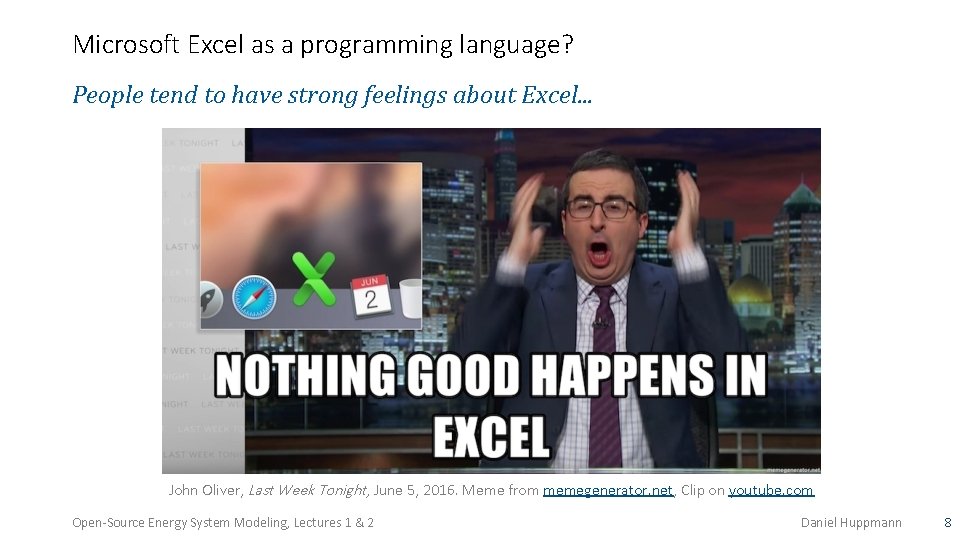
Microsoft Excel as a programming language? People tend to have strong feelings about Excel. . . John Oliver, Last Week Tonight, June 5, 2016. Meme from memegenerator. net, Clip on youtube. com Open-Source Energy System Modeling, Lectures 1 & 2 Daniel Huppmann 8

Part 1 An introduction to open, collaborative scientific research Based on material by Matthew Gidden (@gidden) and Paul Natsuo Kishimoto (@khaeru) Open-Source Energy System Modeling, Lectures 1 & 2 Daniel Huppmann 9
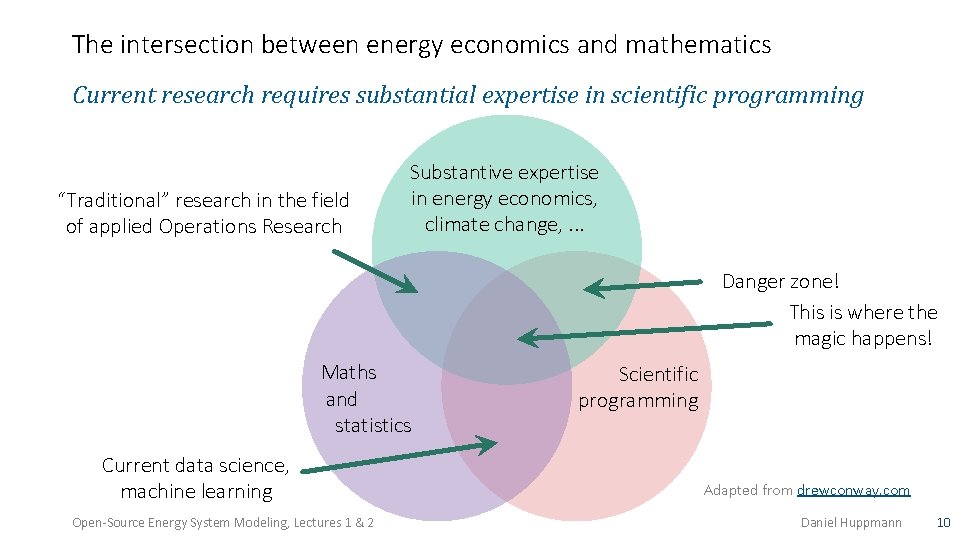
The intersection between energy economics and mathematics Current research requires substantial expertise in scientific programming “Traditional” research in the field of applied Operations Research Substantive expertise in energy economics, climate change, . . . Danger zone! This is where the magic happens! Maths and statistics Current data science, machine learning Open-Source Energy System Modeling, Lectures 1 & 2 Scientific programming Adapted from drewconway. com Daniel Huppmann 10
Key misconceptions about best practice in open scientific programming If you think that this topic is of no concern to you, you’re probably wrong • Who is your main (and usually worst) collaborator? Yourself from six months ago! Because you did not write enough documentation and don’t respond to emails anymore • Why is it a bad idea to use data or software that does not have an open license? Bad karma! Are you intending to distribute your work? How are you planning to deal with the parts that your project depends on? • Why should you share data and code under an open-source license? Good karma! Standard licenses have a disclaimer of liability, so you cannot be accountable for problems There is probably a growing expectation from your (potential) collaborators Treat your Git. Hub, etc. profile as your “business card” similar to your list of publications Open-Source Energy System Modeling, Lectures 1 & 2 Daniel Huppmann 11
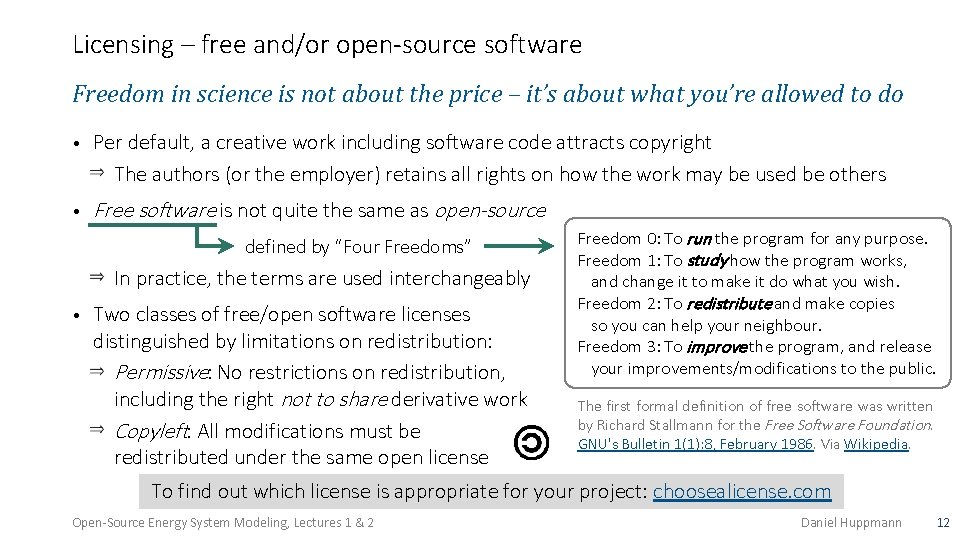
Licensing – free and/or open-source software Freedom in science is not about the price – it’s about what you’re allowed to do • Per default, a creative work including software code attracts copyright The authors (or the employer) retains all rights on how the work may be used be others • Free software is not quite the same as open-source defined by “Four Freedoms” In practice, the terms are used interchangeably • Two classes of free/open software licenses distinguished by limitations on redistribution: Permissive: No restrictions on redistribution, including the right not to share derivative work Copyleft: All modifications must be redistributed under the same open license Freedom 0: To run the program for any purpose. Freedom 1: To study how the program works, and change it to make it do what you wish. Freedom 2: To redistribute and make copies so you can help your neighbour. Freedom 3: To improve the program, and release your improvements/modifications to the public. The first formal definition of free software was written by Richard Stallmann for the Free Software Foundation. GNU's Bulletin 1(1): 8, February 1986. Via Wikipedia. To find out which license is appropriate for your project: choosealicense. com Open-Source Energy System Modeling, Lectures 1 & 2 Daniel Huppmann 12
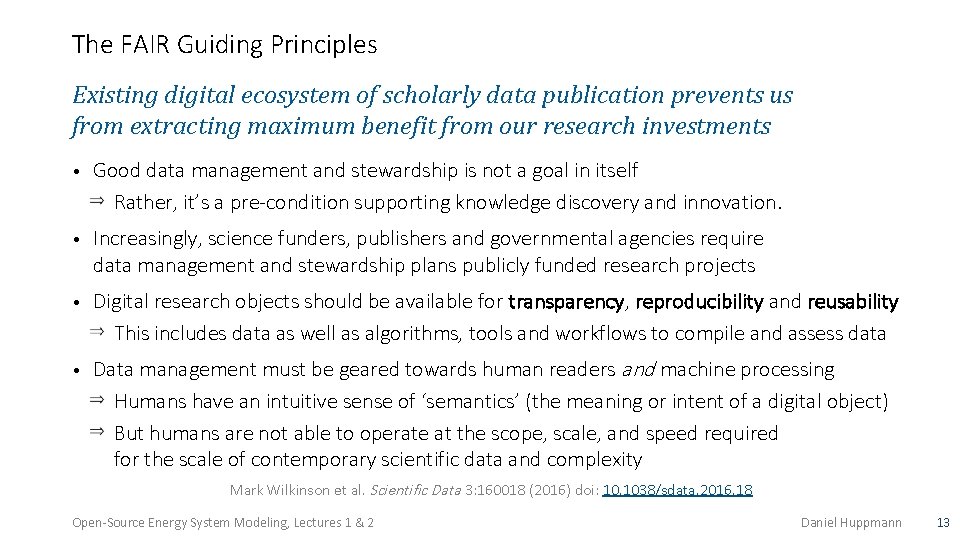
The FAIR Guiding Principles Existing digital ecosystem of scholarly data publication prevents us from extracting maximum benefit from our research investments • Good data management and stewardship is not a goal in itself Rather, it’s a pre-condition supporting knowledge discovery and innovation. • Increasingly, science funders, publishers and governmental agencies require data management and stewardship plans publicly funded research projects • Digital research objects should be available for transparency, reproducibility and reusability This includes data as well as algorithms, tools and workflows to compile and assess data • Data management must be geared towards human readers and machine processing Humans have an intuitive sense of ‘semantics’ (the meaning or intent of a digital object) But humans are not able to operate at the scope, scale, and speed required for the scale of contemporary scientific data and complexity Mark Wilkinson et al. Scientific Data 3: 160018 (2016) doi: 10. 1038/sdata. 2016. 18 Open-Source Energy System Modeling, Lectures 1 & 2 Daniel Huppmann 13
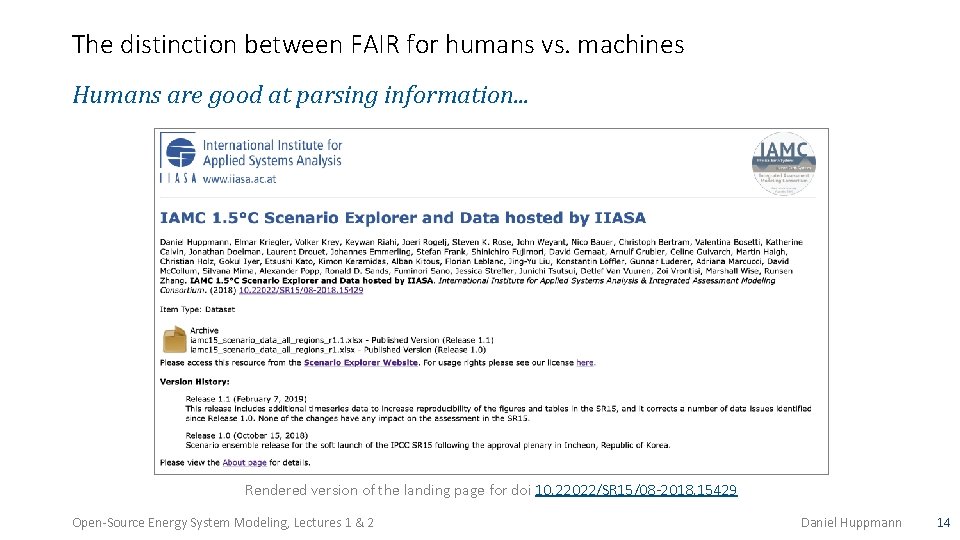
The distinction between FAIR for humans vs. machines Humans are good at parsing information. . . Rendered version of the landing page for doi 10. 22022/SR 15/08 -2018. 15429 Open-Source Energy System Modeling, Lectures 1 & 2 Daniel Huppmann 14

The distinction between FAIR for humans vs. machines Computers require additional structure to parse information <h 1>IAMC 1. 5°C Scenario Explorer and Data hosted by IIASA</h 1> <Creator: Author>Daniel Huppmann</Creator: Author>. . . <Creation. Name: Title><b>IAMC 1. 5°C Scenario Explorer and Data hosted by IIASA</b></Creation. Name: Title> <Agent: Publisher><i>International Institute for Applied Systems Analysis & Integrated Assessment Modeling Consortium</i></Agent: Publisher>. <Date. Of. Publishing>(2018)</Date. Of. Publishing> <Name: Identifier: Doi. Name> <a target="_blank" href="https: //doi. org/10. 22022/SR 15/08 -2018. 15429"> 10. 22022/SR 15/08 -2018. 15429</a></Name: Identifier: Doi. Name> Item Type: <Type>Dataset</Type> Please access this resource from the <Digital: Website><a target="_blank” href="https: //data. ene. iiasa. ac. at/ iamc-1. 5 c-explorer"> <b>Scenario Explorer Website</b></a></Digital: Website>. Source code of landing page for doi 10. 22022/SR 15/08 -2018. 15429 Open-Source Energy System Modeling, Lectures 1 & 2 Daniel Huppmann 15
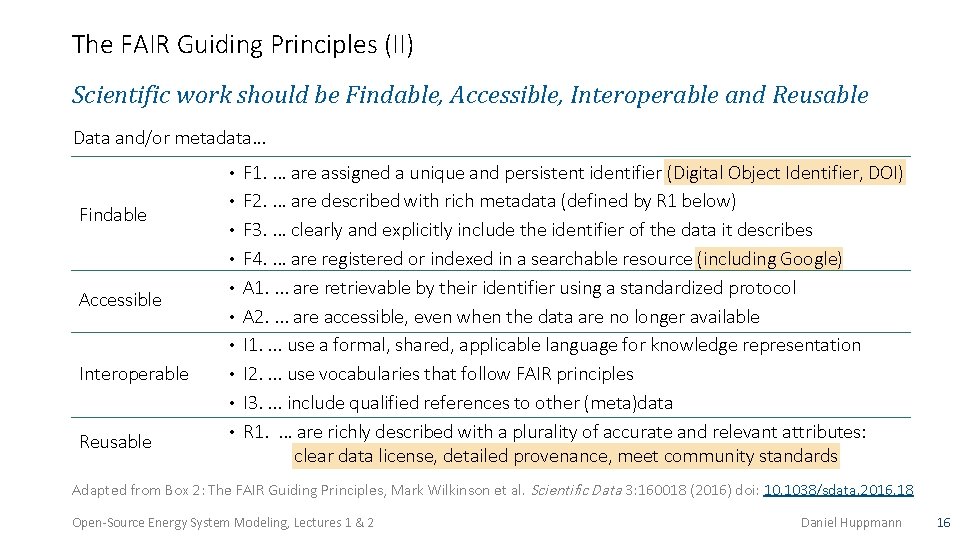
The FAIR Guiding Principles (II) Scientific work should be Findable, Accessible, Interoperable and Reusable Data and/or metadata. . . • Findable • • • Accessible • • • Interoperable • • Reusable • F 1. . are assigned a unique and persistent identifier (Digital Object Identifier, DOI) F 2. . are described with rich metadata (defined by R 1 below) F 3. . clearly and explicitly include the identifier of the data it describes F 4. . are registered or indexed in a searchable resource (including Google) A 1. . are retrievable by their identifier using a standardized protocol A 2. . are accessible, even when the data are no longer available I 1. . use a formal, shared, applicable language for knowledge representation I 2. . use vocabularies that follow FAIR principles I 3. . include qualified references to other (meta)data R 1. . are richly described with a plurality of accurate and relevant attributes: clear data license, detailed provenance, meet community standards Adapted from Box 2: The FAIR Guiding Principles, Mark Wilkinson et al. Scientific Data 3: 160018 (2016) doi: 10. 1038/sdata. 2016. 18 Open-Source Energy System Modeling, Lectures 1 & 2 Daniel Huppmann 16
More common misconceptions about open scientific programming There are many arguments against open-source – almost none are valid • “I put all my source code/data on my website, so it is open!” This is only true if you added an approved open-source license Otherwise, don’t use the term open, because it can be (mis)understood as free software • “My code/data is open because I’ll just send a copy to anyone who asks” This is not open or free according to the common understanding in the community • “If I make release my code/data under an open-source license, some people may misuse it!” If you don’t make it openly available, nobody is going to use it at all • “My code/data can’t have a DOI because there are proprietary data included. . . ” The DOI is only attached to the metadata of the object, so there is no problem • “I can’t release my code/data now because I have to clean it first and write documentation” If that is your approach to scientific programming, you’re doing it wrong. . . Open-Source Energy System Modeling, Lectures 1 & 2 Daniel Huppmann 17
Reproducibility is key to good scientific research Some examples of what’s reproducible. . . not! Archiving Definition: Permanent, incorruptible (as far as possible) storage of code, data or results Data or results can be preserved, yet may be impossible to recreate (or just understand). Version control Definition: VC tracks changes to software source code or data over time. VC can be used by one person and yet be unintelligible (i. e. , not reproducible) to another. Testing & quality control Definition: Implementation of checks to verify that software and data behave as expected. Reproducibility of the analysis for one research project doesn’t prevent the next researcher from ‘breaking’ (de-calibrating, misusing) a model or piece of software. Recommended further reading: Barnes (2010). Publish your computer code: it is good enough. Nature 467(753): 775. doi: 10. 1038/467753 a Barba (2016). The hard road to reproducibility. Science 354(6308): 142. doi: 10. 1126/science. 354. 6308. 142 Open-Source Energy System Modeling, Lectures 1 & 2 Daniel Huppmann 18

The rationale for proper version control tools In love and in scientific research, there is no such thing as “final”. . . Adapted from “not. Final. doc” at “Piled Higher and Deeper” by Jorge Cham, http: //phdcomics. com Open-Source Energy System Modeling, Lectures 1 & 2 Daniel Huppmann 19
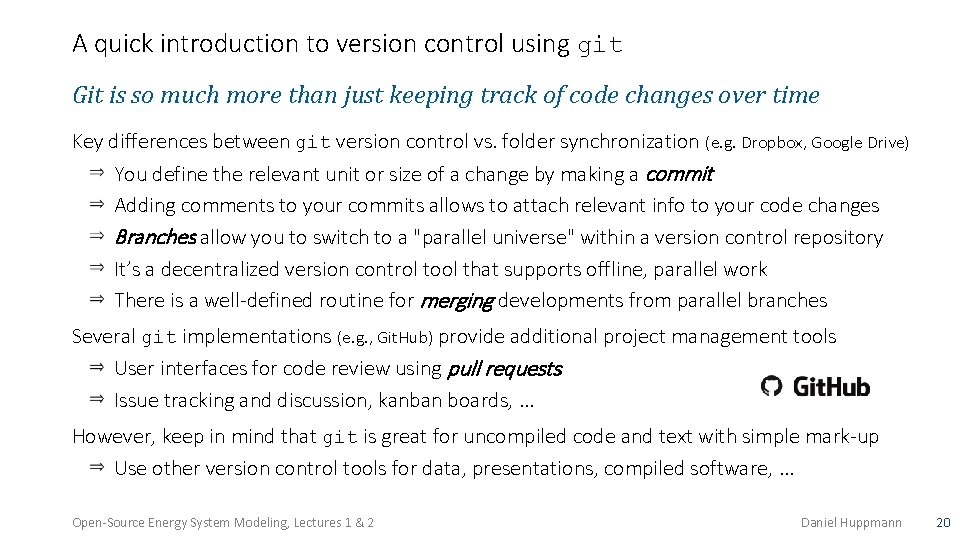
A quick introduction to version control using git Git is so much more than just keeping track of code changes over time Key differences between git version control vs. folder synchronization (e. g. Dropbox, Google Drive) You define the relevant unit or size of a change by making a commit Adding comments to your commits allows to attach relevant info to your code changes Branches allow you to switch to a "parallel universe" within a version control repository It’s a decentralized version control tool that supports offline, parallel work There is a well-defined routine for merging developments from parallel branches Several git implementations (e. g. , Git. Hub) provide additional project management tools User interfaces for code review using pull requests Issue tracking and discussion, kanban boards, . . . However, keep in mind that git is great for uncompiled code and text with simple mark-up Use other version control tools for data, presentations, compiled software, . . . Open-Source Energy System Modeling, Lectures 1 & 2 Daniel Huppmann 20
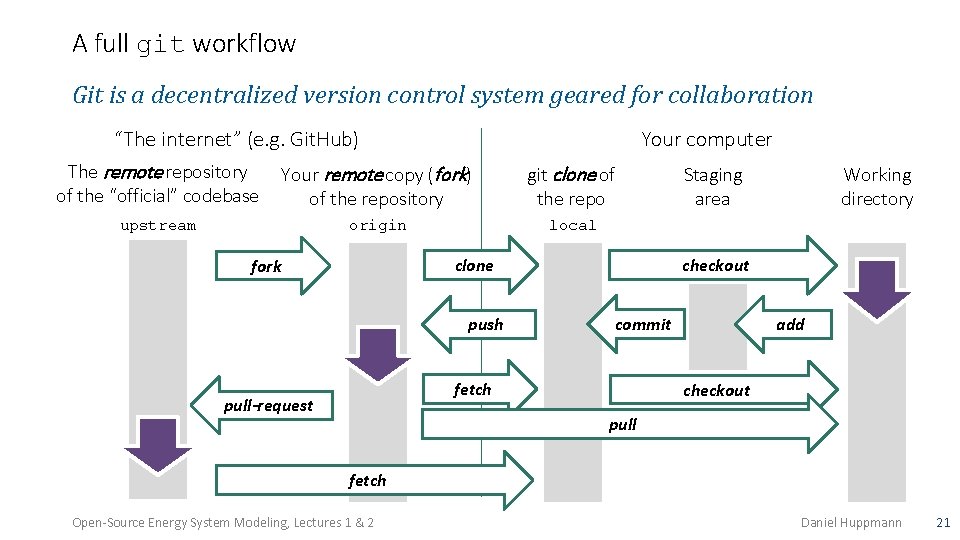
A full git workflow Git is a decentralized version control system geared for collaboration “The internet” (e. g. Git. Hub) The remote repository Your remote copy (fork) Your computer of the “official” codebase of the repository git clone of the repo upstream origin local clone fork push Working directory checkout commit fetch pull-request Staging area add checkout pull fetch Open-Source Energy System Modeling, Lectures 1 & 2 Daniel Huppmann 21
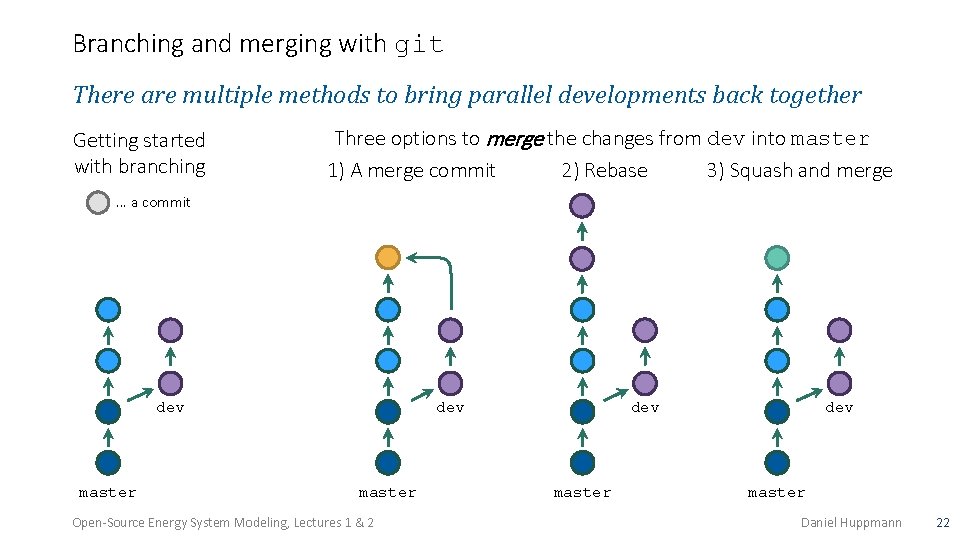
Branching and merging with git There are multiple methods to bring parallel developments back together Getting started with branching Three options to merge the changes from dev into master 1) A merge commit 2) Rebase 3) Squash and merge . . . a commit dev master Open-Source Energy System Modeling, Lectures 1 & 2 dev master Daniel Huppmann 22

Part 2 Setting up a simple repository with unit tests and continuous integration The first rule of live demos: Never do a live demo. So let’s do a live demo. Open-Source Energy System Modeling, Lectures 1 & 2 Daniel Huppmann 23

Hands-on exercise • Set up a new public Git. Hub repository at www. github. com • Update the README (formatting using markdown) • “Clone” the repository to your computer (recommended for novices: gitkraken. com) • Add a license (why not start with APACHE 2. 0? ) Add the statement and the badge to the readme • Start developing a little Python function (recommended for novices: anaconda. com) • Add a unit test • Add a gitignore file • Add continuous integration using a new branch travis-ci. com to execute unit tests stickler-ci to implement linter and code style verification • Create a pull request to execute the CI and merge the new branch into master • Add contributing guidelines, set up templates for pull requests • Create a release Open-Source Energy System Modeling, Lectures 1 & 2 Daniel Huppmann 24
Hands-on exercise (Part II) • https: //github. com/danielhuppmann/lecture_live_demo_2019 • If a non-admin user wants to push commits, you have to “fork” the repo (create a copy under your Git. Hub user) • Clone the fork to your computer • Start a new branch • Add a new function or extend some feature such that the unit tests fail • Make a pull request to the upstream repository • Fix the code such that unit tests pass • Ask someone else to perform code review • Merge the new development (by an admin) Open-Source Energy System Modeling, Lectures 1 & 2 Daniel Huppmann 25
Part 3 Some practical considerations and advice Open-Source Energy System Modeling, Lectures 1 & 2 Daniel Huppmann 26
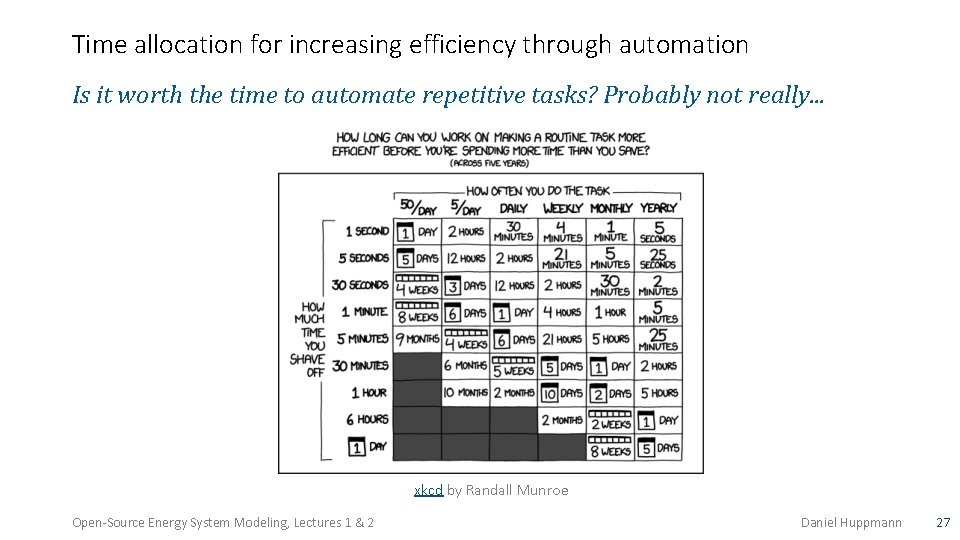
Time allocation for increasing efficiency through automation Is it worth the time to automate repetitive tasks? Probably not really. . . xkcd by Randall Munroe Open-Source Energy System Modeling, Lectures 1 & 2 Daniel Huppmann 27
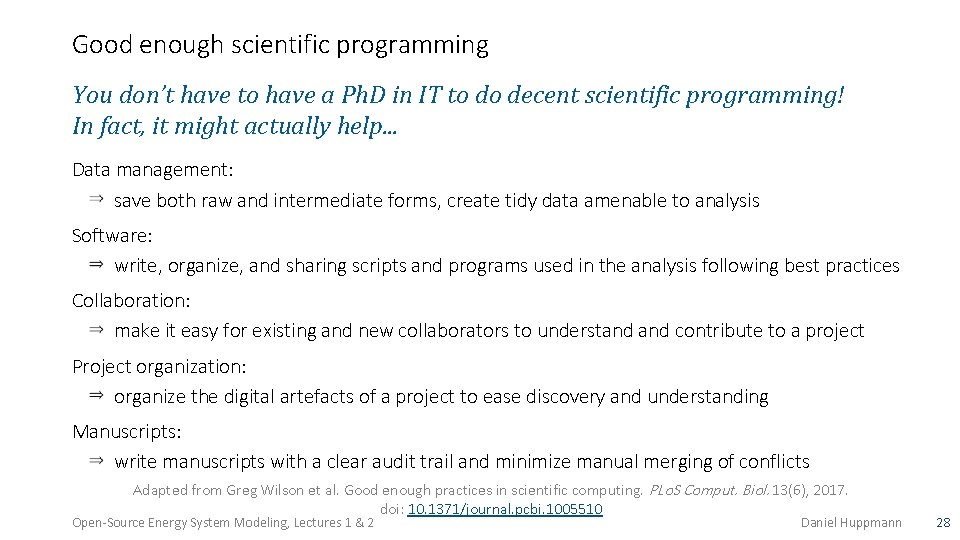
Good enough scientific programming You don’t have to have a Ph. D in IT to do decent scientific programming! In fact, it might actually help. . . Data management: save both raw and intermediate forms, create tidy data amenable to analysis Software: write, organize, and sharing scripts and programs used in the analysis following best practices Collaboration: make it easy for existing and new collaborators to understand contribute to a project Project organization: organize the digital artefacts of a project to ease discovery and understanding Manuscripts: write manuscripts with a clear audit trail and minimize manual merging of conflicts Adapted from Greg Wilson et al. Good enough practices in scientific computing. PLo. S Comput. Biol. 13(6), 2017. doi: 10. 1371/journal. pcbi. 1005510 Open-Source Energy System Modeling, Lectures 1 & 2 Daniel Huppmann 28
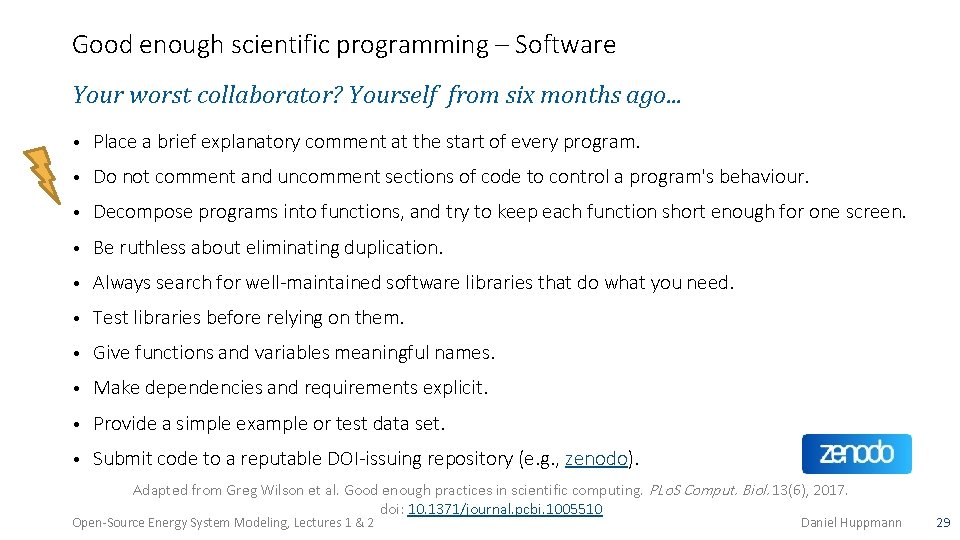
Good enough scientific programming – Software Your worst collaborator? Yourself from six months ago. . . • Place a brief explanatory comment at the start of every program. • Do not comment and uncomment sections of code to control a program's behaviour. • Decompose programs into functions, and try to keep each function short enough for one screen. • Be ruthless about eliminating duplication. • Always search for well-maintained software libraries that do what you need. • Test libraries before relying on them. • Give functions and variables meaningful names. • Make dependencies and requirements explicit. • Provide a simple example or test data set. • Submit code to a reputable DOI-issuing repository (e. g. , zenodo). Adapted from Greg Wilson et al. Good enough practices in scientific computing. PLo. S Comput. Biol. 13(6), 2017. doi: 10. 1371/journal. pcbi. 1005510 Open-Source Energy System Modeling, Lectures 1 & 2 Daniel Huppmann 29
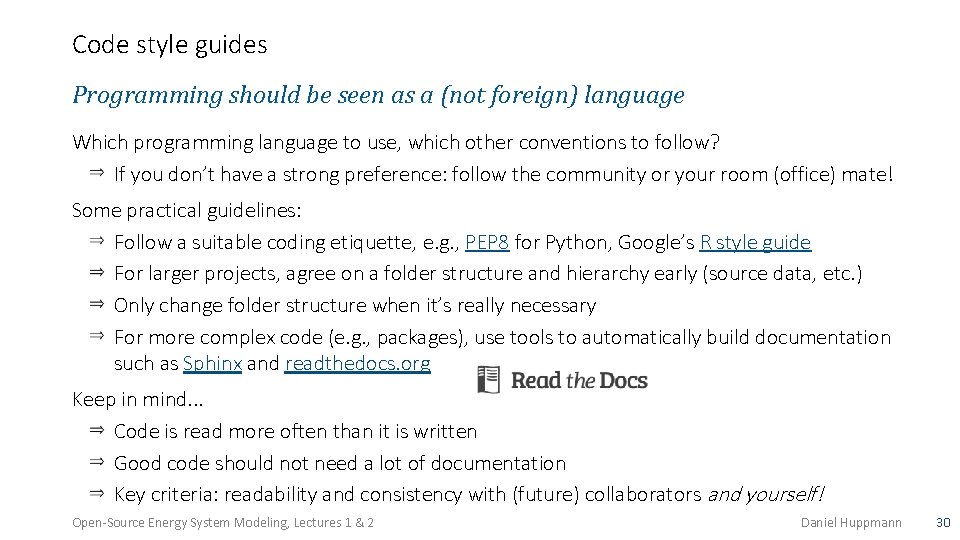
Code style guides Programming should be seen as a (not foreign) language Which programming language to use, which other conventions to follow? If you don’t have a strong preference: follow the community or your room (office) mate! Some practical guidelines: Follow a suitable coding etiquette, e. g. , PEP 8 for Python, Google’s R style guide For larger projects, agree on a folder structure and hierarchy early (source data, etc. ) Only change folder structure when it’s really necessary For more complex code (e. g. , packages), use tools to automatically build documentation such as Sphinx and readthedocs. org Keep in mind. . . Code is read more often than it is written Good code should not need a lot of documentation Key criteria: readability and consistency with (future) collaborators and yourself! Open-Source Energy System Modeling, Lectures 1 & 2 Daniel Huppmann 30
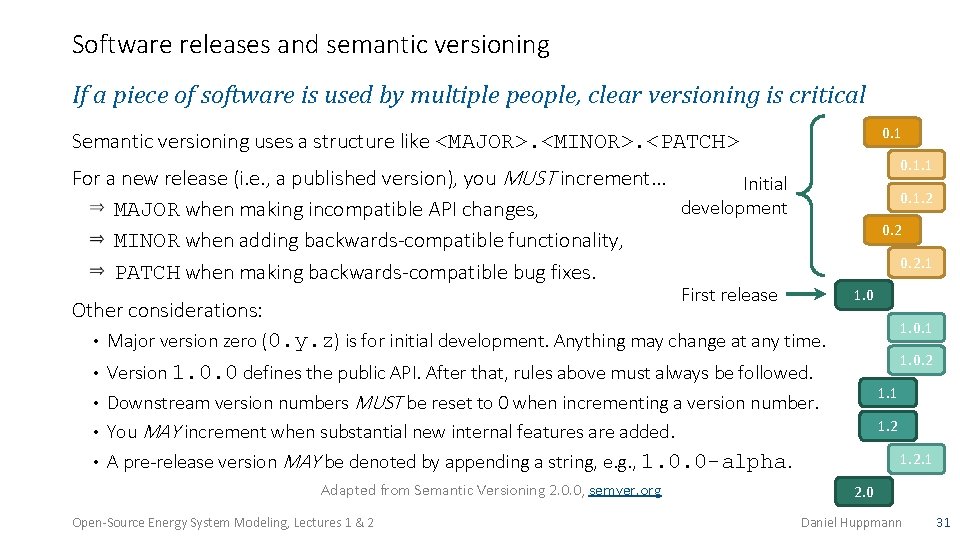
Software releases and semantic versioning If a piece of software is used by multiple people, clear versioning is critical 0. 1 Semantic versioning uses a structure like <MAJOR>. <MINOR>. <PATCH> 0. 1. 1 For a new release (i. e. , a published version), you MUST increment. . . Initial development MAJOR when making incompatible API changes, MINOR when adding backwards-compatible functionality, PATCH when making backwards-compatible bug fixes. 0. 1. 2 0. 2. 1 First release Other considerations: 1. 0 • Major version zero (0. y. z) is for initial development. Anything may change at any time. • Version 1. 0. 0 defines the public API. After that, rules above must always be followed. 1. 0. 1 1. 0. 2 1. 1 Downstream version numbers MUST be reset to 0 when incrementing a version number. • You MAY increment when substantial new internal features are added. • A pre-release version MAY be denoted by appending a string, e. g. , 1. 0. 0 -alpha. • Adapted from Semantic Versioning 2. 0. 0, semver. org Open-Source Energy System Modeling, Lectures 1 & 2 1. 2. 1 2. 0 Daniel Huppmann 31
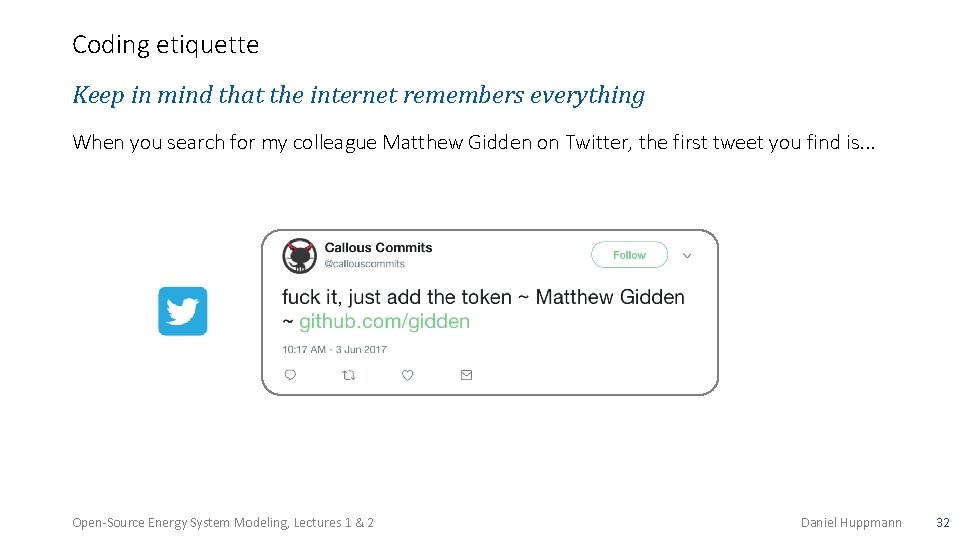
Coding etiquette Keep in mind that the internet remembers everything When you search for my colleague Matthew Gidden on Twitter, the first tweet you find is. . . Open-Source Energy System Modeling, Lectures 1 & 2 Daniel Huppmann 32
Social etiquette Be kind and respectful in collaboration, code review and comments Collaborative scientific programming is about communication, not code It’s the people, stupid! And don’t be annoyed when, sometimes, some collaborators are stupid. . . Keep in mind that discussions via e-mail, chat, pull requests comments, code review, etc. lack a lot of the social cues that human interaction is built upon If there are two roughly equivalent ways to do something and a code reviewer suggests that you use the other approach. . . Just do it her/his way if there is no good reason not to – out of respect for the reviewer and to avoid getting bogged down in escalating discussions Give credit generously to your collaborators and contributors! Open-Source Energy System Modeling, Lectures 1 & 2 Daniel Huppmann 33
Thank you very much for your attention! Many thanks to Matthew Gidden (@gidden) and Paul Natsuo Kishimoto (@khaeru) for sharing their lecture material and experience with collaborative programming Dr. Daniel Huppmann Research Scholar – Energy Program International Institute for Applied Systems Analysis (IIASA) Schlossplatz 1, A-2361 Laxenburg, Austria huppmann@iiasa. ac. at http: //www. iiasa. ac. at/staff/huppmann This presentation is licensed under a Creative Commons Attribution 4. 0 International License
- Slides: 34