
Lecture3 Types of lasers HeNe Laser Laser Types

- Slides: 12
Lecture-3 Types of lasers He-Ne Laser
Laser Types • According to the active material: solid-state, liquid, gas, excimer or semiconductor lasers. Gas: He. Ne laser, excimer lasers, CO 2 lasers Liquid: dye lasers Solid: Nd: YAG laser, Ti: sapphire laser Diode (semiconductor) lasers. According to the wavelength: infra-red, visible, ultra-violet (UV) or x-ray lasers.
Types of Laser Based on the mode of operation (i) Pulsed Laser systems (ii) Q-switched systems (iii) Continuous wave Laser systems Based on the mechanism in which Population Inversion is achieved (i) Three level lasers (ii) Four level lasers Based on state of active medium used (i) Gas Laser (ii) Solid state Laser (iii) Semiconductor Laser (iv) Tunable dye Laser
Types of Laser • Gas Laser: He-Ne, Argon ion and CO 2 • Solid state Laser : Ruby, Nd: YAG, Nd: glass • Semiconductor Laser • Tunable dye Laser
Helium-neon Laser It was invented by Javan et. al. in 1961 and his coworkers at Bell Telephone Laboratories
Introduction • A helium-neon laser (He-Ne laser) is a type of small gas laser. He. Ne lasers have many industrial and scientific uses, and are often used in laboratory demonstrations of optics. • He-Ne laser is a four-level laser. • Its usual operation wavelength is 6328Å in the red portion of the visible spectrum. • This was the first gas laser to be operated successfully.
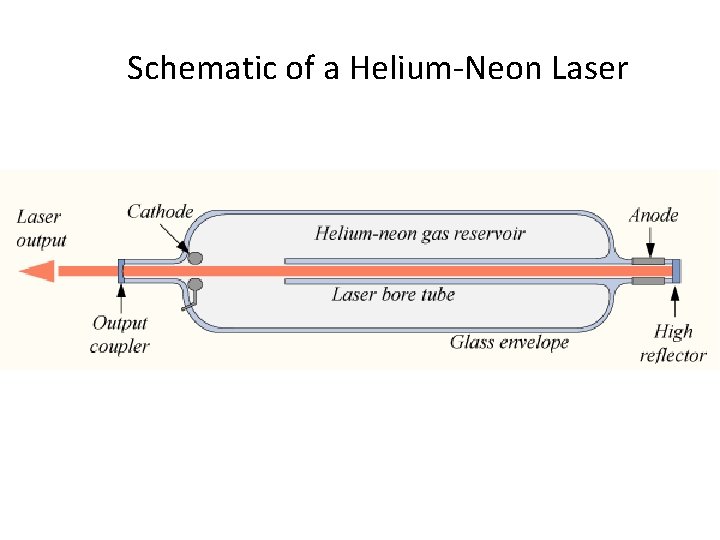
Construction of He-Ne laser • This consists of a mixture of helium and neon gases in a ratio of about 10: 1 • The setup consists of a discharge tube of length 80 cm and bore diameter of 1. 5 cm. • The pressure inside the tube is about 1 mm of Hg. • The energy or pump source of the laser is provided by an electrical discharge of around 1000 volts through an anode and cathode at each end of the glass tube. A current of 5 to 100 m. A is typical for CW operation. • The optical cavity of the laser typically consists of a plane, highreflecting mirror at one end of the laser tube, and a partially transparent mirror of approximately 1% transmission at the other end.
Schematic of a Helium-Neon Laser
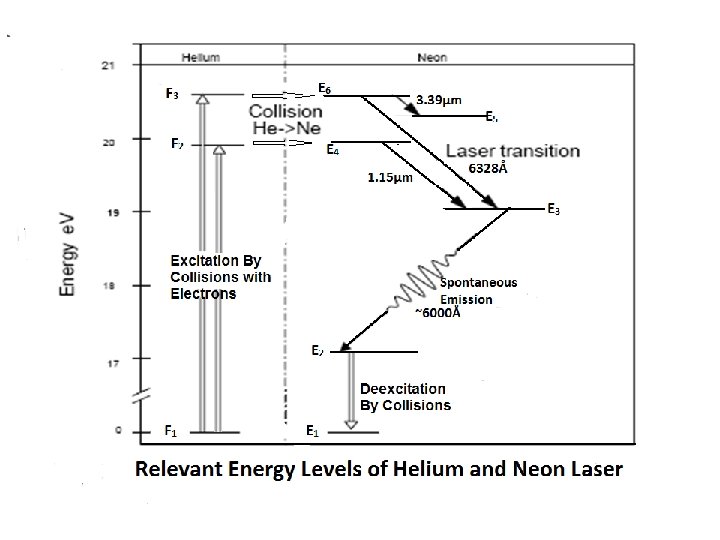
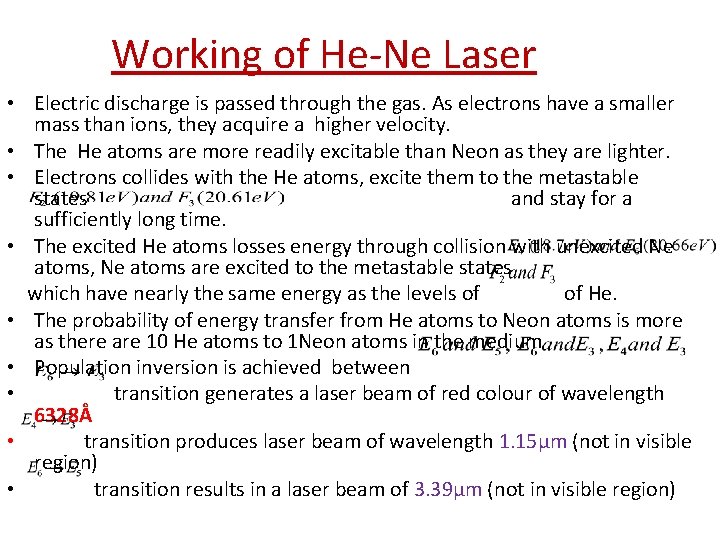
Working of He-Ne Laser • Electric discharge is passed through the gas. As electrons have a smaller mass than ions, they acquire a higher velocity. • The He atoms are more readily excitable than Neon as they are lighter. • Electrons collides with the He atoms, excite them to the metastable states and stay for a sufficiently long time. • The excited He atoms losses energy through collision with unexcited Ne atoms, Ne atoms are excited to the metastable states which have nearly the same energy as the levels of of He. • The probability of energy transfer from He atoms to Neon atoms is more as there are 10 He atoms to 1 Neon atoms in the medium • Population inversion is achieved between • transition generates a laser beam of red colour of wavelength 6328Å • transition produces laser beam of wavelength 1. 15µm (not in visible region) • transition results in a laser beam of 3. 39µm (not in visible region)
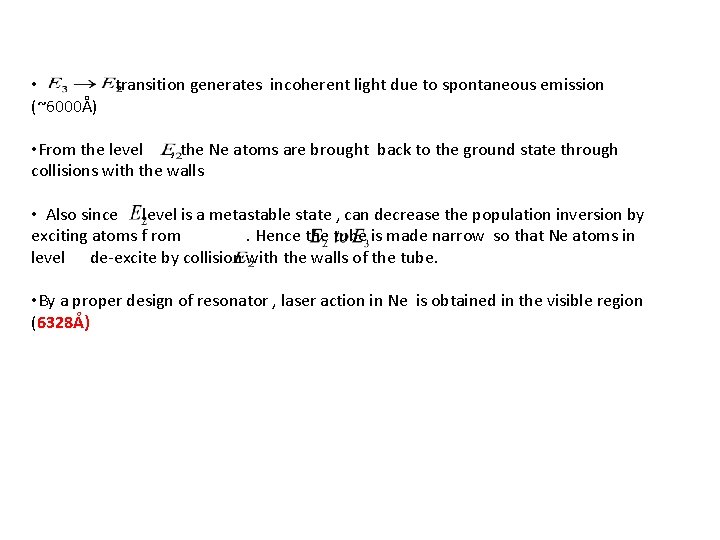
• transition generates incoherent light due to spontaneous emission (~6000Å) • From the level , the Ne atoms are brought back to the ground state through collisions with the walls • Also since level is a metastable state , can decrease the population inversion by exciting atoms f rom. Hence the tube is made narrow so that Ne atoms in level de-excite by collision with the walls of the tube. • By a proper design of resonator , laser action in Ne is obtained in the visible region (6328Å)
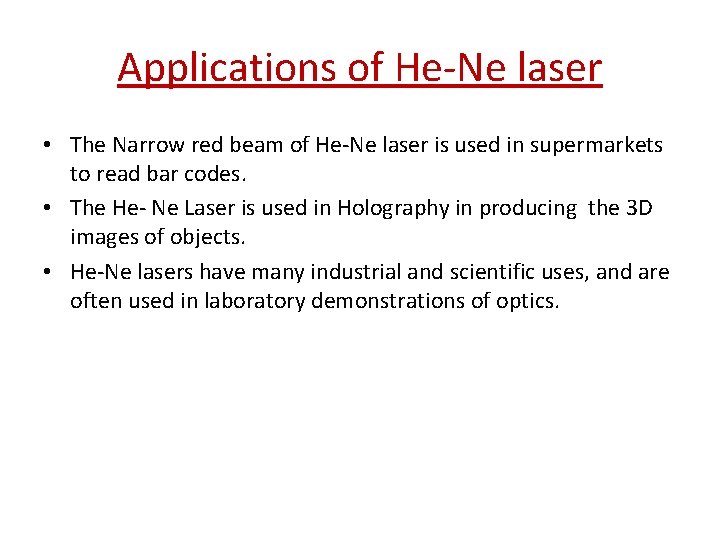
Applications of He-Ne laser • The Narrow red beam of He-Ne laser is used in supermarkets to read bar codes. • The He- Ne Laser is used in Holography in producing the 3 D images of objects. • He-Ne lasers have many industrial and scientific uses, and are often used in laboratory demonstrations of optics.