
Lecture3 PATELLOFEMORAL JOINT Patellofemoral Articular Surfaces and Joint


- Slides: 14
Lecture-3 PATELLO-FEMORAL JOINT
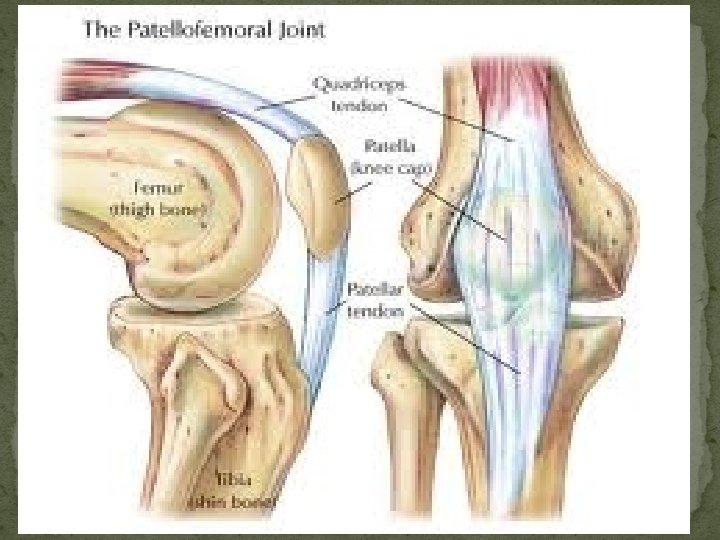
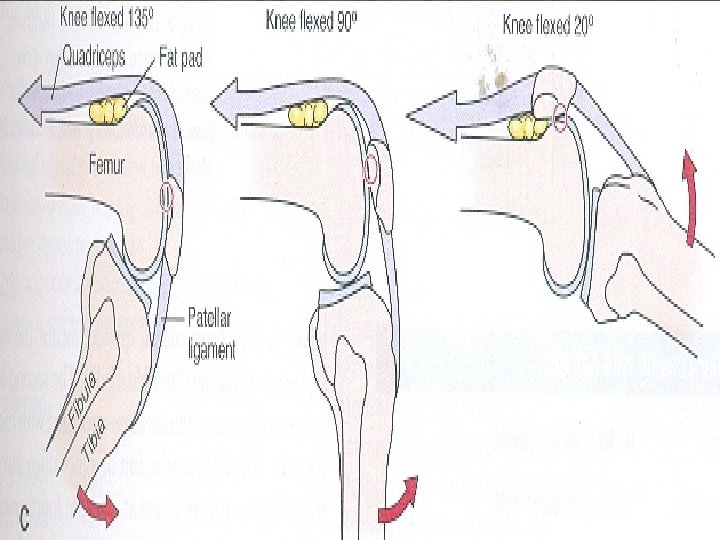
Patellofemoral Articular Surfaces and Joint Congruence �In full KE �Patella lies on femoral sulcus. � not yet entered intercondylar groove, � joint congruency is minimal � Great potential for patellar instability � ratio of length of patellar tendon to length of patella is approximately 1: 1 � markedly long tendon produces an abnormally high position of the patella on femoral sulcus � known as patella alta, � which increases the risk for patellar instability �In patients with patella alta, tibiofemoral �joint must be flexed more before the patella translates
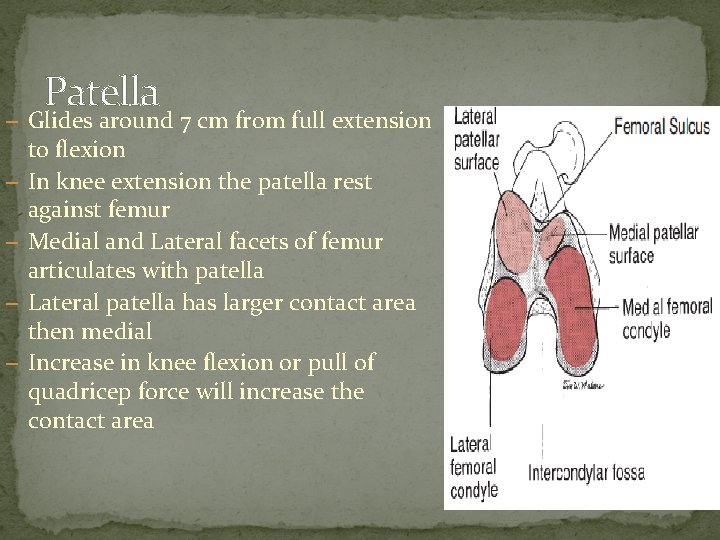
Patella – Glides around 7 cm from full extension – – to flexion In knee extension the patella rest against femur Medial and Lateral facets of femur articulates with patella Lateral patella has larger contact area then medial Increase in knee flexion or pull of quadricep force will increase the contact area
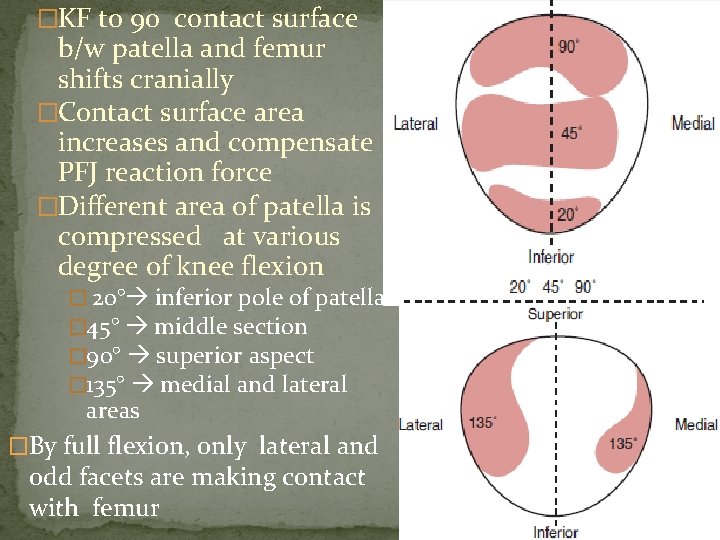
�KF to 90 contact surface b/w patella and femur shifts cranially �Contact surface area increases and compensate PFJ reaction force �Different area of patella is compressed at various degree of knee flexion � 20° inferior pole of patella � 45° middle section � 90° superior aspect � 135° medial and lateral areas �By full flexion, only lateral and odd facets are making contact with femur
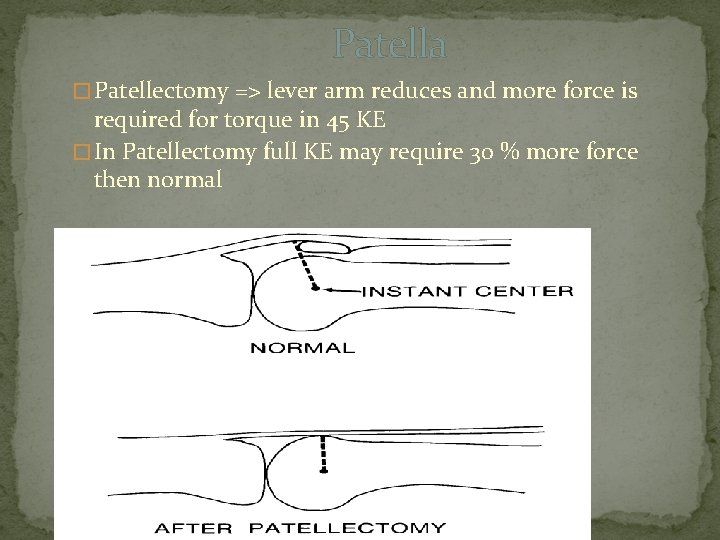
Patella � Patellectomy => lever arm reduces and more force is required for torque in 45 KE � In Patellectomy full KE may require 30 % more force then normal
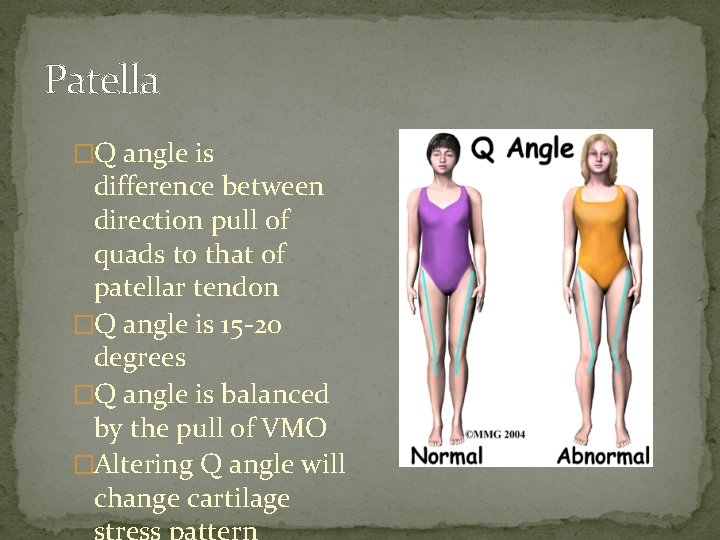
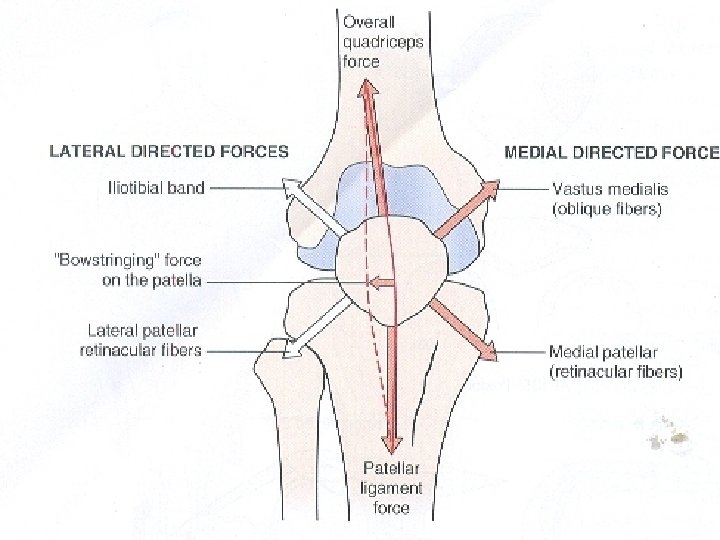
Patella �Q angle is difference between direction pull of quads to that of patellar tendon �Q angle is 15 -20 degrees �Q angle is balanced by the pull of VMO �Altering Q angle will change cartilage
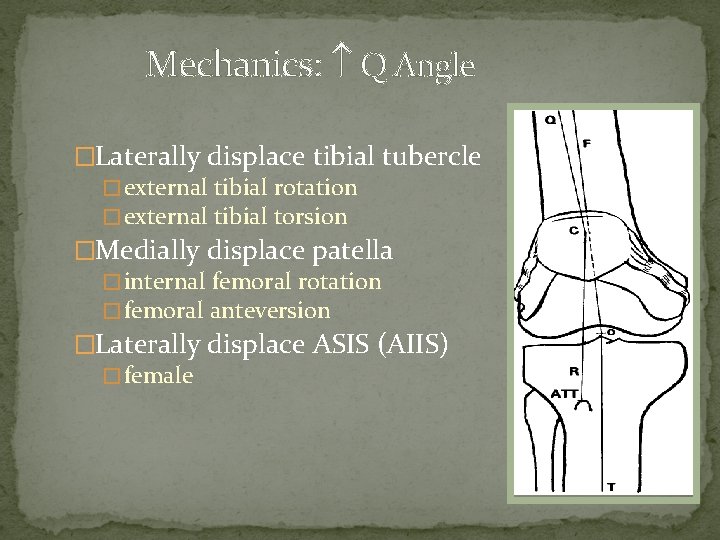
Mechanics: Q Angle �Laterally displace tibial tubercle � external tibial rotation � external tibial torsion �Medially displace patella � internal femoral rotation � femoral anteversion �Laterally displace ASIS (AIIS) � female
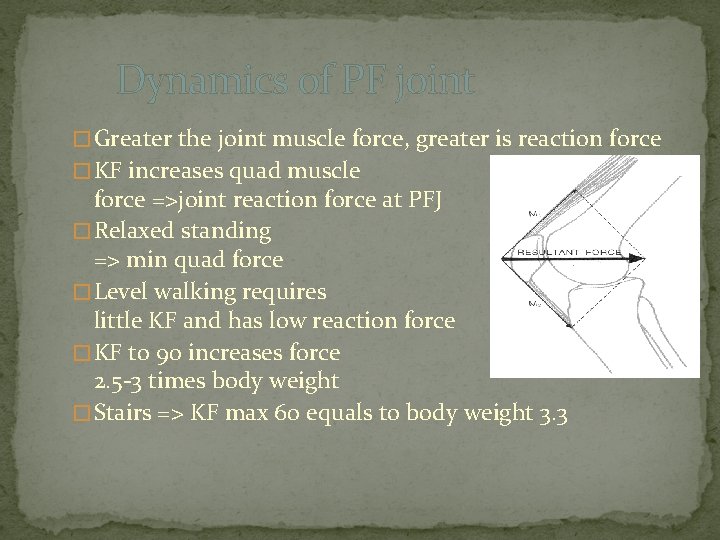
Dynamics of PF joint � Greater the joint muscle force, greater is reaction force � KF increases quad muscle force =>joint reaction force at PFJ � Relaxed standing => min quad force � Level walking requires little KF and has low reaction force � KF to 90 increases force 2. 5 -3 times body weight � Stairs => KF max 60 equals to body weight 3. 3
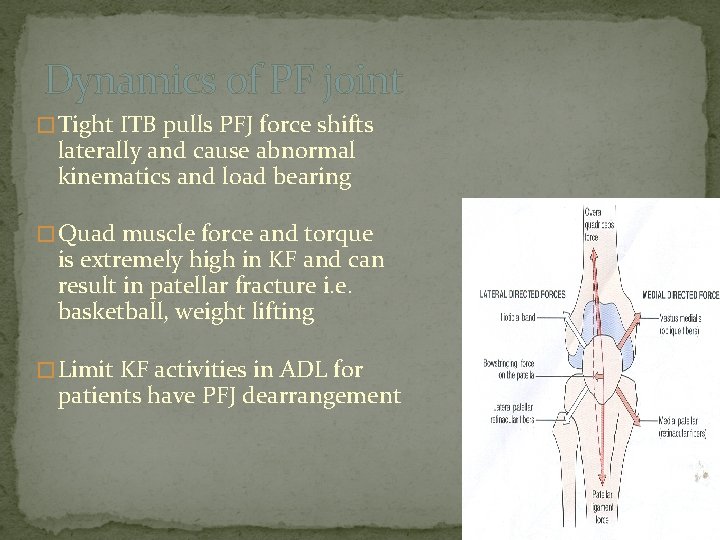
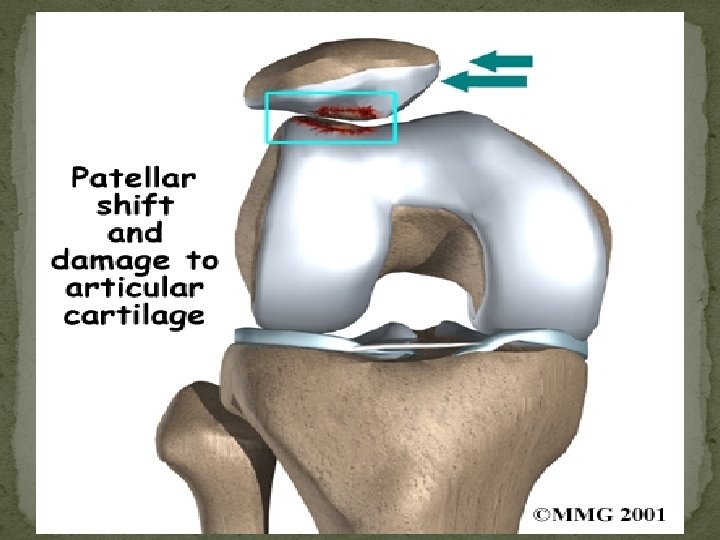
Dynamics of PF joint � Tight ITB pulls PFJ force shifts laterally and cause abnormal kinematics and load bearing � Quad muscle force and torque is extremely high in KF and can result in patellar fracture i. e. basketball, weight lifting � Limit KF activities in ADL for patients have PFJ dearrangement