
Lecture Title Fungal Infections of Central Nervous System
- Slides: 20
Lecture Title: Fungal Infections of Central Nervous System (CNS Block, Microbiology)
Lecture Objectives. . 1. To know the main fungi that affect the central nervous system and the clinical settings of such infections. 2. To acquire the basic knowledge about fungal meningitis and brain abscess: clinical features, etiology, diagnosis, and treatment.
Fungal infections of central nervous system (CNS) ØCNS infections are both diagnostic challenge and medical emergency ØDelay in diagnosis and initiation of appropriate therapy will lead to high mortality rate or in permanent, severe neurological damage ØFungal infections of the CNS are not common However, they are being increasingly diagnosed Why?
Risk factors HIV/AIDS Hematopoietic stem cell transplant (HSCT) Solid organs transplantation Malignancies Neutropenia Hereditary immune defects Immunosuppressive medications Diabetes mellitus Surgery or trauma Indwelling catheters (e. g. candidemia CNS seeding)
How fungi reach the central nervous system Fungi reach the central nervous system by different mechanisms: ØHematogenous spread ØLocal extension from the paranasal sinuses, the ear, or the orbits. ØTraumatic introduction Surgical procedures Head trauma Injections lumbar punctures
Clinical syndromes Ø Meningitis Sub acute Chronic Ø Brain abscess With or without vascular invasion Ø These clinical syndromes can occur either alone or in combination. Ø Certain clinical syndromes are specific for certain fungi
Etiology Ø Several fungal agents can cause CNS infections. Yeast: Candida spp Cryptococcus spp Dimorphic Histoplasma spp Blastomyces spp Coccidioides spp Paracoccidioides spp Mould Aspergillus spp Zygomycetes Exophiala spp Cladophialophora bantiana Rhinocladiella mackinziei and Others
Cryptococcal meningitis AIDS is the leading predisposing factor Etiology: Cryptococcus neoformans is the most common etiology ØCapsulated yeast cells ØNaturally in Pigeon habitats ØAcquired by inhalation Mainly meningitis
Candidiasis Candida species are the fourth most common cause of hospital acquired blood stream infections ØCandida can reach the CNS: §Hematogenously, §Surgery, Catheters Clinical syndromes Cerebral abscesses Meningitis Etiology: Candida albicans, and other species including C. glabrata, C. tropicalis C. parapsilosis, and C. krusei.
ØCNS Aspergillosis Usually brain abscesses (single or multiple) ØCommon risk factors include: § Malignancies § Transplantation § Chemotherapy ØSpread Hematogenously Ø May also occur via direct spread from the anatomically adjacent sinuses, ØMortality rate is high Etiology: Aspergillus fumigatus, but also A. flavus, and A. terrus
CNS Zygomycosis (mucoromycosis) ØThe rhinocerebral form is the most frequent presenting clinical syndrome in CNS zygomycosis. Diabetics with ketoacidosis, in addition to other risk factors ØThe clinical manifestations of the rhinocerebral form start as sinusitis, rapidly progress and involve the orbit, eye and optic nerve and extend to the brain Facial edema, pain, necrosis, loss of vision, black discharge Angiotropism; As angio-invasion is very frequent Etiology: Zygomycetes e. g. Rhizopus, Absidia, Mucor Fast growing fungi ØMortality is high (80 - 100%) Progression is rapid, To improve the outcome: Rapid diagnosis Control the underlying disease Early surgical debridement Appropriate antifungal therapy
Pheohyphomycosis ØFungal infections caused by dematiaceous fungi ØNeurotropic fungi ØCNS infections: Usually brain abscess, and chronic ØReported in immunocompetent hosts Etiology: Rhinocladiella mackenziei ( Mainly reported from Middle East) Cladophialophora, Exophiala , many others
Other Infections §Histoplasmosis §Blastomycosis §Coccidiodomycosis §Paracoccidiodomycosis ØCaused by primary pathogens ØSub acute or chronic Meningitis (common), and brain abscess ØFollowing a primary infection, mainly respiratory
Diagnosis Clinical features (history, risk factors, etc) Not Specific Neuro-imaging Good value in diagnosis and therapy monitoring Lab Investigations CSF examination (cell count, chemistry) Histopathology Microbiology
Lab Diagnosis Clinical Samples CSF Biopsy Pus, aspirate Blood (for serology) 1. CSF abnormalities Cell count Glucose level (low) Protein level (high) Not specific for Fungal infections
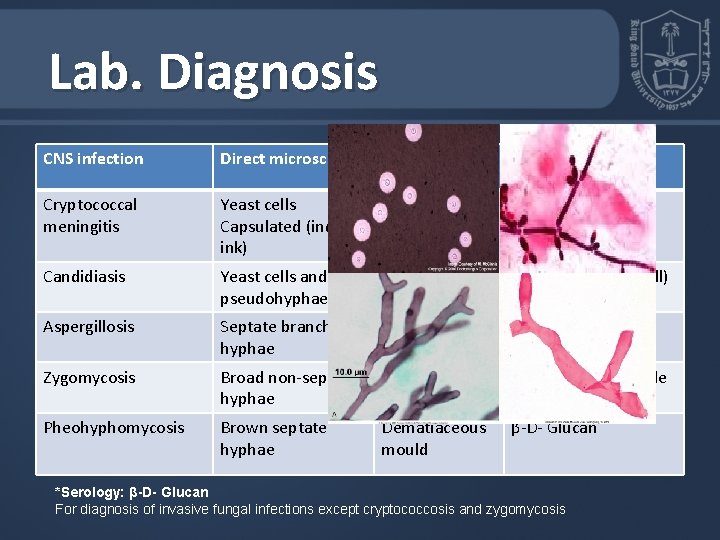
Lab Diagnosis 2. Direct Microscopy Fungal stains: Giemsa, GMS, PAS, India ink (Cryptococcus neoformans) 3. Culture Fungal media: SDA, BHI, other media if needed. 4. Serology Candida Aspergillus Cryptococcus Histoplasma Blastomyces Coccidioides Paracoccidioides 5. PCR
Lab. Diagnosis CNS infection Direct microscopy Culture Serology* Cryptococcal meningitis Yeast cells Capsulated (india ink) Yeast Cryptococcal Ag (capsule) Latex agglutination Candidiasis Yeast cells and pseudohyphae Yeast Manann Ag (cell wall) Aspergillosis Septate branching hyphae Hyaline mould Galactomannan Ag Zygomycosis Broad non-septate hyphae Hyaline mould Fast growing No serology available Pheohyphomycosis Brown septate hyphae Dematiaceous mould β-D- Glucan *Serology: β-D- Glucan For diagnosis of invasive fungal infections except cryptococcosis and zygomycosis
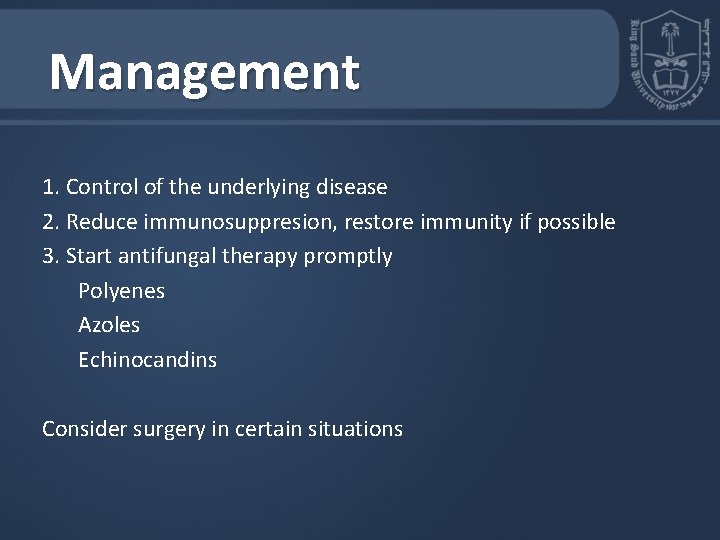
Management 1. Control of the underlying disease 2. Reduce immunosuppresion, restore immunity if possible 3. Start antifungal therapy promptly Polyenes Azoles Echinocandins Consider surgery in certain situations
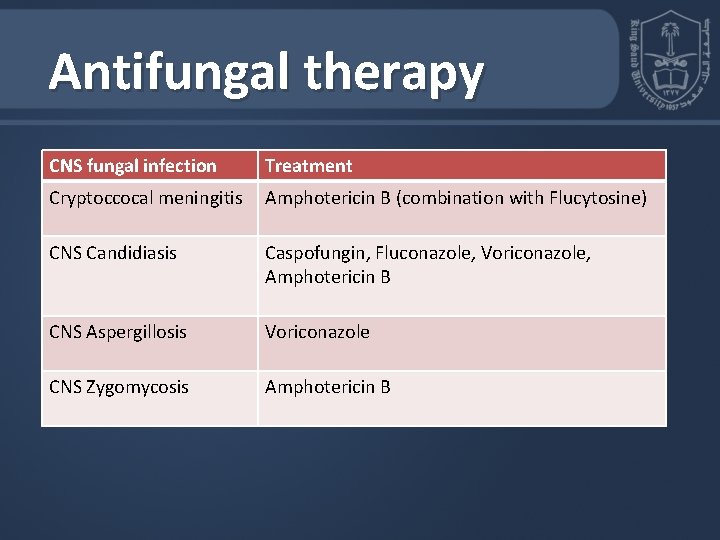
Antifungal therapy CNS fungal infection Treatment Cryptoccocal meningitis Amphotericin B (combination with Flucytosine) CNS Candidiasis Caspofungin, Fluconazole, Voriconazole, Amphotericin B CNS Aspergillosis Voriconazole CNS Zygomycosis Amphotericin B
Thank You (CNS Block, Microbiology)