
Lecture Slides Chapter 7 Shafts and Shaft Components
- Slides: 21
Lecture Slides Chapter 7 Shafts and Shaft Components © 2015 by Mc. Graw-Hill Education. This is proprietary material solely for authorized instructor use. Not authorized for sale or distribution in any manner. This document may not be copied, scanned, duplicated, forwarded, distributed, or posted on a website, in whole or part.
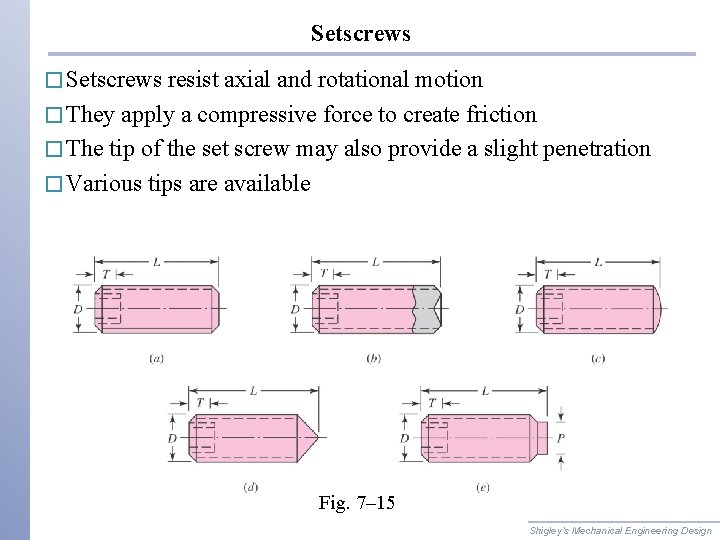
Setscrews � Setscrews resist axial and rotational motion � They apply a compressive force to create friction � The tip of the set screw may also provide a slight penetration � Various tips are available Fig. 7– 15 Shigley’s Mechanical Engineering Design
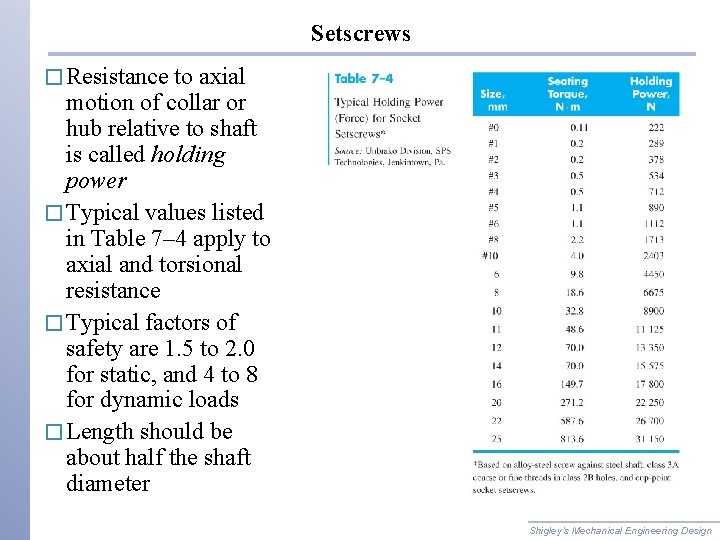
Setscrews � Resistance to axial motion of collar or hub relative to shaft is called holding power � Typical values listed in Table 7– 4 apply to axial and torsional resistance � Typical factors of safety are 1. 5 to 2. 0 for static, and 4 to 8 for dynamic loads � Length should be about half the shaft diameter Shigley’s Mechanical Engineering Design
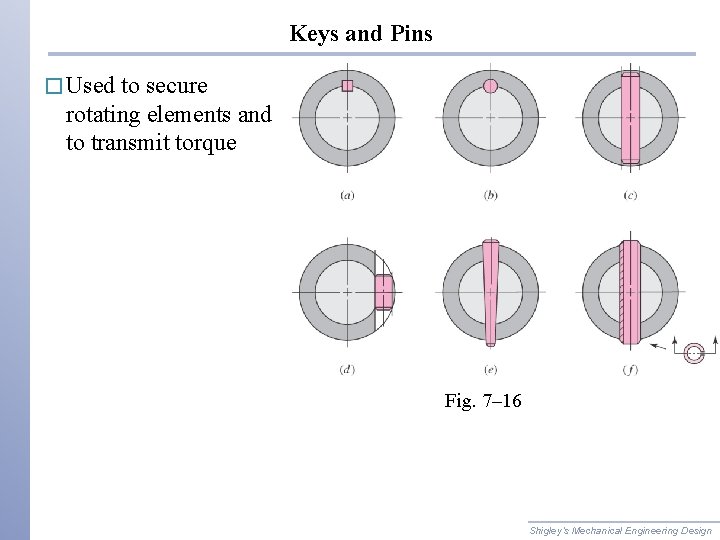
Keys and Pins � Used to secure rotating elements and to transmit torque Fig. 7– 16 Shigley’s Mechanical Engineering Design
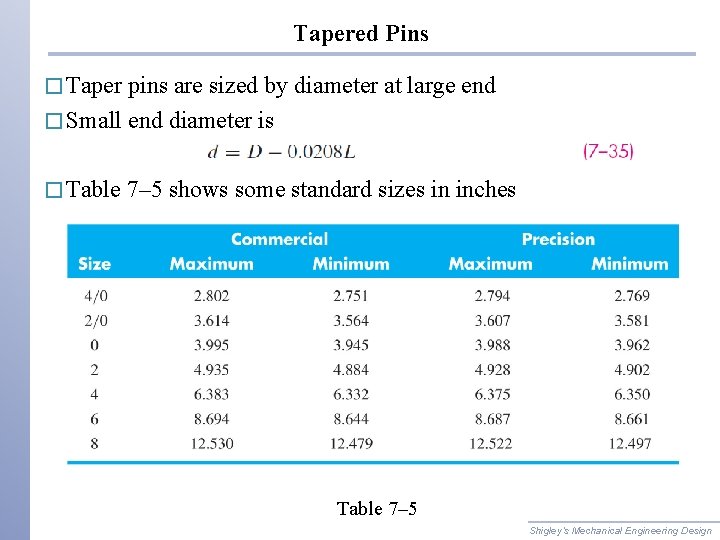
Tapered Pins � Taper pins are sized by diameter at large end � Small end diameter is � Table 7– 5 shows some standard sizes in inches Table 7– 5 Shigley’s Mechanical Engineering Design
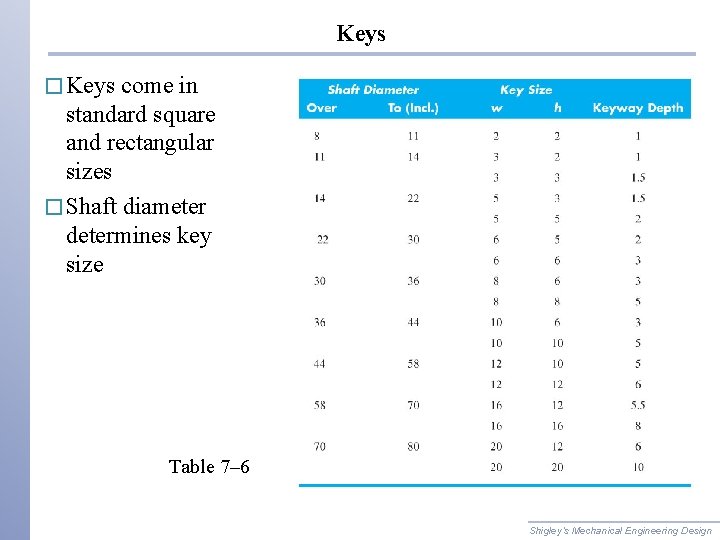
Keys � Keys come in standard square and rectangular sizes � Shaft diameter determines key size Table 7– 6 Shigley’s Mechanical Engineering Design
Keys � Failure of keys is by either direct shear or bearing stress � Key length is designed to provide desired factor of safety � Factor of safety should not be excessive, so the inexpensive key is the weak link � Key length is limited to hub length � Key length should not exceed 1. 5 times shaft diameter to avoid problems from twisting � Multiple keys may be used to carry greater torque, typically oriented 90º from one another � Stock key material is typically low carbon cold-rolled steel, with dimensions slightly under the nominal dimensions to easily fit end-milled keyway � A setscrew is sometimes used with a key for axial positioning, and to minimize rotational backlash Shigley’s Mechanical Engineering Design
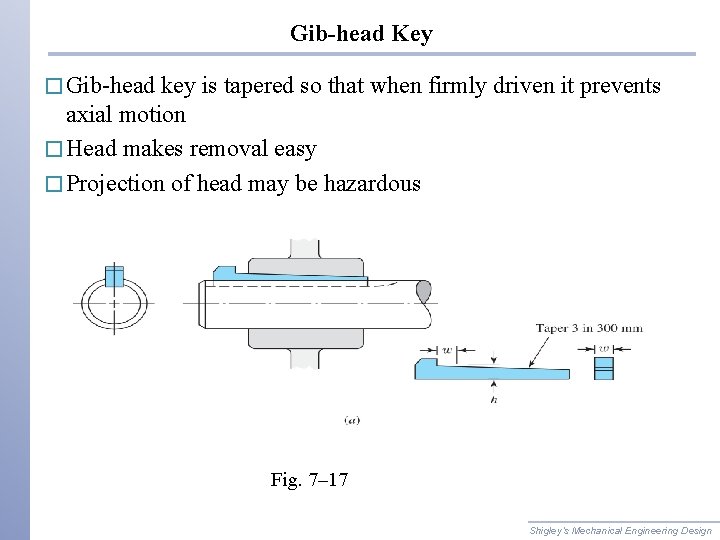
Gib-head Key � Gib-head key is tapered so that when firmly driven it prevents axial motion � Head makes removal easy � Projection of head may be hazardous Fig. 7– 17 Shigley’s Mechanical Engineering Design
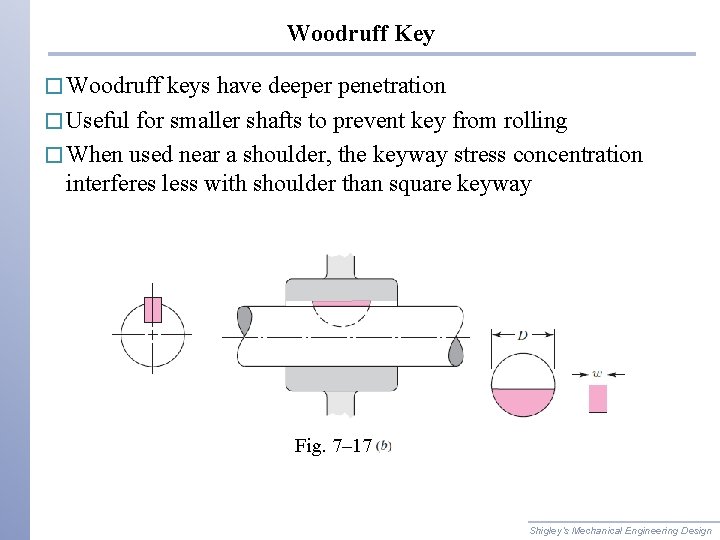
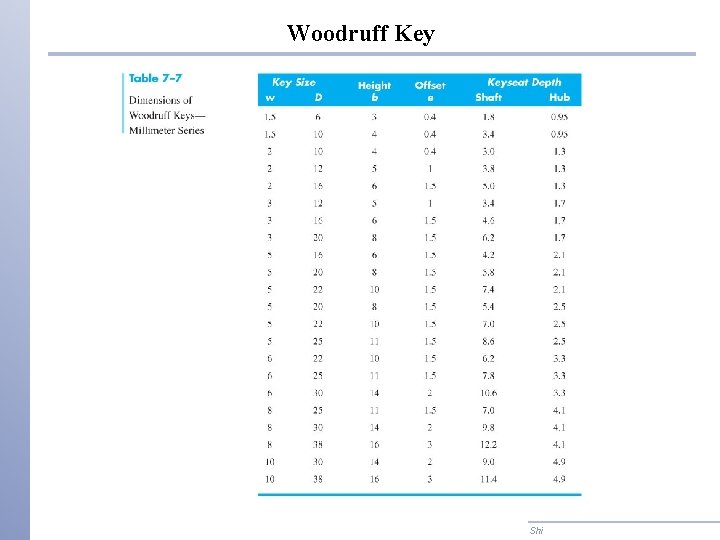
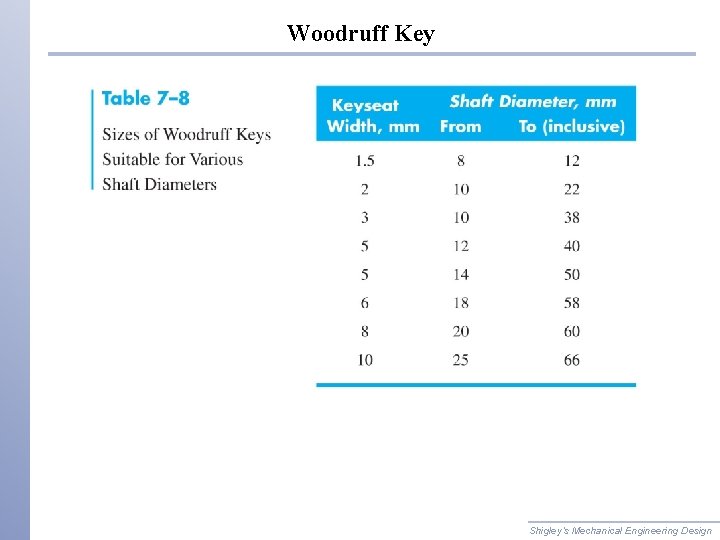
Woodruff Key � Woodruff keys have deeper penetration � Useful for smaller shafts to prevent key from rolling � When used near a shoulder, the keyway stress concentration interferes less with shoulder than square keyway Fig. 7– 17 Shigley’s Mechanical Engineering Design
Woodruff Key Shi
Woodruff Key Shigley’s Mechanical Engineering Design
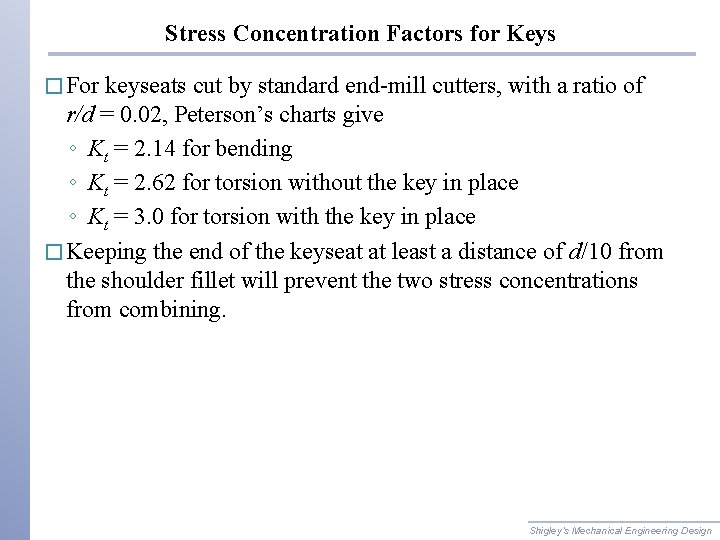
Stress Concentration Factors for Keys � For keyseats cut by standard end-mill cutters, with a ratio of r/d = 0. 02, Peterson’s charts give ◦ Kt = 2. 14 for bending ◦ Kt = 2. 62 for torsion without the key in place ◦ Kt = 3. 0 for torsion with the key in place � Keeping the end of the keyseat at least a distance of d/10 from the shoulder fillet will prevent the two stress concentrations from combining. Shigley’s Mechanical Engineering Design
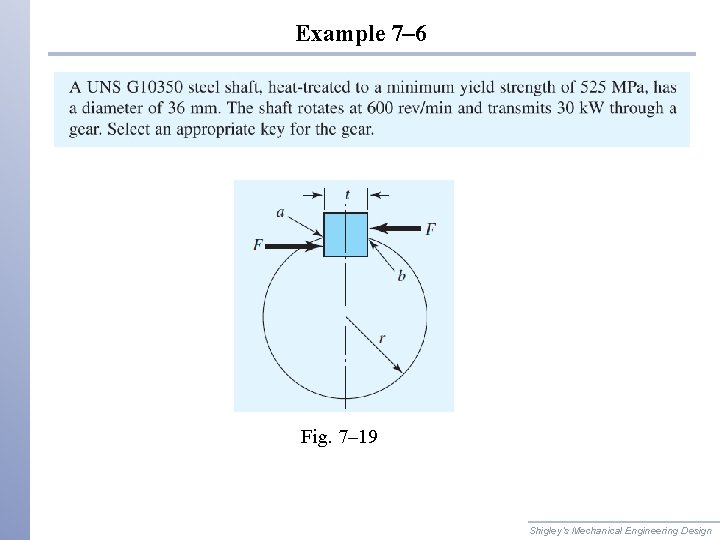
Example 7– 6 Fig. 7– 19 Shigley’s Mechanical Engineering Design
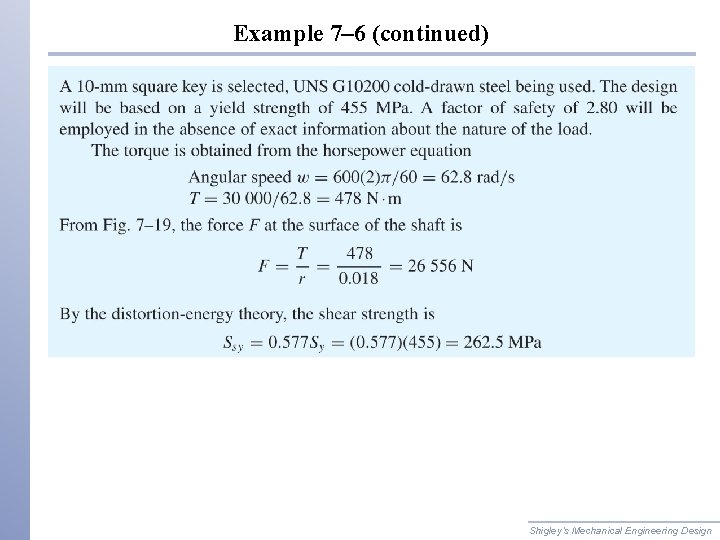
Example 7– 6 (continued) Shigley’s Mechanical Engineering Design
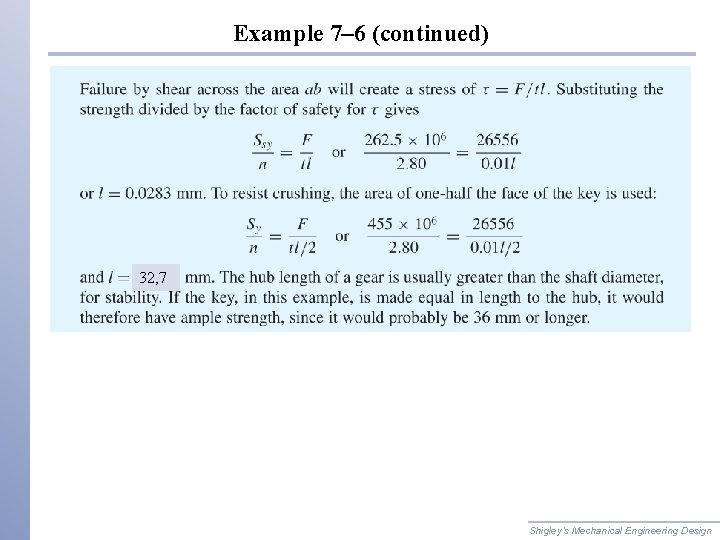
Example 7– 6 (continued) 32, 7 Shigley’s Mechanical Engineering Design
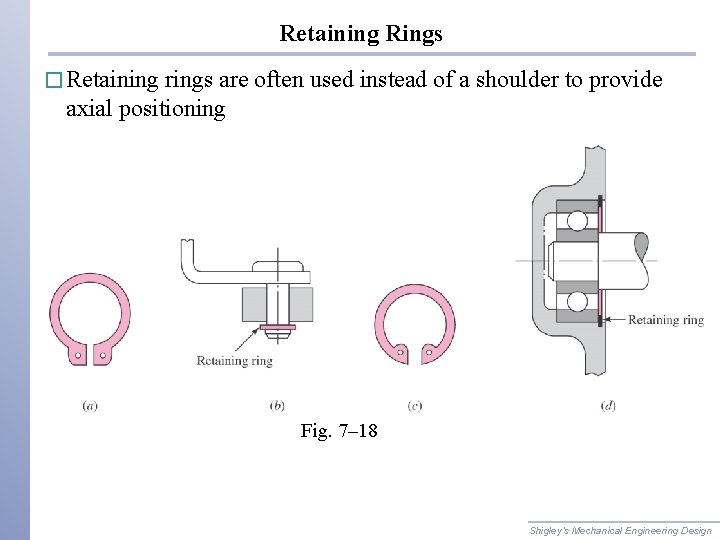
Retaining Rings � Retaining rings are often used instead of a shoulder to provide axial positioning Fig. 7– 18 Shigley’s Mechanical Engineering Design
Retaining Rings � Retaining ring must seat well in bottom of groove to support axial loads against the sides of the groove. � This requires sharp radius in bottom of groove. � Stress concentrations for flat-bottomed grooves are available in Table A– 15– 16 and A– 15– 17. � Typical stress concentration factors are high, around 5 for bending and axial, and 3 for torsion Shigley’s Mechanical Engineering Design
Stress in Interference Fits � Interference fit generates pressure at interface � Need to ensure stresses are acceptable � Treat shaft as cylinder with uniform external pressure � Treat hub as hollow cylinder with uniform internal pressure � These situations were developed in Ch. 3 and will be adapted here Shigley’s Mechanical Engineering Design
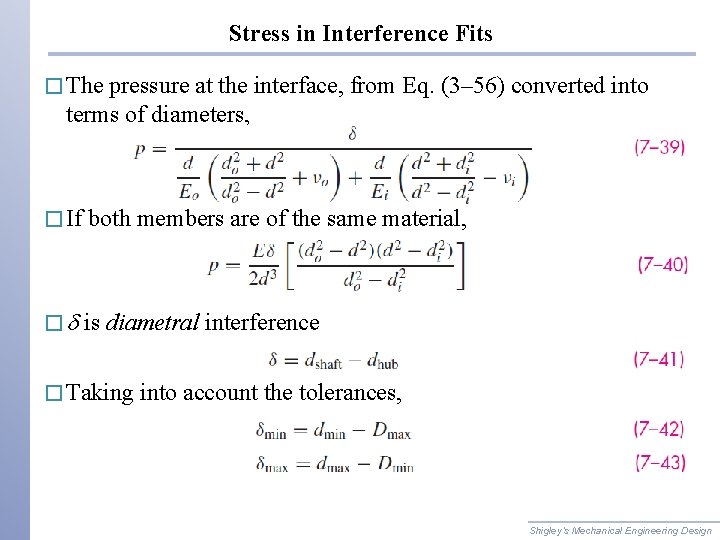
Stress in Interference Fits � The pressure at the interface, from Eq. (3– 56) converted into terms of diameters, � If both members are of the same material, �d is diametral interference � Taking into account the tolerances, Shigley’s Mechanical Engineering Design
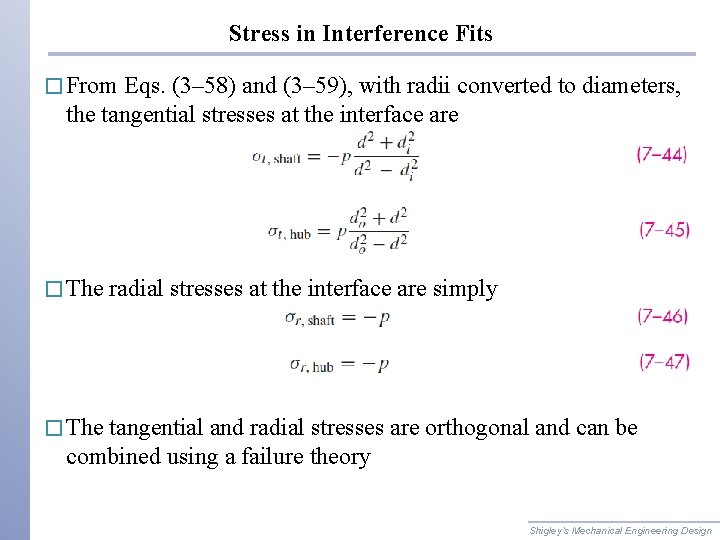
Stress in Interference Fits � From Eqs. (3– 58) and (3– 59), with radii converted to diameters, the tangential stresses at the interface are � The radial stresses at the interface are simply � The tangential and radial stresses are orthogonal and can be combined using a failure theory Shigley’s Mechanical Engineering Design
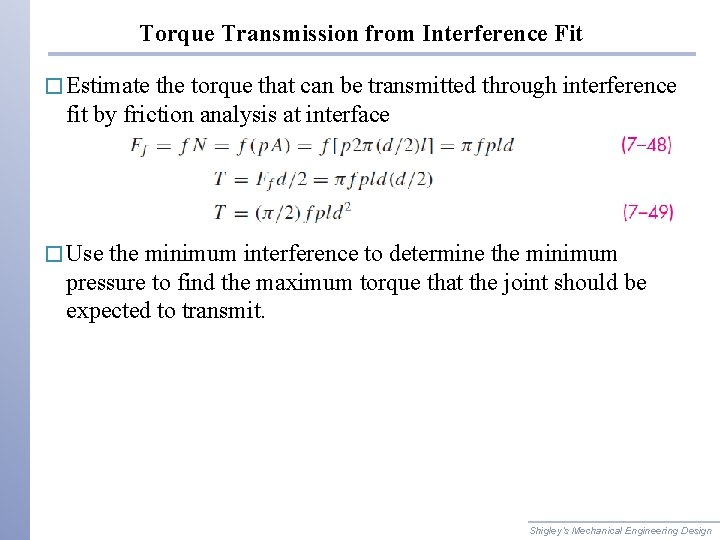
Torque Transmission from Interference Fit � Estimate the torque that can be transmitted through interference fit by friction analysis at interface � Use the minimum interference to determine the minimum pressure to find the maximum torque that the joint should be expected to transmit. Shigley’s Mechanical Engineering Design