
Lecture Presentation Chapter 7 Periodic Properties of the
- Slides: 39
Lecture Presentation Chapter 7 Periodic Properties of the Elements © 2012 Pearson Education, Inc. John D. Bookstaver St. Charles Community College Cottleville, MO
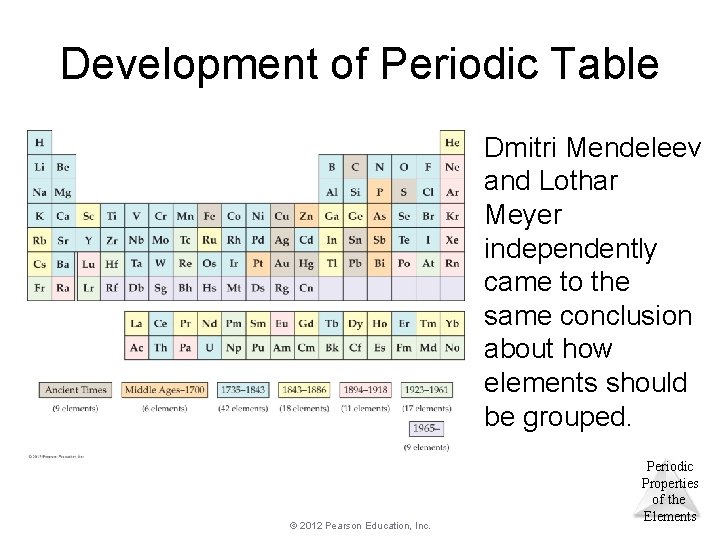
Development of Periodic Table Dmitri Mendeleev and Lothar Meyer independently came to the same conclusion about how elements should be grouped. © 2012 Pearson Education, Inc. Periodic Properties of the Elements
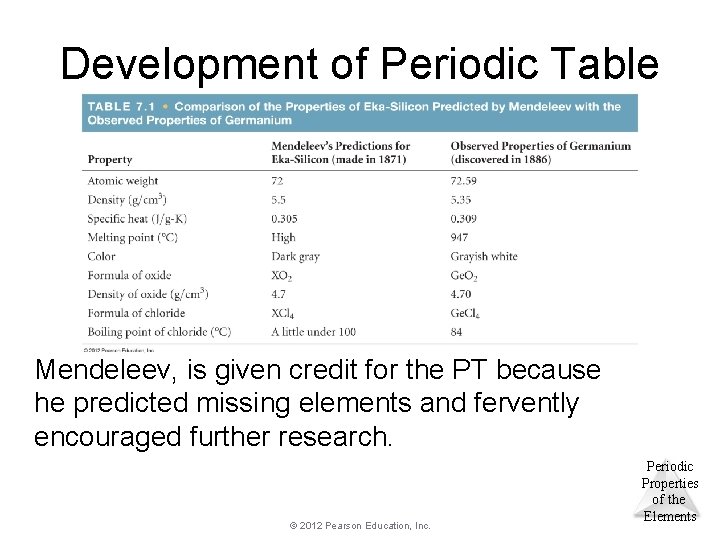
Development of Periodic Table Mendeleev, is given credit for the PT because he predicted missing elements and fervently encouraged further research. © 2012 Pearson Education, Inc. Periodic Properties of the Elements
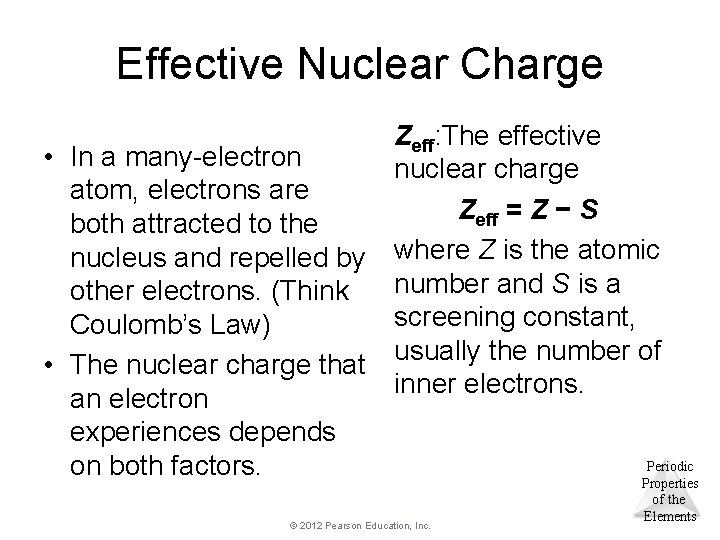
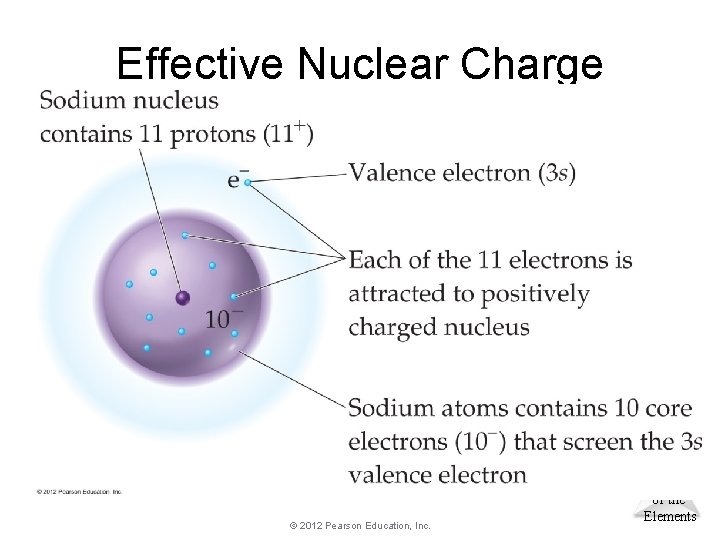
Effective Nuclear Charge • In a many-electron atom, electrons are both attracted to the nucleus and repelled by other electrons. (Think Coulomb’s Law) • The nuclear charge that an electron experiences depends on both factors. Zeff: The effective nuclear charge Zeff = Z − S where Z is the atomic number and S is a screening constant, usually the number of inner electrons. © 2012 Pearson Education, Inc. Periodic Properties of the Elements
Effective Nuclear Charge © 2012 Pearson Education, Inc. Periodic Properties of the Elements
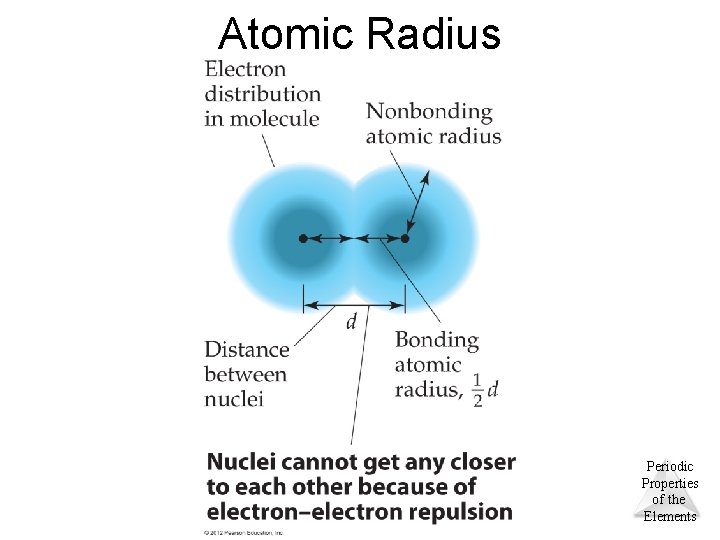
Atomic Radius © 2012 Pearson Education, Inc. Periodic Properties of the Elements
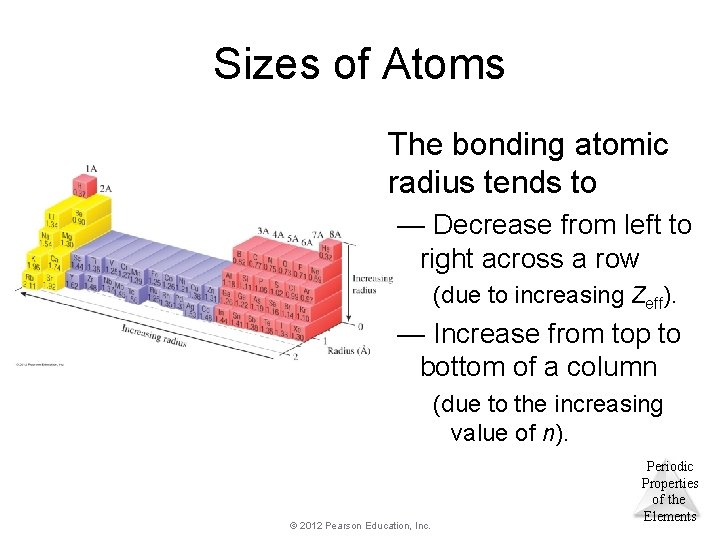
Sizes of Atoms The bonding atomic radius tends to — Decrease from left to right across a row (due to increasing Zeff). — Increase from top to bottom of a column (due to the increasing value of n). © 2012 Pearson Education, Inc. Periodic Properties of the Elements
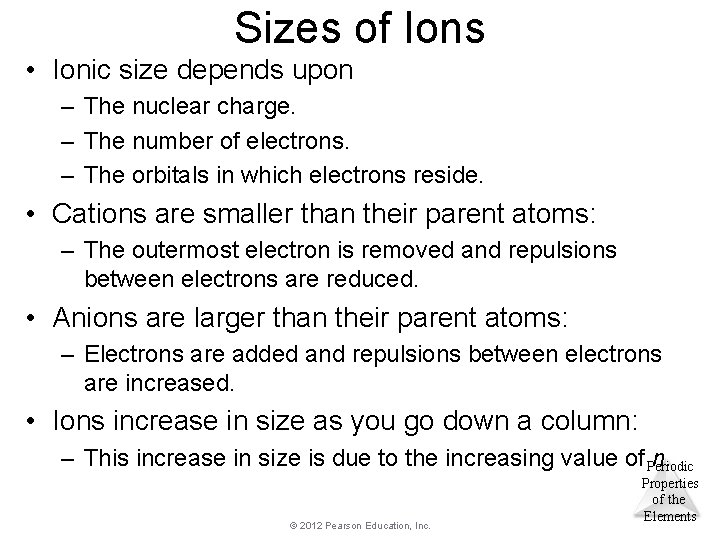
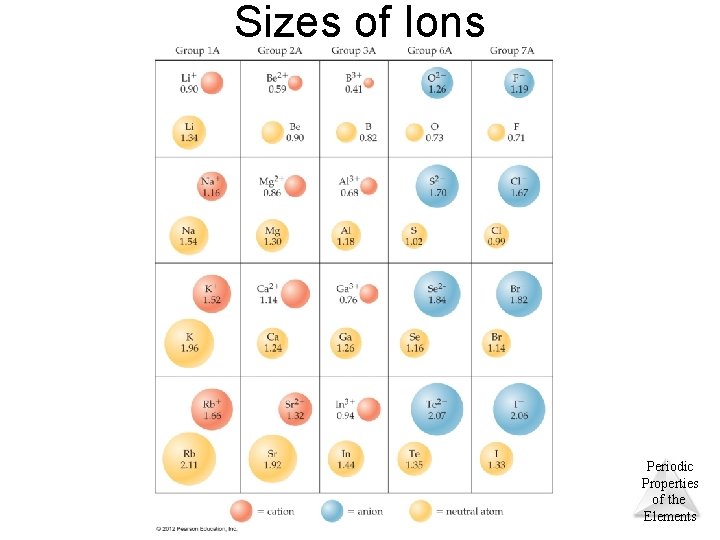
Sizes of Ions • Ionic size depends upon – The nuclear charge. – The number of electrons. – The orbitals in which electrons reside. • Cations are smaller than their parent atoms: – The outermost electron is removed and repulsions between electrons are reduced. • Anions are larger than their parent atoms: – Electrons are added and repulsions between electrons are increased. • Ions increase in size as you go down a column: – This increase in size is due to the increasing value of Periodic n. © 2012 Pearson Education, Inc. Properties of the Elements
Sizes of Ions © 2012 Pearson Education, Inc. Periodic Properties of the Elements
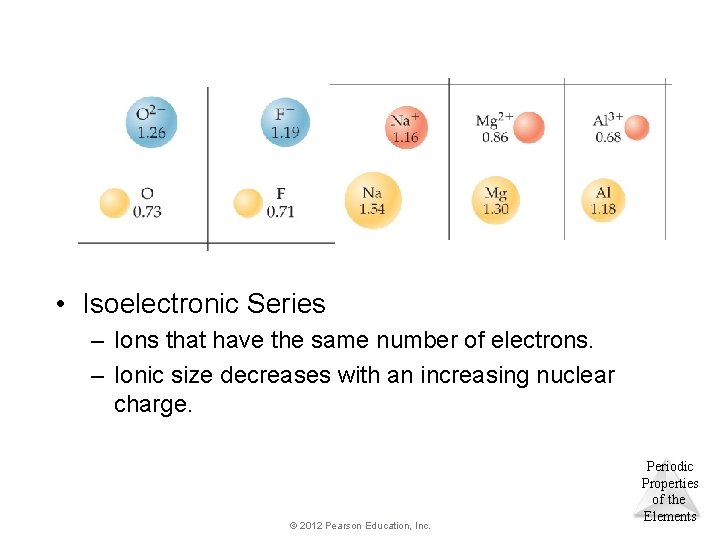
• Isoelectronic Series – Ions that have the same number of electrons. – Ionic size decreases with an increasing nuclear charge. © 2012 Pearson Education, Inc. Periodic Properties of the Elements
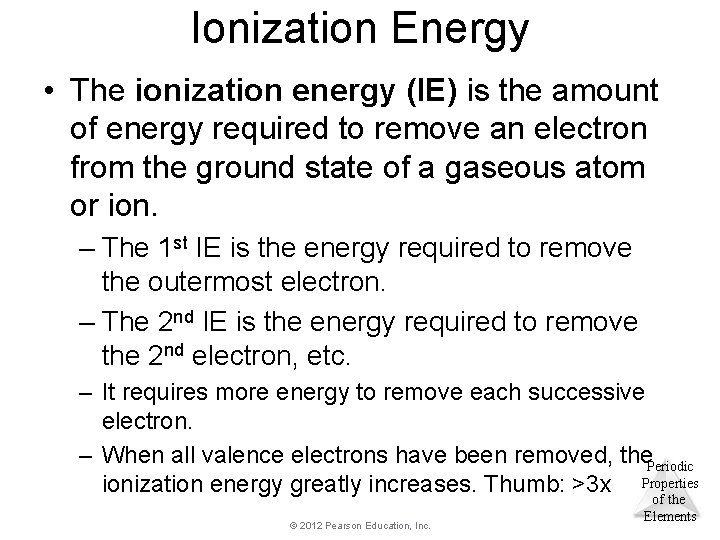
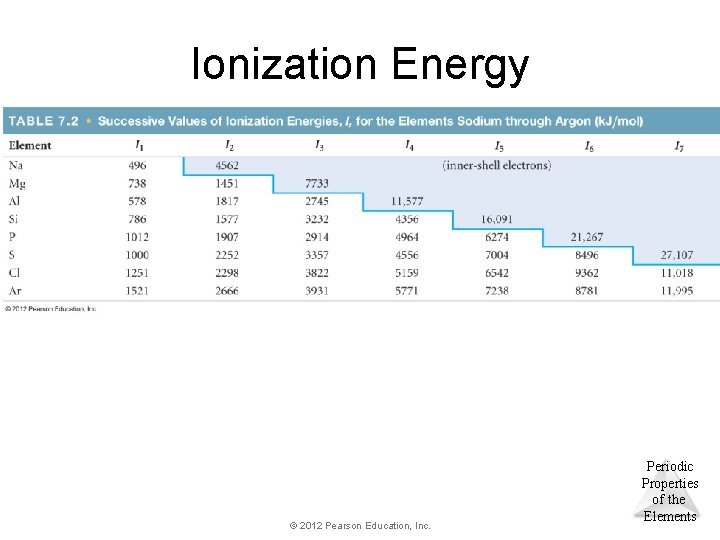
Ionization Energy • The ionization energy (IE) is the amount of energy required to remove an electron from the ground state of a gaseous atom or ion. – The 1 st IE is the energy required to remove the outermost electron. – The 2 nd IE is the energy required to remove the 2 nd electron, etc. – It requires more energy to remove each successive electron. – When all valence electrons have been removed, the. Periodic ionization energy greatly increases. Thumb: >3 x Properties of the © 2012 Pearson Education, Inc. Elements
Ionization Energy © 2012 Pearson Education, Inc. Periodic Properties of the Elements
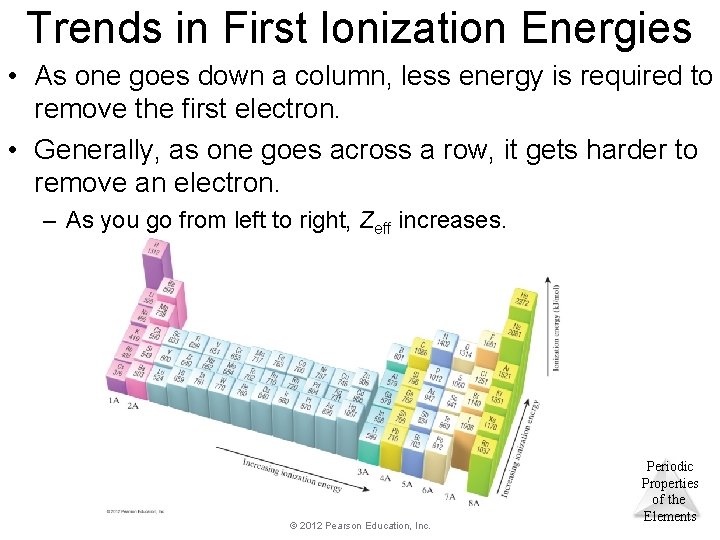
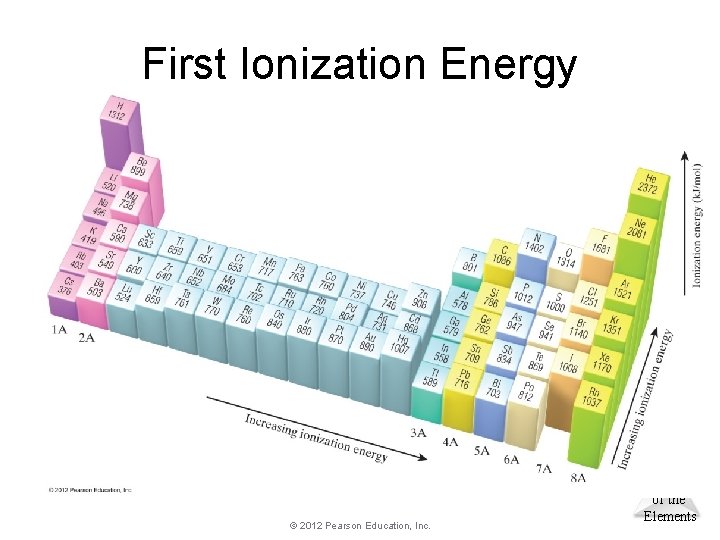
Trends in First Ionization Energies • As one goes down a column, less energy is required to remove the first electron. • Generally, as one goes across a row, it gets harder to remove an electron. – As you go from left to right, Zeff increases. © 2012 Pearson Education, Inc. Periodic Properties of the Elements
First Ionization Energy © 2012 Pearson Education, Inc. Periodic Properties of the Elements
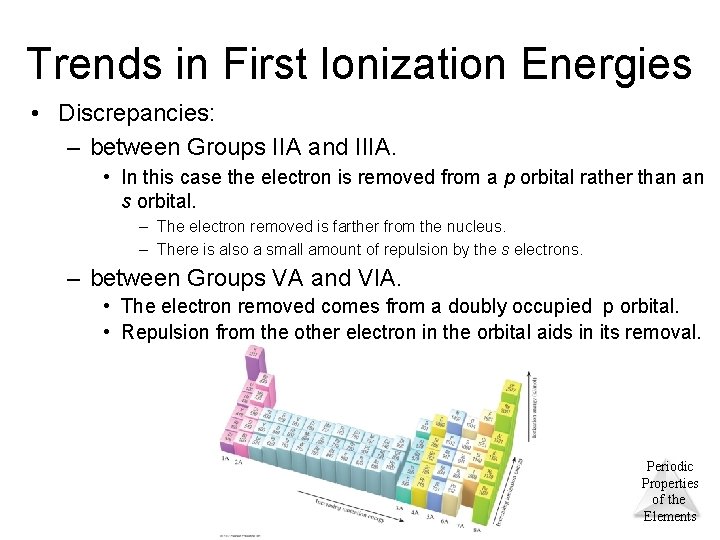
Trends in First Ionization Energies • Discrepancies: – between Groups IIA and IIIA. • In this case the electron is removed from a p orbital rather than an s orbital. – The electron removed is farther from the nucleus. – There is also a small amount of repulsion by the s electrons. – between Groups VA and VIA. • The electron removed comes from a doubly occupied p orbital. • Repulsion from the other electron in the orbital aids in its removal. © 2012 Pearson Education, Inc. Periodic Properties of the Elements
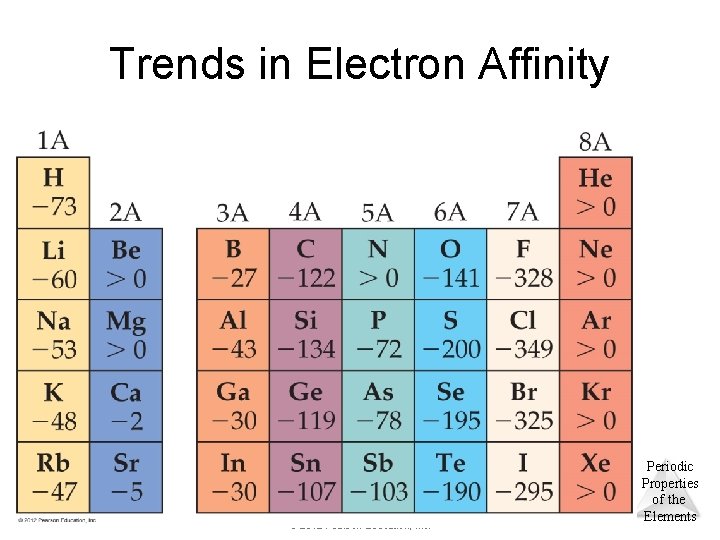
Electron Affinity Electron affinity is the energy change accompanying the addition of an electron to a gaseous atom: Cl + e− Cl− • In general, electron affinity becomes more exothermic as you go from left to Periodic right across a row. Properties © 2012 Pearson Education, Inc. of the Elements
Trends in Electron Affinity © 2012 Pearson Education, Inc. Periodic Properties of the Elements
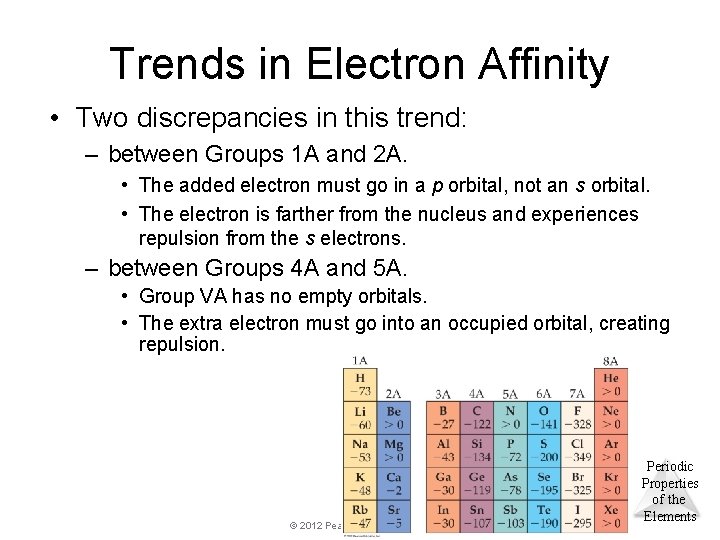
Trends in Electron Affinity • Two discrepancies in this trend: – between Groups 1 A and 2 A. • The added electron must go in a p orbital, not an s orbital. • The electron is farther from the nucleus and experiences repulsion from the s electrons. – between Groups 4 A and 5 A. • Group VA has no empty orbitals. • The extra electron must go into an occupied orbital, creating repulsion. © 2012 Pearson Education, Inc. Periodic Properties of the Elements
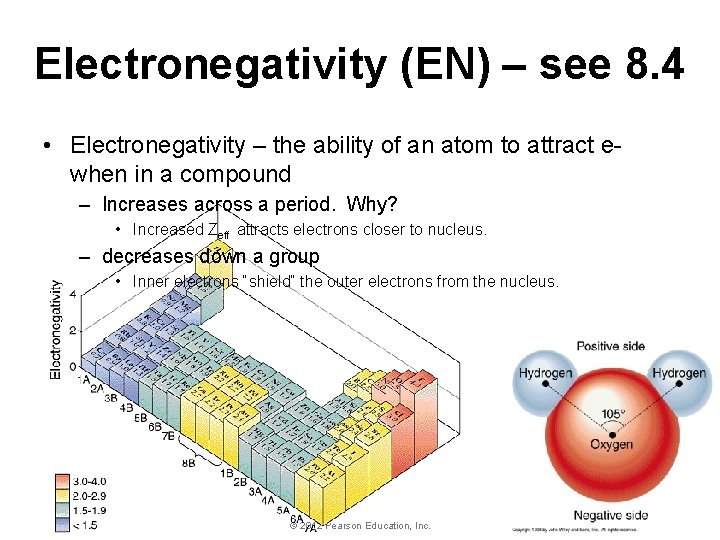
Electronegativity (EN) – see 8. 4 • Electronegativity – the ability of an atom to attract ewhen in a compound – Increases across a period. Why? • Increased Zeff attracts electrons closer to nucleus. – decreases down a group • Inner electrons “shield” the outer electrons from the nucleus. © 2012 Pearson Education, Inc. Periodic Properties of the Elements
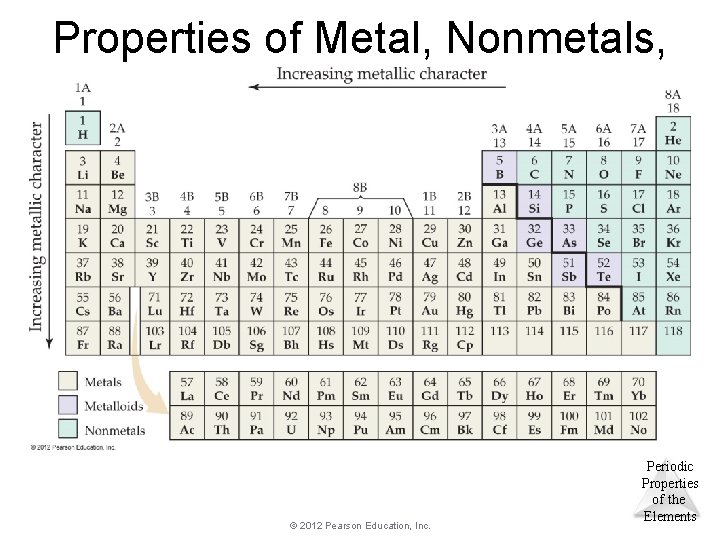
Properties of Metal, Nonmetals, and Metalloids © 2012 Pearson Education, Inc. Periodic Properties of the Elements
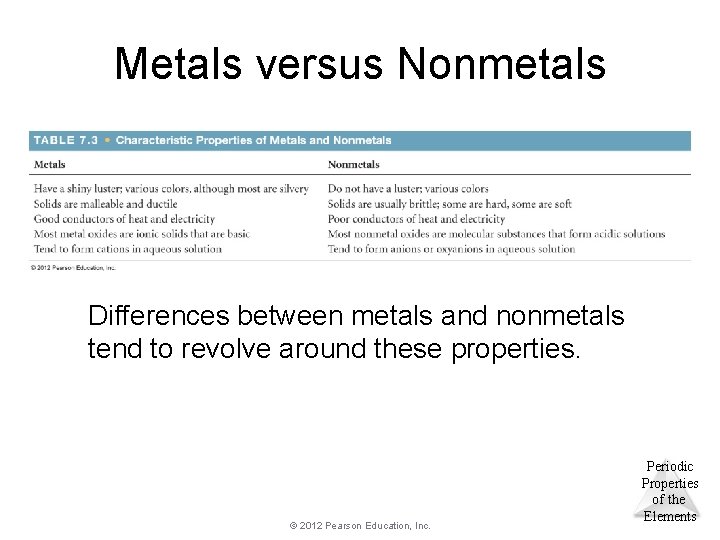
Metals versus Nonmetals Differences between metals and nonmetals tend to revolve around these properties. © 2012 Pearson Education, Inc. Periodic Properties of the Elements
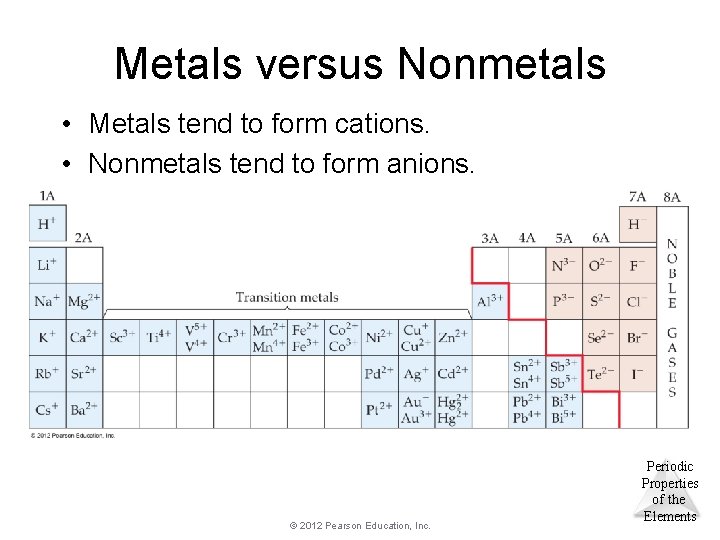
Metals versus Nonmetals • Metals tend to form cations. • Nonmetals tend to form anions. © 2012 Pearson Education, Inc. Periodic Properties of the Elements
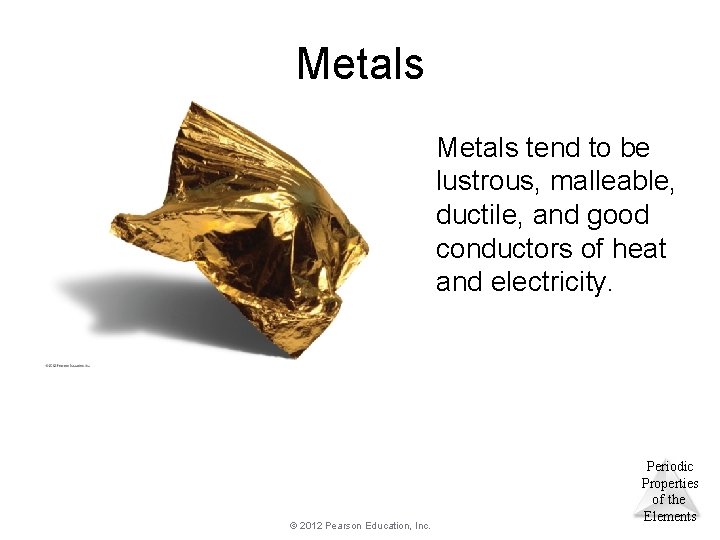
Metals tend to be lustrous, malleable, ductile, and good conductors of heat and electricity. © 2012 Pearson Education, Inc. Periodic Properties of the Elements
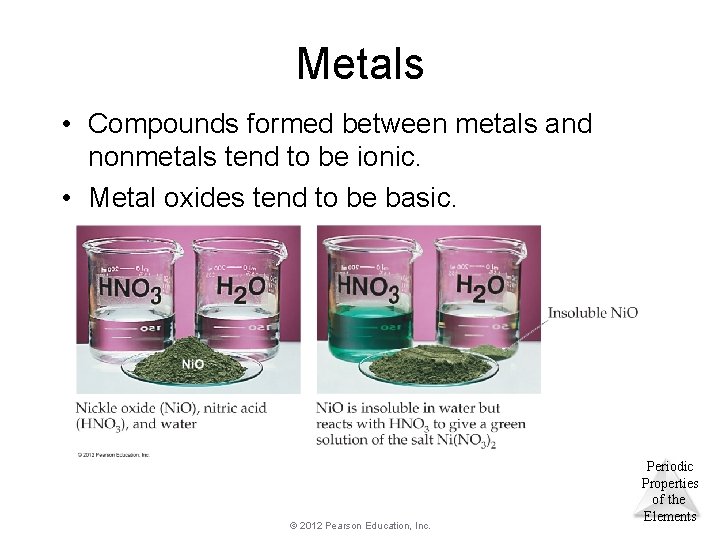
Metals • Compounds formed between metals and nonmetals tend to be ionic. • Metal oxides tend to be basic. © 2012 Pearson Education, Inc. Periodic Properties of the Elements
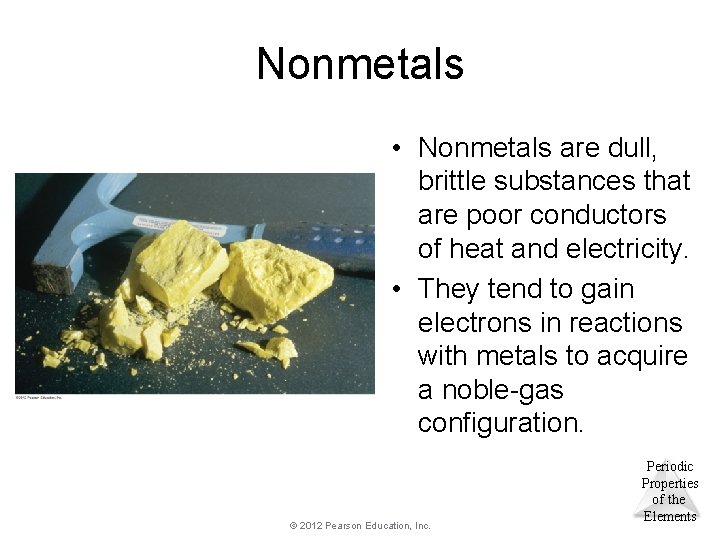
Nonmetals • Nonmetals are dull, brittle substances that are poor conductors of heat and electricity. • They tend to gain electrons in reactions with metals to acquire a noble-gas configuration. © 2012 Pearson Education, Inc. Periodic Properties of the Elements
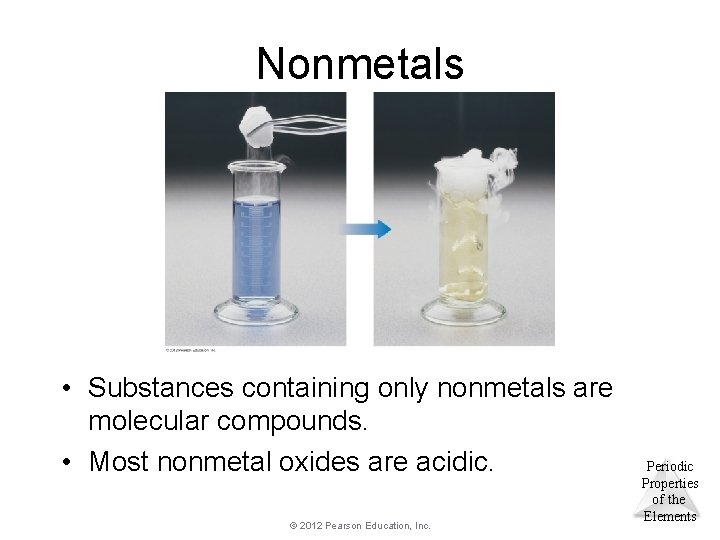
Nonmetals • Substances containing only nonmetals are molecular compounds. • Most nonmetal oxides are acidic. © 2012 Pearson Education, Inc. Periodic Properties of the Elements
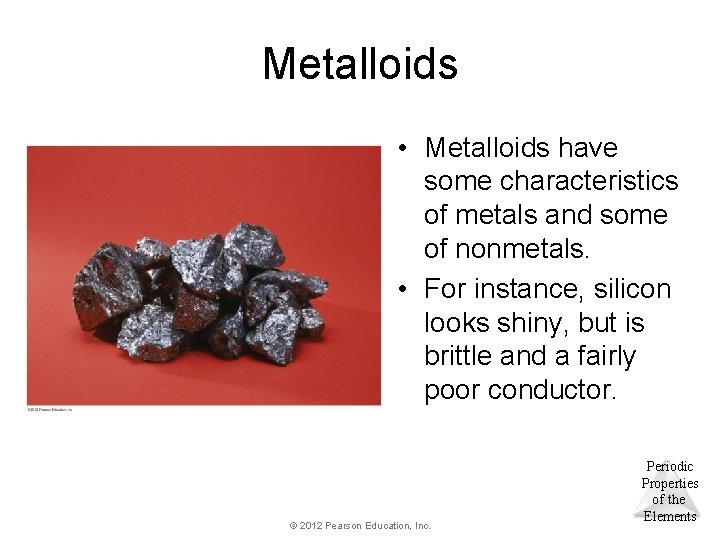
Metalloids • Metalloids have some characteristics of metals and some of nonmetals. • For instance, silicon looks shiny, but is brittle and a fairly poor conductor. © 2012 Pearson Education, Inc. Periodic Properties of the Elements
Group Trends • If you feel the need to write this down, please access it on Mastering Chemistry and do so. This relates to the reaction types we learned in Honors Chemistry. © 2012 Pearson Education, Inc. Periodic Properties of the Elements
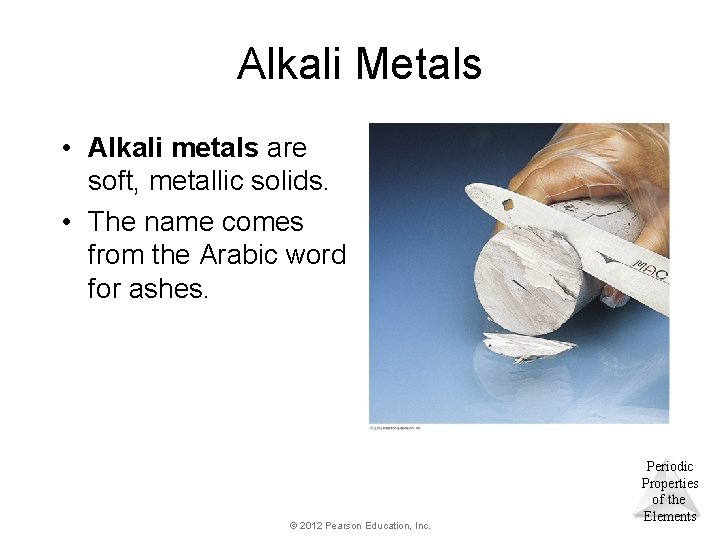
Alkali Metals • Alkali metals are soft, metallic solids. • The name comes from the Arabic word for ashes. © 2012 Pearson Education, Inc. Periodic Properties of the Elements
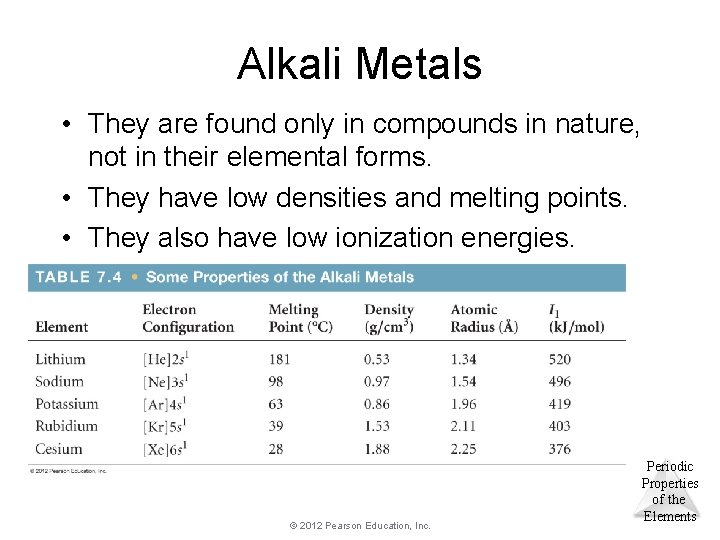
Alkali Metals • They are found only in compounds in nature, not in their elemental forms. • They have low densities and melting points. • They also have low ionization energies. © 2012 Pearson Education, Inc. Periodic Properties of the Elements
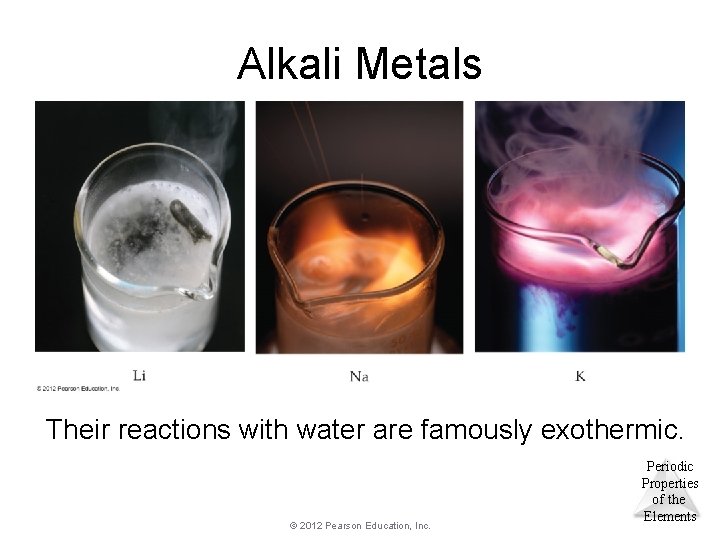
Alkali Metals Their reactions with water are famously exothermic. © 2012 Pearson Education, Inc. Periodic Properties of the Elements
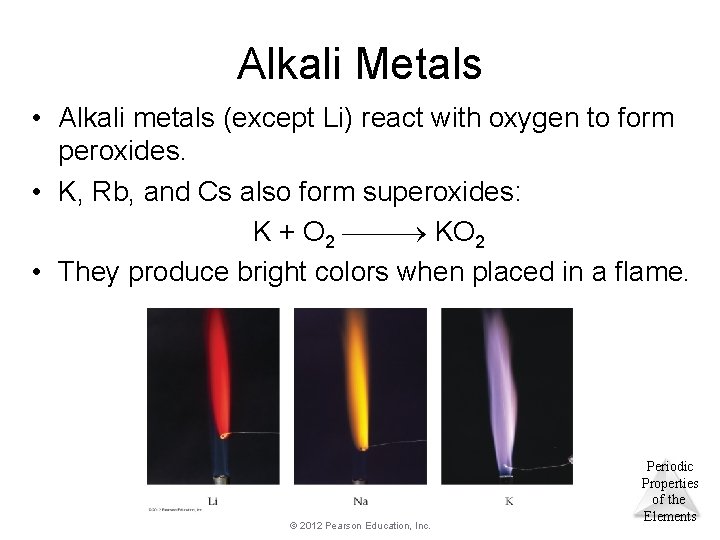
Alkali Metals • Alkali metals (except Li) react with oxygen to form peroxides. • K, Rb, and Cs also form superoxides: K + O 2 KO 2 • They produce bright colors when placed in a flame. © 2012 Pearson Education, Inc. Periodic Properties of the Elements
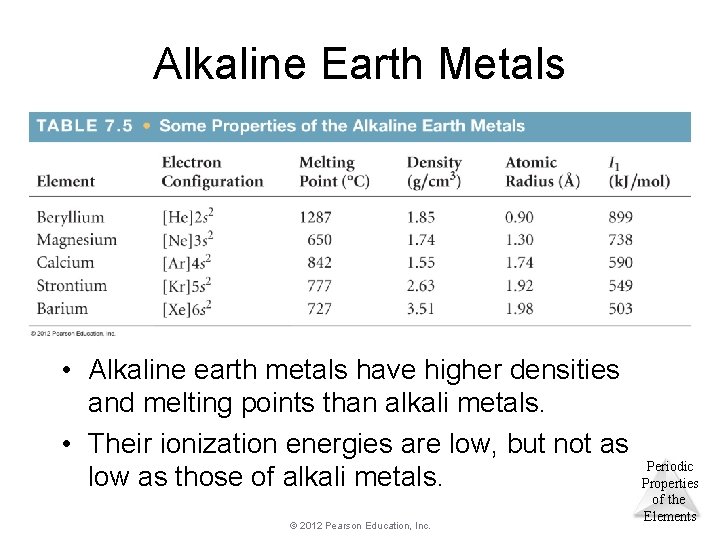
Alkaline Earth Metals • Alkaline earth metals have higher densities and melting points than alkali metals. • Their ionization energies are low, but not as low as those of alkali metals. © 2012 Pearson Education, Inc. Periodic Properties of the Elements
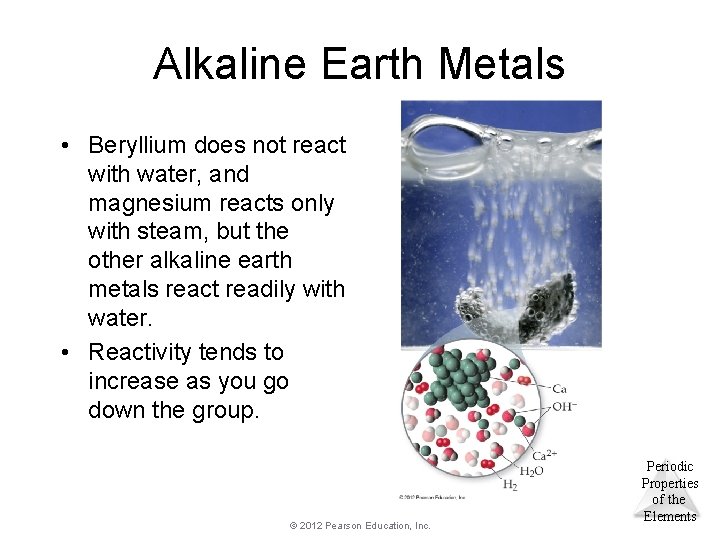
Alkaline Earth Metals • Beryllium does not react with water, and magnesium reacts only with steam, but the other alkaline earth metals react readily with water. • Reactivity tends to increase as you go down the group. © 2012 Pearson Education, Inc. Periodic Properties of the Elements
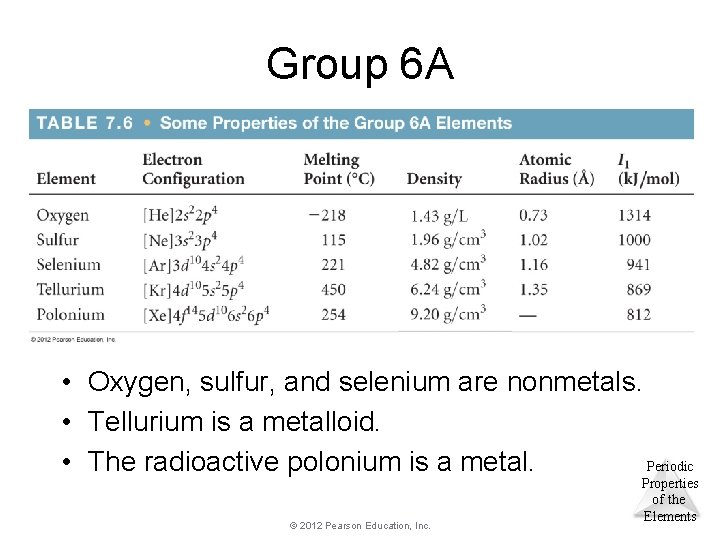
Group 6 A • Oxygen, sulfur, and selenium are nonmetals. • Tellurium is a metalloid. Periodic • The radioactive polonium is a metal. © 2012 Pearson Education, Inc. Properties of the Elements
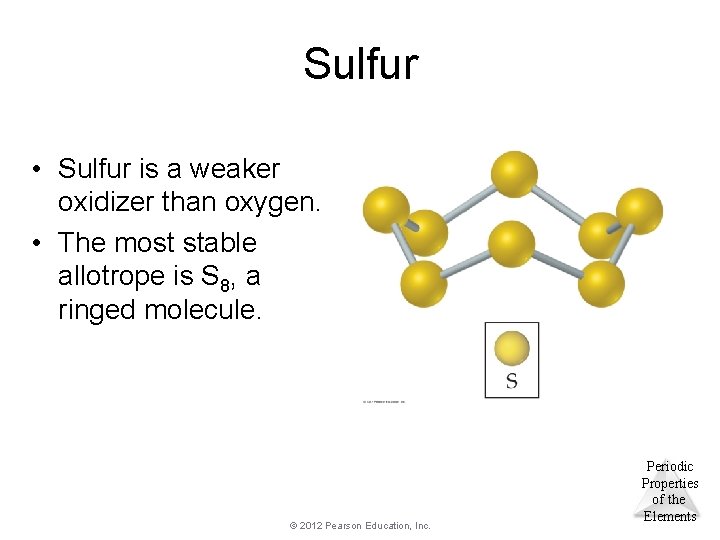
Sulfur • Sulfur is a weaker oxidizer than oxygen. • The most stable allotrope is S 8, a ringed molecule. © 2012 Pearson Education, Inc. Periodic Properties of the Elements
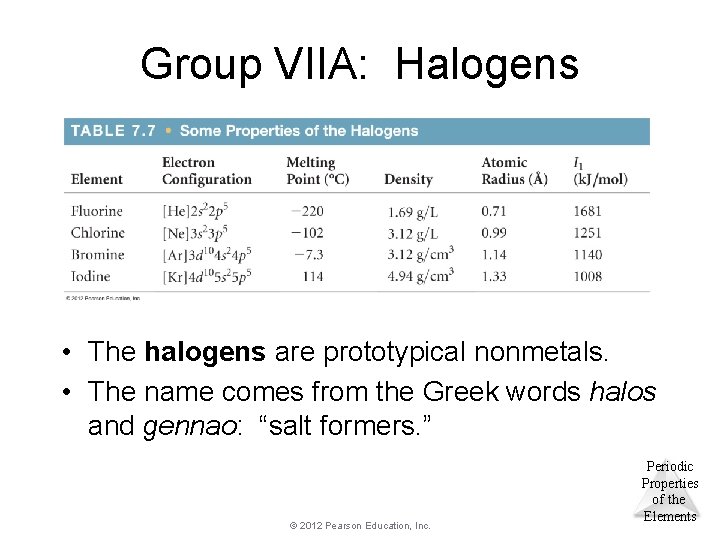
Group VIIA: Halogens • The halogens are prototypical nonmetals. • The name comes from the Greek words halos and gennao: “salt formers. ” © 2012 Pearson Education, Inc. Periodic Properties of the Elements
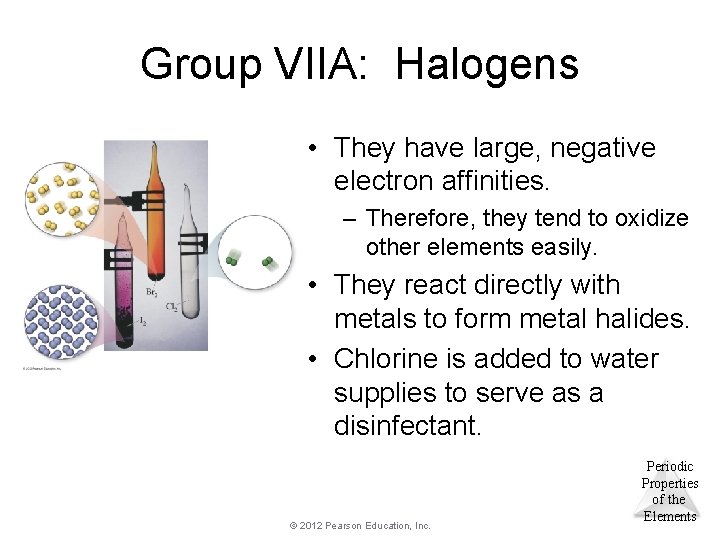
Group VIIA: Halogens • They have large, negative electron affinities. – Therefore, they tend to oxidize other elements easily. • They react directly with metals to form metal halides. • Chlorine is added to water supplies to serve as a disinfectant. © 2012 Pearson Education, Inc. Periodic Properties of the Elements
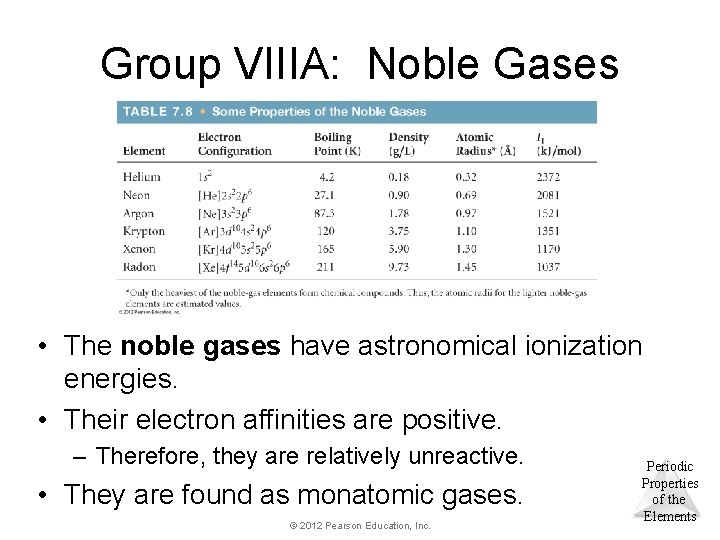
Group VIIIA: Noble Gases • The noble gases have astronomical ionization energies. • Their electron affinities are positive. – Therefore, they are relatively unreactive. • They are found as monatomic gases. © 2012 Pearson Education, Inc. Periodic Properties of the Elements