
Lecture Presentation Chapter 3 Matter and Energy John
- Slides: 60
Lecture Presentation Chapter 3 Matter and Energy John Singer Jackson College © 2018 Pearson Education, Inc.
Matter • Matter is any substance that has mass and occupies volume. • Matter exists in one of three physical states: 1. Solid 2. Liquid 3. Gas © 2018 Pearson Education, Inc.
Kinetic-Molecular Theory • The Kinetic-Molecular theory can be used to explain the states of matter in terms of the motions and energy of particles. © 2018 Pearson Education, Inc.
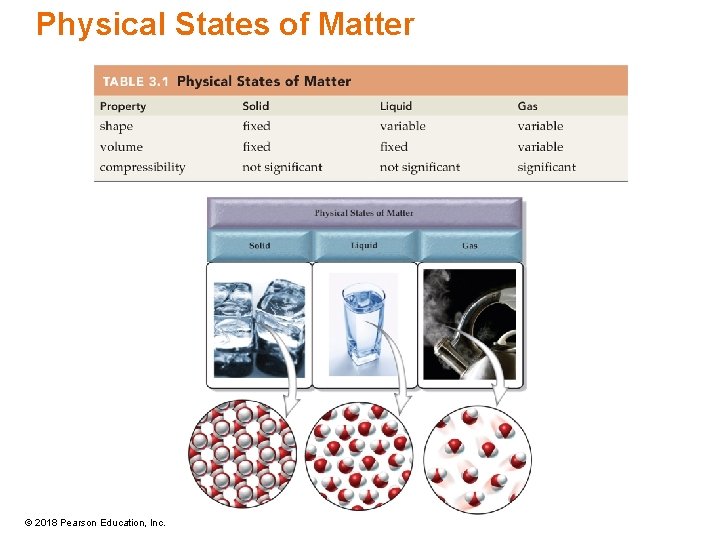
Solid State Definition • Solids have a definite, fixed shape. • Solids cannot be compressed and have a definite volume. © 2018 Pearson Education, Inc.
Solid State Kinetic-Molecular Theory • In a solid, the particles of matter are tightly packed together. • Solids have the least energy of the three states of matter. © 2018 Pearson Education, Inc.
Liquid State Definition • Liquids have an indefinite shape and assume the shape of their container. • Liquids cannot be compressed and have a definite volume. © 2018 Pearson Education, Inc.
Liquid State Kinetic-Molecular Theory • In a liquid, the particles of matter are loosely packed and are free to move past one another. • Liquids have less energy than gases but more energy than solids. © 2018 Pearson Education, Inc.
Gaseous State Definition • Gases have an indefinite shape and assume the shape of their container. • Gases can be compressed and have an indefinite volume. © 2018 Pearson Education, Inc.
Gaseous State Kinetic-Molecular Theory • In a gas, the particles of matter are far apart and uniformly distributed throughout the container. • Gases have the most energy of the three states of matter. © 2018 Pearson Education, Inc.
Physical States of Matter © 2018 Pearson Education, Inc.
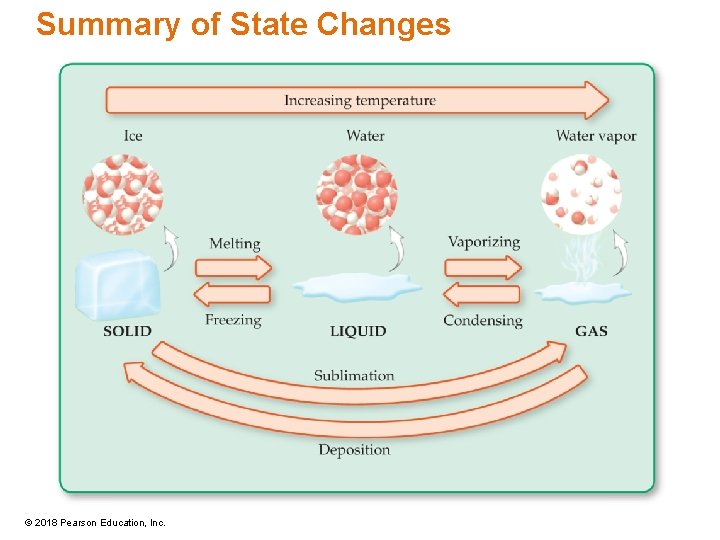
Changes in Physical States • Most substances can exist as either a solid, a liquid, or a gas. – For example: Water exists as a solid below 0 °C; as a liquid between 0 °C and 100 °C; and as a gas above 100 °C. © 2018 Pearson Education, Inc.
Solid ↔ Liquid Phase Changes • When a solid changes to a liquid, the phase change is called melting. • A substance melts as the temperature increases. • When a liquid changes to a solid, the phase change is called freezing. • A substance freezes as the temperature decreases. © 2018 Pearson Education, Inc.
Liquid ↔ Gas Phase Changes • When a liquid changes to a gas, the phase change is called vaporizing. • A substance vaporizes as the temperature increases. • When a gas changes to a liquid, the phase change is called condensing. • A substance condenses as the temperature decreases. © 2018 Pearson Education, Inc.
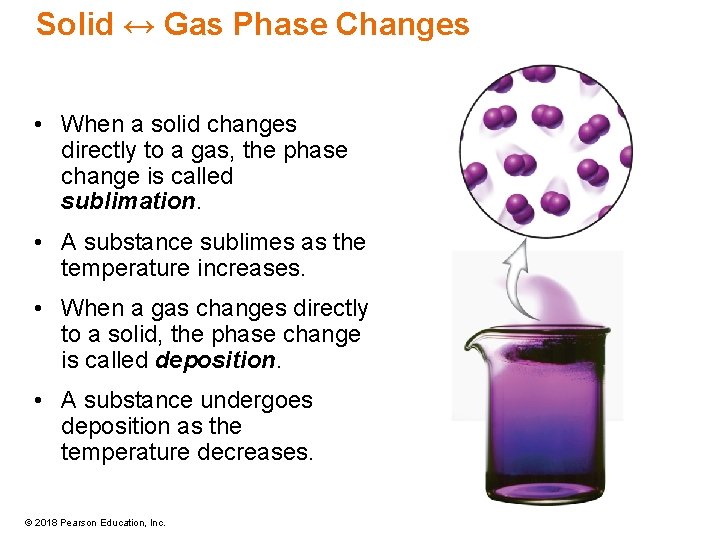
Solid ↔ Gas Phase Changes • When a solid changes directly to a gas, the phase change is called sublimation. • A substance sublimes as the temperature increases. • When a gas changes directly to a solid, the phase change is called deposition. • A substance undergoes deposition as the temperature decreases. © 2018 Pearson Education, Inc.
Summary of State Changes © 2018 Pearson Education, Inc.
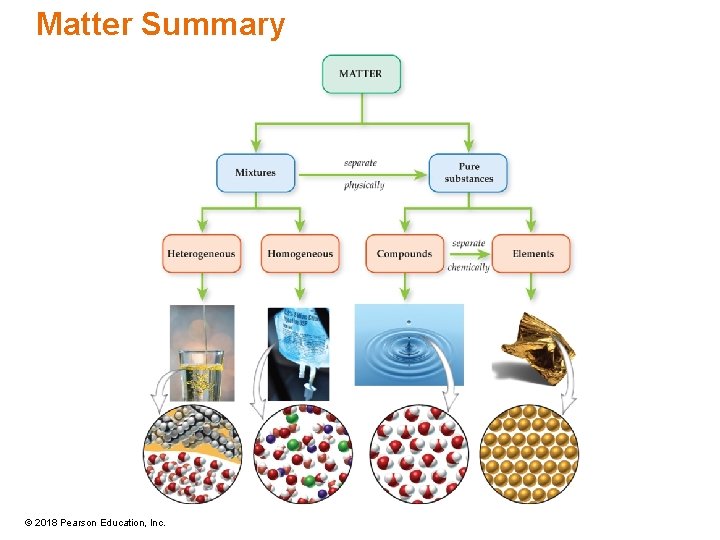
Classifications of Matter • Matter can be divided into two classes: 1. Mixtures 2. Pure substances © 2018 Pearson Education, Inc.
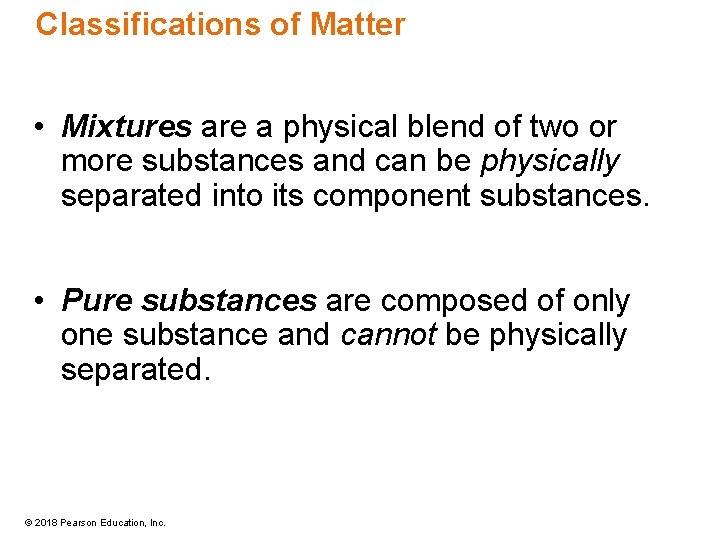
Classifications of Matter • Mixtures are a physical blend of two or more substances and can be physically separated into its component substances. • Pure substances are composed of only one substance and cannot be physically separated. © 2018 Pearson Education, Inc.
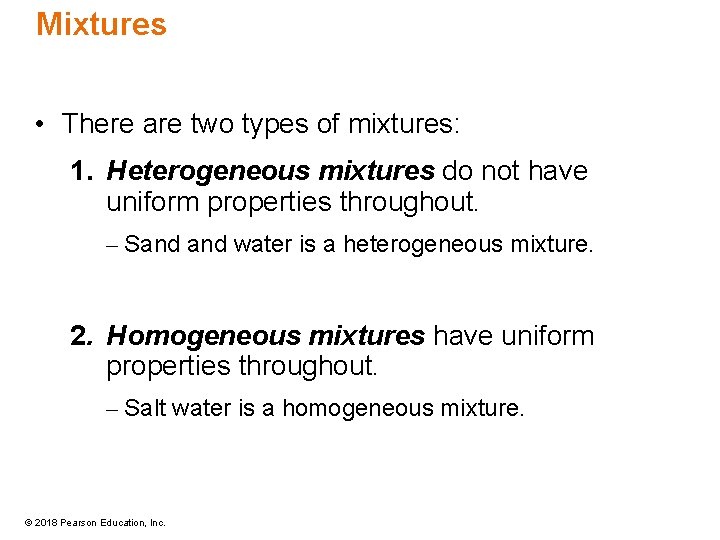
Mixtures • There are two types of mixtures: 1. Heterogeneous mixtures do not have uniform properties throughout. ‒ Sand water is a heterogeneous mixture. 2. Homogeneous mixtures have uniform properties throughout. ‒ Salt water is a homogeneous mixture. © 2018 Pearson Education, Inc.
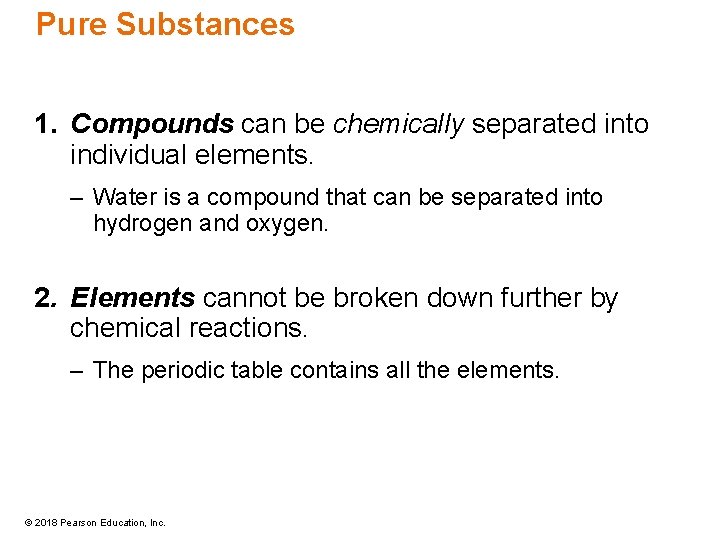
Pure Substances 1. Compounds can be chemically separated into individual elements. – Water is a compound that can be separated into hydrogen and oxygen. 2. Elements cannot be broken down further by chemical reactions. – The periodic table contains all the elements. © 2018 Pearson Education, Inc.
Matter Summary © 2018 Pearson Education, Inc.
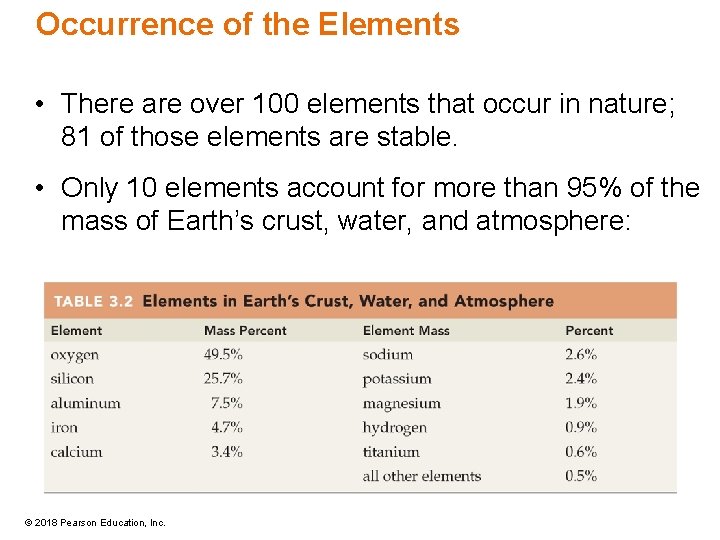
Occurrence of the Elements • There are over 100 elements that occur in nature; 81 of those elements are stable. • Only 10 elements account for more than 95% of the mass of Earth’s crust, water, and atmosphere: © 2018 Pearson Education, Inc.
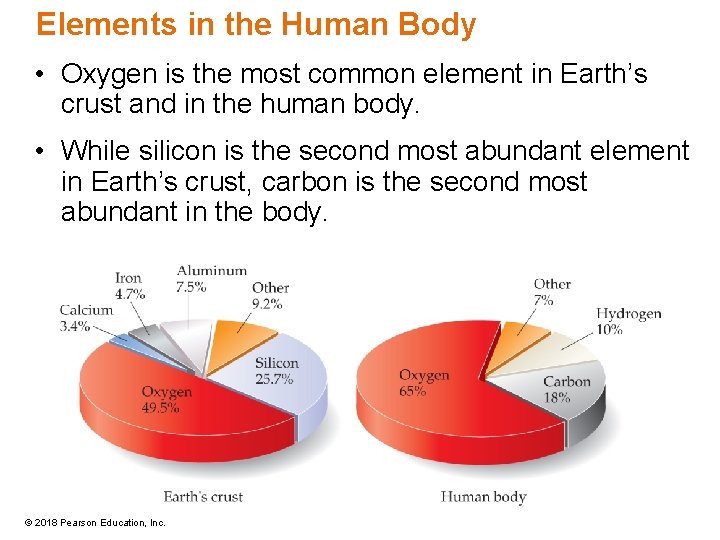
Elements in the Human Body • Oxygen is the most common element in Earth’s crust and in the human body. • While silicon is the second most abundant element in Earth’s crust, carbon is the second most abundant in the body. © 2018 Pearson Education, Inc.
Names of the Elements • Each element has a unique name. • Names have several origins. – Hydrogen is derived from Greek. – Carbon is derived from Latin. – Curium is named for Marie Curie. © 2018 Pearson Education, Inc.
Element Symbols • Each element is abbreviated using a oneor two-letter chemical symbol. • Note: When a symbol has two letters, the first is capitalized, and the second is lowercase. © 2018 Pearson Education, Inc.
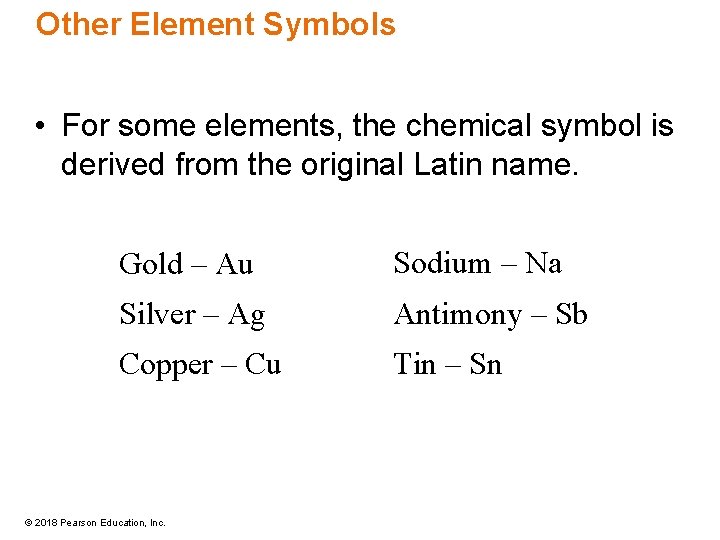
Other Element Symbols • For some elements, the chemical symbol is derived from the original Latin name. Gold – Au Sodium – Na Silver – Ag Antimony – Sb Copper – Cu Tin – Sn © 2018 Pearson Education, Inc.
Names of Elements • Many metals have names that end in –ium. – For example: magnesium, chromium, titanium © 2018 Pearson Education, Inc.
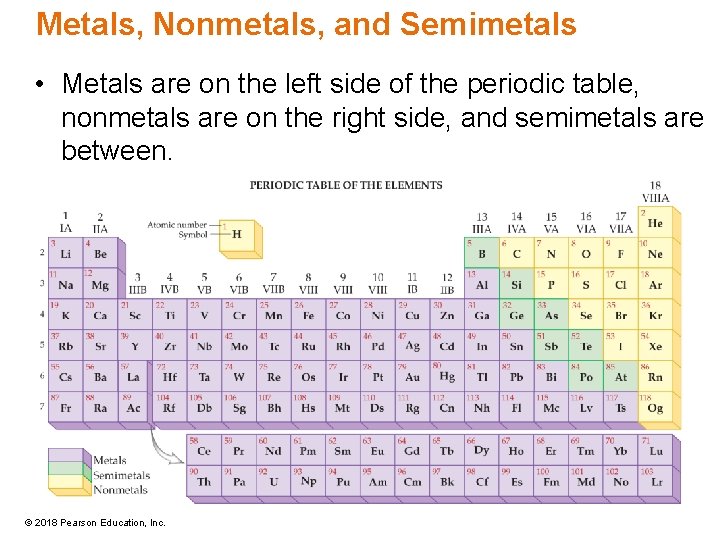
Types of Elements • Elements can be divided into three classes: 1. Metals 2. Nonmetals 3. Semimetals or metalloids © 2018 Pearson Education, Inc.
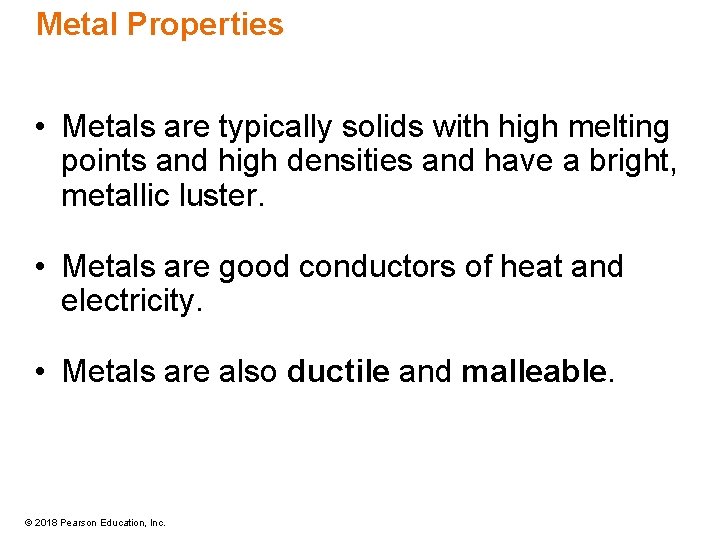
Metal Properties • Metals are typically solids with high melting points and high densities and have a bright, metallic luster. • Metals are good conductors of heat and electricity. • Metals are also ductile and malleable. © 2018 Pearson Education, Inc.
Nonmetal Properties • Nonmetals typically have low melting points and low densities and have a dull appearance. • Nonmetals are poor conductors of heat and electricity. • Nonmetals are not malleable or ductile and crush into a powder when hammered. © 2018 Pearson Education, Inc.
Semimetal or Metalloid Properties • Semimetals typically exhibit properties of both metals and nonmetals. – For example: Silicon is a semiconductor and will only conduct electricity under some conditions. © 2018 Pearson Education, Inc.
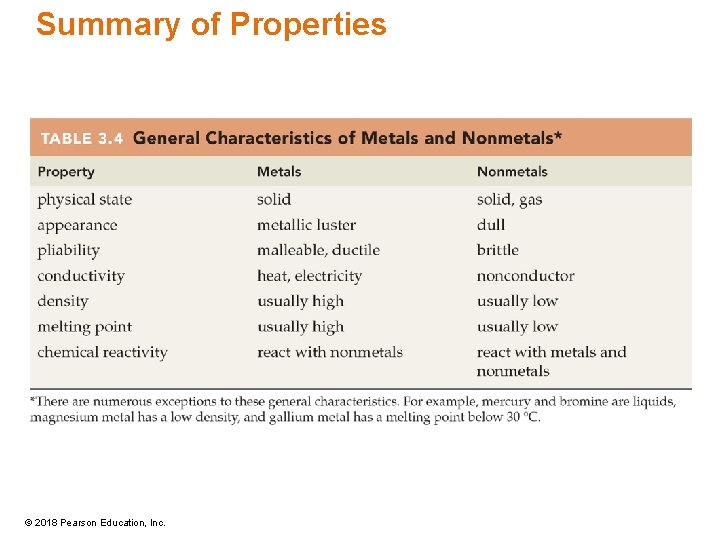
Summary of Properties © 2018 Pearson Education, Inc.
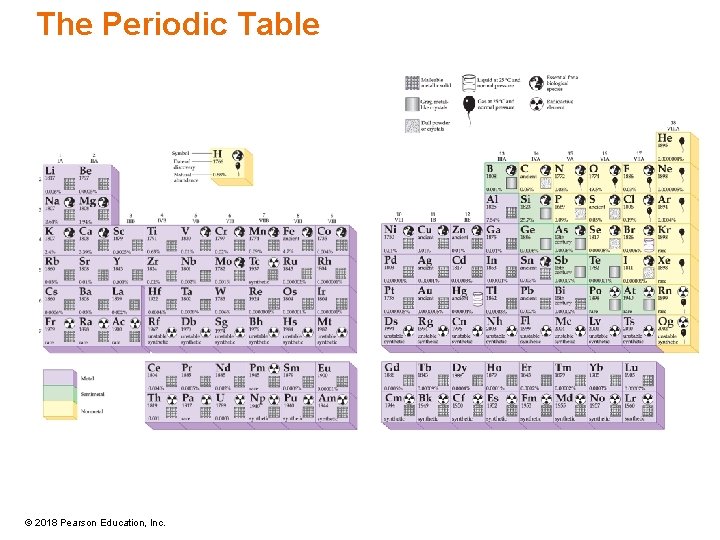
Periodic Table of the Elements • Each element is assigned a number to identify it. – It is called the atomic number. • The elements are arranged by atomic number on the periodic table. © 2018 Pearson Education, Inc.
The Periodic Table © 2018 Pearson Education, Inc.
Metals, Nonmetals, and Semimetals • Metals are on the left side of the periodic table, nonmetals are on the right side, and semimetals are between. © 2018 Pearson Education, Inc.
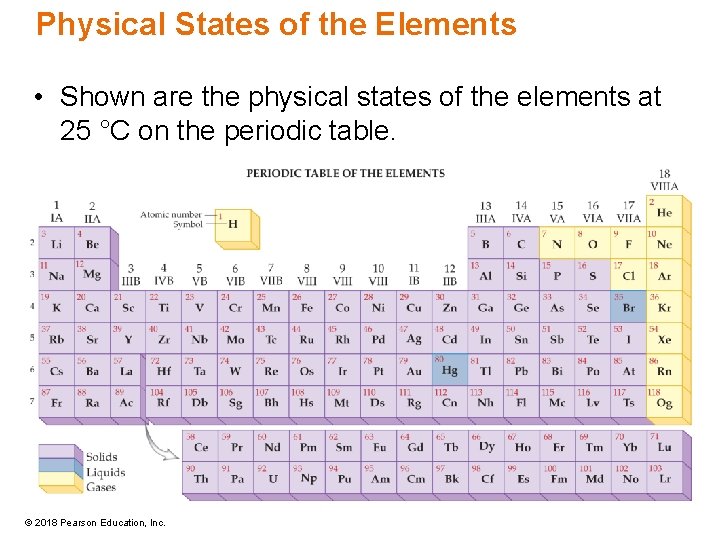
Physical States of the Elements • Shown are the physical states of the elements at 25 °C on the periodic table. © 2018 Pearson Education, Inc.
Chemistry Connection: Elements 104 and Beyond • Scientists continue to discover new, heavier elements beyond the current periodic table. • Sometimes disagreements arise over naming of the new elements. • IUPAC assigns names to new elements. • Until IUPAC assigns a name, the elements are named using Latin prefixes for the numbers followed by the suffix –ium. – Hence, element 104 is unnilquadium. © 2018 Pearson Education, Inc.
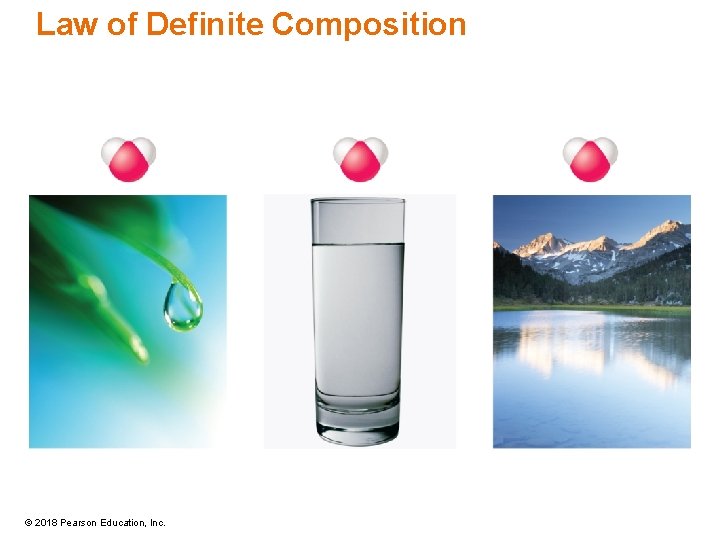
Law of Definite Composition • The law of definite composition states that “Compounds always contain the same elements in a constant proportion by mass. ” © 2018 Pearson Education, Inc.
Law of Definite Composition © 2018 Pearson Education, Inc.
Chemical Formulas • A unit of matter composed of two or more nonmetal atoms is a molecule. • A chemical formula is an expression of the number of atoms of each element in a compound. © 2018 Pearson Education, Inc.
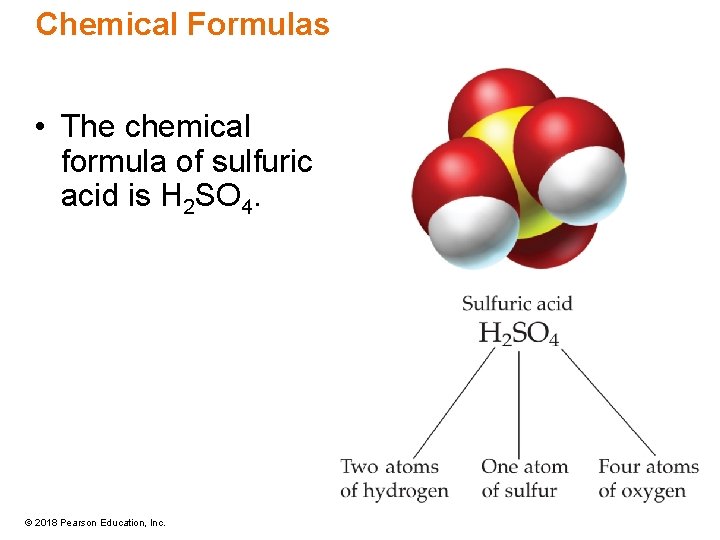
Chemical Formulas • The chemical formula of sulfuric acid is H 2 SO 4. © 2018 Pearson Education, Inc.
Writing Chemical Formulas • The number of each type of atom in a molecule is indicated with a subscript in a chemical formula. • If there is only one atom of a certain type, no “ 1” is used. © 2018 Pearson Education, Inc.
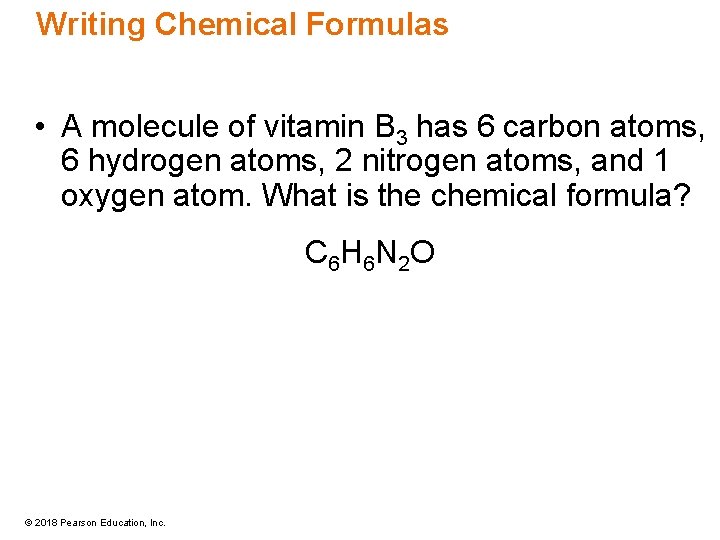
Writing Chemical Formulas • A molecule of vitamin B 3 has 6 carbon atoms, 6 hydrogen atoms, 2 nitrogen atoms, and 1 oxygen atom. What is the chemical formula? C 6 H 6 N 2 O © 2018 Pearson Education, Inc.
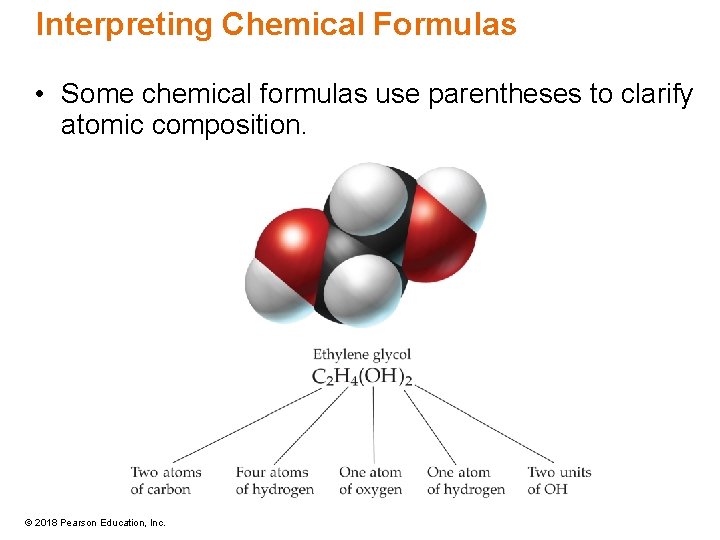
Interpreting Chemical Formulas • Some chemical formulas use parentheses to clarify atomic composition. © 2018 Pearson Education, Inc.
Physical and Chemical Properties • A physical property is a characteristic of a pure substance that we can observe without changing its composition. • Physical properties include appearance, melting and boiling points, density, heat and electrical conductivity, solubility, and physical state. © 2018 Pearson Education, Inc.
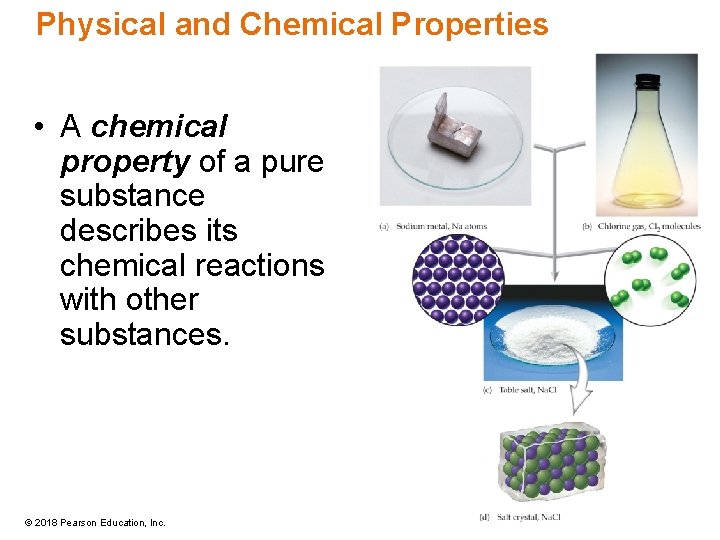
Physical and Chemical Properties • A chemical property of a pure substance describes its chemical reactions with other substances. © 2018 Pearson Education, Inc.
Physical and Chemical Change • A physical change is a change where the chemical composition of the sample does not change. • These include changes in physical state or shape of a pure substance. © 2018 Pearson Education, Inc.
Physical and Chemical Change • A chemical change is a chemical reaction. • The composition of the sample changes during a chemical change. © 2018 Pearson Education, Inc.
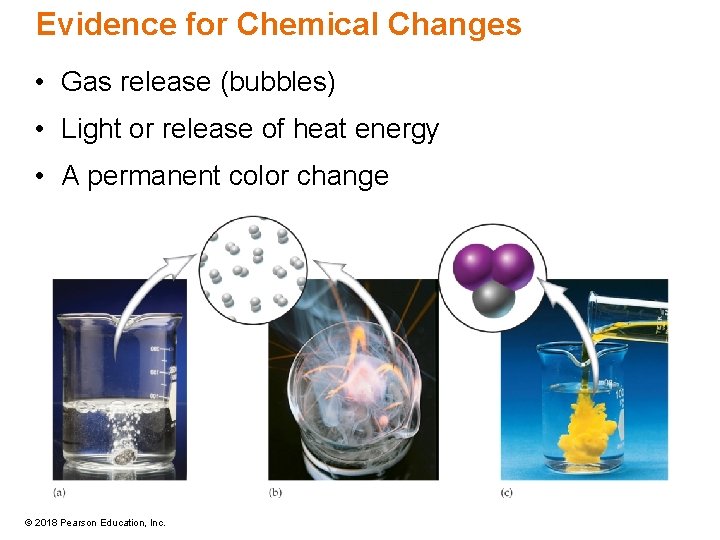
Evidence for Chemical Changes • Gas release (bubbles) • Light or release of heat energy • A permanent color change © 2018 Pearson Education, Inc.
Conservation of Mass • Antoine Lavoisier found that the mass of reactants before a chemical change was always equal to the mass of products after a chemical change. – This is the law of conservation of mass. © 2018 Pearson Education, Inc.
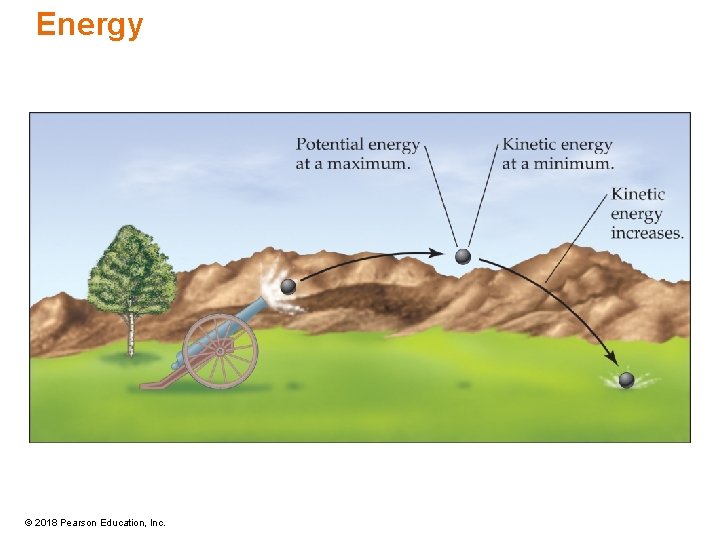
Potential and Kinetic Energy • Potential energy, PE: stored energy; results from position or composition • Kinetic energy, KE: the energy matter has as a result of its motion © 2018 Pearson Education, Inc.
Energy © 2018 Pearson Education, Inc.
KE, Temperature, and Physical State • All substances have kinetic energy regardless of their physical state. • Solids have the lowest kinetic energy, and gases have the greatest kinetic energy. • Temperature is the measure of the average kinetic energy of a system. © 2018 Pearson Education, Inc.
Law of Conservation of Energy • Just like matter, energy cannot be created or destroyed, but it can be converted from one form to another. – This is the law of conservation of energy. © 2018 Pearson Education, Inc.
Forms of Energy • There are six forms of energy: 1. Heat 2. Light 3. Chemical 4. Electrical 5. Mechanical 6. Nuclear © 2018 Pearson Education, Inc.
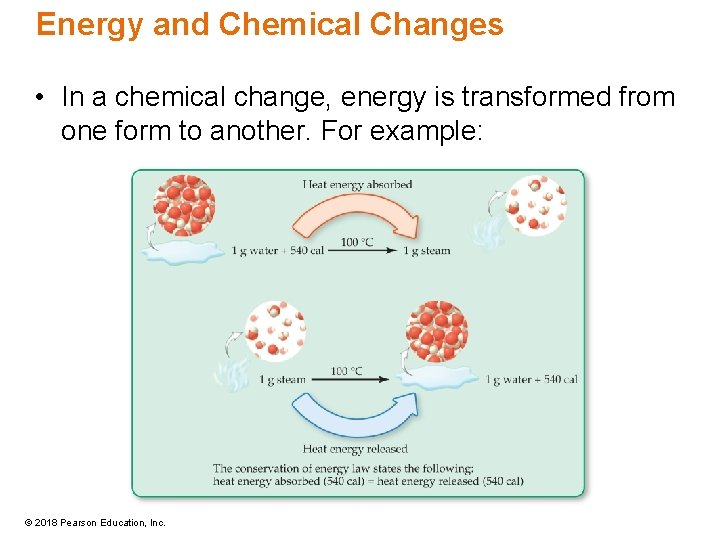
Energy and Chemical Changes • In a chemical change, energy is transformed from one form to another. For example: © 2018 Pearson Education, Inc.
Critical Thinking: Lower Gasoline Bills • In terms of expense, is it better to fill a gas tank in the cool morning or in the warm afternoon? • No matter the temperature, the number of gallons delivered is always the same. • When the temperature is lower, a greater mass of gasoline is delivered for the same volume. • However, the difference in mass between 40 °F and 70 °F is only about 1%. © 2018 Pearson Education, Inc.
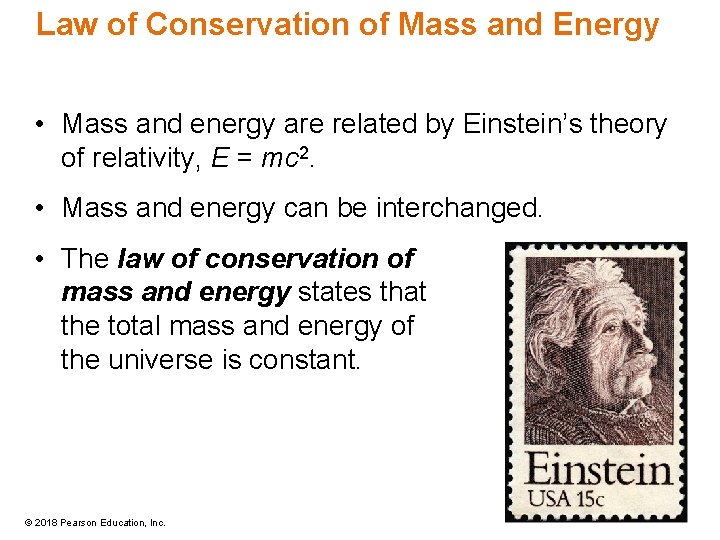
Law of Conservation of Mass and Energy • Mass and energy are related by Einstein’s theory of relativity, E = mc 2. • Mass and energy can be interchanged. • The law of conservation of mass and energy states that the total mass and energy of the universe is constant. © 2018 Pearson Education, Inc.
Chapter Summary • Matter exists in three physical states: 1. Solid 2. Liquid 3. Gas • Substances can be converted between the three states. • Substances can be mixtures or pure substances. © 2018 Pearson Education, Inc.
Chapter Summary, Continued • Pure substances can be either compounds or elements. • The elements are arranged in the periodic table. • Each element has a name and a one- or two-letter symbol. • Elements are classified as either metals, nonmetals, or semimetals. © 2018 Pearson Education, Inc.
Chapter Summary, Continued • A physical change is a change in physical state or shape. • A chemical change is a change in the chemical composition of a substance. • Both mass and energy are conserved in chemical and physical changes. © 2018 Pearson Education, Inc.