
Lecture Presentation Chapter 3 Chemical Reactions and Reaction

- Slides: 43
Lecture Presentation Chapter 3 Chemical Reactions and Reaction Stoichiometry © 2018 Pearson Education, Inc. James F. Kirby Quinnipiac University Hamden, CT
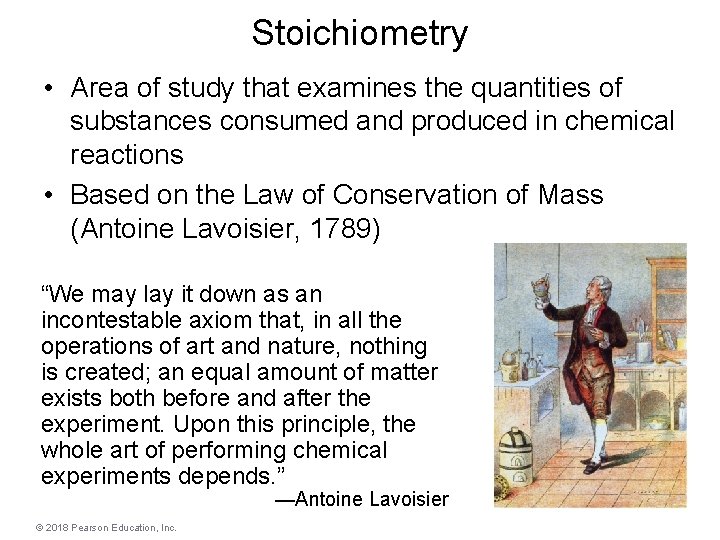
Stoichiometry • Area of study that examines the quantities of substances consumed and produced in chemical reactions • Based on the Law of Conservation of Mass (Antoine Lavoisier, 1789) “We may lay it down as an incontestable axiom that, in all the operations of art and nature, nothing is created; an equal amount of matter exists both before and after the experiment. Upon this principle, the whole art of performing chemical experiments depends. ” —Antoine Lavoisier © 2018 Pearson Education, Inc.
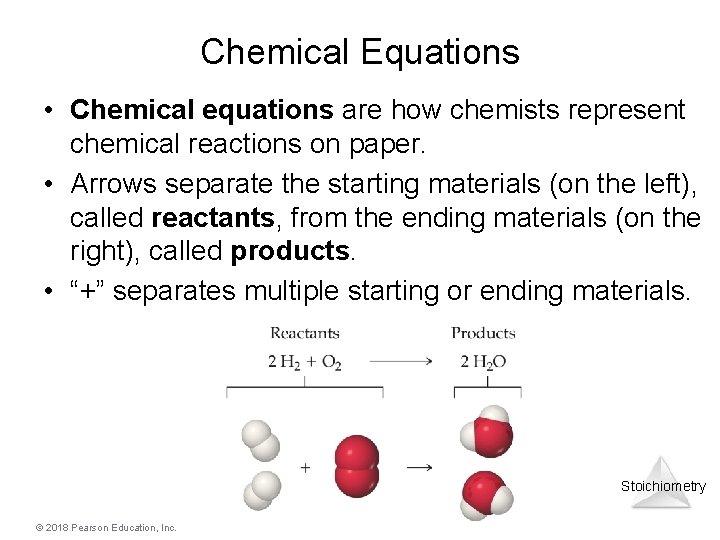
Chemical Equations • Chemical equations are how chemists represent chemical reactions on paper. • Arrows separate the starting materials (on the left), called reactants, from the ending materials (on the right), called products. • “+” separates multiple starting or ending materials. Stoichiometry © 2018 Pearson Education, Inc.
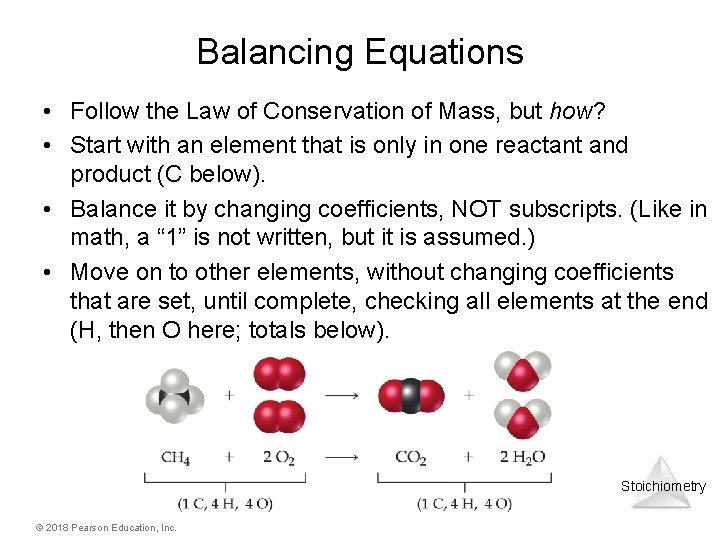
Balancing Equations • Follow the Law of Conservation of Mass, but how? • Start with an element that is only in one reactant and product (C below). • Balance it by changing coefficients, NOT subscripts. (Like in math, a “ 1” is not written, but it is assumed. ) • Move on to other elements, without changing coefficients that are set, until complete, checking all elements at the end (H, then O here; totals below). Stoichiometry © 2018 Pearson Education, Inc.
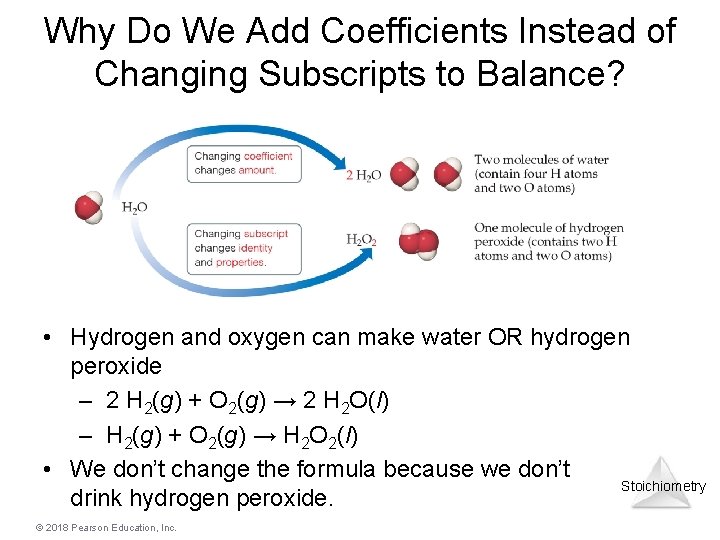
Why Do We Add Coefficients Instead of Changing Subscripts to Balance? • Hydrogen and oxygen can make water OR hydrogen peroxide – 2 H 2(g) + O 2(g) → 2 H 2 O(l) – H 2(g) + O 2(g) → H 2 O 2(l) • We don’t change the formula because we don’t Stoichiometry drink hydrogen peroxide. © 2018 Pearson Education, Inc.
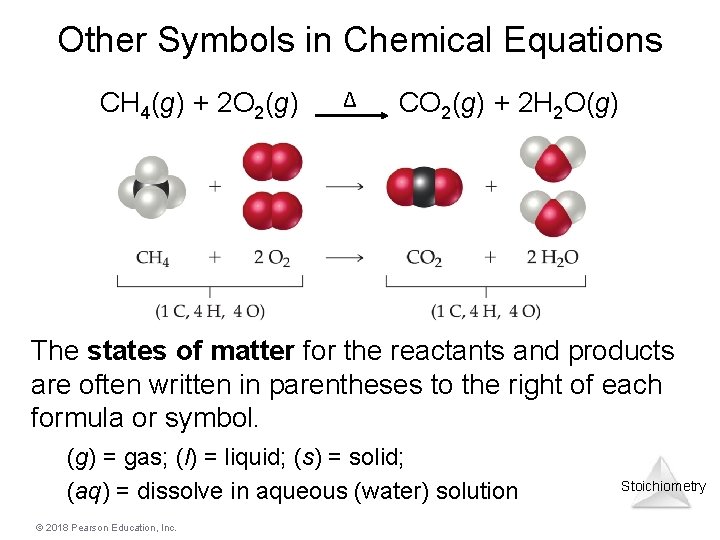
Other Symbols in Chemical Equations CH 4(g) + 2 O 2(g) Δ CO 2(g) + 2 H 2 O(g) The states of matter for the reactants and products are often written in parentheses to the right of each formula or symbol. (g) = gas; (l) = liquid; (s) = solid; (aq) = dissolve in aqueous (water) solution © 2018 Pearson Education, Inc. Stoichiometry
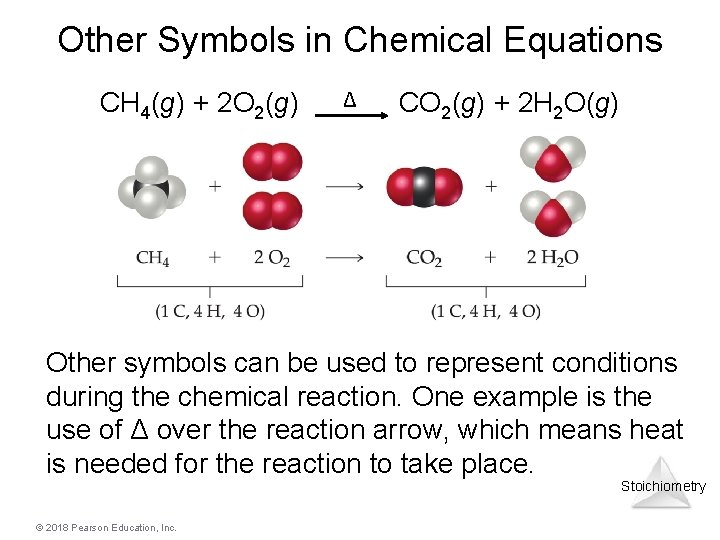
Other Symbols in Chemical Equations CH 4(g) + 2 O 2(g) Δ CO 2(g) + 2 H 2 O(g) Other symbols can be used to represent conditions during the chemical reaction. One example is the use of Δ over the reaction arrow, which means heat is needed for the reaction to take place. Stoichiometry © 2018 Pearson Education, Inc.
Simple Patterns of Chemical Reactivity • Types of reactions, which can be predicted at this point – Combination reactions – Decomposition reactions – Combustion reactions Stoichiometry © 2018 Pearson Education, Inc.
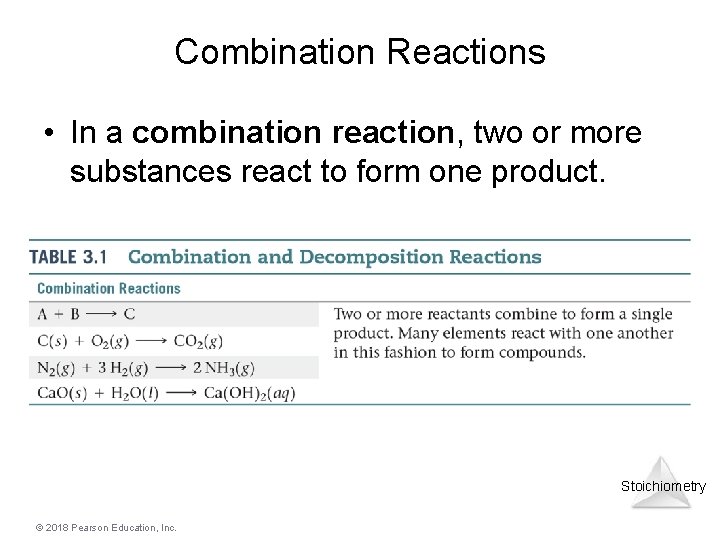
Combination Reactions • In a combination reaction, two or more substances react to form one product. Stoichiometry © 2018 Pearson Education, Inc.
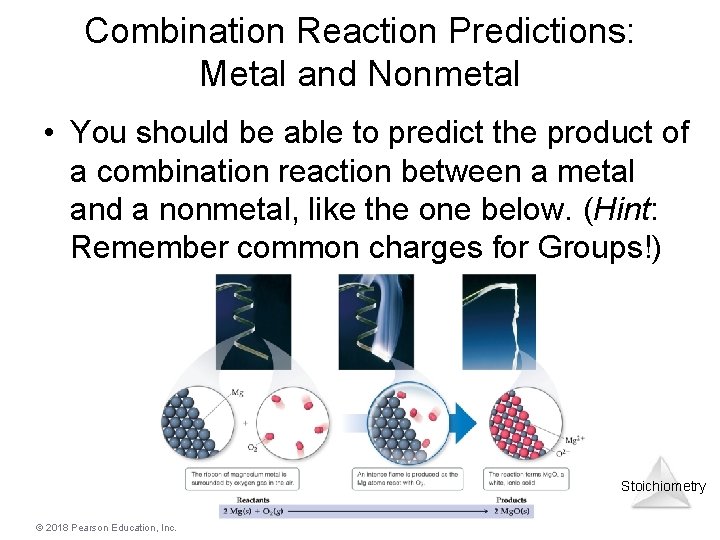
Combination Reaction Predictions: Metal and Nonmetal • You should be able to predict the product of a combination reaction between a metal and a nonmetal, like the one below. (Hint: Remember common charges for Groups!) Stoichiometry © 2018 Pearson Education, Inc.
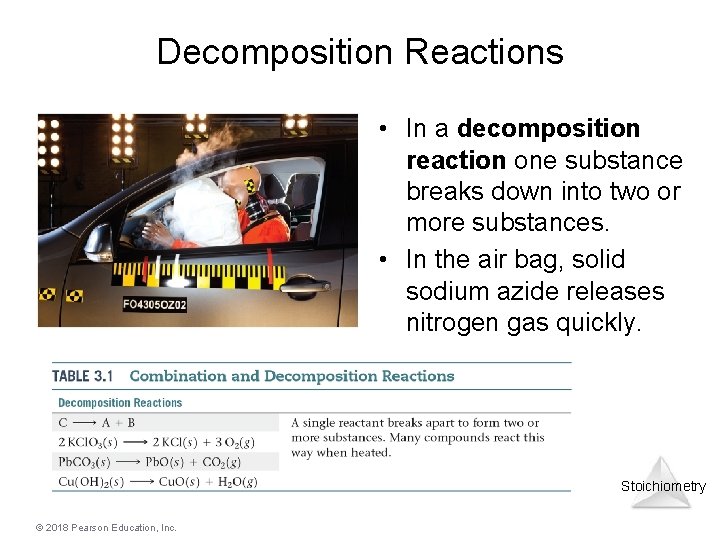
Decomposition Reactions • In a decomposition reaction one substance breaks down into two or more substances. • In the air bag, solid sodium azide releases nitrogen gas quickly. Stoichiometry © 2018 Pearson Education, Inc.
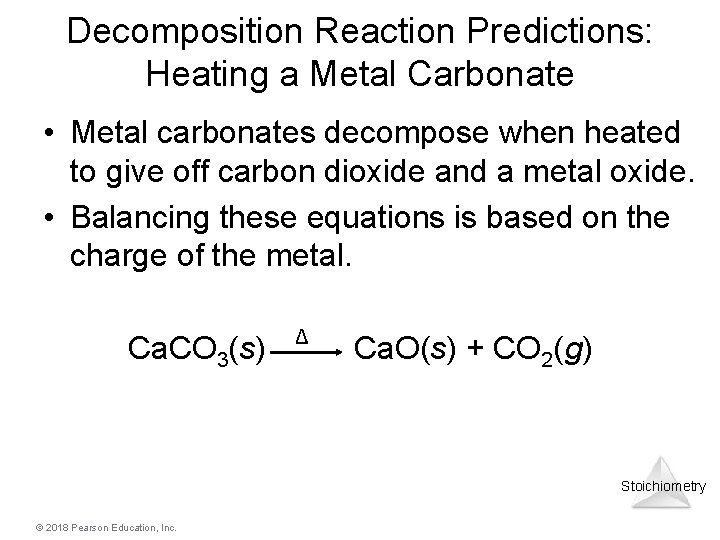
Decomposition Reaction Predictions: Heating a Metal Carbonate • Metal carbonates decompose when heated to give off carbon dioxide and a metal oxide. • Balancing these equations is based on the charge of the metal. Ca. CO 3(s) Δ Ca. O(s) + CO 2(g) Stoichiometry © 2018 Pearson Education, Inc.
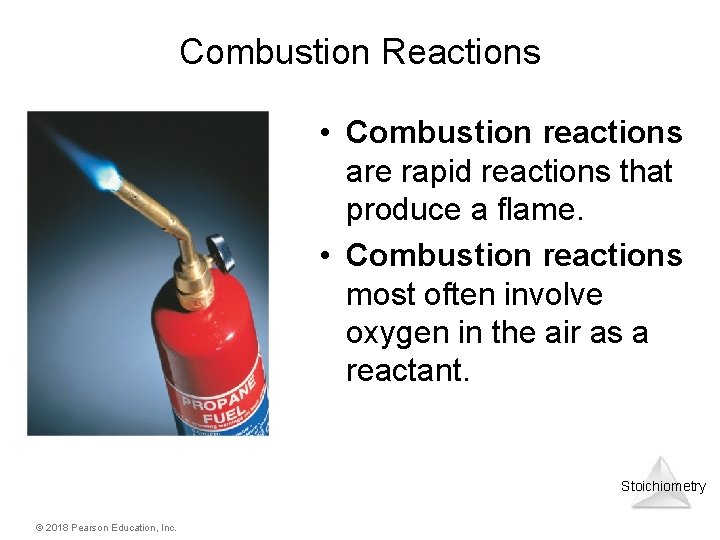
Combustion Reactions • Combustion reactions are rapid reactions that produce a flame. • Combustion reactions most often involve oxygen in the air as a reactant. Stoichiometry © 2018 Pearson Education, Inc.
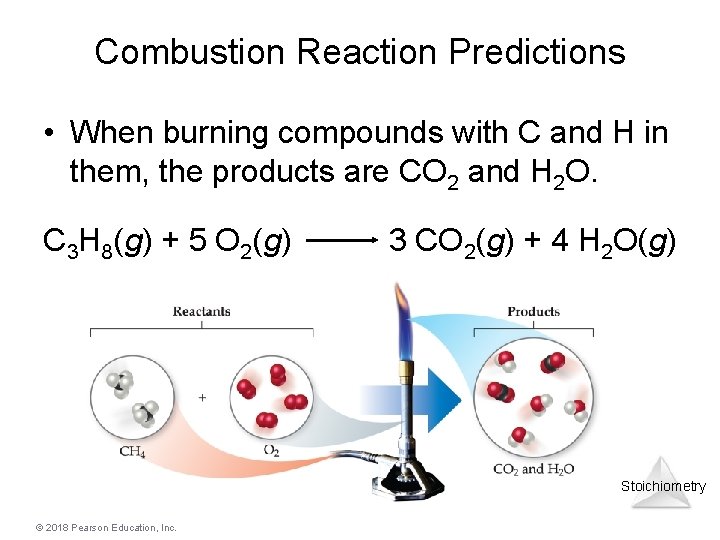
Combustion Reaction Predictions • When burning compounds with C and H in them, the products are CO 2 and H 2 O. C 3 H 8(g) + 5 O 2(g) 3 CO 2(g) + 4 H 2 O(g) Stoichiometry © 2018 Pearson Education, Inc.
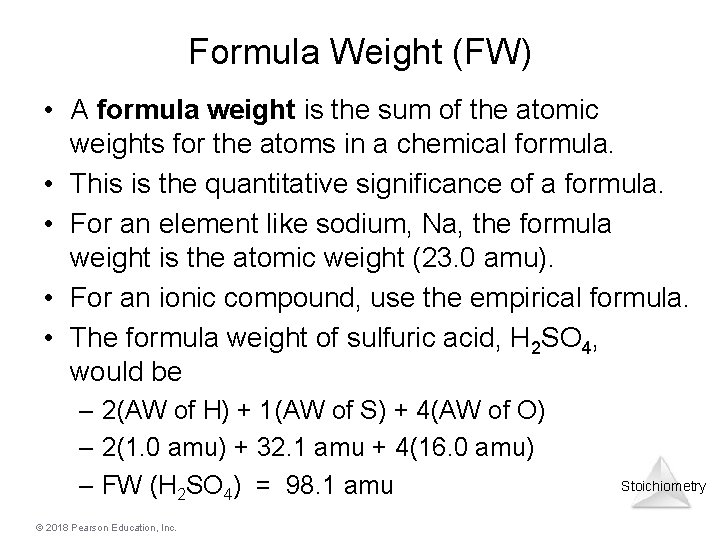
Formula Weight (FW) • A formula weight is the sum of the atomic weights for the atoms in a chemical formula. • This is the quantitative significance of a formula. • For an element like sodium, Na, the formula weight is the atomic weight (23. 0 amu). • For an ionic compound, use the empirical formula. • The formula weight of sulfuric acid, H 2 SO 4, would be – 2(AW of H) + 1(AW of S) + 4(AW of O) – 2(1. 0 amu) + 32. 1 amu + 4(16. 0 amu) – FW (H 2 SO 4) = 98. 1 amu © 2018 Pearson Education, Inc. Stoichiometry
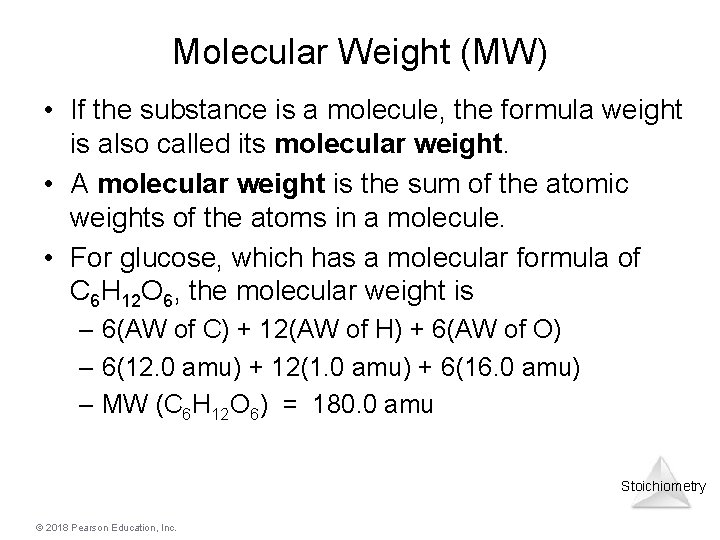
Molecular Weight (MW) • If the substance is a molecule, the formula weight is also called its molecular weight. • A molecular weight is the sum of the atomic weights of the atoms in a molecule. • For glucose, which has a molecular formula of C 6 H 12 O 6, the molecular weight is – 6(AW of C) + 12(AW of H) + 6(AW of O) – 6(12. 0 amu) + 12(1. 0 amu) + 6(16. 0 amu) – MW (C 6 H 12 O 6) = 180. 0 amu Stoichiometry © 2018 Pearson Education, Inc.
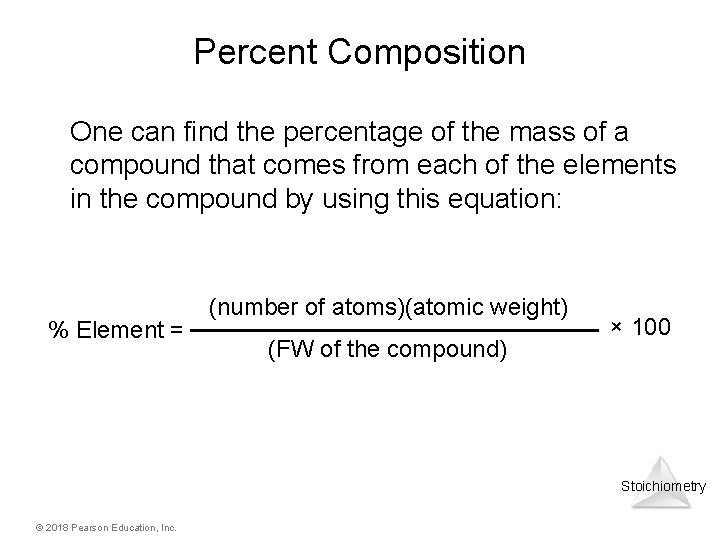
Percent Composition One can find the percentage of the mass of a compound that comes from each of the elements in the compound by using this equation: % Element = (number of atoms)(atomic weight) (FW of the compound) × 100 Stoichiometry © 2018 Pearson Education, Inc.
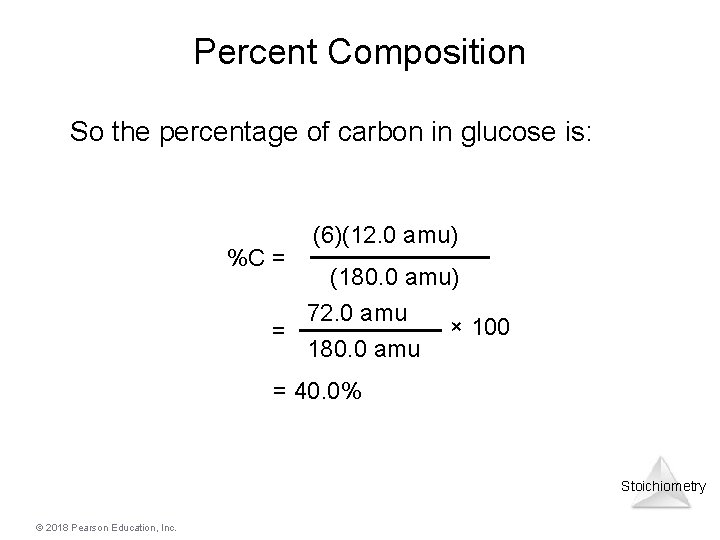
Percent Composition So the percentage of carbon in glucose is: %C = (6)(12. 0 amu) (180. 0 amu) 72. 0 amu × 100 = 180. 0 amu = 40. 0% Stoichiometry © 2018 Pearson Education, Inc.
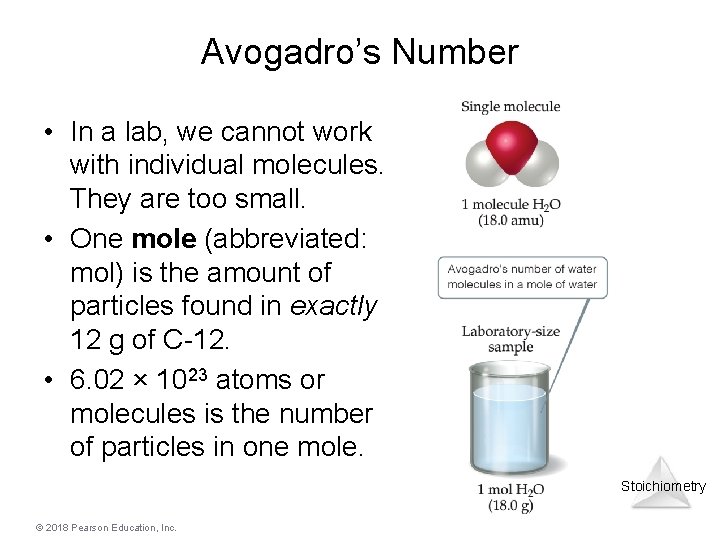
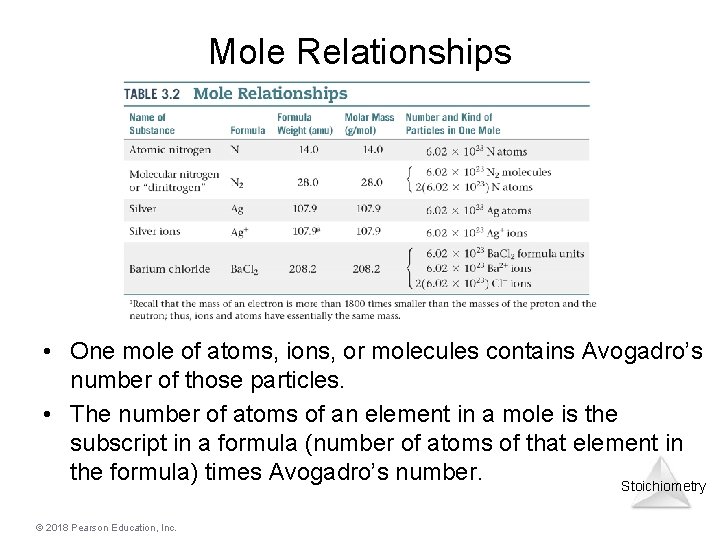
Avogadro’s Number • In a lab, we cannot work with individual molecules. They are too small. • One mole (abbreviated: mol) is the amount of particles found in exactly 12 g of C-12. • 6. 02 × 1023 atoms or molecules is the number of particles in one mole. Stoichiometry © 2018 Pearson Education, Inc.
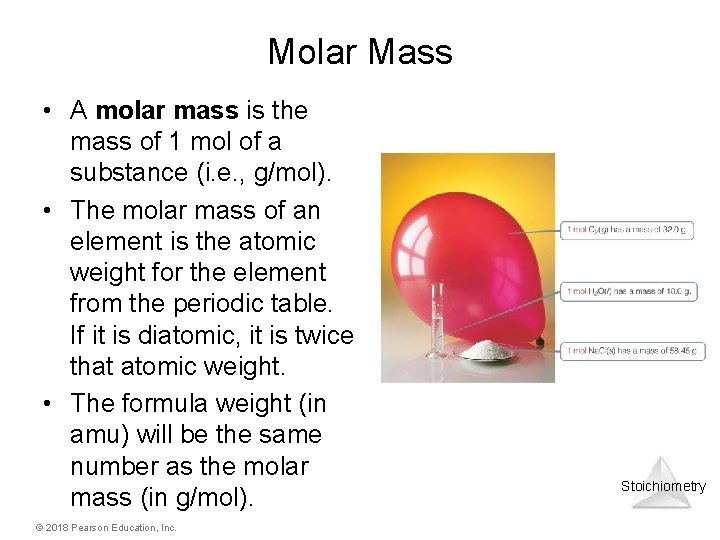
Molar Mass • A molar mass is the mass of 1 mol of a substance (i. e. , g/mol). • The molar mass of an element is the atomic weight for the element from the periodic table. If it is diatomic, it is twice that atomic weight. • The formula weight (in amu) will be the same number as the molar mass (in g/mol). © 2018 Pearson Education, Inc. Stoichiometry
Mole Relationships • One mole of atoms, ions, or molecules contains Avogadro’s number of those particles. • The number of atoms of an element in a mole is the subscript in a formula (number of atoms of that element in the formula) times Avogadro’s number. Stoichiometry © 2018 Pearson Education, Inc.
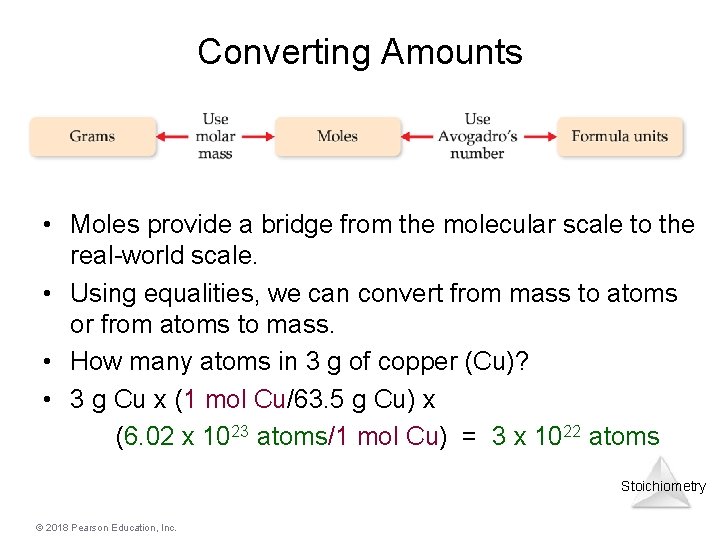
Converting Amounts • Moles provide a bridge from the molecular scale to the real-world scale. • Using equalities, we can convert from mass to atoms or from atoms to mass. • How many atoms in 3 g of copper (Cu)? • 3 g Cu x (1 mol Cu/63. 5 g Cu) x (6. 02 x 1023 atoms/1 mol Cu) = 3 x 10²² atoms Stoichiometry © 2018 Pearson Education, Inc.
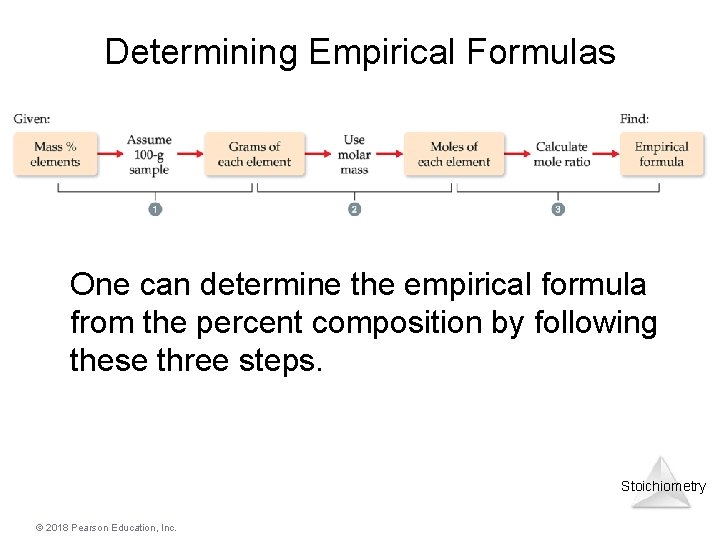
Determining Empirical Formulas One can determine the empirical formula from the percent composition by following these three steps. Stoichiometry © 2018 Pearson Education, Inc.
Determining Empirical Formulas— an Example The compound para-aminobenzoic acid (you may have seen it listed as PABA on your bottle of sunscreen) is composed of carbon (61. 31%), hydrogen (5. 14%), nitrogen (10. 21%), and oxygen (23. 33%). Find the empirical formula of PABA. Stoichiometry © 2018 Pearson Education, Inc.
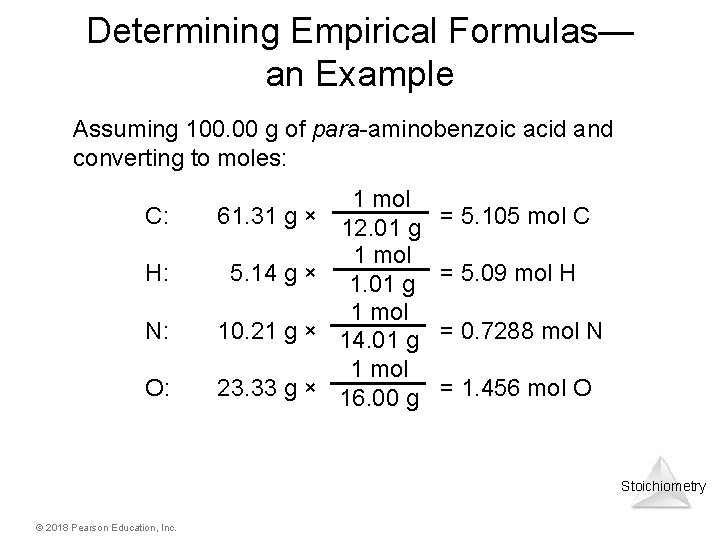
Determining Empirical Formulas— an Example Assuming 100. 00 g of para-aminobenzoic acid and converting to moles: C: 61. 31 g × H: 5. 14 g × N: 10. 21 g × O: 23. 33 g × 1 mol 12. 01 g 1 mol 14. 01 g 1 mol 16. 00 g = 5. 105 mol C = 5. 09 mol H = 0. 7288 mol N = 1. 456 mol O Stoichiometry © 2018 Pearson Education, Inc.
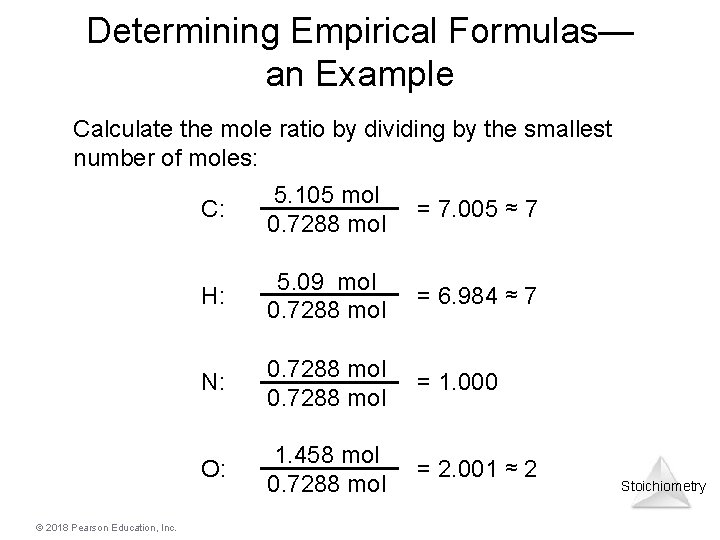
Determining Empirical Formulas— an Example Calculate the mole ratio by dividing by the smallest number of moles: © 2018 Pearson Education, Inc. C: 5. 105 mol 0. 7288 mol = 7. 005 ≈ 7 H: 5. 09 mol 0. 7288 mol = 6. 984 ≈ 7 N: 0. 7288 mol = 1. 000 O: 1. 458 mol 0. 7288 mol = 2. 001 ≈ 2 Stoichiometry
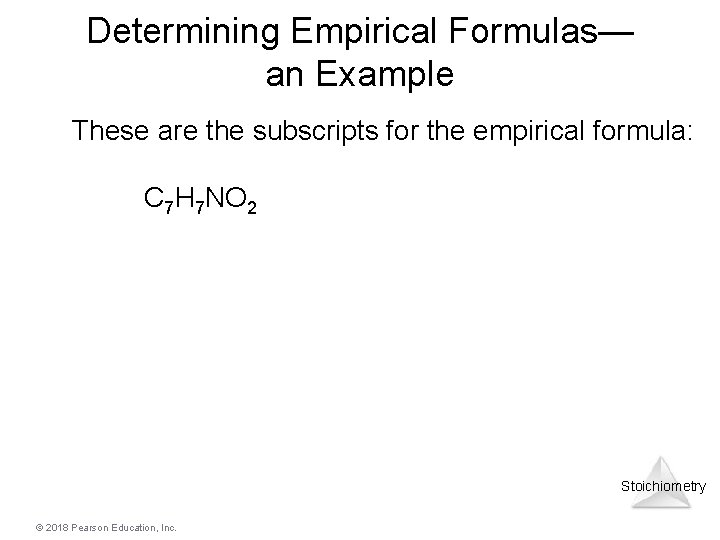
Determining Empirical Formulas— an Example These are the subscripts for the empirical formula: C 7 H 7 NO 2 Stoichiometry © 2018 Pearson Education, Inc.
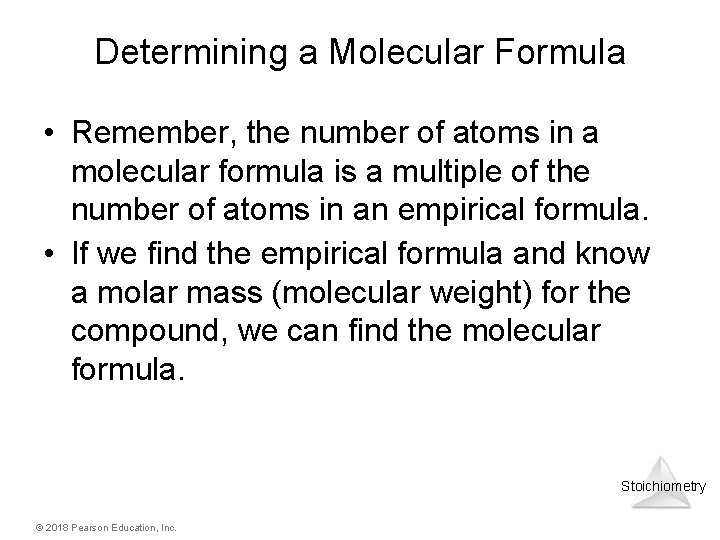
Determining a Molecular Formula • Remember, the number of atoms in a molecular formula is a multiple of the number of atoms in an empirical formula. • If we find the empirical formula and know a molar mass (molecular weight) for the compound, we can find the molecular formula. Stoichiometry © 2018 Pearson Education, Inc.
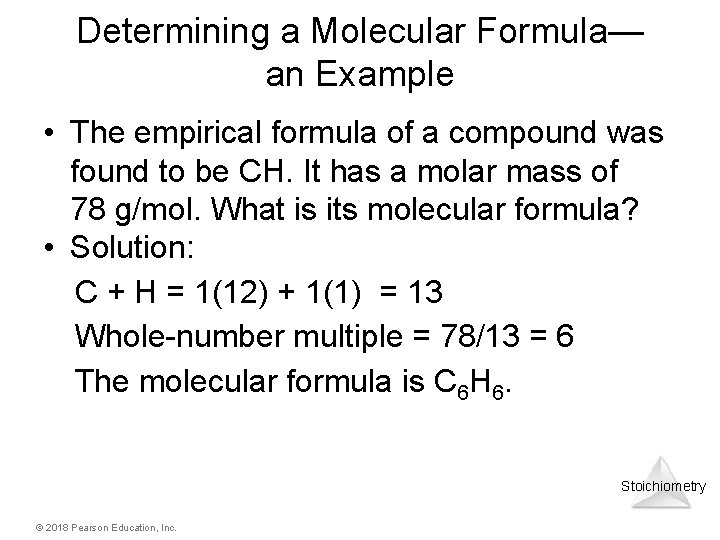
Determining a Molecular Formula— an Example • The empirical formula of a compound was found to be CH. It has a molar mass of 78 g/mol. What is its molecular formula? • Solution: C + H = 1(12) + 1(1) = 13 Whole-number multiple = 78/13 = 6 The molecular formula is C 6 H 6. Stoichiometry © 2018 Pearson Education, Inc.
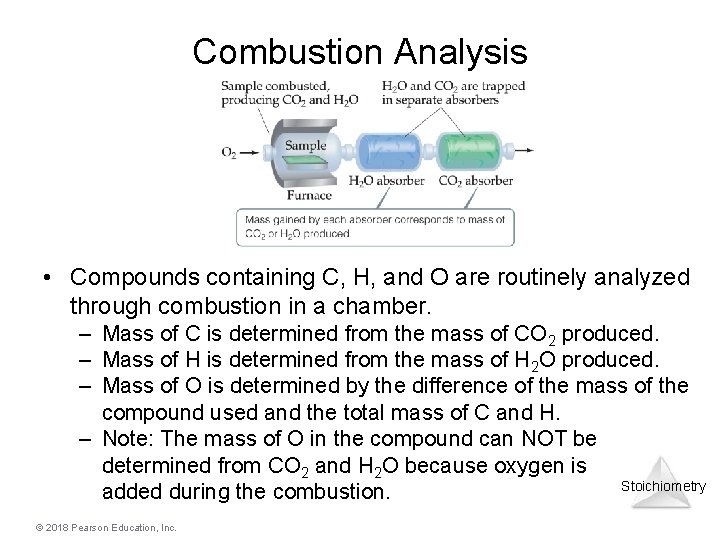
Combustion Analysis • Compounds containing C, H, and O are routinely analyzed through combustion in a chamber. – Mass of C is determined from the mass of CO 2 produced. – Mass of H is determined from the mass of H 2 O produced. – Mass of O is determined by the difference of the mass of the compound used and the total mass of C and H. – Note: The mass of O in the compound can NOT be determined from CO 2 and H 2 O because oxygen is Stoichiometry added during the combustion. © 2018 Pearson Education, Inc.
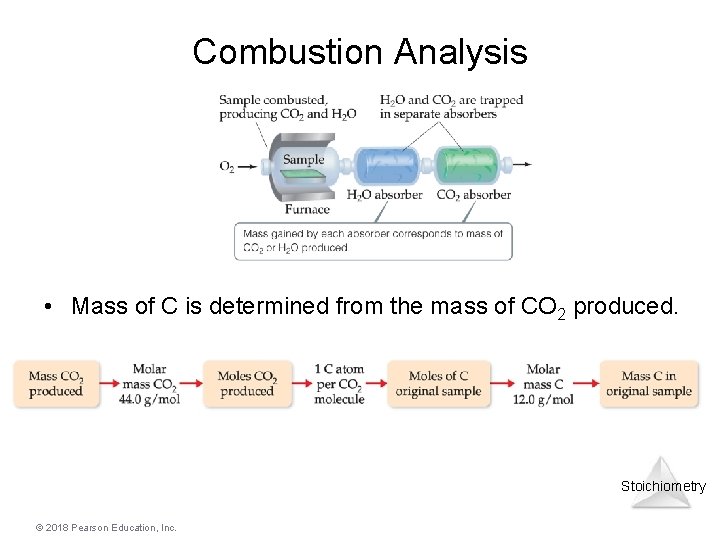
Combustion Analysis • Mass of C is determined from the mass of CO 2 produced. Stoichiometry © 2018 Pearson Education, Inc.
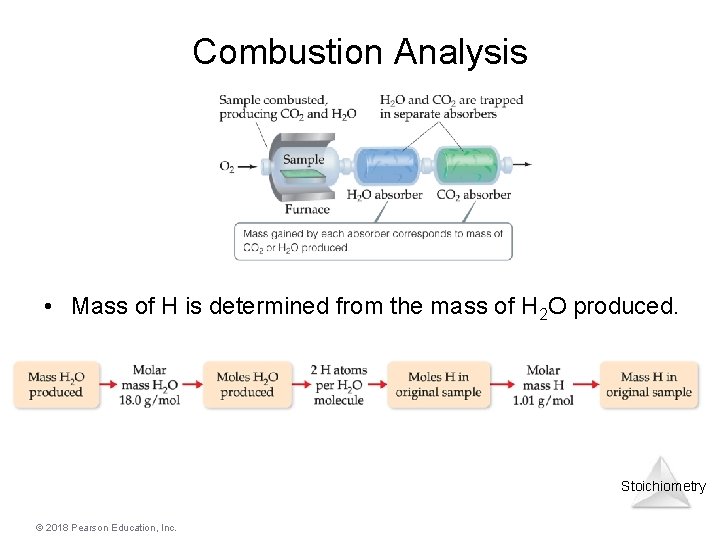
Combustion Analysis • Mass of H is determined from the mass of H 2 O produced. Stoichiometry © 2018 Pearson Education, Inc.
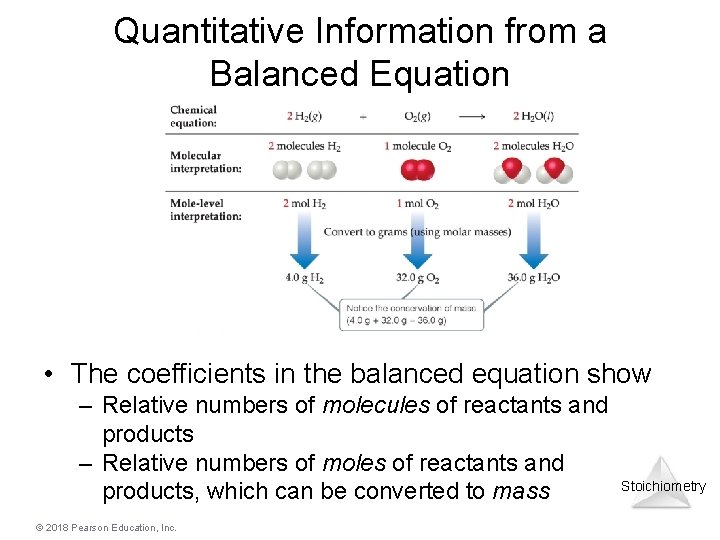
Quantitative Information from a Balanced Equation • The coefficients in the balanced equation show – Relative numbers of molecules of reactants and products – Relative numbers of moles of reactants and products, which can be converted to mass © 2018 Pearson Education, Inc. Stoichiometry
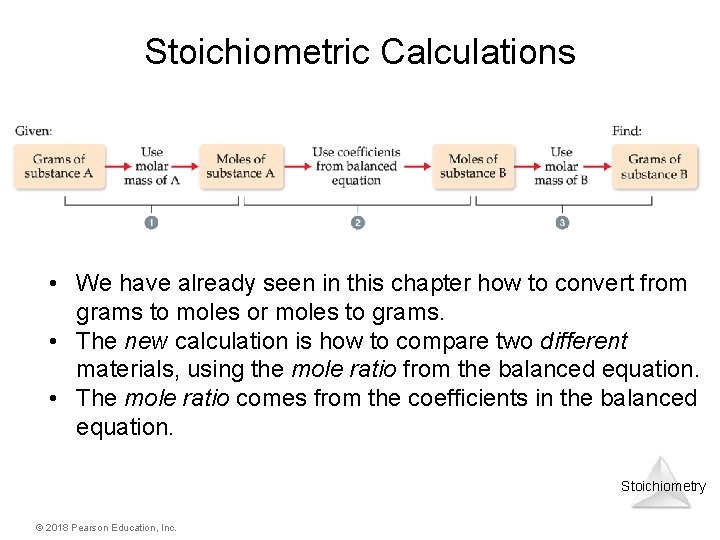
Stoichiometric Calculations • We have already seen in this chapter how to convert from grams to moles or moles to grams. • The new calculation is how to compare two different materials, using the mole ratio from the balanced equation. • The mole ratio comes from the coefficients in the balanced equation. Stoichiometry © 2018 Pearson Education, Inc.
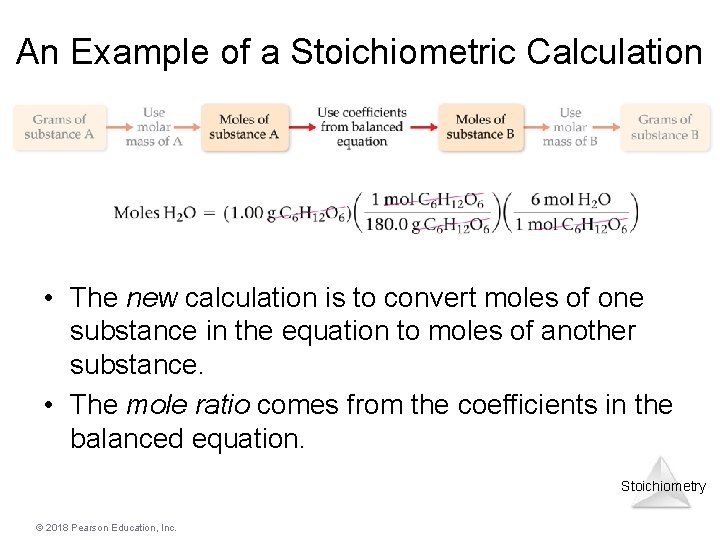
An Example of a Stoichiometric Calculation • How many grams of water can be produced from 1. 00 g of glucose? C 6 H 12 O 6(s) + 6 O 2(g) → 6 CO 2(g) + 6 H 2 O(l) • There is 1. 00 g of glucose to start. • The first step is to convert it to moles. Stoichiometry © 2018 Pearson Education, Inc.
An Example of a Stoichiometric Calculation • The new calculation is to convert moles of one substance in the equation to moles of another substance. • The mole ratio comes from the coefficients in the balanced equation. Stoichiometry © 2018 Pearson Education, Inc.
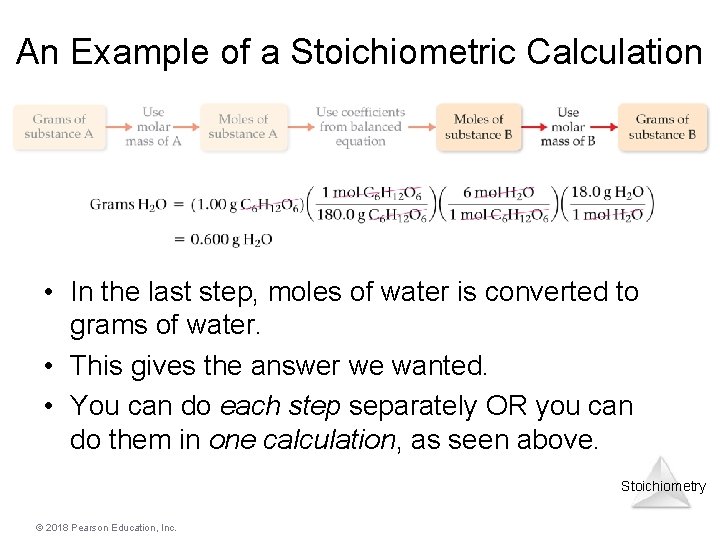
An Example of a Stoichiometric Calculation • In the last step, moles of water is converted to grams of water. • This gives the answer we wanted. • You can do each step separately OR you can do them in one calculation, as seen above. Stoichiometry © 2018 Pearson Education, Inc.
Heat and Stoichiometry • Heat does NOT appear in a balanced equation. • However, in Chapter 5 we will see how amounts of heat are related to a balanced equation. • Those amounts depend on stoichiometry as well. Stoichiometry © 2018 Pearson Education, Inc.
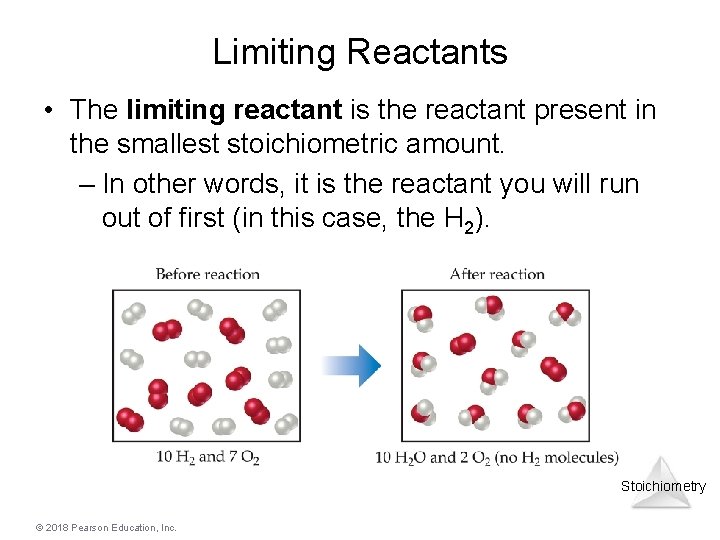
Limiting Reactants • The limiting reactant is the reactant present in the smallest stoichiometric amount. – In other words, it is the reactant you will run out of first (in this case, the H 2). Stoichiometry © 2018 Pearson Education, Inc.
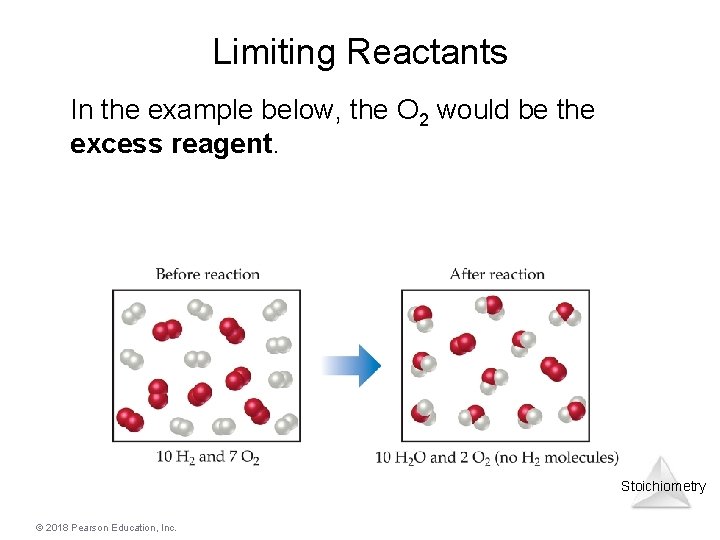
Limiting Reactants In the example below, the O 2 would be the excess reagent. Stoichiometry © 2018 Pearson Education, Inc.
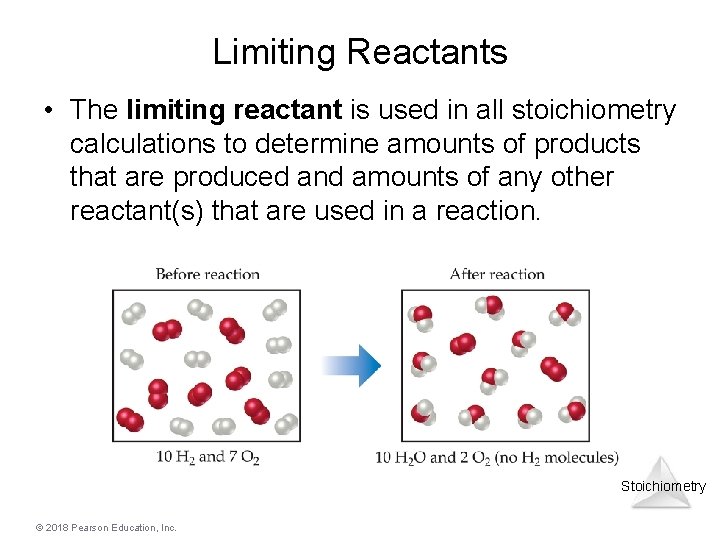
Limiting Reactants • The limiting reactant is used in all stoichiometry calculations to determine amounts of products that are produced and amounts of any other reactant(s) that are used in a reaction. Stoichiometry © 2018 Pearson Education, Inc.
Theoretical Yield • The theoretical yield is the maximum amount of product that can be made. – In other words, it is the amount of product possible as calculated through the stoichiometry problem. • This is different from the actual yield, which is the amount one actually produces and measures. Stoichiometry © 2018 Pearson Education, Inc.
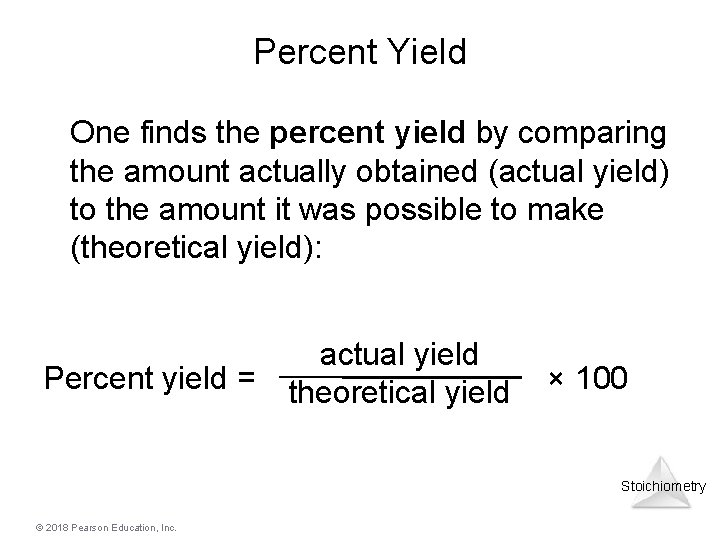
Percent Yield One finds the percent yield by comparing the amount actually obtained (actual yield) to the amount it was possible to make (theoretical yield): Percent yield = actual yield theoretical yield × 100 Stoichiometry © 2018 Pearson Education, Inc.