
Lecture Presentation Chapter 22 Metabolic Pathways for Carbohydrates
Lecture Presentation Chapter 22 Metabolic Pathways for Carbohydrates Karen C. Timberlake General, Organic, and Biological Chemistry: Structures of Life, 5/e Karen C. Timberlake © 2016 Pearson Education, Inc.
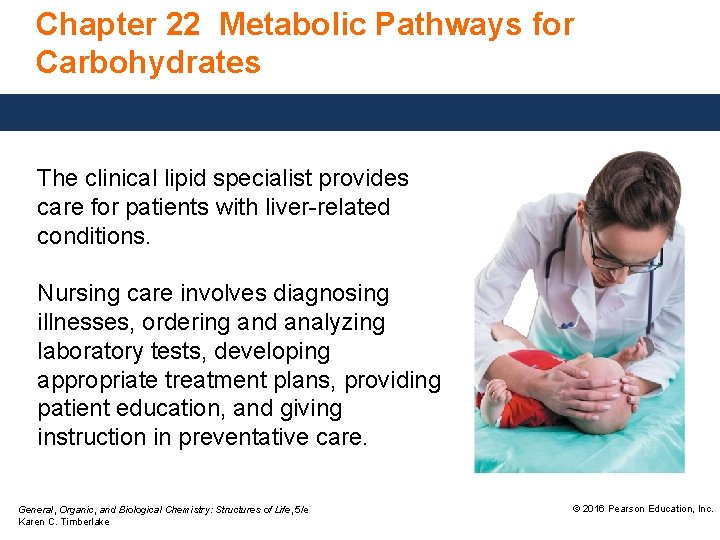
Chapter 22 Metabolic Pathways for Carbohydrates The clinical lipid specialist provides care for patients with liver-related conditions. Nursing care involves diagnosing illnesses, ordering and analyzing laboratory tests, developing appropriate treatment plans, providing patient education, and giving instruction in preventative care. General, Organic, and Biological Chemistry: Structures of Life, 5/e Karen C. Timberlake © 2016 Pearson Education, Inc.
Chapter Readiness Core Chemistry Skills • Identifying D- and L-Fischer Projections (15. 2) • Describing Enzyme Action (20. 1) • Classifying Enzymes (20. 2) • Identifying Factors Affecting Enzyme Activity (20. 3) • Describing the Role of Cofactors (20. 6) General, Organic, and Biological Chemistry: Structures of Life, 5/e Karen C. Timberlake © 2016 Pearson Education, Inc.
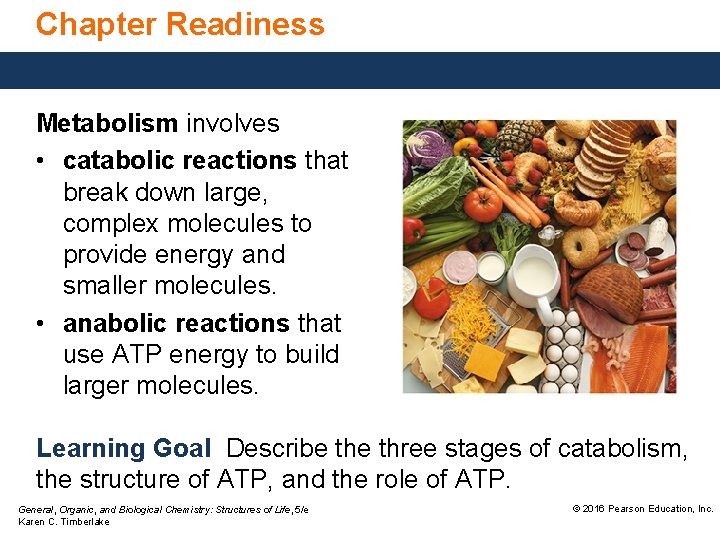
Chapter Readiness Metabolism involves • catabolic reactions that break down large, complex molecules to provide energy and smaller molecules. • anabolic reactions that use ATP energy to build larger molecules. Learning Goal Describe three stages of catabolism, the structure of ATP, and the role of ATP. General, Organic, and Biological Chemistry: Structures of Life, 5/e Karen C. Timberlake © 2016 Pearson Education, Inc.
Stages of Catabolism Catabolic reactions are organized in stages as shown below. Stage 1: Digestion and hydrolysis break down large molecules to smaller ones that enter the bloodstream. Stage 2: Within the cells, degradation breaks down molecules to two- and three-carbon compounds. Stage 3: Oxidation of small molecules in the citric acid cycle and electron transport provides ATP energy. General, Organic, and Biological Chemistry: Structures of Life, 5/e Karen C. Timberlake © 2016 Pearson Education, Inc.
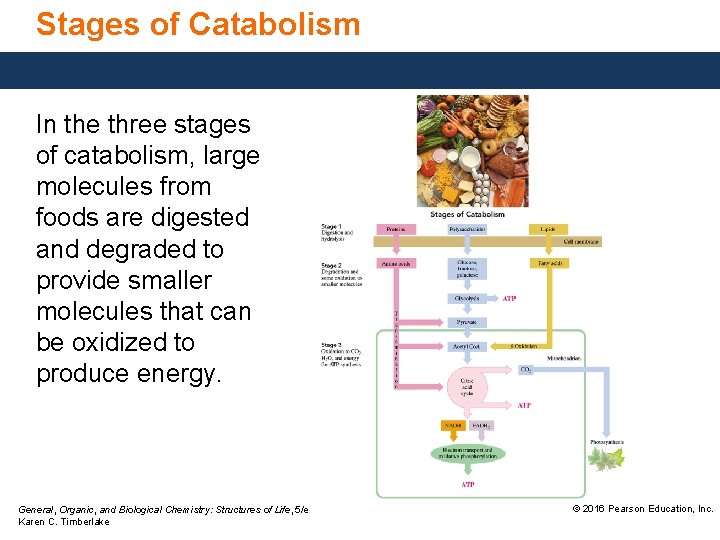
Stages of Catabolism In the three stages of catabolism, large molecules from foods are digested and degraded to provide smaller molecules that can be oxidized to produce energy. General, Organic, and Biological Chemistry: Structures of Life, 5/e Karen C. Timberlake © 2016 Pearson Education, Inc.
Cell Structure for Metabolism Cells in plants and animals are known as eukaryotic cells, which have a nucleus that contains DNA. In animals, • a cell membrane separates the materials inside the cell from the aqueous environment surrounding the cell. • the cell nucleus contains the genes that control DNA replication and protein synthesis. • the cytosol, or fluid part of the cell, contains electrolytes and enzymes that catalyze chemical reactions in the cell. General, Organic, and Biological Chemistry: Structures of Life, 5/e Karen C. Timberlake © 2016 Pearson Education, Inc.
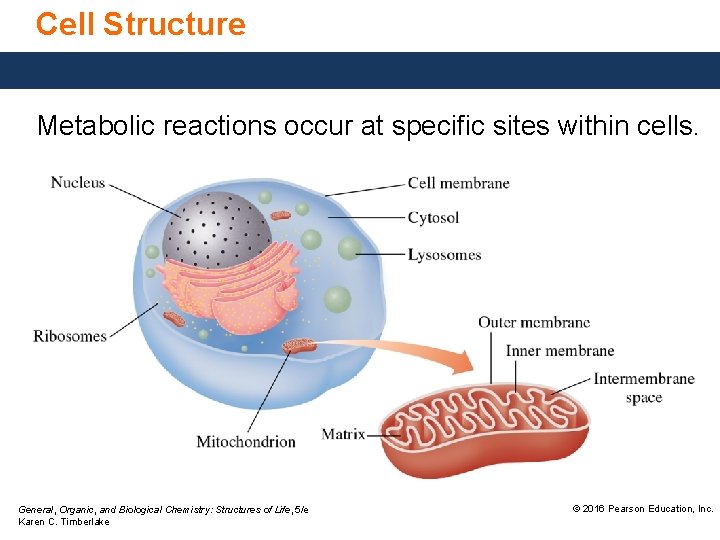
Cell Structure Metabolic reactions occur at specific sites within cells. General, Organic, and Biological Chemistry: Structures of Life, 5/e Karen C. Timberlake © 2016 Pearson Education, Inc.
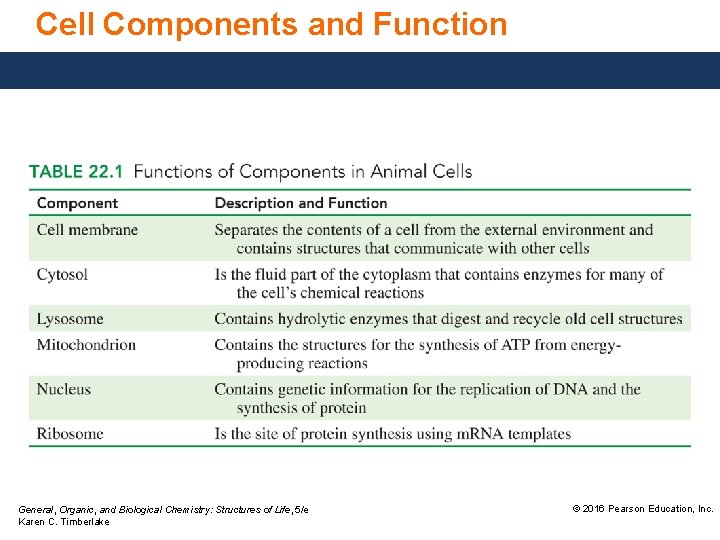
Cell Components and Function General, Organic, and Biological Chemistry: Structures of Life, 5/e Karen C. Timberlake © 2016 Pearson Education, Inc.
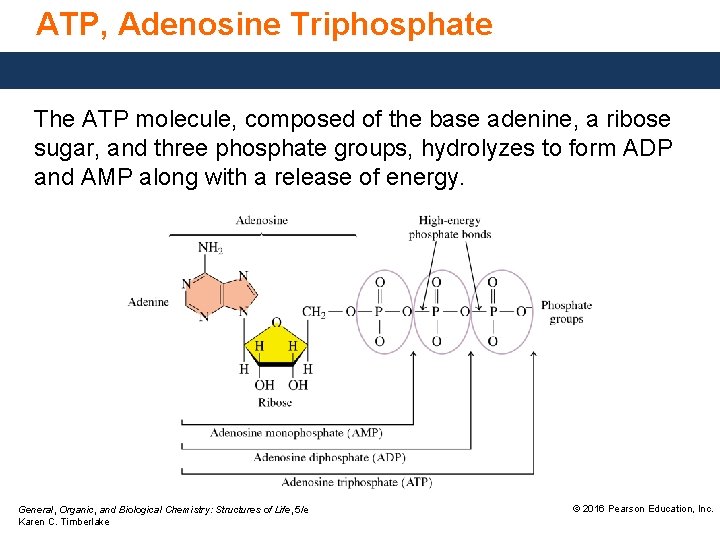
ATP, Adenosine Triphosphate The ATP molecule, composed of the base adenine, a ribose sugar, and three phosphate groups, hydrolyzes to form ADP and AMP along with a release of energy. General, Organic, and Biological Chemistry: Structures of Life, 5/e Karen C. Timberlake © 2016 Pearson Education, Inc.
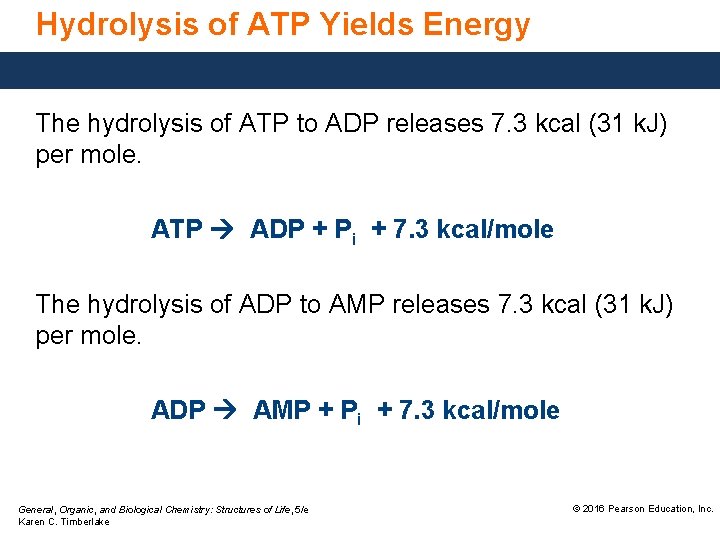
Hydrolysis of ATP Yields Energy The hydrolysis of ATP to ADP releases 7. 3 kcal (31 k. J) per mole. ATP ADP + Pi + 7. 3 kcal/mole The hydrolysis of ADP to AMP releases 7. 3 kcal (31 k. J) per mole. ADP AMP + Pi + 7. 3 kcal/mole General, Organic, and Biological Chemistry: Structures of Life, 5/e Karen C. Timberlake © 2016 Pearson Education, Inc.
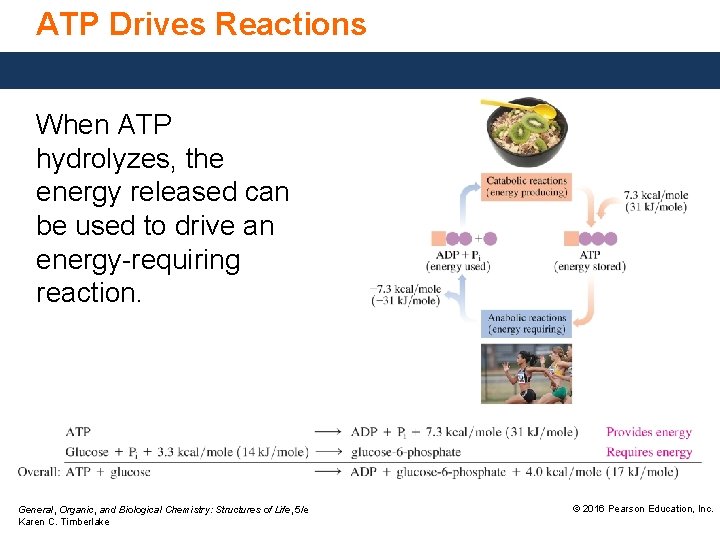
ATP Drives Reactions When ATP hydrolyzes, the energy released can be used to drive an energy-requiring reaction. General, Organic, and Biological Chemistry: Structures of Life, 5/e Karen C. Timberlake © 2016 Pearson Education, Inc.
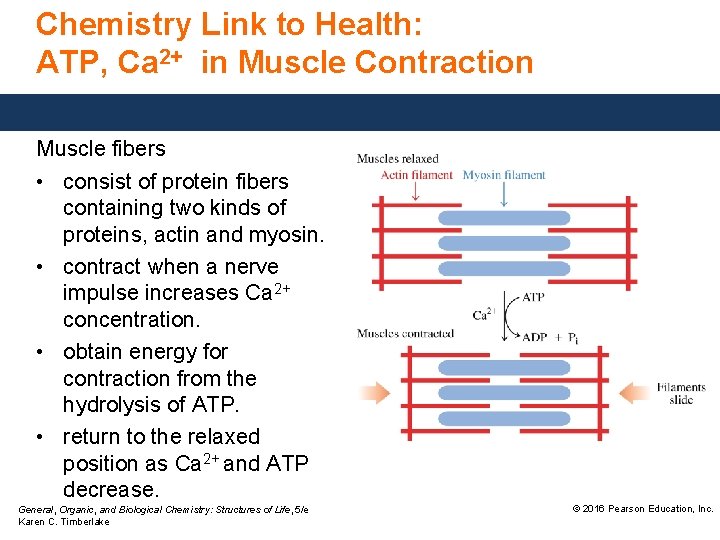
Chemistry Link to Health: ATP, Ca 2+ in Muscle Contraction Muscle fibers • consist of protein fibers containing two kinds of proteins, actin and myosin. • contract when a nerve impulse increases Ca 2+ concentration. • obtain energy for contraction from the hydrolysis of ATP. • return to the relaxed position as Ca 2+ and ATP decrease. General, Organic, and Biological Chemistry: Structures of Life, 5/e Karen C. Timberlake © 2016 Pearson Education, Inc.
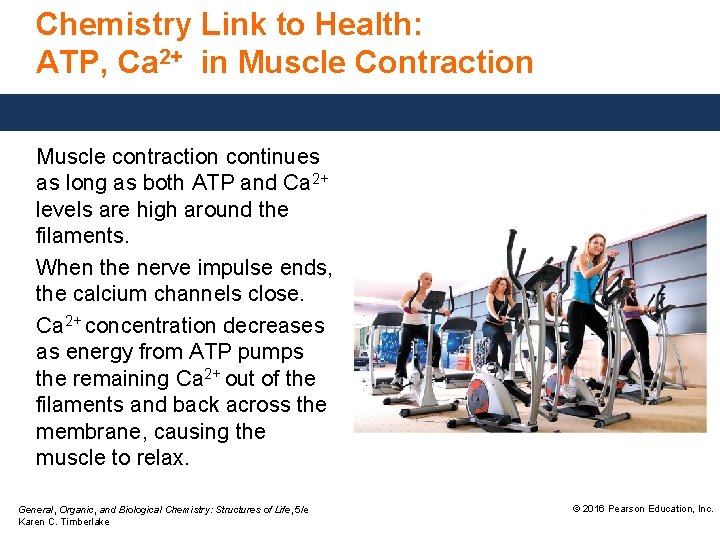
Chemistry Link to Health: ATP, Ca 2+ in Muscle Contraction Muscle contraction continues as long as both ATP and Ca 2+ levels are high around the filaments. When the nerve impulse ends, the calcium channels close. Ca 2+ concentration decreases as energy from ATP pumps the remaining Ca 2+ out of the filaments and back across the membrane, causing the muscle to relax. General, Organic, and Biological Chemistry: Structures of Life, 5/e Karen C. Timberlake © 2016 Pearson Education, Inc.
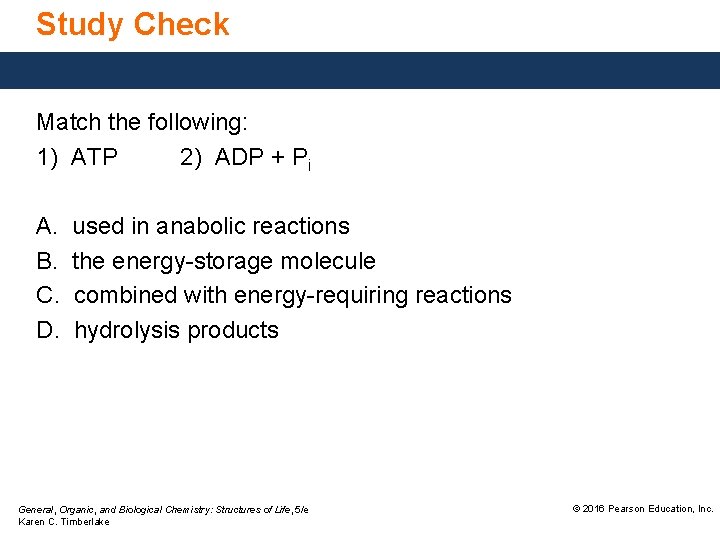
Study Check Match the following: 1) ATP 2) ADP + Pi A. B. C. D. used in anabolic reactions the energy-storage molecule combined with energy-requiring reactions hydrolysis products General, Organic, and Biological Chemistry: Structures of Life, 5/e Karen C. Timberlake © 2016 Pearson Education, Inc.
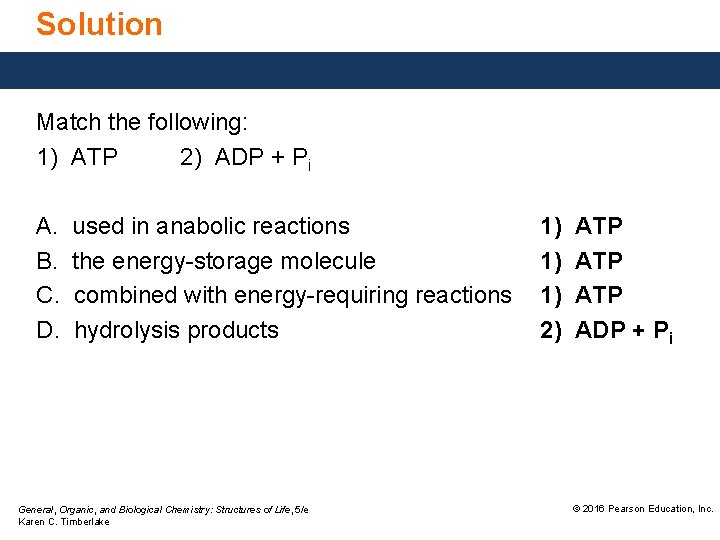
Solution Match the following: 1) ATP 2) ADP + Pi A. B. C. D. used in anabolic reactions the energy-storage molecule combined with energy-requiring reactions hydrolysis products General, Organic, and Biological Chemistry: Structures of Life, 5/e Karen C. Timberlake 1) 1) 1) 2) ATP ATP ADP + Pi © 2016 Pearson Education, Inc.
- Slides: 16