
Lecture Presentation Chapter 22 Biochemistry 2017 Pearson Education
Lecture Presentation Chapter 22 Biochemistry © 2017 Pearson Education, Inc.
Diabetes • Over 16 million people in the United States are afflicted with diabetes. – Generally controllable, but may be fatal • Type 1 diabetes is caused by the inability of the pancreas to produce enough insulin. • Insulin is a protein needed to promote the adsorption of glucose into the cells. • Animal insulin was used as a treatment. • Now human insulin can be synthesized and manufactured because Sanger was able to determine the exact structure of human insulin. © 2017 Pearson Education, Inc.
Biochemistry • Biochemistry is the study of the chemistry of living organisms. • Much of biochemistry deals with the large, complex molecules necessary for life as we know it. • However, most of these complex molecules are actually made of smaller, simpler units; they are polymers. • There are four main, major chemical components of cells—lipids, proteins, carbohydrates, and nucleic acids. © 2017 Pearson Education, Inc.
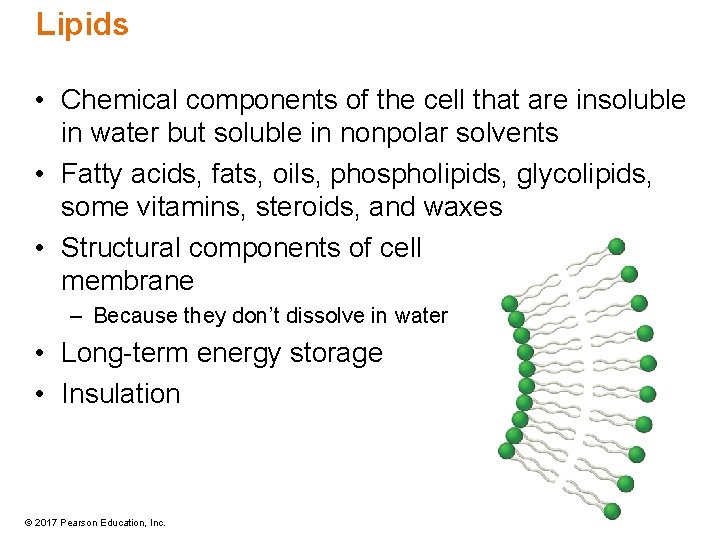
Lipids • Chemical components of the cell that are insoluble in water but soluble in nonpolar solvents • Fatty acids, fats, oils, phospholipids, glycolipids, some vitamins, steroids, and waxes • Structural components of cell membrane – Because they don’t dissolve in water • Long-term energy storage • Insulation © 2017 Pearson Education, Inc.
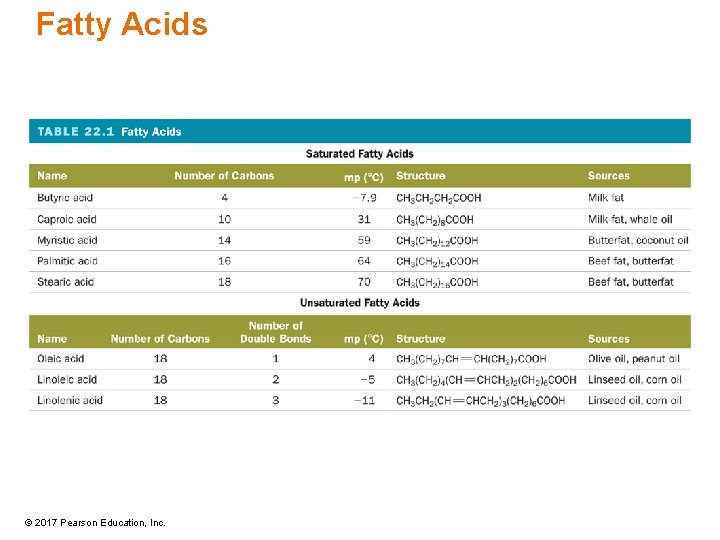
Fatty Acids • Carboxylic acid (head) with a very long hydrocarbon side chain (tail) • Saturated fatty acids contain no C═C double bonds in the hydrocarbon side chain. • Unsaturated fatty acids have C═C double bonds. – Monounsaturated have 1 C═C. – Polyunsaturated have more than 1 C═C. © 2017 Pearson Education, Inc.
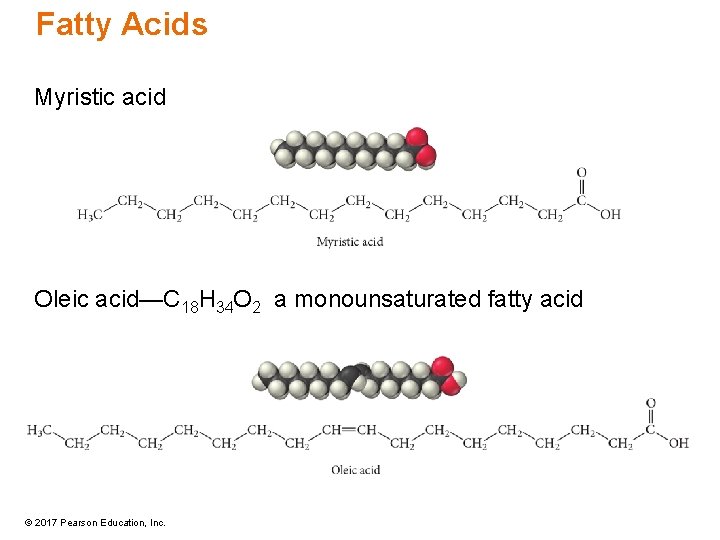
Fatty Acids Myristic acid Oleic acid—C 18 H 34 O 2 a monounsaturated fatty acid © 2017 Pearson Education, Inc.
Fatty Acids © 2017 Pearson Education, Inc.
Structure and Melting Point • Larger fatty acid = higher melting point • Double bonds decrease melting point. – More double bonds = lower MP • Saturated = no double bonds – Monounsaturated = one double bond – Polyunsaturated = many double bonds • Largely nonpolar, the main attractive forces are dispersion forces. • Larger molecule = more electrons = larger dipole = stronger attractions = higher melting point • More straight = more surface contact = stronger attractions = higher melting point © 2017 Pearson Education, Inc.
Triglycerides • Triglycerides are fats and oils that differ in the length of the fatty-acid side chains and degree of unsaturation. – Side chains range from 12 to 20 carbon atoms. – Most natural triglycerides have different fatty-acid chains in the triglyceride; simple triglycerides have three identical chains. • Saturated fat = all saturated fatty-acid chains – Warm-blooded animal fat – Solids • Unsaturated fats = some unsaturated fatty-acid chains – Cold-blooded animal fat or vegetable oils – Liquids © 2017 Pearson Education, Inc.
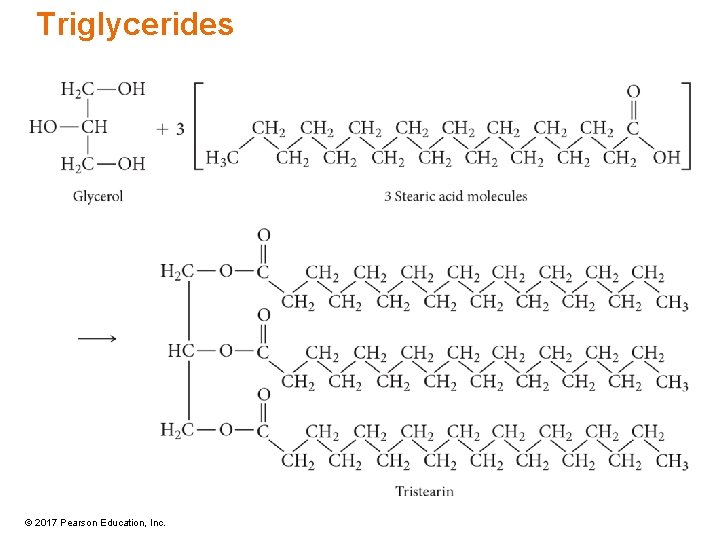
Triglycerides © 2017 Pearson Education, Inc.
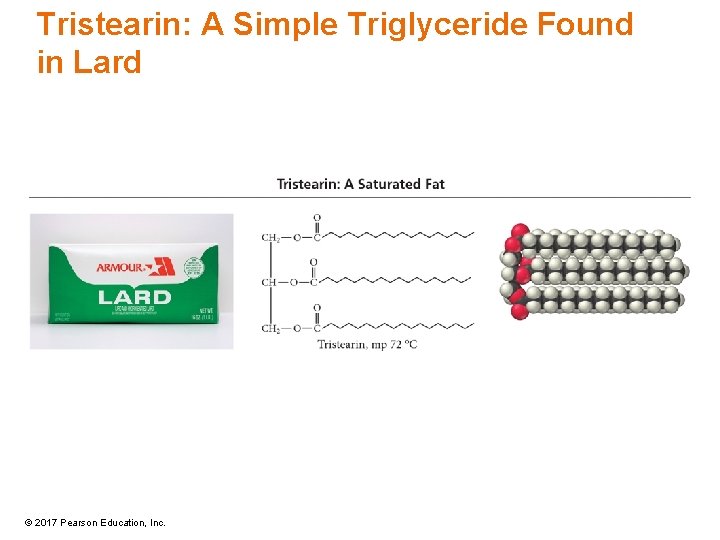
Tristearin: A Simple Triglyceride Found in Lard © 2017 Pearson Education, Inc.
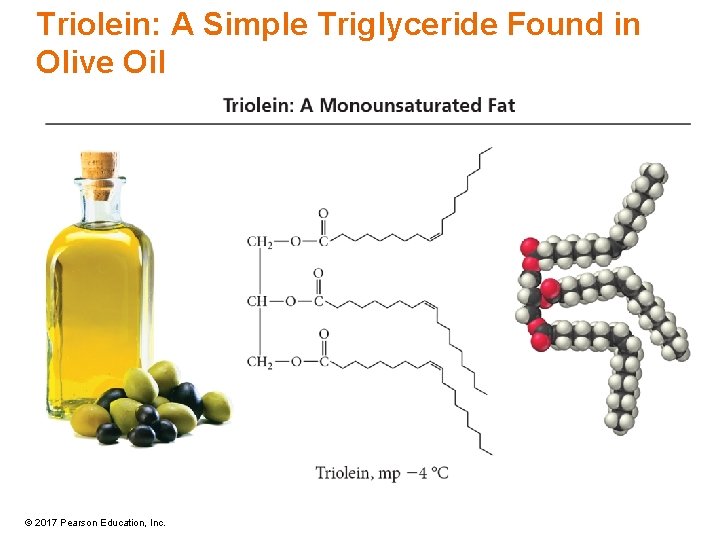
Triolein: A Simple Triglyceride Found in Olive Oil © 2017 Pearson Education, Inc.
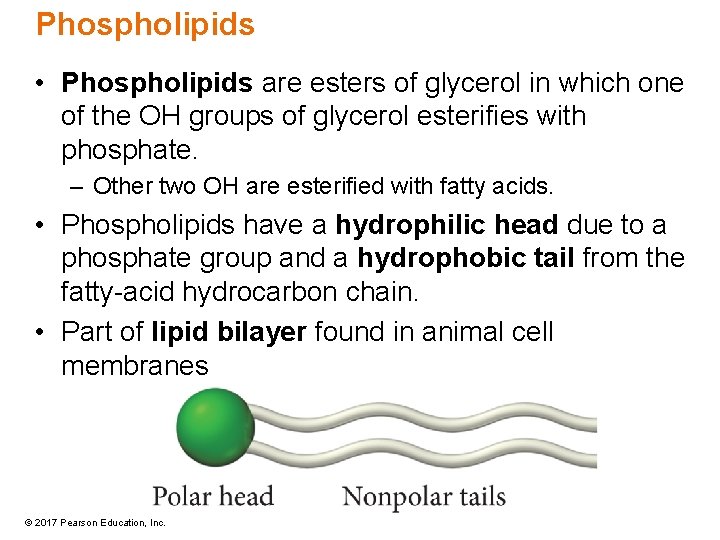
Phospholipids • Phospholipids are esters of glycerol in which one of the OH groups of glycerol esterifies with phosphate. – Other two OH are esterified with fatty acids. • Phospholipids have a hydrophilic head due to a phosphate group and a hydrophobic tail from the fatty-acid hydrocarbon chain. • Part of lipid bilayer found in animal cell membranes © 2017 Pearson Education, Inc.
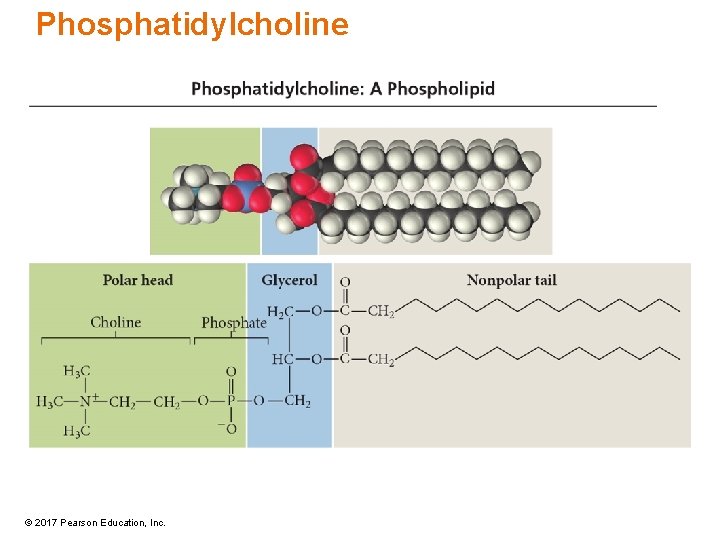
Phosphatidylcholine © 2017 Pearson Education, Inc.
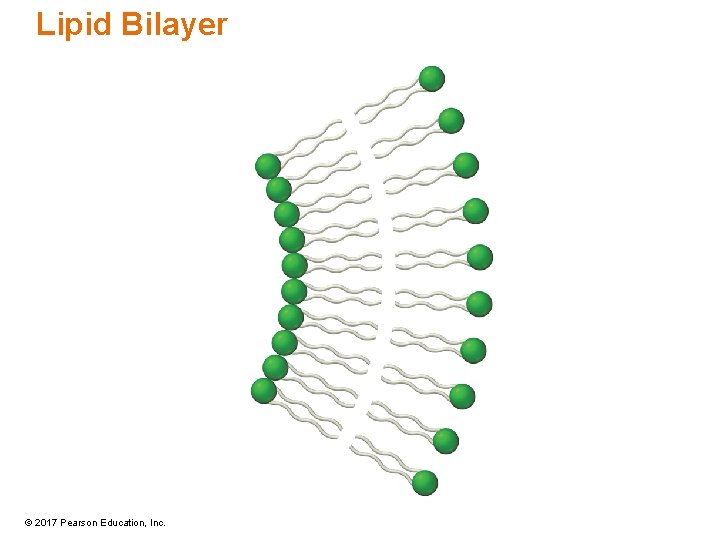
Lipid Bilayer © 2017 Pearson Education, Inc.
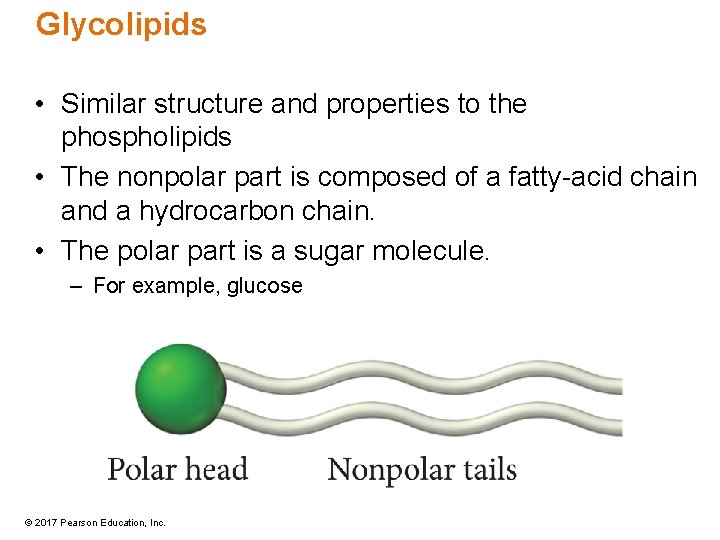
Glycolipids • Similar structure and properties to the phospholipids • The nonpolar part is composed of a fatty-acid chain and a hydrocarbon chain. • The polar part is a sugar molecule. – For example, glucose © 2017 Pearson Education, Inc.
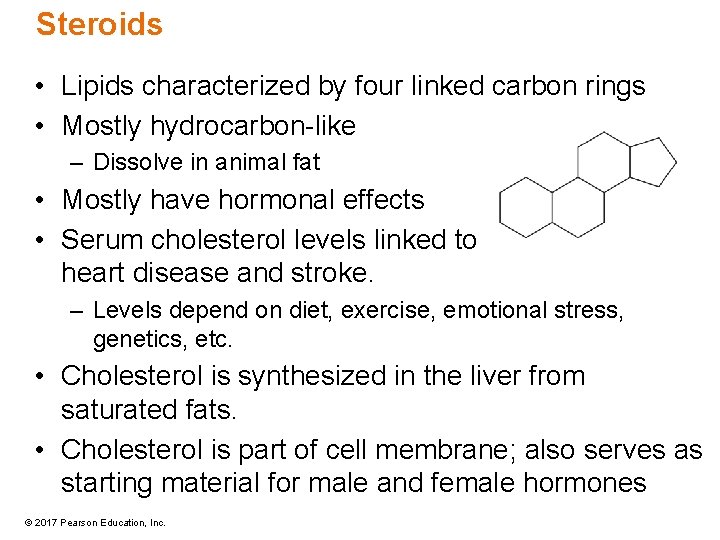
Steroids • Lipids characterized by four linked carbon rings • Mostly hydrocarbon-like – Dissolve in animal fat • Mostly have hormonal effects • Serum cholesterol levels linked to heart disease and stroke. – Levels depend on diet, exercise, emotional stress, genetics, etc. • Cholesterol is synthesized in the liver from saturated fats. • Cholesterol is part of cell membrane; also serves as starting material for male and female hormones © 2017 Pearson Education, Inc.
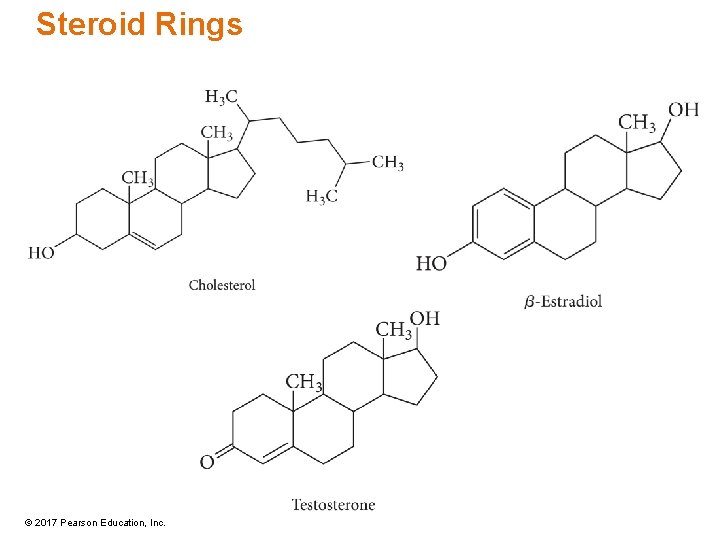
Steroid Rings © 2017 Pearson Education, Inc.
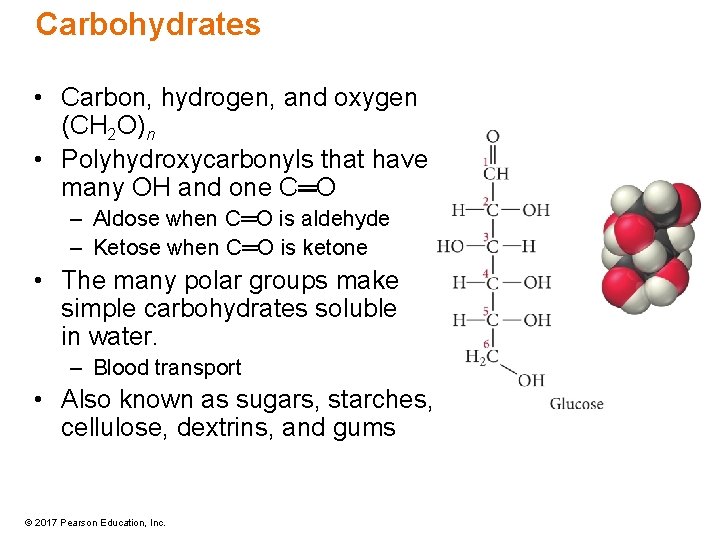
Carbohydrates • Carbon, hydrogen, and oxygen (CH 2 O)n • Polyhydroxycarbonyls that have many OH and one C═O – Aldose when C═O is aldehyde – Ketose when C═O is ketone • The many polar groups make simple carbohydrates soluble in water. – Blood transport • Also known as sugars, starches, cellulose, dextrins, and gums © 2017 Pearson Education, Inc.
Classification of Carbohydrates • Monosaccharides cannot be broken down into simpler carbohydrates. – Triose, tetrose, pentose, hexose • Disaccharides are two monosaccharides attached by a glycosidic link. – Glycosidic link forms with the condensation of H 2 O between two monosacccharides. • Polysaccharides are three or more monosaccharides linked into complex chains. – Starch and cellulose are polysaccharides of glucose. © 2017 Pearson Education, Inc.
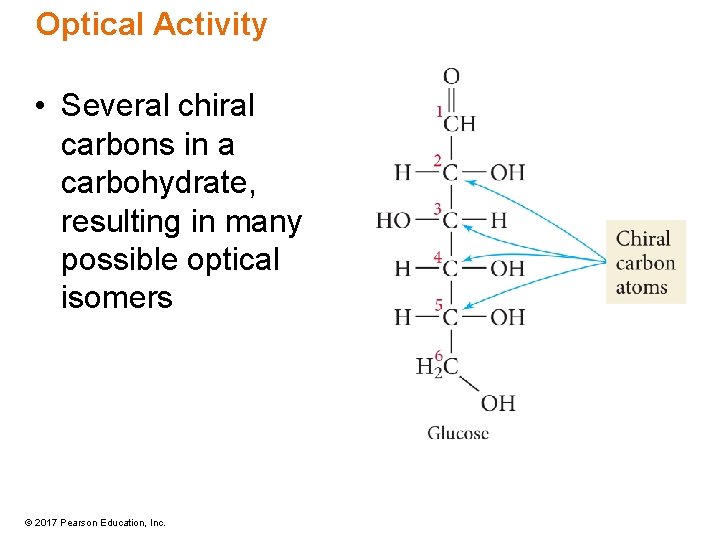
Optical Activity • Several chiral carbons in a carbohydrate, resulting in many possible optical isomers © 2017 Pearson Education, Inc.
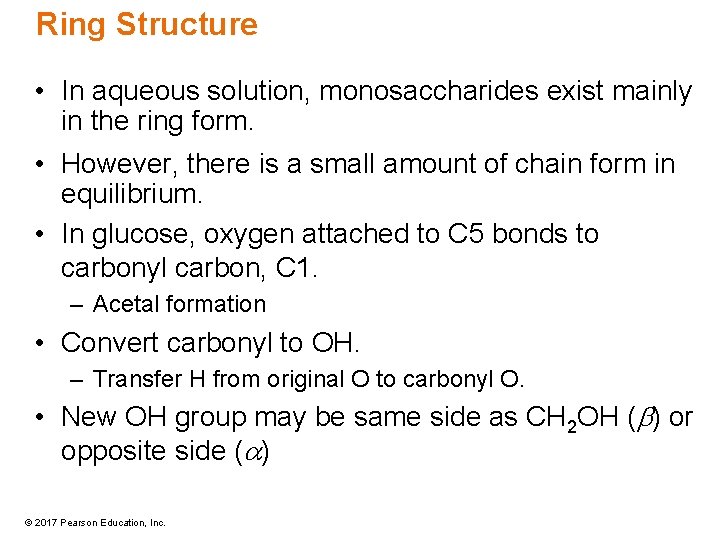
Ring Structure • In aqueous solution, monosaccharides exist mainly in the ring form. • However, there is a small amount of chain form in equilibrium. • In glucose, oxygen attached to C 5 bonds to carbonyl carbon, C 1. – Acetal formation • Convert carbonyl to OH. – Transfer H from original O to carbonyl O. • New OH group may be same side as CH 2 OH (b) or opposite side (a) © 2017 Pearson Education, Inc.
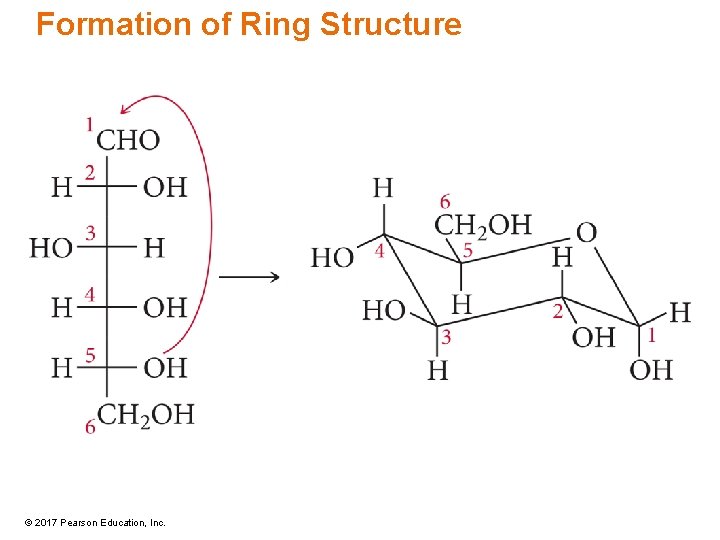
Formation of Ring Structure © 2017 Pearson Education, Inc.
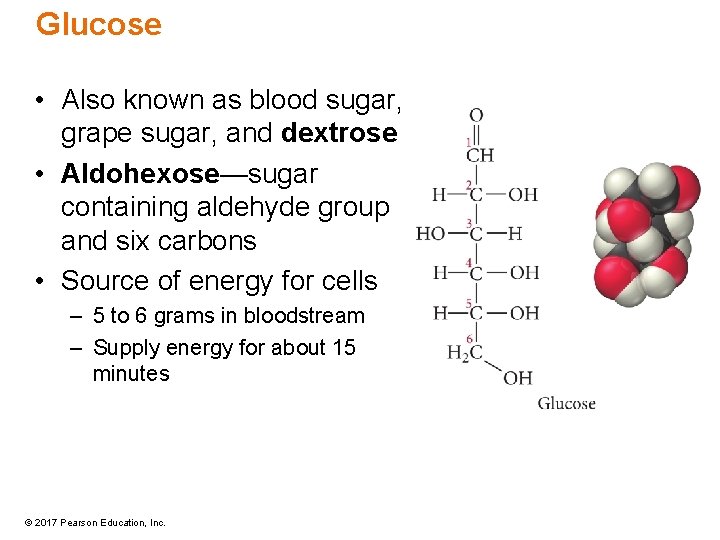
Glucose • Also known as blood sugar, grape sugar, and dextrose • Aldohexose—sugar containing aldehyde group and six carbons • Source of energy for cells – 5 to 6 grams in bloodstream – Supply energy for about 15 minutes © 2017 Pearson Education, Inc.
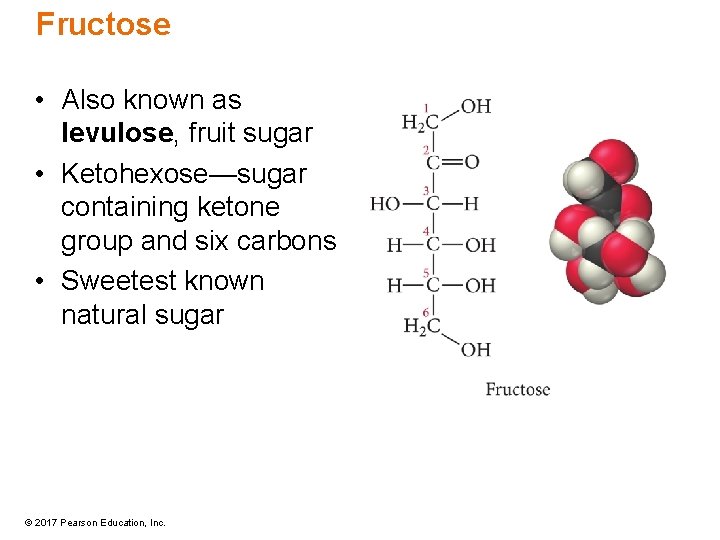
Fructose • Also known as levulose, fruit sugar • Ketohexose—sugar containing ketone group and six carbons • Sweetest known natural sugar © 2017 Pearson Education, Inc.
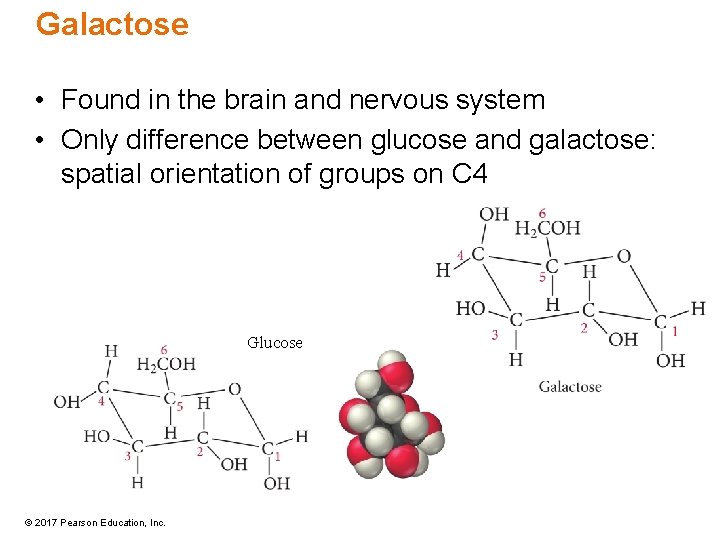
Galactose • Found in the brain and nervous system • Only difference between glucose and galactose: spatial orientation of groups on C 4 Glucose © 2017 Pearson Education, Inc.
Sucrose • Also known as table sugar, cane sugar, beet sugar • Glucose + fructose = sucrose • a– 1, 2–glycosidic linkage involves aldehyde group from glucose and ketone group from fructose • Nonreducing © 2017 Pearson Education, Inc.
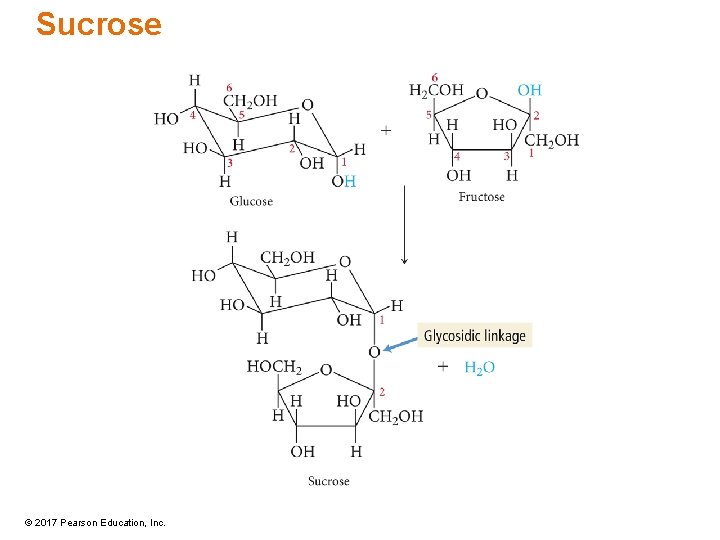
Sucrose © 2017 Pearson Education, Inc.
Hydrolysis • In digestion, polysaccharides and disaccharides are broken down into monosaccharides. • Hydrolysis is the addition of water to break glycosidic link. – Under acidic or basic conditions • Monosaccharides can pass through intestinal wall into the bloodstream; larger sugars cannot. © 2017 Pearson Education, Inc.
Polysaccharides • Also known as complex carbohydrates • Polymer of monosaccharide units bonded together in a chain • The glycosidic link between units may be either a or b. – In a, the rings are all oriented the same direction. – In b, the rings alternate orientation. © 2017 Pearson Education, Inc.
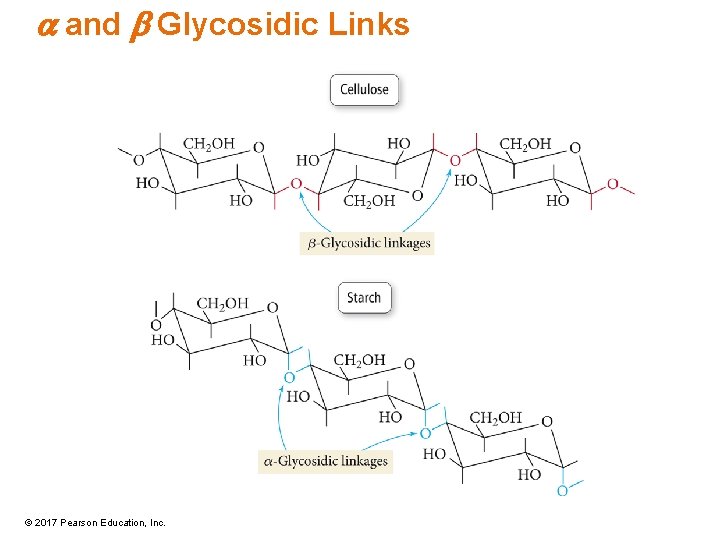
a and b Glycosidic Links © 2017 Pearson Education, Inc.
Cellulose • Made of glucose rings • b–glycosidic linkages • Not digestible • Fibrous, plant structural material • Allows neighboring chains to H-bond, resulting in a rigid structure © 2017 Pearson Education, Inc.
Starch • Made of amylose and amylopectin polysaccharides, both made up of glucose • a–glycosidic linkages • Give glucose on hydrolysis • Main energy storage medium • Digestible, soft, and chewy • Composed of straight amylose polymer chains and branched amylopectin polymer chains © 2017 Pearson Education, Inc.
Glycogen • Made of glucose rings • a–glycosidic link • Similar to amylopectin polymer chains except more highly branched • Many branches mean faster hydrolysis—a quickly accessible energy reserve. • Glycogen depletion from muscles results in the exercise becoming much more difficult. © 2017 Pearson Education, Inc.
Proteins • Involved in practically every facet of cell function • Structural elements of muscle, skin, and cartilage • Different classes of proteins with varied function • Polymers of amino acids © 2017 Pearson Education, Inc.
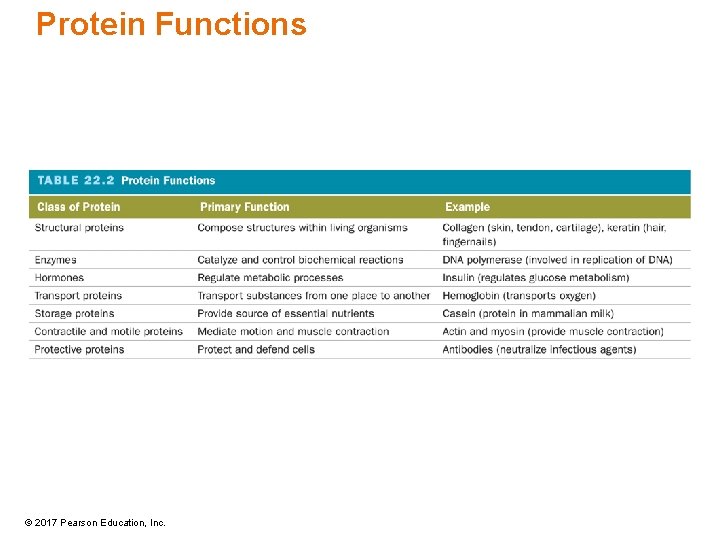
Protein Functions © 2017 Pearson Education, Inc.
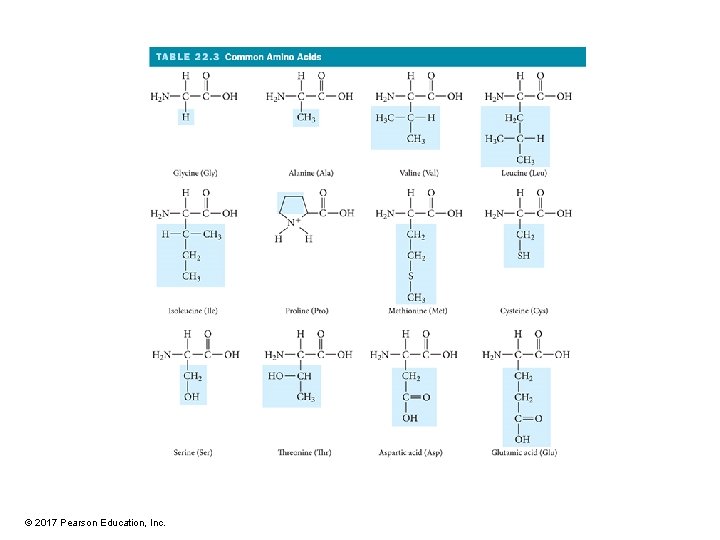
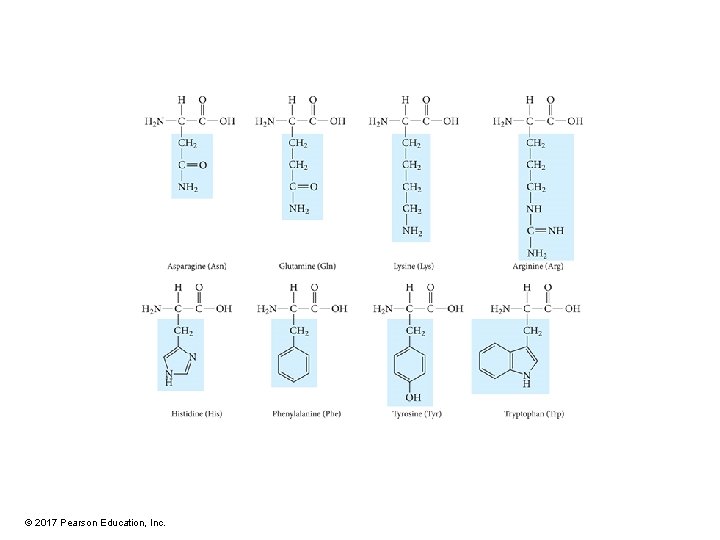
Amino Acids • Consist of a carbon atom—called the a-carbon—bonded to four different groups: amine group, R group (or side chain), carboxylic acid group, and hydrogen atom • —NH 2 group on carbon adjacent to COOH - a-amino acids • All amino acids except for glycine are chiral. © 2017 Pearson Education, Inc.
Amino Acids • Building blocks of proteins • The main difference between amino acids is the side chain. – R group • Some R groups are polar while others are nonpolar. • Some polar R groups are acidic while others are basic. • Some R groups contain O, some contain N, and others contain S. • Some R groups are rings while others are chains. © 2017 Pearson Education, Inc.
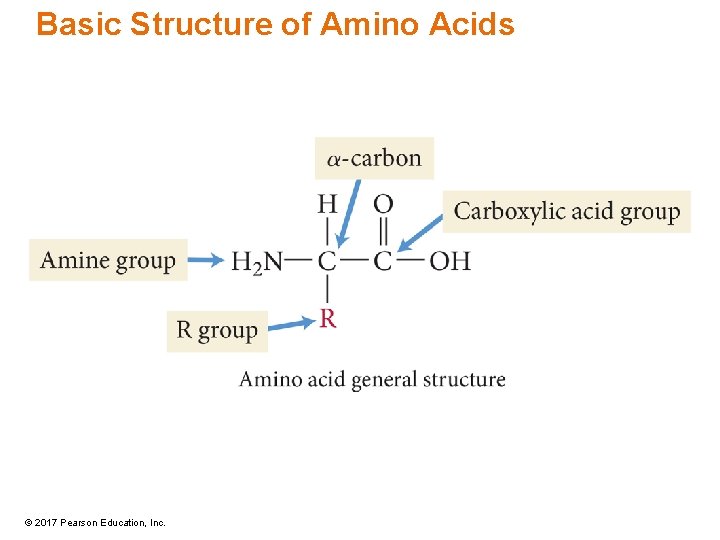
Basic Structure of Amino Acids © 2017 Pearson Education, Inc.
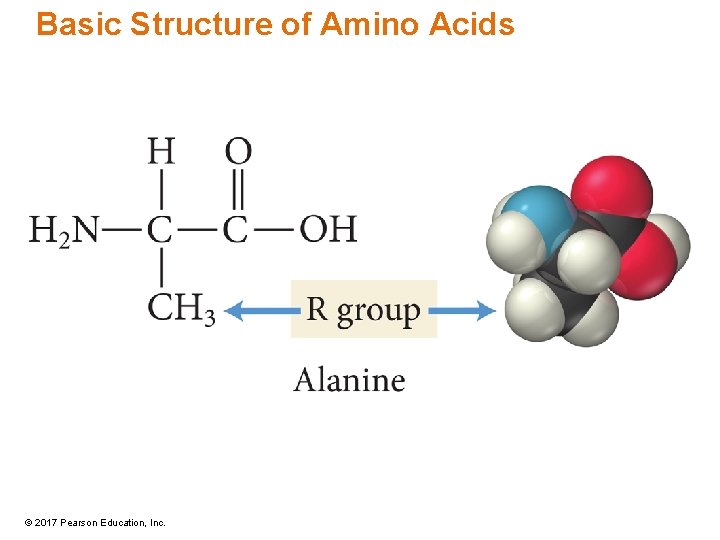
Basic Structure of Amino Acids © 2017 Pearson Education, Inc.
© 2017 Pearson Education, Inc.
© 2017 Pearson Education, Inc.
Optical Activity • The a carbon is chiral on the amino acids. – Except for glycine • Most naturally occurring amino acids have the same orientation of the groups as occurs in Lenantioners, or L-enantiomer. • Therefore, they are called the L-amino acids. – Not l for levorotatory © 2017 Pearson Education, Inc.
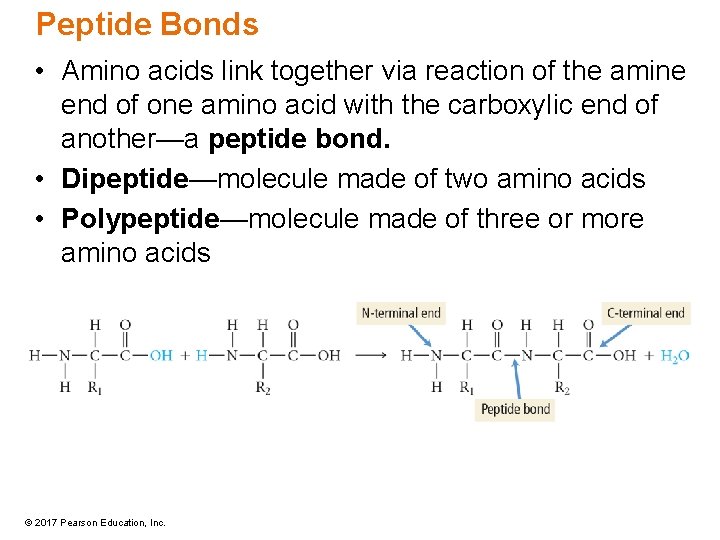
Peptide Bonds • Amino acids link together via reaction of the amine end of one amino acid with the carboxylic end of another—a peptide bond. • Dipeptide—molecule made of two amino acids • Polypeptide—molecule made of three or more amino acids © 2017 Pearson Education, Inc.
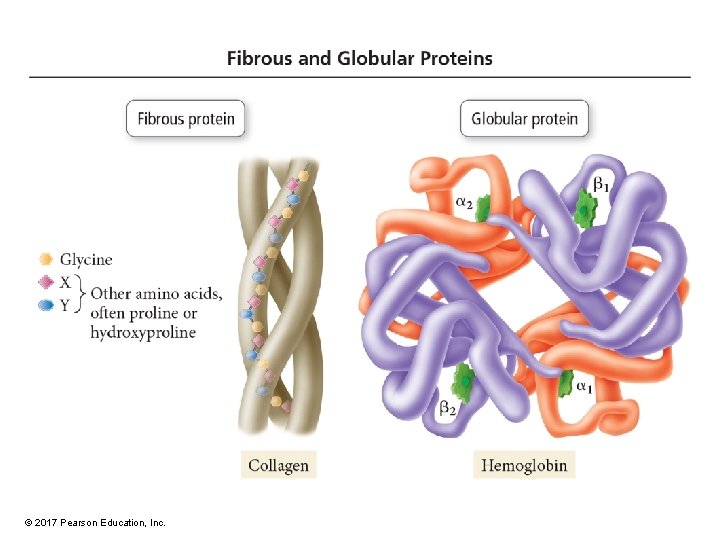
Protein Structure • Protein structure is key to its function. • Most proteins are classified as either fibrous or globular. • Fibrous proteins have a linear, simple structure. – Insoluble in water – Used in structural features of the cell • Globular proteins have a complex, threedimensional structure. – Generally have polar R groups of the amino acids pointing out, so they are somewhat soluble but also maintain an area that is nonpolar in the interior. © 2017 Pearson Education, Inc.
© 2017 Pearson Education, Inc.
© 2017 Pearson Education, Inc.
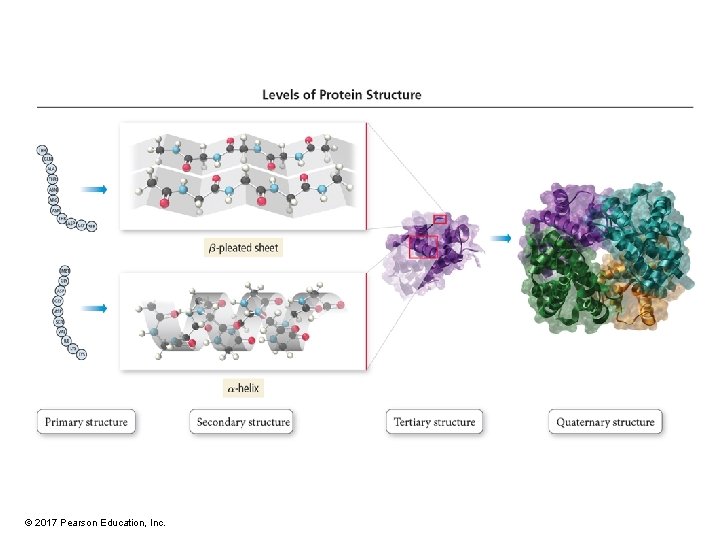
Primary Protein Structure • The primary structure is the sequence of amino acids in its chain(s). • Determines the other three kinds of structure • Even minor changes in the amino acid sequence can destroy the function of a protein. © 2017 Pearson Education, Inc.
Primary Structure Sickle-Cell Anemia • Sickle-cell anemia results in changes in primary structure. • It replaces one Val amino acid with Glu on two of the four chains. • Red blood cells take on a sickle shape that can damage organs. • The sickle-cell shape impedes circulation. • Sickle-cell disease is fatal. © 2017 Pearson Education, Inc.
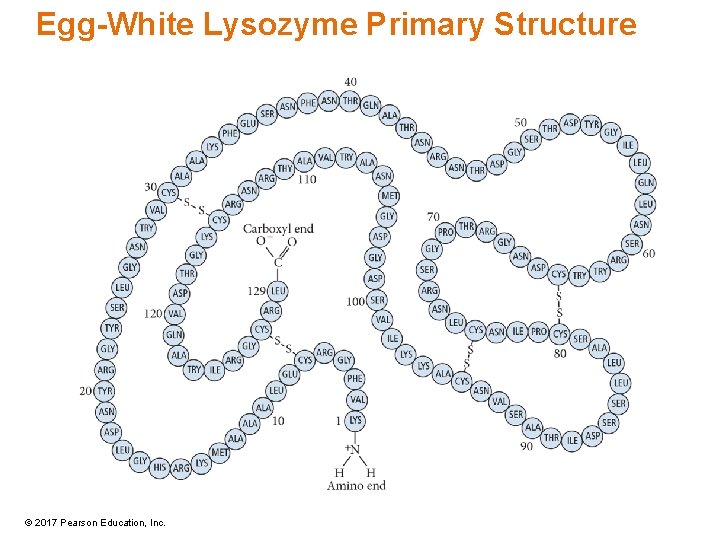
Egg-White Lysozyme Primary Structure © 2017 Pearson Education, Inc.
Secondary Structure • Regular, repeating patterns in arrangement of protein chains • Maintained by interactions between amino acids that are near each other in the chain • Formed and held by H bonds between NH and C═O • a-helix – Most common • b-pleated sheet • Many proteins have sections that are a-helix, other sections that are b-sheets, and others that are random coils. © 2017 Pearson Education, Inc.
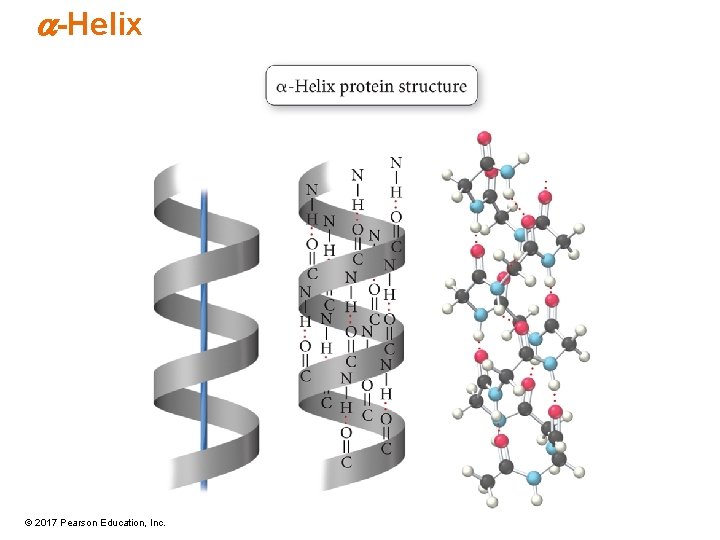
a-Helix © 2017 Pearson Education, Inc.
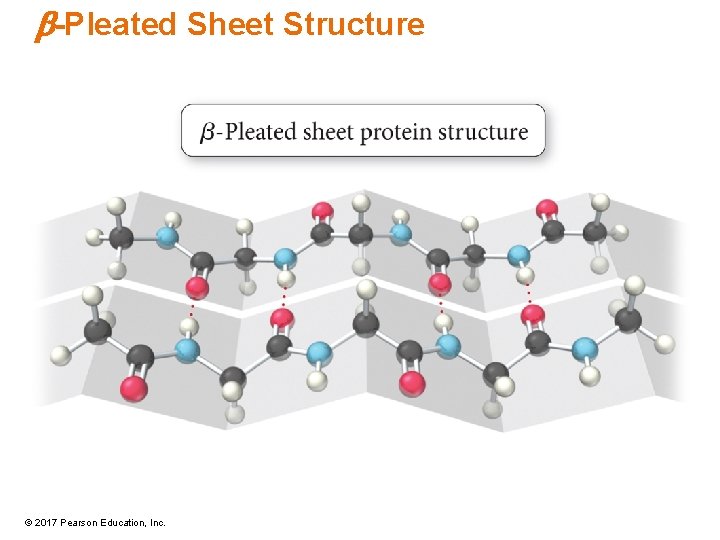
b-Pleated Sheet Structure © 2017 Pearson Education, Inc.
Tertiary Structure • The tertiary structure comprises the large-scale bends and folds due to interactions between R groups separated by large distances on the chains. • Types of interactions include – H bonds – Disulfide linkages • Between cysteine amino acids – Hydrophobic interactions • Between large, nonpolar R groups – Salt bridges • Between acidic and basic R groups © 2017 Pearson Education, Inc.
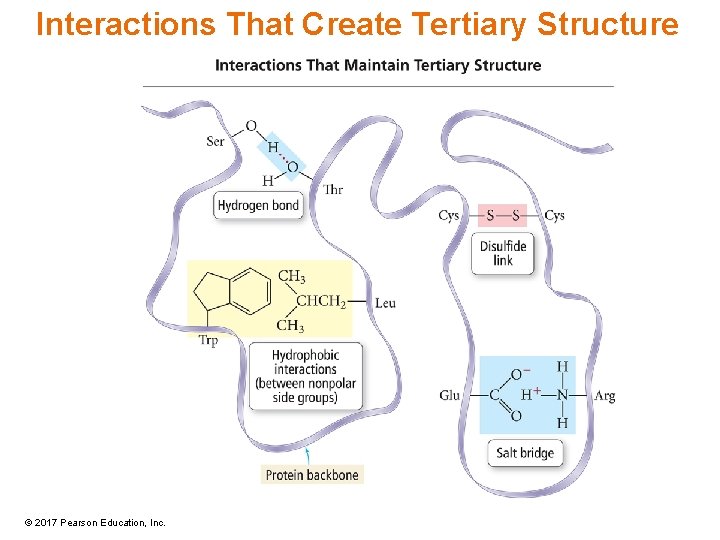
Interactions That Create Tertiary Structure © 2017 Pearson Education, Inc.
Tertiary Structure and Protein Type • Fibrous proteins generally lack tertiary structure. – Extend as long, straight chains with some secondary structure • Globular proteins fold in on themselves, forming complex shapes due to the tertiary interactions. © 2017 Pearson Education, Inc.
Quaternary Structure • Many proteins are composed of multiple amino-acid chains. • The way the chains are linked together is called quaternary structure. • Interactions holding the chains together are the same kinds as in tertiary structure. © 2017 Pearson Education, Inc.
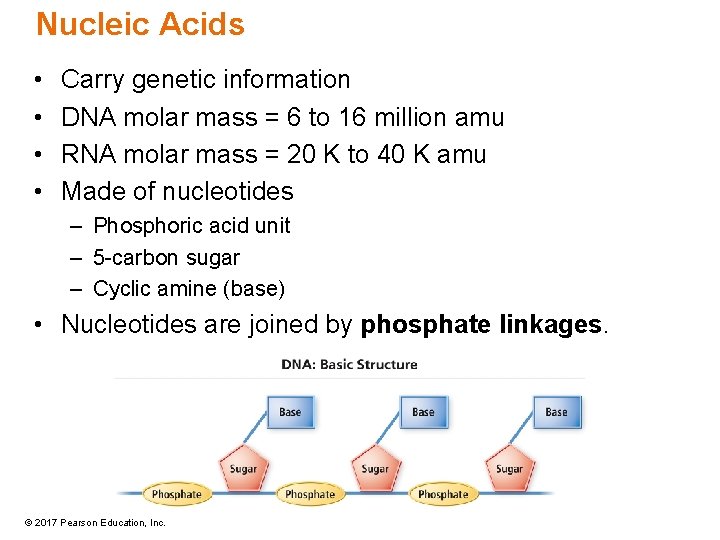
Nucleic Acids • • Carry genetic information DNA molar mass = 6 to 16 million amu RNA molar mass = 20 K to 40 K amu Made of nucleotides – Phosphoric acid unit – 5 -carbon sugar – Cyclic amine (base) • Nucleotides are joined by phosphate linkages. © 2017 Pearson Education, Inc.
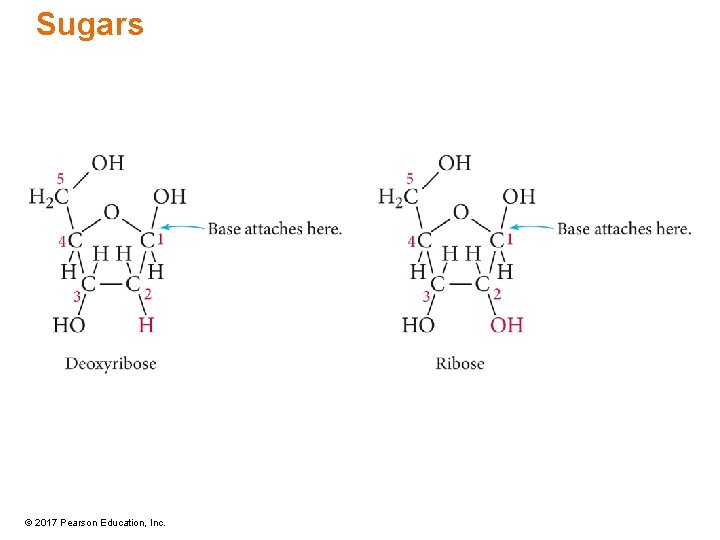
Nucleotide Structure • Each nucleotide has three parts: a cyclic pentose, a phosphate group, and an organic aromatic base. • The pentoses are ribose or deoxyribose. • The pentoses are the central backbone of the nucleotide. • The pentose is attached to the organic base at C 1 and to the phosphate group at C 5. © 2017 Pearson Education, Inc.
Sugars © 2017 Pearson Education, Inc.
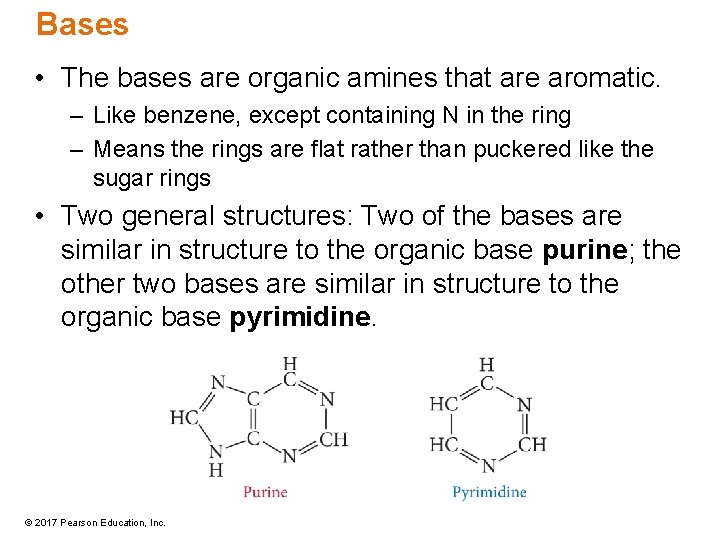
Bases • The bases are organic amines that are aromatic. – Like benzene, except containing N in the ring – Means the rings are flat rather than puckered like the sugar rings • Two general structures: Two of the bases are similar in structure to the organic base purine; the other two bases are similar in structure to the organic base pyrimidine. © 2017 Pearson Education, Inc.
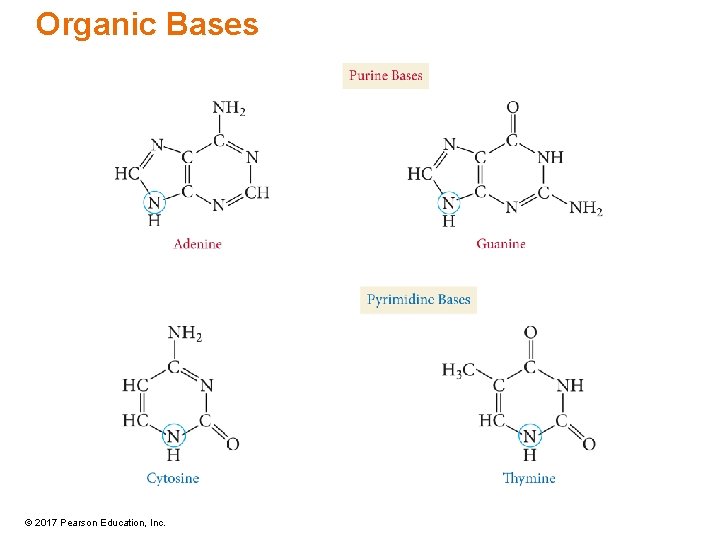
Organic Bases © 2017 Pearson Education, Inc.
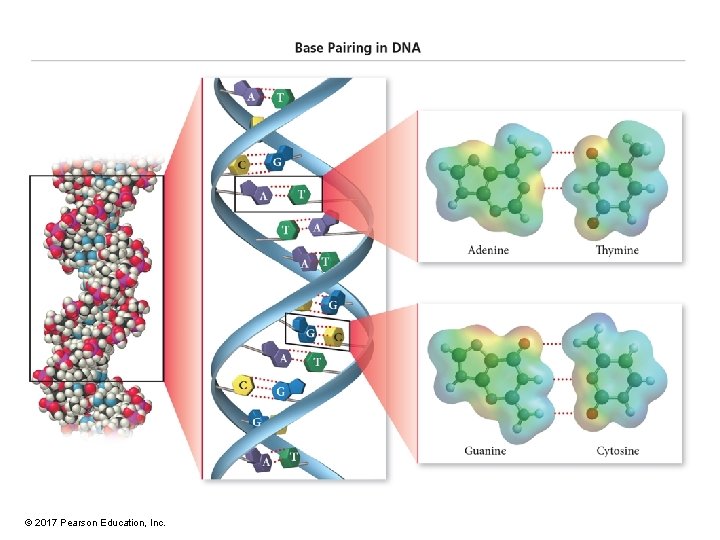
Bases • The structure of the bases is complementary, meaning that a purine and pyrimidine will precisely align to H-bond with each other. – Adenine matches thymine or uracil. – Guanine matches cytosine. • Attach to sugar at C 1 of the sugar through circled N © 2017 Pearson Education, Inc.
© 2017 Pearson Education, Inc.
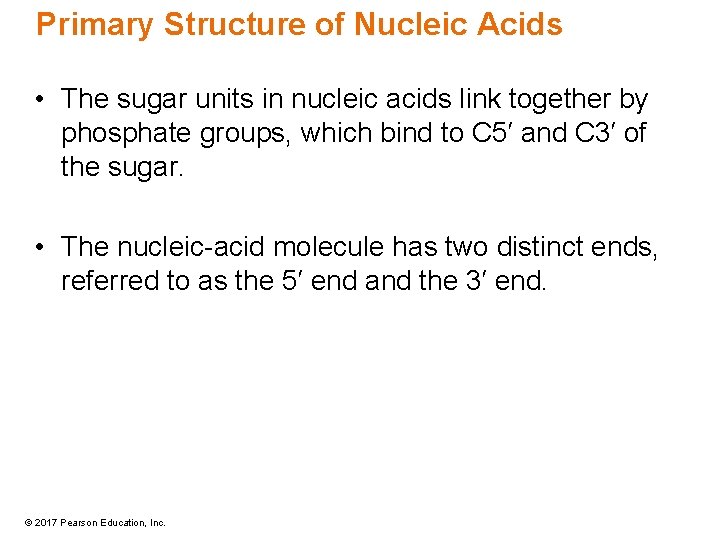
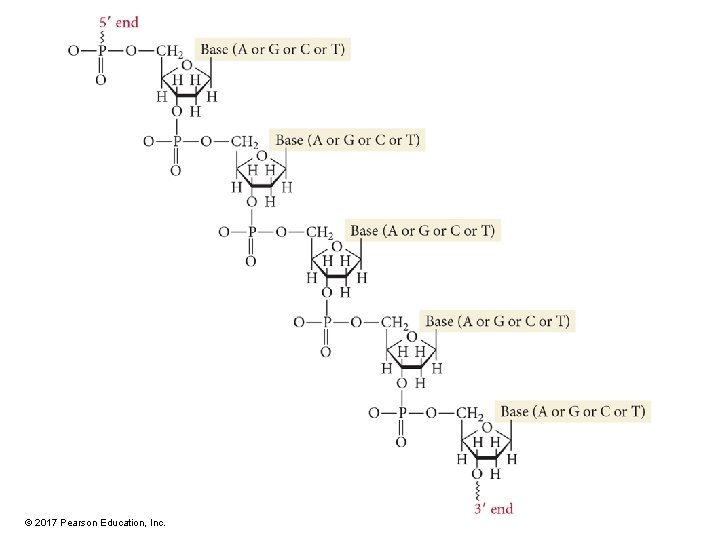
Primary Structure of Nucleic Acids • The sugar units in nucleic acids link together by phosphate groups, which bind to C 5′ and C 3′ of the sugar. • The nucleic-acid molecule has two distinct ends, referred to as the 5′ end and the 3′ end. © 2017 Pearson Education, Inc.
© 2017 Pearson Education, Inc.
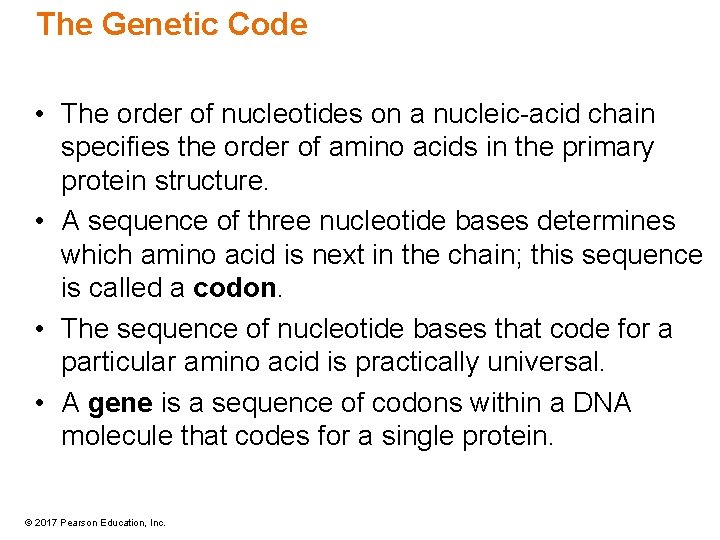
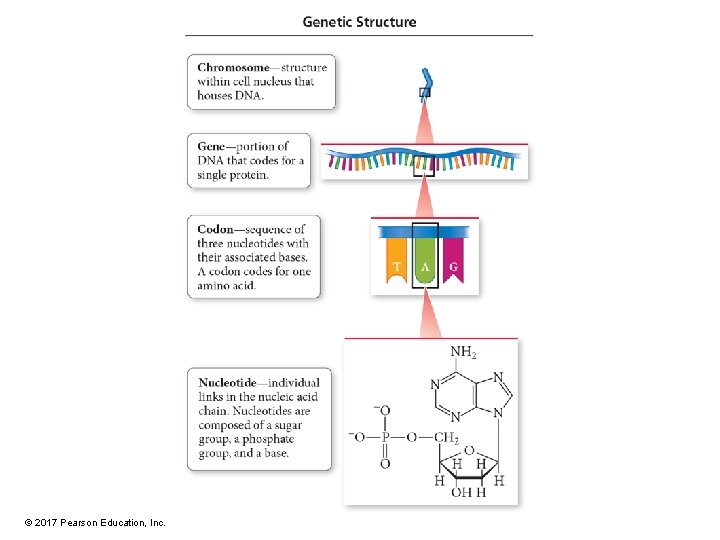
The Genetic Code • The order of nucleotides on a nucleic-acid chain specifies the order of amino acids in the primary protein structure. • A sequence of three nucleotide bases determines which amino acid is next in the chain; this sequence is called a codon. • The sequence of nucleotide bases that code for a particular amino acid is practically universal. • A gene is a sequence of codons within a DNA molecule that codes for a single protein. © 2017 Pearson Education, Inc.
© 2017 Pearson Education, Inc.
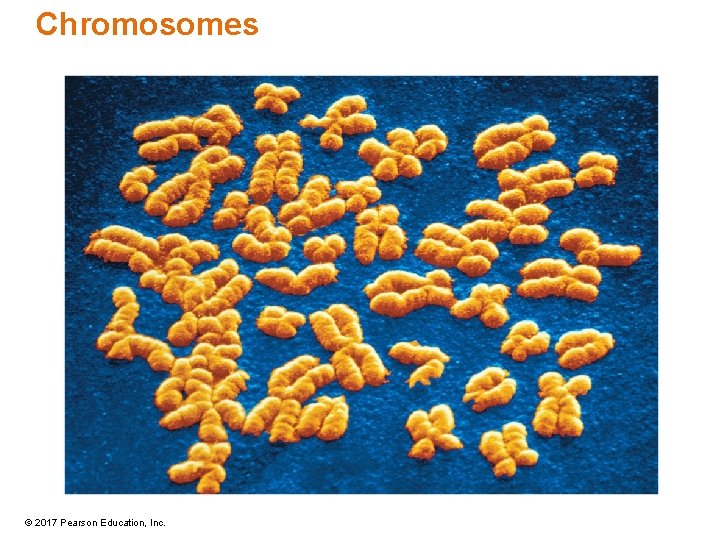
Chromosomes © 2017 Pearson Education, Inc.
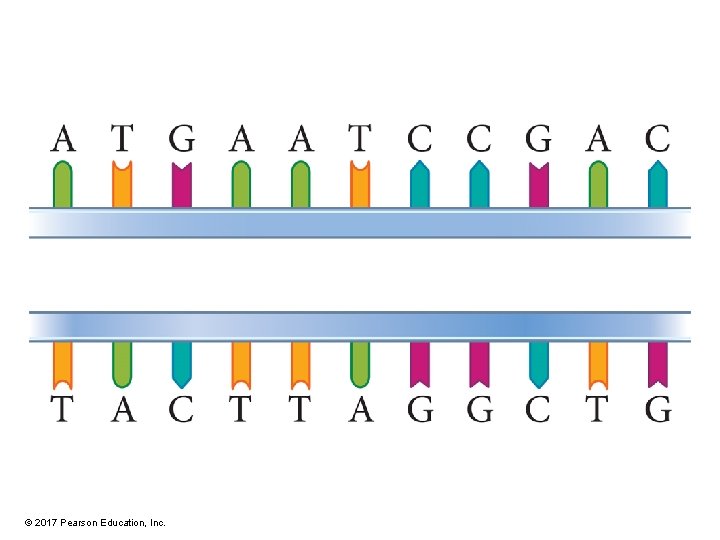
DNA Structure • DNA is made of two strands linked together by H bonds between bases. • Strands are antiparallel. – One runs 3'→ 5', while other runs 5'→ 3'. • Bases are complementary and directed to the interior of the helix. – A pairs with T and C with G. © 2017 Pearson Education, Inc.
© 2017 Pearson Education, Inc.
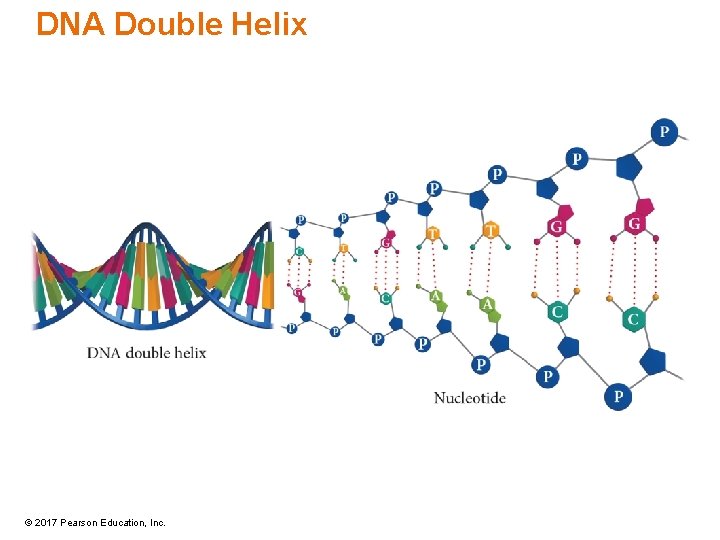
DNA Double Helix © 2017 Pearson Education, Inc.
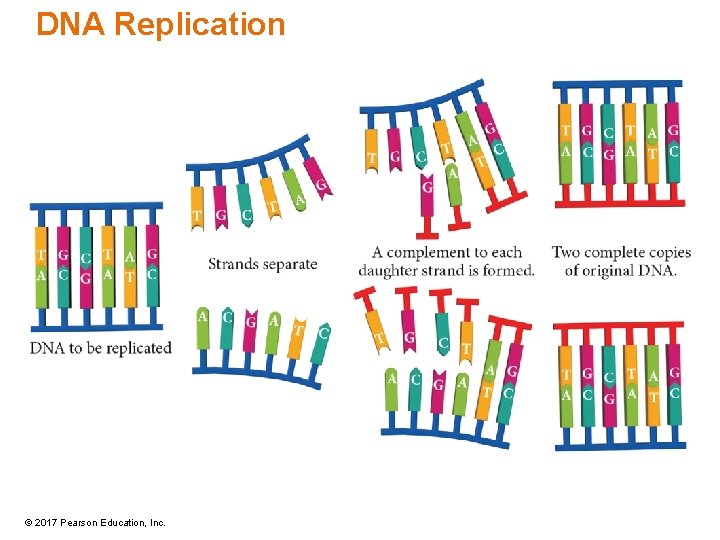
DNA Replication • When the DNA is to be replicated, the region to be replicated uncoils. • This H bond between the base pairs is broken, separating the two strands. • With the aid of enzymes, new strands of DNA are constructed by linking the complementary nucleotides and the original strand together. © 2017 Pearson Education, Inc.
DNA Replication © 2017 Pearson Education, Inc.
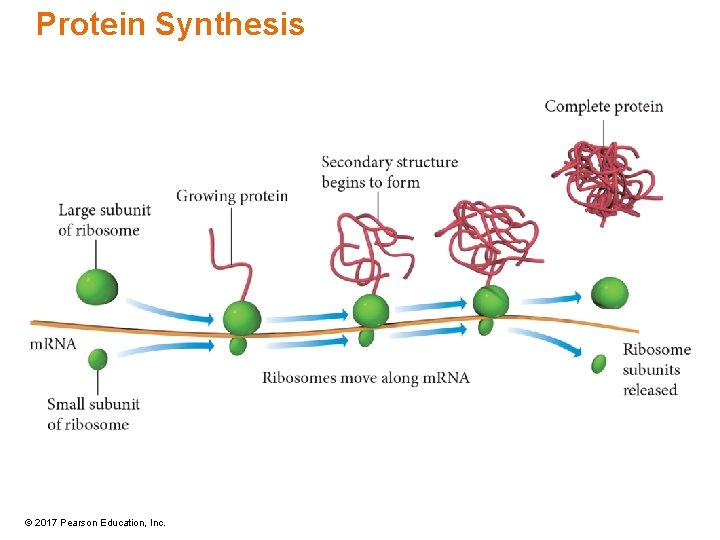
Protein Synthesis • Transcription → translation • In the nucleus, the DNA strand at the gene separates, and a complementary copy of the gene is made in RNA. – Messenger RNA = m. RNA • The m. RNA travels into the cytoplasm where it links with a ribosome. • At the ribosome, each codon on the RNA codes for a single amino acid, and these are joined together to form the polypeptide chain. © 2017 Pearson Education, Inc.
Protein Synthesis © 2017 Pearson Education, Inc.
- Slides: 76