
Lecture Presentation Chapter 2 Particles of Matter Bradley
Lecture Presentation Chapter 2 Particles of Matter Bradley Sieve Northern Kentucky University Highland Heights, KY © 2014 Pearson Education, Inc.
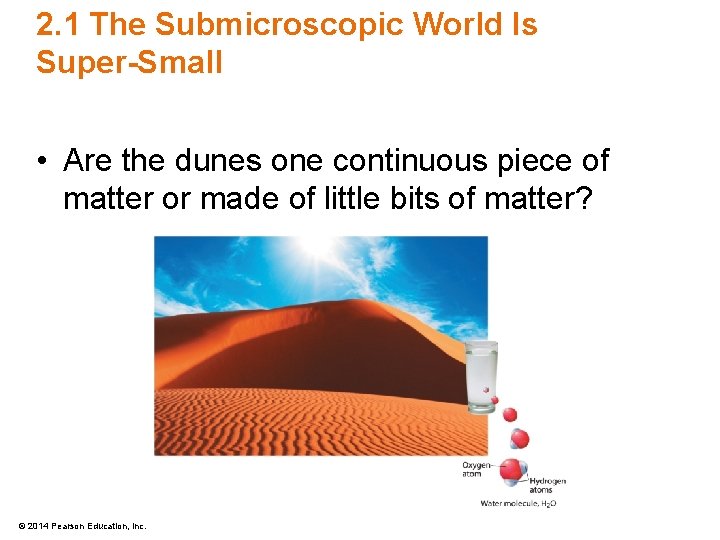
2. 1 The Submicroscopic World Is Super-Small • Are the dunes one continuous piece of matter or made of little bits of matter? © 2014 Pearson Education, Inc.
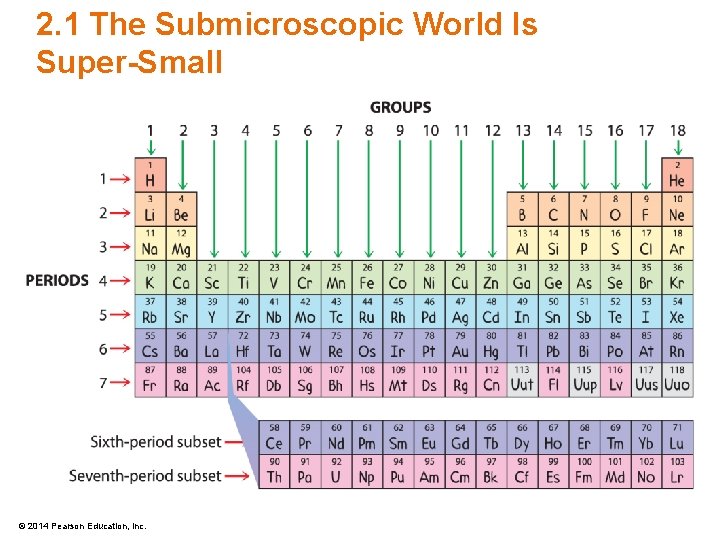
2. 1 The Submicroscopic World Is Super-Small • All matter is made of atoms – Very small fundamental unit • One grain of sand contains 1. 25 x 1020 atoms • More than 100 types of atoms are known – The periodic table organizes the different atoms • Atoms combine to form molecules © 2014 Pearson Education, Inc.
2. 1 The Submicroscopic World Is Super-Small © 2014 Pearson Education, Inc.
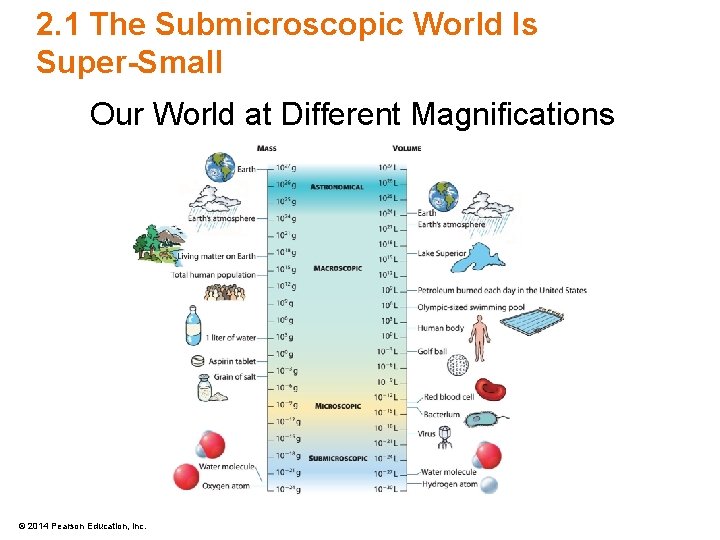
2. 1 The Submicroscopic World Is Super-Small Our World at Different Magnifications © 2014 Pearson Education, Inc.
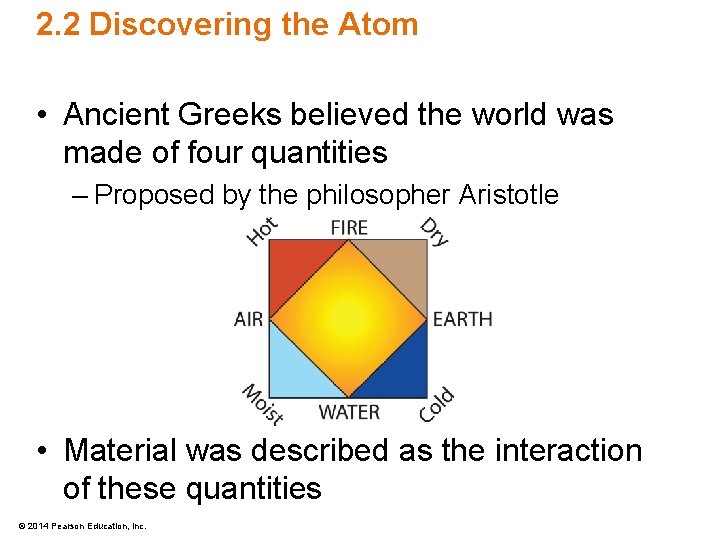
2. 2 Discovering the Atom • Ancient Greeks believed the world was made of four quantities – Proposed by the philosopher Aristotle • Material was described as the interaction of these quantities © 2014 Pearson Education, Inc.
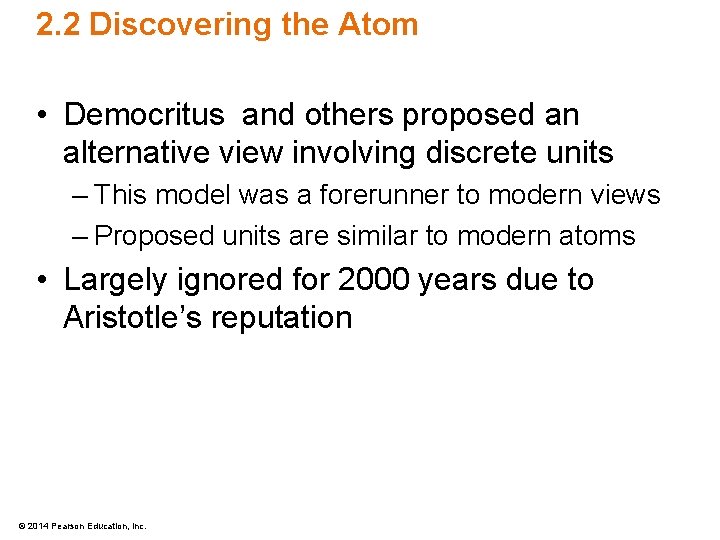
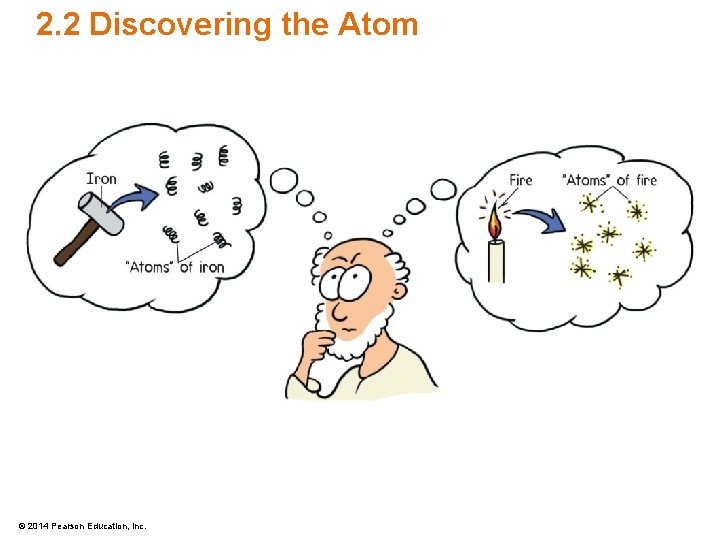
2. 2 Discovering the Atom • Democritus and others proposed an alternative view involving discrete units – This model was a forerunner to modern views – Proposed units are similar to modern atoms • Largely ignored for 2000 years due to Aristotle’s reputation © 2014 Pearson Education, Inc.
2. 2 Discovering the Atom © 2014 Pearson Education, Inc.
2. 2 Discovering the Atom • Alchemy: the study of changing one material into another • Attempted to – Change one metal into another – Create potions to confer immortality • This was done by altering amount of each of Aristotle’s quantities present © 2014 Pearson Education, Inc.
2. 2 Discovering the Atom Antoine Lavoisier – Defined an element • A fundamental substance that cannot be broken down into anything else – Was able to break apart the water, confirming it was not an element – Developed the law of conservation of mass © 2014 Pearson Education, Inc.
2. 2 Discovering the Atom John Dalton – Reintroduced the ideas of Democritus • Highlighting the concept of atoms – Dalton’s atomic model further defined the atom • Theory built on four main points © 2014 Pearson Education, Inc.
2. 2 Discovering the Atom Dalton’s Atomic Model 1. Each element consists of indivisible, minute particles called atoms 2. Atoms can be neither created nor destroyed in chemical reactions 3. All atoms of a given element are identical 4. Atoms of different elements have different masses © 2014 Pearson Education, Inc.
![2. 2 Discovering the Atom Fathers of Modern Chemistry [image 1. 11] [image 2.](http://slidetodoc.com/presentation_image_h2/1a6b4566bd5b2df4afe1dbb9f7a6d871/image-13.jpg "2. 2 Discovering the Atom Fathers of Modern Chemistry [image 1. 11] [image 2.")
2. 2 Discovering the Atom Fathers of Modern Chemistry [image 1. 11] [image 2. 5] [image 2. 6] Lavoisier Dalton Mendeleev © 2014 Pearson Education, Inc.
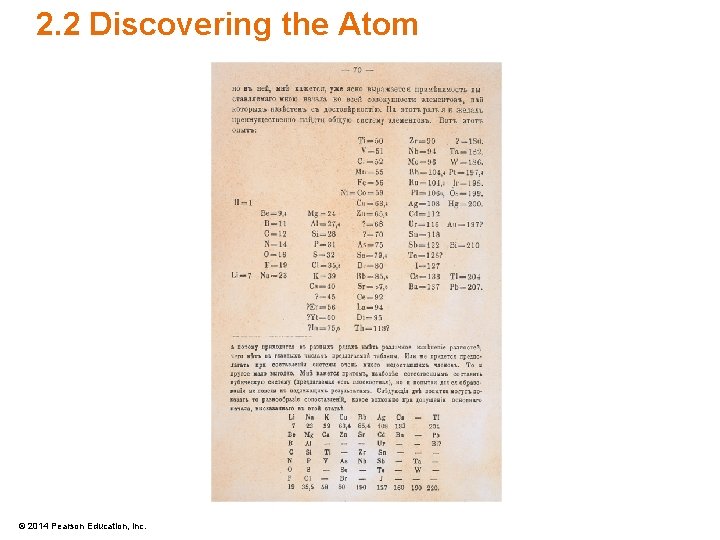
2. 2 Discovering the Atom Dmitri Mendeleev – Developed the periodic table • • First made as a chart to help a student Ordered elements based on increasing mass Noticed trends in the vertical columns of the chart When trends did not match, left an empty space s – Predicted that the missing elements were simply not discovered yet © 2014 Pearson Education, Inc.
2. 2 Discovering the Atom © 2014 Pearson Education, Inc.
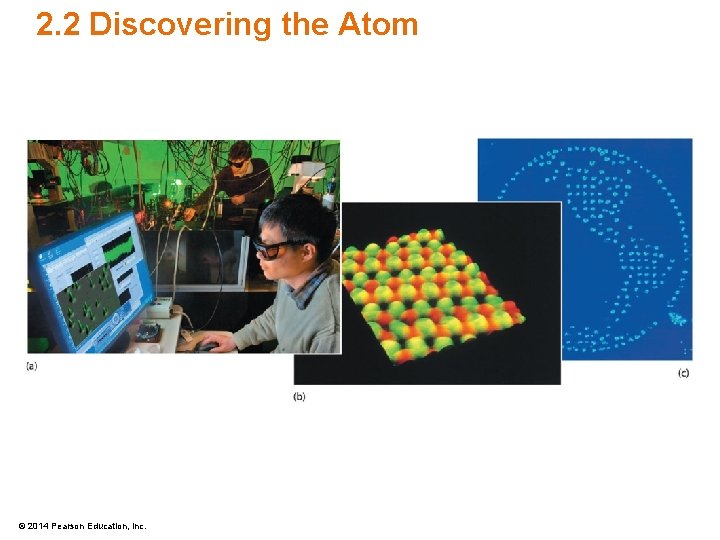
2. 2 Discovering the Atom • Our understanding of atoms has continued to improve – This has led to many advancements • Medicines can extend life • Oil can produce many useful products • Fertilizer can be produced from air – Technology can now capture images of atoms © 2014 Pearson Education, Inc.
2. 2 Discovering the Atom © 2014 Pearson Education, Inc.
Concept Check Lavoisier hypothesized that an element was a material made of a fundamental substance that could not be broken down into anything else. According to Dalton, this fundamental substance was made of a. water. b. fire. c. atoms. d. molecules. © 2014 Pearson Education, Inc.
Concept Check The answer is (c). Dalton reintroduced the concept of atoms put forth by Democritus some 2000 years earlier. Unlike Democritus, however, Dalton assumed that the atoms of different elements differed from one another only by their mass. © 2014 Pearson Education, Inc.
2. 3 Mass Is How Much, and Volume Is How Spacious Mass – Is how much matter • The greater the mass, the greater the amount of matter – Is a measure of an object’s inertia • The resistance of an object to changes in motion • Standard unit of mass is the kilogram – One kilogram is equal to 1000 grams • Mass and weight are not the same © 2014 Pearson Education, Inc.
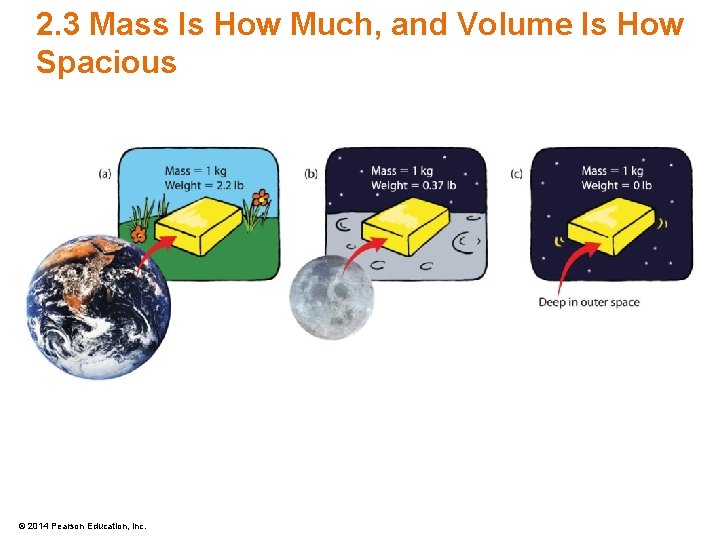
2. 3 Mass Is How Much, and Volume Is How Spacious © 2014 Pearson Education, Inc.
2. 3 Mass Is How Much, and Volume Is How Spacious Volume • Is the amount of space an object occupies • Standard unit is the liter – Is equal to a 10 cm-per-side cube • Often measured using the displacement method © 2014 Pearson Education, Inc.
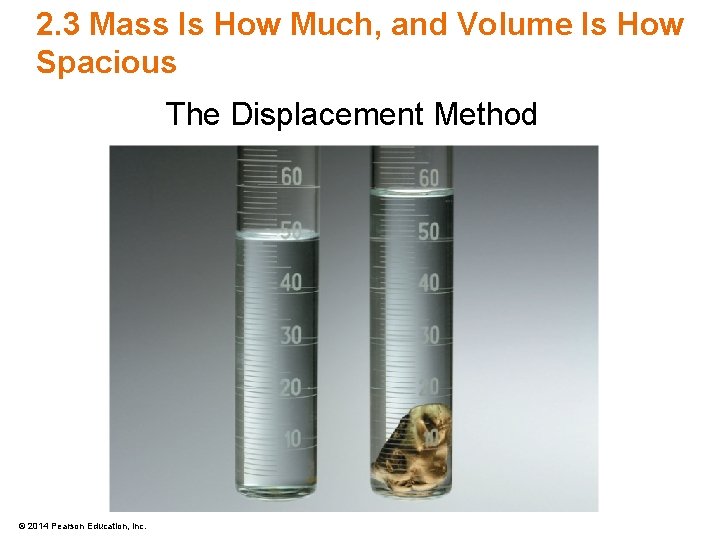
2. 3 Mass Is How Much, and Volume Is How Spacious The Displacement Method © 2014 Pearson Education, Inc.
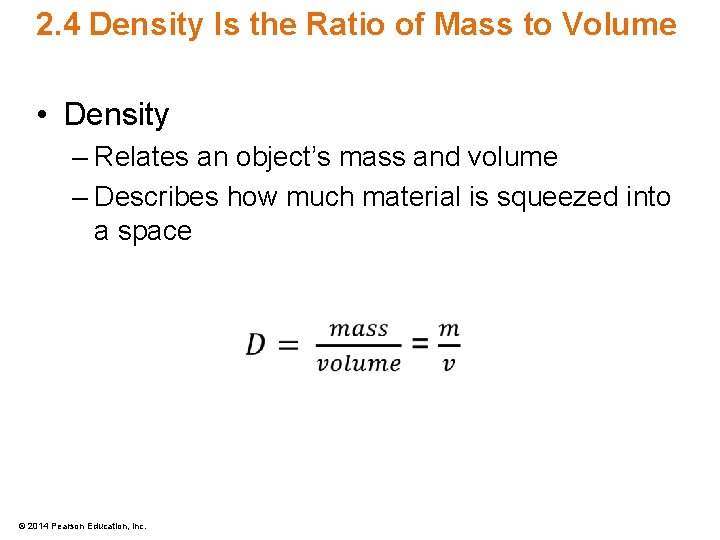
2. 4 Density Is the Ratio of Mass to Volume • Density – Relates an object’s mass and volume – Describes how much material is squeezed into a space • © 2014 Pearson Education, Inc.
Concept Check Which occupies a greater volume: 1 kilogram of lead or 1 kilogram of aluminum? © 2014 Pearson Education, Inc.
Concept Check The aluminum. Think of it this way. Because lead is so dense, only a little bit is needed for you to have 1 kilogram. Aluminum, by contrast, is far less dense; so 1 kilogram of aluminum occupies much more volume than the same mass of lead. © 2014 Pearson Education, Inc.
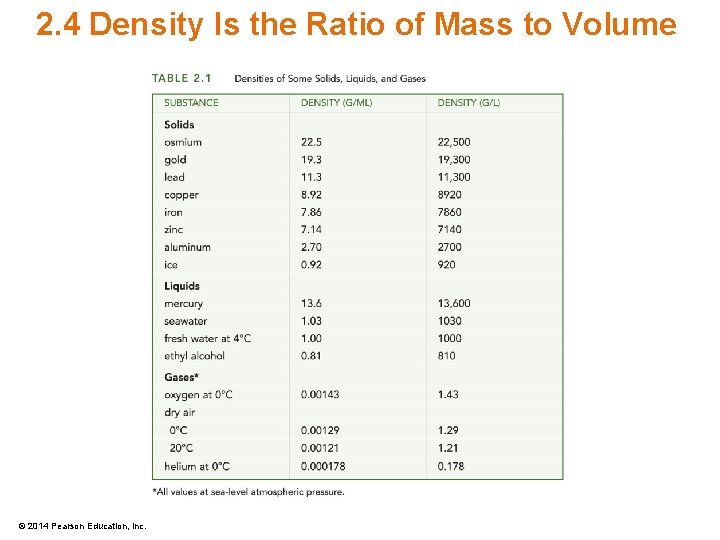
2. 4 Density Is the Ratio of Mass to Volume © 2014 Pearson Education, Inc.
2. 5 Energy Is the Mover of Matter • Energy is the capacity to do work • Types of energy – Potential energy is stored energy – Kinetic energy is the energy of motion – Chemical potential energy • Energy stored in atoms and molecules © 2014 Pearson Education, Inc.
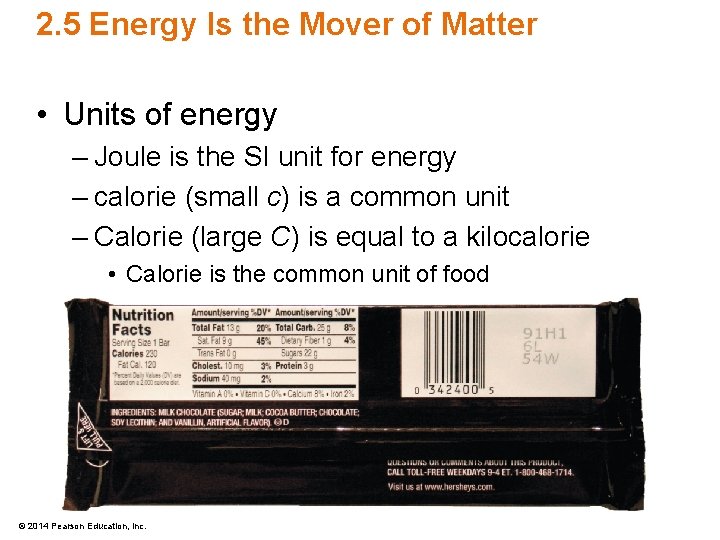
2. 5 Energy Is the Mover of Matter • Units of energy – Joule is the SI unit for energy – calorie (small c) is a common unit – Calorie (large C) is equal to a kilocalorie • Calorie is the common unit of food © 2014 Pearson Education, Inc.
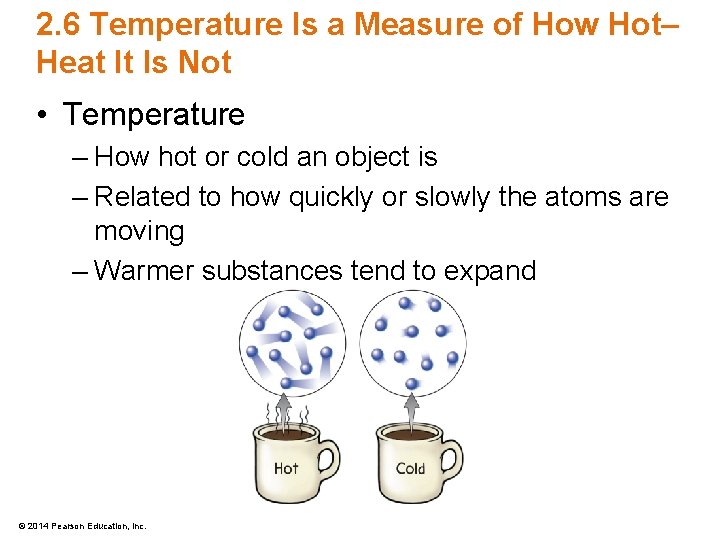
2. 6 Temperature Is a Measure of How Hot– Heat It Is Not • Temperature – How hot or cold an object is – Related to how quickly or slowly the atoms are moving – Warmer substances tend to expand © 2014 Pearson Education, Inc.
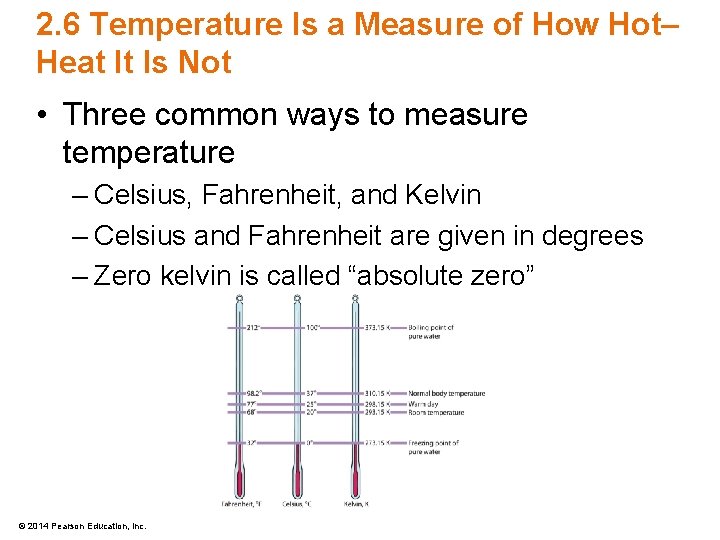
2. 6 Temperature Is a Measure of How Hot– Heat It Is Not • Three common ways to measure temperature – Celsius, Fahrenheit, and Kelvin – Celsius and Fahrenheit are given in degrees – Zero kelvin is called “absolute zero” © 2014 Pearson Education, Inc.
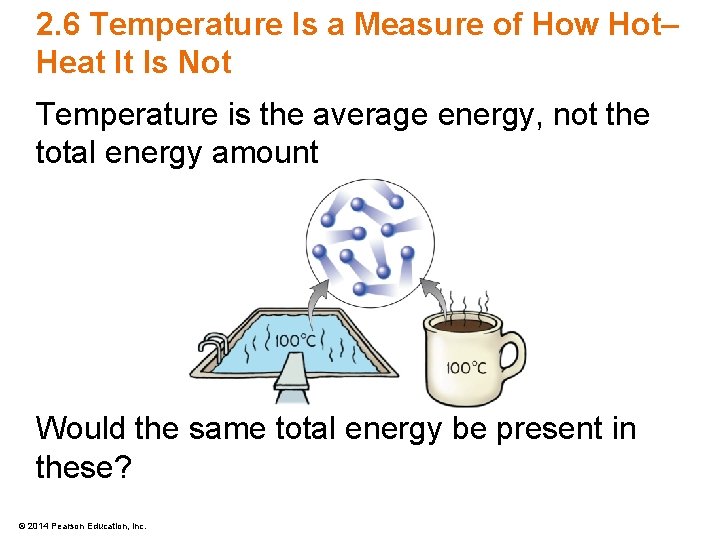
2. 6 Temperature Is a Measure of How Hot– Heat It Is Not Temperature is the average energy, not the total energy amount Would the same total energy be present in these? © 2014 Pearson Education, Inc.
2. 6 Temperature Is a Measure of How Hot– Heat It Is Not • Heat is the flow of energy from one object to another – Flows from warm objects to cooler objects – The greater the temperature difference, the greater the rate of heat flow © 2014 Pearson Education, Inc.
2. 7 The Phase of a Material Depends on the Motion of Its Particles • Phases of matter at the macroscopic scale – Solid • Exhibits definite volume and definite shape – Liquid • Has definite volume but indefinite shape • Shape changes when the container changes – Gas • Exhibits neither definite shape nor volume • Fills the container no matter the size © 2014 Pearson Education, Inc.
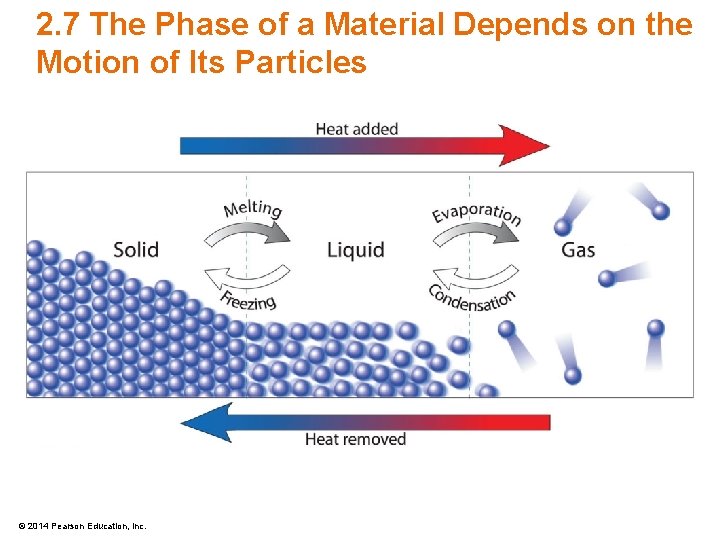
2. 7 The Phase of a Material Depends on the Motion of Its Particles • Phases of matter at the subatomic level – Solid • Very strong intermolecular forces • Very little atomic motion – Liquid • Medium level forces and atomic motion • Higher motion indicates higher temperatures – Gas • Weakest or no intermolecular forces • Atoms act nearly independent of each other © 2014 Pearson Education, Inc.
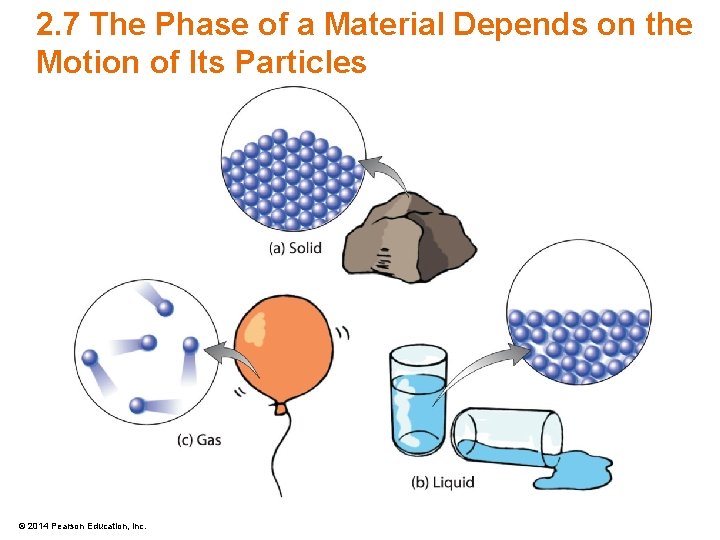
2. 7 The Phase of a Material Depends on the Motion of Its Particles © 2014 Pearson Education, Inc.
Concept Check Why are gases so much easier to compress into smaller volumes compared to solids and liquids? © 2014 Pearson Education, Inc.
Concept Check Because there is a lot of space between gas particles. The particles of a solid or liquid, on the other hand, are already close to one another, meaning little room is left for a further decrease in volume. © 2014 Pearson Education, Inc.
2. 7 The Phase of a Material Depends on the Motion of Its Particles • Phase changes–described by familiar terms – Melting–phase change from solid to liquid – Freezing–change from liquid to solid – Evaporation–change from liquid to gas – Condensation–change from gas to liquid © 2014 Pearson Education, Inc.
2. 7 The Phase of a Material Depends on the Motion of Its Particles © 2014 Pearson Education, Inc.
2. 8 Gas Laws Describe the Behavior of Gases • Gas laws predict the behavior of gases – Boyle’s Law • Relates pressure and volume – Charles’s Law • Relates volume and temperatur – Avogadro’s Law • Relates volume and number of particles © 2014 Pearson Education, Inc.
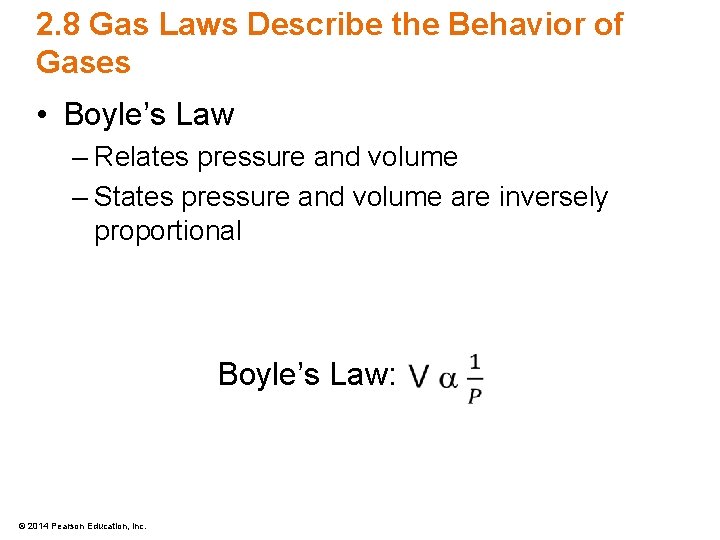
2. 8 Gas Laws Describe the Behavior of Gases • Boyle’s Law – Relates pressure and volume – States pressure and volume are inversely proportional Boyle’s Law: • © 2014 Pearson Education, Inc.
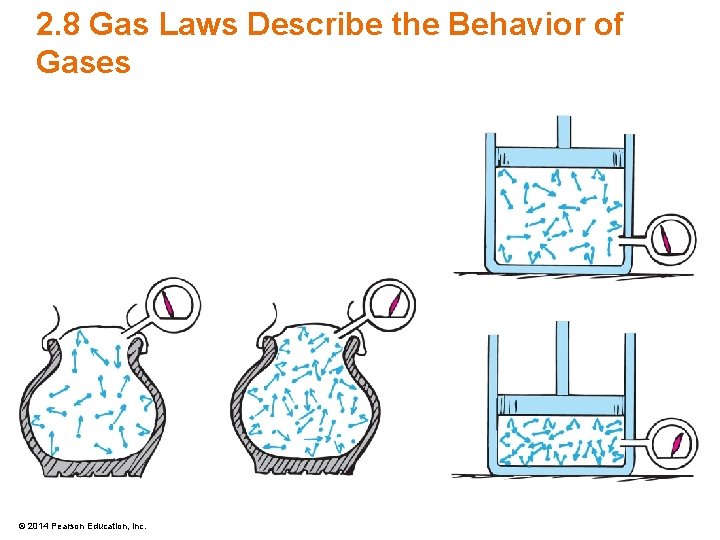
2. 8 Gas Laws Describe the Behavior of Gases © 2014 Pearson Education, Inc.
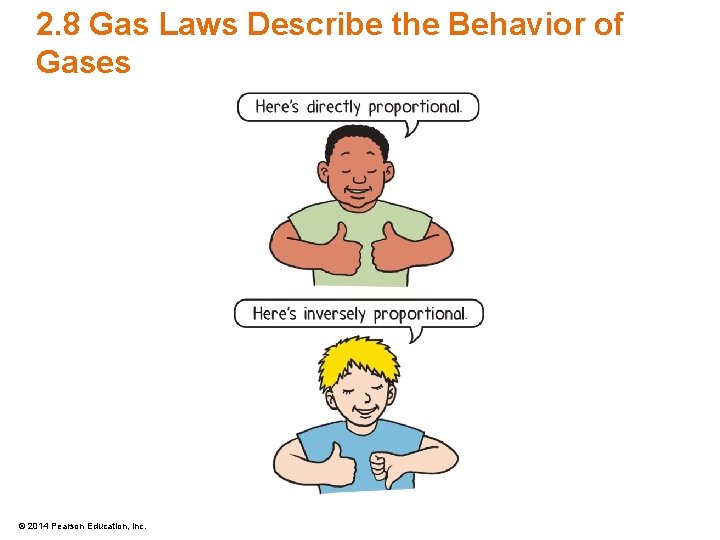
2. 8 Gas Laws Describe the Behavior of Gases © 2014 Pearson Education, Inc.
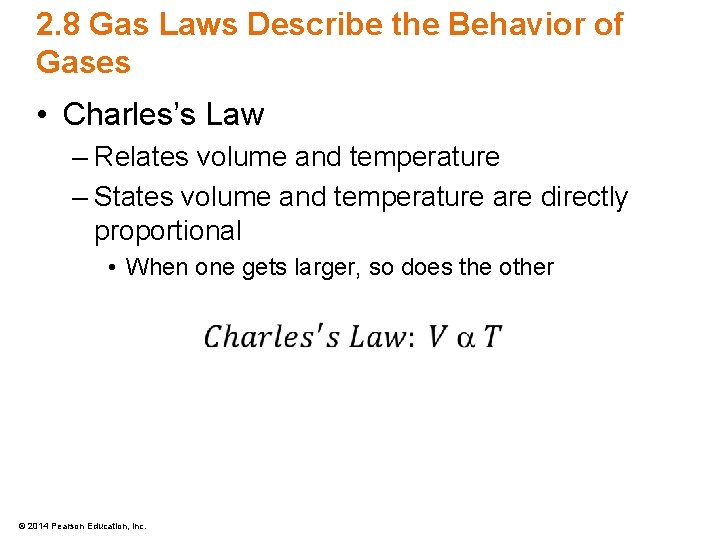
2. 8 Gas Laws Describe the Behavior of Gases • Charles’s Law – Relates volume and temperature – States volume and temperature are directly proportional • When one gets larger, so does the other • © 2014 Pearson Education, Inc.
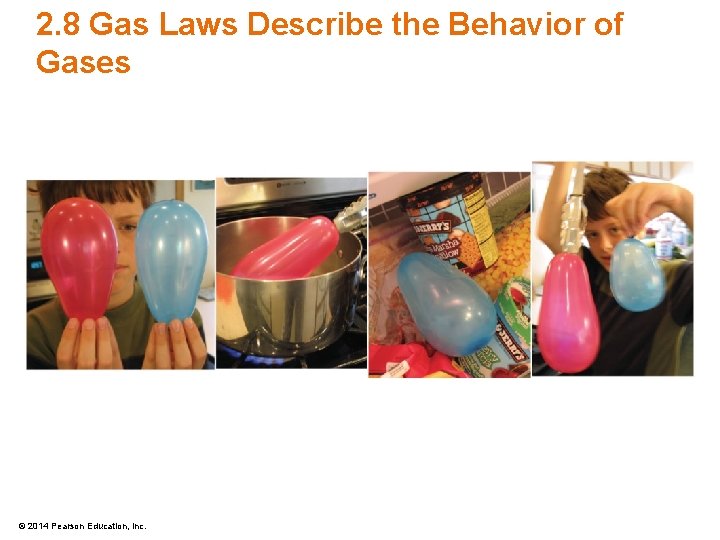
2. 8 Gas Laws Describe the Behavior of Gases © 2014 Pearson Education, Inc.
Concept Check A perfectly elastic balloon holding helium is warmed. What happens to its volume? © 2014 Pearson Education, Inc.
Concept Check According to Charles’s Law, as a gas is warmed, its volume expands. © 2014 Pearson Education, Inc.
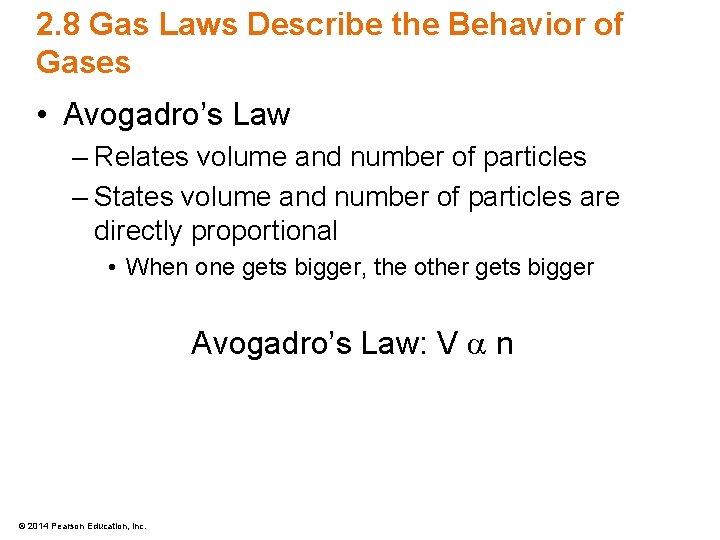
2. 8 Gas Laws Describe the Behavior of Gases • Avogadro’s Law – Relates volume and number of particles – States volume and number of particles are directly proportional • When one gets bigger, the other gets bigger Avogadro’s Law: V n © 2014 Pearson Education, Inc.
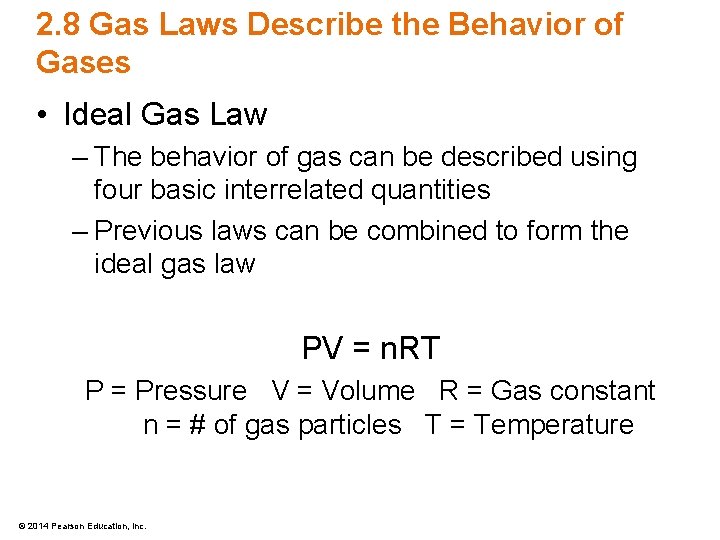
2. 8 Gas Laws Describe the Behavior of Gases • Ideal Gas Law – The behavior of gas can be described using four basic interrelated quantities – Previous laws can be combined to form the ideal gas law PV = n. RT P = Pressure V = Volume R = Gas constant n = # of gas particles T = Temperature © 2014 Pearson Education, Inc.
Concept Check Which do gas laws describe more accurately: a gas at high pressure and low temperature or a gas at low pressure and high temperature? © 2014 Pearson Education, Inc.
Concept Check Gas laws work best for gases at low pressure and high temperature. © 2014 Pearson Education, Inc.
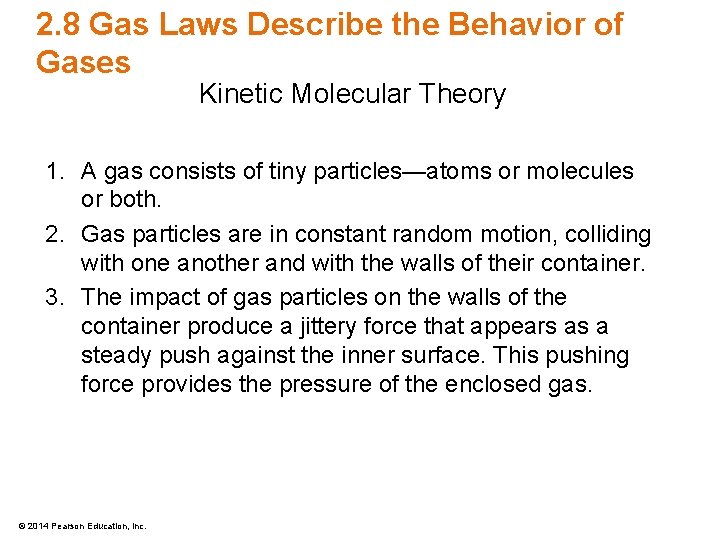
2. 8 Gas Laws Describe the Behavior of Gases Kinetic Molecular Theory 1. A gas consists of tiny particles—atoms or molecules or both. 2. Gas particles are in constant random motion, colliding with one another and with the walls of their container. 3. The impact of gas particles on the walls of the container produce a jittery force that appears as a steady push against the inner surface. This pushing force provides the pressure of the enclosed gas. © 2014 Pearson Education, Inc.
2. 8 Gas Laws Describe the Behavior of Gases Kinetic Molecular Theory (continued) 4. Deviations from gas laws arise primarily because of the interactions occurring among gas particles and because gas particles are not infinitely small. 5. The average kinetic energy (energy due to motion) of the gas particles is directly proportional to the temperature of the gas. © 2014 Pearson Education, Inc.
- Slides: 54