
Lecture Presentation Chapter 16 Aqueous Ionic Equilibrium chengkuanmail
Lecture Presentation Chapter 16 Aqueous Ionic Equilibrium chengkuan@mail. ntou. edu. tw © 2014 Pearson Education, Inc.
Aqueous Ionic Equilibrium 16. 1 The Danger of Antifreeze 16. 2 Buffers: Solution That Resist p. H Change 16. 3 Buffer Effectiveness: Buffer Range and Capacity 16. 4 Titration and p. H Curve 16. 5 Solubility Equilibria and the Solubility Product Constant 16. 6 Precipitation 16. 7 Qualitative Chemical Analysis 16. 8 Complex Ion Equilibria © 2014 Pearson Education, Inc.
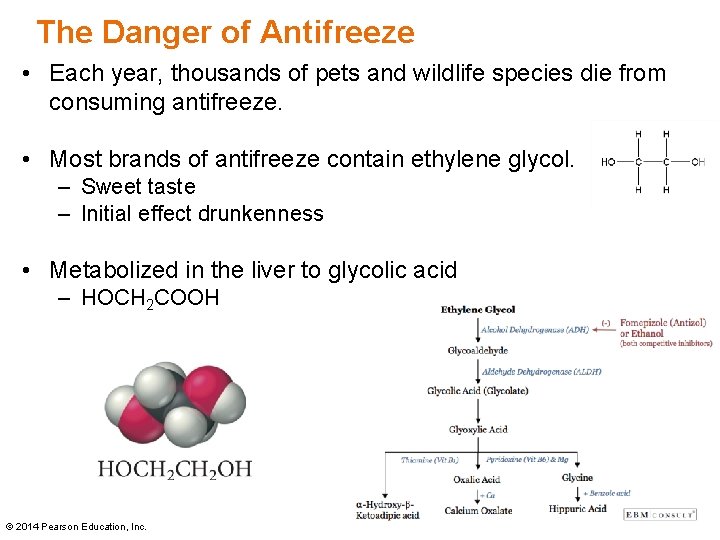
The Danger of Antifreeze • Each year, thousands of pets and wildlife species die from consuming antifreeze. • Most brands of antifreeze contain ethylene glycol. – Sweet taste – Initial effect drunkenness • Metabolized in the liver to glycolic acid – HOCH 2 COOH © 2014 Pearson Education, Inc.
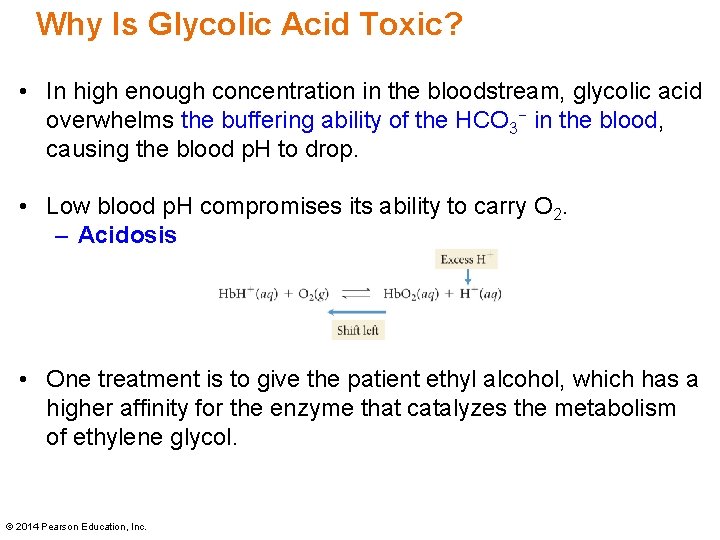
Why Is Glycolic Acid Toxic? • In high enough concentration in the bloodstream, glycolic acid overwhelms the buffering ability of the HCO 3− in the blood, causing the blood p. H to drop. • Low blood p. H compromises its ability to carry O 2. – Acidosis • One treatment is to give the patient ethyl alcohol, which has a higher affinity for the enzyme that catalyzes the metabolism of ethylene glycol. © 2014 Pearson Education, Inc.
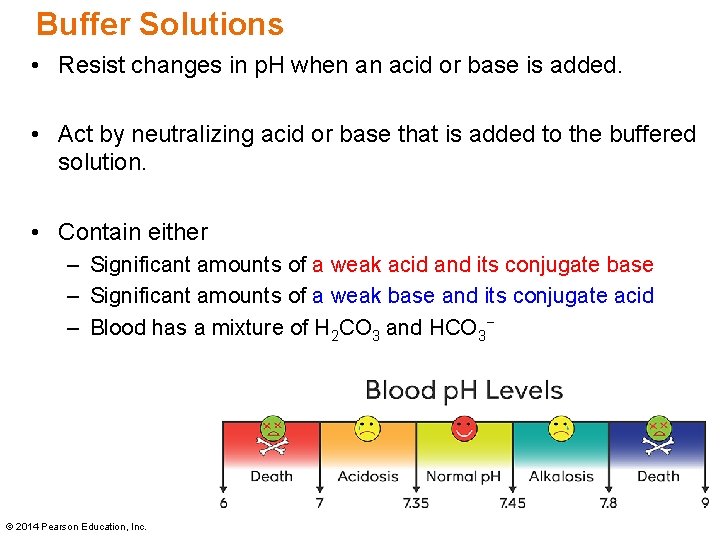
Buffer Solutions • Resist changes in p. H when an acid or base is added. • Act by neutralizing acid or base that is added to the buffered solution. • Contain either – Significant amounts of a weak acid and its conjugate base – Significant amounts of a weak base and its conjugate acid – Blood has a mixture of H 2 CO 3 and HCO 3− © 2014 Pearson Education, Inc.
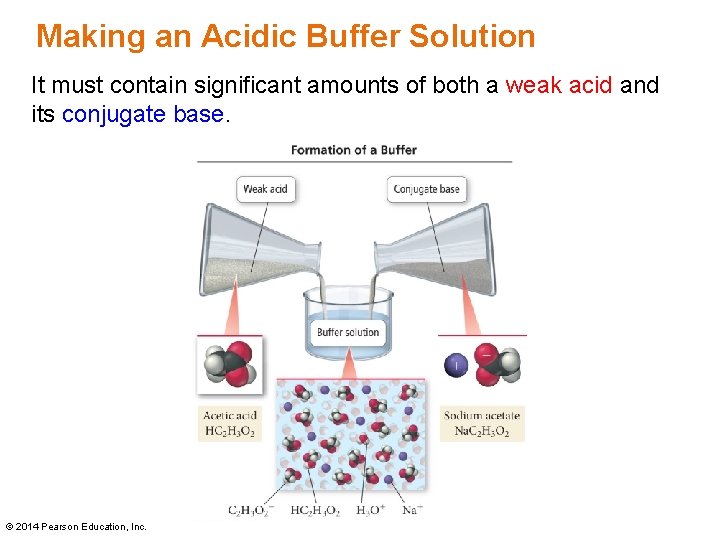
Making an Acidic Buffer Solution It must contain significant amounts of both a weak acid and its conjugate base. © 2014 Pearson Education, Inc.
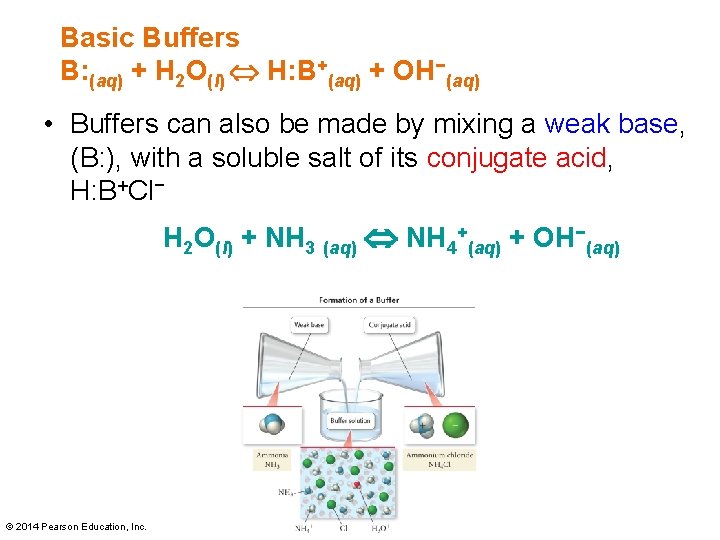
Basic Buffers B: (aq) + H 2 O(l) H: B+(aq) + OH−(aq) • Buffers can also be made by mixing a weak base, (B: ), with a soluble salt of its conjugate acid, H: B+Cl− H 2 O(l) + NH 3 (aq) NH 4+(aq) + OH−(aq) © 2014 Pearson Education, Inc.
An Acidic Buffer Solution • If a strong base is added, it is neutralized by the weak acid (HC 2 H 3 O 2) in the buffer. Na. OH(aq) + HC 2 H 3 O 2(aq) H 2 O(l) + Na. C 2 H 3 O 2(aq) • If the amount of Na. OH added is less than the amount of acetic acid present, the p. H change is small. • If a strong acid is added, it is neutralized by the conjugate base (Na. C 2 H 3 O 2) in the buffer. HCl(aq) + Na. C 2 H 3 O 2 HC 2 H 3 O 2(aq) + Na. Cl(aq) • If the amount of HCl is less than the amount of Na. C 2 H 3 O 2 present, the p. H change is small. © 2014 Pearson Education, Inc.
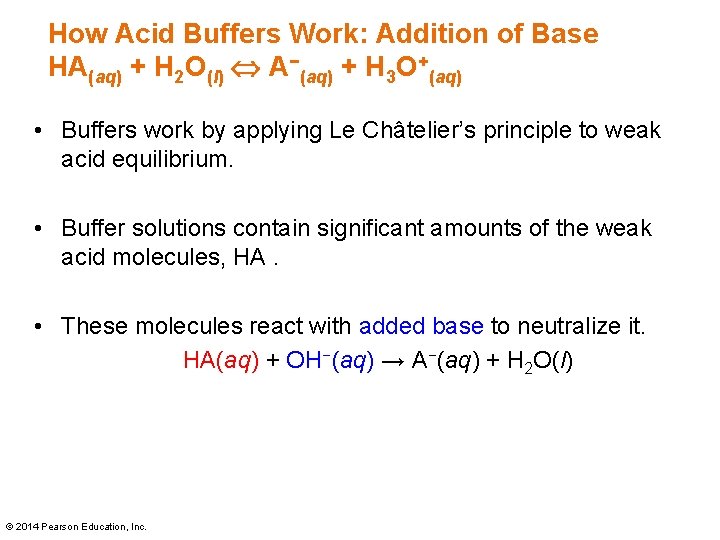
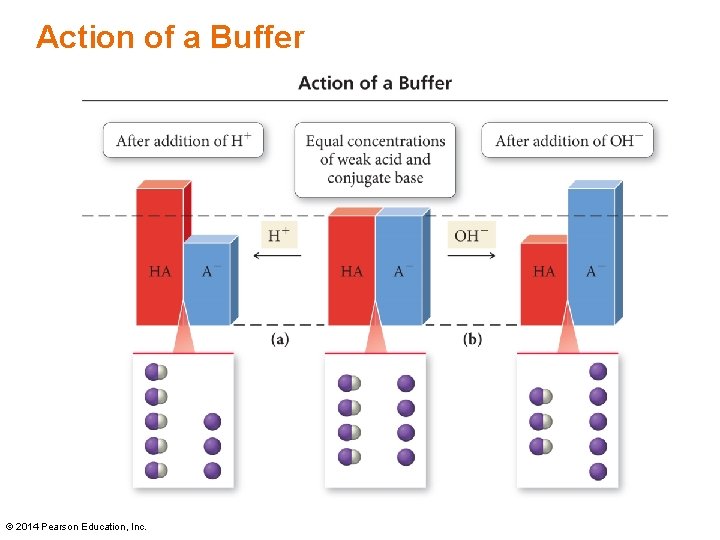
How Acid Buffers Work: Addition of Base HA(aq) + H 2 O(l) A−(aq) + H 3 O+(aq) • Buffers work by applying Le Châtelier’s principle to weak acid equilibrium. • Buffer solutions contain significant amounts of the weak acid molecules, HA. • These molecules react with added base to neutralize it. HA(aq) + OH−(aq) → A−(aq) + H 2 O(l) © 2014 Pearson Education, Inc.
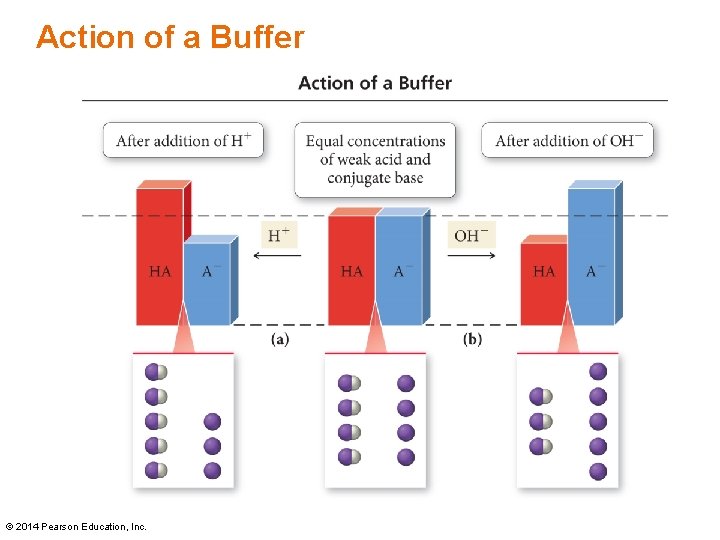
Action of a Buffer Figure 16. 3 pg 762 © 2014 Pearson Education, Inc.
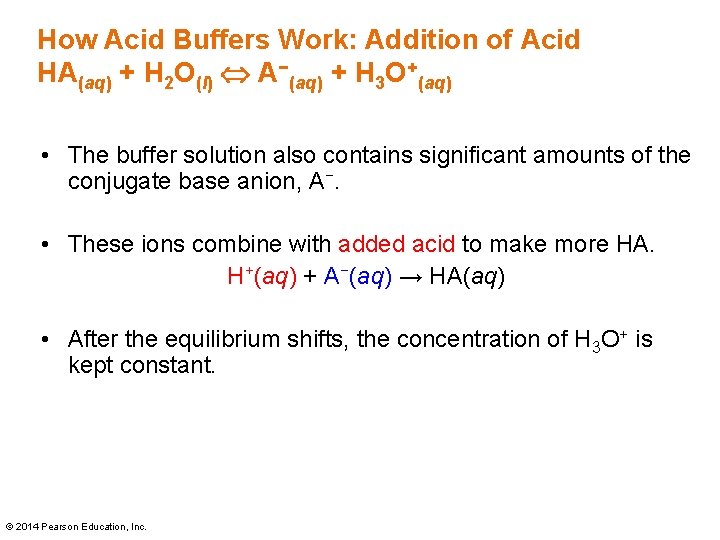
How Acid Buffers Work: Addition of Acid HA(aq) + H 2 O(l) A−(aq) + H 3 O+(aq) • The buffer solution also contains significant amounts of the conjugate base anion, A−. • These ions combine with added acid to make more HA. H+(aq) + A−(aq) → HA(aq) • After the equilibrium shifts, the concentration of H 3 O+ is kept constant. © 2014 Pearson Education, Inc.
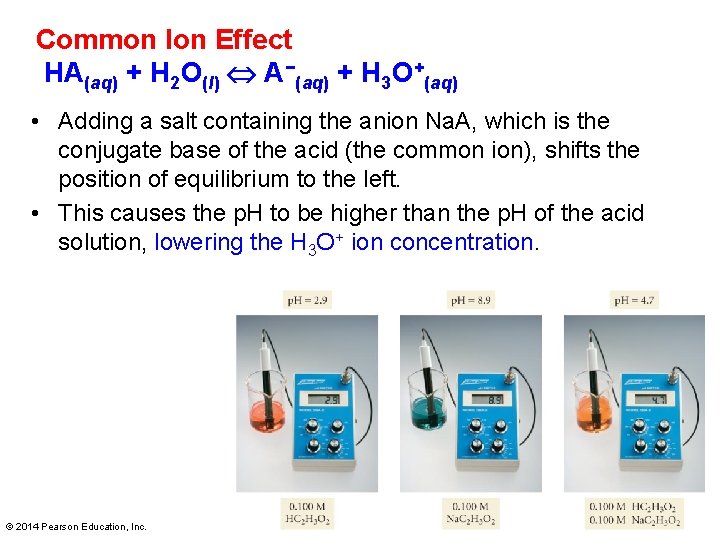
Common Ion Effect HA(aq) + H 2 O(l) A−(aq) + H 3 O+(aq) • Adding a salt containing the anion Na. A, which is the conjugate base of the acid (the common ion), shifts the position of equilibrium to the left. • This causes the p. H to be higher than the p. H of the acid solution, lowering the H 3 O+ ion concentration. © 2014 Pearson Education, Inc.
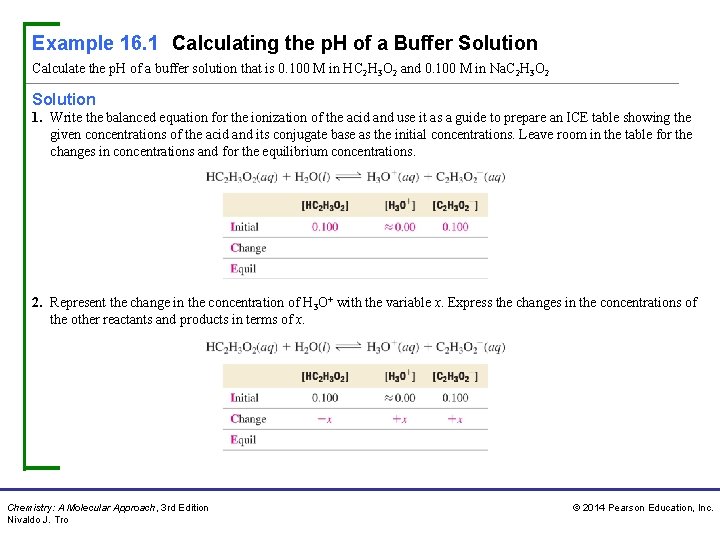
Example 16. 1 Calculating the p. H of a Buffer Solution Calculate the p. H of a buffer solution that is 0. 100 M in HC 2 H 3 O 2 and 0. 100 M in Na. C 2 H 3 O 2 Solution 1. Write the balanced equation for the ionization of the acid and use it as a guide to prepare an ICE table showing the given concentrations of the acid and its conjugate base as the initial concentrations. Leave room in the table for the changes in concentrations and for the equilibrium concentrations. 2. Represent the change in the concentration of H 3 O+ with the variable x. Express the changes in the concentrations of the other reactants and products in terms of x. Chemistry: A Molecular Approach, 3 rd Edition Nivaldo J. Tro © 2014 Pearson Education, Inc.
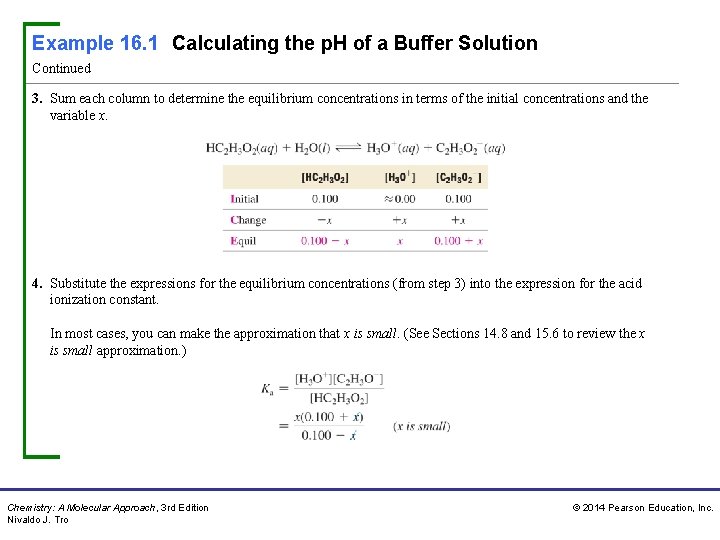
Example 16. 1 Calculating the p. H of a Buffer Solution Continued 3. Sum each column to determine the equilibrium concentrations in terms of the initial concentrations and the variable x. 4. Substitute the expressions for the equilibrium concentrations (from step 3) into the expression for the acid ionization constant. In most cases, you can make the approximation that x is small. (See Sections 14. 8 and 15. 6 to review the x is small approximation. ) Chemistry: A Molecular Approach, 3 rd Edition Nivaldo J. Tro © 2014 Pearson Education, Inc.
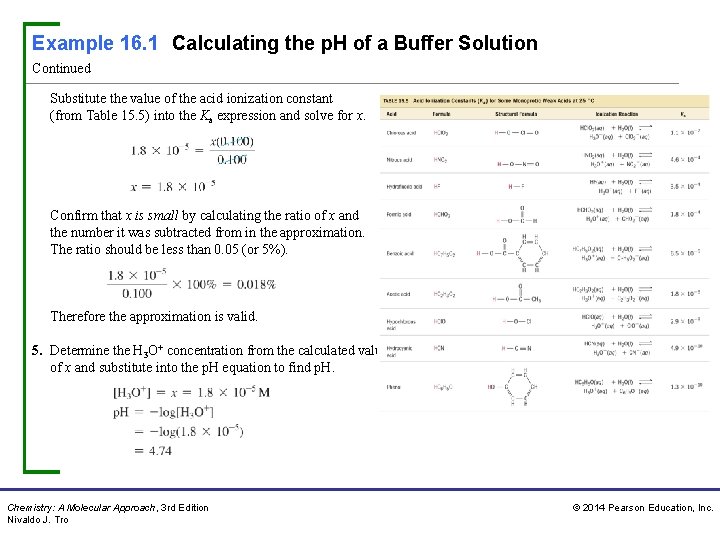
Example 16. 1 Calculating the p. H of a Buffer Solution Continued Substitute the value of the acid ionization constant (from Table 15. 5) into the Ka expression and solve for x. Confirm that x is small by calculating the ratio of x and the number it was subtracted from in the approximation. The ratio should be less than 0. 05 (or 5%). Therefore the approximation is valid. 5. Determine the H 3 O+ concentration from the calculated value of x and substitute into the p. H equation to find p. H. Chemistry: A Molecular Approach, 3 rd Edition Nivaldo J. Tro © 2014 Pearson Education, Inc.
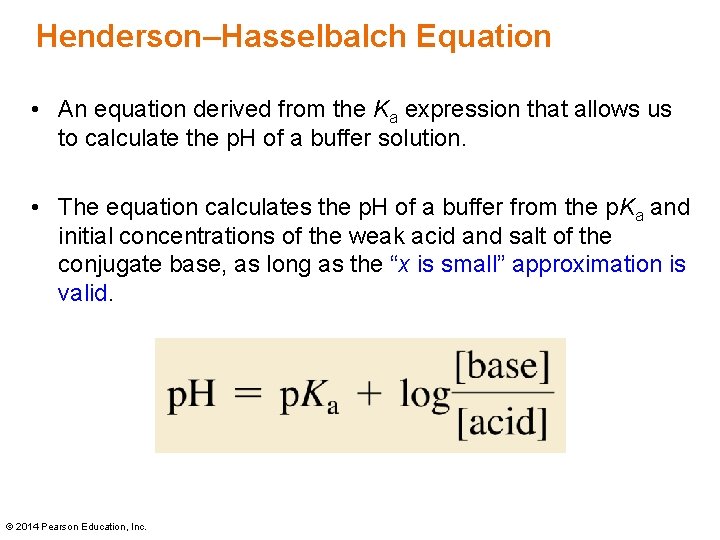
Henderson–Hasselbalch Equation • An equation derived from the Ka expression that allows us to calculate the p. H of a buffer solution. • The equation calculates the p. H of a buffer from the p. Ka and initial concentrations of the weak acid and salt of the conjugate base, as long as the “x is small” approximation is valid. © 2014 Pearson Education, Inc.
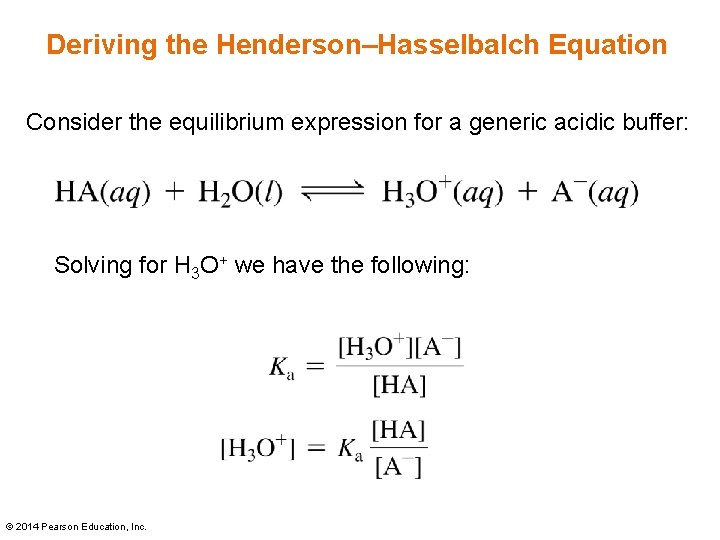
Deriving the Henderson–Hasselbalch Equation Consider the equilibrium expression for a generic acidic buffer: Solving for H 3 O+ we have the following: © 2014 Pearson Education, Inc.
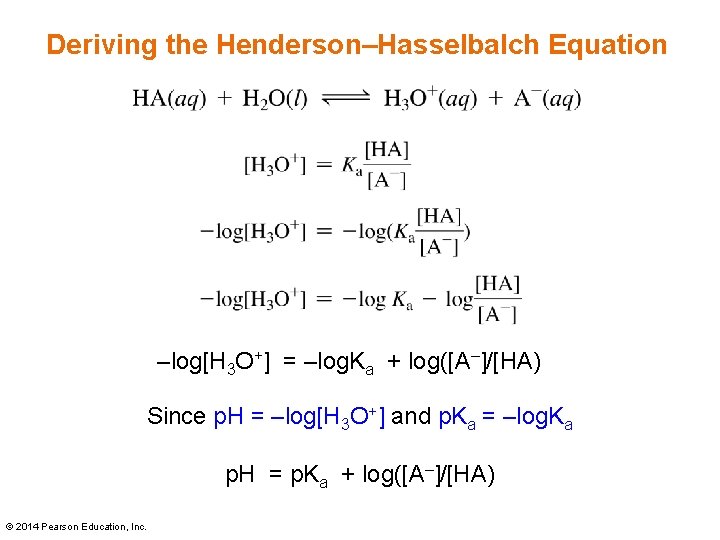
Deriving the Henderson–Hasselbalch Equation –log[H 3 O+] = –log. Ka + log([A–]/[HA) Since p. H = –log[H 3 O+] and p. Ka = –log. Ka p. H = p. Ka + log([A–]/[HA) © 2014 Pearson Education, Inc.
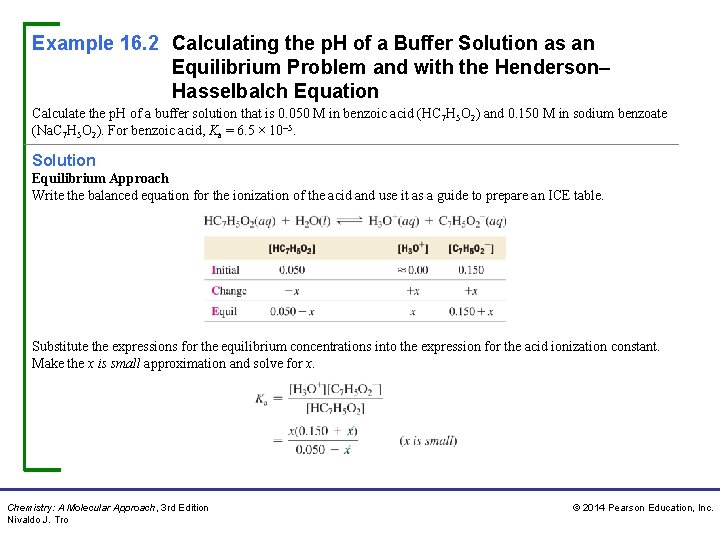
Example 16. 2 Calculating the p. H of a Buffer Solution as an Equilibrium Problem and with the Henderson– Hasselbalch Equation Calculate the p. H of a buffer solution that is 0. 050 M in benzoic acid (HC 7 H 5 O 2) and 0. 150 M in sodium benzoate (Na. C 7 H 5 O 2). For benzoic acid, Ka = 6. 5 × 10– 5. Solution Equilibrium Approach Write the balanced equation for the ionization of the acid and use it as a guide to prepare an ICE table. Substitute the expressions for the equilibrium concentrations into the expression for the acid ionization constant. Make the x is small approximation and solve for x. Chemistry: A Molecular Approach, 3 rd Edition Nivaldo J. Tro © 2014 Pearson Education, Inc.
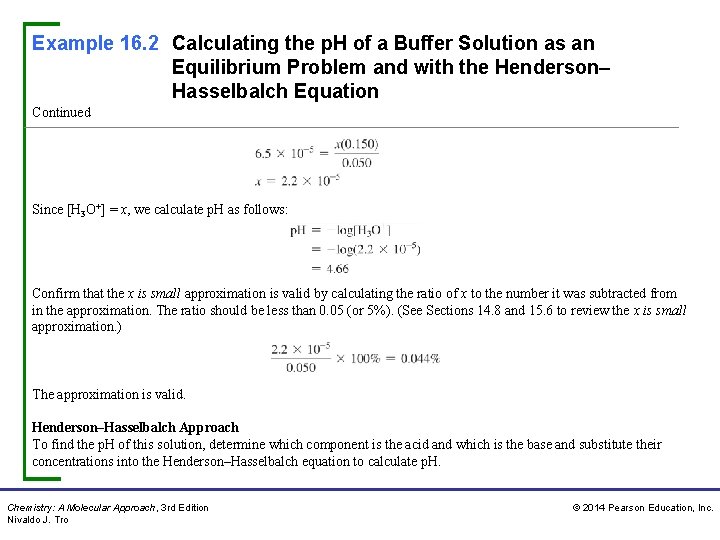
Example 16. 2 Calculating the p. H of a Buffer Solution as an Equilibrium Problem and with the Henderson– Hasselbalch Equation Continued Since [H 3 O+] = x, we calculate p. H as follows: Confirm that the x is small approximation is valid by calculating the ratio of x to the number it was subtracted from in the approximation. The ratio should be less than 0. 05 (or 5%). (See Sections 14. 8 and 15. 6 to review the x is small approximation. ) The approximation is valid. Henderson–Hasselbalch Approach To find the p. H of this solution, determine which component is the acid and which is the base and substitute their concentrations into the Henderson–Hasselbalch equation to calculate p. H. Chemistry: A Molecular Approach, 3 rd Edition Nivaldo J. Tro © 2014 Pearson Education, Inc.
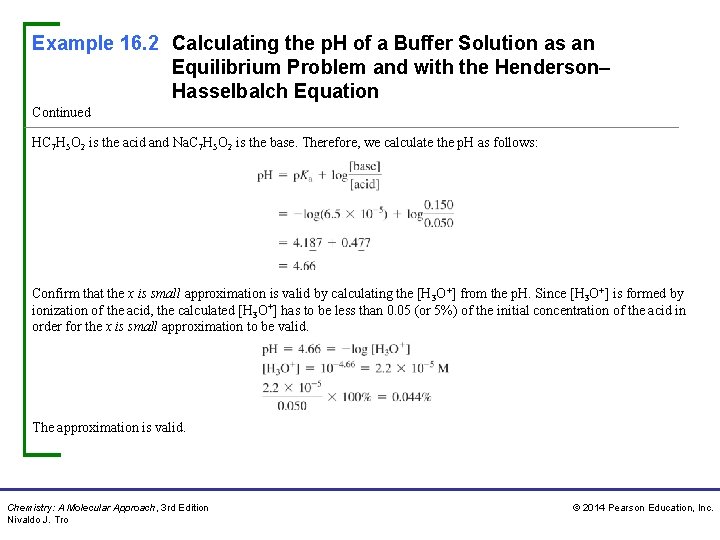
Example 16. 2 Calculating the p. H of a Buffer Solution as an Equilibrium Problem and with the Henderson– Hasselbalch Equation Continued HC 7 H 5 O 2 is the acid and Na. C 7 H 5 O 2 is the base. Therefore, we calculate the p. H as follows: Confirm that the x is small approximation is valid by calculating the [H 3 O+] from the p. H. Since [H 3 O+] is formed by ionization of the acid, the calculated [H 3 O+] has to be less than 0. 05 (or 5%) of the initial concentration of the acid in order for the x is small approximation to be valid. The approximation is valid. Chemistry: A Molecular Approach, 3 rd Edition Nivaldo J. Tro © 2014 Pearson Education, Inc.
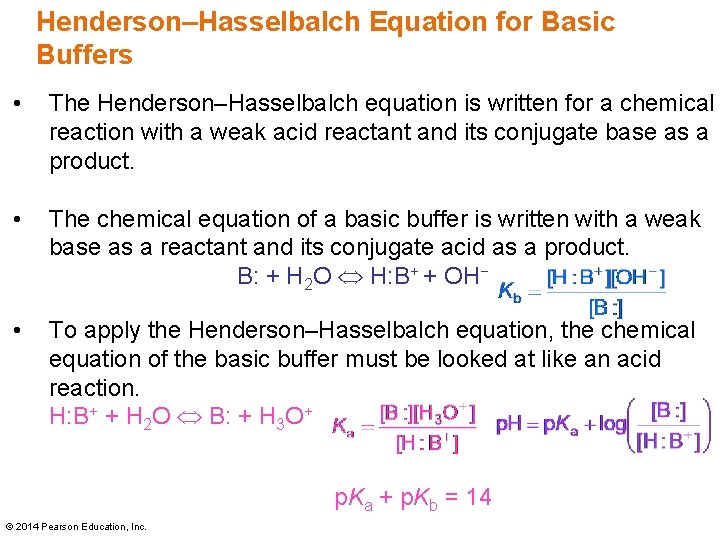
Henderson–Hasselbalch Equation for Basic Buffers • The Henderson–Hasselbalch equation is written for a chemical reaction with a weak acid reactant and its conjugate base as a product. • The chemical equation of a basic buffer is written with a weak base as a reactant and its conjugate acid as a product. B: + H 2 O H: B+ + OH− • To apply the Henderson–Hasselbalch equation, the chemical equation of the basic buffer must be looked at like an acid reaction. H: B+ + H 2 O B: + H 3 O+ p. Ka + p. Kb = 14 © 2014 Pearson Education, Inc.
Do I Use the Full Equilibrium Analysis or the Henderson–Hasselbalch Equation? • The Henderson–Hasselbalch equation is generally good enough when the “x is small” approximation is applicable. • Generally, the “x is small” approximation will work when both of the following are true: a) The initial concentrations of acid and salt are not very dilute. b) The Ka is fairly small. • For most problems, this means that the initial acid and salt concentrations should be over 100 to 1000 times larger than the value of Ka. © 2014 Pearson Education, Inc.
Action of a Buffer Figure 16. 3 pg 762 © 2014 Pearson Education, Inc.
How Much Does the p. H of a Buffer Change When an Acid or Base Is Added? • Calculating the new p. H after adding acid or base requires breaking the problem into two parts: 1. A stoichiometry calculation for the reaction of the added chemical with one of the ingredients of the buffer to reduce its initial concentration and increase the concentration of the other. ü Added acid reacts with the A− to make more HA ü Added base reacts with the HA to make more A− 2. An equilibrium calculation of [H 3 O+] using the new initial values of [HA] and [A−] © 2014 Pearson Education, Inc.
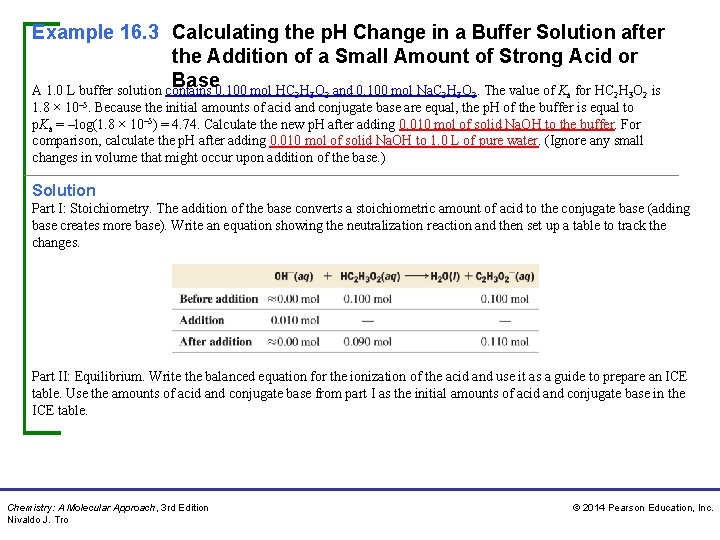
Example 16. 3 Calculating the p. H Change in a Buffer Solution after the Addition of a Small Amount of Strong Acid or Base A 1. 0 L buffer solution contains 0. 100 mol HC H O and 0. 100 mol Na. C H O. The value of K for HC H O is 2 3 2 a 2 3 2 1. 8 × 10– 5. Because the initial amounts of acid and conjugate base are equal, the p. H of the buffer is equal to p. Ka = –log(1. 8 × 10– 5) = 4. 74. Calculate the new p. H after adding 0. 010 mol of solid Na. OH to the buffer. For comparison, calculate the p. H after adding 0. 010 mol of solid Na. OH to 1. 0 L of pure water. (Ignore any small changes in volume that might occur upon addition of the base. ) Solution Part I: Stoichiometry. The addition of the base converts a stoichiometric amount of acid to the conjugate base (adding base creates more base). Write an equation showing the neutralization reaction and then set up a table to track the changes. Part II: Equilibrium. Write the balanced equation for the ionization of the acid and use it as a guide to prepare an ICE table. Use the amounts of acid and conjugate base from part I as the initial amounts of acid and conjugate base in the ICE table. Chemistry: A Molecular Approach, 3 rd Edition Nivaldo J. Tro © 2014 Pearson Education, Inc.
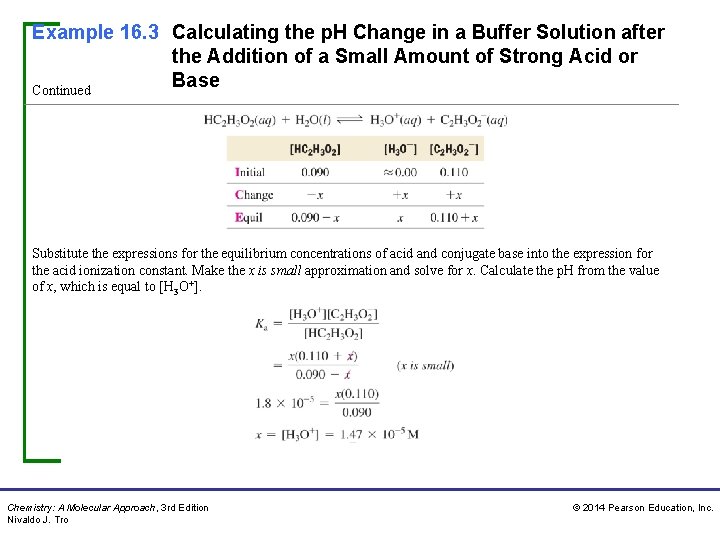
Example 16. 3 Calculating the p. H Change in a Buffer Solution after the Addition of a Small Amount of Strong Acid or Base Continued Substitute the expressions for the equilibrium concentrations of acid and conjugate base into the expression for the acid ionization constant. Make the x is small approximation and solve for x. Calculate the p. H from the value of x, which is equal to [H 3 O+]. Chemistry: A Molecular Approach, 3 rd Edition Nivaldo J. Tro © 2014 Pearson Education, Inc.
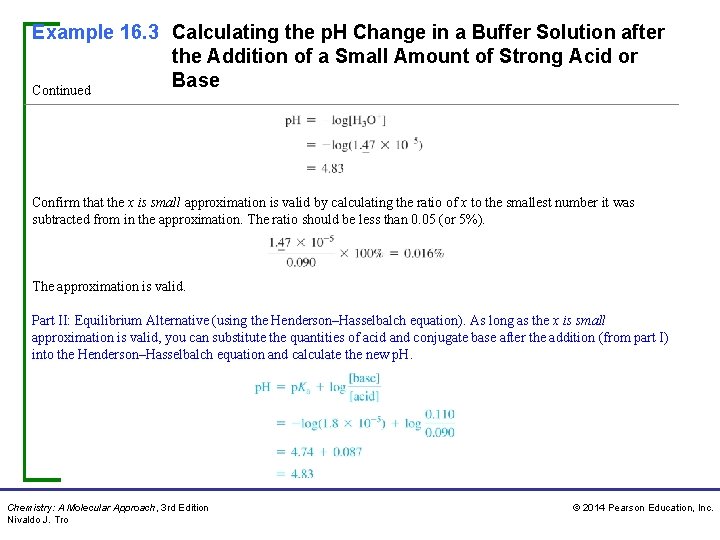
Example 16. 3 Calculating the p. H Change in a Buffer Solution after the Addition of a Small Amount of Strong Acid or Base Continued Confirm that the x is small approximation is valid by calculating the ratio of x to the smallest number it was subtracted from in the approximation. The ratio should be less than 0. 05 (or 5%). The approximation is valid. Part II: Equilibrium Alternative (using the Henderson–Hasselbalch equation). As long as the x is small approximation is valid, you can substitute the quantities of acid and conjugate base after the addition (from part I) into the Henderson–Hasselbalch equation and calculate the new p. H. Chemistry: A Molecular Approach, 3 rd Edition Nivaldo J. Tro © 2014 Pearson Education, Inc.
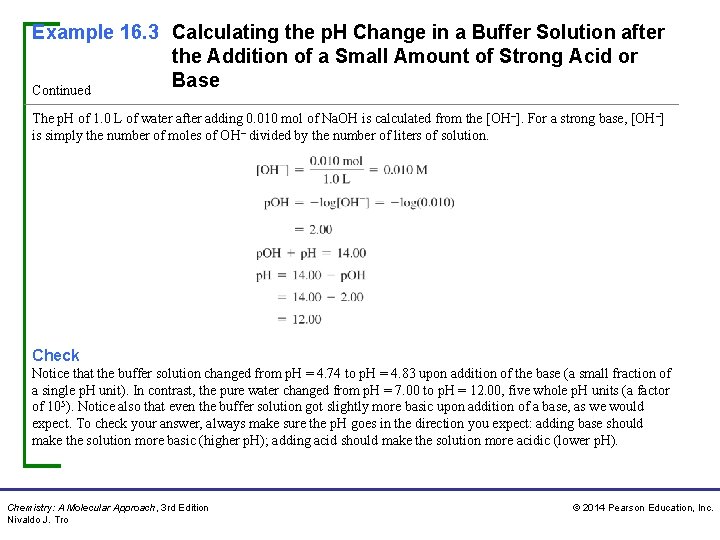
Example 16. 3 Calculating the p. H Change in a Buffer Solution after the Addition of a Small Amount of Strong Acid or Base Continued The p. H of 1. 0 L of water after adding 0. 010 mol of Na. OH is calculated from the [OH–]. For a strong base, [OH–] is simply the number of moles of OH– divided by the number of liters of solution. Check Notice that the buffer solution changed from p. H = 4. 74 to p. H = 4. 83 upon addition of the base (a small fraction of a single p. H unit). In contrast, the pure water changed from p. H = 7. 00 to p. H = 12. 00, five whole p. H units (a factor of 105). Notice also that even the buffer solution got slightly more basic upon addition of a base, as we would expect. To check your answer, always make sure the p. H goes in the direction you expect: adding base should make the solution more basic (higher p. H); adding acid should make the solution more acidic (lower p. H). Chemistry: A Molecular Approach, 3 rd Edition Nivaldo J. Tro © 2014 Pearson Education, Inc.
Buffering Effectiveness • A good buffer should be able to neutralize moderate amounts of added acid or base. • The effectiveness of a buffer depends on two factors (1) the absolute amounts of acid and base, and (2) the relative amounts of acid and base. • The buffering capacity is the amount of acid or base a buffer can neutralize. • The buffering range is the p. H range the buffer can be effective. © 2014 Pearson Education, Inc.
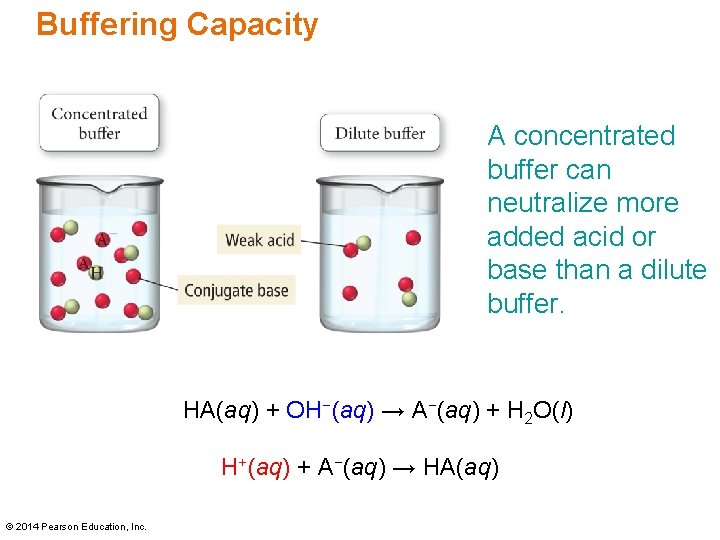
Buffering Capacity A concentrated buffer can neutralize more added acid or base than a dilute buffer. HA(aq) + OH−(aq) → A−(aq) + H 2 O(l) H+(aq) + A−(aq) → HA(aq) © 2014 Pearson Education, Inc.
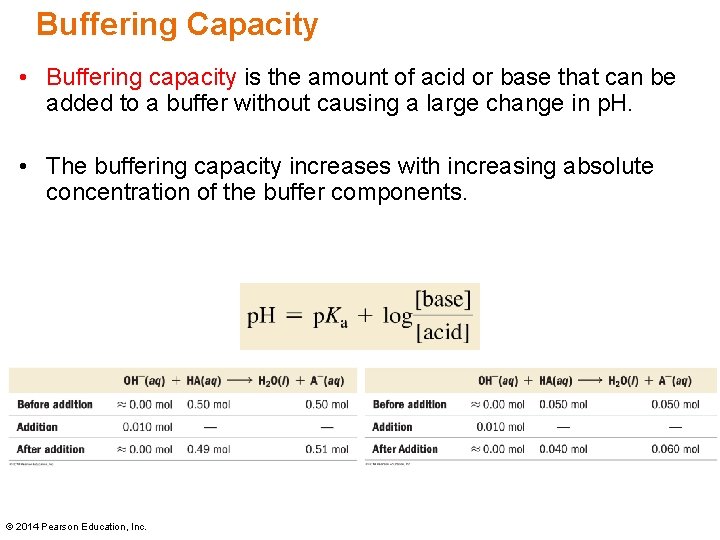
Buffering Capacity • Buffering capacity is the amount of acid or base that can be added to a buffer without causing a large change in p. H. • The buffering capacity increases with increasing absolute concentration of the buffer components. © 2014 Pearson Education, Inc.
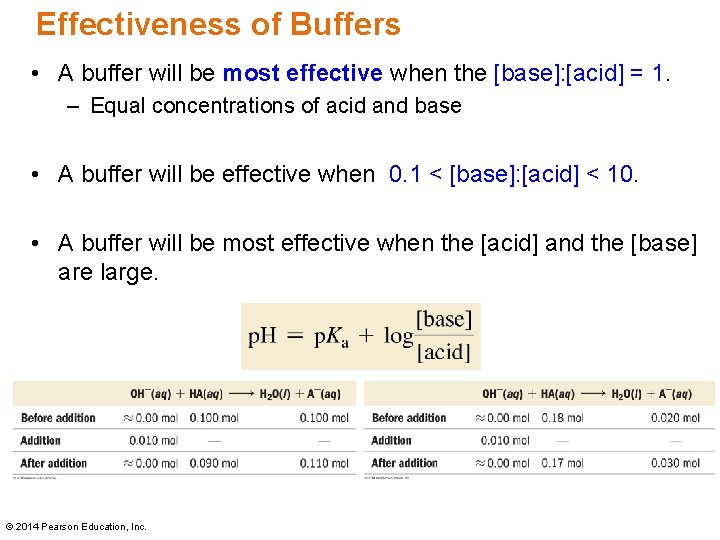
Effectiveness of Buffers • A buffer will be most effective when the [base]: [acid] = 1. – Equal concentrations of acid and base • A buffer will be effective when 0. 1 < [base]: [acid] < 10. • A buffer will be most effective when the [acid] and the [base] are large. © 2014 Pearson Education, Inc.
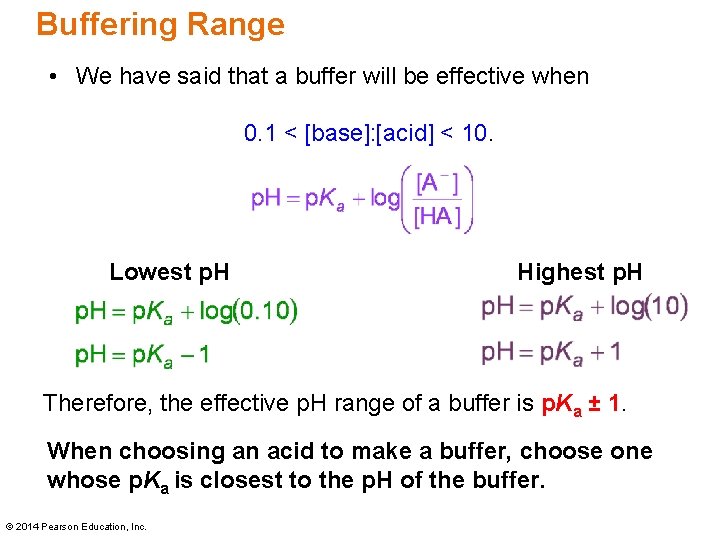
Buffering Range • We have said that a buffer will be effective when 0. 1 < [base]: [acid] < 10. Lowest p. H Highest p. H Therefore, the effective p. H range of a buffer is p. Ka ± 1. When choosing an acid to make a buffer, choose one whose p. Ka is closest to the p. H of the buffer. © 2014 Pearson Education, Inc.
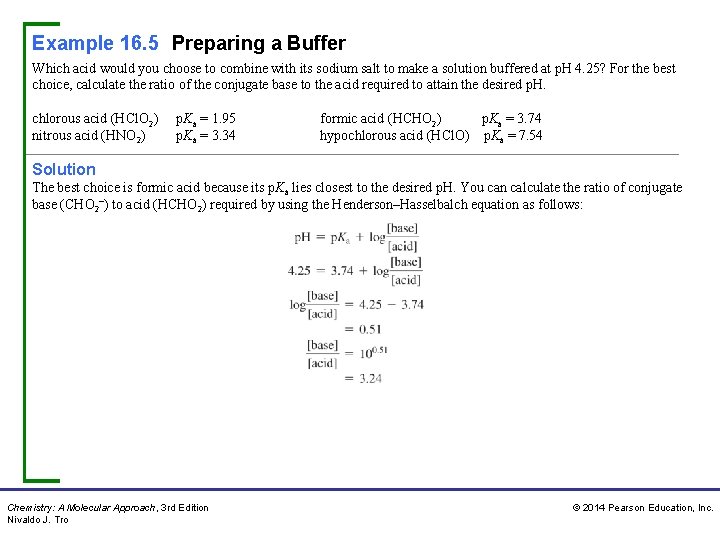
Example 16. 5 Preparing a Buffer Which acid would you choose to combine with its sodium salt to make a solution buffered at p. H 4. 25? For the best choice, calculate the ratio of the conjugate base to the acid required to attain the desired p. H. chlorous acid (HCl. O 2) nitrous acid (HNO 2) p. Ka = 1. 95 p. Ka = 3. 34 formic acid (HCHO 2) p. Ka = 3. 74 hypochlorous acid (HCl. O) p. Ka = 7. 54 Solution The best choice is formic acid because its p. Ka lies closest to the desired p. H. You can calculate the ratio of conjugate base (CHO 2–) to acid (HCHO 2) required by using the Henderson–Hasselbalch equation as follows: Chemistry: A Molecular Approach, 3 rd Edition Nivaldo J. Tro © 2014 Pearson Education, Inc.
Titration • In an acid–base titration, a solution of known concentration (titrant) is slowly added to a solution of unknown concentration from a burette until the reaction is complete. – When the reaction is complete we have reached the endpoint of the titration. • An indicator may be added to determine the endpoint. – An indicator is a chemical that changes color when the p. H changes. • When the moles of H 3 O+ = moles of OH−, the titration has reached its equivalence point. © 2014 Pearson Education, Inc.
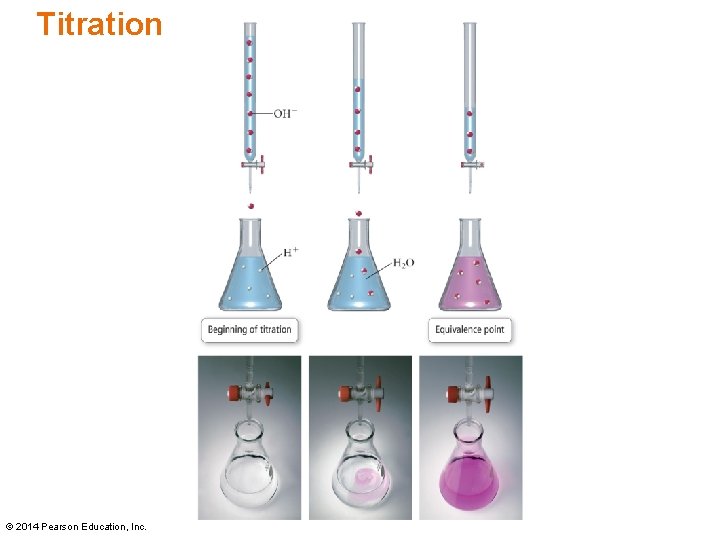
Titration © 2014 Pearson Education, Inc.
Titration Curve • It is a plot of p. H versus the amount of added titrant. • The inflection point of the curve is the equivalence point of the titration. • Prior to the equivalence point, the unknown solution in the flask is in excess, so the p. H is closest to its p. H. • The p. H of the equivalence point depends on the p. H of the salt solution. – Equivalence point of neutral salt, p. H = 7 – Equivalence point of acidic salt, p. H < 7 (NH 4+) – Equivalence point of basic salt, p. H > 7 (A-) • Beyond the equivalence point, the known solution in the burette is in excess, so the p. H approaches its p. H. © 2014 Pearson Education, Inc.
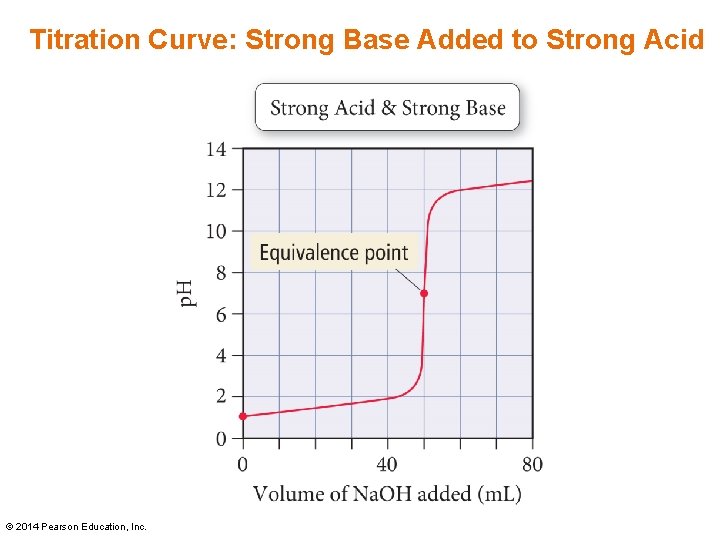
Titration Curve: Strong Base Added to Strong Acid © 2014 Pearson Education, Inc.
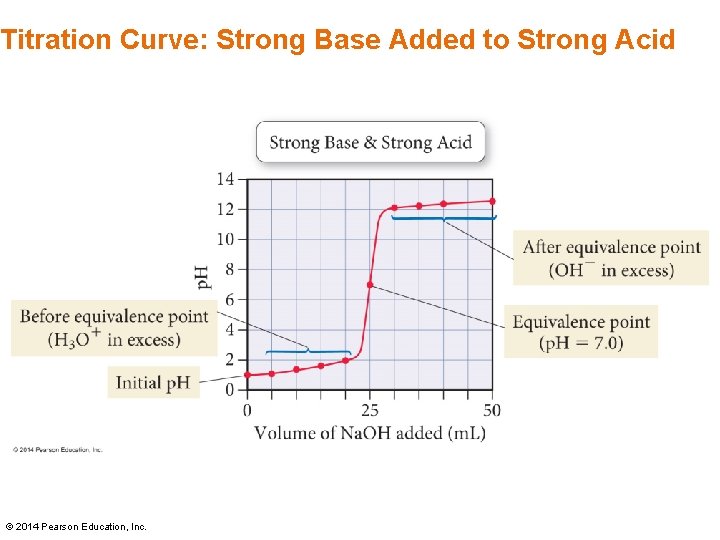
Titration Curve: Strong Base Added to Strong Acid © 2014 Pearson Education, Inc.
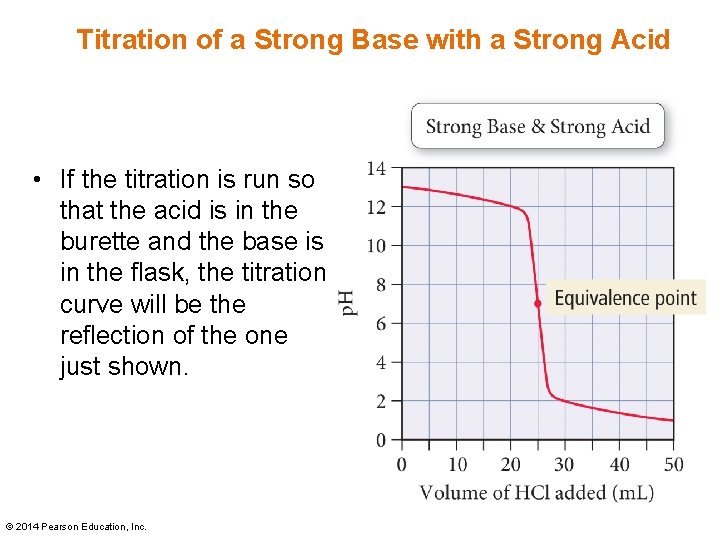
Titration of a Strong Base with a Strong Acid • If the titration is run so that the acid is in the burette and the base is in the flask, the titration curve will be the reflection of the one just shown. © 2014 Pearson Education, Inc.
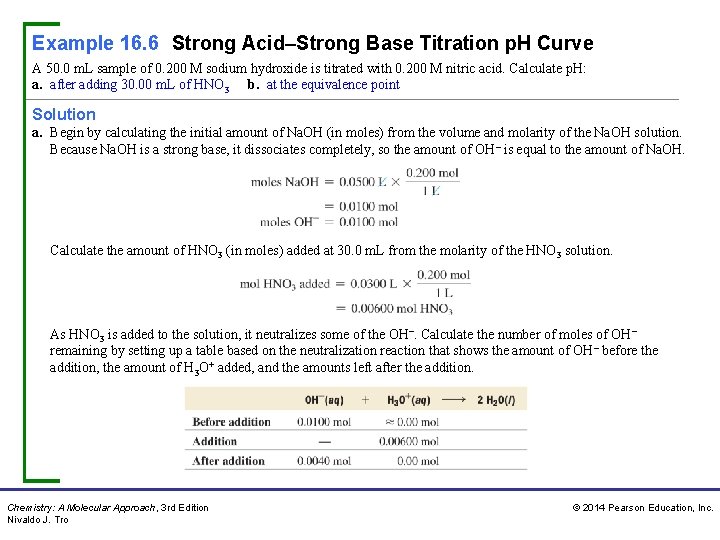
Example 16. 6 Strong Acid–Strong Base Titration p. H Curve A 50. 0 m. L sample of 0. 200 M sodium hydroxide is titrated with 0. 200 M nitric acid. Calculate p. H: a. after adding 30. 00 m. L of HNO 3 b. at the equivalence point Solution a. Begin by calculating the initial amount of Na. OH (in moles) from the volume and molarity of the Na. OH solution. Because Na. OH is a strong base, it dissociates completely, so the amount of OH– is equal to the amount of Na. OH. Calculate the amount of HNO 3 (in moles) added at 30. 0 m. L from the molarity of the HNO 3 solution. As HNO 3 is added to the solution, it neutralizes some of the OH–. Calculate the number of moles of OH– remaining by setting up a table based on the neutralization reaction that shows the amount of OH – before the addition, the amount of H 3 O+ added, and the amounts left after the addition. Chemistry: A Molecular Approach, 3 rd Edition Nivaldo J. Tro © 2014 Pearson Education, Inc.
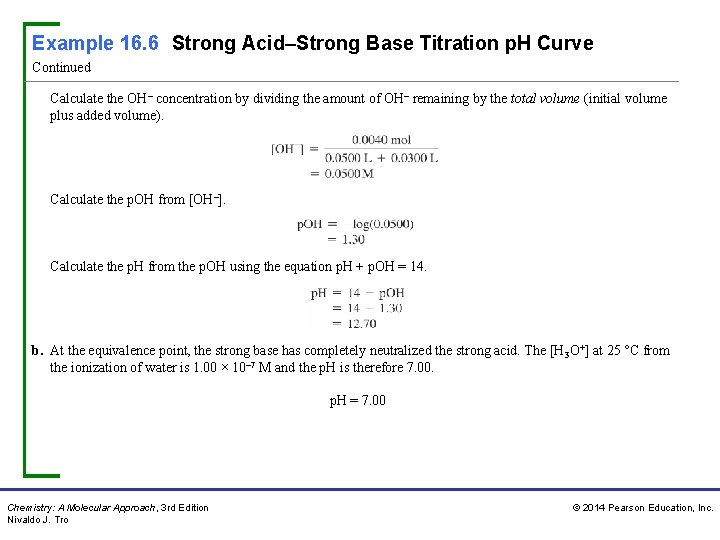
Example 16. 6 Strong Acid–Strong Base Titration p. H Curve Continued Calculate the OH– concentration by dividing the amount of OH– remaining by the total volume (initial volume plus added volume). Calculate the p. OH from [OH–]. Calculate the p. H from the p. OH using the equation p. H + p. OH = 14. b. At the equivalence point, the strong base has completely neutralized the strong acid. The [H 3 O+] at 25 °C from the ionization of water is 1. 00 × 10– 7 M and the p. H is therefore 7. 00. p. H = 7. 00 Chemistry: A Molecular Approach, 3 rd Edition Nivaldo J. Tro © 2014 Pearson Education, Inc.
Titration of a Weak Acid with a Strong Base • Titrating a weak acid with a strong base results in differences in the titration curve at the equivalence point and excess acid region. • The initial p. H is determined using the Ka of the weak acid. • The p. H in the excess acid region is determined as you would determine the p. H of a buffer. • The p. H at the equivalence point is determined using the Kb of the conjugate base of the weak acid. • The p. H after equivalence is dominated by the excess strong base. – The basicity from the conjugate base anion is negligible. © 2014 Pearson Education, Inc.
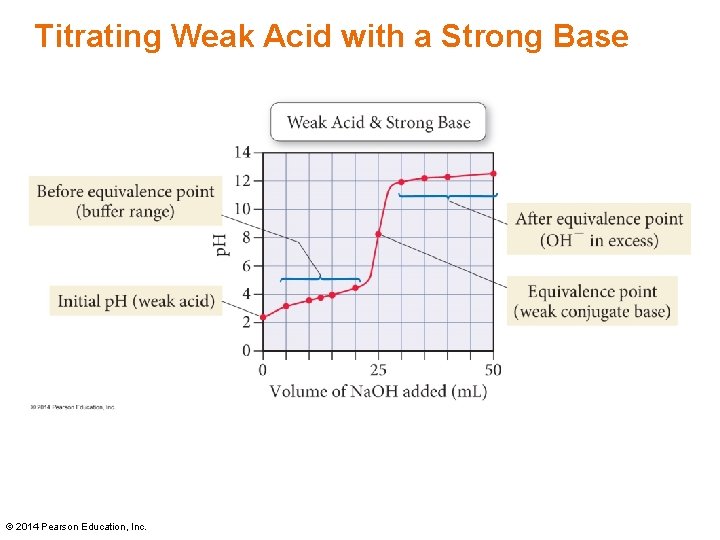
Titrating Weak Acid with a Strong Base © 2014 Pearson Education, Inc.
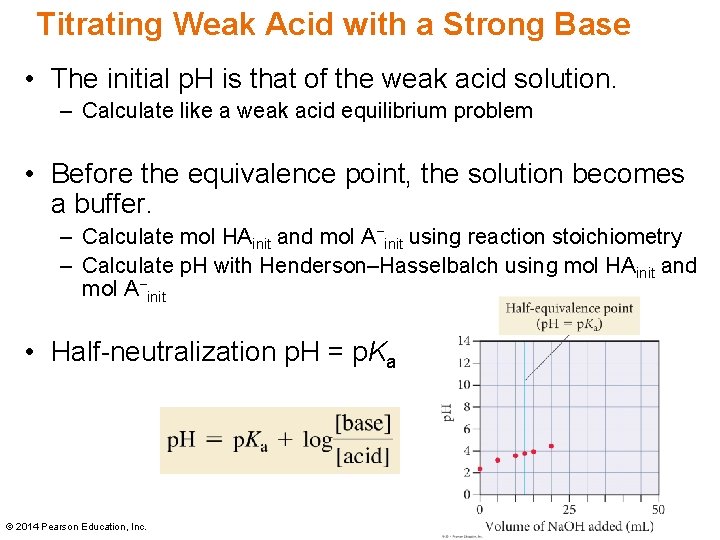
Titrating Weak Acid with a Strong Base • The initial p. H is that of the weak acid solution. – Calculate like a weak acid equilibrium problem • Before the equivalence point, the solution becomes a buffer. – Calculate mol HAinit and mol A−init using reaction stoichiometry – Calculate p. H with Henderson–Hasselbalch using mol HAinit and mol A−init • Half-neutralization p. H = p. Ka © 2014 Pearson Education, Inc.
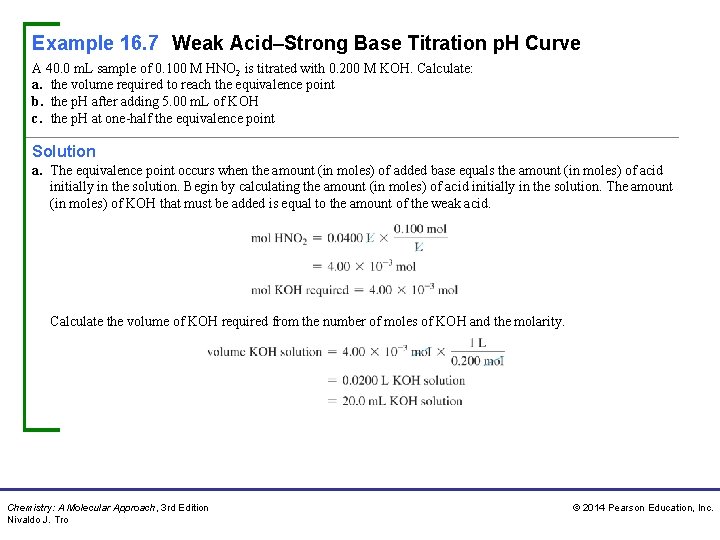
Example 16. 7 Weak Acid–Strong Base Titration p. H Curve A 40. 0 m. L sample of 0. 100 M HNO 2 is titrated with 0. 200 M KOH. Calculate: a. the volume required to reach the equivalence point b. the p. H after adding 5. 00 m. L of KOH c. the p. H at one-half the equivalence point Solution a. The equivalence point occurs when the amount (in moles) of added base equals the amount (in moles) of acid initially in the solution. Begin by calculating the amount (in moles) of acid initially in the solution. The amount (in moles) of KOH that must be added is equal to the amount of the weak acid. Calculate the volume of KOH required from the number of moles of KOH and the molarity. Chemistry: A Molecular Approach, 3 rd Edition Nivaldo J. Tro © 2014 Pearson Education, Inc.
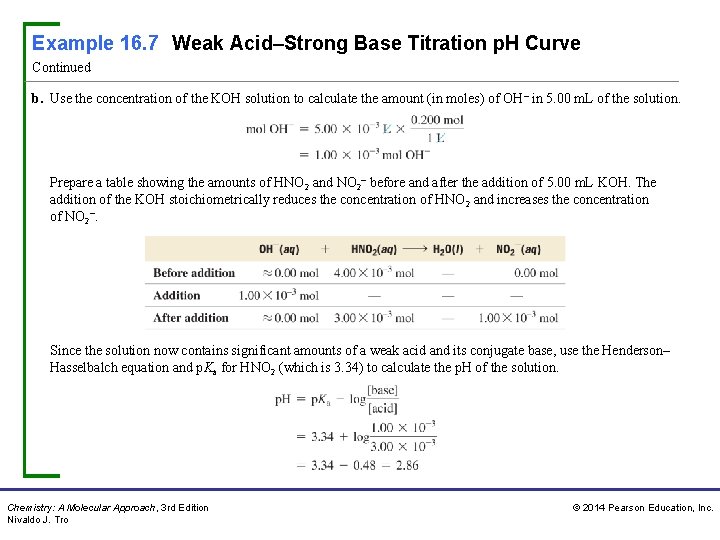
Example 16. 7 Weak Acid–Strong Base Titration p. H Curve Continued b. Use the concentration of the KOH solution to calculate the amount (in moles) of OH– in 5. 00 m. L of the solution. Prepare a table showing the amounts of HNO 2 and NO 2– before and after the addition of 5. 00 m. L KOH. The addition of the KOH stoichiometrically reduces the concentration of HNO 2 and increases the concentration of NO 2–. Since the solution now contains significant amounts of a weak acid and its conjugate base, use the Henderson– Hasselbalch equation and p. Ka for HNO 2 (which is 3. 34) to calculate the p. H of the solution. Chemistry: A Molecular Approach, 3 rd Edition Nivaldo J. Tro © 2014 Pearson Education, Inc.
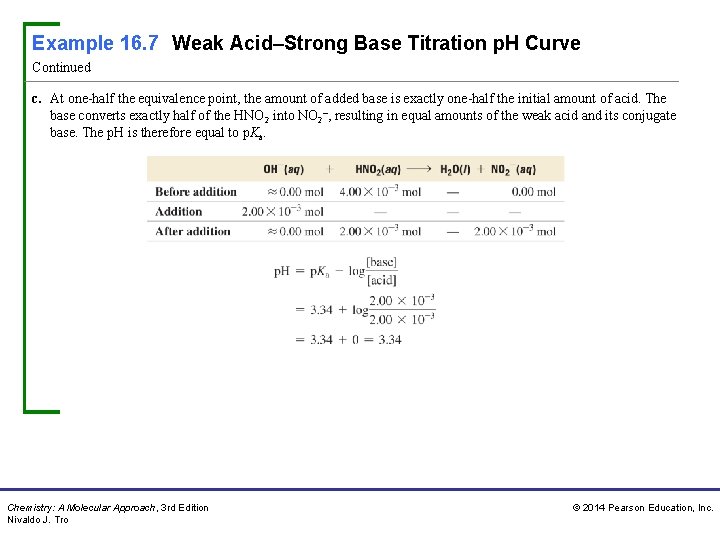
Example 16. 7 Weak Acid–Strong Base Titration p. H Curve Continued c. At one-half the equivalence point, the amount of added base is exactly one-half the initial amount of acid. The base converts exactly half of the HNO 2 into NO 2–, resulting in equal amounts of the weak acid and its conjugate base. The p. H is therefore equal to p. Ka. Chemistry: A Molecular Approach, 3 rd Edition Nivaldo J. Tro © 2014 Pearson Education, Inc.
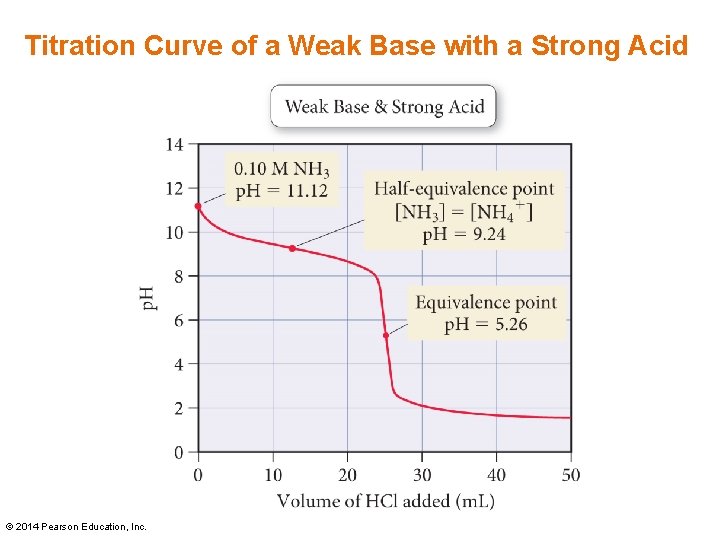
Titration Curve of a Weak Base with a Strong Acid © 2014 Pearson Education, Inc.
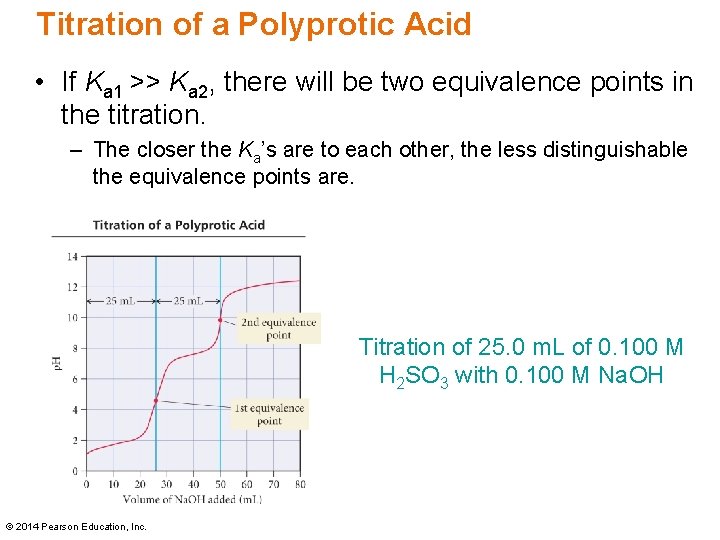
Titration of a Polyprotic Acid • If Ka 1 >> Ka 2, there will be two equivalence points in the titration. – The closer the Ka’s are to each other, the less distinguishable the equivalence points are. Titration of 25. 0 m. L of 0. 100 M H 2 SO 3 with 0. 100 M Na. OH © 2014 Pearson Education, Inc.
Monitoring p. H during a Titration • The general method for monitoring the p. H during the course of a titration is to measure the conductivity of the solution due to the [H 3 O+]. – Using a probe that specifically measures just [H 3 O+]. • The endpoint of the titration is reached at the equivalence point in the titration—at the inflection point of the titration curve. • If you just need to know the amount of titrant added to reach the endpoint, we often monitor the titration with an indicator. © 2014 Pearson Education, Inc.
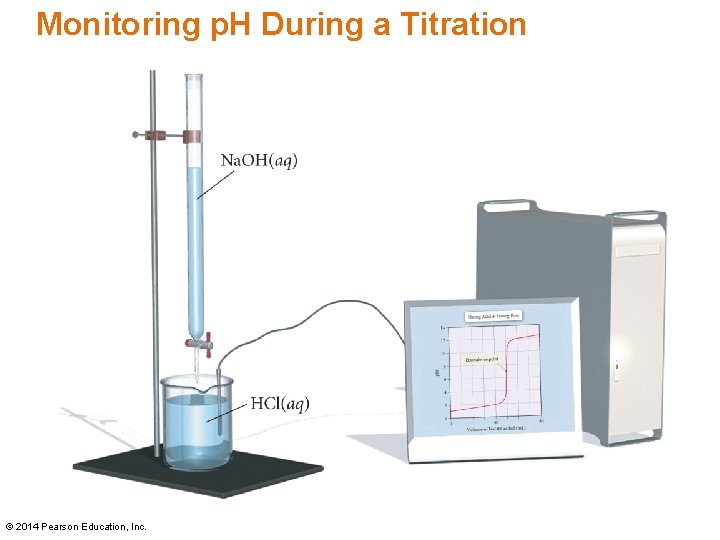
Monitoring p. H During a Titration Figure 16. 10 pg 780 © 2014 Pearson Education, Inc.
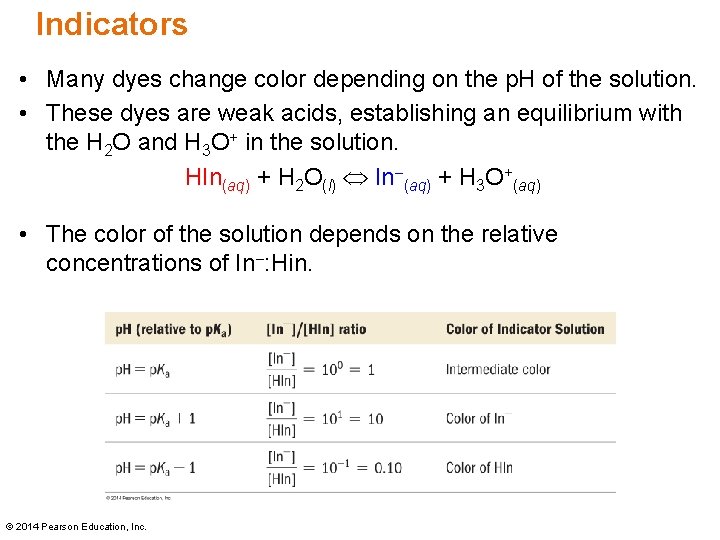
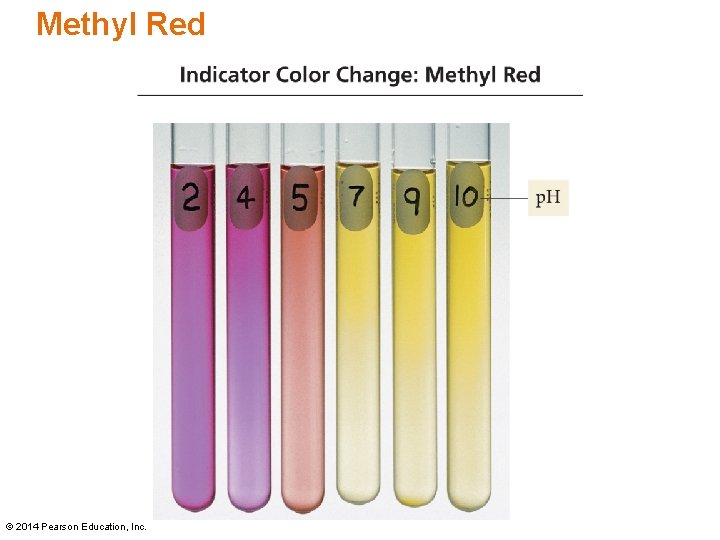
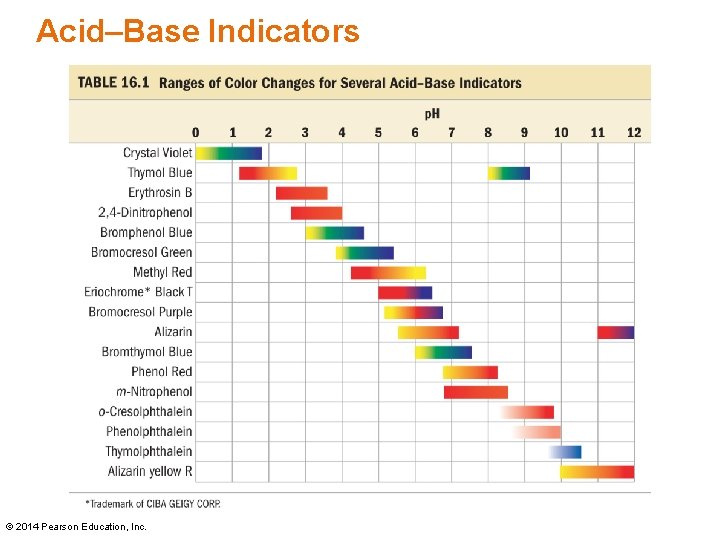
Indicators • Many dyes change color depending on the p. H of the solution. • These dyes are weak acids, establishing an equilibrium with the H 2 O and H 3 O+ in the solution. HIn(aq) + H 2 O(l) In (aq) + H 3 O+(aq) • The color of the solution depends on the relative concentrations of In : Hin. © 2014 Pearson Education, Inc.
Monitoring a Titration with an Indicator • For most titrations, the titration curve shows a very large change in p. H for very small additions of titrant near the equivalence point. • An indicator can therefore be used to determine the endpoint of the titration if it changes color within the same range as the rapid change in p. H. – p. Ka of HIn ≈ p. H at equivalence point © 2014 Pearson Education, Inc.
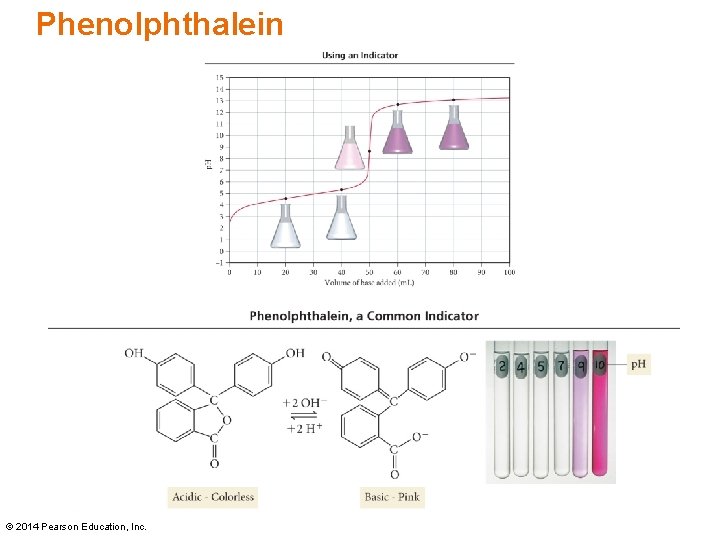
Phenolphthalein © 2014 Pearson Education, Inc.
Methyl Red © 2014 Pearson Education, Inc.
Acid–Base Indicators Table 16. 1 pg 783 © 2014 Pearson Education, Inc.
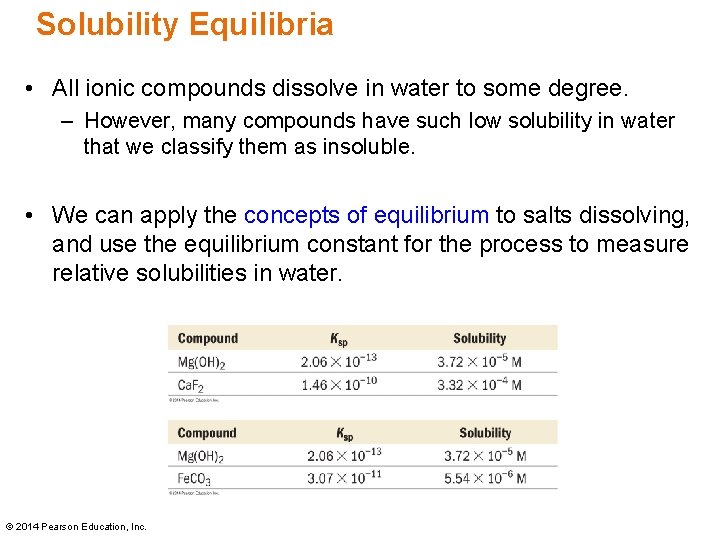
Solubility Equilibria • All ionic compounds dissolve in water to some degree. – However, many compounds have such low solubility in water that we classify them as insoluble. • We can apply the concepts of equilibrium to salts dissolving, and use the equilibrium constant for the process to measure relative solubilities in water. © 2014 Pearson Education, Inc.
Solubility Product • The equilibrium constant for the dissociation of a solid salt into its aqueous ions is called the solubility product, Ksp. • For an ionic solid Mn. Xm, the dissociation reaction is Mn. Xm(s) n. Mm+(aq) + m. Xn−(aq). • The solubility product would be Ksp = [Mm+]n[Xn−]m. • For example, the dissociation reaction for Pb. Cl 2 is Pb. Cl 2(s) Pb 2+(aq) + 2 Cl−(aq). • And its equilibrium constant is Ksp = [Pb 2+][Cl−]2. © 2014 Pearson Education, Inc.
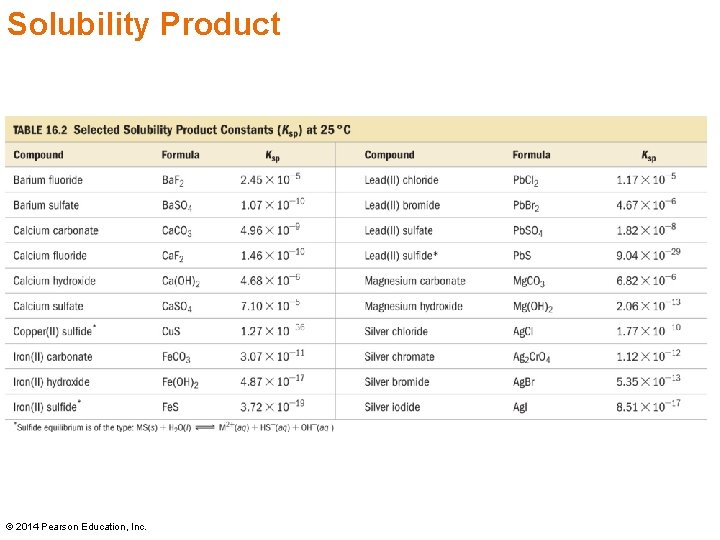
Solubility Product © 2014 Pearson Education, Inc.
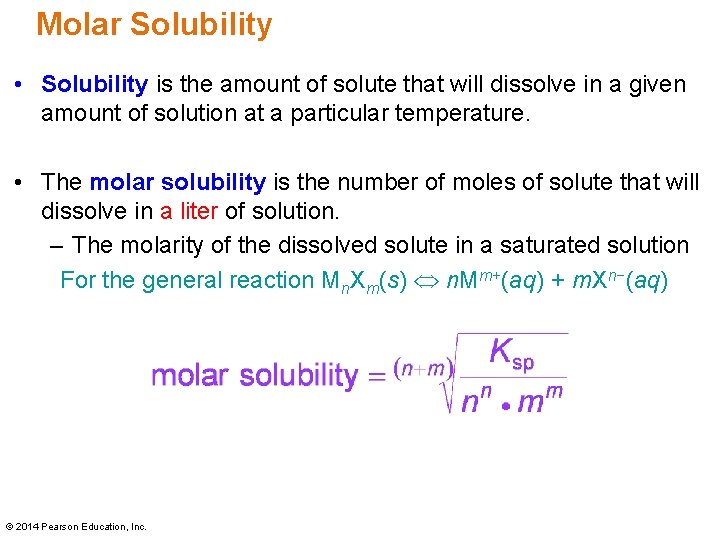
Molar Solubility • Solubility is the amount of solute that will dissolve in a given amount of solution at a particular temperature. • The molar solubility is the number of moles of solute that will dissolve in a liter of solution. – The molarity of the dissolved solute in a saturated solution For the general reaction Mn. Xm(s) n. Mm+(aq) + m. Xn−(aq) © 2014 Pearson Education, Inc.
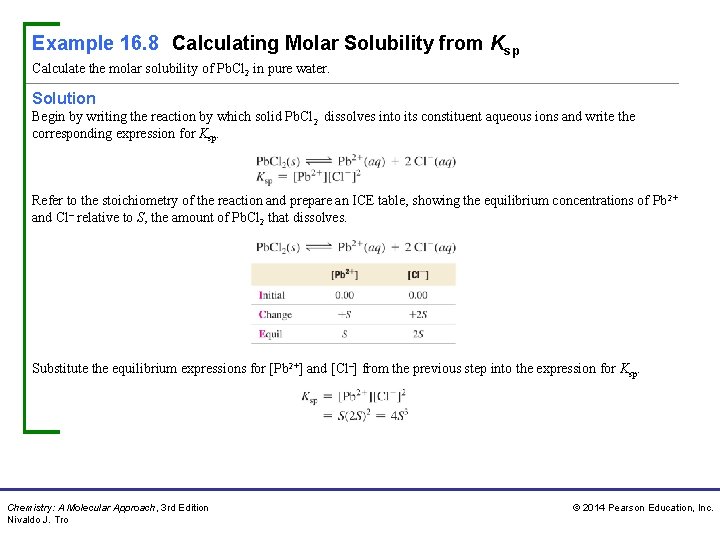
Example 16. 8 Calculating Molar Solubility from Ksp Calculate the molar solubility of Pb. Cl 2 in pure water. Solution Begin by writing the reaction by which solid Pb. Cl 2 dissolves into its constituent aqueous ions and write the corresponding expression for Ksp. Refer to the stoichiometry of the reaction and prepare an ICE table, showing the equilibrium concentrations of Pb 2+ and Cl– relative to S, the amount of Pb. Cl 2 that dissolves. Substitute the equilibrium expressions for [Pb 2+] and [Cl–] from the previous step into the expression for Ksp. Chemistry: A Molecular Approach, 3 rd Edition Nivaldo J. Tro © 2014 Pearson Education, Inc.
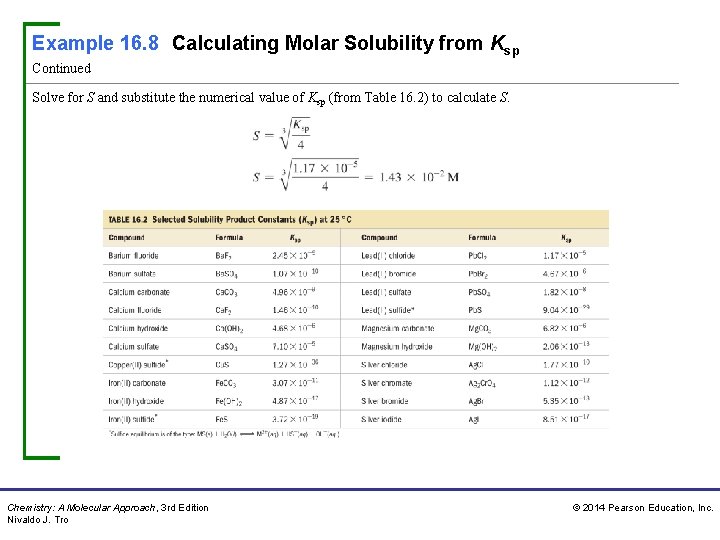
Example 16. 8 Calculating Molar Solubility from Ksp Continued Solve for S and substitute the numerical value of Ksp (from Table 16. 2) to calculate S. Chemistry: A Molecular Approach, 3 rd Edition Nivaldo J. Tro © 2014 Pearson Education, Inc.
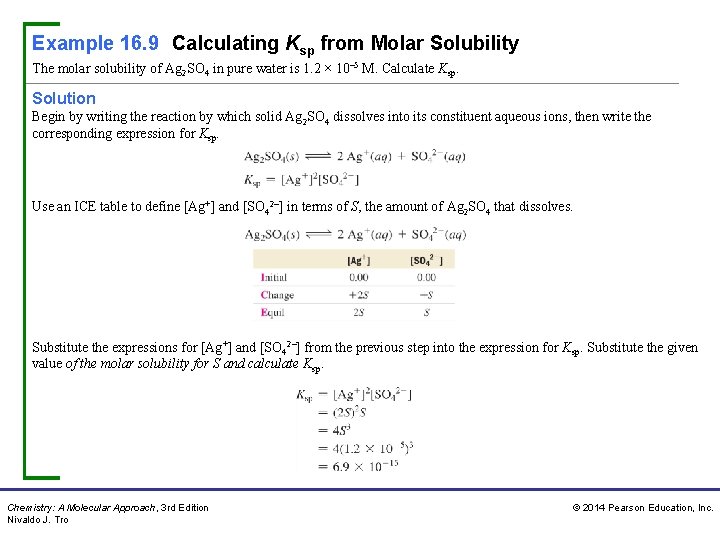
Example 16. 9 Calculating Ksp from Molar Solubility The molar solubility of Ag 2 SO 4 in pure water is 1. 2 × 10– 5 M. Calculate Ksp. Solution Begin by writing the reaction by which solid Ag 2 SO 4 dissolves into its constituent aqueous ions, then write the corresponding expression for Ksp. Use an ICE table to define [Ag+] and [SO 42–] in terms of S, the amount of Ag 2 SO 4 that dissolves. Substitute the expressions for [Ag+] and [SO 42–] from the previous step into the expression for Ksp. Substitute the given value of the molar solubility for S and calculate Ksp. Chemistry: A Molecular Approach, 3 rd Edition Nivaldo J. Tro © 2014 Pearson Education, Inc.
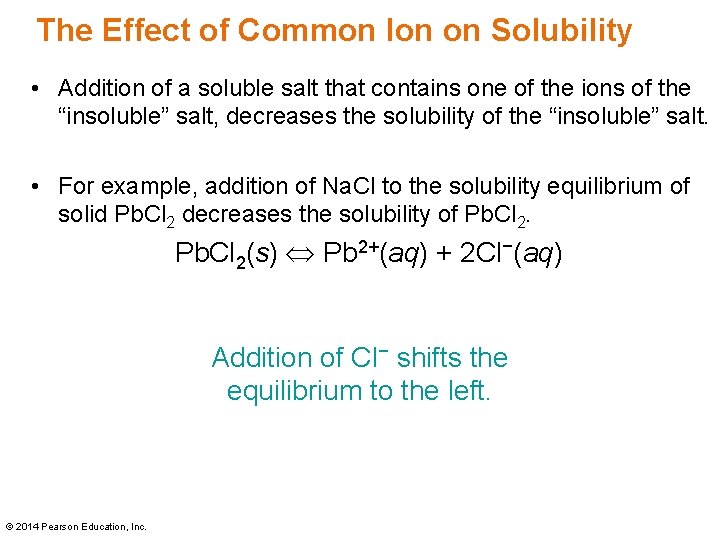
The Effect of Common Ion on Solubility • Addition of a soluble salt that contains one of the ions of the “insoluble” salt, decreases the solubility of the “insoluble” salt. • For example, addition of Na. Cl to the solubility equilibrium of solid Pb. Cl 2 decreases the solubility of Pb. Cl 2(s) Pb 2+(aq) + 2 Cl−(aq) Addition of Cl− shifts the equilibrium to the left. © 2014 Pearson Education, Inc.
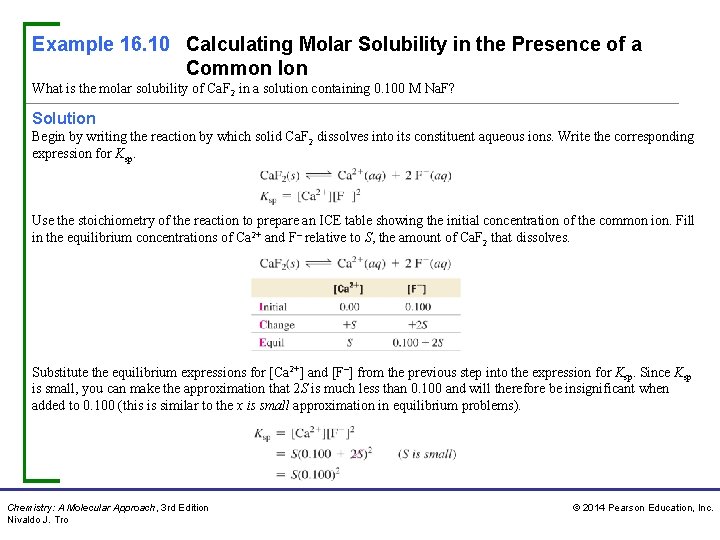
Example 16. 10 Calculating Molar Solubility in the Presence of a Common Ion What is the molar solubility of Ca. F 2 in a solution containing 0. 100 M Na. F? Solution Begin by writing the reaction by which solid Ca. F 2 dissolves into its constituent aqueous ions. Write the corresponding expression for Ksp. Use the stoichiometry of the reaction to prepare an ICE table showing the initial concentration of the common ion. Fill in the equilibrium concentrations of Ca 2+ and F– relative to S, the amount of Ca. F 2 that dissolves. Substitute the equilibrium expressions for [Ca 2+] and [F–] from the previous step into the expression for Ksp. Since Ksp is small, you can make the approximation that 2 S is much less than 0. 100 and will therefore be insignificant when added to 0. 100 (this is similar to the x is small approximation in equilibrium problems). Chemistry: A Molecular Approach, 3 rd Edition Nivaldo J. Tro © 2014 Pearson Education, Inc.
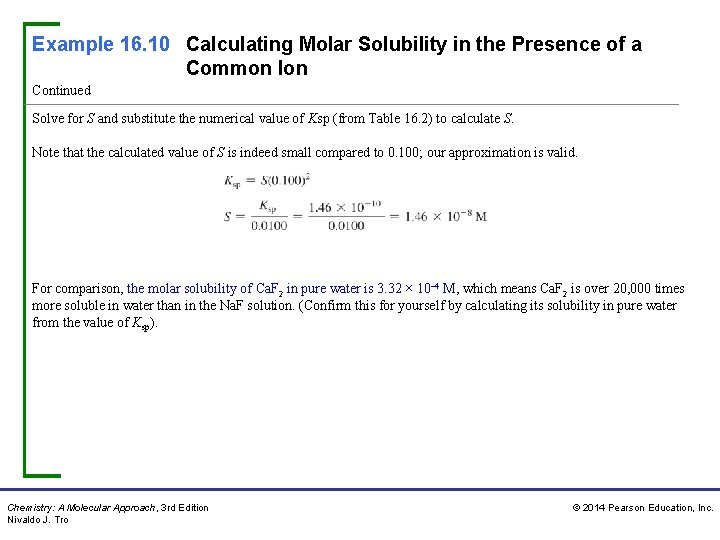
Example 16. 10 Calculating Molar Solubility in the Presence of a Common Ion Continued Solve for S and substitute the numerical value of Ksp (from Table 16. 2) to calculate S. Note that the calculated value of S is indeed small compared to 0. 100; our approximation is valid. For comparison, the molar solubility of Ca. F 2 in pure water is 3. 32 × 10– 4 M, which means Ca. F 2 is over 20, 000 times more soluble in water than in the Na. F solution. (Confirm this for yourself by calculating its solubility in pure water from the value of Ksp). Chemistry: A Molecular Approach, 3 rd Edition Nivaldo J. Tro © 2014 Pearson Education, Inc.
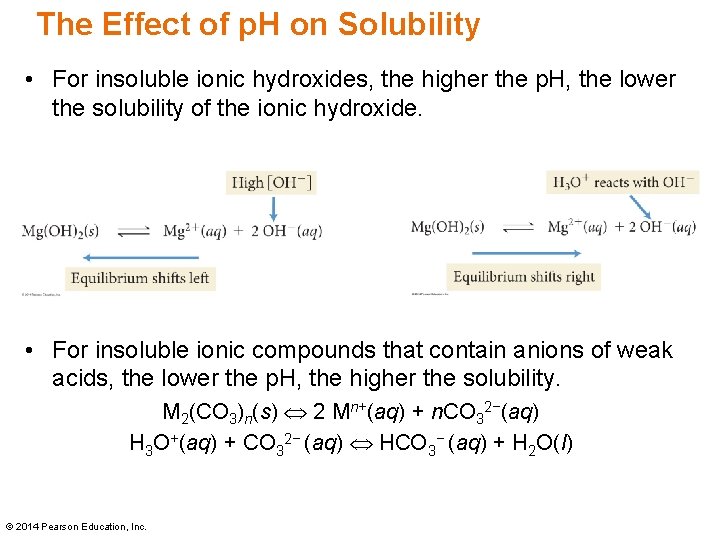
The Effect of p. H on Solubility • For insoluble ionic hydroxides, the higher the p. H, the lower the solubility of the ionic hydroxide. • For insoluble ionic compounds that contain anions of weak acids, the lower the p. H, the higher the solubility. M 2(CO 3)n(s) 2 Mn+(aq) + n. CO 32−(aq) H 3 O+(aq) + CO 32− (aq) HCO 3− (aq) + H 2 O(l) © 2014 Pearson Education, Inc.
Precipitation • Precipitation will occur when the concentrations of the ions exceed the solubility of the ionic compound. • If we compare the reaction quotient, Q, for the current solution concentrations to the value of Ksp, we can determine if precipitation will occur. – Q = Ksp, the solution is saturated, no precipitation. – Q < Ksp, the solution is unsaturated, no precipitation. – Q > Ksp, the solution would be above saturation, the salt above saturation will precipitate. • Some solutions with Q > Ksp will not precipitate unless disturbed; these are called supersaturated solutions. © 2014 Pearson Education, Inc.
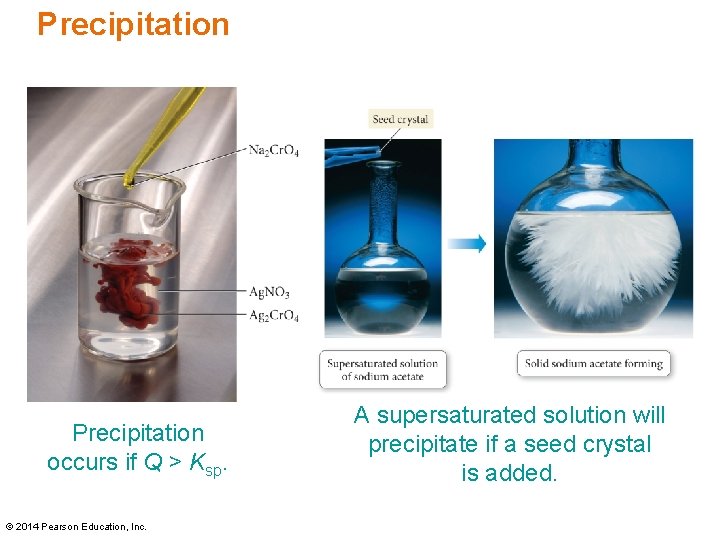
Precipitation Image top right of page 789 Precipitation occurs if Q > Ksp. © 2014 Pearson Education, Inc. A supersaturated solution will precipitate if a seed crystal is added.
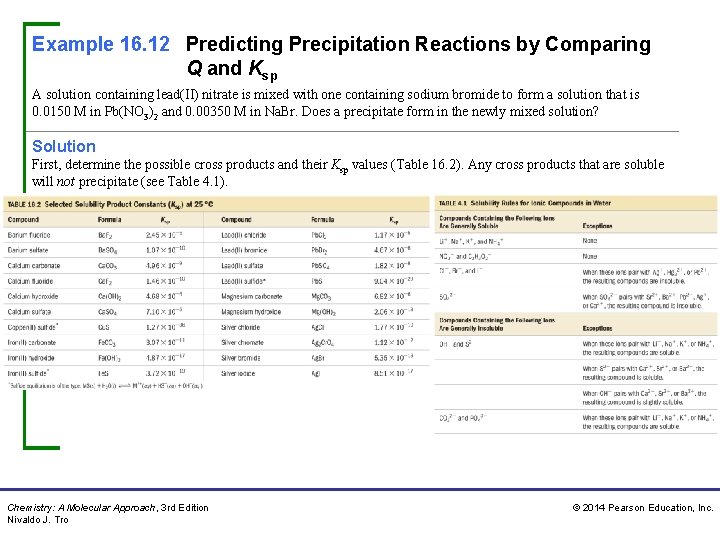
Example 16. 12 Predicting Precipitation Reactions by Comparing Q and Ksp A solution containing lead(II) nitrate is mixed with one containing sodium bromide to form a solution that is 0. 0150 M in Pb(NO 3)2 and 0. 00350 M in Na. Br. Does a precipitate form in the newly mixed solution? Solution First, determine the possible cross products and their Ksp values (Table 16. 2). Any cross products that are soluble will not precipitate (see Table 4. 1). Chemistry: A Molecular Approach, 3 rd Edition Nivaldo J. Tro © 2014 Pearson Education, Inc.
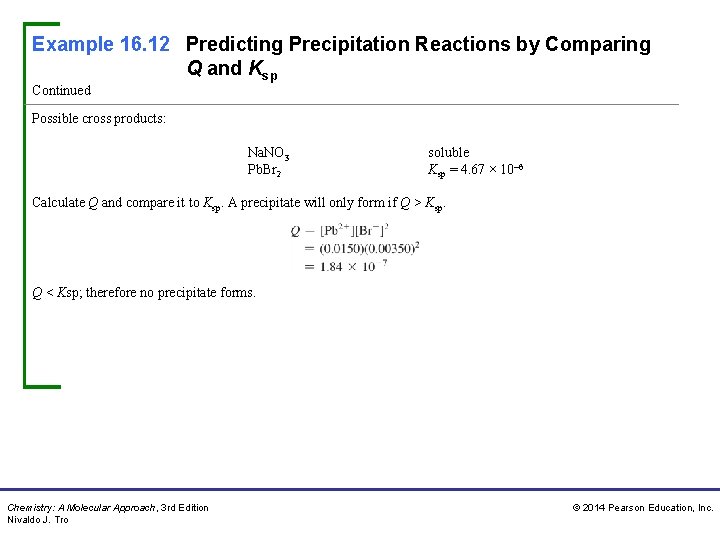
Example 16. 12 Predicting Precipitation Reactions by Comparing Q and Ksp Continued Possible cross products: Na. NO 3 Pb. Br 2 soluble Ksp = 4. 67 × 10– 6 Calculate Q and compare it to Ksp. A precipitate will only form if Q > Ksp. Q < Ksp; therefore no precipitate forms. Chemistry: A Molecular Approach, 3 rd Edition Nivaldo J. Tro © 2014 Pearson Education, Inc.
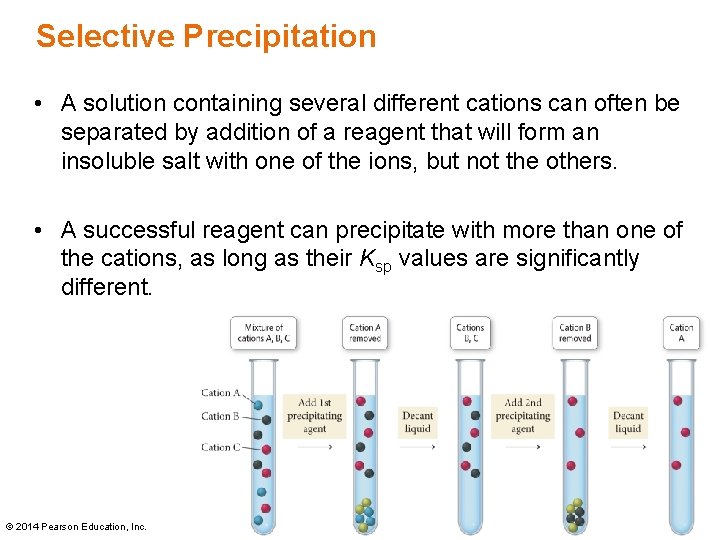
Selective Precipitation • A solution containing several different cations can often be separated by addition of a reagent that will form an insoluble salt with one of the ions, but not the others. • A successful reagent can precipitate with more than one of the cations, as long as their Ksp values are significantly different. © 2014 Pearson Education, Inc.
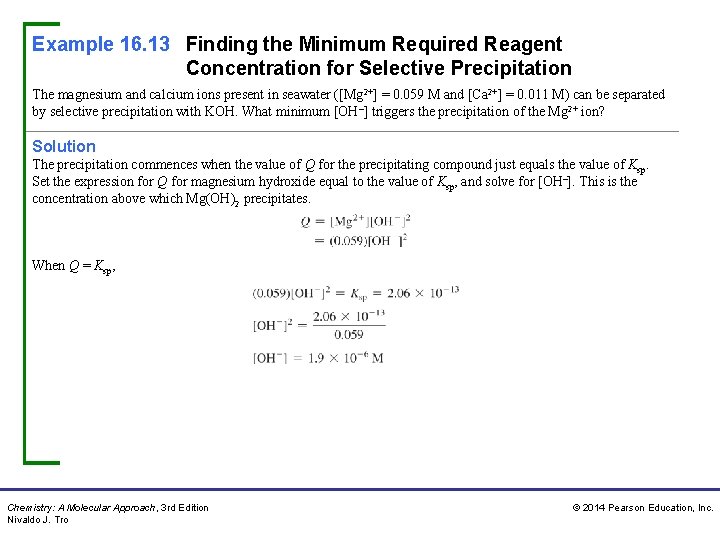
Example 16. 13 Finding the Minimum Required Reagent Concentration for Selective Precipitation The magnesium and calcium ions present in seawater ([Mg 2+] = 0. 059 M and [Ca 2+] = 0. 011 M) can be separated by selective precipitation with KOH. What minimum [OH–] triggers the precipitation of the Mg 2+ ion? Solution The precipitation commences when the value of Q for the precipitating compound just equals the value of Ksp. Set the expression for Q for magnesium hydroxide equal to the value of Ksp, and solve for [OH–]. This is the concentration above which Mg(OH)2 precipitates. When Q = Ksp, Chemistry: A Molecular Approach, 3 rd Edition Nivaldo J. Tro © 2014 Pearson Education, Inc.
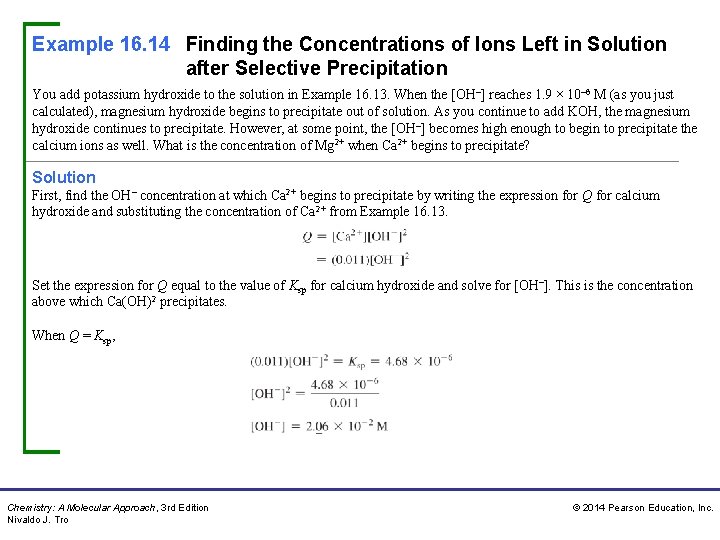
Example 16. 14 Finding the Concentrations of Ions Left in Solution after Selective Precipitation You add potassium hydroxide to the solution in Example 16. 13. When the [OH–] reaches 1. 9 × 10– 6 M (as you just calculated), magnesium hydroxide begins to precipitate out of solution. As you continue to add KOH, the magnesium hydroxide continues to precipitate. However, at some point, the [OH–] becomes high enough to begin to precipitate the calcium ions as well. What is the concentration of Mg 2+ when Ca 2+ begins to precipitate? Solution First, find the OH– concentration at which Ca 2+ begins to precipitate by writing the expression for Q for calcium hydroxide and substituting the concentration of Ca 2+ from Example 16. 13. Set the expression for Q equal to the value of Ksp for calcium hydroxide and solve for [OH–]. This is the concentration above which Ca(OH)2 precipitates. When Q = Ksp, Chemistry: A Molecular Approach, 3 rd Edition Nivaldo J. Tro © 2014 Pearson Education, Inc.
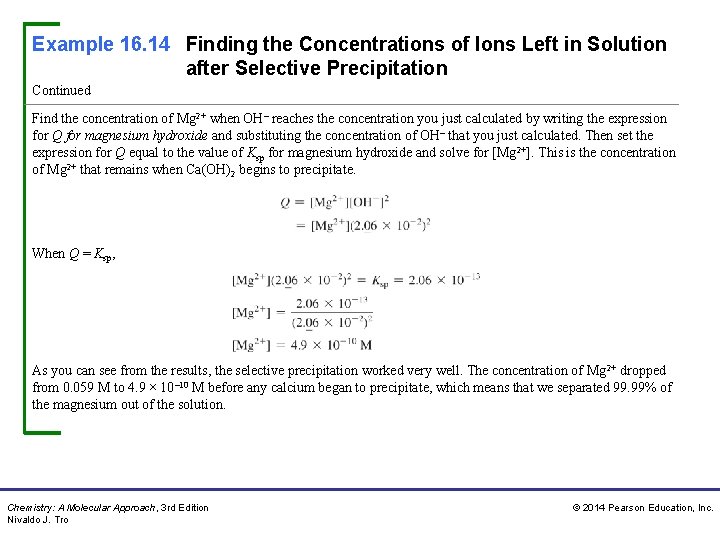
Example 16. 14 Finding the Concentrations of Ions Left in Solution after Selective Precipitation Continued Find the concentration of Mg 2+ when OH– reaches the concentration you just calculated by writing the expression for Q for magnesium hydroxide and substituting the concentration of OH– that you just calculated. Then set the expression for Q equal to the value of Ksp for magnesium hydroxide and solve for [Mg 2+]. This is the concentration of Mg 2+ that remains when Ca(OH)2 begins to precipitate. When Q = Ksp, As you can see from the results, the selective precipitation worked very well. The concentration of Mg 2+ dropped from 0. 059 M to 4. 9 × 10– 10 M before any calcium began to precipitate, which means that we separated 99. 99% of the magnesium out of the solution. Chemistry: A Molecular Approach, 3 rd Edition Nivaldo J. Tro © 2014 Pearson Education, Inc.
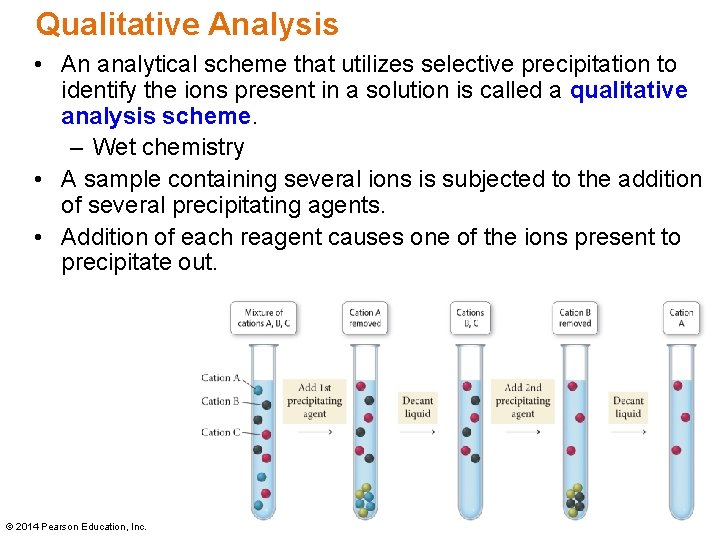
Qualitative Analysis • An analytical scheme that utilizes selective precipitation to identify the ions present in a solution is called a qualitative analysis scheme. – Wet chemistry • A sample containing several ions is subjected to the addition of several precipitating agents. • Addition of each reagent causes one of the ions present to precipitate out. © 2014 Pearson Education, Inc.

A General Qualitative Analysis Scheme Figure 16. 16 pg 118 © 2014 Pearson Education, Inc.
Group 1 • Group one cations are Ag+, Pb 2+, and Hg 22+. • All these cations form compounds with Cl− that are insoluble in water. – As long as the concentration is large enough – Pb. Cl 2 may be borderline • Molar solubility of Pb. Cl 2 = 1. 43 × 10− 2 M • Precipitated by the addition of HCl. © 2014 Pearson Education, Inc.
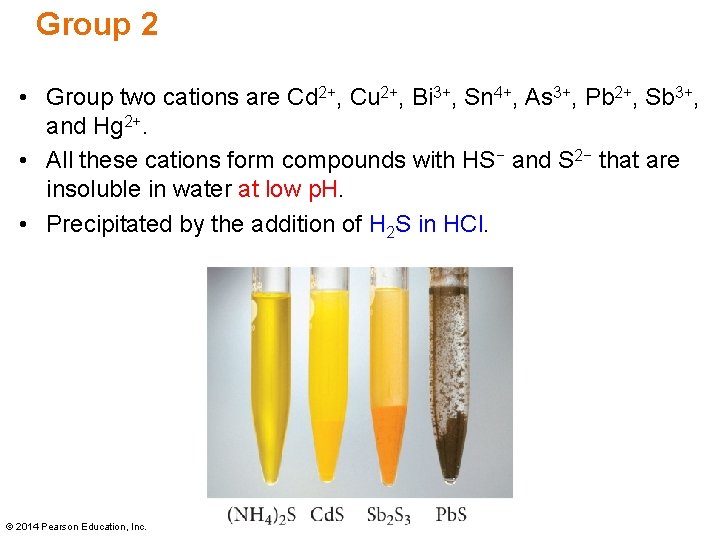
Group 2 • Group two cations are Cd 2+, Cu 2+, Bi 3+, Sn 4+, As 3+, Pb 2+, Sb 3+, and Hg 2+. • All these cations form compounds with HS− and S 2− that are insoluble in water at low p. H. • Precipitated by the addition of H 2 S in HCl. © 2014 Pearson Education, Inc.
Group 3 • Group three cations are Fe 2+, Co 2+, Zn 2+, Mn 2+, Ni 2+ precipitated as sulfides, as well as Cr 3+, Fe 3+, and Al 3+ precipitated as hydroxides. • All these cations form compounds with S 2− that are insoluble in water at high p. H. • Precipitated by the addition of H 2 S in Na. OH. Group 4 • Group four cations are Mg 2+, Ca 2+, Ba 2+. • All these cations form compounds with PO 43− that are insoluble in water at high p. H. • Precipitated by the addition of (NH 4)2 HPO 4. © 2014 Pearson Education, Inc.
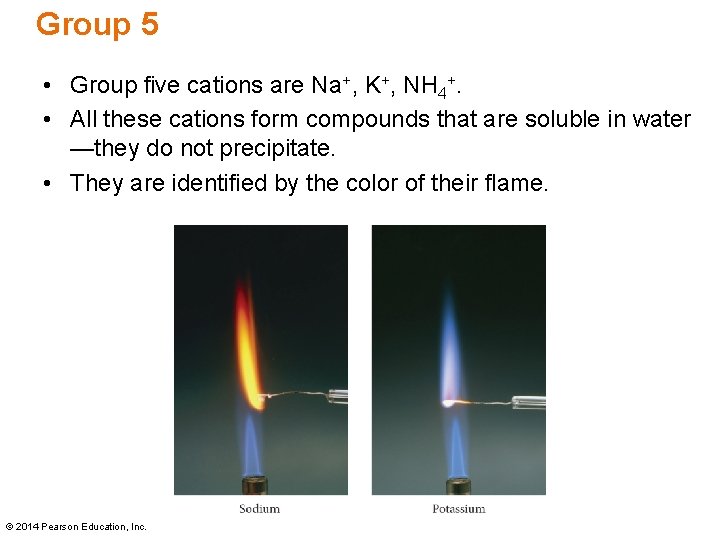
Group 5 • Group five cations are Na+, K+, NH 4+. • All these cations form compounds that are soluble in water —they do not precipitate. • They are identified by the color of their flame. © 2014 Pearson Education, Inc.
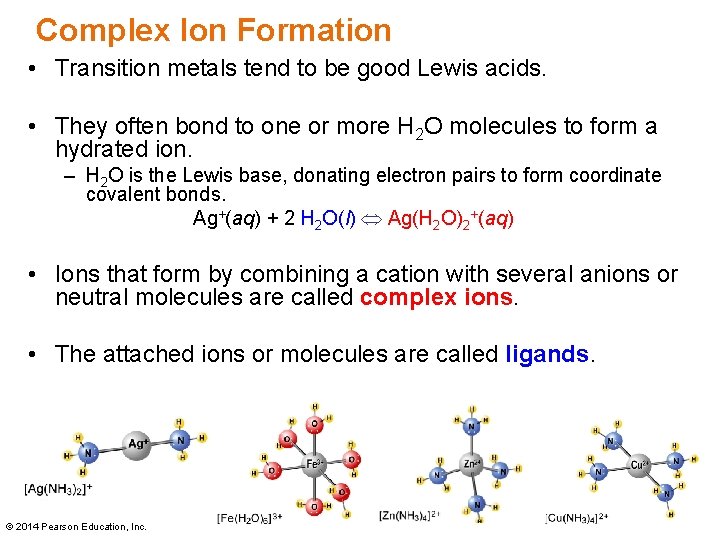
Complex Ion Formation • Transition metals tend to be good Lewis acids. • They often bond to one or more H 2 O molecules to form a hydrated ion. – H 2 O is the Lewis base, donating electron pairs to form coordinate covalent bonds. Ag+(aq) + 2 H 2 O(l) Ag(H 2 O)2+(aq) • Ions that form by combining a cation with several anions or neutral molecules are called complex ions. • The attached ions or molecules are called ligands. © 2014 Pearson Education, Inc.
Complex Ion Equilibria • If a ligand is added to a solution that forms a stronger bond than the current ligand, it will replace the current ligand. Ag(H 2 O)2+(aq) + 2 NH 3(aq) Ag(NH 3)2+(aq) + 2 H 2 O(l) – Generally, H 2 O is not included, because its complex ion is always present in aqueous solution. Ag+(aq) + 2 NH 3(aq) Ag(NH 3)2+(aq) © 2014 Pearson Education, Inc.
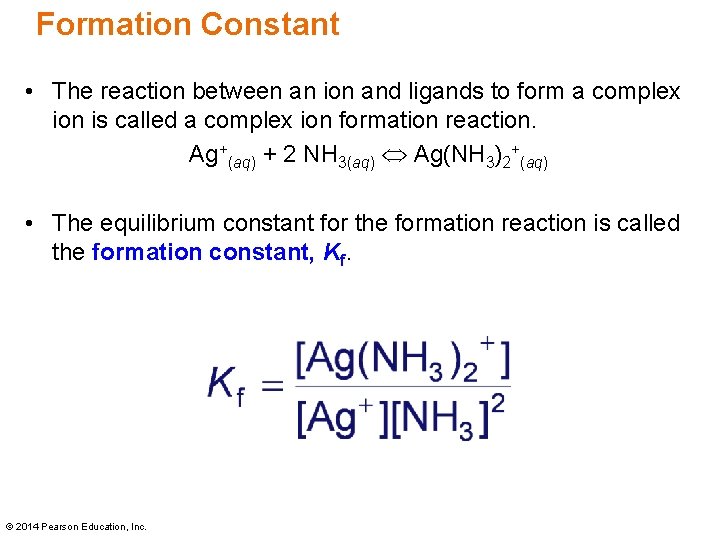
Formation Constant • The reaction between an ion and ligands to form a complex ion is called a complex ion formation reaction. Ag+(aq) + 2 NH 3(aq) Ag(NH 3)2+(aq) • The equilibrium constant for the formation reaction is called the formation constant, Kf. © 2014 Pearson Education, Inc.
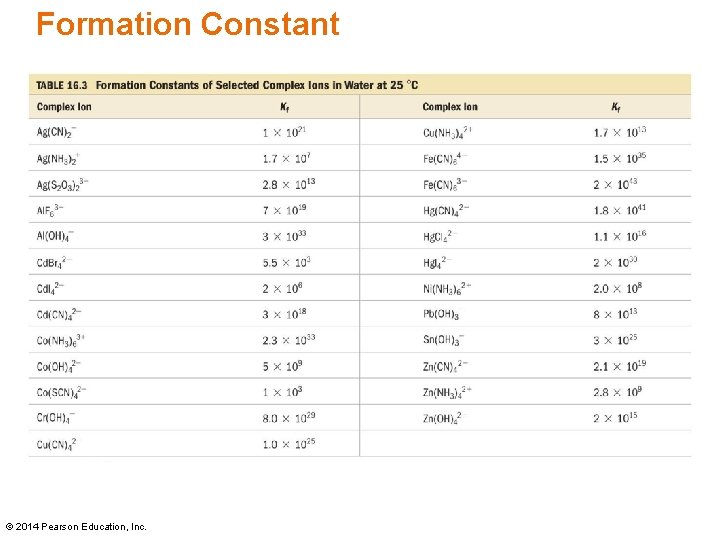
Formation Constant © 2014 Pearson Education, Inc.
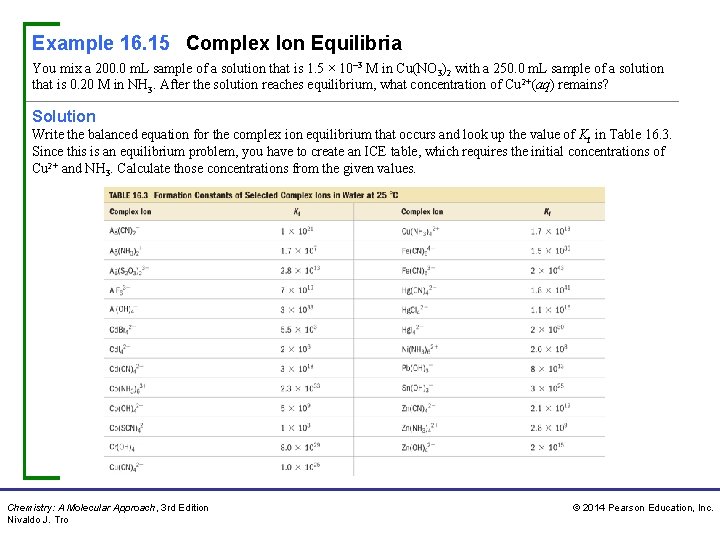
Example 16. 15 Complex Ion Equilibria You mix a 200. 0 m. L sample of a solution that is 1. 5 × 10– 3 M in Cu(NO 3)2 with a 250. 0 m. L sample of a solution that is 0. 20 M in NH 3. After the solution reaches equilibrium, what concentration of Cu 2+(aq) remains? Solution Write the balanced equation for the complex ion equilibrium that occurs and look up the value of Kf in Table 16. 3. Since this is an equilibrium problem, you have to create an ICE table, which requires the initial concentrations of Cu 2+ and NH 3. Calculate those concentrations from the given values. Chemistry: A Molecular Approach, 3 rd Edition Nivaldo J. Tro © 2014 Pearson Education, Inc.
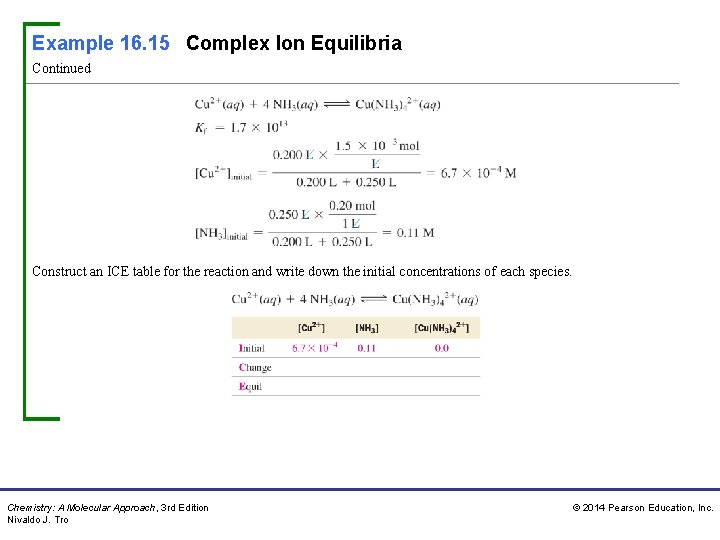
Example 16. 15 Complex Ion Equilibria Continued Construct an ICE table for the reaction and write down the initial concentrations of each species. Chemistry: A Molecular Approach, 3 rd Edition Nivaldo J. Tro © 2014 Pearson Education, Inc.
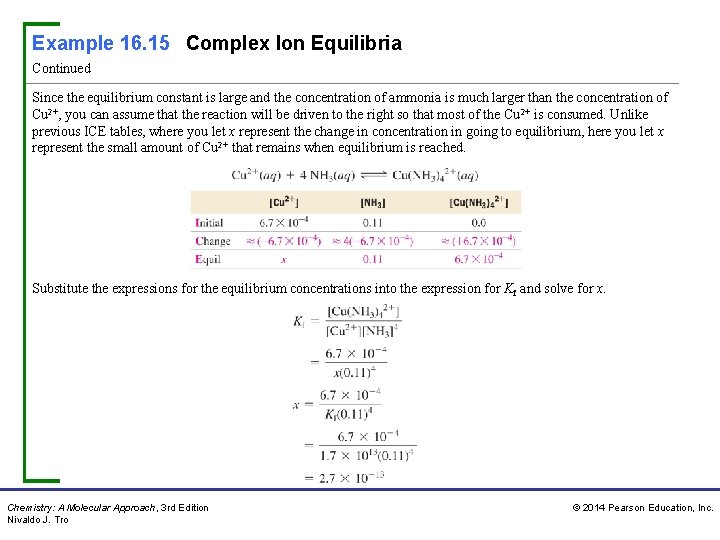
Example 16. 15 Complex Ion Equilibria Continued Since the equilibrium constant is large and the concentration of ammonia is much larger than the concentration of Cu 2+, you can assume that the reaction will be driven to the right so that most of the Cu 2+ is consumed. Unlike previous ICE tables, where you let x represent the change in concentration in going to equilibrium, here you let x represent the small amount of Cu 2+ that remains when equilibrium is reached. Substitute the expressions for the equilibrium concentrations into the expression for Kf and solve for x. Chemistry: A Molecular Approach, 3 rd Edition Nivaldo J. Tro © 2014 Pearson Education, Inc.
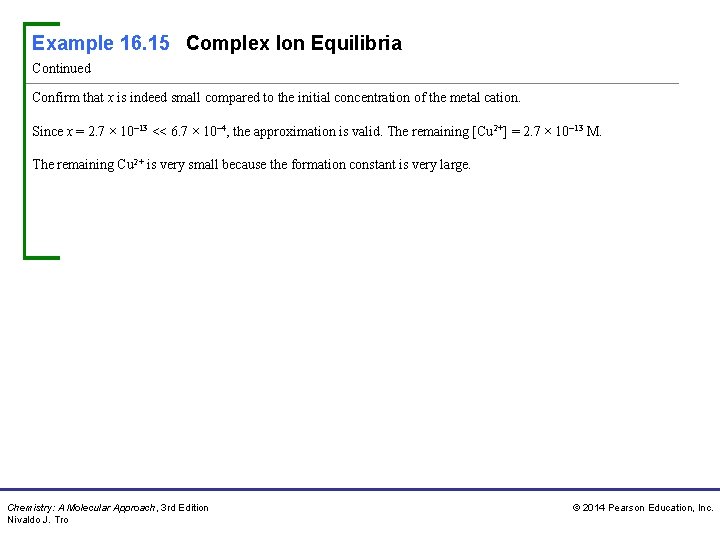
Example 16. 15 Complex Ion Equilibria Continued Confirm that x is indeed small compared to the initial concentration of the metal cation. Since x = 2. 7 × 10– 13 << 6. 7 × 10– 4, the approximation is valid. The remaining [Cu 2+] = 2. 7 × 10– 13 M. The remaining Cu 2+ is very small because the formation constant is very large. Chemistry: A Molecular Approach, 3 rd Edition Nivaldo J. Tro © 2014 Pearson Education, Inc.
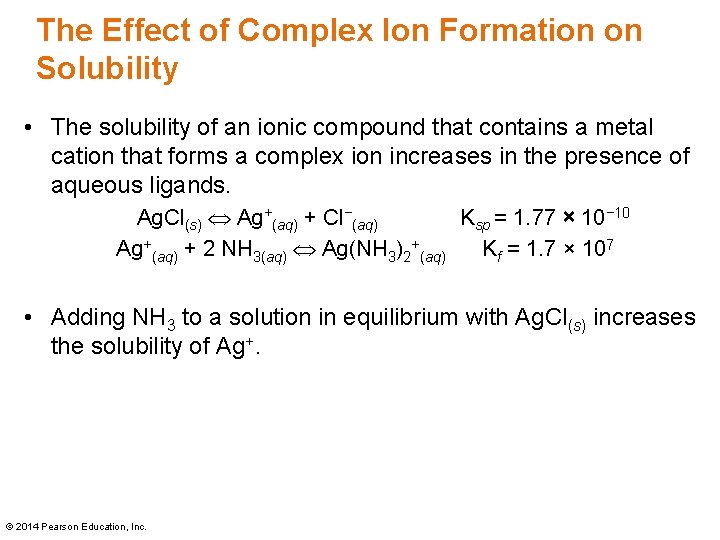
The Effect of Complex Ion Formation on Solubility • The solubility of an ionic compound that contains a metal cation that forms a complex ion increases in the presence of aqueous ligands. Ag. Cl(s) Ag+(aq) + Cl−(aq) Ksp = 1. 77 × 10− 10 Ag+(aq) + 2 NH 3(aq) Ag(NH 3)2+(aq) Kf = 1. 7 × 10⁷ • Adding NH 3 to a solution in equilibrium with Ag. Cl(s) increases the solubility of Ag+. © 2014 Pearson Education, Inc.
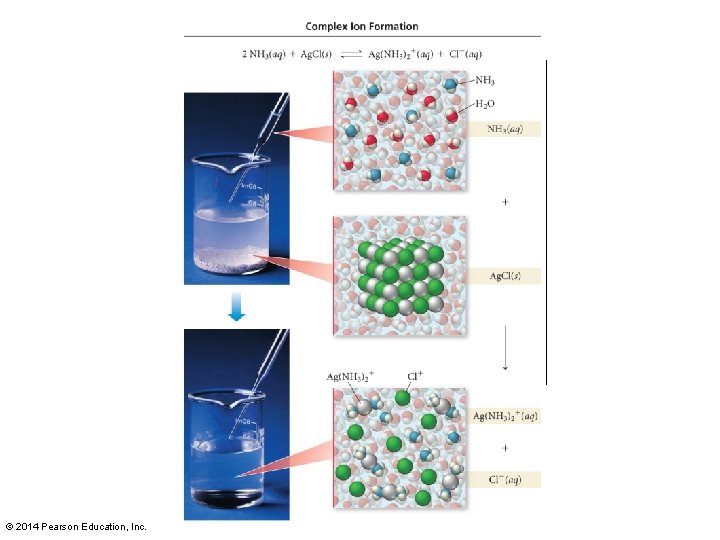
Figure 16. 18 © 2014 Pearson Education, Inc.
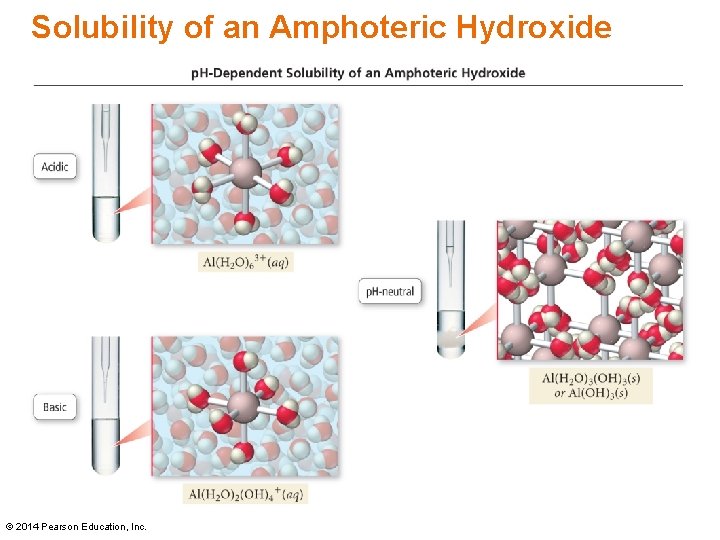
Solubility of Amphoteric Metal Hydroxides • Many metal hydroxides are insoluble. • All metal hydroxides become more soluble in acidic solution. – Shifting the equilibrium to the right by removing OH− • Some metal hydroxides also become more soluble in basic solution. – Acting as a Lewis base forming a complex ion • Substances that behave as both an acid and base are said to be amphoteric. • Some cations that form amphoteric hydroxides include Al 3+, Cr 3+, Zn 2+, Pb 2+, and Sb 2+. © 2014 Pearson Education, Inc.
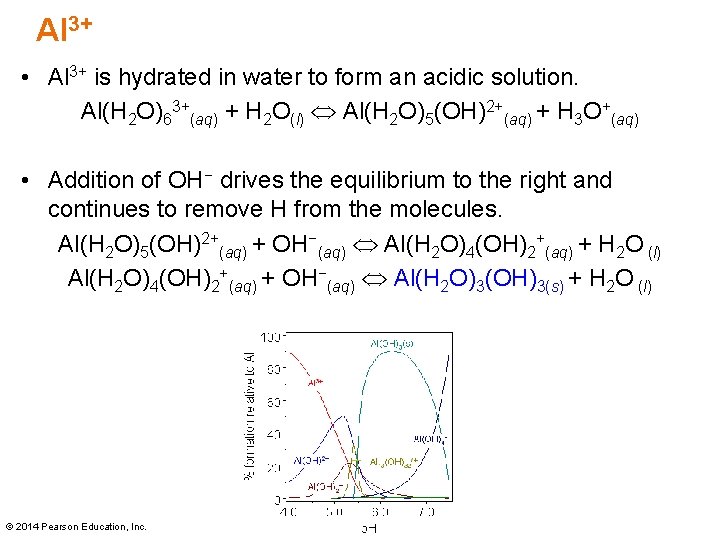
Al 3+ • Al 3+ is hydrated in water to form an acidic solution. Al(H 2 O)63+(aq) + H 2 O(l) Al(H 2 O)5(OH)2+(aq) + H 3 O+(aq) • Addition of OH− drives the equilibrium to the right and continues to remove H from the molecules. Al(H 2 O)5(OH)2+(aq) + OH−(aq) Al(H 2 O)4(OH)2+(aq) + H 2 O (l) Al(H 2 O)4(OH)2+(aq) + OH−(aq) Al(H 2 O)3(OH)3(s) + H 2 O (l) © 2014 Pearson Education, Inc.
Solubility of an Amphoteric Hydroxide © 2014 Pearson Education, Inc.
- Slides: 96