
Lecture Presentation Chapter 13 Properties of Solutions 2015
- Slides: 193
Lecture Presentation Chapter 13 Properties of Solutions . © 2015 Pearson Education, Inc. James F. Kirby Quinnipiac University Hamden, CT Solutions
13. 1 Solution Process Solutions © 2015 Pearson Education, Inc.
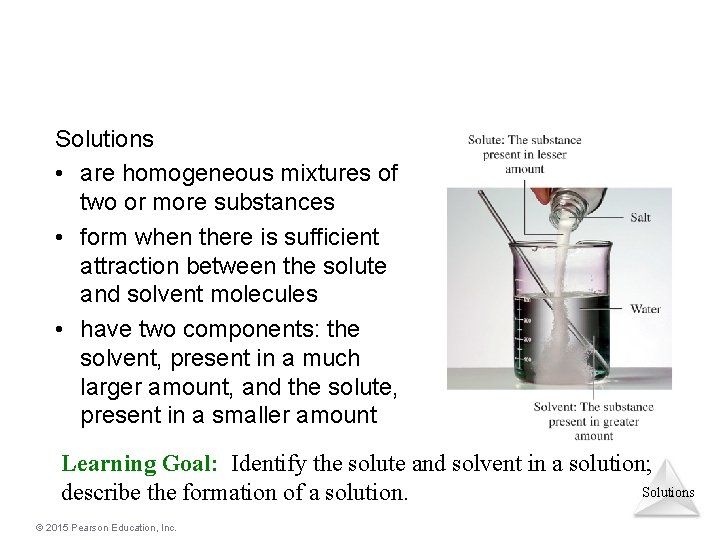
Solutions • are homogeneous mixtures of two or more substances • form when there is sufficient attraction between the solute and solvent molecules • have two components: the solvent, present in a much larger amount, and the solute, present in a smaller amount Learning Goal: Identify the solute and solvent in a solution; Solutions describe the formation of a solution. © 2015 Pearson Education, Inc.
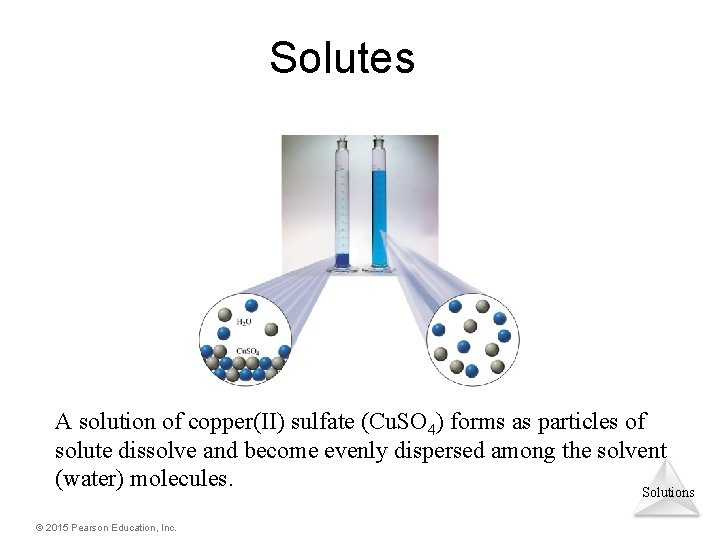
Solutes • may be liquids, gases, or solids • are spread evenly throughout the solution • mix with solvents, so the solute and solvent have the same physical state • cannot be separated by filtration but can be separated by evaporation • are not visible but can give a color to the solution Solutions © 2015 Pearson Education, Inc.
Solutes A solution of copper(II) sulfate (Cu. SO 4) forms as particles of solute dissolve and become evenly dispersed among the solvent (water) molecules. Solutions © 2015 Pearson Education, Inc.
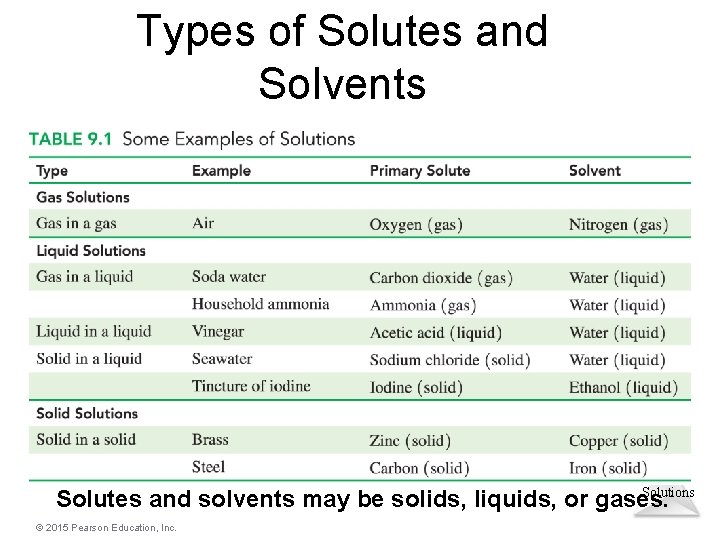
Types of Solutes and Solvents Solutions Solutes and solvents may be solids, liquids, or gases. © 2015 Pearson Education, Inc.
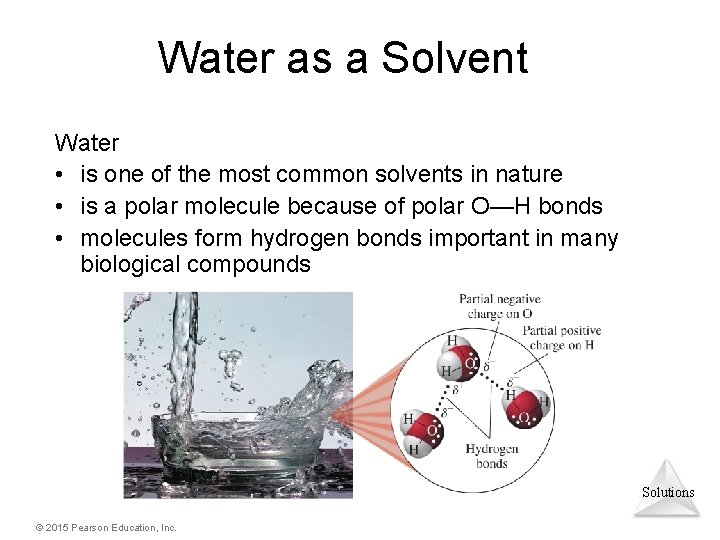
Water as a Solvent Water • is one of the most common solvents in nature • is a polar molecule because of polar O—H bonds • molecules form hydrogen bonds important in many biological compounds Solutions © 2015 Pearson Education, Inc.
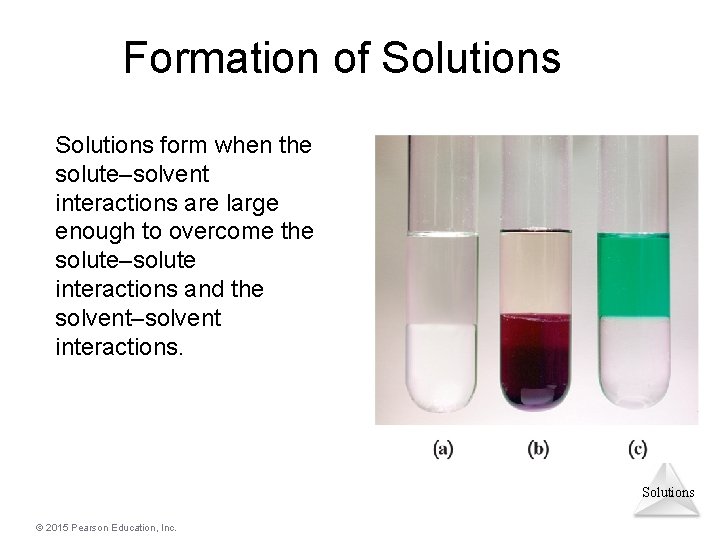
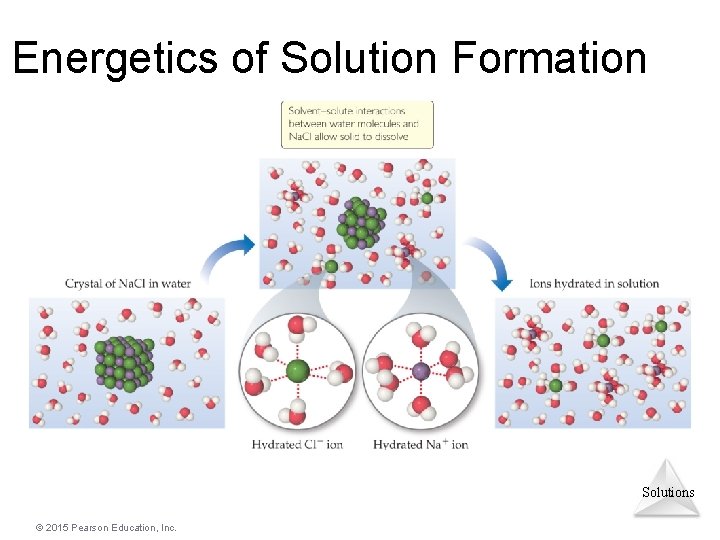
Formation of Solutions form when the solute–solvent interactions are large enough to overcome the solute–solute interactions and the solvent–solvent interactions. Solutions © 2015 Pearson Education, Inc.
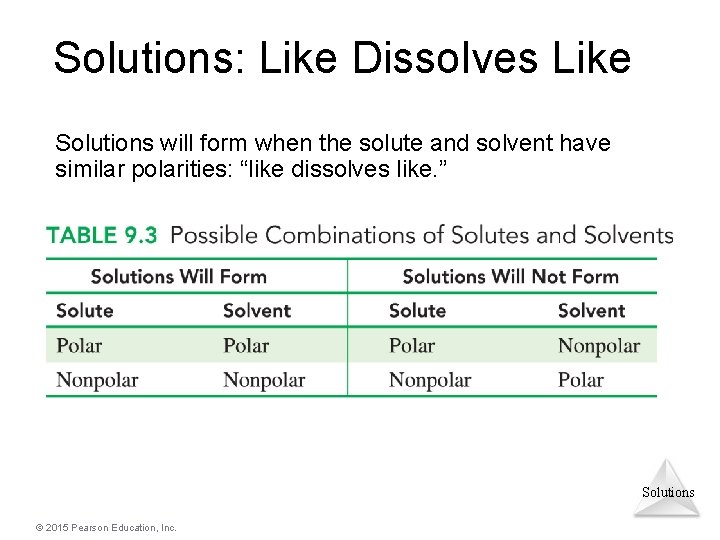
Solutions: Like Dissolves Like Solutions will form when the solute and solvent have similar polarities: “like dissolves like. ” Solutions © 2015 Pearson Education, Inc.
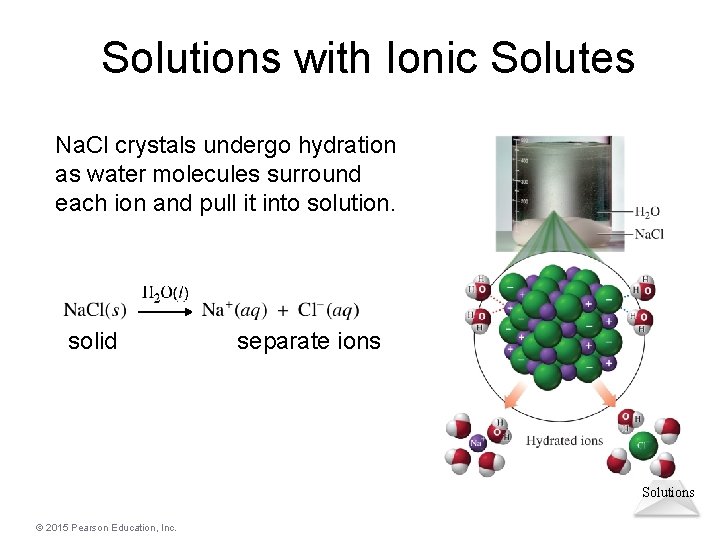
Solutions with Ionic Solutes Na. Cl crystals undergo hydration as water molecules surround each ion and pull it into solution. solid separate ions Solutions © 2015 Pearson Education, Inc.
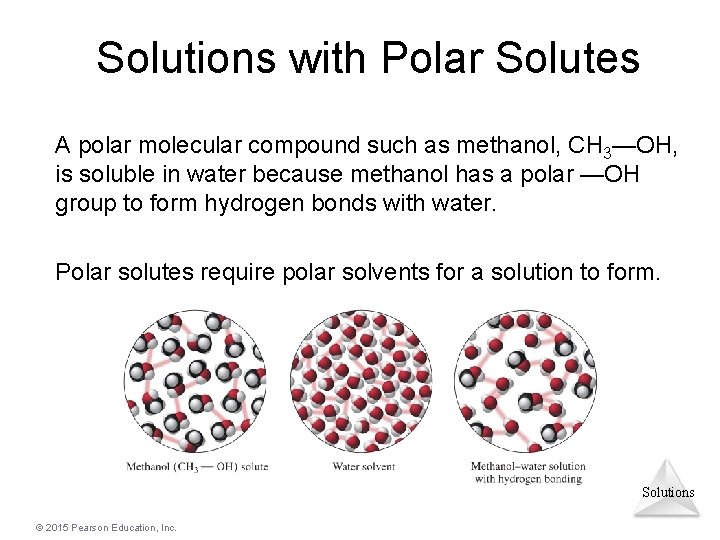
Solutions with Polar Solutes A polar molecular compound such as methanol, CH 3—OH, is soluble in water because methanol has a polar —OH group to form hydrogen bonds with water. Polar solutes require polar solvents for a solution to form. Solutions © 2015 Pearson Education, Inc.
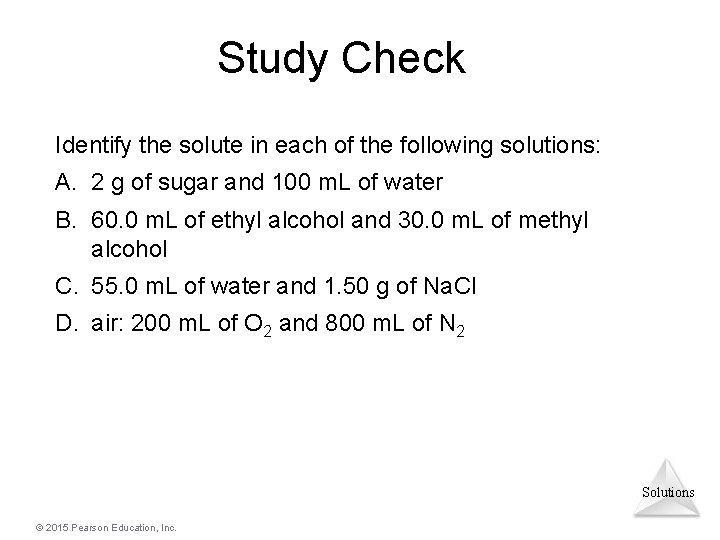
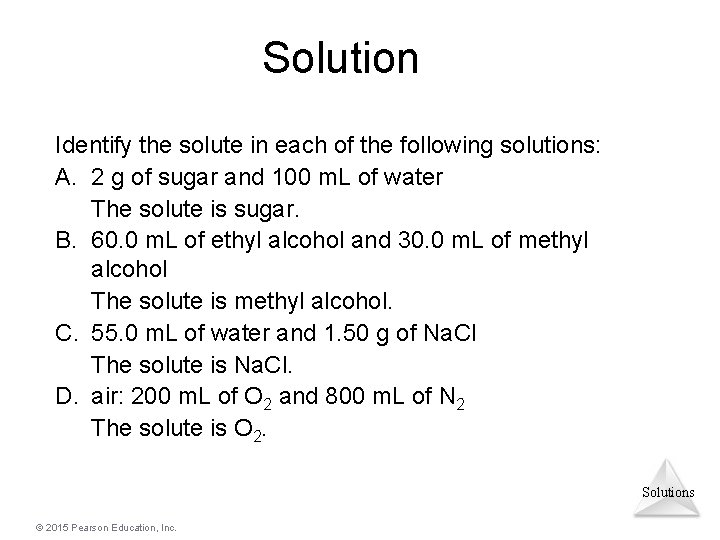
Study Check Identify the solute in each of the following solutions: A. 2 g of sugar and 100 m. L of water B. 60. 0 m. L of ethyl alcohol and 30. 0 m. L of methyl alcohol C. 55. 0 m. L of water and 1. 50 g of Na. Cl D. air: 200 m. L of O 2 and 800 m. L of N 2 Solutions © 2015 Pearson Education, Inc.
Solution Identify the solute in each of the following solutions: A. 2 g of sugar and 100 m. L of water The solute is sugar. B. 60. 0 m. L of ethyl alcohol and 30. 0 m. L of methyl alcohol The solute is methyl alcohol. C. 55. 0 m. L of water and 1. 50 g of Na. Cl The solute is Na. Cl. D. air: 200 m. L of O 2 and 800 m. L of N 2 The solute is O 2. Solutions © 2015 Pearson Education, Inc.
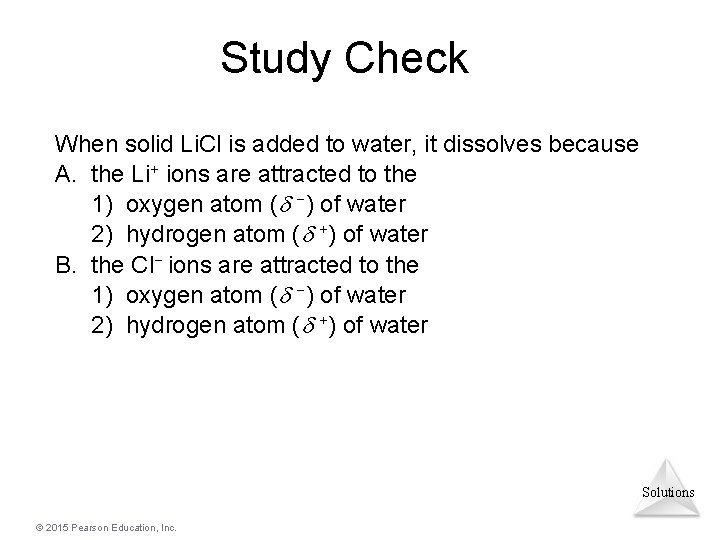
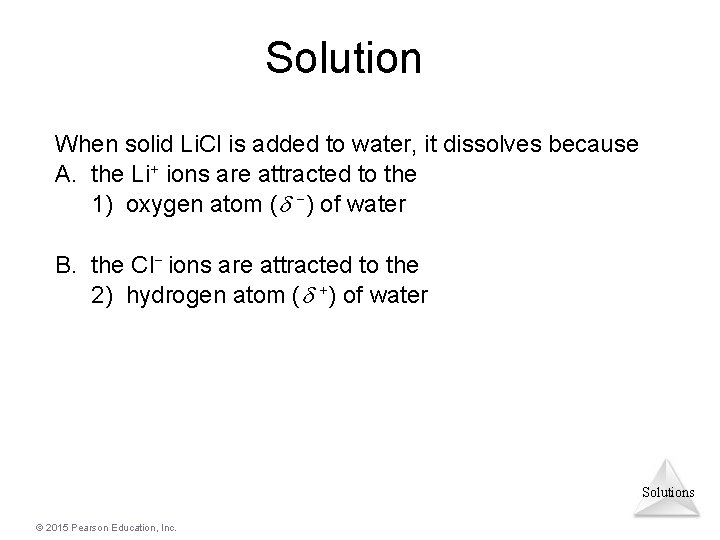
Study Check When solid Li. Cl is added to water, it dissolves because A. the Li+ ions are attracted to the 1) oxygen atom ( −) of water 2) hydrogen atom ( +) of water B. the Cl− ions are attracted to the 1) oxygen atom ( −) of water 2) hydrogen atom ( +) of water Solutions © 2015 Pearson Education, Inc.
Solution When solid Li. Cl is added to water, it dissolves because A. the Li+ ions are attracted to the 1) oxygen atom ( −) of water B. the Cl− ions are attracted to the 2) hydrogen atom ( +) of water Solutions © 2015 Pearson Education, Inc.
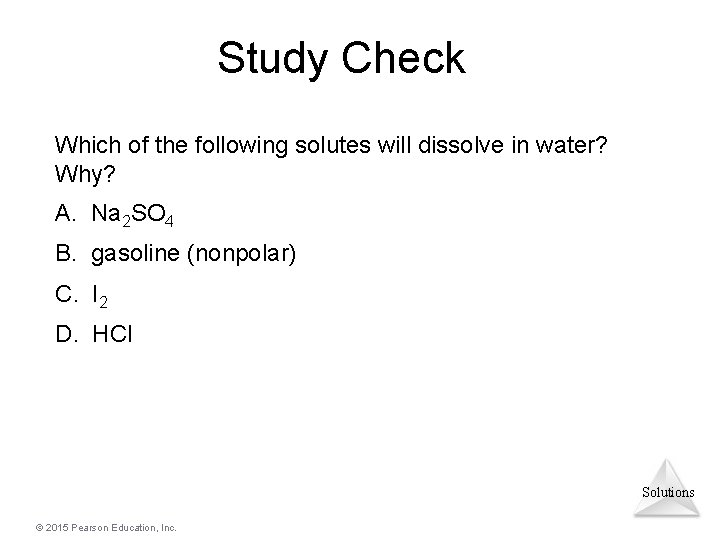
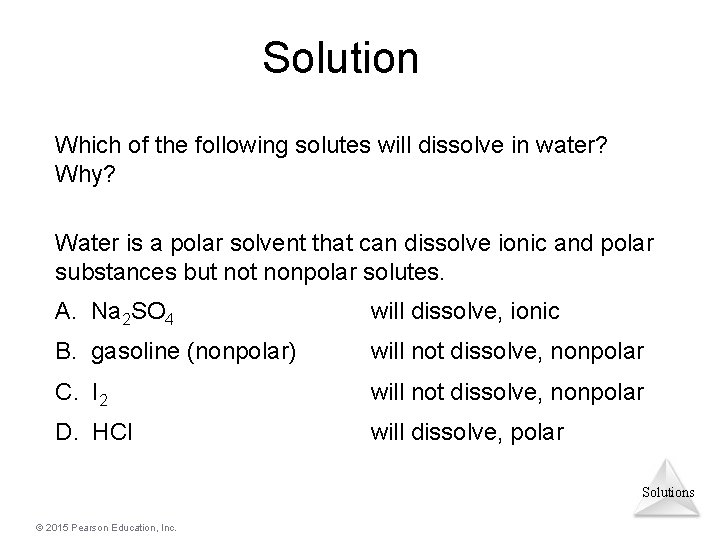
Study Check Which of the following solutes will dissolve in water? Why? A. Na 2 SO 4 B. gasoline (nonpolar) C. I 2 D. HCl Solutions © 2015 Pearson Education, Inc.
Solution Which of the following solutes will dissolve in water? Why? Water is a polar solvent that can dissolve ionic and polar substances but nonpolar solutes. A. Na 2 SO 4 will dissolve, ionic B. gasoline (nonpolar) will not dissolve, nonpolar C. I 2 will not dissolve, nonpolar D. HCl will dissolve, polar Solutions © 2015 Pearson Education, Inc.
CHAPTER : SOLUTIONS Vinegar is a solution that contains approximately 4 g of acetic acid in 100 m. L of water. Identify the solute and solvent in this solution of vinegar. A. B. C. D. Vinegar is the solute; water is the solvent. Water is the solute; vinegar is the solvent. Acetic acid is the solute; water is the solvent. Water is the solute; vinegar is the solvent. Solutions © 2015 Pearson Education, Inc.
CHAPTER : SOLUTIONS Vinegar is a solution that contains approximately 4 g of acetic acid in 100 m. L of water. Identify the solute and solvent in this solution of vinegar. A. B. C. D. Vinegar is the solute; water is the solvent. Water is the solute; vinegar is the solvent. Acetic acid is the solute; water is the solvent. Water is the solute; vinegar is the solvent. Solutions © 2015 Pearson Education, Inc.
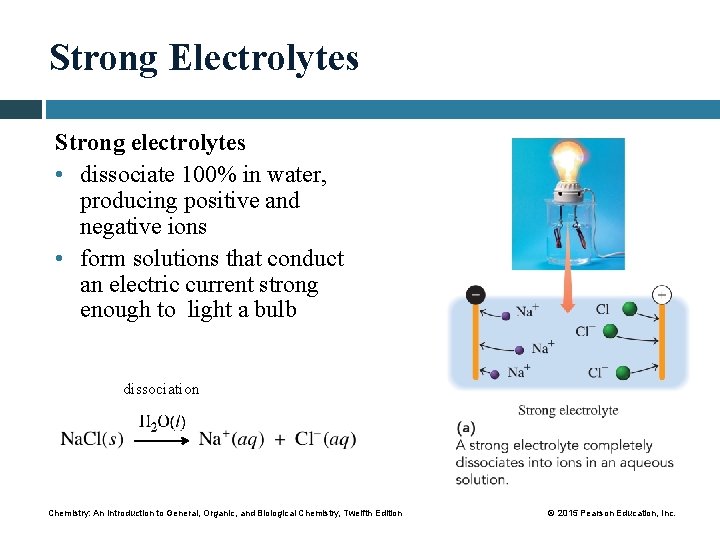
Strong Electrolytes Strong electrolytes • dissociate 100% in water, producing positive and negative ions • form solutions that conduct an electric current strong enough to light a bulb dissociation Chemistry: An Introduction to General, Organic, and Biological Chemistry, Twelfth Edition © 2015 Pearson Education, Inc.
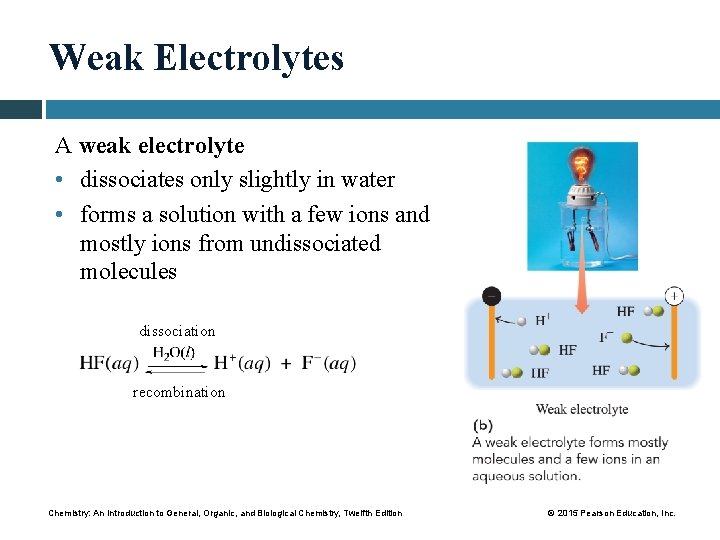
Weak Electrolytes A weak electrolyte • dissociates only slightly in water • forms a solution with a few ions and mostly ions from undissociated molecules dissociation recombination Chemistry: An Introduction to General, Organic, and Biological Chemistry, Twelfth Edition © 2015 Pearson Education, Inc.
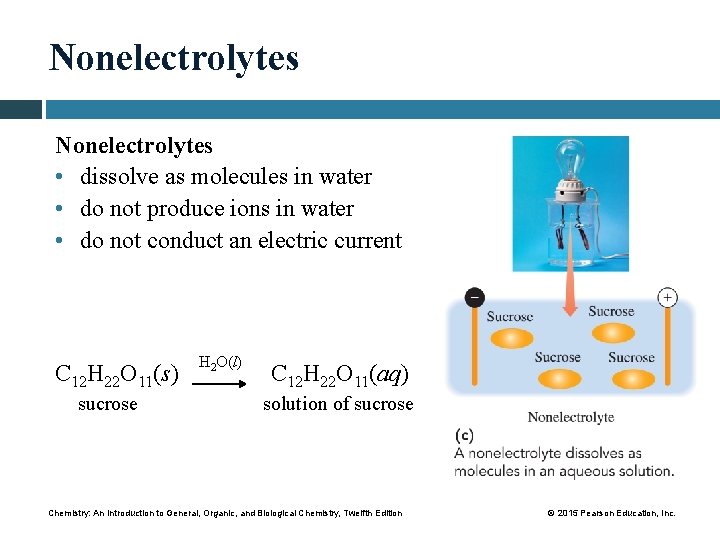
Nonelectrolytes • dissolve as molecules in water • do not produce ions in water • do not conduct an electric current C 12 H 22 O 11(s) sucrose H 2 O(l) C 12 H 22 O 11(aq) solution of sucrose Chemistry: An Introduction to General, Organic, and Biological Chemistry, Twelfth Edition © 2015 Pearson Education, Inc.
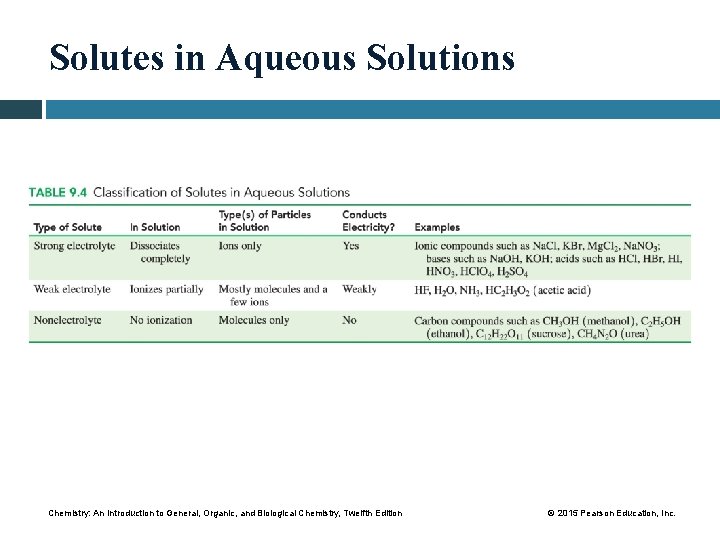
Solutes in Aqueous Solutions Chemistry: An Introduction to General, Organic, and Biological Chemistry, Twelfth Edition © 2015 Pearson Education, Inc.
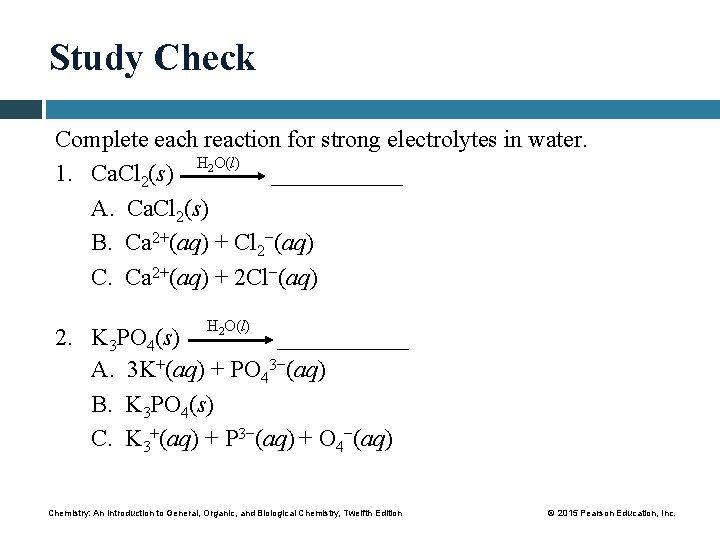
Study Check Complete each reaction for strong electrolytes in water. H O(l) 1. Ca. Cl 2(s) 2 ______ A. Ca. Cl 2(s) B. Ca 2+(aq) + Cl 2−(aq) C. Ca 2+(aq) + 2 Cl−(aq) H 2 O(l) 2. K 3 PO 4(s) ______ A. 3 K+(aq) + PO 43−(aq) B. K 3 PO 4(s) C. K 3+(aq) + P 3−(aq) + O 4−(aq) Chemistry: An Introduction to General, Organic, and Biological Chemistry, Twelfth Edition © 2015 Pearson Education, Inc.
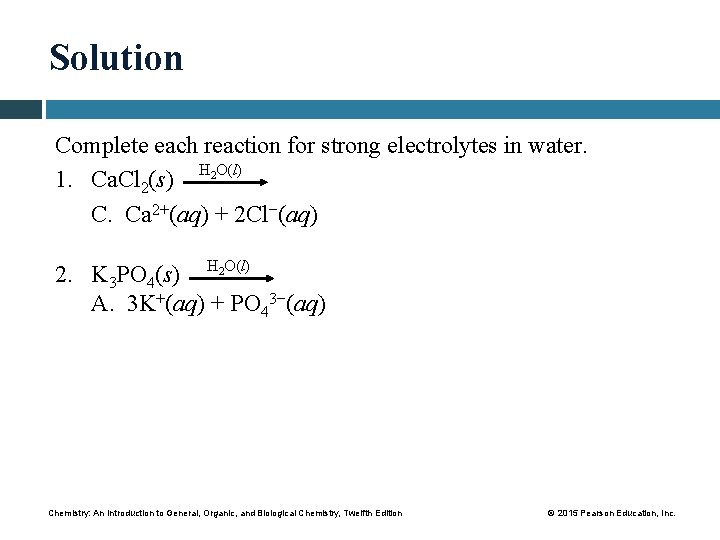
Solution Complete each reaction for strong electrolytes in water. H 2 O(l) 1. Ca. Cl 2(s) C. Ca 2+(aq) + 2 Cl−(aq) 2. K 3 PO 4(s) H 2 O(l) A. 3 K+(aq) + PO 43−(aq) Chemistry: An Introduction to General, Organic, and Biological Chemistry, Twelfth Edition © 2015 Pearson Education, Inc.
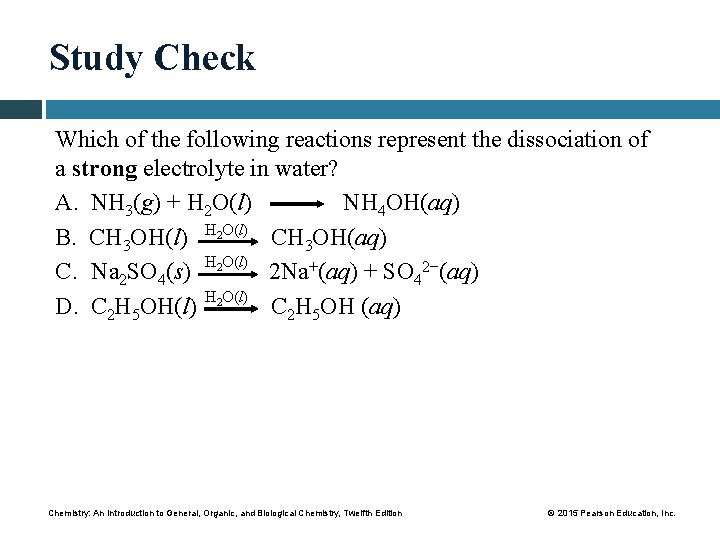
Study Check Which of the following reactions represent the dissociation of a strong electrolyte in water? A. NH 3(g) + H 2 O(l) NH 4 OH(aq) B. CH 3 OH(l) H 2 O(l) CH 3 OH(aq) C. Na 2 SO 4(s) H 2 O(l) 2 Na+(aq) + SO 42−(aq) D. C 2 H 5 OH(l) H 2 O(l) C 2 H 5 OH (aq) Chemistry: An Introduction to General, Organic, and Biological Chemistry, Twelfth Edition © 2015 Pearson Education, Inc.
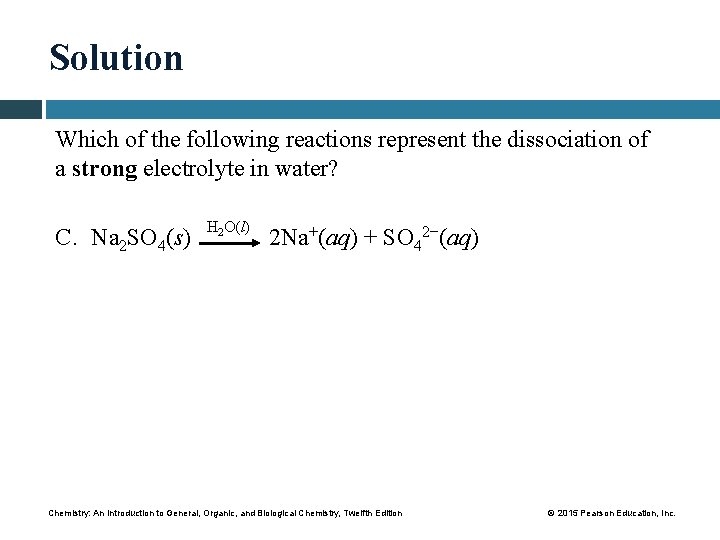
Solution Which of the following reactions represent the dissociation of a strong electrolyte in water? C. Na 2 SO 4(s) H 2 O(l) 2 Na+(aq) + SO 42−(aq) Chemistry: An Introduction to General, Organic, and Biological Chemistry, Twelfth Edition © 2015 Pearson Education, Inc.
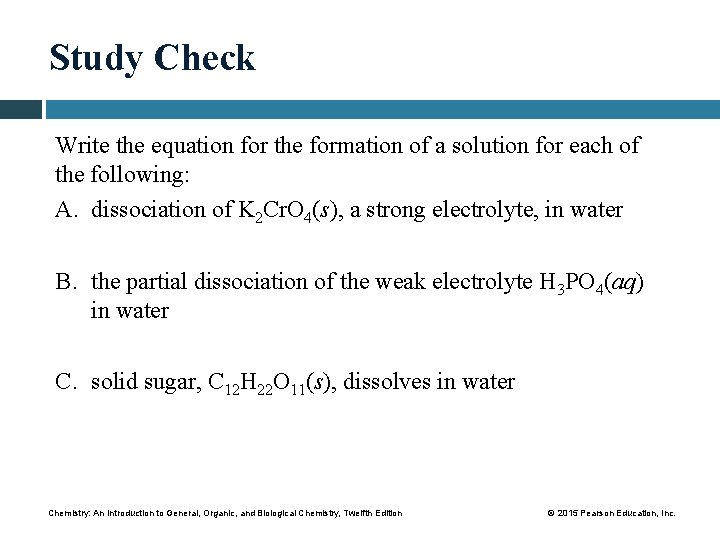
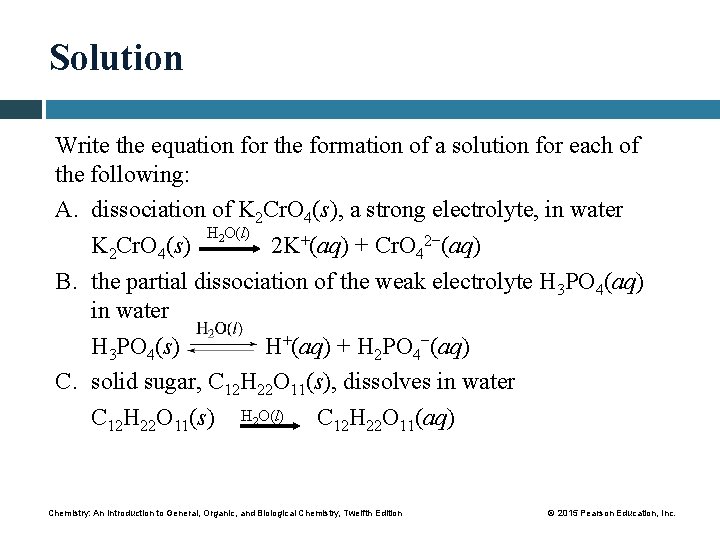
Study Check Write the equation for the formation of a solution for each of the following: A. dissociation of K 2 Cr. O 4(s), a strong electrolyte, in water B. the partial dissociation of the weak electrolyte H 3 PO 4(aq) in water C. solid sugar, C 12 H 22 O 11(s), dissolves in water Chemistry: An Introduction to General, Organic, and Biological Chemistry, Twelfth Edition © 2015 Pearson Education, Inc.
Solution Write the equation for the formation of a solution for each of the following: A. dissociation of K 2 Cr. O 4(s), a strong electrolyte, in water H 2 O(l) K 2 Cr. O 4(s) 2 K+(aq) + Cr. O 42−(aq) B. the partial dissociation of the weak electrolyte H 3 PO 4(aq) in water H 3 PO 4(s) H+(aq) + H 2 PO 4−(aq) C. solid sugar, C 12 H 22 O 11(s), dissolves in water C 12 H 22 O 11(s) H 2 O(l) C 12 H 22 O 11(aq) Chemistry: An Introduction to General, Organic, and Biological Chemistry, Twelfth Edition © 2015 Pearson Education, Inc.
Solutions • Solutions are homogeneous mixtures of two or more pure substances. • In a solution, the solute is dispersed uniformly throughout the solvent. • The ability of substances to form solutions depends on Ø natural tendency toward mixing. Ø intermolecular forces. Solutions © 2015 Pearson Education, Inc.
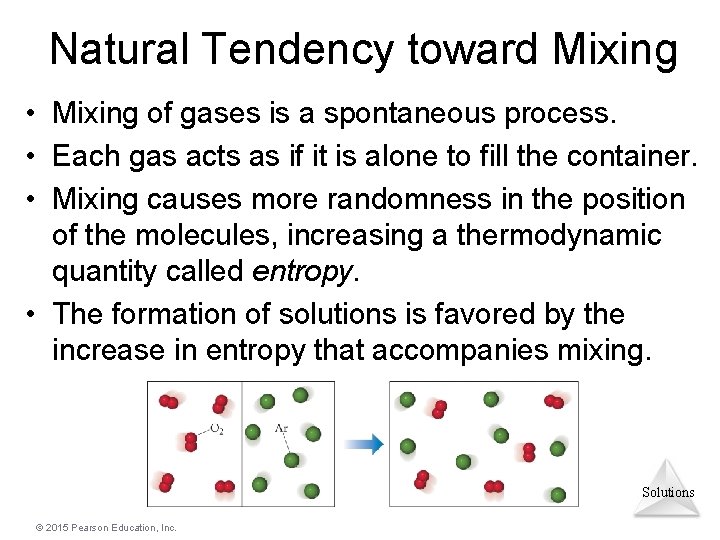
Natural Tendency toward Mixing • Mixing of gases is a spontaneous process. • Each gas acts as if it is alone to fill the container. • Mixing causes more randomness in the position of the molecules, increasing a thermodynamic quantity called entropy. • The formation of solutions is favored by the increase in entropy that accompanies mixing. Solutions © 2015 Pearson Education, Inc.
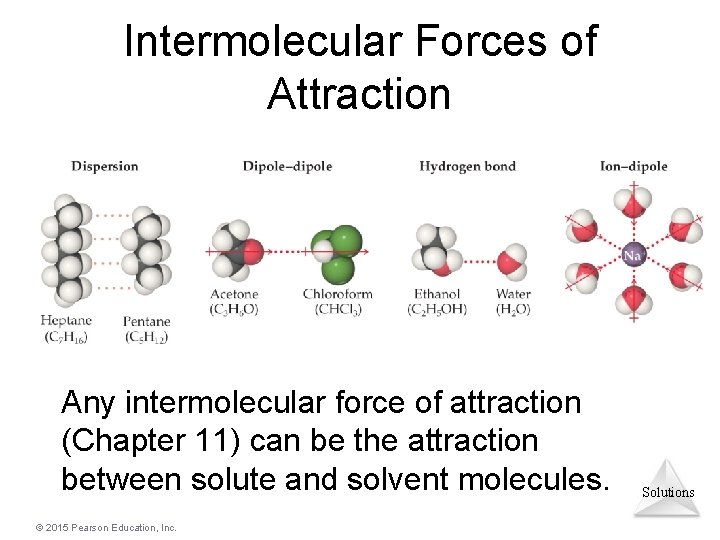
Intermolecular Forces of Attraction Any intermolecular force of attraction (Chapter 11) can be the attraction between solute and solvent molecules. © 2015 Pearson Education, Inc. Solutions
Attractions Involved When Forming a Solution • Solute–solute interactions must be overcome to disperse these particles when making a solution. • Solvent–solvent interactions must be overcome to make room for the solute. • Solvent–solute interactions occur as the particles mix. Solutions © 2015 Pearson Education, Inc.
Energetics of Solution Formation Solutions © 2015 Pearson Education, Inc.
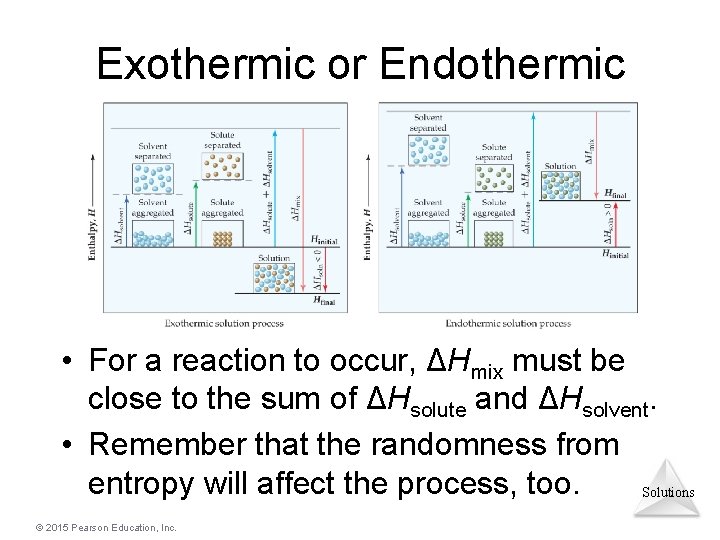
Exothermic or Endothermic • For a reaction to occur, ΔHmix must be close to the sum of ΔHsolute and ΔHsolvent. • Remember that the randomness from entropy will affect the process, too. Solutions © 2015 Pearson Education, Inc.
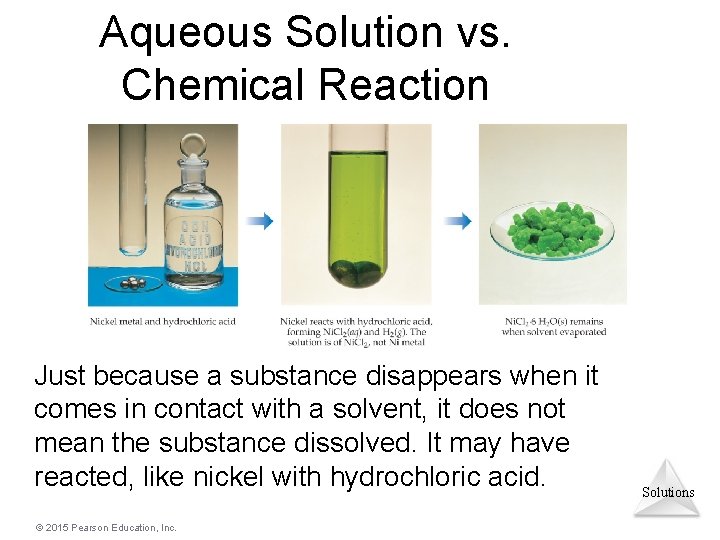
Aqueous Solution vs. Chemical Reaction Just because a substance disappears when it comes in contact with a solvent, it does not mean the substance dissolved. It may have reacted, like nickel with hydrochloric acid. © 2015 Pearson Education, Inc. Solutions
13. 2 Saturated Solutions and Solubility Solutions © 2015 Pearson Education, Inc.
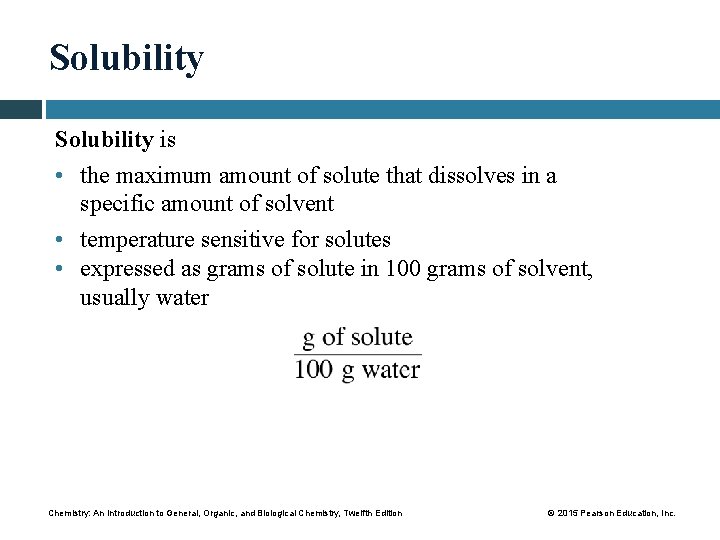
Solubility is • the maximum amount of solute that dissolves in a specific amount of solvent • temperature sensitive for solutes • expressed as grams of solute in 100 grams of solvent, usually water Chemistry: An Introduction to General, Organic, and Biological Chemistry, Twelfth Edition © 2015 Pearson Education, Inc.
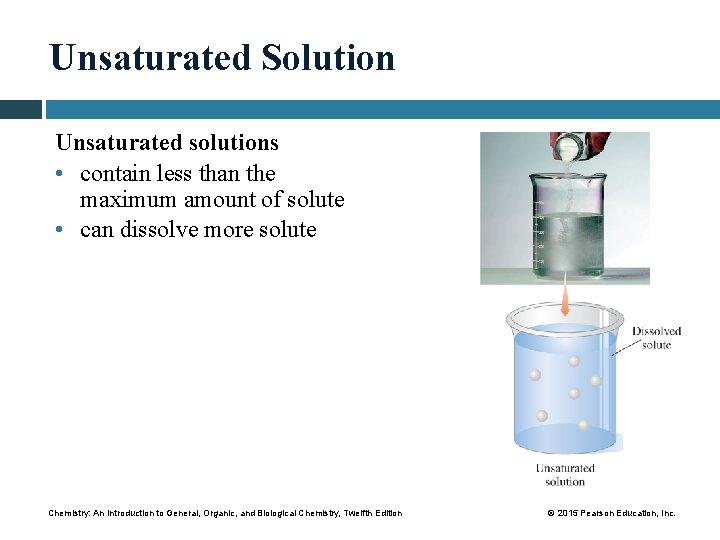
Unsaturated Solution Unsaturated solutions • contain less than the maximum amount of solute • can dissolve more solute Chemistry: An Introduction to General, Organic, and Biological Chemistry, Twelfth Edition © 2015 Pearson Education, Inc.
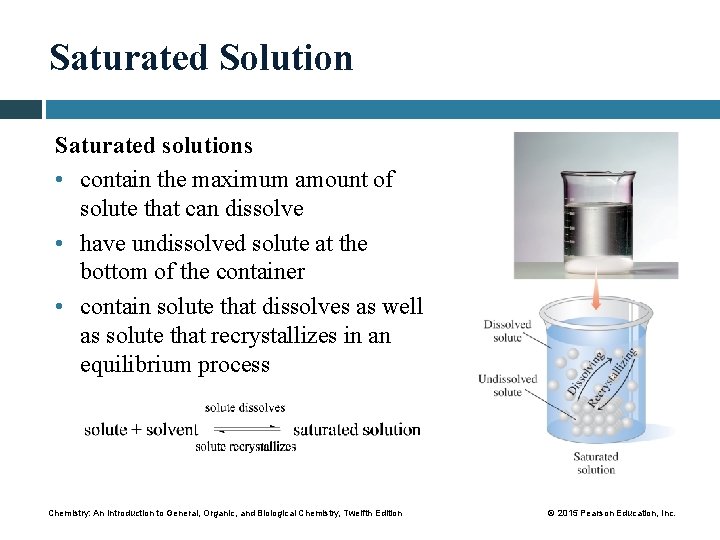
Saturated Solution Saturated solutions • contain the maximum amount of solute that can dissolve • have undissolved solute at the bottom of the container • contain solute that dissolves as well as solute that recrystallizes in an equilibrium process Chemistry: An Introduction to General, Organic, and Biological Chemistry, Twelfth Edition © 2015 Pearson Education, Inc.
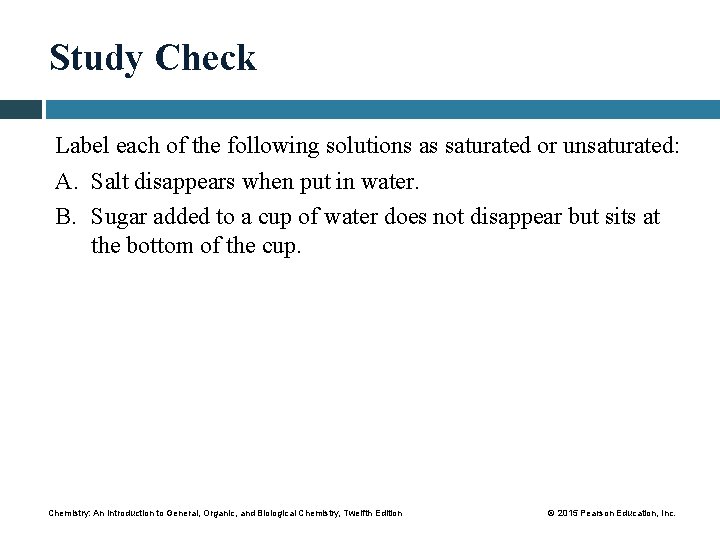
Study Check Label each of the following solutions as saturated or unsaturated: A. Salt disappears when put in water. B. Sugar added to a cup of water does not disappear but sits at the bottom of the cup. Chemistry: An Introduction to General, Organic, and Biological Chemistry, Twelfth Edition © 2015 Pearson Education, Inc.
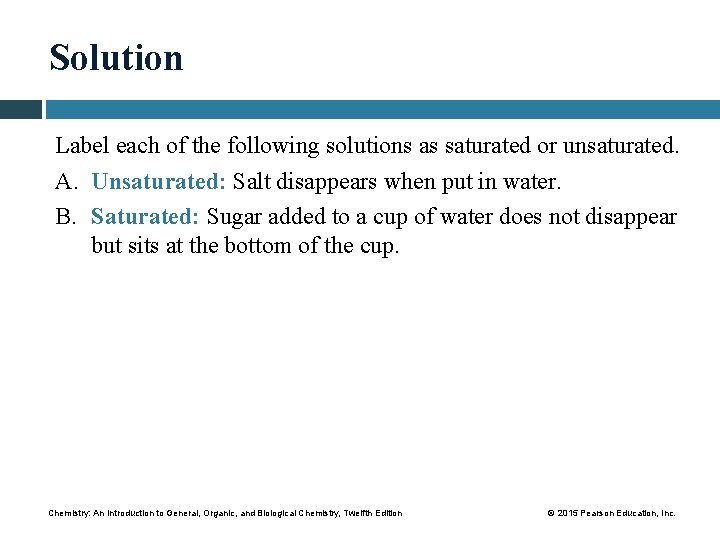
Solution Label each of the following solutions as saturated or unsaturated. A. Unsaturated: Salt disappears when put in water. B. Saturated: Sugar added to a cup of water does not disappear but sits at the bottom of the cup. Chemistry: An Introduction to General, Organic, and Biological Chemistry, Twelfth Edition © 2015 Pearson Education, Inc.
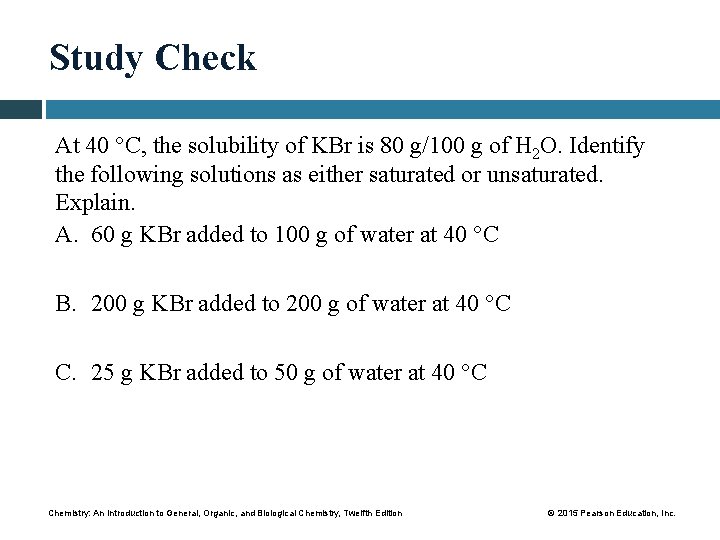
Study Check At 40 °C, the solubility of KBr is 80 g/100 g of H 2 O. Identify the following solutions as either saturated or unsaturated. Explain. A. 60 g KBr added to 100 g of water at 40 °C B. 200 g KBr added to 200 g of water at 40 °C C. 25 g KBr added to 50 g of water at 40 °C Chemistry: An Introduction to General, Organic, and Biological Chemistry, Twelfth Edition © 2015 Pearson Education, Inc.
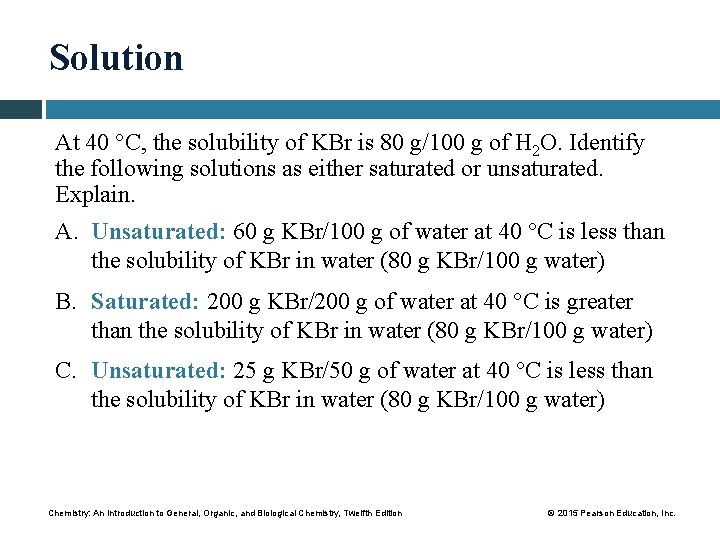
Solution At 40 °C, the solubility of KBr is 80 g/100 g of H 2 O. Identify the following solutions as either saturated or unsaturated. Explain. A. Unsaturated: 60 g KBr/100 g of water at 40 °C is less than the solubility of KBr in water (80 g KBr/100 g water) B. Saturated: 200 g KBr/200 g of water at 40 °C is greater than the solubility of KBr in water (80 g KBr/100 g water) C. Unsaturated: 25 g KBr/50 g of water at 40 °C is less than the solubility of KBr in water (80 g KBr/100 g water) Chemistry: An Introduction to General, Organic, and Biological Chemistry, Twelfth Edition © 2015 Pearson Education, Inc.
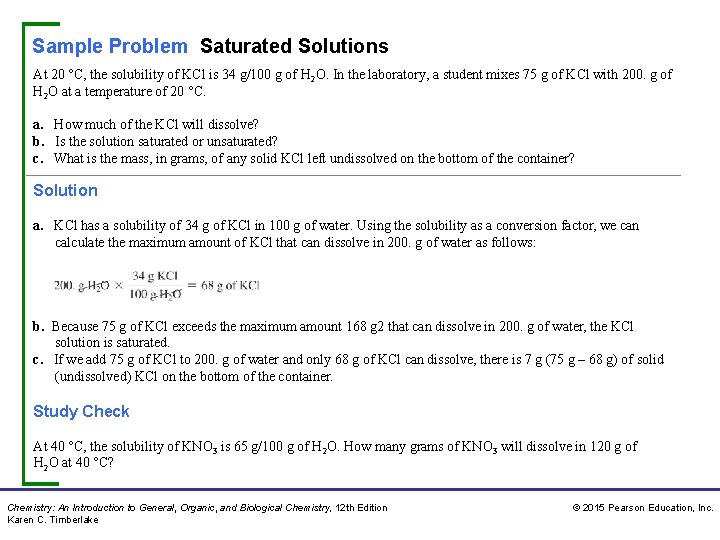
Sample Problem Saturated Solutions At 20 °C, the solubility of KCl is 34 g/100 g of H 2 O. In the laboratory, a student mixes 75 g of KCl with 200. g of H 2 O at a temperature of 20 °C. a. How much of the KCl will dissolve? b. Is the solution saturated or unsaturated? c. What is the mass, in grams, of any solid KCl left undissolved on the bottom of the container? Solution a. KCl has a solubility of 34 g of KCl in 100 g of water. Using the solubility as a conversion factor, we can calculate the maximum amount of KCl that can dissolve in 200. g of water as follows: b. Because 75 g of KCl exceeds the maximum amount 168 g 2 that can dissolve in 200. g of water, the KCl solution is saturated. c. If we add 75 g of KCl to 200. g of water and only 68 g of KCl can dissolve, there is 7 g (75 g – 68 g) of solid (undissolved) KCl on the bottom of the container. Study Check At 40 °C, the solubility of KNO 3 is 65 g/100 g of H 2 O. How many grams of KNO 3 will dissolve in 120 g of H 2 O at 40 °C? Chemistry: An Introduction to General, Organic, and Biological Chemistry, 12 th Edition Karen C. Timberlake © 2015 Pearson Education, Inc.
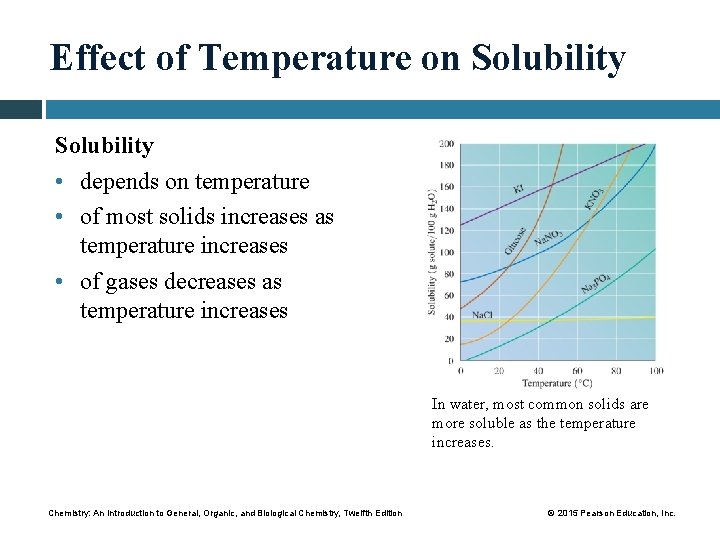
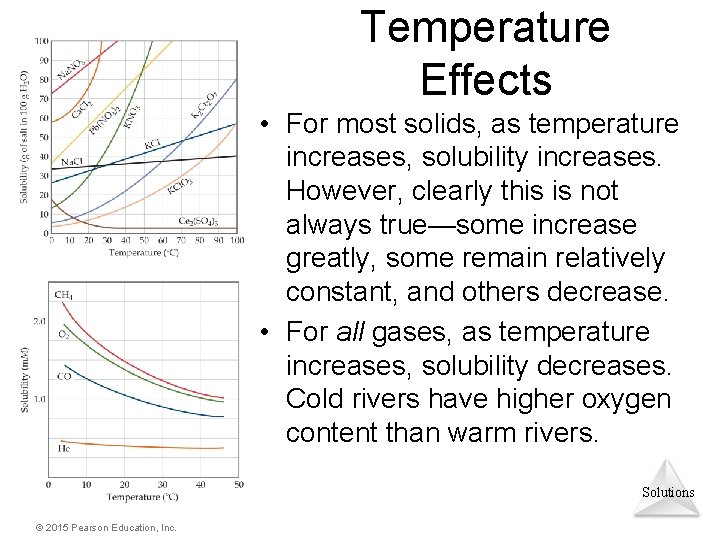
Effect of Temperature on Solubility • depends on temperature • of most solids increases as temperature increases • of gases decreases as temperature increases In water, most common solids are more soluble as the temperature increases. Chemistry: An Introduction to General, Organic, and Biological Chemistry, Twelfth Edition © 2015 Pearson Education, Inc.
Study Check 1. Why could a bottle of carbonated drink possibly burst (explode) when it is left out in the hot sun? 2. Why do fish die in water that is too warm? Chemistry: An Introduction to General, Organic, and Biological Chemistry, Twelfth Edition © 2015 Pearson Education, Inc.
Solution 1. The pressure in a bottle increases as the gas leaves solution when it becomes less soluble at higher temperatures. As pressure increases, the bottle could burst. 2. Because O 2 gas is less soluble in warm water, fish cannot obtain the amount of O 2 required for their survival. Chemistry: An Introduction to General, Organic, and Biological Chemistry, Twelfth Edition © 2015 Pearson Education, Inc.
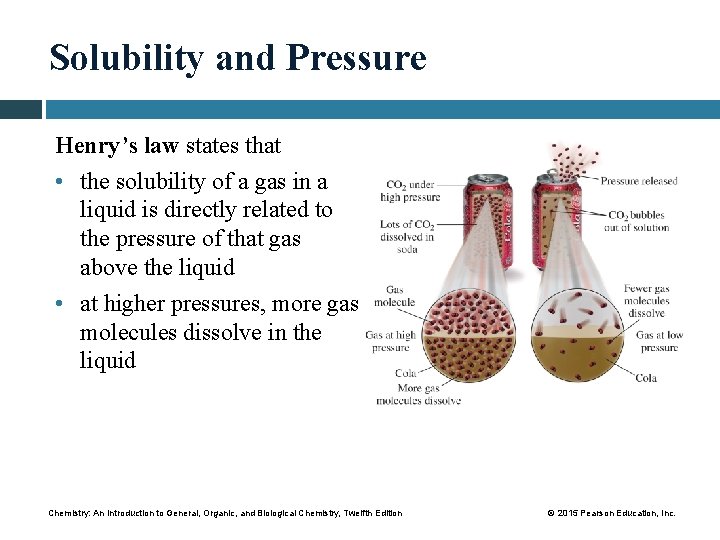
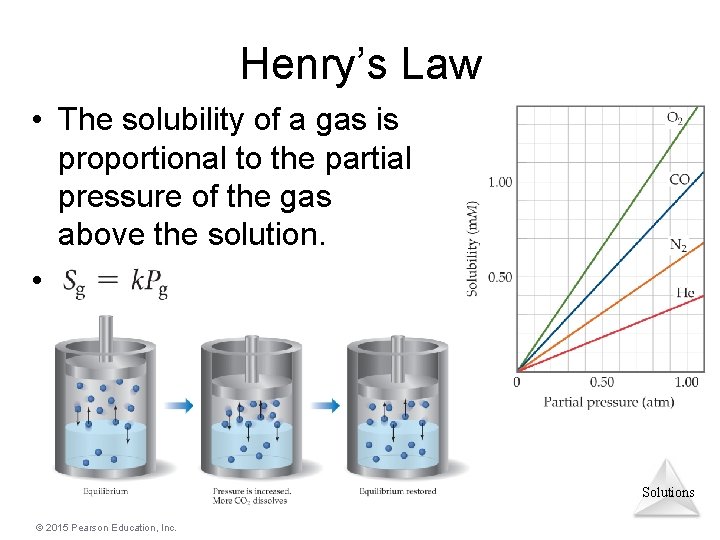
Solubility and Pressure Henry’s law states that • the solubility of a gas in a liquid is directly related to the pressure of that gas above the liquid • at higher pressures, more gas molecules dissolve in the liquid Chemistry: An Introduction to General, Organic, and Biological Chemistry, Twelfth Edition © 2015 Pearson Education, Inc.
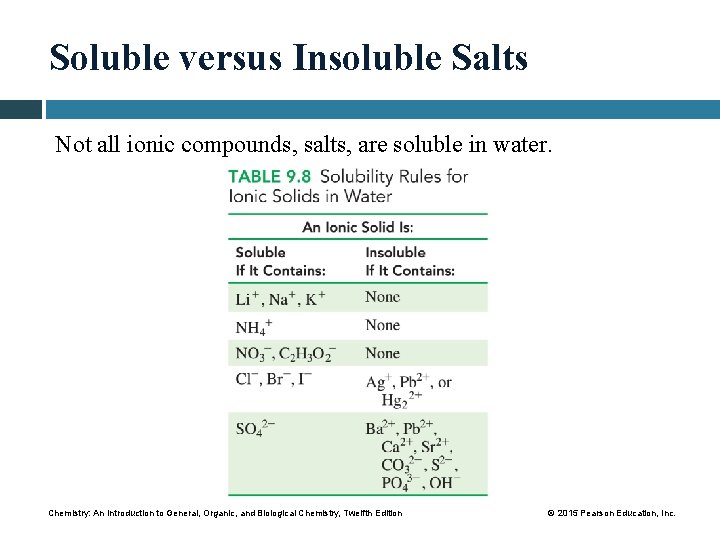
Soluble versus Insoluble Salts Not all ionic compounds, salts, are soluble in water. Chemistry: An Introduction to General, Organic, and Biological Chemistry, Twelfth Edition © 2015 Pearson Education, Inc.
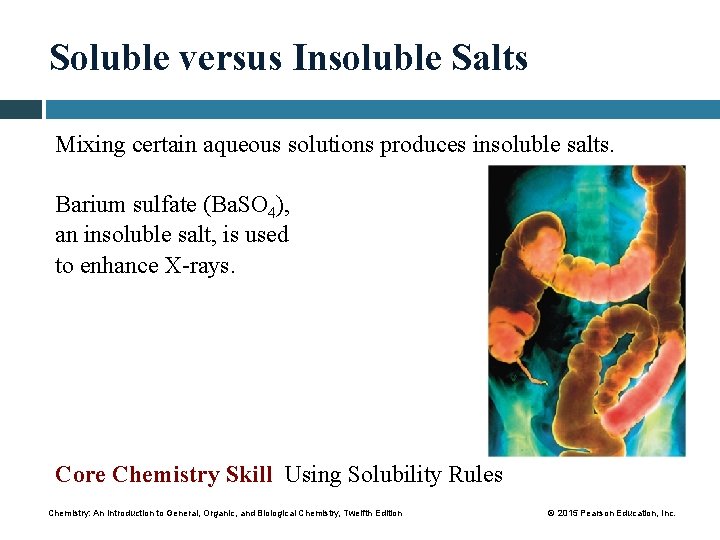
Soluble versus Insoluble Salts Mixing certain aqueous solutions produces insoluble salts. Barium sulfate (Ba. SO 4), an insoluble salt, is used to enhance X-rays. Core Chemistry Skill Using Solubility Rules Chemistry: An Introduction to General, Organic, and Biological Chemistry, Twelfth Edition © 2015 Pearson Education, Inc.
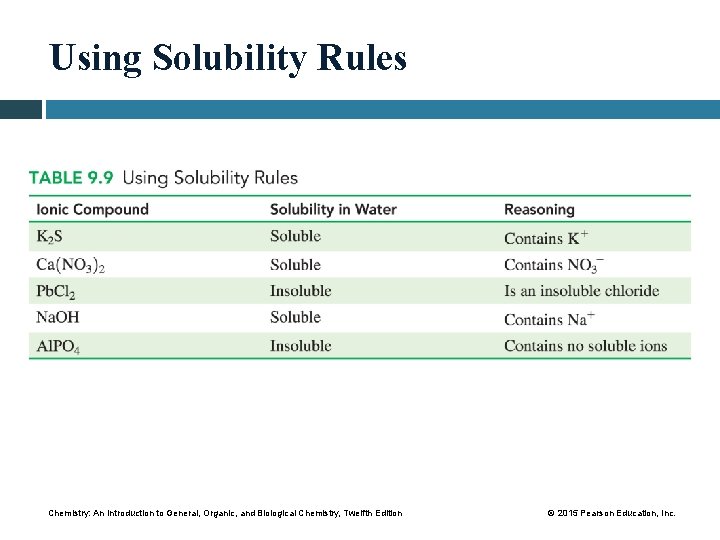
Using Solubility Rules Chemistry: An Introduction to General, Organic, and Biological Chemistry, Twelfth Edition © 2015 Pearson Education, Inc.
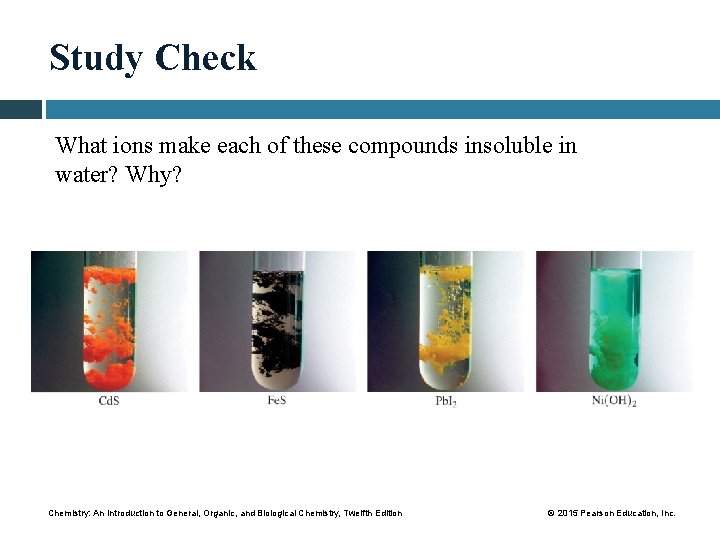
Study Check What ions make each of these compounds insoluble in water? Why? Chemistry: An Introduction to General, Organic, and Biological Chemistry, Twelfth Edition © 2015 Pearson Education, Inc.
Solution What ions make each of these compounds insoluble in water? Why? A. Cd. S(s) S 2− compounds are generally insoluble. B. Fe. S(s) S 2− compounds are generally insoluble. C. Pb. I 2(s) I− is soluble unless combined with Pb 2+. D. Ni(OH)2(s) OH compounds are generally insoluble. Chemistry: An Introduction to General, Organic, and Biological Chemistry, Twelfth Edition © 2015 Pearson Education, Inc.
Sample Problem Soluble and Insoluble Salts Predict whether each of the following salts is soluble in water and explain why: a. Na 3 PO 4 b. Ca. CO 3 Solution a. The salt Na 3 PO 4 is soluble in water because any compound that contains Na+ is soluble. b. The salt Ca. CO 3 is not soluble. The compound does not contain a soluble positive ion, which means that a calcium salt containing CO 32– is not soluble. Study Check Predict whether Mg. Cl 2 is soluble in water and explain why. Chemistry: An Introduction to General, Organic, and Biological Chemistry, 12 th Edition Karen C. Timberlake © 2015 Pearson Education, Inc.
Opposing Processes • The solution-making process and crystallization are opposing processes. • • When the rate of the opposing processes is equal, additional solute will not dissolve unless some crystallizes from solution. This is a saturated solution. • If we have not yet reached the amount that will result in crystallization, we have an unsaturated solution. Solutions © 2015 Pearson Education, Inc.
Solubility • Solubility is the maximum amount of solute that can dissolve in a given amount of solvent at a given temperature. • Saturated solutions have that amount of solute dissolved. • Unsaturated solutions have any amount of solute less than the maximum amount dissolved in solution. • Surprisingly, there is one more type of Solutions solution. © 2015 Pearson Education, Inc.
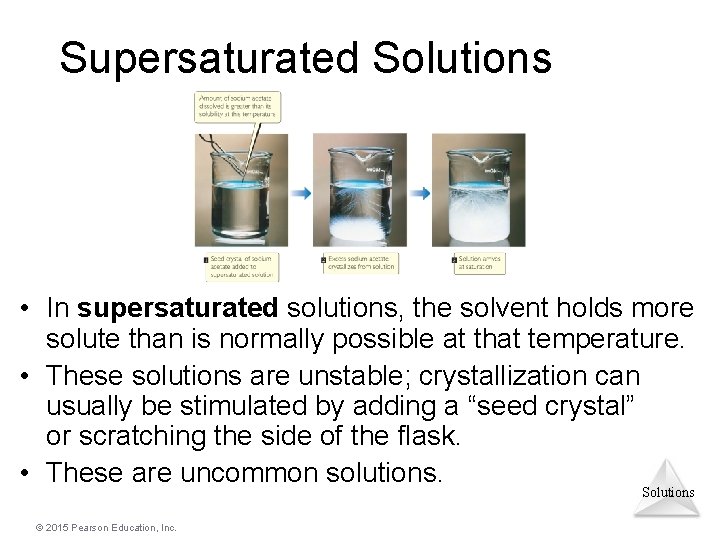
Supersaturated Solutions • In supersaturated solutions, the solvent holds more solute than is normally possible at that temperature. • These solutions are unstable; crystallization can usually be stimulated by adding a “seed crystal” or scratching the side of the flask. • These are uncommon solutions. Solutions © 2015 Pearson Education, Inc.
13. 3 Factors Affecting Solubility Solutions © 2015 Pearson Education, Inc.
Factors That Affect Solubility • Solute–solvent Interactions • Pressure (for gaseous solutes) • Temperature Solutions © 2015 Pearson Education, Inc.
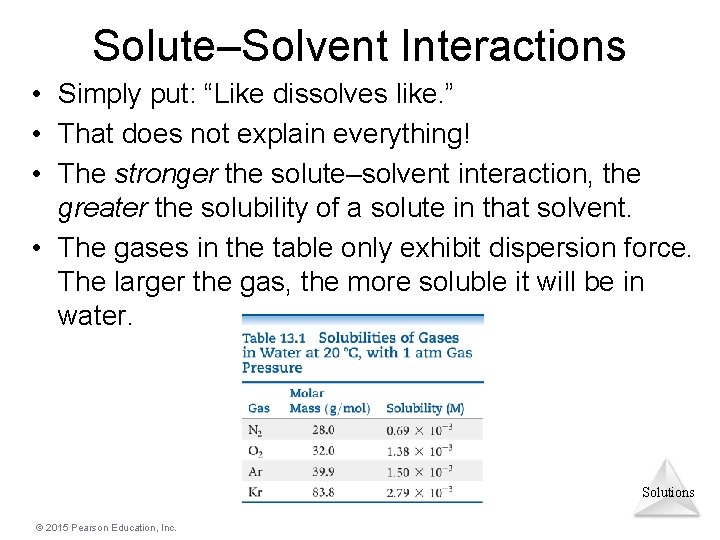
Solute–Solvent Interactions • Simply put: “Like dissolves like. ” • That does not explain everything! • The stronger the solute–solvent interaction, the greater the solubility of a solute in that solvent. • The gases in the table only exhibit dispersion force. The larger the gas, the more soluble it will be in water. Solutions © 2015 Pearson Education, Inc.
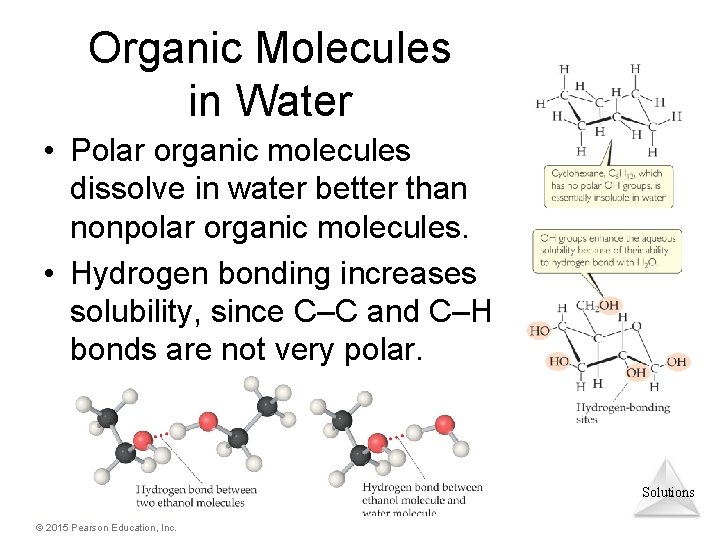
Organic Molecules in Water • Polar organic molecules dissolve in water better than nonpolar organic molecules. • Hydrogen bonding increases solubility, since C–C and C–H bonds are not very polar. Solutions © 2015 Pearson Education, Inc.
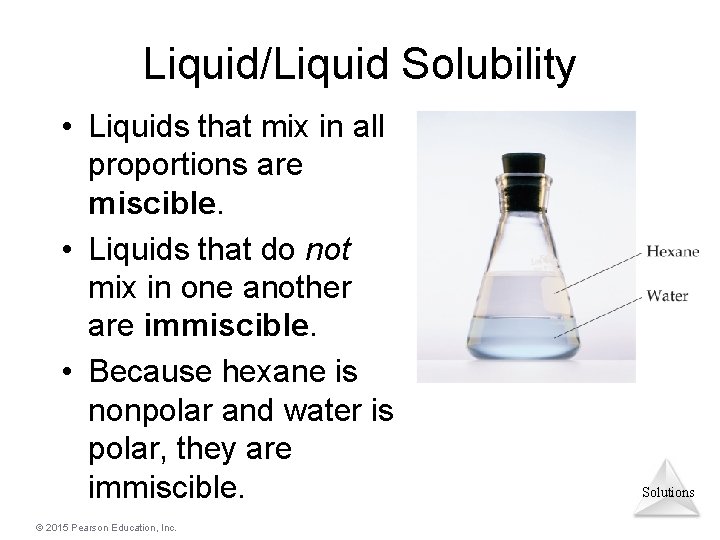
Liquid/Liquid Solubility • Liquids that mix in all proportions are miscible. • Liquids that do not mix in one another are immiscible. • Because hexane is nonpolar and water is polar, they are immiscible. © 2015 Pearson Education, Inc. Solutions
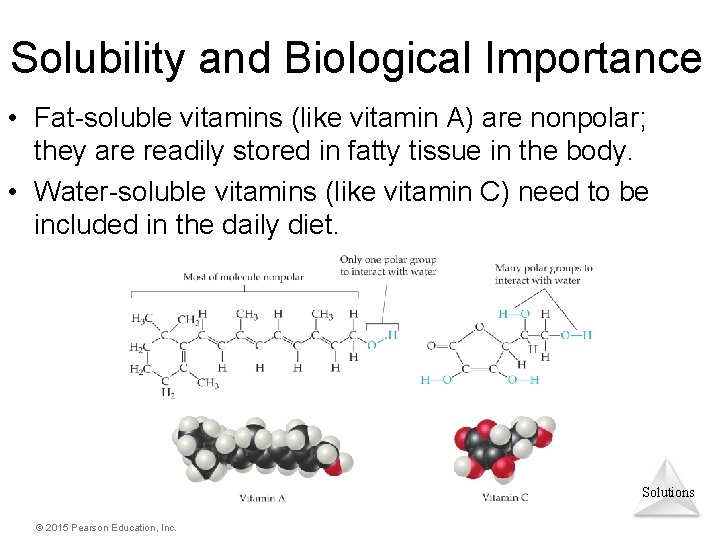
Solubility and Biological Importance • Fat-soluble vitamins (like vitamin A) are nonpolar; they are readily stored in fatty tissue in the body. • Water-soluble vitamins (like vitamin C) need to be included in the daily diet. Solutions © 2015 Pearson Education, Inc.
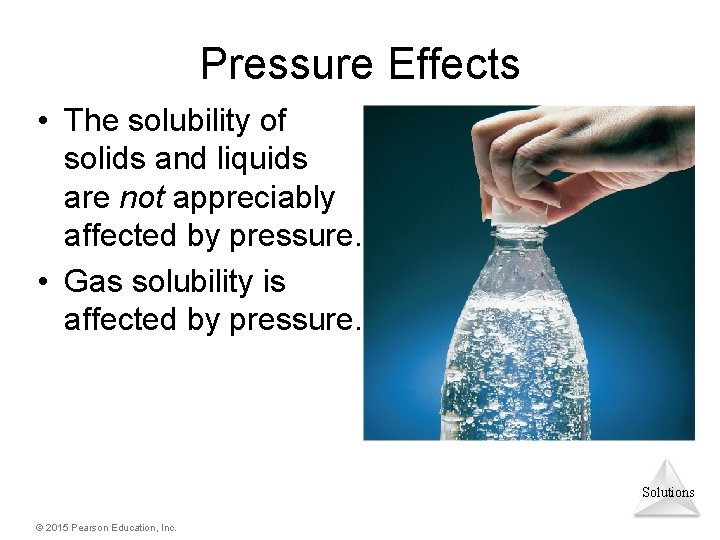
Pressure Effects • The solubility of solids and liquids are not appreciably affected by pressure. • Gas solubility is affected by pressure. Solutions © 2015 Pearson Education, Inc.
Henry’s Law • The solubility of a gas is proportional to the partial pressure of the gas above the solution. • Solutions © 2015 Pearson Education, Inc.
Temperature Effects • For most solids, as temperature increases, solubility increases. However, clearly this is not always true—some increase greatly, some remain relatively constant, and others decrease. • For all gases, as temperature increases, solubility decreases. Cold rivers have higher oxygen content than warm rivers. Solutions © 2015 Pearson Education, Inc.
13. 4 Solution Concentration Solutions © 2015 Pearson Education, Inc.
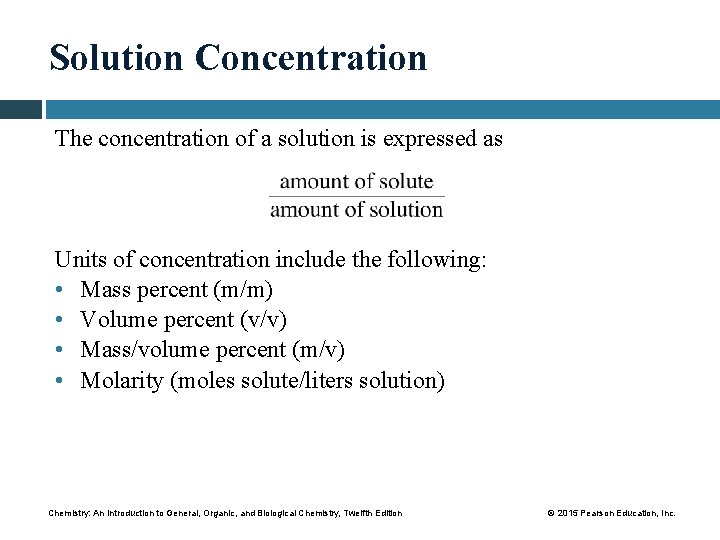
Solution Concentration The concentration of a solution is expressed as Units of concentration include the following: • Mass percent (m/m) • Volume percent (v/v) • Mass/volume percent (m/v) • Molarity (moles solute/liters solution) Chemistry: An Introduction to General, Organic, and Biological Chemistry, Twelfth Edition © 2015 Pearson Education, Inc.
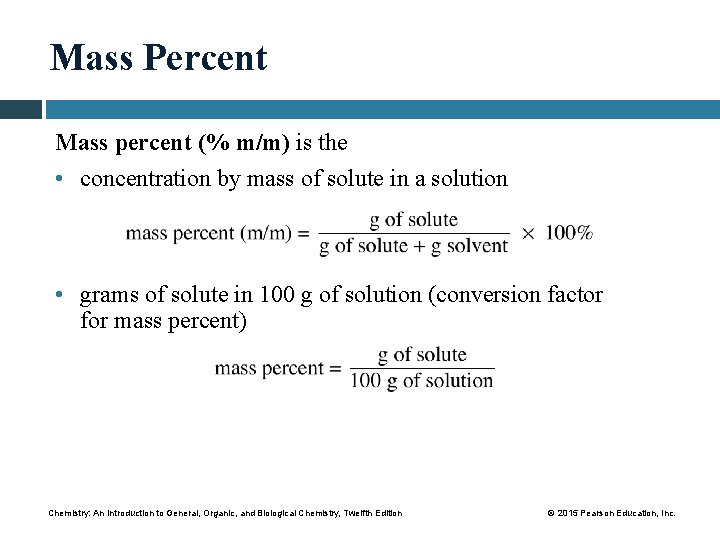
Mass Percent Mass percent (% m/m) is the • concentration by mass of solute in a solution • grams of solute in 100 g of solution (conversion factor for mass percent) Chemistry: An Introduction to General, Organic, and Biological Chemistry, Twelfth Edition © 2015 Pearson Education, Inc.
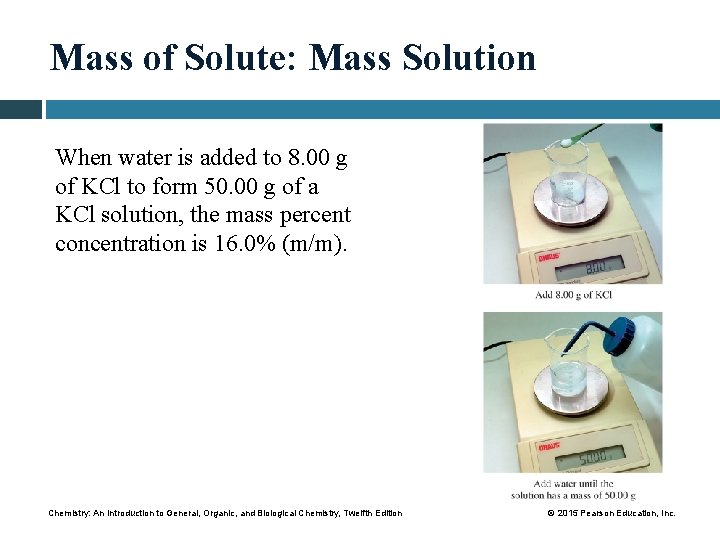
Mass of Solute: Mass Solution When water is added to 8. 00 g of KCl to form 50. 00 g of a KCl solution, the mass percent concentration is 16. 0% (m/m). Chemistry: An Introduction to General, Organic, and Biological Chemistry, Twelfth Edition © 2015 Pearson Education, Inc.
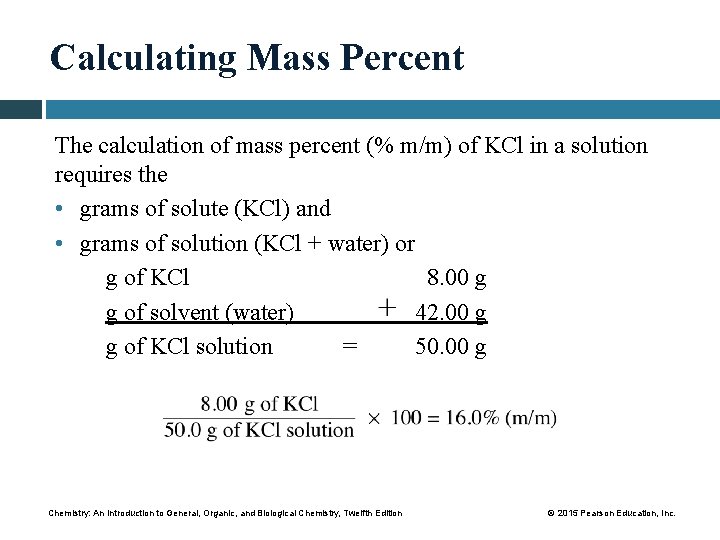
Calculating Mass Percent The calculation of mass percent (% m/m) of KCl in a solution requires the • grams of solute (KCl) and • grams of solution (KCl + water) or g of KCl 8. 00 g g of solvent (water) 42. 00 g g of KCl solution = 50. 00 g Chemistry: An Introduction to General, Organic, and Biological Chemistry, Twelfth Edition © 2015 Pearson Education, Inc.
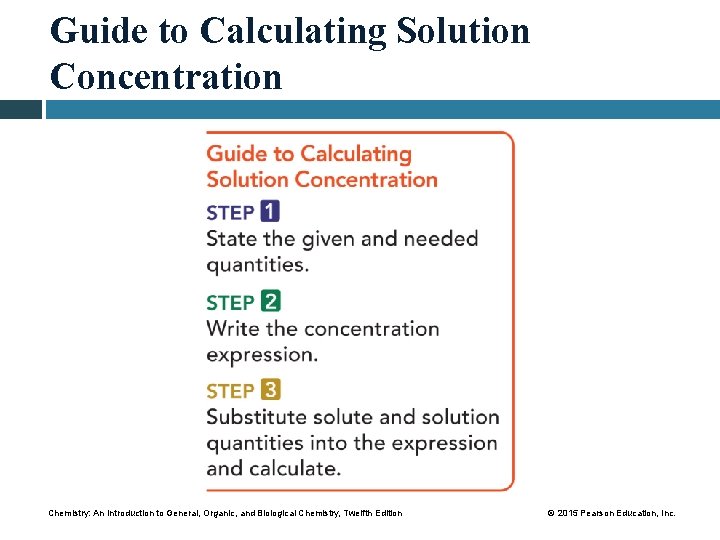
Guide to Calculating Solution Concentration Chemistry: An Introduction to General, Organic, and Biological Chemistry, Twelfth Edition © 2015 Pearson Education, Inc.
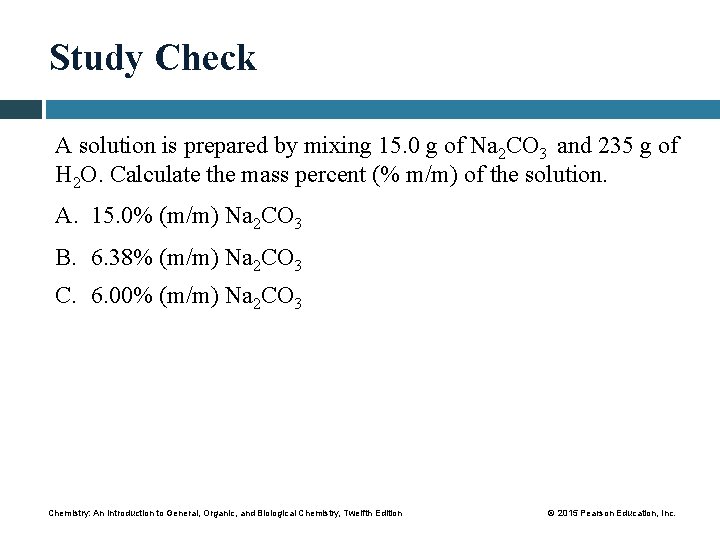
Study Check A solution is prepared by mixing 15. 0 g of Na 2 CO 3 and 235 g of H 2 O. Calculate the mass percent (% m/m) of the solution. A. 15. 0% (m/m) Na 2 CO 3 B. 6. 38% (m/m) Na 2 CO 3 C. 6. 00% (m/m) Na 2 CO 3 Chemistry: An Introduction to General, Organic, and Biological Chemistry, Twelfth Edition © 2015 Pearson Education, Inc.
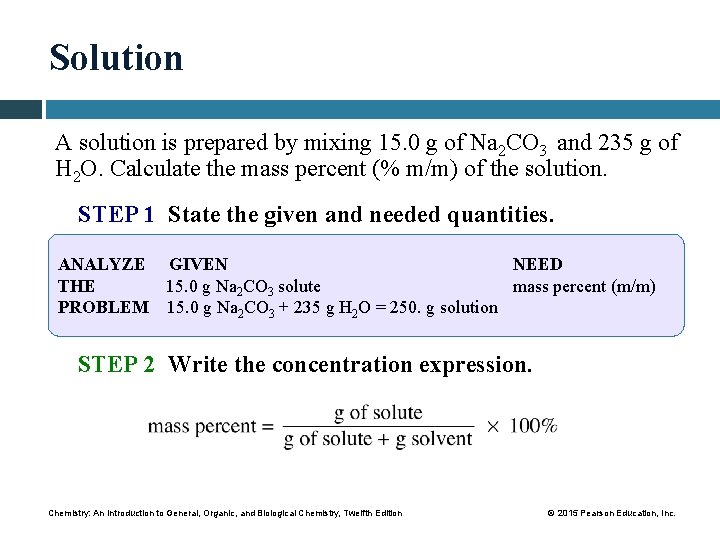
Solution A solution is prepared by mixing 15. 0 g of Na 2 CO 3 and 235 g of H 2 O. Calculate the mass percent (% m/m) of the solution. STEP 1 State the given and needed quantities. ANALYZE GIVEN NEED THE 15. 0 g Na 2 CO 3 solute mass percent (m/m) PROBLEM 15. 0 g Na 2 CO 3 + 235 g H 2 O = 250. g solution STEP 2 Write the concentration expression. Chemistry: An Introduction to General, Organic, and Biological Chemistry, Twelfth Edition © 2015 Pearson Education, Inc.
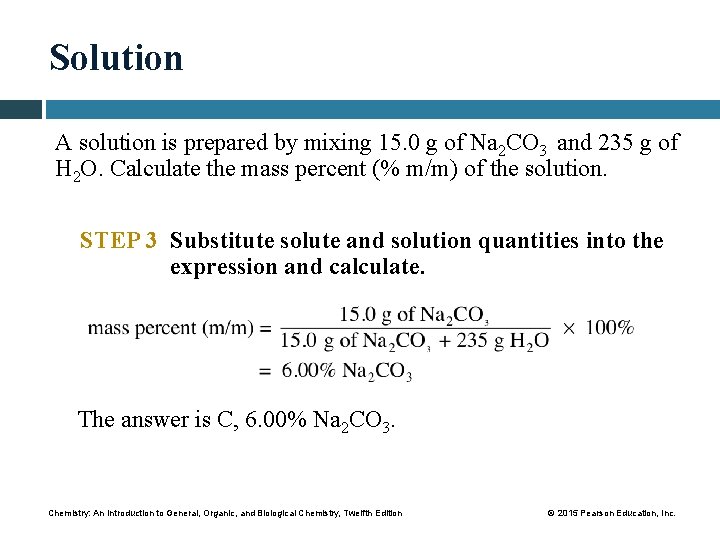
Solution A solution is prepared by mixing 15. 0 g of Na 2 CO 3 and 235 g of H 2 O. Calculate the mass percent (% m/m) of the solution. STEP 3 Substitute solute and solution quantities into the expression and calculate. The answer is C, 6. 00% Na 2 CO 3. Chemistry: An Introduction to General, Organic, and Biological Chemistry, Twelfth Edition © 2015 Pearson Education, Inc.
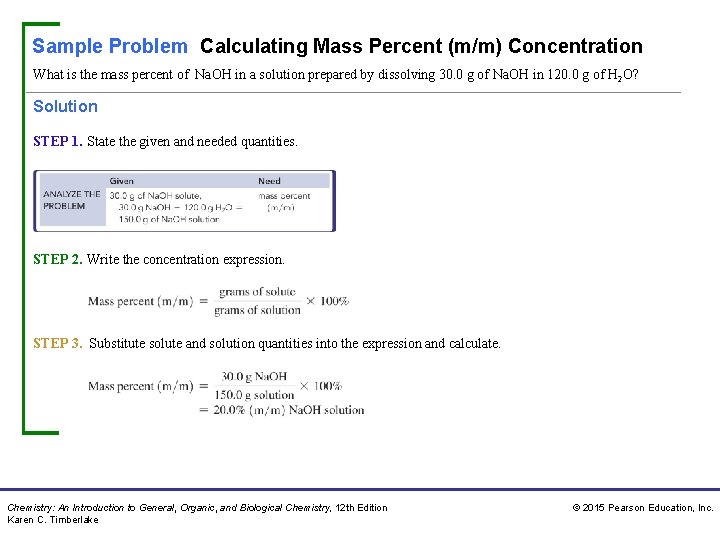
Sample Problem Calculating Mass Percent (m/m) Concentration What is the mass percent of Na. OH in a solution prepared by dissolving 30. 0 g of Na. OH in 120. 0 g of H 2 O? Solution STEP 1. State the given and needed quantities. STEP 2. Write the concentration expression. STEP 3. Substitute solute and solution quantities into the expression and calculate. Chemistry: An Introduction to General, Organic, and Biological Chemistry, 12 th Edition Karen C. Timberlake © 2015 Pearson Education, Inc.
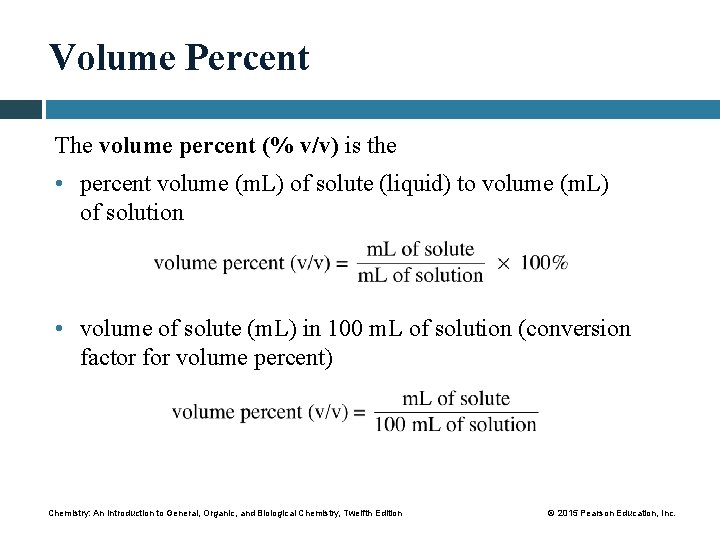
Volume Percent The volume percent (% v/v) is the • percent volume (m. L) of solute (liquid) to volume (m. L) of solution • volume of solute (m. L) in 100 m. L of solution (conversion factor for volume percent) Chemistry: An Introduction to General, Organic, and Biological Chemistry, Twelfth Edition © 2015 Pearson Education, Inc.
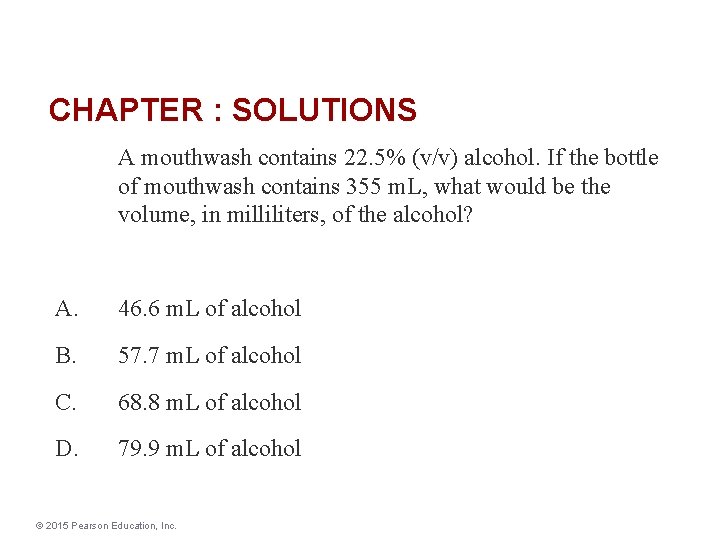
CHAPTER : SOLUTIONS A mouthwash contains 22. 5% (v/v) alcohol. If the bottle of mouthwash contains 355 m. L, what would be the volume, in milliliters, of the alcohol? A. 46. 6 m. L of alcohol B. 57. 7 m. L of alcohol C. 68. 8 m. L of alcohol D. 79. 9 m. L of alcohol © 2015 Pearson Education, Inc.
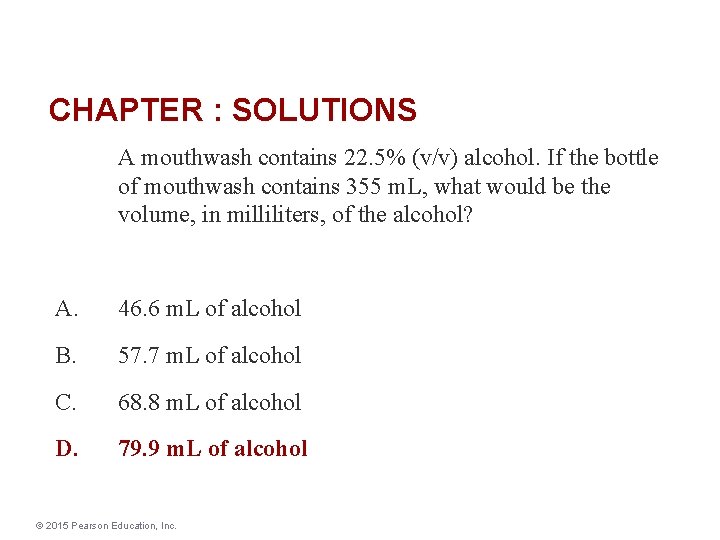
CHAPTER : SOLUTIONS A mouthwash contains 22. 5% (v/v) alcohol. If the bottle of mouthwash contains 355 m. L, what would be the volume, in milliliters, of the alcohol? A. 46. 6 m. L of alcohol B. 57. 7 m. L of alcohol C. 68. 8 m. L of alcohol D. 79. 9 m. L of alcohol © 2015 Pearson Education, Inc.
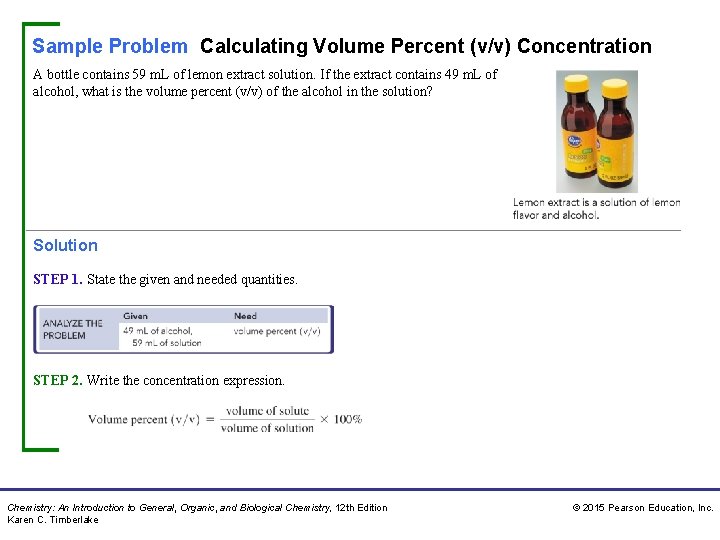
Sample Problem Calculating Volume Percent (v/v) Concentration A bottle contains 59 m. L of lemon extract solution. If the extract contains 49 m. L of alcohol, what is the volume percent (v/v) of the alcohol in the solution? Solution STEP 1. State the given and needed quantities. STEP 2. Write the concentration expression. Chemistry: An Introduction to General, Organic, and Biological Chemistry, 12 th Edition Karen C. Timberlake © 2015 Pearson Education, Inc.
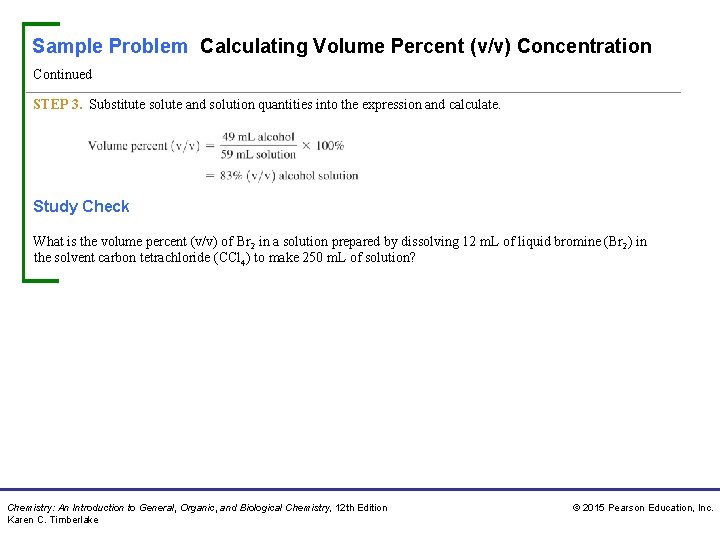
Sample Problem Calculating Volume Percent (v/v) Concentration Continued STEP 3. Substitute solute and solution quantities into the expression and calculate. Study Check What is the volume percent (v/v) of Br 2 in a solution prepared by dissolving 12 m. L of liquid bromine (Br 2) in the solvent carbon tetrachloride (CCl 4) to make 250 m. L of solution? Chemistry: An Introduction to General, Organic, and Biological Chemistry, 12 th Edition Karen C. Timberlake © 2015 Pearson Education, Inc.
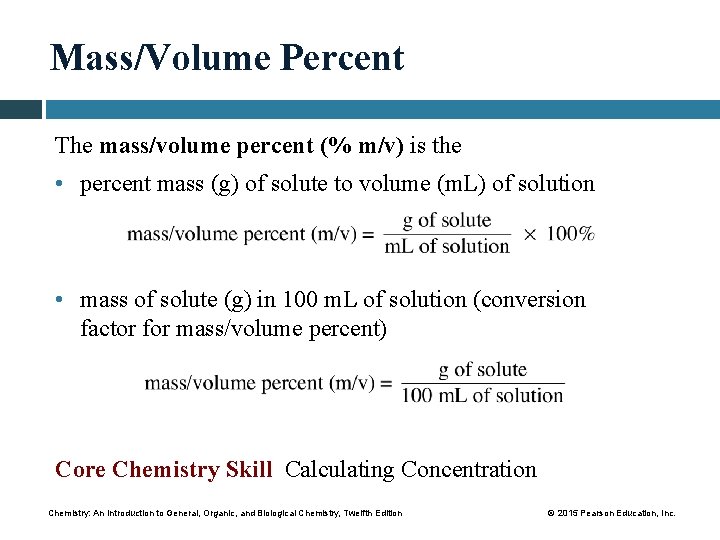
Mass/Volume Percent The mass/volume percent (% m/v) is the • percent mass (g) of solute to volume (m. L) of solution • mass of solute (g) in 100 m. L of solution (conversion factor for mass/volume percent) Core Chemistry Skill Calculating Concentration Chemistry: An Introduction to General, Organic, and Biological Chemistry, Twelfth Edition © 2015 Pearson Education, Inc.
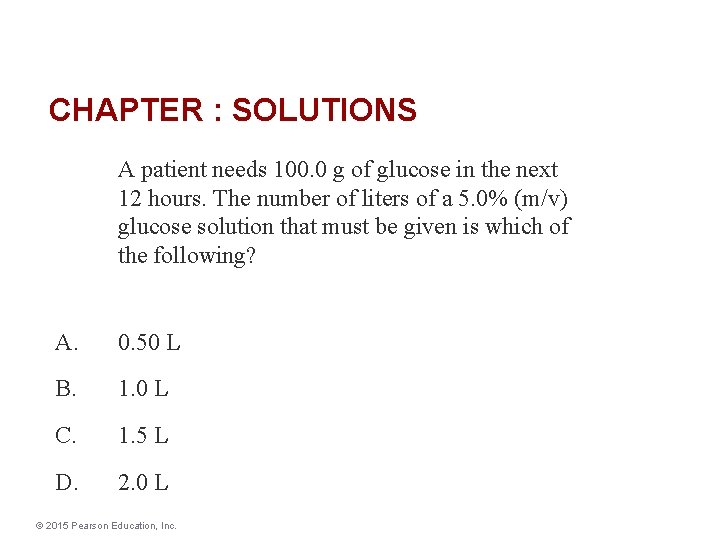
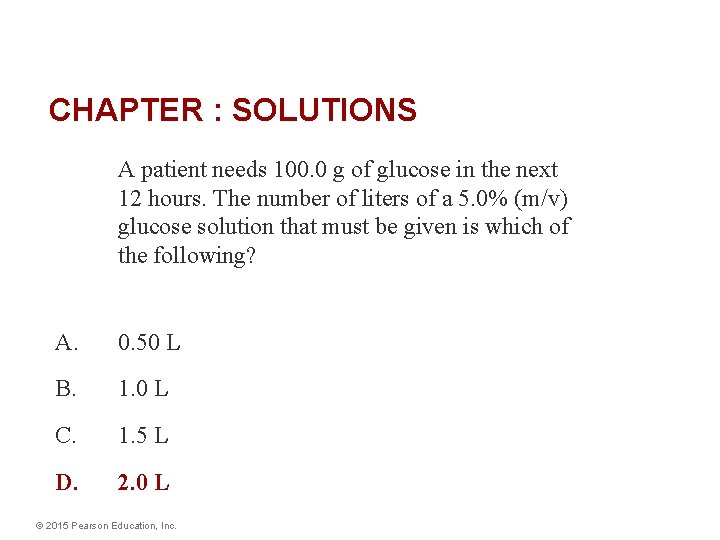
CHAPTER : SOLUTIONS A patient needs 100. 0 g of glucose in the next 12 hours. The number of liters of a 5. 0% (m/v) glucose solution that must be given is which of the following? A. 0. 50 L B. 1. 0 L C. 1. 5 L D. 2. 0 L © 2015 Pearson Education, Inc.
CHAPTER : SOLUTIONS A patient needs 100. 0 g of glucose in the next 12 hours. The number of liters of a 5. 0% (m/v) glucose solution that must be given is which of the following? A. 0. 50 L B. 1. 0 L C. 1. 5 L D. 2. 0 L © 2015 Pearson Education, Inc.
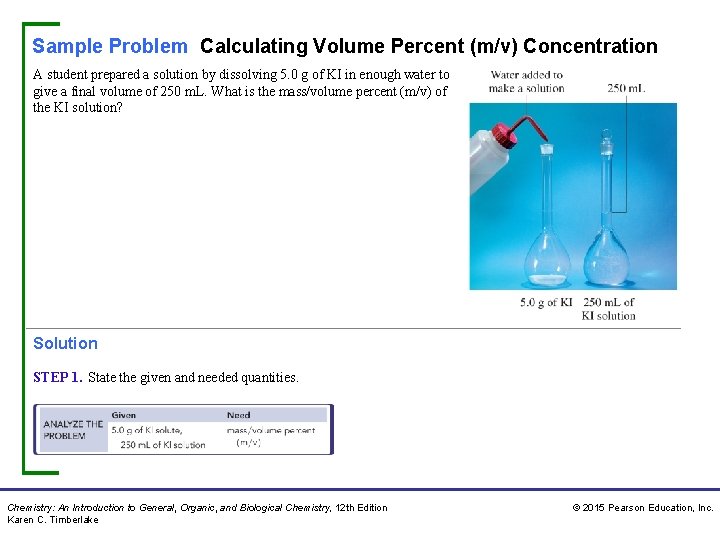
Sample Problem Calculating Volume Percent (m/v) Concentration A student prepared a solution by dissolving 5. 0 g of KI in enough water to give a final volume of 250 m. L. What is the mass/volume percent (m/v) of the KI solution? Solution STEP 1. State the given and needed quantities. Chemistry: An Introduction to General, Organic, and Biological Chemistry, 12 th Edition Karen C. Timberlake © 2015 Pearson Education, Inc.
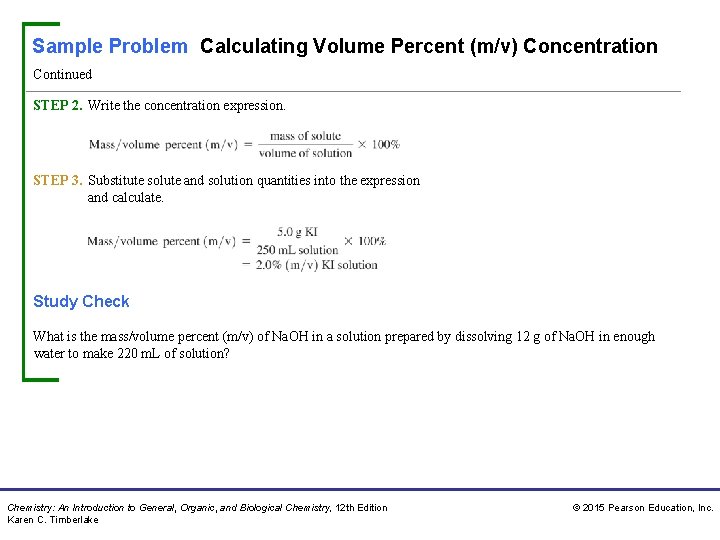
Sample Problem Calculating Volume Percent (m/v) Concentration Continued STEP 2. Write the concentration expression. STEP 3. Substitute solute and solution quantities into the expression and calculate. Study Check What is the mass/volume percent (m/v) of Na. OH in a solution prepared by dissolving 12 g of Na. OH in enough water to make 220 m. L of solution? Chemistry: An Introduction to General, Organic, and Biological Chemistry, 12 th Edition Karen C. Timberlake © 2015 Pearson Education, Inc.
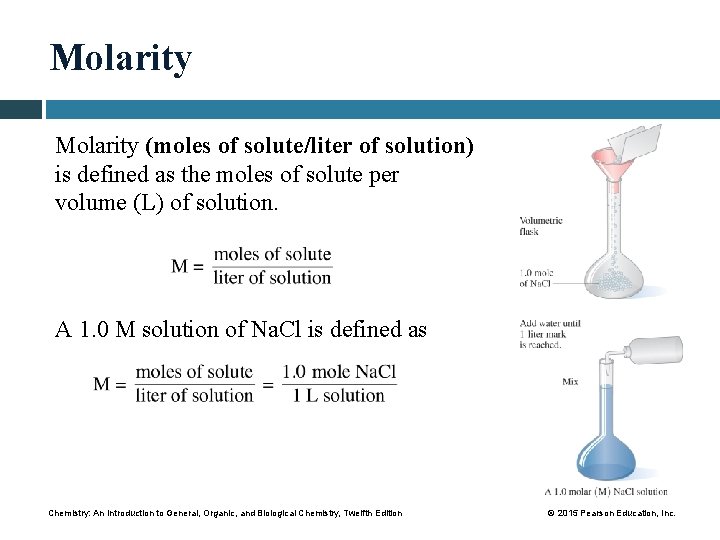
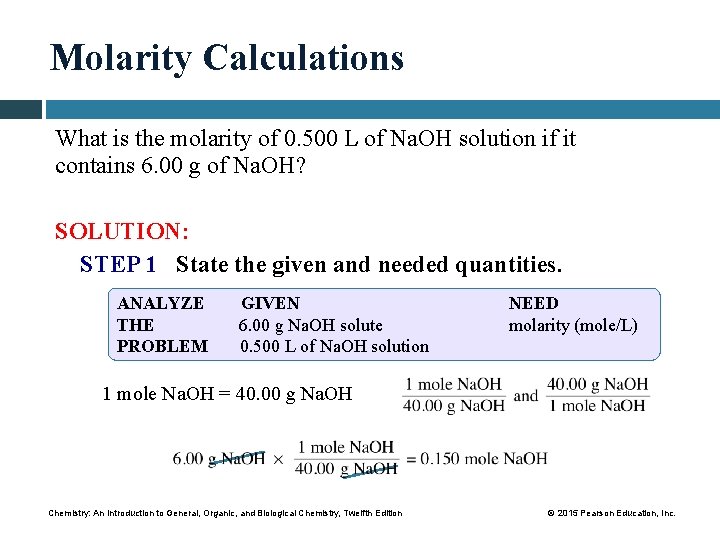
Molarity (moles of solute/liter of solution) is defined as the moles of solute per volume (L) of solution. A 1. 0 M solution of Na. Cl is defined as Chemistry: An Introduction to General, Organic, and Biological Chemistry, Twelfth Edition © 2015 Pearson Education, Inc.
Molarity Calculations What is the molarity of 0. 500 L of Na. OH solution if it contains 6. 00 g of Na. OH? SOLUTION: STEP 1 State the given and needed quantities. ANALYZE THE PROBLEM GIVEN 6. 00 g Na. OH solute 0. 500 L of Na. OH solution NEED molarity (mole/L) 1 mole Na. OH = 40. 00 g Na. OH Chemistry: An Introduction to General, Organic, and Biological Chemistry, Twelfth Edition © 2015 Pearson Education, Inc.
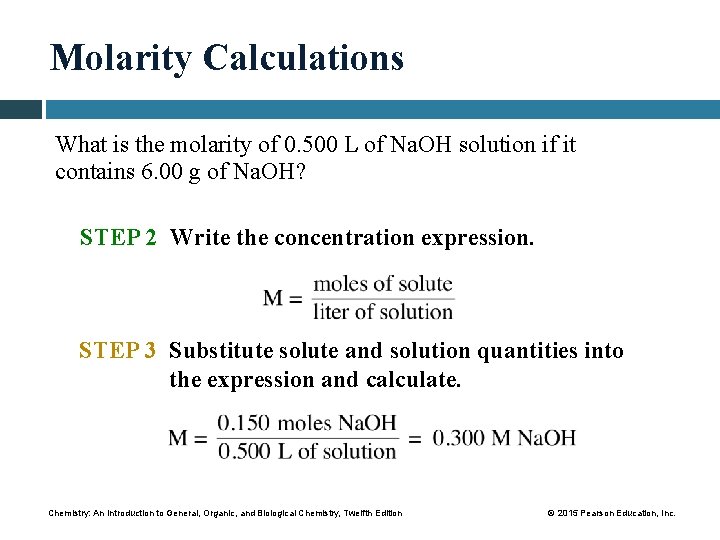
Molarity Calculations What is the molarity of 0. 500 L of Na. OH solution if it contains 6. 00 g of Na. OH? STEP 2 Write the concentration expression. STEP 3 Substitute solute and solution quantities into the expression and calculate. Chemistry: An Introduction to General, Organic, and Biological Chemistry, Twelfth Edition © 2015 Pearson Education, Inc.
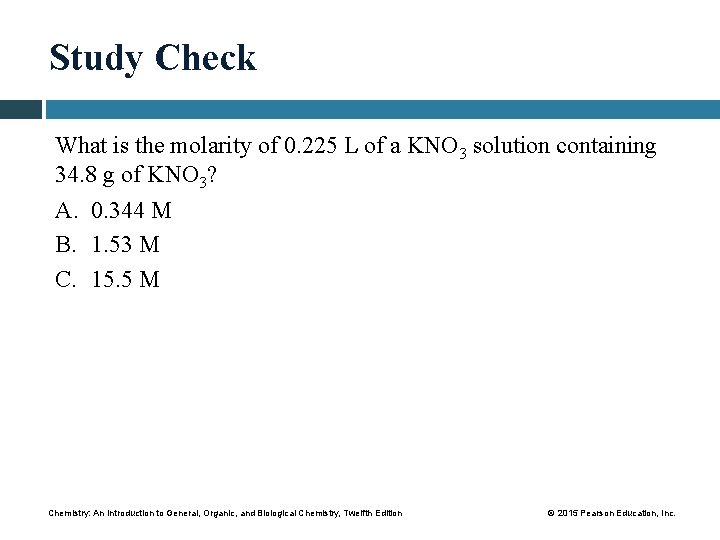
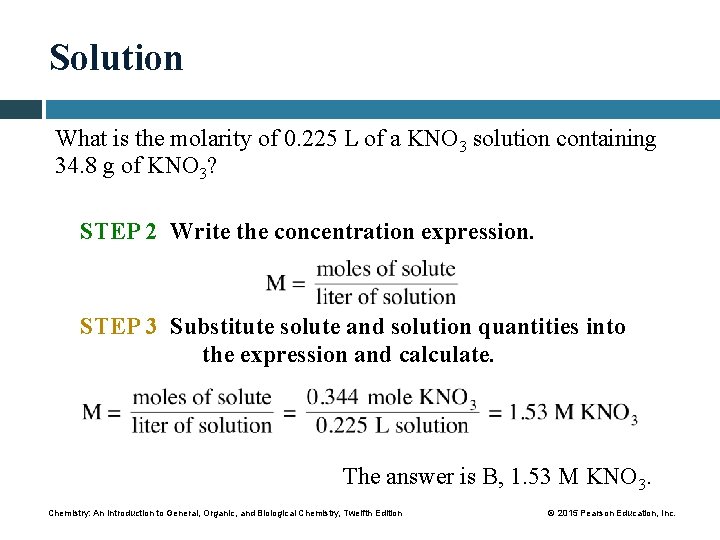
Study Check What is the molarity of 0. 225 L of a KNO 3 solution containing 34. 8 g of KNO 3? A. 0. 344 M B. 1. 53 M C. 15. 5 M Chemistry: An Introduction to General, Organic, and Biological Chemistry, Twelfth Edition © 2015 Pearson Education, Inc.
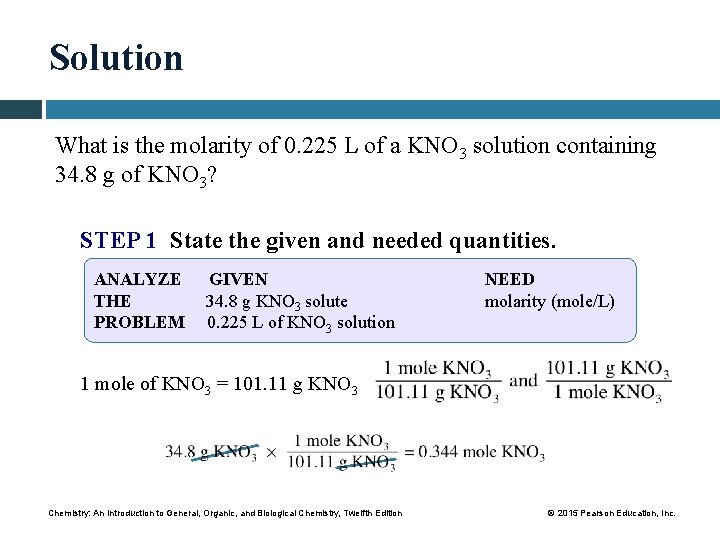
Solution What is the molarity of 0. 225 L of a KNO 3 solution containing 34. 8 g of KNO 3? STEP 1 State the given and needed quantities. ANALYZE THE PROBLEM GIVEN 34. 8 g KNO 3 solute 0. 225 L of KNO 3 solution NEED molarity (mole/L) 1 mole of KNO 3 = 101. 11 g KNO 3 Chemistry: An Introduction to General, Organic, and Biological Chemistry, Twelfth Edition © 2015 Pearson Education, Inc.
Solution What is the molarity of 0. 225 L of a KNO 3 solution containing 34. 8 g of KNO 3? STEP 2 Write the concentration expression. STEP 3 Substitute solute and solution quantities into the expression and calculate. The answer is B, 1. 53 M KNO 3. Chemistry: An Introduction to General, Organic, and Biological Chemistry, Twelfth Edition © 2015 Pearson Education, Inc.
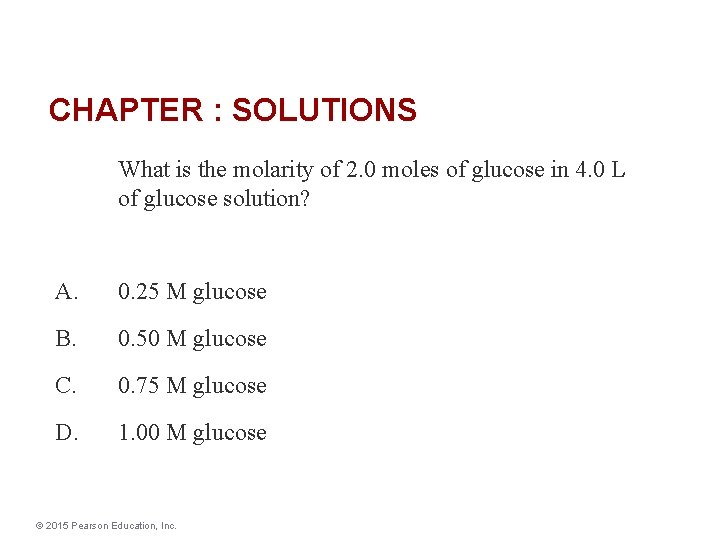
CHAPTER : SOLUTIONS What is the molarity of 2. 0 moles of glucose in 4. 0 L of glucose solution? A. 0. 25 M glucose B. 0. 50 M glucose C. 0. 75 M glucose D. 1. 00 M glucose © 2015 Pearson Education, Inc.
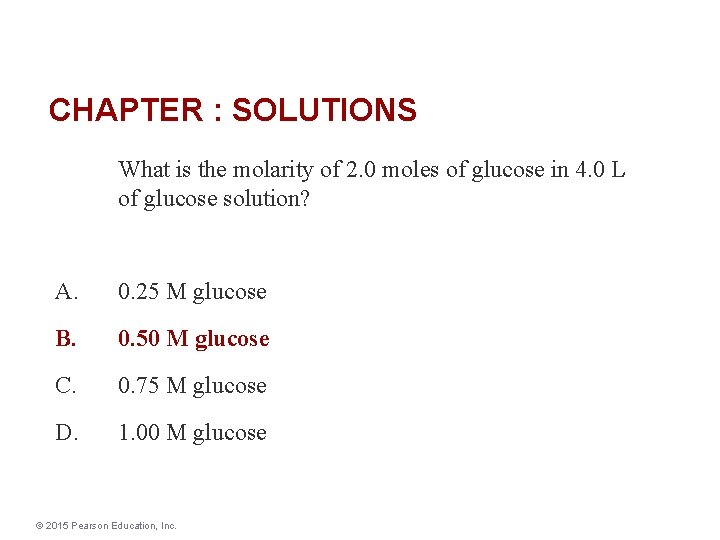
CHAPTER : SOLUTIONS What is the molarity of 2. 0 moles of glucose in 4. 0 L of glucose solution? A. 0. 25 M glucose B. 0. 50 M glucose C. 0. 75 M glucose D. 1. 00 M glucose © 2015 Pearson Education, Inc.
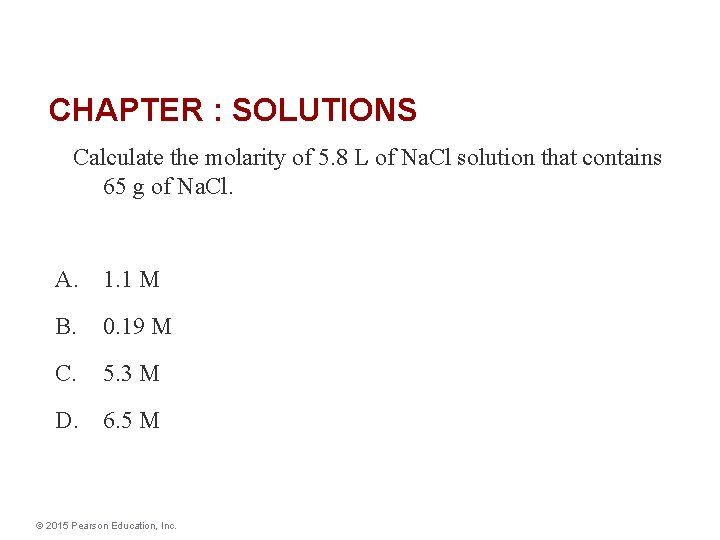
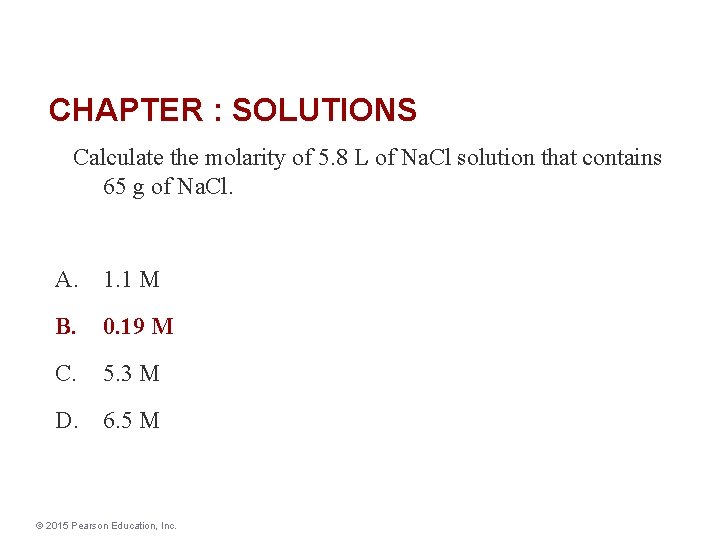
CHAPTER : SOLUTIONS Calculate the molarity of 5. 8 L of Na. Cl solution that contains 65 g of Na. Cl. A. 1. 1 M B. 0. 19 M C. 5. 3 M D. 6. 5 M © 2015 Pearson Education, Inc.
CHAPTER : SOLUTIONS Calculate the molarity of 5. 8 L of Na. Cl solution that contains 65 g of Na. Cl. A. 1. 1 M B. 0. 19 M C. 5. 3 M D. 6. 5 M © 2015 Pearson Education, Inc.
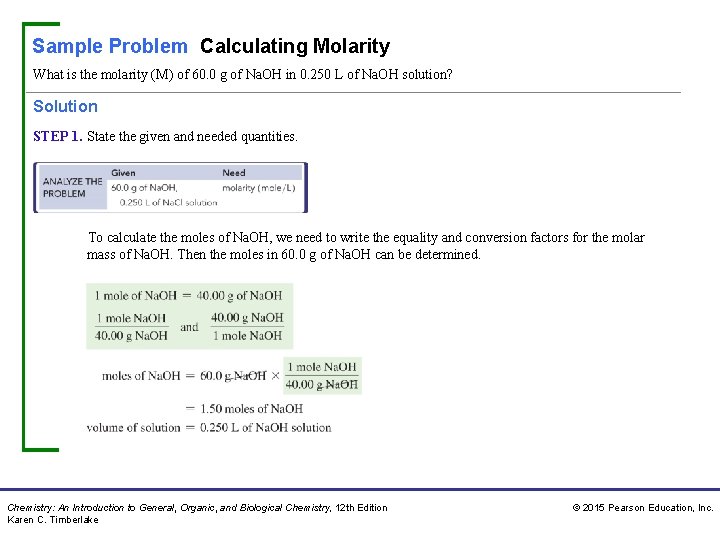
Sample Problem Calculating Molarity What is the molarity (M) of 60. 0 g of Na. OH in 0. 250 L of Na. OH solution? Solution STEP 1. State the given and needed quantities. To calculate the moles of Na. OH, we need to write the equality and conversion factors for the molar mass of Na. OH. Then the moles in 60. 0 g of Na. OH can be determined. Chemistry: An Introduction to General, Organic, and Biological Chemistry, 12 th Edition Karen C. Timberlake © 2015 Pearson Education, Inc.
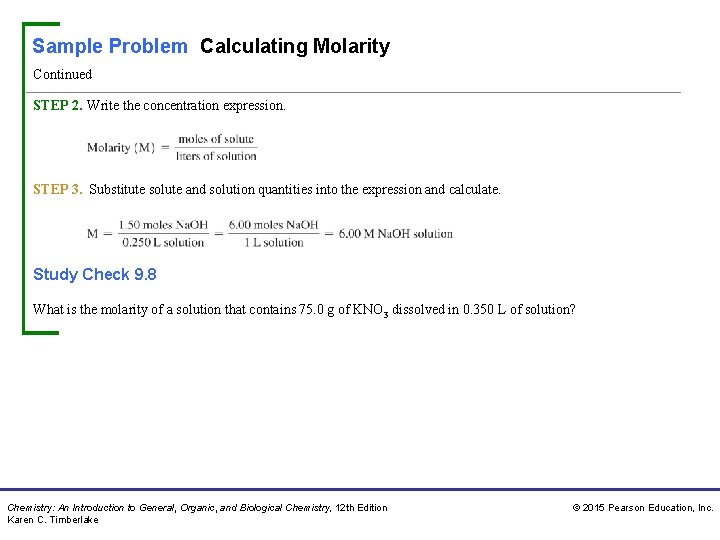
Sample Problem Calculating Molarity Continued STEP 2. Write the concentration expression. STEP 3. Substitute solute and solution quantities into the expression and calculate. Study Check 9. 8 What is the molarity of a solution that contains 75. 0 g of KNO 3 dissolved in 0. 350 L of solution? Chemistry: An Introduction to General, Organic, and Biological Chemistry, 12 th Edition Karen C. Timberlake © 2015 Pearson Education, Inc.
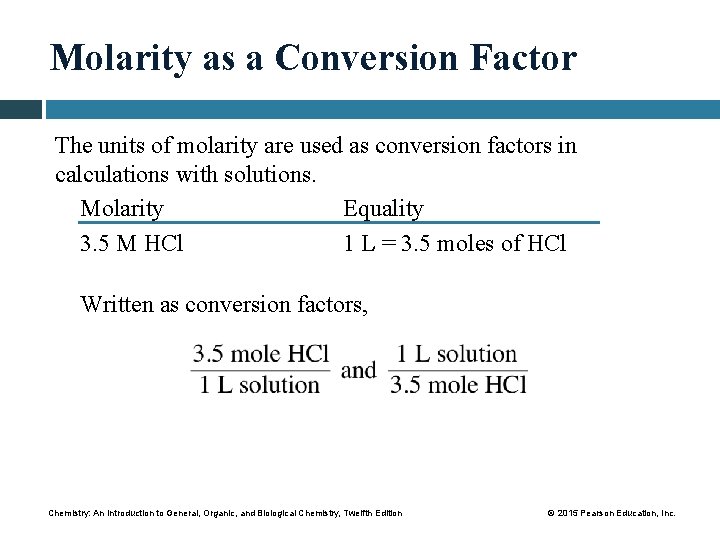
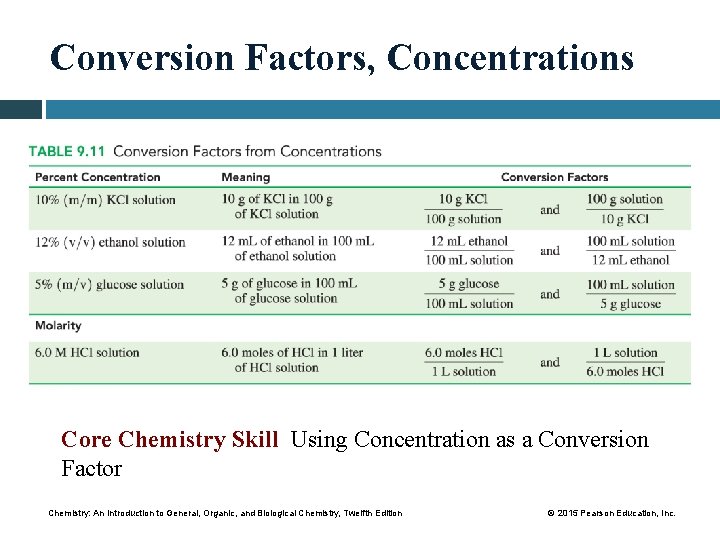
Molarity as a Conversion Factor The units of molarity are used as conversion factors in calculations with solutions. Molarity Equality 3. 5 M HCl 1 L = 3. 5 moles of HCl Written as conversion factors, Chemistry: An Introduction to General, Organic, and Biological Chemistry, Twelfth Edition © 2015 Pearson Education, Inc.
Conversion Factors, Concentrations Core Chemistry Skill Using Concentration as a Conversion Factor Chemistry: An Introduction to General, Organic, and Biological Chemistry, Twelfth Edition © 2015 Pearson Education, Inc.
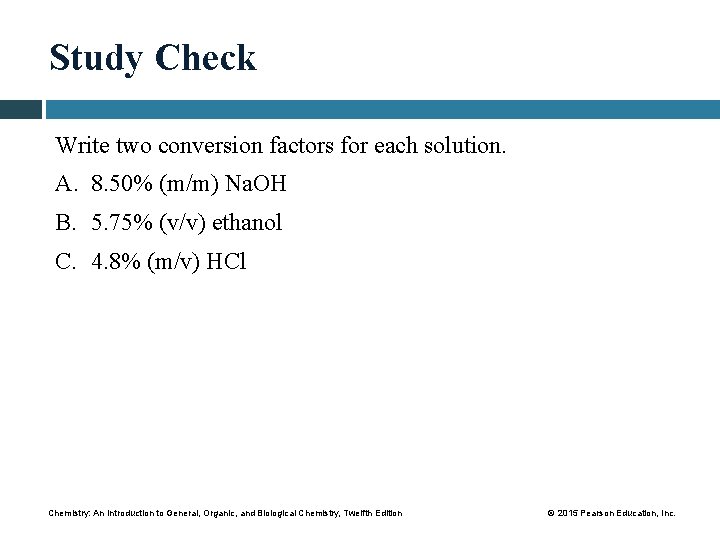
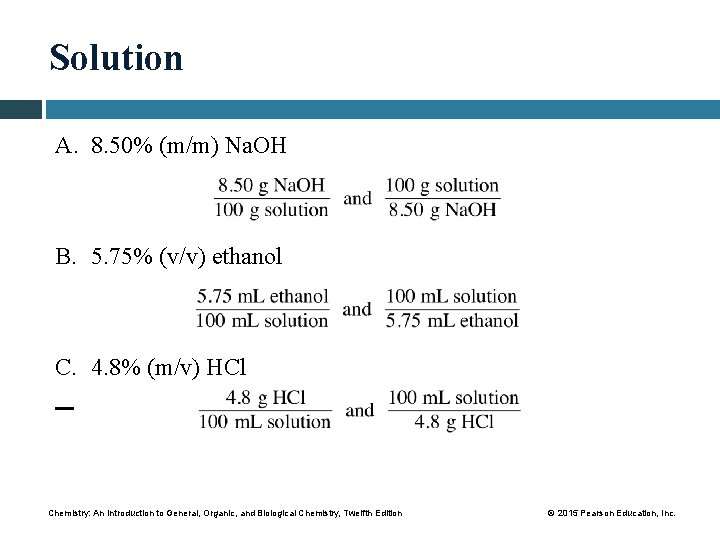
Study Check Write two conversion factors for each solution. A. 8. 50% (m/m) Na. OH B. 5. 75% (v/v) ethanol C. 4. 8% (m/v) HCl Chemistry: An Introduction to General, Organic, and Biological Chemistry, Twelfth Edition © 2015 Pearson Education, Inc.
Solution A. 8. 50% (m/m) Na. OH B. 5. 75% (v/v) ethanol C. 4. 8% (m/v) HCl Chemistry: An Introduction to General, Organic, and Biological Chemistry, Twelfth Edition © 2015 Pearson Education, Inc.
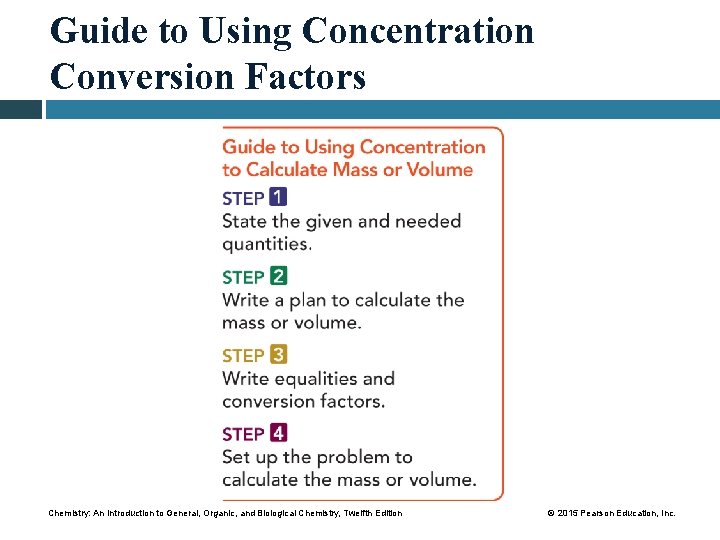
Guide to Using Concentration Conversion Factors Chemistry: An Introduction to General, Organic, and Biological Chemistry, Twelfth Edition © 2015 Pearson Education, Inc.
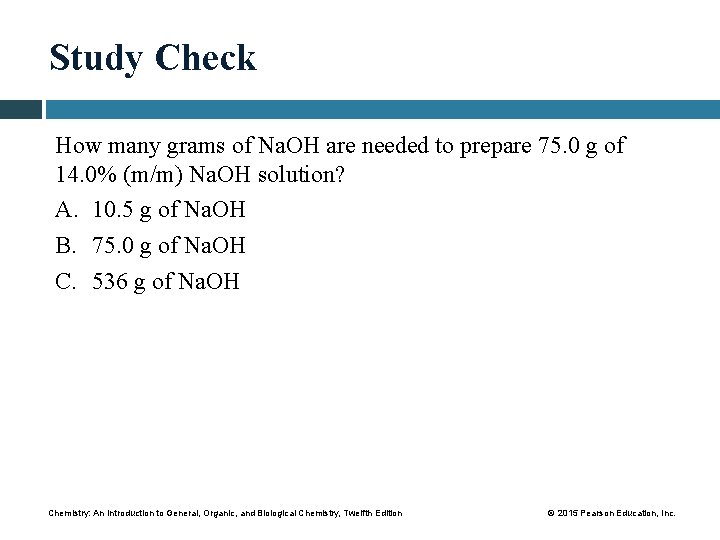
Study Check How many grams of Na. OH are needed to prepare 75. 0 g of 14. 0% (m/m) Na. OH solution? A. 10. 5 g of Na. OH B. 75. 0 g of Na. OH C. 536 g of Na. OH Chemistry: An Introduction to General, Organic, and Biological Chemistry, Twelfth Edition © 2015 Pearson Education, Inc.
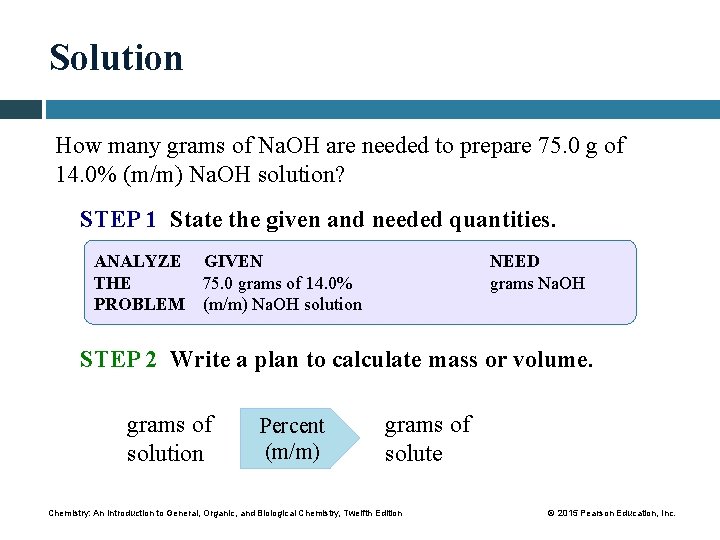
Solution How many grams of Na. OH are needed to prepare 75. 0 g of 14. 0% (m/m) Na. OH solution? STEP 1 State the given and needed quantities. ANALYZE GIVEN THE 75. 0 grams of 14. 0% PROBLEM (m/m) Na. OH solution NEED grams Na. OH STEP 2 Write a plan to calculate mass or volume. grams of solution Percent (m/m) grams of solute Chemistry: An Introduction to General, Organic, and Biological Chemistry, Twelfth Edition © 2015 Pearson Education, Inc.
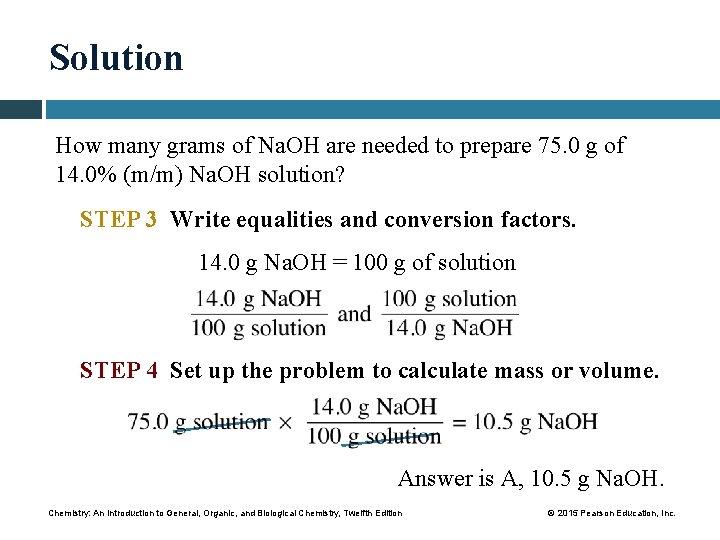
Solution How many grams of Na. OH are needed to prepare 75. 0 g of 14. 0% (m/m) Na. OH solution? STEP 3 Write equalities and conversion factors. 14. 0 g Na. OH = 100 g of solution STEP 4 Set up the problem to calculate mass or volume. Answer is A, 10. 5 g Na. OH. Chemistry: An Introduction to General, Organic, and Biological Chemistry, Twelfth Edition © 2015 Pearson Education, Inc.
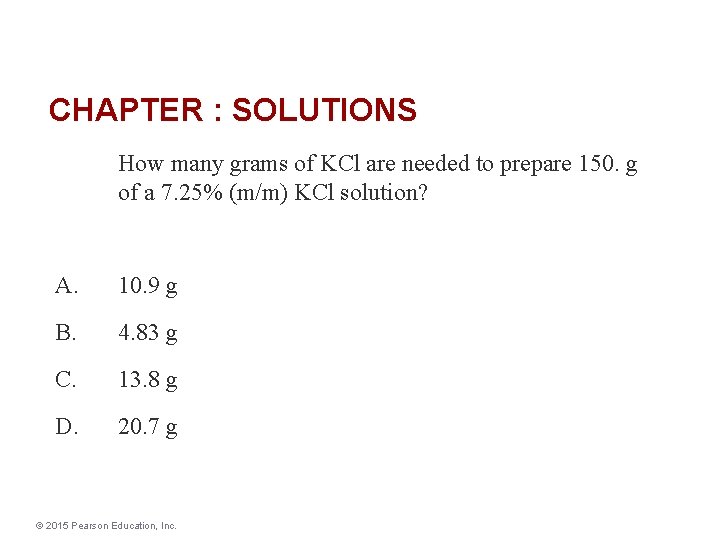
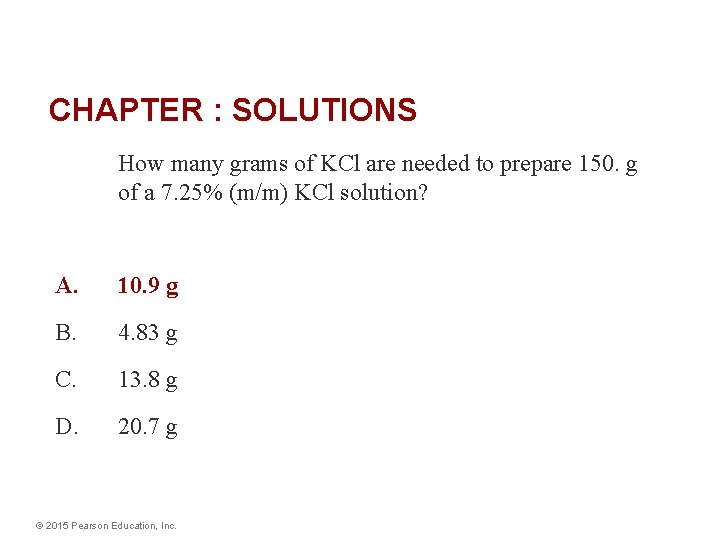
CHAPTER : SOLUTIONS How many grams of KCl are needed to prepare 150. g of a 7. 25% (m/m) KCl solution? A. 10. 9 g B. 4. 83 g C. 13. 8 g D. 20. 7 g © 2015 Pearson Education, Inc.
CHAPTER : SOLUTIONS How many grams of KCl are needed to prepare 150. g of a 7. 25% (m/m) KCl solution? A. 10. 9 g B. 4. 83 g C. 13. 8 g D. 20. 7 g © 2015 Pearson Education, Inc.
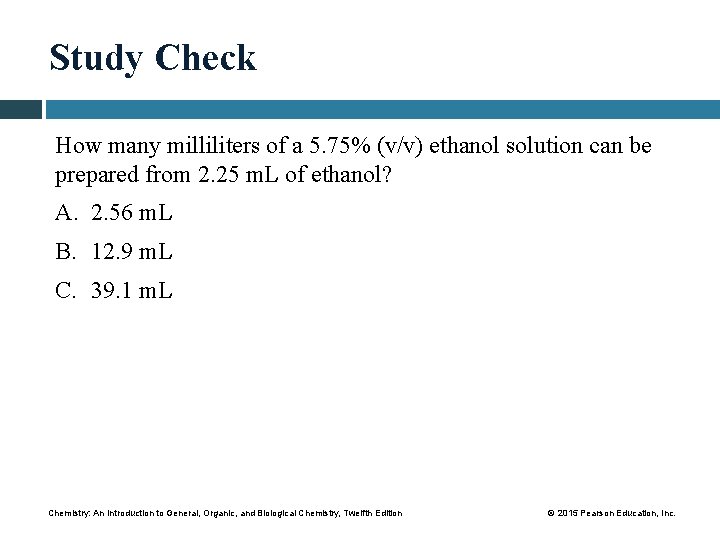
Study Check How many milliliters of a 5. 75% (v/v) ethanol solution can be prepared from 2. 25 m. L of ethanol? A. 2. 56 m. L B. 12. 9 m. L C. 39. 1 m. L Chemistry: An Introduction to General, Organic, and Biological Chemistry, Twelfth Edition © 2015 Pearson Education, Inc.
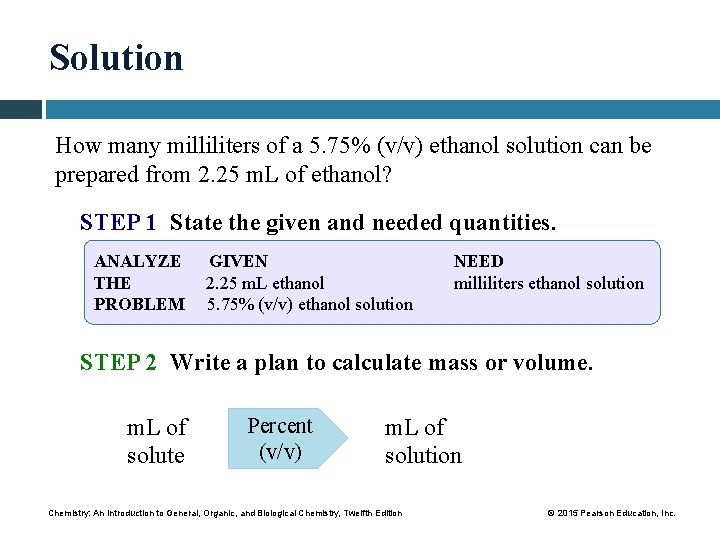
Solution How many milliliters of a 5. 75% (v/v) ethanol solution can be prepared from 2. 25 m. L of ethanol? STEP 1 State the given and needed quantities. ANALYZE THE PROBLEM GIVEN 2. 25 m. L ethanol 5. 75% (v/v) ethanol solution NEED milliliters ethanol solution STEP 2 Write a plan to calculate mass or volume. m. L of solute Percent (v/v) m. L of solution Chemistry: An Introduction to General, Organic, and Biological Chemistry, Twelfth Edition © 2015 Pearson Education, Inc.
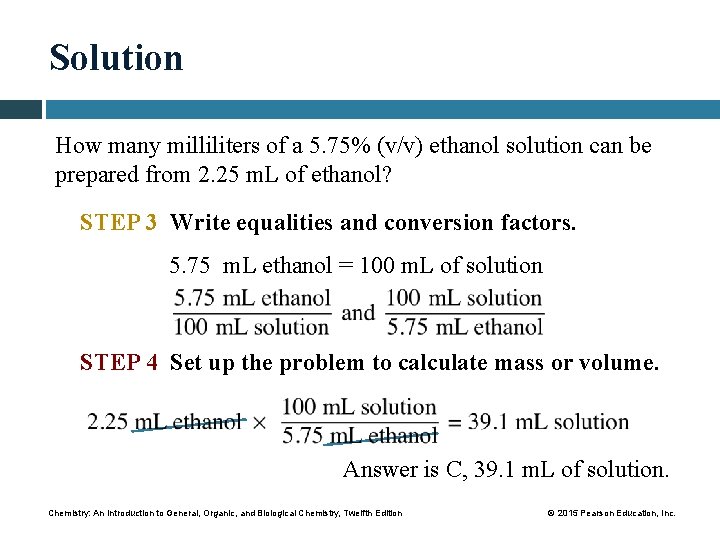
Solution How many milliliters of a 5. 75% (v/v) ethanol solution can be prepared from 2. 25 m. L of ethanol? STEP 3 Write equalities and conversion factors. 5. 75 m. L ethanol = 100 m. L of solution STEP 4 Set up the problem to calculate mass or volume. Answer is C, 39. 1 m. L of solution. Chemistry: An Introduction to General, Organic, and Biological Chemistry, Twelfth Edition © 2015 Pearson Education, Inc.
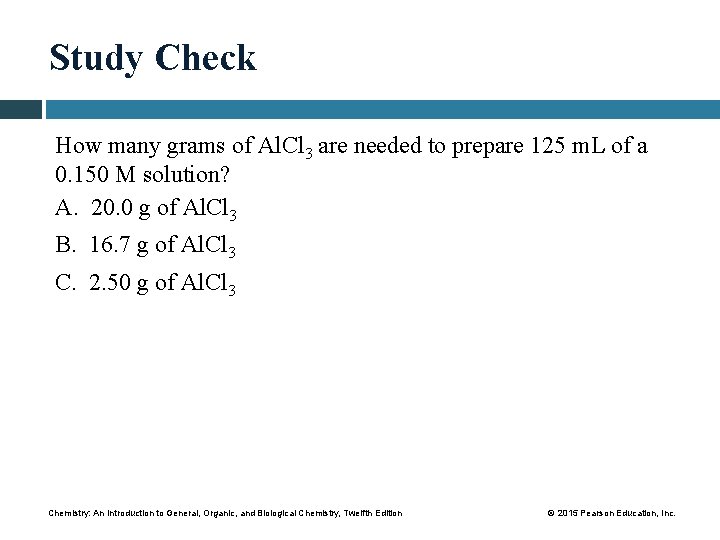
Study Check How many grams of Al. Cl 3 are needed to prepare 125 m. L of a 0. 150 M solution? A. 20. 0 g of Al. Cl 3 B. 16. 7 g of Al. Cl 3 C. 2. 50 g of Al. Cl 3 Chemistry: An Introduction to General, Organic, and Biological Chemistry, Twelfth Edition © 2015 Pearson Education, Inc.
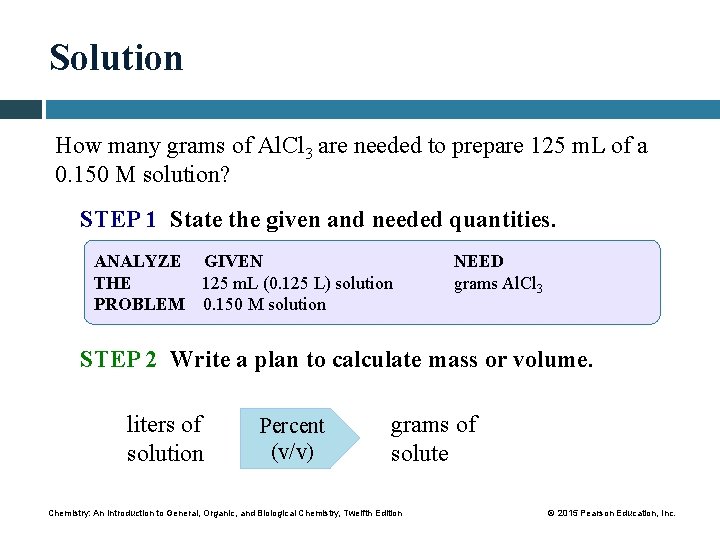
Solution How many grams of Al. Cl 3 are needed to prepare 125 m. L of a 0. 150 M solution? STEP 1 State the given and needed quantities. ANALYZE GIVEN THE 125 m. L (0. 125 L) solution PROBLEM 0. 150 M solution NEED grams Al. Cl 3 STEP 2 Write a plan to calculate mass or volume. liters of solution Percent (v/v) grams of solute Chemistry: An Introduction to General, Organic, and Biological Chemistry, Twelfth Edition © 2015 Pearson Education, Inc.
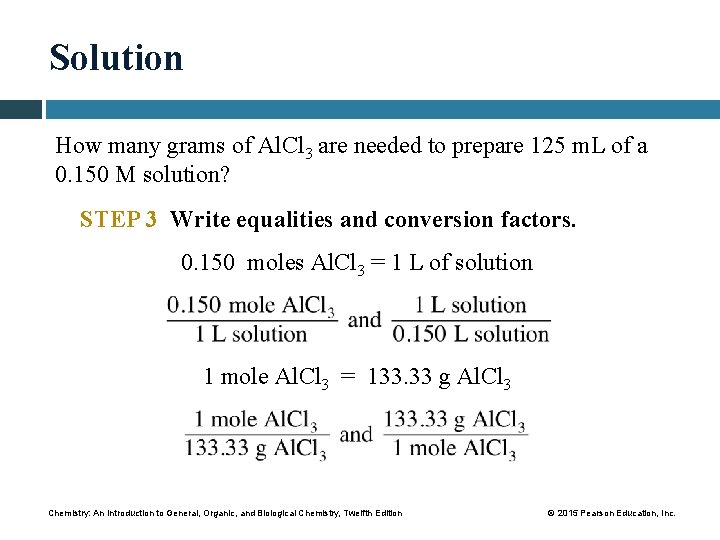
Solution How many grams of Al. Cl 3 are needed to prepare 125 m. L of a 0. 150 M solution? STEP 3 Write equalities and conversion factors. 0. 150 moles Al. Cl 3 = 1 L of solution 1 mole Al. Cl 3 = 133. 33 g Al. Cl 3 Chemistry: An Introduction to General, Organic, and Biological Chemistry, Twelfth Edition © 2015 Pearson Education, Inc.
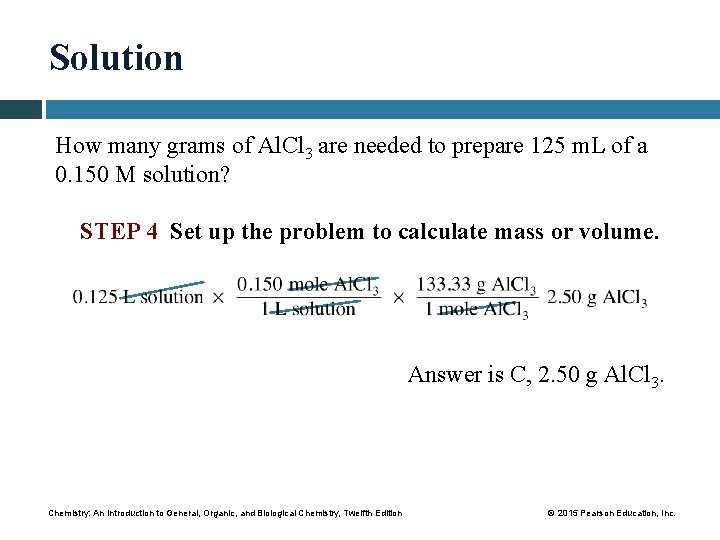
Solution How many grams of Al. Cl 3 are needed to prepare 125 m. L of a 0. 150 M solution? STEP 4 Set up the problem to calculate mass or volume. Answer is C, 2. 50 g Al. Cl 3. Chemistry: An Introduction to General, Organic, and Biological Chemistry, Twelfth Edition © 2015 Pearson Education, Inc.
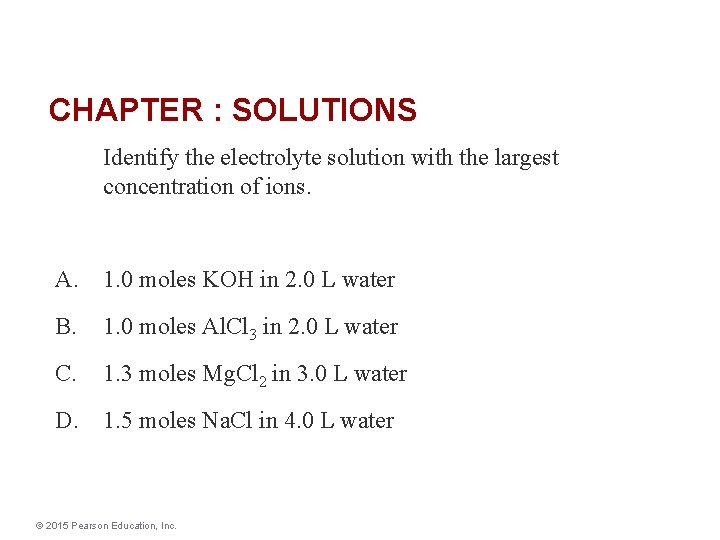
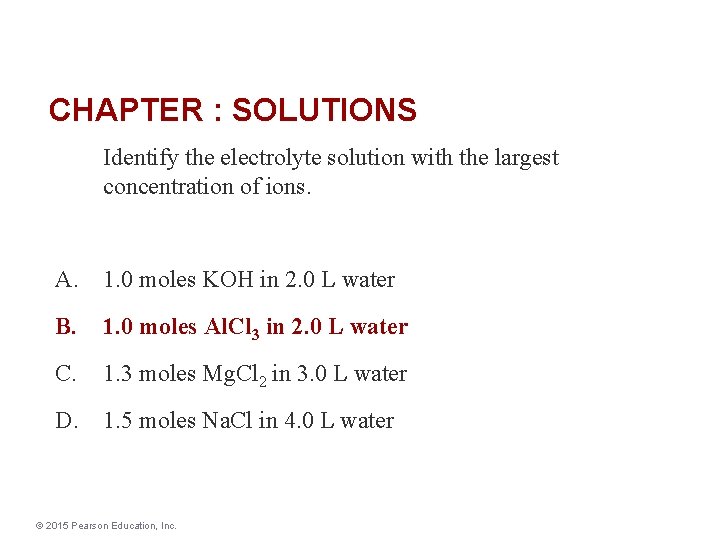
CHAPTER : SOLUTIONS Identify the electrolyte solution with the largest concentration of ions. A. 1. 0 moles KOH in 2. 0 L water B. 1. 0 moles Al. Cl 3 in 2. 0 L water C. 1. 3 moles Mg. Cl 2 in 3. 0 L water D. 1. 5 moles Na. Cl in 4. 0 L water © 2015 Pearson Education, Inc.
CHAPTER : SOLUTIONS Identify the electrolyte solution with the largest concentration of ions. A. 1. 0 moles KOH in 2. 0 L water B. 1. 0 moles Al. Cl 3 in 2. 0 L water C. 1. 3 moles Mg. Cl 2 in 3. 0 L water D. 1. 5 moles Na. Cl in 4. 0 L water © 2015 Pearson Education, Inc.
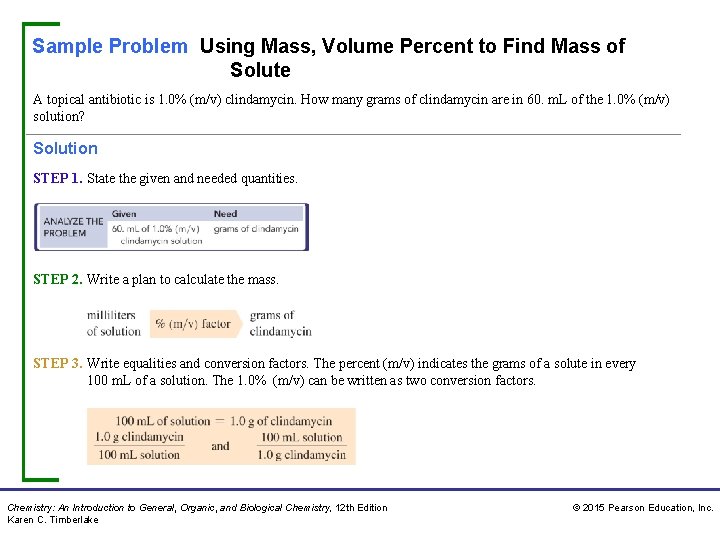
Sample Problem Using Mass, Volume Percent to Find Mass of Solute A topical antibiotic is 1. 0% (m/v) clindamycin. How many grams of clindamycin are in 60. m. L of the 1. 0% (m/v) solution? Solution STEP 1. State the given and needed quantities. STEP 2. Write a plan to calculate the mass. STEP 3. Write equalities and conversion factors. The percent (m/v) indicates the grams of a solute in every 100 m. L of a solution. The 1. 0% (m/v) can be written as two conversion factors. Chemistry: An Introduction to General, Organic, and Biological Chemistry, 12 th Edition Karen C. Timberlake © 2015 Pearson Education, Inc.
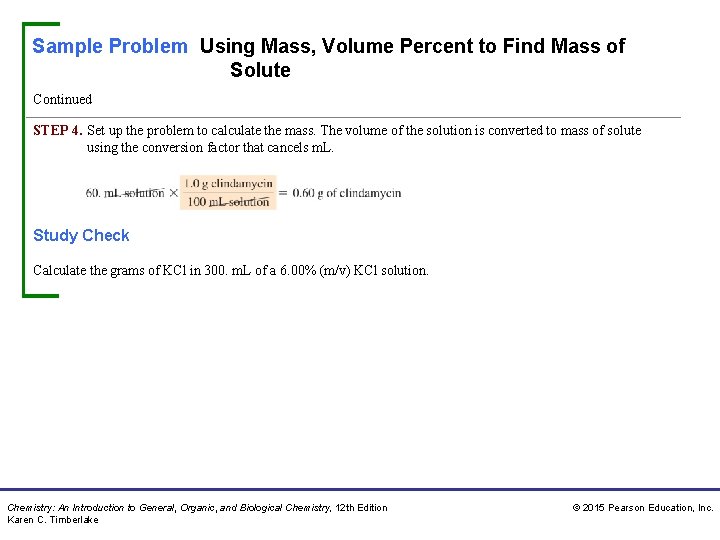
Sample Problem Using Mass, Volume Percent to Find Mass of Solute Continued STEP 4. Set up the problem to calculate the mass. The volume of the solution is converted to mass of solute using the conversion factor that cancels m. L. Study Check Calculate the grams of KCl in 300. m. L of a 6. 00% (m/v) KCl solution. Chemistry: An Introduction to General, Organic, and Biological Chemistry, 12 th Edition Karen C. Timberlake © 2015 Pearson Education, Inc.
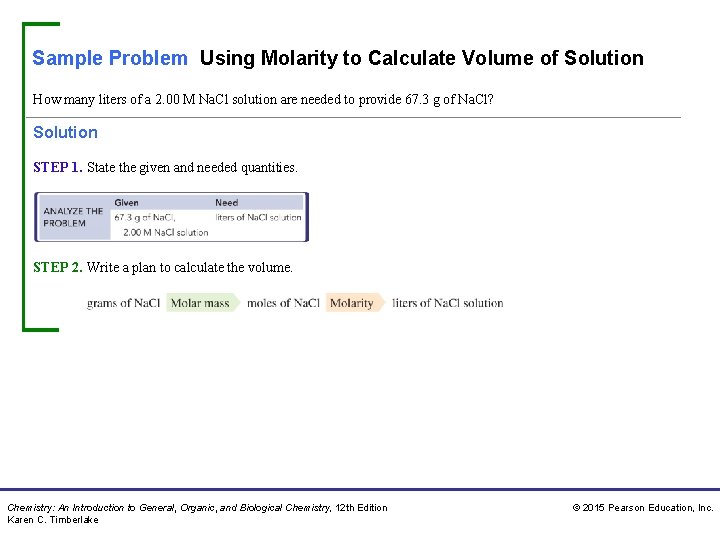
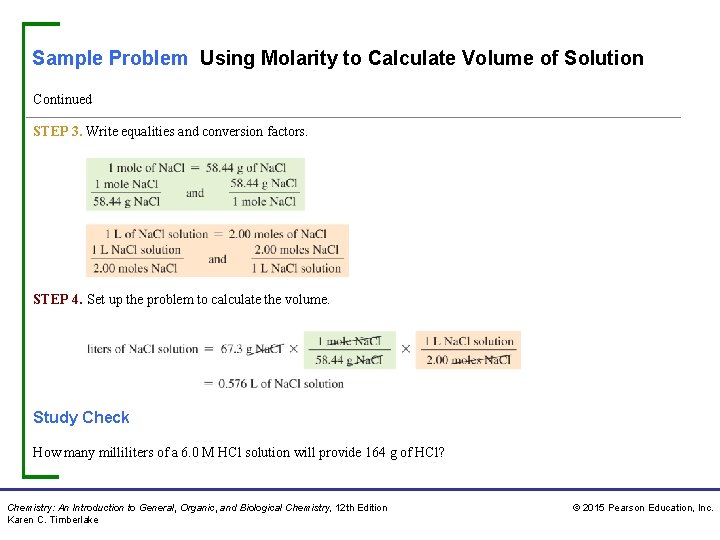
Sample Problem Using Molarity to Calculate Volume of Solution How many liters of a 2. 00 M Na. Cl solution are needed to provide 67. 3 g of Na. Cl? Solution STEP 1. State the given and needed quantities. STEP 2. Write a plan to calculate the volume. Chemistry: An Introduction to General, Organic, and Biological Chemistry, 12 th Edition Karen C. Timberlake © 2015 Pearson Education, Inc.
Sample Problem Using Molarity to Calculate Volume of Solution Continued STEP 3. Write equalities and conversion factors. STEP 4. Set up the problem to calculate the volume. Study Check How many milliliters of a 6. 0 M HCl solution will provide 164 g of HCl? Chemistry: An Introduction to General, Organic, and Biological Chemistry, 12 th Edition Karen C. Timberlake © 2015 Pearson Education, Inc.
Solution Concentration • We have discussed solubility and solutions qualitatively: saturated (which is quantitative), unsaturated, and supersaturated. • Now we will give specific amounts to solutions. Solutions © 2015 Pearson Education, Inc.
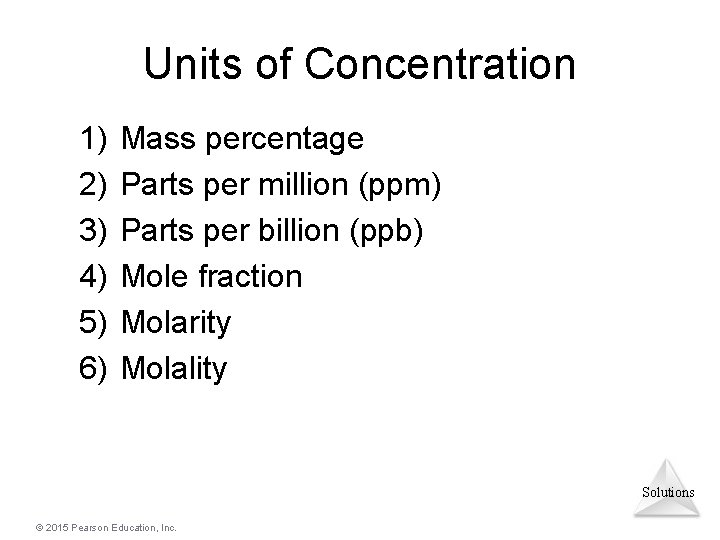
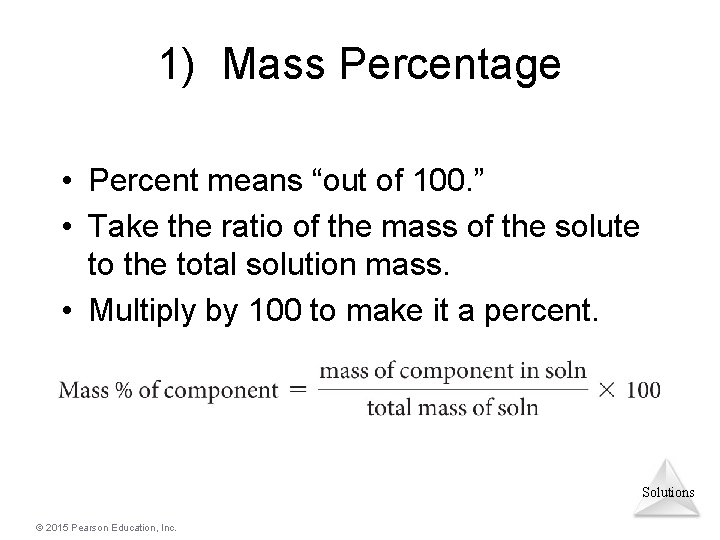
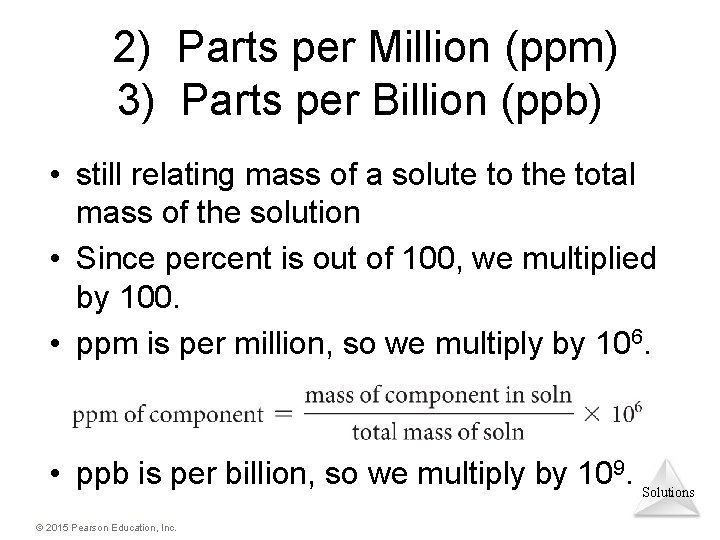
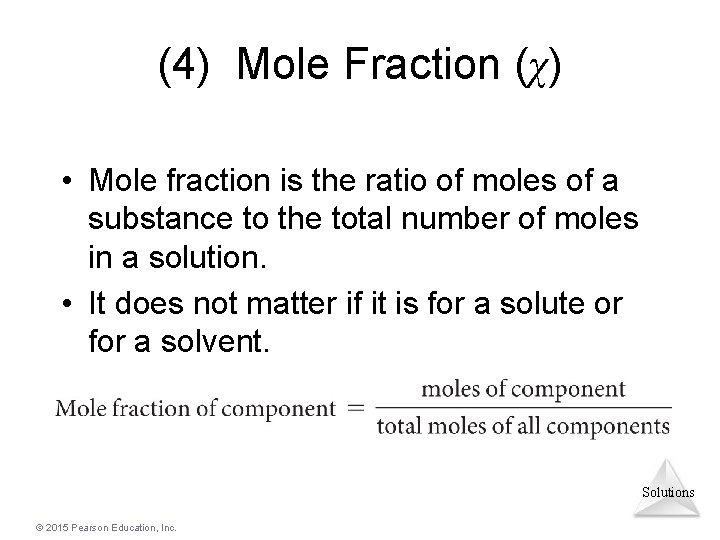
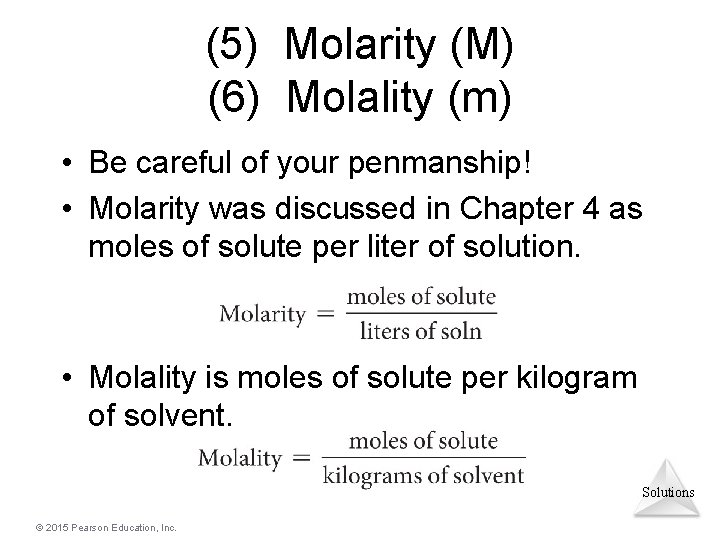
Units of Concentration 1) 2) 3) 4) 5) 6) Mass percentage Parts per million (ppm) Parts per billion (ppb) Mole fraction Molarity Molality Solutions © 2015 Pearson Education, Inc.
1) Mass Percentage • Percent means “out of 100. ” • Take the ratio of the mass of the solute to the total solution mass. • Multiply by 100 to make it a percent. Solutions © 2015 Pearson Education, Inc.
2) Parts per Million (ppm) 3) Parts per Billion (ppb) • still relating mass of a solute to the total mass of the solution • Since percent is out of 100, we multiplied by 100. • ppm is per million, so we multiply by 106. • ppb is per billion, so we multiply by 109. Solutions © 2015 Pearson Education, Inc.
(4) Mole Fraction (χ) • Mole fraction is the ratio of moles of a substance to the total number of moles in a solution. • It does not matter if it is for a solute or for a solvent. Solutions © 2015 Pearson Education, Inc.
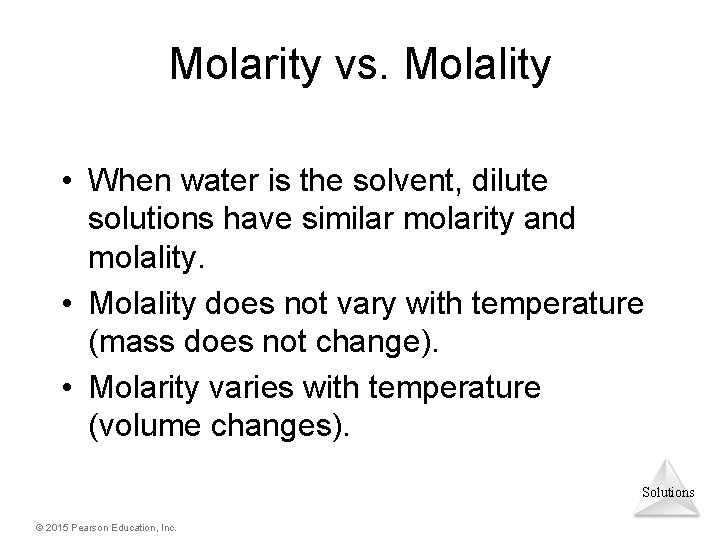
(5) Molarity (M) (6) Molality (m) • Be careful of your penmanship! • Molarity was discussed in Chapter 4 as moles of solute per liter of solution. • Molality is moles of solute per kilogram of solvent. Solutions © 2015 Pearson Education, Inc.
Molarity vs. Molality • When water is the solvent, dilute solutions have similar molarity and molality. • Molality does not vary with temperature (mass does not change). • Molarity varies with temperature (volume changes). Solutions © 2015 Pearson Education, Inc.
Converting Units • Follow dimensional analysis techniques from Chapter 1. • To convert between molality and molarity, the density of the solution must be used. Solutions © 2015 Pearson Education, Inc.
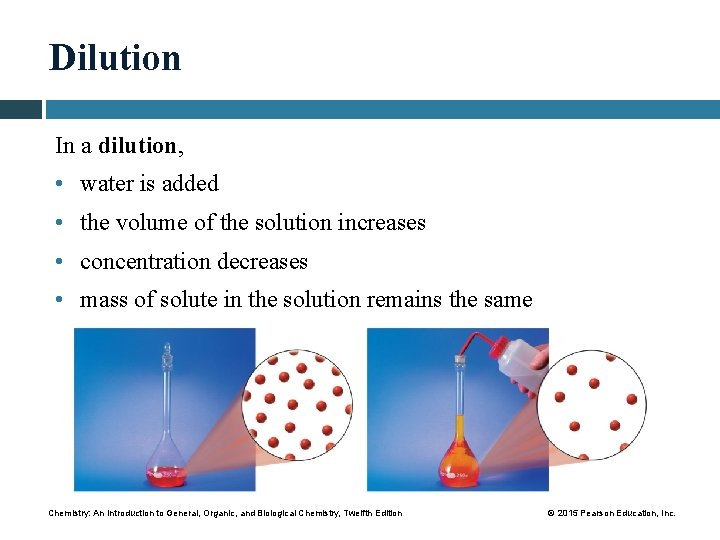
Dilution In a dilution, • water is added • the volume of the solution increases • concentration decreases • mass of solute in the solution remains the same Chemistry: An Introduction to General, Organic, and Biological Chemistry, Twelfth Edition © 2015 Pearson Education, Inc.
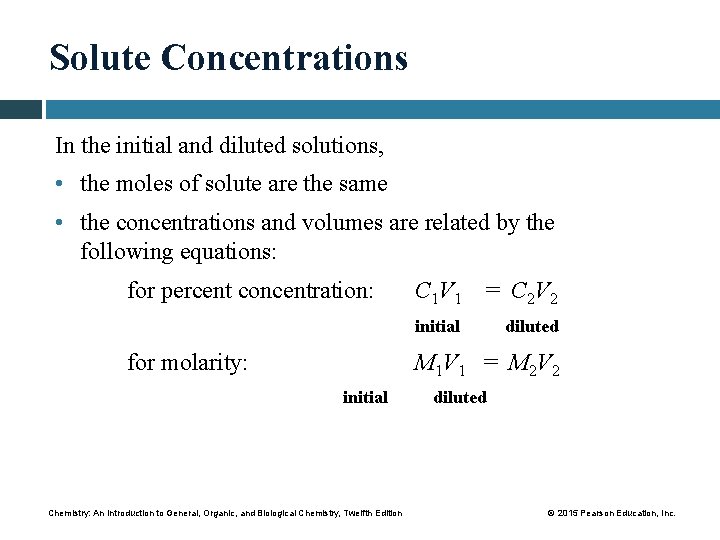
Solute Concentrations In the initial and diluted solutions, • the moles of solute are the same • the concentrations and volumes are related by the following equations: for percent concentration: for molarity: C 1 V 1 = C 2 V 2 initial diluted M 1 V 1 = M 2 V 2 initial Chemistry: An Introduction to General, Organic, and Biological Chemistry, Twelfth Edition diluted © 2015 Pearson Education, Inc.
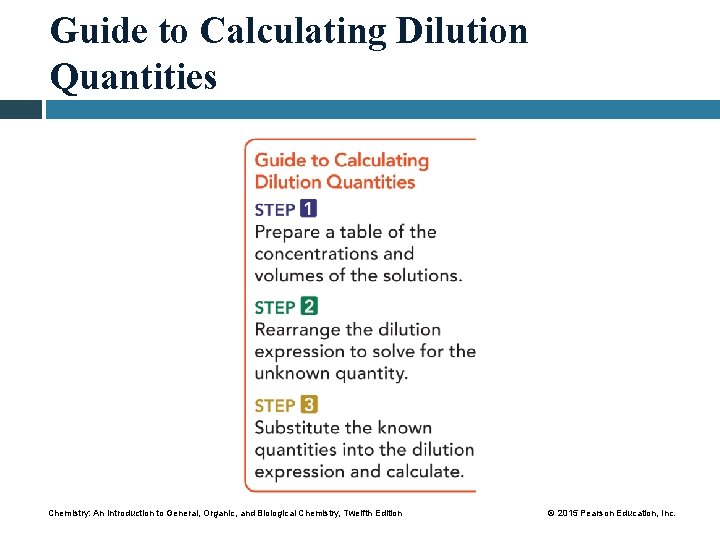
Guide to Calculating Dilution Quantities Chemistry: An Introduction to General, Organic, and Biological Chemistry, Twelfth Edition © 2015 Pearson Education, Inc.
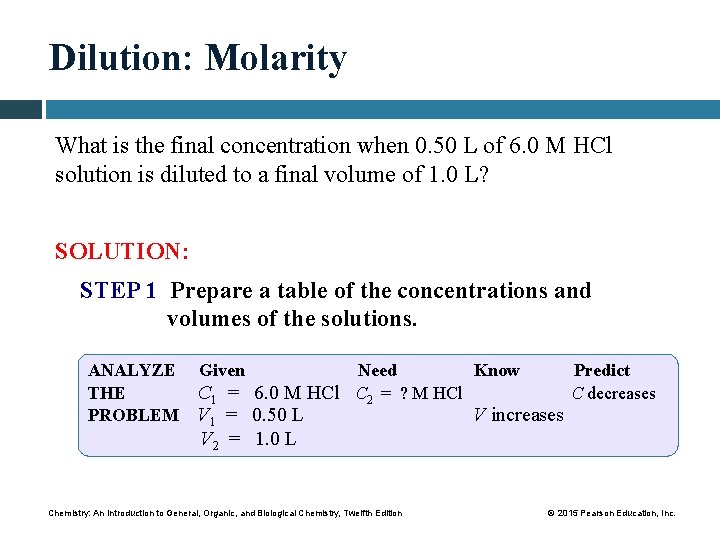
Dilution: Molarity What is the final concentration when 0. 50 L of 6. 0 M HCl solution is diluted to a final volume of 1. 0 L? SOLUTION: STEP 1 Prepare a table of the concentrations and volumes of the solutions. ANALYZE THE PROBLEM Given Need Know C 1 = 6. 0 M HCl C 2 = ? M HCl V 1 = 0. 50 L V 2 = 1. 0 L Chemistry: An Introduction to General, Organic, and Biological Chemistry, Twelfth Edition Predict C decreases V increases © 2015 Pearson Education, Inc.
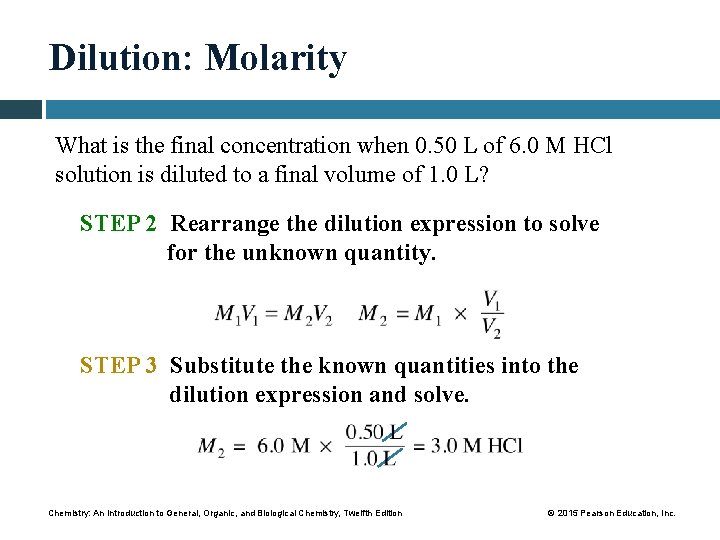
Dilution: Molarity What is the final concentration when 0. 50 L of 6. 0 M HCl solution is diluted to a final volume of 1. 0 L? STEP 2 Rearrange the dilution expression to solve for the unknown quantity. STEP 3 Substitute the known quantities into the dilution expression and solve. Chemistry: An Introduction to General, Organic, and Biological Chemistry, Twelfth Edition © 2015 Pearson Education, Inc.
Study Check What volume of a 2. 00% (m/v) HCl solution can be prepared by diluting 25. 0 m. L of 14. 0% (m/v) HCl solution? Chemistry: An Introduction to General, Organic, and Biological Chemistry, Twelfth Edition © 2015 Pearson Education, Inc.
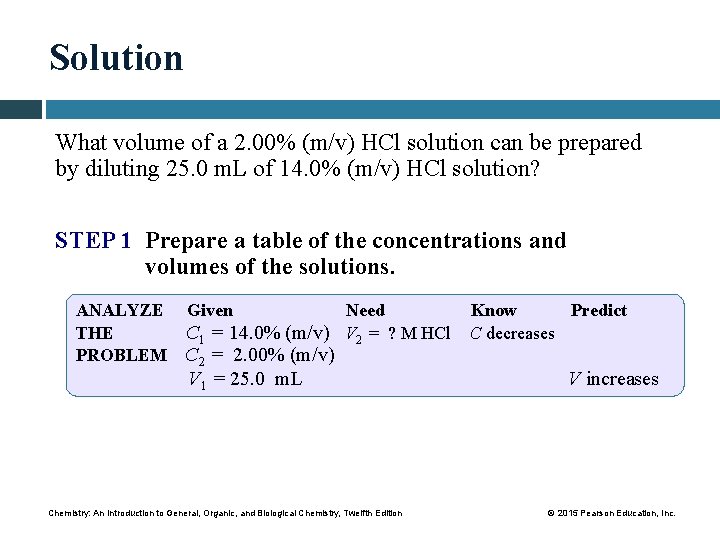
Solution What volume of a 2. 00% (m/v) HCl solution can be prepared by diluting 25. 0 m. L of 14. 0% (m/v) HCl solution? STEP 1 Prepare a table of the concentrations and volumes of the solutions. ANALYZE THE PROBLEM Given Need C 1 = 14. 0% (m/v) V 2 = ? M HCl C 2 = 2. 00% (m/v) V 1 = 25. 0 m. L Chemistry: An Introduction to General, Organic, and Biological Chemistry, Twelfth Edition Know Predict C decreases V increases © 2015 Pearson Education, Inc.
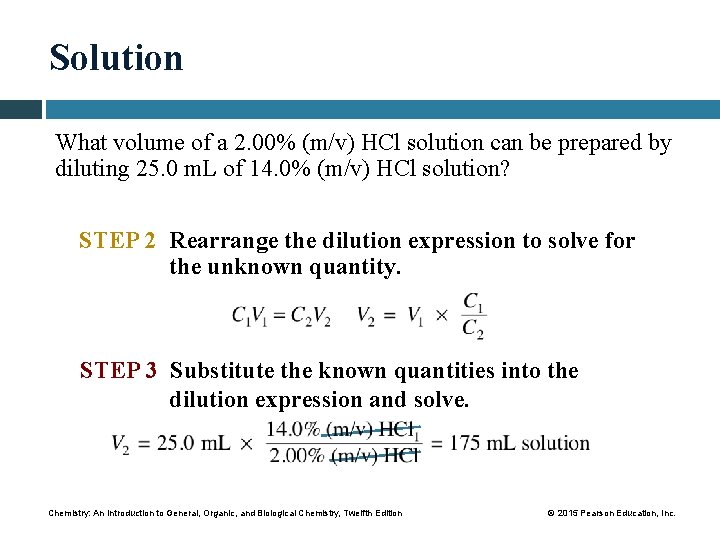
Solution What volume of a 2. 00% (m/v) HCl solution can be prepared by diluting 25. 0 m. L of 14. 0% (m/v) HCl solution? STEP 2 Rearrange the dilution expression to solve for the unknown quantity. STEP 3 Substitute the known quantities into the dilution expression and solve. Chemistry: An Introduction to General, Organic, and Biological Chemistry, Twelfth Edition © 2015 Pearson Education, Inc.
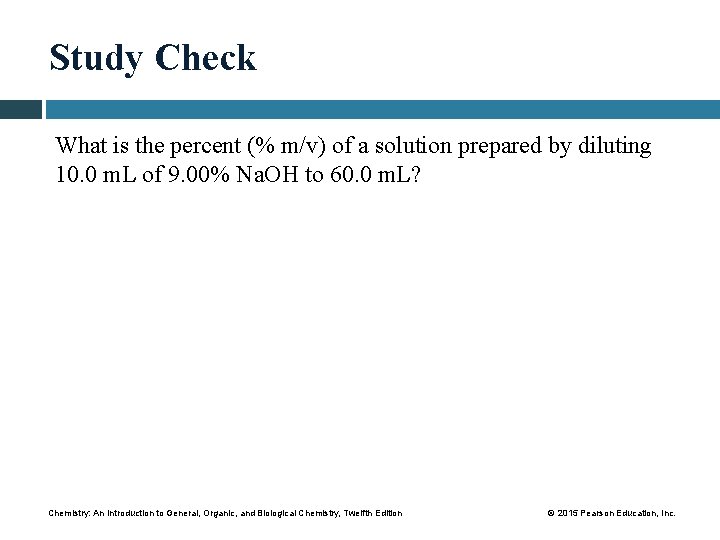
Study Check What is the percent (% m/v) of a solution prepared by diluting 10. 0 m. L of 9. 00% Na. OH to 60. 0 m. L? Chemistry: An Introduction to General, Organic, and Biological Chemistry, Twelfth Edition © 2015 Pearson Education, Inc.
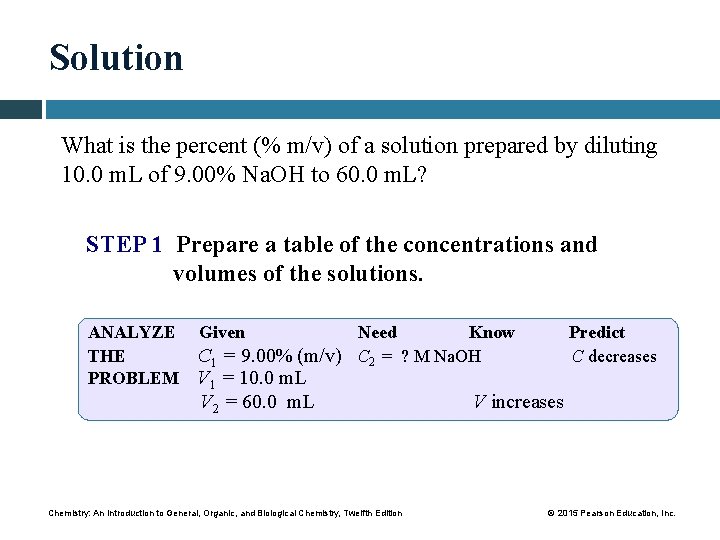
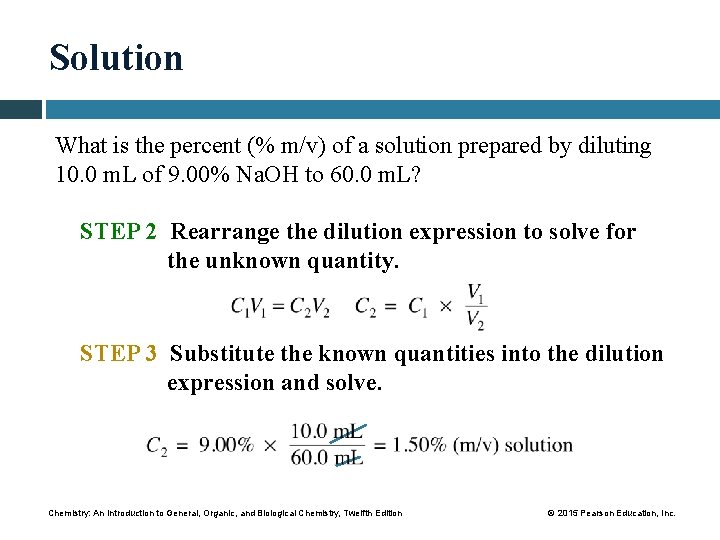
Solution What is the percent (% m/v) of a solution prepared by diluting 10. 0 m. L of 9. 00% Na. OH to 60. 0 m. L? STEP 1 Prepare a table of the concentrations and volumes of the solutions. ANALYZE THE PROBLEM Given Need Know C 1 = 9. 00% (m/v) C 2 = ? M Na. OH V 1 = 10. 0 m. L V 2 = 60. 0 m. L Chemistry: An Introduction to General, Organic, and Biological Chemistry, Twelfth Edition Predict C decreases V increases © 2015 Pearson Education, Inc.
Solution What is the percent (% m/v) of a solution prepared by diluting 10. 0 m. L of 9. 00% Na. OH to 60. 0 m. L? STEP 2 Rearrange the dilution expression to solve for the unknown quantity. STEP 3 Substitute the known quantities into the dilution expression and solve. Chemistry: An Introduction to General, Organic, and Biological Chemistry, Twelfth Edition © 2015 Pearson Education, Inc.
Study Check What is the molarity (M) of a solution prepared by diluting 0. 180 L of 0. 600 M HNO 3 to 0. 540 L? Chemistry: An Introduction to General, Organic, and Biological Chemistry, Twelfth Edition © 2015 Pearson Education, Inc.
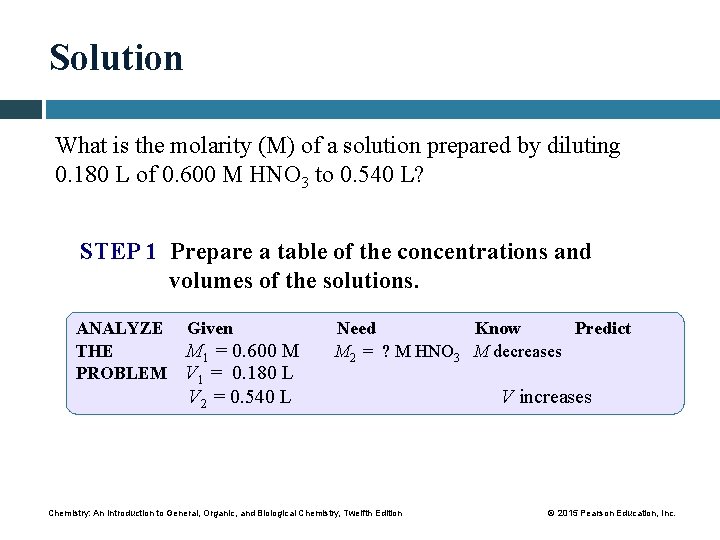
Solution What is the molarity (M) of a solution prepared by diluting 0. 180 L of 0. 600 M HNO 3 to 0. 540 L? STEP 1 Prepare a table of the concentrations and volumes of the solutions. ANALYZE THE PROBLEM Given M 1 = 0. 600 M V 1 = 0. 180 L V 2 = 0. 540 L Need Know Predict M 2 = ? M HNO 3 M decreases Chemistry: An Introduction to General, Organic, and Biological Chemistry, Twelfth Edition V increases © 2015 Pearson Education, Inc.
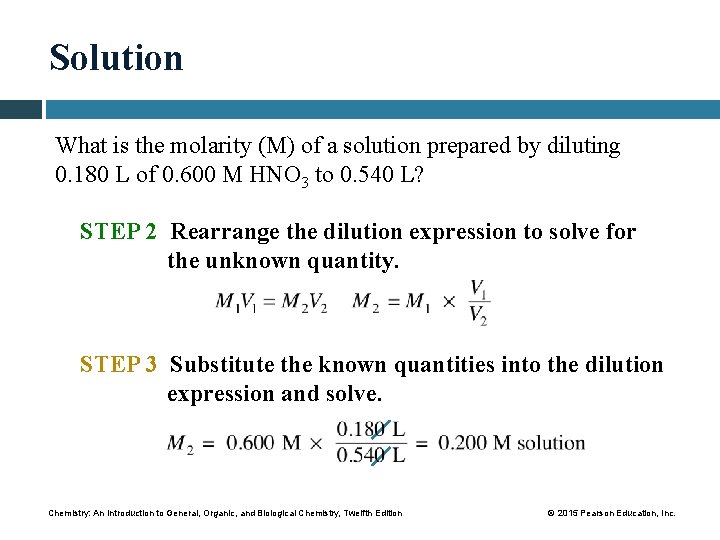
Solution What is the molarity (M) of a solution prepared by diluting 0. 180 L of 0. 600 M HNO 3 to 0. 540 L? STEP 2 Rearrange the dilution expression to solve for the unknown quantity. STEP 3 Substitute the known quantities into the dilution expression and solve. Chemistry: An Introduction to General, Organic, and Biological Chemistry, Twelfth Edition © 2015 Pearson Education, Inc.
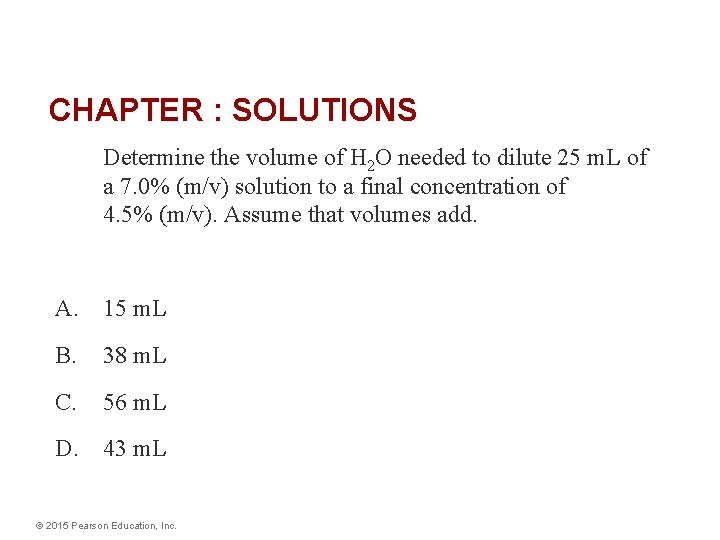
CHAPTER : SOLUTIONS Determine the volume of H 2 O needed to dilute 25 m. L of a 7. 0% (m/v) solution to a final concentration of 4. 5% (m/v). Assume that volumes add. A. 15 m. L B. 38 m. L C. 56 m. L D. 43 m. L © 2015 Pearson Education, Inc.
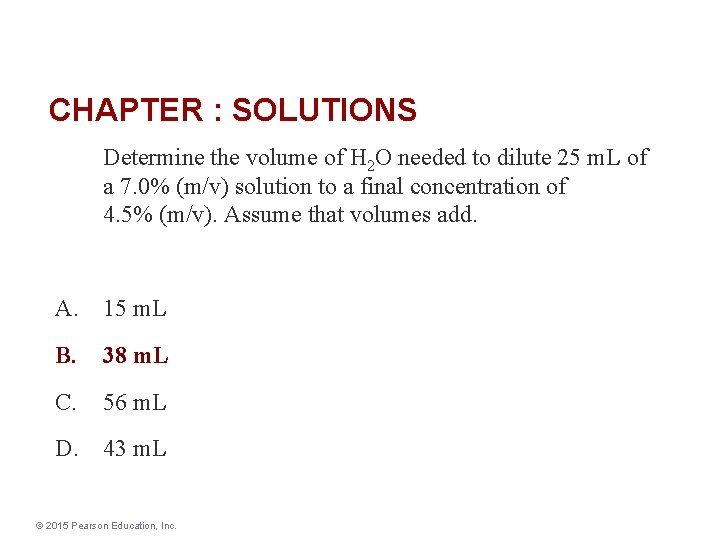
CHAPTER : SOLUTIONS Determine the volume of H 2 O needed to dilute 25 m. L of a 7. 0% (m/v) solution to a final concentration of 4. 5% (m/v). Assume that volumes add. A. 15 m. L B. 38 m. L C. 56 m. L D. 43 m. L © 2015 Pearson Education, Inc.
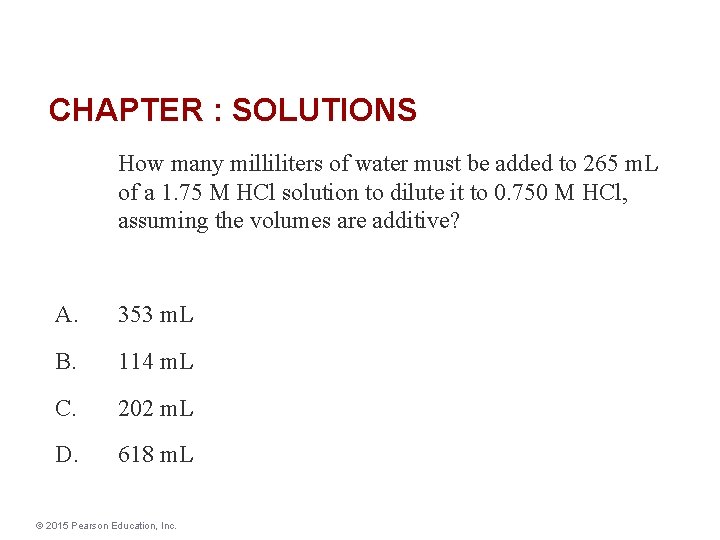
CHAPTER : SOLUTIONS How many milliliters of water must be added to 265 m. L of a 1. 75 M HCl solution to dilute it to 0. 750 M HCl, assuming the volumes are additive? A. 353 m. L B. 114 m. L C. 202 m. L D. 618 m. L © 2015 Pearson Education, Inc.
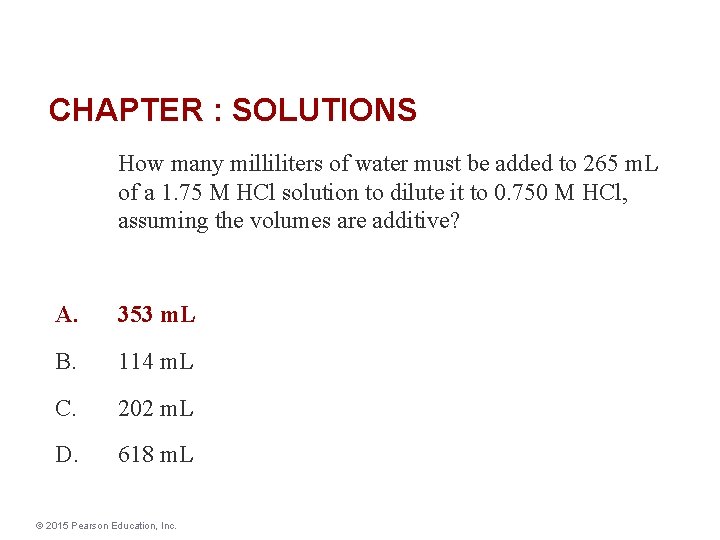
CHAPTER : SOLUTIONS How many milliliters of water must be added to 265 m. L of a 1. 75 M HCl solution to dilute it to 0. 750 M HCl, assuming the volumes are additive? A. 353 m. L B. 114 m. L C. 202 m. L D. 618 m. L © 2015 Pearson Education, Inc.
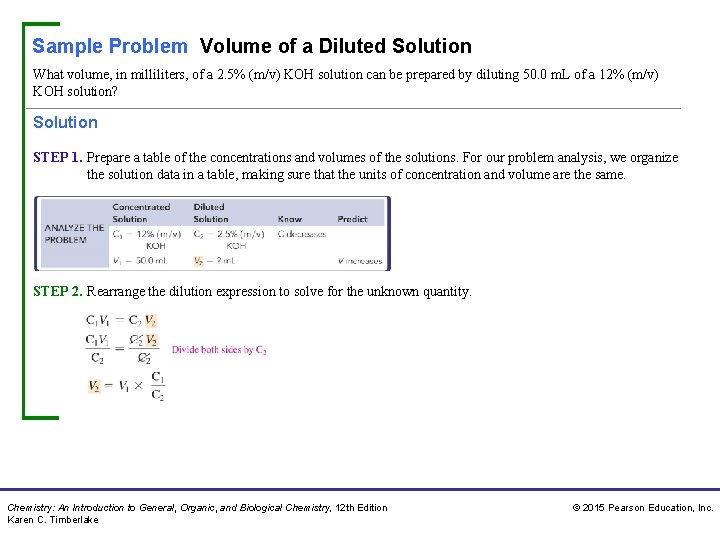
Sample Problem Volume of a Diluted Solution What volume, in milliliters, of a 2. 5% (m/v) KOH solution can be prepared by diluting 50. 0 m. L of a 12% (m/v) KOH solution? Solution STEP 1. Prepare a table of the concentrations and volumes of the solutions. For our problem analysis, we organize the solution data in a table, making sure that the units of concentration and volume are the same. STEP 2. Rearrange the dilution expression to solve for the unknown quantity. Chemistry: An Introduction to General, Organic, and Biological Chemistry, 12 th Edition Karen C. Timberlake © 2015 Pearson Education, Inc.
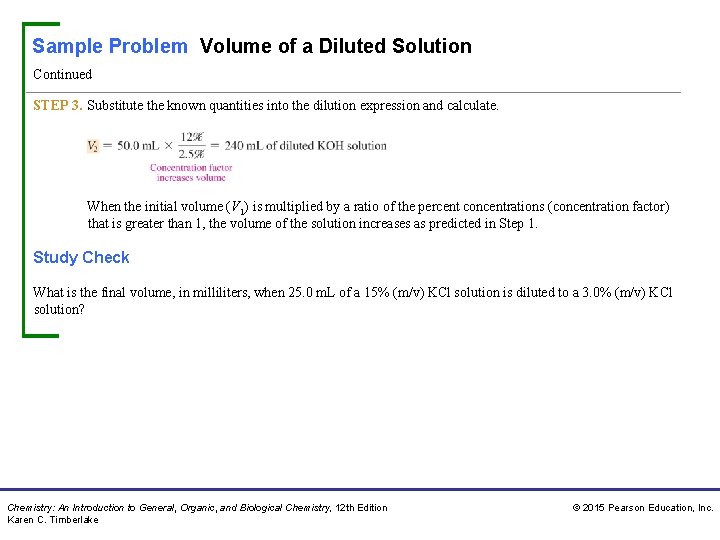
Sample Problem Volume of a Diluted Solution Continued STEP 3. Substitute the known quantities into the dilution expression and calculate. When the initial volume (V 1) is multiplied by a ratio of the percent concentrations (concentration factor) that is greater than 1, the volume of the solution increases as predicted in Step 1. Study Check What is the final volume, in milliliters, when 25. 0 m. L of a 15% (m/v) KCl solution is diluted to a 3. 0% (m/v) KCl solution? Chemistry: An Introduction to General, Organic, and Biological Chemistry, 12 th Edition Karen C. Timberlake © 2015 Pearson Education, Inc.
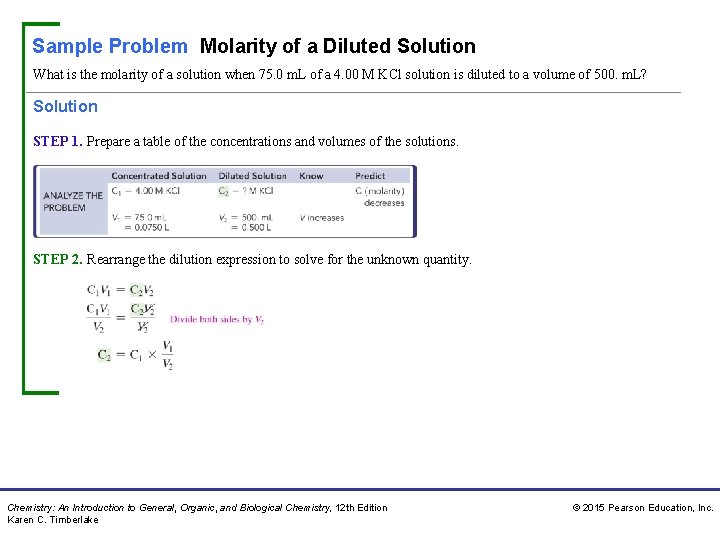
Sample Problem Molarity of a Diluted Solution What is the molarity of a solution when 75. 0 m. L of a 4. 00 M KCl solution is diluted to a volume of 500. m. L? Solution STEP 1. Prepare a table of the concentrations and volumes of the solutions. STEP 2. Rearrange the dilution expression to solve for the unknown quantity. Chemistry: An Introduction to General, Organic, and Biological Chemistry, 12 th Edition Karen C. Timberlake © 2015 Pearson Education, Inc.
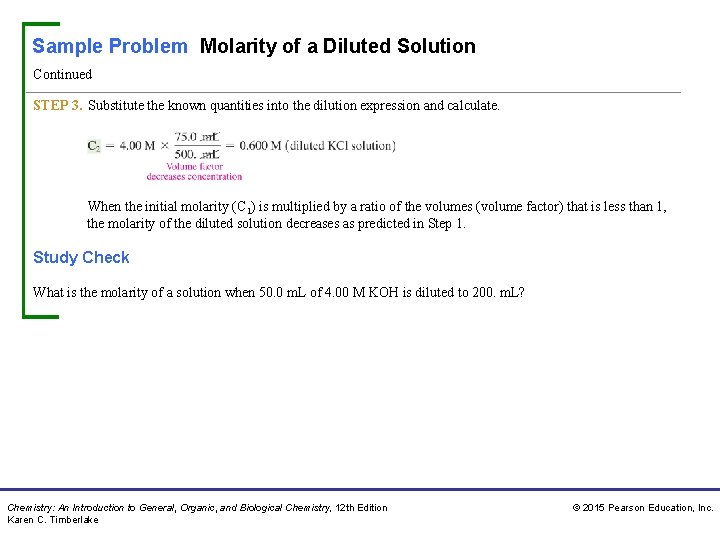
Sample Problem Molarity of a Diluted Solution Continued STEP 3. Substitute the known quantities into the dilution expression and calculate. When the initial molarity (C 1) is multiplied by a ratio of the volumes (volume factor) that is less than 1, the molarity of the diluted solution decreases as predicted in Step 1. Study Check What is the molarity of a solution when 50. 0 m. L of 4. 00 M KOH is diluted to 200. m. L? Chemistry: An Introduction to General, Organic, and Biological Chemistry, 12 th Edition Karen C. Timberlake © 2015 Pearson Education, Inc.
13. 5 Colligative Properties Solutions © 2015 Pearson Education, Inc.
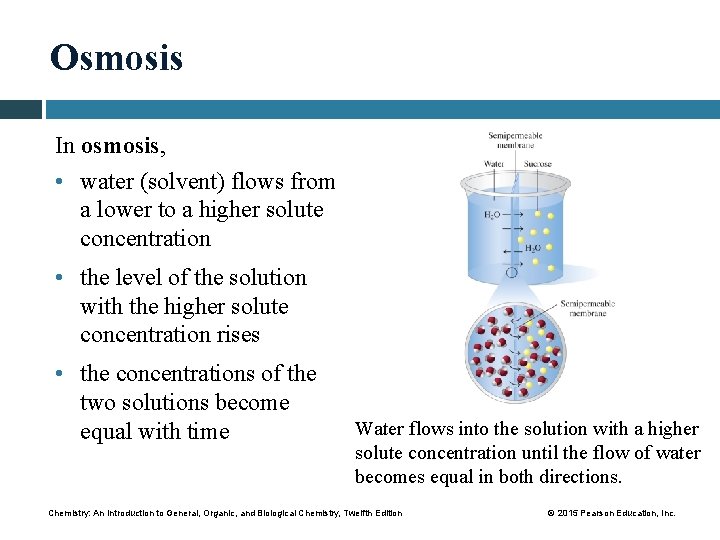
Osmosis In osmosis, • water (solvent) flows from a lower to a higher solute concentration • the level of the solution with the higher solute concentration rises • the concentrations of the two solutions become equal with time Water flows into the solution with a higher solute concentration until the flow of water becomes equal in both directions. Chemistry: An Introduction to General, Organic, and Biological Chemistry, Twelfth Edition © 2015 Pearson Education, Inc.
Osmotic Pressure Osmotic pressure is • equal to the pressure that would prevent the flow of additional water into the more concentrated solution • greater as the number of dissolved particles in the solution increases Chemistry: An Introduction to General, Organic, and Biological Chemistry, Twelfth Edition © 2015 Pearson Education, Inc.
Reverse Osmosis In a process called reverse osmosis, • a pressure greater than the osmotic pressure is applied to a solution forcing it through a purification membrane • the flow of water is reversed because water flows from an area of lower water concentration to an area of higher water concentration, leaving behind the molecules and ions in solution Reverse osmosis, used in a few desalination plants to obtain pure water from sea (salt) water, requires a large amount of energy. Chemistry: An Introduction to General, Organic, and Biological Chemistry, Twelfth Edition © 2015 Pearson Education, Inc.
Colligative Properties • Colligative properties depend only on the quantity, not on the identity of the solute particles. • Among colligative properties are: – Vapor-pressure lowering – Boiling-point elevation – Freezing-point depression – Osmotic pressure Solutions © 2015 Pearson Education, Inc.
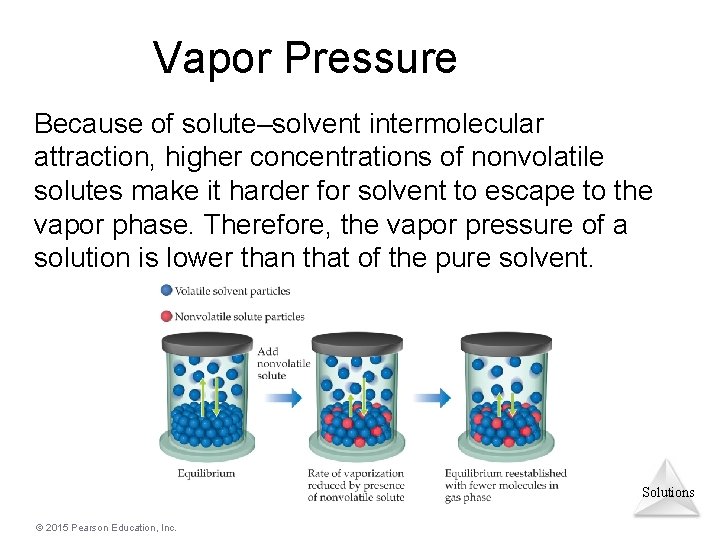
Vapor Pressure Because of solute–solvent intermolecular attraction, higher concentrations of nonvolatile solutes make it harder for solvent to escape to the vapor phase. Therefore, the vapor pressure of a solution is lower than that of the pure solvent. Solutions © 2015 Pearson Education, Inc.
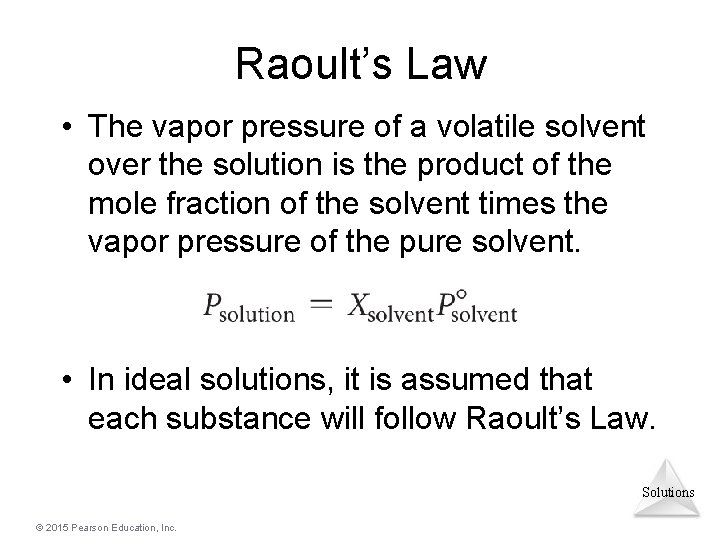
Raoult’s Law • The vapor pressure of a volatile solvent over the solution is the product of the mole fraction of the solvent times the vapor pressure of the pure solvent. • In ideal solutions, it is assumed that each substance will follow Raoult’s Law. Solutions © 2015 Pearson Education, Inc.
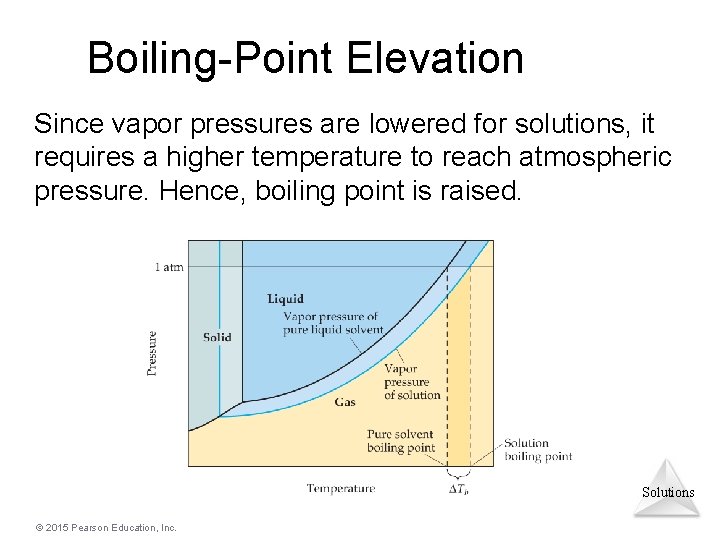
Boiling-Point Elevation Since vapor pressures are lowered for solutions, it requires a higher temperature to reach atmospheric pressure. Hence, boiling point is raised. Solutions © 2015 Pearson Education, Inc.
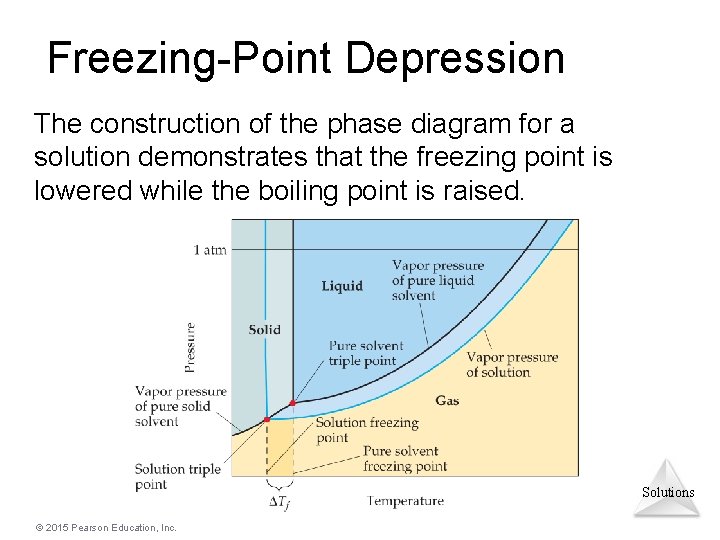
Freezing-Point Depression The construction of the phase diagram for a solution demonstrates that the freezing point is lowered while the boiling point is raised. Solutions © 2015 Pearson Education, Inc.
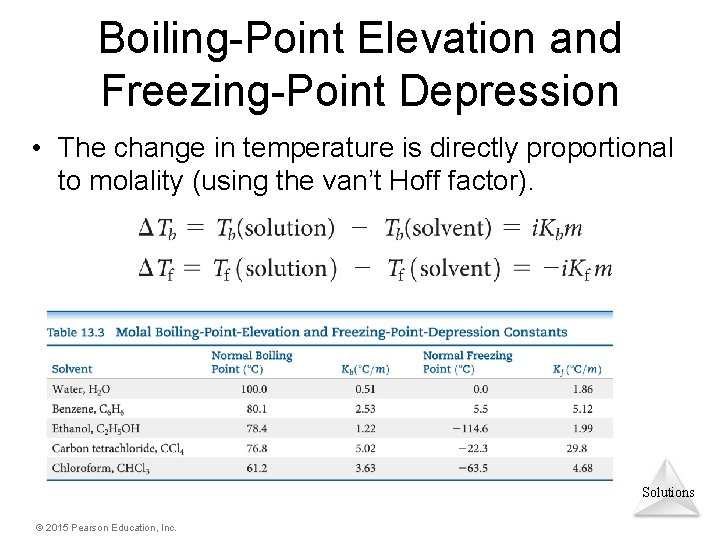
Boiling-Point Elevation and Freezing-Point Depression • The change in temperature is directly proportional to molality (using the van’t Hoff factor). Solutions © 2015 Pearson Education, Inc.
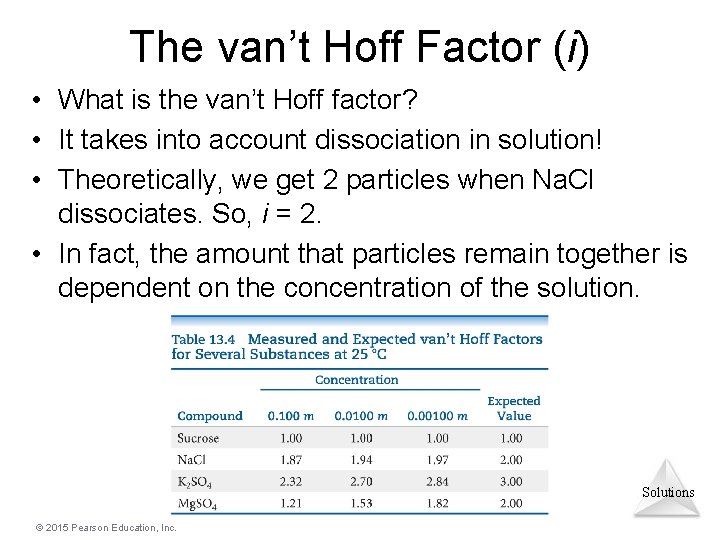
The van’t Hoff Factor (i) • What is the van’t Hoff factor? • It takes into account dissociation in solution! • Theoretically, we get 2 particles when Na. Cl dissociates. So, i = 2. • In fact, the amount that particles remain together is dependent on the concentration of the solution. Solutions © 2015 Pearson Education, Inc.
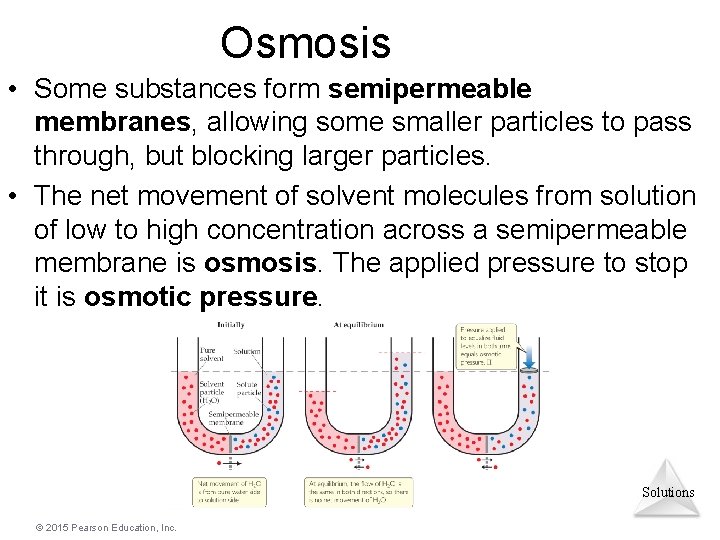
Osmosis • Some substances form semipermeable membranes, allowing some smaller particles to pass through, but blocking larger particles. • The net movement of solvent molecules from solution of low to high concentration across a semipermeable membrane is osmosis. The applied pressure to stop it is osmotic pressure. Solutions © 2015 Pearson Education, Inc.
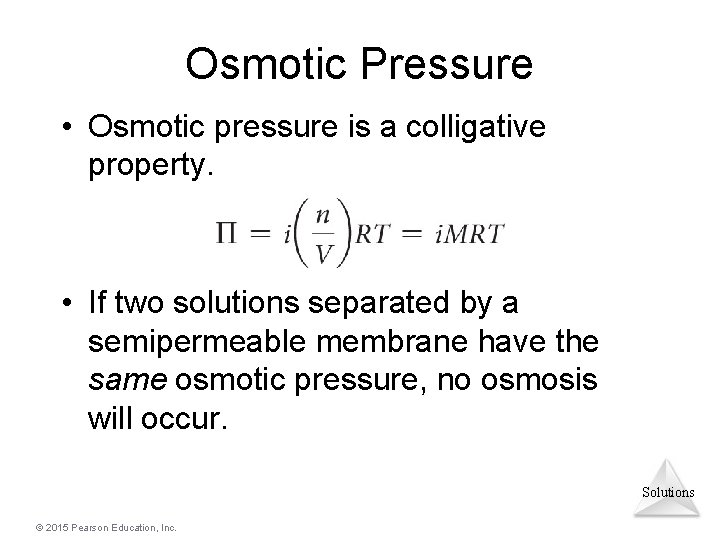
Osmotic Pressure • Osmotic pressure is a colligative property. • If two solutions separated by a semipermeable membrane have the same osmotic pressure, no osmosis will occur. Solutions © 2015 Pearson Education, Inc.
Types of Solutions & Osmosis 1) Isotonic solutions: Same osmotic pressure; solvent passes the membrane at the same rate both ways. 2) Hypotonic solution: Lower osmotic pressure; solvent will leave this solution at a higher rate than it enters with. 3) Hypertonic solution: Higher osmotic pressure; solvent will enter this solution at a higher rate than it leaves with. Solutions © 2015 Pearson Education, Inc.
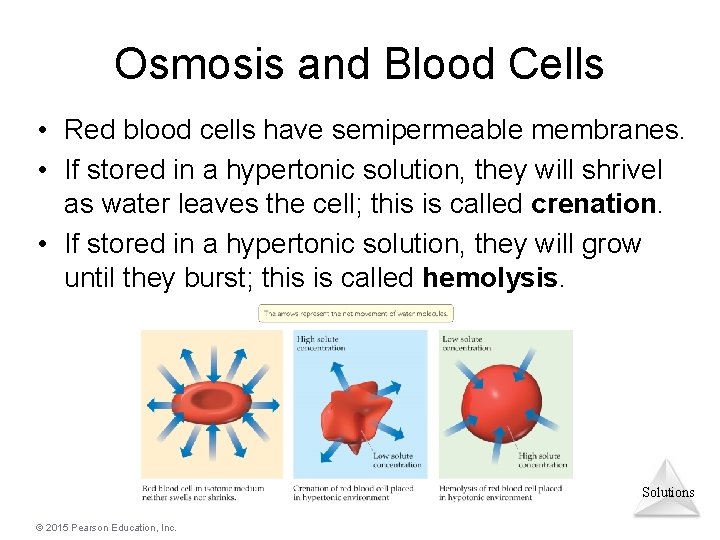
Osmosis and Blood Cells • Red blood cells have semipermeable membranes. • If stored in a hypertonic solution, they will shrivel as water leaves the cell; this is called crenation. • If stored in a hypertonic solution, they will grow until they burst; this is called hemolysis. Solutions © 2015 Pearson Education, Inc.
13. 6 Colloids Solutions © 2015 Pearson Education, Inc.
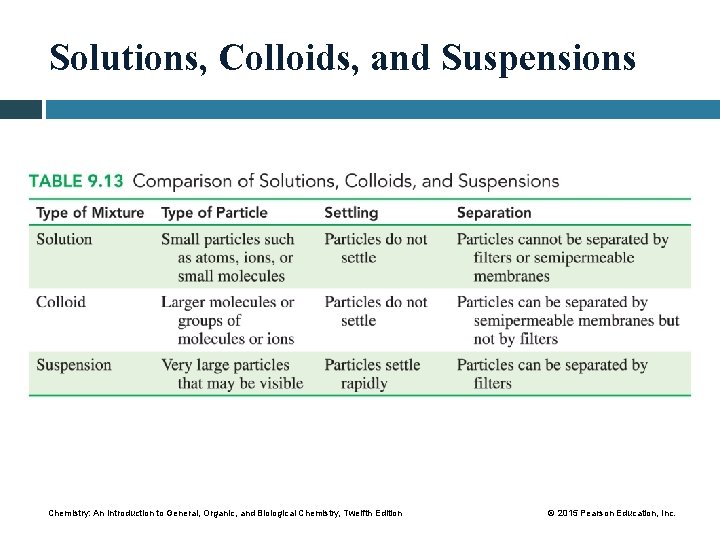
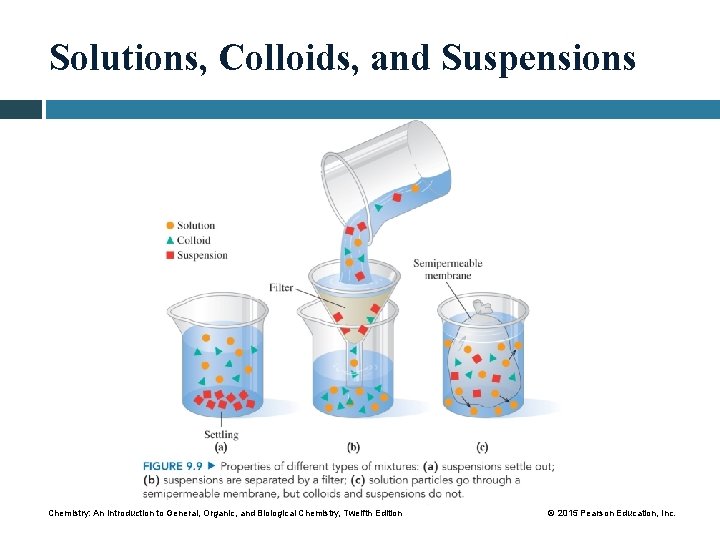
Solutions • are transparent • do not separate • contain small particles, ions, or molecules that cannot be filtered and pass through semipermeable membranes Chemistry: An Introduction to General, Organic, and Biological Chemistry, Twelfth Edition © 2015 Pearson Education, Inc.
Colloids • have medium-size particles • cannot be filtered • can be separated by semipermeable membranes Chemistry: An Introduction to General, Organic, and Biological Chemistry, Twelfth Edition © 2015 Pearson Education, Inc.
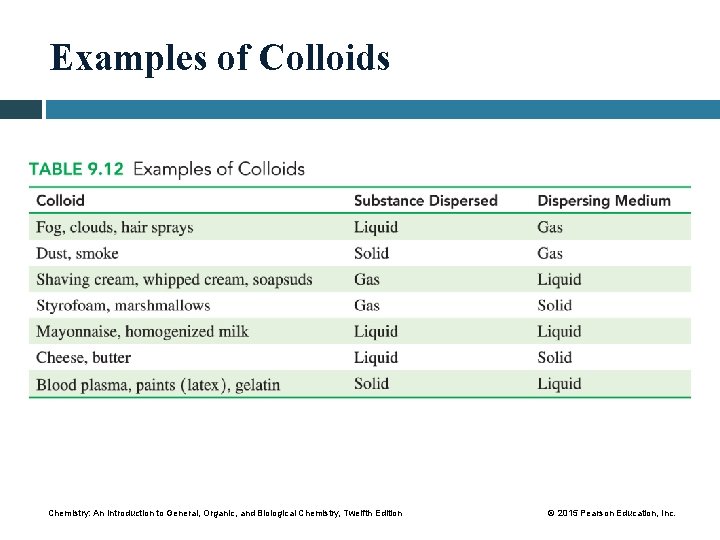
Examples of Colloids Chemistry: An Introduction to General, Organic, and Biological Chemistry, Twelfth Edition © 2015 Pearson Education, Inc.
Suspensions • are heterogeneous, nonuniform mixtures • have very large particles that settle out of solution • can be filtered • must be stirred to stay suspended Examples include blood platelets, muddy water, and calamine lotion. Chemistry: An Introduction to General, Organic, and Biological Chemistry, Twelfth Edition © 2015 Pearson Education, Inc.
Solutions, Colloids, and Suspensions Chemistry: An Introduction to General, Organic, and Biological Chemistry, Twelfth Edition © 2015 Pearson Education, Inc.
Solutions, Colloids, and Suspensions Chemistry: An Introduction to General, Organic, and Biological Chemistry, Twelfth Edition © 2015 Pearson Education, Inc.
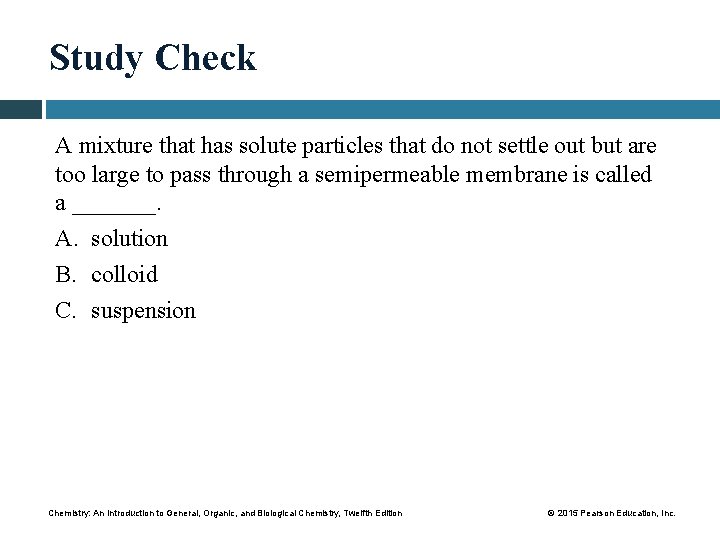
Study Check A mixture that has solute particles that do not settle out but are too large to pass through a semipermeable membrane is called a _______. A. solution B. colloid C. suspension Chemistry: An Introduction to General, Organic, and Biological Chemistry, Twelfth Edition © 2015 Pearson Education, Inc.
Solution A mixture that has solute particles that do not settle out but are too large to pass through a semipermeable membrane is called a ______. B. colloid Chemistry: An Introduction to General, Organic, and Biological Chemistry, Twelfth Edition © 2015 Pearson Education, Inc.
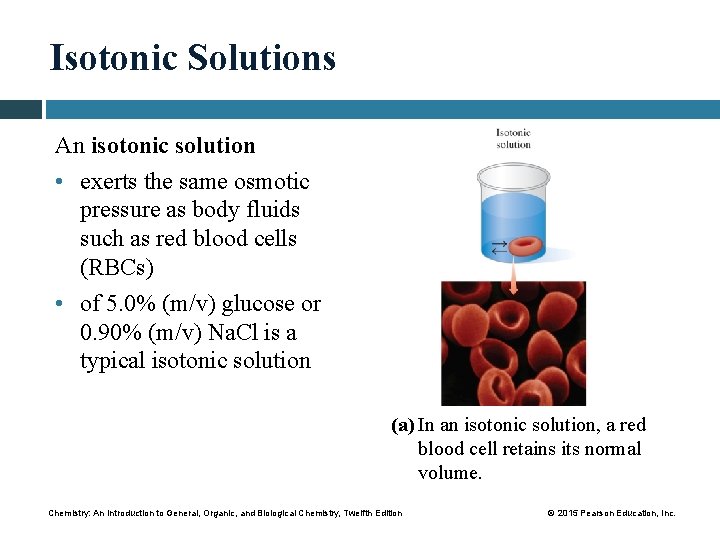
Isotonic Solutions An isotonic solution • exerts the same osmotic pressure as body fluids such as red blood cells (RBCs) • of 5. 0% (m/v) glucose or 0. 90% (m/v) Na. Cl is a typical isotonic solution (a) In an isotonic solution, a red blood cell retains its normal volume. Chemistry: An Introduction to General, Organic, and Biological Chemistry, Twelfth Edition © 2015 Pearson Education, Inc.
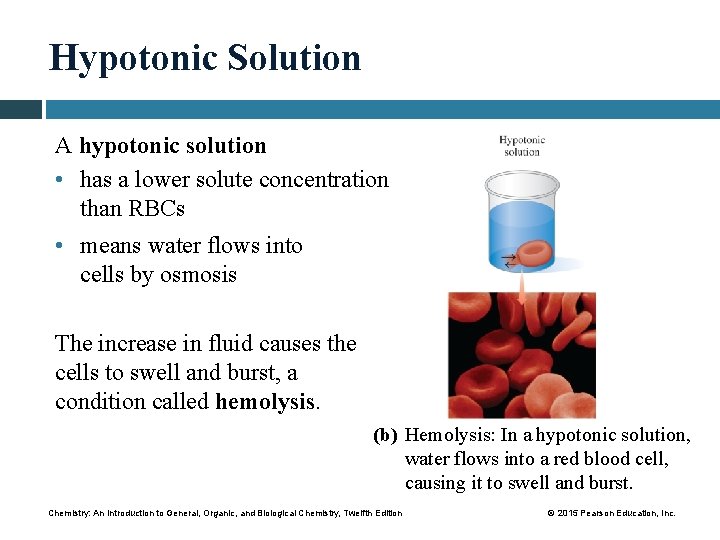
Hypotonic Solution A hypotonic solution • has a lower solute concentration than RBCs • means water flows into cells by osmosis The increase in fluid causes the cells to swell and burst, a condition called hemolysis. (b) Hemolysis: In a hypotonic solution, water flows into a red blood cell, causing it to swell and burst. Chemistry: An Introduction to General, Organic, and Biological Chemistry, Twelfth Edition © 2015 Pearson Education, Inc.
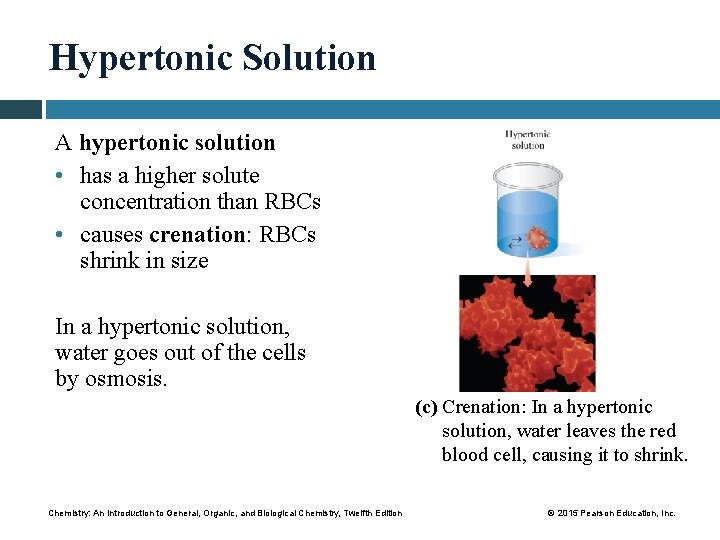
Hypertonic Solution A hypertonic solution • has a higher solute concentration than RBCs • causes crenation: RBCs shrink in size In a hypertonic solution, water goes out of the cells by osmosis. (c) Crenation: In a hypertonic solution, water leaves the red blood cell, causing it to shrink. Chemistry: An Introduction to General, Organic, and Biological Chemistry, Twelfth Edition © 2015 Pearson Education, Inc.
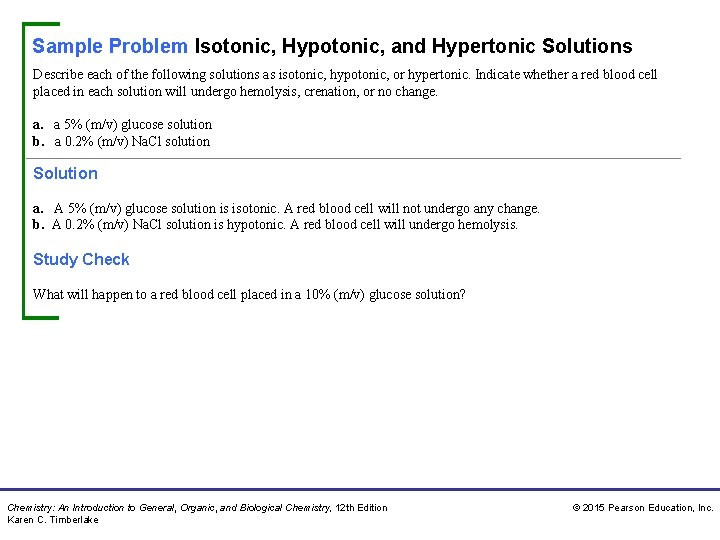
Sample Problem Isotonic, Hypotonic, and Hypertonic Solutions Describe each of the following solutions as isotonic, hypotonic, or hypertonic. Indicate whether a red blood cell placed in each solution will undergo hemolysis, crenation, or no change. a. a 5% (m/v) glucose solution b. a 0. 2% (m/v) Na. Cl solution Solution a. A 5% (m/v) glucose solution is isotonic. A red blood cell will not undergo any change. b. A 0. 2% (m/v) Na. Cl solution is hypotonic. A red blood cell will undergo hemolysis. Study Check What will happen to a red blood cell placed in a 10% (m/v) glucose solution? Chemistry: An Introduction to General, Organic, and Biological Chemistry, 12 th Edition Karen C. Timberlake © 2015 Pearson Education, Inc.
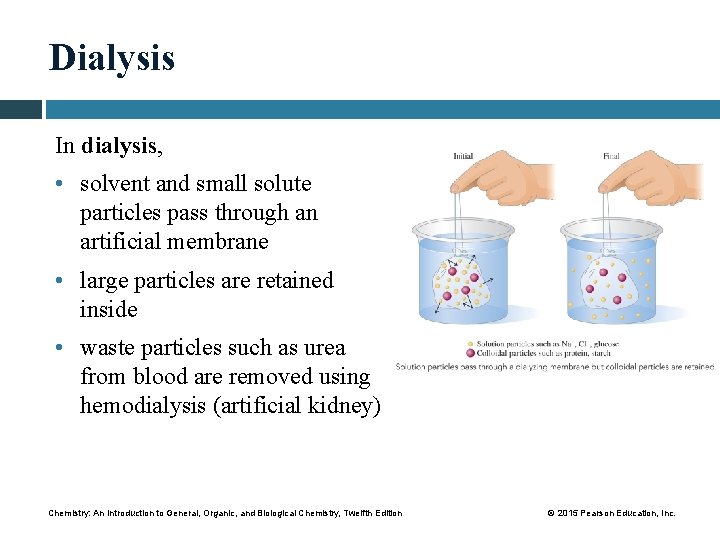
Dialysis In dialysis, • solvent and small solute particles pass through an artificial membrane • large particles are retained inside • waste particles such as urea from blood are removed using hemodialysis (artificial kidney) Chemistry: An Introduction to General, Organic, and Biological Chemistry, Twelfth Edition © 2015 Pearson Education, Inc.
Study Check Indicate whether each of the following solutions is A. isotonic B. hypotonic C. hypertonic 1. 2. 3. 4. ____ 2% Na. Cl solution ____ 1% glucose solution ____ 0. 5% Na. Cl solution ____ 5% glucose solution Chemistry: An Introduction to General, Organic, and Biological Chemistry, Twelfth Edition © 2015 Pearson Education, Inc.
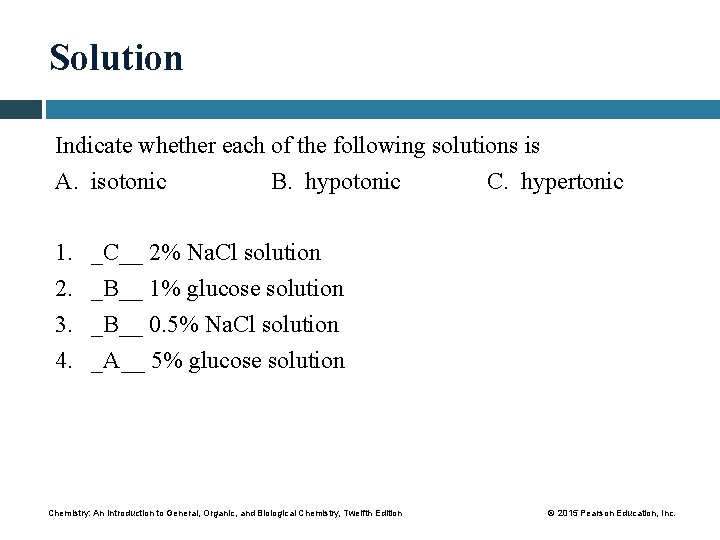
Solution Indicate whether each of the following solutions is A. isotonic B. hypotonic C. hypertonic 1. 2. 3. 4. _C__ 2% Na. Cl solution _B__ 1% glucose solution _B__ 0. 5% Na. Cl solution _A__ 5% glucose solution Chemistry: An Introduction to General, Organic, and Biological Chemistry, Twelfth Edition © 2015 Pearson Education, Inc.
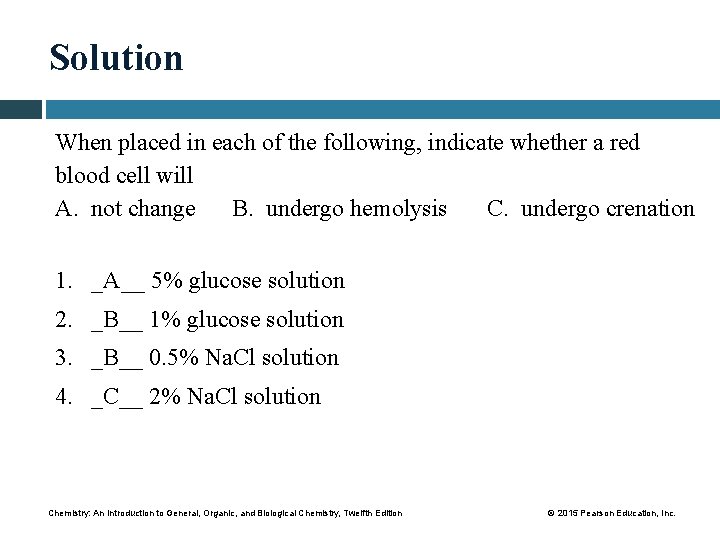
Study Check When placed in each of the following, indicate whether a red blood cell will A. not change B. undergo hemolysis C. undergo crenation 1. ____ 5% glucose solution 2. ____ 1% glucose solution 3. ____ 0. 5% Na. Cl solution 4. ____ 2% Na. Cl solution Chemistry: An Introduction to General, Organic, and Biological Chemistry, Twelfth Edition © 2015 Pearson Education, Inc.
Solution When placed in each of the following, indicate whether a red blood cell will A. not change B. undergo hemolysis C. undergo crenation 1. _A__ 5% glucose solution 2. _B__ 1% glucose solution 3. _B__ 0. 5% Na. Cl solution 4. _C__ 2% Na. Cl solution Chemistry: An Introduction to General, Organic, and Biological Chemistry, Twelfth Edition © 2015 Pearson Education, Inc.
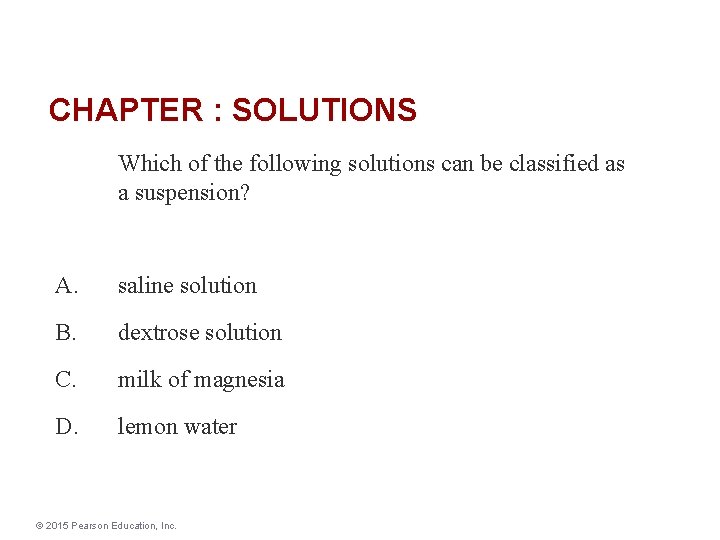
CHAPTER : SOLUTIONS Which of the following solutions can be classified as a suspension? A. saline solution B. dextrose solution C. milk of magnesia D. lemon water © 2015 Pearson Education, Inc.
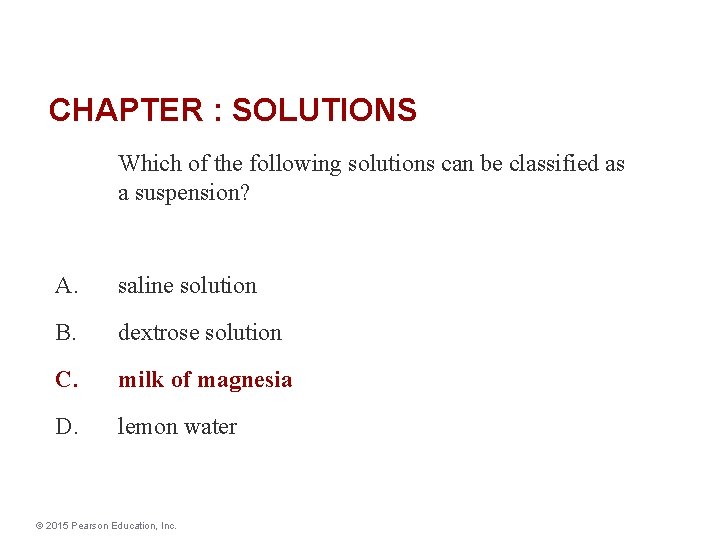
CHAPTER : SOLUTIONS Which of the following solutions can be classified as a suspension? A. saline solution B. dextrose solution C. milk of magnesia D. lemon water © 2015 Pearson Education, Inc.
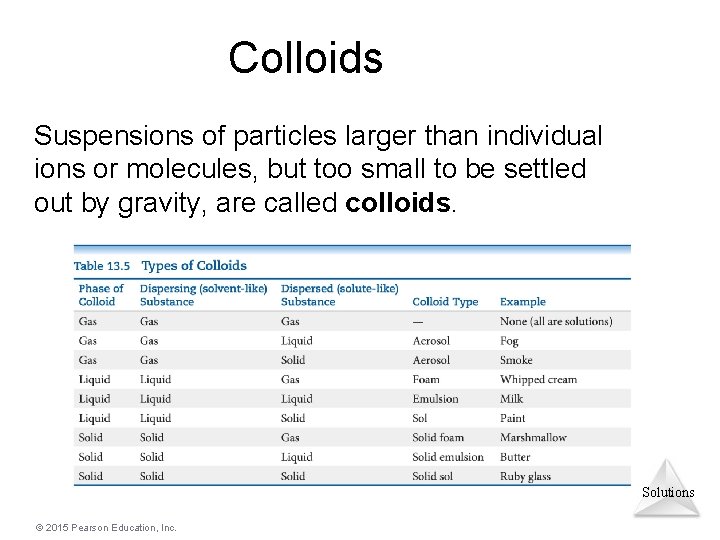
Colloids Suspensions of particles larger than individual ions or molecules, but too small to be settled out by gravity, are called colloids. Solutions © 2015 Pearson Education, Inc.
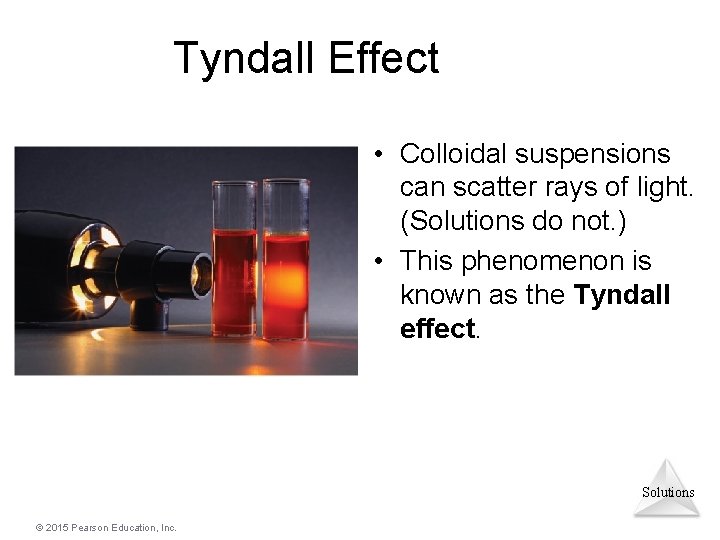
Tyndall Effect • Colloidal suspensions can scatter rays of light. (Solutions do not. ) • This phenomenon is known as the Tyndall effect. Solutions © 2015 Pearson Education, Inc.
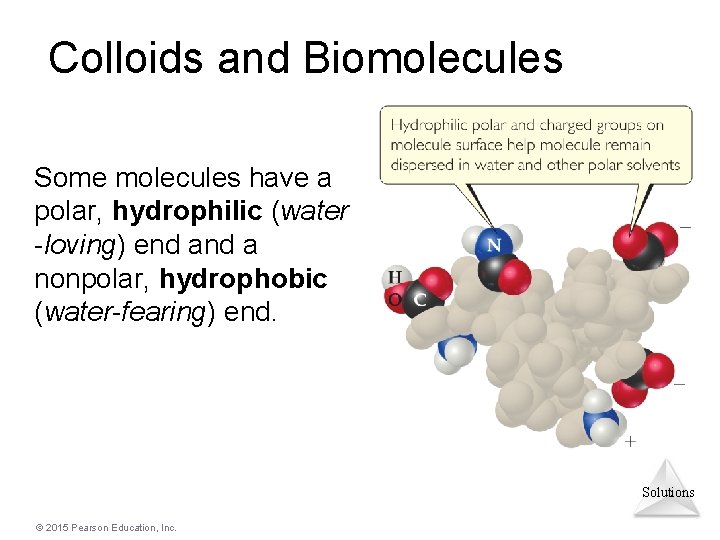
Colloids and Biomolecules Some molecules have a polar, hydrophilic (water -loving) end a nonpolar, hydrophobic (water-fearing) end. Solutions © 2015 Pearson Education, Inc.
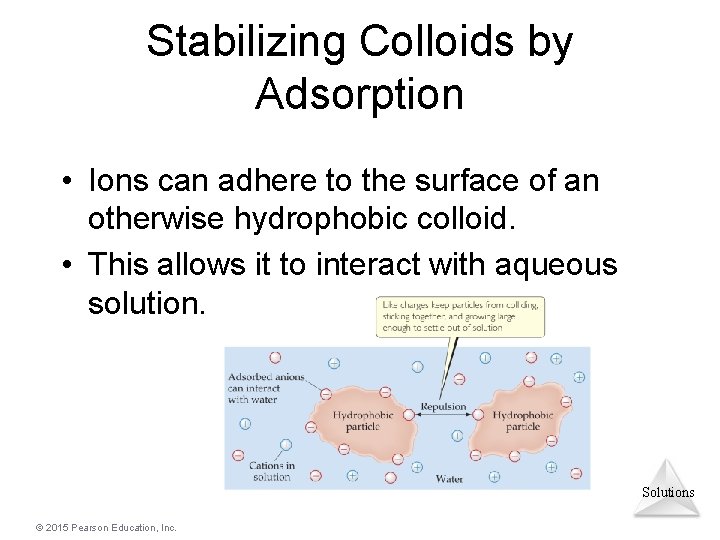
Stabilizing Colloids by Adsorption • Ions can adhere to the surface of an otherwise hydrophobic colloid. • This allows it to interact with aqueous solution. Solutions © 2015 Pearson Education, Inc.
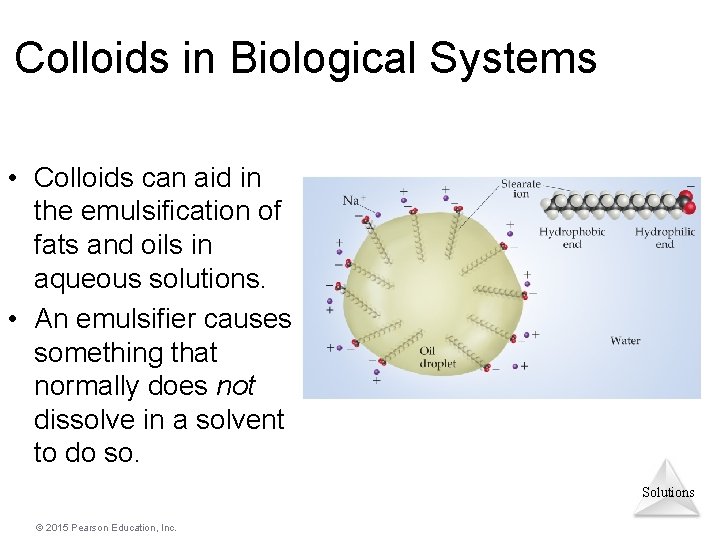
Colloids in Biological Systems • Colloids can aid in the emulsification of fats and oils in aqueous solutions. • An emulsifier causes something that normally does not dissolve in a solvent to do so. Solutions © 2015 Pearson Education, Inc.
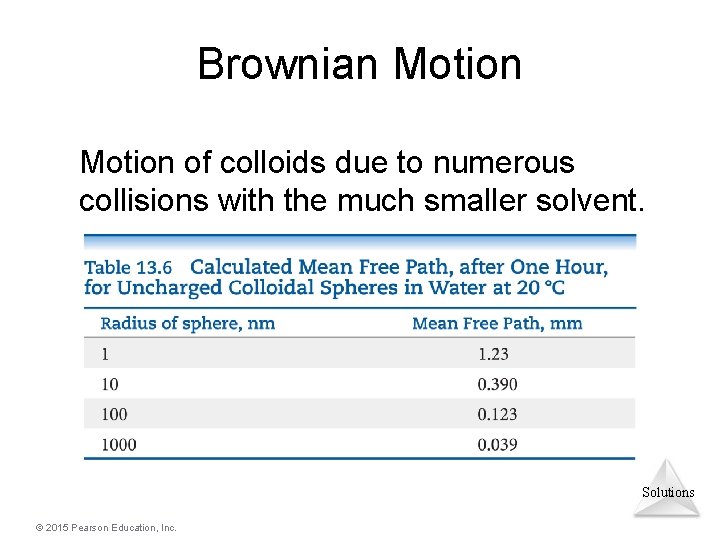
Brownian Motion of colloids due to numerous collisions with the much smaller solvent. Solutions © 2015 Pearson Education, Inc.