
Lecture Presentation Chapter 11 Liquids and Intermolecular Forces

- Slides: 37
Lecture Presentation Chapter 11 Liquids and Intermolecular Forces © 2012 Pearson Education, Inc. John D. Bookstaver St. Charles Community College Cottleville, MO
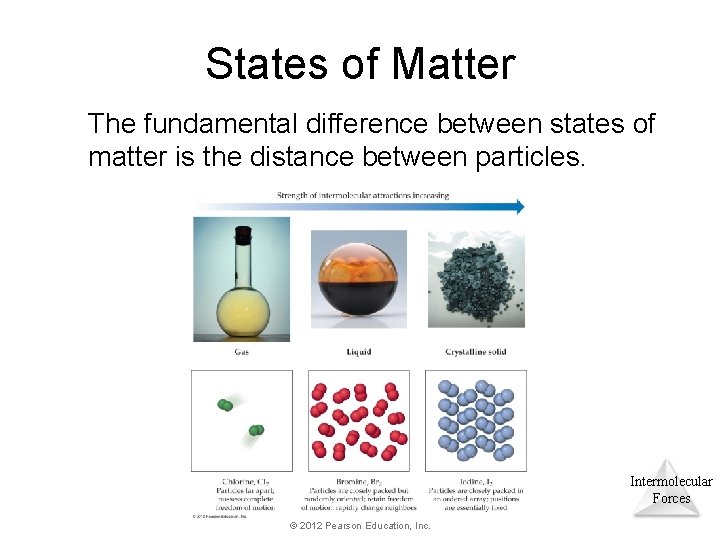
States of Matter The fundamental difference between states of matter is the distance between particles. Intermolecular Forces © 2012 Pearson Education, Inc.
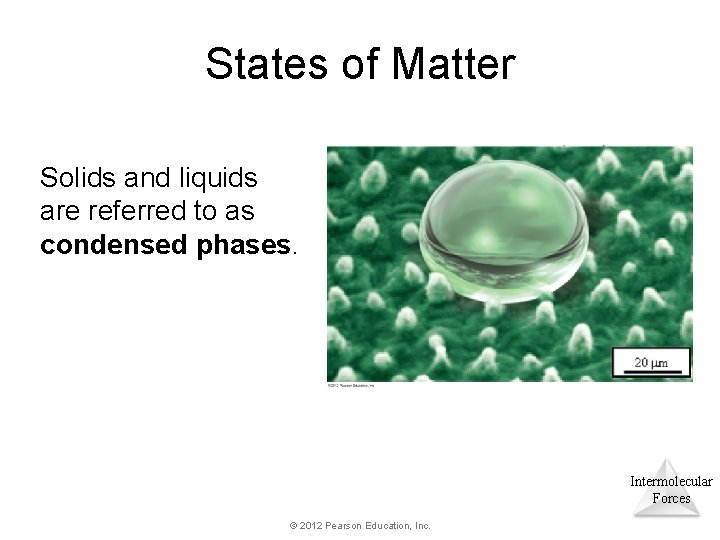
States of Matter Solids and liquids are referred to as condensed phases. Intermolecular Forces © 2012 Pearson Education, Inc.
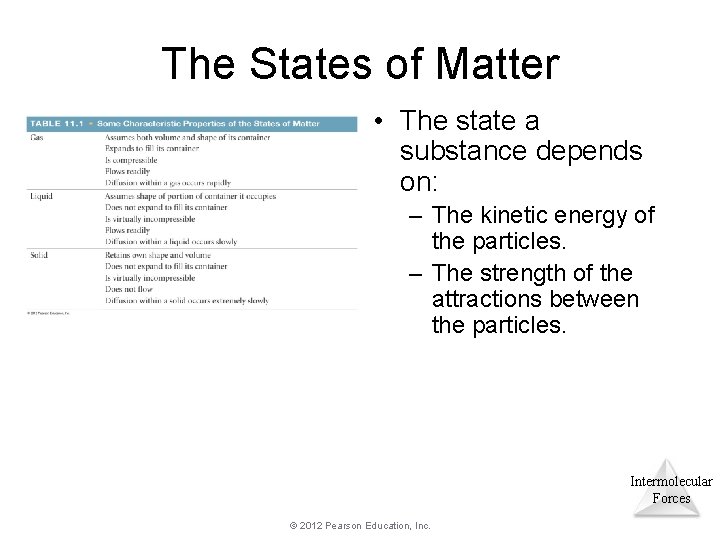
The States of Matter • The state a substance depends on: – The kinetic energy of the particles. – The strength of the attractions between the particles. Intermolecular Forces © 2012 Pearson Education, Inc.
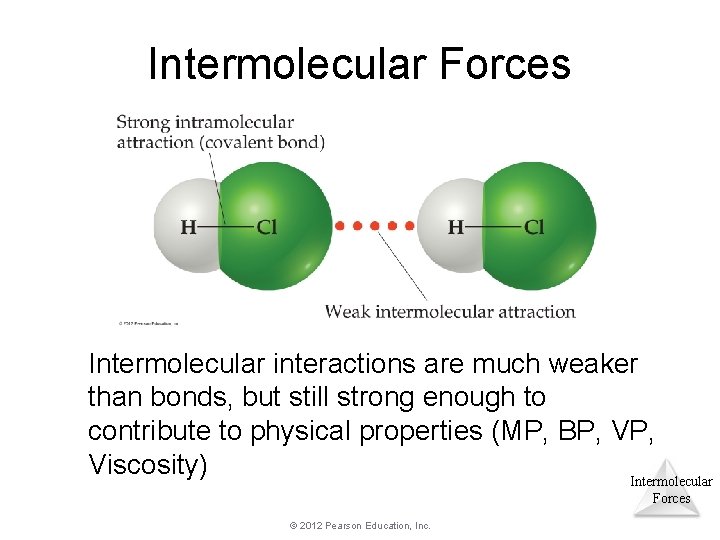
Intermolecular Forces Intermolecular interactions are much weaker than bonds, but still strong enough to contribute to physical properties (MP, BP, Viscosity) Intermolecular Forces © 2012 Pearson Education, Inc.
van der Waals Forces • Dipole–dipole interactions • Hydrogen bonding • London dispersion forces Intermolecular Forces © 2012 Pearson Education, Inc.
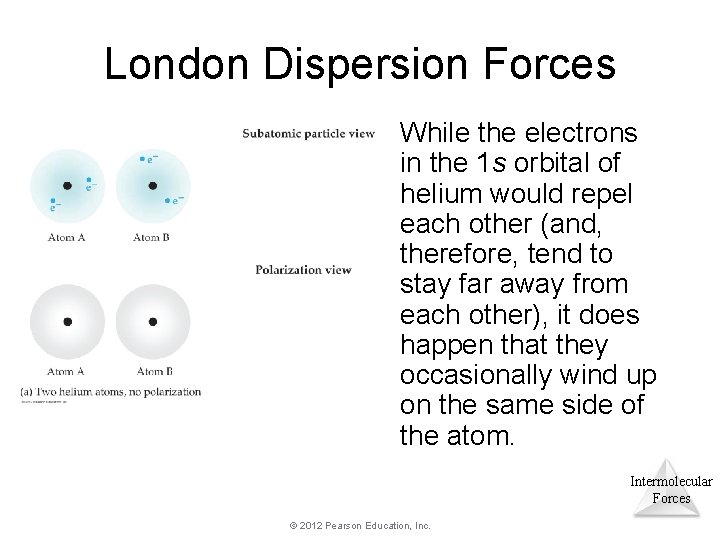
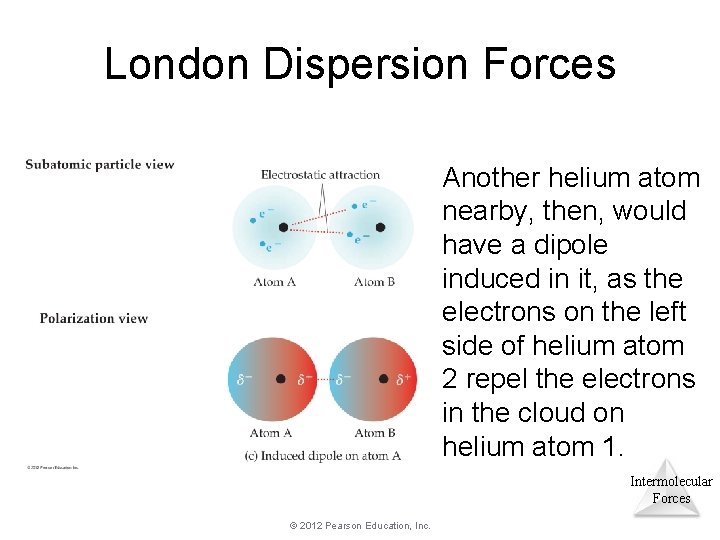
London Dispersion Forces While the electrons in the 1 s orbital of helium would repel each other (and, therefore, tend to stay far away from each other), it does happen that they occasionally wind up on the same side of the atom. Intermolecular Forces © 2012 Pearson Education, Inc.
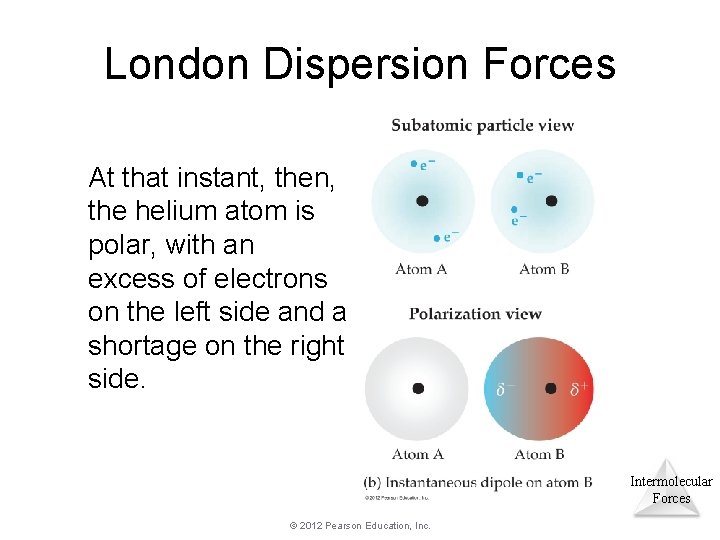
London Dispersion Forces At that instant, then, the helium atom is polar, with an excess of electrons on the left side and a shortage on the right side. Intermolecular Forces © 2012 Pearson Education, Inc.
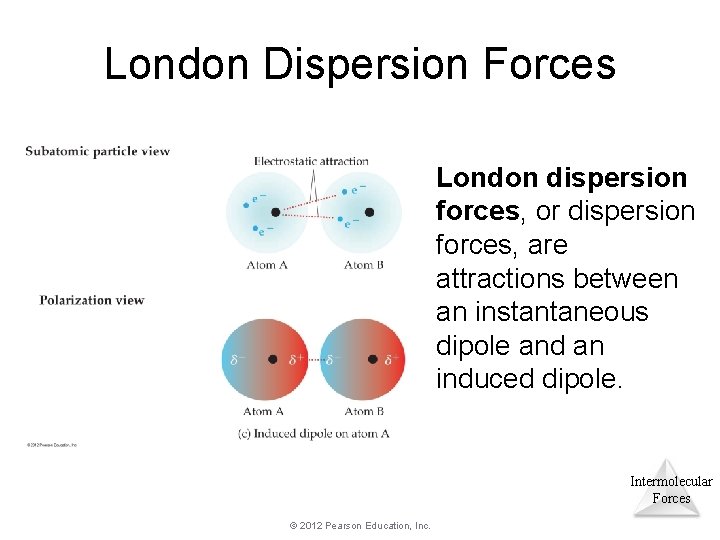
London Dispersion Forces Another helium atom nearby, then, would have a dipole induced in it, as the electrons on the left side of helium atom 2 repel the electrons in the cloud on helium atom 1. Intermolecular Forces © 2012 Pearson Education, Inc.
London Dispersion Forces London dispersion forces, or dispersion forces, are attractions between an instantaneous dipole and an induced dipole. Intermolecular Forces © 2012 Pearson Education, Inc.
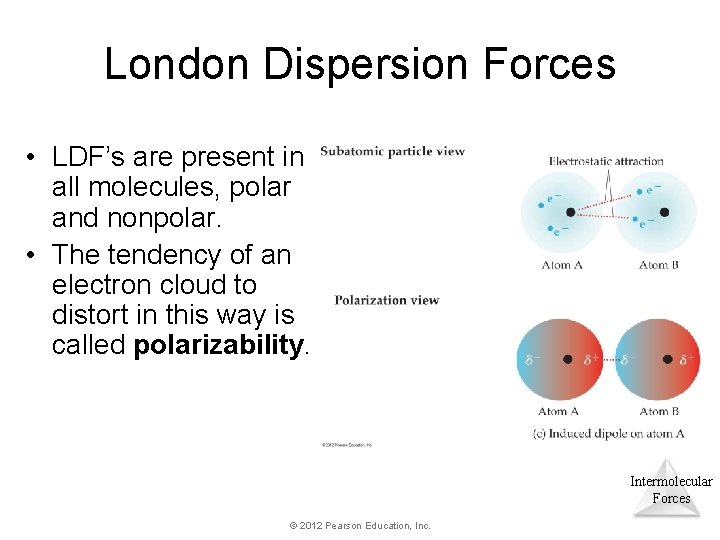
London Dispersion Forces • LDF’s are present in all molecules, polar and nonpolar. • The tendency of an electron cloud to distort in this way is called polarizability. Intermolecular Forces © 2012 Pearson Education, Inc.
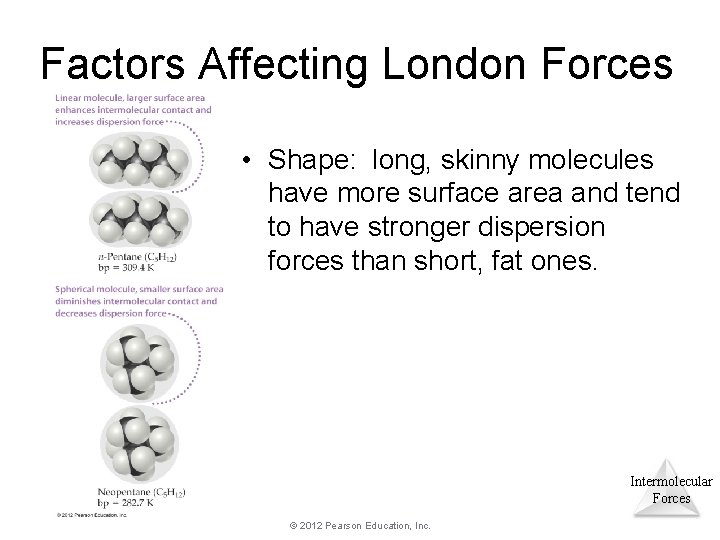
Factors Affecting London Forces • Shape: long, skinny molecules have more surface area and tend to have stronger dispersion forces than short, fat ones. Intermolecular Forces © 2012 Pearson Education, Inc.
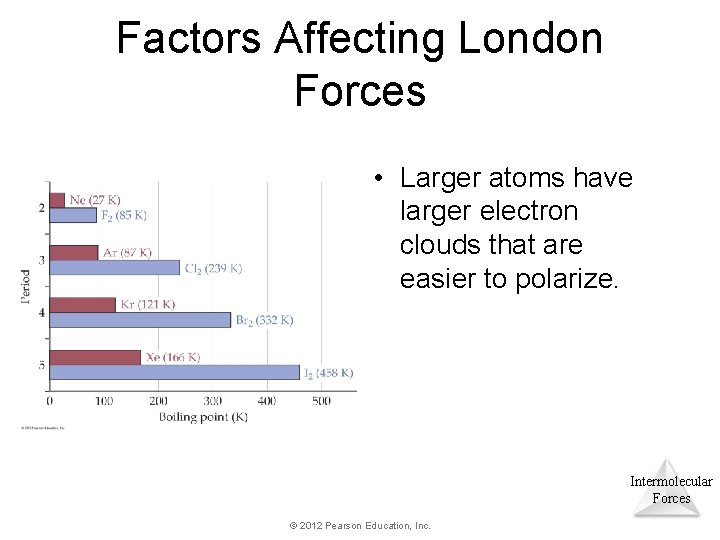
Factors Affecting London Forces • Larger atoms have larger electron clouds that are easier to polarize. Intermolecular Forces © 2012 Pearson Education, Inc.
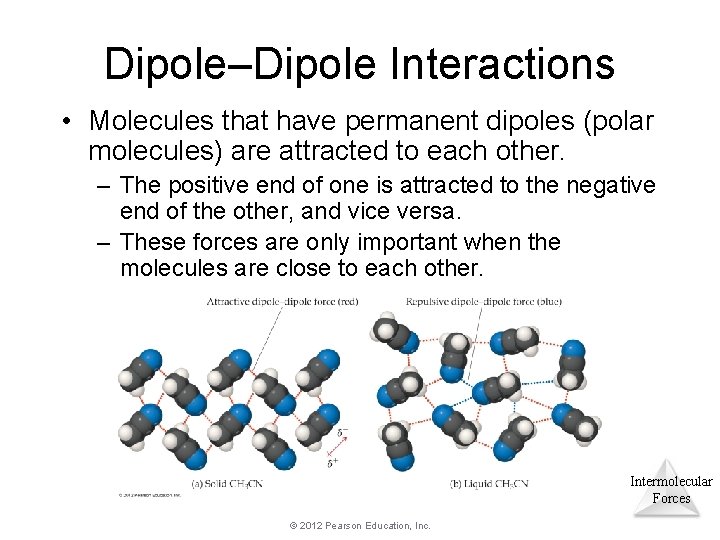
Dipole–Dipole Interactions • Molecules that have permanent dipoles (polar molecules) are attracted to each other. – The positive end of one is attracted to the negative end of the other, and vice versa. – These forces are only important when the molecules are close to each other. Intermolecular Forces © 2012 Pearson Education, Inc.
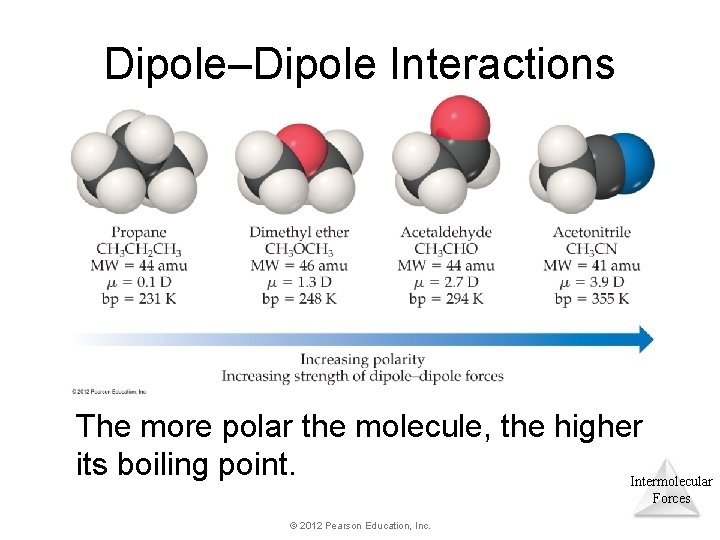
Dipole–Dipole Interactions The more polar the molecule, the higher its boiling point. Intermolecular Forces © 2012 Pearson Education, Inc.
Which Have a Greater Effect? Dipole–Dipole Interactions or Dispersion Forces • Same size and shape, dipole–dipole interactions are most important. • If one molecule is much larger (~3 x larger or more) than another, dispersion forces determine physical properties. Intermolecular Forces © 2012 Pearson Education, Inc.
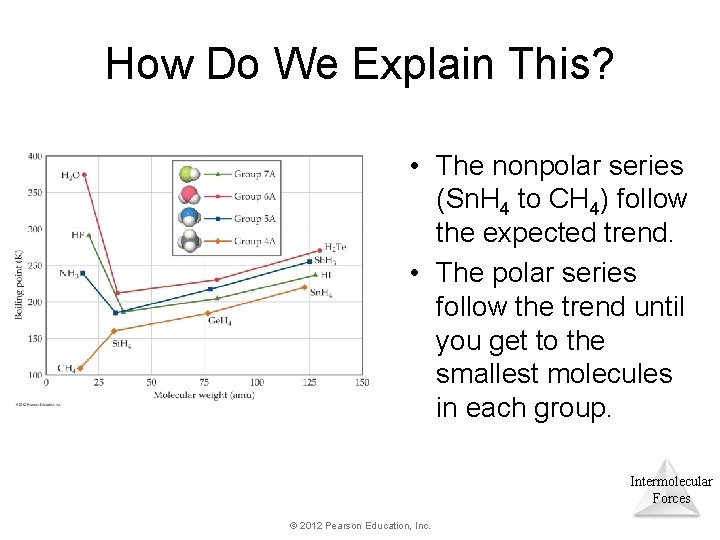
How Do We Explain This? • The nonpolar series (Sn. H 4 to CH 4) follow the expected trend. • The polar series follow the trend until you get to the smallest molecules in each group. Intermolecular Forces © 2012 Pearson Education, Inc.
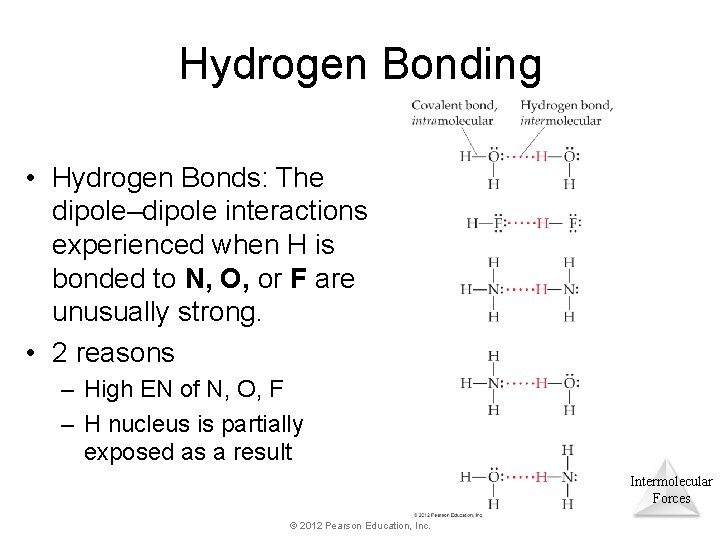
Hydrogen Bonding • Hydrogen Bonds: The dipole–dipole interactions experienced when H is bonded to N, O, or F are unusually strong. • 2 reasons – High EN of N, O, F – H nucleus is partially exposed as a result Intermolecular Forces © 2012 Pearson Education, Inc.
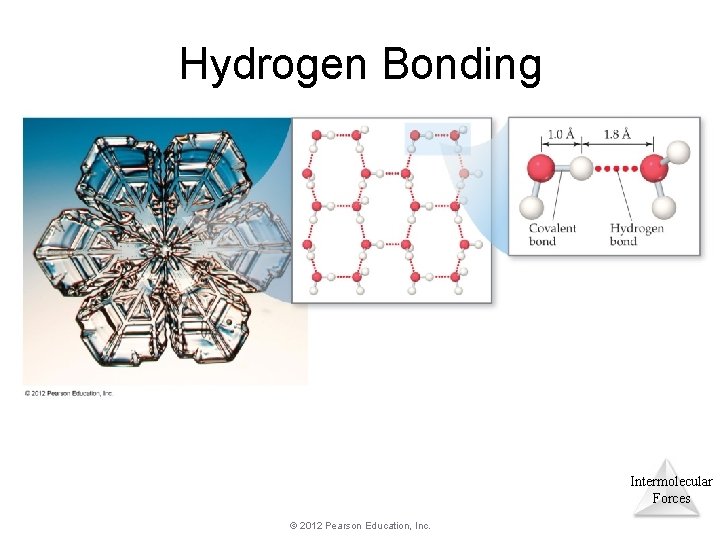
Hydrogen Bonding Intermolecular Forces © 2012 Pearson Education, Inc.
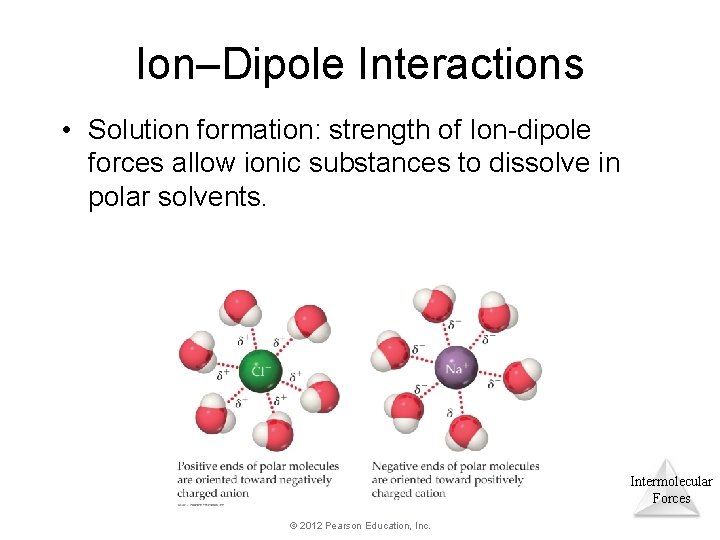
Ion–Dipole Interactions • Solution formation: strength of Ion-dipole forces allow ionic substances to dissolve in polar solvents. Intermolecular Forces © 2012 Pearson Education, Inc.
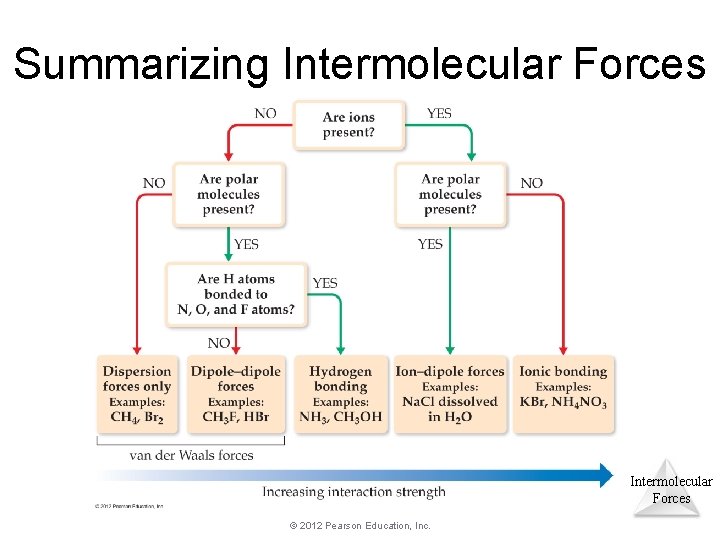
Summarizing Intermolecular Forces © 2012 Pearson Education, Inc.
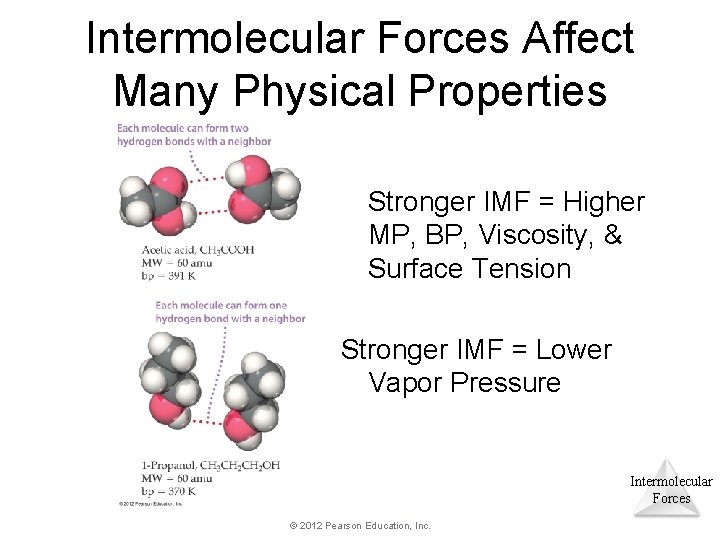
Intermolecular Forces Affect Many Physical Properties Stronger IMF = Higher MP, BP, Viscosity, & Surface Tension Stronger IMF = Lower Vapor Pressure Intermolecular Forces © 2012 Pearson Education, Inc.
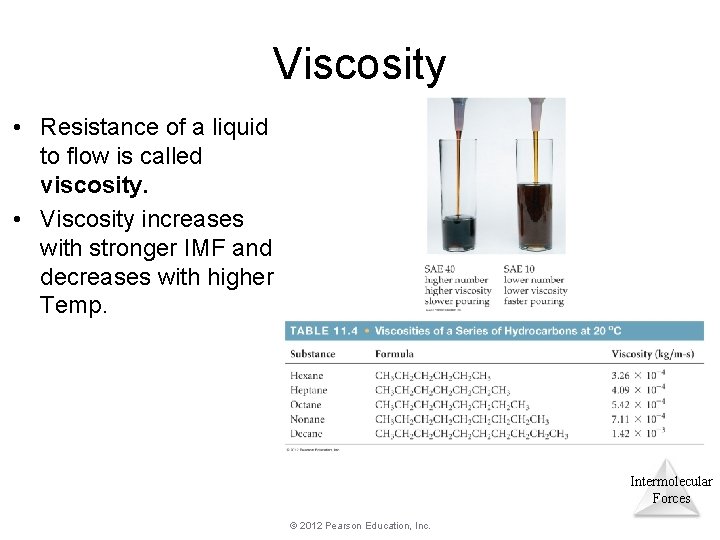
Viscosity • Resistance of a liquid to flow is called viscosity. • Viscosity increases with stronger IMF and decreases with higher Temp. Intermolecular Forces © 2012 Pearson Education, Inc.
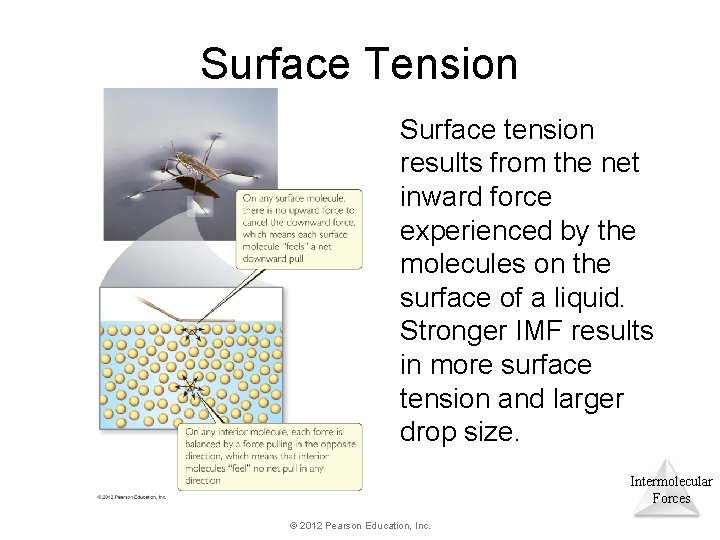
Surface Tension Surface tension results from the net inward force experienced by the molecules on the surface of a liquid. Stronger IMF results in more surface tension and larger drop size. Intermolecular Forces © 2012 Pearson Education, Inc.
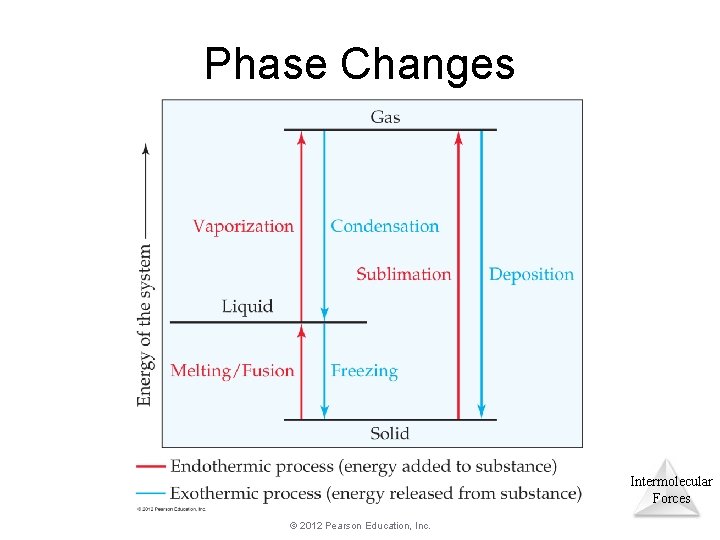
Phase Changes Intermolecular Forces © 2012 Pearson Education, Inc.
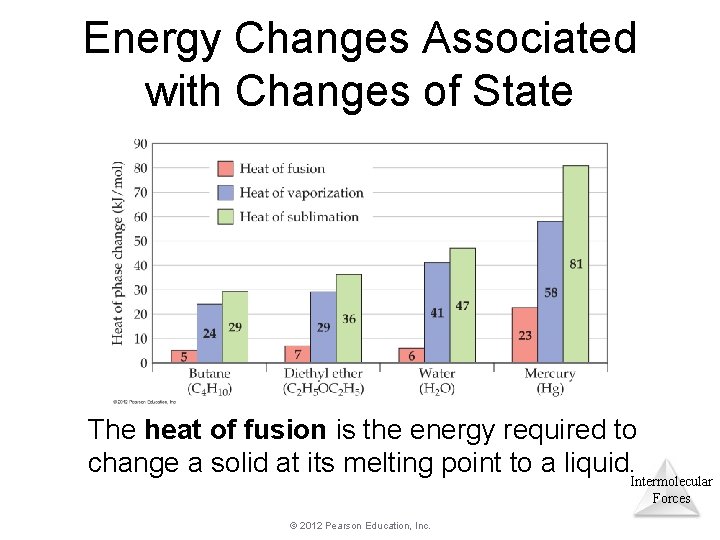
Energy Changes Associated with Changes of State The heat of fusion is the energy required to change a solid at its melting point to a liquid. Intermolecular Forces © 2012 Pearson Education, Inc.
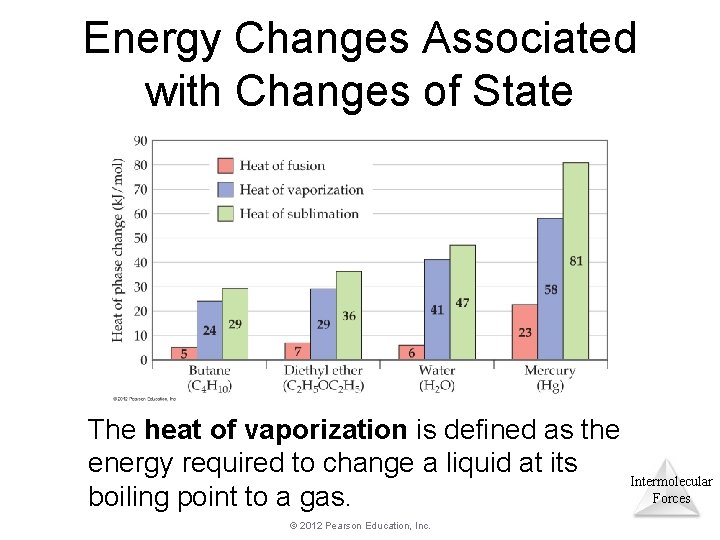
Energy Changes Associated with Changes of State The heat of vaporization is defined as the energy required to change a liquid at its boiling point to a gas. © 2012 Pearson Education, Inc. Intermolecular Forces
Energy Changes Associated with Changes of State The heat of sublimation is defined as the energy required to change a solid directly to a gas. Intermolecular Forces © 2012 Pearson Education, Inc.
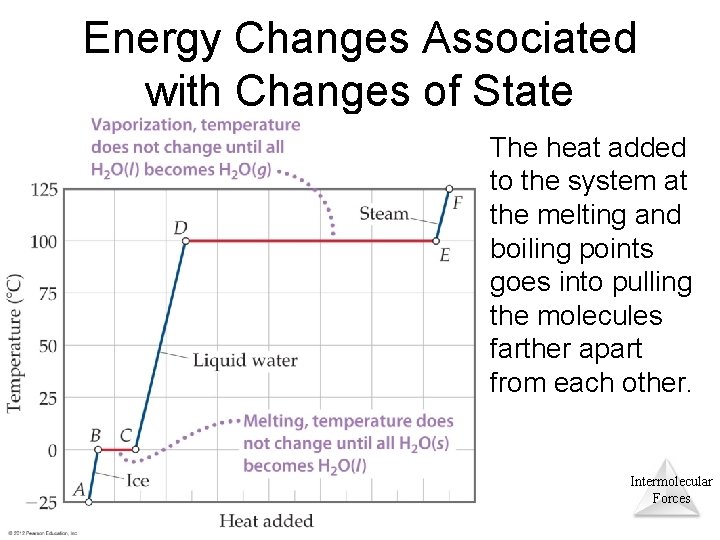
Energy Changes Associated with Changes of State • The heat added to the system at the melting and boiling points goes into pulling the molecules farther apart from each other. Intermolecular Forces © 2012 Pearson Education, Inc.
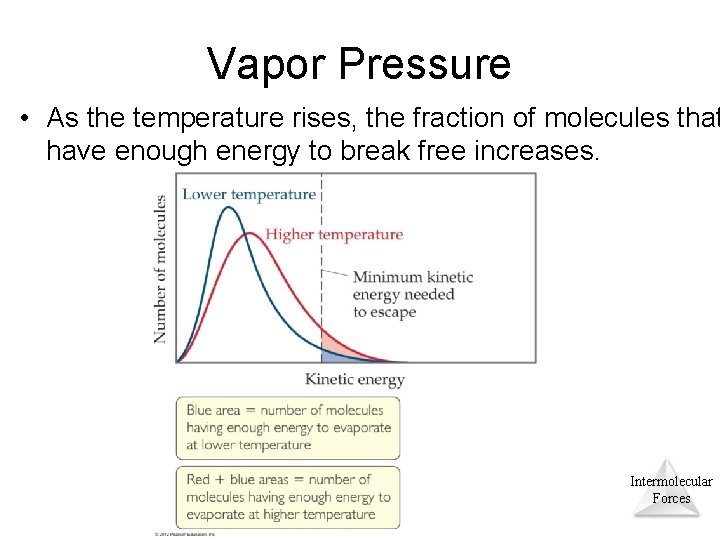
Vapor Pressure • As the temperature rises, the fraction of molecules that have enough energy to break free increases. Intermolecular Forces © 2012 Pearson Education, Inc.
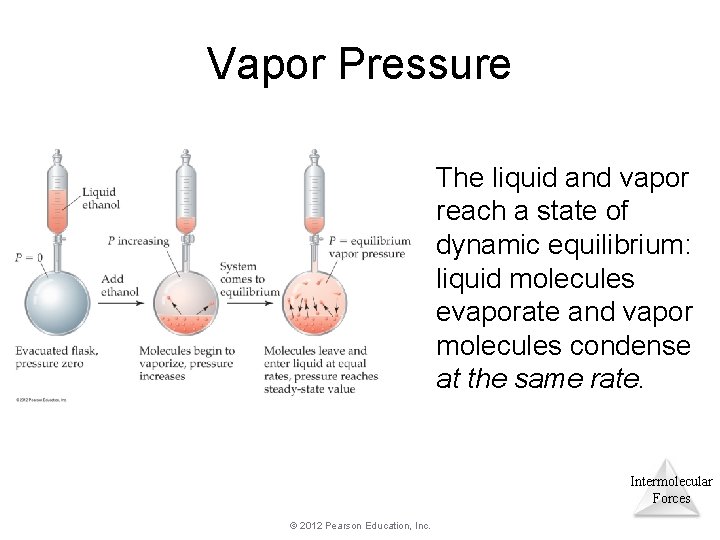
Vapor Pressure The liquid and vapor reach a state of dynamic equilibrium: liquid molecules evaporate and vapor molecules condense at the same rate. Intermolecular Forces © 2012 Pearson Education, Inc.
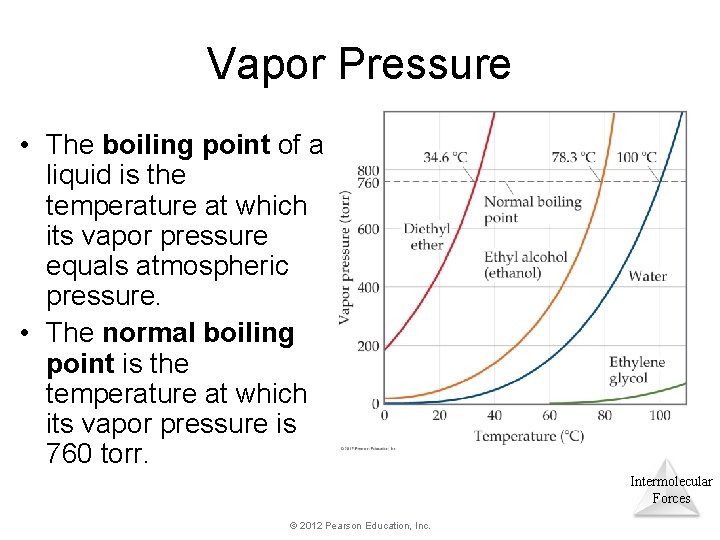
Vapor Pressure • The boiling point of a liquid is the temperature at which its vapor pressure equals atmospheric pressure. • The normal boiling point is the temperature at which its vapor pressure is 760 torr. Intermolecular Forces © 2012 Pearson Education, Inc.
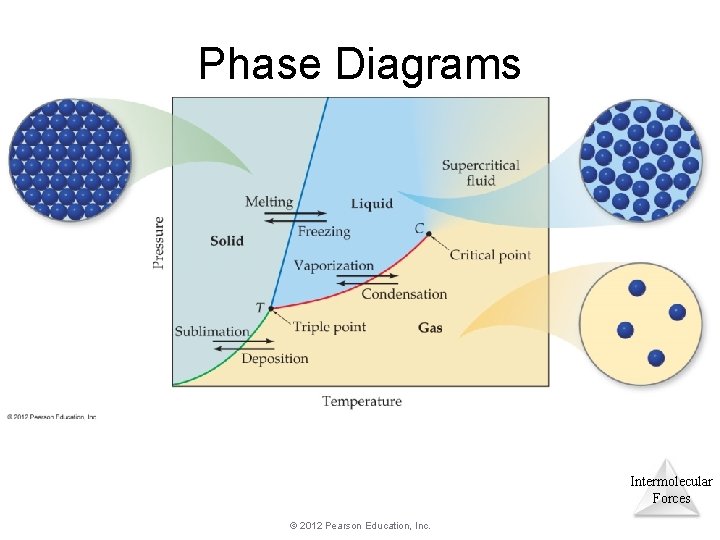
Phase Diagrams Intermolecular Forces © 2012 Pearson Education, Inc.
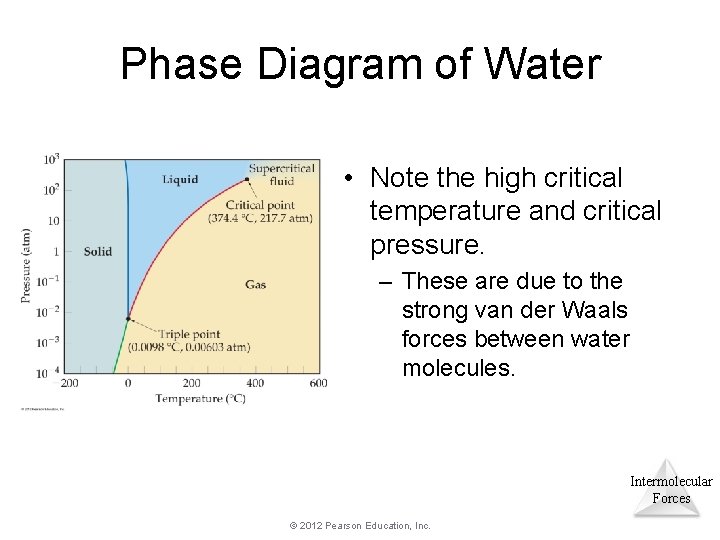
Phase Diagram of Water • Note the high critical temperature and critical pressure. – These are due to the strong van der Waals forces between water molecules. Intermolecular Forces © 2012 Pearson Education, Inc.
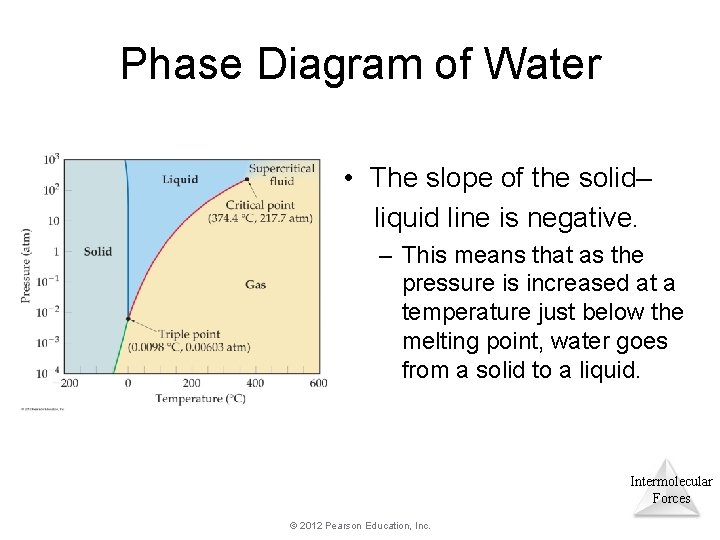
Phase Diagram of Water • The slope of the solid– liquid line is negative. – This means that as the pressure is increased at a temperature just below the melting point, water goes from a solid to a liquid. Intermolecular Forces © 2012 Pearson Education, Inc.
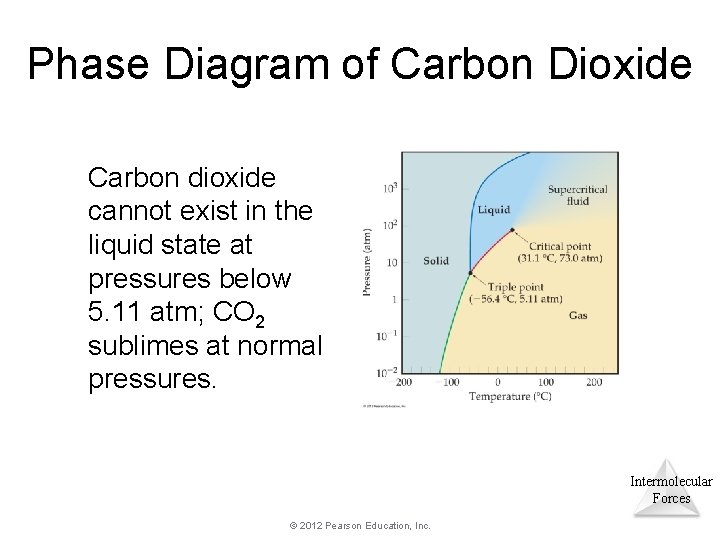
Phase Diagram of Carbon Dioxide Carbon dioxide cannot exist in the liquid state at pressures below 5. 11 atm; CO 2 sublimes at normal pressures. Intermolecular Forces © 2012 Pearson Education, Inc.
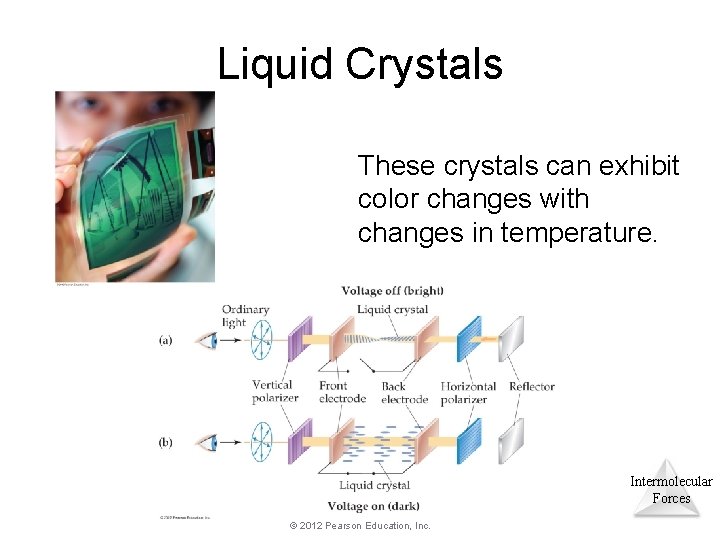
Liquid Crystals These crystals can exhibit color changes with changes in temperature. Intermolecular Forces © 2012 Pearson Education, Inc.