
Lecture Presentation Chapter 11 Liquids and Intermolecular Forces
- Slides: 36
Lecture Presentation Chapter 11 Liquids and Intermolecular Forces © 2015 Pearson Education, Inc. James F. Kirby Quinnipiac University Hamden, CT
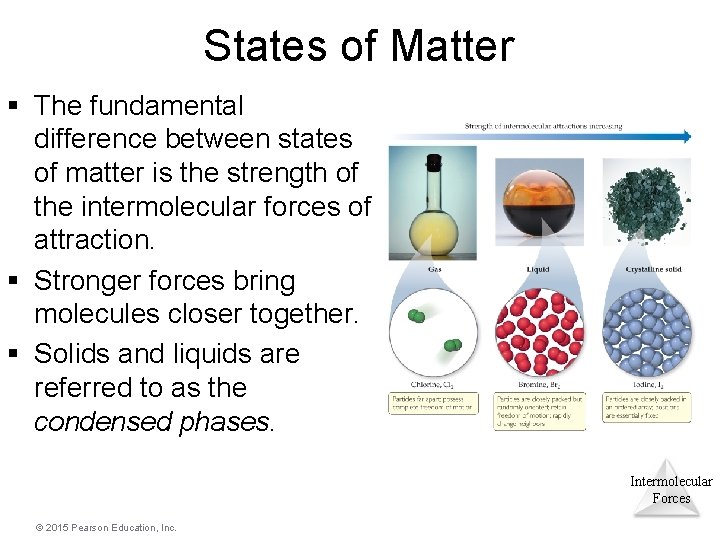
States of Matter § The fundamental difference between states of matter is the strength of the intermolecular forces of attraction. § Stronger forces bring molecules closer together. § Solids and liquids are referred to as the condensed phases. Intermolecular Forces © 2015 Pearson Education, Inc.
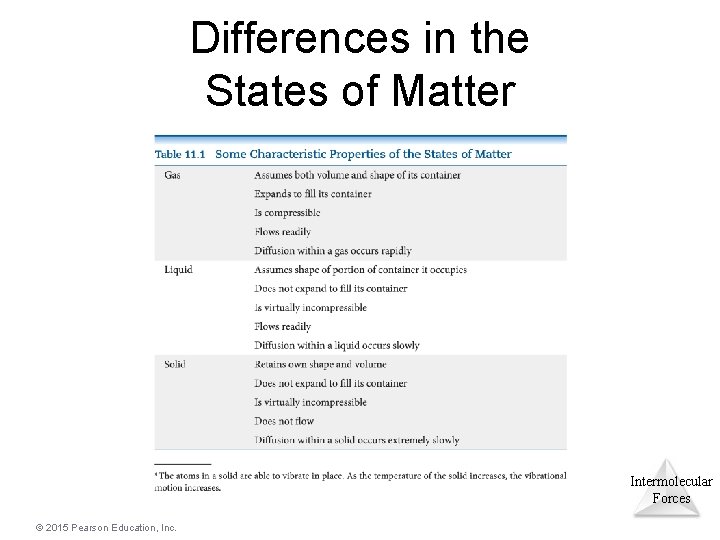
Differences in the States of Matter Intermolecular Forces © 2015 Pearson Education, Inc.
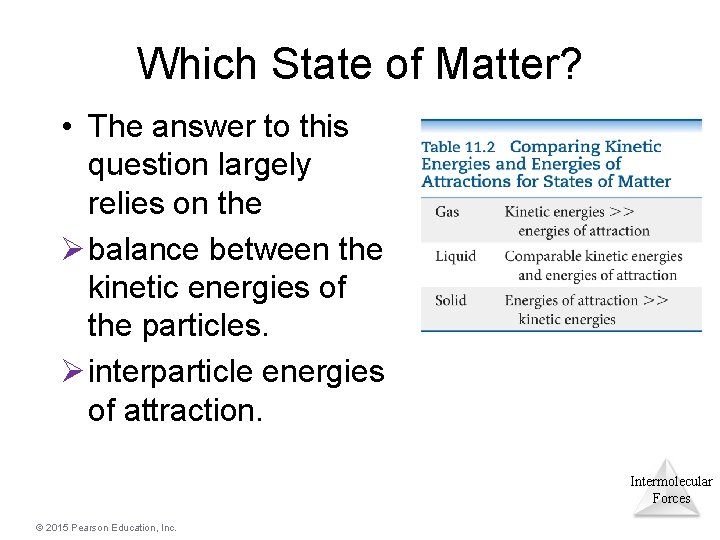
Which State of Matter? • The answer to this question largely relies on the Ø balance between the kinetic energies of the particles. Ø interparticle energies of attraction. Intermolecular Forces © 2015 Pearson Education, Inc.
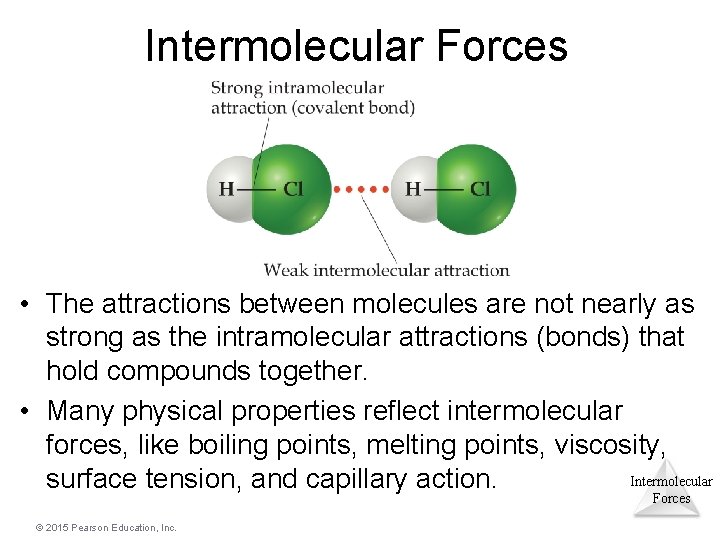
Intermolecular Forces • The attractions between molecules are not nearly as strong as the intramolecular attractions (bonds) that hold compounds together. • Many physical properties reflect intermolecular forces, like boiling points, melting points, viscosity, Intermolecular surface tension, and capillary action. Forces © 2015 Pearson Education, Inc.
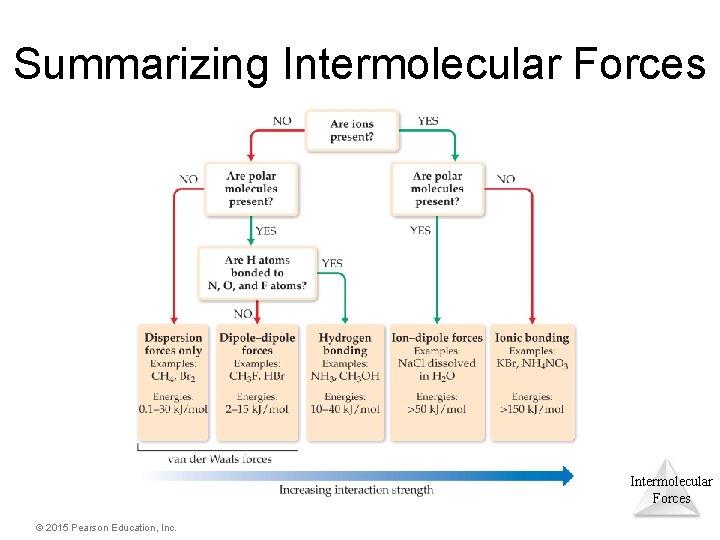
Types of Intermolecular Force • Weakest to strongest forces: Ø dispersion forces (or London dispersion forces) Ø dipole–dipole forces Ø hydrogen bonding (a special dipole–dipole force) Ø ion–dipole forces o Note: The first two types are also referred to collectively as van der Waals forces. Intermolecular Forces © 2015 Pearson Education, Inc.
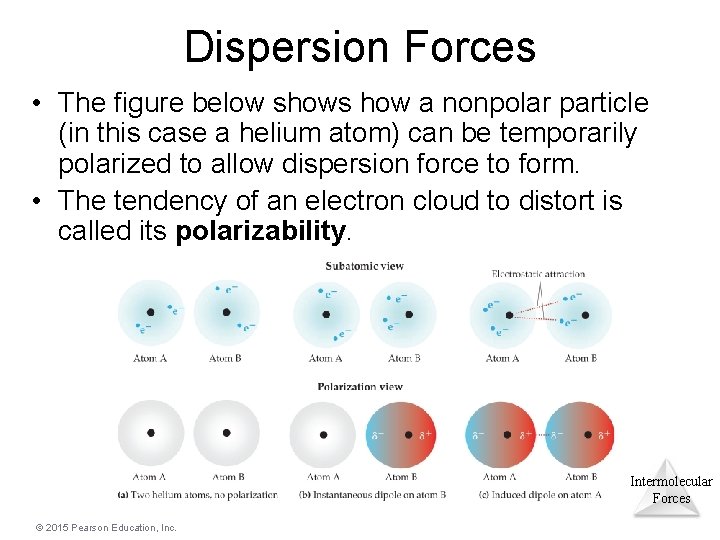
Dispersion Forces • The figure below shows how a nonpolar particle (in this case a helium atom) can be temporarily polarized to allow dispersion force to form. • The tendency of an electron cloud to distort is called its polarizability. Intermolecular Forces © 2015 Pearson Education, Inc.
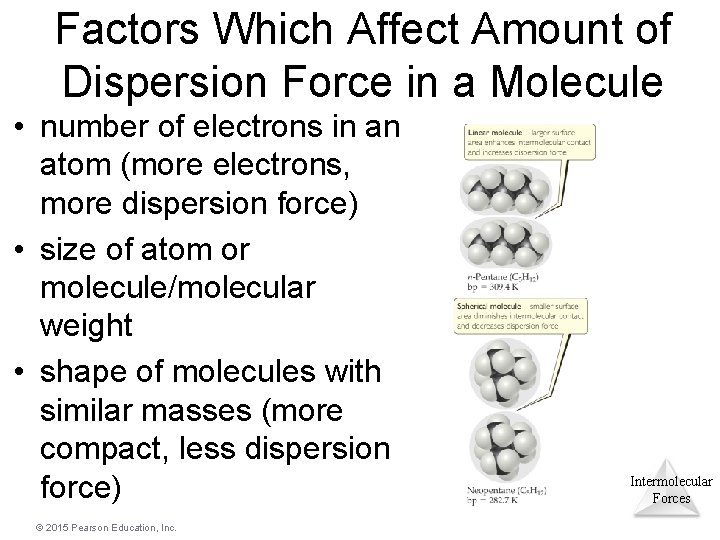
Factors Which Affect Amount of Dispersion Force in a Molecule • number of electrons in an atom (more electrons, more dispersion force) • size of atom or molecule/molecular weight • shape of molecules with similar masses (more compact, less dispersion force) © 2015 Pearson Education, Inc. Intermolecular Forces
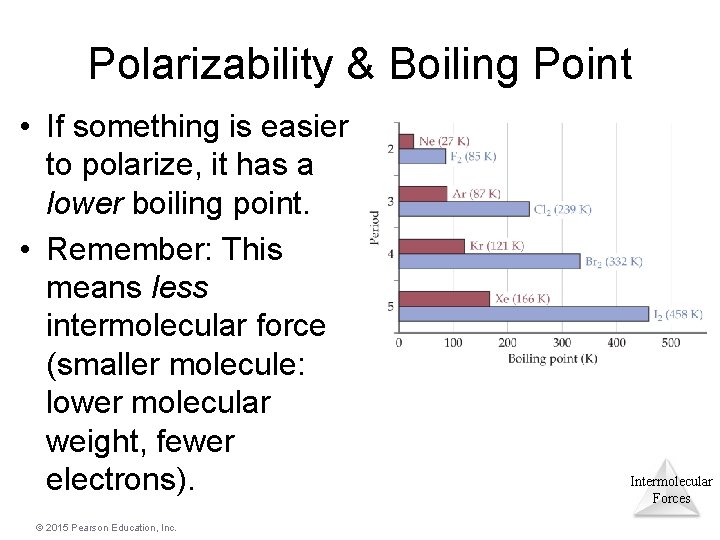
Polarizability & Boiling Point • If something is easier to polarize, it has a lower boiling point. • Remember: This means less intermolecular force (smaller molecule: lower molecular weight, fewer electrons). © 2015 Pearson Education, Inc. Intermolecular Forces
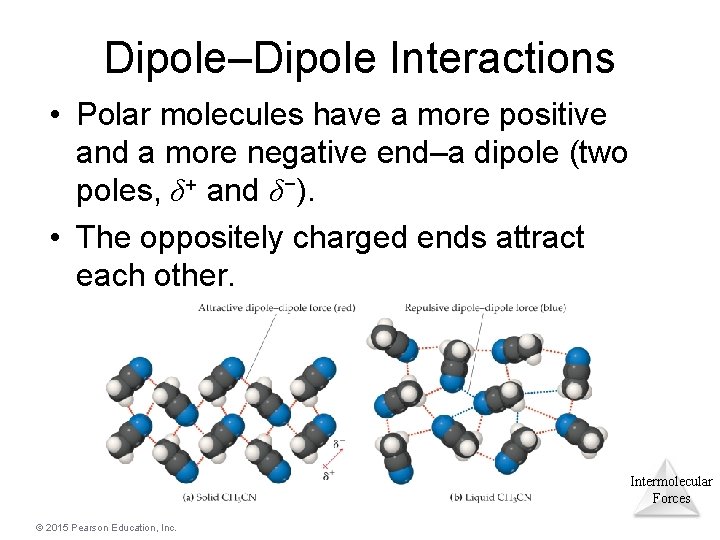
Dipole–Dipole Interactions • Polar molecules have a more positive and a more negative end–a dipole (two poles, δ+ and δ−). • The oppositely charged ends attract each other. Intermolecular Forces © 2015 Pearson Education, Inc.
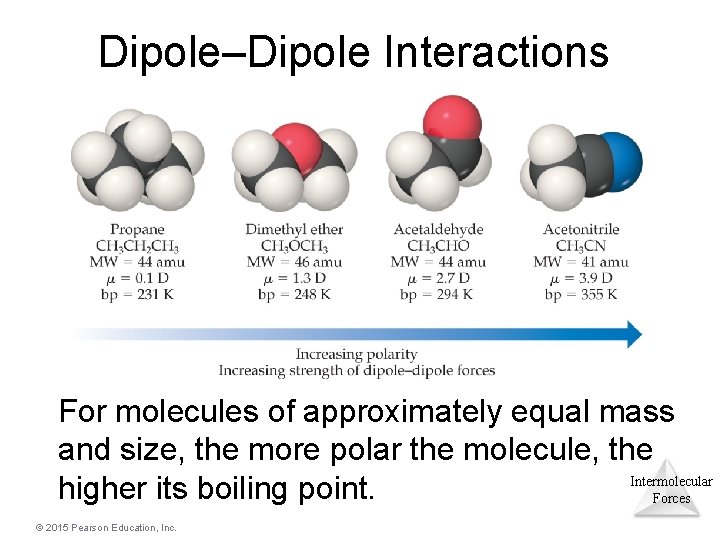
Dipole–Dipole Interactions For molecules of approximately equal mass and size, the more polar the molecule, the Intermolecular higher its boiling point. Forces © 2015 Pearson Education, Inc.
Which Have a Greater Effect: Dipole–Dipole Interactions or Dispersion Forces? • If two molecules are of comparable size and shape, dipole–dipole interactions will likely be the dominating force. • If one molecule is much larger than another, dispersion forces will likely determine its physical properties. Intermolecular Forces © 2015 Pearson Education, Inc.
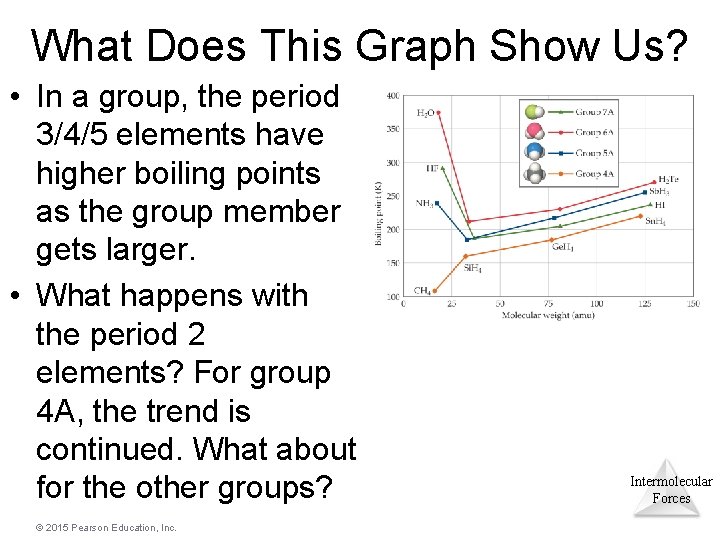
What Does This Graph Show Us? • In a group, the period 3/4/5 elements have higher boiling points as the group member gets larger. • What happens with the period 2 elements? For group 4 A, the trend is continued. What about for the other groups? © 2015 Pearson Education, Inc. Intermolecular Forces
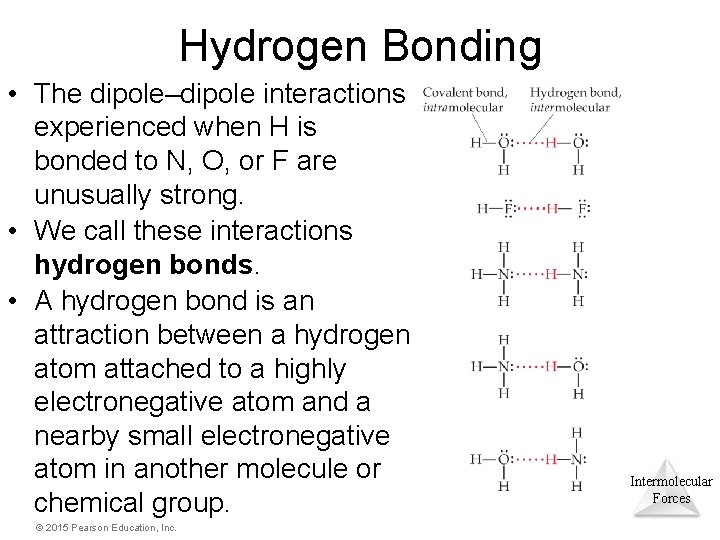
Hydrogen Bonding • The dipole–dipole interactions experienced when H is bonded to N, O, or F are unusually strong. • We call these interactions hydrogen bonds. • A hydrogen bond is an attraction between a hydrogen atom attached to a highly electronegative atom and a nearby small electronegative atom in another molecule or chemical group. © 2015 Pearson Education, Inc. Intermolecular Forces
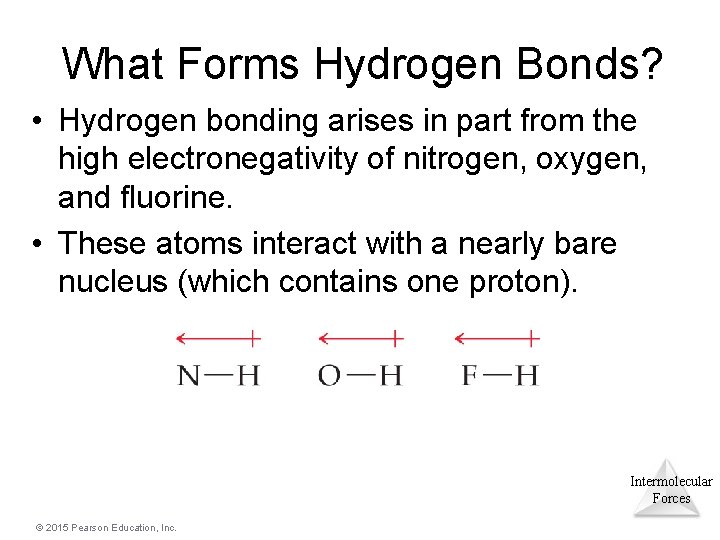
What Forms Hydrogen Bonds? • Hydrogen bonding arises in part from the high electronegativity of nitrogen, oxygen, and fluorine. • These atoms interact with a nearly bare nucleus (which contains one proton). Intermolecular Forces © 2015 Pearson Education, Inc.
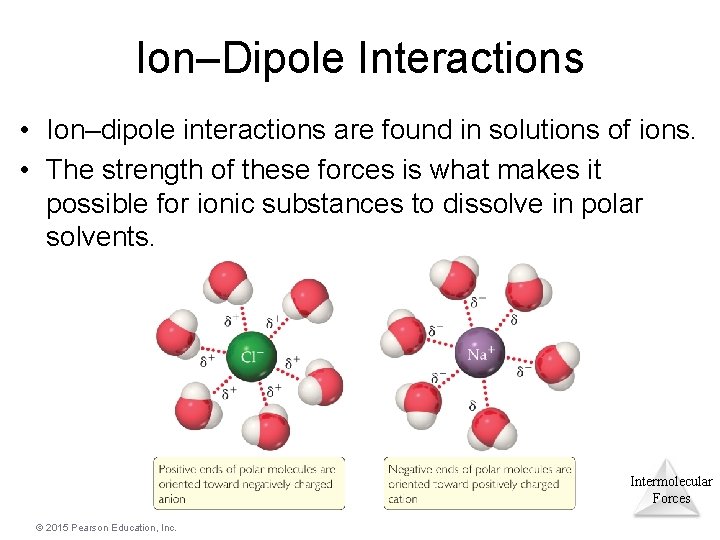
Ion–Dipole Interactions • Ion–dipole interactions are found in solutions of ions. • The strength of these forces is what makes it possible for ionic substances to dissolve in polar solvents. Intermolecular Forces © 2015 Pearson Education, Inc.
Summarizing Intermolecular Forces © 2015 Pearson Education, Inc.
Liquid Properties Affected by Intermolecular Forces • boiling point (previously discussed) and melting point • viscosity • surface tension • capillary action Intermolecular Forces © 2015 Pearson Education, Inc.
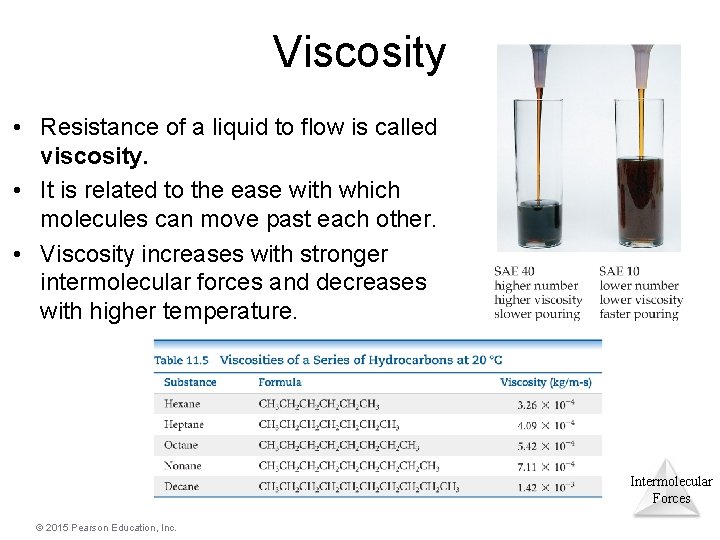
Viscosity • Resistance of a liquid to flow is called viscosity. • It is related to the ease with which molecules can move past each other. • Viscosity increases with stronger intermolecular forces and decreases with higher temperature. Intermolecular Forces © 2015 Pearson Education, Inc.
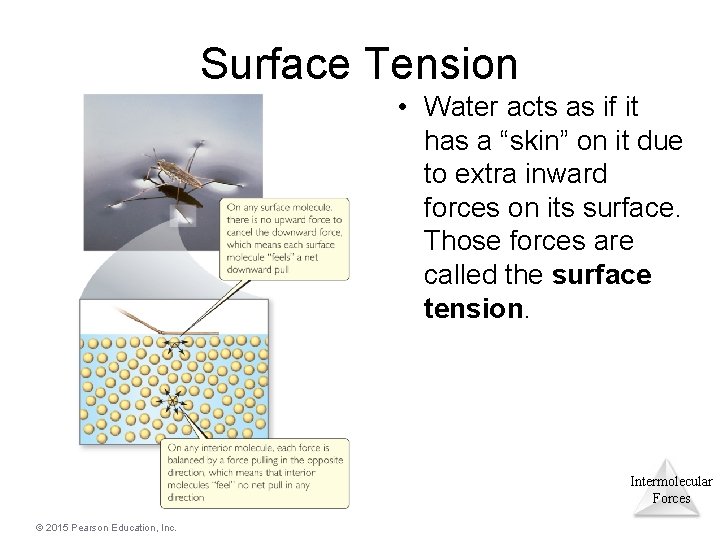
Surface Tension • Water acts as if it has a “skin” on it due to extra inward forces on its surface. Those forces are called the surface tension. Intermolecular Forces © 2015 Pearson Education, Inc.
Cohesion and Adhesion • Intermolecular forces that bind similar molecules to one another are called cohesive forces. • Intermolecular forces that bind a substance to a surface are called adhesive forces. • These forces are important in capillary action. Intermolecular Forces © 2015 Pearson Education, Inc.
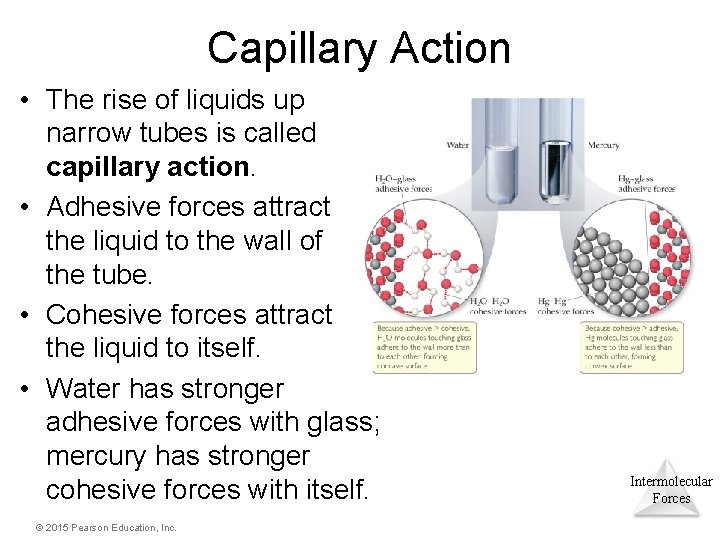
Capillary Action • The rise of liquids up narrow tubes is called capillary action. • Adhesive forces attract the liquid to the wall of the tube. • Cohesive forces attract the liquid to itself. • Water has stronger adhesive forces with glass; mercury has stronger cohesive forces with itself. © 2015 Pearson Education, Inc. Intermolecular Forces
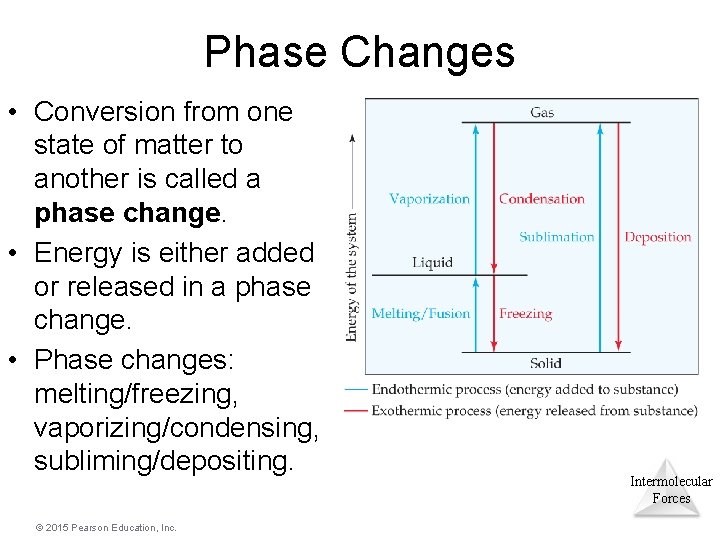
Phase Changes • Conversion from one state of matter to another is called a phase change. • Energy is either added or released in a phase change. • Phase changes: melting/freezing, vaporizing/condensing, subliming/depositing. © 2015 Pearson Education, Inc. Intermolecular Forces
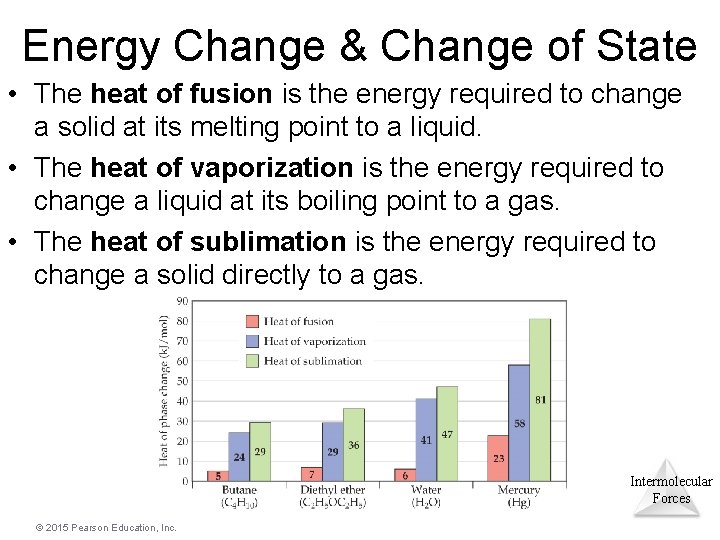
Energy Change & Change of State • The heat of fusion is the energy required to change a solid at its melting point to a liquid. • The heat of vaporization is the energy required to change a liquid at its boiling point to a gas. • The heat of sublimation is the energy required to change a solid directly to a gas. Intermolecular Forces © 2015 Pearson Education, Inc.
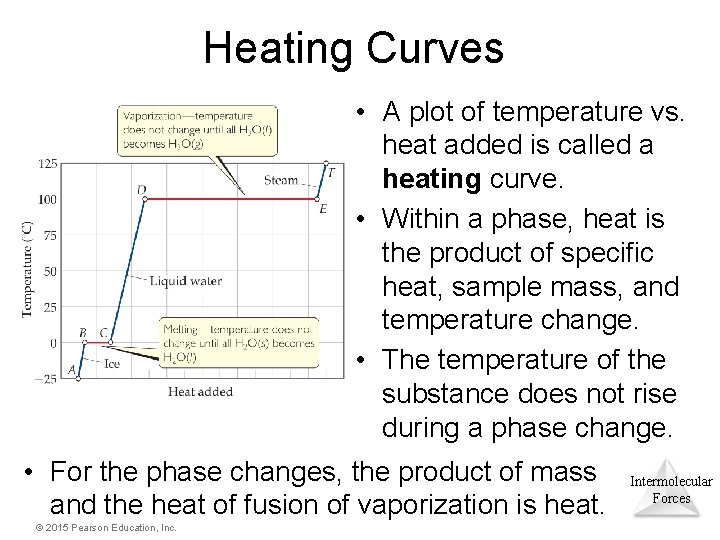
Heating Curves • A plot of temperature vs. heat added is called a heating curve. • Within a phase, heat is the product of specific heat, sample mass, and temperature change. • The temperature of the substance does not rise during a phase change. • For the phase changes, the product of mass and the heat of fusion of vaporization is heat. © 2015 Pearson Education, Inc. Intermolecular Forces
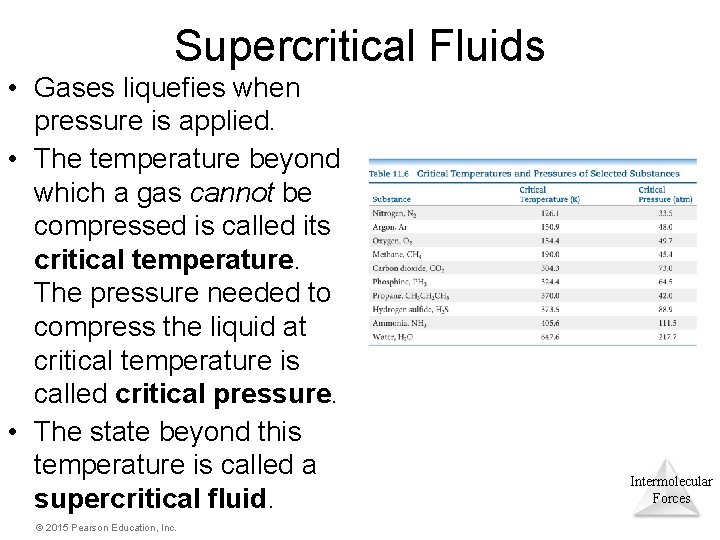
Supercritical Fluids • Gases liquefies when pressure is applied. • The temperature beyond which a gas cannot be compressed is called its critical temperature. The pressure needed to compress the liquid at critical temperature is called critical pressure. • The state beyond this temperature is called a supercritical fluid. © 2015 Pearson Education, Inc. Intermolecular Forces
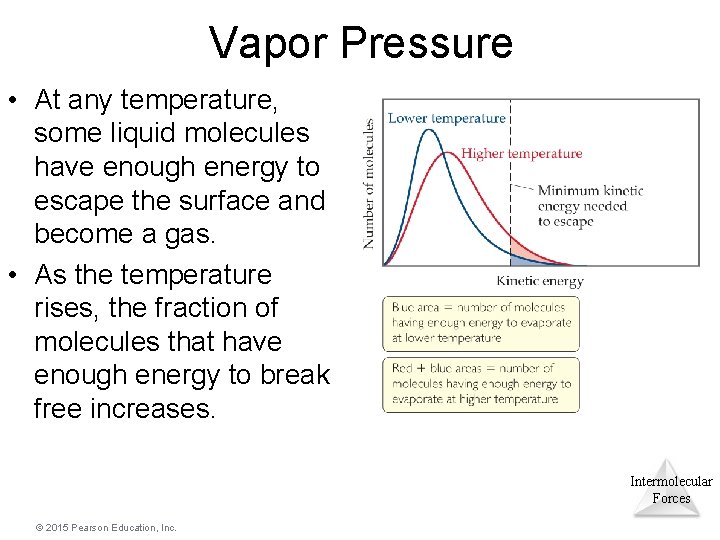
Vapor Pressure • At any temperature, some liquid molecules have enough energy to escape the surface and become a gas. • As the temperature rises, the fraction of molecules that have enough energy to break free increases. Intermolecular Forces © 2015 Pearson Education, Inc.
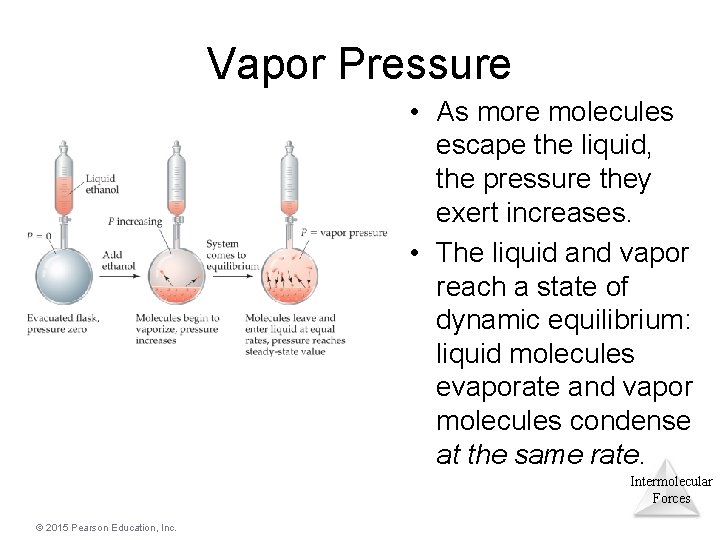
Vapor Pressure • As more molecules escape the liquid, the pressure they exert increases. • The liquid and vapor reach a state of dynamic equilibrium: liquid molecules evaporate and vapor molecules condense at the same rate. Intermolecular Forces © 2015 Pearson Education, Inc.
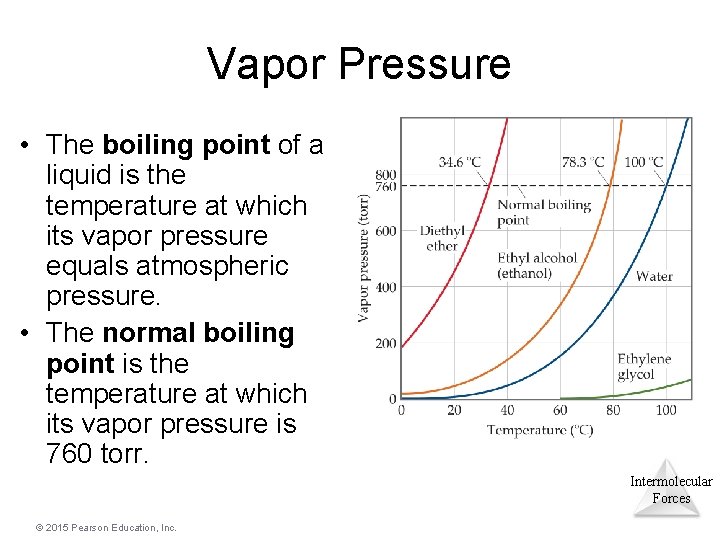
Vapor Pressure • The boiling point of a liquid is the temperature at which its vapor pressure equals atmospheric pressure. • The normal boiling point is the temperature at which its vapor pressure is 760 torr. Intermolecular Forces © 2015 Pearson Education, Inc.
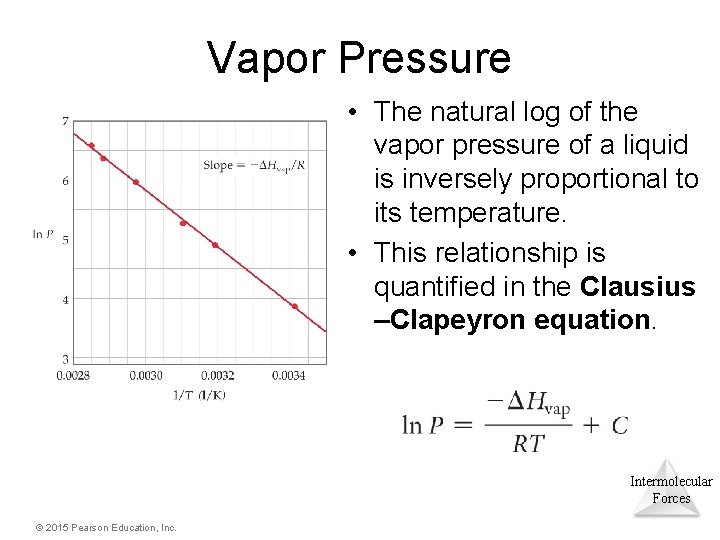
Vapor Pressure • The natural log of the vapor pressure of a liquid is inversely proportional to its temperature. • This relationship is quantified in the Clausius –Clapeyron equation. Intermolecular Forces © 2015 Pearson Education, Inc.
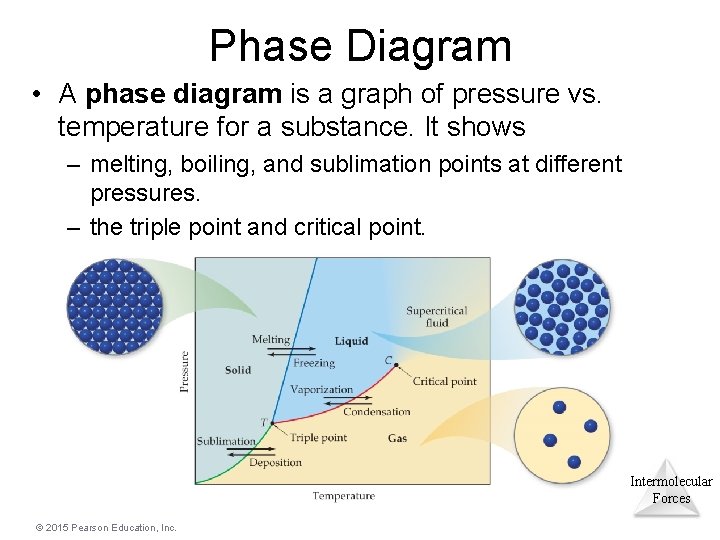
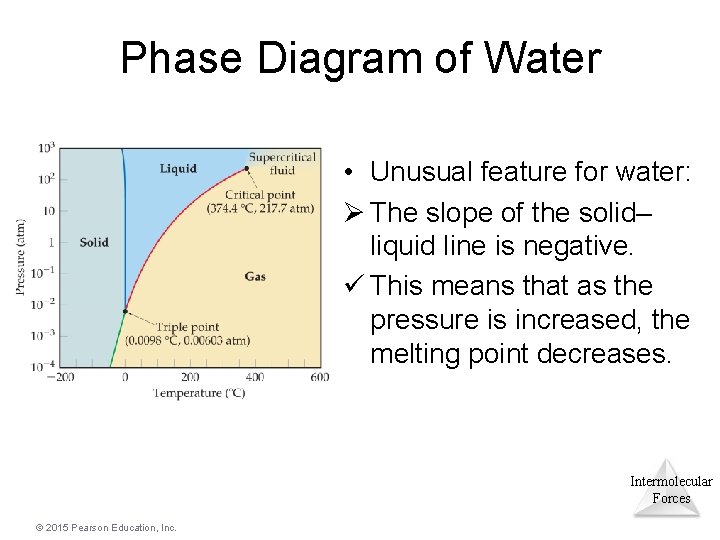
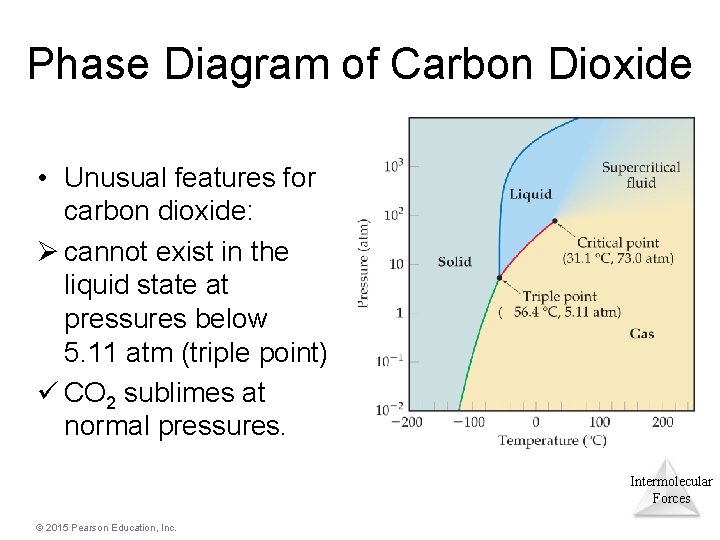
Phase Diagram • A phase diagram is a graph of pressure vs. temperature for a substance. It shows – melting, boiling, and sublimation points at different pressures. – the triple point and critical point. Intermolecular Forces © 2015 Pearson Education, Inc.
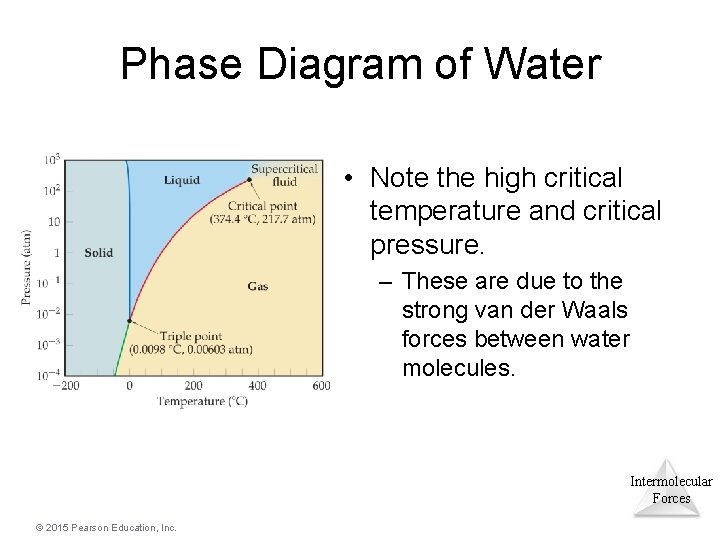
Phase Diagram of Water • Note the high critical temperature and critical pressure. – These are due to the strong van der Waals forces between water molecules. Intermolecular Forces © 2015 Pearson Education, Inc.
Phase Diagram of Water • Unusual feature for water: Ø The slope of the solid– liquid line is negative. ü This means that as the pressure is increased, the melting point decreases. Intermolecular Forces © 2015 Pearson Education, Inc.
Phase Diagram of Carbon Dioxide • Unusual features for carbon dioxide: Ø cannot exist in the liquid state at pressures below 5. 11 atm (triple point) ü CO 2 sublimes at normal pressures. Intermolecular Forces © 2015 Pearson Education, Inc.
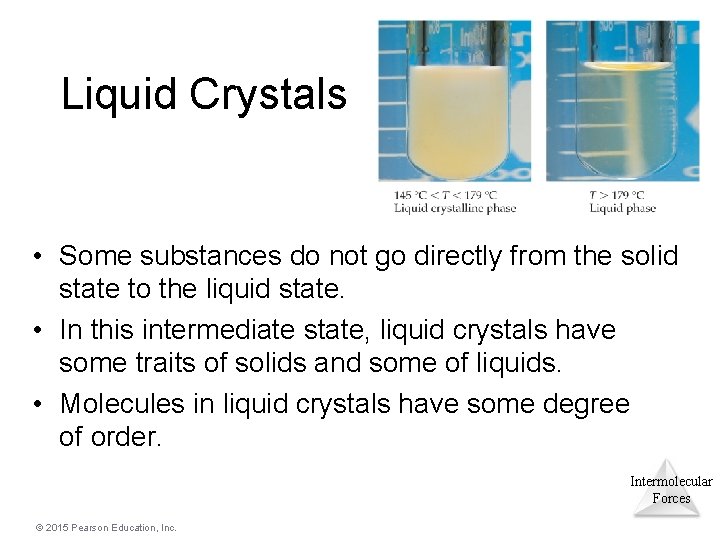
Liquid Crystals • Some substances do not go directly from the solid state to the liquid state. • In this intermediate state, liquid crystals have some traits of solids and some of liquids. • Molecules in liquid crystals have some degree of order. Intermolecular Forces © 2015 Pearson Education, Inc.
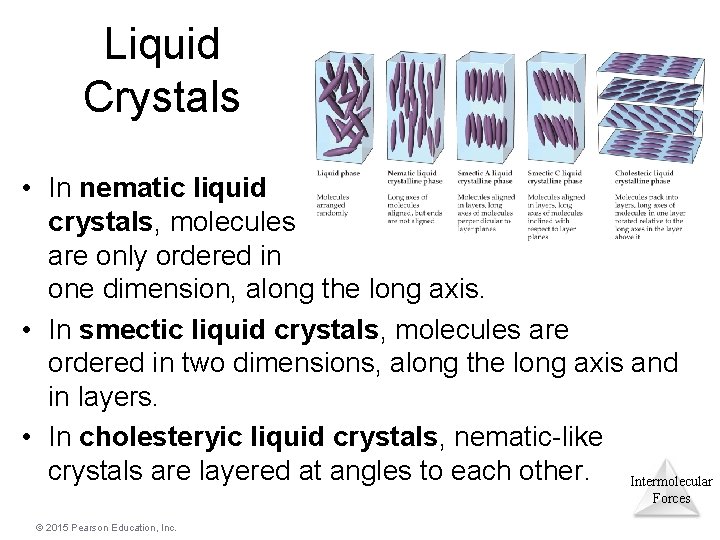
Liquid Crystals • In nematic liquid crystals, molecules are only ordered in one dimension, along the long axis. • In smectic liquid crystals, molecules are ordered in two dimensions, along the long axis and in layers. • In cholesteryic liquid crystals, nematic-like crystals are layered at angles to each other. Intermolecular Forces © 2015 Pearson Education, Inc.