
Lecture Presentation Chapter 11 Acids and Bases Karen
Lecture Presentation Chapter 11 Acids and Bases Karen C. Timberlake General, Organic, and Biological Chemistry: Structures of Life, 5/e Karen C. Timberlake © 2016 Pearson Education, Inc.
Topics covered in this Chapter • 11. 1 Acids and Bases • 11. 2 Brønsted–Lowry Acids and Bases • 11. 3 Strengths of Acids and Bases • 11. 4 Dissociation Constants for Acids and Bases • • • 11. 5 Dissociation of Water 11. 6 The p. H Scale 11. 7 Reactions of Acids and Bases 11. 8 Acid–Base Titration 11. 9 Buffers General, Organic, and Biological Chemistry: Structures of Life, 5/e Karen C. Timberlake © 2016 Pearson Education, Inc.
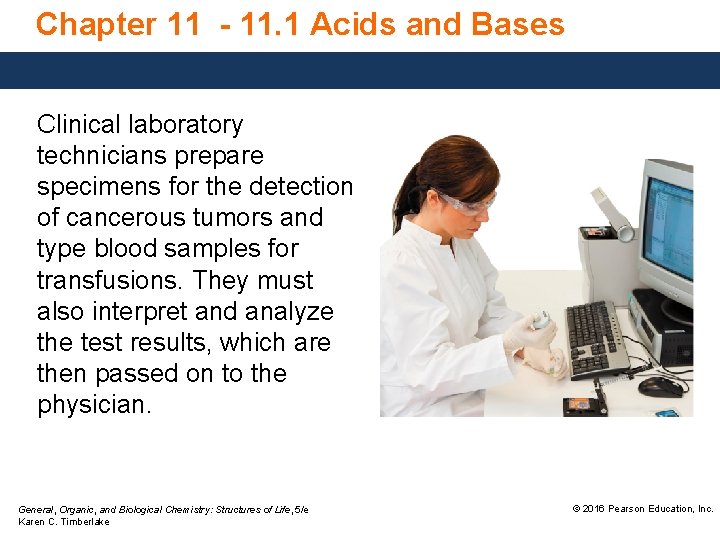
Chapter 11 - 11. 1 Acids and Bases Clinical laboratory technicians prepare specimens for the detection of cancerous tumors and type blood samples for transfusions. They must also interpret and analyze the test results, which are then passed on to the physician. General, Organic, and Biological Chemistry: Structures of Life, 5/e Karen C. Timberlake © 2016 Pearson Education, Inc.
Chapter 11 Readiness Key Math Skills • Solving Equations (1. 4 D) • Writing Numbers in Scientific Notation (1. 4 F) General, Organic, and Biological Chemistry: Structures of Life, 5/e Karen C. Timberlake © 2016 Pearson Education, Inc.
Chapter 11 Readiness Core Chemistry Skills • Writing Ionic Formulas (6. 2) • Balancing a Chemical Equation (7. 1) • Using Concentrations as a Conversion Factor (9. 4) • Writing the Equilibrium Constant Expression (10. 3) • Calculating Equilibrium Concentrations (10. 4) • Using Le Châtelier’s Principle (10. 5) General, Organic, and Biological Chemistry: Structures of Life, 5/e Karen C. Timberlake © 2016 Pearson Education, Inc.
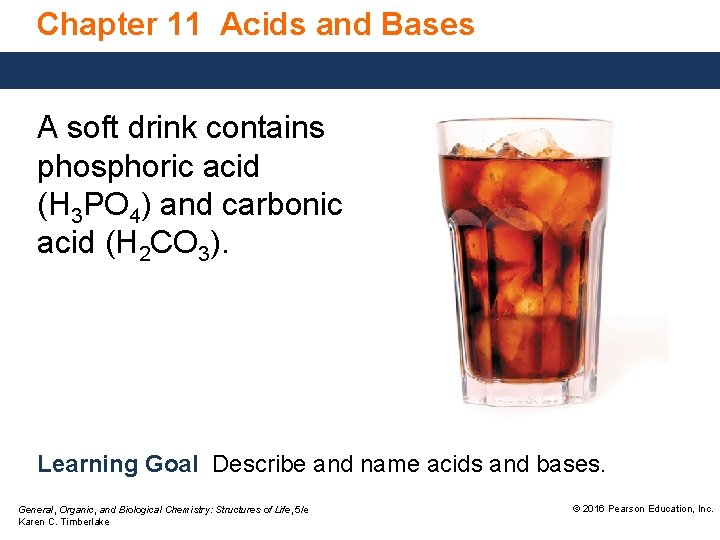
Chapter 11 Acids and Bases A soft drink contains phosphoric acid (H 3 PO 4) and carbonic acid (H 2 CO 3). Learning Goal Describe and name acids and bases. General, Organic, and Biological Chemistry: Structures of Life, 5/e Karen C. Timberlake © 2016 Pearson Education, Inc.
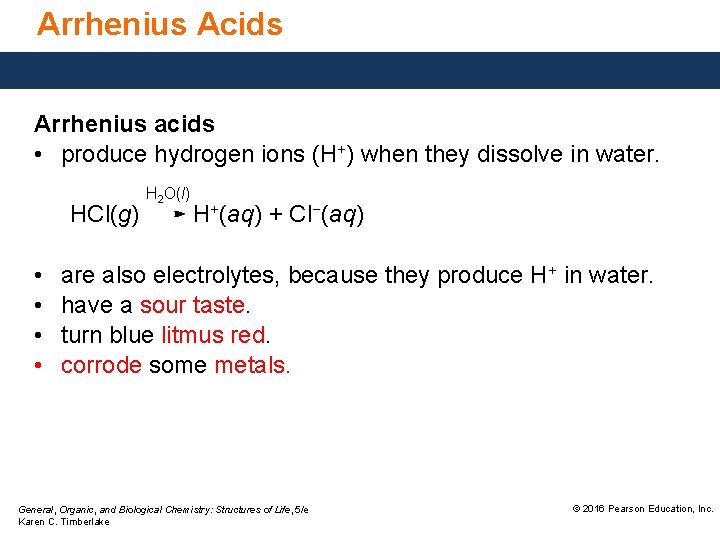
Arrhenius Acids Arrhenius acids • produce hydrogen ions (H+) when they dissolve in water. H 2 O(l) HCl(g) H+(aq) + Cl−(aq) • • are also electrolytes, because they produce H+ in water. have a sour taste. turn blue litmus red. corrode some metals. General, Organic, and Biological Chemistry: Structures of Life, 5/e Karen C. Timberlake © 2016 Pearson Education, Inc.
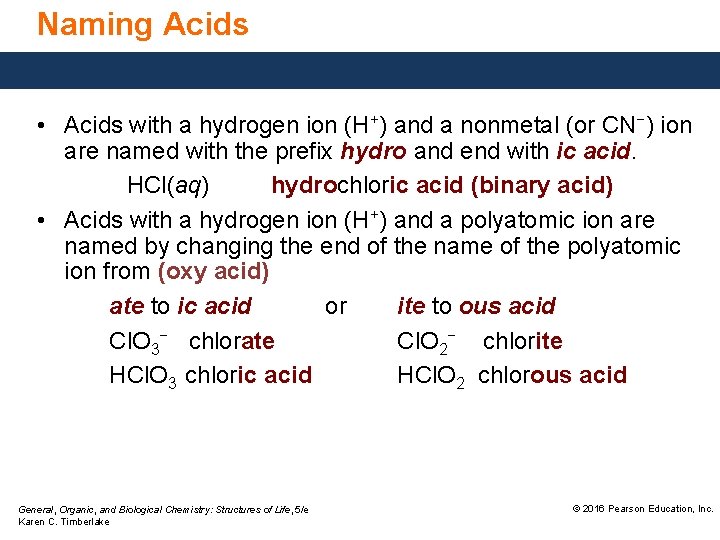
Naming Acids • Acids with a hydrogen ion (H+) and a nonmetal (or CN−) ion are named with the prefix hydro and end with ic acid. HCl(aq) hydrochloric acid (binary acid) • Acids with a hydrogen ion (H+) and a polyatomic ion are named by changing the end of the name of the polyatomic ion from (oxy acid) ate to ic acid or ite to ous acid Cl. O 3− chlorate Cl. O 2− chlorite HCl. O 3 chloric acid HCl. O 2 chlorous acid General, Organic, and Biological Chemistry: Structures of Life, 5/e Karen C. Timberlake © 2016 Pearson Education, Inc.
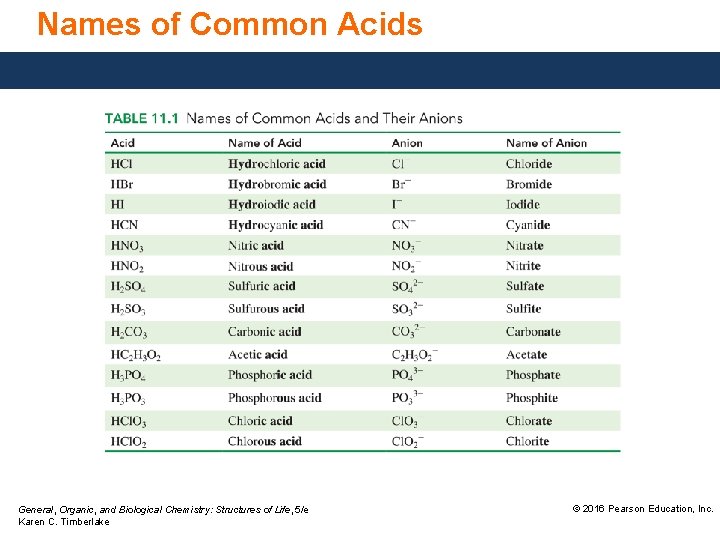
Names of Common Acids General, Organic, and Biological Chemistry: Structures of Life, 5/e Karen C. Timberlake © 2016 Pearson Education, Inc.
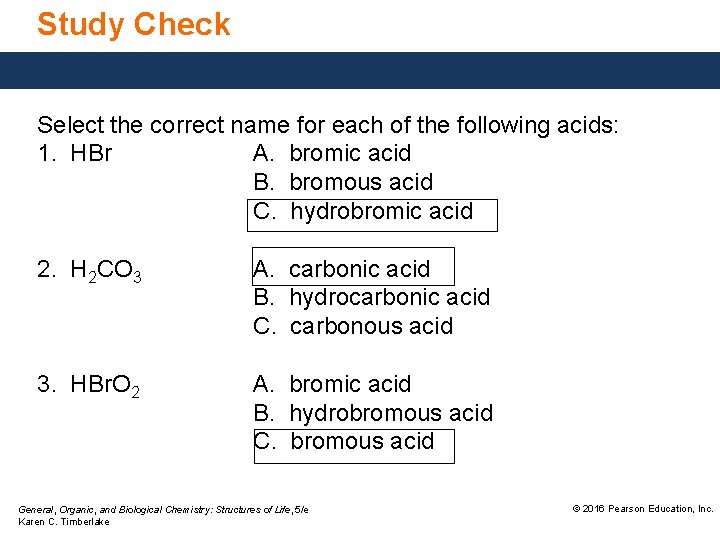
Study Check Select the correct name for each of the following acids: 1. HBr A. bromic acid B. bromous acid C. hydrobromic acid 2. H 2 CO 3 A. carbonic acid B. hydrocarbonic acid C. carbonous acid 3. HBr. O 2 A. bromic acid B. hydrobromous acid C. bromous acid General, Organic, and Biological Chemistry: Structures of Life, 5/e Karen C. Timberlake © 2016 Pearson Education, Inc.
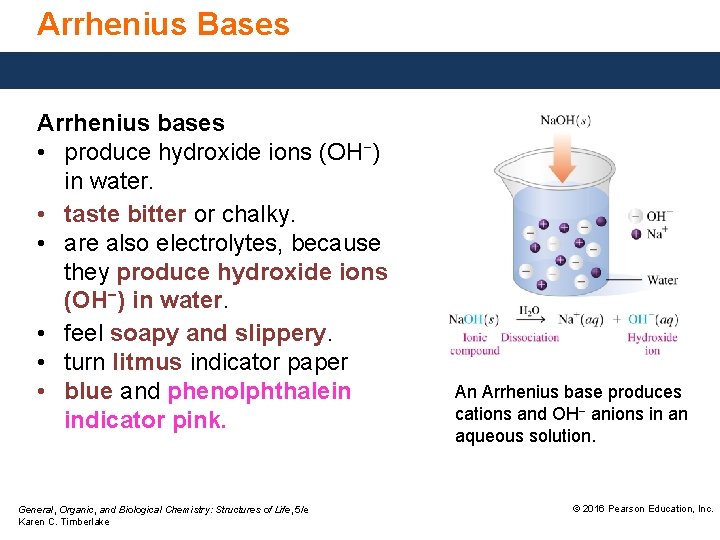
Arrhenius Bases Arrhenius bases • produce hydroxide ions (OH−) in water. • taste bitter or chalky. • are also electrolytes, because they produce hydroxide ions (OH−) in water. • feel soapy and slippery. • turn litmus indicator paper • blue and phenolphthalein indicator pink. General, Organic, and Biological Chemistry: Structures of Life, 5/e Karen C. Timberlake An Arrhenius base produces cations and OH− anions in an aqueous solution. © 2016 Pearson Education, Inc.
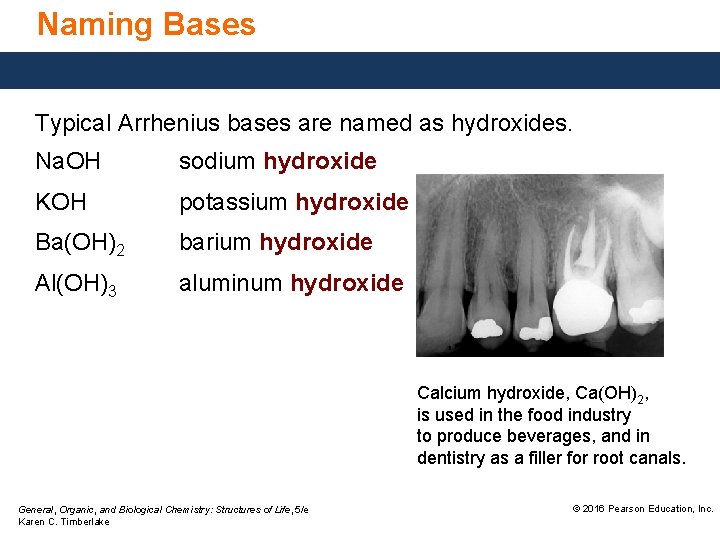
Naming Bases Typical Arrhenius bases are named as hydroxides. Na. OH sodium hydroxide KOH potassium hydroxide Ba(OH)2 barium hydroxide Al(OH)3 aluminum hydroxide Calcium hydroxide, Ca(OH)2, is used in the food industry to produce beverages, and in dentistry as a filler for root canals. General, Organic, and Biological Chemistry: Structures of Life, 5/e Karen C. Timberlake © 2016 Pearson Education, Inc.
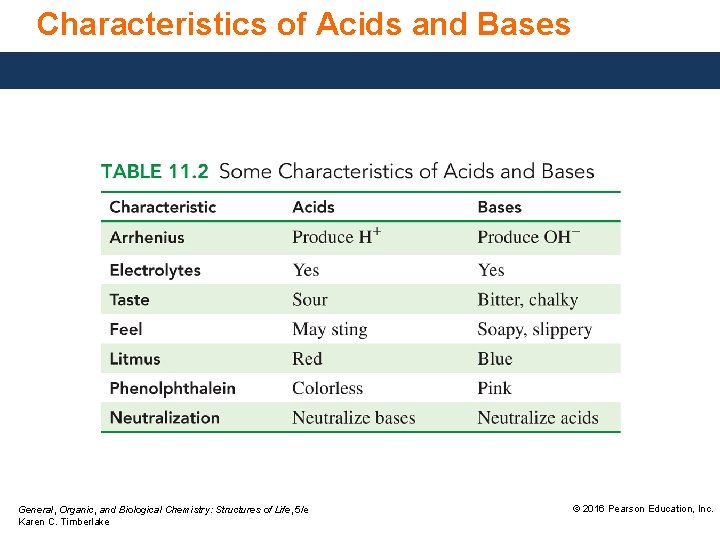
Characteristics of Acids and Bases General, Organic, and Biological Chemistry: Structures of Life, 5/e Karen C. Timberlake © 2016 Pearson Education, Inc.
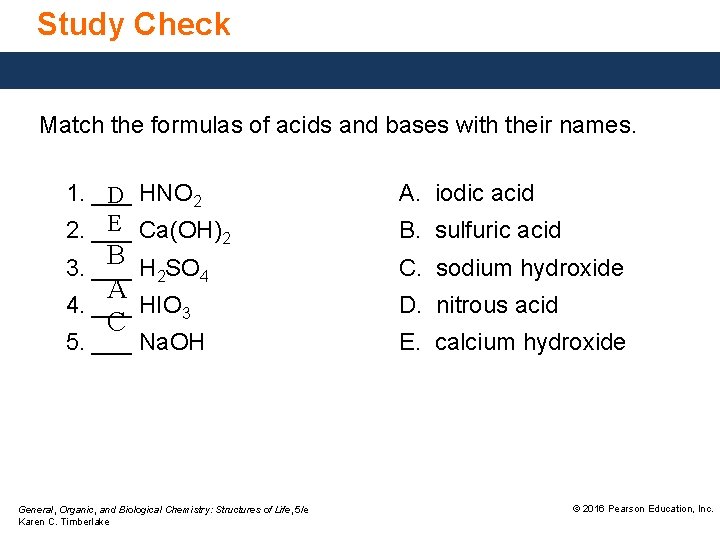
Study Check Match the formulas of acids and bases with their names. 1. ___ HNO D 2 E 2. ___ Ca(OH) B SO 3. ___ H 2 4 A. iodic acid 2 A 4. ___ HIO 3 C 5. ___ Na. OH General, Organic, and Biological Chemistry: Structures of Life, 5/e Karen C. Timberlake B. sulfuric acid C. sodium hydroxide D. nitrous acid E. calcium hydroxide © 2016 Pearson Education, Inc.
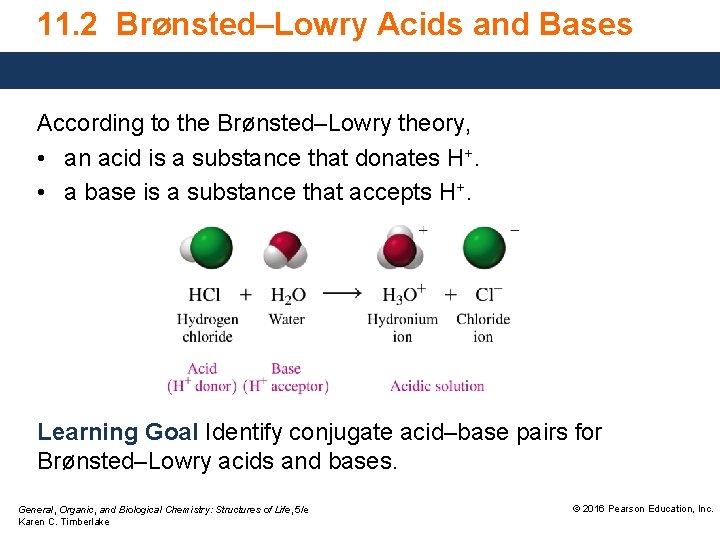
11. 2 Brønsted–Lowry Acids and Bases According to the Brønsted–Lowry theory, • an acid is a substance that donates H+. • a base is a substance that accepts H+. Learning Goal Identify conjugate acid–base pairs for Brønsted–Lowry acids and bases. General, Organic, and Biological Chemistry: Structures of Life, 5/e Karen C. Timberlake © 2016 Pearson Education, Inc.
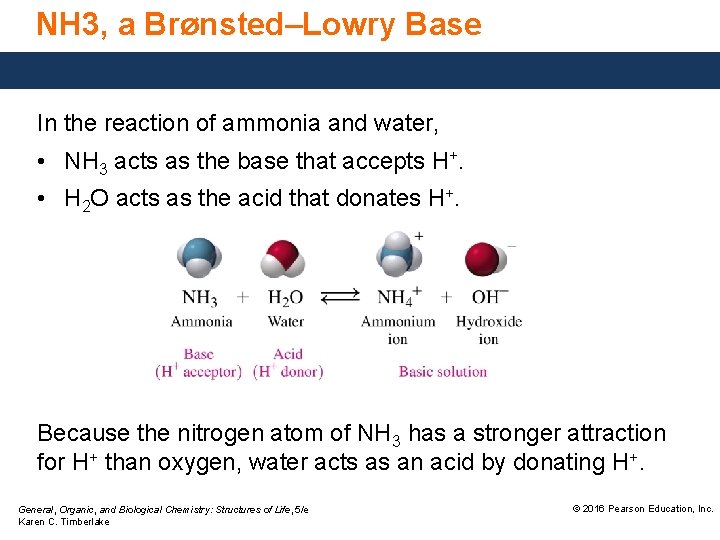
NH 3, a Brønsted–Lowry Base In the reaction of ammonia and water, • NH 3 acts as the base that accepts H+. • H 2 O acts as the acid that donates H+. Because the nitrogen atom of NH 3 has a stronger attraction for H+ than oxygen, water acts as an acid by donating H+. General, Organic, and Biological Chemistry: Structures of Life, 5/e Karen C. Timberlake © 2016 Pearson Education, Inc.
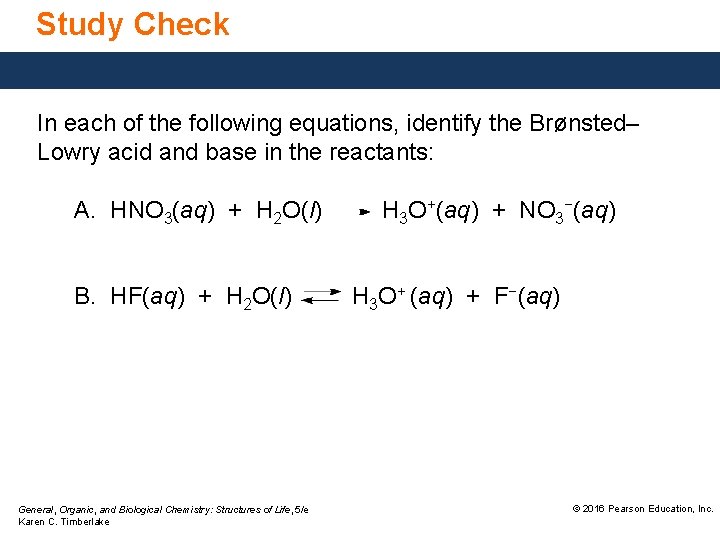
Study Check In each of the following equations, identify the Brønsted– Lowry acid and base in the reactants: A. HNO 3(aq) + H 2 O(l) H 3 O+(aq) + NO 3−(aq) B. HF(aq) + H 2 O(l) H 3 O+ (aq) + F−(aq) General, Organic, and Biological Chemistry: Structures of Life, 5/e Karen C. Timberlake © 2016 Pearson Education, Inc.
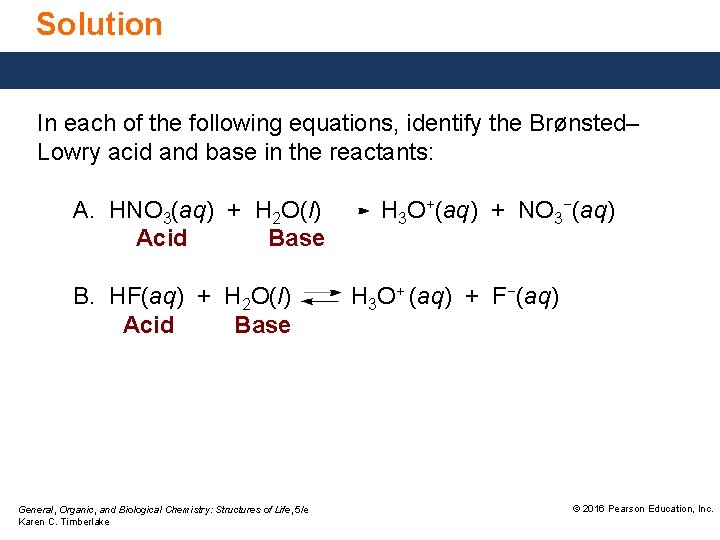
Solution In each of the following equations, identify the Brønsted– Lowry acid and base in the reactants: A. HNO 3(aq) + H 2 O(l) H 3 O+(aq) + NO 3−(aq) Acid Base B. HF(aq) + H 2 O(l) H 3 O+ (aq) + F−(aq) Acid Base General, Organic, and Biological Chemistry: Structures of Life, 5/e Karen C. Timberlake © 2016 Pearson Education, Inc.
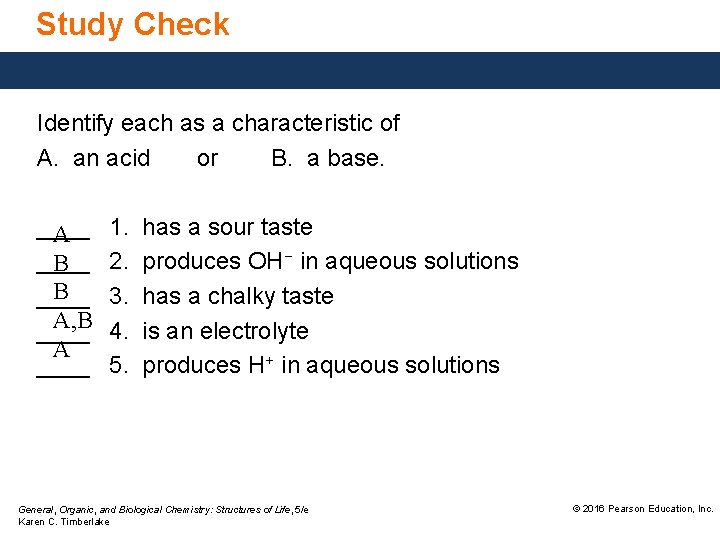
Study Check Identify each as a characteristic of A. an acid or B. a base. ____ A ____ B B ____ A, B ____ A ____ 1. has a sour taste 2. produces OH− in aqueous solutions 3. has a chalky taste 4. is an electrolyte 5. produces H+ in aqueous solutions General, Organic, and Biological Chemistry: Structures of Life, 5/e Karen C. Timberlake © 2016 Pearson Education, Inc.
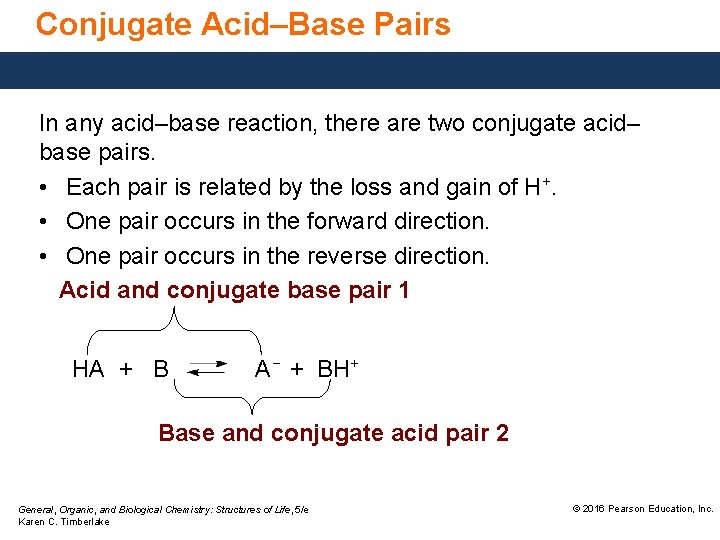
Conjugate Acid–Base Pairs In any acid–base reaction, there are two conjugate acid– base pairs. • Each pair is related by the loss and gain of H+. • One pair occurs in the forward direction. • One pair occurs in the reverse direction. Acid and conjugate base pair 1 HA + B A− + BH+ Base and conjugate acid pair 2 General, Organic, and Biological Chemistry: Structures of Life, 5/e Karen C. Timberlake © 2016 Pearson Education, Inc.
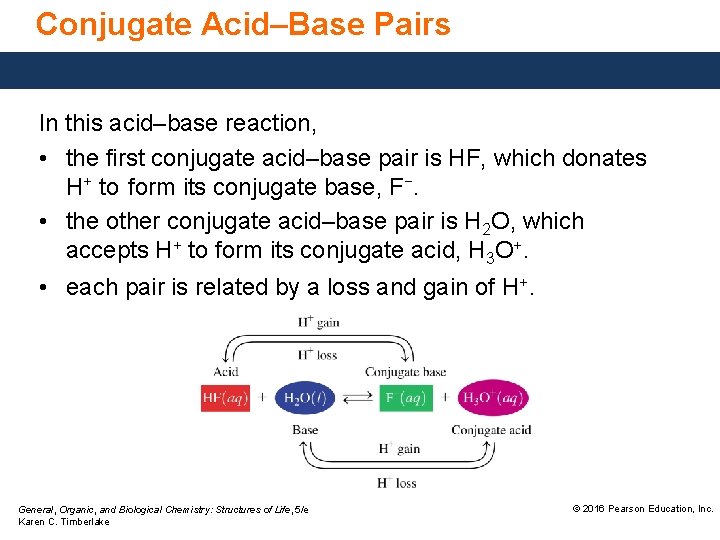
Conjugate Acid–Base Pairs In this acid–base reaction, • the first conjugate acid–base pair is HF, which donates H+ to form its conjugate base, F−. • the other conjugate acid–base pair is H 2 O, which accepts H+ to form its conjugate acid, H 3 O+. • each pair is related by a loss and gain of H+. General, Organic, and Biological Chemistry: Structures of Life, 5/e Karen C. Timberlake © 2016 Pearson Education, Inc.
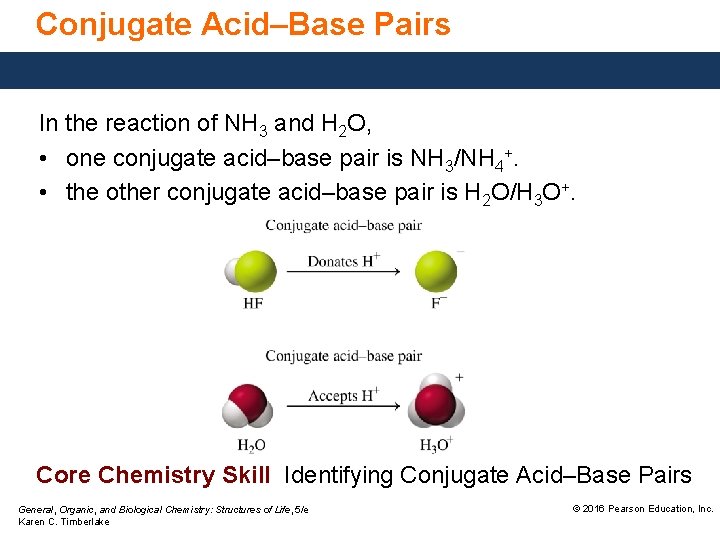
Conjugate Acid–Base Pairs In the reaction of NH 3 and H 2 O, • one conjugate acid–base pair is NH 3/NH 4+. • the other conjugate acid–base pair is H 2 O/H 3 O+. Core Chemistry Skill Identifying Conjugate Acid–Base Pairs General, Organic, and Biological Chemistry: Structures of Life, 5/e Karen C. Timberlake © 2016 Pearson Education, Inc.
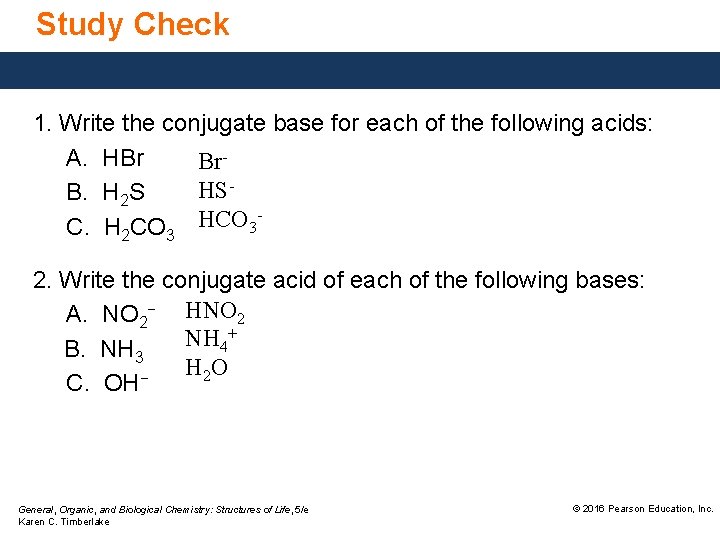
Study Check 1. Write the conjugate base for each of the following acids: A. HBr Br. HS B. H 2 S HCO 3 C. H 2 CO 3 2. Write the conjugate acid of each of the following bases: A. NO 2− HNO 2 NH 4+ B. NH 3 H 2 O − C. OH General, Organic, and Biological Chemistry: Structures of Life, 5/e Karen C. Timberlake © 2016 Pearson Education, Inc.
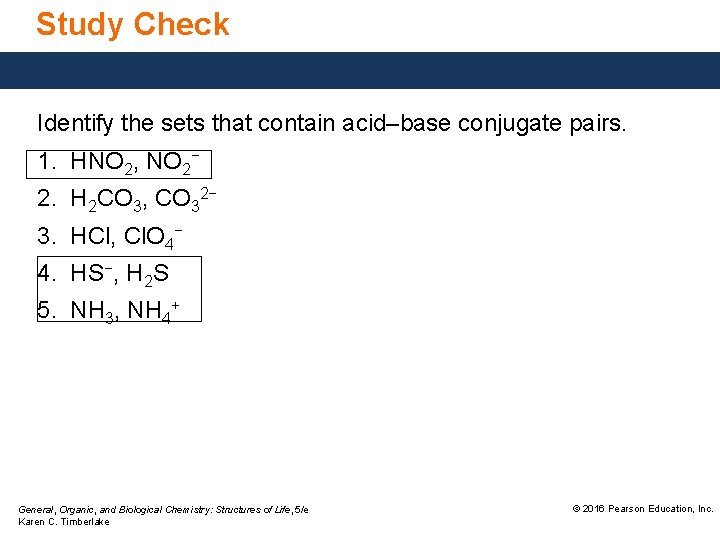
Study Check Identify the sets that contain acid–base conjugate pairs. 1. HNO 2, NO 2− 2. H 2 CO 3, CO 32− 3. HCl, Cl. O 4− 4. HS−, H 2 S 5. NH 3, NH 4+ General, Organic, and Biological Chemistry: Structures of Life, 5/e Karen C. Timberlake © 2016 Pearson Education, Inc.
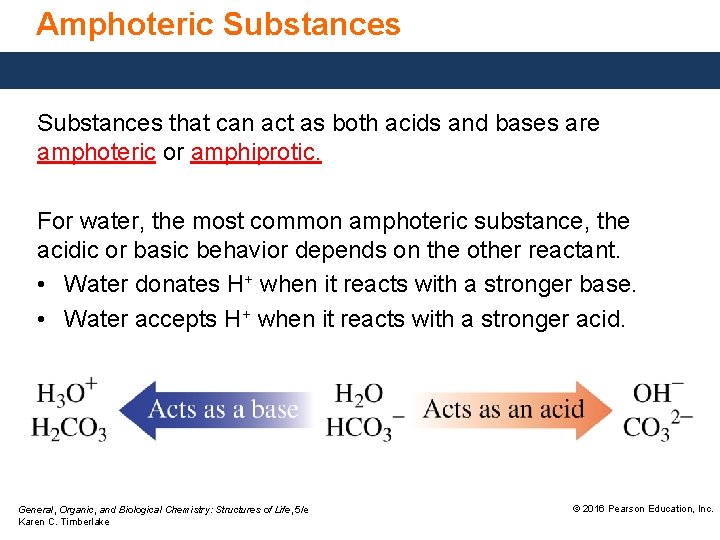
Amphoteric Substances that can act as both acids and bases are amphoteric or amphiprotic. For water, the most common amphoteric substance, the acidic or basic behavior depends on the other reactant. • Water donates H+ when it reacts with a stronger base. • Water accepts H+ when it reacts with a stronger acid. General, Organic, and Biological Chemistry: Structures of Life, 5/e Karen C. Timberlake © 2016 Pearson Education, Inc.
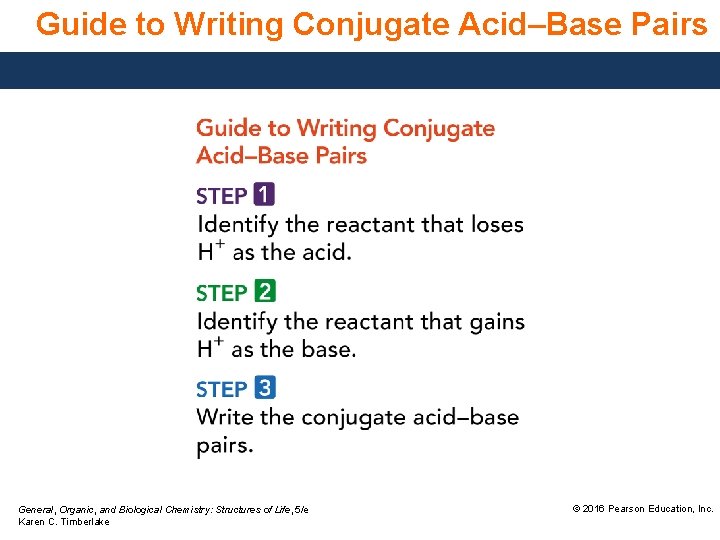
Guide to Writing Conjugate Acid–Base Pairs General, Organic, and Biological Chemistry: Structures of Life, 5/e Karen C. Timberlake © 2016 Pearson Education, Inc.
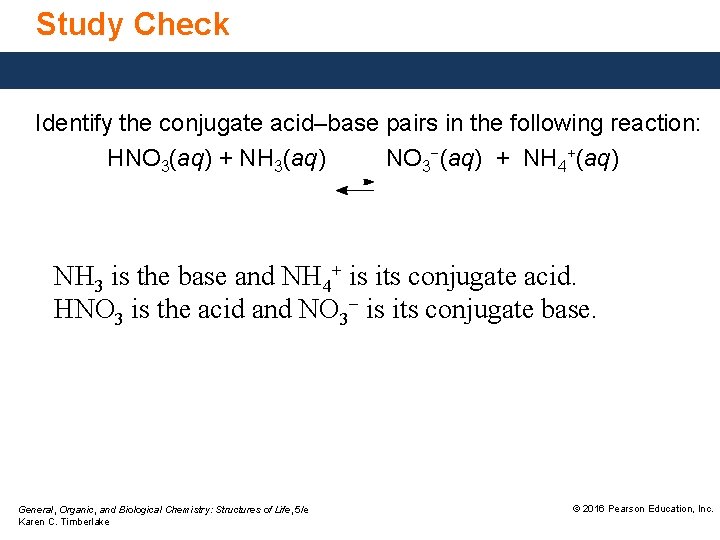
Study Check Identify the conjugate acid–base pairs in the following reaction: HNO 3(aq) + NH 3(aq) NO 3−(aq) + NH 4+(aq) NH 3 is the base and NH 4+ is its conjugate acid. HNO 3 is the acid and NO 3− is its conjugate base. General, Organic, and Biological Chemistry: Structures of Life, 5/e Karen C. Timberlake © 2016 Pearson Education, Inc.
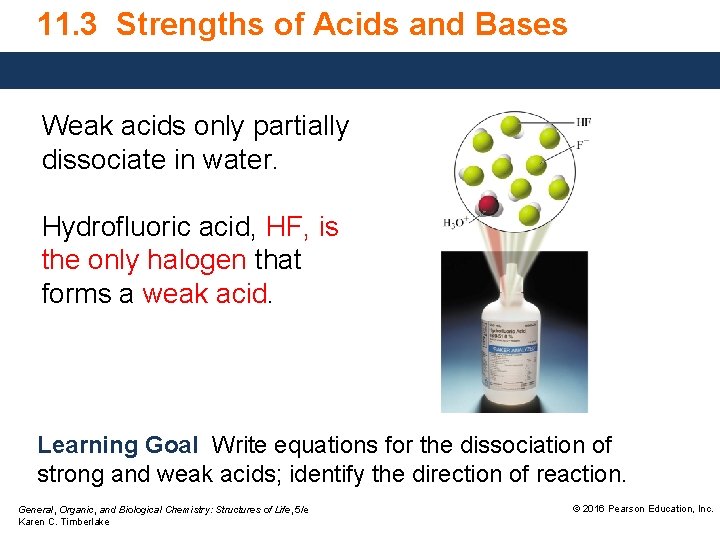
11. 3 Strengths of Acids and Bases Weak acids only partially dissociate in water. Hydrofluoric acid, HF, is the only halogen that forms a weak acid. Learning Goal Write equations for the dissociation of strong and weak acids; identify the direction of reaction. General, Organic, and Biological Chemistry: Structures of Life, 5/e Karen C. Timberlake © 2016 Pearson Education, Inc.
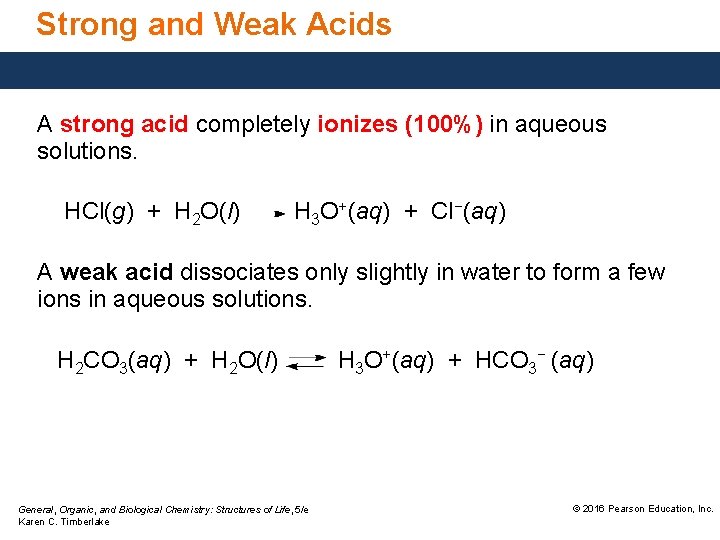
Strong and Weak Acids A strong acid completely ionizes (100%) in aqueous solutions. HCl(g) + H 2 O(l) H 3 O+(aq) + Cl−(aq) A weak acid dissociates only slightly in water to form a few ions in aqueous solutions. H 2 CO 3(aq) + H 2 O(l) H 3 O+(aq) + HCO 3− (aq) General, Organic, and Biological Chemistry: Structures of Life, 5/e Karen C. Timberlake © 2016 Pearson Education, Inc.
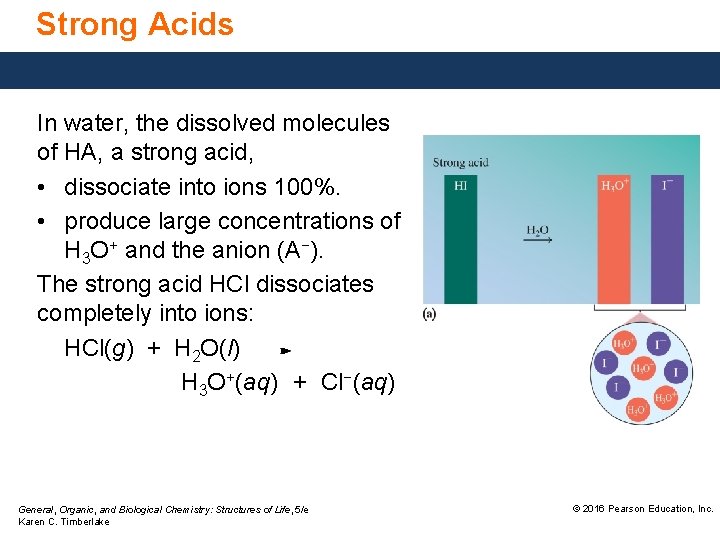
Strong Acids In water, the dissolved molecules of HA, a strong acid, • dissociate into ions 100%. • produce large concentrations of H 3 O+ and the anion (A−). The strong acid HCl dissociates completely into ions: HCl(g) + H 2 O(l) H 3 O+(aq) + Cl−(aq) General, Organic, and Biological Chemistry: Structures of Life, 5/e Karen C. Timberlake © 2016 Pearson Education, Inc.
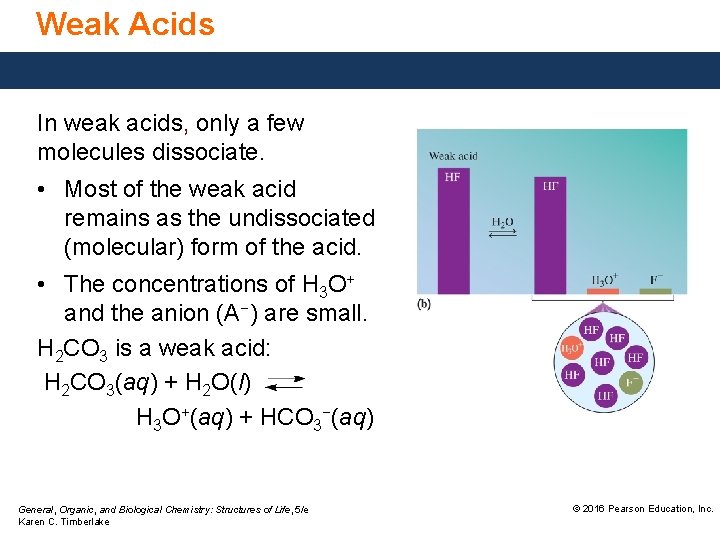
Weak Acids In weak acids, only a few molecules dissociate. • Most of the weak acid remains as the undissociated (molecular) form of the acid. • The concentrations of H 3 O+ and the anion (A−) are small. H 2 CO 3 is a weak acid: H 2 CO 3(aq) + H 2 O(l) H 3 O+(aq) + HCO 3−(aq) General, Organic, and Biological Chemistry: Structures of Life, 5/e Karen C. Timberlake © 2016 Pearson Education, Inc.
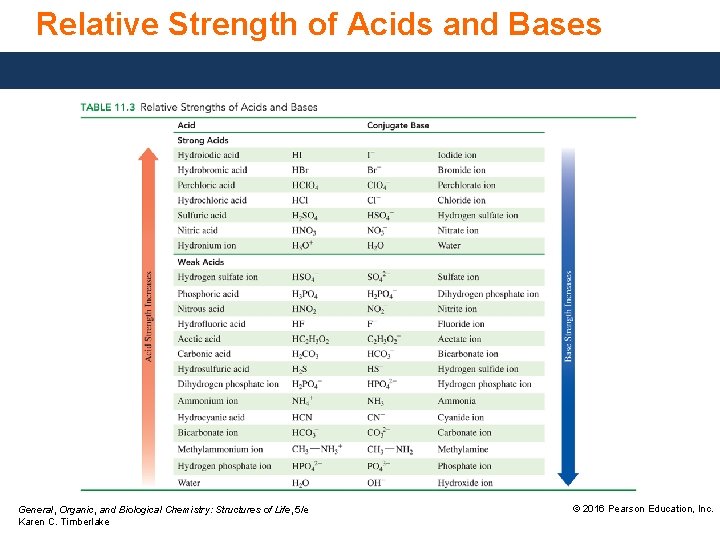
Relative Strength of Acids and Bases General, Organic, and Biological Chemistry: Structures of Life, 5/e Karen C. Timberlake © 2016 Pearson Education, Inc.
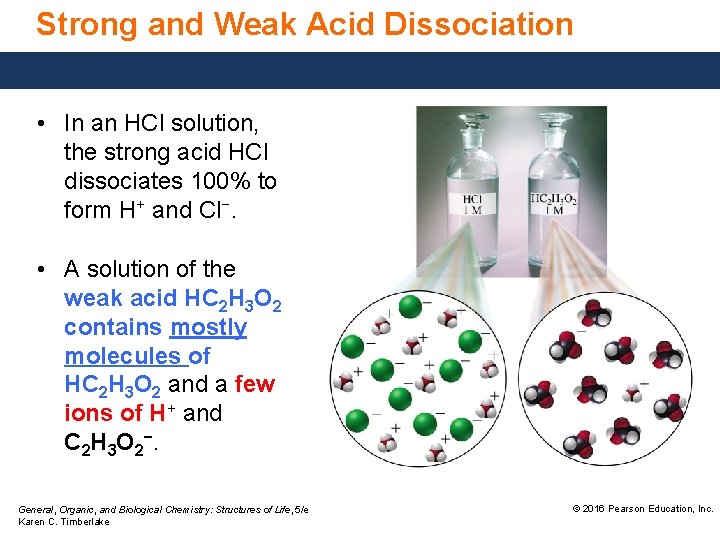
Strong and Weak Acid Dissociation • In an HCl solution, the strong acid HCl dissociates 100% to form H+ and Cl−. • A solution of the weak acid HC 2 H 3 O 2 contains mostly molecules of HC 2 H 3 O 2 and a few ions of H+ and C 2 H 3 O 2−. General, Organic, and Biological Chemistry: Structures of Life, 5/e Karen C. Timberlake © 2016 Pearson Education, Inc.
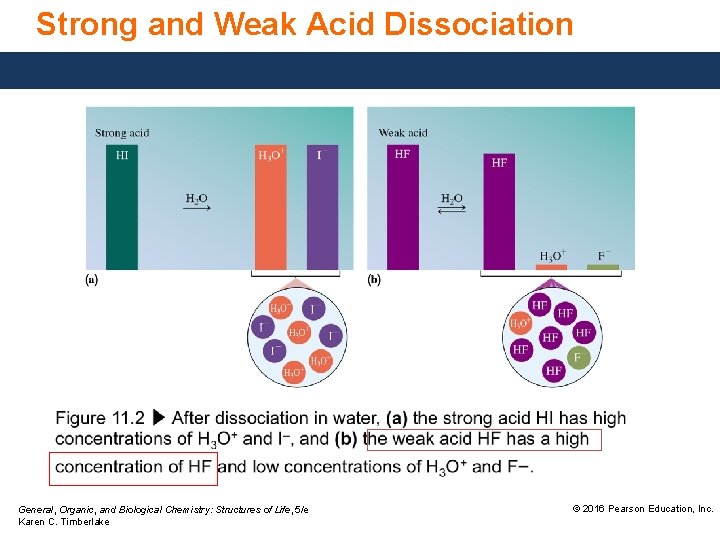
Strong and Weak Acid Dissociation General, Organic, and Biological Chemistry: Structures of Life, 5/e Karen C. Timberlake © 2016 Pearson Education, Inc.
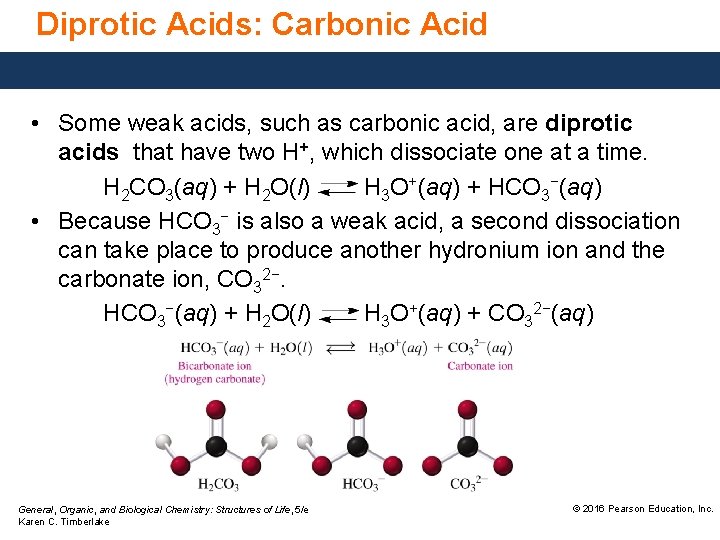
Diprotic Acids: Carbonic Acid • Some weak acids, such as carbonic acid, are diprotic acids that have two H+, which dissociate one at a time. H 2 CO 3(aq) + H 2 O(l) H 3 O+(aq) + HCO 3−(aq) • Because HCO 3− is also a weak acid, a second dissociation can take place to produce another hydronium ion and the carbonate ion, CO 32−. HCO 3−(aq) + H 2 O(l) H 3 O+(aq) + CO 32−(aq) General, Organic, and Biological Chemistry: Structures of Life, 5/e Karen C. Timberlake © 2016 Pearson Education, Inc.
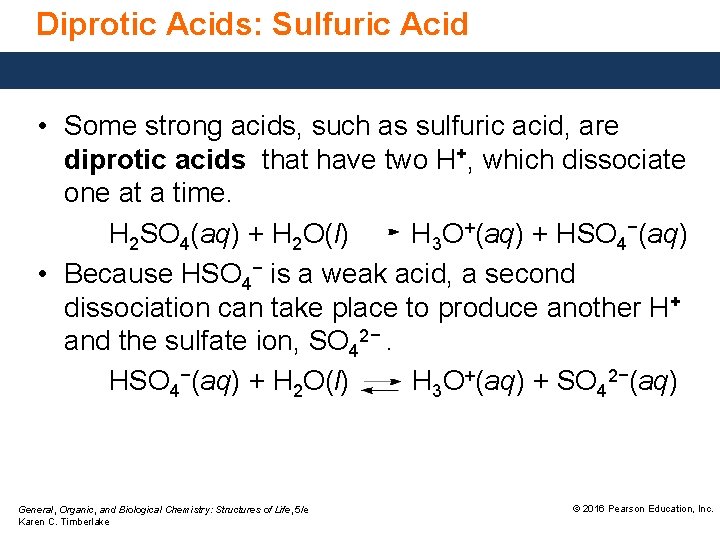
Diprotic Acids: Sulfuric Acid • Some strong acids, such as sulfuric acid, are diprotic acids that have two H+, which dissociate one at a time. H 2 SO 4(aq) + H 2 O(l) H 3 O+(aq) + HSO 4−(aq) • Because HSO 4− is a weak acid, a second dissociation can take place to produce another H+ and the sulfate ion, SO 42−. HSO 4−(aq) + H 2 O(l) H 3 O+(aq) + SO 42−(aq) General, Organic, and Biological Chemistry: Structures of Life, 5/e Karen C. Timberlake © 2016 Pearson Education, Inc.
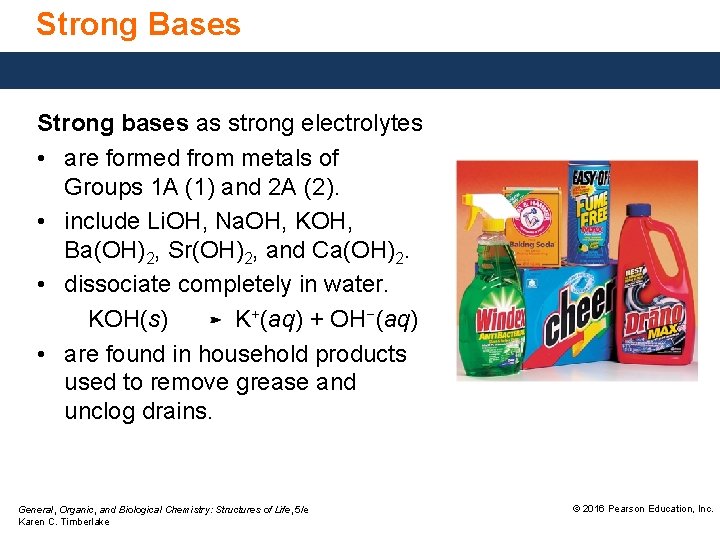
Strong Bases Strong bases as strong electrolytes • are formed from metals of Groups 1 A (1) and 2 A (2). • include Li. OH, Na. OH, KOH, Ba(OH)2, Sr(OH)2, and Ca(OH)2. • dissociate completely in water. KOH(s) K+(aq) + OH−(aq) • are found in household products used to remove grease and unclog drains. General, Organic, and Biological Chemistry: Structures of Life, 5/e Karen C. Timberlake © 2016 Pearson Education, Inc.
Weak Bases Weak bases are weak electrolytes • that are poor acceptors of H+ ions. • produce very few ions in solution. • include ammonia. NH 3(g) + H 2 O(l) NH 4+(aq) + OH−(aq) Ammonia General, Organic, and Biological Chemistry: Structures of Life, 5/e Karen C. Timberlake Ammonium hydroxide © 2016 Pearson Education, Inc.
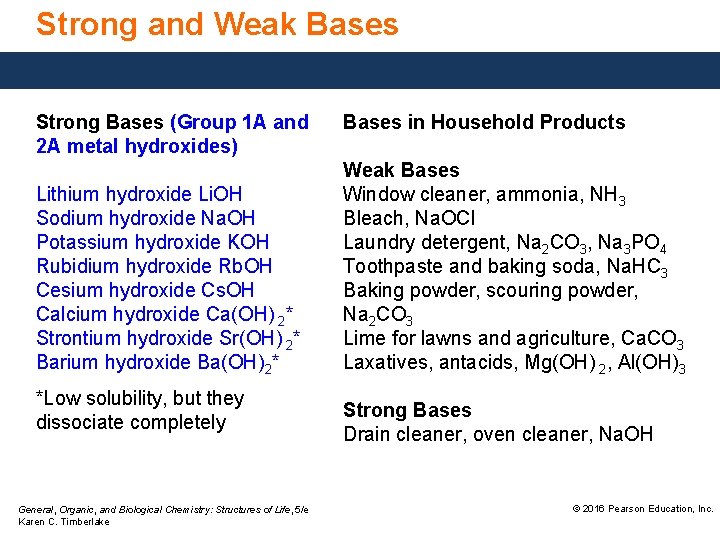
Strong and Weak Bases Strong Bases (Group 1 A and 2 A metal hydroxides) Lithium hydroxide Li. OH Sodium hydroxide Na. OH Potassium hydroxide KOH Rubidium hydroxide Rb. OH Cesium hydroxide Cs. OH Calcium hydroxide Ca(OH) 2* Strontium hydroxide Sr(OH) 2* Barium hydroxide Ba(OH)2* *Low solubility, but they dissociate completely General, Organic, and Biological Chemistry: Structures of Life, 5/e Karen C. Timberlake Bases in Household Products Weak Bases Window cleaner, ammonia, NH 3 Bleach, Na. OCl Laundry detergent, Na 2 CO 3, Na 3 PO 4 Toothpaste and baking soda, Na. HC 3 Baking powder, scouring powder, Na 2 CO 3 Lime for lawns and agriculture, Ca. CO 3 Laxatives, antacids, Mg(OH) 2, Al(OH)3 Strong Bases Drain cleaner, oven cleaner, Na. OH © 2016 Pearson Education, Inc.
Direction of Reaction Strong acids have weak conjugate bases that do not readily accept H+. • As the strength of the acid decreases, the strength of its conjugate base increases. In any acid–base reaction, there are two acids and two bases. • However, one acid is stronger than the other acid, and one base is stronger than the other base. • By comparing their relative strengths, we can determine the direction of the reaction. General, Organic, and Biological Chemistry: Structures of Life, 5/e Karen C. Timberlake © 2016 Pearson Education, Inc.
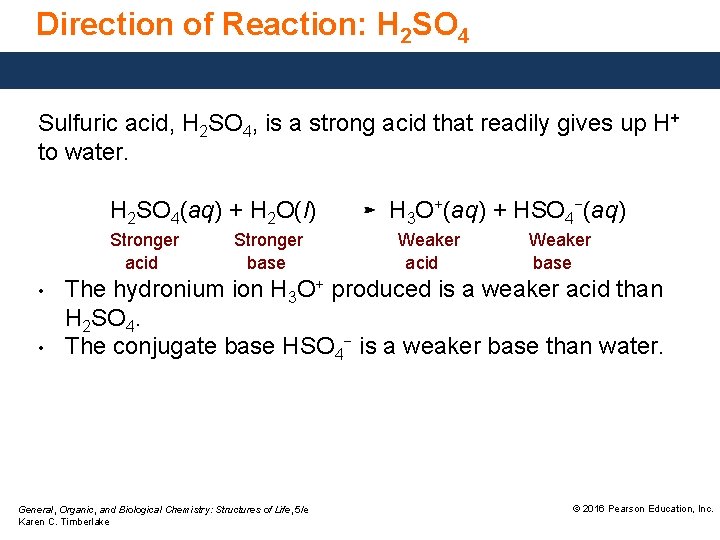
Direction of Reaction: H 2 SO 4 Sulfuric acid, H 2 SO 4, is a strong acid that readily gives up H+ to water. • • H 2 SO 4(aq) + H 2 O(l) H 3 O+(aq) + HSO 4−(aq) Stronger Weaker acid base The hydronium ion H 3 O+ produced is a weaker acid than H 2 SO 4. The conjugate base HSO 4− is a weaker base than water. General, Organic, and Biological Chemistry: Structures of Life, 5/e Karen C. Timberlake © 2016 Pearson Education, Inc.
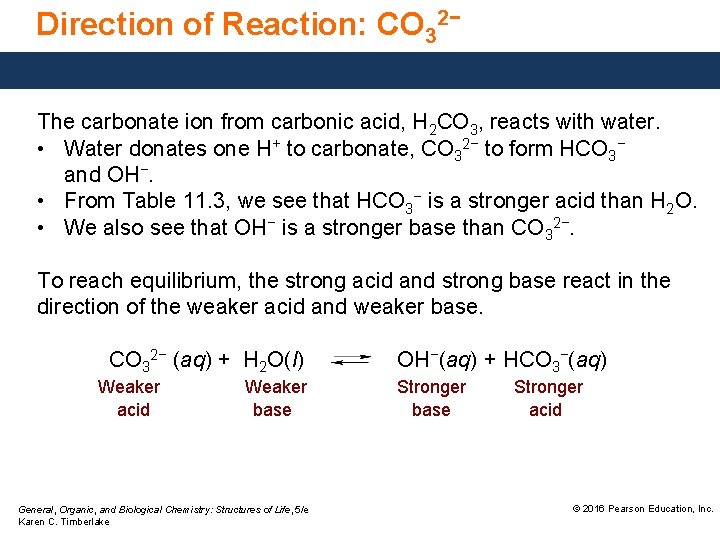
Direction of Reaction: CO 32− The carbonate ion from carbonic acid, H 2 CO 3, reacts with water. • Water donates one H+ to carbonate, CO 32− to form HCO 3− and OH−. • From Table 11. 3, we see that HCO 3− is a stronger acid than H 2 O. • We also see that OH− is a stronger base than CO 32−. To reach equilibrium, the strong acid and strong base react in the direction of the weaker acid and weaker base. CO 32− (aq) + H 2 O(l) Weaker acid base General, Organic, and Biological Chemistry: Structures of Life, 5/e Karen C. Timberlake OH−(aq) + HCO 3−(aq) Stronger base acid © 2016 Pearson Education, Inc.
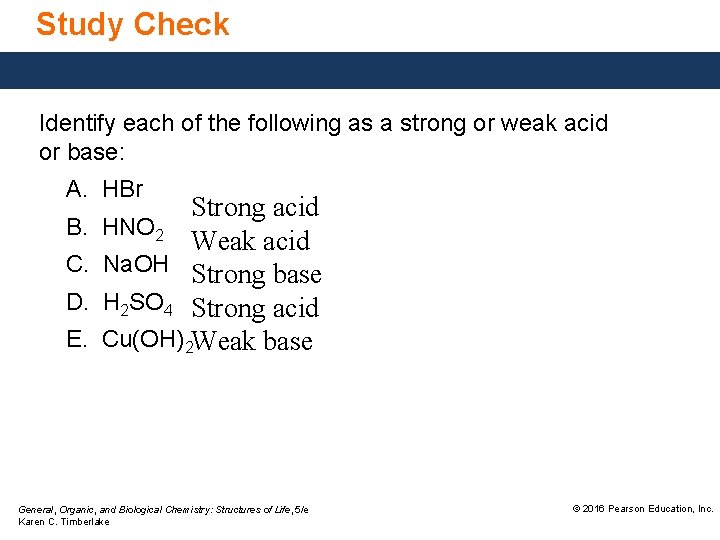
Study Check Identify each of the following as a strong or weak acid or base: A. HBr Strong acid B. HNO 2 Weak acid C. Na. OH Strong base D. H 2 SO 4 Strong acid E. Cu(OH)2 Weak base General, Organic, and Biological Chemistry: Structures of Life, 5/e Karen C. Timberlake © 2016 Pearson Education, Inc.
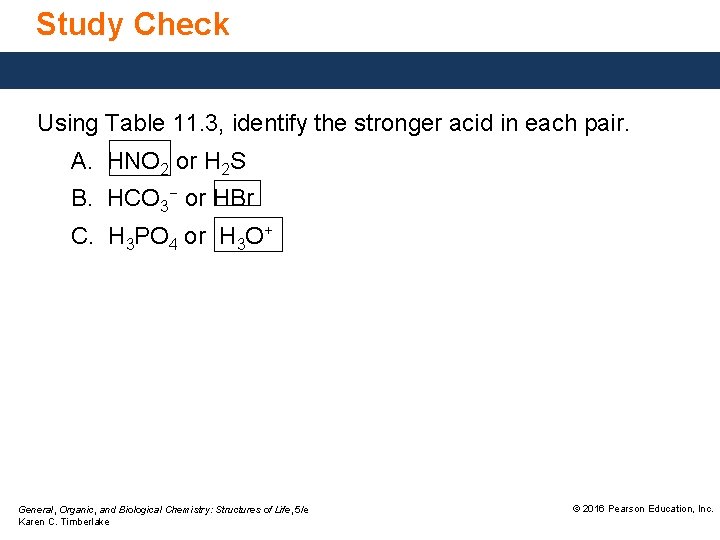
Study Check Using Table 11. 3, identify the stronger acid in each pair. A. HNO 2 or H 2 S B. HCO 3− or HBr C. H 3 PO 4 or H 3 O+ General, Organic, and Biological Chemistry: Structures of Life, 5/e Karen C. Timberlake © 2016 Pearson Education, Inc.
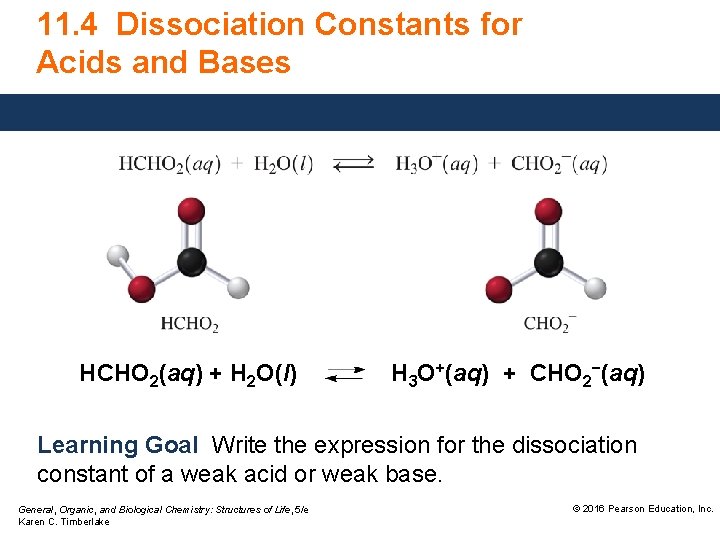
11. 4 Dissociation Constants for Acids and Bases HCHO 2(aq) + H 2 O(l) H 3 O+(aq) + CHO 2−(aq) Learning Goal Write the expression for the dissociation constant of a weak acid or weak base. General, Organic, and Biological Chemistry: Structures of Life, 5/e Karen C. Timberlake © 2016 Pearson Education, Inc.
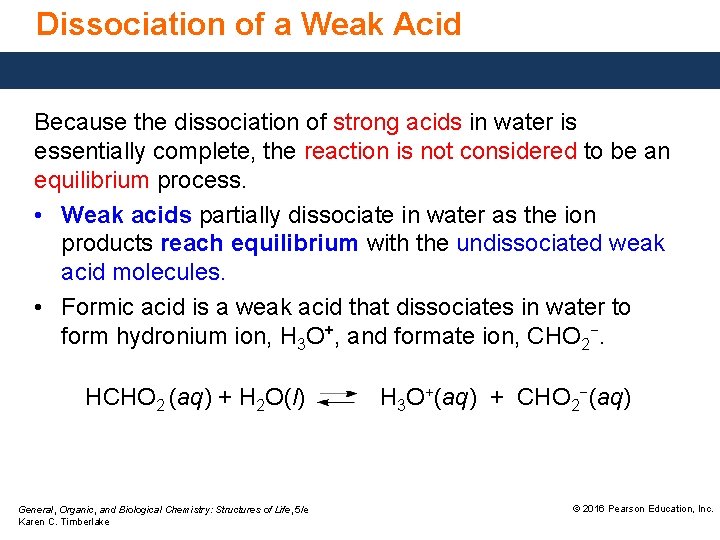
Dissociation of a Weak Acid Because the dissociation of strong acids in water is essentially complete, the reaction is not considered to be an equilibrium process. • Weak acids partially dissociate in water as the ion products reach equilibrium with the undissociated weak acid molecules. • Formic acid is a weak acid that dissociates in water to form hydronium ion, H 3 O+, and formate ion, CHO 2−. HCHO 2 (aq) + H 2 O(l) General, Organic, and Biological Chemistry: Structures of Life, 5/e Karen C. Timberlake H 3 O+(aq) + CHO 2−(aq) © 2016 Pearson Education, Inc.
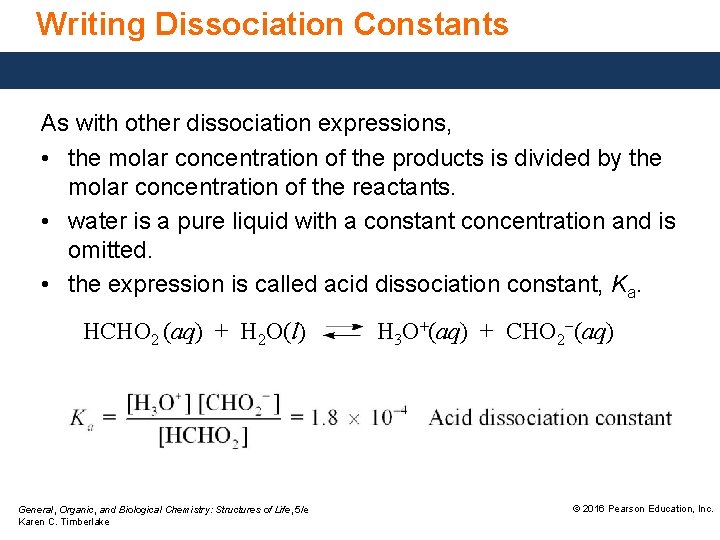
Writing Dissociation Constants As with other dissociation expressions, • the molar concentration of the products is divided by the molar concentration of the reactants. • water is a pure liquid with a constant concentration and is omitted. • the expression is called acid dissociation constant, Ka. HCHO 2 (aq) + H 2 O(l) General, Organic, and Biological Chemistry: Structures of Life, 5/e Karen C. Timberlake H 3 O+(aq) + CHO 2−(aq) © 2016 Pearson Education, Inc.
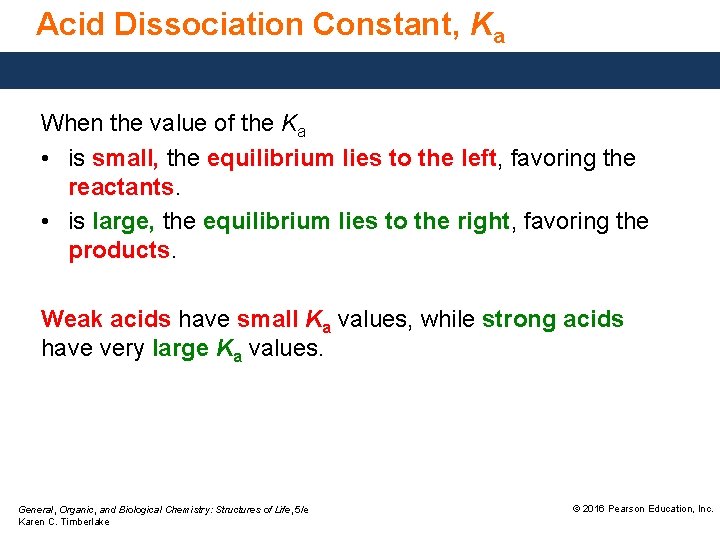
Acid Dissociation Constant, Ka When the value of the Ka • is small, the equilibrium lies to the left, favoring the reactants. • is large, the equilibrium lies to the right, favoring the products. Weak acids have small Ka values, while strong acids have very large Ka values. General, Organic, and Biological Chemistry: Structures of Life, 5/e Karen C. Timberlake © 2016 Pearson Education, Inc.
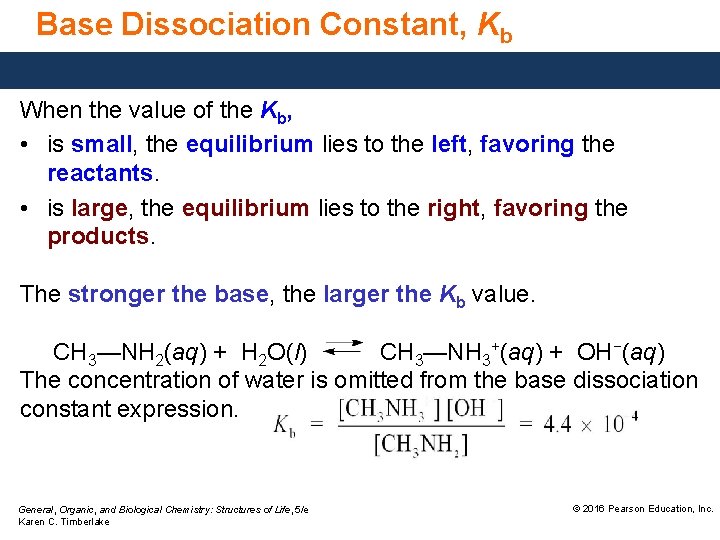
Base Dissociation Constant, Kb When the value of the Kb, • is small, the equilibrium lies to the left, favoring the reactants. • is large, the equilibrium lies to the right, favoring the products. The stronger the base, the larger the Kb value. CH 3—NH 2(aq) + H 2 O(l) CH 3—NH 3+(aq) + OH−(aq) The concentration of water is omitted from the base dissociation constant expression. General, Organic, and Biological Chemistry: Structures of Life, 5/e Karen C. Timberlake © 2016 Pearson Education, Inc.
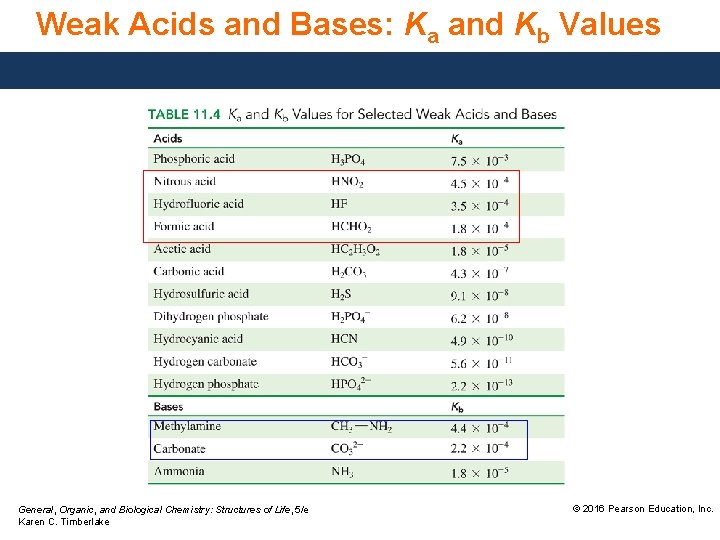
Weak Acids and Bases: Ka and Kb Values General, Organic, and Biological Chemistry: Structures of Life, 5/e Karen C. Timberlake © 2016 Pearson Education, Inc.
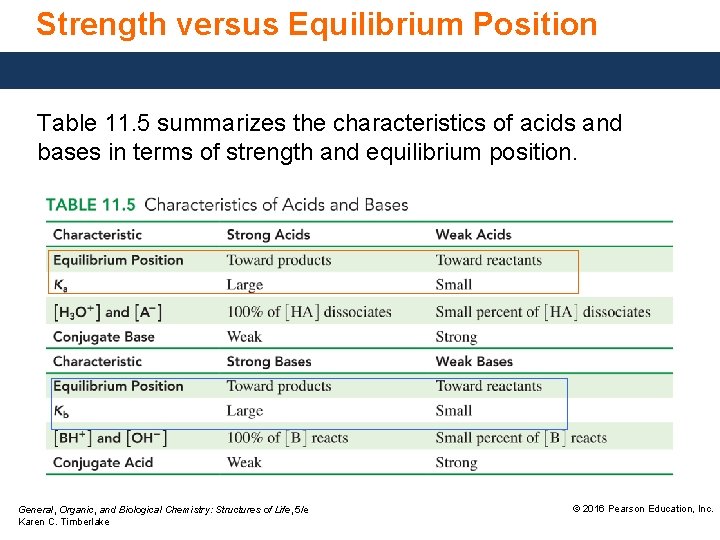
Strength versus Equilibrium Position Table 11. 5 summarizes the characteristics of acids and bases in terms of strength and equilibrium position. General, Organic, and Biological Chemistry: Structures of Life, 5/e Karen C. Timberlake © 2016 Pearson Education, Inc.
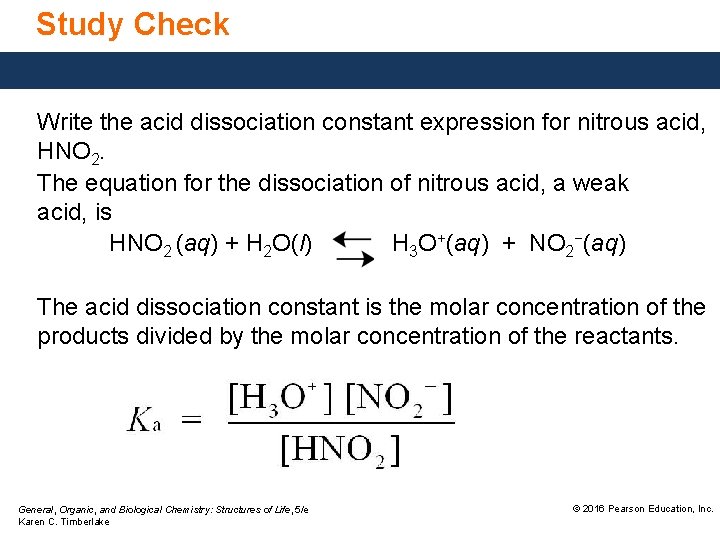
Study Check Write the acid dissociation constant expression for nitrous acid, HNO 2. The equation for the dissociation of nitrous acid, a weak acid, is HNO 2 (aq) + H 2 O(l) H 3 O+(aq) + NO 2−(aq) The acid dissociation constant is the molar concentration of the products divided by the molar concentration of the reactants. General, Organic, and Biological Chemistry: Structures of Life, 5/e Karen C. Timberlake © 2016 Pearson Education, Inc.
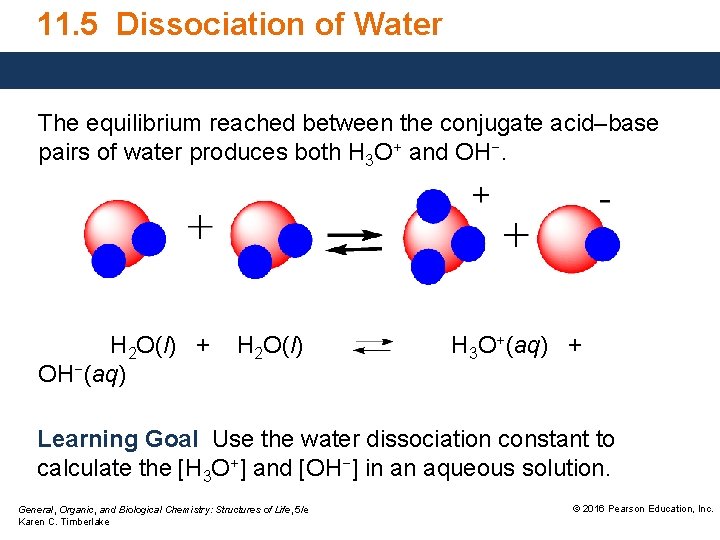
11. 5 Dissociation of Water The equilibrium reached between the conjugate acid–base pairs of water produces both H 3 O+ and OH−. H 2 O(l) + H 2 O(l) OH−(aq) H 3 O+(aq) + Learning Goal Use the water dissociation constant to calculate the [H 3 O+] and [OH−] in an aqueous solution. General, Organic, and Biological Chemistry: Structures of Life, 5/e Karen C. Timberlake © 2016 Pearson Education, Inc.
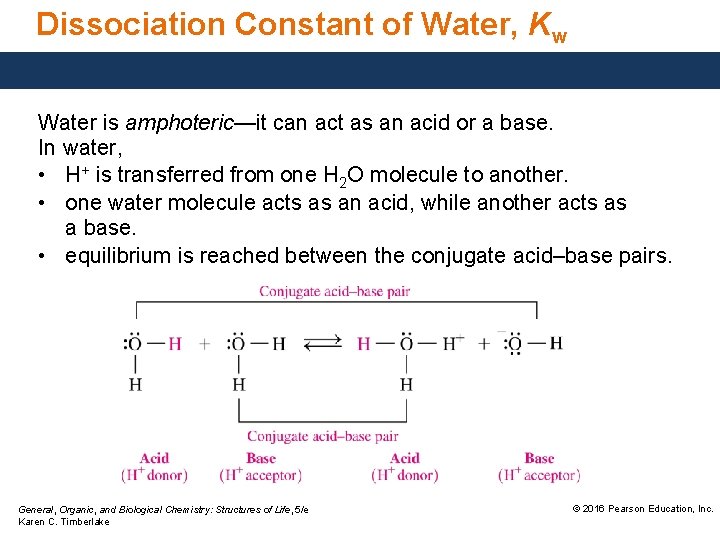
Dissociation Constant of Water, Kw Water is amphoteric—it can act as an acid or a base. In water, • H+ is transferred from one H 2 O molecule to another. • one water molecule acts as an acid, while another acts as a base. • equilibrium is reached between the conjugate acid–base pairs. General, Organic, and Biological Chemistry: Structures of Life, 5/e Karen C. Timberlake © 2016 Pearson Education, Inc.
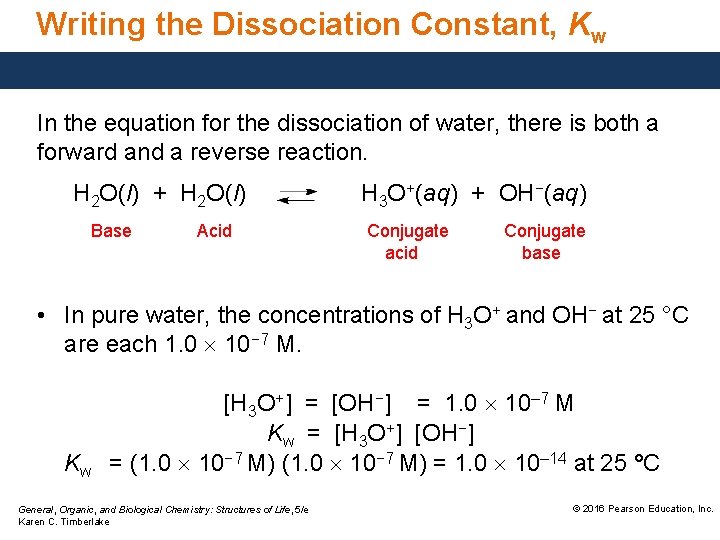
Writing the Dissociation Constant, Kw In the equation for the dissociation of water, there is both a forward and a reverse reaction. H 2 O(l) + H 2 O(l) H 3 O+(aq) + OH−(aq) Base Acid Conjugate acid base • In pure water, the concentrations of H 3 O+ and OH− at 25 °C are each 1. 0 10− 7 M. [H 3 O+] = [OH−] = 1. 0 10– 7 M Kw = [H 3 O+] [OH−] Kw = (1. 0 10− 7 M) = 1. 0 10– 14 at 25 °C © 2016 Pearson Education, Inc. General, Organic, and Biological Chemistry: Structures of Life, 5/e Karen C. Timberlake
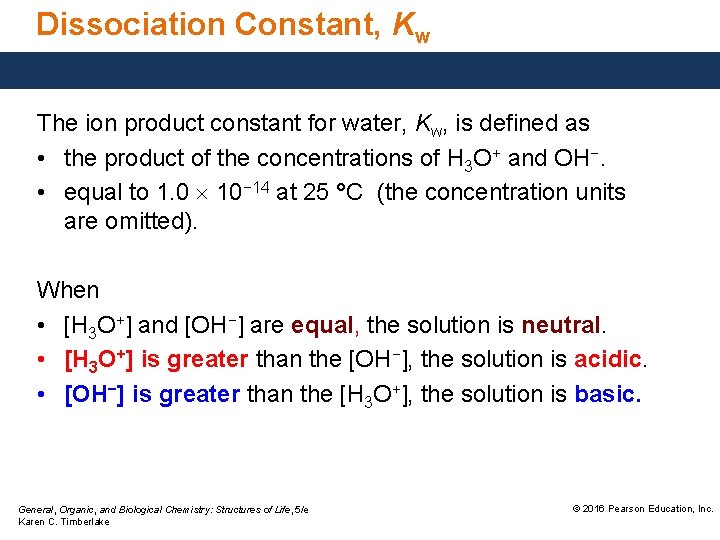
Dissociation Constant, Kw The ion product constant for water, Kw, is defined as • the product of the concentrations of H 3 O+ and OH−. • equal to 1. 0 10− 14 at 25 °C (the concentration units are omitted). When • [H 3 O+] and [OH−] are equal, the solution is neutral. • [H 3 O+] is greater than the [OH−], the solution is acidic. • [OH−] is greater than the [H 3 O+], the solution is basic. General, Organic, and Biological Chemistry: Structures of Life, 5/e Karen C. Timberlake © 2016 Pearson Education, Inc.
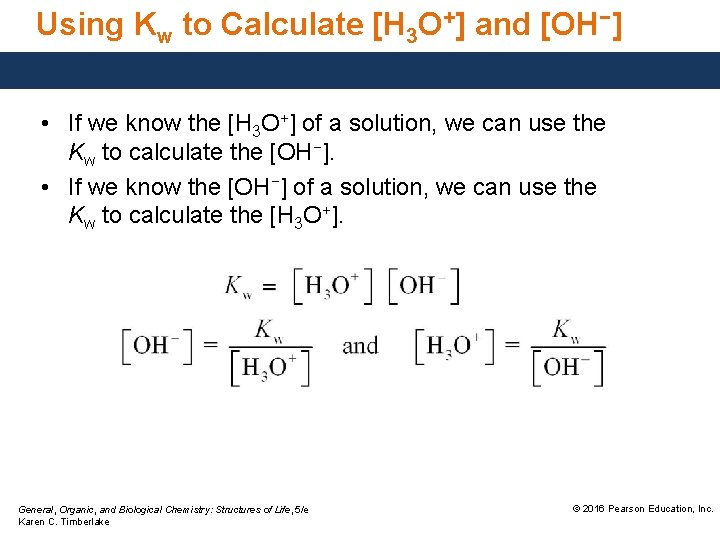
Using Kw to Calculate [H 3 O+] and [OH−] • If we know the [H 3 O+] of a solution, we can use the Kw to calculate the [OH−]. • If we know the [OH−] of a solution, we can use the Kw to calculate the [H 3 O+]. General, Organic, and Biological Chemistry: Structures of Life, 5/e Karen C. Timberlake © 2016 Pearson Education, Inc.
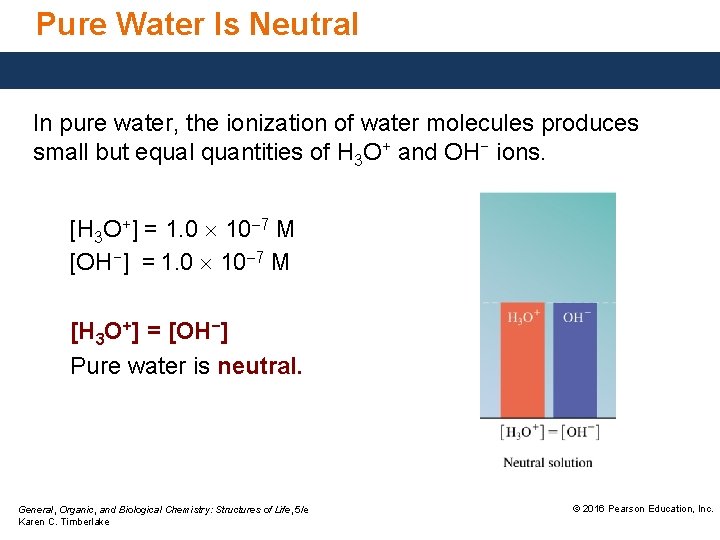
Pure Water Is Neutral In pure water, the ionization of water molecules produces small but equal quantities of H 3 O+ and OH− ions. [H 3 O+] = 1. 0 10 7 M [OH−] = 1. 0 10 7 M [H 3 O+] = [OH−] Pure water is neutral. General, Organic, and Biological Chemistry: Structures of Life, 5/e Karen C. Timberlake © 2016 Pearson Education, Inc.
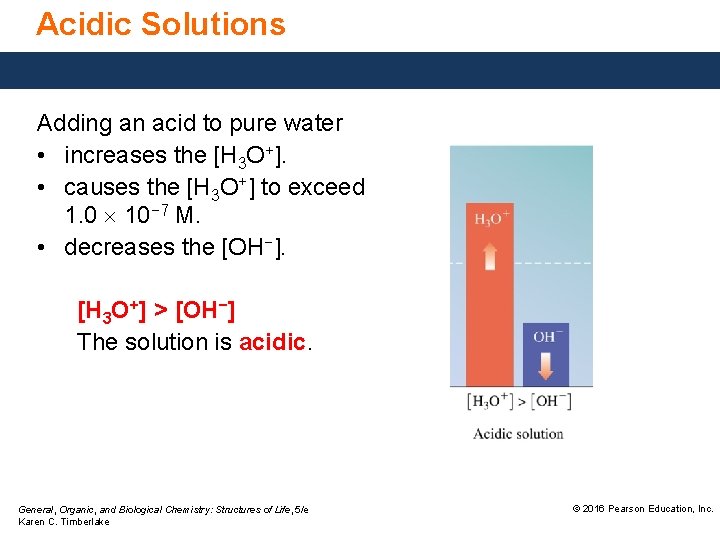
Acidic Solutions Adding an acid to pure water • increases the [H 3 O+]. • causes the [H 3 O+] to exceed 1. 0 10− 7 M. • decreases the [OH−]. [H 3 O+] > [OH−] The solution is acidic. General, Organic, and Biological Chemistry: Structures of Life, 5/e Karen C. Timberlake © 2016 Pearson Education, Inc.
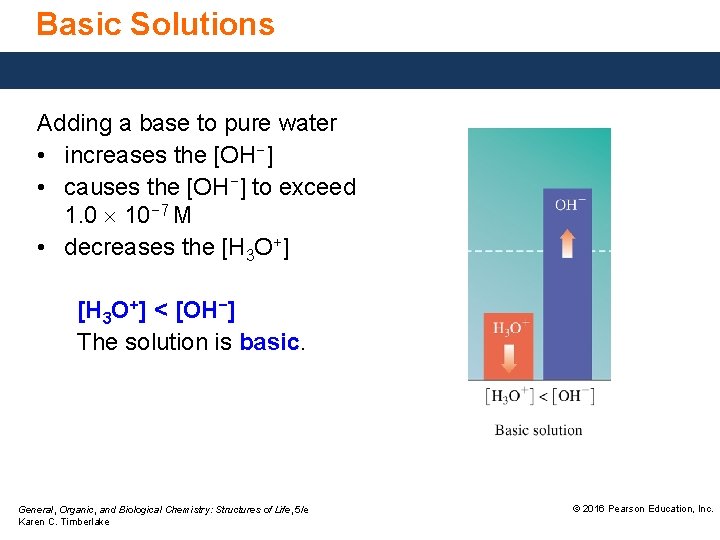
Basic Solutions Adding a base to pure water • increases the [OH−] • causes the [OH−] to exceed 1. 0 10− 7 M • decreases the [H 3 O+] < [OH−] The solution is basic. General, Organic, and Biological Chemistry: Structures of Life, 5/e Karen C. Timberlake © 2016 Pearson Education, Inc.
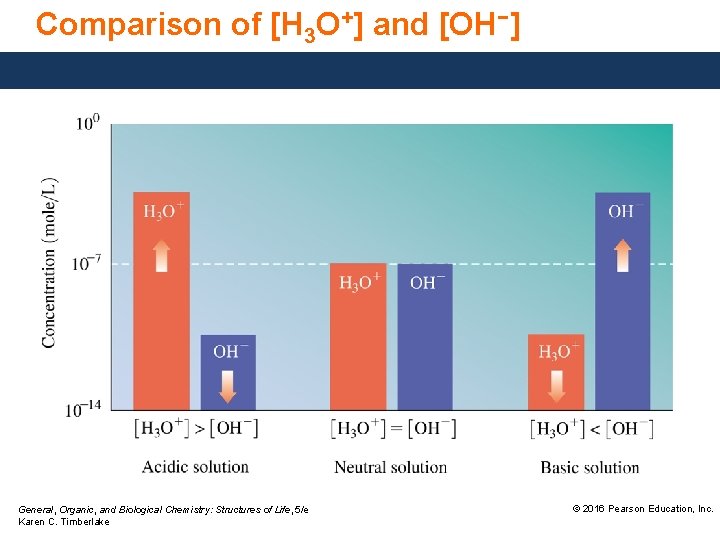
Comparison of [H 3 O+] and [OH−] General, Organic, and Biological Chemistry: Structures of Life, 5/e Karen C. Timberlake © 2016 Pearson Education, Inc.
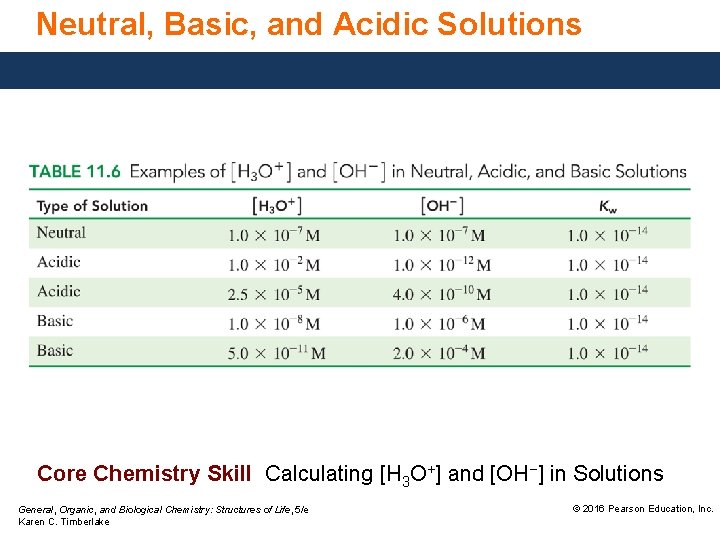
Neutral, Basic, and Acidic Solutions Core Chemistry Skill Calculating [H 3 O+] and [OH−] in Solutions General, Organic, and Biological Chemistry: Structures of Life, 5/e Karen C. Timberlake © 2016 Pearson Education, Inc.
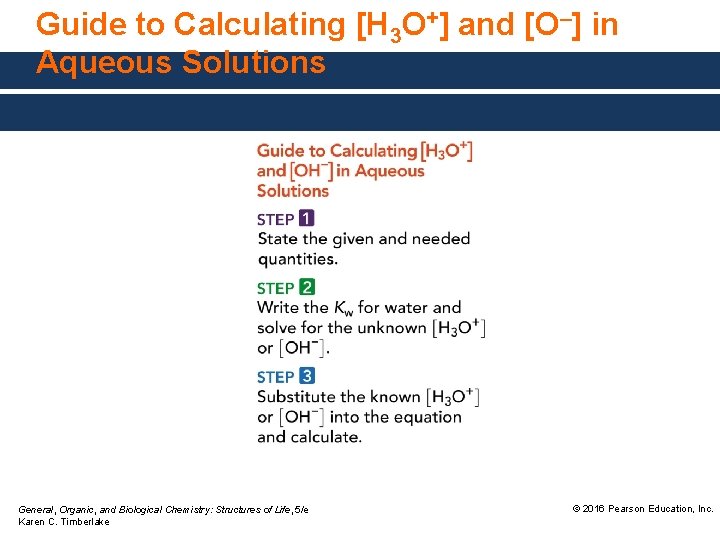
Guide to Calculating [H 3 O+] and [O–] in Aqueous Solutions General, Organic, and Biological Chemistry: Structures of Life, 5/e Karen C. Timberlake © 2016 Pearson Education, Inc.
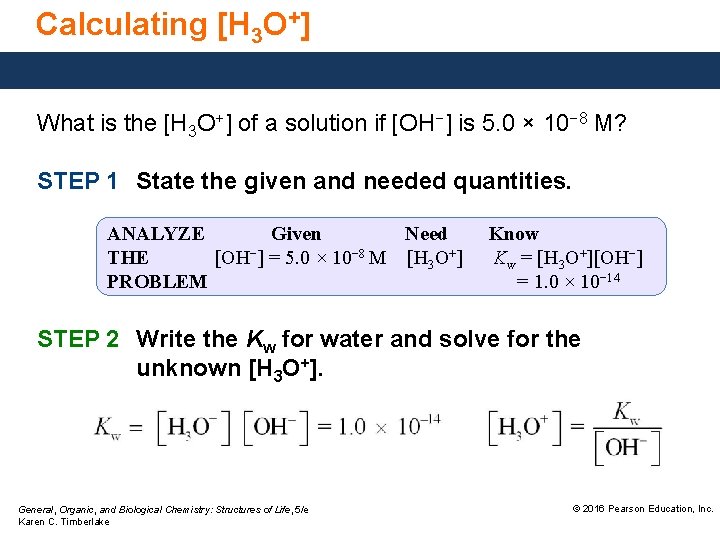
Calculating [H 3 O+] What is the [H 3 O+] of a solution if [OH−] is 5. 0 × 10− 8 M? STEP 1 State the given and needed quantities. ANALYZE Given Need Know THE [OH−] = 5. 0 × 10− 8 M [H 3 O+] Kw = [H 3 O+][OH−] PROBLEM = 1. 0 × 10− 14 STEP 2 Write the Kw for water and solve for the unknown [H 3 O+]. General, Organic, and Biological Chemistry: Structures of Life, 5/e Karen C. Timberlake © 2016 Pearson Education, Inc.
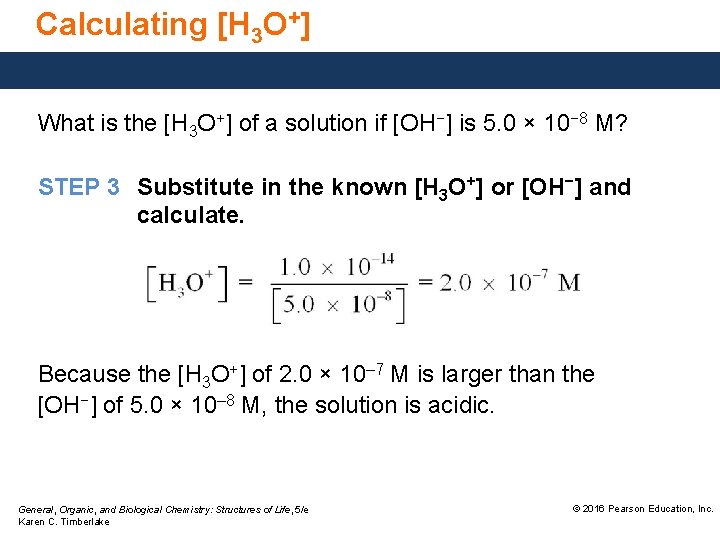
Calculating [H 3 O+] What is the [H 3 O+] of a solution if [OH−] is 5. 0 × 10− 8 M? STEP 3 Substitute in the known [H 3 O+] or [OH−] and calculate. Because the [H 3 O+] of 2. 0 × 10– 7 M is larger than the [OH−] of 5. 0 × 10– 8 M, the solution is acidic. General, Organic, and Biological Chemistry: Structures of Life, 5/e Karen C. Timberlake © 2016 Pearson Education, Inc.
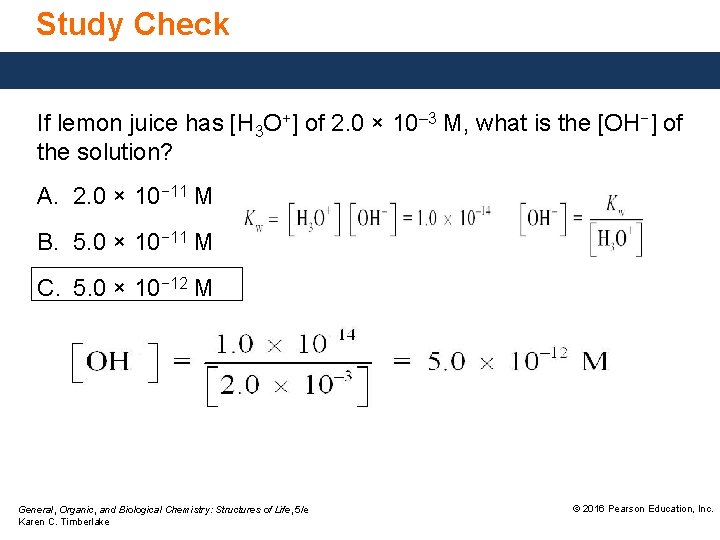
Study Check If lemon juice has [H 3 O+] of 2. 0 × 10– 3 M, what is the [OH−] of the solution? A. 2. 0 × 10− 11 M B. 5. 0 × 10− 11 M C. 5. 0 × 10− 12 M General, Organic, and Biological Chemistry: Structures of Life, 5/e Karen C. Timberlake © 2016 Pearson Education, Inc.
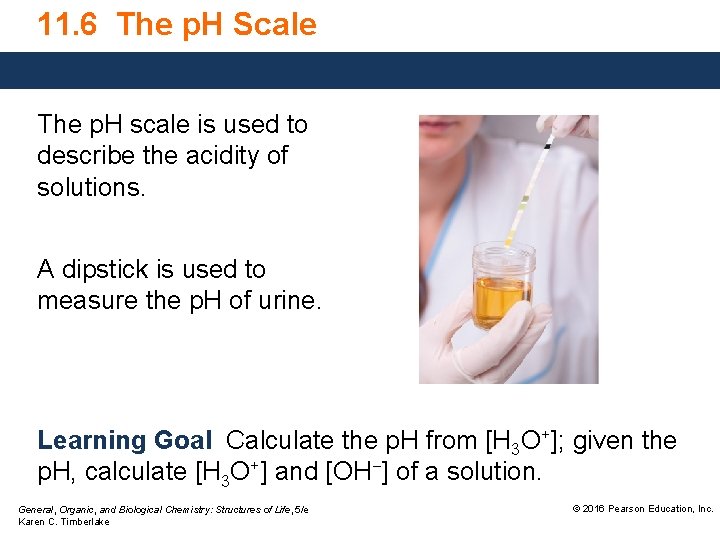
11. 6 The p. H Scale The p. H scale is used to describe the acidity of solutions. A dipstick is used to measure the p. H of urine. Learning Goal Calculate the p. H from [H 3 O+]; given the p. H, calculate [H 3 O+] and [OH−] of a solution. General, Organic, and Biological Chemistry: Structures of Life, 5/e Karen C. Timberlake © 2016 Pearson Education, Inc.
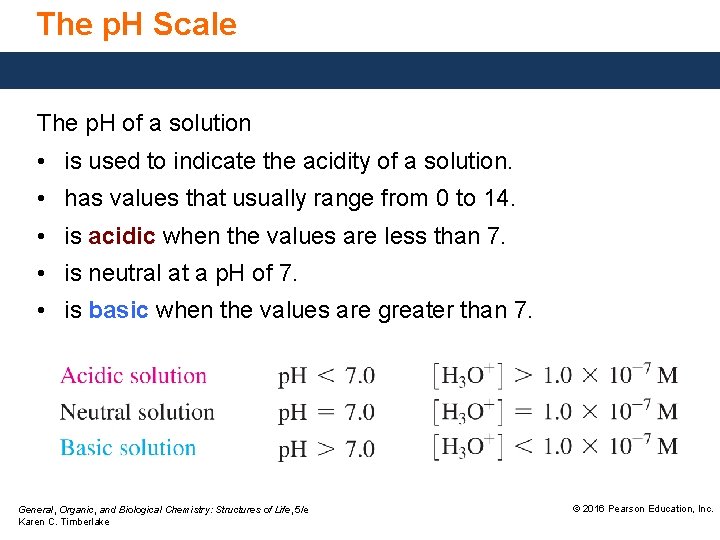
The p. H Scale The p. H of a solution • is used to indicate the acidity of a solution. • has values that usually range from 0 to 14. • is acidic when the values are less than 7. • is neutral at a p. H of 7. • is basic when the values are greater than 7. General, Organic, and Biological Chemistry: Structures of Life, 5/e Karen C. Timberlake © 2016 Pearson Education, Inc.
The p. H Scale The p. H of a solution is commonly measured using • a p. H meter in the laboratory. • p. H paper, an indicator that turns specific colors at a specific p. H value. The p. H of a solution is found by comparing the colors of indicator paper to a chart. General, Organic, and Biological Chemistry: Structures of Life, 5/e Karen C. Timberlake © 2016 Pearson Education, Inc.
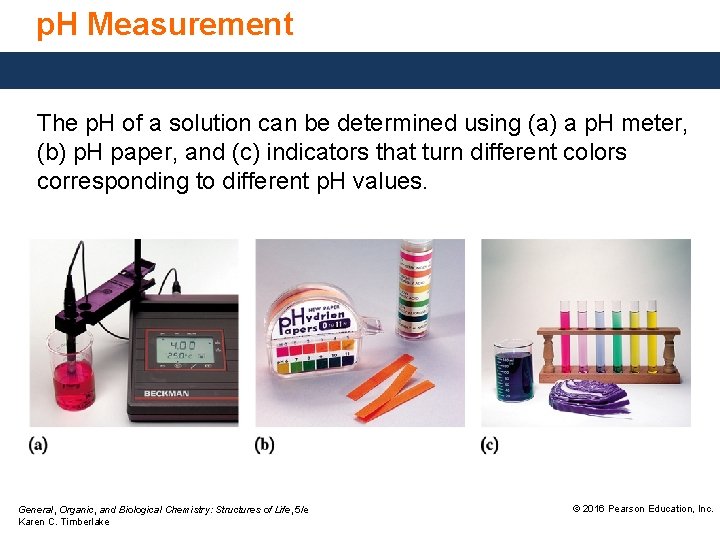
p. H Measurement The p. H of a solution can be determined using (a) a p. H meter, (b) p. H paper, and (c) indicators that turn different colors corresponding to different p. H values. General, Organic, and Biological Chemistry: Structures of Life, 5/e Karen C. Timberlake © 2016 Pearson Education, Inc.
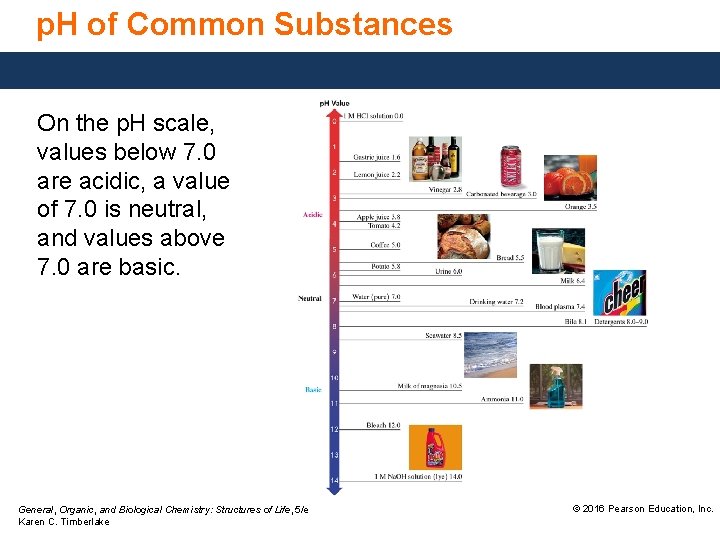
p. H of Common Substances On the p. H scale, values below 7. 0 are acidic, a value of 7. 0 is neutral, and values above 7. 0 are basic. General, Organic, and Biological Chemistry: Structures of Life, 5/e Karen C. Timberlake © 2016 Pearson Education, Inc.
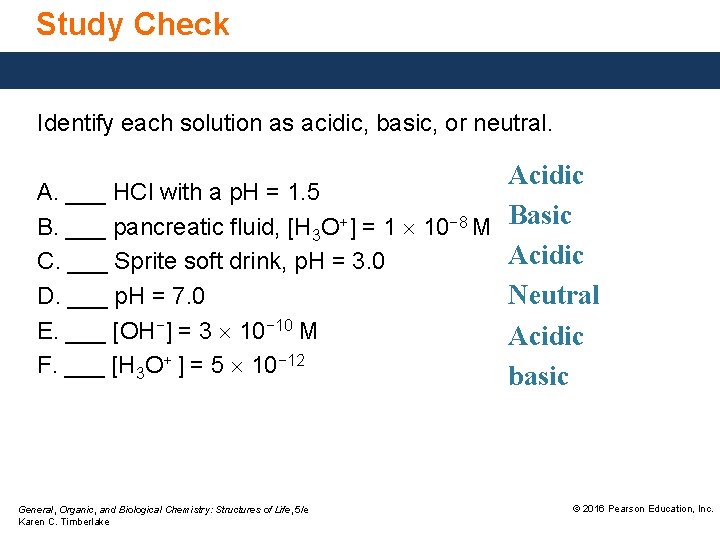
Study Check Identify each solution as acidic, basic, or neutral. Acidic A. ___ HCl with a p. H = 1. 5 B. ___ pancreatic fluid, [H 3 O+] = 1 10− 8 M Basic Acidic C. ___ Sprite soft drink, p. H = 3. 0 D. ___ p. H = 7. 0 Neutral E. ___ [OH−] = 3 10− 10 M Acidic F. ___ [H 3 O+ ] = 5 10− 12 basic General, Organic, and Biological Chemistry: Structures of Life, 5/e Karen C. Timberlake © 2016 Pearson Education, Inc.
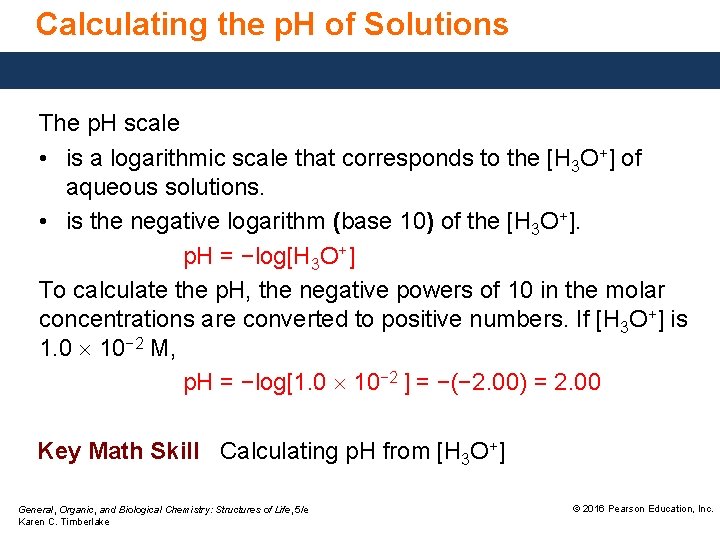
Calculating the p. H of Solutions The p. H scale • is a logarithmic scale that corresponds to the [H 3 O+] of aqueous solutions. • is the negative logarithm (base 10) of the [H 3 O+]. p. H = −log[H 3 O+] To calculate the p. H, the negative powers of 10 in the molar concentrations are converted to positive numbers. If [H 3 O+] is 1. 0 10− 2 M, p. H = −log[1. 0 10− 2 ] = −(− 2. 00) = 2. 00 Key Math Skill Calculating p. H from [H 3 O+] General, Organic, and Biological Chemistry: Structures of Life, 5/e Karen C. Timberlake © 2016 Pearson Education, Inc.
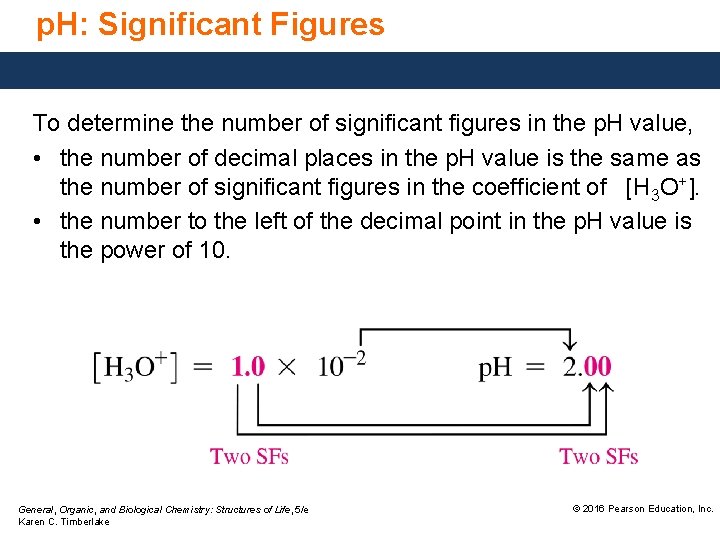
p. H: Significant Figures To determine the number of significant figures in the p. H value, • the number of decimal places in the p. H value is the same as the number of significant figures in the coefficient of [H 3 O+]. • the number to the left of the decimal point in the p. H value is the power of 10. General, Organic, and Biological Chemistry: Structures of Life, 5/e Karen C. Timberlake © 2016 Pearson Education, Inc.
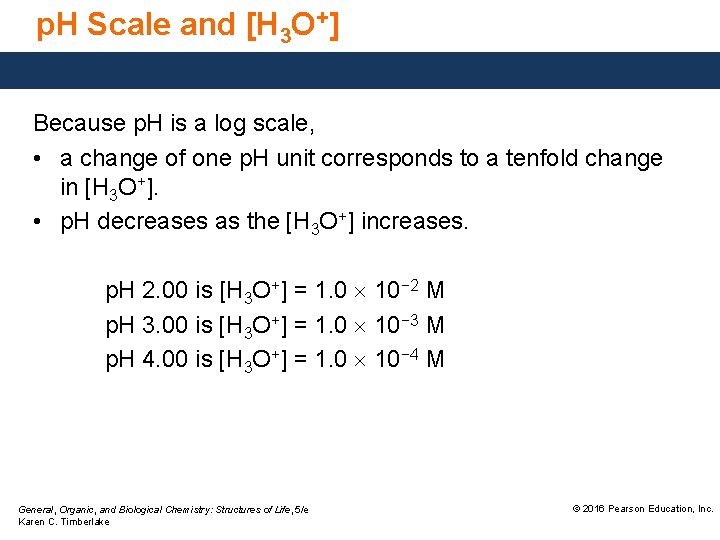
p. H Scale and [H 3 O+] Because p. H is a log scale, • a change of one p. H unit corresponds to a tenfold change in [H 3 O+]. • p. H decreases as the [H 3 O+] increases. p. H 2. 00 is [H 3 O+] = 1. 0 10− 2 M p. H 3. 00 is [H 3 O+] = 1. 0 10− 3 M p. H 4. 00 is [H 3 O+] = 1. 0 10− 4 M General, Organic, and Biological Chemistry: Structures of Life, 5/e Karen C. Timberlake © 2016 Pearson Education, Inc.
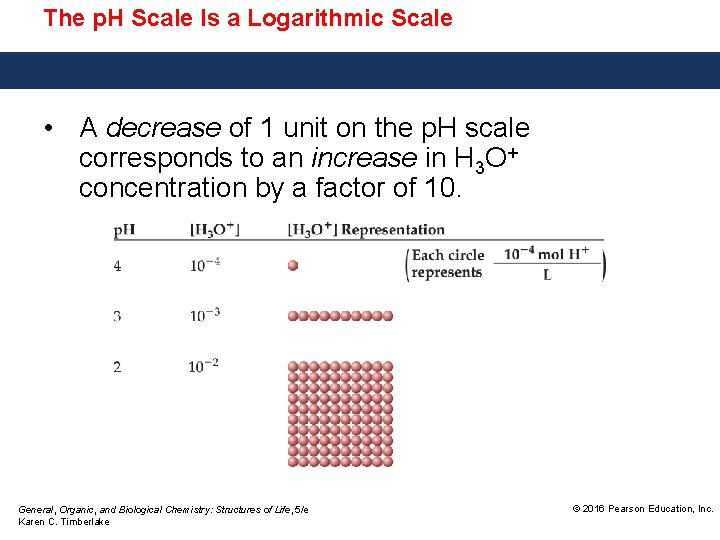
The p. H Scale Is a Logarithmic Scale • A decrease of 1 unit on the p. H scale corresponds to an increase in H 3 O+ concentration by a factor of 10. General, Organic, and Biological Chemistry: Structures of Life, 5/e Karen C. Timberlake © 2016 Pearson Education, Inc.
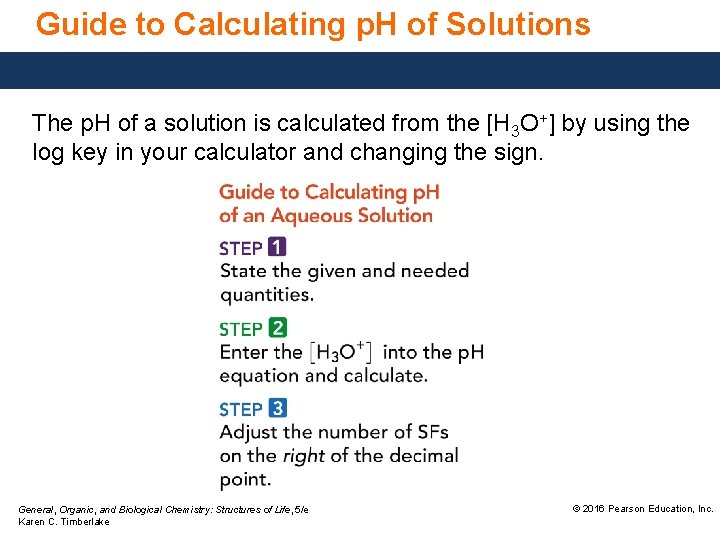
Guide to Calculating p. H of Solutions The p. H of a solution is calculated from the [H 3 O+] by using the log key in your calculator and changing the sign. General, Organic, and Biological Chemistry: Structures of Life, 5/e Karen C. Timberlake © 2016 Pearson Education, Inc.
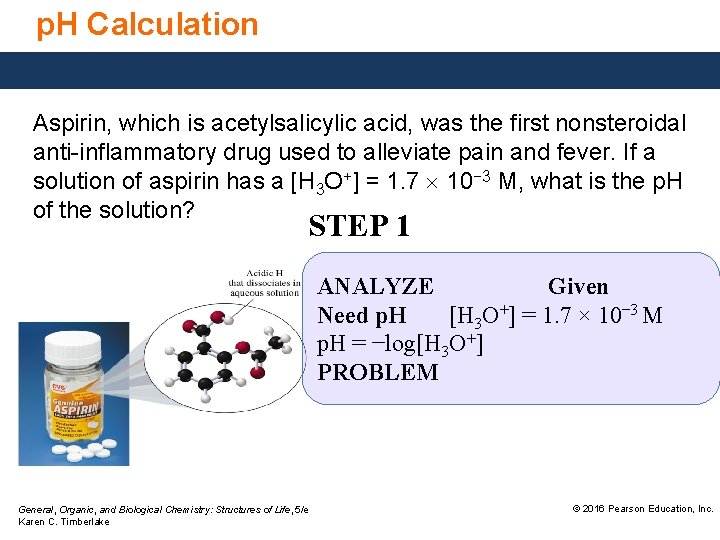
p. H Calculation Aspirin, which is acetylsalicylic acid, was the first nonsteroidal anti-inflammatory drug used to alleviate pain and fever. If a solution of aspirin has a [H 3 O+] = 1. 7 10− 3 M, what is the p. H of the solution? STEP 1 ANALYZE Given Need p. H [H 3 O+] = 1. 7 × 10− 3 M p. H = −log[H 3 O+] PROBLEM General, Organic, and Biological Chemistry: Structures of Life, 5/e Karen C. Timberlake © 2016 Pearson Education, Inc.
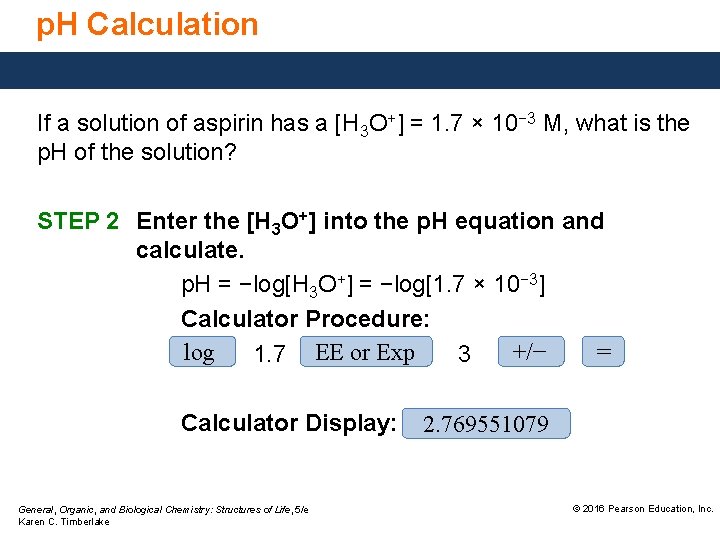
p. H Calculation If a solution of aspirin has a [H 3 O+] = 1. 7 × 10− 3 M, what is the p. H of the solution? STEP 2 Enter the [H 3 O+] into the p. H equation and calculate. p. H = −log[H 3 O+] = −log[1. 7 × 10− 3] Calculator Procedure: log +/− = 1. 7 EE or Exp 3 Calculator Display: General, Organic, and Biological Chemistry: Structures of Life, 5/e Karen C. Timberlake 2. 769551079 © 2016 Pearson Education, Inc.
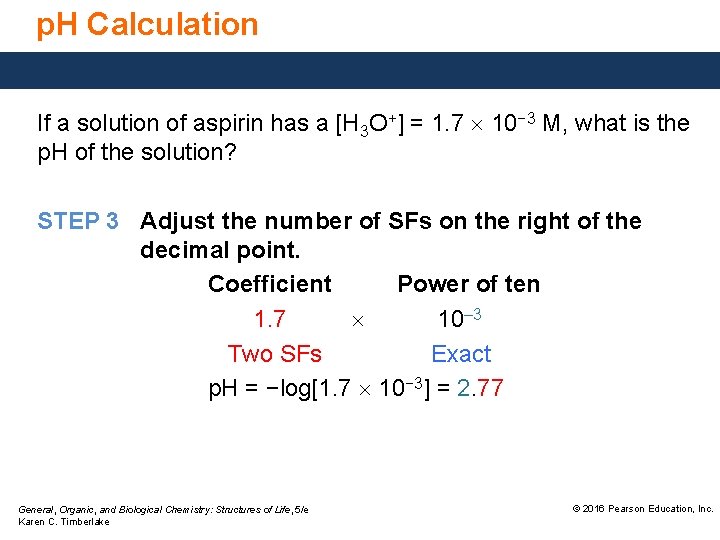
p. H Calculation If a solution of aspirin has a [H 3 O+] = 1. 7 10− 3 M, what is the p. H of the solution? STEP 3 Adjust the number of SFs on the right of the decimal point. Coefficient Power of ten 1. 7 10– 3 Two SFs Exact p. H = −log[1. 7 10− 3] = 2. 77 General, Organic, and Biological Chemistry: Structures of Life, 5/e Karen C. Timberlake © 2016 Pearson Education, Inc.
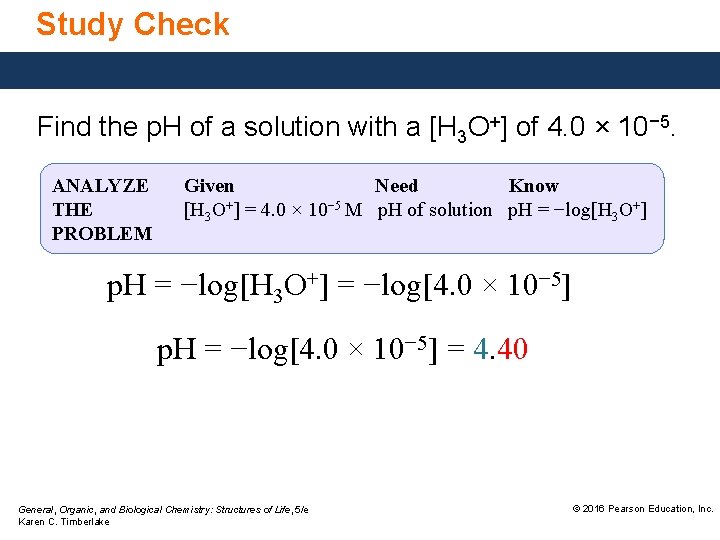
Study Check Find the p. H of a solution with a [H 3 O+] of 4. 0 × 10− 5. ANALYZE Given Need Know THE [H 3 O+] = 4. 0 × 10− 5 M p. H of solution p. H = −log[H 3 O+] PROBLEM p. H = −log[H 3 O+] = −log[4. 0 × 10− 5] p. H = −log[4. 0 × 10− 5] = 4. 40 General, Organic, and Biological Chemistry: Structures of Life, 5/e Karen C. Timberlake © 2016 Pearson Education, Inc.
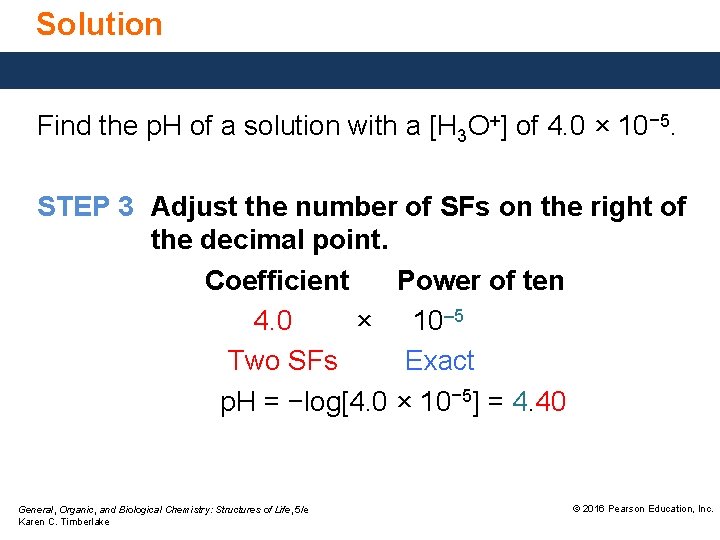
Solution Find the p. H of a solution with a [H 3 O+] of 4. 0 × 10− 5. STEP 3 Adjust the number of SFs on the right of the decimal point. Coefficient Power of ten 4. 0 × 10– 5 Two SFs Exact p. H = −log[4. 0 × 10− 5] = 4. 40 General, Organic, and Biological Chemistry: Structures of Life, 5/e Karen C. Timberlake © 2016 Pearson Education, Inc.
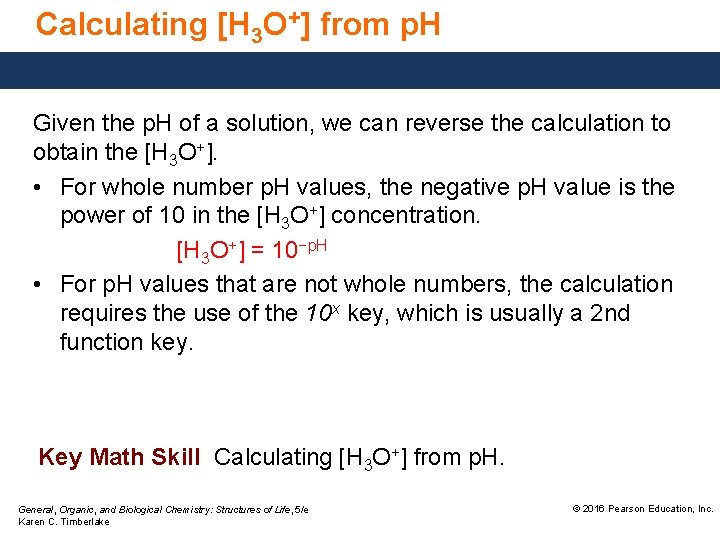
Calculating [H 3 O+] from p. H Given the p. H of a solution, we can reverse the calculation to obtain the [H 3 O+]. • For whole number p. H values, the negative p. H value is the power of 10 in the [H 3 O+] concentration. [H 3 O+] = 10−p. H • For p. H values that are not whole numbers, the calculation requires the use of the 10 x key, which is usually a 2 nd function key. Key Math Skill Calculating [H 3 O+] from p. H. General, Organic, and Biological Chemistry: Structures of Life, 5/e Karen C. Timberlake © 2016 Pearson Education, Inc.
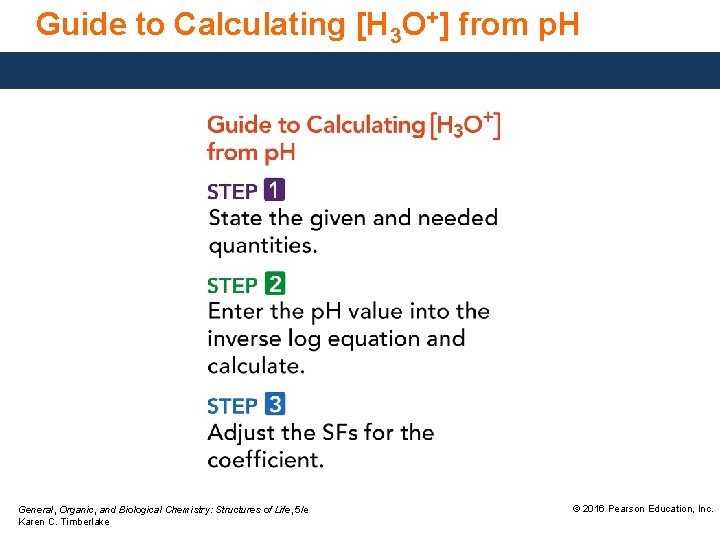
Guide to Calculating [H 3 O+] from p. H General, Organic, and Biological Chemistry: Structures of Life, 5/e Karen C. Timberlake © 2016 Pearson Education, Inc.
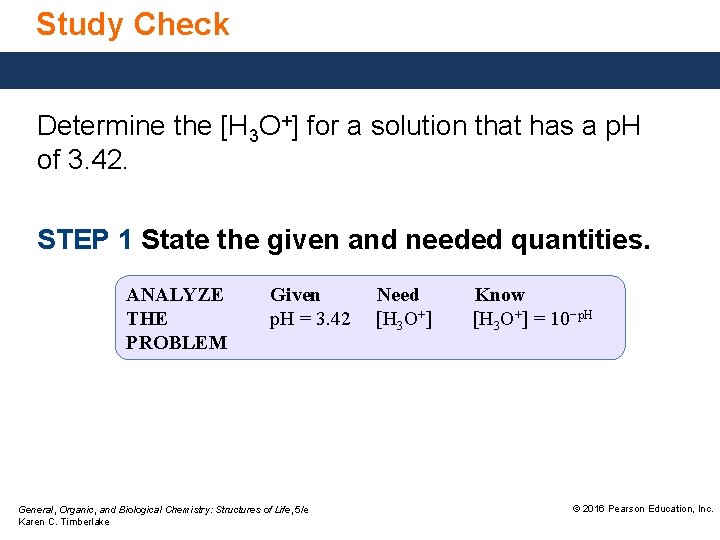
Study Check Determine the [H 3 O+] for a solution that has a p. H of 3. 42. STEP 1 State the given and needed quantities. ANALYZE THE PROBLEM Given Need Know p. H = 3. 42 [H 3 O+] = 10−p. H General, Organic, and Biological Chemistry: Structures of Life, 5/e Karen C. Timberlake © 2016 Pearson Education, Inc.
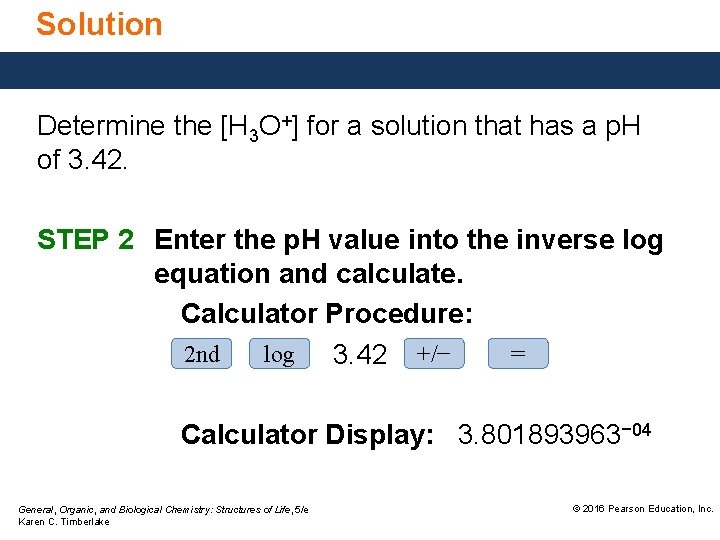
Solution Determine the [H 3 O+] for a solution that has a p. H of 3. 42. STEP 2 Enter the p. H value into the inverse log equation and calculate. Calculator Procedure: 2 nd log 3. 42 +/− = Calculator Display: 3. 801893963− 04 General, Organic, and Biological Chemistry: Structures of Life, 5/e Karen C. Timberlake © 2016 Pearson Education, Inc.
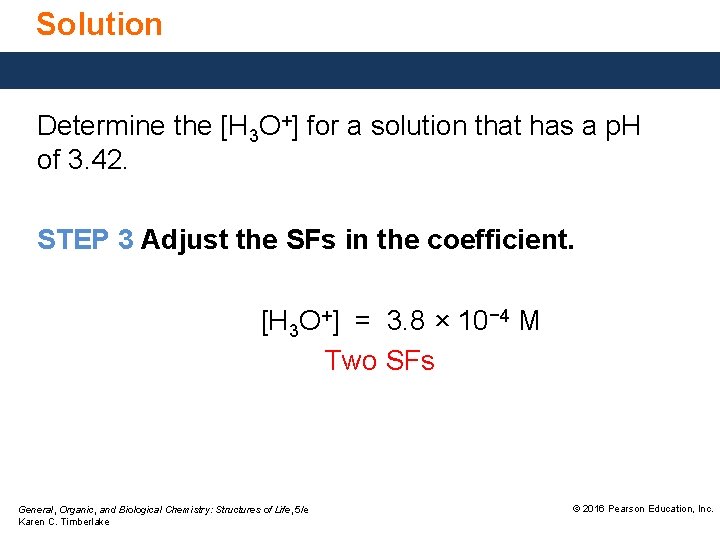
Solution Determine the [H 3 O+] for a solution that has a p. H of 3. 42. STEP 3 Adjust the SFs in the coefficient. [H 3 O+] = 3. 8 × 10− 4 M Two SFs General, Organic, and Biological Chemistry: Structures of Life, 5/e Karen C. Timberlake © 2016 Pearson Education, Inc.
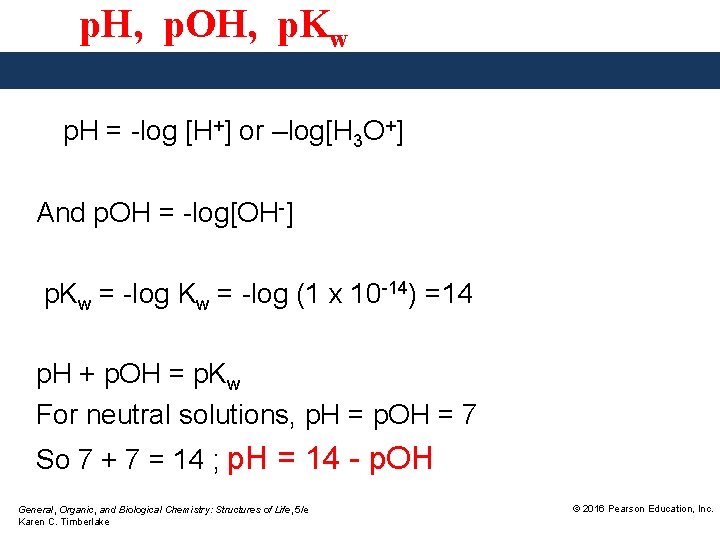
p. H, p. OH, p. Kw p. H = -log [H+] or –log[H 3 O+] And p. OH = -log[OH-] p. Kw = -log (1 x 10 -14) =14 p. H + p. OH = p. Kw For neutral solutions, p. H = p. OH = 7 So 7 + 7 = 14 ; p. H = 14 - p. OH General, Organic, and Biological Chemistry: Structures of Life, 5/e Karen C. Timberlake © 2016 Pearson Education, Inc.
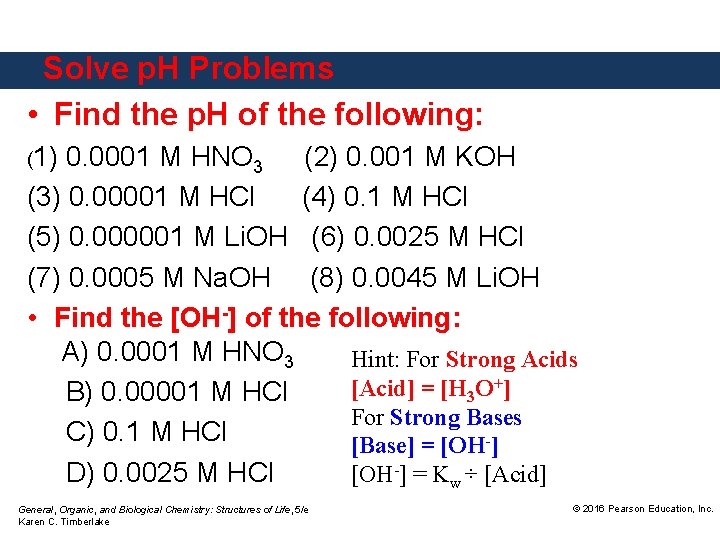
Solve p. H Problems • Find the p. H of the following: (1) 0. 0001 M HNO 3 (2) 0. 001 M KOH (3) 0. 00001 M HCl (4) 0. 1 M HCl (5) 0. 000001 M Li. OH (6) 0. 0025 M HCl (7) 0. 0005 M Na. OH (8) 0. 0045 M Li. OH • Find the [OH-] of the following: A) 0. 0001 M HNO 3 Hint: For Strong Acids [Acid] = [H 3 O+] B) 0. 00001 M HCl For Strong Bases C) 0. 1 M HCl [Base] = [OH-] D) 0. 0025 M HCl [OH-] = Kw ÷ [Acid] General, Organic, and Biological Chemistry: Structures of Life, 5/e Karen C. Timberlake © 2016 Pearson Education, Inc.
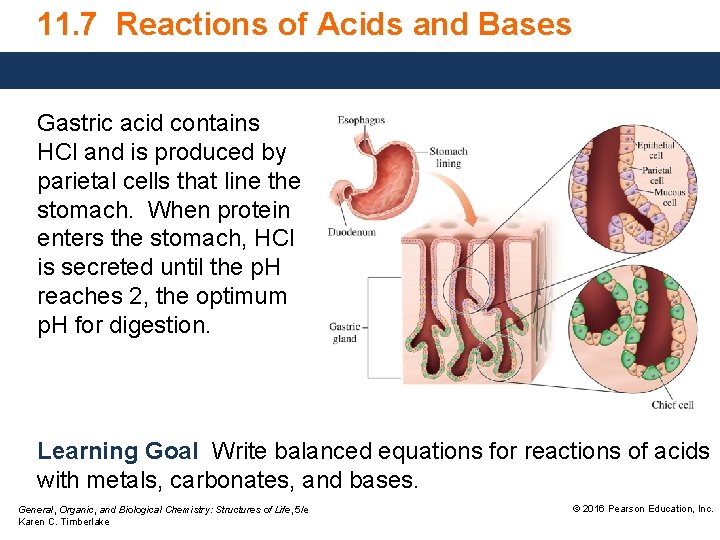
11. 7 Reactions of Acids and Bases Gastric acid contains HCl and is produced by parietal cells that line the stomach. When protein enters the stomach, HCl is secreted until the p. H reaches 2, the optimum p. H for digestion. Learning Goal Write balanced equations for reactions of acids with metals, carbonates, and bases. General, Organic, and Biological Chemistry: Structures of Life, 5/e Karen C. Timberlake © 2016 Pearson Education, Inc.
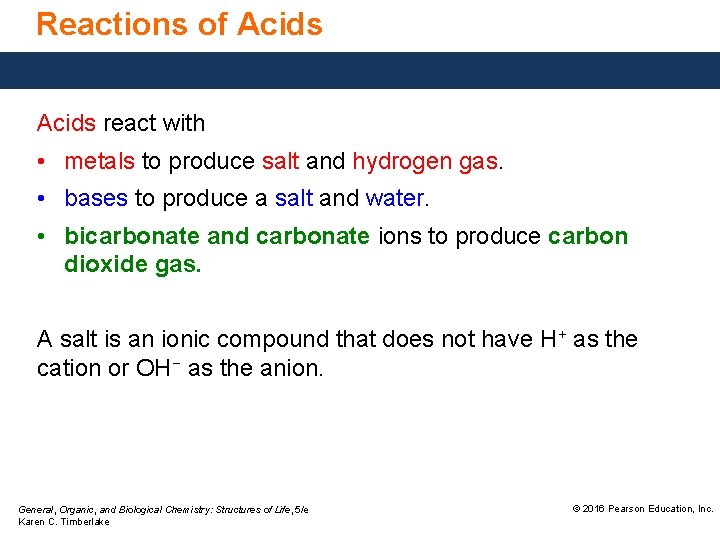
Reactions of Acids react with • metals to produce salt and hydrogen gas. • bases to produce a salt and water. • bicarbonate and carbonate ions to produce carbon dioxide gas. A salt is an ionic compound that does not have H+ as the cation or OH− as the anion. General, Organic, and Biological Chemistry: Structures of Life, 5/e Karen C. Timberlake © 2016 Pearson Education, Inc.
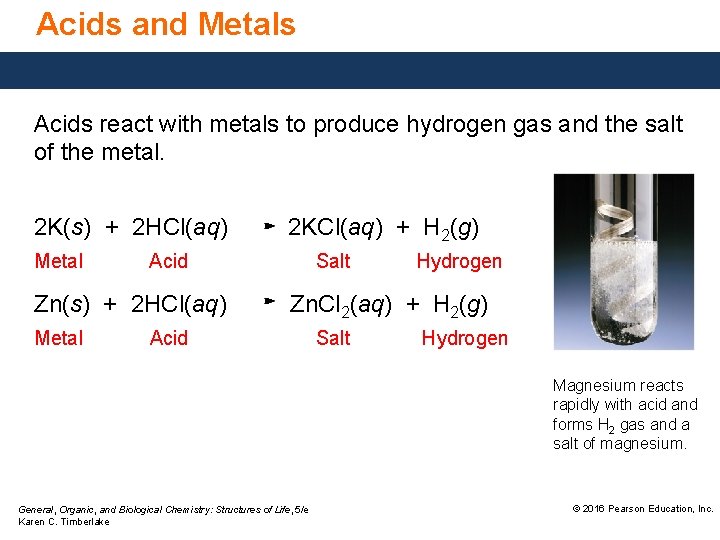
Acids and Metals Acids react with metals to produce hydrogen gas and the salt of the metal. 2 K(s) + 2 HCl(aq) 2 KCl(aq) + H 2(g) Metal Acid Salt Hydrogen Zn(s) + 2 HCl(aq) Zn. Cl 2(aq) + H 2(g) Metal Acid Salt Hydrogen Magnesium reacts rapidly with acid and forms H 2 gas and a salt of magnesium. General, Organic, and Biological Chemistry: Structures of Life, 5/e Karen C. Timberlake © 2016 Pearson Education, Inc.
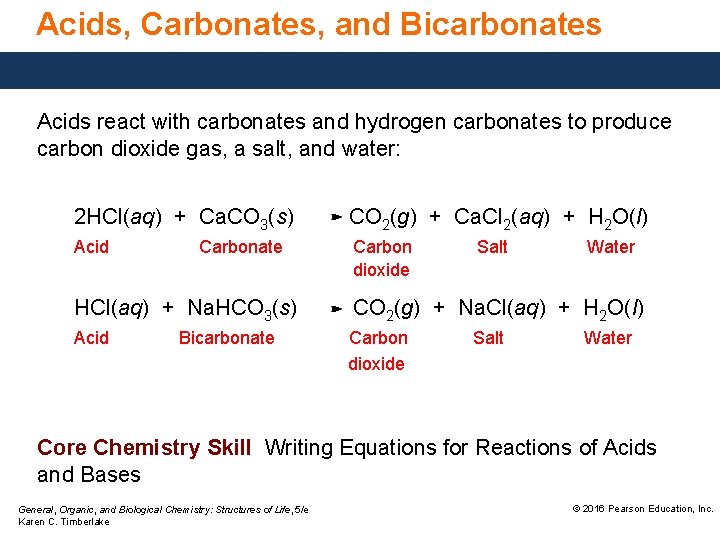
Acids, Carbonates, and Bicarbonates Acids react with carbonates and hydrogen carbonates to produce carbon dioxide gas, a salt, and water: 2 HCl(aq) + Ca. CO 3(s) CO 2(g) + Ca. Cl 2(aq) + H 2 O(l) Acid Carbonate Carbon Salt Water dioxide HCl(aq) + Na. HCO 3(s) CO 2(g) + Na. Cl(aq) + H 2 O(l) Acid Bicarbonate Carbon Salt Water dioxide Core Chemistry Skill Writing Equations for Reactions of Acids and Bases General, Organic, and Biological Chemistry: Structures of Life, 5/e Karen C. Timberlake © 2016 Pearson Education, Inc.
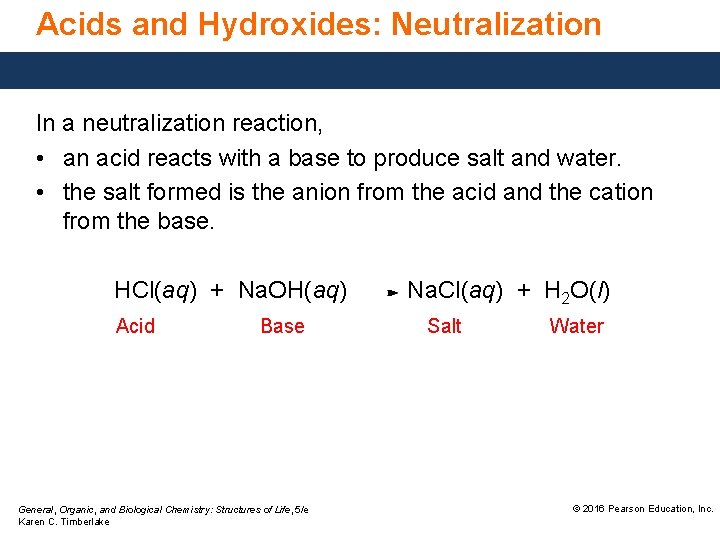
Acids and Hydroxides: Neutralization In a neutralization reaction, • an acid reacts with a base to produce salt and water. • the salt formed is the anion from the acid and the cation from the base. HCl(aq) + Na. OH(aq) Na. Cl(aq) + H 2 O(l) Acid Base Salt Water General, Organic, and Biological Chemistry: Structures of Life, 5/e Karen C. Timberlake © 2016 Pearson Education, Inc.
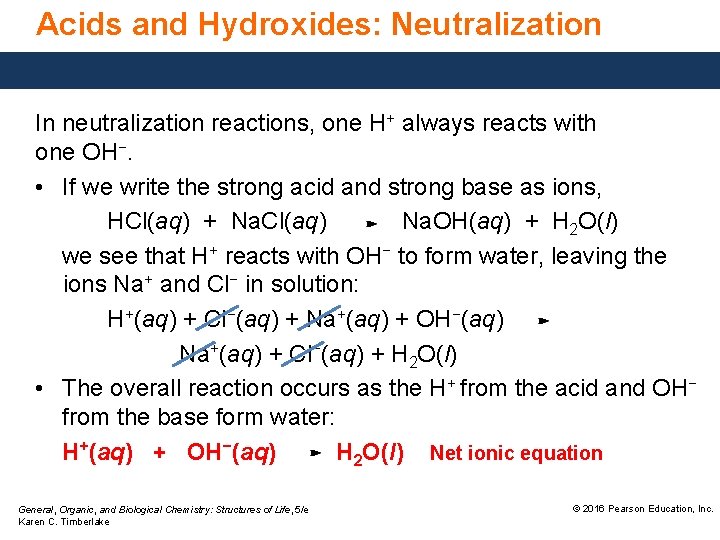
Acids and Hydroxides: Neutralization In neutralization reactions, one H+ always reacts with one OH−. • If we write the strong acid and strong base as ions, HCl(aq) + Na. Cl(aq) Na. OH(aq) + H 2 O(l) we see that H+ reacts with OH− to form water, leaving the ions Na+ and Cl− in solution: H+(aq) + Cl−(aq) + Na+(aq) + OH−(aq) Na+(aq) + Cl−(aq) + H 2 O(l) • The overall reaction occurs as the H+ from the acid and OH− from the base form water: H+(aq) + OH−(aq) H 2 O(l) Net ionic equation General, Organic, and Biological Chemistry: Structures of Life, 5/e Karen C. Timberlake © 2016 Pearson Education, Inc.
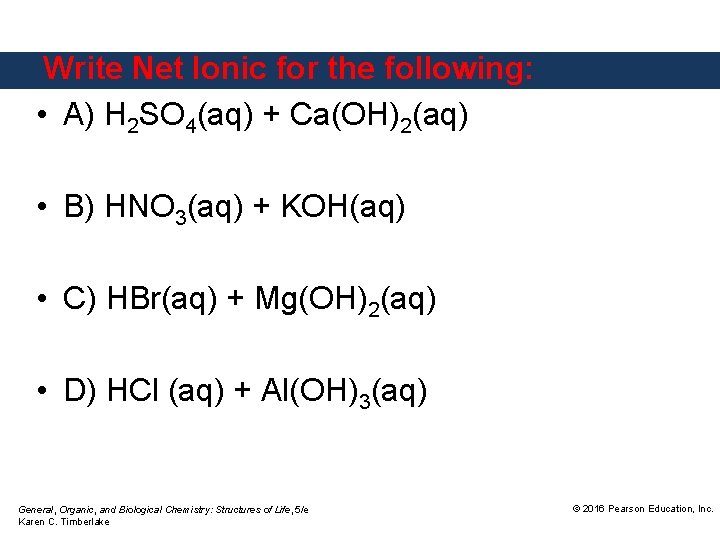
Write Net Ionic for the following: • A) H 2 SO 4(aq) + Ca(OH)2(aq) • B) HNO 3(aq) + KOH(aq) • C) HBr(aq) + Mg(OH)2(aq) • D) HCl (aq) + Al(OH)3(aq) General, Organic, and Biological Chemistry: Structures of Life, 5/e Karen C. Timberlake © 2016 Pearson Education, Inc.
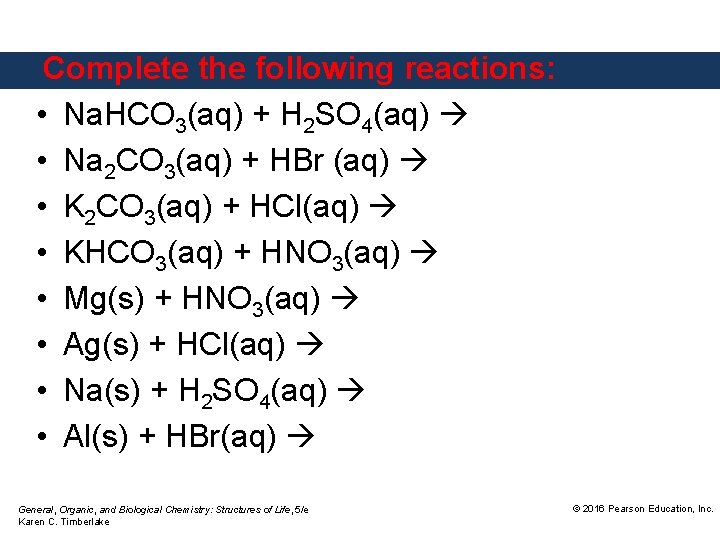
Complete the following reactions: • Na. HCO 3(aq) + H 2 SO 4(aq) • Na 2 CO 3(aq) + HBr (aq) • K 2 CO 3(aq) + HCl(aq) • KHCO 3(aq) + HNO 3(aq) • Mg(s) + HNO 3(aq) • Ag(s) + HCl(aq) • Na(s) + H 2 SO 4(aq) • Al(s) + HBr(aq) General, Organic, and Biological Chemistry: Structures of Life, 5/e Karen C. Timberlake © 2016 Pearson Education, Inc.
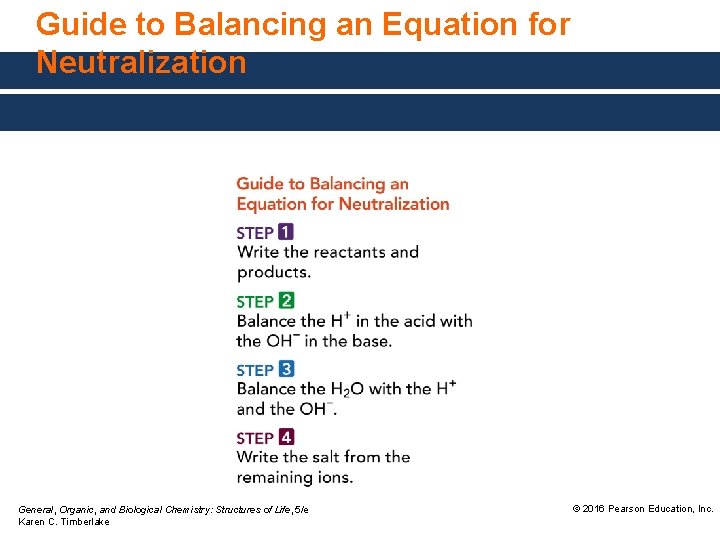
Guide to Balancing an Equation for Neutralization General, Organic, and Biological Chemistry: Structures of Life, 5/e Karen C. Timberlake © 2016 Pearson Education, Inc.
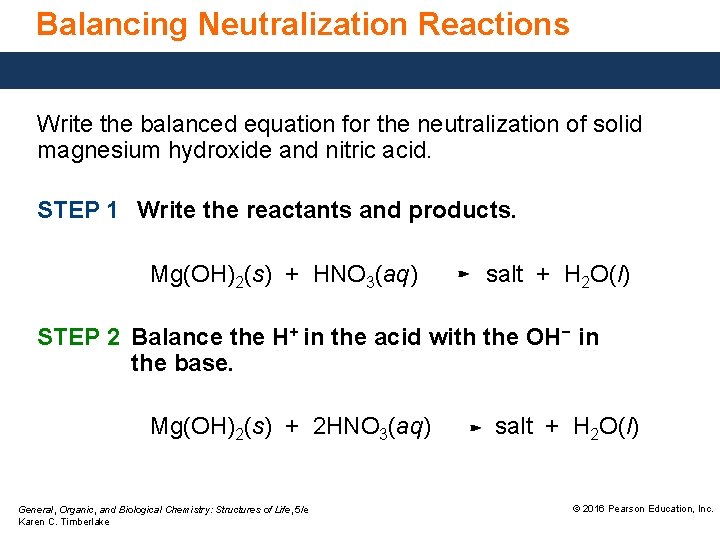
Balancing Neutralization Reactions Write the balanced equation for the neutralization of solid magnesium hydroxide and nitric acid. STEP 1 Write the reactants and products. Mg(OH)2(s) + HNO 3(aq) salt + H 2 O(l) STEP 2 Balance the H+ in the acid with the OH− in the base. Mg(OH)2(s) + 2 HNO 3(aq) salt + H 2 O(l) General, Organic, and Biological Chemistry: Structures of Life, 5/e Karen C. Timberlake © 2016 Pearson Education, Inc.
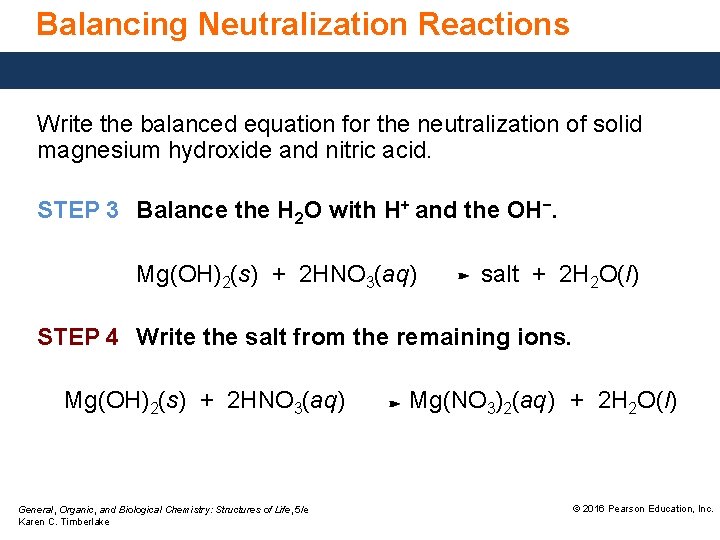
Balancing Neutralization Reactions Write the balanced equation for the neutralization of solid magnesium hydroxide and nitric acid. STEP 3 Balance the H 2 O with H+ and the OH−. Mg(OH)2(s) + 2 HNO 3(aq) salt + 2 H 2 O(l) STEP 4 Write the salt from the remaining ions. Mg(OH)2(s) + 2 HNO 3(aq) Mg(NO 3)2(aq) + 2 H 2 O(l) General, Organic, and Biological Chemistry: Structures of Life, 5/e Karen C. Timberlake © 2016 Pearson Education, Inc.
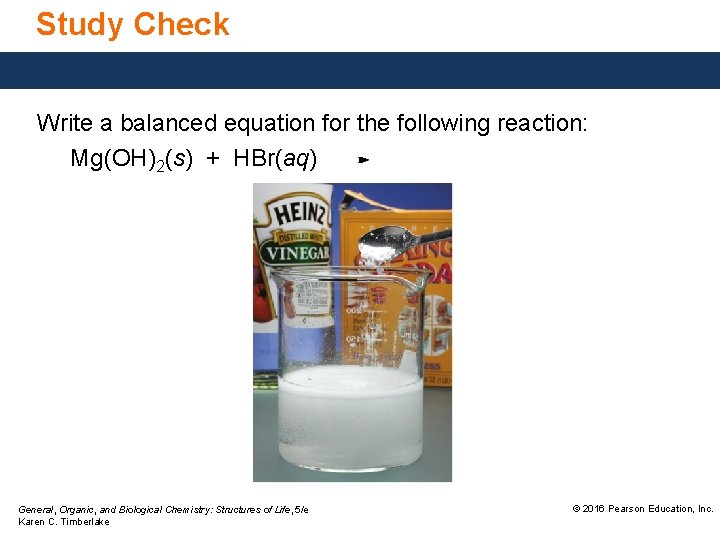
Study Check Write a balanced equation for the following reaction: Mg(OH)2(s) + HBr(aq) General, Organic, and Biological Chemistry: Structures of Life, 5/e Karen C. Timberlake © 2016 Pearson Education, Inc.
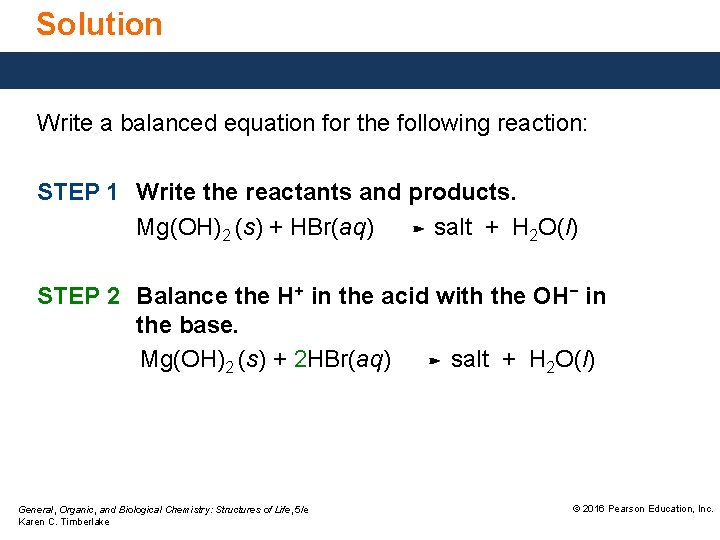
Solution Write a balanced equation for the following reaction: STEP 1 Write the reactants and products. Mg(OH)2 (s) + HBr(aq) salt + H 2 O(l) STEP 2 Balance the H+ in the acid with the OH− in the base. Mg(OH)2 (s) + 2 HBr(aq) salt + H 2 O(l) General, Organic, and Biological Chemistry: Structures of Life, 5/e Karen C. Timberlake © 2016 Pearson Education, Inc.
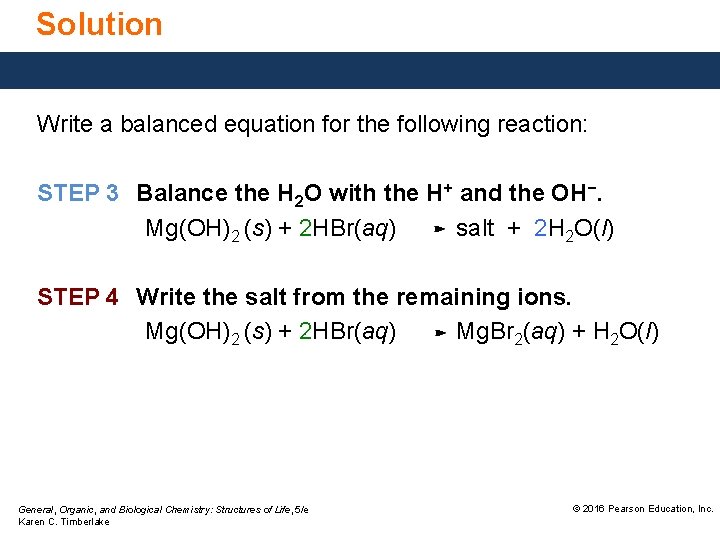
Solution Write a balanced equation for the following reaction: STEP 3 Balance the H 2 O with the H+ and the OH−. Mg(OH)2 (s) + 2 HBr(aq) salt + 2 H 2 O(l) STEP 4 Write the salt from the remaining ions. Mg(OH)2 (s) + 2 HBr(aq) Mg. Br 2(aq) + H 2 O(l) General, Organic, and Biological Chemistry: Structures of Life, 5/e Karen C. Timberlake © 2016 Pearson Education, Inc.
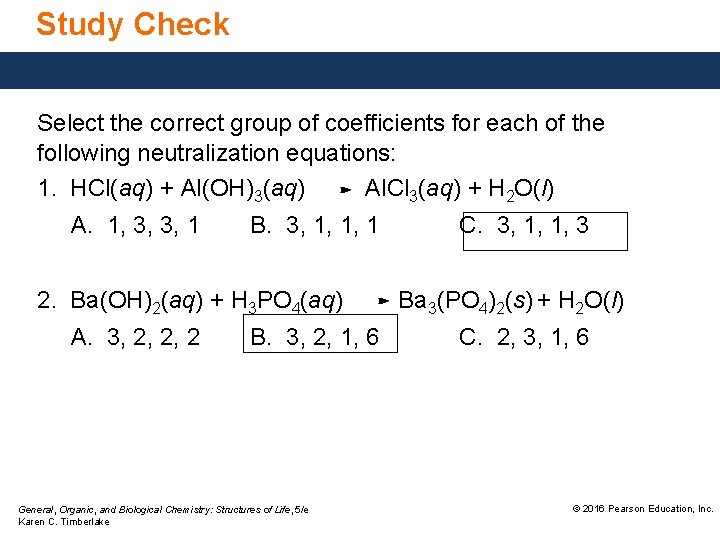
Study Check Select the correct group of coefficients for each of the following neutralization equations: 1. HCl(aq) + Al(OH)3(aq) Al. Cl 3(aq) + H 2 O(l) A. 1, 3, 3, 1 B. 3, 1, 1, 1 C. 3, 1, 1, 3 2. Ba(OH)2(aq) + H 3 PO 4(aq) Ba 3(PO 4)2(s) + H 2 O(l) A. 3, 2, 2, 2 B. 3, 2, 1, 6 C. 2, 3, 1, 6 General, Organic, and Biological Chemistry: Structures of Life, 5/e Karen C. Timberlake © 2016 Pearson Education, Inc.
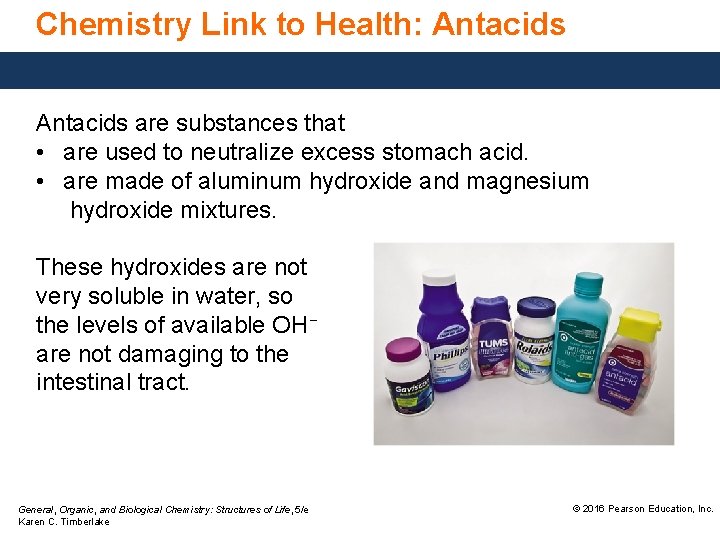
Chemistry Link to Health: Antacids are substances that • are used to neutralize excess stomach acid. • are made of aluminum hydroxide and magnesium hydroxide mixtures. These hydroxides are not very soluble in water, so the levels of available OH− are not damaging to the intestinal tract. General, Organic, and Biological Chemistry: Structures of Life, 5/e Karen C. Timberlake © 2016 Pearson Education, Inc.
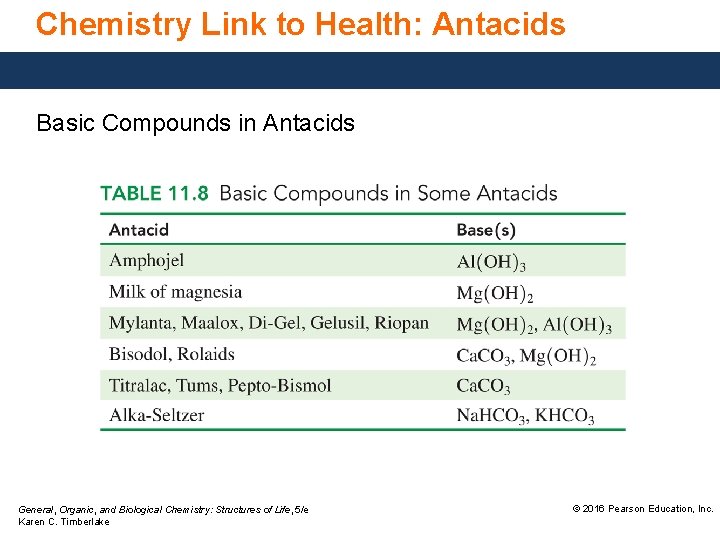
Chemistry Link to Health: Antacids Basic Compounds in Antacids General, Organic, and Biological Chemistry: Structures of Life, 5/e Karen C. Timberlake © 2016 Pearson Education, Inc.
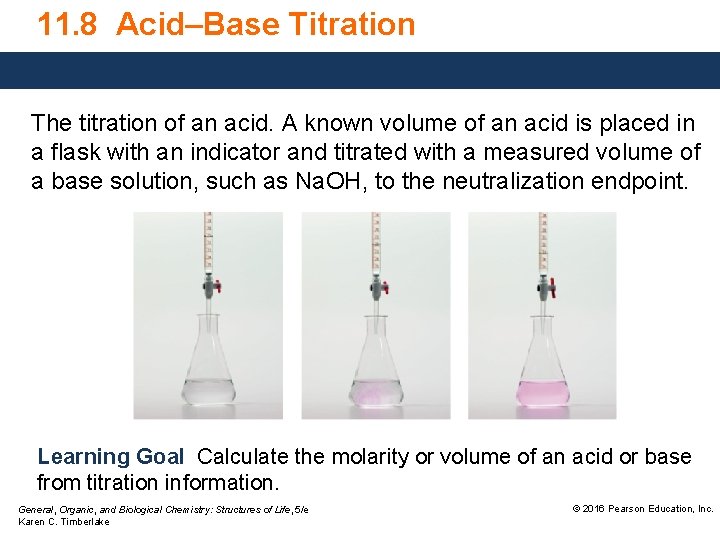
11. 8 Acid–Base Titration The titration of an acid. A known volume of an acid is placed in a flask with an indicator and titrated with a measured volume of a base solution, such as Na. OH, to the neutralization endpoint. Learning Goal Calculate the molarity or volume of an acid or base from titration information. General, Organic, and Biological Chemistry: Structures of Life, 5/e Karen C. Timberlake © 2016 Pearson Education, Inc.
Acid–Base Titration • is a laboratory procedure used to determine the molarity of an acid. • uses a base such as Na. OH to neutralize a measured volume of an acid. • requires a few drops of an indicator such as phenolphthalein to identify the endpoint. Core Chemistry Skill Calculating Molarity or Volume of an Acid or Base in a Titration General, Organic, and Biological Chemistry: Structures of Life, 5/e Karen C. Timberlake © 2016 Pearson Education, Inc.
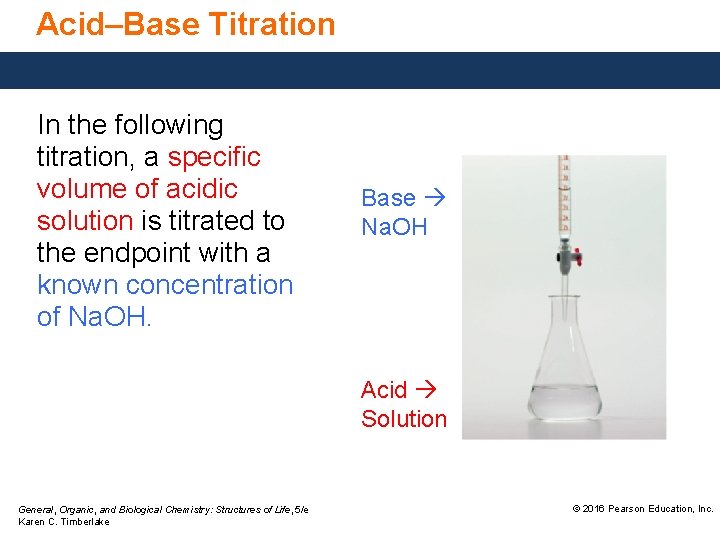
Acid–Base Titration In the following titration, a specific volume of acidic solution is titrated to the endpoint with a known concentration of Na. OH. Base Na. OH Acid Solution General, Organic, and Biological Chemistry: Structures of Life, 5/e Karen C. Timberlake © 2016 Pearson Education, Inc.
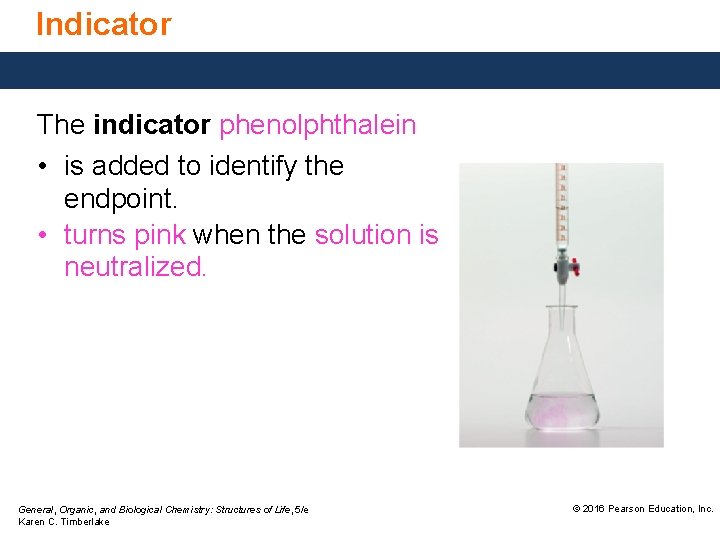
Indicator The indicator phenolphthalein • is added to identify the endpoint. • turns pink when the solution is neutralized. General, Organic, and Biological Chemistry: Structures of Life, 5/e Karen C. Timberlake © 2016 Pearson Education, Inc.
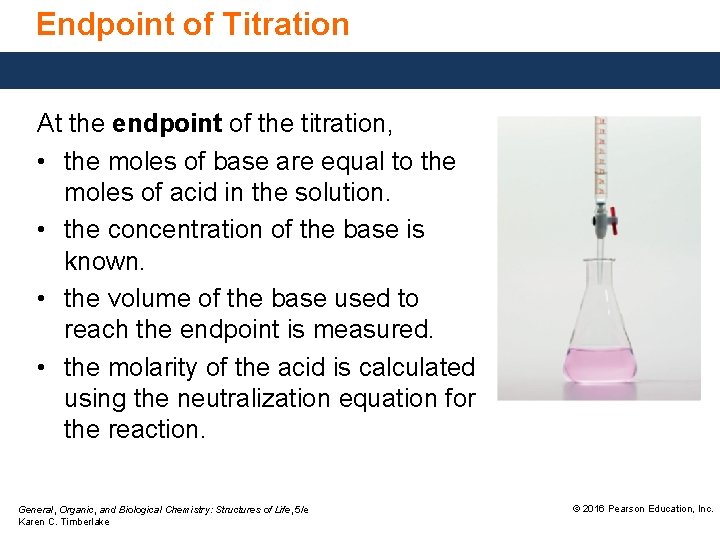
Endpoint of Titration At the endpoint of the titration, • the moles of base are equal to the moles of acid in the solution. • the concentration of the base is known. • the volume of the base used to reach the endpoint is measured. • the molarity of the acid is calculated using the neutralization equation for the reaction. General, Organic, and Biological Chemistry: Structures of Life, 5/e Karen C. Timberlake © 2016 Pearson Education, Inc.
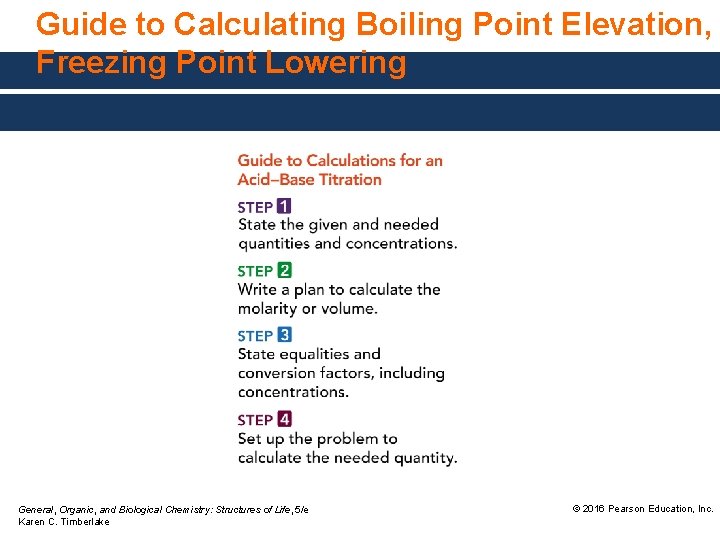
Guide to Calculating Boiling Point Elevation, Freezing Point Lowering General, Organic, and Biological Chemistry: Structures of Life, 5/e Karen C. Timberlake © 2016 Pearson Education, Inc.
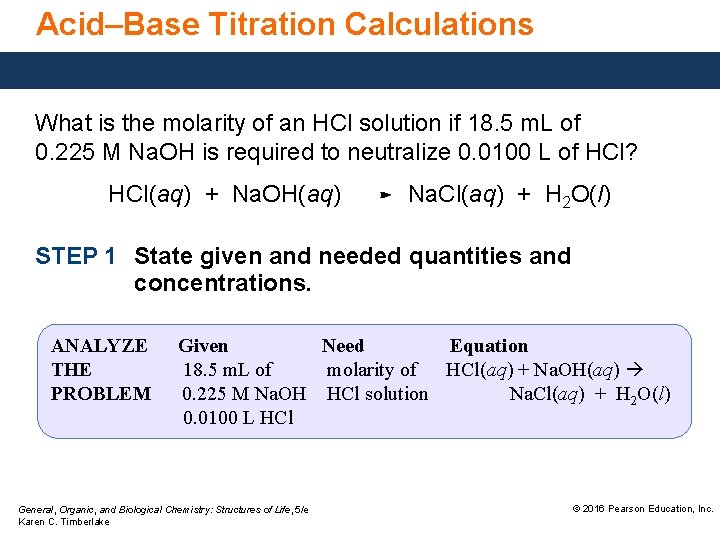
Acid–Base Titration Calculations What is the molarity of an HCl solution if 18. 5 m. L of 0. 225 M Na. OH is required to neutralize 0. 0100 L of HCl? HCl(aq) + Na. OH(aq) Na. Cl(aq) + H 2 O(l) STEP 1 State given and needed quantities and concentrations. ANALYZE Given Need Equation THE 18. 5 m. L of molarity of HCl(aq) + Na. OH(aq) PROBLEM 0. 225 M Na. OH HCl solution Na. Cl(aq) + H 2 O(l) 0. 0100 L HCl General, Organic, and Biological Chemistry: Structures of Life, 5/e Karen C. Timberlake © 2016 Pearson Education, Inc.
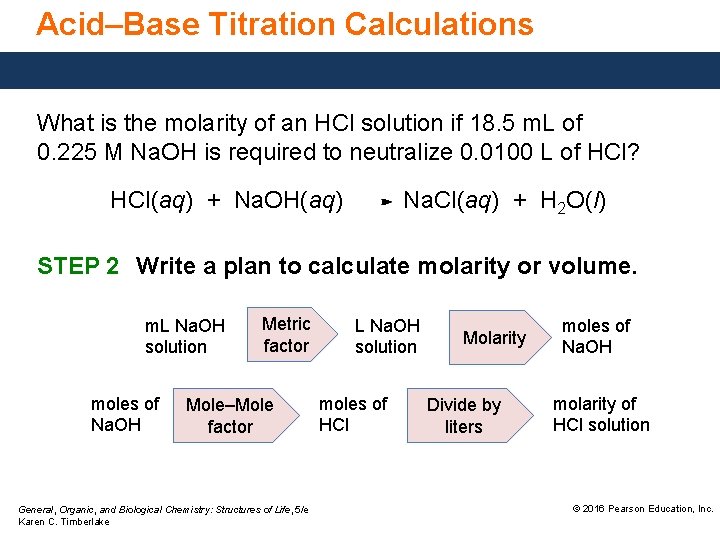
Acid–Base Titration Calculations What is the molarity of an HCl solution if 18. 5 m. L of 0. 225 M Na. OH is required to neutralize 0. 0100 L of HCl? HCl(aq) + Na. OH(aq) Na. Cl(aq) + H 2 O(l) STEP 2 Write a plan to calculate molarity or volume. m. L Na. OH solution Metric factor L Na. OH solution Molarity moles of Na. OH Mole–Mole factor General, Organic, and Biological Chemistry: Structures of Life, 5/e Karen C. Timberlake moles of HCl Divide by liters moles of Na. OH molarity of HCl solution © 2016 Pearson Education, Inc.
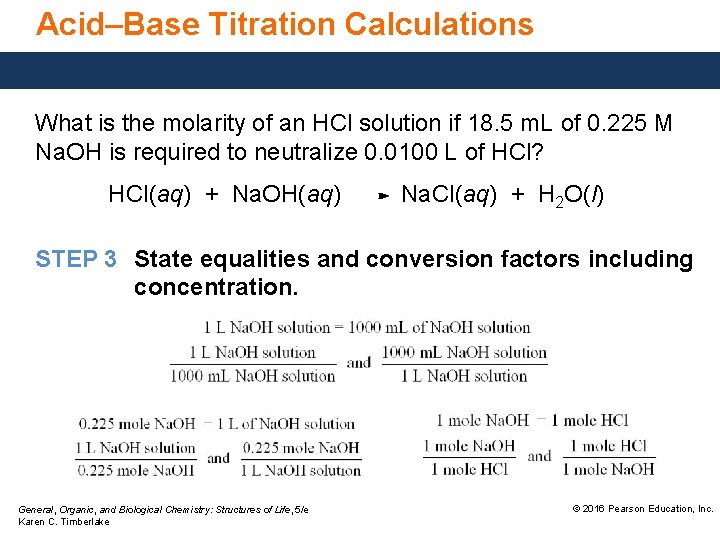
Acid–Base Titration Calculations What is the molarity of an HCl solution if 18. 5 m. L of 0. 225 M Na. OH is required to neutralize 0. 0100 L of HCl? HCl(aq) + Na. OH(aq) Na. Cl(aq) + H 2 O(l) STEP 3 State equalities and conversion factors including concentration. General, Organic, and Biological Chemistry: Structures of Life, 5/e Karen C. Timberlake © 2016 Pearson Education, Inc.
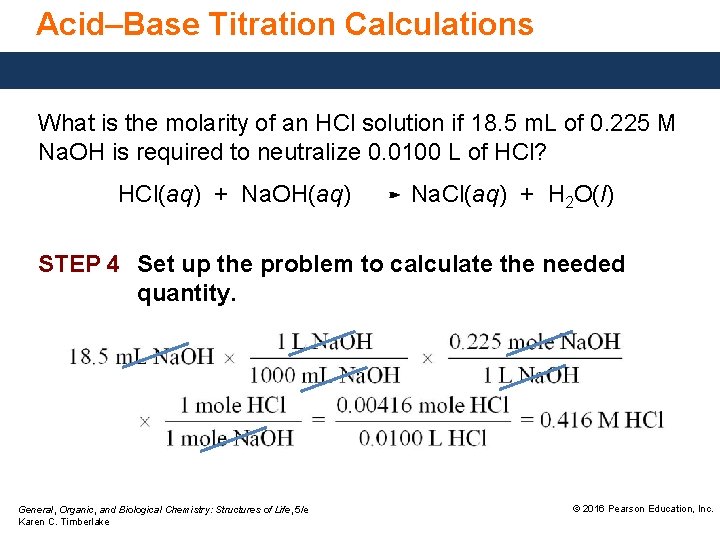
Acid–Base Titration Calculations What is the molarity of an HCl solution if 18. 5 m. L of 0. 225 M Na. OH is required to neutralize 0. 0100 L of HCl? HCl(aq) + Na. OH(aq) Na. Cl(aq) + H 2 O(l) STEP 4 Set up the problem to calculate the needed quantity. General, Organic, and Biological Chemistry: Structures of Life, 5/e Karen C. Timberlake © 2016 Pearson Education, Inc.
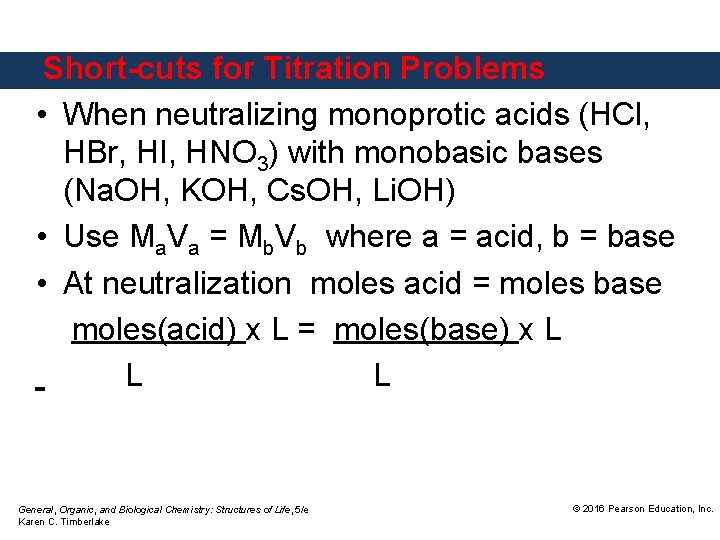
Short-cuts for Titration Problems • When neutralizing monoprotic acids (HCl, HBr, HI, HNO 3) with monobasic bases (Na. OH, KOH, Cs. OH, Li. OH) • Use Ma. Va = Mb. Vb where a = acid, b = base • At neutralization moles acid = moles base moles(acid) x L = moles(base) x L L L General, Organic, and Biological Chemistry: Structures of Life, 5/e Karen C. Timberlake © 2016 Pearson Education, Inc.
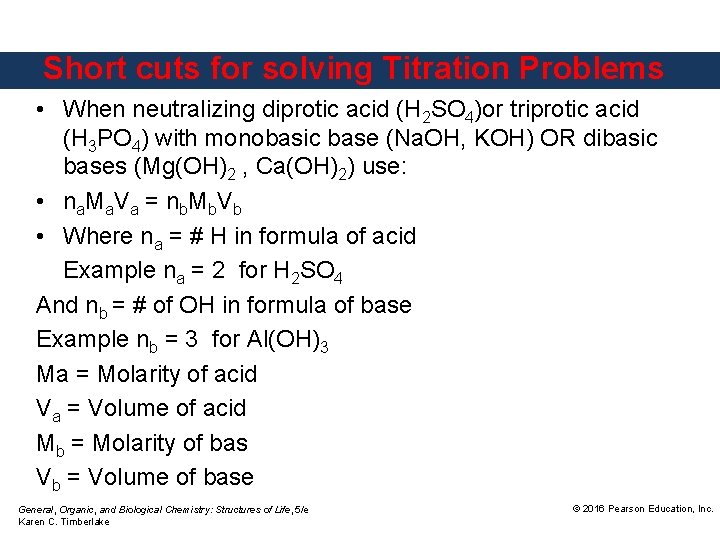
Short cuts for solving Titration Problems • When neutralizing diprotic acid (H 2 SO 4)or triprotic acid (H 3 PO 4) with monobasic base (Na. OH, KOH) OR dibasic bases (Mg(OH)2 , Ca(OH)2) use: • na. Ma. Va = nb. Mb. Vb • Where na = # H in formula of acid Example na = 2 for H 2 SO 4 And nb = # of OH in formula of base Example nb = 3 for Al(OH)3 Ma = Molarity of acid Va = Volume of acid Mb = Molarity of bas Vb = Volume of base General, Organic, and Biological Chemistry: Structures of Life, 5/e Karen C. Timberlake © 2016 Pearson Education, Inc.
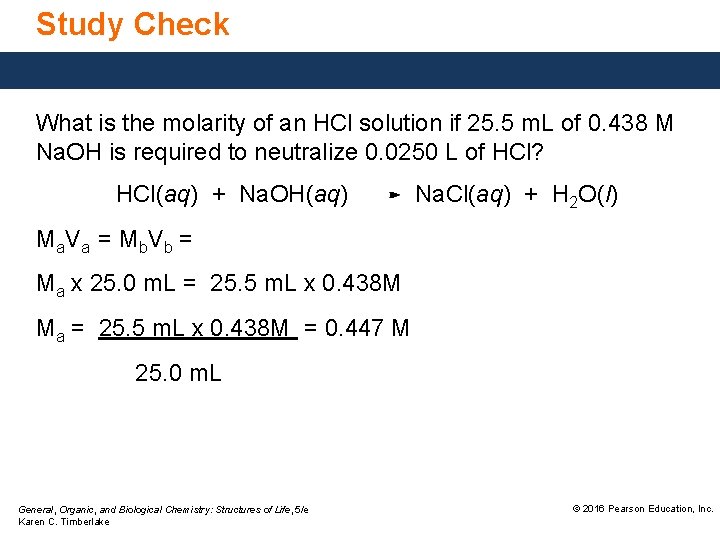
Study Check What is the molarity of an HCl solution if 25. 5 m. L of 0. 438 M Na. OH is required to neutralize 0. 0250 L of HCl? HCl(aq) + Na. OH(aq) Na. Cl(aq) + H 2 O(l) Ma. Va = Mb. Vb = Ma x 25. 0 m. L = 25. 5 m. L x 0. 438 M Ma = 25. 5 m. L x 0. 438 M = 0. 447 M 25. 0 m. L General, Organic, and Biological Chemistry: Structures of Life, 5/e Karen C. Timberlake © 2016 Pearson Education, Inc.
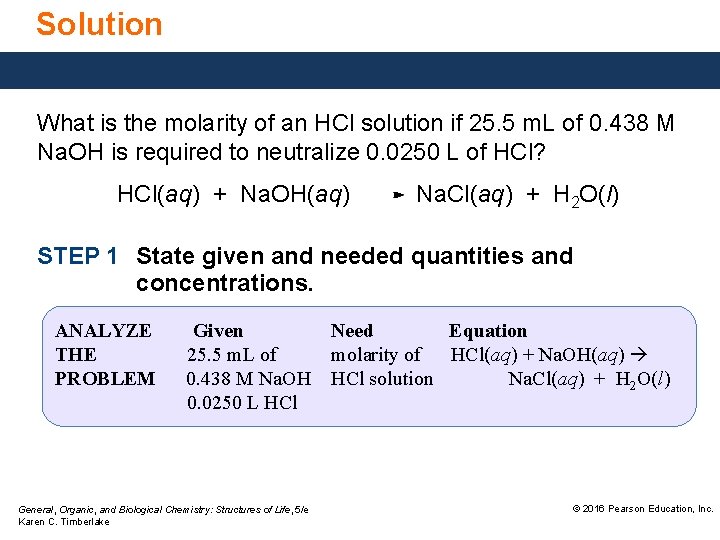
Solution What is the molarity of an HCl solution if 25. 5 m. L of 0. 438 M Na. OH is required to neutralize 0. 0250 L of HCl? HCl(aq) + Na. OH(aq) Na. Cl(aq) + H 2 O(l) STEP 1 State given and needed quantities and concentrations. ANALYZE Given Need Equation THE 25. 5 m. L of molarity of HCl(aq) + Na. OH(aq) PROBLEM 0. 438 M Na. OH HCl solution Na. Cl(aq) + H 2 O(l) 0. 0250 L HCl General, Organic, and Biological Chemistry: Structures of Life, 5/e Karen C. Timberlake © 2016 Pearson Education, Inc.
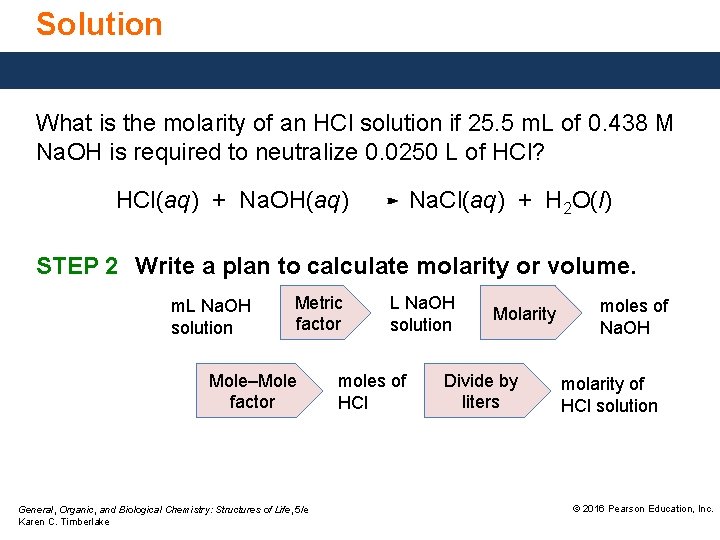
Solution What is the molarity of an HCl solution if 25. 5 m. L of 0. 438 M Na. OH is required to neutralize 0. 0250 L of HCl? HCl(aq) + Na. OH(aq) Na. Cl(aq) + H 2 O(l) STEP 2 Write a plan to calculate molarity or volume. m. L Na. OH solution Metric factor L Na. OH solution Molarity Mole–Mole Divide by moles of factor General, Organic, and Biological Chemistry: Structures of Life, 5/e Karen C. Timberlake HCl liters moles of Na. OH molarity of HCl solution © 2016 Pearson Education, Inc.
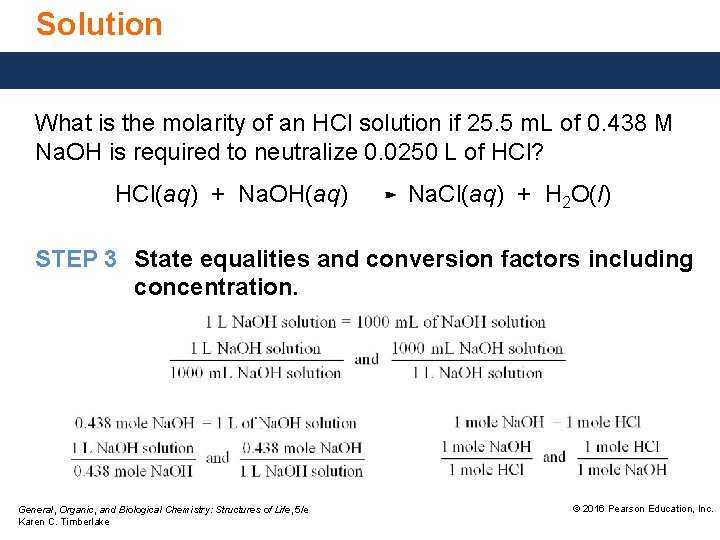
Solution What is the molarity of an HCl solution if 25. 5 m. L of 0. 438 M Na. OH is required to neutralize 0. 0250 L of HCl? HCl(aq) + Na. OH(aq) Na. Cl(aq) + H 2 O(l) STEP 3 State equalities and conversion factors including concentration. General, Organic, and Biological Chemistry: Structures of Life, 5/e Karen C. Timberlake © 2016 Pearson Education, Inc.
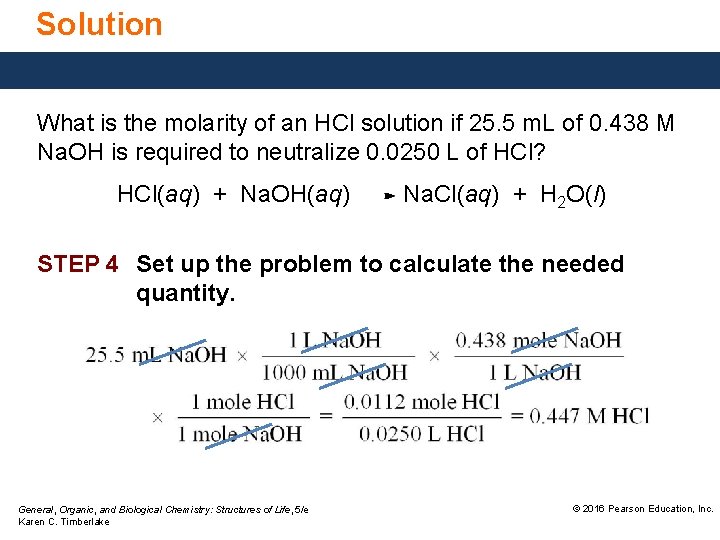
Solution What is the molarity of an HCl solution if 25. 5 m. L of 0. 438 M Na. OH is required to neutralize 0. 0250 L of HCl? HCl(aq) + Na. OH(aq) Na. Cl(aq) + H 2 O(l) STEP 4 Set up the problem to calculate the needed quantity. General, Organic, and Biological Chemistry: Structures of Life, 5/e Karen C. Timberlake © 2016 Pearson Education, Inc.
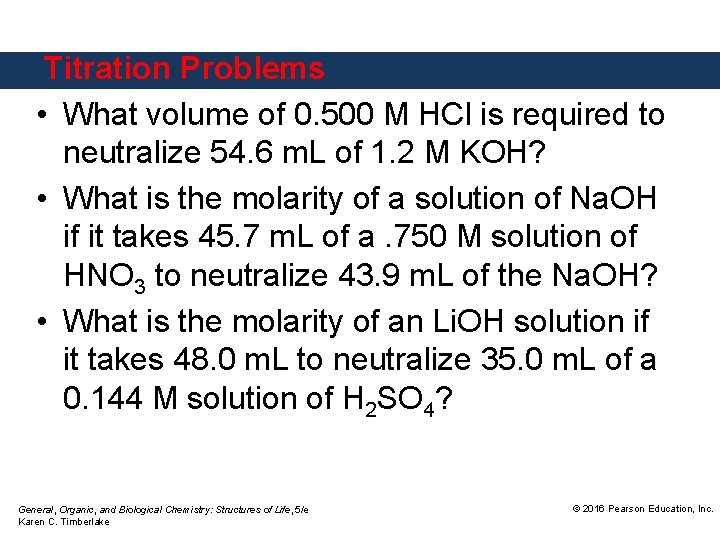
Titration Problems • What volume of 0. 500 M HCl is required to neutralize 54. 6 m. L of 1. 2 M KOH? • What is the molarity of a solution of Na. OH if it takes 45. 7 m. L of a. 750 M solution of HNO 3 to neutralize 43. 9 m. L of the Na. OH? • What is the molarity of an Li. OH solution if it takes 48. 0 m. L to neutralize 35. 0 m. L of a 0. 144 M solution of H 2 SO 4? General, Organic, and Biological Chemistry: Structures of Life, 5/e Karen C. Timberlake © 2016 Pearson Education, Inc.
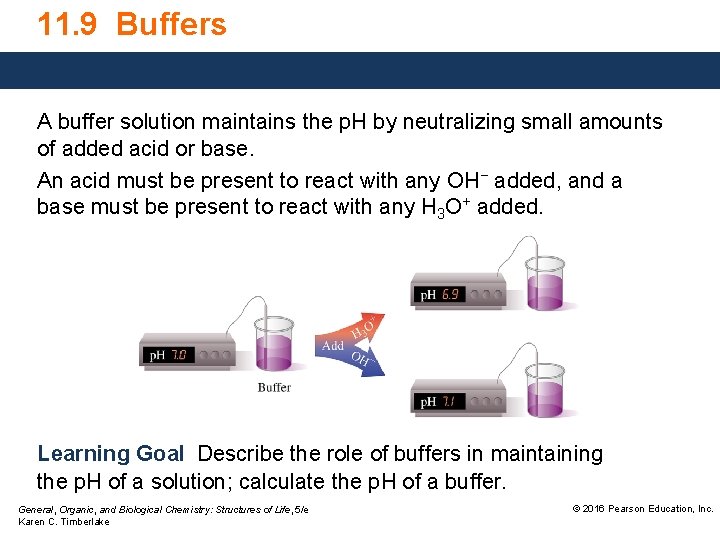
11. 9 Buffers A buffer solution maintains the p. H by neutralizing small amounts of added acid or base. An acid must be present to react with any OH− added, and a base must be present to react with any H 3 O+ added. Learning Goal Describe the role of buffers in maintaining the p. H of a solution; calculate the p. H of a buffer. General, Organic, and Biological Chemistry: Structures of Life, 5/e Karen C. Timberlake © 2016 Pearson Education, Inc.
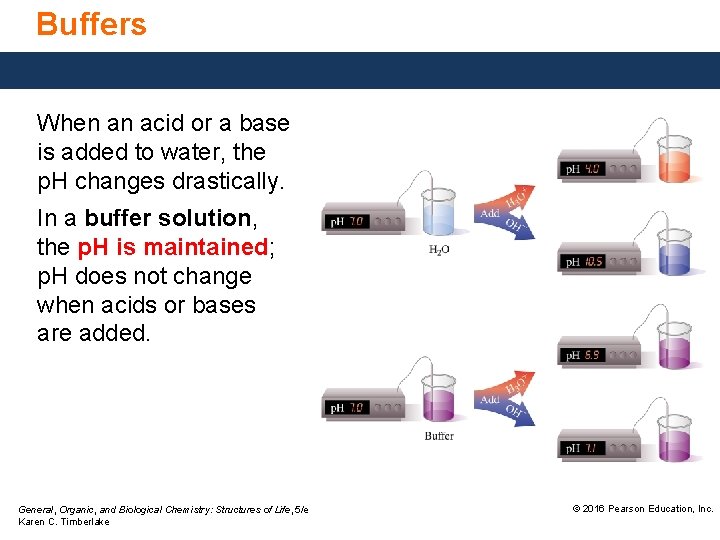
Buffers When an acid or a base is added to water, the p. H changes drastically. In a buffer solution, the p. H is maintained; p. H does not change when acids or bases are added. General, Organic, and Biological Chemistry: Structures of Life, 5/e Karen C. Timberlake © 2016 Pearson Education, Inc.
How Buffers Work Buffers work because • they resist changes in p. H from the addition of an acid or a base. • in the body, they absorb H 3 O+ or OH− from foods and cellular processes to maintain p. H. • they are important in the proper functioning of cells and blood. • they maintain a p. H close to 7. 4 in blood. A change in the p. H of the blood affects the uptake of oxygen and cellular processes. General, Organic, and Biological Chemistry: Structures of Life, 5/e Karen C. Timberlake © 2016 Pearson Education, Inc.
Components of a Buffer A buffer solution • contains a combination of acid–base conjugate pairs, a weak acid and a salt of its conjugate base, such as HC 2 H 3 O 2(aq) and C 2 H 3 O 2−(aq) • has equal concentrations of a weak acid and its salt. General, Organic, and Biological Chemistry: Structures of Life, 5/e Karen C. Timberlake © 2016 Pearson Education, Inc.
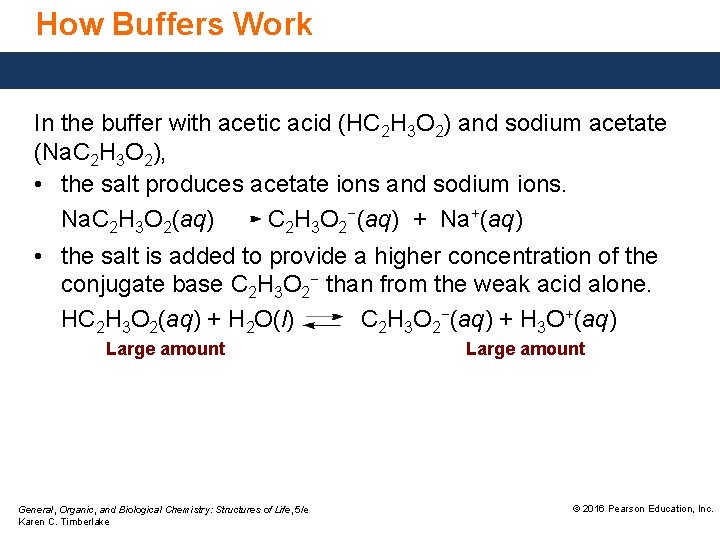
How Buffers Work In the buffer with acetic acid (HC 2 H 3 O 2) and sodium acetate (Na. C 2 H 3 O 2), • the salt produces acetate ions and sodium ions. Na. C 2 H 3 O 2(aq) C 2 H 3 O 2−(aq) + Na+(aq) • the salt is added to provide a higher concentration of the conjugate base C 2 H 3 O 2− than from the weak acid alone. HC 2 H 3 O 2(aq) + H 2 O(l) C 2 H 3 O 2−(aq) + H 3 O+(aq) Large amount General, Organic, and Biological Chemistry: Structures of Life, 5/e Karen C. Timberlake Large amount © 2016 Pearson Education, Inc.
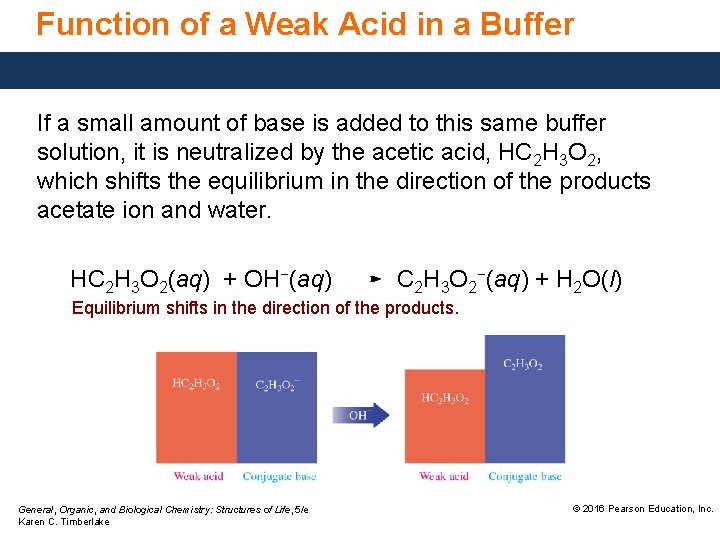
Function of a Weak Acid in a Buffer If a small amount of base is added to this same buffer solution, it is neutralized by the acetic acid, HC 2 H 3 O 2, which shifts the equilibrium in the direction of the products acetate ion and water. HC 2 H 3 O 2(aq) + OH−(aq) C 2 H 3 O 2−(aq) + H 2 O(l) Equilibrium shifts in the direction of the products. General, Organic, and Biological Chemistry: Structures of Life, 5/e Karen C. Timberlake © 2016 Pearson Education, Inc.
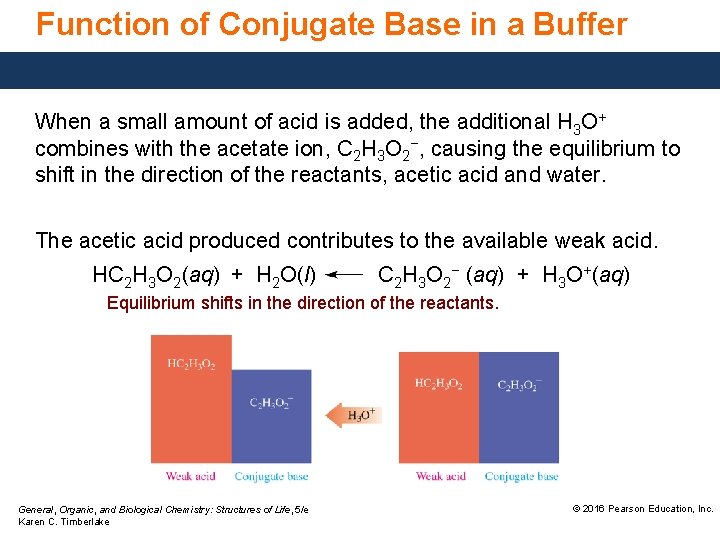
Function of Conjugate Base in a Buffer When a small amount of acid is added, the additional H 3 O+ combines with the acetate ion, C 2 H 3 O 2−, causing the equilibrium to shift in the direction of the reactants, acetic acid and water. The acetic acid produced contributes to the available weak acid. HC 2 H 3 O 2(aq) + H 2 O(l) C 2 H 3 O 2− (aq) + H 3 O+(aq) Equilibrium shifts in the direction of the reactants. General, Organic, and Biological Chemistry: Structures of Life, 5/e Karen C. Timberlake © 2016 Pearson Education, Inc.
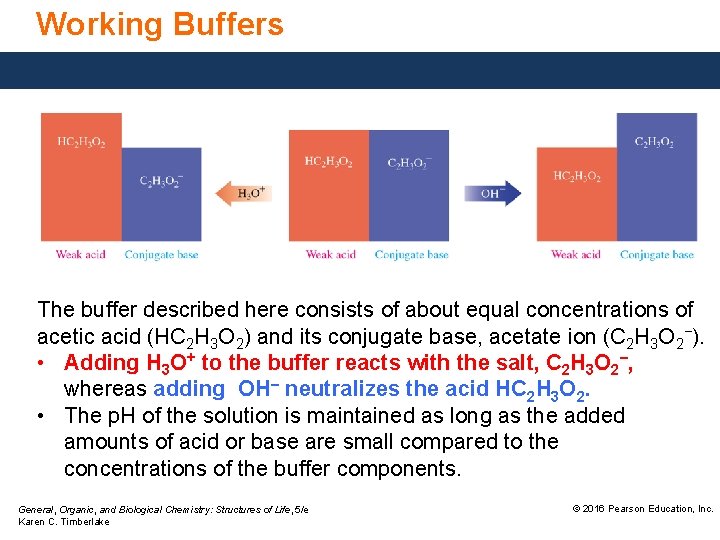
Working Buffers The buffer described here consists of about equal concentrations of acetic acid (HC 2 H 3 O 2) and its conjugate base, acetate ion (C 2 H 3 O 2−). • Adding H 3 O+ to the buffer reacts with the salt, C 2 H 3 O 2−, whereas adding OH− neutralizes the acid HC 2 H 3 O 2. • The p. H of the solution is maintained as long as the added amounts of acid or base are small compared to the concentrations of the buffer components. General, Organic, and Biological Chemistry: Structures of Life, 5/e Karen C. Timberlake © 2016 Pearson Education, Inc.
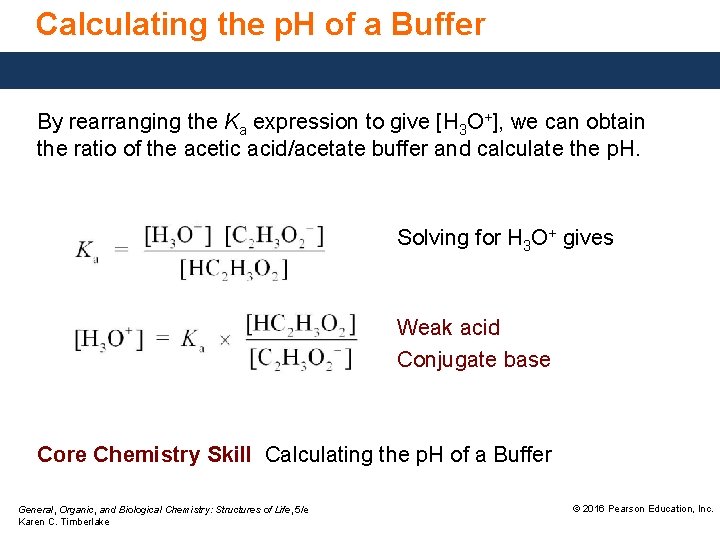
Calculating the p. H of a Buffer By rearranging the Ka expression to give [H 3 O+], we can obtain the ratio of the acetic acid/acetate buffer and calculate the p. H. Solving for H 3 O+ gives Weak acid Conjugate base Core Chemistry Skill Calculating the p. H of a Buffer General, Organic, and Biological Chemistry: Structures of Life, 5/e Karen C. Timberlake © 2016 Pearson Education, Inc.
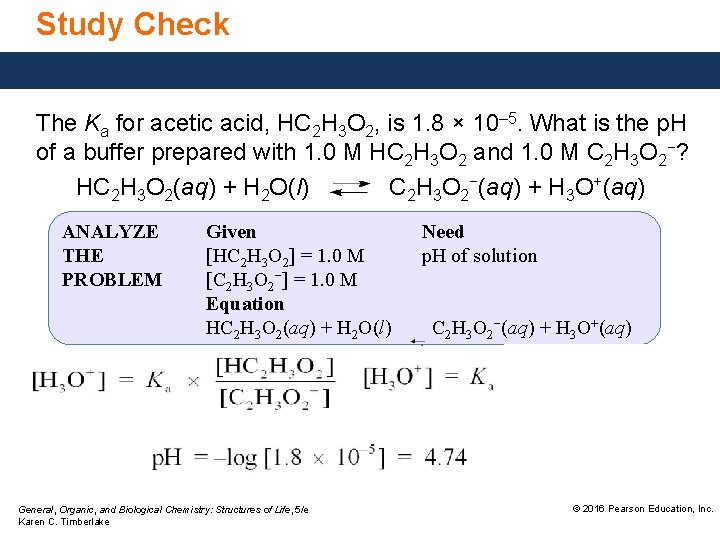
Study Check The Ka for acetic acid, HC 2 H 3 O 2, is 1. 8 × 10– 5. What is the p. H of a buffer prepared with 1. 0 M HC 2 H 3 O 2 and 1. 0 M C 2 H 3 O 2−? HC 2 H 3 O 2(aq) + H 2 O(l) C 2 H 3 O 2−(aq) + H 3 O+(aq) ANALYZE THE PROBLEM Given [HC 2 H 3 O 2] = 1. 0 M [C 2 H 3 O 2−] = 1. 0 M Equation HC 2 H 3 O 2(aq) + H 2 O(l) General, Organic, and Biological Chemistry: Structures of Life, 5/e Karen C. Timberlake Need p. H of solution C 2 H 3 O 2−(aq) + H 3 O+(aq) © 2016 Pearson Education, Inc.
Calculating the p. H of a Buffer Because Ka is a constant at a given temperature, • the [H 3 O+] is determined by the [HC 2 H 3 O 2]/[C 2 H 3 O 2−] ratio. • the addition of small amounts of either acid or base changes the ratio of [HC 2 H 3 O 2]/[C 2 H 3 O 2−] only slightly. • the changes in [H 3 O+] will be small and the p. H will be maintained. • the addition of a large amount of acid or base may exceed the buffering capacity of the system. General, Organic, and Biological Chemistry: Structures of Life, 5/e Karen C. Timberlake © 2016 Pearson Education, Inc.
Buffers and p. H Changes Buffers can be prepared from conjugate acid–base pairs such as H 2 PO 4−/HPO 42− and HPO 42−/PO 43−, HCO 3−/CO 32−, or NH 4+/NH 3. The p. H of the buffer solution will depend on the conjugate acid–base pair chosen. General, Organic, and Biological Chemistry: Structures of Life, 5/e Karen C. Timberlake © 2016 Pearson Education, Inc.
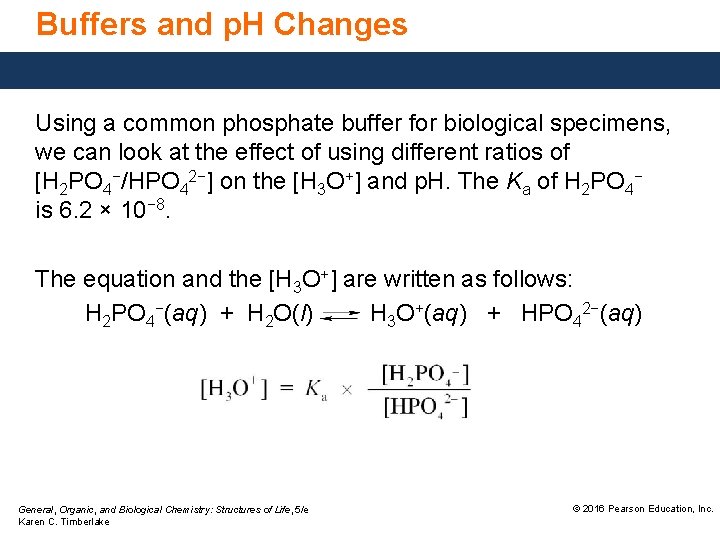
Buffers and p. H Changes Using a common phosphate buffer for biological specimens, we can look at the effect of using different ratios of [H 2 PO 4−/HPO 42−] on the [H 3 O+] and p. H. The Ka of H 2 PO 4− is 6. 2 × 10− 8. The equation and the [H 3 O+] are written as follows: H 2 PO 4−(aq) + H 2 O(l) H 3 O+(aq) + HPO 42−(aq) General, Organic, and Biological Chemistry: Structures of Life, 5/e Karen C. Timberlake © 2016 Pearson Education, Inc.
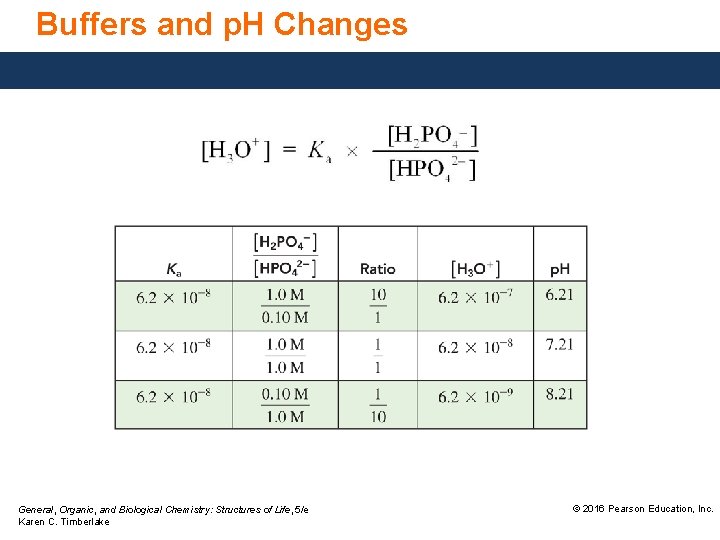
Buffers and p. H Changes General, Organic, and Biological Chemistry: Structures of Life, 5/e Karen C. Timberlake © 2016 Pearson Education, Inc.
Buffer Problem One of the conjugate acid–base pairs that buffers the blood plasma is H 2 PO 4– /HPO 42–, which has a Ka of 6. 2 × 10– 8. What is the p. H of a buffer that is prepared from 0. 10 M H 2 PO 4– and 0. 50 M HPO 42–? General, Organic, and Biological Chemistry: Structures of Life, 5/e Karen C. Timberlake © 2016 Pearson Education, Inc.
Chemistry Link to Health: Buffers in Blood Plasma The arterial blood plasma has a normal p. H of 7. 35 to 7. 45. If changes in H 3 O+ lower the p. H below 6. 8 or raise it above 8. 0, cells cannot function properly and death may result. In our cells, CO 2 • is continually produced as an end product of cellular metabolism. • is carried to the lungs for elimination, and the rest dissolves in body fluids such as plasma and saliva, forming carbonic acid, H 2 CO 3. As a weak acid, carbonic acid dissociates to give bicarbonate, HCO 3−, and H 3 O+. General, Organic, and Biological Chemistry: Structures of Life, 5/e Karen C. Timberlake © 2016 Pearson Education, Inc.
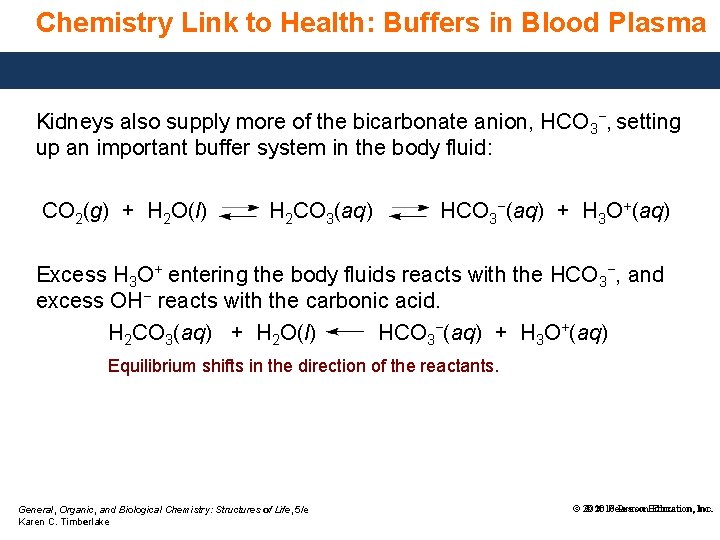
Chemistry Link to Health: Buffers in Blood Plasma Kidneys also supply more of the bicarbonate anion, HCO 3−, setting up an important buffer system in the body fluid: CO 2(g) + H 2 O(l) H 2 CO 3(aq) HCO 3−(aq) + H 3 O+(aq) Excess H 3 O+ entering the body fluids reacts with the HCO 3−, and excess OH− reacts with the carbonic acid. H 2 CO 3(aq) + H 2 O(l) HCO 3−(aq) + H 3 O+(aq) Equilibrium shifts in the direction of the reactants. General, Organic, and Biological Chemistry: Structures of Life, 5/e Karen C. Timberlake © 2016 Pearson Education, Inc.
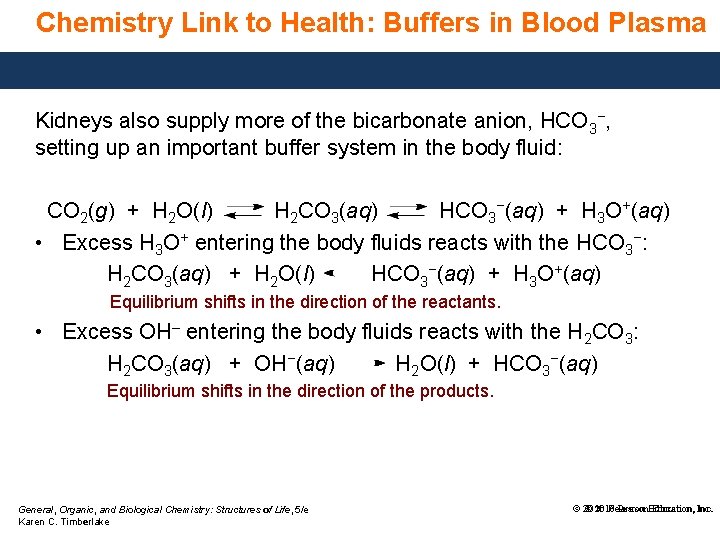
Chemistry Link to Health: Buffers in Blood Plasma Kidneys also supply more of the bicarbonate anion, HCO 3−, setting up an important buffer system in the body fluid: CO 2(g) + H 2 O(l) H 2 CO 3(aq) HCO 3−(aq) + H 3 O+(aq) • Excess H 3 O+ entering the body fluids reacts with the HCO 3−: H 2 CO 3(aq) + H 2 O(l) HCO 3−(aq) + H 3 O+(aq) Equilibrium shifts in the direction of the reactants. • Excess OH– entering the body fluids reacts with the H 2 CO 3: H 2 CO 3(aq) + OH−(aq) H 2 O(l) + HCO 3−(aq) Equilibrium shifts in the direction of the products. General, Organic, and Biological Chemistry: Structures of Life, 5/e Karen C. Timberlake © 2016 Pearson Education, Inc.
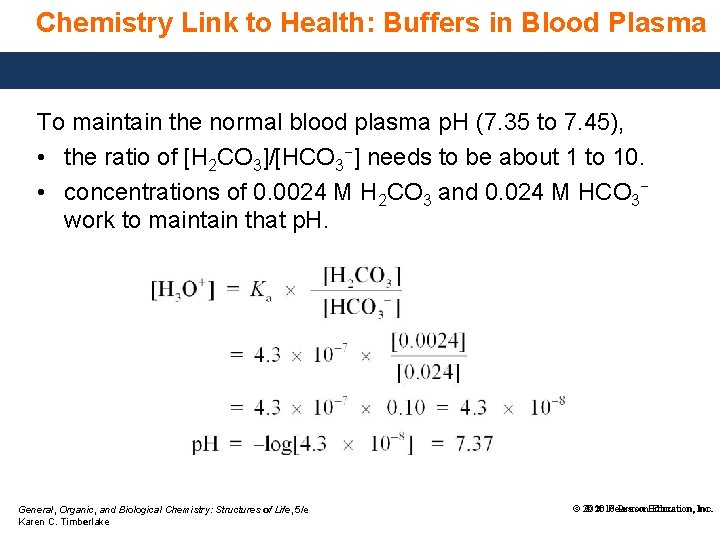
Chemistry Link to Health: Buffers in Blood Plasma To maintain the normal blood plasma p. H (7. 35 to 7. 45), • the ratio of [H 2 CO 3]/[HCO 3−] needs to be about 1 to 10. • concentrations of 0. 0024 M H 2 CO 3 and 0. 024 M HCO 3− work to maintain that p. H. General, Organic, and Biological Chemistry: Structures of Life, 5/e Karen C. Timberlake © 2016 Pearson Education, Inc.
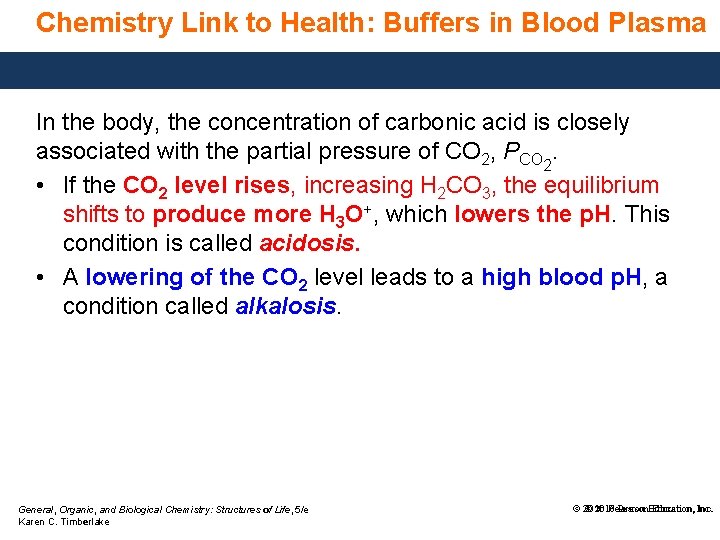
Chemistry Link to Health: Buffers in Blood Plasma In the body, the concentration of carbonic acid is closely associated with the partial pressure of CO 2, PCO 2. • If the CO 2 level rises, increasing H 2 CO 3, the equilibrium shifts to produce more H 3 O+, which lowers the p. H. This condition is called acidosis. • A lowering of the CO 2 level leads to a high blood p. H, a condition called alkalosis. General, Organic, and Biological Chemistry: Structures of Life, 5/e Karen C. Timberlake © 2016 Pearson Education, Inc.
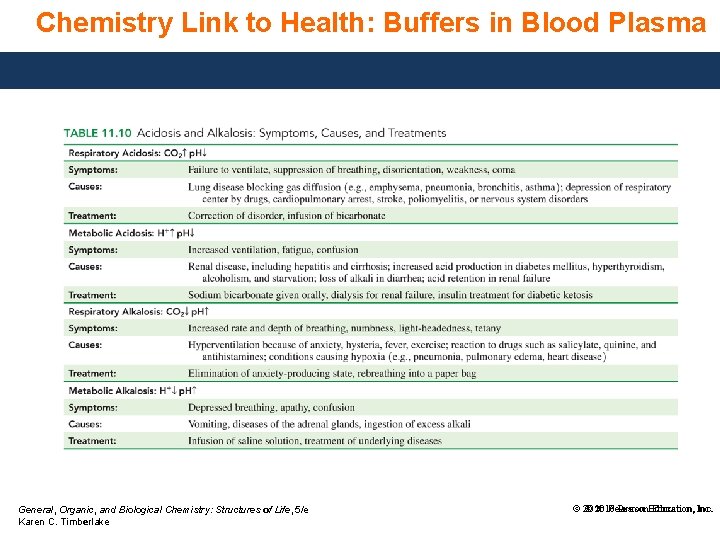
Chemistry Link to Health: Buffers in Blood Plasma General, Organic, and Biological Chemistry: Structures of Life, 5/e Karen C. Timberlake © 2016 Pearson Education, Inc.
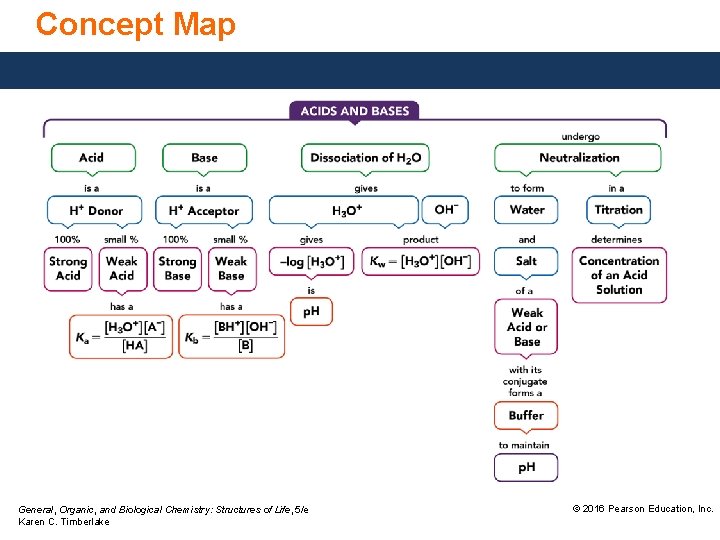
Concept Map General, Organic, and Biological Chemistry: Structures of Life, 5/e Karen C. Timberlake © 2016 Pearson Education, Inc.
End of Chapter 11 Any Questions? General, Organic, and Biological Chemistry: Structures of Life, 5/e Karen C. Timberlake 147 © 2016 Pearson Education, Inc.
- Slides: 147