
Lecture Power Points Chapter 26 Physics Principles with


- Slides: 32
Lecture Power. Points Chapter 26 Physics: Principles with Applications, 7 th edition Giancoli © 2014 Pearson Education, Inc. This work is protected by United States copyright laws and is provided solely for the use of instructors in teaching their courses and assessing student learning. Dissemination or sale of any part of this work (including on the World Wide Web) will destroy the integrity of the work and is not permitted. The work and materials from it should never be made available to students except by instructors using the accompanying text in their classes. All recipients of this work are expected to abide by these restrictions and to honor the intended pedagogical purposes and the needs of other instructors who rely on these materials.
Chapter 26 The Special Theory of Relativity © 2014 Pearson Education, Inc.
Contents of Chapter 26 • Galilean-Newtonian Relativity • Postulates of the Special Theory of Relativity • Simultaneity • Time Dilation and the Twin Paradox • Length Contraction • Four-Dimensional Space-Time © 2014 Pearson Education, Inc.
Contents of Chapter 26 • Relativistic Momentum • The Ultimate Speed • E = mc 2; Mass and Energy • Relativistic Addition of Velocities • The Impact of Special Relativity © 2014 Pearson Education, Inc.
26 -1 Galilean-Newtonian Relativity Definition of an inertial reference frame: One in which Newton’s first law is valid Earth is rotating and therefore not an inertial reference frame, but can treat it as one for many purposes A frame moving with a constant velocity with respect to an inertial reference frame is itself inertial © 2014 Pearson Education, Inc.
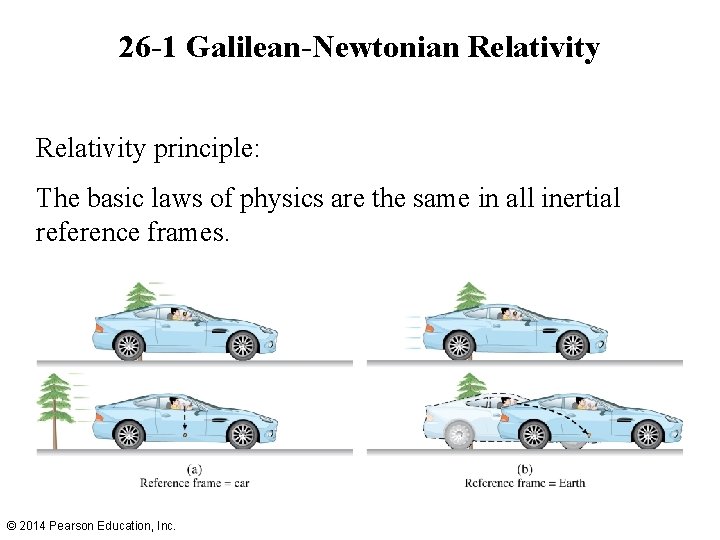
26 -1 Galilean-Newtonian Relativity principle: The basic laws of physics are the same in all inertial reference frames. © 2014 Pearson Education, Inc.
26 -1 Galilean-Newtonian Relativity This principle works well for mechanical phenomena. However, Maxwell’s equations yield the velocity of light; it is 3. 0 × 108 m/s. So, which is the reference frame in which light travels at that speed? Scientists searched for variations in the speed of light depending on the direction of the ray, but found none. © 2014 Pearson Education, Inc.
26 -2 Postulates of the Special Theory of Relativity 1. The laws of physics have the same form in all inertial reference frames. 2. Light propagates through empty space with speed c independent of the speed of source or observer. This solves the problem—the speed of light is in fact the same in all inertial reference frames. © 2014 Pearson Education, Inc.
26 -3 Simultaneity One of the implications of relativity theory is that time is not absolute. Distant observers do not necessarily agree on time intervals between events, or on whether they are simultaneous or not. In relativity, an “event” is defined as occurring at a specific place and time. © 2014 Pearson Education, Inc.
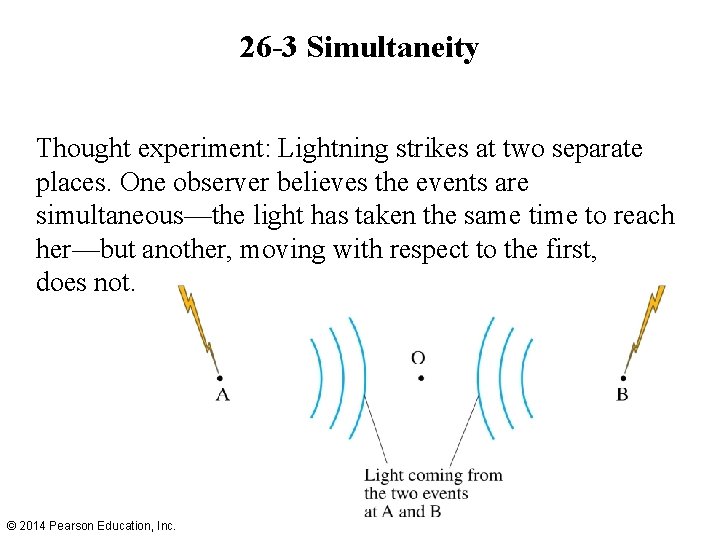
26 -3 Simultaneity Thought experiment: Lightning strikes at two separate places. One observer believes the events are simultaneous—the light has taken the same time to reach her—but another, moving with respect to the first, does not. © 2014 Pearson Education, Inc.
26 -3 Simultaneity Here, it is clear that if one observer sees the events as simultaneous, the other cannot, given that the speed of light is the same for each. © 2014 Pearson Education, Inc.
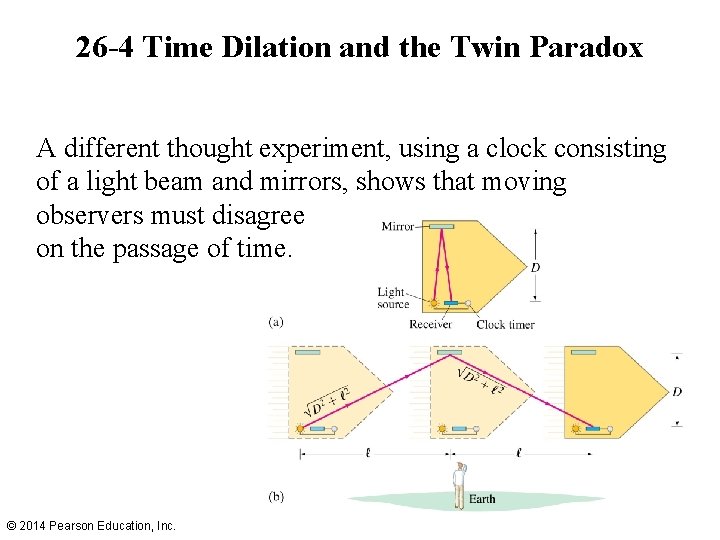
26 -4 Time Dilation and the Twin Paradox A different thought experiment, using a clock consisting of a light beam and mirrors, shows that moving observers must disagree on the passage of time. © 2014 Pearson Education, Inc.
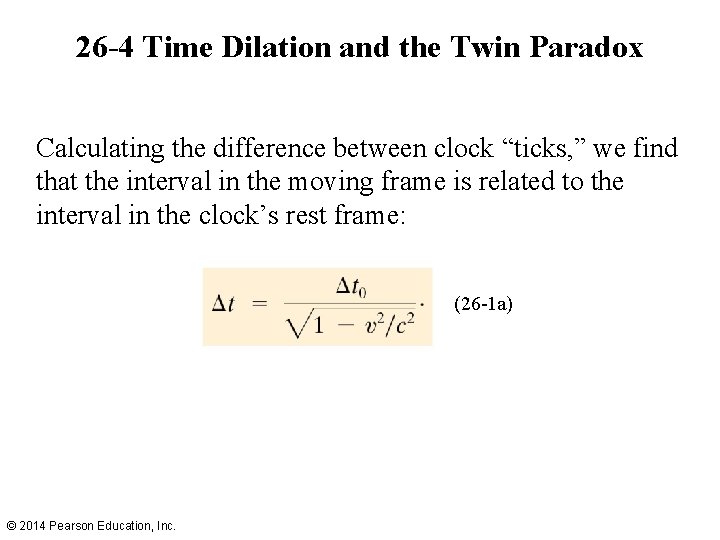
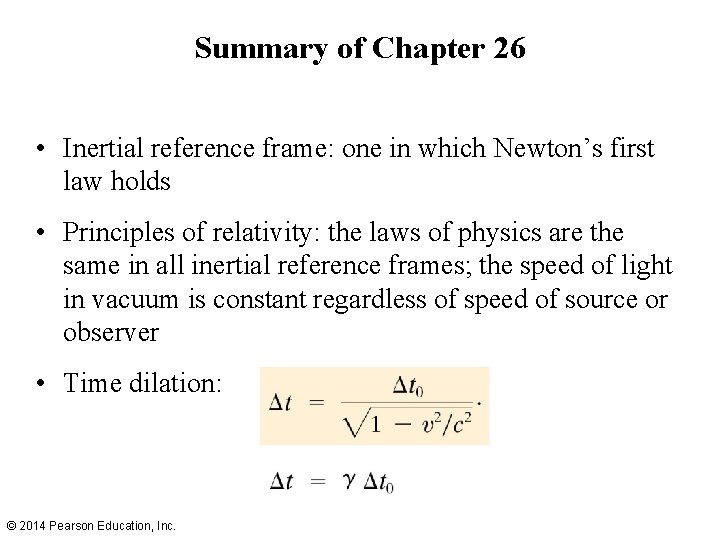
26 -4 Time Dilation and the Twin Paradox Calculating the difference between clock “ticks, ” we find that the interval in the moving frame is related to the interval in the clock’s rest frame: (26 -1 a) © 2014 Pearson Education, Inc.
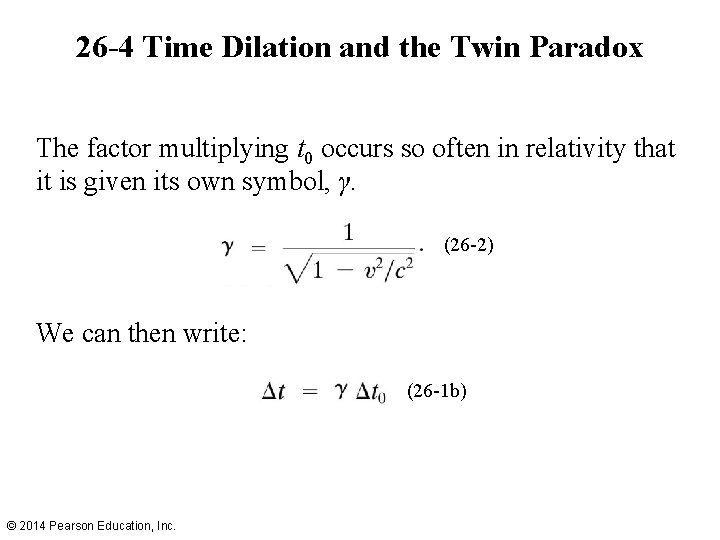
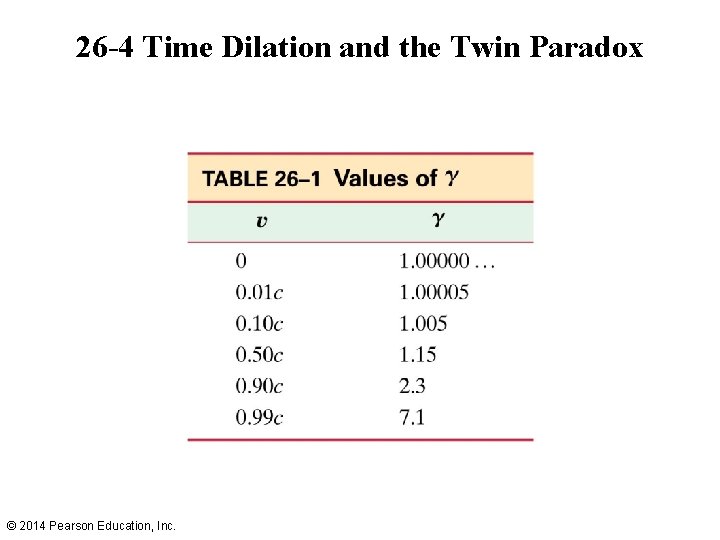
26 -4 Time Dilation and the Twin Paradox The factor multiplying t 0 occurs so often in relativity that it is given its own symbol, γ. (26 -2) We can then write: (26 -1 b) © 2014 Pearson Education, Inc.
26 -4 Time Dilation and the Twin Paradox To clarify: • The time interval in the frame where two events occur in the same place is t 0. • The time interval in a frame moving with respect to the first one is Δt. © 2014 Pearson Education, Inc.
26 -4 Time Dilation and the Twin Paradox It has been proposed that space travel could take advantage of time dilation—if an astronaut’s speed is close enough to the speed of light, a trip of 100 lightyears could appear to the astronaut as having been much shorter. The astronaut would return to Earth after being away for a few years, and would find that hundreds of years had passed on Earth. © 2014 Pearson Education, Inc.
26 -4 Time Dilation and the Twin Paradox This brings up the twin paradox—if any inertial frame is just as good as any other, why doesn’t the astronaut age faster than the Earth traveling away from him? The solution to the paradox is that the astronaut’s reference frame has not been continuously inertial—he turns around at some point and comes back. It is impossible to do this without accelerating. © 2014 Pearson Education, Inc.
26 -4 Time Dilation and the Twin Paradox © 2014 Pearson Education, Inc.
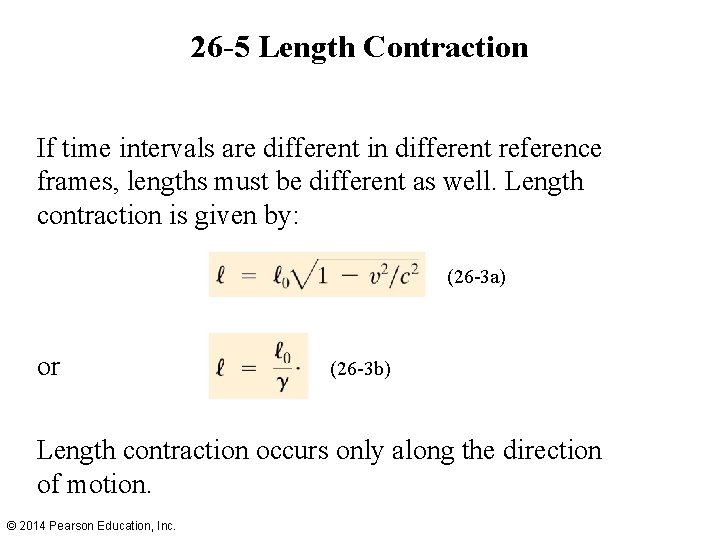
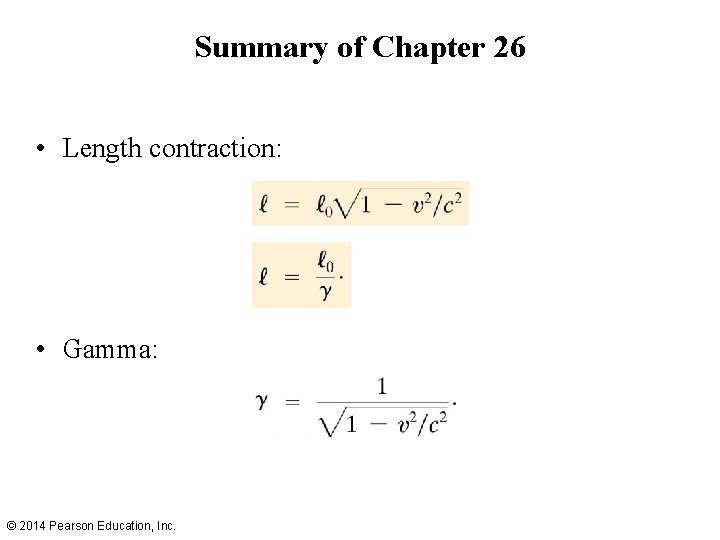
26 -5 Length Contraction If time intervals are different in different reference frames, lengths must be different as well. Length contraction is given by: (26 -3 a) or (26 -3 b) Length contraction occurs only along the direction of motion. © 2014 Pearson Education, Inc.
26 -6 Four-Dimensional Space-Time Space and time are even more intricately connected. Space has three dimensions, and time is a fourth. When viewed from different reference frames, the space and time coordinates can mix. © 2014 Pearson Education, Inc.
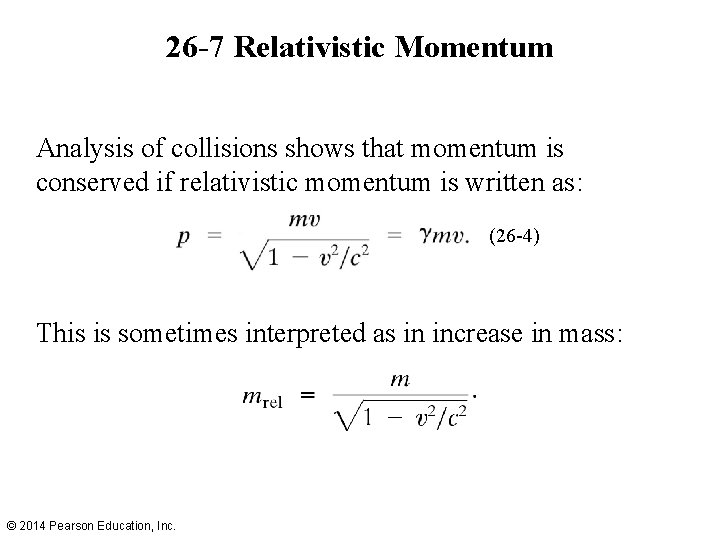
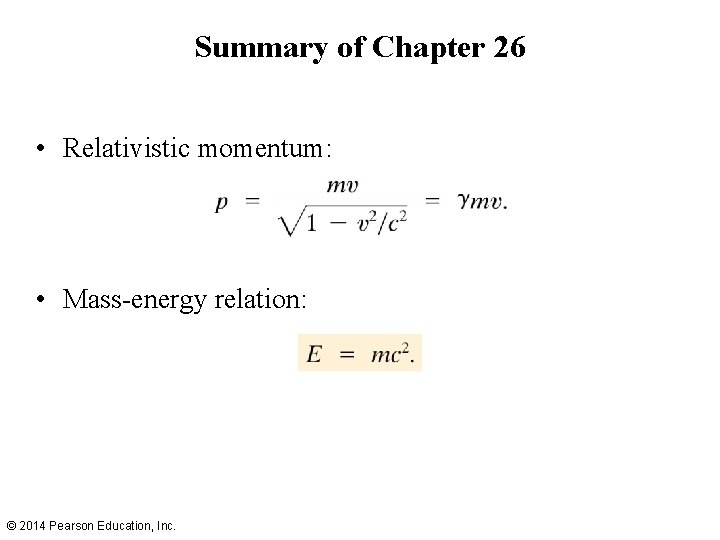
26 -7 Relativistic Momentum Analysis of collisions shows that momentum is conserved if relativistic momentum is written as: (26 -4) This is sometimes interpreted as in increase in mass: © 2014 Pearson Education, Inc.
26 -8 The Ultimate Speed A basic result of special relativity is that nothing can equal or exceed the speed of light. This would require infinite momentum—not possible for anything with nonzero mass. © 2014 Pearson Education, Inc.
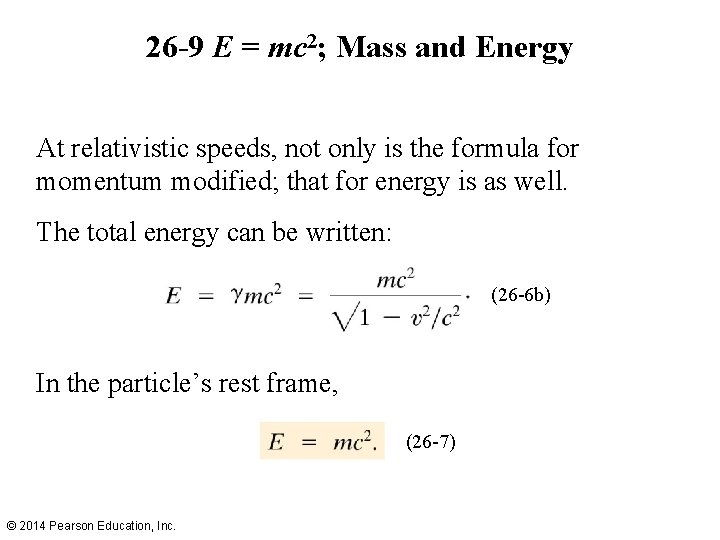
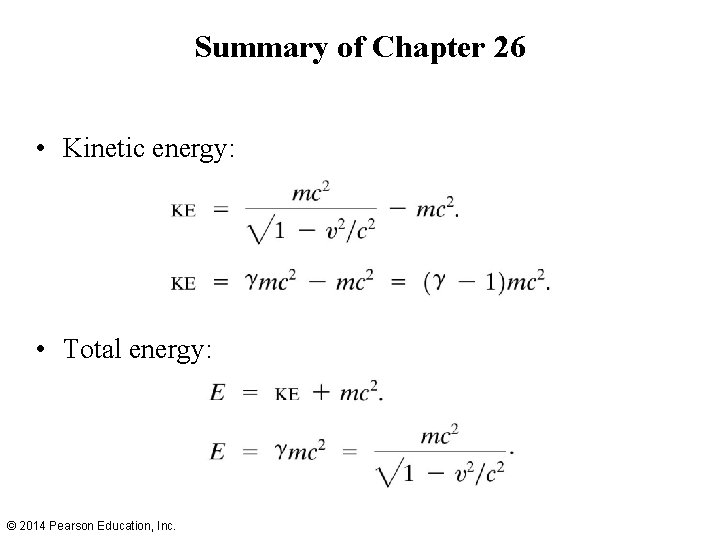
26 -9 E = mc 2; Mass and Energy At relativistic speeds, not only is the formula for momentum modified; that for energy is as well. The total energy can be written: (26 -6 b) In the particle’s rest frame, (26 -7) © 2014 Pearson Education, Inc.
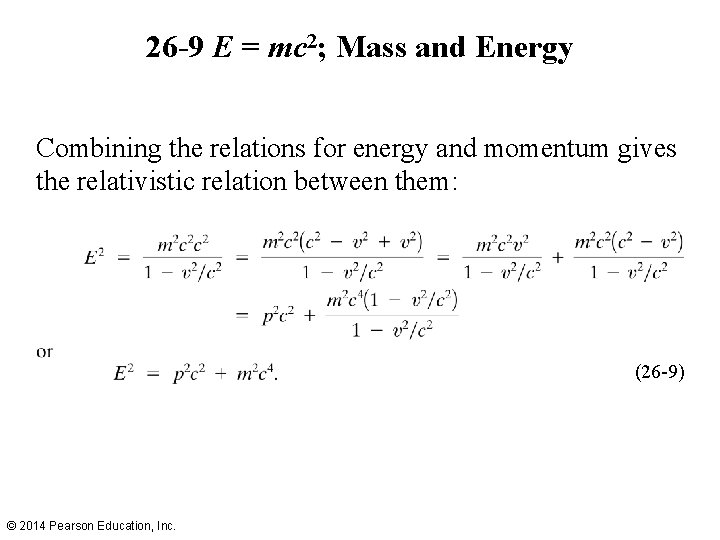
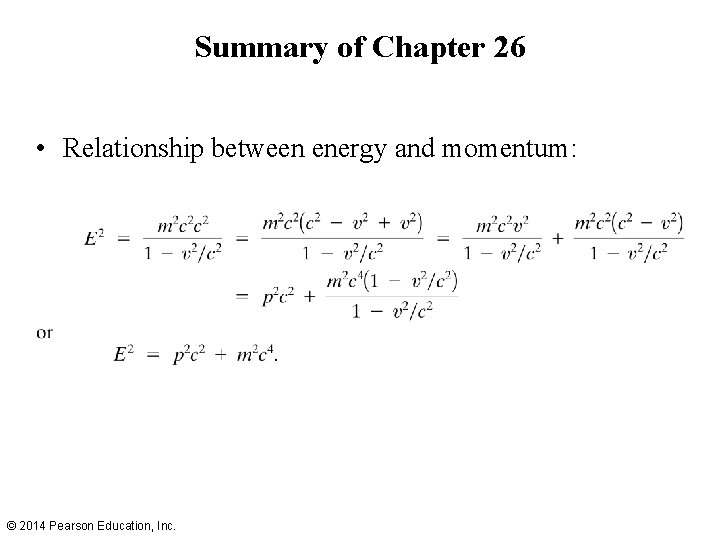
26 -9 E = mc 2; Mass and Energy Combining the relations for energy and momentum gives the relativistic relation between them: (26 -9) © 2014 Pearson Education, Inc.
26 -9 E = mc 2; Mass and Energy All the formulas presented here become the usual Newtonian kinematic formulas when the speeds are much smaller than the speed of light. There is no fixed rule for when the speed is high enough that relativistic formulas must be used—it depends on the desired accuracy of the calculation. © 2014 Pearson Education, Inc.
26 -10 Relativistic Addition of Velocities Relativistic velocities cannot simply add; the speed of light is an absolute limit. The relativistic formula is: (26 -10) © 2014 Pearson Education, Inc.
26 -11 The Impact of Special Relativity The predictions of special relativity have been tested thoroughly, and verified to great accuracy. The correspondence principle says that a more general theory must agree with a more restricted theory where their realms of validity overlap. This is why the effects of special relativity are not obvious in everyday life. © 2014 Pearson Education, Inc.
Summary of Chapter 26 • Inertial reference frame: one in which Newton’s first law holds • Principles of relativity: the laws of physics are the same in all inertial reference frames; the speed of light in vacuum is constant regardless of speed of source or observer • Time dilation: © 2014 Pearson Education, Inc.
Summary of Chapter 26 • Length contraction: • Gamma: © 2014 Pearson Education, Inc.
Summary of Chapter 26 • Relativistic momentum: • Mass-energy relation: © 2014 Pearson Education, Inc.
Summary of Chapter 26 • Kinetic energy: • Total energy: © 2014 Pearson Education, Inc.
Summary of Chapter 26 • Relationship between energy and momentum: © 2014 Pearson Education, Inc.