
Lecture Power Point Chemistry The Molecular Nature of
- Slides: 51
Lecture Power. Point Chemistry The Molecular Nature of Matter and Change Seventh Edition Martin S. Silberberg and Patricia G. Amateis 3 -1 Copyright Mc. Graw-Hill Education. All rights reserved. No reproduction or distribution without the prior written consent of Mc. Graw-Hill Education.
Chapter 3 Stoichiometry of Formulas and Equations 3 -2
Mole - Mass Relationships in Chemical Systems 3. 1 The Mole 3. 2 Determining the Formula of an Unknown Compound 3. 3 Writing and Balancing Chemical Equations 3. 4 Calculating Quantities of Reactant and Product 3 -3
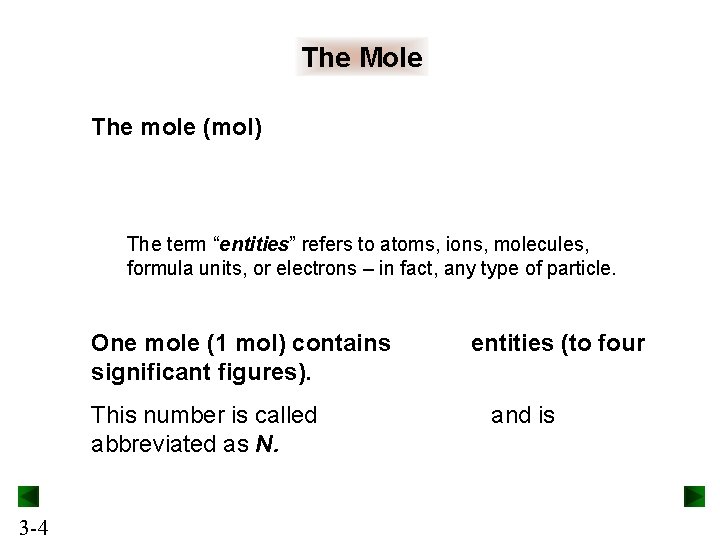
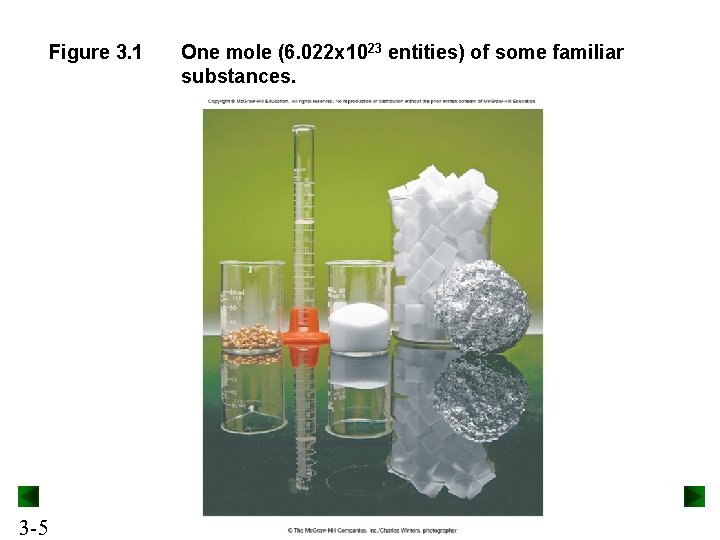
The Mole The mole (mol) The term “entities” refers to atoms, ions, molecules, formula units, or electrons – in fact, any type of particle. One mole (1 mol) contains significant figures). This number is called abbreviated as N. 3 -4 entities (to four and is
Figure 3. 1 3 -5 One mole (6. 022 x 1023 entities) of some familiar substances.
Molar Mass (M) of a substance is the mass per mole of its entities (atoms, molecules, or formula units). For monatomic elements, the molar mass is the same as the atomic mass in grams per mole. The atomic mass is simply read from the Periodic Table. The molar mass of Ne = 3 -6
For molecular elements and for compounds, the formula is needed to determine the molar mass. The molar mass of O 2 = The molar mass of SO 2 = 3 -7
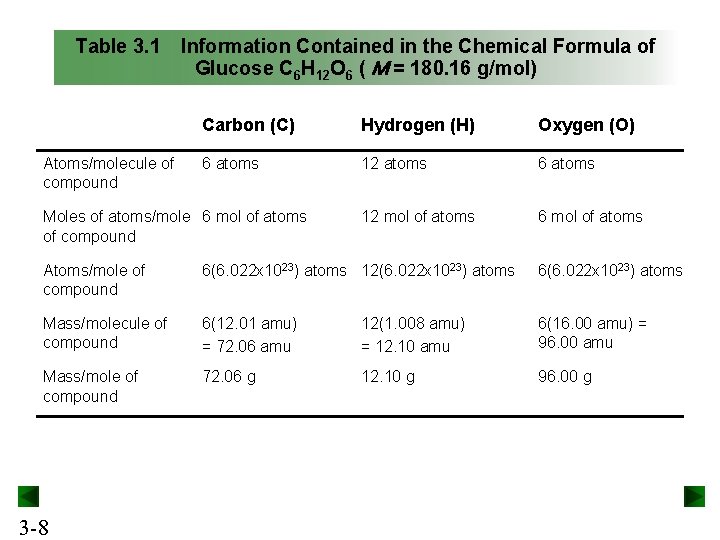
Table 3. 1 Atoms/molecule of compound Information Contained in the Chemical Formula of Glucose C 6 H 12 O 6 ( M = 180. 16 g/mol) Carbon (C) Hydrogen (H) Oxygen (O) 6 atoms 12 atoms 6 atoms 12 mol of atoms 6 mol of atoms Moles of atoms/mole 6 mol of atoms of compound Atoms/mole of compound 6(6. 022 x 1023) atoms 12(6. 022 x 1023) atoms 6(6. 022 x 1023) atoms Mass/molecule of compound 6(12. 01 amu) = 72. 06 amu 12(1. 008 amu) = 12. 10 amu 6(16. 00 amu) = 96. 00 amu Mass/mole of compound 72. 06 g 12. 10 g 96. 00 g 3 -8
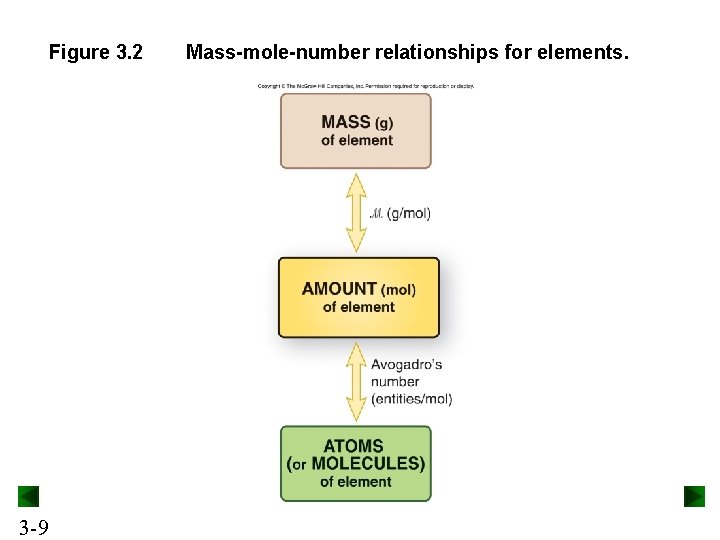
Figure 3. 2 3 -9 Mass-mole-number relationships for elements.
Sample Problem 3. 1 PROBLEM: 3 -10 Converting Between Mass and Amount of an Element Silver (Ag) is used in jewelry and tableware but no longer in U. S. coins. How many grams of Ag are in 0. 0342 mol of Ag?
Sample Problem 3. 2 Converting Between Number of Entities and Amount of an Element PROBLEM: Gallium (Ga) is a key element in solar panels, calculators and other light-sensitive electronic devices. How many Ga atoms are in 2. 85 x 10 -3 mol of gallium? 3 -11
Sample Problem 3. 3 Converting Between Number of Entities and Mass of an Element PROBLEM: Iron (Fe) is the main component of steel and is therefore the most important metal in society; it is also essential in the body. How many Fe atoms are in 95. 8 g of Fe? 3 -12
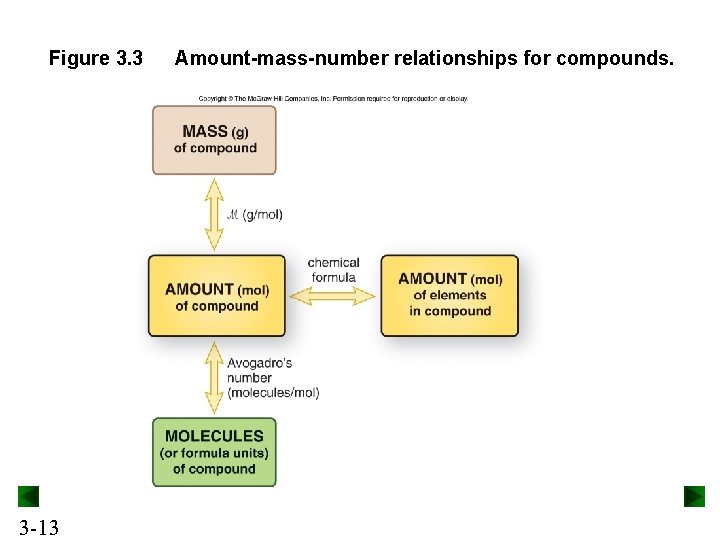
Figure 3. 3 3 -13 Amount-mass-number relationships for compounds.
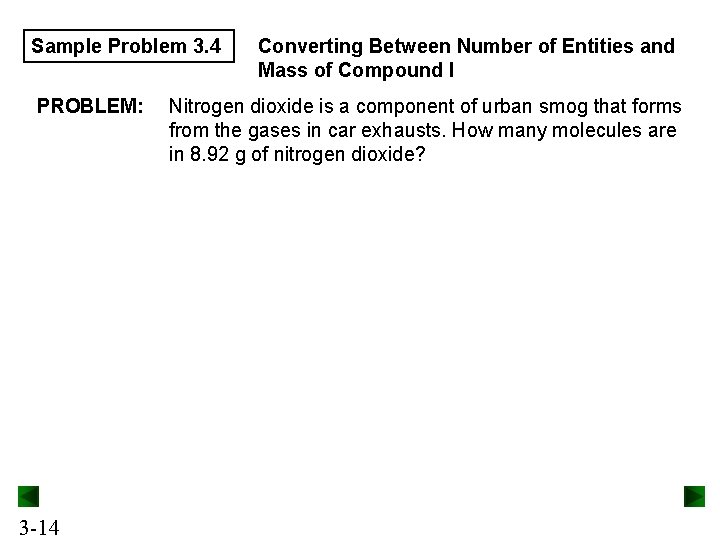
Sample Problem 3. 4 PROBLEM: 3 -14 Converting Between Number of Entities and Mass of Compound I Nitrogen dioxide is a component of urban smog that forms from the gases in car exhausts. How many molecules are in 8. 92 g of nitrogen dioxide?
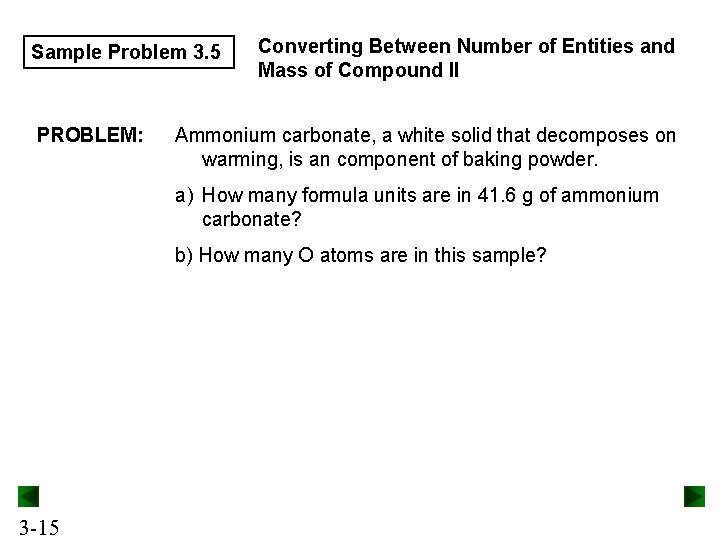
Sample Problem 3. 5 PROBLEM: Converting Between Number of Entities and Mass of Compound II Ammonium carbonate, a white solid that decomposes on warming, is an component of baking powder. a) How many formula units are in 41. 6 g of ammonium carbonate? b) How many O atoms are in this sample? 3 -15
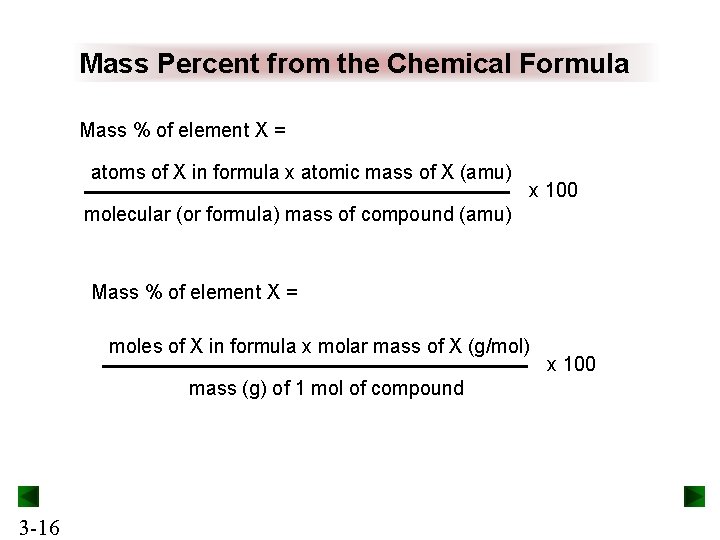
Mass Percent from the Chemical Formula Mass % of element X = atoms of X in formula x atomic mass of X (amu) x 100 molecular (or formula) mass of compound (amu) Mass % of element X = moles of X in formula x molar mass of X (g/mol) mass (g) of 1 mol of compound 3 -16 x 100
Sample Problem 3. 6 Calculating the Mass Percent of Each Element in a Compound from the Formula PROBLEM: Farmers base the effectiveness of fertilizers on their nitrogen content. Ammonium nitrate is a common fertilizer. What is the mass percent of each element in ammonium nitrate? 3 -17
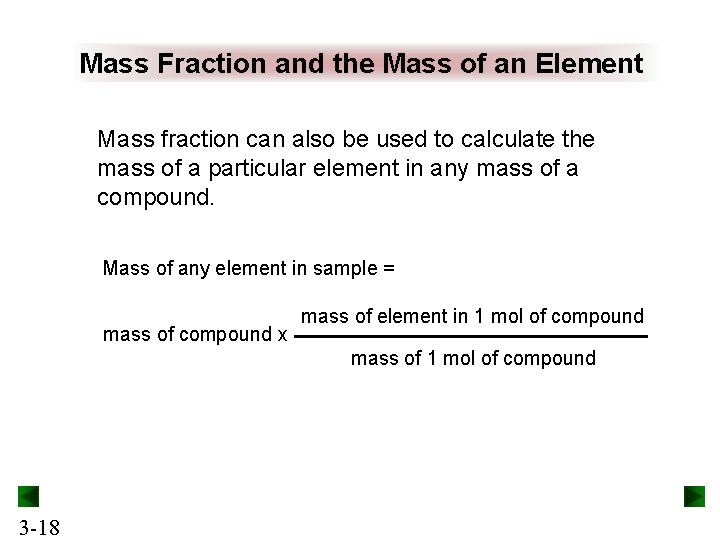
Mass Fraction and the Mass of an Element Mass fraction can also be used to calculate the mass of a particular element in any mass of a compound. Mass of any element in sample = mass of compound x mass of element in 1 mol of compound mass of 1 mol of compound 3 -18
Sample Problem 3. 7 Calculating the Mass of an Element in a Compound PROBLEM: Use the information from Sample Problem 3. 6 to determine the mass (g) of nitrogen in 650. g of ammonium nitrate. 3 -19
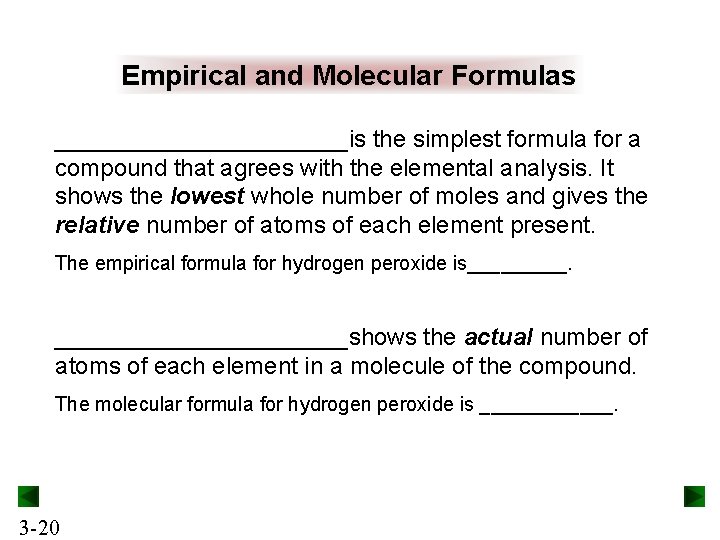
Empirical and Molecular Formulas ___________is the simplest formula for a compound that agrees with the elemental analysis. It shows the lowest whole number of moles and gives the relative number of atoms of each element present. The empirical formula for hydrogen peroxide is_____. ___________shows the actual number of atoms of each element in a molecule of the compound. The molecular formula for hydrogen peroxide is ______. 3 -20
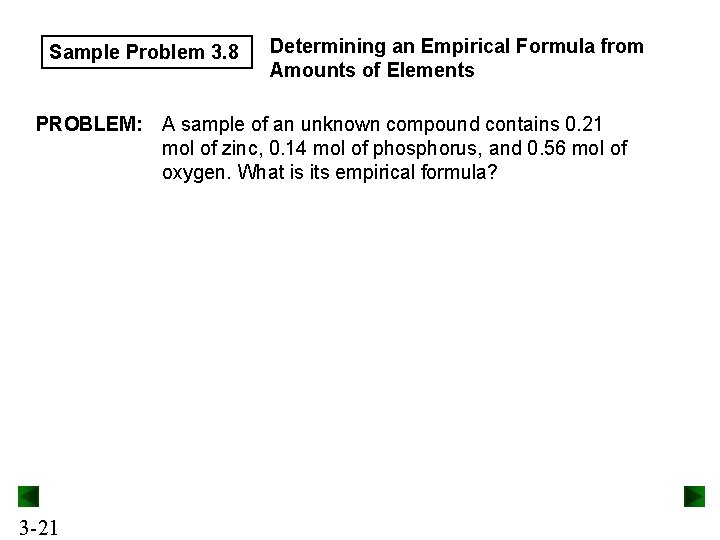
Sample Problem 3. 8 Determining an Empirical Formula from Amounts of Elements PROBLEM: A sample of an unknown compound contains 0. 21 mol of zinc, 0. 14 mol of phosphorus, and 0. 56 mol of oxygen. What is its empirical formula? 3 -21
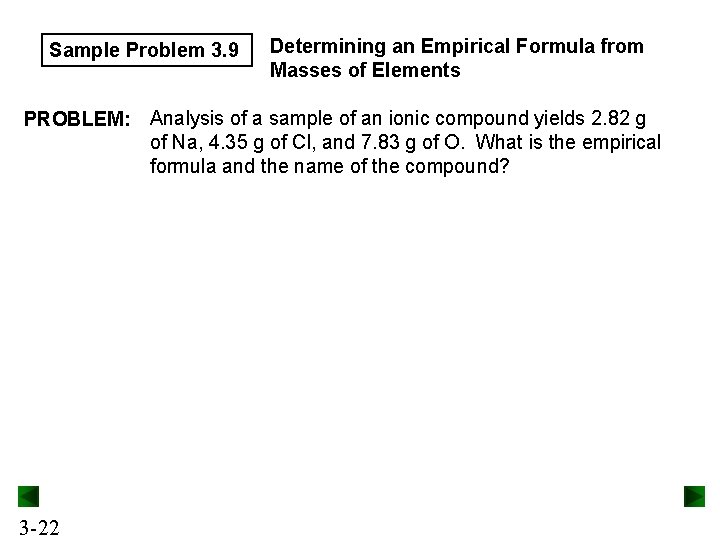
Sample Problem 3. 9 Determining an Empirical Formula from Masses of Elements PROBLEM: Analysis of a sample of an ionic compound yields 2. 82 g of Na, 4. 35 g of Cl, and 7. 83 g of O. What is the empirical formula and the name of the compound? 3 -22
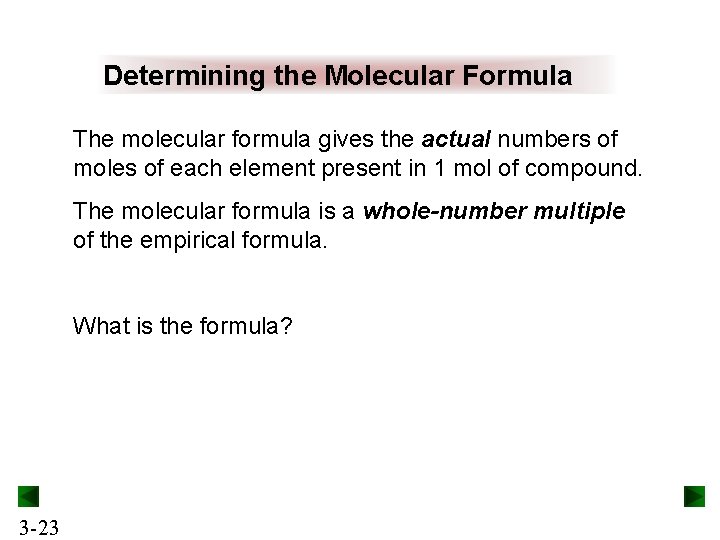
Determining the Molecular Formula The molecular formula gives the actual numbers of moles of each element present in 1 mol of compound. The molecular formula is a whole-number multiple of the empirical formula. What is the formula? 3 -23
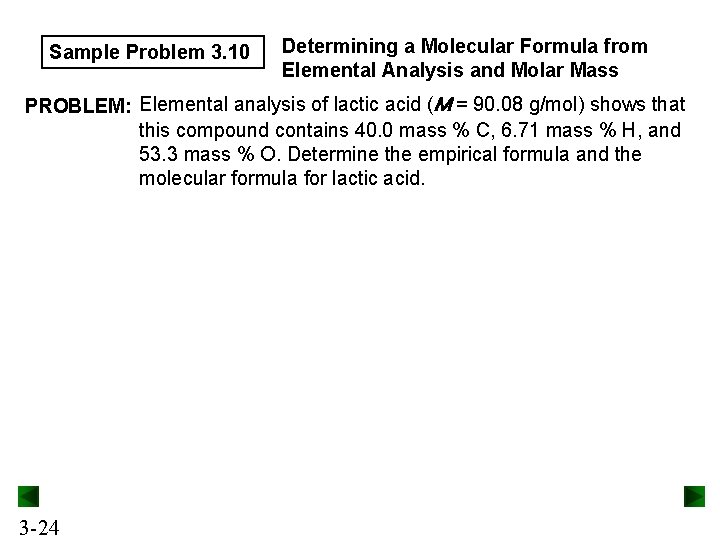
Sample Problem 3. 10 Determining a Molecular Formula from Elemental Analysis and Molar Mass PROBLEM: Elemental analysis of lactic acid (M = 90. 08 g/mol) shows that this compound contains 40. 0 mass % C, 6. 71 mass % H, and 53. 3 mass % O. Determine the empirical formula and the molecular formula for lactic acid. 3 -24
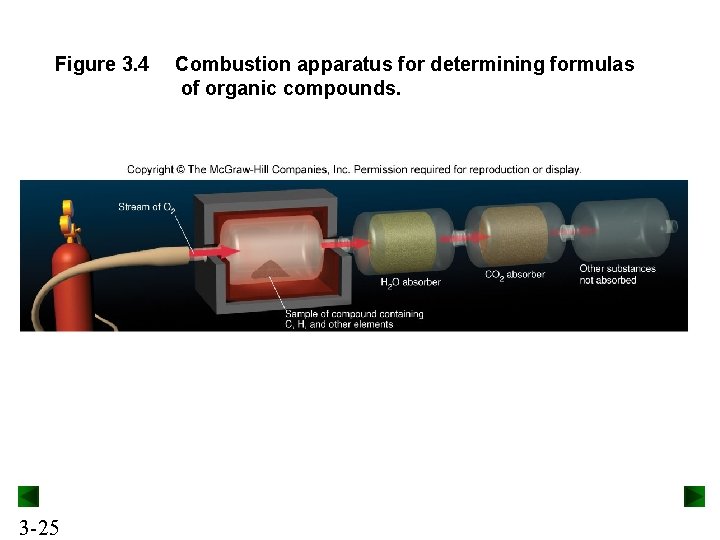
Figure 3. 4 3 -25 Combustion apparatus for determining formulas of organic compounds.
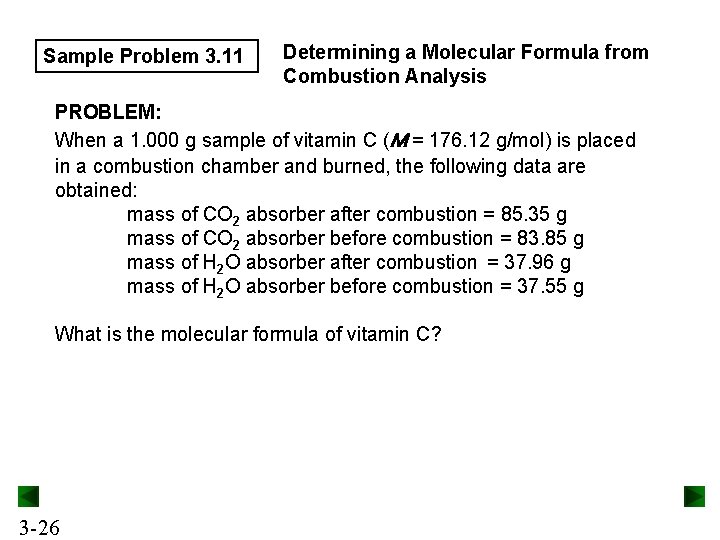
Sample Problem 3. 11 Determining a Molecular Formula from Combustion Analysis PROBLEM: When a 1. 000 g sample of vitamin C (M = 176. 12 g/mol) is placed in a combustion chamber and burned, the following data are obtained: mass of CO 2 absorber after combustion = 85. 35 g mass of CO 2 absorber before combustion = 83. 85 g mass of H 2 O absorber after combustion = 37. 96 g mass of H 2 O absorber before combustion = 37. 55 g What is the molecular formula of vitamin C? 3 -26
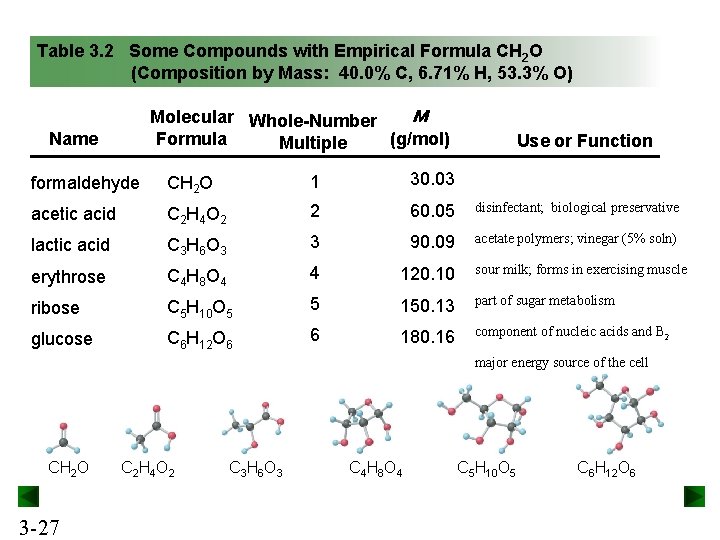
Table 3. 2 Some Compounds with Empirical Formula CH 2 O (Composition by Mass: 40. 0% C, 6. 71% H, 53. 3% O) M Molecular Whole-Number Formula (g/mol) Multiple Name Use or Function formaldehyde CH 2 O 1 30. 03 acetic acid C 2 H 4 O 2 2 60. 05 disinfectant; biological preservative lactic acid C 3 H 6 O 3 3 90. 09 acetate polymers; vinegar (5% soln) erythrose C 4 H 8 O 4 4 120. 10 sour milk; forms in exercising muscle ribose C 5 H 10 O 5 5 150. 13 part of sugar metabolism glucose C 6 H 12 O 6 6 180. 16 component of nucleic acids and B 2 major energy source of the cell CH 2 O 3 -27 C 2 H 4 O 2 C 3 H 6 O 3 C 4 H 8 O 4 C 5 H 10 O 5 C 6 H 12 O 6
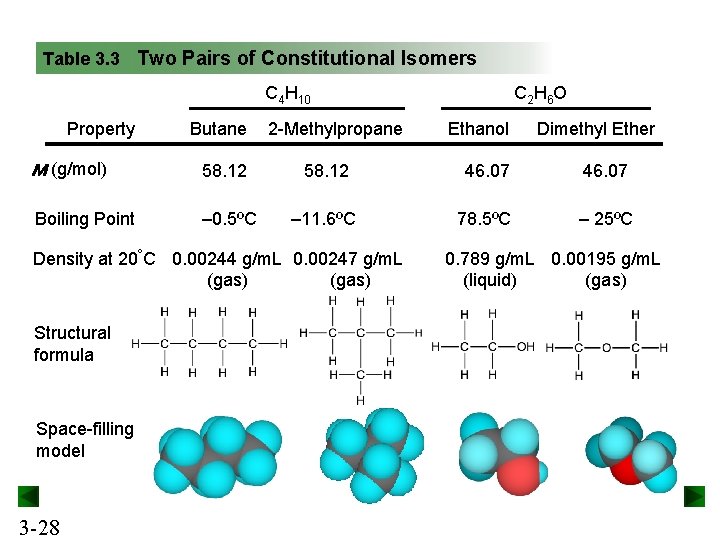
Table 3. 3 Two Pairs of Constitutional Isomers C 4 H 10 Property Butane 2 -Methylpropane C 2 H 6 O Ethanol Dimethyl Ether M (g/mol) 58. 12 46. 07 Boiling Point – 0. 5ºC – 11. 6ºC 78. 5ºC – 25ºC Density at 20°C 0. 00244 g/m. L 0. 00247 g/m. L (gas) Structural formula Space-filling model 3 -28 0. 789 g/m. L 0. 00195 g/m. L (liquid) (gas)
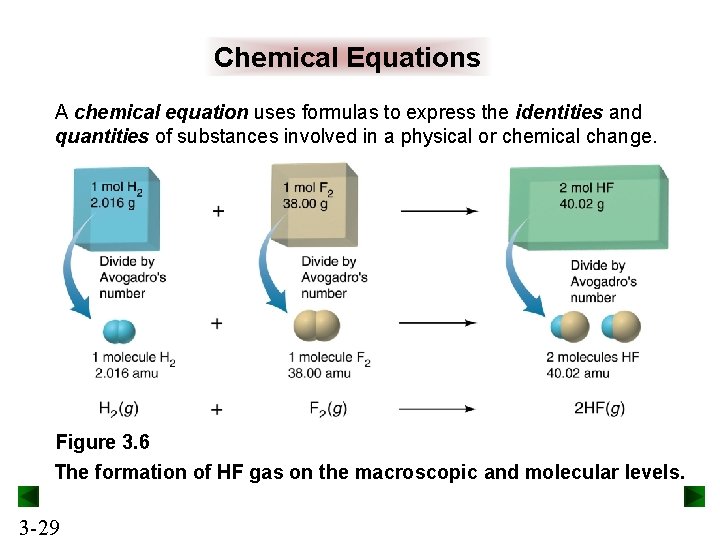
Chemical Equations A chemical equation uses formulas to express the identities and quantities of substances involved in a physical or chemical change. Figure 3. 6 The formation of HF gas on the macroscopic and molecular levels. 3 -29
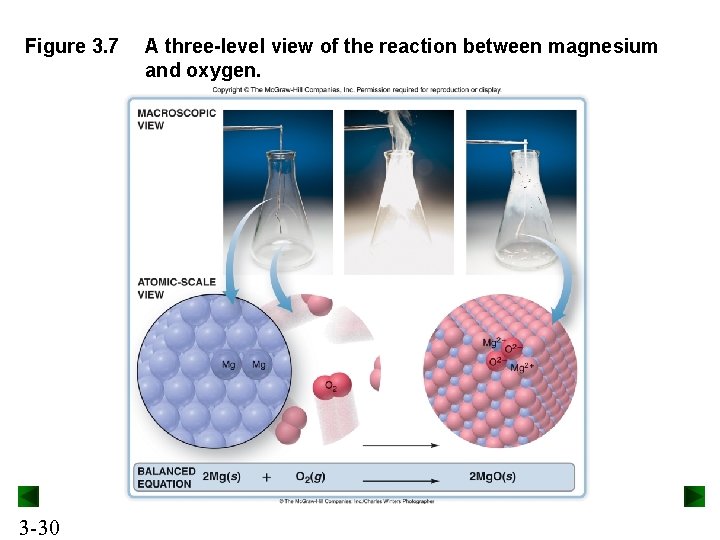
Figure 3. 7 3 -30 A three-level view of the reaction between magnesium and oxygen.
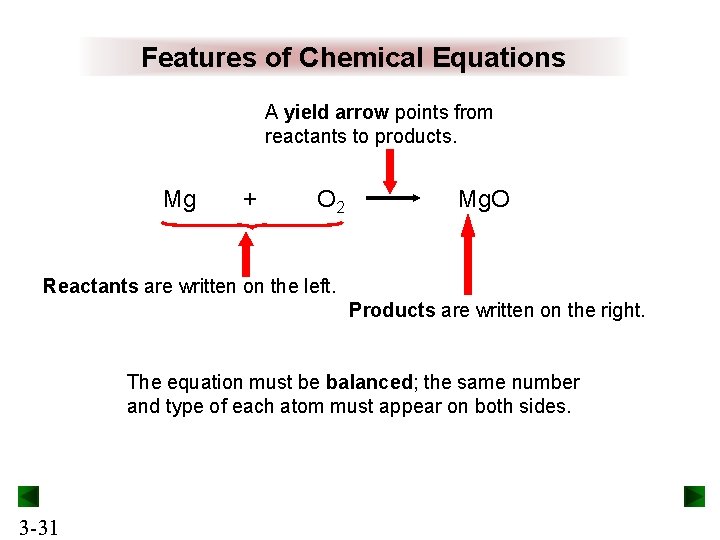
Features of Chemical Equations A yield arrow points from reactants to products. Mg + O 2 Mg. O Reactants are written on the left. Products are written on the right. The equation must be balanced; the same number and type of each atom must appear on both sides. 3 -31
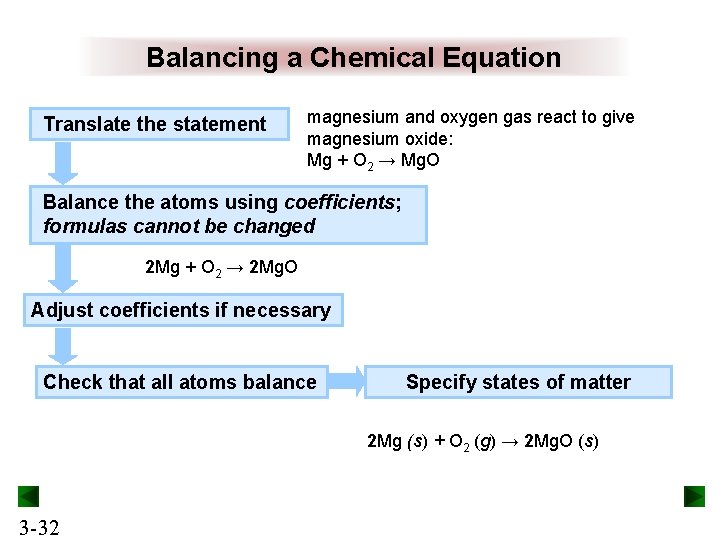
Balancing a Chemical Equation Translate the statement magnesium and oxygen gas react to give magnesium oxide: Mg + O 2 → Mg. O Balance the atoms using coefficients; formulas cannot be changed 2 Mg + O 2 → 2 Mg. O Adjust coefficients if necessary Check that all atoms balance Specify states of matter 2 Mg (s) + O 2 (g) → 2 Mg. O (s) 3 -32
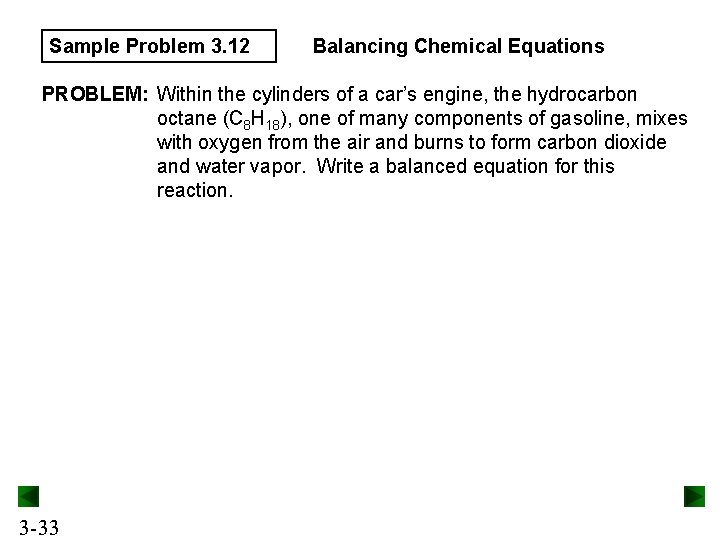
Sample Problem 3. 12 Balancing Chemical Equations PROBLEM: Within the cylinders of a car’s engine, the hydrocarbon octane (C 8 H 18), one of many components of gasoline, mixes with oxygen from the air and burns to form carbon dioxide and water vapor. Write a balanced equation for this reaction. 3 -33
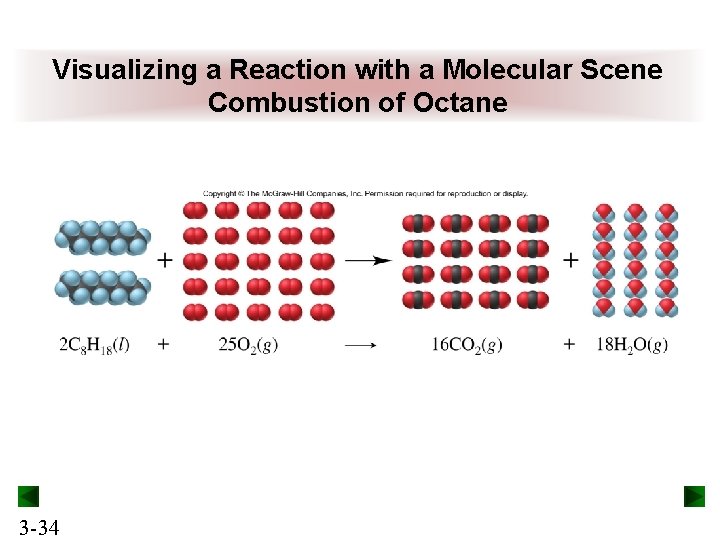
Visualizing a Reaction with a Molecular Scene Combustion of Octane 3 -34
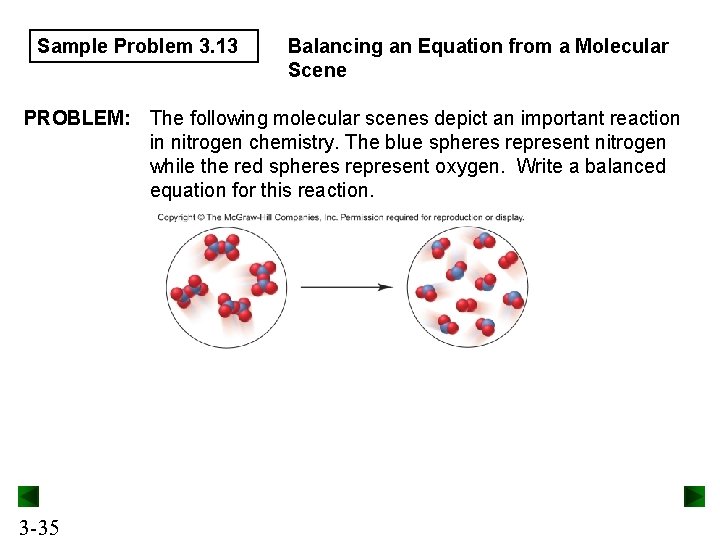
Sample Problem 3. 13 Balancing an Equation from a Molecular Scene PROBLEM: The following molecular scenes depict an important reaction in nitrogen chemistry. The blue spheres represent nitrogen while the red spheres represent oxygen. Write a balanced equation for this reaction. 3 -35
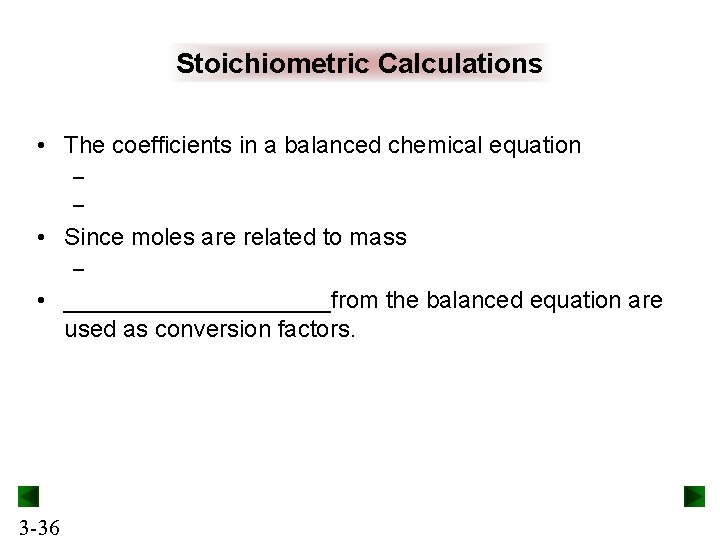
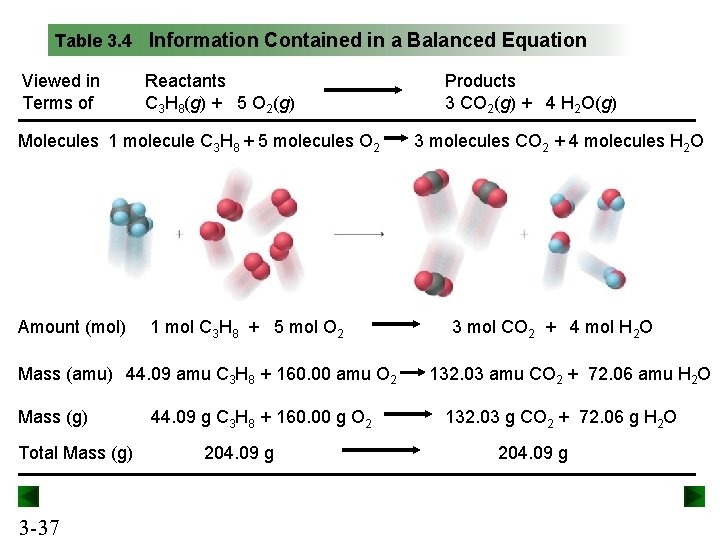
Stoichiometric Calculations • The coefficients in a balanced chemical equation – – • Since moles are related to mass – • __________from the balanced equation are used as conversion factors. 3 -36
Table 3. 4 Information Contained in a Balanced Equation Viewed in Terms of Reactants C 3 H 8(g) + 5 O 2(g) Molecules 1 molecule C 3 H 8 + 5 molecules O 2 Amount (mol) 1 mol C 3 H 8 + 5 mol O 2 Mass (amu) 44. 09 amu C 3 H 8 + 160. 00 amu O 2 Mass (g) Total Mass (g) 3 -37 44. 09 g C 3 H 8 + 160. 00 g O 2 204. 09 g Products 3 CO 2(g) + 4 H 2 O(g) 3 molecules CO 2 + 4 molecules H 2 O 3 mol CO 2 + 4 mol H 2 O 132. 03 amu CO 2 + 72. 06 amu H 2 O 132. 03 g CO 2 + 72. 06 g H 2 O 204. 09 g
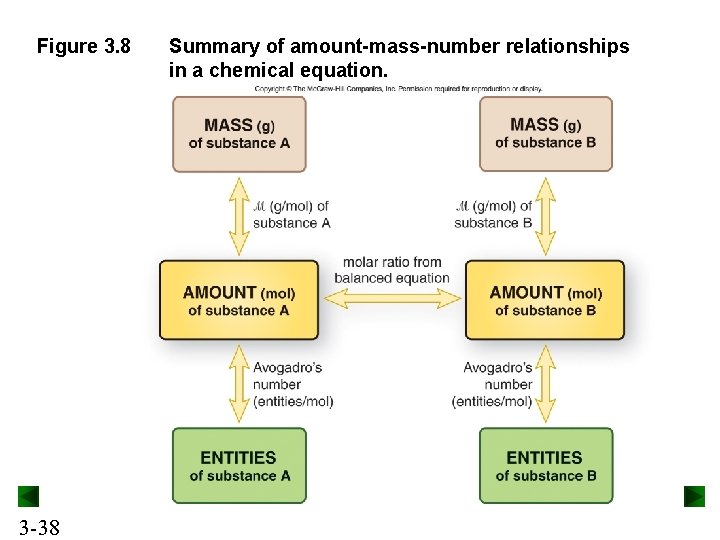
Figure 3. 8 3 -38 Summary of amount-mass-number relationships in a chemical equation.
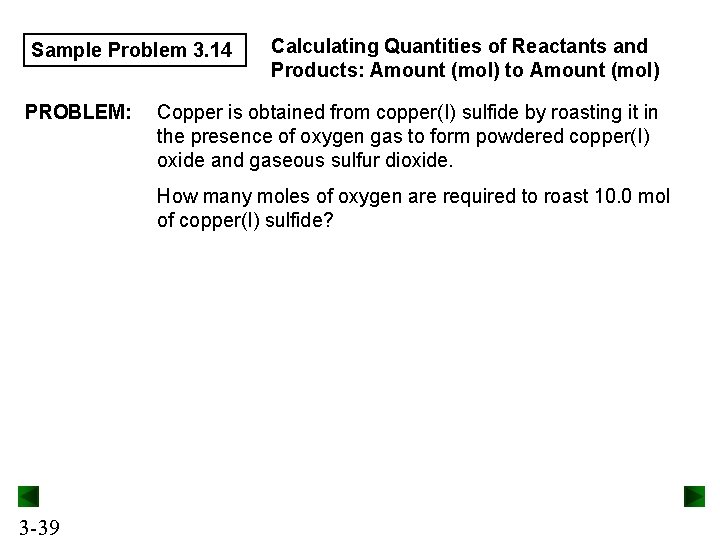
Sample Problem 3. 14 PROBLEM: Calculating Quantities of Reactants and Products: Amount (mol) to Amount (mol) Copper is obtained from copper(I) sulfide by roasting it in the presence of oxygen gas to form powdered copper(I) oxide and gaseous sulfur dioxide. How many moles of oxygen are required to roast 10. 0 mol of copper(I) sulfide? 3 -39
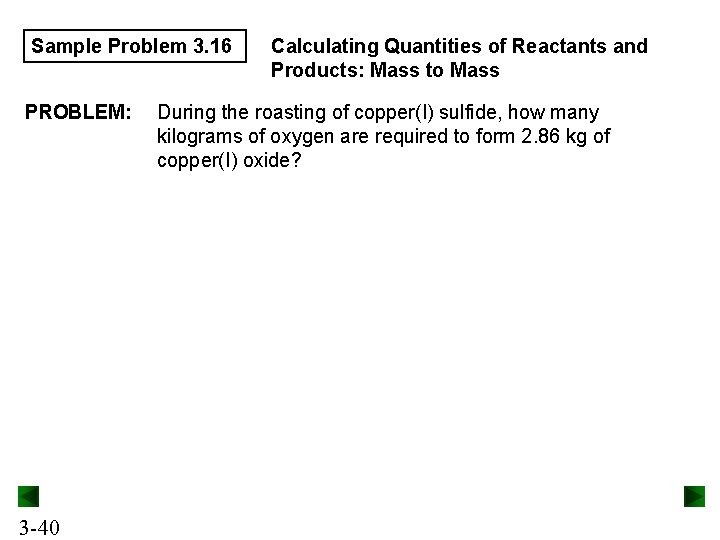
Sample Problem 3. 16 PROBLEM: 3 -40 Calculating Quantities of Reactants and Products: Mass to Mass During the roasting of copper(I) sulfide, how many kilograms of oxygen are required to form 2. 86 kg of copper(I) oxide?
Reactions in Sequence • Reactions often occur in sequence. • The product of one reaction becomes a reactant in the next. • An overall reaction is written by combining the reactions; – any substance that forms in one reaction and reacts in the next can be eliminated. 3 -41
Sample Problem 3. 17 Writing an Overall Equation for a Reaction Sequence PROBLEM: Roasting is the first step in extracting copper from chalcocite, the ore used in the previous problem. In the next step, copper(I) oxide reacts with powdered carbon to yield copper metal and carbon monoxide gas. Write a balanced overall equation for the two-step process. 3 -42
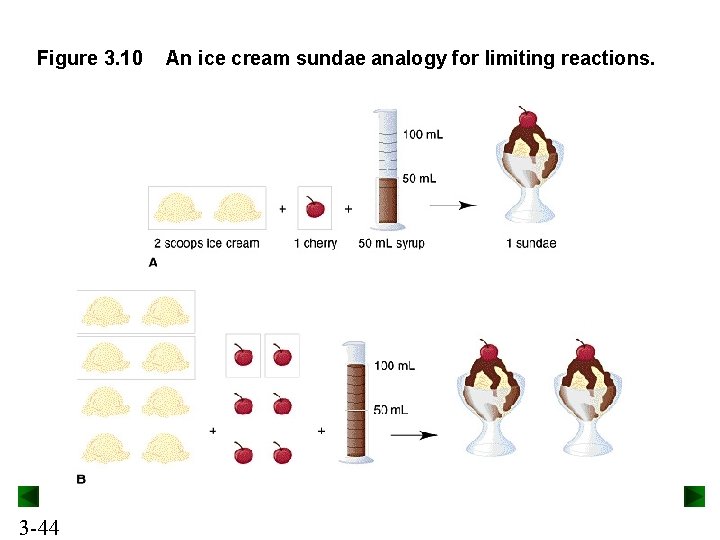
Limiting Reactants • So far we have assumed that reactants are present in the correct amounts to react completely. • In reality, one reactant may limit the amount of product that can form. • ___________will be completely used up in the reaction. • The reactant that is not limiting is in ______– some of this reactant will be left over. 3 -43
Figure 3. 10 3 -44 An ice cream sundae analogy for limiting reactions.
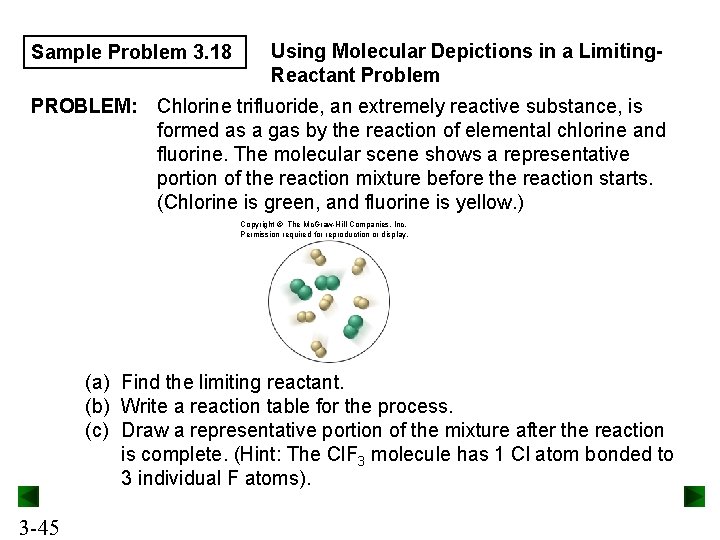
Sample Problem 3. 18 Using Molecular Depictions in a Limiting. Reactant Problem PROBLEM: Chlorine trifluoride, an extremely reactive substance, is formed as a gas by the reaction of elemental chlorine and fluorine. The molecular scene shows a representative portion of the reaction mixture before the reaction starts. (Chlorine is green, and fluorine is yellow. ) Copyright © The Mc. Graw-Hill Companies, Inc. Permission required for reproduction or display. (a) Find the limiting reactant. (b) Write a reaction table for the process. (c) Draw a representative portion of the mixture after the reaction is complete. (Hint: The Cl. F 3 molecule has 1 Cl atom bonded to 3 individual F atoms). 3 -45
3 -46
Calculating Quantities in a Limiting. Reactant Problem: Amount to Amount PROBLEM: In another preparation of Cl. F 3, 0. 750 mol of Cl 2 reacts with 3. 00 mol of F 2. Sample Problem 3. 19 (a) Find the limiting reactant. (b) Write a reaction table. 3 -47
Sample Problem 3. 20 Calculating Quantities in a Limiting. Reactant Problem: Mass to Mass PROBLEM: A fuel mixture used in the early days of rocketry consisted of two liquids, hydrazine (N 2 H 4) and dinitrogen tetraoxide (N 2 O 4), which ignite on contact to form nitrogen gas and water vapor. (a) How many grams of nitrogen gas form when 1. 00 x 102 g of N 2 H 4 and 2. 00 x 102 g of N 2 O 4 are mixed? (b) Write a reaction table for this process. 3 -48
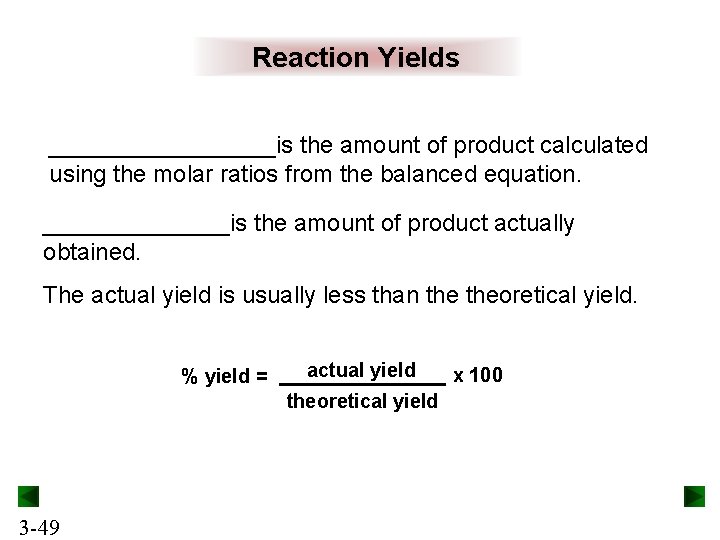
Reaction Yields _________is the amount of product calculated using the molar ratios from the balanced equation. _______is the amount of product actually obtained. The actual yield is usually less than theoretical yield. % yield = actual yield theoretical yield 3 -49 x 100
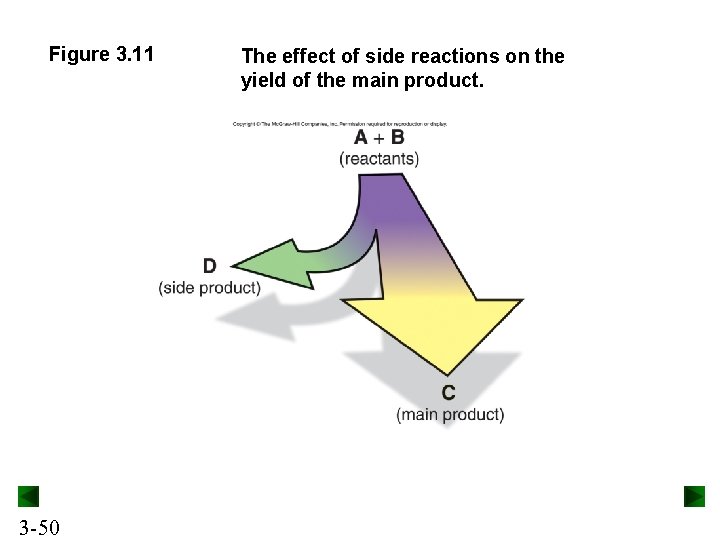
Figure 3. 11 3 -50 The effect of side reactions on the yield of the main product.
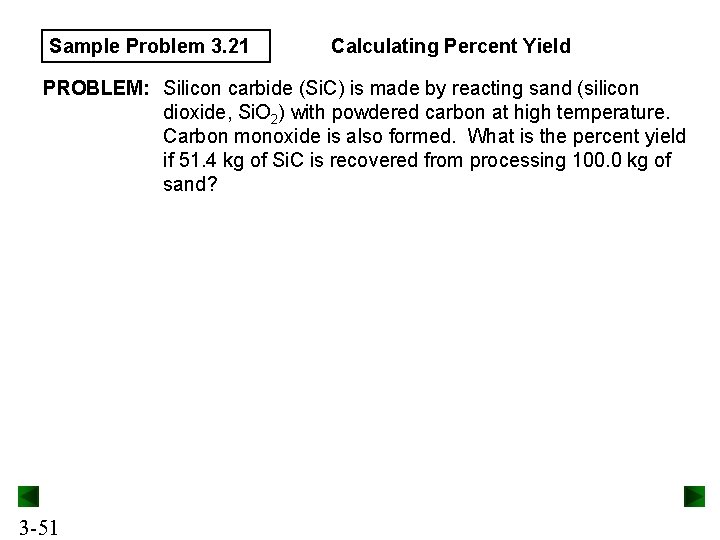
Sample Problem 3. 21 Calculating Percent Yield PROBLEM: Silicon carbide (Si. C) is made by reacting sand (silicon dioxide, Si. O 2) with powdered carbon at high temperature. Carbon monoxide is also formed. What is the percent yield if 51. 4 kg of Si. C is recovered from processing 100. 0 kg of sand? 3 -51