
Lecture Pipelining Extensions Static ILP Topics control hazards






- Slides: 27
Lecture: Pipelining Extensions, Static ILP • Topics: control hazards, multi-cycle instructions, pipelining equations, loop unrolling 1
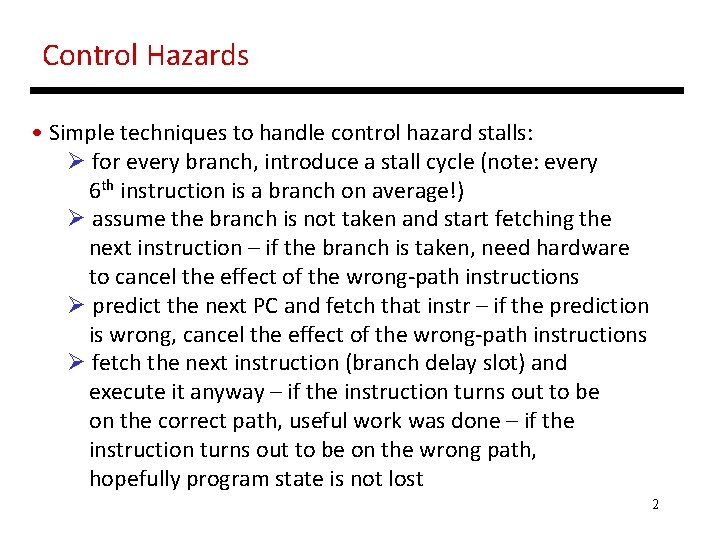
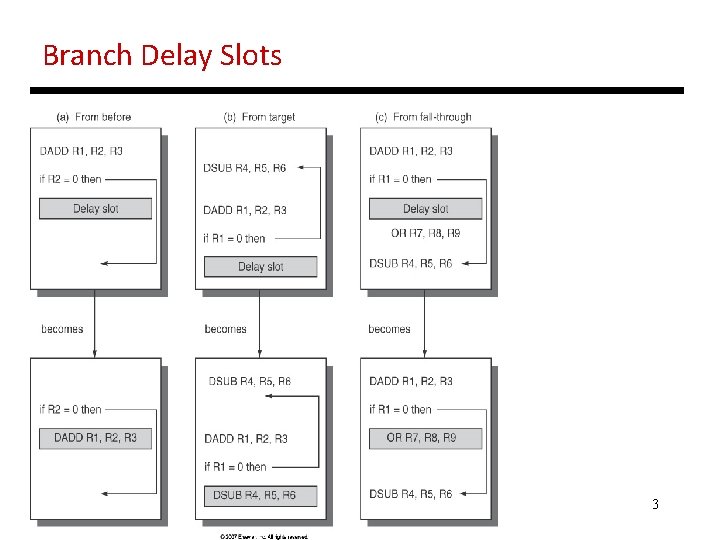
Control Hazards • Simple techniques to handle control hazard stalls: Ø for every branch, introduce a stall cycle (note: every 6 th instruction is a branch on average!) Ø assume the branch is not taken and start fetching the next instruction – if the branch is taken, need hardware to cancel the effect of the wrong-path instructions Ø predict the next PC and fetch that instr – if the prediction is wrong, cancel the effect of the wrong-path instructions Ø fetch the next instruction (branch delay slot) and execute it anyway – if the instruction turns out to be on the correct path, useful work was done – if the instruction turns out to be on the wrong path, hopefully program state is not lost 2
Branch Delay Slots 3
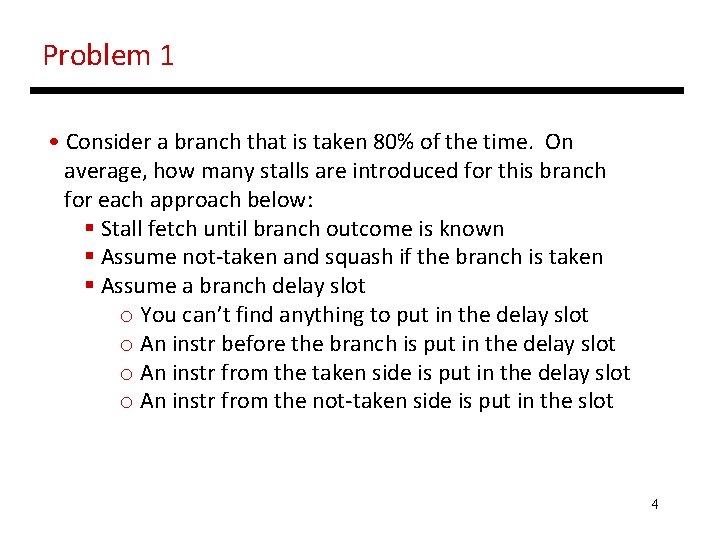
Problem 1 • Consider a branch that is taken 80% of the time. On average, how many stalls are introduced for this branch for each approach below: § Stall fetch until branch outcome is known § Assume not-taken and squash if the branch is taken § Assume a branch delay slot o You can’t find anything to put in the delay slot o An instr before the branch is put in the delay slot o An instr from the taken side is put in the delay slot o An instr from the not-taken side is put in the slot 4
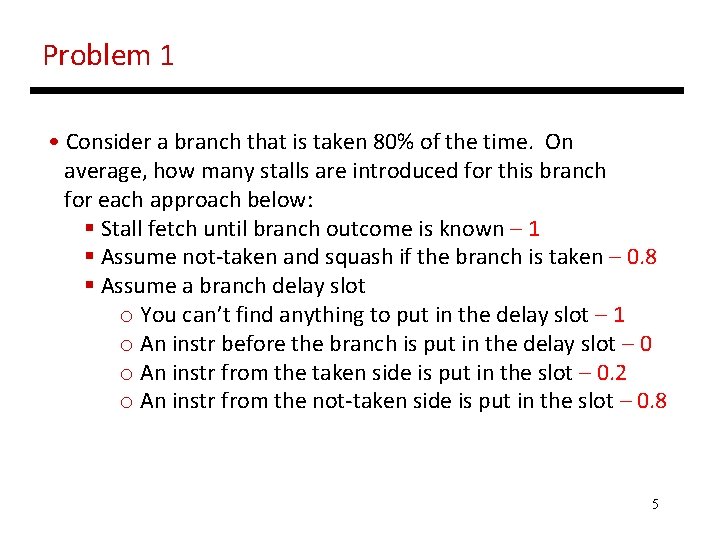
Problem 1 • Consider a branch that is taken 80% of the time. On average, how many stalls are introduced for this branch for each approach below: § Stall fetch until branch outcome is known – 1 § Assume not-taken and squash if the branch is taken – 0. 8 § Assume a branch delay slot o You can’t find anything to put in the delay slot – 1 o An instr before the branch is put in the delay slot – 0 o An instr from the taken side is put in the slot – 0. 2 o An instr from the not-taken side is put in the slot – 0. 8 5
Multicycle Instructions 6
Effects of Multicycle Instructions • Potentially multiple writes to the register file in a cycle • Frequent RAW hazards • WAW hazards (WAR hazards not possible) • Imprecise exceptions because of o-o-o instr completion Note: Can also increase the “width” of the processor: handle multiple instructions at the same time: for example, fetch two instructions, read registers for both, execute both, etc. 7
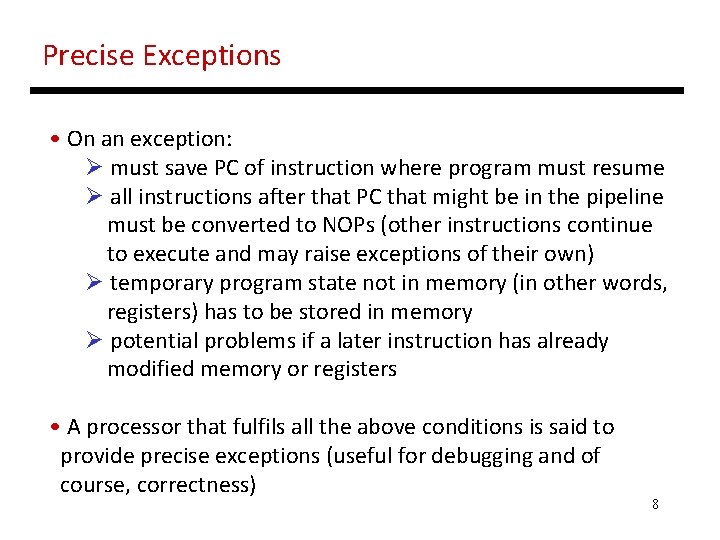
Precise Exceptions • On an exception: Ø must save PC of instruction where program must resume Ø all instructions after that PC that might be in the pipeline must be converted to NOPs (other instructions continue to execute and may raise exceptions of their own) Ø temporary program state not in memory (in other words, registers) has to be stored in memory Ø potential problems if a later instruction has already modified memory or registers • A processor that fulfils all the above conditions is said to provide precise exceptions (useful for debugging and of course, correctness) 8
Dealing with these Effects • Multiple writes to the register file: increase the number of ports, stall one of the writers during ID, stall one of the writers during WB (the stall will propagate) • WAW hazards: detect the hazard during ID and stall the later instruction • Imprecise exceptions: buffer the results if they complete early or save more pipeline state so that you can return to exactly the same state that you left at 9
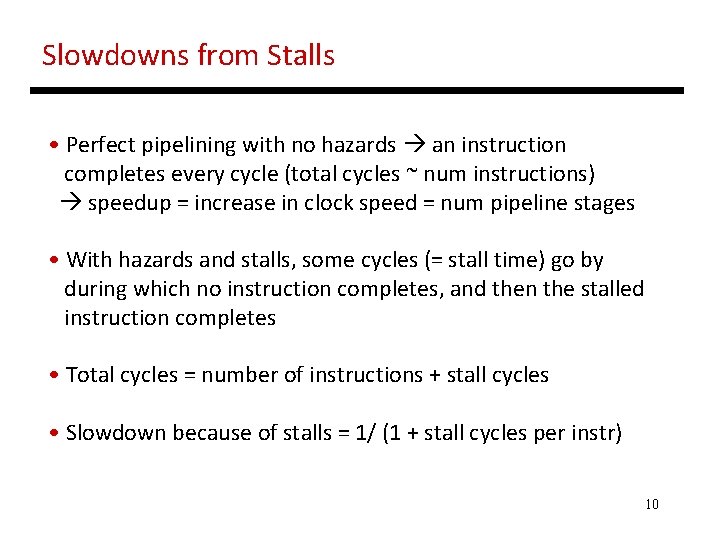
Slowdowns from Stalls • Perfect pipelining with no hazards an instruction completes every cycle (total cycles ~ num instructions) speedup = increase in clock speed = num pipeline stages • With hazards and stalls, some cycles (= stall time) go by during which no instruction completes, and then the stalled instruction completes • Total cycles = number of instructions + stall cycles • Slowdown because of stalls = 1/ (1 + stall cycles per instr) 10
Pipelining Limits Gap between indep instrs: T + Tovh Gap between dep instrs: T + Tovh A B C D E F Gap between indep instrs: T/3 + Tovh Gap between dep instrs: T + 3 Tovh Gap between indep instrs: T/6 + Tovh Gap between dep instrs: T + 6 Tovh Assume that there is a dependence where the final result of the first instruction is required before starting the second instruction 11
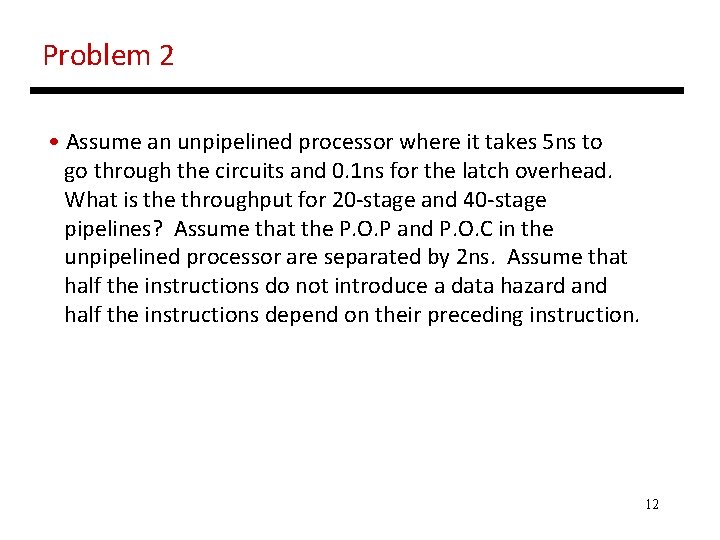
Problem 2 • Assume an unpipelined processor where it takes 5 ns to go through the circuits and 0. 1 ns for the latch overhead. What is the throughput for 20 -stage and 40 -stage pipelines? Assume that the P. O. P and P. O. C in the unpipelined processor are separated by 2 ns. Assume that half the instructions do not introduce a data hazard and half the instructions depend on their preceding instruction. 12
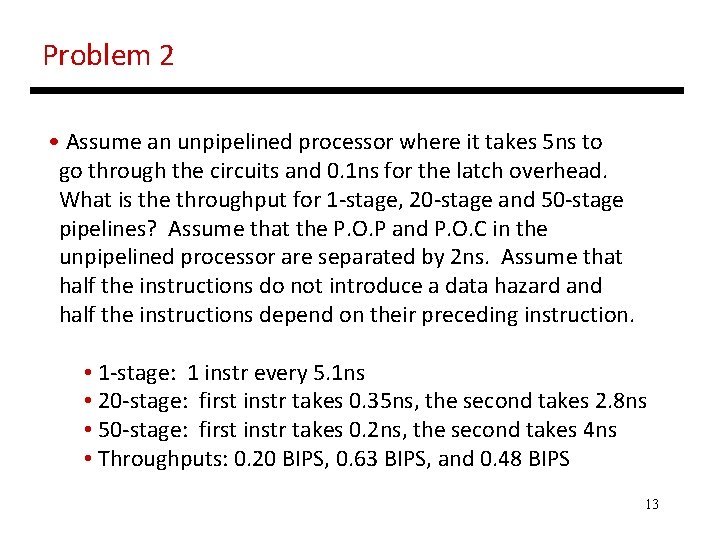
Problem 2 • Assume an unpipelined processor where it takes 5 ns to go through the circuits and 0. 1 ns for the latch overhead. What is the throughput for 1 -stage, 20 -stage and 50 -stage pipelines? Assume that the P. O. P and P. O. C in the unpipelined processor are separated by 2 ns. Assume that half the instructions do not introduce a data hazard and half the instructions depend on their preceding instruction. • 1 -stage: 1 instr every 5. 1 ns • 20 -stage: first instr takes 0. 35 ns, the second takes 2. 8 ns • 50 -stage: first instr takes 0. 2 ns, the second takes 4 ns • Throughputs: 0. 20 BIPS, 0. 63 BIPS, and 0. 48 BIPS 13
ILP • Instruction-level parallelism: overlap among instructions: pipelining or multiple instruction execution • What determines the degree of ILP? Ø dependences: property of the program Ø hazards: property of the pipeline 14
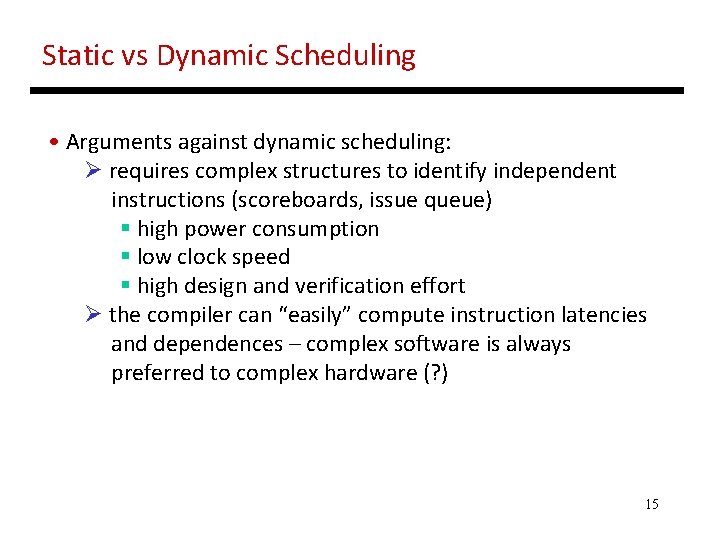
Static vs Dynamic Scheduling • Arguments against dynamic scheduling: Ø requires complex structures to identify independent instructions (scoreboards, issue queue) § high power consumption § low clock speed § high design and verification effort Ø the compiler can “easily” compute instruction latencies and dependences – complex software is always preferred to complex hardware (? ) 15
Loop Scheduling • The compiler’s job is to minimize stalls • Focus on loops: account for most cycles, relatively easy to analyze and optimize 16
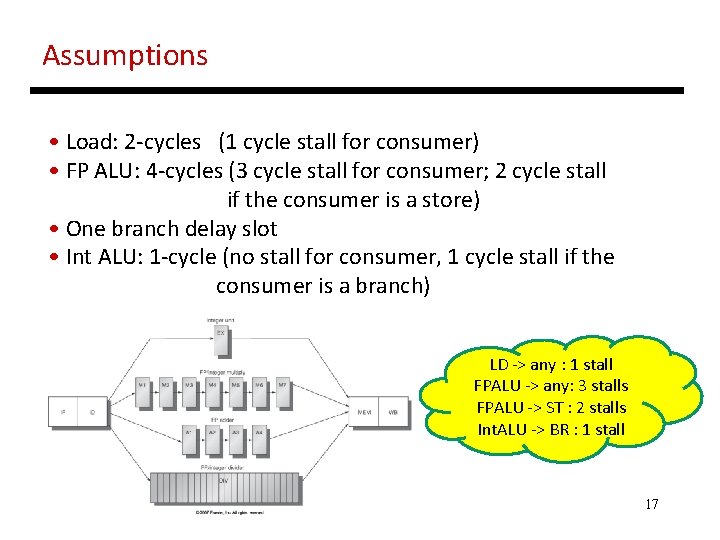
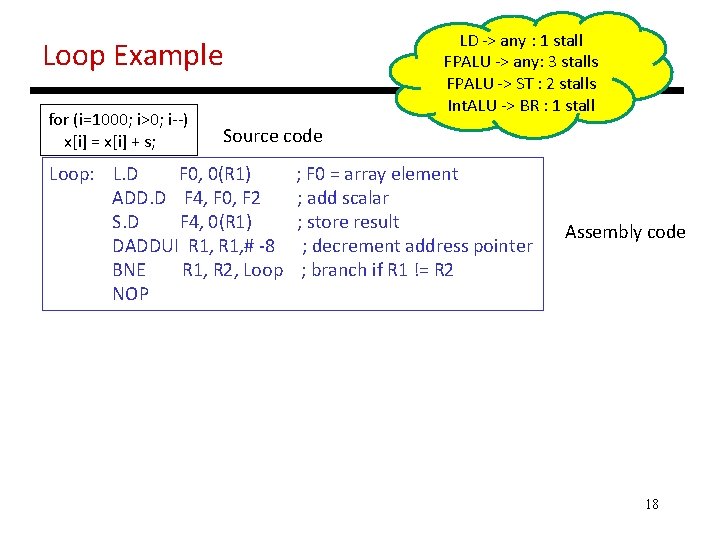
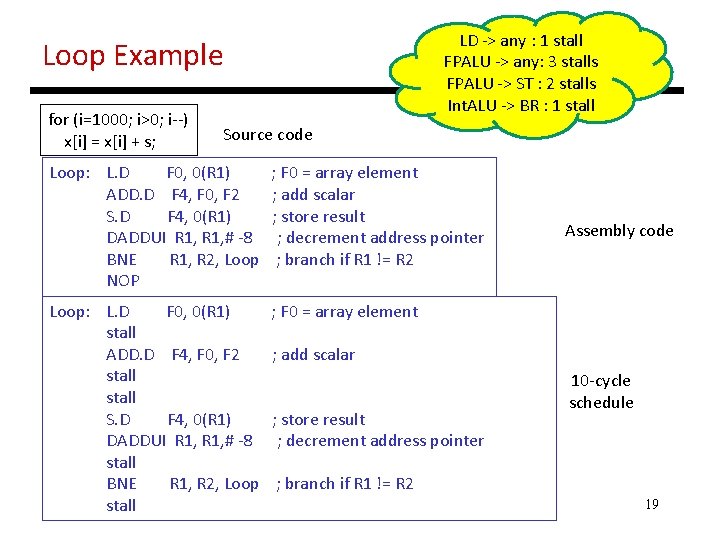
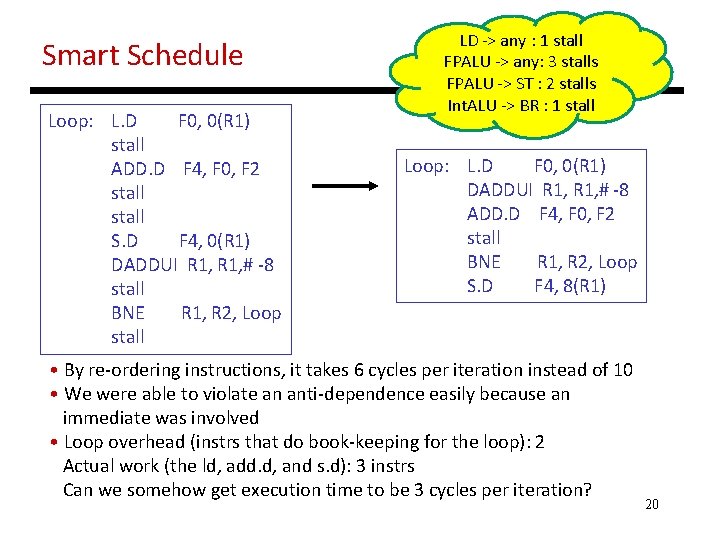
Assumptions • Load: 2 -cycles (1 cycle stall for consumer) • FP ALU: 4 -cycles (3 cycle stall for consumer; 2 cycle stall if the consumer is a store) • One branch delay slot • Int ALU: 1 -cycle (no stall for consumer, 1 cycle stall if the consumer is a branch) LD -> any : 1 stall FPALU -> any: 3 stalls FPALU -> ST : 2 stalls Int. ALU -> BR : 1 stall 17
LD -> any : 1 stall FPALU -> any: 3 stalls FPALU -> ST : 2 stalls Int. ALU -> BR : 1 stall Loop Example for (i=1000; i>0; i--) x[i] = x[i] + s; Source code Loop: L. D F 0, 0(R 1) ADD. D F 4, F 0, F 2 S. D F 4, 0(R 1) DADDUI R 1, # -8 BNE R 1, R 2, Loop NOP ; F 0 = array element ; add scalar ; store result ; decrement address pointer ; branch if R 1 != R 2 Assembly code 18
LD -> any : 1 stall FPALU -> any: 3 stalls FPALU -> ST : 2 stalls Int. ALU -> BR : 1 stall Loop Example for (i=1000; i>0; i--) x[i] = x[i] + s; Source code Loop: L. D F 0, 0(R 1) ADD. D F 4, F 0, F 2 S. D F 4, 0(R 1) DADDUI R 1, # -8 BNE R 1, R 2, Loop NOP ; F 0 = array element ; add scalar ; store result ; decrement address pointer ; branch if R 1 != R 2 Loop: L. D F 0, 0(R 1) stall ADD. D F 4, F 0, F 2 stall S. D F 4, 0(R 1) DADDUI R 1, # -8 stall BNE R 1, R 2, Loop stall ; F 0 = array element Assembly code ; add scalar ; store result ; decrement address pointer 10 -cycle schedule ; branch if R 1 != R 2 19
Smart Schedule Loop: L. D F 0, 0(R 1) stall ADD. D F 4, F 0, F 2 stall S. D F 4, 0(R 1) DADDUI R 1, # -8 stall BNE R 1, R 2, Loop stall LD -> any : 1 stall FPALU -> any: 3 stalls FPALU -> ST : 2 stalls Int. ALU -> BR : 1 stall Loop: L. D F 0, 0(R 1) DADDUI R 1, # -8 ADD. D F 4, F 0, F 2 stall BNE R 1, R 2, Loop S. D F 4, 8(R 1) • By re-ordering instructions, it takes 6 cycles per iteration instead of 10 • We were able to violate an anti-dependence easily because an immediate was involved • Loop overhead (instrs that do book-keeping for the loop): 2 Actual work (the ld, add. d, and s. d): 3 instrs Can we somehow get execution time to be 3 cycles per iteration? 20
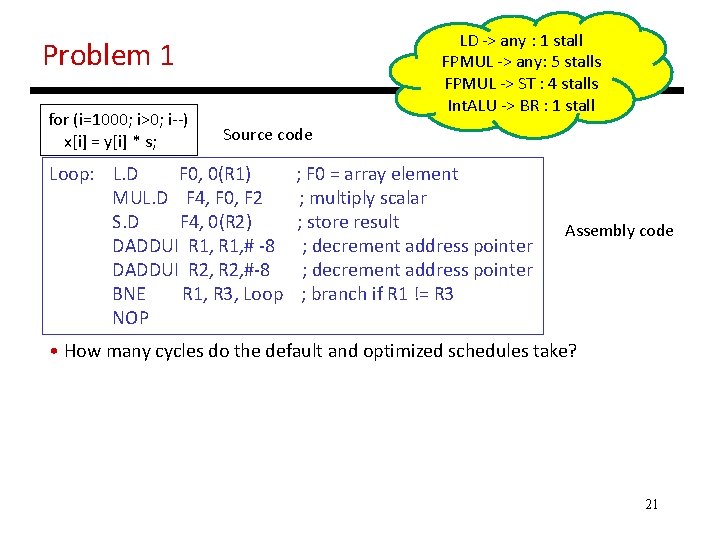
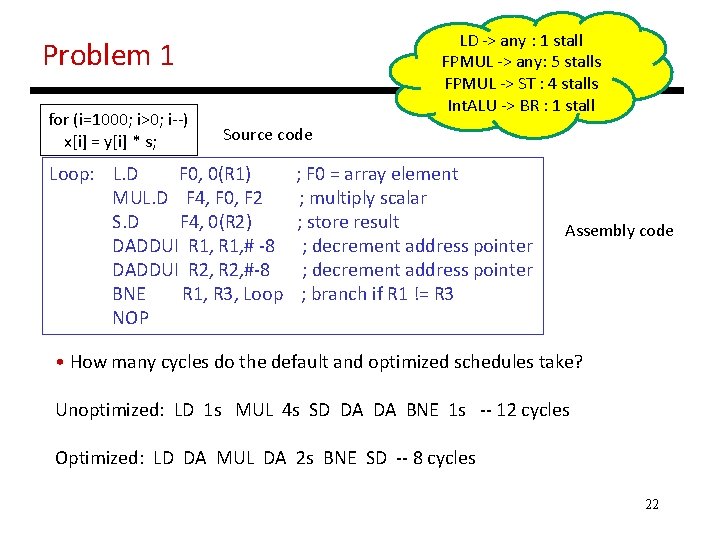
LD -> any : 1 stall FPMUL -> any: 5 stalls FPMUL -> ST : 4 stalls Int. ALU -> BR : 1 stall Problem 1 for (i=1000; i>0; i--) x[i] = y[i] * s; Source code Loop: L. D F 0, 0(R 1) MUL. D F 4, F 0, F 2 S. D F 4, 0(R 2) DADDUI R 1, # -8 DADDUI R 2, #-8 BNE R 1, R 3, Loop NOP ; F 0 = array element ; multiply scalar ; store result ; decrement address pointer ; branch if R 1 != R 3 Assembly code • How many cycles do the default and optimized schedules take? 21
LD -> any : 1 stall FPMUL -> any: 5 stalls FPMUL -> ST : 4 stalls Int. ALU -> BR : 1 stall Problem 1 for (i=1000; i>0; i--) x[i] = y[i] * s; Source code Loop: L. D F 0, 0(R 1) MUL. D F 4, F 0, F 2 S. D F 4, 0(R 2) DADDUI R 1, # -8 DADDUI R 2, #-8 BNE R 1, R 3, Loop NOP ; F 0 = array element ; multiply scalar ; store result ; decrement address pointer ; branch if R 1 != R 3 Assembly code • How many cycles do the default and optimized schedules take? Unoptimized: LD 1 s MUL 4 s SD DA DA BNE 1 s -- 12 cycles Optimized: LD DA MUL DA 2 s BNE SD -- 8 cycles 22
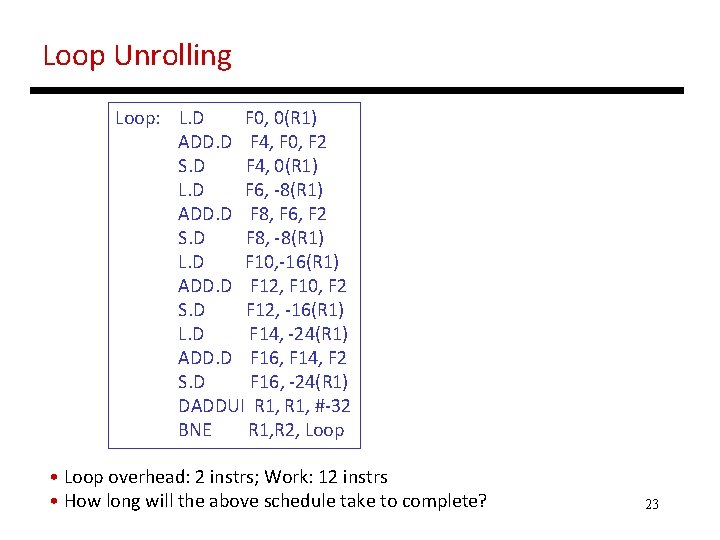
Loop Unrolling Loop: L. D F 0, 0(R 1) ADD. D F 4, F 0, F 2 S. D F 4, 0(R 1) L. D F 6, -8(R 1) ADD. D F 8, F 6, F 2 S. D F 8, -8(R 1) L. D F 10, -16(R 1) ADD. D F 12, F 10, F 2 S. D F 12, -16(R 1) L. D F 14, -24(R 1) ADD. D F 16, F 14, F 2 S. D F 16, -24(R 1) DADDUI R 1, #-32 BNE R 1, R 2, Loop • Loop overhead: 2 instrs; Work: 12 instrs • How long will the above schedule take to complete? 23
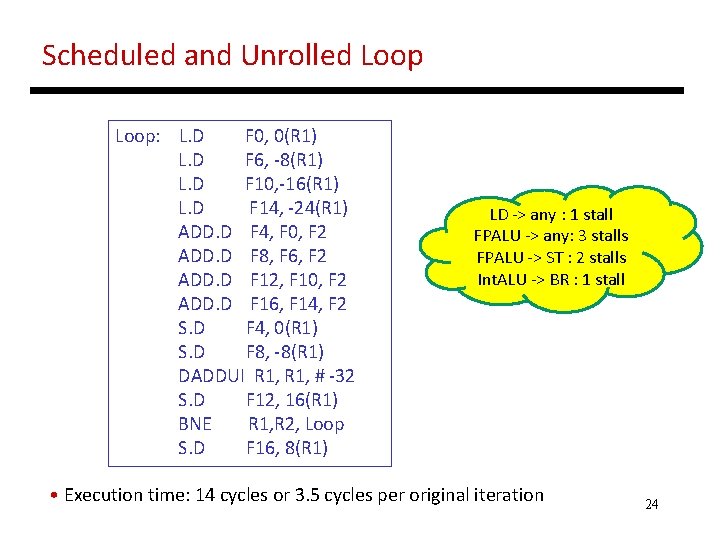
Scheduled and Unrolled Loop: L. D F 0, 0(R 1) L. D F 6, -8(R 1) L. D F 10, -16(R 1) L. D F 14, -24(R 1) ADD. D F 4, F 0, F 2 ADD. D F 8, F 6, F 2 ADD. D F 12, F 10, F 2 ADD. D F 16, F 14, F 2 S. D F 4, 0(R 1) S. D F 8, -8(R 1) DADDUI R 1, # -32 S. D F 12, 16(R 1) BNE R 1, R 2, Loop S. D F 16, 8(R 1) LD -> any : 1 stall FPALU -> any: 3 stalls FPALU -> ST : 2 stalls Int. ALU -> BR : 1 stall • Execution time: 14 cycles or 3. 5 cycles per original iteration 24
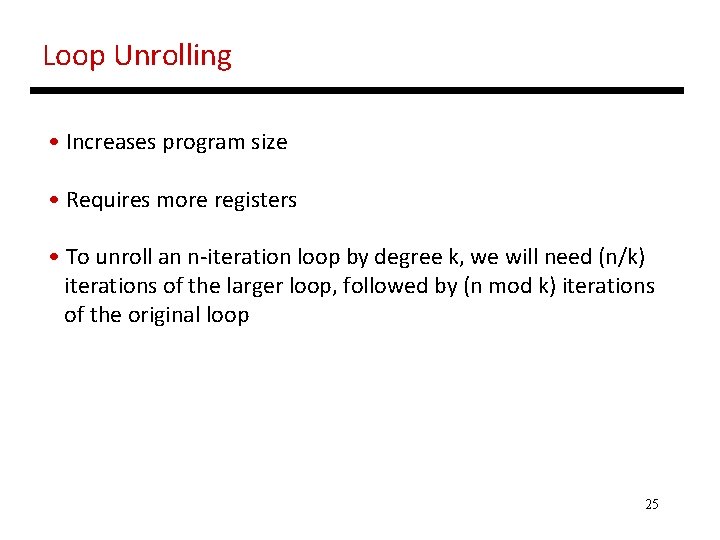
Loop Unrolling • Increases program size • Requires more registers • To unroll an n-iteration loop by degree k, we will need (n/k) iterations of the larger loop, followed by (n mod k) iterations of the original loop 25
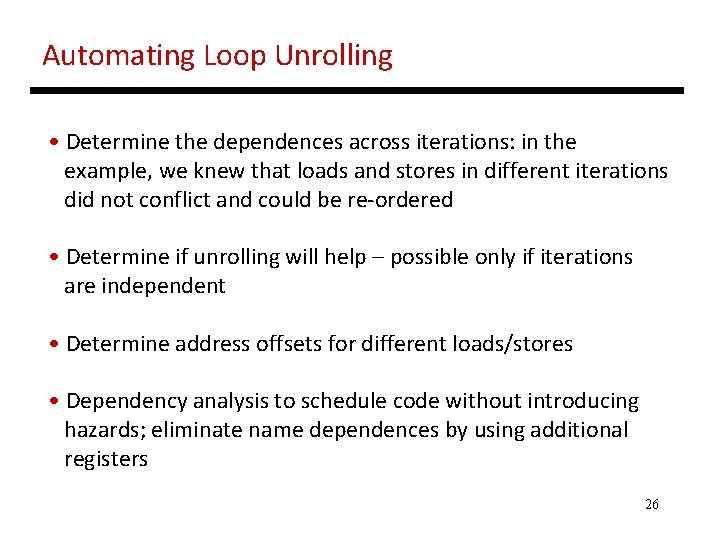
Automating Loop Unrolling • Determine the dependences across iterations: in the example, we knew that loads and stores in different iterations did not conflict and could be re-ordered • Determine if unrolling will help – possible only if iterations are independent • Determine address offsets for different loads/stores • Dependency analysis to schedule code without introducing hazards; eliminate name dependences by using additional registers 26
27