
Lecture outline Nearestneighbor search in low dimensions kdtrees
Lecture outline • Nearest-neighbor search in low dimensions – kd-trees • Nearest-neighbor search in high dimensions – LSH • Applications to data mining
Definition • Given: a set X of n points in Rd • Nearest neighbor: for any query point qєRd return the point xєX minimizing D(x, q) • Intuition: Find the point in X that is the closest to q
Motivation • • Learning: Nearest neighbor rule Databases: Retrieval Data mining: Clustering Donald Knuth in vol. 3 of The Art of Computer Programming called it the post-office problem, referring to the application of assigning a resident to the nearest-post office
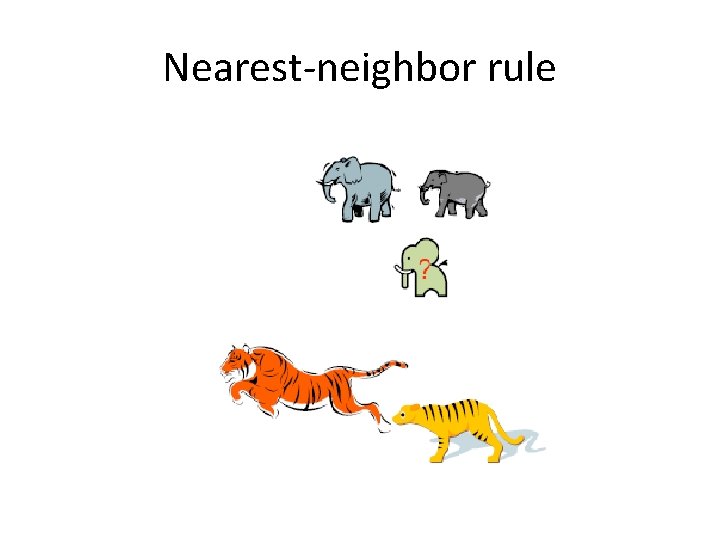
Nearest-neighbor rule
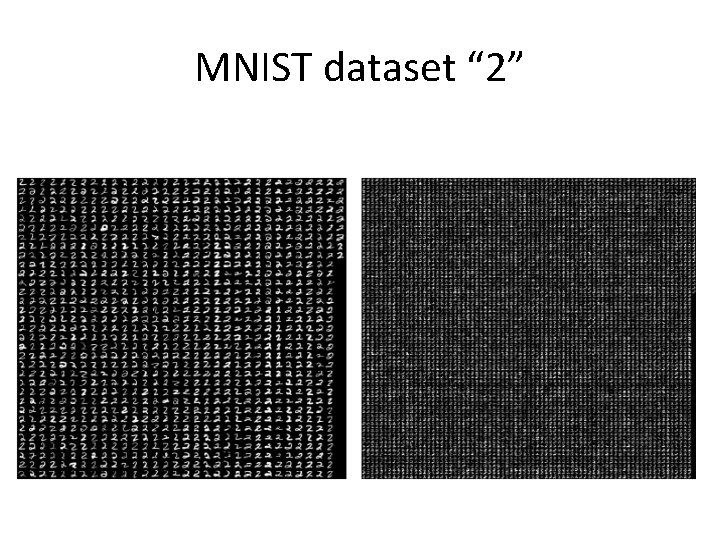
MNIST dataset “ 2”
Methods for computing NN • Linear scan: O(nd) time • This is pretty much all what is known for exact algorithms with theoretical guarantees • In practice: – kd-trees work “well” in “low-medium” dimensions
2 -dimensional kd-trees • A data structure to support range queries in R 2 – Not the most efficient solution in theory – Everyone uses it in practice • Preprocessing time: O(nlogn) • Space complexity: O(n) • Query time: O(n 1/2+k)
2 -dimensional kd-trees • Algorithm: – Choose x or y coordinate (alternate) – Choose the median of the coordinate; this defines a horizontal or vertical line – Recurse on both sides • We get a binary tree: – Size O(n) – Depth O(logn) – Construction time O(nlogn)
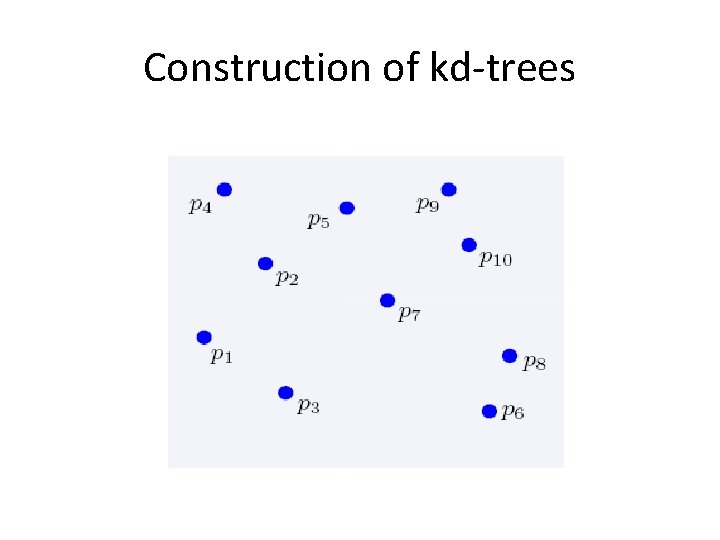
Construction of kd-trees
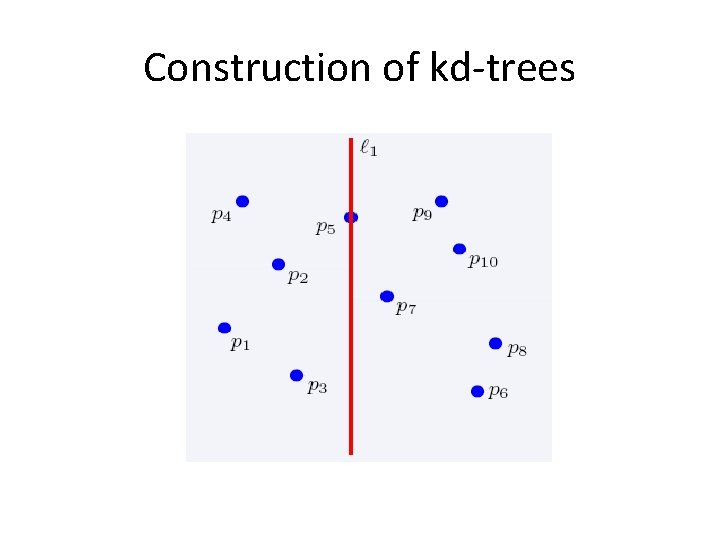
Construction of kd-trees
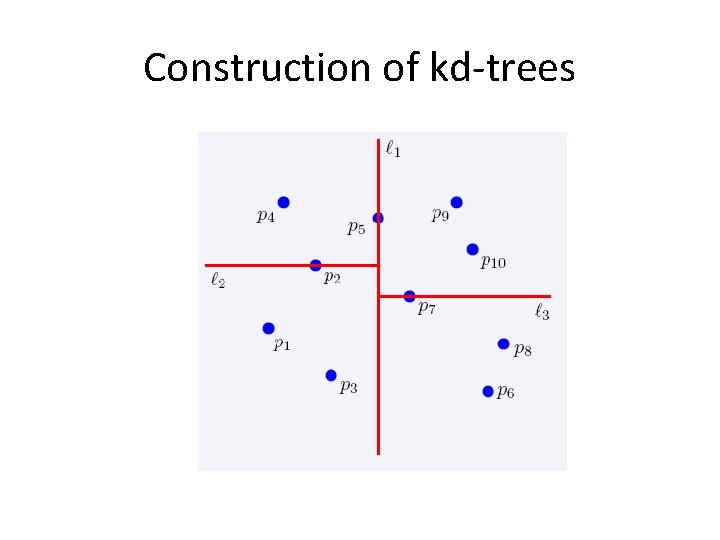
Construction of kd-trees
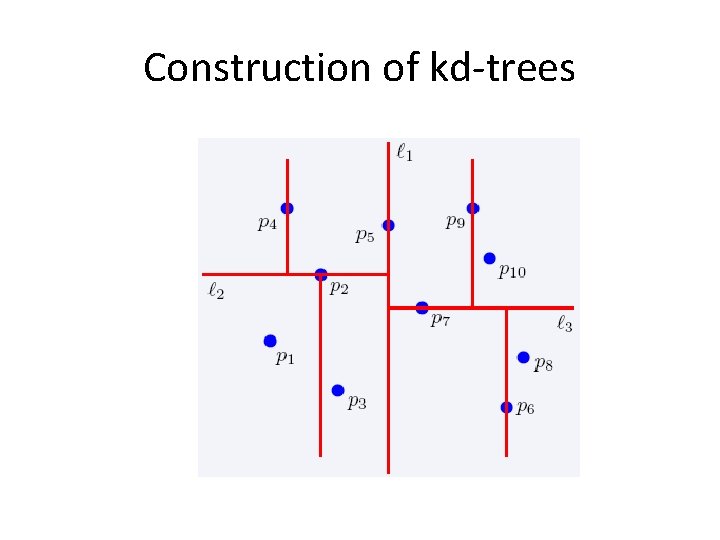
Construction of kd-trees
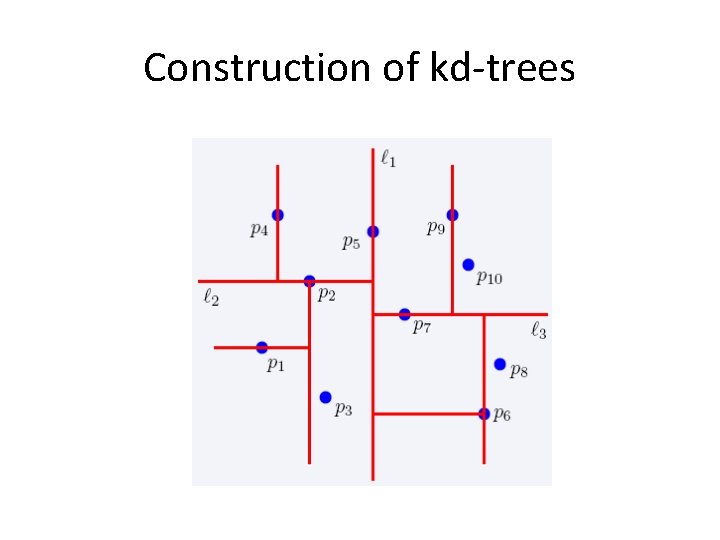
Construction of kd-trees

The complete kd-tree
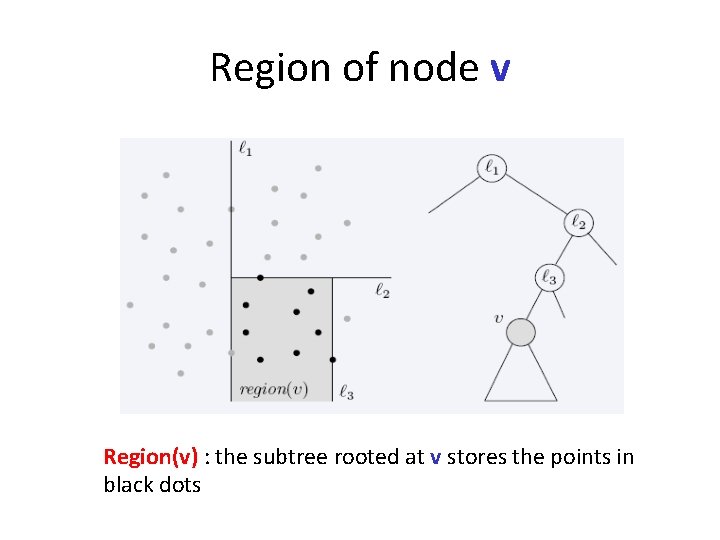
Region of node v Region(v) : the subtree rooted at v stores the points in black dots
Searching in kd-trees • Range-searching in 2 -d – Given a set of n points, build a data structure that for any query rectangle R reports all point in R
kd-tree: range queries • Recursive procedure starting from v = root • Search (v, R) – If v is a leaf, then report the point stored in v if it lies in R – Otherwise, if Reg(v) is contained in R, report all points in the subtree(v) – Otherwise: • If Reg(left(v)) intersects R, then Search(left(v), R) • If Reg(right(v)) intersects R, then Search(right(v), R)
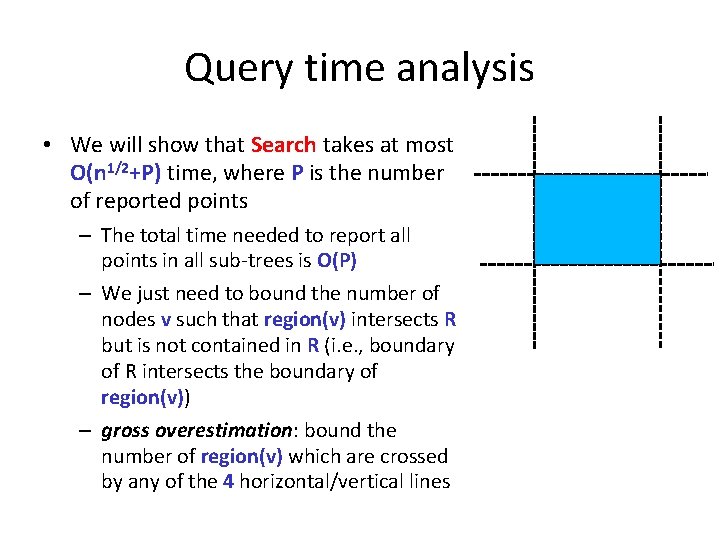
Query time analysis • We will show that Search takes at most O(n 1/2+P) time, where P is the number of reported points – The total time needed to report all points in all sub-trees is O(P) – We just need to bound the number of nodes v such that region(v) intersects R but is not contained in R (i. e. , boundary of R intersects the boundary of region(v)) – gross overestimation: bound the number of region(v) which are crossed by any of the 4 horizontal/vertical lines
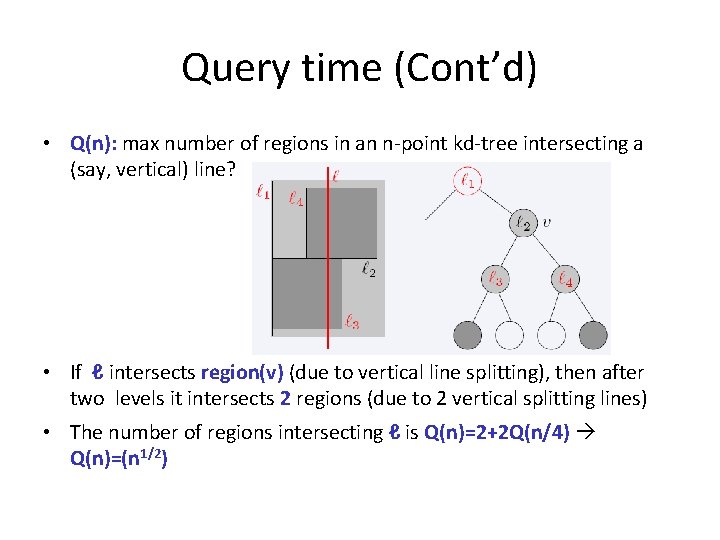
Query time (Cont’d) • Q(n): max number of regions in an n-point kd-tree intersecting a (say, vertical) line? • If ℓ intersects region(v) (due to vertical line splitting), then after two levels it intersects 2 regions (due to 2 vertical splitting lines) • The number of regions intersecting ℓ is Q(n)=2+2 Q(n/4) Q(n)=(n 1/2)
d-dimensional kd-trees • A data structure to support range queries in Rd • Preprocessing time: O(nlogn) • Space complexity: O(n) • Query time: O(n 1 -1/d+k)
Construction of the d-dimensional kd-trees • The construction algorithm is similar as in 2 -d • At the root we split the set of points into two subsets of same size by a hyperplane vertical to x 1 -axis • At the children of the root, the partition is based on the second coordinate: x 2 -coordinate • At depth d, we start all over again by partitioning on the first coordinate • The recursion stops until there is only one point left, which is stored as a leaf
Locality-sensitive hashing (LSH) • Idea: Construct hash functions h: Rd U such that for any pair of points p, q: – If D(p, q)≤r, then Pr[h(p)=h(q)] is high – If D(p, q)≥cr, then Pr[h(p)=h(q)] is small • Then, we can solve the “approximate NN” problem by hashing • LSH is a general framework; for a given D we need to find the right h
Approximate Nearest Neighbor • Given a set of points X in Rd and query point qєRd c-Approximate r-Nearest Neighbor search returns: – Returns p∈P, D(p, q) ≤ r – Returns NO if there is no p’∈X, D(p’, q) ≤ cr
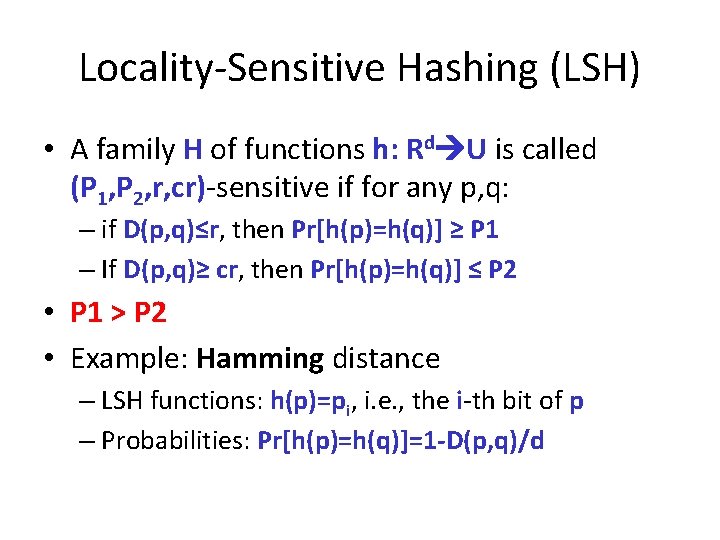
Locality-Sensitive Hashing (LSH) • A family H of functions h: Rd U is called (P 1, P 2, r, cr)-sensitive if for any p, q: – if D(p, q)≤r, then Pr[h(p)=h(q)] ≥ P 1 – If D(p, q)≥ cr, then Pr[h(p)=h(q)] ≤ P 2 • P 1 > P 2 • Example: Hamming distance – LSH functions: h(p)=pi, i. e. , the i-th bit of p – Probabilities: Pr[h(p)=h(q)]=1 -D(p, q)/d
Algorithm -- preprocessing • g(p) = <h 1(p), h 2(p), …, hk(p)> • Preprocessing – Select g 1, g 2, …, g. L – For all pєX hash p to buckets g 1(p), …, g. L(p) – Since the number of possible buckets might be large we only maintain the non empty ones • Running time?
Algorithm -- query • Query q: – Retrieve the points from buckets g 1(q), g 2(q), …, g. L(q) and let points retrieved be x 1, …, x. L • If D(xi, q)≤r report it • Otherwise report that there does not exist such a NN – Answer the query based on the retrieved points – Time O(d. L)
Applications of LSH in data mining • Numerous….
Applications • Find pages with similar sets of words (for clustering or classification) • Find users in Netflix data that watch similar movies • Find movies with similar sets of users • Find images of related things

How would you do it? • Finding very similar items might be computationally demanding task • We can relax our requirement to finding somewhat similar items
Running example: comparing documents • Documents have common text, but no common topic • Easy special cases: – Identical documents – Fully contained documents (letter by letter) • General case: – Many small pieces of one document appear out of order in another. What do we do then?

Finding similar documents • Given a collection of documents, find pairs of documents that have lots of text in common – Identify mirror sites or web pages – Plagiarism – Similar news articles
Key steps • Shingling: convert documents (news articles, emails, etc) to sets • LSH: convert large sets to small signatures, while preserving the similarity • Compare the signatures instead of the actual documents
Shingles • A k-shingle (or k-gram) is a sequence of k characters that appears in a document • If doc = abcab and k=3, then 2 -singles: {ab, bc, ca} • Represent a document by a set of k-shingles
Assumption • Documents that have similar sets of k-shingles are similar: same text appears in the two documents; the position of the text does not matter • What should be the value of k? – What would large or small k mean?
Data model: sets • Data points are represented as sets (i. e. , sets of shingles) • Similar data points have large intersections in their sets – Think of documents and shingles – Customers and products – Users and movies
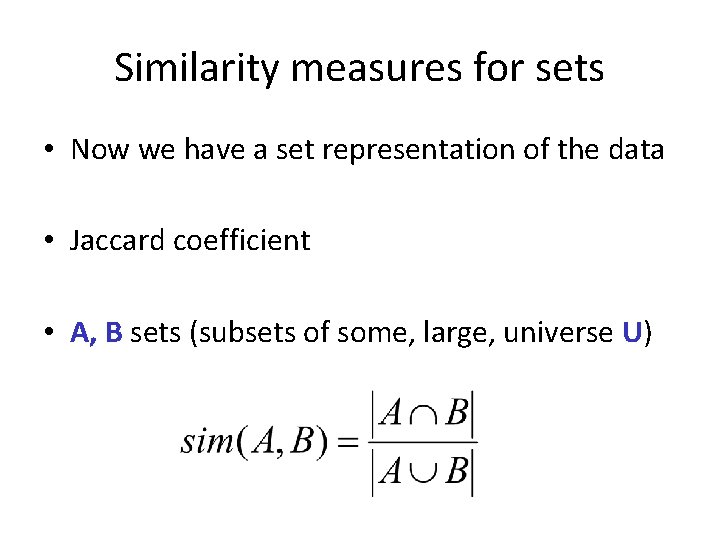
Similarity measures for sets • Now we have a set representation of the data • Jaccard coefficient • A, B sets (subsets of some, large, universe U)
Find similar objects using the Jaccard similarity • Naïve method? • Problems with the naïve method? – There are too many objects – Each object consists of too many sets
Speedingup the naïve method • Represent every object by a signature (summary of the object) • Examine pairs of signatures rather than pairs of objects • Find all similar pairs of signatures • Check point: check that objects with similar signatures are actually similar
Still problems • Comparing large number of signatures with each other may take too much time (although it takes less space) • The method can produce pairs of objects that might not be similar (false positives). The check point needs to be enforced
Creating signatures • For object x, signature of x (sign(x)) is much smaller (in space) than x • For objects x, y it should hold that sim(x, y) is almost the same as sim(sing(x), sign(y))
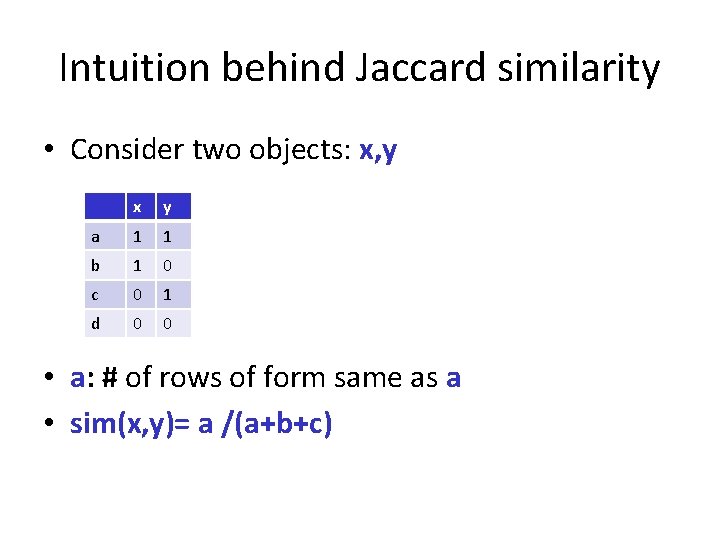
Intuition behind Jaccard similarity • Consider two objects: x, y x y a 1 1 b 1 0 c 0 1 d 0 0 • a: # of rows of form same as a • sim(x, y)= a /(a+b+c)
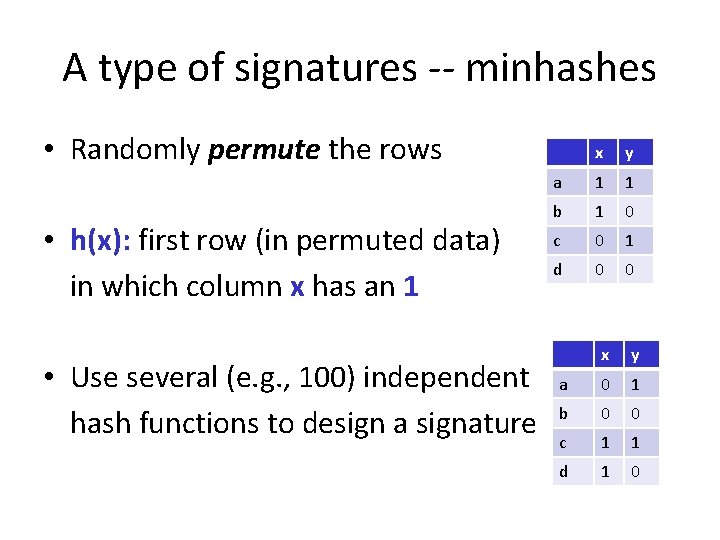
A type of signatures -- minhashes • Randomly permute the rows • h(x): first row (in permuted data) in which column x has an 1 • Use several (e. g. , 100) independent hash functions to design a signature x y a 1 1 b 1 0 c 0 1 d 0 0 x y a 0 1 b 0 0 c 1 1 d 1 0
“Surprising” property • The probability (over all permutations of rows) that h(x)=h(y) is the same as sim(x, y) • Both of them are a/(a+b+c) • So? – The similarity of signatures is the fraction of the hash functions on which they agree
Minhash algorithm • Pick k (e. g. , 100) permutations of the rows • Think of sign(x) as a new vector • Let sign(x)[i]: in the i-th permutation, the index of the first row that has 1 for object x
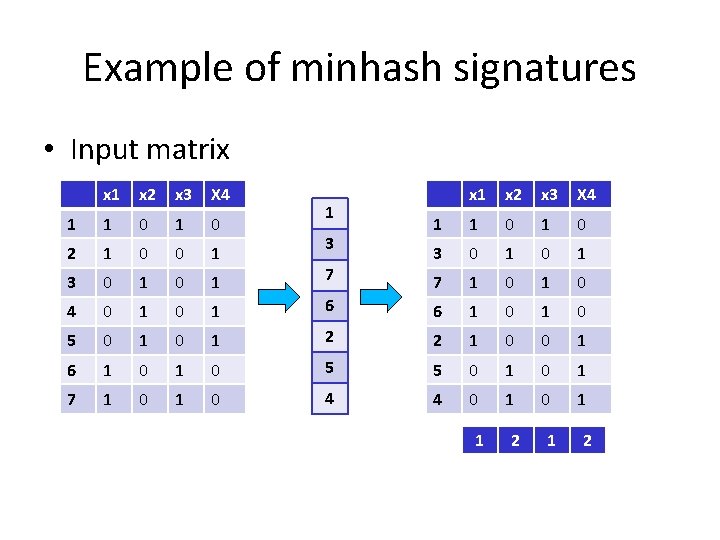
Example of minhash signatures • Input matrix x 1 x 2 x 3 X 4 1 1 0 1 0 2 1 0 0 1 3 0 1 0 1 7 7 1 0 4 0 1 6 6 1 0 5 0 1 2 2 1 0 0 1 6 1 0 5 5 0 1 7 1 0 4 4 0 1 1 3 1 2
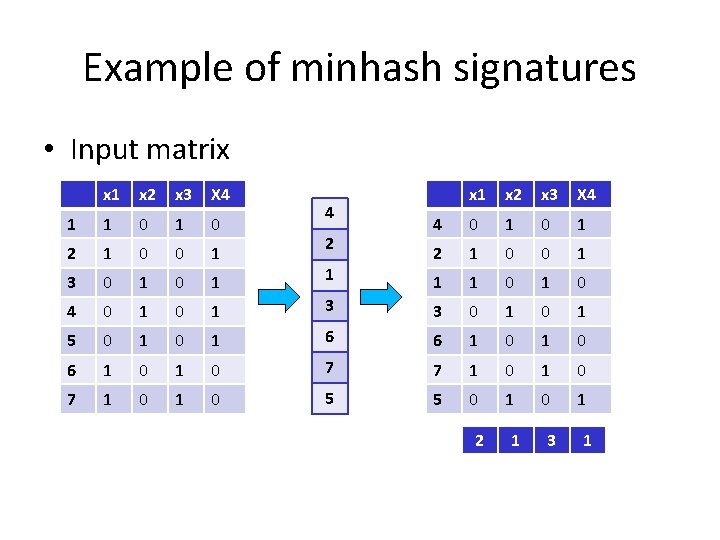
Example of minhash signatures • Input matrix x 1 x 2 x 3 X 4 1 1 0 4 0 1 2 1 0 0 1 3 0 1 1 1 1 0 4 0 1 3 3 0 1 5 0 1 6 6 1 0 1 0 7 7 1 0 1 0 5 5 0 1 4 2 2 1 3 1
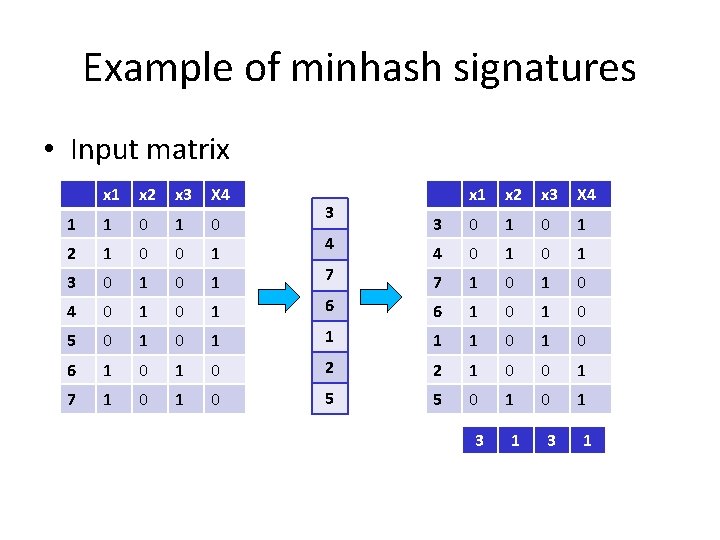
Example of minhash signatures • Input matrix x 1 x 2 x 3 X 4 1 1 0 3 0 1 2 1 0 0 1 4 0 1 3 0 1 7 7 1 0 4 0 1 6 6 1 0 5 0 1 1 1 1 0 6 1 0 2 2 1 0 0 1 7 1 0 5 5 0 1 3 4 3 1
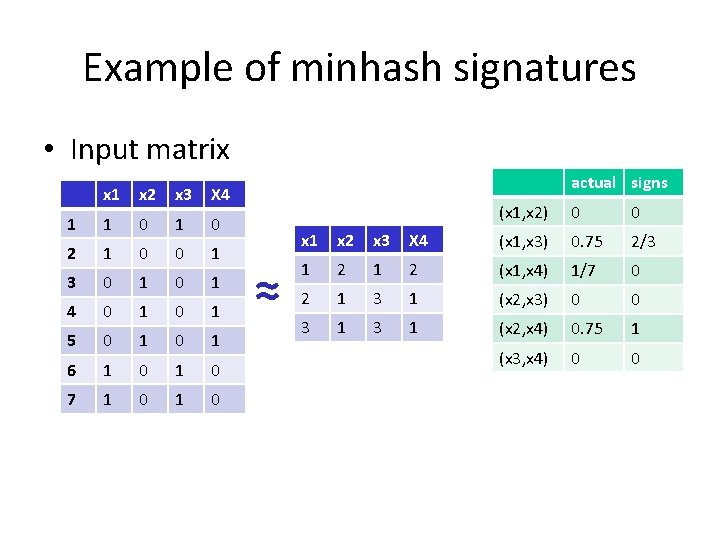
Example of minhash signatures • Input matrix x 1 x 2 x 3 X 4 1 1 0 2 1 0 0 1 3 0 1 4 0 1 5 0 1 6 1 0 7 1 0 actual signs ≈ (x 1, x 2) 0 0 x 1 x 2 x 3 X 4 (x 1, x 3) 0. 75 2/3 1 2 (x 1, x 4) 1/7 0 2 1 3 1 (x 2, x 3) 0 0 3 1 (x 2, x 4) 0. 75 1 (x 3, x 4) 0 0
Is it now feasible? • Assume a billion rows • Hard to pick a random permutation of 1…billion • Even representing a random permutation requires 1 billion entries!!! • How about accessing rows in permuted order? •
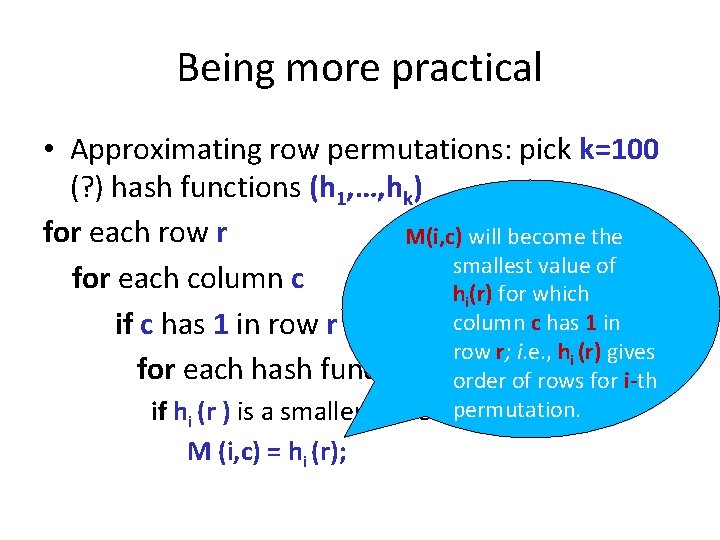
Being more practical • Approximating row permutations: pick k=100 (? ) hash functions (h 1, …, hk) for each row r M(i, c) will become the smallest value of for each column c hi(r) for which column c has 1 in if c has 1 in row r; i. e. , hi (r) gives for each hash function horder i do of rows for i-th permutation. if hi (r ) is a smaller value than M(i, c) then M (i, c) = hi (r);
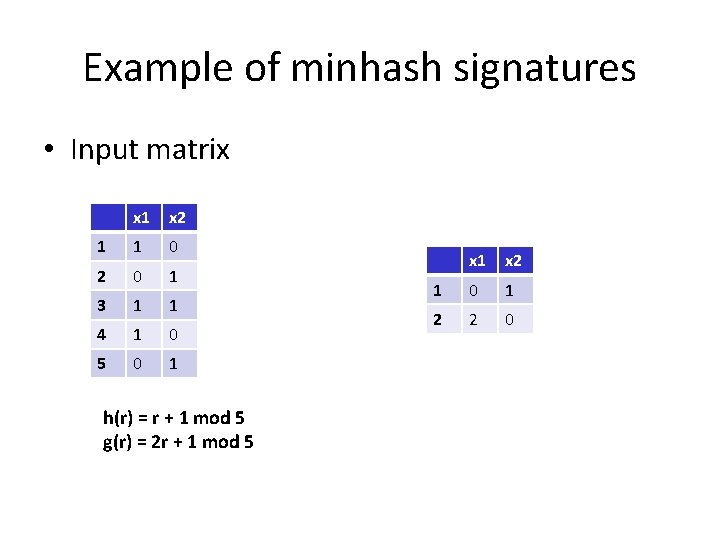
Example of minhash signatures • Input matrix x 1 x 2 1 1 0 2 0 1 3 1 1 4 1 0 5 0 1 h(r) = r + 1 mod 5 g(r) = 2 r + 1 mod 5 x 1 x 2 1 0 1 2 2 0
- Slides: 51