
Lecture Outline Chapter 4 The Solar System Copyright

- Slides: 41
Lecture Outline Chapter 4 The Solar System Copyright © 2010 Pearson Education, Inc.
Chapter 6 The Solar System Copyright © 2010 Pearson Education, Inc.
Units of Chapter 6 An Inventory of the Solar System Interplanetary Matter The Formation of the Solar System Planets Beyond the Solar System Summary of Chapter 6 Copyright © 2010 Pearson Education, Inc.
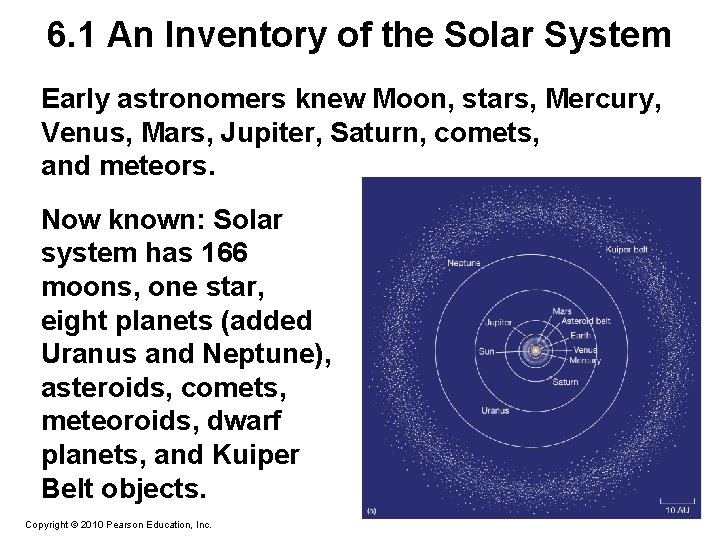
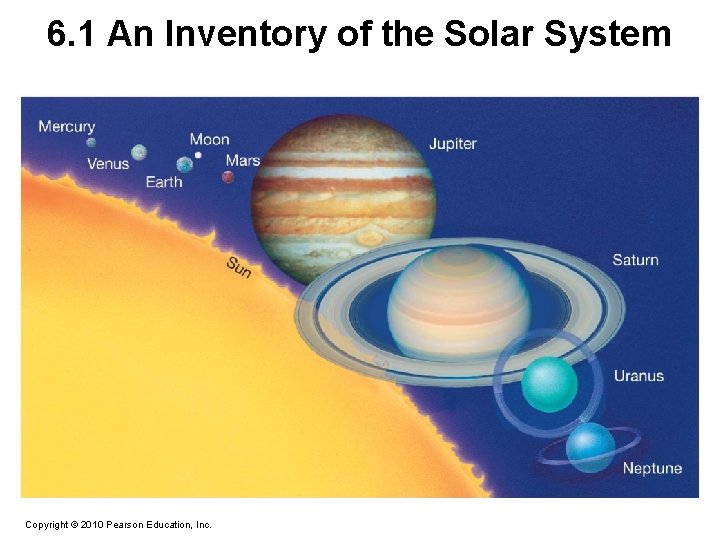
6. 1 An Inventory of the Solar System Early astronomers knew Moon, stars, Mercury, Venus, Mars, Jupiter, Saturn, comets, and meteors. Now known: Solar system has 166 moons, one star, eight planets (added Uranus and Neptune), asteroids, comets, meteoroids, dwarf planets, and Kuiper Belt objects. Copyright © 2010 Pearson Education, Inc.
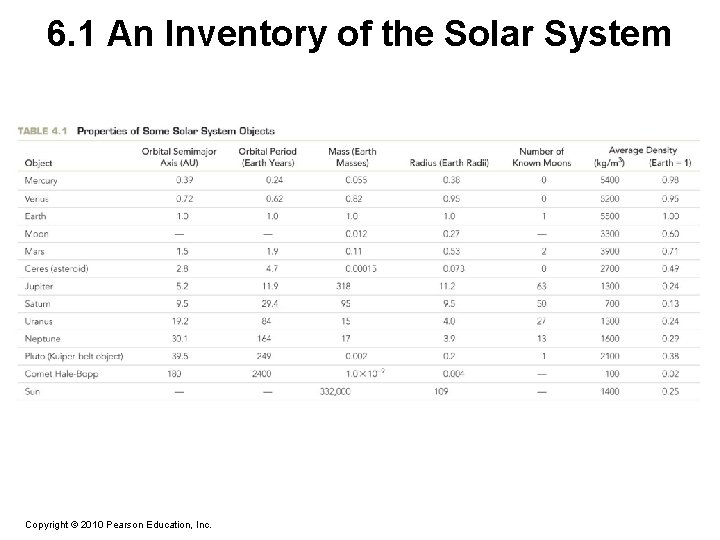
6. 1 An Inventory of the Solar System Copyright © 2010 Pearson Education, Inc.
6. 1 An Inventory of the Solar System • Distance from Sun known by Kepler’s laws. • Orbital period can be observed. • Radius known from angular size. • Masses known from Newton’s laws. • Rotation period known from observations. • Density can be calculated knowing radius and mass. Copyright © 2010 Pearson Education, Inc.
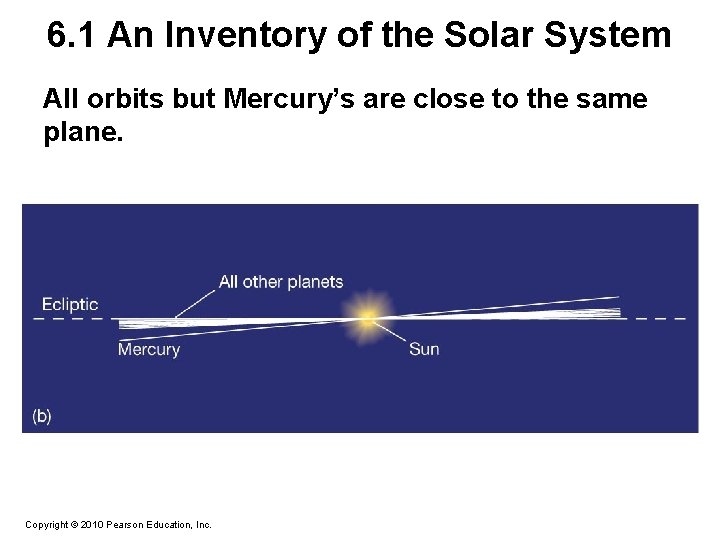
6. 1 An Inventory of the Solar System All orbits but Mercury’s are close to the same plane. Copyright © 2010 Pearson Education, Inc.
Angular Diameter • Angular Diameter is the diameter of a planet of moon as seen from the Earth. We can use geometry to calculate the actual size (diameter) of a planet or moon with the following ratio. • Actual Diameter/ 2 p distance = angular diameter / 360 o – This formula becomes: • Actual Diameter = distance (angular diameter / 57. 3 o) • The angular diameter may be in arc minutes or arc seconds but must be changed to degrees. Calculate the diameter of the Moon and the Sun with the following. • Angular diameter of the Sun and the Moon is 31 Arc minutes • Distance from the Earth to the Moon d = 3. 8 x 10⁸ m • Distance from the Earth to the Sun d = 1. 5 x 10¹¹ m Copyright © 2010 Pearson Education, Inc.
6. 1 An Inventory of the Solar System Copyright © 2010 Pearson Education, Inc.
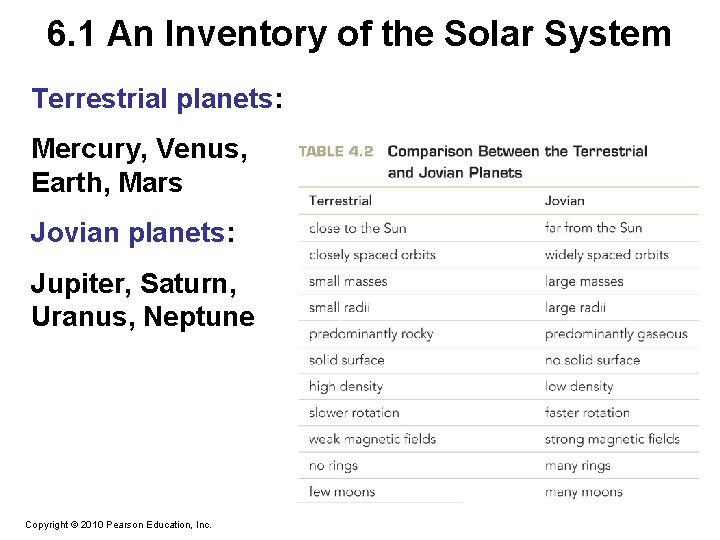
6. 1 An Inventory of the Solar System Terrestrial planets: Mercury, Venus, Earth, Mars Jovian planets: Jupiter, Saturn, Uranus, Neptune Copyright © 2010 Pearson Education, Inc.
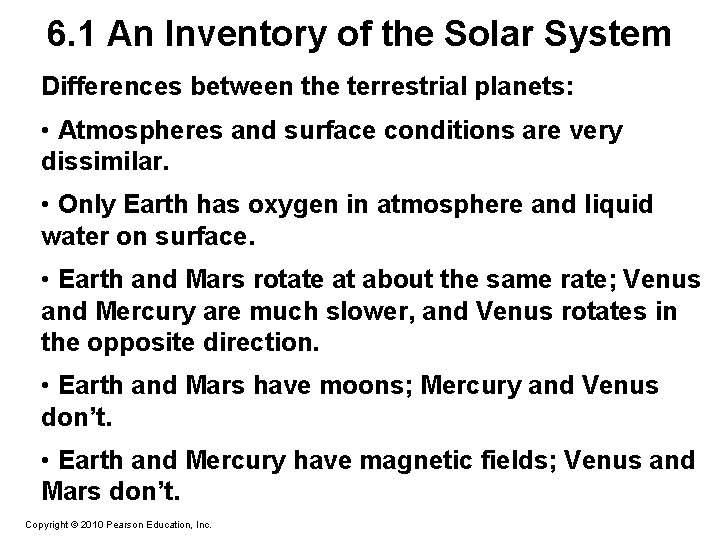
6. 1 An Inventory of the Solar System Differences between the terrestrial planets: • Atmospheres and surface conditions are very dissimilar. • Only Earth has oxygen in atmosphere and liquid water on surface. • Earth and Mars rotate at about the same rate; Venus and Mercury are much slower, and Venus rotates in the opposite direction. • Earth and Mars have moons; Mercury and Venus don’t. • Earth and Mercury have magnetic fields; Venus and Mars don’t. Copyright © 2010 Pearson Education, Inc.
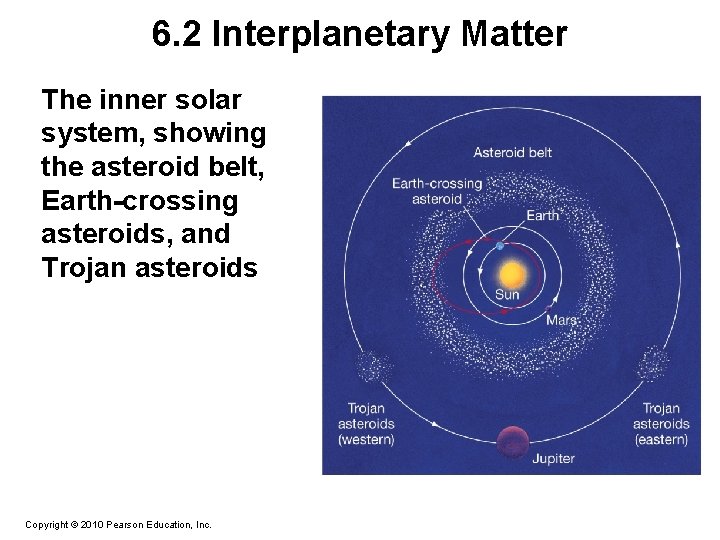
6. 2 Interplanetary Matter The inner solar system, showing the asteroid belt, Earth-crossing asteroids, and Trojan asteroids Copyright © 2010 Pearson Education, Inc.
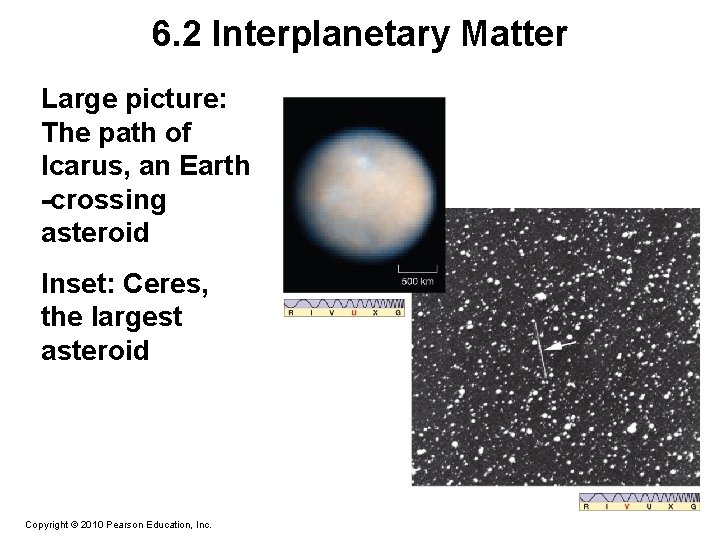
6. 2 Interplanetary Matter Large picture: The path of Icarus, an Earth -crossing asteroid Inset: Ceres, the largest asteroid Copyright © 2010 Pearson Education, Inc.
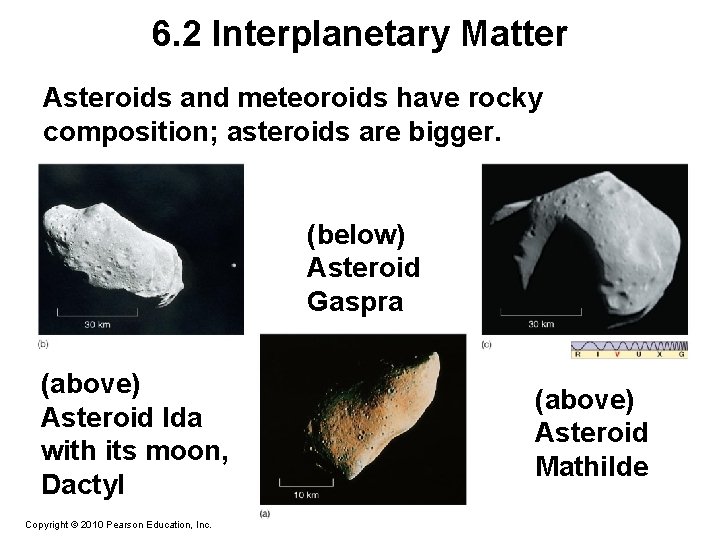
6. 2 Interplanetary Matter Asteroids and meteoroids have rocky composition; asteroids are bigger. (below) Asteroid Gaspra (above) Asteroid Ida with its moon, Dactyl Copyright © 2010 Pearson Education, Inc. (above) Asteroid Mathilde
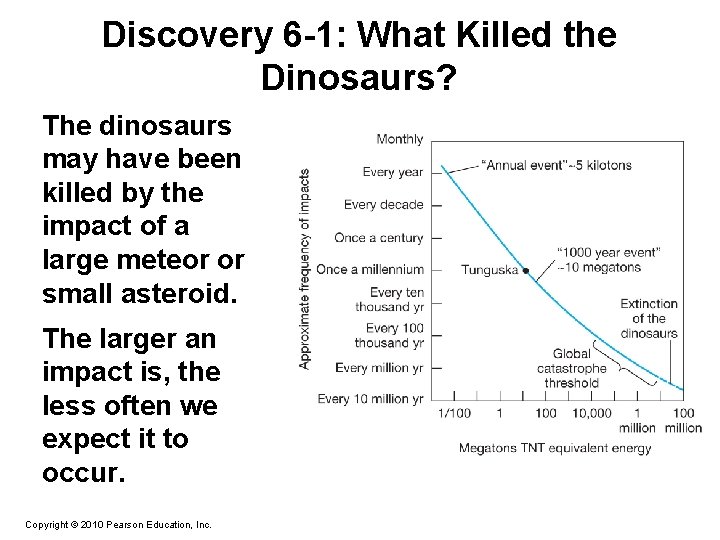
Discovery 6 -1: What Killed the Dinosaurs? The dinosaurs may have been killed by the impact of a large meteor or small asteroid. The larger an impact is, the less often we expect it to occur. Copyright © 2010 Pearson Education, Inc.
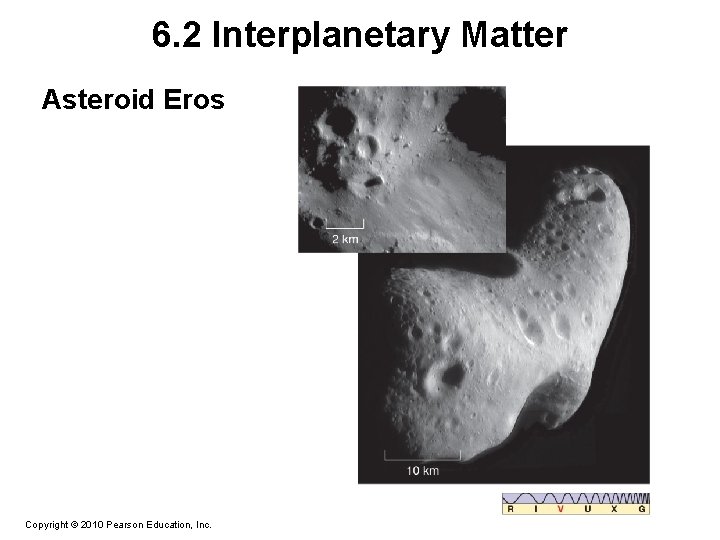
6. 2 Interplanetary Matter Asteroid Eros Copyright © 2010 Pearson Education, Inc.
Comets • Comets are similar to asteroids in that they orbit the sun and are made of minerals and other rocky substances. • The difference is that comets are also made up of ice which as it sublimes on its approach around the earth forms a tail that follows the comet in its orbit as it approaches the sun. • Comets have extremely elliptical orbits several astronomical units away from the sun. The tail of the comet only appears as it approaches the sun and disappears as it moves away. • Halley’s Comet is easily visible from the Earth every 76 years. This comet has been documented at every passage since 240 B. C. Most recently in 1986. Its tail is almost 1 A. U. in length. • Comet Hale-Bopp was a very bright and large comet that was seen in 1997. Copyright © 2010 Pearson Education, Inc.
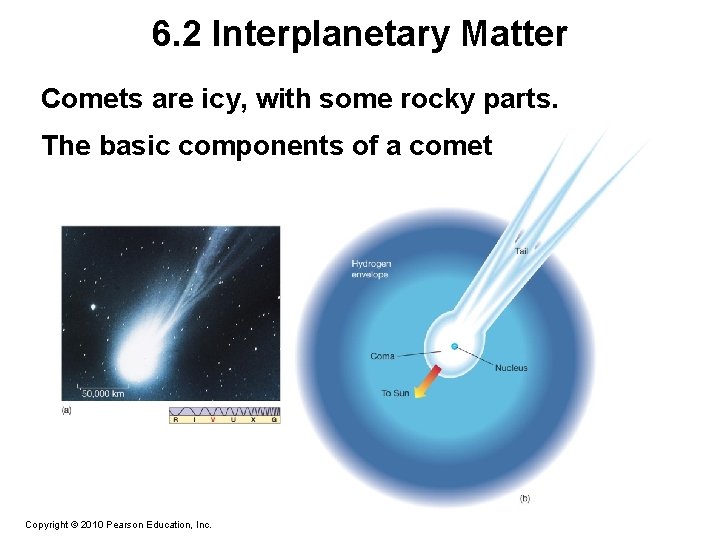
Parts of a Comet • Comets do not give off their own light. They are seen with reflected light when the sun’s light hits them. They typically have the following parts. • Nucleus: the main solid body, • Coma: halo of dust and gas the forms as the comet approaches the sun • Hydrogen Envelope: part that engulfs the coma as the comet grows • Tail: largest part of comet made of ionized atoms (ion tail) and dust particles (dust tail). Copyright © 2010 Pearson Education, Inc.
6. 2 Interplanetary Matter Comets are icy, with some rocky parts. The basic components of a comet Copyright © 2010 Pearson Education, Inc.
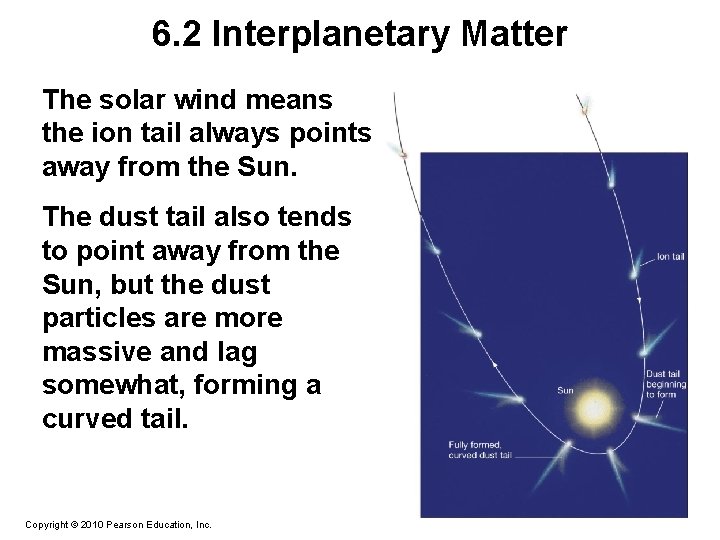
6. 2 Interplanetary Matter The solar wind means the ion tail always points away from the Sun. The dust tail also tends to point away from the Sun, but the dust particles are more massive and lag somewhat, forming a curved tail. Copyright © 2010 Pearson Education, Inc.
6. 2 Interplanetary Matter The internal structure of the cometary nucleus Copyright © 2010 Pearson Education, Inc.
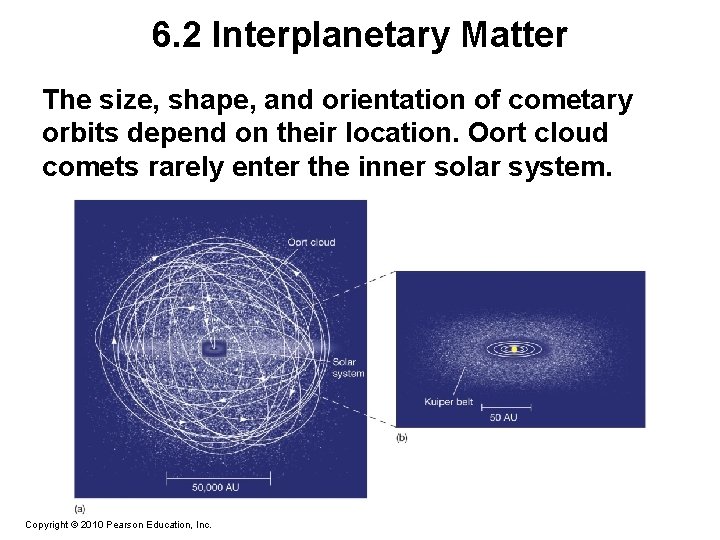
6. 2 Interplanetary Matter The size, shape, and orientation of cometary orbits depend on their location. Oort cloud comets rarely enter the inner solar system. Copyright © 2010 Pearson Education, Inc.
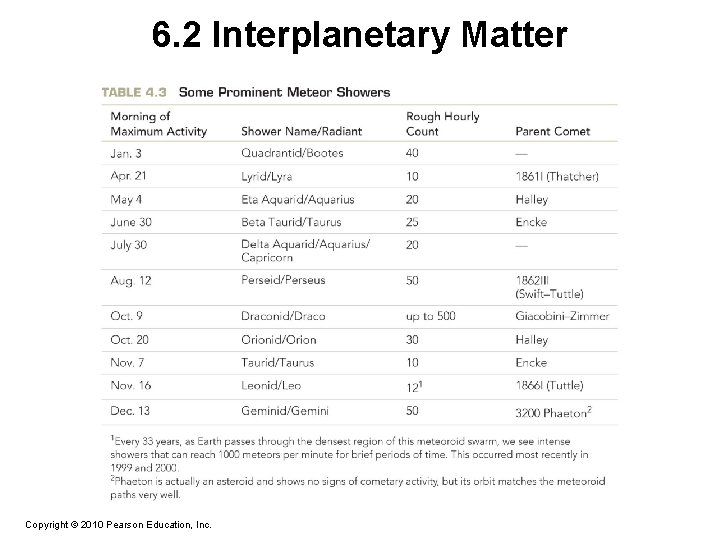
Meteoroids • • • Meteoroids are smaller fragments of rocky material that traveling through space. Fragments smaller than 100 m in diameter are classified as meteoroids. (Bigger fragments are asteroids). Meteoroids that enter earth’s atmosphere are called meteors. They appear as shooting stars. across the night sky. Do not confuse them with comets! Most meteors burn up in the Earth’s atmosphere. Meteorites are the parts of a meteor that reach the surface of the earth. If part of a meteor swarm hits the earth, a meteor shower is the result. The Earth’s motion frequently takes it across the path of comets and therefore some of these meteoroid swarms. Since this happens about the same time each year, meteor showers occur regularly and are fairly predictable. Meteor Showers are named for their radiant, which is the constellation they appear to come from in the night sky. Example: The Perseid shower seems to come from the constellation Perseus. Copyright © 2010 Pearson Education, Inc.
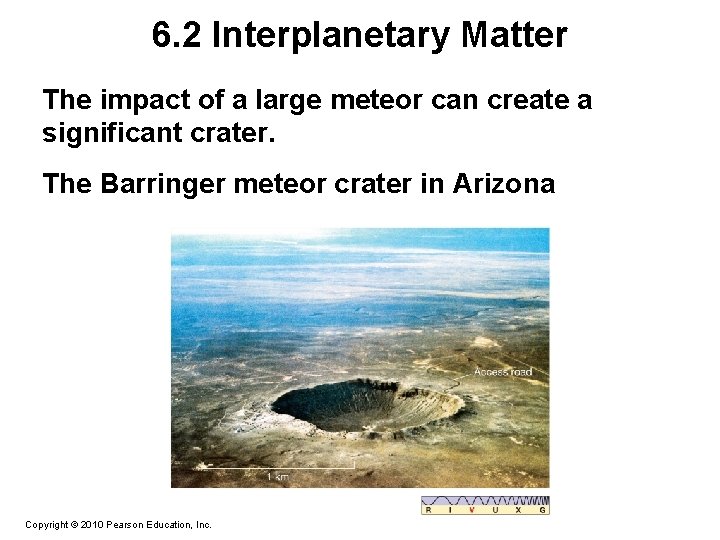
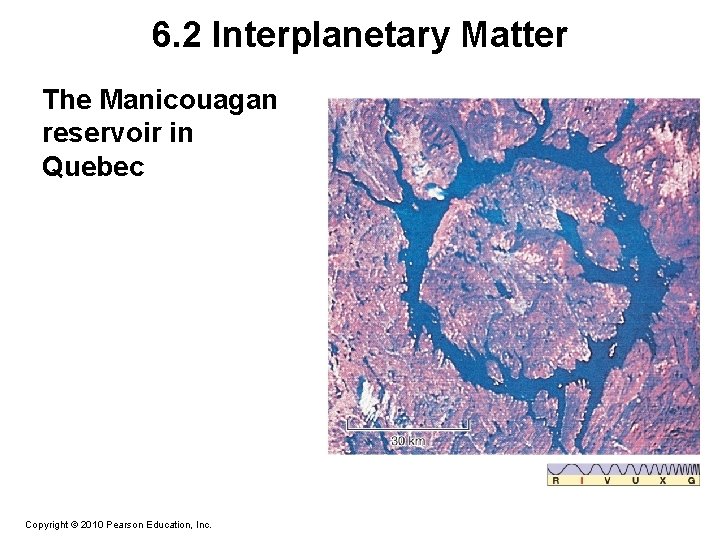
Meteoroids • • Larger Meteoroids do not come from comets but rather have strayed from the asteroid belt. These meteoroids are responsible for most of the cratering on the inner terrestrial planets and the moon. Smaller meteoroids (1 meter across about 1 ton of mass) burn up in the earth’s atomosphere. Larger meteoroids can reach the surface and do significant damage. – Barringer Crater (1 km wide), – Manicouagan Reservoir – These collisions seem to occur once every few hundred thousand years – Tunguska event in 1908 leveled Siberian forests in a remote part of Russia. Copyright © 2010 Pearson Education, Inc.
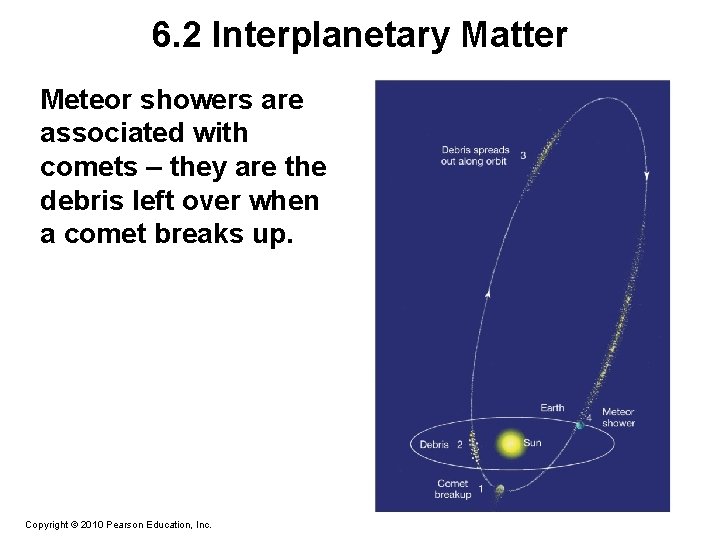
6. 2 Interplanetary Matter Meteor showers are associated with comets – they are the debris left over when a comet breaks up. Copyright © 2010 Pearson Education, Inc.
6. 2 Interplanetary Matter Copyright © 2010 Pearson Education, Inc.
6. 2 Interplanetary Matter The impact of a large meteor can create a significant crater. The Barringer meteor crater in Arizona Copyright © 2010 Pearson Education, Inc.
6. 2 Interplanetary Matter The Manicouagan reservoir in Quebec Copyright © 2010 Pearson Education, Inc.
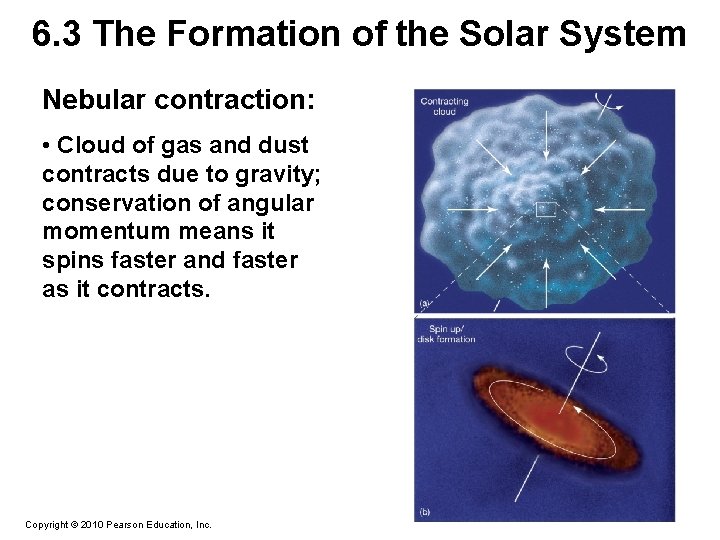
6. 3 The Formation of the Solar System Nebular contraction: • Cloud of gas and dust contracts due to gravity; conservation of angular momentum means it spins faster and faster as it contracts. Copyright © 2010 Pearson Education, Inc.
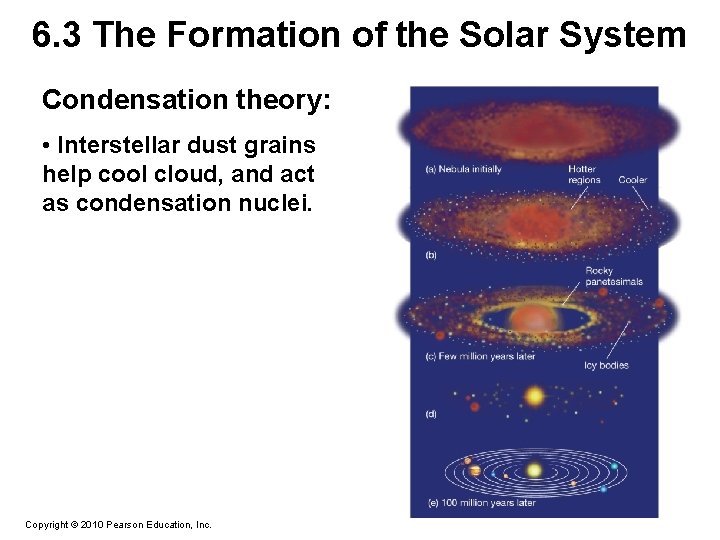
6. 3 The Formation of the Solar System Condensation theory: • Interstellar dust grains help cool cloud, and act as condensation nuclei. Copyright © 2010 Pearson Education, Inc.
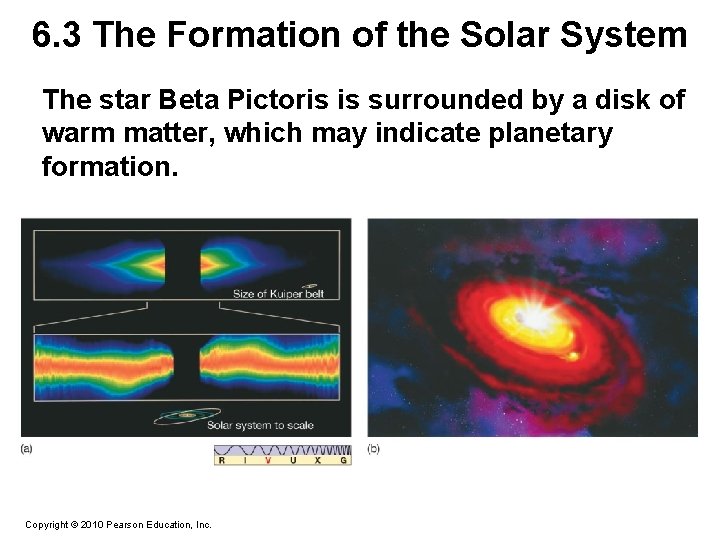
6. 3 The Formation of the Solar System The star Beta Pictoris is surrounded by a disk of warm matter, which may indicate planetary formation. Copyright © 2010 Pearson Education, Inc.
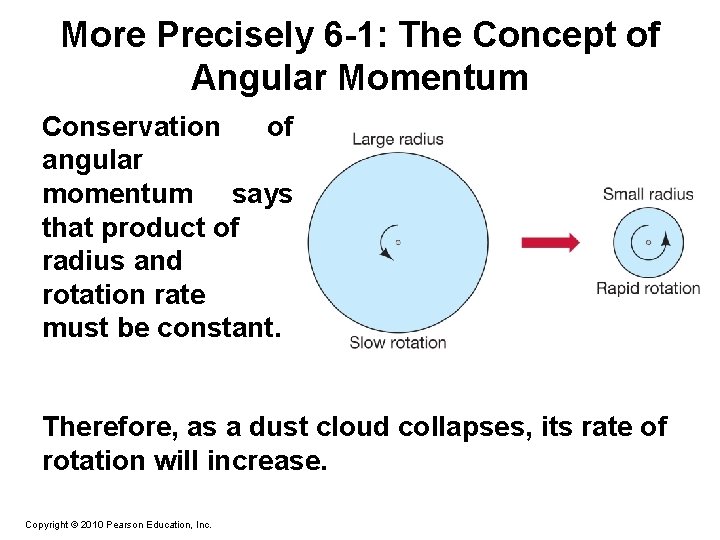
More Precisely 6 -1: The Concept of Angular Momentum Conservation of angular momentum says that product of radius and rotation rate must be constant. Therefore, as a dust cloud collapses, its rate of rotation will increase. Copyright © 2010 Pearson Education, Inc.
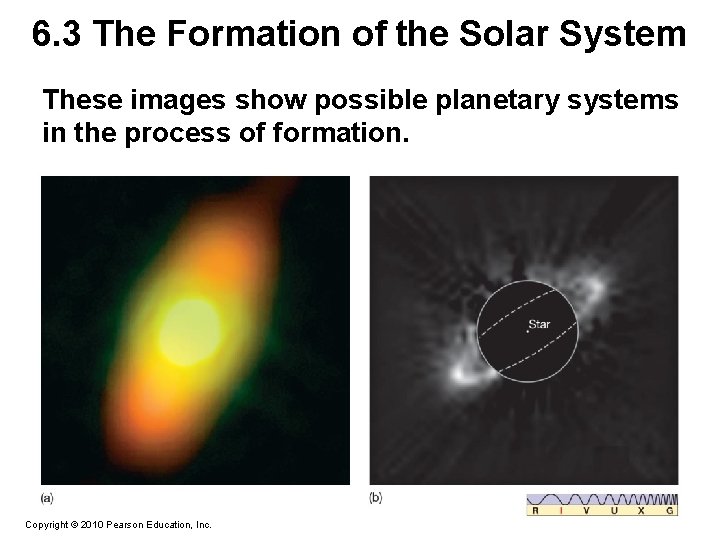
6. 3 The Formation of the Solar System These images show possible planetary systems in the process of formation. Copyright © 2010 Pearson Education, Inc.
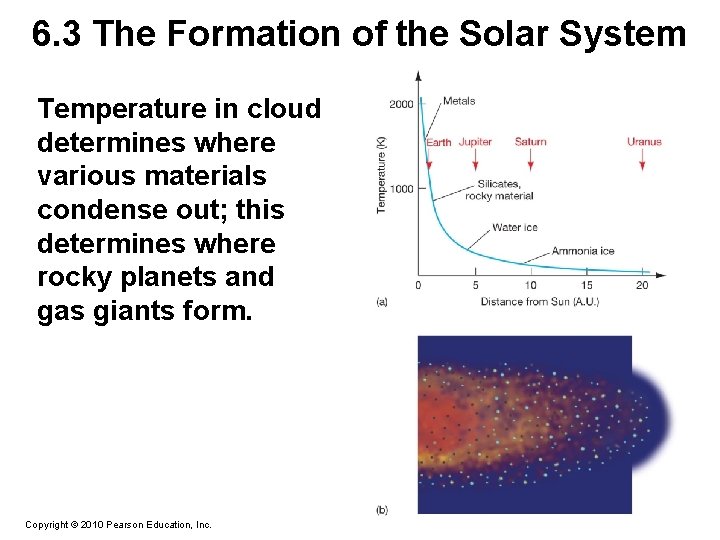
6. 3 The Formation of the Solar System Temperature in cloud determines where various materials condense out; this determines where rocky planets and gas giants form. Copyright © 2010 Pearson Education, Inc.
6. 4 Planets Beyond the Solar System Many planets have been discovered in other solar systems; this is one that is visible. Copyright © 2010 Pearson Education, Inc.
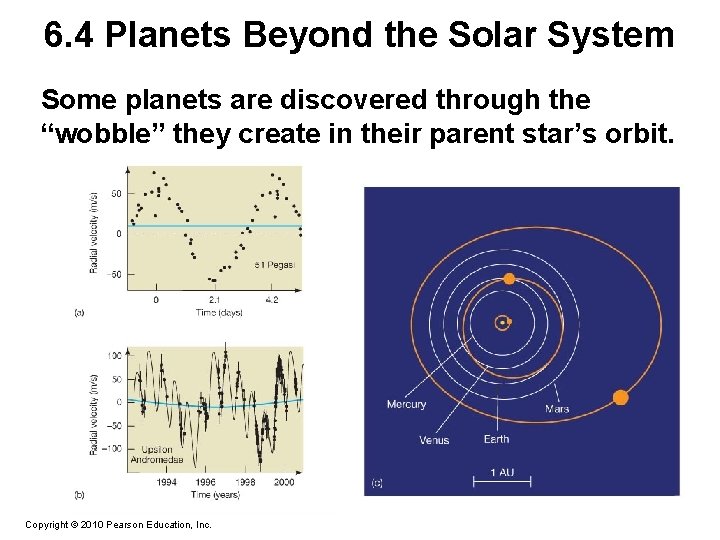
6. 4 Planets Beyond the Solar System Some planets are discovered through the “wobble” they create in their parent star’s orbit. Copyright © 2010 Pearson Education, Inc.
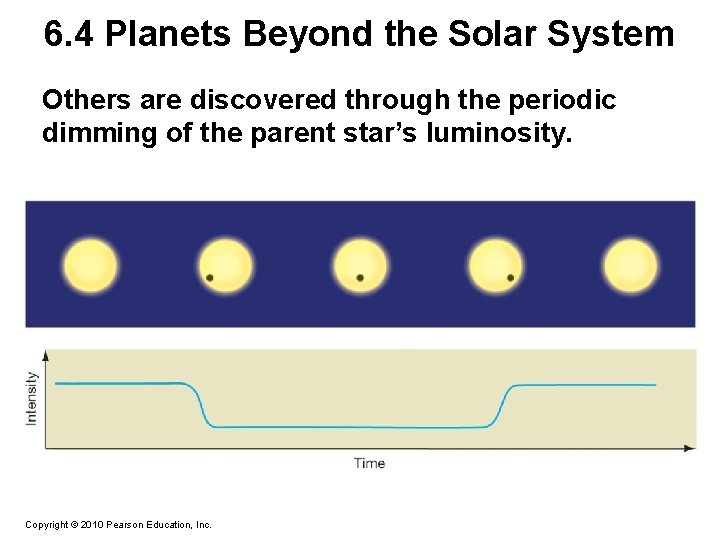
6. 4 Planets Beyond the Solar System Others are discovered through the periodic dimming of the parent star’s luminosity. Copyright © 2010 Pearson Education, Inc.
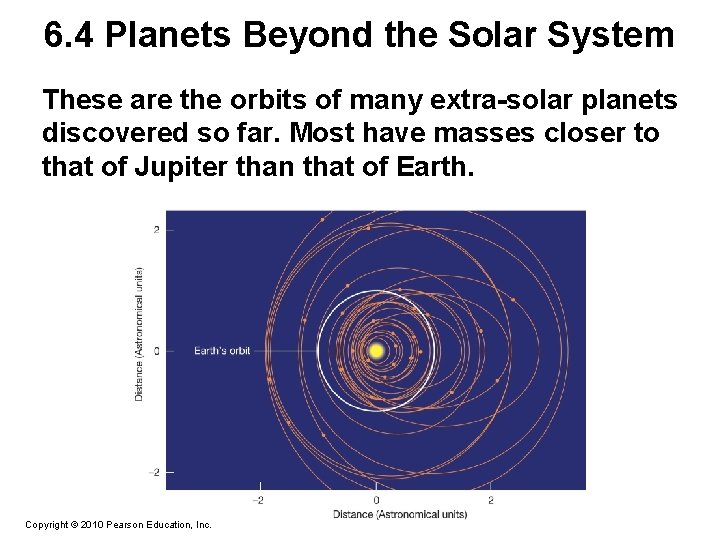
6. 4 Planets Beyond the Solar System These are the orbits of many extra-solar planets discovered so far. Most have masses closer to that of Jupiter than that of Earth. Copyright © 2010 Pearson Education, Inc.
Summary of Chapter 6 • Solar system consists of Sun and everything orbiting it. • Asteroids are rocky, and most orbit between orbits of Mars and Jupiter. • Comets are icy, and are believed to have formed early in the solar system’s life. • Major planets orbit Sun in same sense, and all but Venus rotate in that sense as well. • Planetary orbits lie almost in the same plane. Copyright © 2010 Pearson Education, Inc.
Summary of Chapter 6, cont. • Four inner planets – terrestrial planets – are rocky, small, and dense. • Four outer planets – Jovian planets – are gaseous and large. • Nebular theory of solar system formation: Cloud of gas and dust gradually collapsed under its own gravity, spinning faster as it shrank. • Condensation theory says dust grains acted as condensation nuclei, beginning formation of larger objects. Copyright © 2010 Pearson Education, Inc.
Summary of Chapter 6, cont. • Planets have been discovered in other solar systems. • Most are large and orbit much closer to the Sun than the large planets in our solar system do. Copyright © 2010 Pearson Education, Inc.