
Lecture Outline Chapter 4 Physics 4 th Edition

- Slides: 18
Lecture Outline Chapter 4 Physics, 4 th Edition James S. Walker Copyright © 2010 Pearson Education, Inc.
Chapter 4 Two-Dimensional Kinematics Copyright © 2010 Pearson Education, Inc.
Units of Chapter 4 • Motion in Two Dimensions • Projectile Motion: Basic Equations • Zero Launch Angle • General Launch Angle • Projectile Motion: Key Characteristics Copyright © 2010 Pearson Education, Inc.
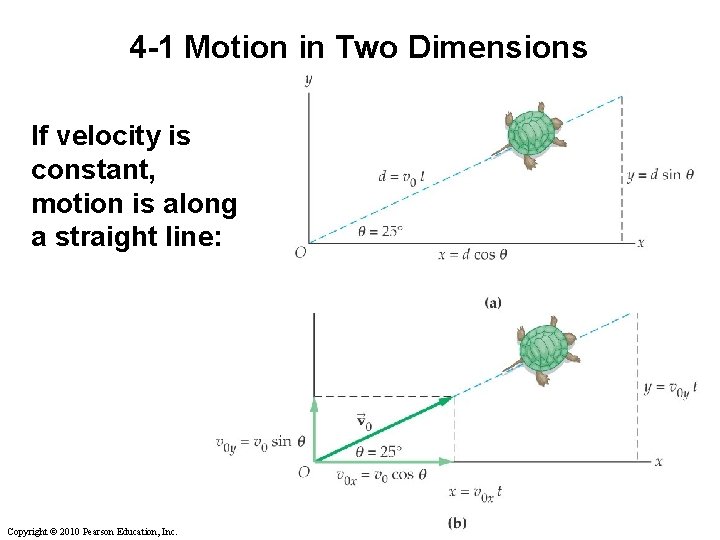
4 -1 Motion in Two Dimensions If velocity is constant, motion is along a straight line: Copyright © 2010 Pearson Education, Inc.
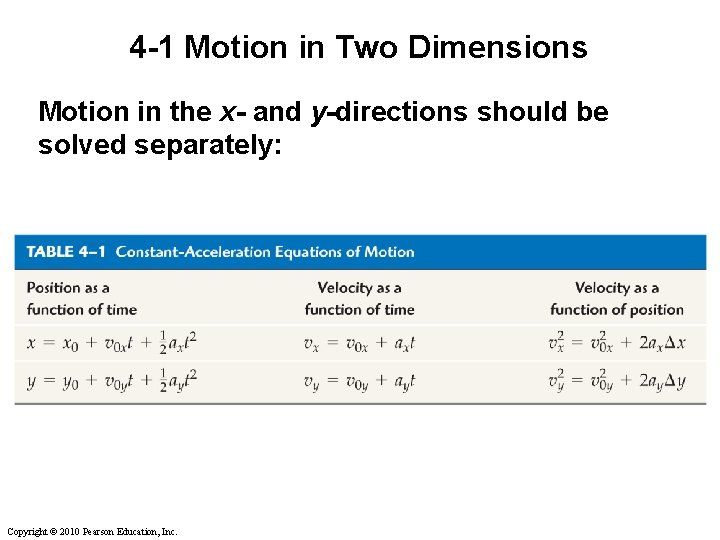
4 -1 Motion in Two Dimensions Motion in the x- and y-directions should be solved separately: Copyright © 2010 Pearson Education, Inc.
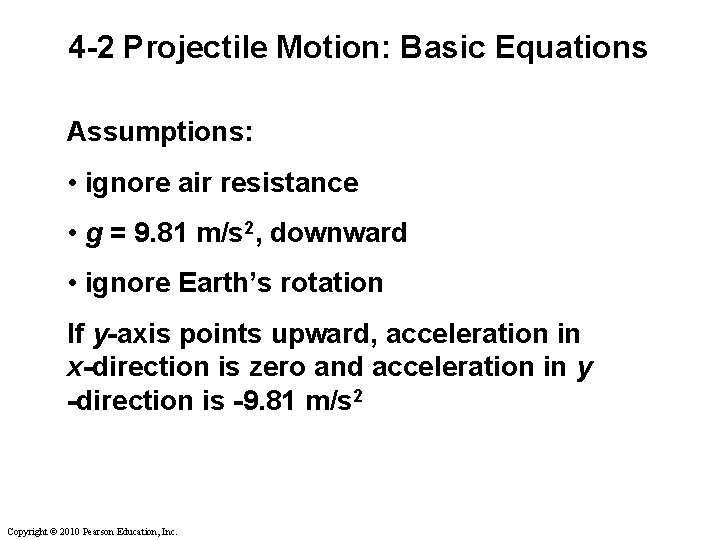
4 -2 Projectile Motion: Basic Equations Assumptions: • ignore air resistance • g = 9. 81 m/s 2, downward • ignore Earth’s rotation If y-axis points upward, acceleration in x-direction is zero and acceleration in y -direction is -9. 81 m/s 2 Copyright © 2010 Pearson Education, Inc.
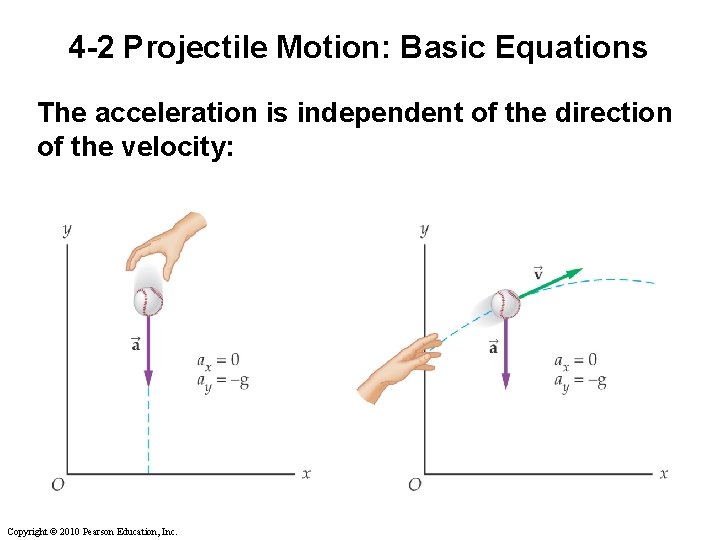
4 -2 Projectile Motion: Basic Equations The acceleration is independent of the direction of the velocity: Copyright © 2010 Pearson Education, Inc.
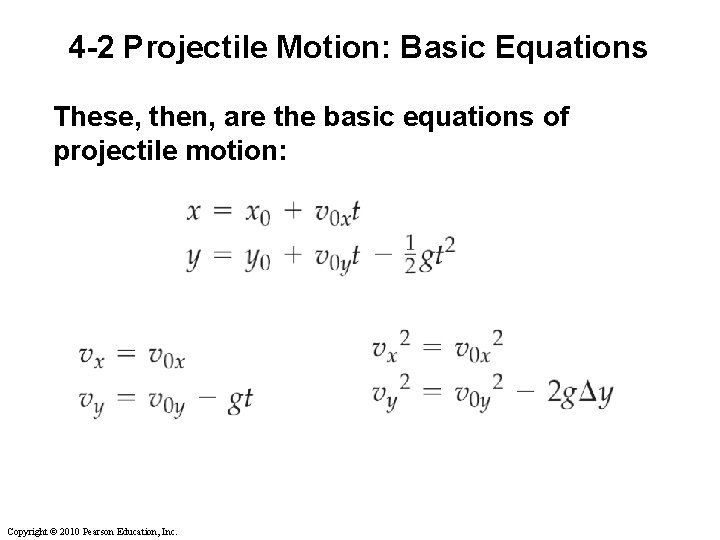
4 -2 Projectile Motion: Basic Equations These, then, are the basic equations of projectile motion: Copyright © 2010 Pearson Education, Inc.
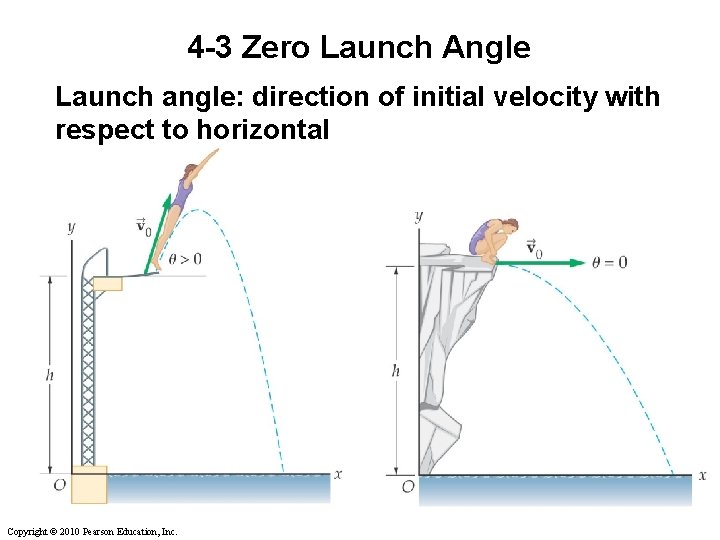
4 -3 Zero Launch Angle Launch angle: direction of initial velocity with respect to horizontal Copyright © 2010 Pearson Education, Inc.
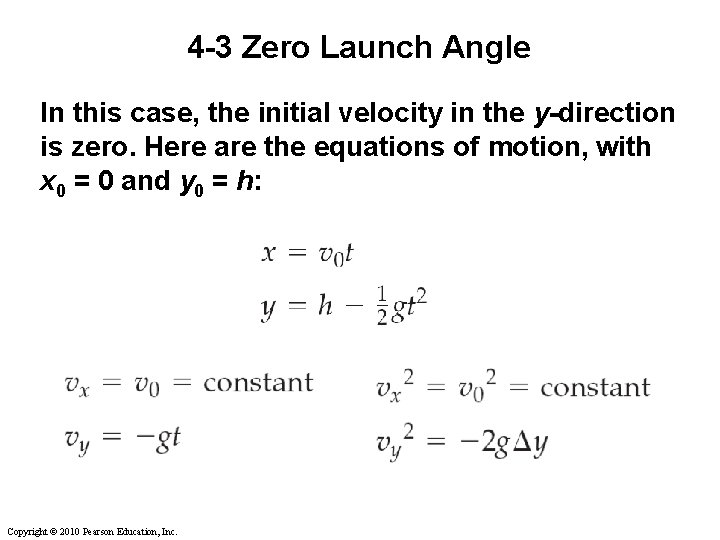
4 -3 Zero Launch Angle In this case, the initial velocity in the y-direction is zero. Here are the equations of motion, with x 0 = 0 and y 0 = h: Copyright © 2010 Pearson Education, Inc.
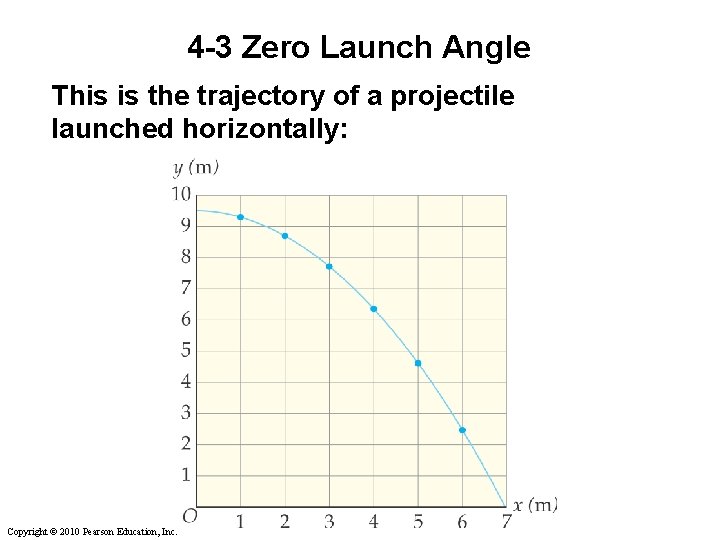
4 -3 Zero Launch Angle This is the trajectory of a projectile launched horizontally: Copyright © 2010 Pearson Education, Inc.
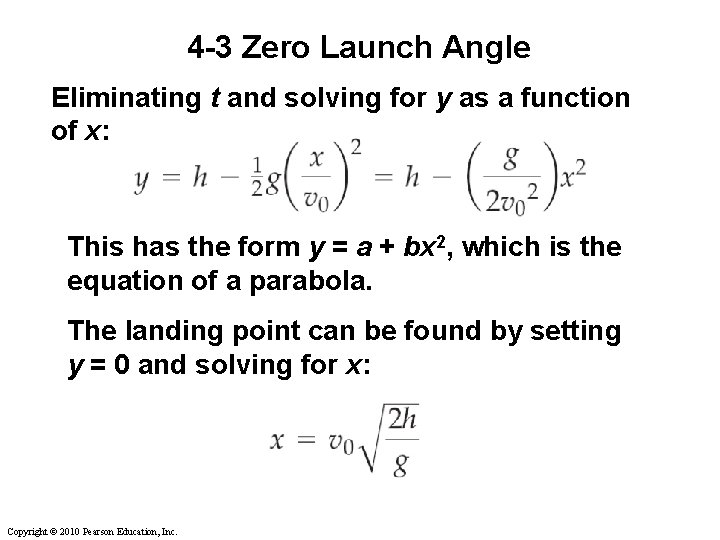
4 -3 Zero Launch Angle Eliminating t and solving for y as a function of x: This has the form y = a + bx 2, which is the equation of a parabola. The landing point can be found by setting y = 0 and solving for x: Copyright © 2010 Pearson Education, Inc.
4 -4 General Launch Angle In general, v 0 x = v 0 cos θ and v 0 y = v 0 sin θ This gives the equations of motion: Copyright © 2010 Pearson Education, Inc.
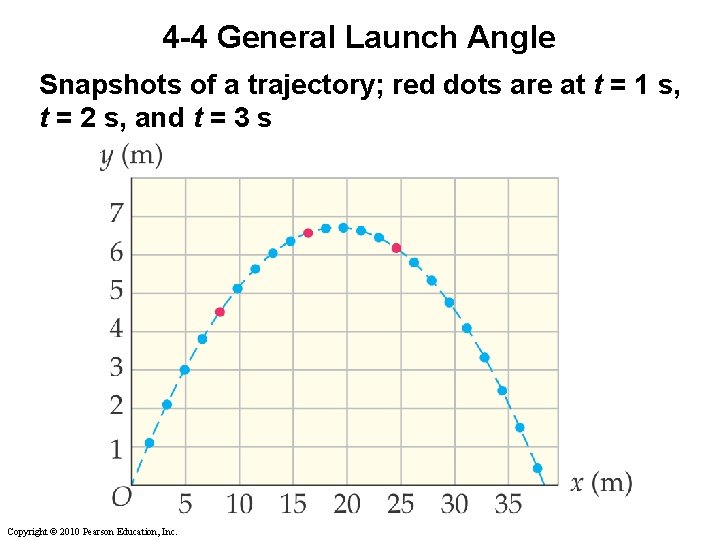
4 -4 General Launch Angle Snapshots of a trajectory; red dots are at t = 1 s, t = 2 s, and t = 3 s Copyright © 2010 Pearson Education, Inc.
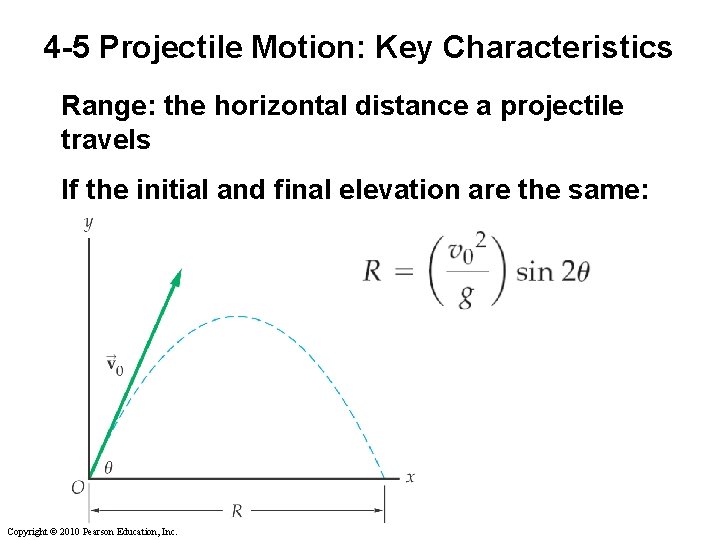
4 -5 Projectile Motion: Key Characteristics Range: the horizontal distance a projectile travels If the initial and final elevation are the same: Copyright © 2010 Pearson Education, Inc.
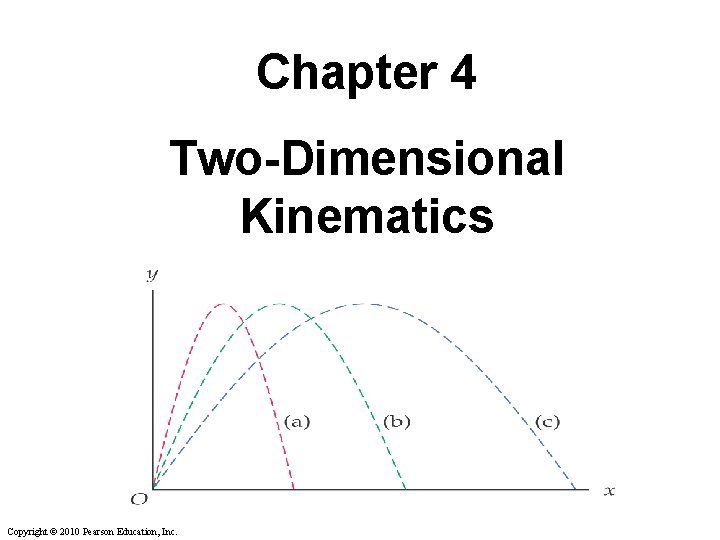
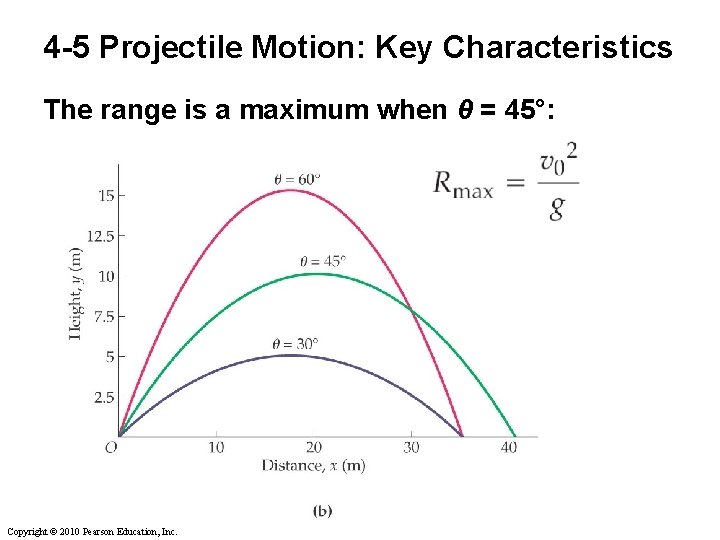
4 -5 Projectile Motion: Key Characteristics The range is a maximum when θ = 45°: Copyright © 2010 Pearson Education, Inc.
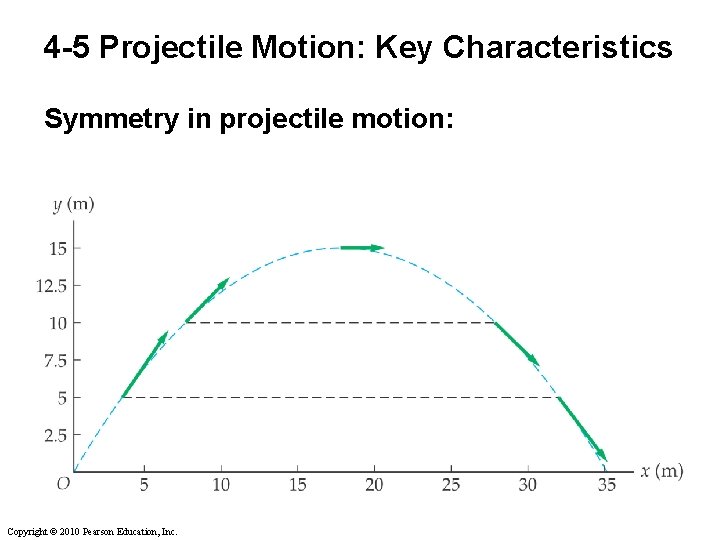
4 -5 Projectile Motion: Key Characteristics Symmetry in projectile motion: Copyright © 2010 Pearson Education, Inc.
Summary of Chapter 4 • Components of motion in the x- and ydirections can be treated independently • In projectile motion, the acceleration is –g • If the launch angle is zero, the initial velocity has only an x-component • The path followed by a projectile is a parabola • The range is the horizontal distance the projectile travels Copyright © 2010 Pearson Education, Inc.