
Lecture Outline Chapter 2 Motion in One Dimension

- Slides: 28
Lecture Outline Chapter 2 Motion in One Dimension © 2015 Pearson Education, Inc. Slide 2 -1
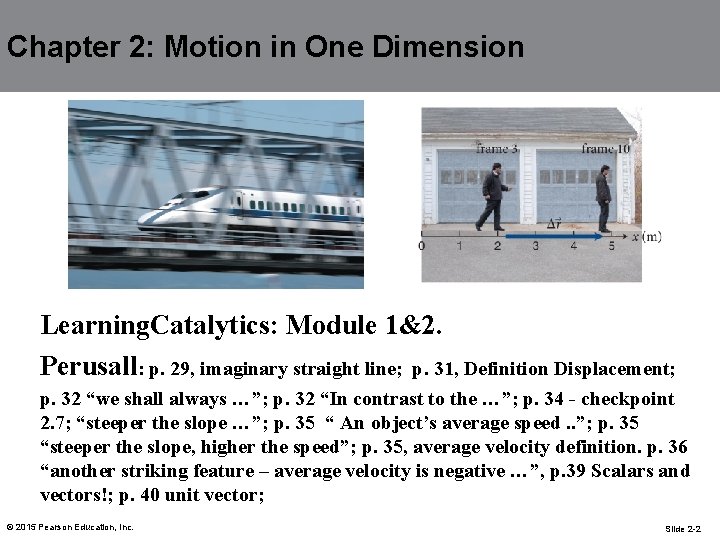
Chapter 2: Motion in One Dimension Learning. Catalytics: Module 1&2. Perusall: p. 29, imaginary straight line; p. 31, Definition Displacement; p. 32 “we shall always …”; p. 32 “In contrast to the …”; p. 34 - checkpoint 2. 7; “steeper the slope …”; p. 35 “ An object’s average speed. . ”; p. 35 “steeper the slope, higher the speed”; p. 35, average velocity definition. p. 36 “another striking feature – average velocity is negative …”, p. 39 Scalars and vectors!; p. 40 unit vector; © 2015 Pearson Education, Inc. Slide 2 -2
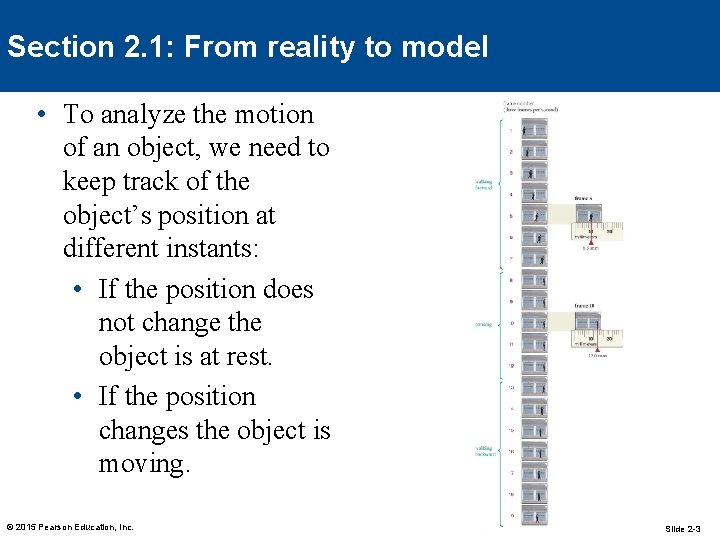
Section 2. 1: From reality to model • To analyze the motion of an object, we need to keep track of the object’s position at different instants: • If the position does not change the object is at rest. • If the position changes the object is moving. © 2015 Pearson Education, Inc. Slide 2 -3
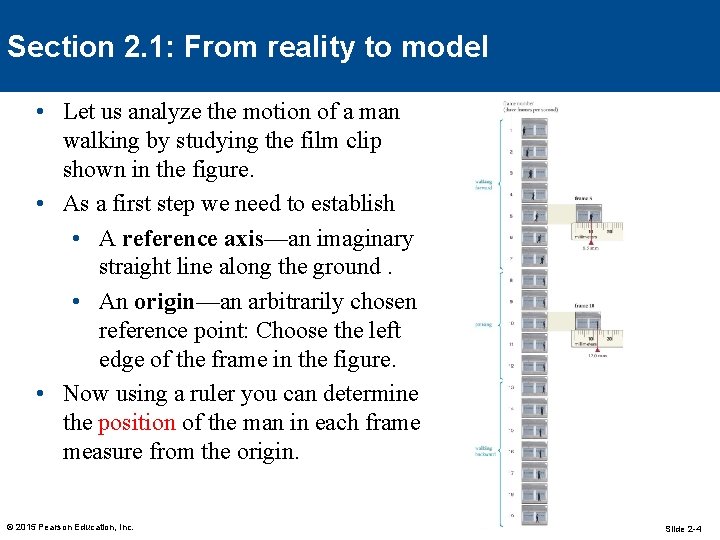
Section 2. 1: From reality to model • Let us analyze the motion of a man walking by studying the film clip shown in the figure. • As a first step we need to establish • A reference axis—an imaginary straight line along the ground. • An origin—an arbitrarily chosen reference point: Choose the left edge of the frame in the figure. • Now using a ruler you can determine the position of the man in each frame measure from the origin. © 2015 Pearson Education, Inc. Slide 2 -4
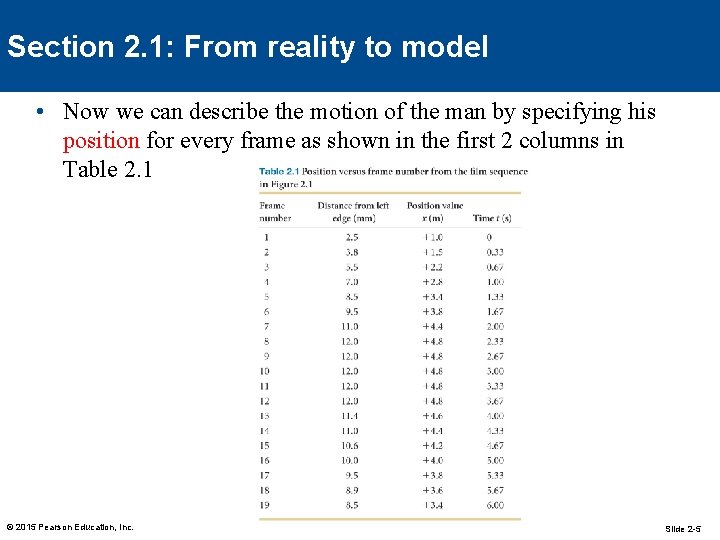
Section 2. 1: From reality to model • Now we can describe the motion of the man by specifying his position for every frame as shown in the first 2 columns in Table 2. 1 © 2015 Pearson Education, Inc. Slide 2 -5
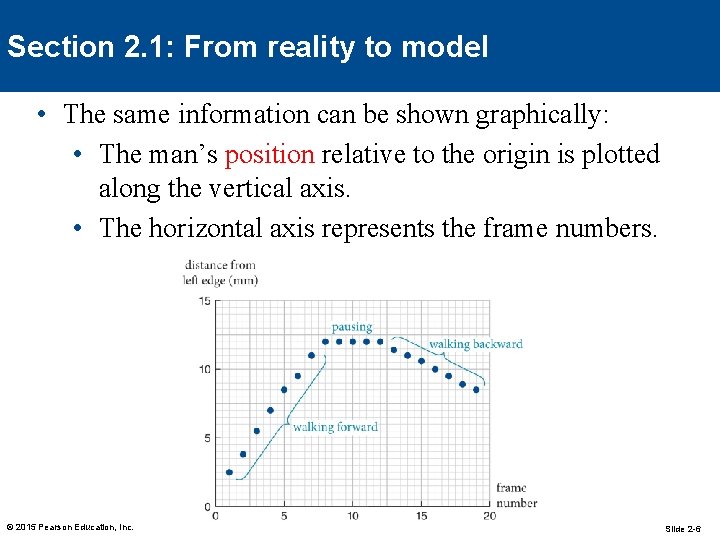
Section 2. 1: From reality to model • The same information can be shown graphically: • The man’s position relative to the origin is plotted along the vertical axis. • The horizontal axis represents the frame numbers. © 2015 Pearson Education, Inc. Slide 2 -6
Section 2. 2: Position and displacement Displacement • The arrow pointing from the initial position of an object to its final position represents a physical quantity called the displacement of the object. • Displacement does not depend on the choice of reference axis or origin. © 2015 Pearson Education, Inc. Slide 2 -7
Section 2. 2: Position and displacement • The x component of an object’s displacement is the change in its x coordinate. • The value of the x component of the displacement is obtained by subtracting the initial x coordinate from the final x coordinate and is independent of the choice of origin: Displacement = Final position – Initial position • The x component of displacement is measured along some specific x axis. • The x component of displacement can be negative or positive. © 2015 Pearson Education, Inc. Slide 2 -8
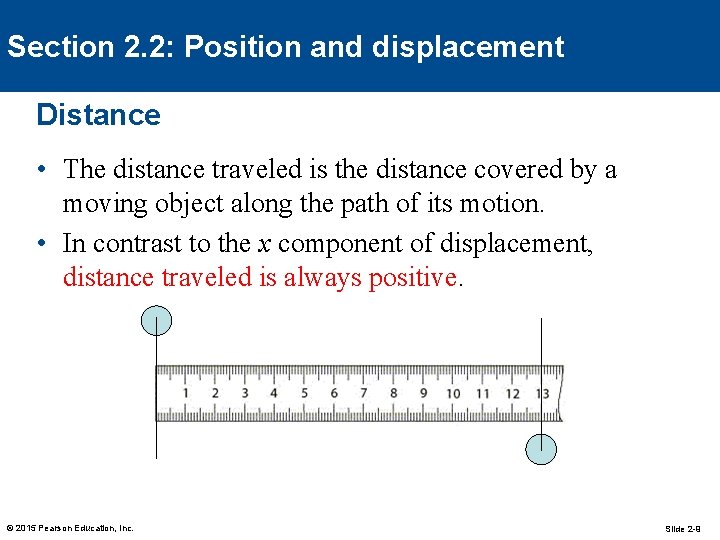
Section 2. 2: Position and displacement Distance • The distance traveled is the distance covered by a moving object along the path of its motion. • In contrast to the x component of displacement, distance traveled is always positive. © 2015 Pearson Education, Inc. Slide 2 -9
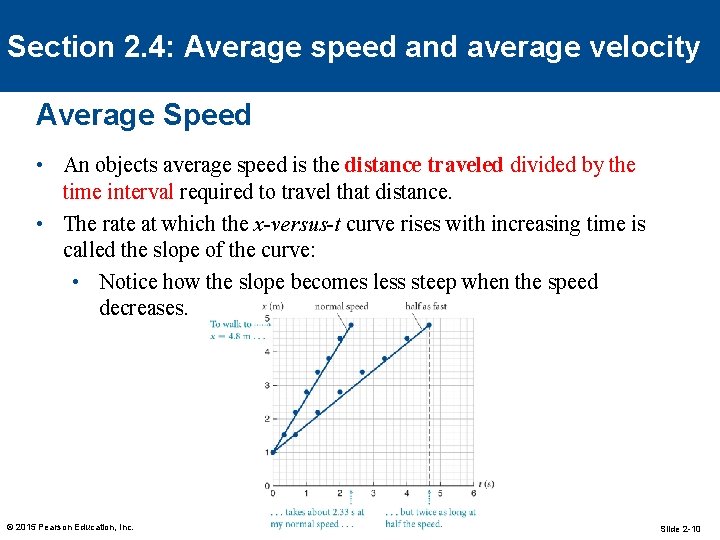
Section 2. 4: Average speed and average velocity Average Speed • An objects average speed is the distance traveled divided by the time interval required to travel that distance. • The rate at which the x-versus-t curve rises with increasing time is called the slope of the curve: • Notice how the slope becomes less steep when the speed decreases. © 2015 Pearson Education, Inc. Slide 2 -10
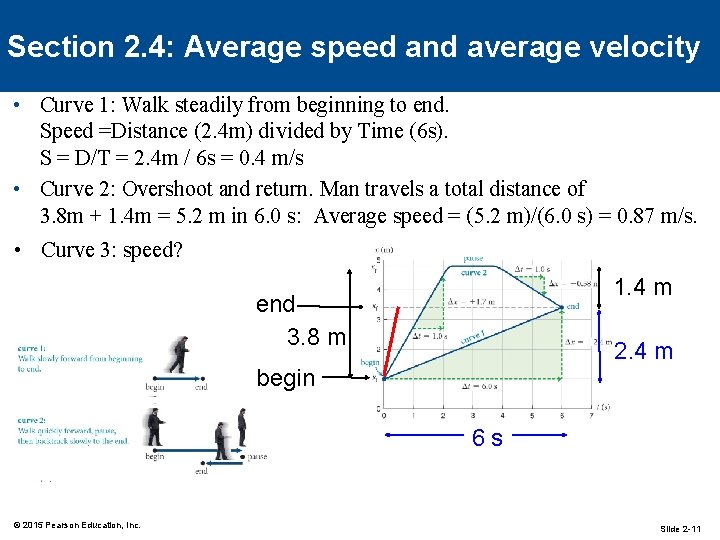
Section 2. 4: Average speed and average velocity • Curve 1: Walk steadily from beginning to end. Speed =Distance (2. 4 m) divided by Time (6 s). S = D/T = 2. 4 m / 6 s = 0. 4 m/s • Curve 2: Overshoot and return. Man travels a total distance of 3. 8 m + 1. 4 m = 5. 2 m in 6. 0 s: Average speed = (5. 2 m)/(6. 0 s) = 0. 87 m/s. • Curve 3: speed? 1. 4 m end 3. 8 m 2. 4 m begin 6 s © 2015 Pearson Education, Inc. Slide 2 -11
Section 2. 4: Average speed and average velocity Velocity • The quantity that gives both the speed and the direction of travel is velocity. • The x component of an object’s average velocity is the x component of its displacement divided by the length of the time interval taken to travel that displacement. © 2015 Pearson Education, Inc. Slide 2 -12
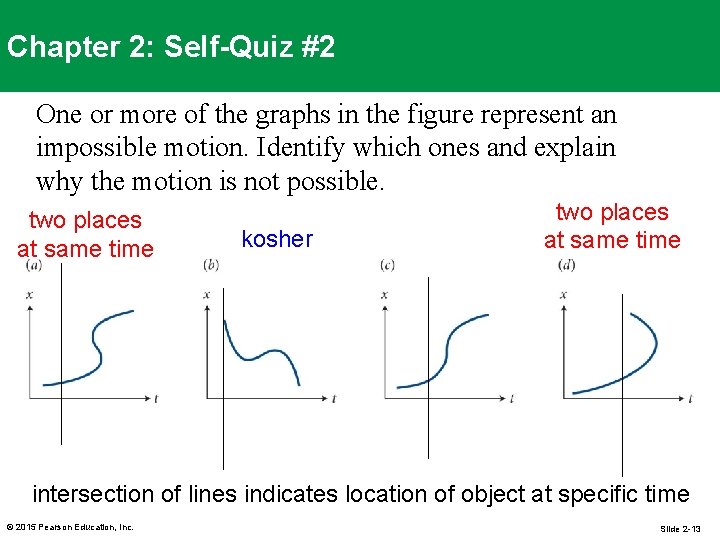
Chapter 2: Self-Quiz #2 One or more of the graphs in the figure represent an impossible motion. Identify which ones and explain why the motion is not possible. two places at same time kosher two places at same time intersection of lines indicates location of object at specific time © 2015 Pearson Education, Inc. Slide 2 -13
Section 2. 5: Scalars and vectors • Scalars: Physical Quantities that are completely specified by a number, which can be positive or negative, and a unit of measure. • Examples: Temperature, volume • Scalars follow ordinary arithmetic laws (add, subtract, etc). • Vectors: Physical quantities that are completely specified by a magnitude and a direction in space. © 2015 Pearson Education, Inc. Slide 2 -14
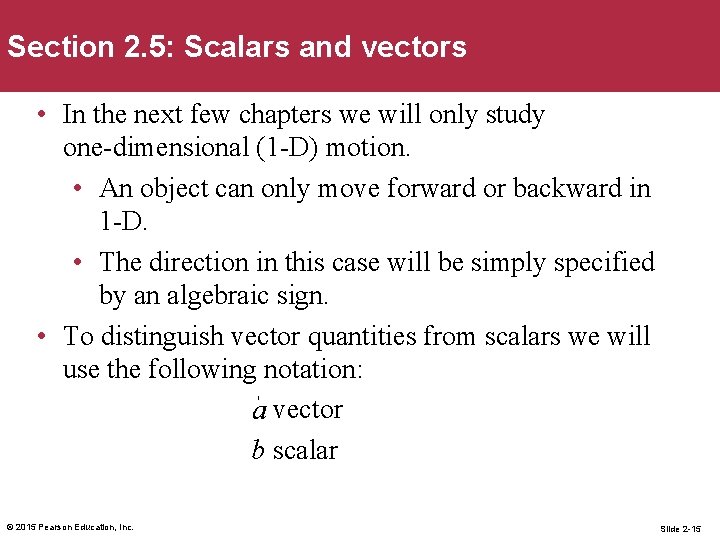
Section 2. 5: Scalars and vectors • In the next few chapters we will only study one-dimensional (1 -D) motion. • An object can only move forward or backward in 1 -D. • The direction in this case will be simply specified by an algebraic sign. • To distinguish vector quantities from scalars we will use the following notation: vector b scalar © 2015 Pearson Education, Inc. Slide 2 -15
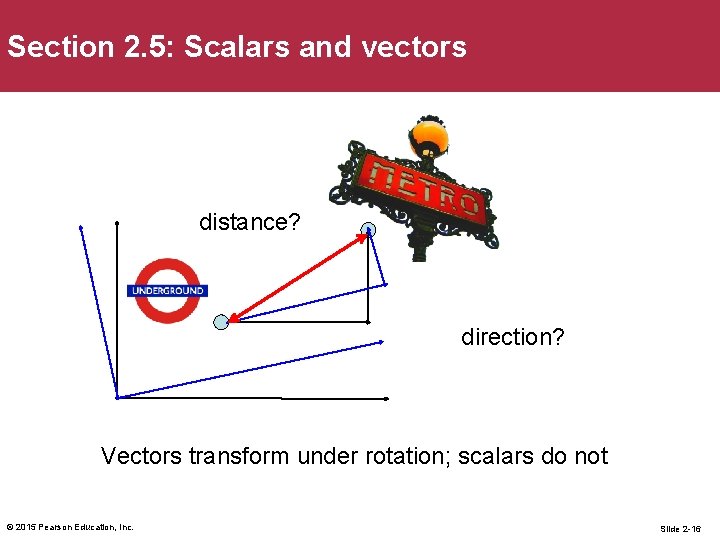
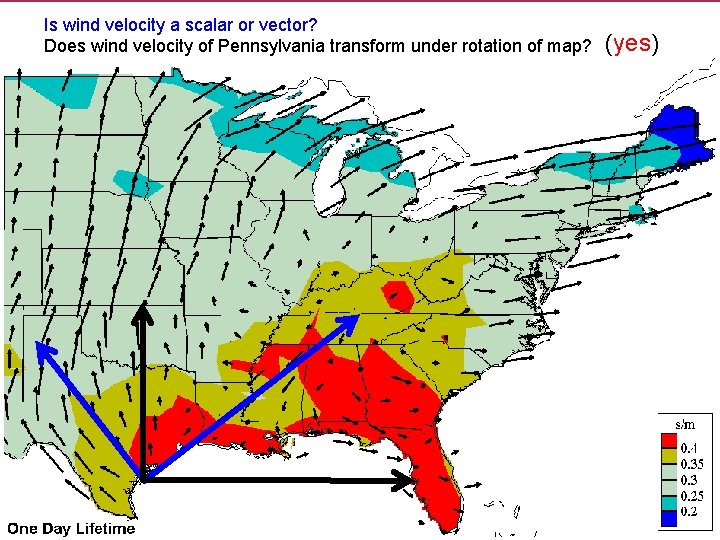
Section 2. 5: Scalars and vectors distance? direction? Vectors transform under rotation; scalars do not © 2015 Pearson Education, Inc. Slide 2 -16
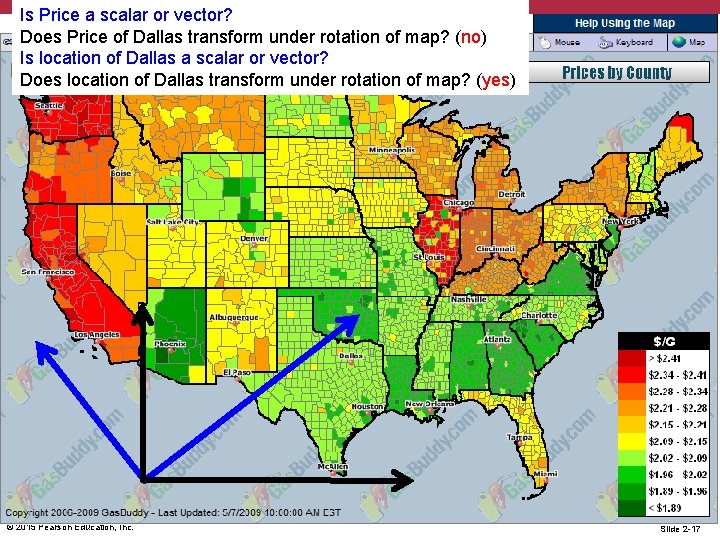
Is Price a scalar or vector? Does Price of Dallas transform under rotation of map? (no) Is location of Dallas a scalar or vector? Does location of Dallas transform under rotation of map? (yes) Section 2. 5: Scalars and vectors © 2015 Pearson Education, Inc. Slide 2 -17
Is wind velocity a scalar or vector? Does wind velocity of Pennsylvania transform under rotation of map? Section 2. 5: Scalars and vectors © 2015 Pearson Education, Inc. (yes) Slide 2 -18
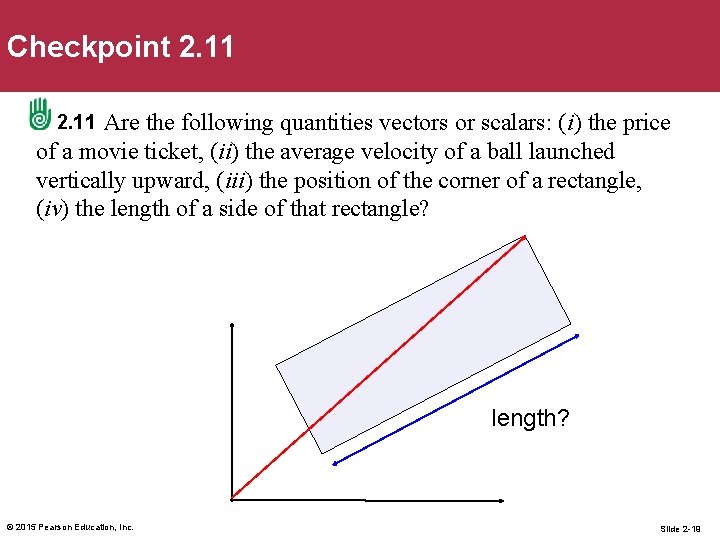
Checkpoint 2. 11 Are the following quantities vectors or scalars: (i) the price of a movie ticket, (ii) the average velocity of a ball launched vertically upward, (iii) the position of the corner of a rectangle, (iv) the length of a side of that rectangle? 2. 11 length? © 2015 Pearson Education, Inc. Slide 2 -19
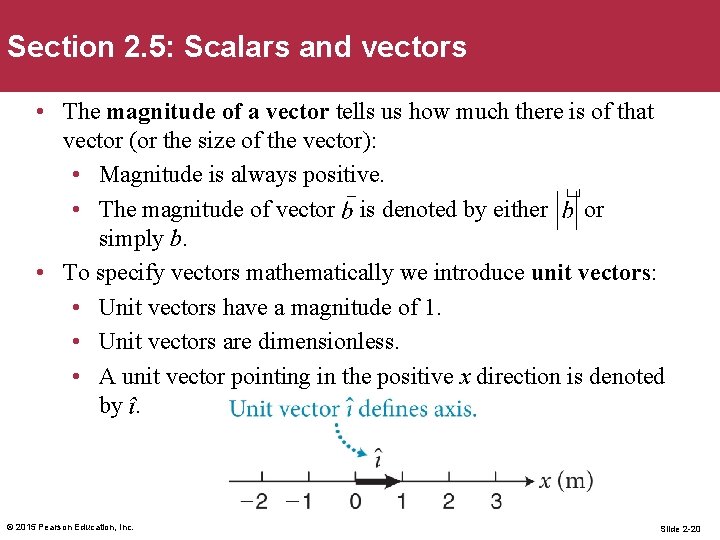
Section 2. 5: Scalars and vectors • The magnitude of a vector tells us how much there is of that vector (or the size of the vector): • Magnitude is always positive. • The magnitude of vector is denoted by either or simply b. • To specify vectors mathematically we introduce unit vectors: • Unit vectors have a magnitude of 1. • Unit vectors are dimensionless. • A unit vector pointing in the positive x direction is denoted by. © 2015 Pearson Education, Inc. Slide 2 -20
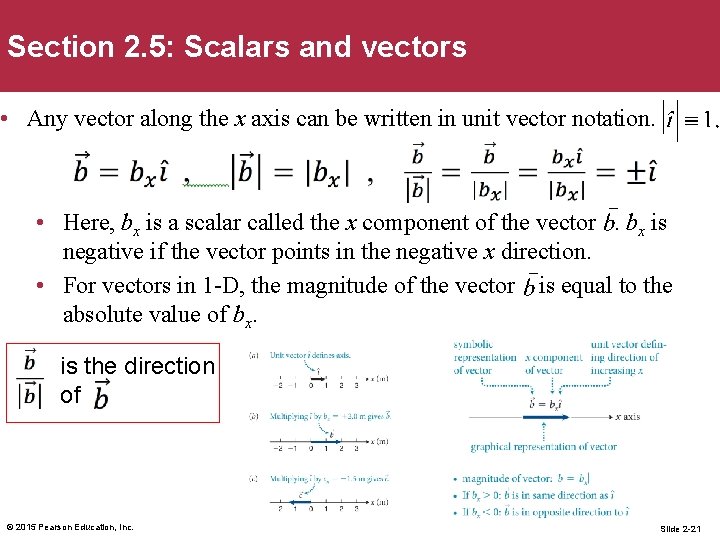
Section 2. 5: Scalars and vectors • Any vector along the x axis can be written in unit vector notation. • Here, bx is a scalar called the x component of the vector. bx is negative if the vector points in the negative x direction. • For vectors in 1 -D, the magnitude of the vector is equal to the absolute value of bx. is the direction of © 2015 Pearson Education, Inc. Slide 2 -21
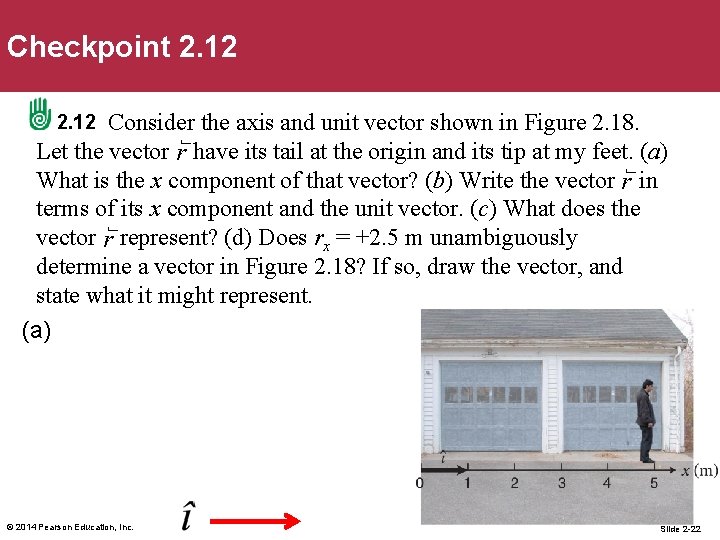
Checkpoint 2. 12 Consider the axis and unit vector shown in Figure 2. 18. Let the vector have its tail at the origin and its tip at my feet. (a) What is the x component of that vector? (b) Write the vector in terms of its x component and the unit vector. (c) What does the vector represent? (d) Does rx = +2. 5 m unambiguously determine a vector in Figure 2. 18? If so, draw the vector, and state what it might represent. (a) 2. 12 © 2014 Pearson Education, Inc. Slide 2 -22
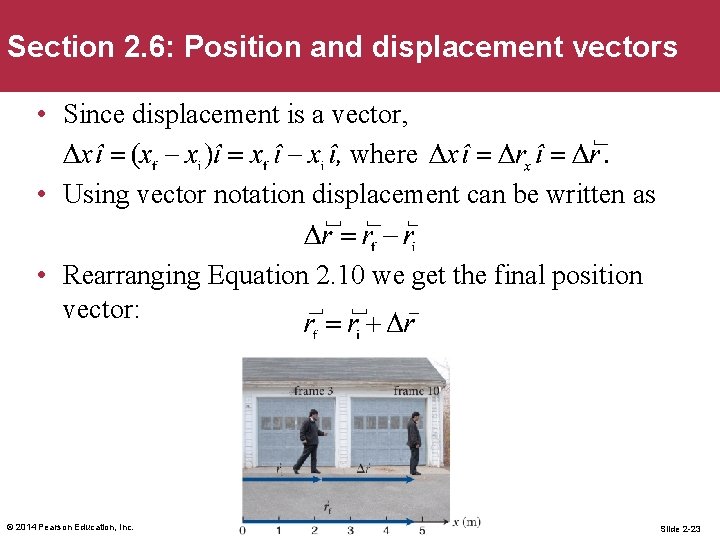
Section 2. 6: Position and displacement vectors • Since displacement is a vector, where • Using vector notation displacement can be written as • Rearranging Equation 2. 10 we get the final position vector: © 2014 Pearson Education, Inc. Slide 2 -23
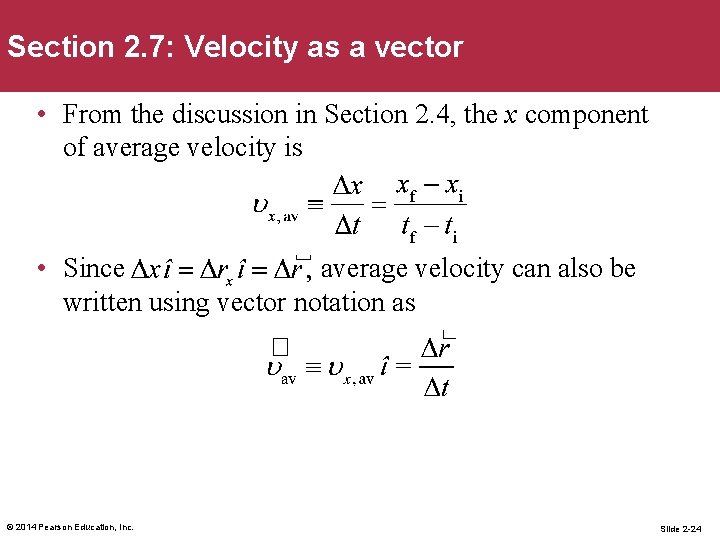
Section 2. 7: Velocity as a vector • From the discussion in Section 2. 4, the x component of average velocity is • Since average velocity can also be written using vector notation as © 2014 Pearson Education, Inc. Slide 2 -24
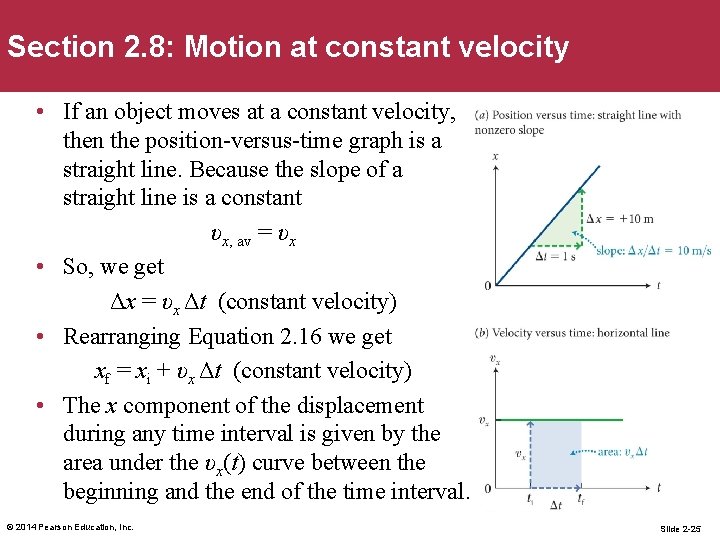
Section 2. 8: Motion at constant velocity • If an object moves at a constant velocity, then the position-versus-time graph is a straight line. Because the slope of a straight line is a constant υx, av = υx • So, we get Δx = υx Δt (constant velocity) • Rearranging Equation 2. 16 we get xf = xi + υx Δt (constant velocity) • The x component of the displacement during any time interval is given by the area under the υx(t) curve between the beginning and the end of the time interval. © 2014 Pearson Education, Inc. Slide 2 -25
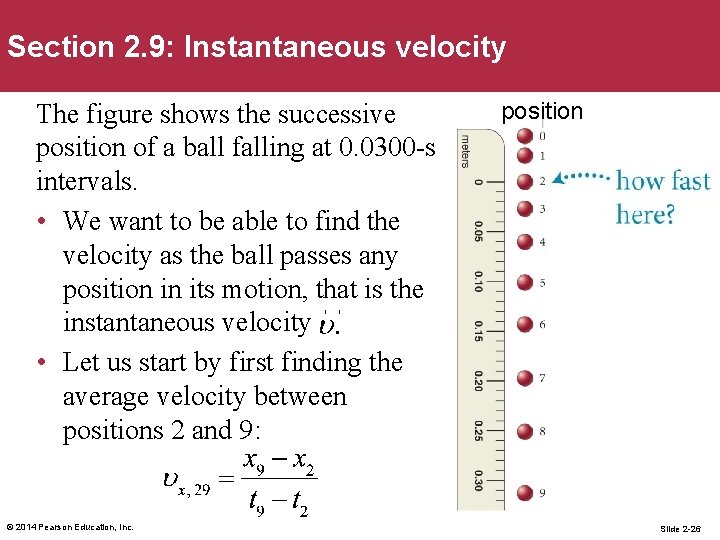
Section 2. 9: Instantaneous velocity The figure shows the successive position of a ball falling at 0. 0300 -s intervals. • We want to be able to find the velocity as the ball passes any position in its motion, that is the instantaneous velocity • Let us start by first finding the average velocity between positions 2 and 9: © 2014 Pearson Education, Inc. position Slide 2 -26
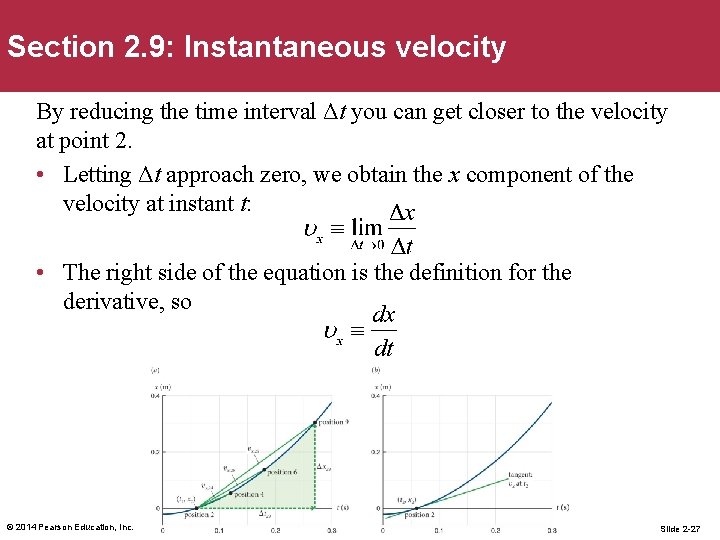
Section 2. 9: Instantaneous velocity By reducing the time interval Δt you can get closer to the velocity at point 2. • Letting Δt approach zero, we obtain the x component of the velocity at instant t: • The right side of the equation is the definition for the derivative, so © 2014 Pearson Education, Inc. Slide 2 -27
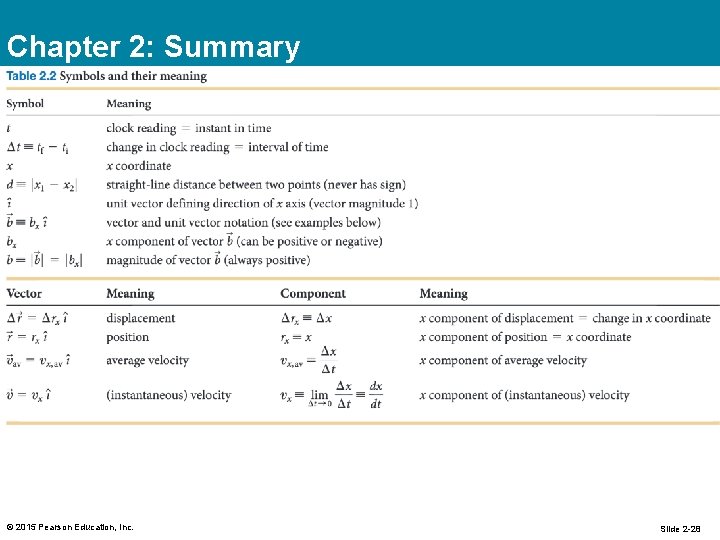
Chapter 2: Summary © 2015 Pearson Education, Inc. Slide 2 -28