
Lecture Outline Chapter 15 Normal and Active Galaxies
- Slides: 42
Lecture Outline Chapter 15 Normal and Active Galaxies Copyright © 2010 Pearson Education, Inc.
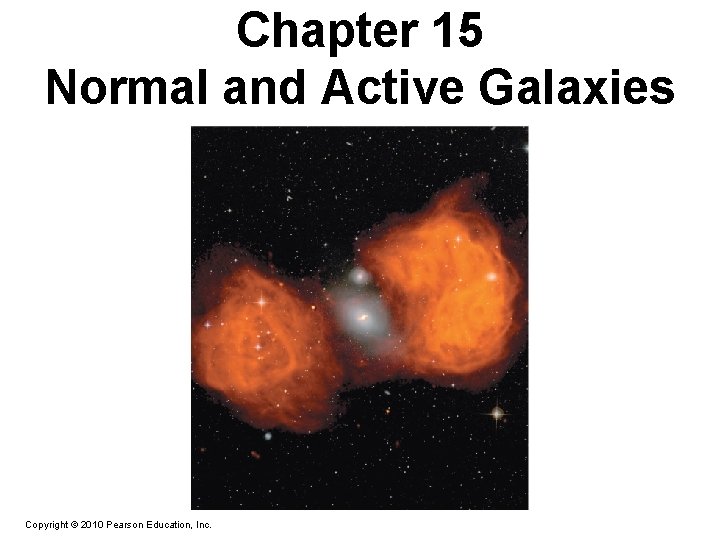
Chapter 15 Normal and Active Galaxies Copyright © 2010 Pearson Education, Inc.
Units of Chapter 15 Hubble’s Galaxy Classification The Distribution of Galaxies in Space Hubble’s Law Active Galactic Nuclei The Central Engine of an Active Galaxy Summary of Chapter 15 Copyright © 2010 Pearson Education, Inc.
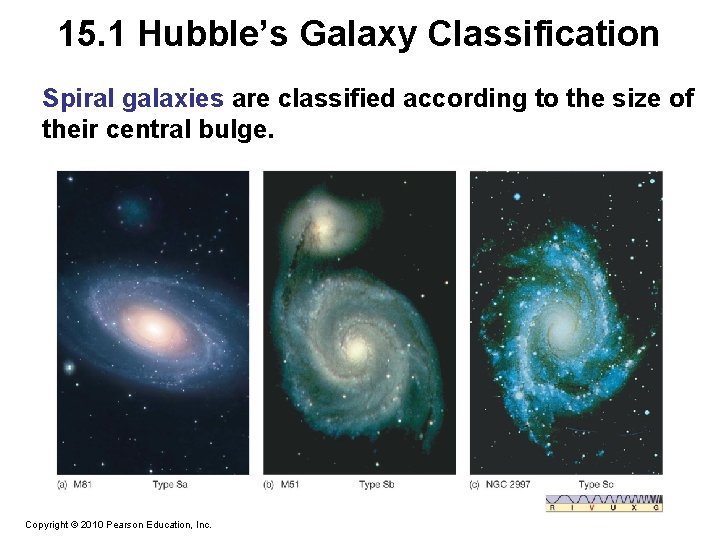
15. 1 Hubble’s Galaxy Classification Spiral galaxies are classified according to the size of their central bulge. Copyright © 2010 Pearson Education, Inc.
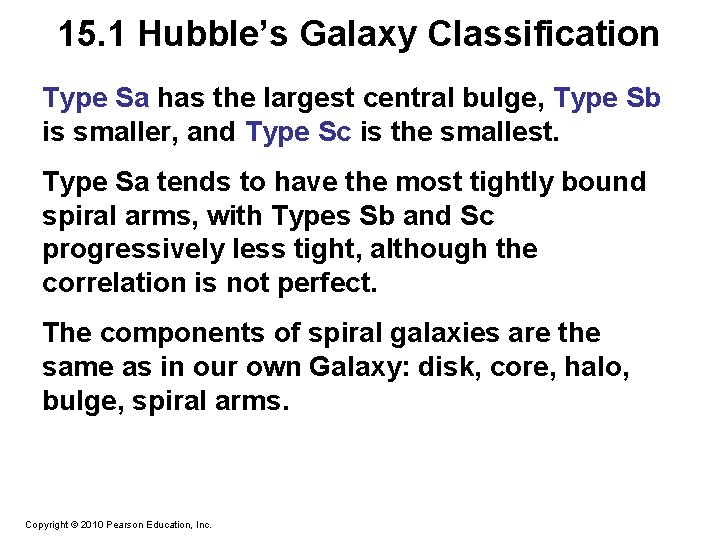
15. 1 Hubble’s Galaxy Classification Type Sa has the largest central bulge, Type Sb is smaller, and Type Sc is the smallest. Type Sa tends to have the most tightly bound spiral arms, with Types Sb and Sc progressively less tight, although the correlation is not perfect. The components of spiral galaxies are the same as in our own Galaxy: disk, core, halo, bulge, spiral arms. Copyright © 2010 Pearson Education, Inc.
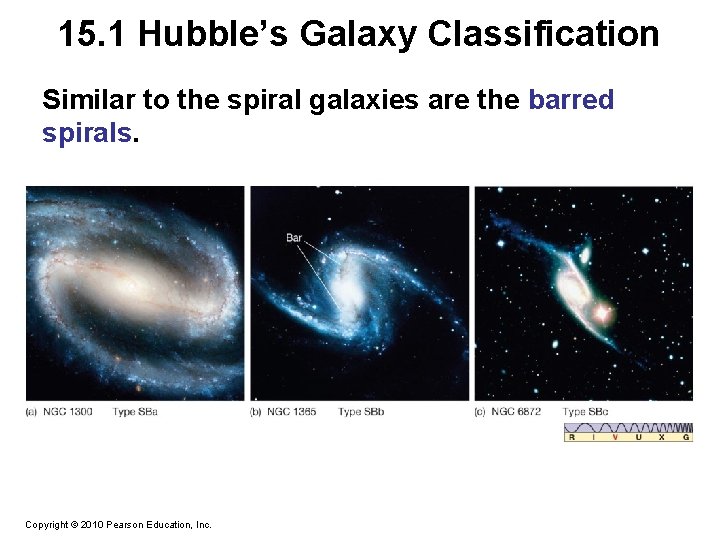
15. 1 Hubble’s Galaxy Classification Similar to the spiral galaxies are the barred spirals. Copyright © 2010 Pearson Education, Inc.
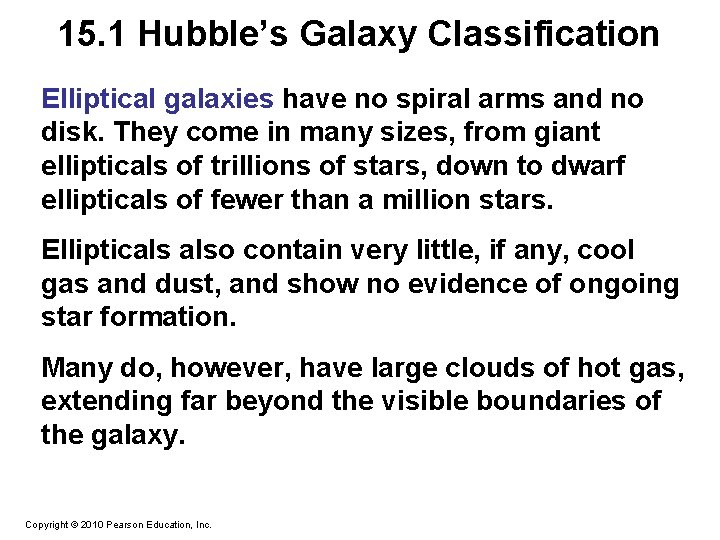
15. 1 Hubble’s Galaxy Classification Elliptical galaxies have no spiral arms and no disk. They come in many sizes, from giant ellipticals of trillions of stars, down to dwarf ellipticals of fewer than a million stars. Ellipticals also contain very little, if any, cool gas and dust, and show no evidence of ongoing star formation. Many do, however, have large clouds of hot gas, extending far beyond the visible boundaries of the galaxy. Copyright © 2010 Pearson Education, Inc.
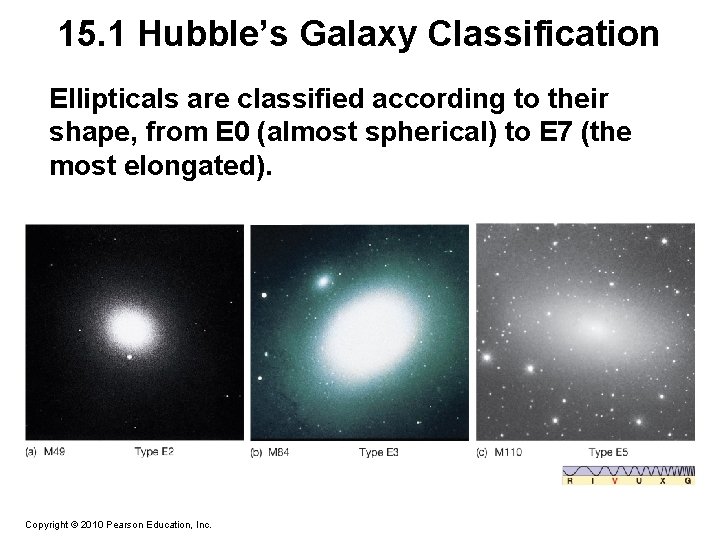
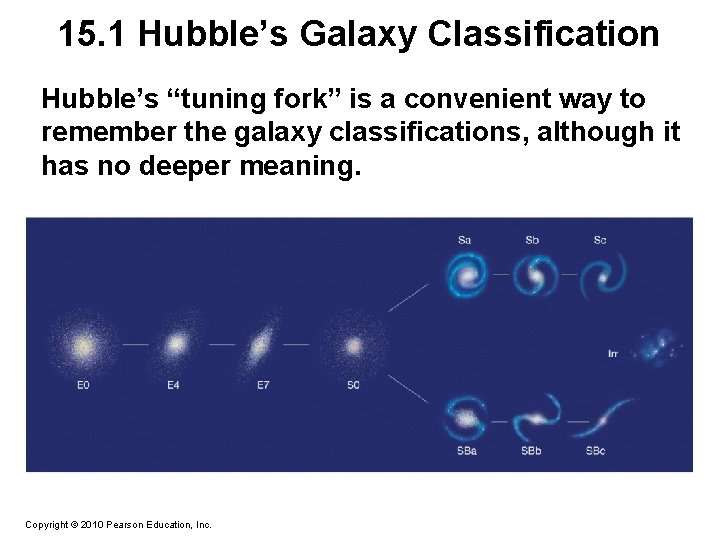
15. 1 Hubble’s Galaxy Classification Ellipticals are classified according to their shape, from E 0 (almost spherical) to E 7 (the most elongated). Copyright © 2010 Pearson Education, Inc.
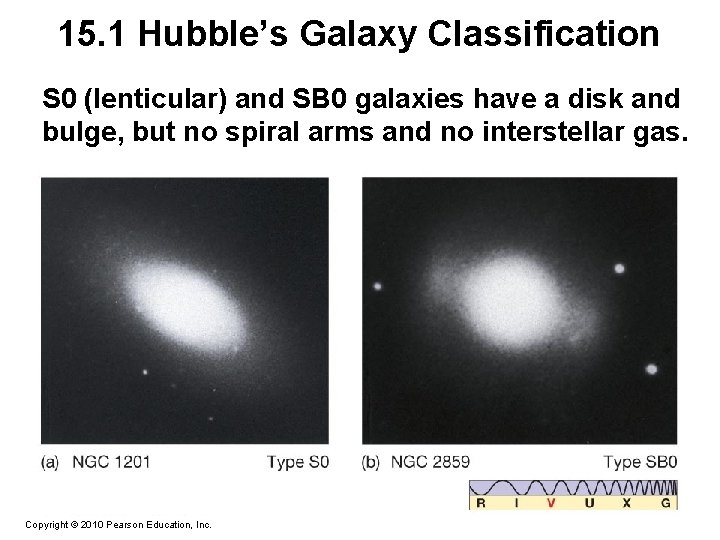
15. 1 Hubble’s Galaxy Classification S 0 (lenticular) and SB 0 galaxies have a disk and bulge, but no spiral arms and no interstellar gas. Copyright © 2010 Pearson Education, Inc.
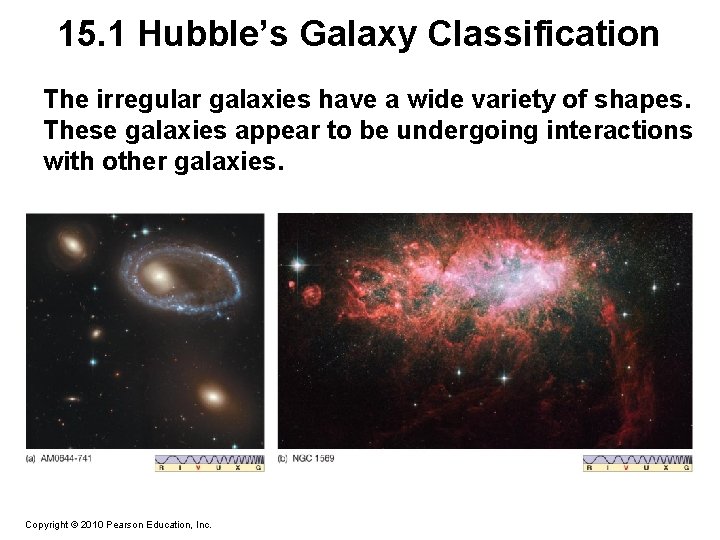
15. 1 Hubble’s Galaxy Classification The irregular galaxies have a wide variety of shapes. These galaxies appear to be undergoing interactions with other galaxies. Copyright © 2010 Pearson Education, Inc.
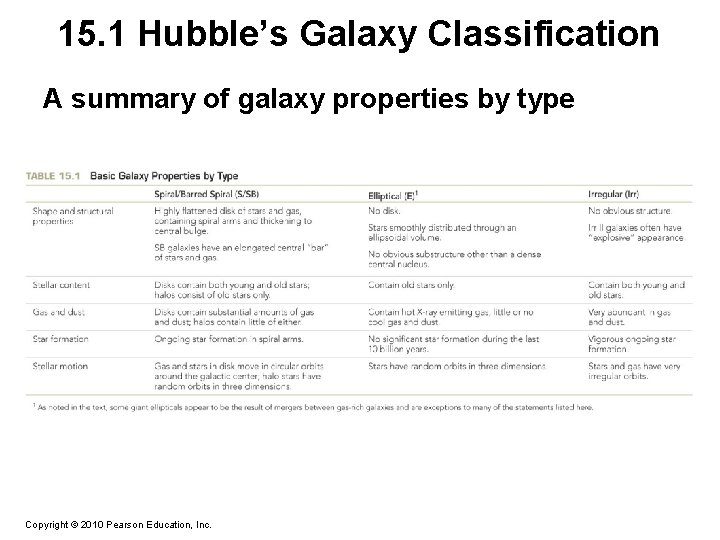
15. 1 Hubble’s Galaxy Classification A summary of galaxy properties by type Copyright © 2010 Pearson Education, Inc.
15. 1 Hubble’s Galaxy Classification Hubble’s “tuning fork” is a convenient way to remember the galaxy classifications, although it has no deeper meaning. Copyright © 2010 Pearson Education, Inc.
15. 2 The Distribution of Galaxies in Space Cepheid variables allow measurement of galaxies to about 25 Mpc away. However, most galaxies are farther away then 25 Mpc. New distance measures are needed. • Tully-Fisher relation correlates a galaxy’s rotation speed (which can be measured using the Doppler effect) to its luminosity. • Type I supernovae all have about the same luminosity, as the process by which they happen doesn’t allow for much variation. Copyright © 2010 Pearson Education, Inc.
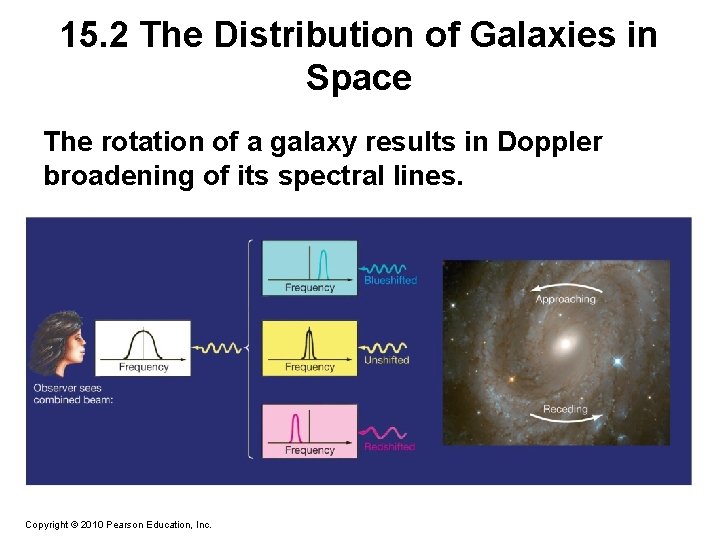
15. 2 The Distribution of Galaxies in Space The rotation of a galaxy results in Doppler broadening of its spectral lines. Copyright © 2010 Pearson Education, Inc.
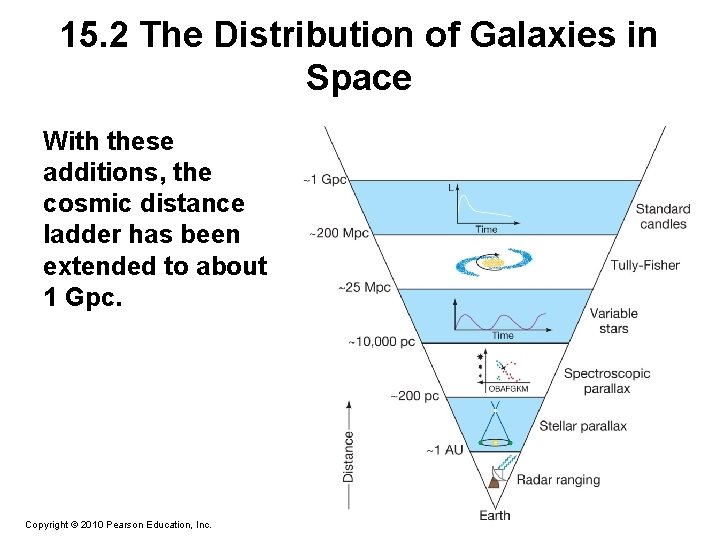
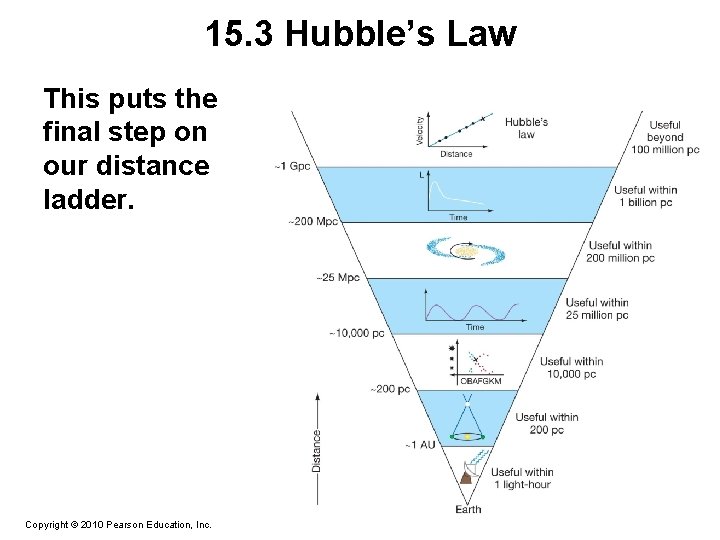
15. 2 The Distribution of Galaxies in Space With these additions, the cosmic distance ladder has been extended to about 1 Gpc. Copyright © 2010 Pearson Education, Inc.
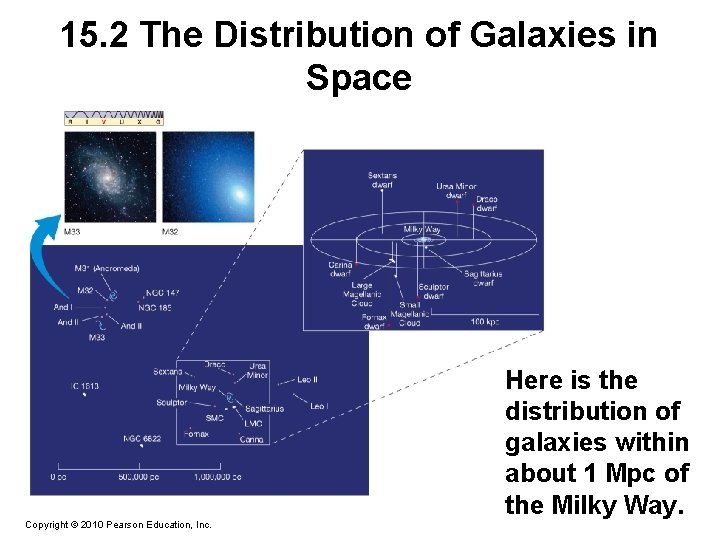
15. 2 The Distribution of Galaxies in Space Copyright © 2010 Pearson Education, Inc. Here is the distribution of galaxies within about 1 Mpc of the Milky Way.
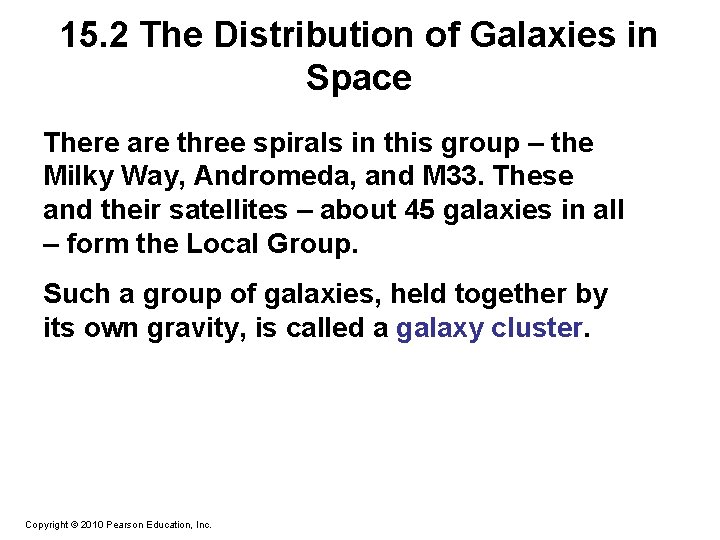
15. 2 The Distribution of Galaxies in Space There are three spirals in this group – the Milky Way, Andromeda, and M 33. These and their satellites – about 45 galaxies in all – form the Local Group. Such a group of galaxies, held together by its own gravity, is called a galaxy cluster. Copyright © 2010 Pearson Education, Inc.
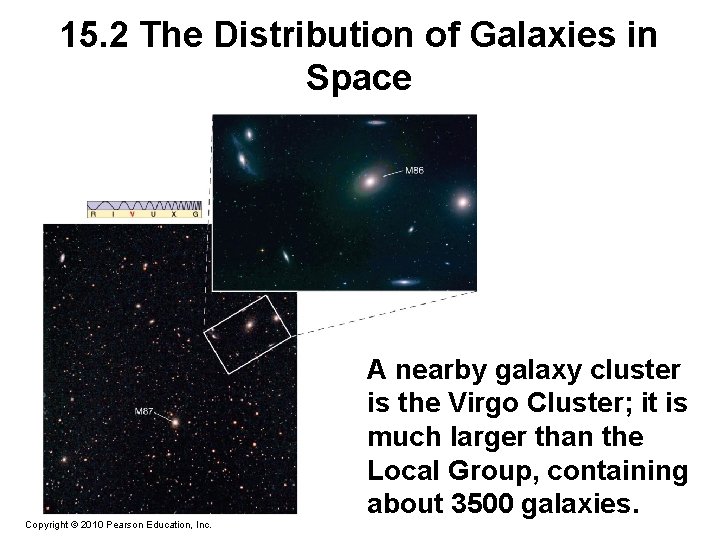
15. 2 The Distribution of Galaxies in Space Copyright © 2010 Pearson Education, Inc. A nearby galaxy cluster is the Virgo Cluster; it is much larger than the Local Group, containing about 3500 galaxies.
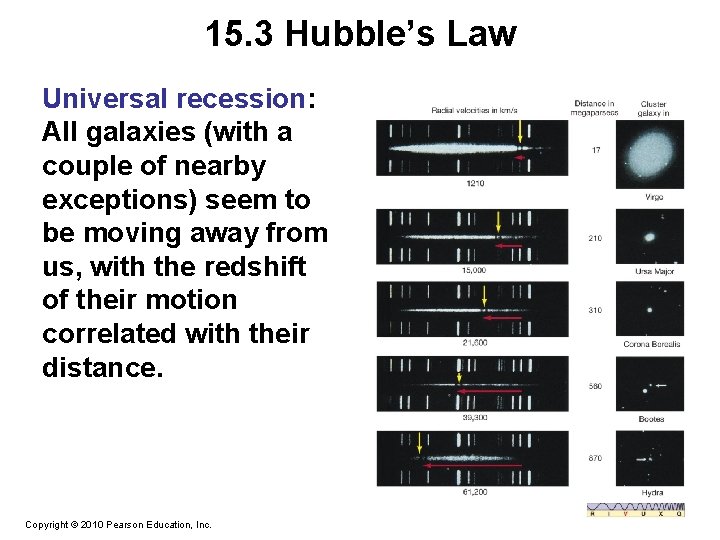
15. 3 Hubble’s Law Universal recession: All galaxies (with a couple of nearby exceptions) seem to be moving away from us, with the redshift of their motion correlated with their distance. Copyright © 2010 Pearson Education, Inc.
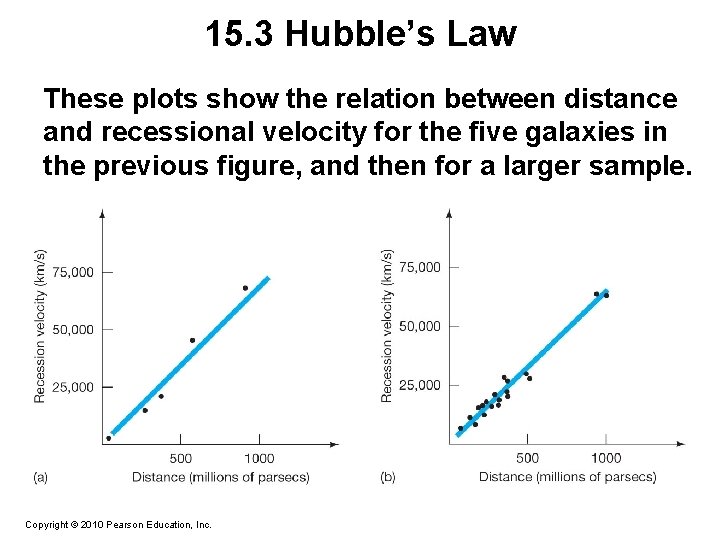
15. 3 Hubble’s Law These plots show the relation between distance and recessional velocity for the five galaxies in the previous figure, and then for a larger sample. Copyright © 2010 Pearson Education, Inc.
15. 3 Hubble’s Law The relationship (slope of the line) is characterized by Hubble’s constant H 0: recessional velocity = H 0 distance The value of Hubble’s constant is currently uncertain, with most estimates ranging from 50 to 80 km/s/Mpc. Measuring distances using Hubble’s law actually works better the farther away the object is; random motions are overwhelmed by the recessional velocity. Copyright © 2010 Pearson Education, Inc.
15. 3 Hubble’s Law This puts the final step on our distance ladder. Copyright © 2010 Pearson Education, Inc.
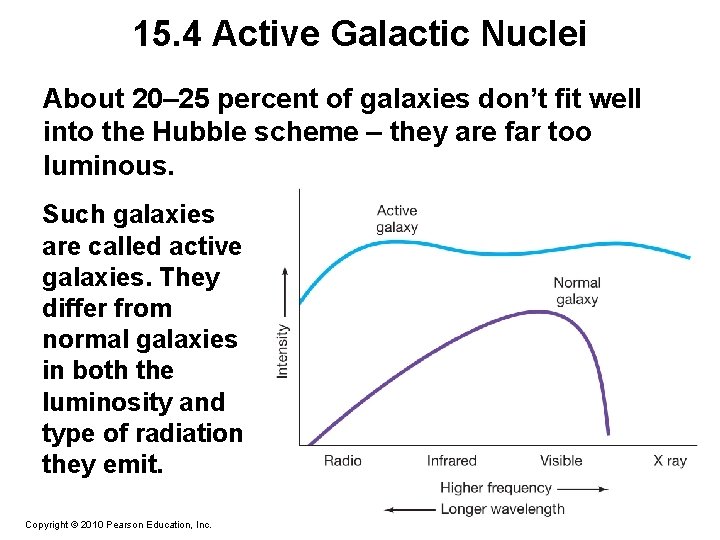
15. 4 Active Galactic Nuclei About 20– 25 percent of galaxies don’t fit well into the Hubble scheme – they are far too luminous. Such galaxies are called active galaxies. They differ from normal galaxies in both the luminosity and type of radiation they emit. Copyright © 2010 Pearson Education, Inc.
15. 4 Active Galactic Nuclei The radiation from these galaxies is called nonstellar radiation. Many luminous galaxies are experiencing an outburst of star formation, probably due to interactions with a neighbor. These galaxies are called starburst galaxies, and we will discuss them later. The galaxies we will discuss now are those whose activity is due to events occurring in and around the galactic center. Copyright © 2010 Pearson Education, Inc.
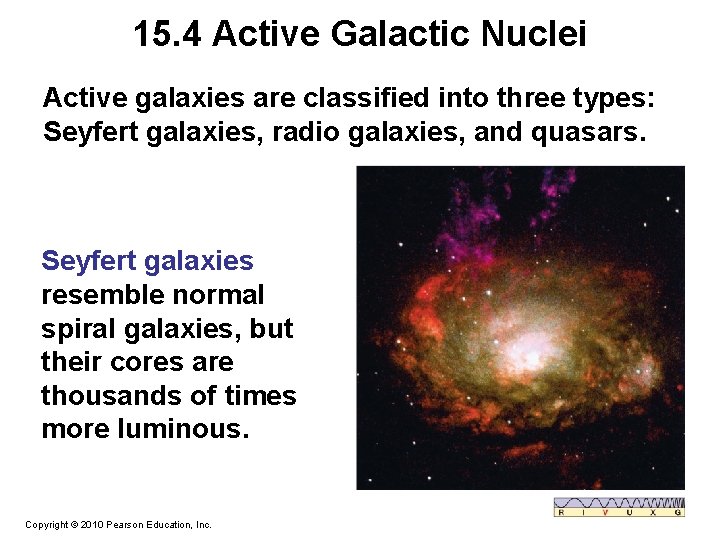
15. 4 Active Galactic Nuclei Active galaxies are classified into three types: Seyfert galaxies, radio galaxies, and quasars. Seyfert galaxies resemble normal spiral galaxies, but their cores are thousands of times more luminous. Copyright © 2010 Pearson Education, Inc.
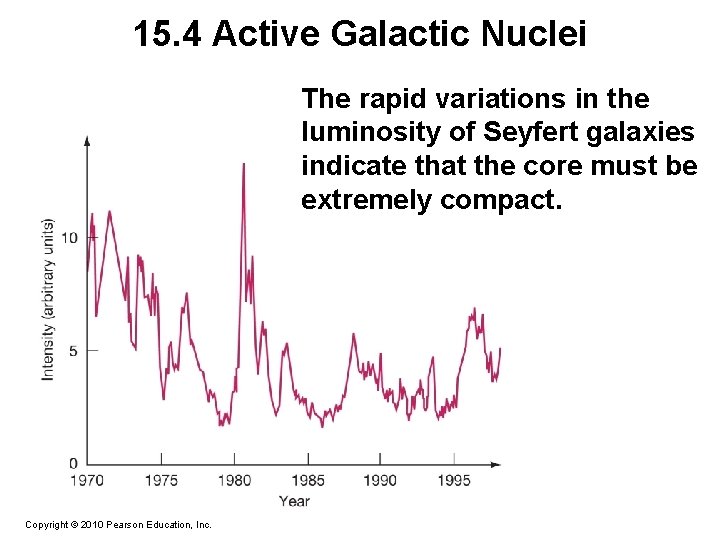
15. 4 Active Galactic Nuclei The rapid variations in the luminosity of Seyfert galaxies indicate that the core must be extremely compact. Copyright © 2010 Pearson Education, Inc.
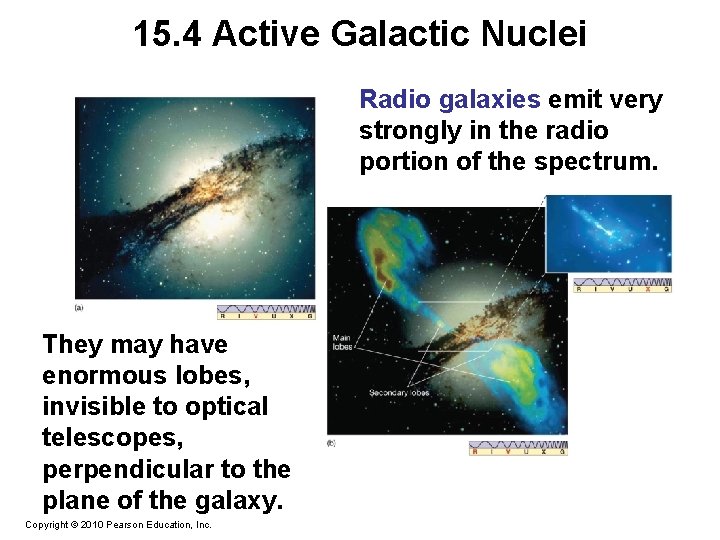
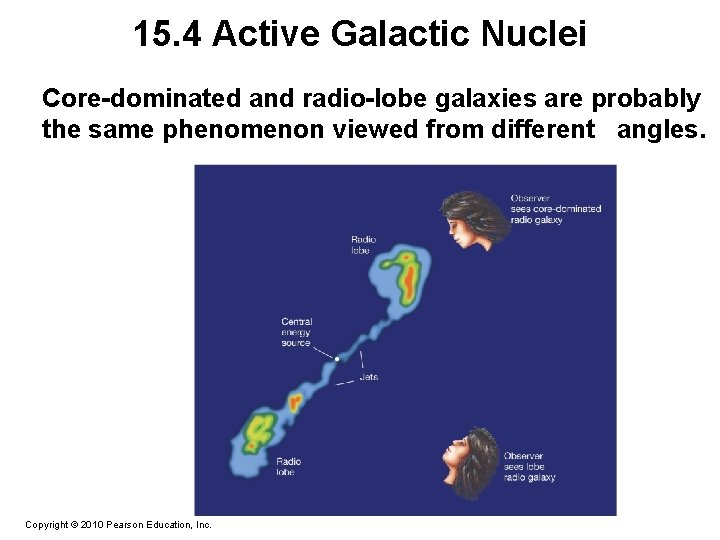
15. 4 Active Galactic Nuclei Radio galaxies emit very strongly in the radio portion of the spectrum. They may have enormous lobes, invisible to optical telescopes, perpendicular to the plane of the galaxy. Copyright © 2010 Pearson Education, Inc.
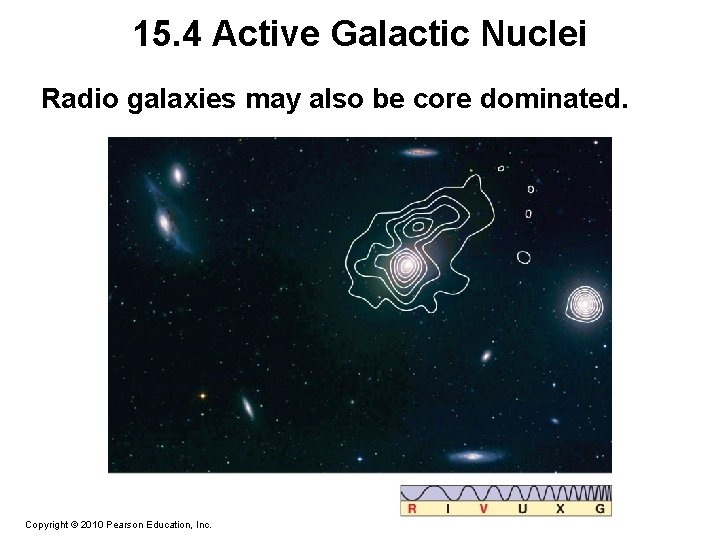
15. 4 Active Galactic Nuclei Radio galaxies may also be core dominated. Copyright © 2010 Pearson Education, Inc.
15. 4 Active Galactic Nuclei Core-dominated and radio-lobe galaxies are probably the same phenomenon viewed from different angles. Copyright © 2010 Pearson Education, Inc.
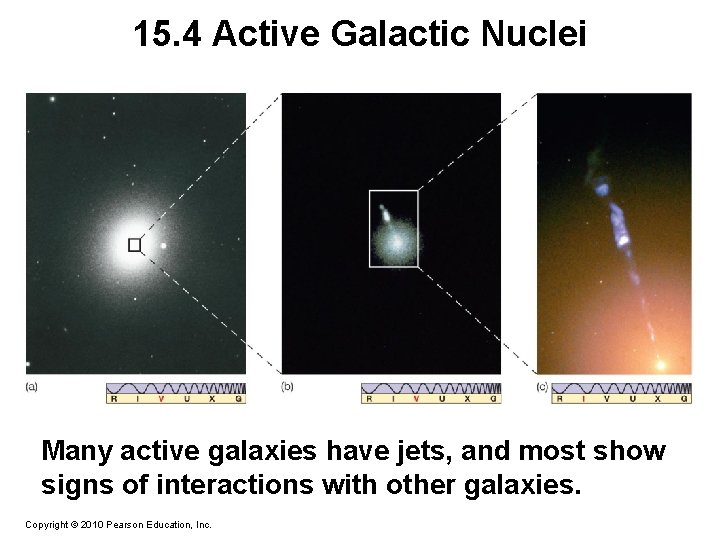
15. 4 Active Galactic Nuclei Many active galaxies have jets, and most show signs of interactions with other galaxies. Copyright © 2010 Pearson Education, Inc.
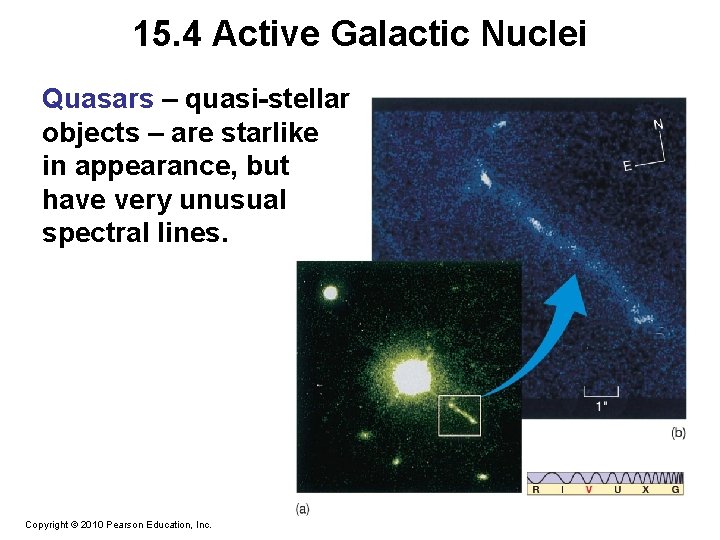
15. 4 Active Galactic Nuclei Quasars – quasi-stellar objects – are starlike in appearance, but have very unusual spectral lines. Copyright © 2010 Pearson Education, Inc.
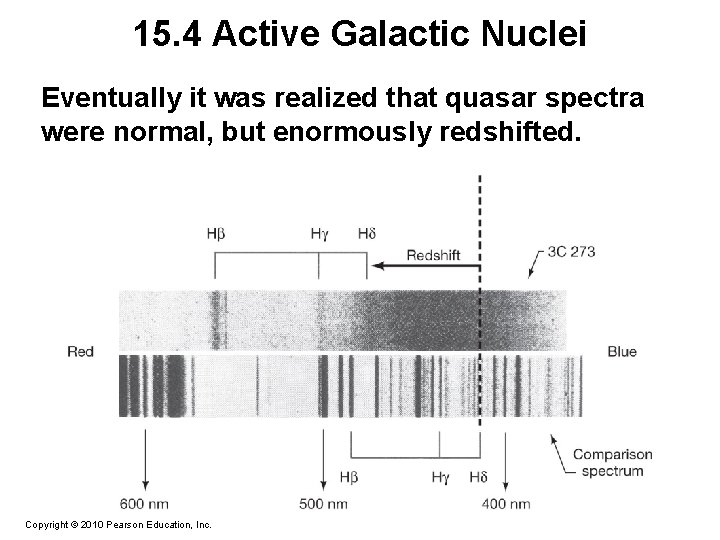
15. 4 Active Galactic Nuclei Eventually it was realized that quasar spectra were normal, but enormously redshifted. Copyright © 2010 Pearson Education, Inc.
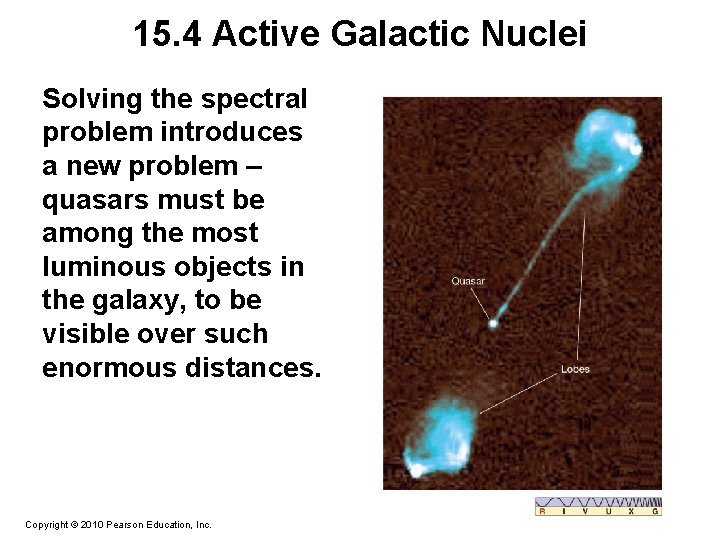
15. 4 Active Galactic Nuclei Solving the spectral problem introduces a new problem – quasars must be among the most luminous objects in the galaxy, to be visible over such enormous distances. Copyright © 2010 Pearson Education, Inc.
15. 5 The Central Engine of an Active Galaxy Active galactic nuclei have some or all of the following properties: • High luminosity • Nonstellar energy emission • Variable energy output, indicating small nucleus • Jets and other signs of explosive activity • Broad emission lines, indicating rapid rotation Copyright © 2010 Pearson Education, Inc.
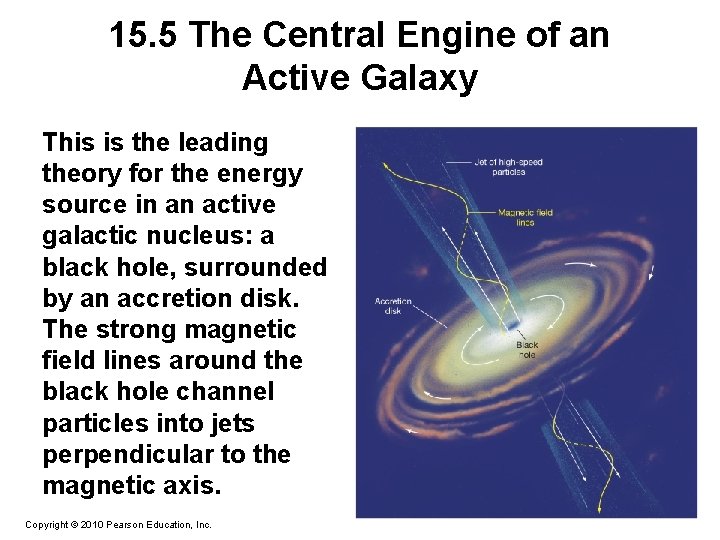
15. 5 The Central Engine of an Active Galaxy This is the leading theory for the energy source in an active galactic nucleus: a black hole, surrounded by an accretion disk. The strong magnetic field lines around the black hole channel particles into jets perpendicular to the magnetic axis. Copyright © 2010 Pearson Education, Inc.
15. 5 The Central Engine of an Active Galaxy In an active galaxy, the central black hole may be billions of solar masses. The accretion disk is whole clouds of interstellar gas and dust; they may radiate away as much as 10– 20 percent of their mass before disappearing. Copyright © 2010 Pearson Education, Inc.
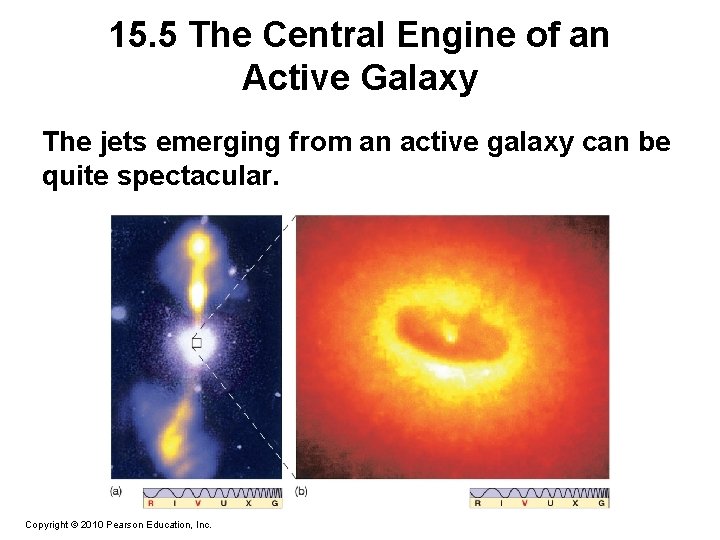
15. 5 The Central Engine of an Active Galaxy The jets emerging from an active galaxy can be quite spectacular. Copyright © 2010 Pearson Education, Inc.
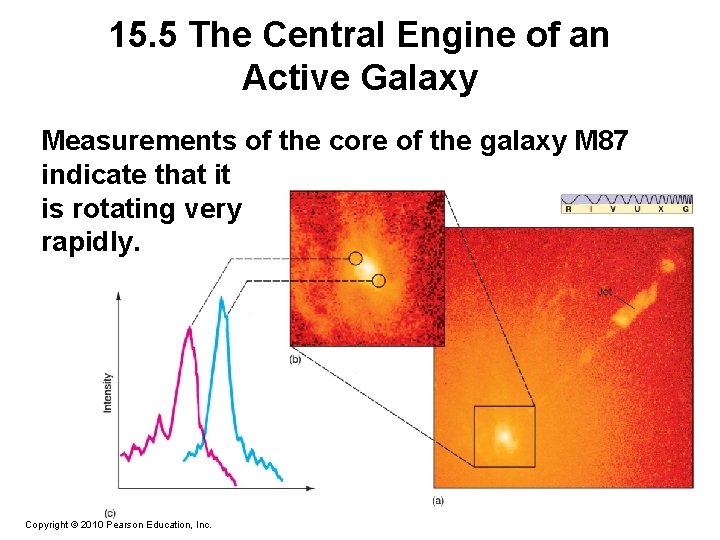
15. 5 The Central Engine of an Active Galaxy Measurements of the core of the galaxy M 87 indicate that it is rotating very rapidly. Copyright © 2010 Pearson Education, Inc.
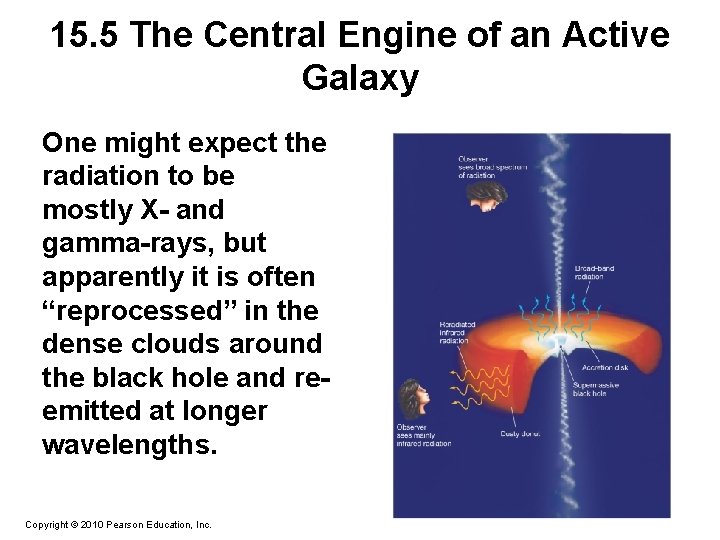
15. 5 The Central Engine of an Active Galaxy One might expect the radiation to be mostly X- and gamma-rays, but apparently it is often “reprocessed” in the dense clouds around the black hole and reemitted at longer wavelengths. Copyright © 2010 Pearson Education, Inc.
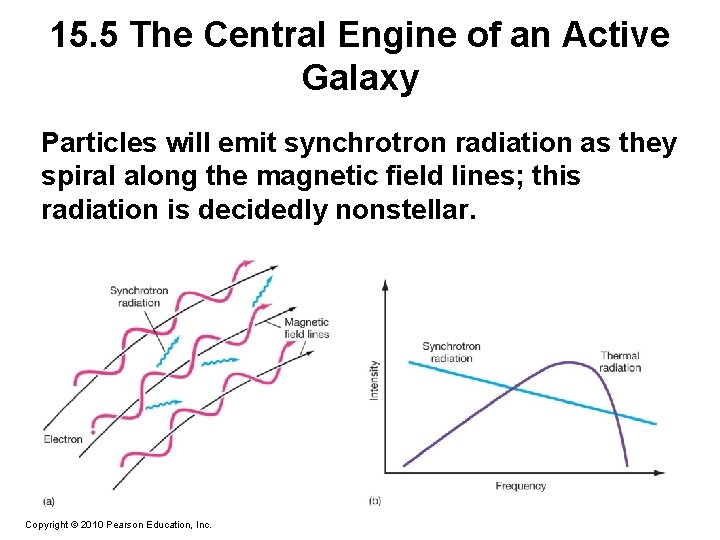
15. 5 The Central Engine of an Active Galaxy Particles will emit synchrotron radiation as they spiral along the magnetic field lines; this radiation is decidedly nonstellar. Copyright © 2010 Pearson Education, Inc.
Summary of Chapter 15 • Hubble classification organizes galaxies according to shape. • Galaxy types include spiral, barred spiral, elliptical, irregular. • Objects of relatively uniform luminosities are called “standard candles”; examples include RR Lyrae stars and Type I supernovae. • The Milky Way lies within a small cluster of galaxies called the Local Group. • Other galaxy clusters may contain thousands of galaxies. Copyright © 2010 Pearson Education, Inc.
Summary of Chapter 15, cont. • Hubble’s law: Galaxies recede from us faster the farther away they are. • Active galaxies are far more luminous than normal galaxies, and their radiation is nonstellar. • Seyfert galaxies, radio galaxies, and quasars all have very small cores; many emit high-speed jets. • Active galaxies are thought to contain supermassive black holes in their centers; infalling matter converts to energy, powering the galaxy. Copyright © 2010 Pearson Education, Inc.