
Lecture Osmoregulation and Excretion Osmoregulation balancing the uptake
Lecture Osmoregulation and Excretion
Osmoregulation • balancing the uptake and loss of water and solutes • based on the controlled movement of solutes between internal fluids and the external environment
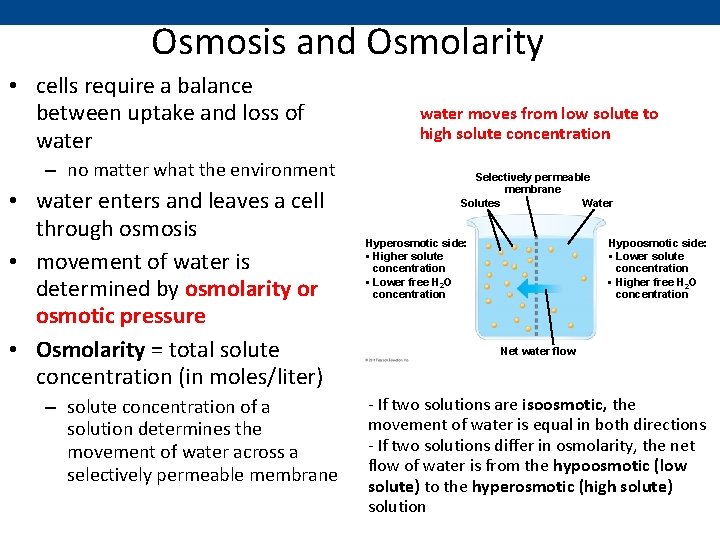
Osmosis and Osmolarity • cells require a balance between uptake and loss of water – no matter what the environment • water enters and leaves a cell through osmosis • movement of water is determined by osmolarity or osmotic pressure • Osmolarity = total solute concentration (in moles/liter) – solute concentration of a solution determines the movement of water across a selectively permeable membrane water moves from low solute to high solute concentration Selectively permeable membrane Solutes Water Hypoosmotic side: • Lower solute concentration • Higher free H 2 O concentration Hyperosmotic side: • Higher solute concentration • Lower free H 2 O concentration Net water flow - If two solutions are isoosmotic, the movement of water is equal in both directions - If two solutions differ in osmolarity, the net flow of water is from the hypoosmotic (low solute) to the hyperosmotic (high solute) solution
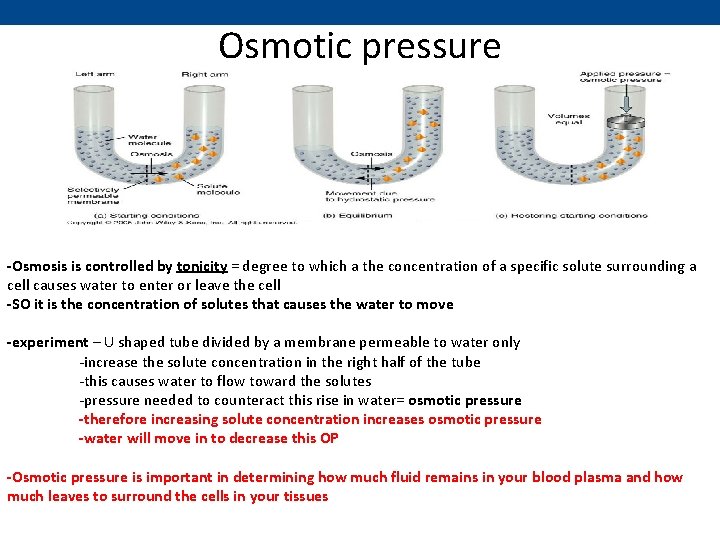
Osmotic pressure -Osmosis is controlled by tonicity = degree to which a the concentration of a specific solute surrounding a cell causes water to enter or leave the cell -SO it is the concentration of solutes that causes the water to move -experiment – U shaped tube divided by a membrane permeable to water only -increase the solute concentration in the right half of the tube -this causes water to flow toward the solutes -pressure needed to counteract this rise in water= osmotic pressure -therefore increasing solute concentration increases osmotic pressure -water will move in to decrease this OP -Osmotic pressure is important in determining how much fluid remains in your blood plasma and how much leaves to surround the cells in your tissues
Osmotic Challenges to Aquatic Animals • Osmoconformers – marine animals – are isoosmotic with their surroundings and do not regulate their osmolarity • e. g. all osmoconformers are marine • Osmoregulators – aquatic animals that expend energy to control water uptake and loss – exist in a hyperosmotic or hypoosmotic environment – can be freshwater, marine or animals that live in temporary waters • e. g. most marine vertebrates and some invertebrates are osmoregulators – can also be terrestrial animals too!
• aquatic animals can be classified on how well they tolerate changes in external osmolarity • stenohaline - cannot tolerate substantial changes in external osmolarity • euryhaline - can survive large fluctuations in external osmolarity
Marine Animals • all osmoconformers are marine • internal osmolarity of its tissue fluids is the same as its environment – no tendency to gain or lose water • but they can differ significantly in the concentrations of specific solutes – e. g. magnesium in seawater = 50 m. M; Altantic lobster = 9 m. M • must actively transport these solutes to maintain homeostasis • but not all marine animals are osmoconformers!!! – most marine animals are osmoregulators
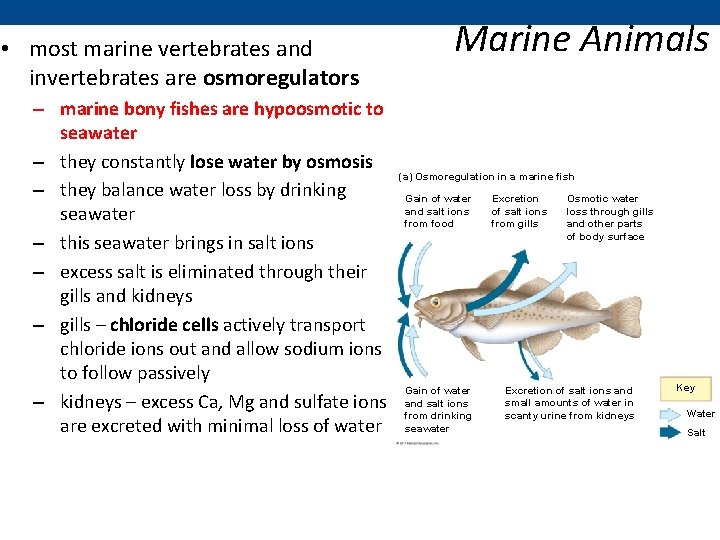
• most marine vertebrates and invertebrates are osmoregulators – marine bony fishes are hypoosmotic to seawater – they constantly lose water by osmosis – they balance water loss by drinking seawater – this seawater brings in salt ions – excess salt is eliminated through their gills and kidneys – gills – chloride cells actively transport chloride ions out and allow sodium ions to follow passively – kidneys – excess Ca, Mg and sulfate ions are excreted with minimal loss of water Marine Animals (a) Osmoregulation in a marine fish Gain of water and salt ions from food Gain of water and salt ions from drinking seawater Excretion of salt ions from gills Osmotic water loss through gills and other parts of body surface Excretion of salt ions and small amounts of water in scanty urine from kidneys Key Water Salt
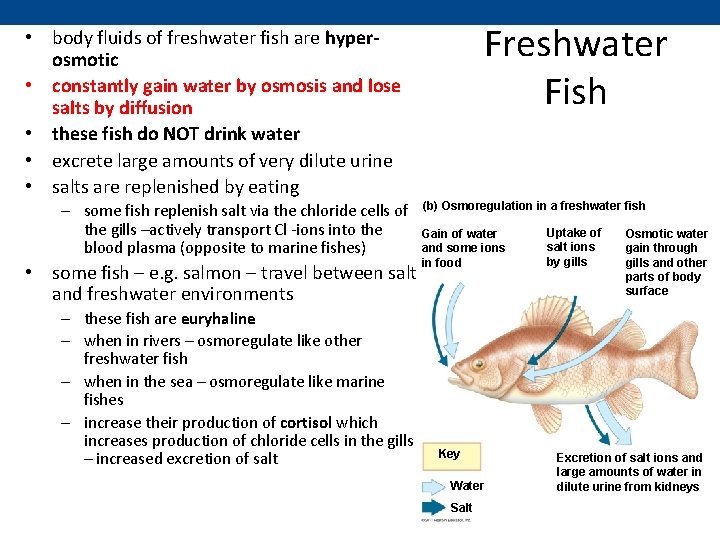
Freshwater Fish • body fluids of freshwater fish are hyperosmotic • constantly gain water by osmosis and lose salts by diffusion • these fish do NOT drink water • excrete large amounts of very dilute urine • salts are replenished by eating – some fish replenish salt via the chloride cells of the gills –actively transport Cl -ions into the blood plasma (opposite to marine fishes) • some fish – e. g. salmon – travel between salt and freshwater environments – these fish are euryhaline – when in rivers – osmoregulate like other freshwater fish – when in the sea – osmoregulate like marine fishes – increase their production of cortisol which increases production of chloride cells in the gills – increased excretion of salt (b) Osmoregulation in a freshwater fish Gain of water and some ions in food Key Water Salt Uptake of salt ions by gills Osmotic water gain through gills and other parts of body surface Excretion of salt ions and large amounts of water in dilute urine from kidneys
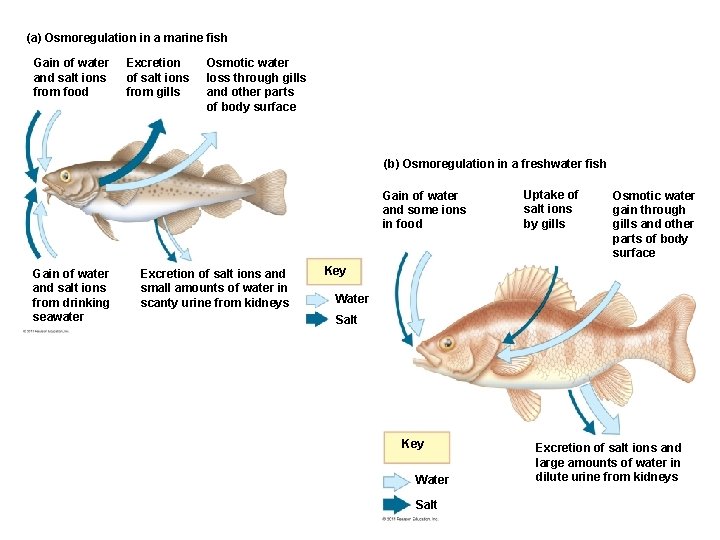
(a) Osmoregulation in a marine fish Gain of water and salt ions from food Excretion of salt ions from gills Osmotic water loss through gills and other parts of body surface (b) Osmoregulation in a freshwater fish Gain of water and some ions in food Gain of water and salt ions from drinking seawater Excretion of salt ions and small amounts of water in scanty urine from kidneys Uptake of salt ions by gills Osmotic water gain through gills and other parts of body surface Key Water Salt Excretion of salt ions and large amounts of water in dilute urine from kidneys
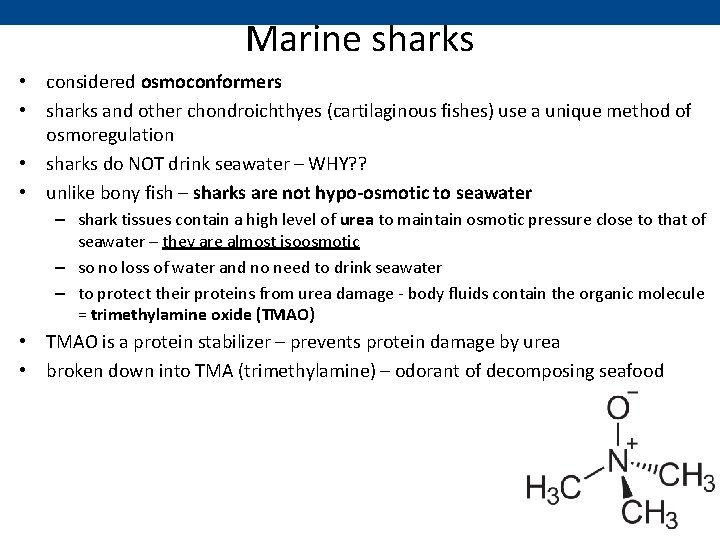
Marine sharks • considered osmoconformers • sharks and other chondroichthyes (cartilaginous fishes) use a unique method of osmoregulation • sharks do NOT drink seawater – WHY? ? • unlike bony fish – sharks are not hypo-osmotic to seawater – shark tissues contain a high level of urea to maintain osmotic pressure close to that of seawater – they are almost isoosmotic – so no loss of water and no need to drink seawater – to protect their proteins from urea damage - body fluids contain the organic molecule = trimethylamine oxide (TMAO) • TMAO is a protein stabilizer – prevents protein damage by urea • broken down into TMA (trimethylamine) – odorant of decomposing seafood
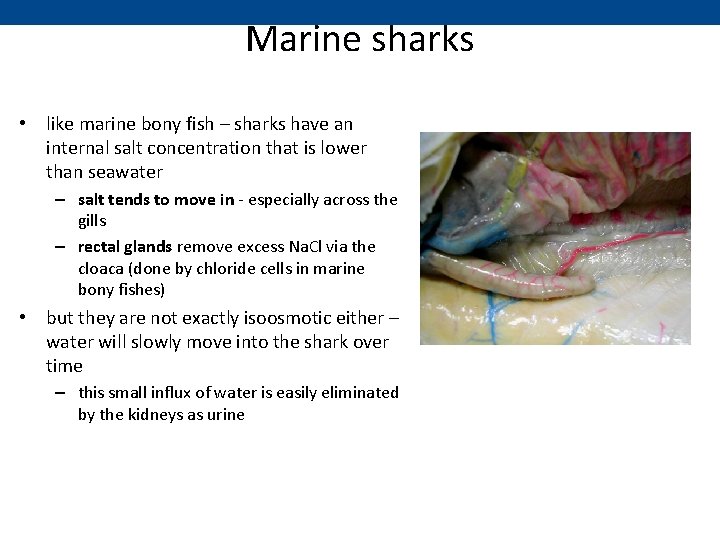
Marine sharks • like marine bony fish – sharks have an internal salt concentration that is lower than seawater – salt tends to move in - especially across the gills – rectal glands remove excess Na. Cl via the cloaca (done by chloride cells in marine bony fishes) • but they are not exactly isoosmotic either – water will slowly move into the shark over time – this small influx of water is easily eliminated by the kidneys as urine
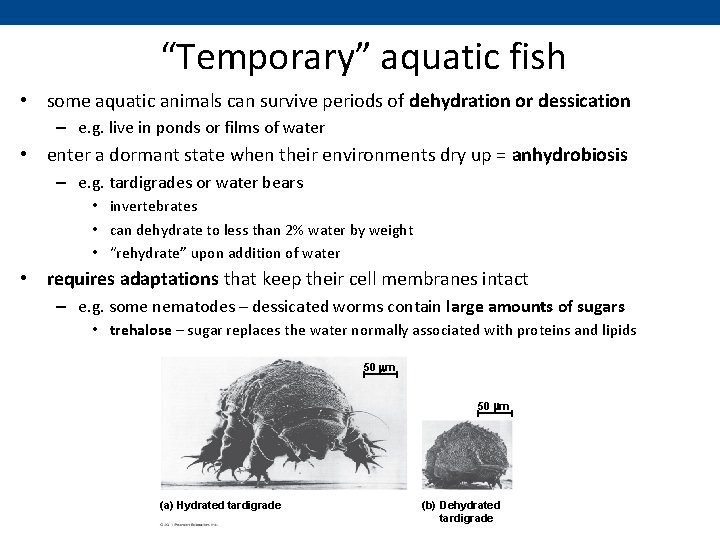
“Temporary” aquatic fish • some aquatic animals can survive periods of dehydration or dessication – e. g. live in ponds or films of water • enter a dormant state when their environments dry up = anhydrobiosis – e. g. tardigrades or water bears • invertebrates • can dehydrate to less than 2% water by weight • “rehydrate” upon addition of water • requires adaptations that keep their cell membranes intact – e. g. some nematodes – dessicated worms contain large amounts of sugars • trehalose – sugar replaces the water normally associated with proteins and lipids 50 m (a) Hydrated tardigrade (b) Dehydrated tardigrade
Terrestrial animals • threat of dehydration is constant • routes for water loss – urine & feces – across respiratory surfaces – across skin • adaptations to reduce water loss are key to survival on land – humans – loss of 12% body water = death • 1. ) body coverings of most terrestrial animals help prevent dehydration • 2. ) behavioral modifications - desert animals & nocturnal lifestyle • 3. ) acquisition of water through eating moist food and producing water metabolically through cellular respiration
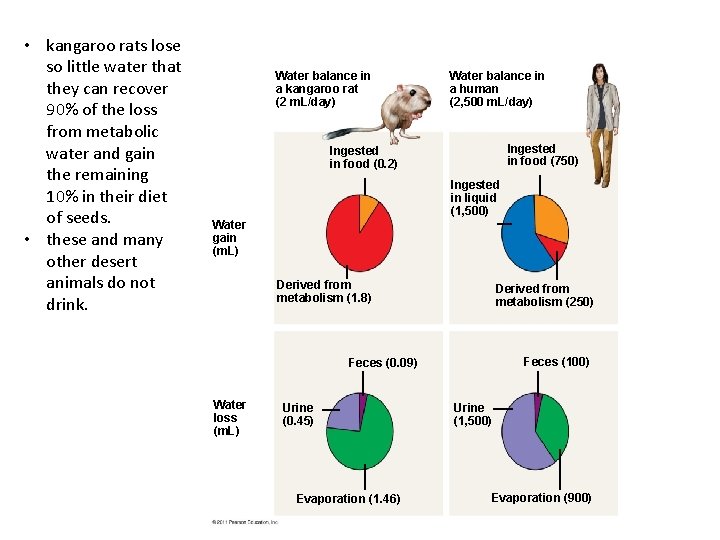
• kangaroo rats lose so little water that they can recover 90% of the loss from metabolic water and gain the remaining 10% in their diet of seeds. • these and many other desert animals do not drink. Water balance in a kangaroo rat (2 m. L/day) Water balance in a human (2, 500 m. L/day) Ingested in food (750) Ingested in food (0. 2) Ingested in liquid (1, 500) Water gain (m. L) Derived from metabolism (1. 8) Derived from metabolism (250) Feces (100) Feces (0. 09) Water loss (m. L) Urine (0. 45) Evaporation (1. 46) Urine (1, 500) Evaporation (900)
Osmoregulation and Energy • Osmoregulators must expend energy to maintain osmotic gradients • the amount of energy differs based on: – 1. how different the animal’s osmolarity is from its surroundings – 2. how easily water and solutes move across the animal’s surface – 3. the work required to pump solutes across the membrane • to minimize this energy cost – most animals have body fluids that are close to the salinity of their environment – freshwater animals – lower solute concentrations vs. those in seawater – freshwater mollusc = 40 m. Osm/L – saltwater mollusc = 1000 m. Osm/L (sea water 1000 m. Osm/L)
Transport Epithelia in Osmoregulation • most animals osmoregulate by regulating the solute content of body fluid that bathes their cells – in those animals with an open circulatory system – tissues are bathed in hemolymph – in those animals with a closed system – cells are bathed in interstitial fluid – derived from blood plasma • the composition of these fluids are maintained by osmoregulatory structures – range from single cells to complex tissues/organs – e. g. mammalian kidney
Transport Epithelia in Osmoregulation • most animals rely upon the presence of a transport epithelia – found in specific organs – one or more layers of epithelial cells that are specialized for moving solutes in specific directions – they are typically arranged in complex tubular networks
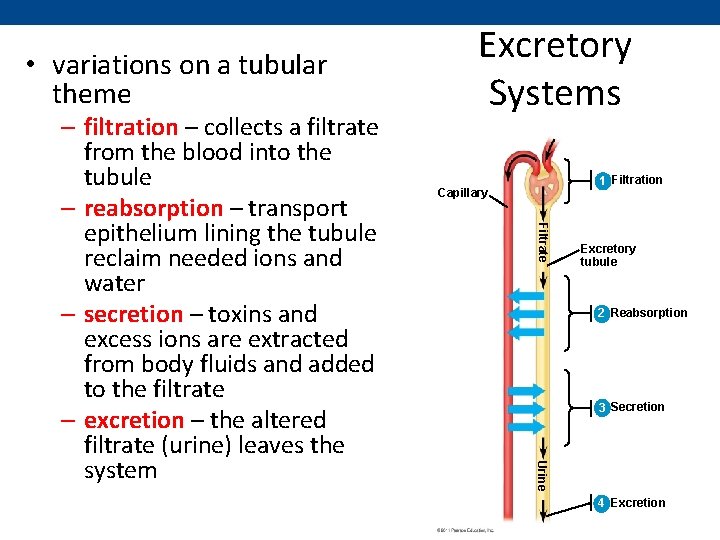
• variations on a tubular theme 1 Filtration Capillary Filtrate Excretory tubule 2 Reabsorption 3 Secretion Urine – filtration – collects a filtrate from the blood into the tubule – reabsorption – transport epithelium lining the tubule reclaim needed ions and water – secretion – toxins and excess ions are extracted from body fluids and added to the filtrate – excretion – the altered filtrate (urine) leaves the system Excretory Systems 4 Excretion
Excretory Systems • animal systems to dispose of metabolic wastes and control body fluid composition • 1. protonephridia • 2. metanephridia • 3. Malphigian tubules • 4. Nasal glands of marine birds • 5. Kidneys
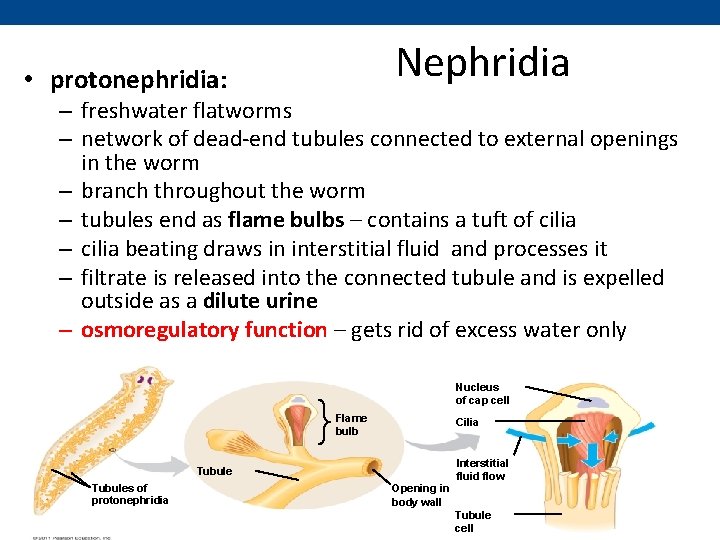
Nephridia • protonephridia: – freshwater flatworms – network of dead-end tubules connected to external openings in the worm – branch throughout the worm – tubules end as flame bulbs – contains a tuft of cilia – cilia beating draws in interstitial fluid and processes it – filtrate is released into the connected tubule and is expelled outside as a dilute urine – osmoregulatory function – gets rid of excess water only Nucleus of cap cell Flame bulb Cilia Interstitial fluid flow Tubules of protonephridia Opening in body wall Tubule cell
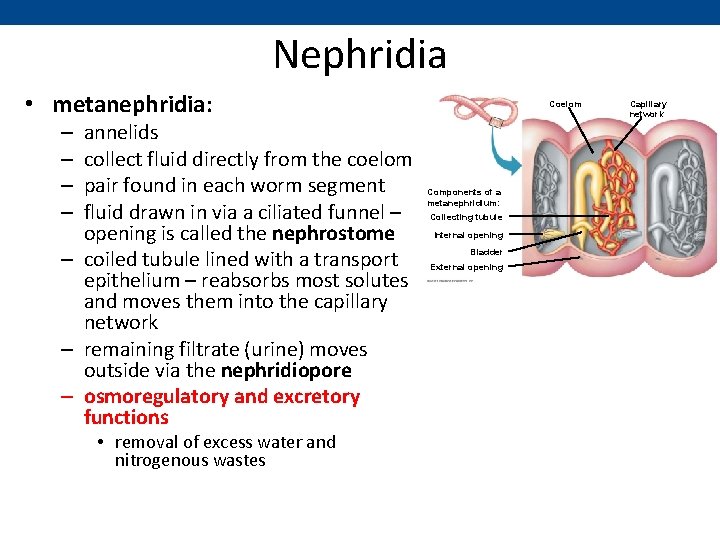
Nephridia • metanephridia: annelids collect fluid directly from the coelom pair found in each worm segment fluid drawn in via a ciliated funnel – opening is called the nephrostome – coiled tubule lined with a transport epithelium – reabsorbs most solutes and moves them into the capillary network – remaining filtrate (urine) moves outside via the nephridiopore – osmoregulatory and excretory functions – – • removal of excess water and nitrogenous wastes Coelom Components of a metanephridium: Collecting tubule Internal opening Bladder External opening Capillary network
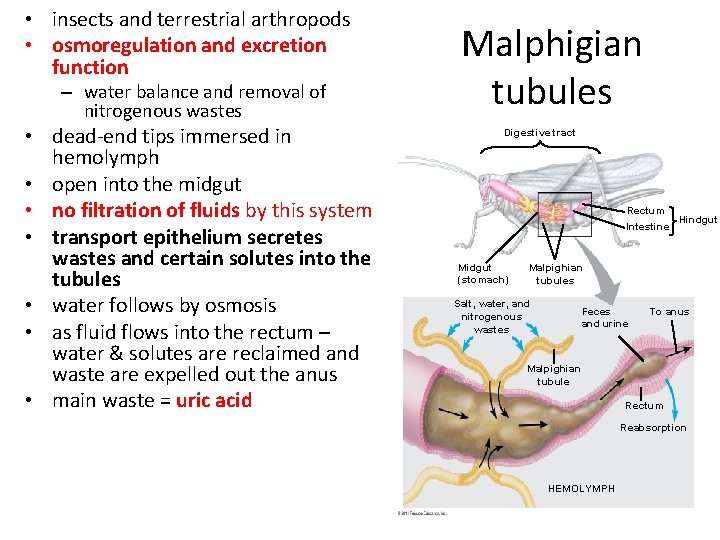
• insects and terrestrial arthropods • osmoregulation and excretion function – water balance and removal of nitrogenous wastes • dead-end tips immersed in hemolymph • open into the midgut • no filtration of fluids by this system • transport epithelium secretes wastes and certain solutes into the tubules • water follows by osmosis • as fluid flows into the rectum – water & solutes are reclaimed and waste are expelled out the anus • main waste = uric acid Malphigian tubules Digestive tract Rectum Intestine Midgut (stomach) Hindgut Malpighian tubules Salt, water, and nitrogenous wastes Feces and urine To anus Malpighian tubule Rectum Reabsorption HEMOLYMPH
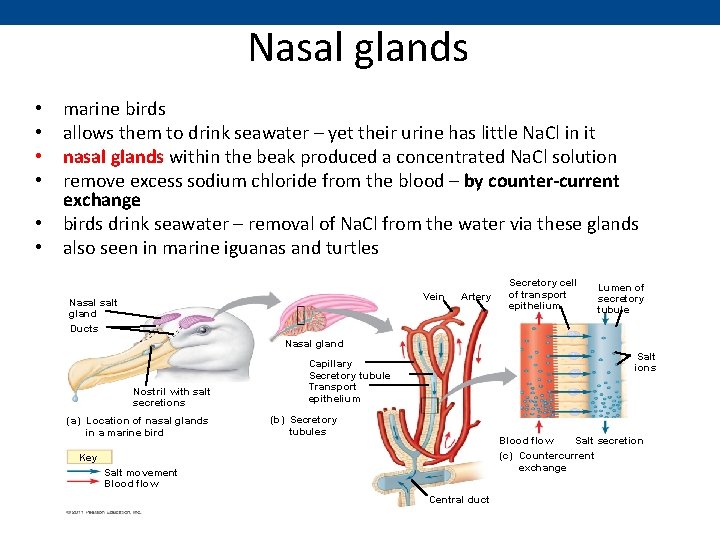
Nasal glands • • • marine birds allows them to drink seawater – yet their urine has little Na. Cl in it nasal glands within the beak produced a concentrated Na. Cl solution remove excess sodium chloride from the blood – by counter-current exchange birds drink seawater – removal of Na. Cl from the water via these glands also seen in marine iguanas and turtles Vein Nasal salt gland Ducts Artery Secretory cell of transport epithelium Lumen of secretory tubule Nasal gland Nostril with salt secretions (a) Location of nasal glands in a marine bird Salt ions Capillary Secretory tubule Transport epithelium (b) Secretory tubules Salt secretion Blood flow (c) Countercurrent exchange Key Salt movement Blood flow Central duct
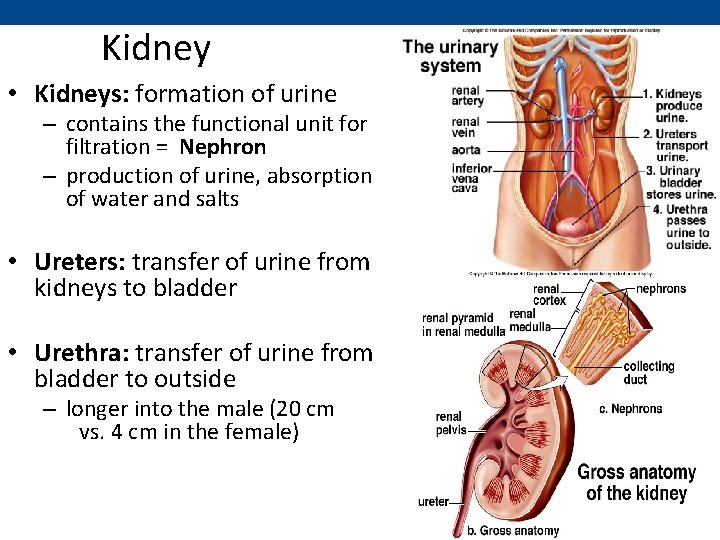
Kidney • Kidneys: formation of urine – contains the functional unit for filtration = Nephron – production of urine, absorption of water and salts • Ureters: transfer of urine from kidneys to bladder • Urethra: transfer of urine from bladder to outside – longer into the male (20 cm vs. 4 cm in the female)
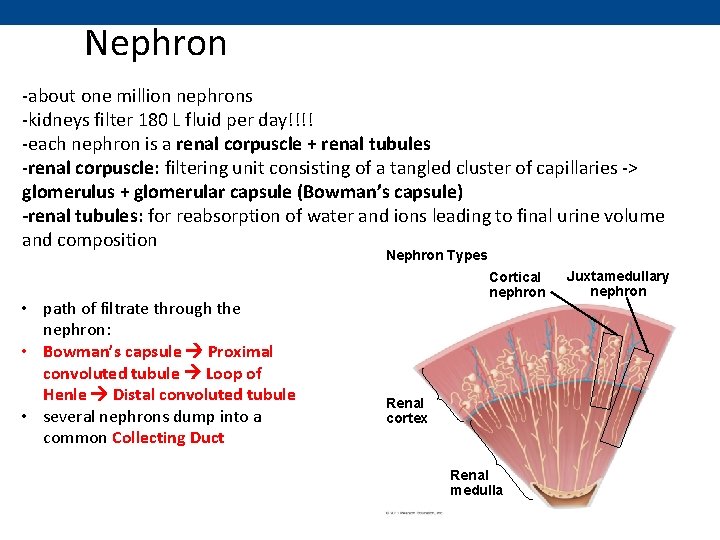
Nephron -about one million nephrons -kidneys filter 180 L fluid per day!!!! -each nephron is a renal corpuscle + renal tubules -renal corpuscle: filtering unit consisting of a tangled cluster of capillaries -> glomerulus + glomerular capsule (Bowman’s capsule) -renal tubules: for reabsorption of water and ions leading to final urine volume and composition Nephron Types • path of filtrate through the nephron: • Bowman’s capsule Proximal convoluted tubule Loop of Henle Distal convoluted tubule • several nephrons dump into a common Collecting Duct Cortical nephron Renal cortex Renal medulla Juxtamedullary nephron
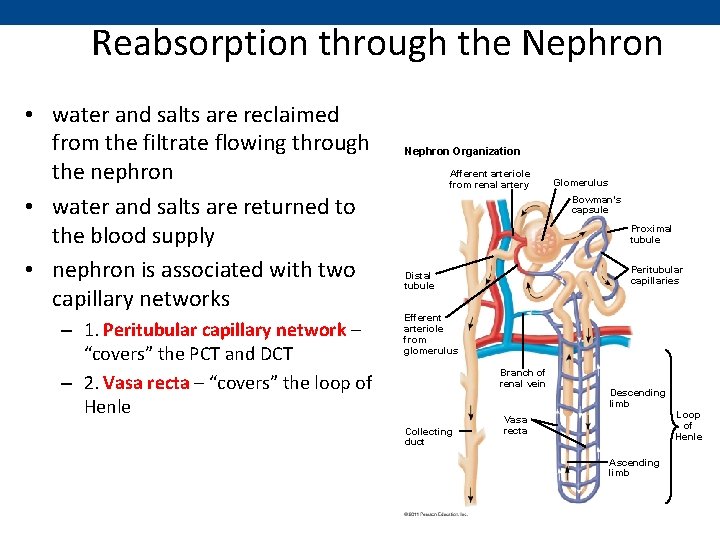
Reabsorption through the Nephron • water and salts are reclaimed from the filtrate flowing through the nephron • water and salts are returned to the blood supply • nephron is associated with two capillary networks – 1. Peritubular capillary network – “covers” the PCT and DCT – 2. Vasa recta – “covers” the loop of Henle Nephron Organization Afferent arteriole from renal artery Glomerulus Bowman’s capsule Proximal tubule Peritubular capillaries Distal tubule Efferent arteriole from glomerulus Branch of renal vein Collecting duct Descending limb Loop of Henle Vasa recta Ascending limb
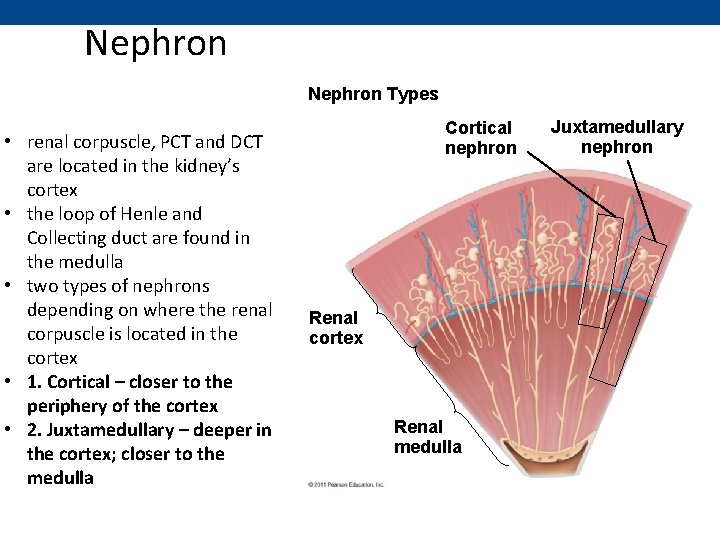
Nephron Types • renal corpuscle, PCT and DCT are located in the kidney’s cortex • the loop of Henle and Collecting duct are found in the medulla • two types of nephrons depending on where the renal corpuscle is located in the cortex • 1. Cortical – closer to the periphery of the cortex • 2. Juxtamedullary – deeper in the cortex; closer to the medulla Cortical nephron Renal cortex Renal medulla Juxtamedullary nephron
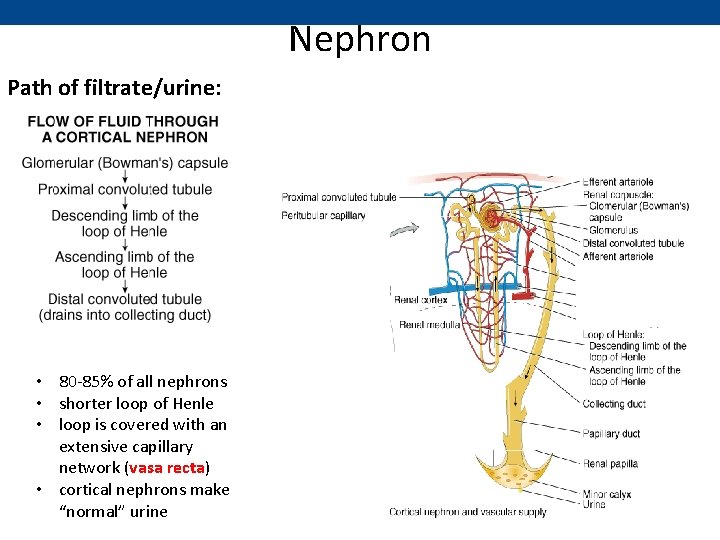
Nephron Path of filtrate/urine: • 80 -85% of all nephrons • shorter loop of Henle • loop is covered with an extensive capillary network (vasa recta) • cortical nephrons make “normal” urine
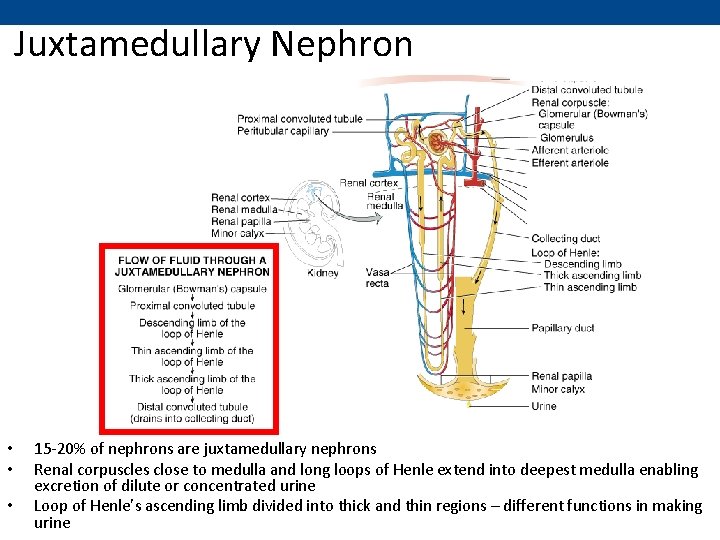
Juxtamedullary Nephron • • • 15 -20% of nephrons are juxtamedullary nephrons Renal corpuscles close to medulla and long loops of Henle extend into deepest medulla enabling excretion of dilute or concentrated urine Loop of Henle’s ascending limb divided into thick and thin regions – different functions in making urine
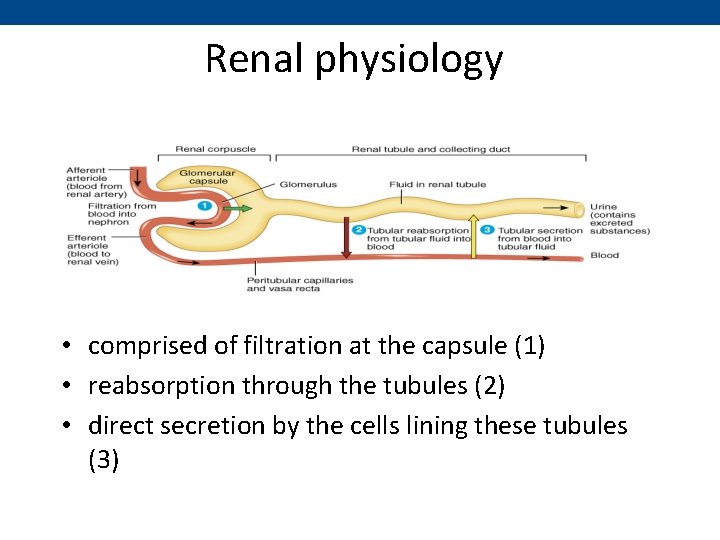
Renal physiology • comprised of filtration at the capsule (1) • reabsorption through the tubules (2) • direct secretion by the cells lining these tubules (3)
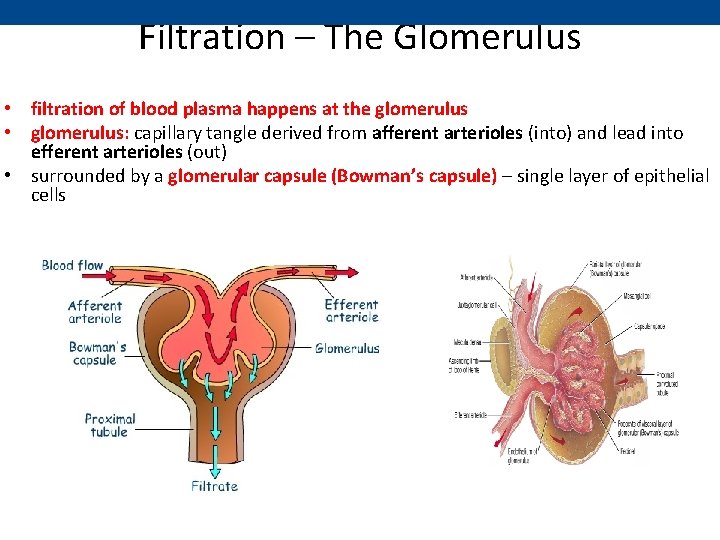
Filtration – The Glomerulus • filtration of blood plasma happens at the glomerulus • glomerulus: capillary tangle derived from afferent arterioles (into) and lead into efferent arterioles (out) • surrounded by a glomerular capsule (Bowman’s capsule) – single layer of epithelial cells
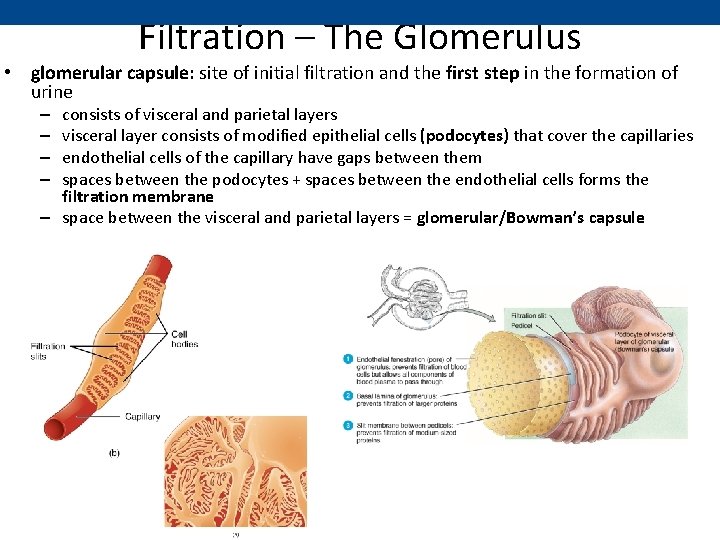
Filtration – The Glomerulus • glomerular capsule: site of initial filtration and the first step in the formation of urine consists of visceral and parietal layers visceral layer consists of modified epithelial cells (podocytes) that cover the capillaries endothelial cells of the capillary have gaps between them spaces between the podocytes + spaces between the endothelial cells forms the filtration membrane – space between the visceral and parietal layers = glomerular/Bowman’s capsule – –
Transport Epithelium of the Renal Tubule • following filtration at the Bowman’s capsule – the filtrate moves through the rest of the nephron for the reabsorption of salts and water • the transport epithelium of the PCT is a single layer of cuboidal epithelial cells with microvilli • cells change their shapes and structures in the loop of Henle (ascending limb= squamous; descending limb= cuboidal) and DCT (cuboidal) • each tubules cell type has a unique function in reabsorbing salts and water
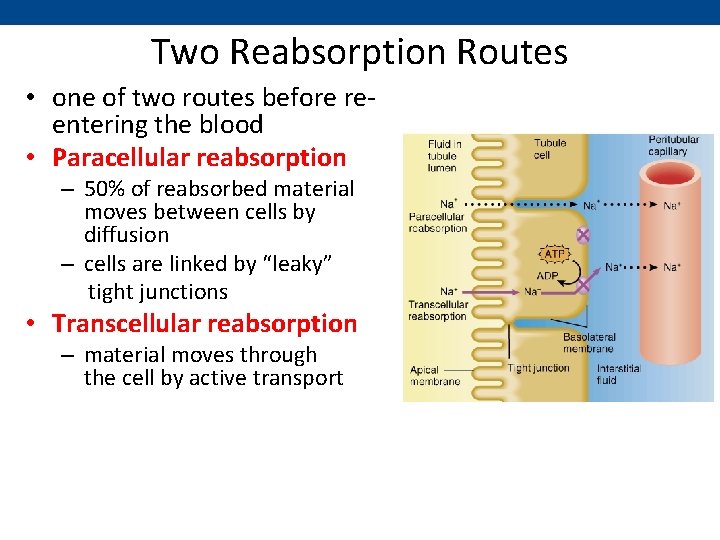
Two Reabsorption Routes • one of two routes before reentering the blood • Paracellular reabsorption – 50% of reabsorbed material moves between cells by diffusion – cells are linked by “leaky” tight junctions • Transcellular reabsorption – material moves through the cell by active transport
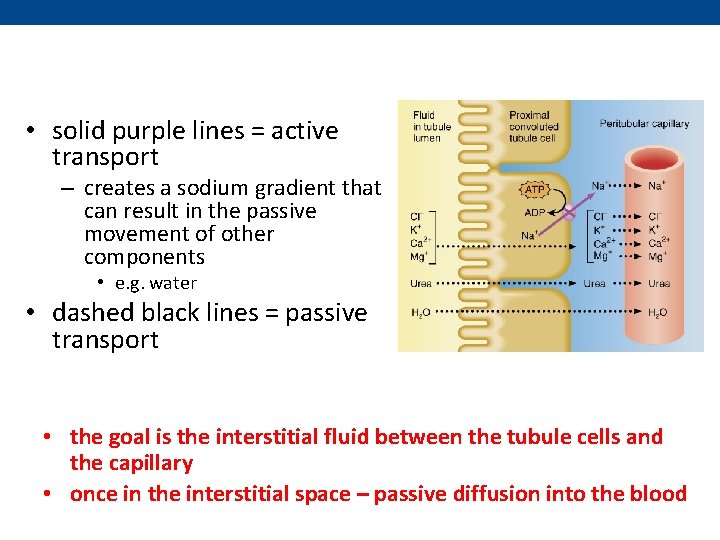
• solid purple lines = active transport – creates a sodium gradient that can result in the passive movement of other components • e. g. water • dashed black lines = passive transport • the goal is the interstitial fluid between the tubule cells and the capillary • once in the interstitial space – passive diffusion into the blood
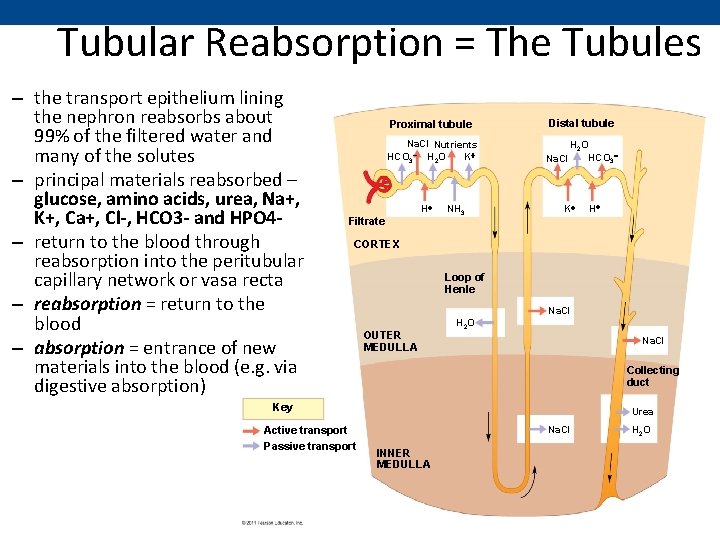
Tubular Reabsorption = The Tubules – the transport epithelium lining the nephron reabsorbs about 99% of the filtered water and many of the solutes – principal materials reabsorbed – glucose, amino acids, urea, Na+, K+, Ca+, Cl-, HCO 3 - and HPO 4– return to the blood through reabsorption into the peritubular capillary network or vasa recta – reabsorption = return to the blood – absorption = entrance of new materials into the blood (e. g. via digestive absorption) Proximal tubule Distal tubule Na. Cl Nutrients HCO 3 H 2 O K Na. Cl H Filtrate NH 3 H 2 O HCO 3 K H CORTEX Loop of Henle Na. Cl OUTER MEDULLA H 2 O Na. Cl Collecting duct Key Active transport Passive transport Urea Na. Cl INNER MEDULLA H 2 O
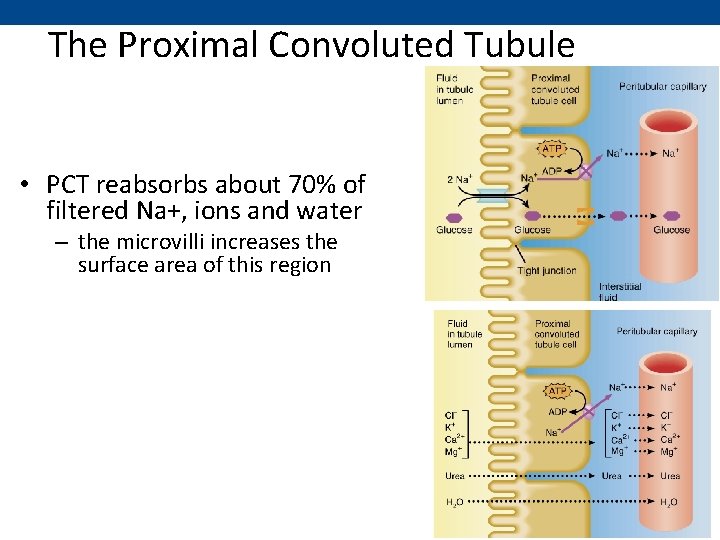
The Proximal Convoluted Tubule • PCT reabsorbs about 70% of filtered Na+, ions and water – the microvilli increases the surface area of this region
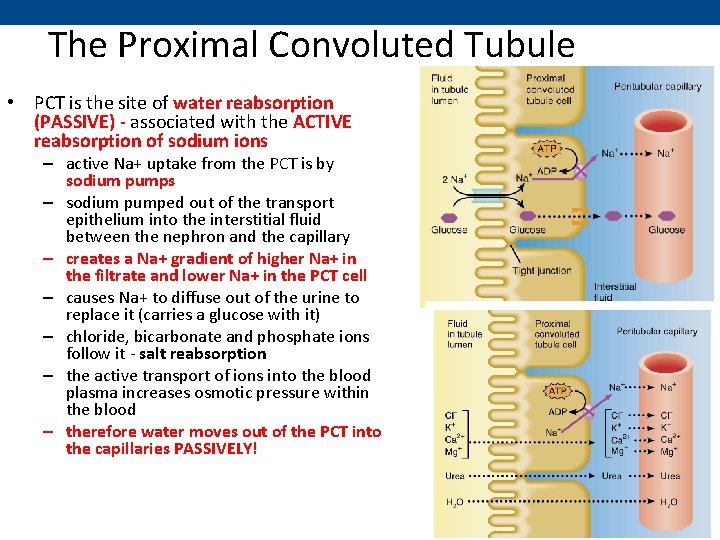
The Proximal Convoluted Tubule • PCT is the site of water reabsorption (PASSIVE) - associated with the ACTIVE reabsorption of sodium ions – active Na+ uptake from the PCT is by sodium pumps – sodium pumped out of the transport epithelium into the interstitial fluid between the nephron and the capillary – creates a Na+ gradient of higher Na+ in the filtrate and lower Na+ in the PCT cell – causes Na+ to diffuse out of the urine to replace it (carries a glucose with it) – chloride, bicarbonate and phosphate ions follow it - salt reabsorption – the active transport of ions into the blood plasma increases osmotic pressure within the blood – therefore water moves out of the PCT into the capillaries PASSIVELY!
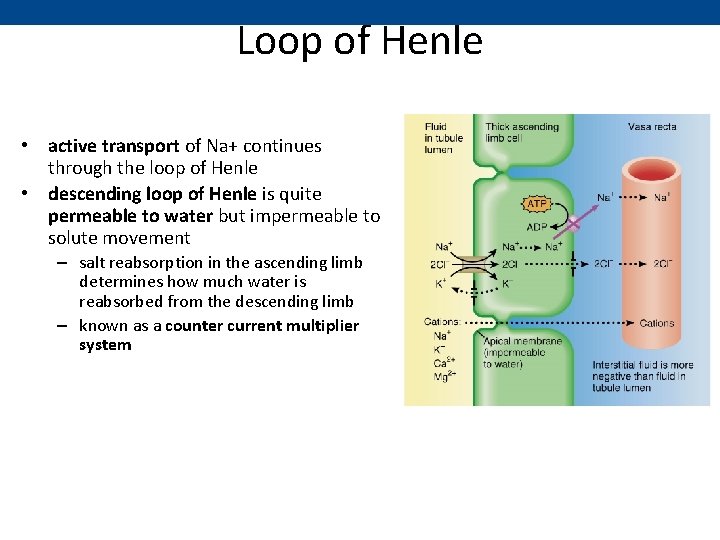
Loop of Henle • active transport of Na+ continues through the loop of Henle • descending loop of Henle is quite permeable to water but impermeable to solute movement – salt reabsorption in the ascending limb determines how much water is reabsorbed from the descending limb – known as a counter current multiplier system
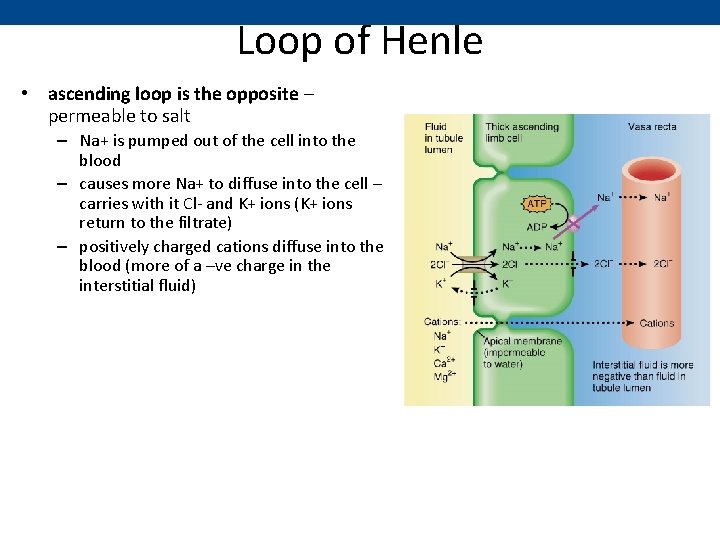
Loop of Henle • ascending loop is the opposite – permeable to salt – Na+ is pumped out of the cell into the blood – causes more Na+ to diffuse into the cell – carries with it Cl- and K+ ions (K+ ions return to the filtrate) – positively charged cations diffuse into the blood (more of a –ve charge in the interstitial fluid)
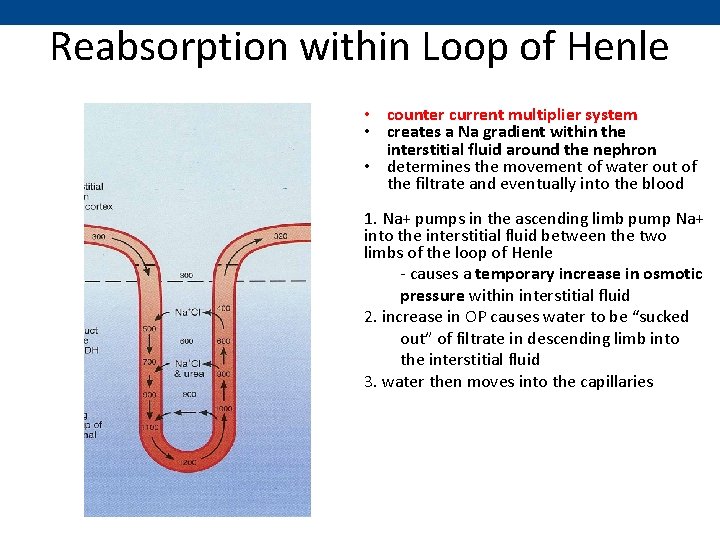
Reabsorption within Loop of Henle • counter current multiplier system • creates a Na gradient within the interstitial fluid around the nephron • determines the movement of water out of the filtrate and eventually into the blood 1. Na+ pumps in the ascending limb pump Na+ into the interstitial fluid between the two limbs of the loop of Henle - causes a temporary increase in osmotic pressure within interstitial fluid 2. increase in OP causes water to be “sucked out” of filtrate in descending limb into the interstitial fluid 3. water then moves into the capillaries
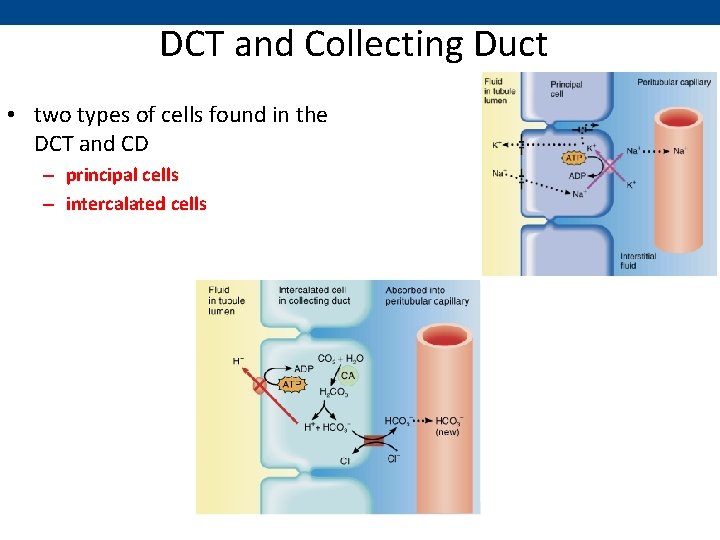
DCT and Collecting Duct • two types of cells found in the DCT and CD – principal cells – intercalated cells
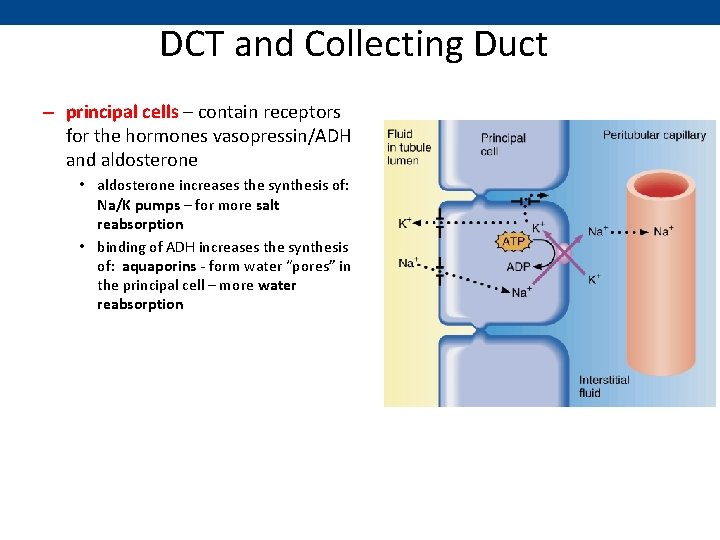
DCT and Collecting Duct – principal cells – contain receptors for the hormones vasopressin/ADH and aldosterone • aldosterone increases the synthesis of: Na/K pumps – for more salt reabsorption • binding of ADH increases the synthesis of: aquaporins - form water “pores” in the principal cell – more water reabsorption
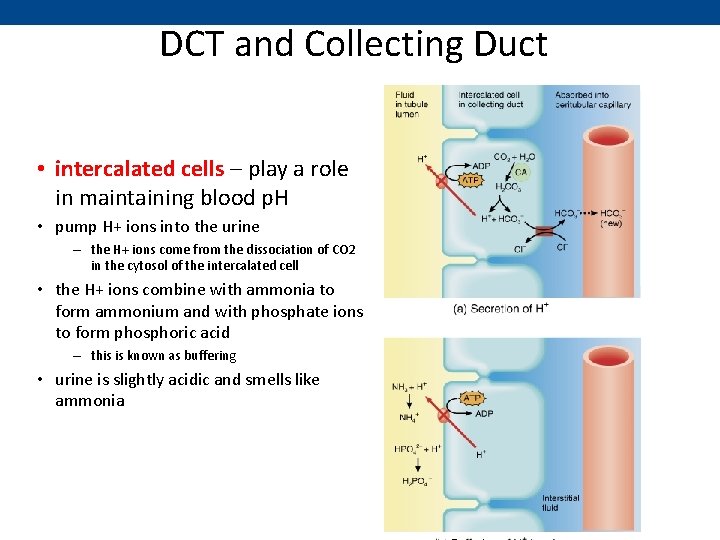
DCT and Collecting Duct • intercalated cells – play a role in maintaining blood p. H • pump H+ ions into the urine – the H+ ions come from the dissociation of CO 2 in the cytosol of the intercalated cell • the H+ ions combine with ammonia to form ammonium and with phosphate ions to form phosphoric acid – this is known as buffering • urine is slightly acidic and smells like ammonia
Reabsorption & Secretion in the Collecting Duct • By end of DCT, 95% of solutes & water have been reabsorbed and returned to the bloodstream • Cells in the collecting duct make the final adjustments – principal cells reabsorb more Na+ and secrete K+ – intercalated cells reabsorb more K+ & bicarbonate ions and secrete H+
Nitrogenous Wastes • function of the kidney is two-fold – osmoregulation – excretion of metabolic wastes • metabolic wastes must be dissolved in water • major metabolic wastes are due to breakdown of proteins and nucleic acids • 1. Ammonia – very toxic, requires a lot of water to eliminate • 2. Urea • 3. Uric acid – less toxic, requires little water to eliminate
Ammonia • can only be tolerated in very low concentrations • to decrease toxicity requires large amounts of water – aquatic animals • ammonia diffuses easily across cell membranes – in aquatic invertebrates – diffuses across the body wall • fish – ammonia is lost as ammonium across the surface of the gills
Urea • terrestrial animals have a problem with ammonia • also a problem for marine animals – since they los large amounts of water via osmosis • mammals, adult amphibians, sharks and some marine fishes and turtles excrete urea – as aquatic juveniles – amphibians excrete NH 3 • produced in the liver through the urea cycle – combination of NH 3 with CO 2 and H 2 O – requires energy • can be transported safely and stored in tissues without toxicity • urea is often retained in body fluids – contributes to osmotic pressure
Uric acid • in humans - formed from the breakdown of nucleic acids – breakdown of purines – A and G • the main excretory product of insects, terrestrial snails, many reptiles and birds • does not dissolve well in water • excreted as a semi-solid with little water loss • even more energetically expensive to synthesis then urea • guano – droppings of birds – mixture of uric acid and brown feces – excellent source of nitrogen for soils
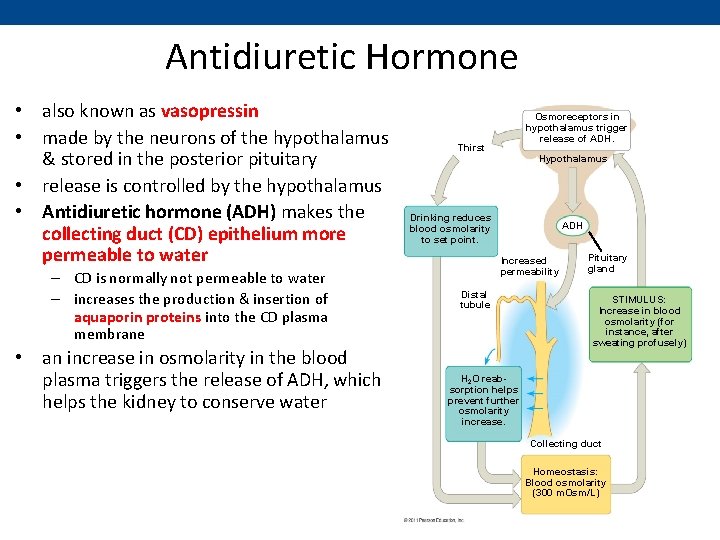
Antidiuretic Hormone • also known as vasopressin • made by the neurons of the hypothalamus & stored in the posterior pituitary • release is controlled by the hypothalamus • Antidiuretic hormone (ADH) makes the collecting duct (CD) epithelium more permeable to water – CD is normally not permeable to water – increases the production & insertion of aquaporin proteins into the CD plasma membrane • an increase in osmolarity in the blood plasma triggers the release of ADH, which helps the kidney to conserve water Osmoreceptors in hypothalamus trigger release of ADH. Thirst Hypothalamus Drinking reduces blood osmolarity to set point. ADH Increased permeability Distal tubule Pituitary gland STIMULUS: Increase in blood osmolarity (for instance, after sweating profusely) H 2 O reabsorption helps prevent further osmolarity increase. Collecting duct Homeostasis: Blood osmolarity (300 m. Osm/L)
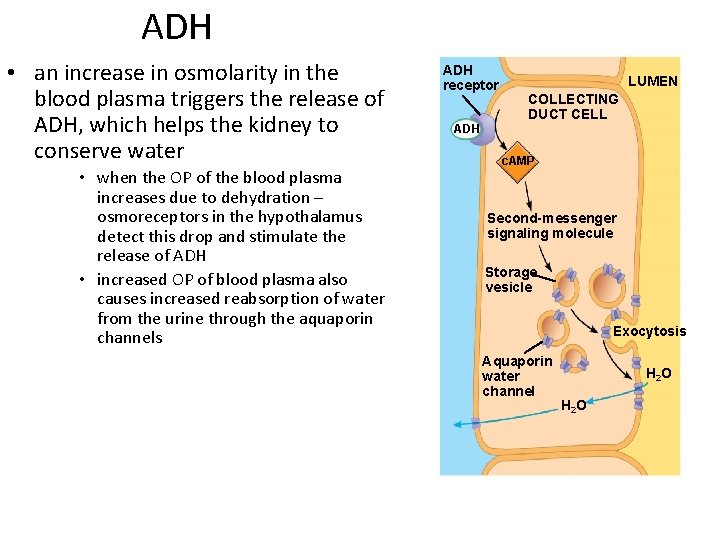
ADH • an increase in osmolarity in the blood plasma triggers the release of ADH, which helps the kidney to conserve water • when the OP of the blood plasma increases due to dehydration – osmoreceptors in the hypothalamus detect this drop and stimulate the release of ADH • increased OP of blood plasma also causes increased reabsorption of water from the urine through the aquaporin channels ADH receptor LUMEN COLLECTING DUCT CELL ADH c. AMP Second-messenger signaling molecule Storage vesicle Exocytosis Aquaporin water channel H 2 O

Renin-Angiotensin-Aldosterone • when blood volume and BP drop – kidney secretes renin into the blood • in the blood renin cleaves angiotensinogen (made by liver hepatocytes) to form the active enzyme angiotensin I • the enzyme ACE (in the lung) – cleaves this even more to form angiotensin II • angiotensin II – 1. decreases filtration by the glomerulus – 2. enhances reabsorption of Na+, Cl+ and water in the PCT – 3. stimulates the release of aldosterone by the adrenal cortex • aldosterone: stimulates the principal cells of the DCT & collecting ducts to reabsorb more Na and Cl- and secrete more K into the blood • results in “salty” blood plasma • osmotic consequence of this causes an increased reabsorption of water from tissue of the body • increase in blood volume and pressure results
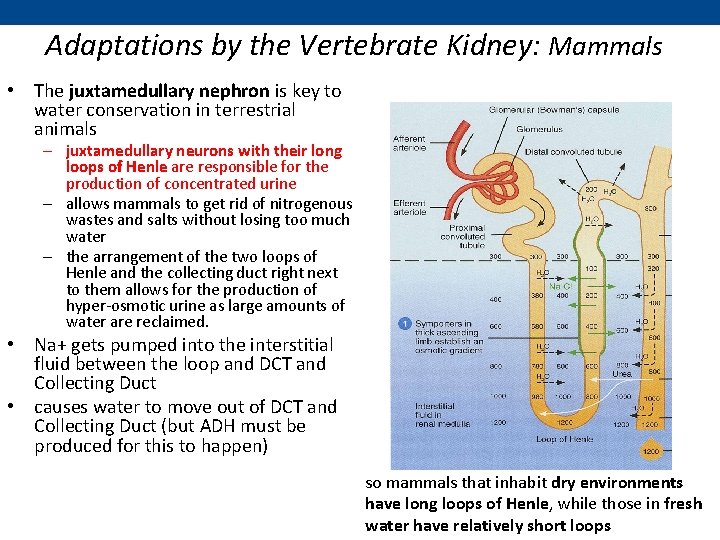
Adaptations by the Vertebrate Kidney: Mammals • The juxtamedullary nephron is key to water conservation in terrestrial animals – juxtamedullary neurons with their long loops of Henle are responsible for the production of concentrated urine – allows mammals to get rid of nitrogenous wastes and salts without losing too much water – the arrangement of the two loops of Henle and the collecting duct right next to them allows for the production of hyper-osmotic urine as large amounts of water are reclaimed. • Na+ gets pumped into the interstitial fluid between the loop and DCT and Collecting Duct • causes water to move out of DCT and Collecting Duct (but ADH must be produced for this to happen) so mammals that inhabit dry environments have long loops of Henle, while those in fresh water have relatively short loops
Birds and Other Reptiles • Birds have shorter loops of Henle but conserve water by excreting uric acid instead of urea – their juxtamedullary nephrons have shorter loops of Henle vs. mammals – so birds can’t concentrate the urine as much as mammals – main water conservation method is the excretion of uric acid • some reptiles have only cortical nephrons but also excrete nitrogenous waste as uric acid – cortical nephrons produce iso-osmotic or hypo-osmotic urine – the cloaca is used to reabsorb water
Freshwater Fishes and Amphibians • Freshwater fishes conserve salt in their distal tubules and excrete large volumes of dilute urine – freshwater fish are hyper-osmotic to their environment – must excrete water continuously – kidneys have many nephrons producing filtrate at a high rate • Kidney function in amphibians is similar to freshwater fishes – amphibians conserve water on land by reabsorbing water from the urinary bladder
Marine Bony Fishes • Marine bony fishes are hypoosmotic compared with their environment – gain salt from the environment • their kidneys have fewer and smaller nephrons • their nephron have small glomeruli and some lack glomeruli entirely • filtration rates are low, and very little urine is excreted • main function is to get rid of divalent ions like calcium, magnesium and sulfate ions – secrete these into the PCT and excrete them in their urine
- Slides: 57