
Lecture Objectives Learn about Chiller modeling Water energy
Lecture Objectives: • Learn about • Chiller modeling • Water energy storage models
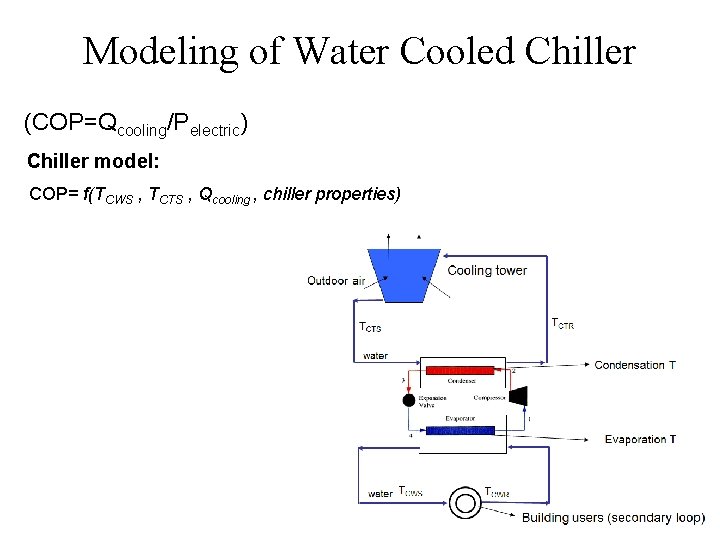
Modeling of Water Cooled Chiller (COP=Qcooling/Pelectric) Chiller model: COP= f(TCWS , TCTS , Qcooling , chiller properties)
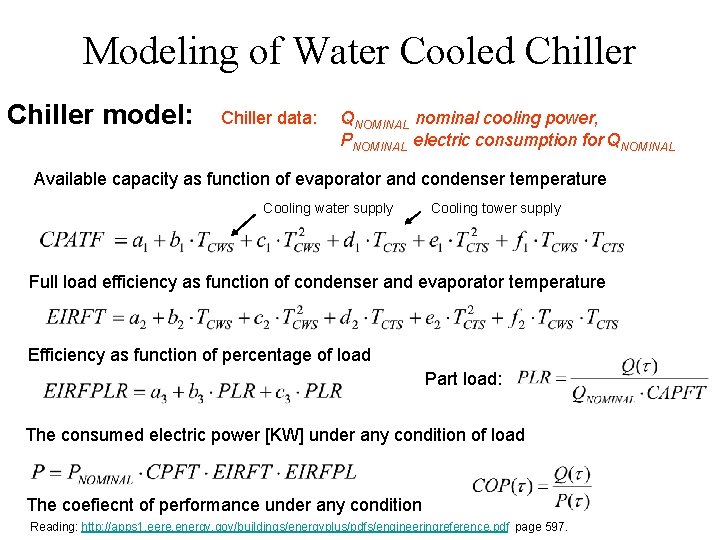
Modeling of Water Cooled Chiller model: Chiller data: QNOMINAL nominal cooling power, PNOMINAL electric consumption for QNOMINAL Available capacity as function of evaporator and condenser temperature Cooling water supply Cooling tower supply Full load efficiency as function of condenser and evaporator temperature Efficiency as function of percentage of load Part load: The consumed electric power [KW] under any condition of load The coefiecnt of performance under any condition Reading: http: //apps 1. eere. energy. gov/buildings/energyplus/pdfs/engineeringreference. pdf page 597.
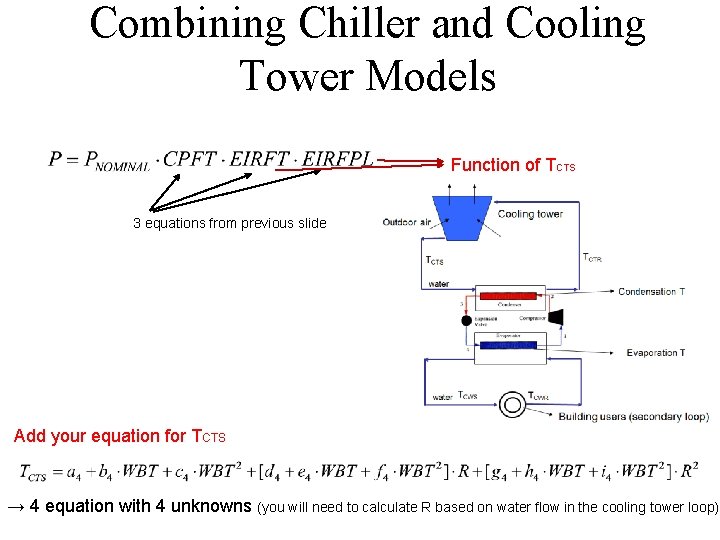
Combining Chiller and Cooling Tower Models Function of TCTS 3 equations from previous slide Add your equation for TCTS → 4 equation with 4 unknowns (you will need to calculate R based on water flow in the cooling tower loop)
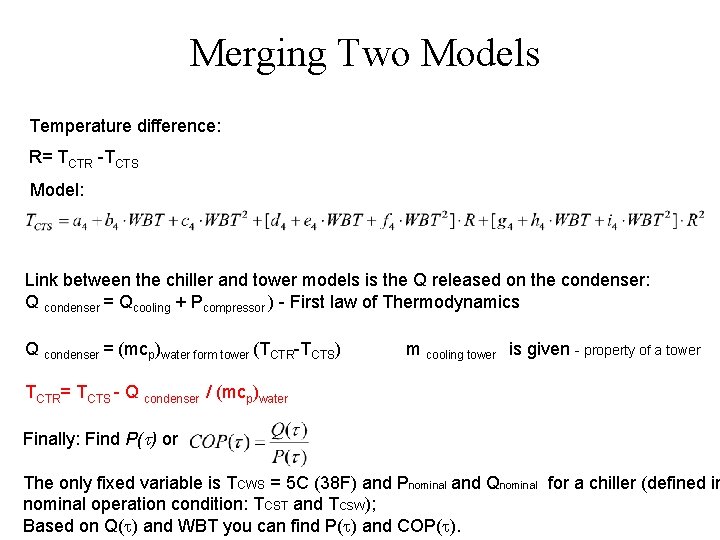
Merging Two Models Temperature difference: R= TCTR -TCTS Model: Link between the chiller and tower models is the Q released on the condenser: Q condenser = Qcooling + Pcompressor ) - First law of Thermodynamics Q condenser = (mcp)water form tower (TCTR-TCTS) m cooling tower is given - property of a tower TCTR= TCTS - Q condenser / (mcp)water Finally: Find P( ) or The only fixed variable is TCWS = 5 C (38 F) and Pnominal and Qnominal for a chiller (defined in nominal operation condition: TCST and TCSW); Based on Q( ) and WBT you can find P( ) and COP( ).
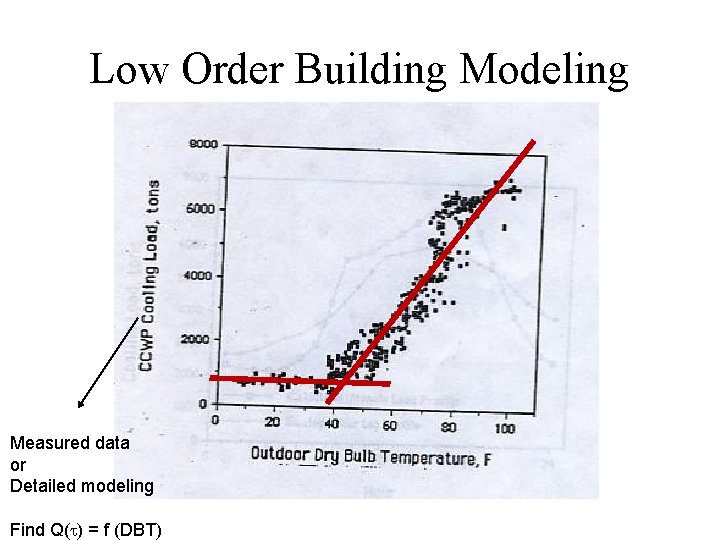
Low Order Building Modeling Measured data or Detailed modeling Find Q( ) = f (DBT)
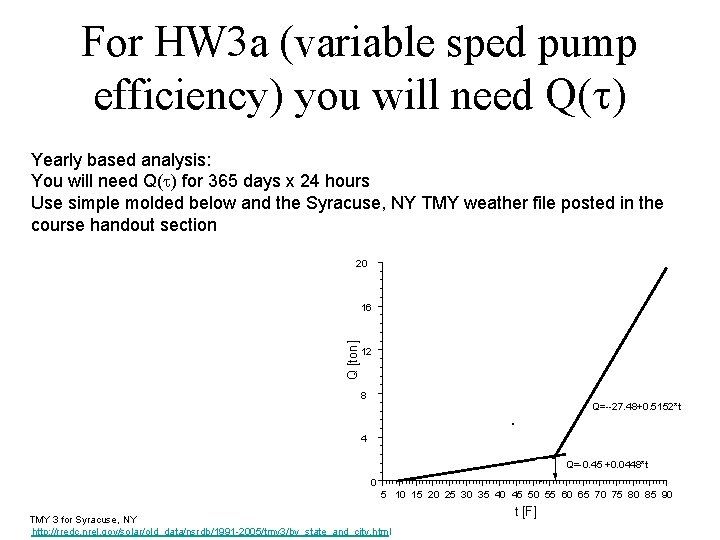
For HW 3 a (variable sped pump efficiency) you will need Q( ) Yearly based analysis: You will need Q( ) for 365 days x 24 hours Use simple molded below and the Syracuse, NY TMY weather file posted in the course handout section 20 Q [ton] 16 12 8 Q=--27. 48+0. 5152*t 4 Q=-0. 45 +0. 0448*t 0 5 10 15 20 25 30 35 40 45 50 55 60 65 70 75 80 85 90 TMY 3 for Syracuse, NY http: //rredc. nrel. gov/solar/old_data/nsrdb/1991 -2005/tmy 3/by_state_and_city. html t [F]
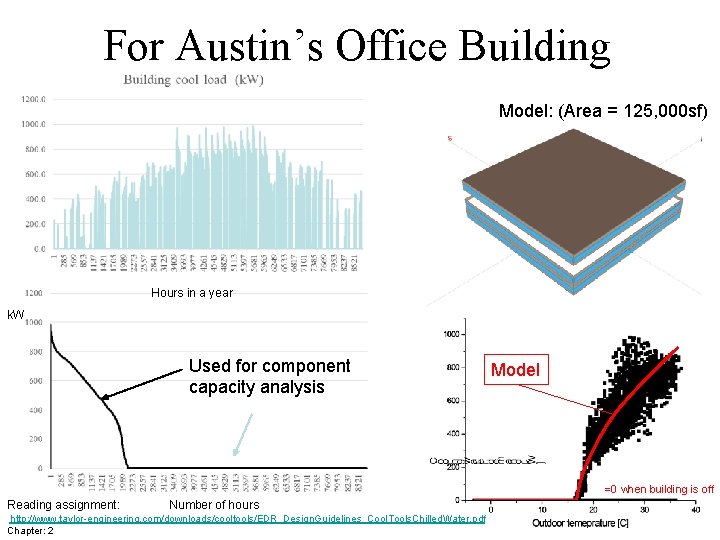
For Austin’s Office Building Model: (Area = 125, 000 sf) Hours in a year k. W Used for component capacity analysis Model =0 when building is off Reading assignment: Number of hours http: //www. taylor-engineering. com/downloads/cooltools/EDR_Design. Guidelines_Cool. Tools. Chilled. Water. pdf Chapter: 2
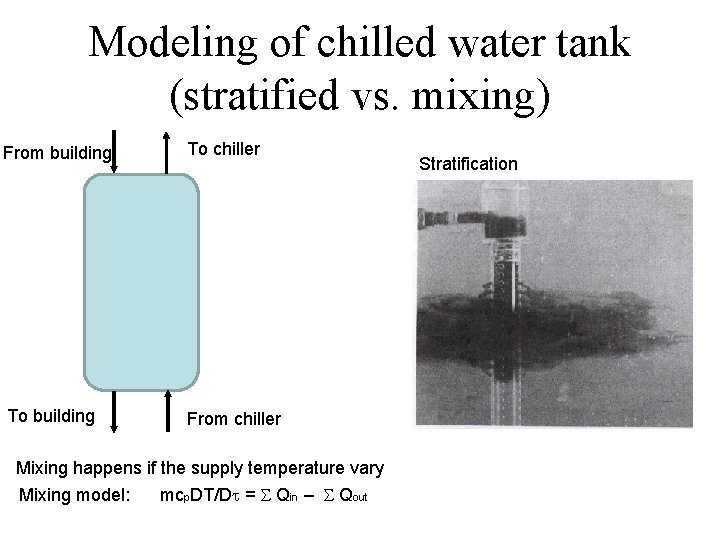
Modeling of chilled water tank (stratified vs. mixing) From building To chiller To building From chiller Mixing happens if the supply temperature vary Mixing model: mcp. DT/D = Qin – Qout Stratification

Stratification Dr. Jing Song’s Ph. D results Flow time at 20 minutes CFD domain Flow time at 1 minute
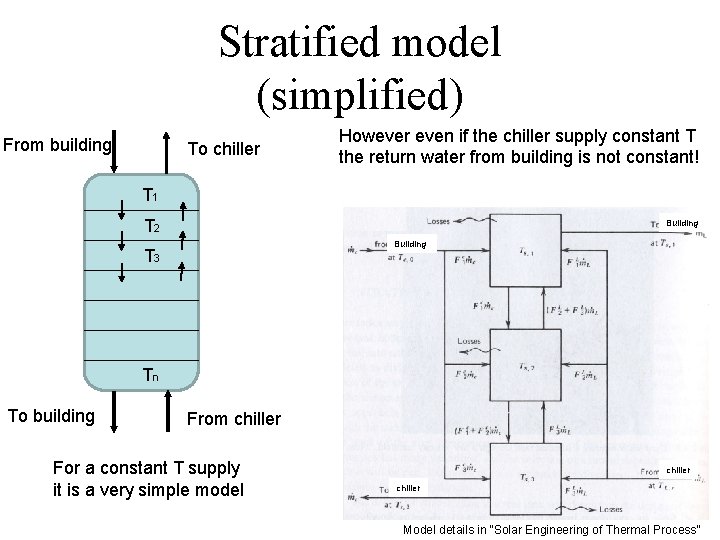
Stratified model (simplified) From building To chiller However even if the chiller supply constant T the return water from building is not constant! T 1 T 2 Building T 3 Tn To building From chiller For a constant T supply it is a very simple model chiller Model details in “Solar Engineering of Thermal Process”
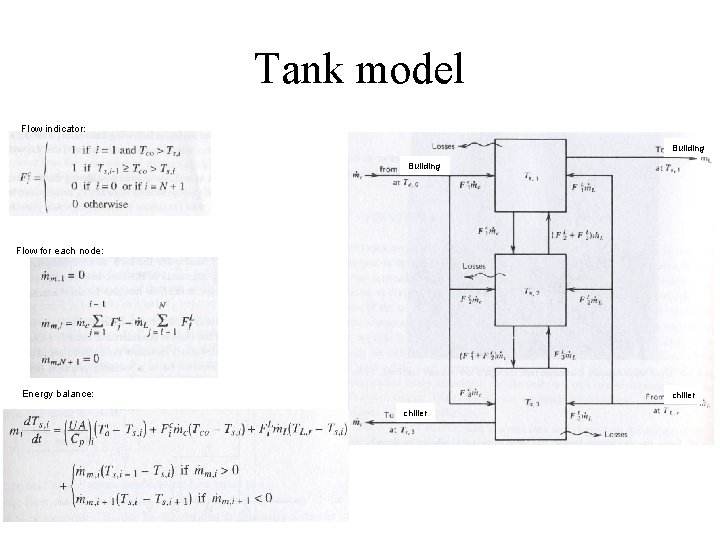
Tank model Flow indicator: Building Flow for each node: Energy balance: chiller
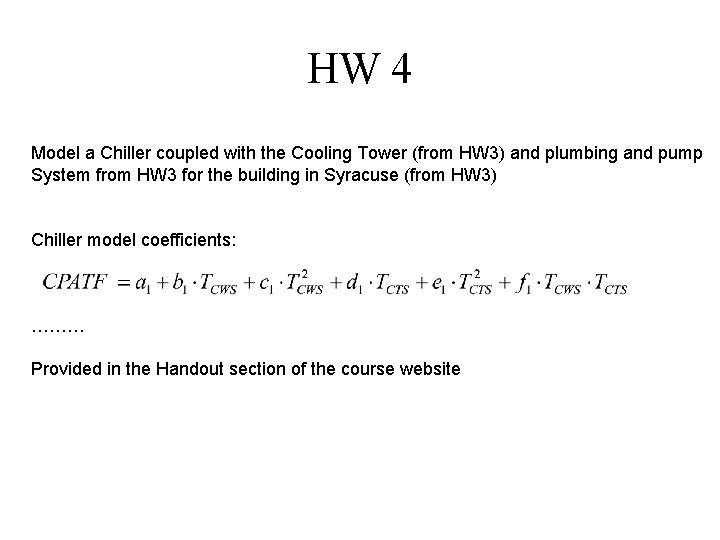
HW 4 Model a Chiller coupled with the Cooling Tower (from HW 3) and plumbing and pump System from HW 3 for the building in Syracuse (from HW 3) Chiller model coefficients: ……… Provided in the Handout section of the course website
- Slides: 13