
Lecture Number 4 Charge Transport and Charge Carrier
Lecture Number 4: Charge Transport and Charge Carrier Statistics Chem 140 a: Photoelectrochemistry of Semiconductors

Review from Last Time Light The quantum mechanics of wave packets gave us: Heavy m* inversely proportional to curvature of E vs. k diagram In a totally symmetric lattice, kx = ky=kz, so there is one value of m*. In general, m* varies with crystallographic direction. Ga. As kx=ky=kz Si kx≠ky=kz
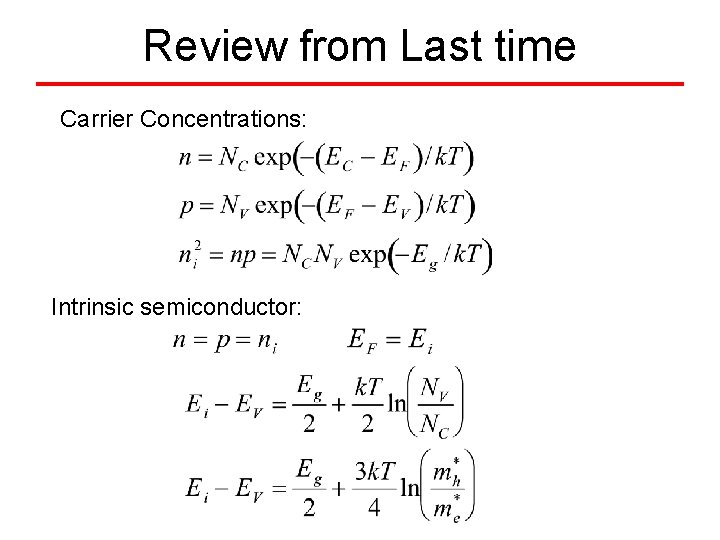
Review from Last time Carrier Concentrations: Intrinsic semiconductor:
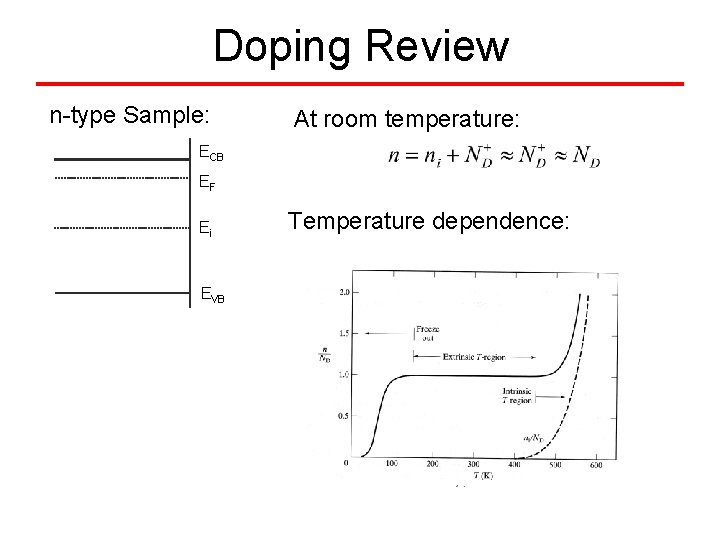
Doping Review n-type Sample: At room temperature: ECB EF Ei EVB Temperature dependence:
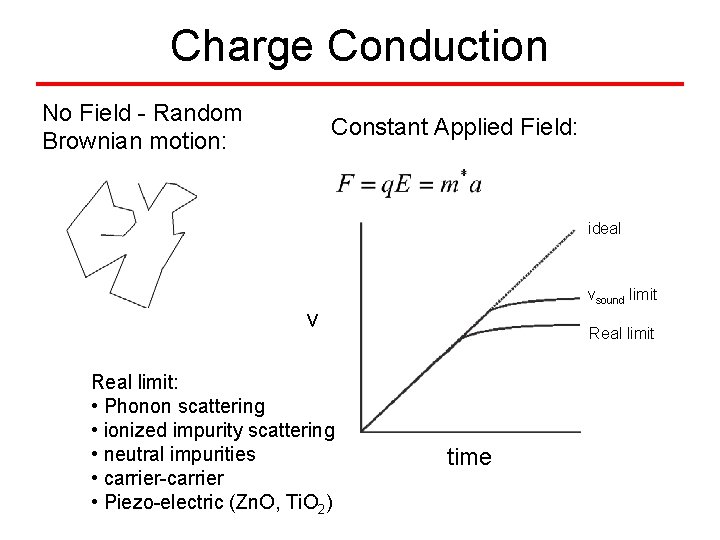
Charge Conduction No Field - Random Brownian motion: Constant Applied Field: ideal vsound limit v Real limit: • Phonon scattering • ionized impurity scattering • neutral impurities • carrier-carrier • Piezo-electric (Zn. O, Ti. O 2) Real limit time
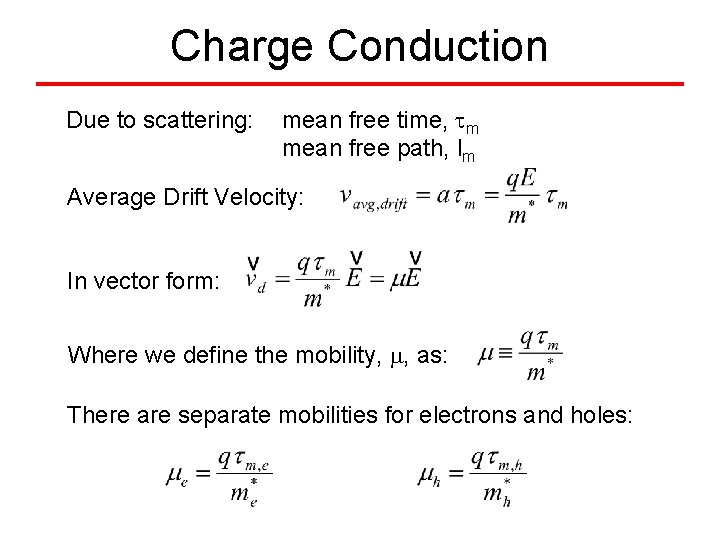
Charge Conduction Due to scattering: mean free time, m mean free path, lm Average Drift Velocity: In vector form: Where we define the mobility, , as: There are separate mobilities for electrons and holes:
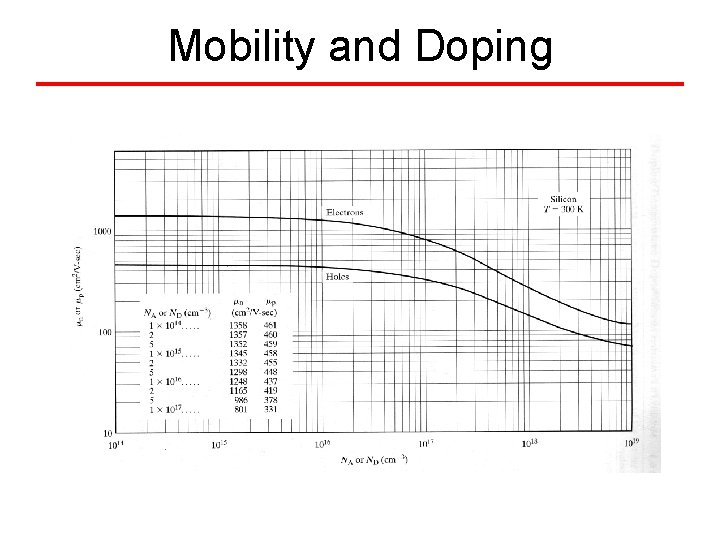
Mobility and Doping
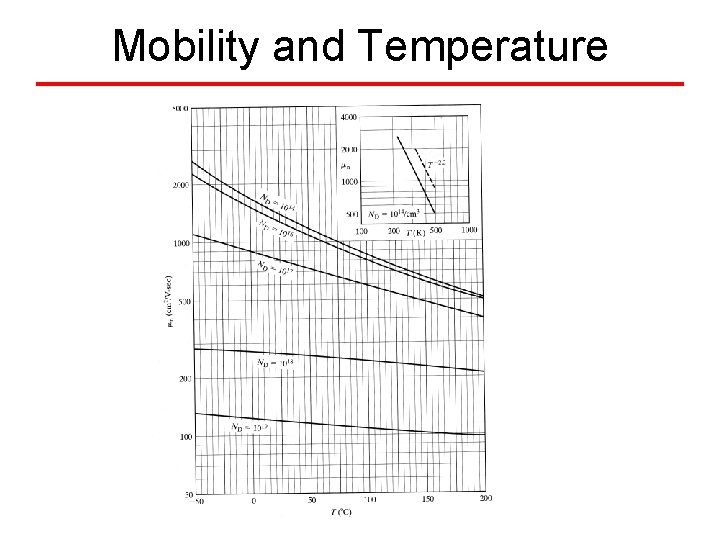
Mobility and Temperature
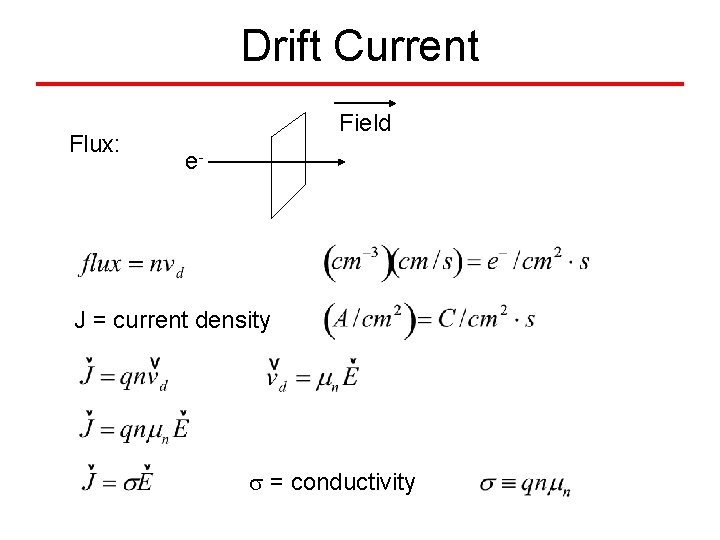
Drift Current Flux: Field e- J = current density = conductivity
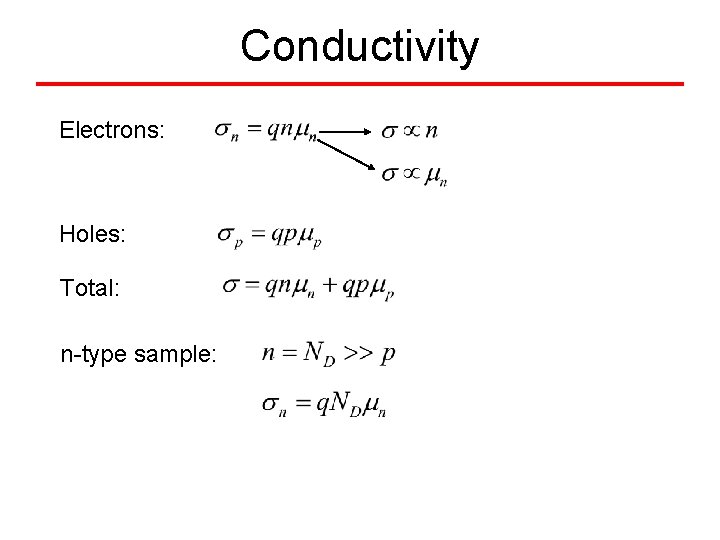
Conductivity Electrons: Holes: Total: n-type sample:
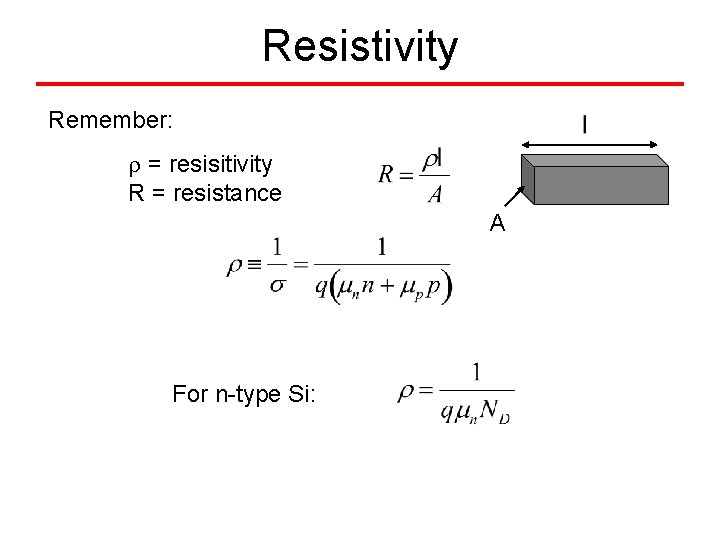
Resistivity Remember: = resisitivity R = resistance A For n-type Si:
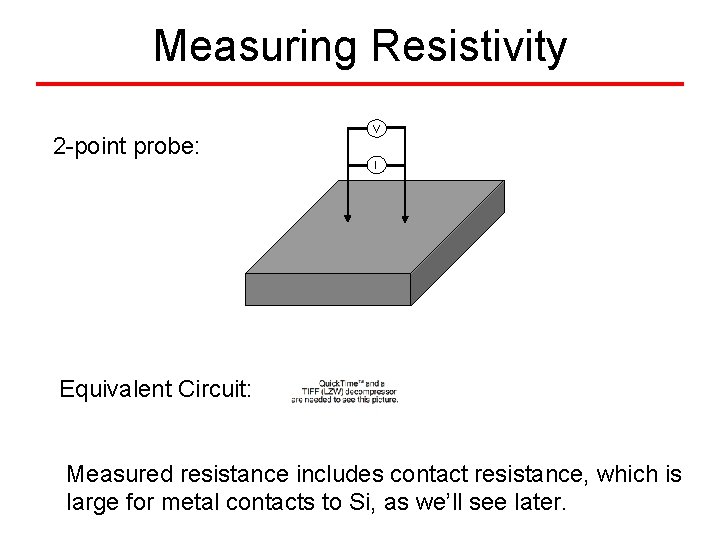
Measuring Resistivity 2 -point probe: V I Equivalent Circuit: Measured resistance includes contact resistance, which is large for metal contacts to Si, as we’ll see later.
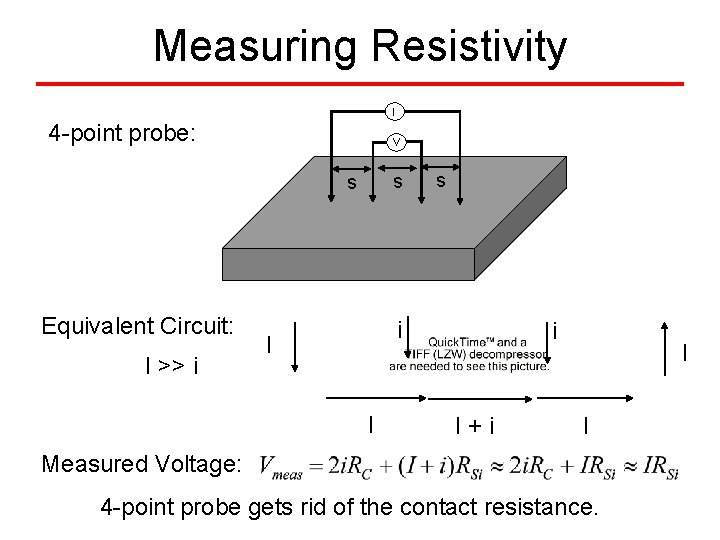
Measuring Resistivity I 4 -point probe: V s s Equivalent Circuit: I >> i s i I I i I+i I I Measured Voltage: 4 -point probe gets rid of the contact resistance.
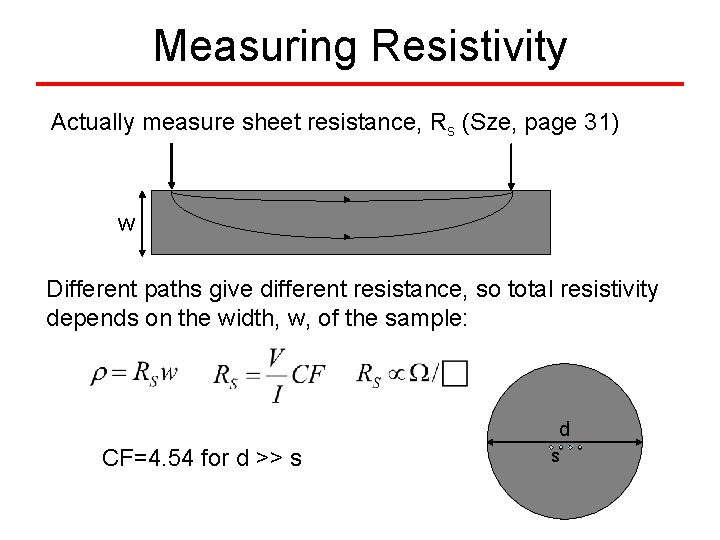
Measuring Resistivity Actually measure sheet resistance, Rs (Sze, page 31) w Different paths give different resistance, so total resistivity depends on the width, w, of the sample: d CF=4. 54 for d >> s s
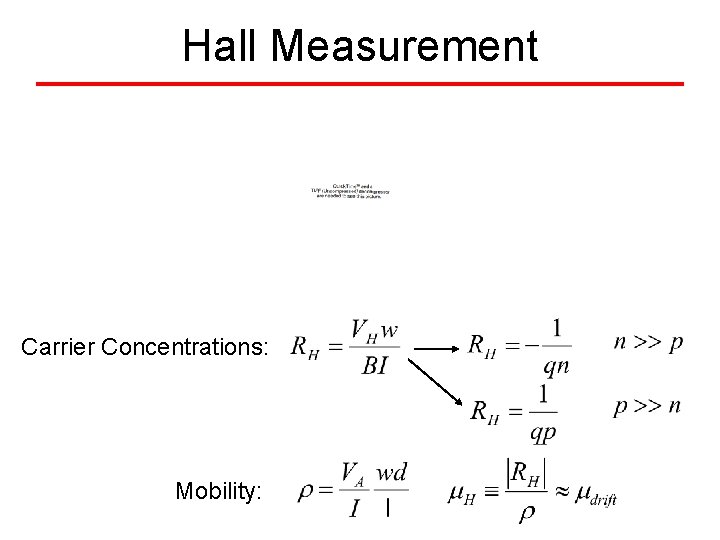
Hall Measurement Carrier Concentrations: Mobility:

Diffusion Current Even in the absence of fields, carriers move by diffusion: ee ee- e- (E-field) Fick’s First law of diffusion: p+ p+ p+ (conc. grad. )
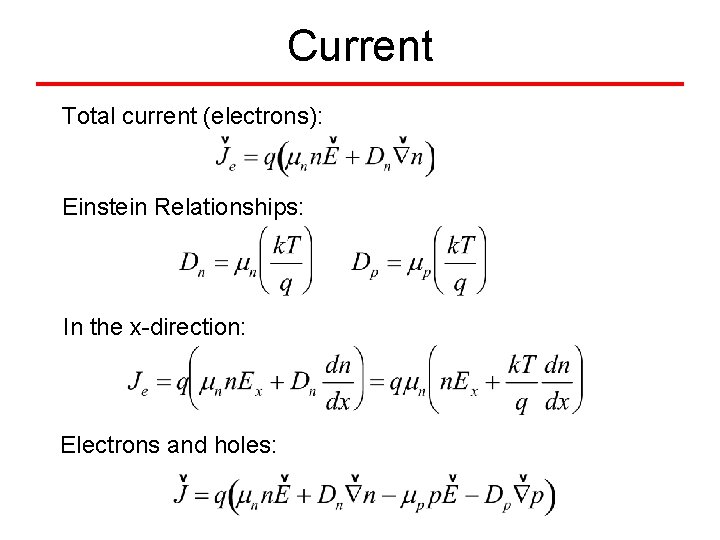
Current Total current (electrons): Einstein Relationships: In the x-direction: Electrons and holes:
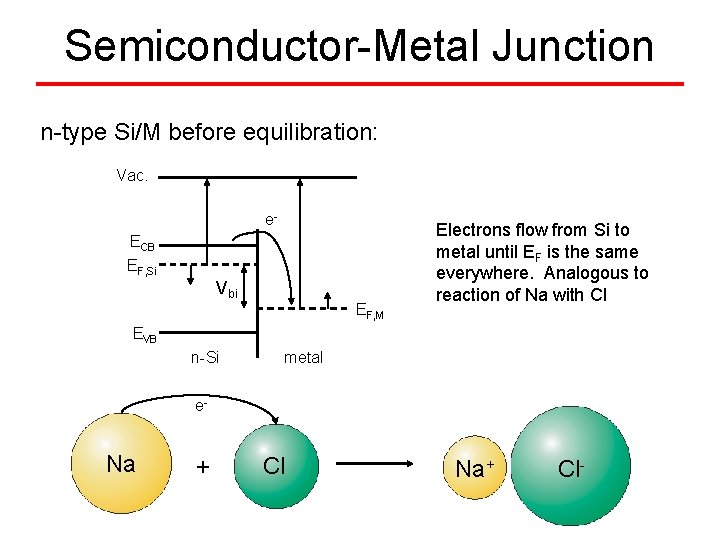
Semiconductor-Metal Junction n-type Si/M before equilibration: Vac. e. ECB EF, Si Vbi EF, M Electrons flow from Si to metal until EF is the same everywhere. Analogous to reaction of Na with Cl EVB n-Si metal e- Na + Cl Na+ Cl-
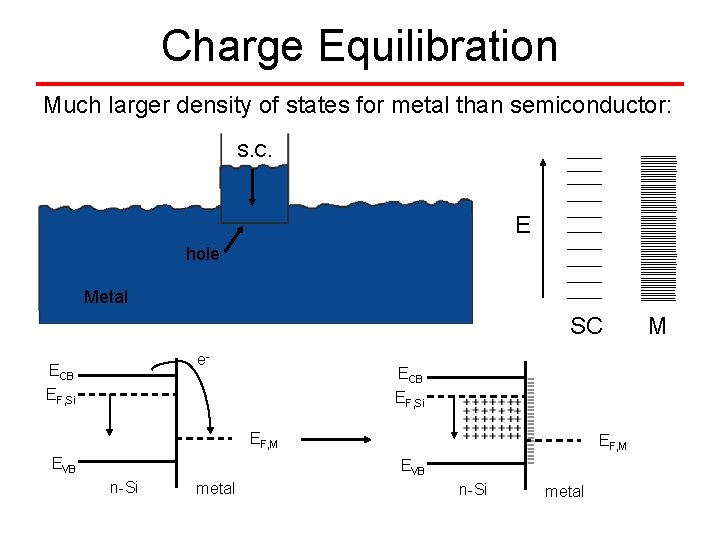
Charge Equilibration Much larger density of states for metal than semiconductor: S. C. E hole Metal SC e- ECB EF, Si EF, M EVB n-Si metal M
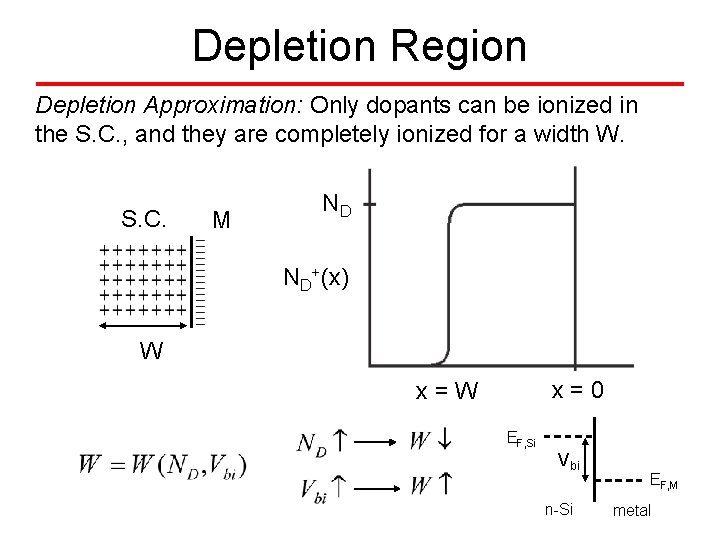
Depletion Region Depletion Approximation: Only dopants can be ionized in the S. C. , and they are completely ionized for a width W. S. C. M ND ND+(x) W x=0 x=W EF, Si Vbi n-Si EF, M metal
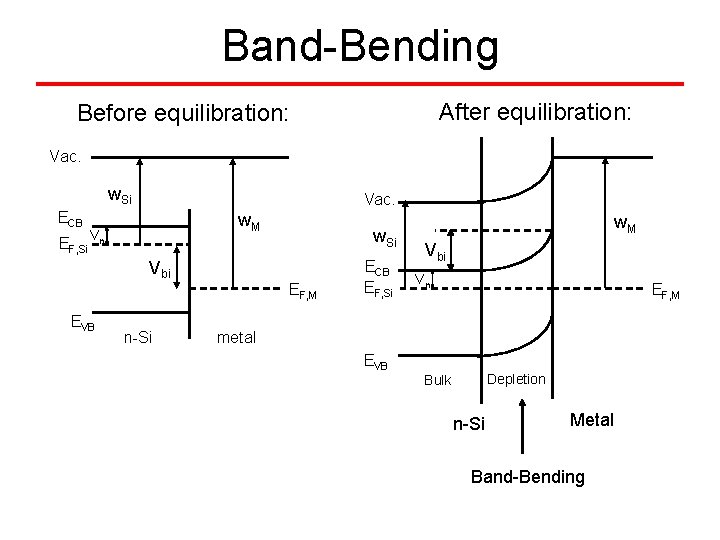
Band-Bending After equilibration: Before equilibration: Vac. w. Si ECB EF, Si Vac. w. M Vn Vbi EVB n-Si w. Si EF, M ECB EF, Si w. M Vbi Vn EF, M metal EVB Depletion Bulk n-Si Metal Band-Bending
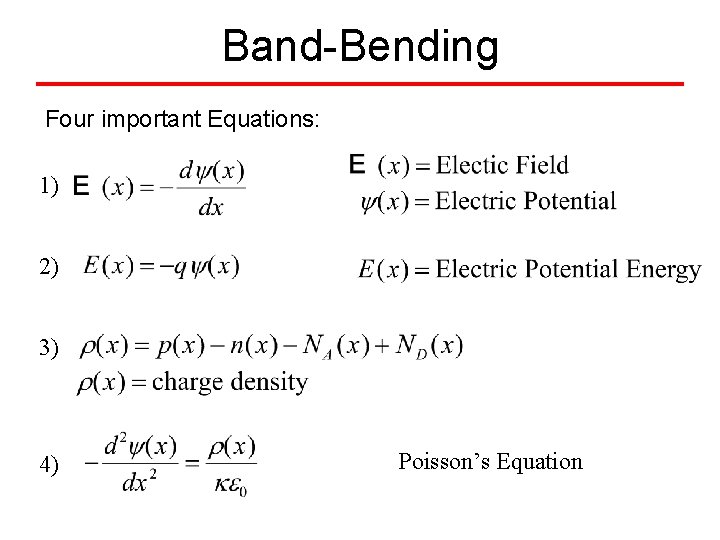
Band-Bending Four important Equations: 1) 2) 3) 4) Poisson’s Equation

Charge Density Semiconductor Bulk Interesting region Poisson’s Equation: Integrating: Metal Bulk
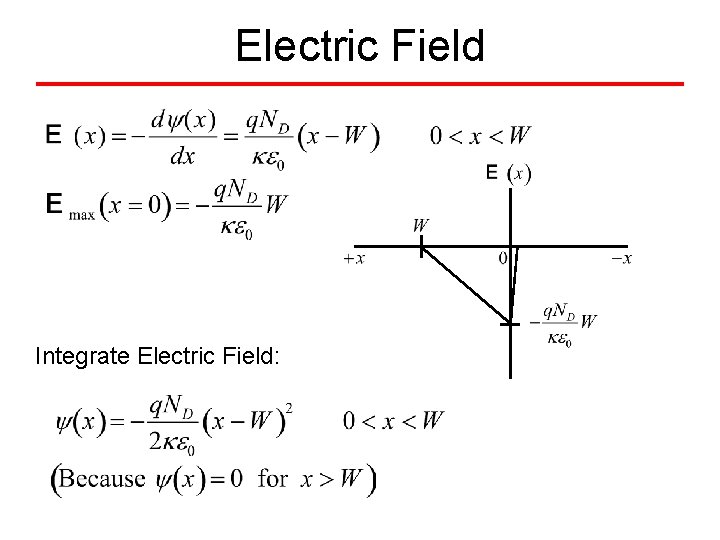
Electric Field Integrate Electric Field:
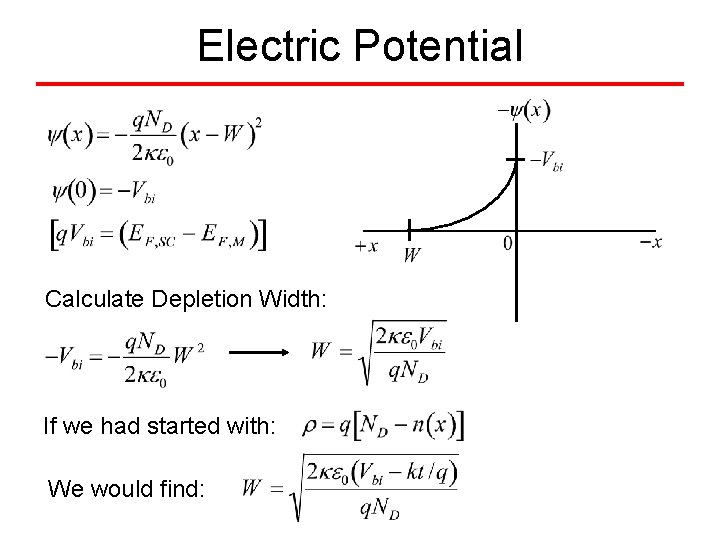
Electric Potential Calculate Depletion Width: If we had started with: We would find:
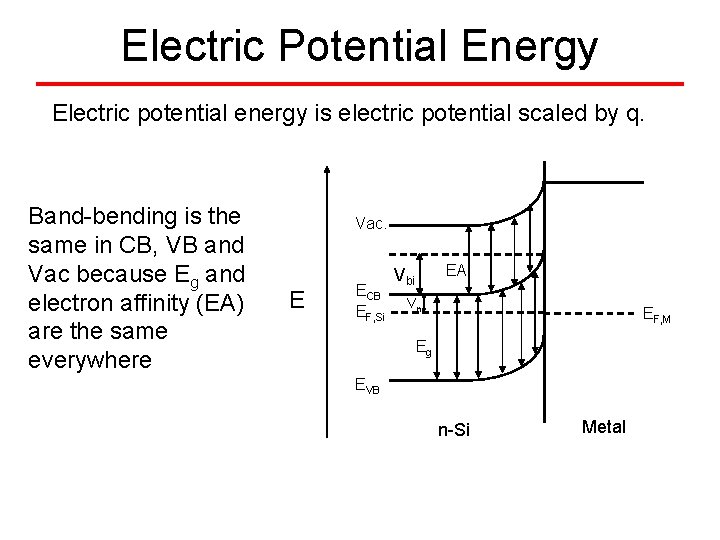
Electric Potential Energy Electric potential energy is electric potential scaled by q. Band-bending is the same in CB, VB and Vac because Eg and electron affinity (EA) are the same everywhere Vac. E ECB EF, Si EA Vbi Vn EF, M Eg EVB n-Si Metal
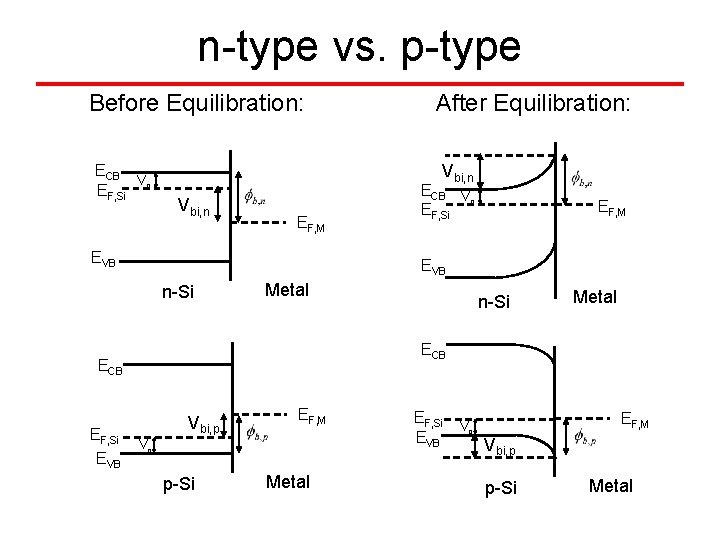
n-type vs. p-type Before Equilibration: ECB V EF, Si n Vbi, n EF, M EVB ECB Vn EF, Si EF, M EVB n-Si Metal ECB EF, Si EVB After Equilibration: Vbi, p EF, M Vp p-Si Metal EF, Si EVB Vp EF, M Vbi, p p-Si Metal
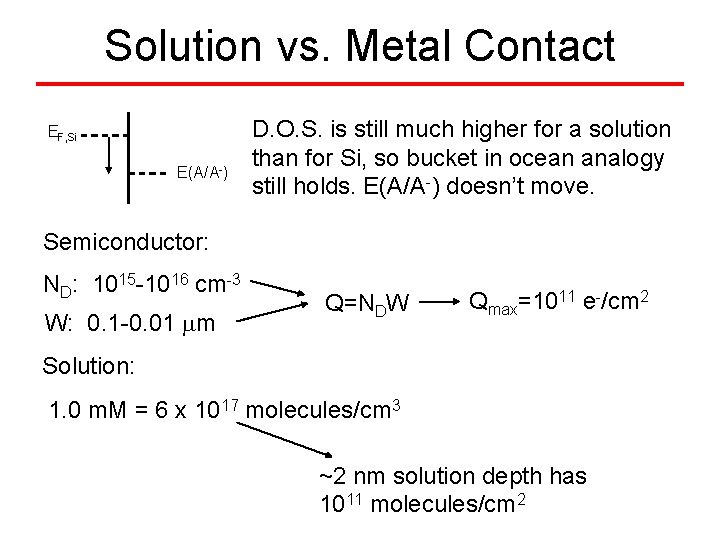
Solution vs. Metal Contact EF, Si E(A/A-) D. O. S. is still much higher for a solution than for Si, so bucket in ocean analogy still holds. E(A/A-) doesn’t move. Semiconductor: ND: 1015 -1016 cm-3 W: 0. 1 -0. 01 m Q=NDW Qmax=1011 e-/cm 2 Solution: 1. 0 m. M = 6 x 10¹⁷ molecules/cm 3 ~2 nm solution depth has 1011 molecules/cm 2
- Slides: 28