
Lecture Note 5 Concurrency Semaphore and Deadlock April

- Slides: 41
Lecture Note 5. Concurrency: Semaphore and Deadlock April 12, 2020 Jongmoo Choi Dept. of software Dankook University http: //embedded. dankook. ac. kr/~choijm (This slide is made by Jongmoo Choi. Please let him know when you want to distribute this slide) J. Choi, DKU
Contents From Chap 30~32 of the OSTEP Chap 30. Condition Variables Chap 31. Semaphores Chap 32. Common Concurrency Problems Chap 33. Event-based Concurrency Chap 34. Summary 2 J. Choi, DKU
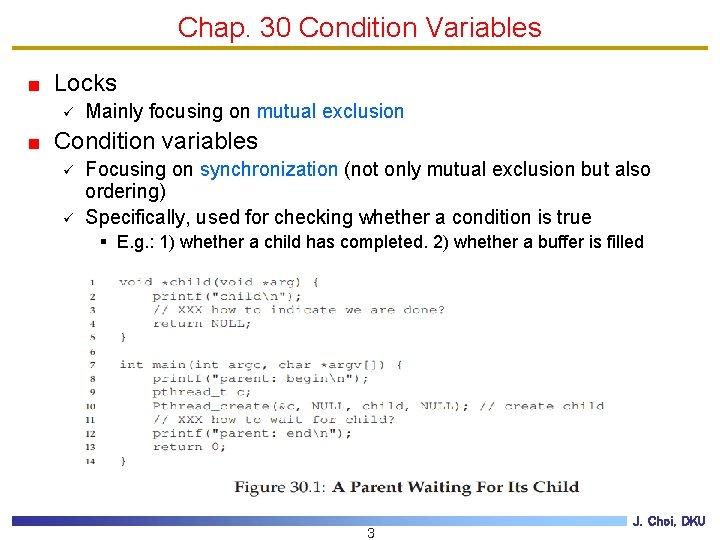
Chap. 30 Condition Variables Locks ü Mainly focusing on mutual exclusion Condition variables ü ü Focusing on synchronization (not only mutual exclusion but also ordering) Specifically, used for checking whether a condition is true § E. g. : 1) whether a child has completed. 2) whether a buffer is filled 3 J. Choi, DKU
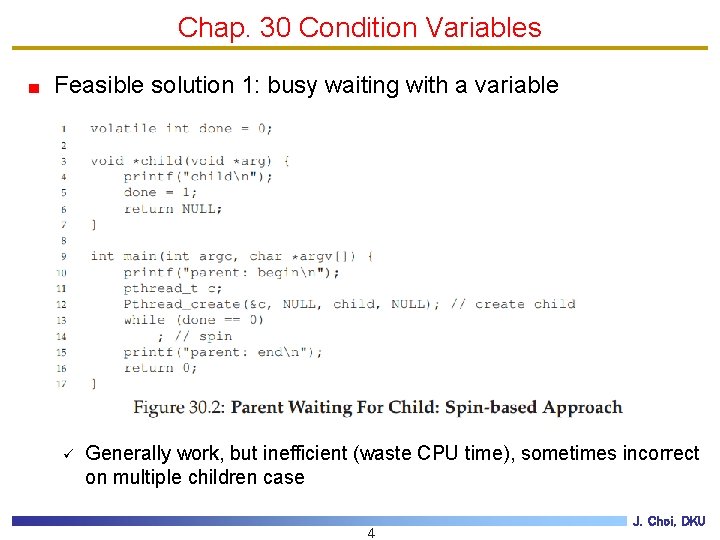
Chap. 30 Condition Variables Feasible solution 1: busy waiting with a variable ü Generally work, but inefficient (waste CPU time), sometimes incorrect on multiple children case 4 J. Choi, DKU
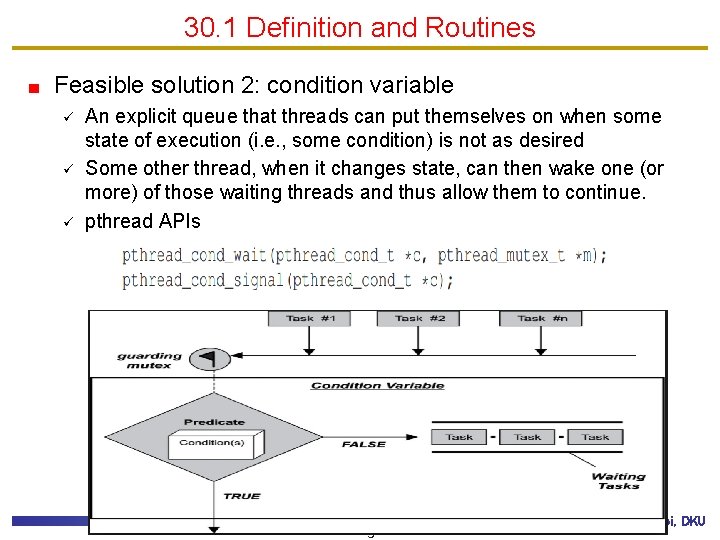
30. 1 Definition and Routines Feasible solution 2: condition variable ü ü ü An explicit queue that threads can put themselves on when some state of execution (i. e. , some condition) is not as desired Some other thread, when it changes state, can then wake one (or more) of those waiting threads and thus allow them to continue. pthread APIs 5 J. Choi, DKU
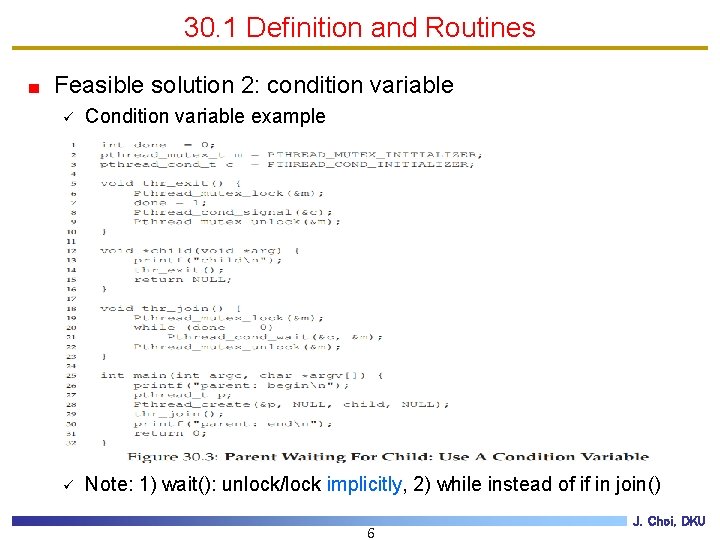
30. 1 Definition and Routines Feasible solution 2: condition variable ü Condition variable example ü Note: 1) wait(): unlock/lock implicitly, 2) while instead of if in join() 6 J. Choi, DKU
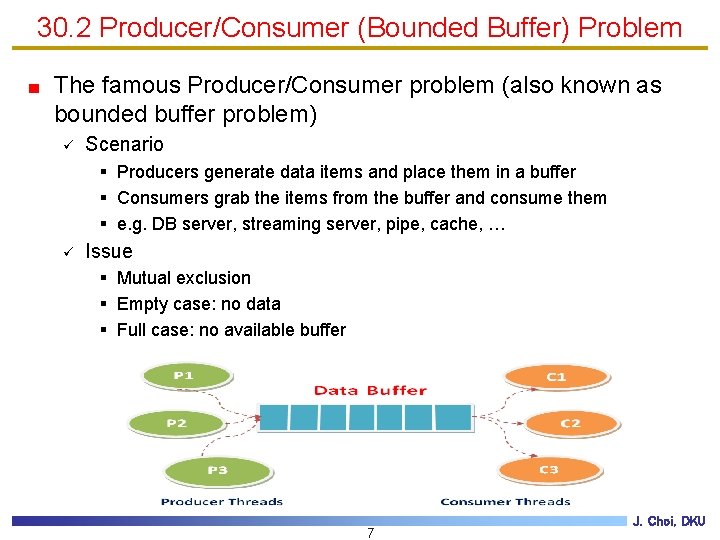
30. 2 Producer/Consumer (Bounded Buffer) Problem The famous Producer/Consumer problem (also known as bounded buffer problem) ü Scenario § Producers generate data items and place them in a buffer § Consumers grab the items from the buffer and consume them § e. g. DB server, streaming server, pipe, cache, … ü Issue § Mutual exclusion § Empty case: no data § Full case: no available buffer 7 J. Choi, DKU
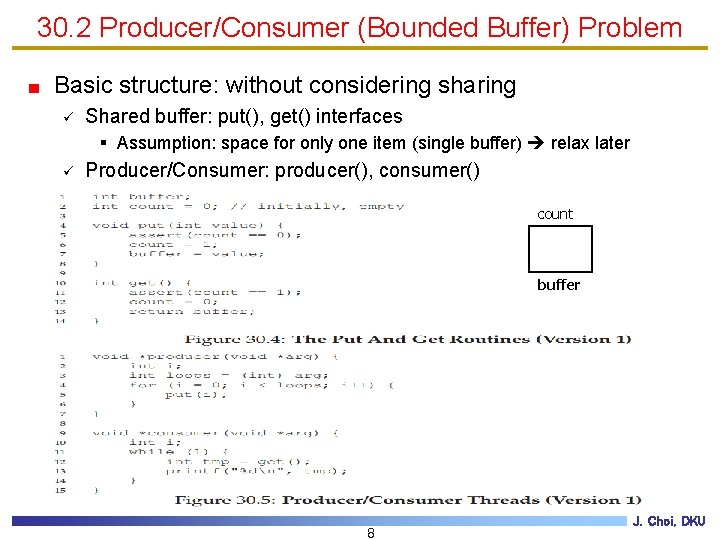
30. 2 Producer/Consumer (Bounded Buffer) Problem Basic structure: without considering sharing ü Shared buffer: put(), get() interfaces § Assumption: space for only one item (single buffer) relax later ü Producer/Consumer: producer(), consumer() count buffer 8 J. Choi, DKU
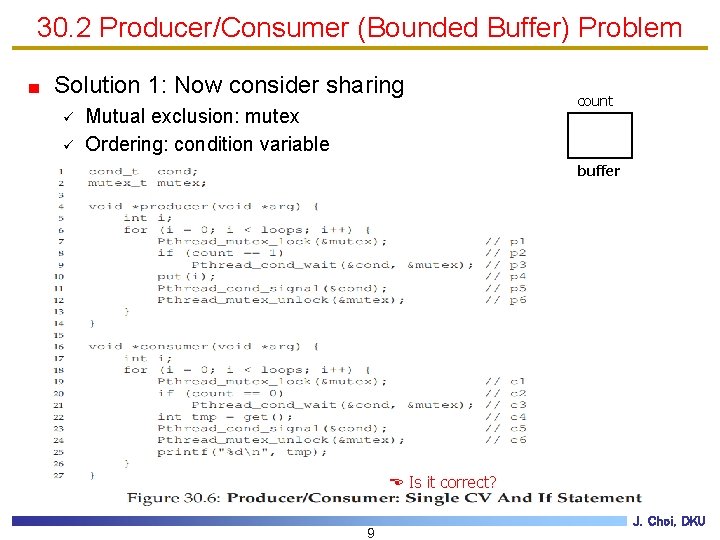
30. 2 Producer/Consumer (Bounded Buffer) Problem Solution 1: Now consider sharing ü ü Mutual exclusion: mutex Ordering: condition variable count buffer Is it correct? 9 J. Choi, DKU
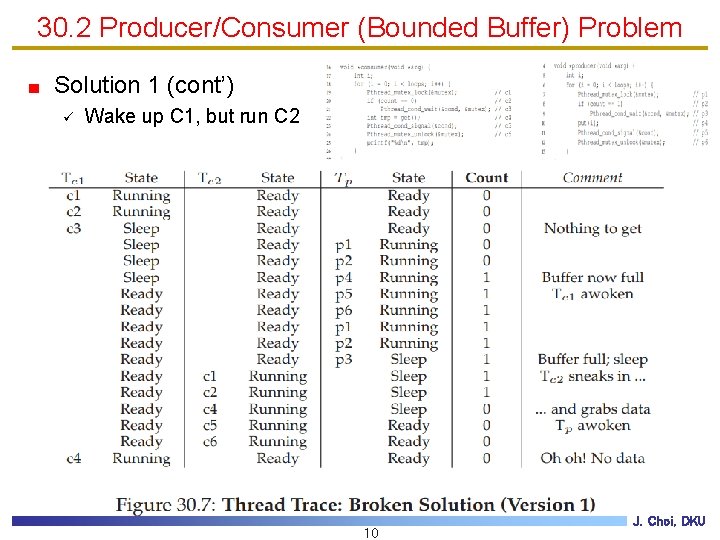
30. 2 Producer/Consumer (Bounded Buffer) Problem Solution 1 (cont’) ü Wake up C 1, but run C 2 10 J. Choi, DKU
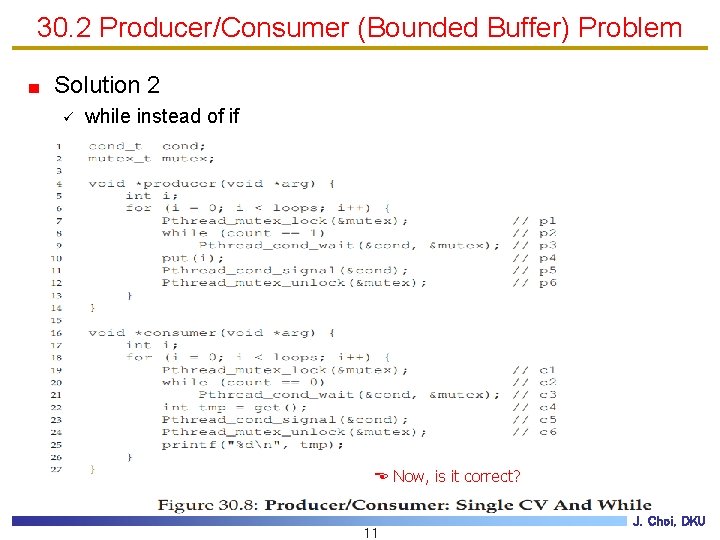
30. 2 Producer/Consumer (Bounded Buffer) Problem Solution 2 ü while instead of if Now, is it correct? 11 J. Choi, DKU
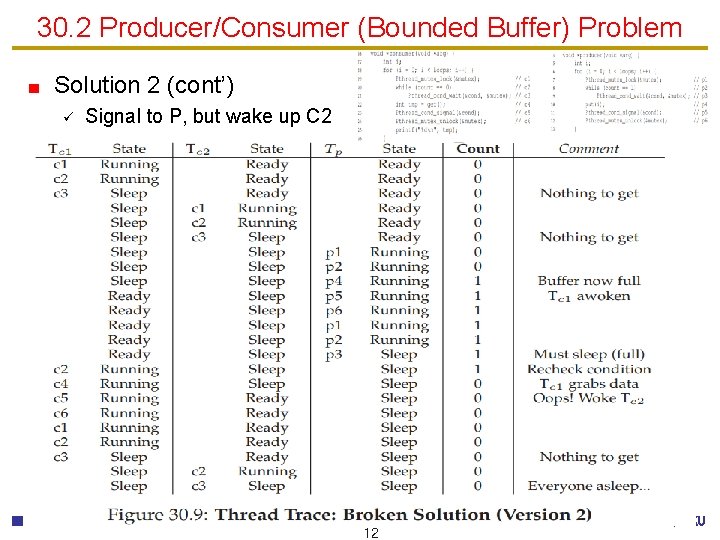
30. 2 Producer/Consumer (Bounded Buffer) Problem Solution 2 (cont’) ü Signal to P, but wake up C 2 12 J. Choi, DKU
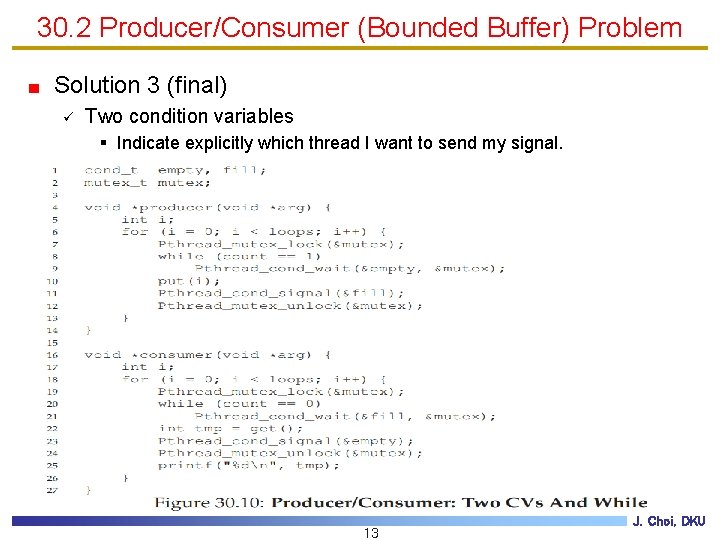
30. 2 Producer/Consumer (Bounded Buffer) Problem Solution 3 (final) ü Two condition variables § Indicate explicitly which thread I want to send my signal. 13 J. Choi, DKU
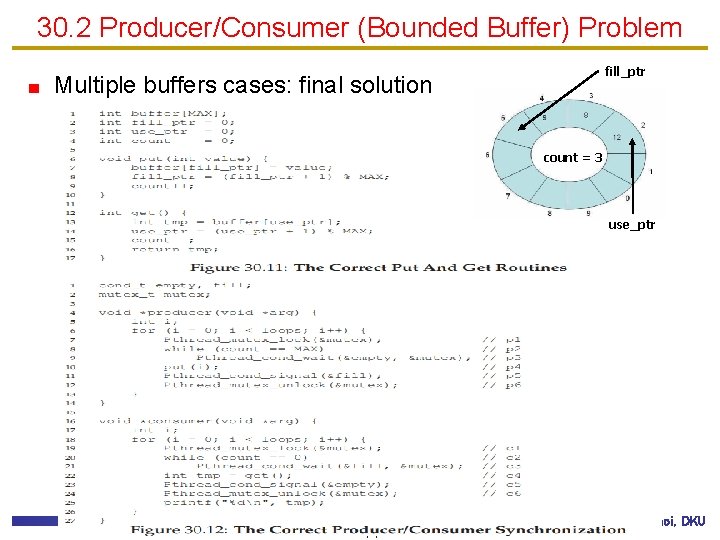
30. 2 Producer/Consumer (Bounded Buffer) Problem fill_ptr Multiple buffers cases: final solution count = 3 use_ptr 14 J. Choi, DKU
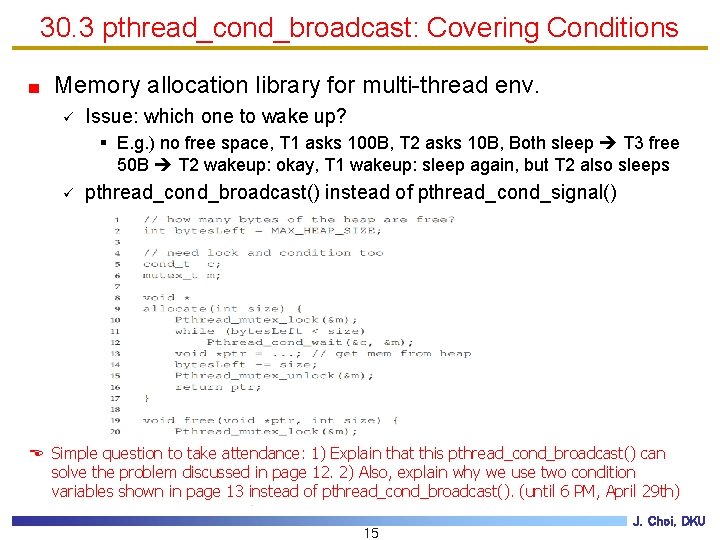
30. 3 pthread_cond_broadcast: Covering Conditions Memory allocation library for multi-thread env. ü Issue: which one to wake up? § E. g. ) no free space, T 1 asks 100 B, T 2 asks 10 B, Both sleep T 3 free 50 B T 2 wakeup: okay, T 1 wakeup: sleep again, but T 2 also sleeps ü pthread_cond_broadcast() instead of pthread_cond_signal() Simple question to take attendance: 1) Explain that this pthread_cond_broadcast() can solve the problem discussed in page 12. 2) Also, explain why we use two condition variables shown in page 13 instead of pthread_cond_broadcast(). (until 6 PM, April 29 th) 15 J. Choi, DKU
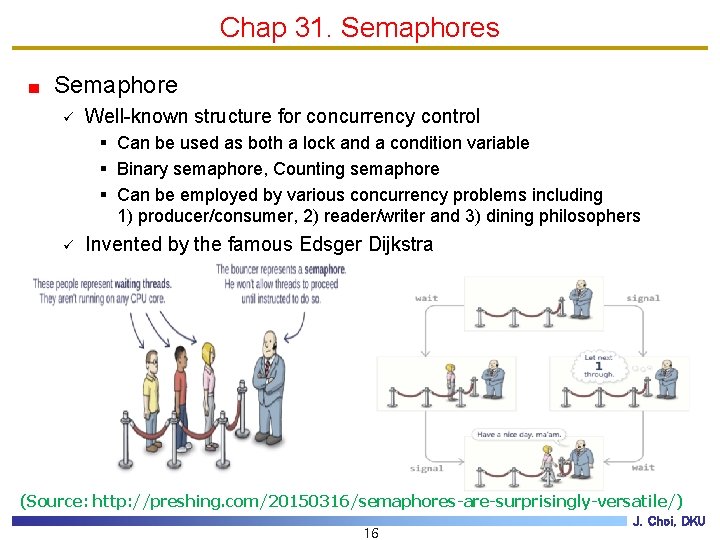
Chap 31. Semaphores Semaphore ü Well-known structure for concurrency control § Can be used as both a lock and a condition variable § Binary semaphore, Counting semaphore § Can be employed by various concurrency problems including 1) producer/consumer, 2) reader/writer and 3) dining philosophers ü Invented by the famous Edsger Dijkstra (Source: http: //preshing. com/20150316/semaphores-are-surprisingly-versatile/) 16 J. Choi, DKU
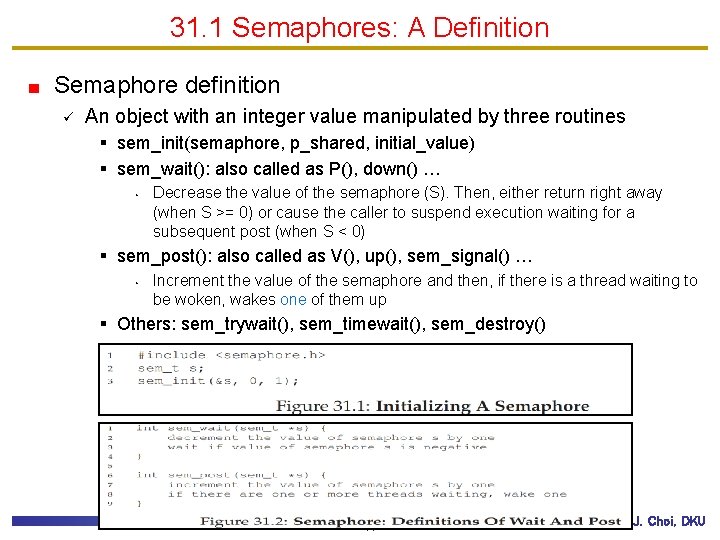
31. 1 Semaphores: A Definition Semaphore definition ü An object with an integer value manipulated by three routines § sem_init(semaphore, p_shared, initial_value) § sem_wait(): also called as P(), down() … • Decrease the value of the semaphore (S). Then, either return right away (when S >= 0) or cause the caller to suspend execution waiting for a subsequent post (when S < 0) § sem_post(): also called as V(), up(), sem_signal() … • Increment the value of the semaphore and then, if there is a thread waiting to be woken, wakes one of them up § Others: sem_trywait(), sem_timewait(), sem_destroy() 17 J. Choi, DKU
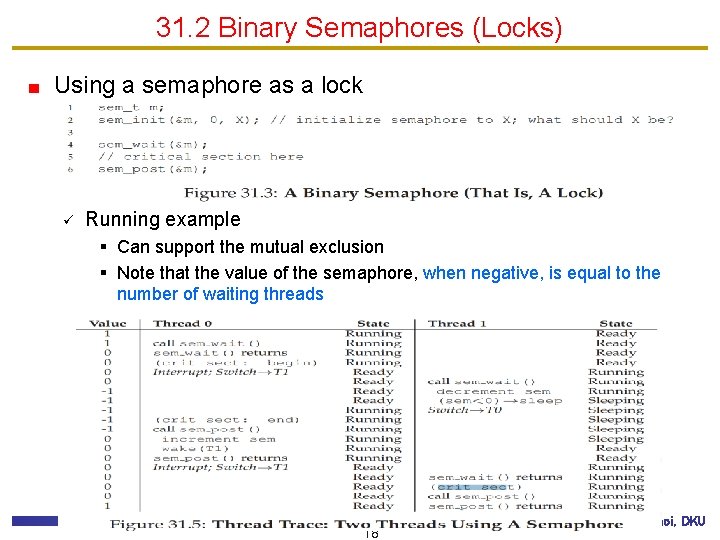
31. 2 Binary Semaphores (Locks) Using a semaphore as a lock ü Running example § Can support the mutual exclusion § Note that the value of the semaphore, when negative, is equal to the number of waiting threads 18 J. Choi, DKU
31. 3 Semaphores for Ordering Using a semaphore as a condition variable ü Initial semaphore value: 0 (note: it is initialized as 1 for mutex) Compare semaphore (this page) with condition variable (page 6) No “Done” variable 19 J. Choi, DKU
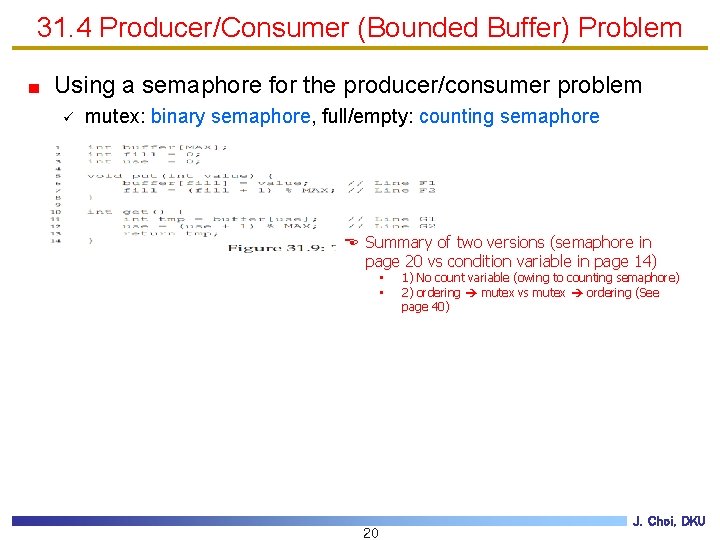
31. 4 Producer/Consumer (Bounded Buffer) Problem Using a semaphore for the producer/consumer problem ü mutex: binary semaphore, full/empty: counting semaphore Summary of two versions (semaphore in page 20 vs condition variable in page 14) • • 20 1) No count variable (owing to counting semaphore) 2) ordering mutex vs mutex ordering (See page 40) J. Choi, DKU
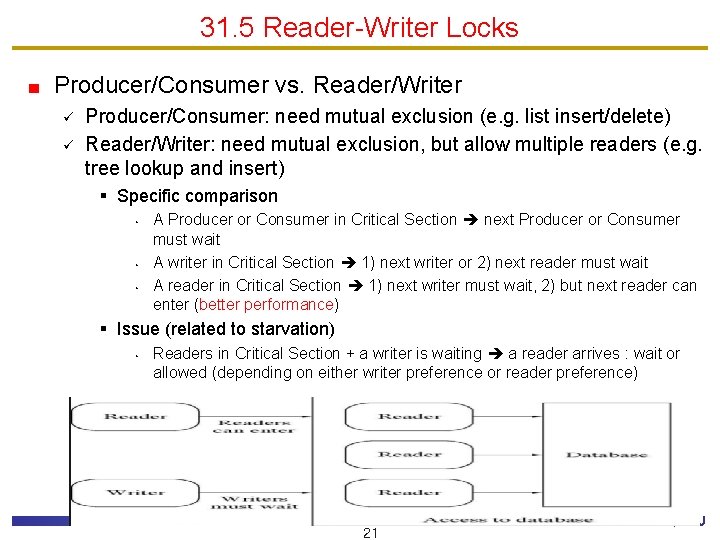
31. 5 Reader-Writer Locks Producer/Consumer vs. Reader/Writer ü ü Producer/Consumer: need mutual exclusion (e. g. list insert/delete) Reader/Writer: need mutual exclusion, but allow multiple readers (e. g. tree lookup and insert) § Specific comparison • • • A Producer or Consumer in Critical Section next Producer or Consumer must wait A writer in Critical Section 1) next writer or 2) next reader must wait A reader in Critical Section 1) next writer must wait, 2) but next reader can enter (better performance) § Issue (related to starvation) • Readers in Critical Section + a writer is waiting a reader arrives : wait or allowed (depending on either writer preference or reader preference) 21 J. Choi, DKU
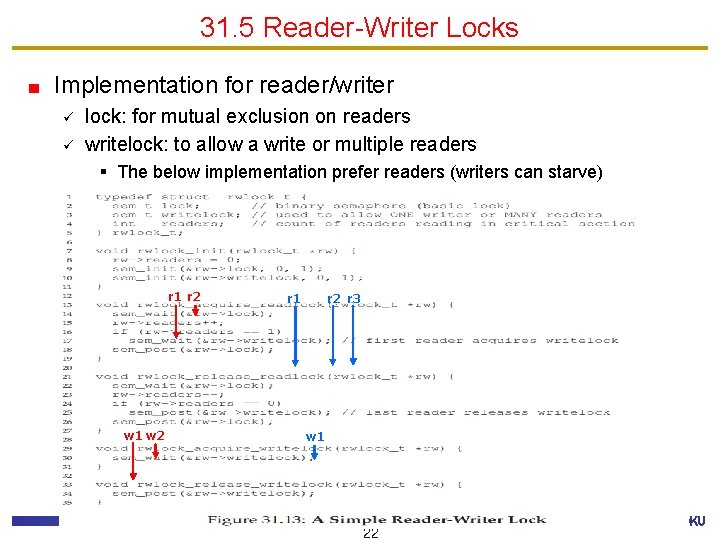
31. 5 Reader-Writer Locks Implementation for reader/writer ü ü lock: for mutual exclusion on readers writelock: to allow a write or multiple readers § The below implementation prefer readers (writers can starve) r 1 r 2 w 1 w 2 r 1 r 2 r 3 w 1 22 J. Choi, DKU
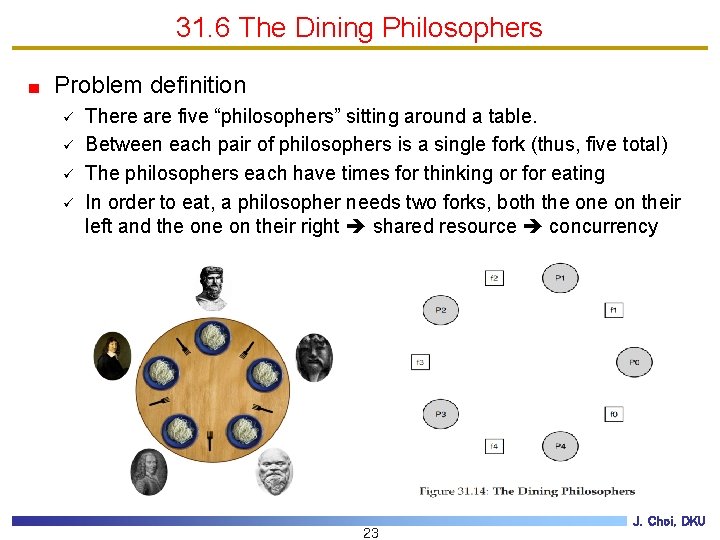
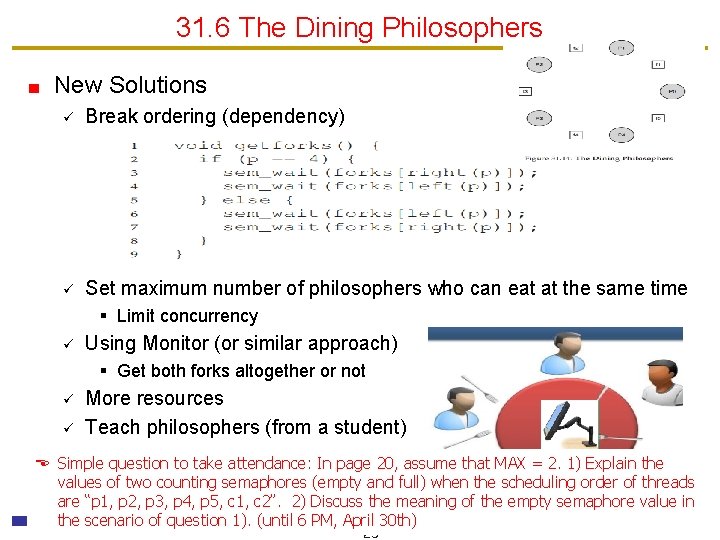
31. 6 The Dining Philosophers Problem definition ü ü There are five “philosophers” sitting around a table. Between each pair of philosophers is a single fork (thus, five total) The philosophers each have times for thinking or for eating In order to eat, a philosopher needs two forks, both the on their left and the on their right shared resource concurrency 23 J. Choi, DKU
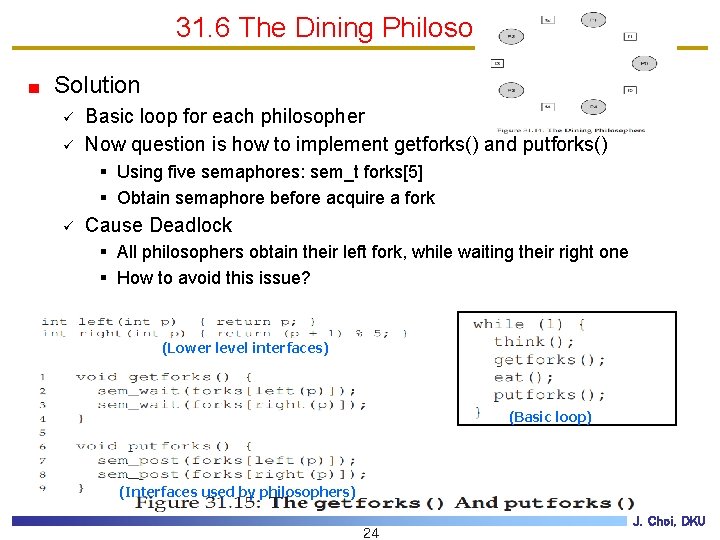
31. 6 The Dining Philosophers Solution ü ü Basic loop for each philosopher Now question is how to implement getforks() and putforks() § Using five semaphores: sem_t forks[5] § Obtain semaphore before acquire a fork ü Cause Deadlock § All philosophers obtain their left fork, while waiting their right one § How to avoid this issue? (Lower level interfaces) (Basic loop) (Interfaces used by philosophers) 24 J. Choi, DKU
31. 6 The Dining Philosophers New Solutions ü Break ordering (dependency) ü Set maximum number of philosophers who can eat at the same time § Limit concurrency ü Using Monitor (or similar approach) § Get both forks altogether or not More resources ü Teach philosophers (from a student) ü … question to take attendance: In page 20, assume that MAX = 2. 1) Explain the Simple ü values of two counting semaphores (empty and full) when the scheduling order of threads are “p 1, p 2, p 3, p 4, p 5, c 1, c 2”. 2) Discuss the meaning of the empty semaphore value in J. Choi, DKU the scenario of question 1). (until 6 PM, April 30 th) 25
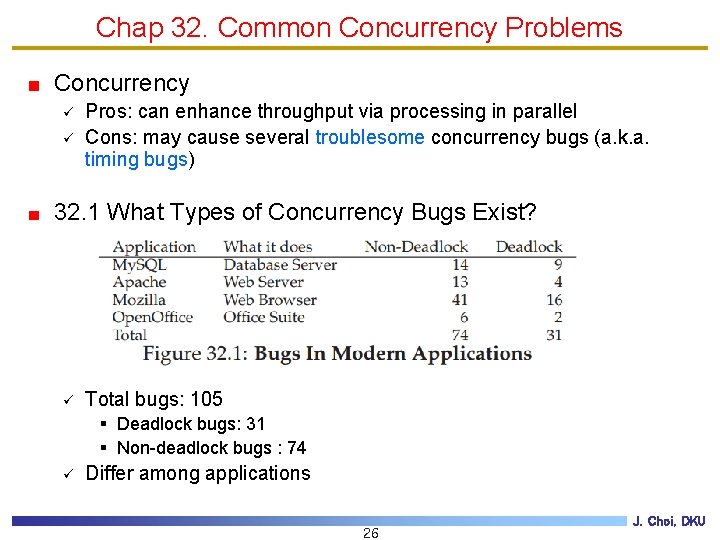
Chap 32. Common Concurrency Problems Concurrency ü ü Pros: can enhance throughput via processing in parallel Cons: may cause several troublesome concurrency bugs (a. k. a. timing bugs) 32. 1 What Types of Concurrency Bugs Exist? ü Total bugs: 105 § Deadlock bugs: 31 § Non-deadlock bugs : 74 ü Differ among applications 26 J. Choi, DKU
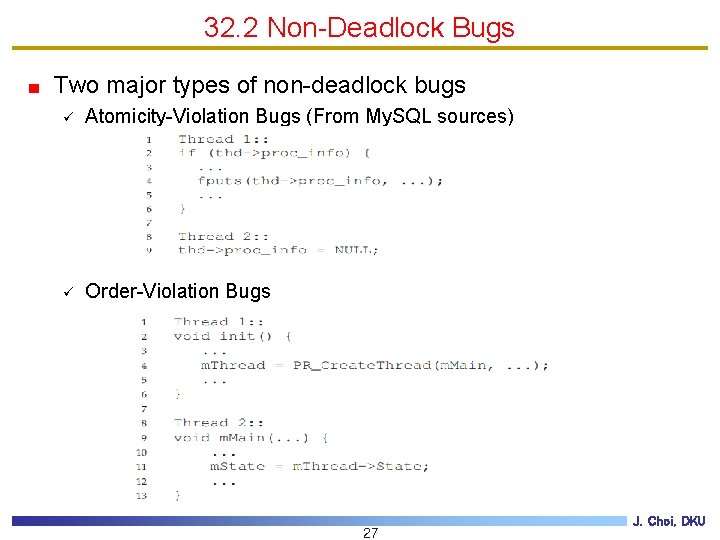
32. 2 Non-Deadlock Bugs Two major types of non-deadlock bugs ü Atomicity-Violation Bugs (From My. SQL sources) ü Order-Violation Bugs 27 J. Choi, DKU
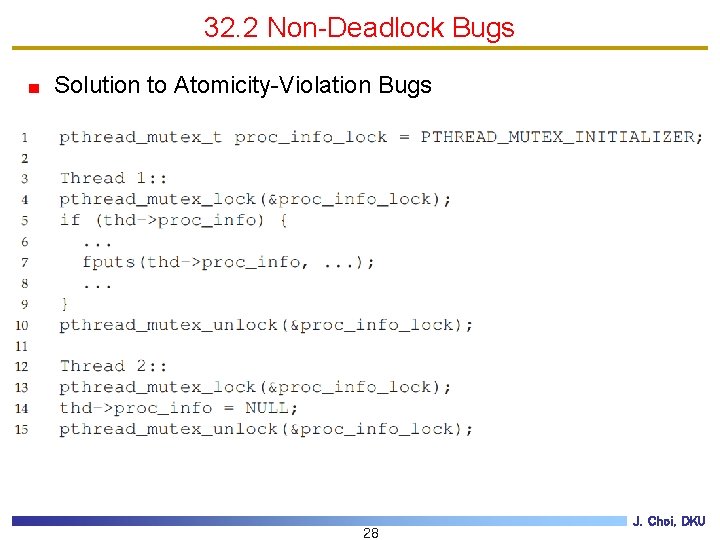
32. 2 Non-Deadlock Bugs Solution to Atomicity-Violation Bugs 28 J. Choi, DKU
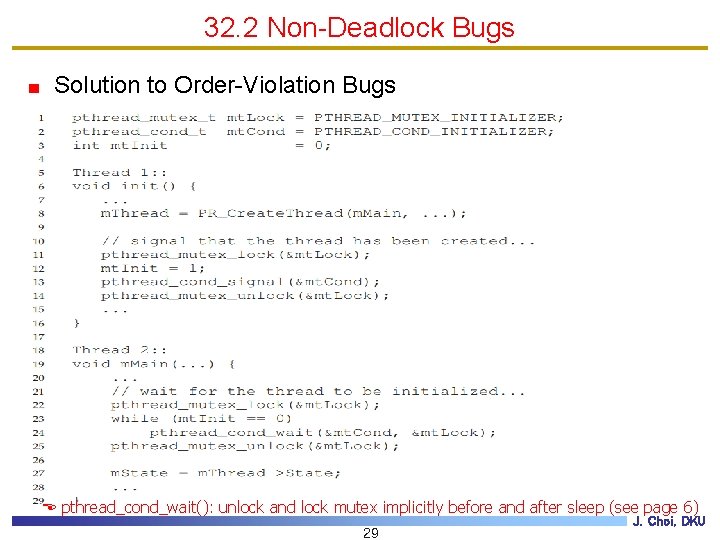
32. 2 Non-Deadlock Bugs Solution to Order-Violation Bugs pthread_cond_wait(): unlock and lock mutex implicitly before and after sleep (see page 6) 29 J. Choi, DKU
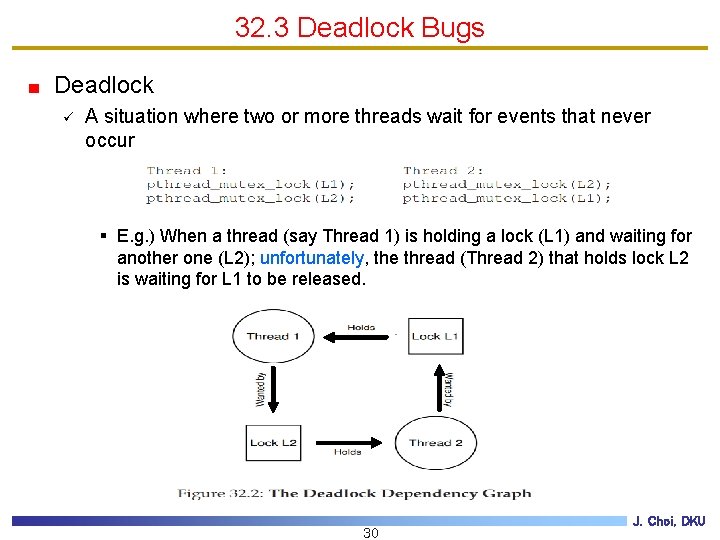
32. 3 Deadlock Bugs Deadlock ü A situation where two or more threads wait for events that never occur § E. g. ) When a thread (say Thread 1) is holding a lock (L 1) and waiting for another one (L 2); unfortunately, the thread (Thread 2) that holds lock L 2 is waiting for L 1 to be released. 30 J. Choi, DKU
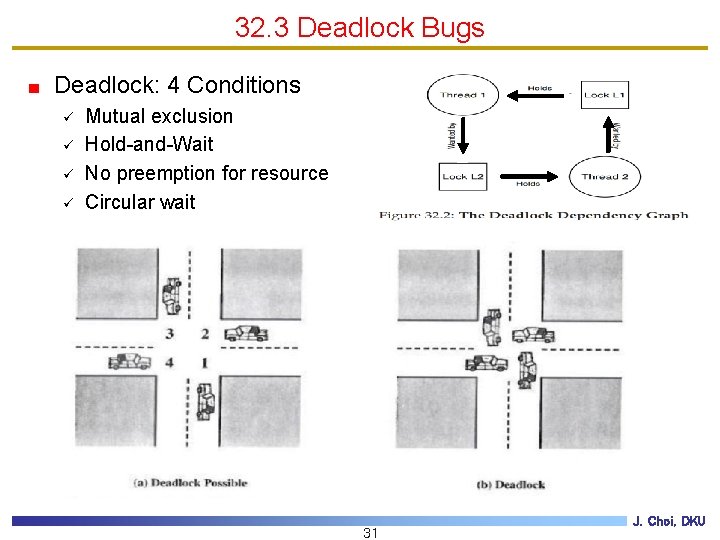
32. 3 Deadlock Bugs Deadlock: 4 Conditions ü ü Mutual exclusion Hold-and-Wait No preemption for resource Circular wait 31 J. Choi, DKU
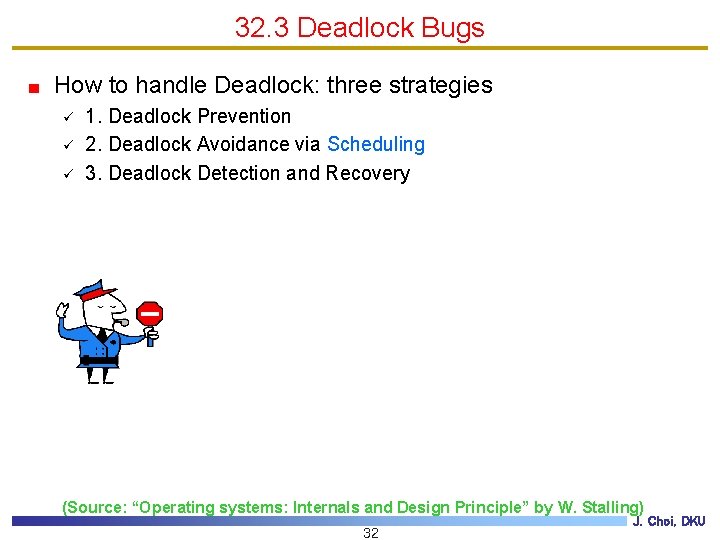
32. 3 Deadlock Bugs How to handle Deadlock: three strategies ü ü ü 1. Deadlock Prevention 2. Deadlock Avoidance via Scheduling 3. Deadlock Detection and Recovery (Source: “Operating systems: Internals and Design Principle” by W. Stalling) 32 J. Choi, DKU
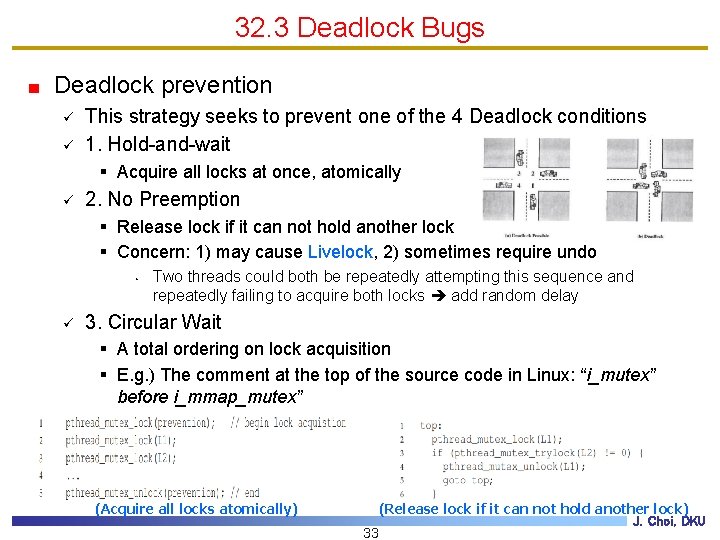
32. 3 Deadlock Bugs Deadlock prevention ü ü This strategy seeks to prevent one of the 4 Deadlock conditions 1. Hold-and-wait § Acquire all locks at once, atomically ü 2. No Preemption § Release lock if it can not hold another lock § Concern: 1) may cause Livelock, 2) sometimes require undo • ü Two threads could both be repeatedly attempting this sequence and repeatedly failing to acquire both locks add random delay 3. Circular Wait § A total ordering on lock acquisition § E. g. ) The comment at the top of the source code in Linux: “i_mutex” before i_mmap_mutex” (Acquire all locks atomically) (Release lock if it can not hold another lock) 33 J. Choi, DKU
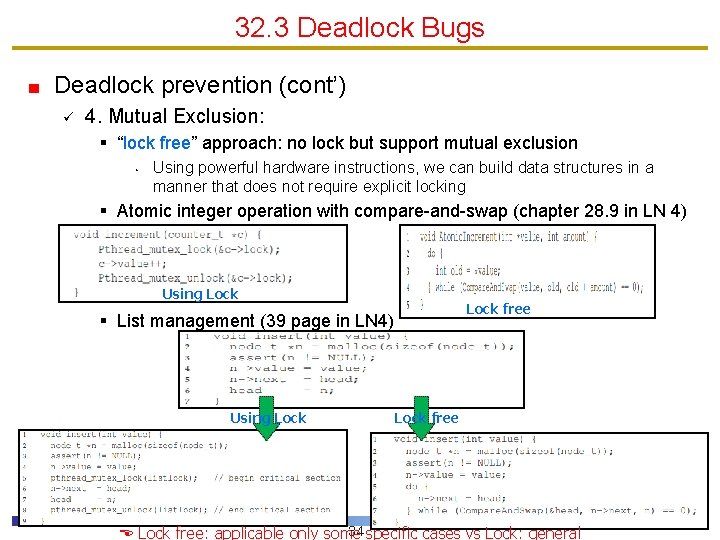
32. 3 Deadlock Bugs Deadlock prevention (cont’) ü 4. Mutual Exclusion: § “lock free” approach: no lock but support mutual exclusion • Using powerful hardware instructions, we can build data structures in a manner that does not require explicit locking § Atomic integer operation with compare-and-swap (chapter 28. 9 in LN 4) Using Lock free § List management (39 page in LN 4) Using Lock free 34 specific cases vs Lock: general Lock free: applicable only some J. Choi, DKU
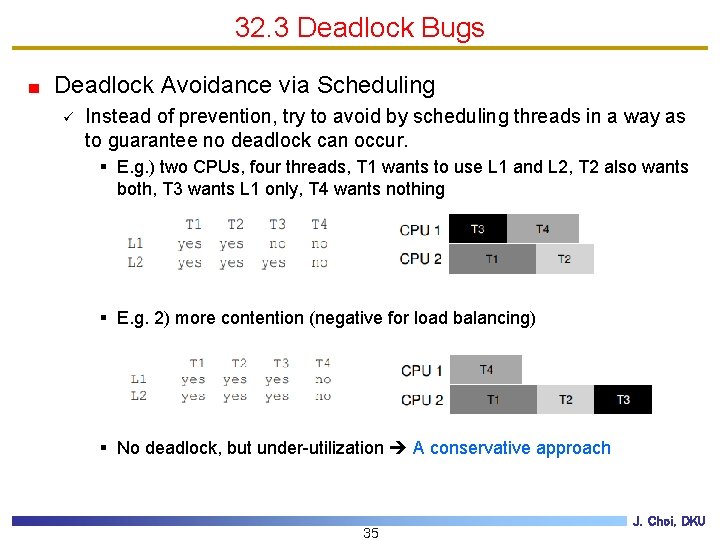
32. 3 Deadlock Bugs Deadlock Avoidance via Scheduling ü Instead of prevention, try to avoid by scheduling threads in a way as to guarantee no deadlock can occur. § E. g. ) two CPUs, four threads, T 1 wants to use L 1 and L 2, T 2 also wants both, T 3 wants L 1 only, T 4 wants nothing § E. g. 2) more contention (negative for load balancing) § No deadlock, but under-utilization A conservative approach 35 J. Choi, DKU
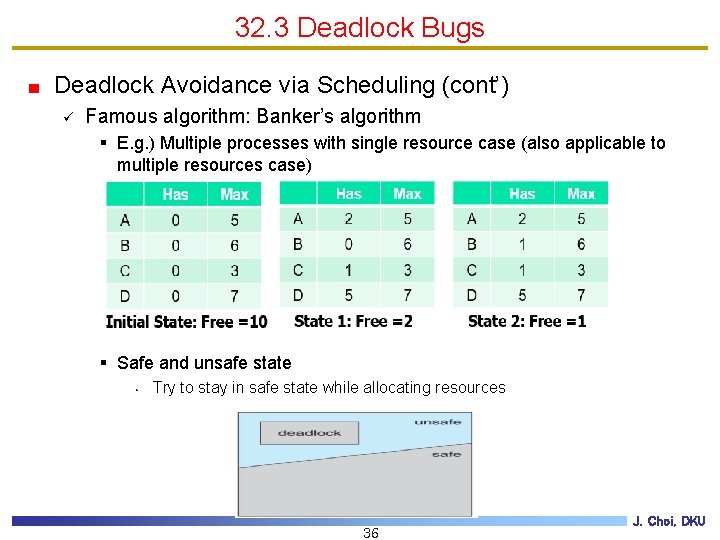
32. 3 Deadlock Bugs Deadlock Avoidance via Scheduling (cont’) ü Famous algorithm: Banker’s algorithm § E. g. ) Multiple processes with single resource case (also applicable to multiple resources case) § Safe and unsafe state • Try to stay in safe state while allocating resources 36 J. Choi, DKU
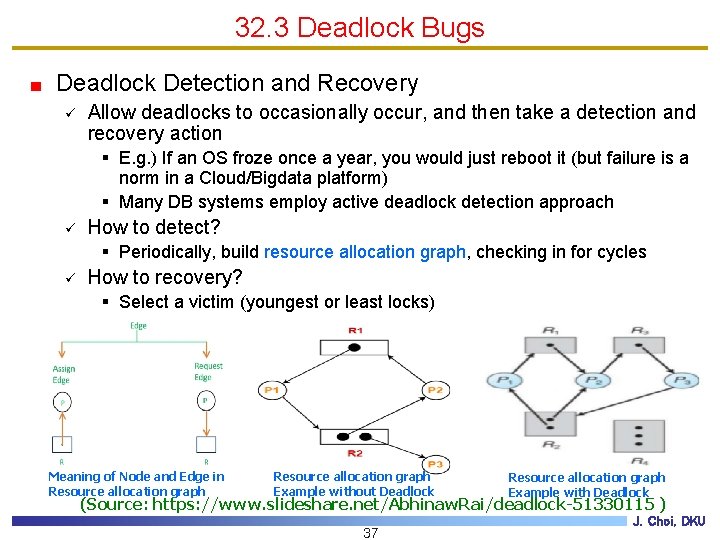
32. 3 Deadlock Bugs Deadlock Detection and Recovery ü Allow deadlocks to occasionally occur, and then take a detection and recovery action § E. g. ) If an OS froze once a year, you would just reboot it (but failure is a norm in a Cloud/Bigdata platform) § Many DB systems employ active deadlock detection approach ü How to detect? § Periodically, build resource allocation graph, checking in for cycles ü How to recovery? § Select a victim (youngest or least locks) Meaning of Node and Edge in Resource allocation graph Example without Deadlock Resource allocation graph Example with Deadlock (Source: https: //www. slideshare. net/Abhinaw. Rai/deadlock-51330115 ) 37 J. Choi, DKU
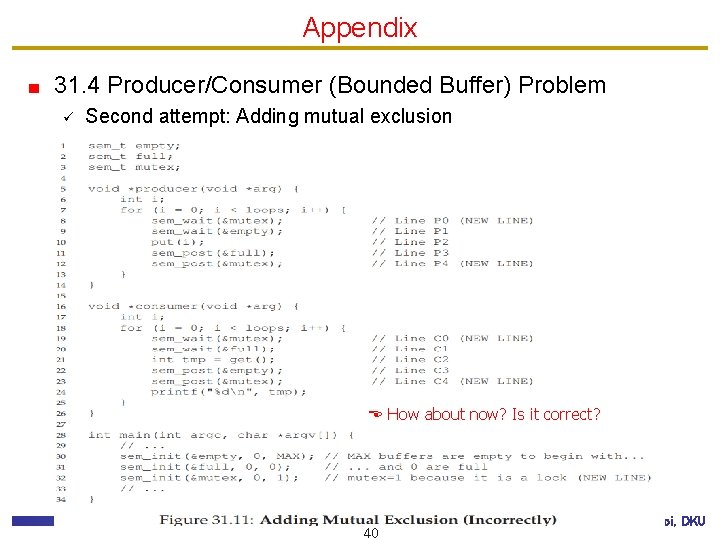
32. 4 Summary Concurrency method ü Lock, Condition variable, Semaphore, … Well-known concurrency problems ü ü ü The Producer/Consumer problem The Reader/Writer problem The Dining philosopher problem Currency bugs ü ü Non-Deadlock bugs Deadlock approach Prevention ü Avoidance ü Detection and Recovery Simple question to take attendance: 1) Explain how the program, shown in page 40, might ü cause deadlock (explain a scenario that causes deadlock), 2) Discuss this deadlock scenario with the resource allocation graph. (hint: compare it with the program shown in page 20). (until 6 PM, May 7 th) J. Choi, DKU 38
Appendix 31. 4 Producer/Consumer (Bounded Buffer) Problem ü First attempt What do you think about this? Correct? 39 J. Choi, DKU
Appendix 31. 4 Producer/Consumer (Bounded Buffer) Problem ü Second attempt: Adding mutual exclusion How about now? Is it correct? 40 J. Choi, DKU
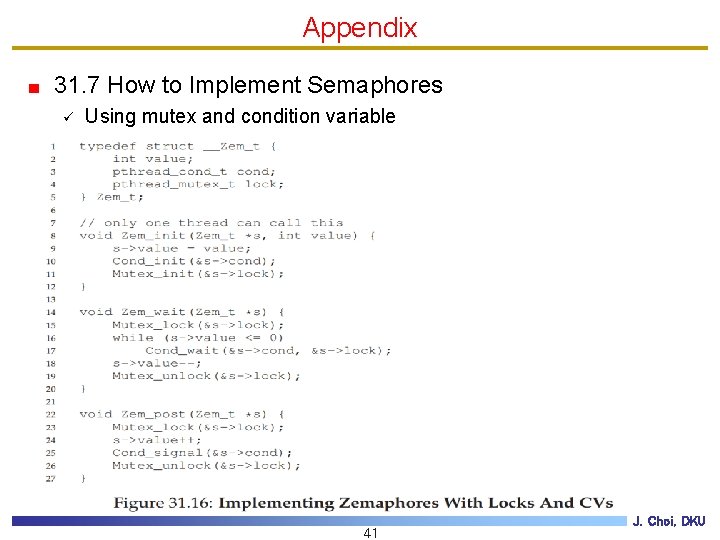
Appendix 31. 7 How to Implement Semaphores ü Using mutex and condition variable 41 J. Choi, DKU