
Lecture IVa jets Marco van Leeuwen Utrecht University


- Slides: 48
Lecture IVa: jets Marco van Leeuwen, Utrecht University Lectures for Helmholtz School Feb/March 2011
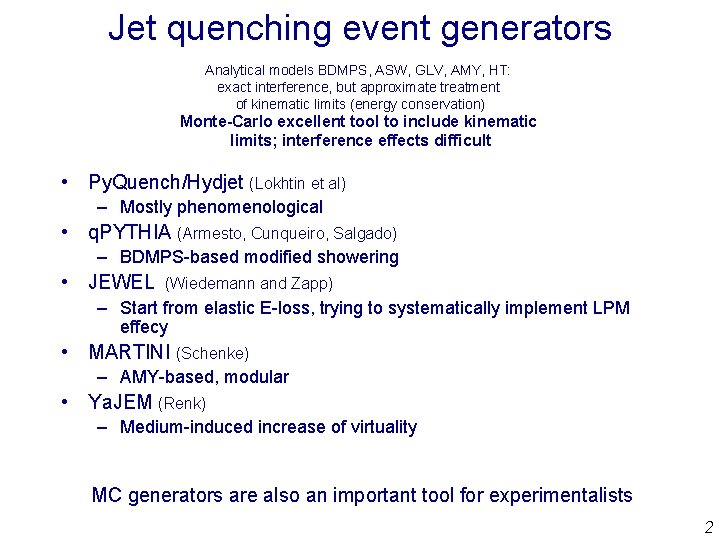
Jet quenching event generators Analytical models BDMPS, ASW, GLV, AMY, HT: exact interference, but approximate treatment of kinematic limits (energy conservation) Monte-Carlo excellent tool to include kinematic limits; interference effects difficult • Py. Quench/Hydjet (Lokhtin et al) – Mostly phenomenological • q. PYTHIA (Armesto, Cunqueiro, Salgado) – BDMPS-based modified showering • JEWEL (Wiedemann and Zapp) – Start from elastic E-loss, trying to systematically implement LPM effecy • MARTINI (Schenke) – AMY-based, modular • Ya. JEM (Renk) – Medium-induced increase of virtuality MC generators are also an important tool for experimentalists 2
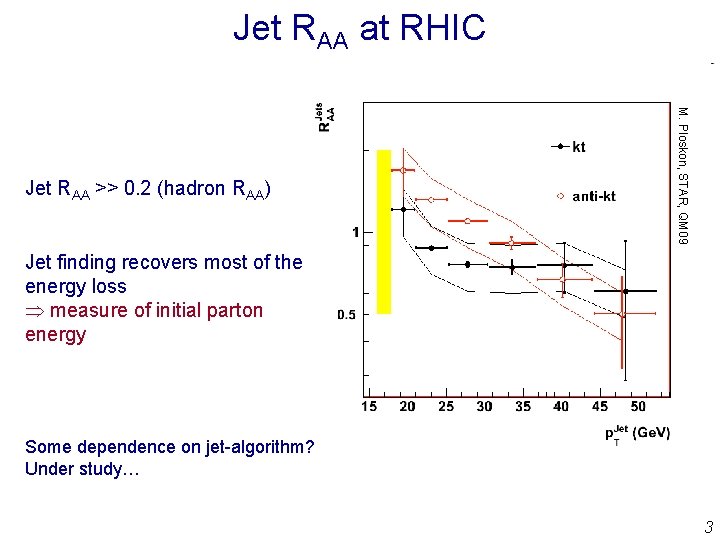
Jet RAA at RHIC M. Ploskon, STAR, QM 09 Jet RAA >> 0. 2 (hadron RAA) Jet finding recovers most of the energy loss measure of initial parton energy Some dependence on jet-algorithm? Under study… 3
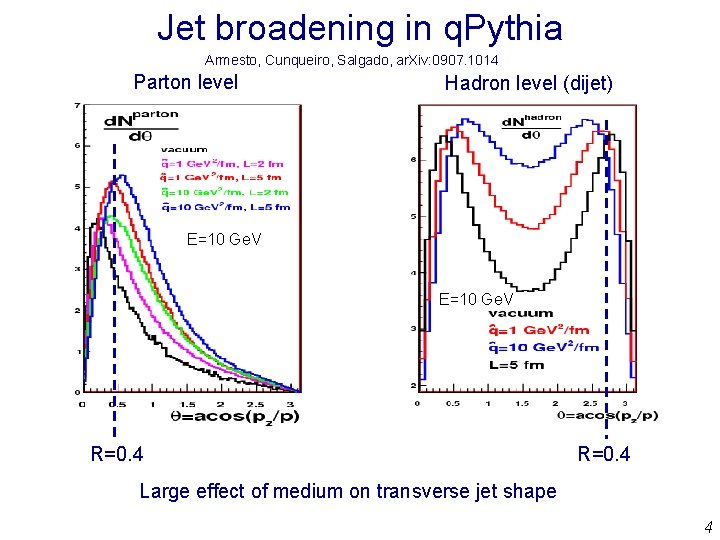
Jet broadening in q. Pythia Armesto, Cunqueiro, Salgado, ar. Xiv: 0907. 1014 Parton level Hadron level (dijet) E=10 Ge. V R=0. 4 Large effect of medium on transverse jet shape 4
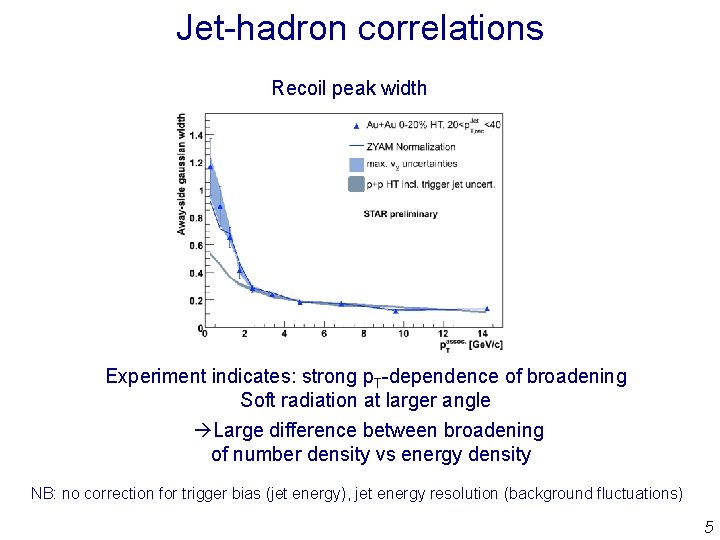
Jet-hadron correlations Recoil peak width Experiment indicates: strong p. T-dependence of broadening Soft radiation at larger angle Large difference between broadening of number density vs energy density NB: no correction for trigger bias (jet energy), jet energy resolution (background fluctuations) 5
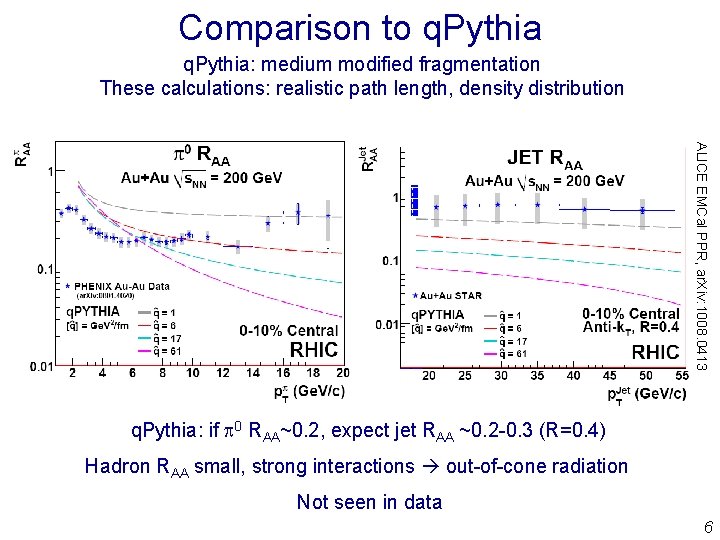
Comparison to q. Pythia: medium modified fragmentation These calculations: realistic path length, density distribution ALICE EMCal PPR, ar. Xiv: 1008. 0413 q. Pythia: if 0 RAA~0. 2, expect jet RAA ~0. 2 -0. 3 (R=0. 4) Hadron RAA small, strong interactions out-of-cone radiation Not seen in data 6
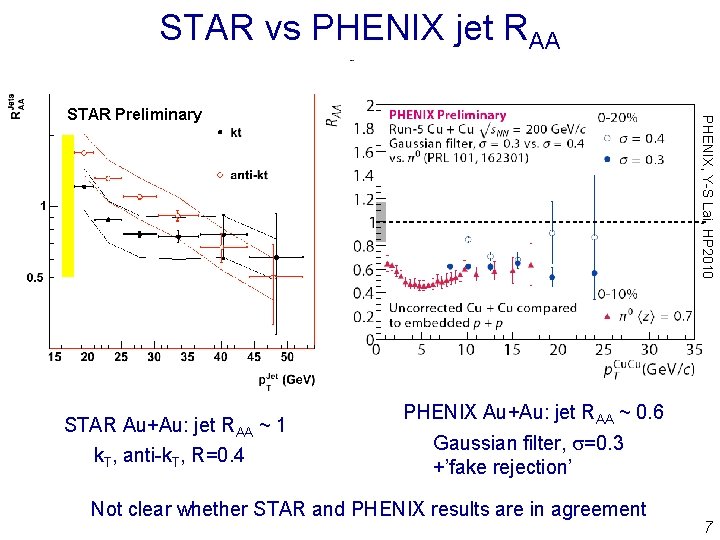
STAR vs PHENIX jet RAA PHENIX, Y-S Lai, HP 2010 STAR Au+Au: jet RAA ~ 1 k. T, anti-k. T, R=0. 4 M. Ploskon, STAR, QM 09 STAR Preliminary PHENIX Au+Au: jet RAA ~ 0. 6 Gaussian filter, s=0. 3 +’fake rejection’ Not clear whether STAR and PHENIX results are in agreement 7
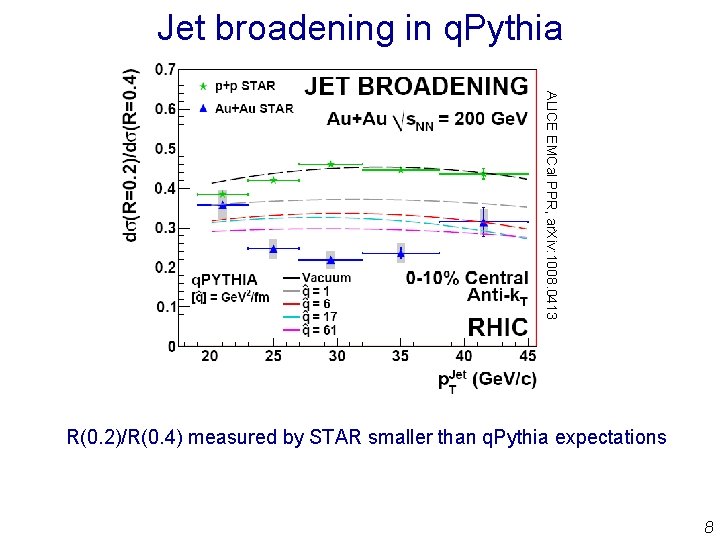
Jet broadening in q. Pythia ALICE EMCal PPR, ar. Xiv: 1008. 0413 R(0. 2)/R(0. 4) measured by STAR smaller than q. Pythia expectations 8
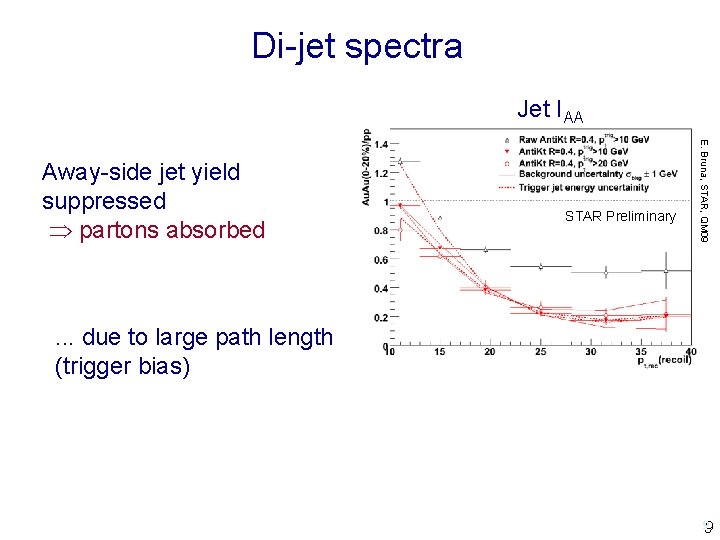
Di-jet spectra Jet IAA STAR Preliminary E. Bruna, STAR, QM 09 Away-side jet yield suppressed partons absorbed . . . due to large path length (trigger bias) 9 9
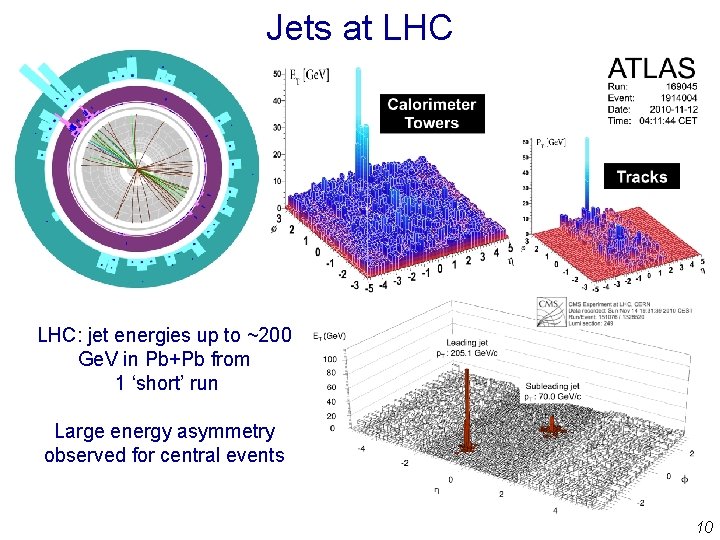
Jets at LHC: jet energies up to ~200 Ge. V in Pb+Pb from 1 ‘short’ run Large energy asymmetry observed for central events 10
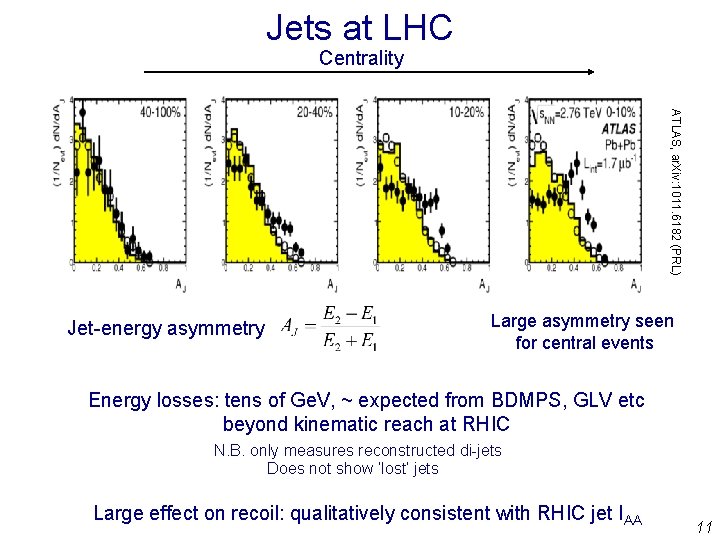
Jets at LHC Centrality ATLAS, ar. Xiv: 1011. 6182 (PRL) Jet-energy asymmetry Large asymmetry seen for central events Energy losses: tens of Ge. V, ~ expected from BDMPS, GLV etc beyond kinematic reach at RHIC N. B. only measures reconstructed di-jets Does not show ‘lost’ jets Large effect on recoil: qualitatively consistent with RHIC jet IAA 11
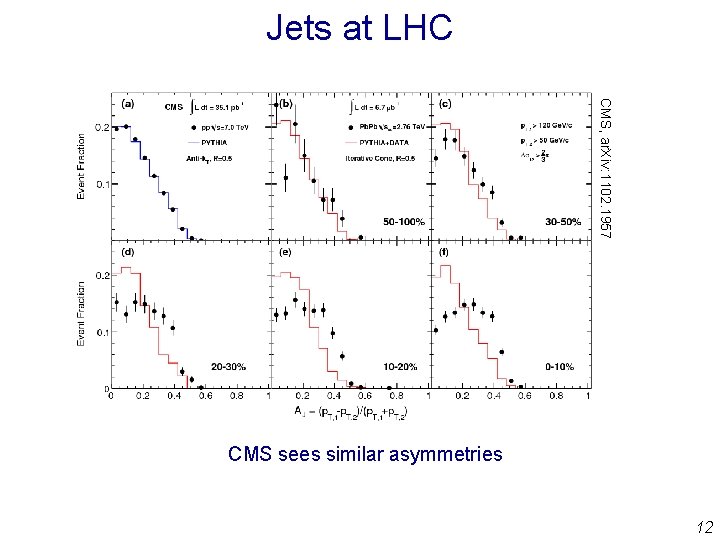
Jets at LHC CMS, ar. Xiv: 1102. 1957 CMS sees similar asymmetries 12
Lecture IVb: Intermediate p. T Marco van Leeuwen, Utrecht University Lectures for Helmholtz School Feb/March 2011
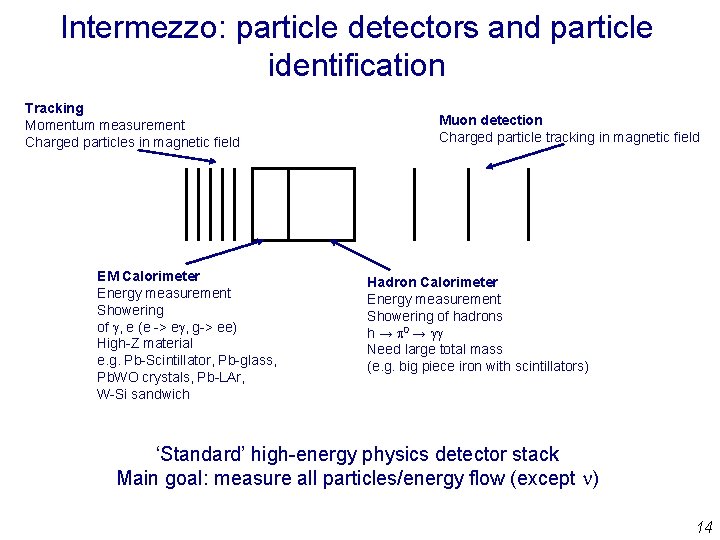
Intermezzo: particle detectors and particle identification Tracking Momentum measurement Charged particles in magnetic field EM Calorimeter Energy measurement Showering of g, e (e -> eg, g-> ee) High-Z material e. g. Pb-Scintillator, Pb-glass, Pb. WO crystals, Pb-LAr, W-Si sandwich Muon detection Charged particle tracking in magnetic field Hadron Calorimeter Energy measurement Showering of hadrons h → 0 → gg Need large total mass (e. g. big piece iron with scintillators) ‘Standard’ high-energy physics detector stack Main goal: measure all particles/energy flow (except n) 14
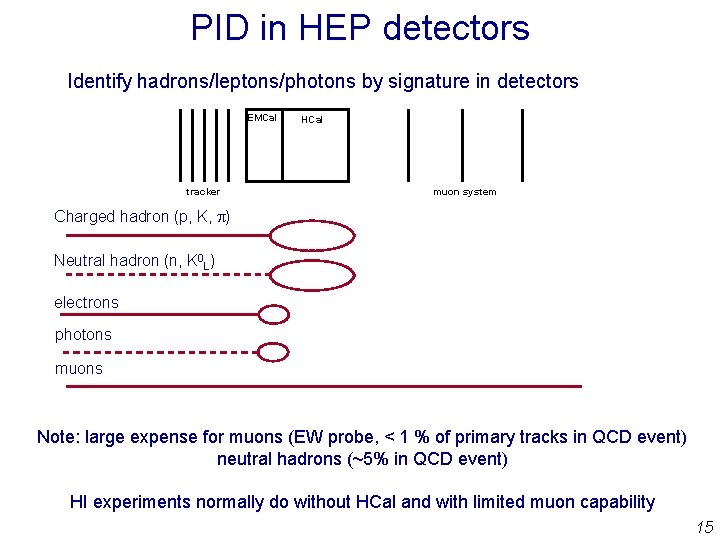
PID in HEP detectors Identify hadrons/leptons/photons by signature in detectors EMCal tracker HCal muon system Charged hadron (p, K, ) Neutral hadron (n, K 0 L) electrons photons muons Note: large expense for muons (EW probe, < 1 % of primary tracks in QCD event) neutral hadrons (~5% in QCD event) HI experiments normally do without HCal and with limited muon capability 15
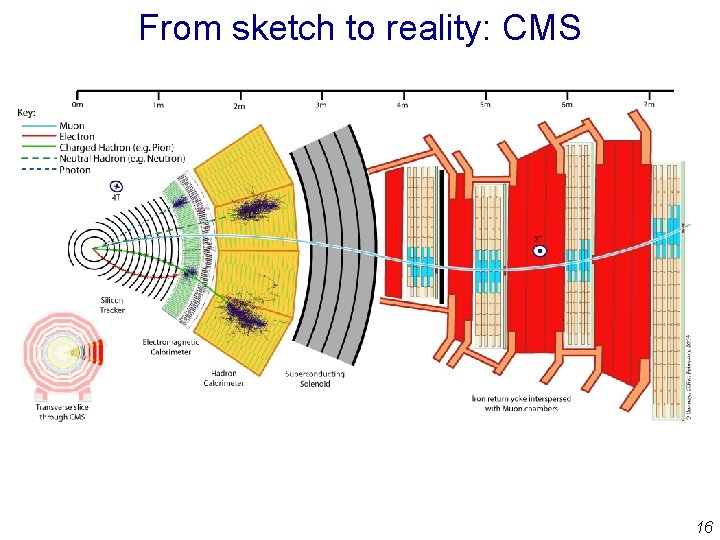
From sketch to reality: CMS 16
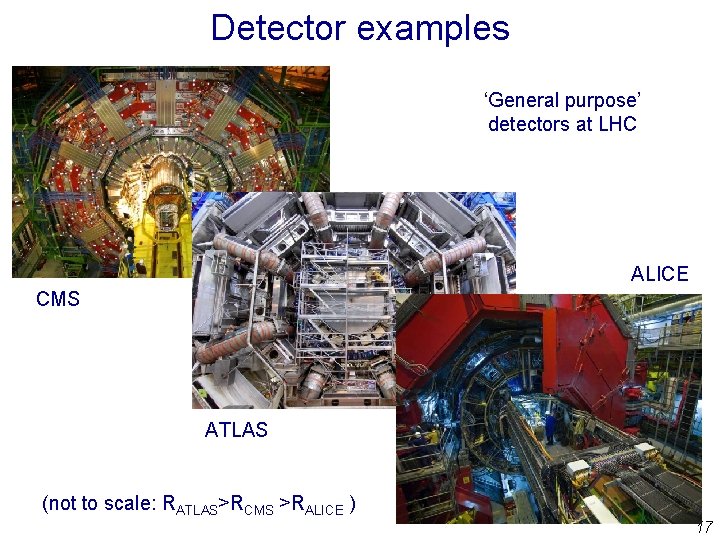
Detector examples ‘General purpose’ detectors at LHC ALICE CMS ATLAS (not to scale: RATLAS>RCMS >RALICE ) 17
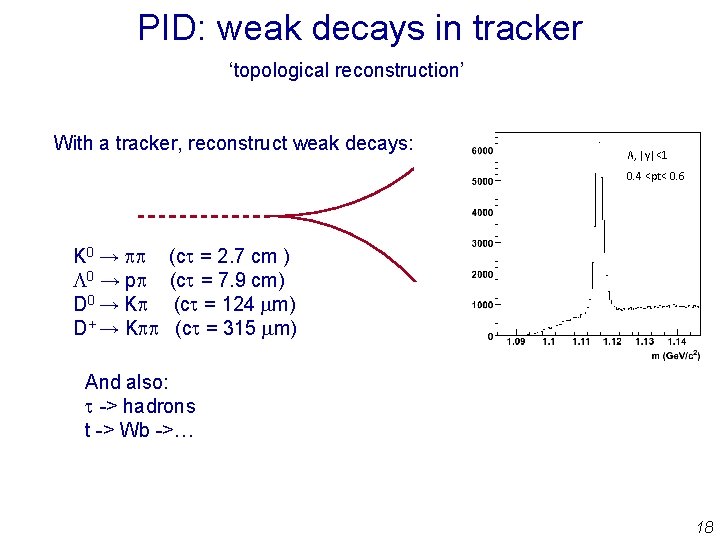
PID: weak decays in tracker ‘topological reconstruction’ With a tracker, reconstruct weak decays: Λ, |y|<1 0. 4 <pt< 0. 6 K 0 → L 0 → p D 0 → K D+ → K (ct = 2. 7 cm ) (ct = 7. 9 cm) (ct = 124 mm) (ct = 315 mm) And also: t -> hadrons t -> Wb ->… 18
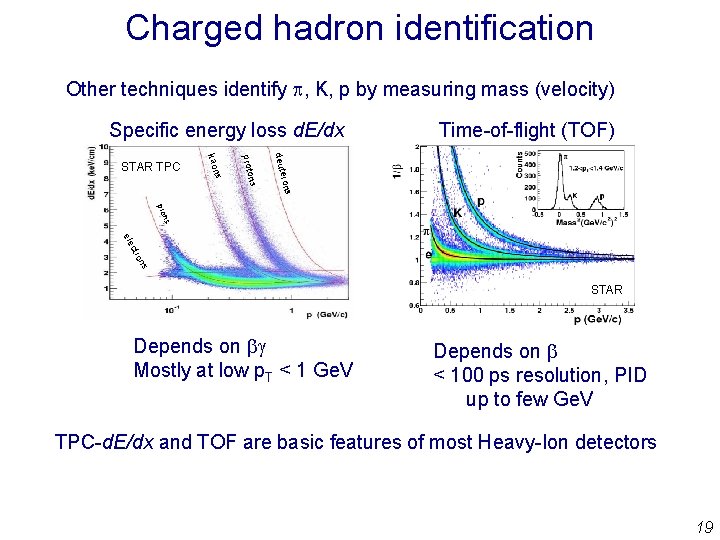
Charged hadron identification Other techniques identify , K, p by measuring mass (velocity) Specific energy loss d. E/dx s eron deut ns proto s kaon STAR TPC Time-of-flight (TOF) s n pio s on ctr ele STAR Depends on bg Mostly at low p. T < 1 Ge. V Depends on b < 100 ps resolution, PID up to few Ge. V TPC-d. E/dx and TOF are basic features of most Heavy-Ion detectors 19
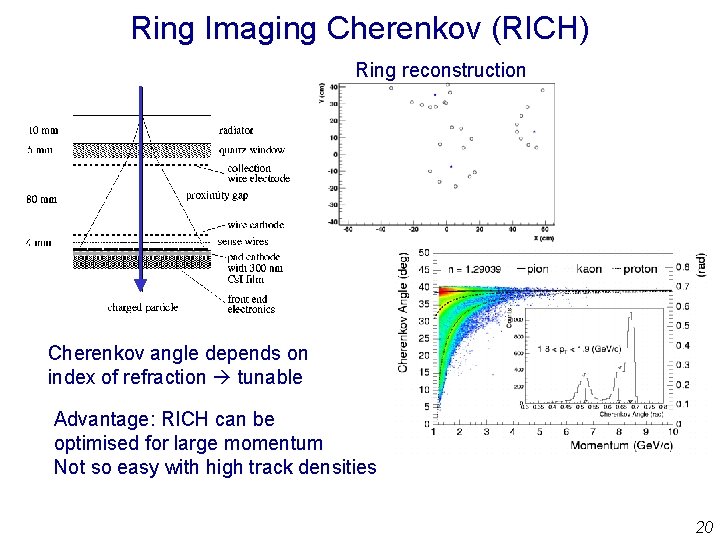
Ring Imaging Cherenkov (RICH) Ring reconstruction Cherenkov angle depends on index of refraction tunable Advantage: RICH can be optimised for large momentum Not so easy with high track densities 20
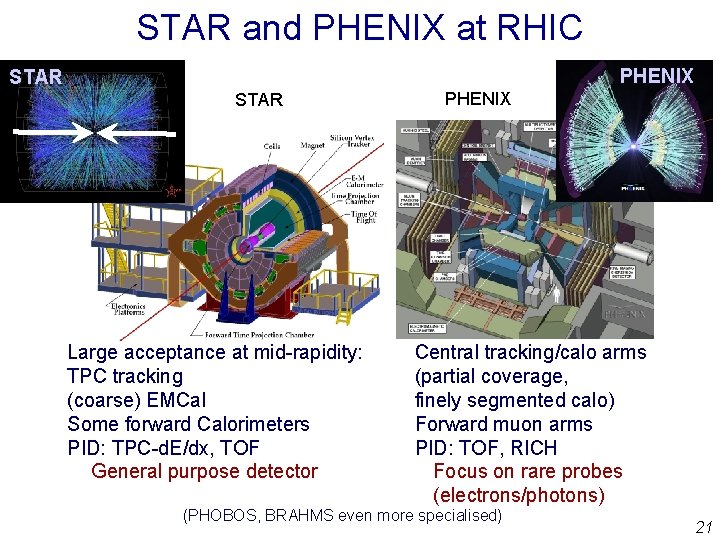
STAR and PHENIX at RHIC PHENIX STAR Large acceptance at mid-rapidity: TPC tracking (coarse) EMCal Some forward Calorimeters PID: TPC-d. E/dx, TOF General purpose detector PHENIX Central tracking/calo arms (partial coverage, finely segmented calo) Forward muon arms PID: TOF, RICH Focus on rare probes (electrons/photons) (PHOBOS, BRAHMS even more specialised) 21
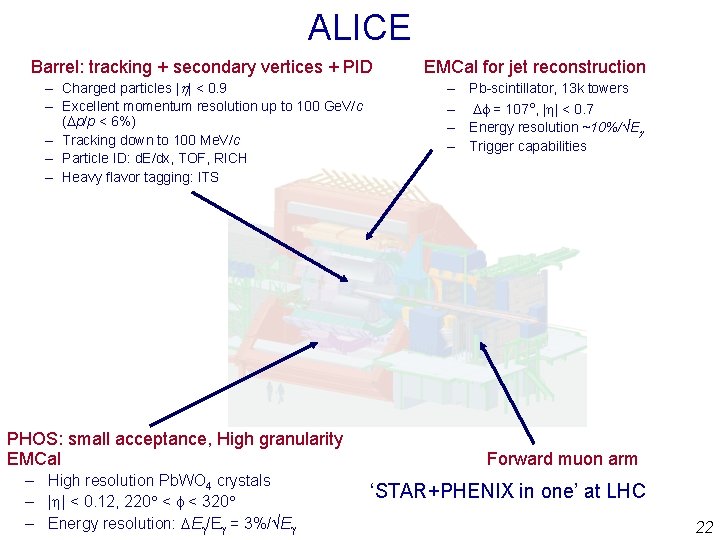
ALICE Barrel: tracking + secondary vertices + PID – Charged particles |h| < 0. 9 – Excellent momentum resolution up to 100 Ge. V/c ( p/p < 6%) – Tracking down to 100 Me. V/c – Particle ID: d. E/dx, TOF, RICH – Heavy flavor tagging: ITS PHOS: small acceptance, High granularity EMCal – High resolution Pb. WO 4 crystals – | | < 0. 12, 220 < f < 320 – Energy resolution: Eg/Eg = 3%/ Eg EMCal for jet reconstruction – Pb-scintillator, 13 k towers – f = 107 , | | < 0. 7 – Energy resolution ~10%/√Eg – Trigger capabilities Forward muon arm ‘STAR+PHENIX in one’ at LHC 22
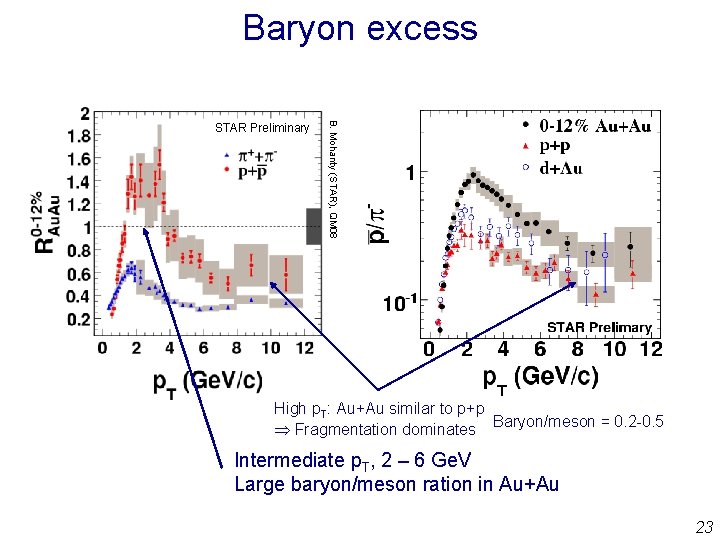
Baryon excess B. Mohanty (STAR), QM 08 STAR Preliminary High p. T: Au+Au similar to p+p Fragmentation dominates Baryon/meson = 0. 2 -0. 5 Intermediate p. T, 2 – 6 Ge. V Large baryon/meson ration in Au+Au 23
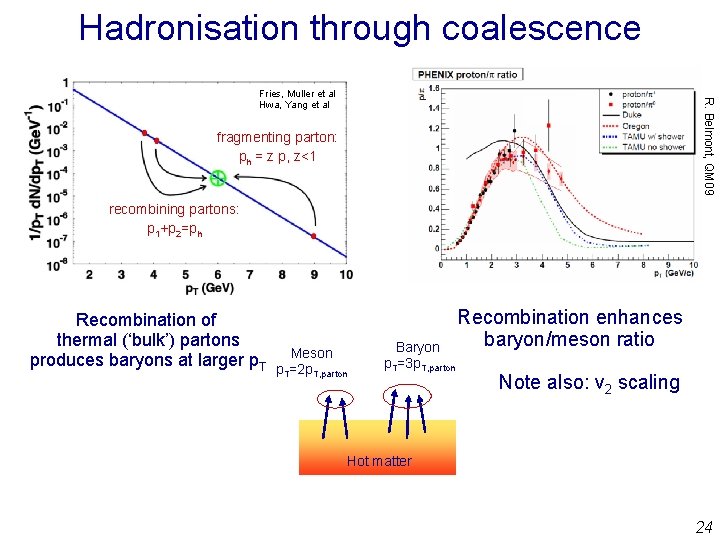
Hadronisation through coalescence R. Belmont, QM 09 Fries, Muller et al Hwa, Yang et al fragmenting parton: ph = z p, z<1 recombining partons: p 1+p 2=ph Recombination of thermal (‘bulk’) partons produces baryons at larger p. T Meson p. T=2 p. T, parton Baryon p. T=3 p. T, parton Recombination enhances baryon/meson ratio Note also: v 2 scaling Hot matter 24
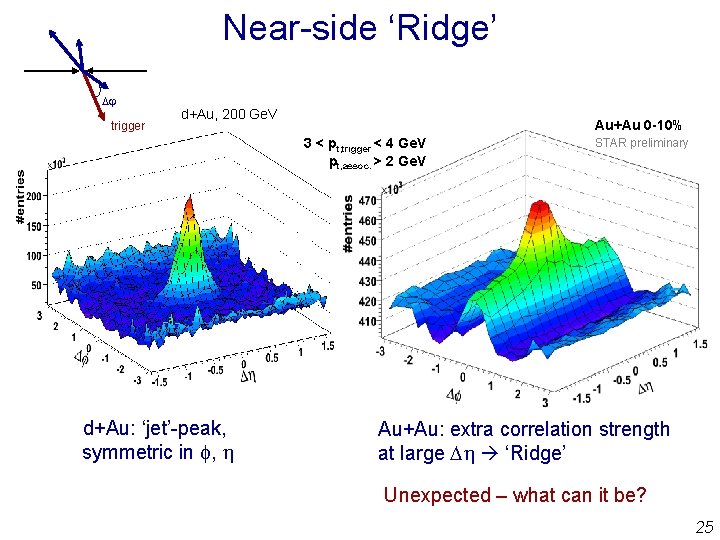
Near-side ‘Ridge’ trigger d+Au, 200 Ge. V Au+Au 0 -10% 3 < pt, trigger < 4 Ge. V pt, assoc. > 2 Ge. V d+Au: ‘jet’-peak, symmetric in f, STAR preliminary Au+Au: extra correlation strength at large ‘Ridge’ Unexpected – what can it be? 25
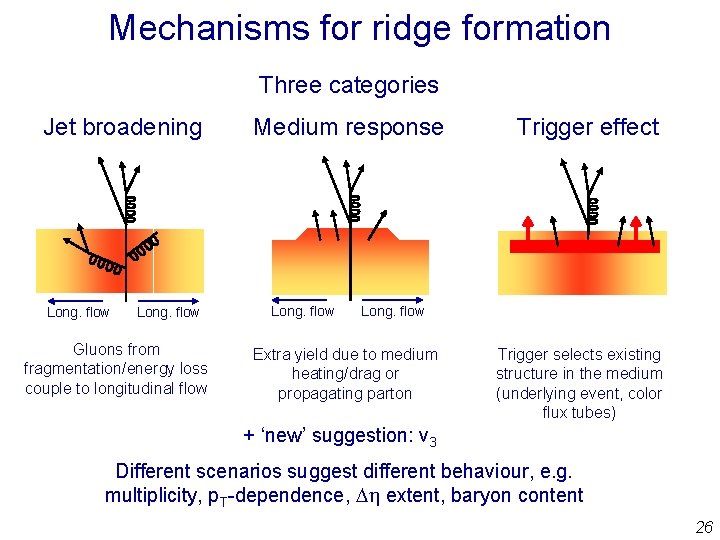
Mechanisms for ridge formation Three categories Jet broadening Long. flow Gluons from fragmentation/energy loss couple to longitudinal flow Medium response Long. flow Trigger effect Long. flow Extra yield due to medium heating/drag or propagating parton Trigger selects existing structure in the medium (underlying event, color flux tubes) + ‘new’ suggestion: v 3 Different scenarios suggest different behaviour, e. g. multiplicity, p. T-dependence, extent, baryon content 26
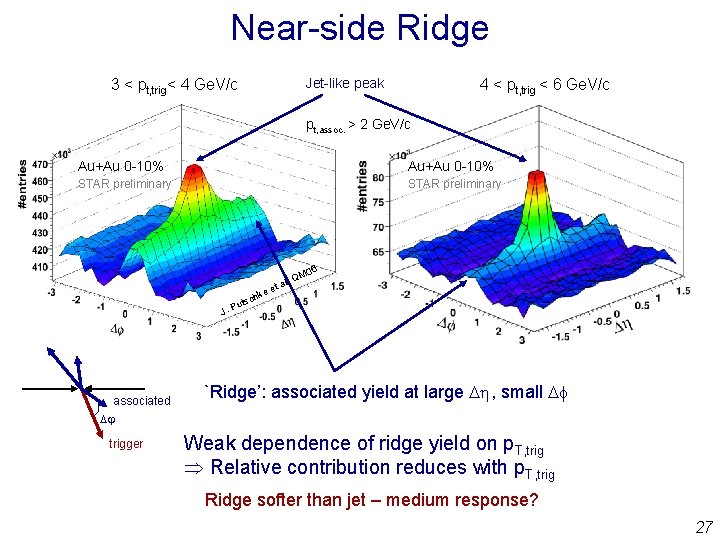
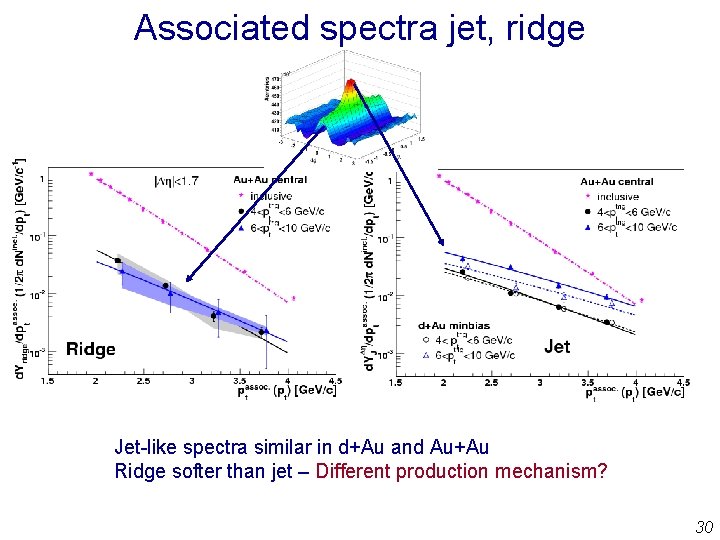
Near-side Ridge 3 < pt, trig< 4 Ge. V/c 4 < pt, trig < 6 Ge. V/c Jet-like peak pt, assoc. > 2 Ge. V/c Au+Au 0 -10% STAR preliminary hke c uts J. P associated l, et a 06 QM `Ridge’: associated yield at large , small f trigger Weak dependence of ridge yield on p. T, trig Relative contribution reduces with p. T, trig Ridge softer than jet – medium response? 27
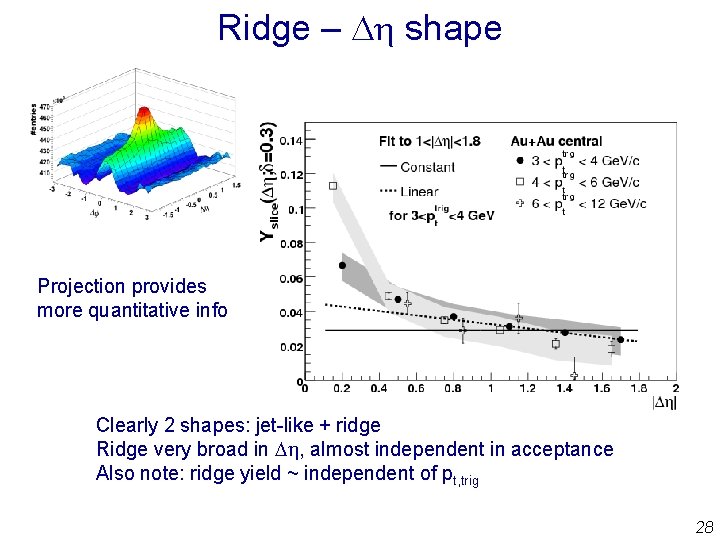
Ridge – shape Projection provides more quantitative info Clearly 2 shapes: jet-like + ridge Ridge very broad in , almost independent in acceptance Also note: ridge yield ~ independent of pt, trig 28
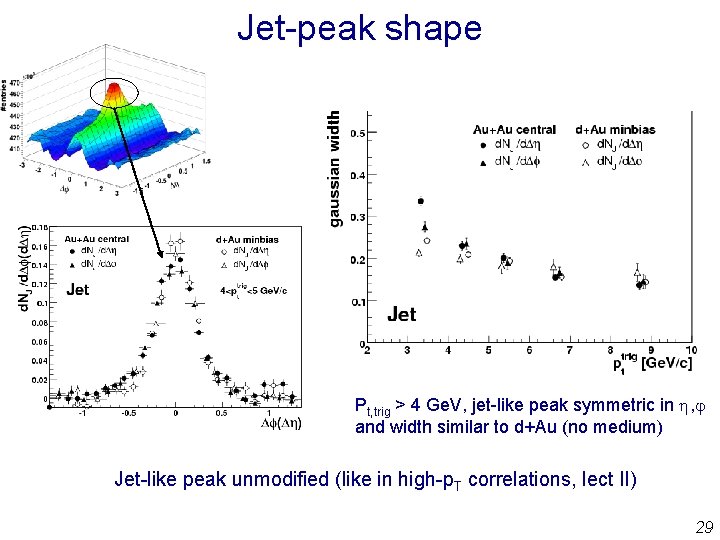
Jet-peak shape Pt, trig > 4 Ge. V, jet-like peak symmetric in , and width similar to d+Au (no medium) Jet-like peak unmodified (like in high-p. T correlations, lect II) 29
Associated spectra jet, ridge Jet-like spectra similar in d+Au and Au+Au Ridge softer than jet – Different production mechanism? 30
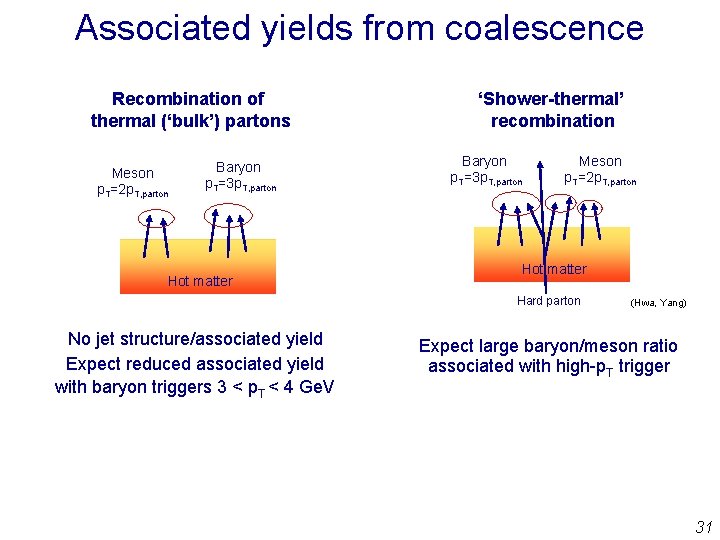
Associated yields from coalescence Recombination of thermal (‘bulk’) partons Meson p. T=2 p. T, parton Baryon p. T=3 p. T, parton Hot matter ‘Shower-thermal’ recombination Baryon p. T=3 p. T, parton Meson p. T=2 p. T, parton Hot matter Hard parton No jet structure/associated yield Expect reduced associated yield with baryon triggers 3 < p. T < 4 Ge. V (Hwa, Yang) Expect large baryon/meson ratio associated with high-p. T trigger 31
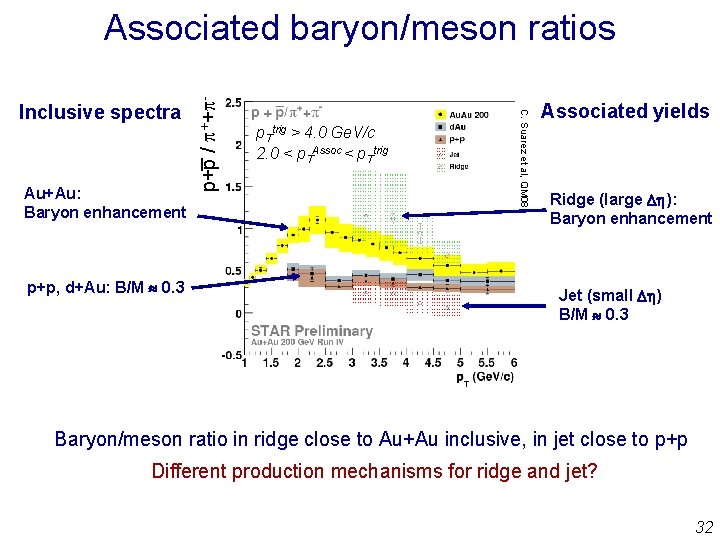
Au+Au: Baryon enhancement p+p, d+Au: B/M 0. 3 p. Ttrig > 4. 0 Ge. V/c 2. 0 < p. TAssoc < p. Ttrig C. Suarez et al, QM 08 Inclusive spectra p+p / ++ - Associated baryon/meson ratios Associated yields Ridge (large Dh): Baryon enhancement Jet (small Dh) B/M 0. 3 Baryon/meson ratio in ridge close to Au+Au inclusive, in jet close to p+p Different production mechanisms for ridge and jet? 32
Ridge summary • Most notable features: – – – Ridge much broader than jet in Jet-like peak similar to d+Au in shape and yield Ridge yield ~ independent of pttrig Ridge spectrum softer than jet p/ ratio in ridge similar to bulk, lower in jet Strongly suggest different production mechanisms for ridge and jet However, the ridge is correlated with jets: causation, or trigger-bias (coincidence? ) 33
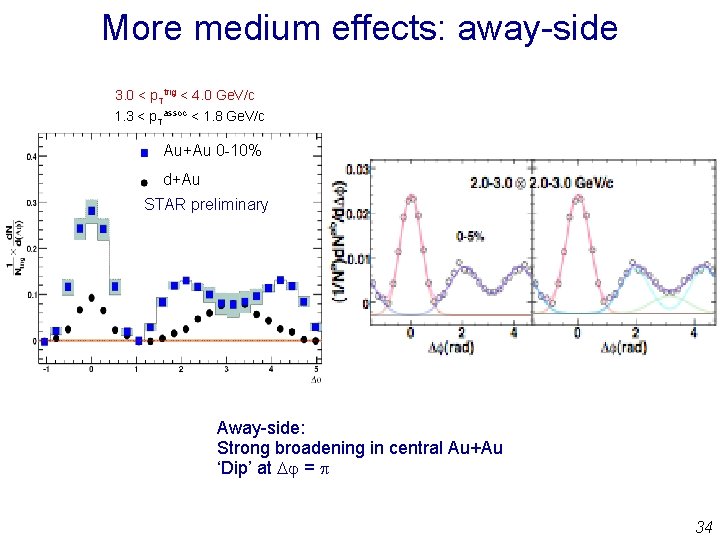
More medium effects: away-side 3. 0 < p. Ttrig < 4. 0 Ge. V/c 1. 3 < p. Tassoc < 1. 8 Ge. V/c Au+Au 0 -10% d+Au STAR preliminary Away-side: Strong broadening in central Au+Au ‘Dip’ at = 34
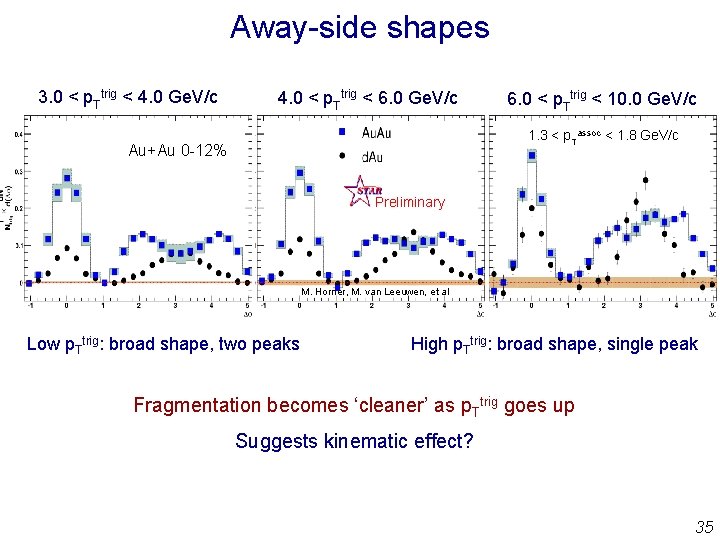
Away-side shapes 3. 0 < p. Ttrig < 4. 0 Ge. V/c 4. 0 < p. Ttrig < 6. 0 Ge. V/c 6. 0 < p. Ttrig < 10. 0 Ge. V/c 1. 3 < p. Tassoc < 1. 8 Ge. V/c Au+Au 0 -12% Preliminary M. Horner, M. van Leeuwen, et al Low p. Ttrig: broad shape, two peaks High p. Ttrig: broad shape, single peak Fragmentation becomes ‘cleaner’ as p. Ttrig goes up Suggests kinematic effect? 35
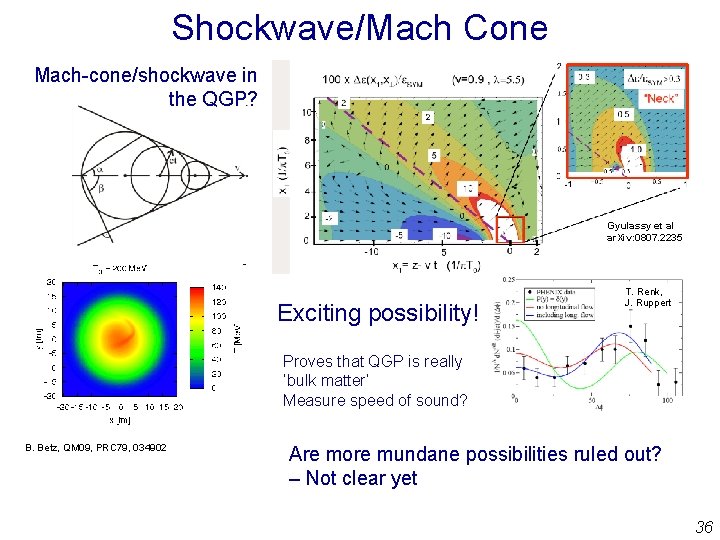
Shockwave/Mach Cone Mach-cone/shockwave in the QGP? Gyulassy et al ar. Xiv: 0807. 2235 Exciting possibility! T. Renk, J. Ruppert Proves that QGP is really ‘bulk matter’ Measure speed of sound? B. Betz, QM 09, PRC 79, 034902 Are more mundane possibilities ruled out? – Not clear yet 36
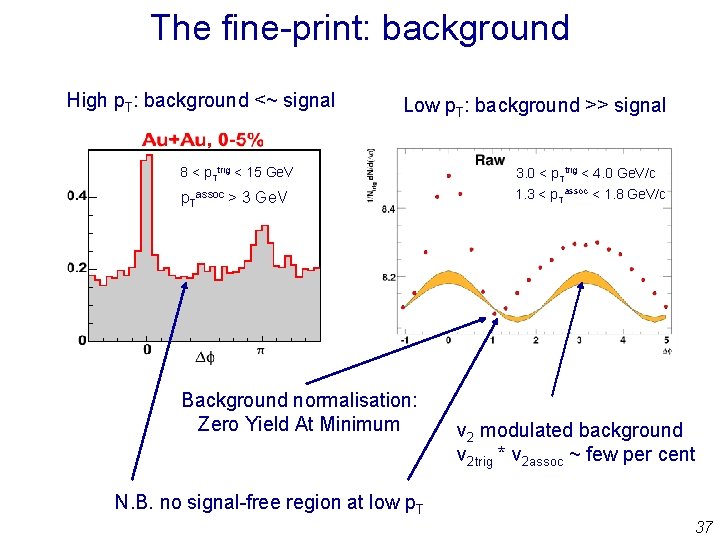
The fine-print: background High p. T: background <~ signal Low p. T: background >> signal 8 < p. Ttrig < 15 Ge. V p. Tassoc > 3 Ge. V Background normalisation: Zero Yield At Minimum 3. 0 < p. Ttrig < 4. 0 Ge. V/c 1. 3 < p. Tassoc < 1. 8 Ge. V/c v 2 modulated background v 2 trig * v 2 assoc ~ few per cent N. B. no signal-free region at low p. T 37
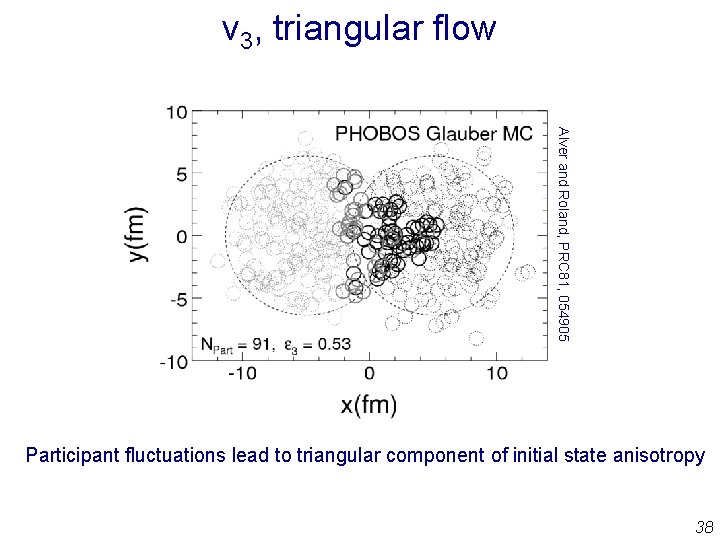
v 3, triangular flow Alver and Roland, PRC 81, 054905 Participant fluctuations lead to triangular component of initial state anisotropy 38
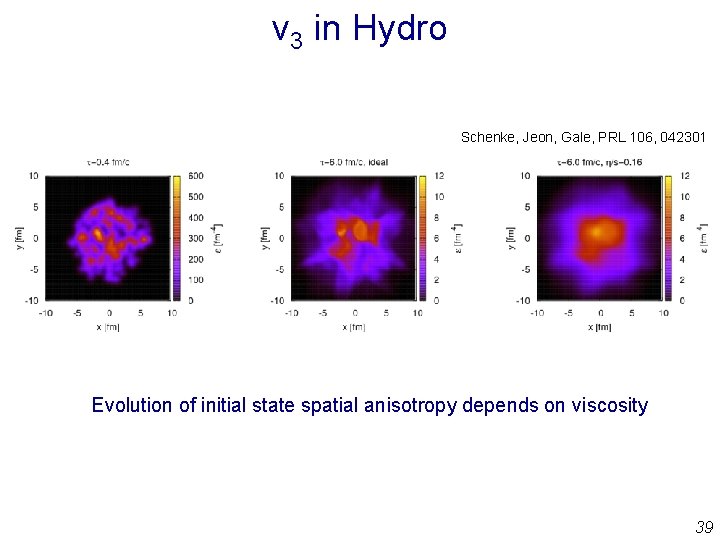
v 3 in Hydro Schenke, Jeon, Gale, PRL 106, 042301 Evolution of initial state spatial anisotropy depends on viscosity 39
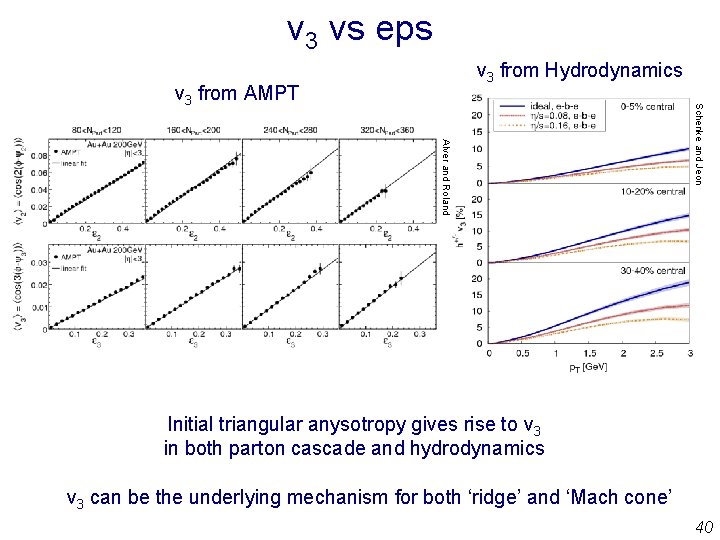
v 3 vs eps v 3 from Hydrodynamics Alver and Roland Schenke and Jeon v 3 from AMPT Initial triangular anysotropy gives rise to v 3 in both parton cascade and hydrodynamics v 3 can be the underlying mechanism for both ‘ridge’ and ‘Mach cone’ 40
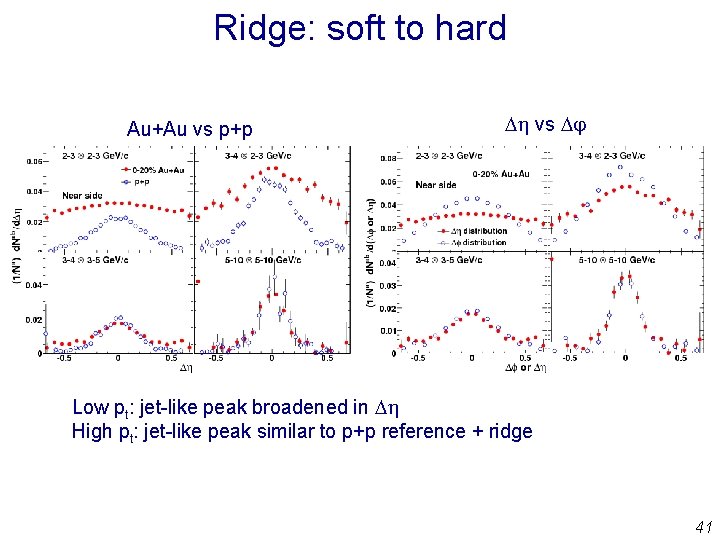
Ridge: soft to hard Au+Au vs p+p vs Low pt: jet-like peak broadened in High pt: jet-like peak similar to p+p reference + ridge 41
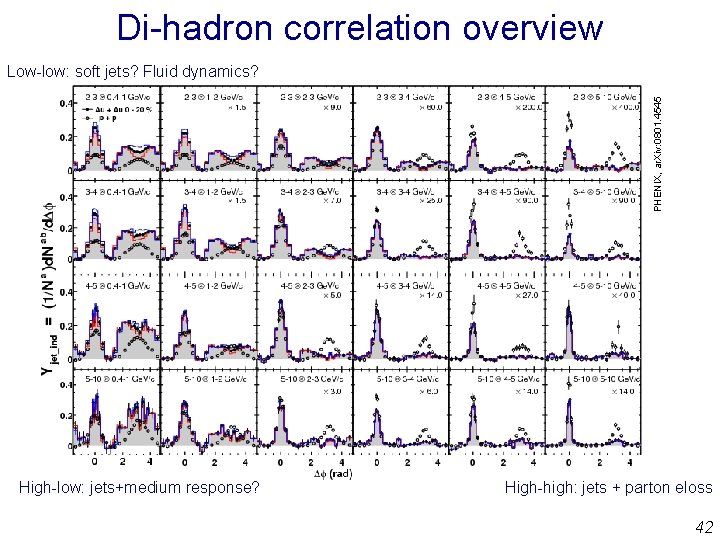
Di-hadron correlation overview PHENIX, ar. Xiv: 0801. 4545 Low-low: soft jets? Fluid dynamics? High-low: jets+medium response? High-high: jets + parton eloss 42
Final note Hard probes of the QCD medium: Two important aspects: – Validate understanding of in-medium fragmentation – Determine medium properties To test understanding, need fewer unknowns than measurements - Light quark energy loss - Heavy quark energy loss - Inclusive vs di-hadrons - Azimuthal modulation (RAA vs rplane, v 2) - Jet-finding Need coherent picture (and understanding exceptions) before we can use energy loss as a tool 43
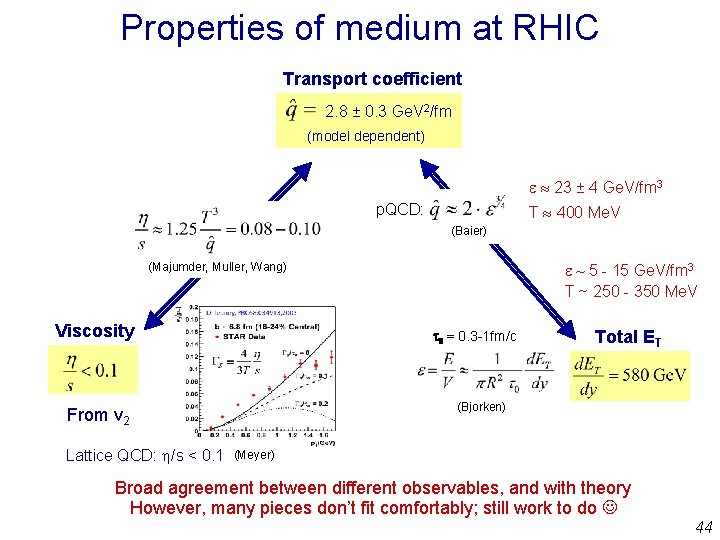
Properties of medium at RHIC Transport coefficient 2. 8 ± 0. 3 Ge. V 2/fm (model dependent) 23 ± 4 Ge. V/fm 3 p. QCD: T 400 Me. V (Baier) (Majumder, Muller, Wang) Viscosity t 0 = 0. 3 -1 fm/c Total ET (Bjorken) From v 2 Lattice QCD: /s < 0. 1 ~ 5 - 15 Ge. V/fm 3 T ~ 250 - 350 Me. V (Meyer) Broad agreement between different observables, and with theory However, many pieces don’t fit comfortably; still work to do 44
Extra slides 45
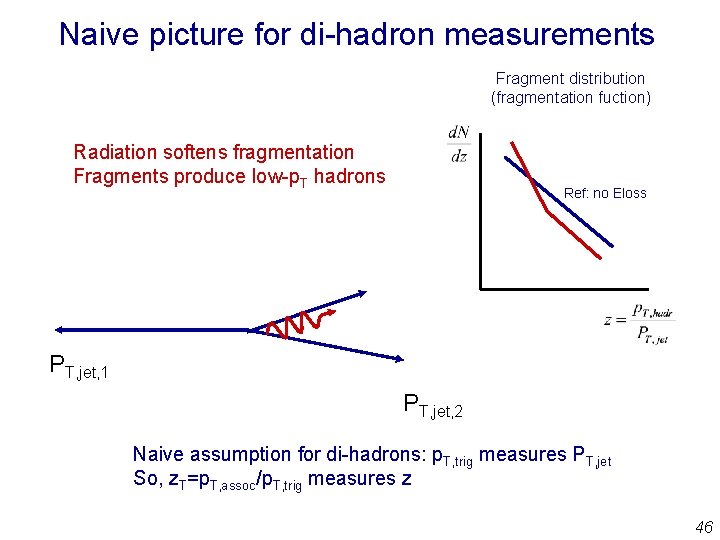
Naive picture for di-hadron measurements Fragment distribution (fragmentation fuction) Radiation softens fragmentation Fragments produce low-p. T hadrons Ref: no Eloss PT, jet, 1 PT, jet, 2 Naive assumption for di-hadrons: p. T, trig measures PT, jet So, z. T=p. T, assoc/p. T, trig measures z 46
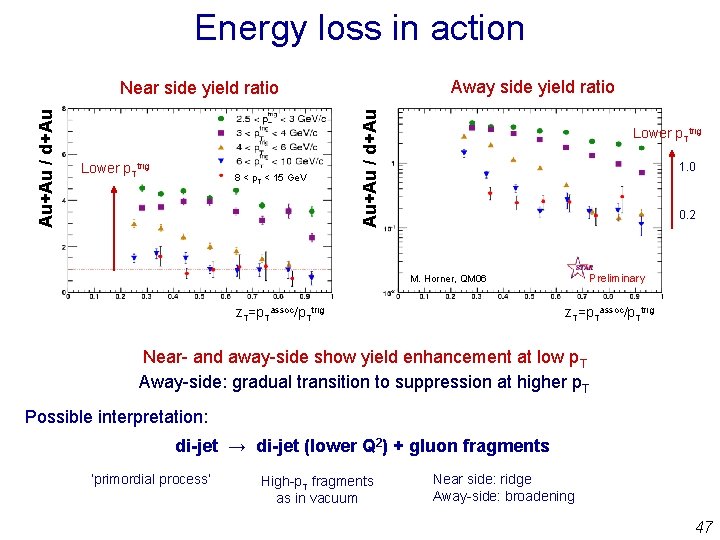
Energy loss in action Near side yield Away side yield ratio | |>0. 9 Lower p. Ttrig 8 < p. T < 15 Ge. V Au+Au / d+Au 8 < p. Ttrig < 15 Ge. V Lower p. Ttrig 8 < p. T < 15 Ge. V 1. 0 0. 2 Preliminary M. Horner, QM 06 trig /p trig z. T=p. Tassoc /p. TTassoc T M. Horner, M. van Leeuwen, et al Au+Au / d+Au Near side yield ratio | |<0. 9 trigassoc/p trig z. T=p. Tassoc/p T T T Near- and away-side show yield enhancement at low p. T Away-side: gradual transition to suppression at higher p. T Possible interpretation: di-jet → di-jet (lower Q 2) + gluon fragments ‘primordial process’ High-p. T fragments as in vacuum Near side: ridge Away-side: broadening 47
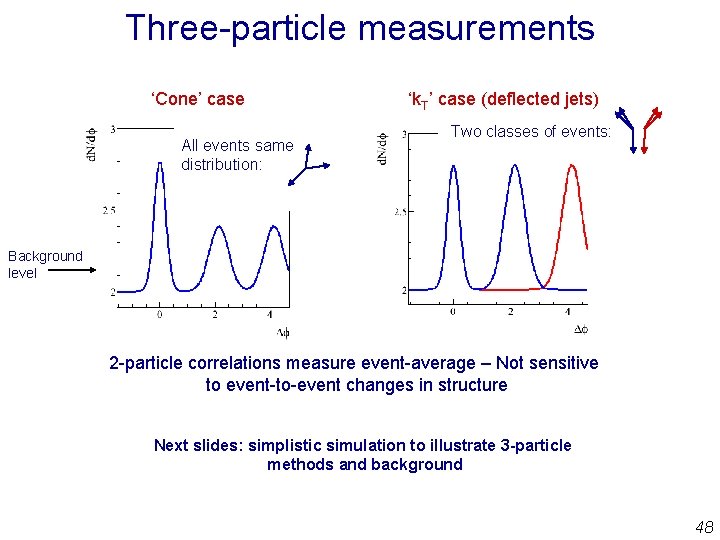
Three-particle measurements ‘Cone’ case All events same distribution: ‘k. T’ case (deflected jets) Two classes of events: Background level 2 -particle correlations measure event-average – Not sensitive to event-to-event changes in structure Next slides: simplistic simulation to illustrate 3 -particle methods and background 48