
Lecture II Class Cestoda common features of Class

- Slides: 40
Lecture II Class Cestoda
common features of Class Cestoda 1. Adult worm is flattened ribbon-like, without body cavity. 2. The body is composed of a head, neck and segmented strobilus (链体). The head has suckers, rostellum (顶突) and hooklets or sucking grooves. The neck is the budding zone from which segments are formed. The strobilus consists of immature, mature and pregnant proglottides. 3. They are hermaphroditic. There is a set of female and male reproductive organs in every mature proglottid. 4. Digestive tract is absent. Nutrition is absorbed by villi of body surface. 5. They are biohelminths. Intermediate hosts are indispensable.
6. All adult worms parasitize digestive tracts of mammals. 7. The developing stages in intermediate hosts are called metacestode ( 中 绦 期 ), such as cysticercus (囊 尾 蚴 ), hydatid cyst (棘 球 蚴 ), cysticercoid (似囊尾蚴), procercoid (原尾蚴), plerocercoid(裂头 蚴). 8. Tapeworms are classified into two orders: Cyclophyllidea (圆叶目): The head is spherical with suckers, hooklets. The uterus has no opening. One intermediate host is required. The eggs contain an oncosphere (六钩蚴). They are medically important, such as Taenia solium (链状带绦虫), Taenia saginata (肥胖带绦虫) and Echinococcus granulosus (细粒棘球绦虫). Pseudophyllidea (假叶目): The head is spear-like with sucking grooves. The uterus has an opening. Two or more intermediate hosts are required. The eggs contain a coracidium(钩球蚴) and have to get into water to develop. Human being occasionally get infection. This worms include Spirometra mansoni( 曼 氏 迭 宫 绦 虫 ) and Diphyllobothrium latum(阔节裂头绦虫).
Taenia solium(pork tapeworm) (链状带绦虫, 猪肉绦虫,猪带绦虫 或 有钩绦虫 ) Adult worms live in human small intestine causing taeniasis (绦 虫 病 ). The larval stage (Cysticercus cellulose 猪囊尾蚴) lives in pig or human tissues causing human cysticercosis( 囊尾蚴病或囊虫病).
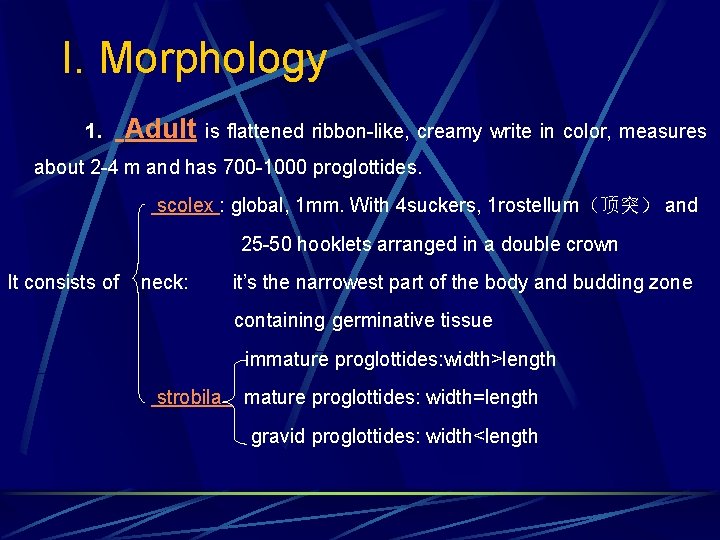
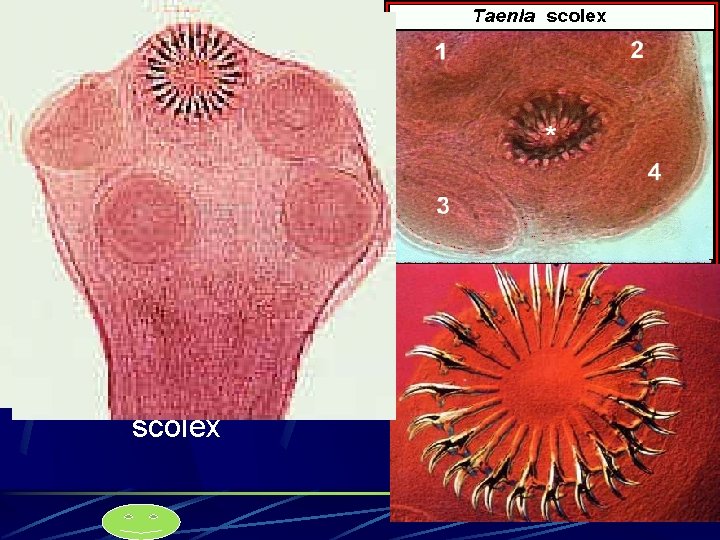
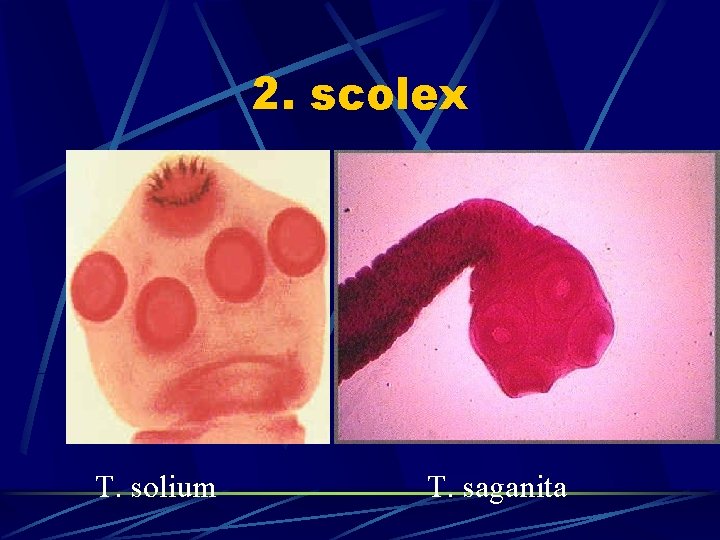
I. Morphology 1. Adult is flattened ribbon-like, creamy write in color, measures about 2 -4 m and has 700 -1000 proglottides. scolex : global, 1 mm. With 4 suckers, 1 rostellum(顶突) and 25 -50 hooklets arranged in a double crown It consists of neck: it’s the narrowest part of the body and budding zone containing germinative tissue immature proglottides: width>length strobila mature proglottides: width=length gravid proglottides: width<length
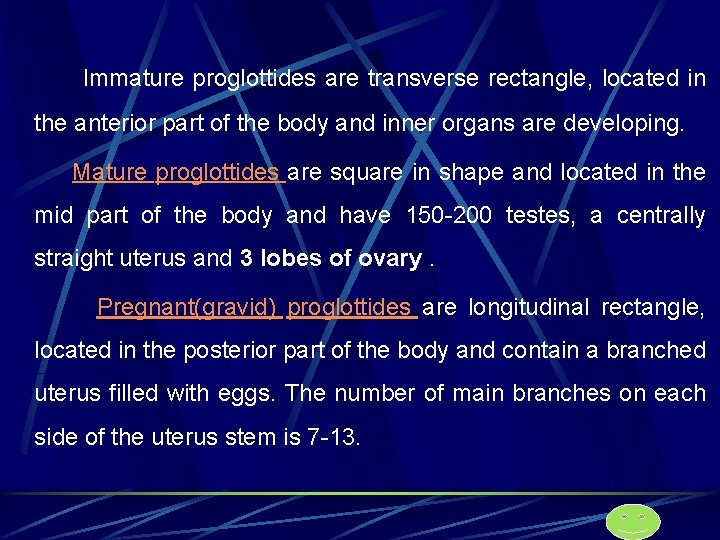
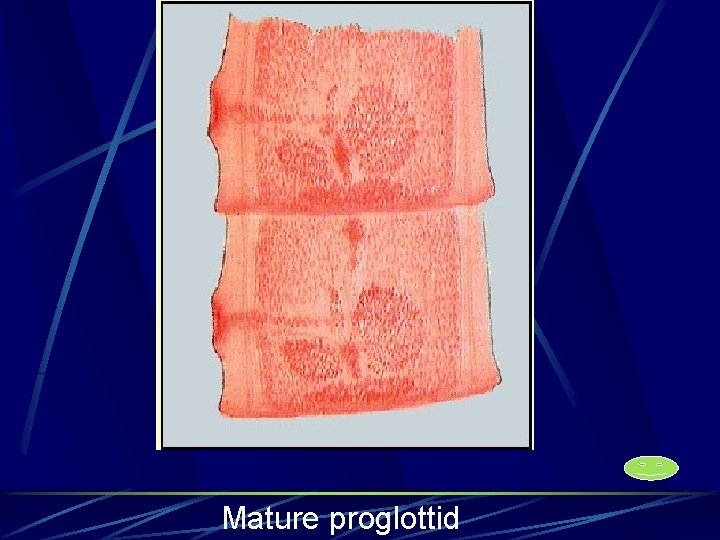
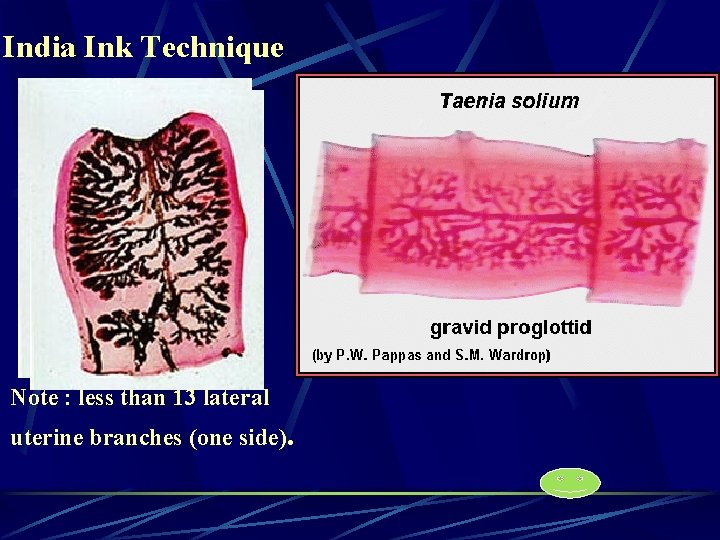
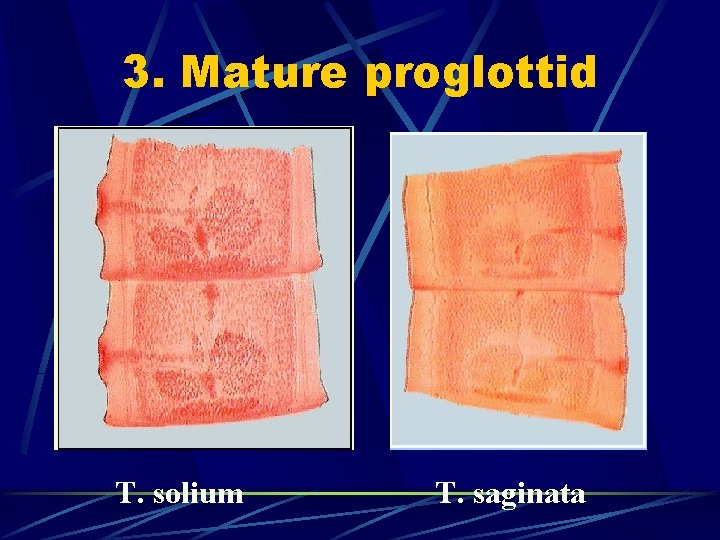
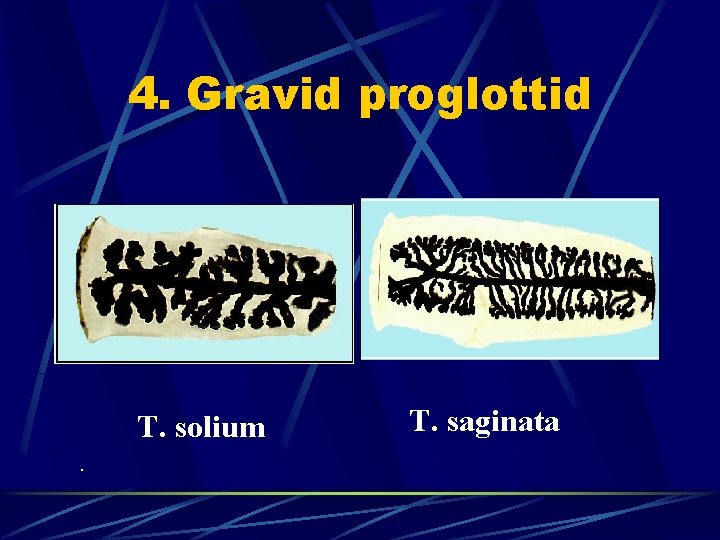
Immature proglottides are transverse rectangle, located in the anterior part of the body and inner organs are developing. Mature proglottides are square in shape and located in the mid part of the body and have 150 -200 testes, a centrally straight uterus and 3 lobes of ovary. Pregnant(gravid) proglottides are longitudinal rectangle, located in the posterior part of the body and contain a branched uterus filled with eggs. The number of main branches on each side of the uterus stem is 7 -13.
scolex
Mature proglottid
India Ink Technique Note : less than 13 lateral uterine branches (one side).
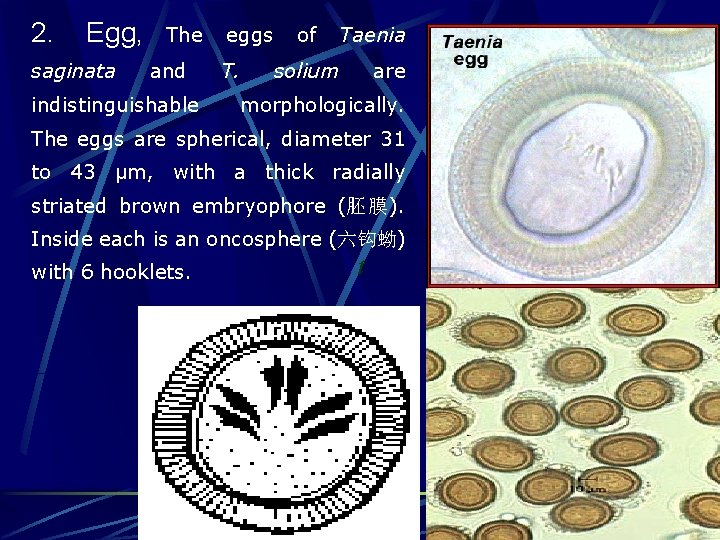
2. Egg, saginata The and indistinguishable eggs T. of Taenia solium are morphologically. The eggs are spherical, diameter 31 to 43 µm, with a thick radially striated brown embryophore (胚膜). Inside each is an oncosphere (六钩蚴) with 6 hooklets. t
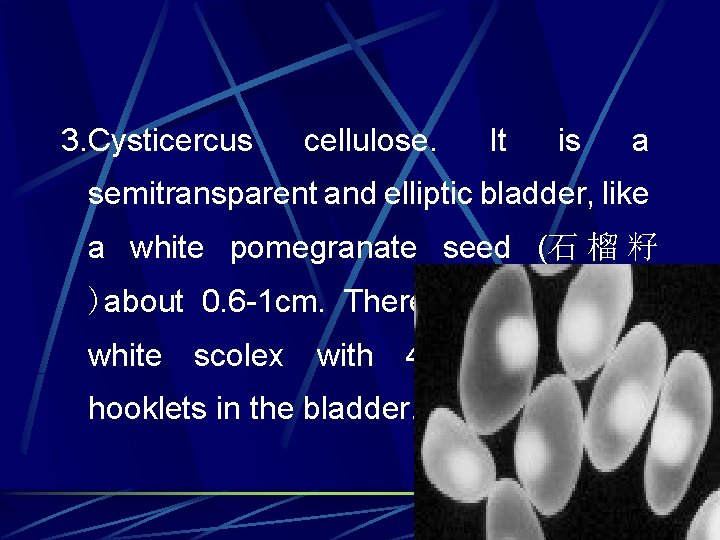
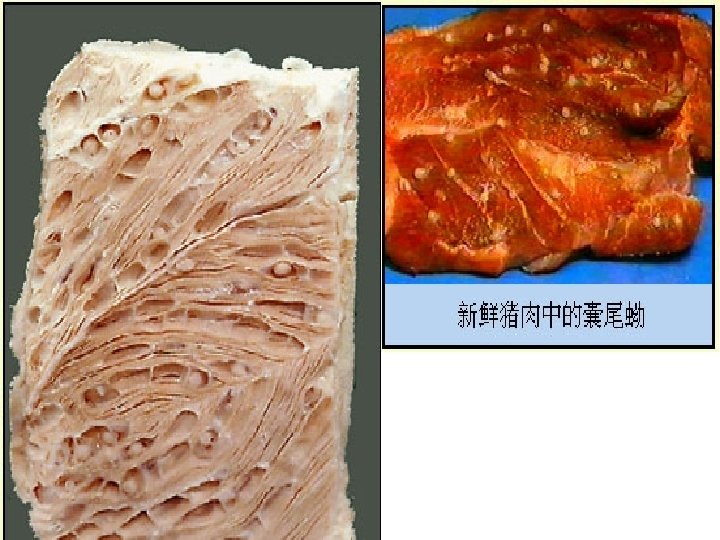
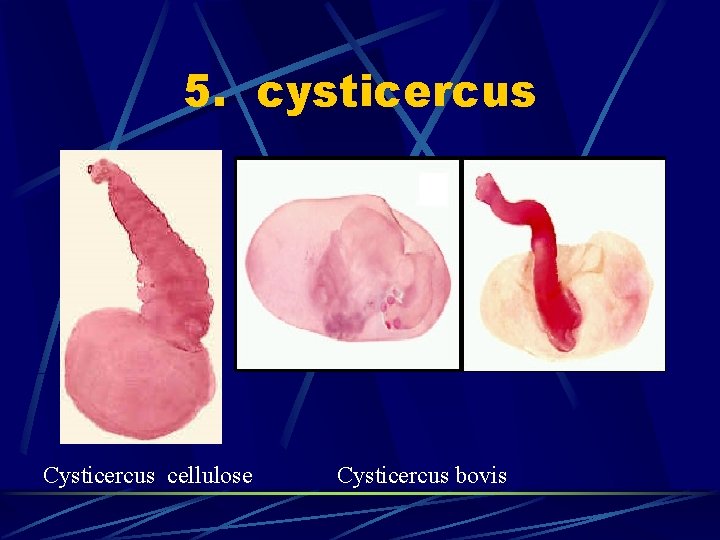
3. Cysticercus cellulose. It is a semitransparent and elliptic bladder, like a white pomegranate seed (石 榴 籽 )about 0. 6 -1 cm. There is fluid and a white scolex with 4 suckers and hooklets in the bladder.
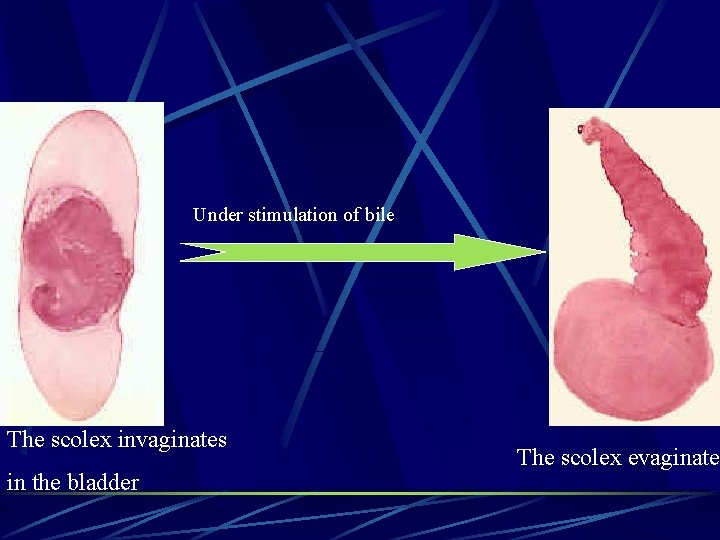
Under stimulation of bile The scolex invaginates in the bladder The scolex evaginates
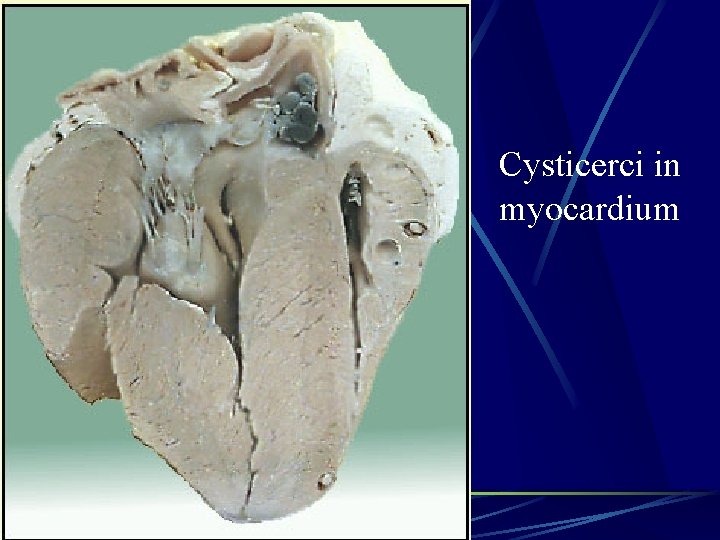
Cysticerci in myocardium
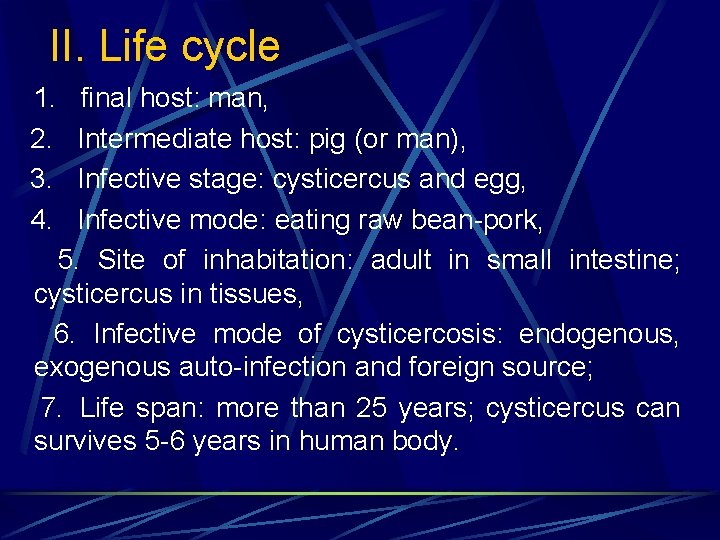
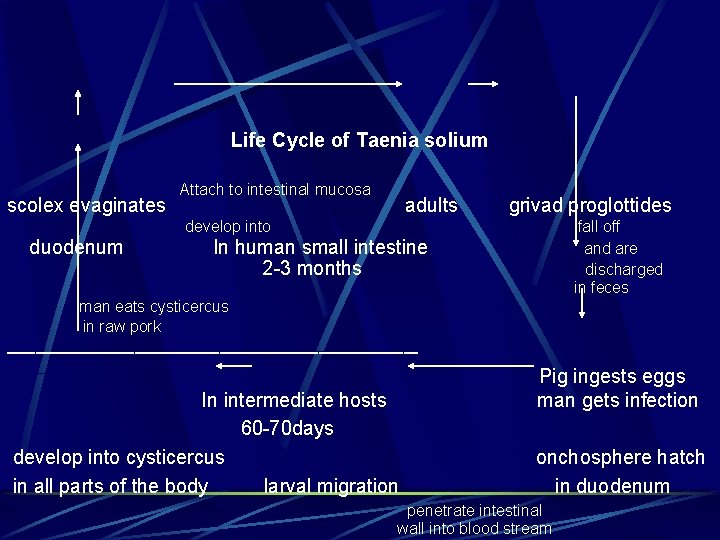
II. Life cycle 1. 2. 3. 4. final host: man, Intermediate host: pig (or man), Infective stage: cysticercus and egg, Infective mode: eating raw bean-pork, 5. Site of inhabitation: adult in small intestine; cysticercus in tissues, 6. Infective mode of cysticercosis: endogenous, exogenous auto-infection and foreign source; 7. Life span: more than 25 years; cysticercus can survives 5 -6 years in human body.
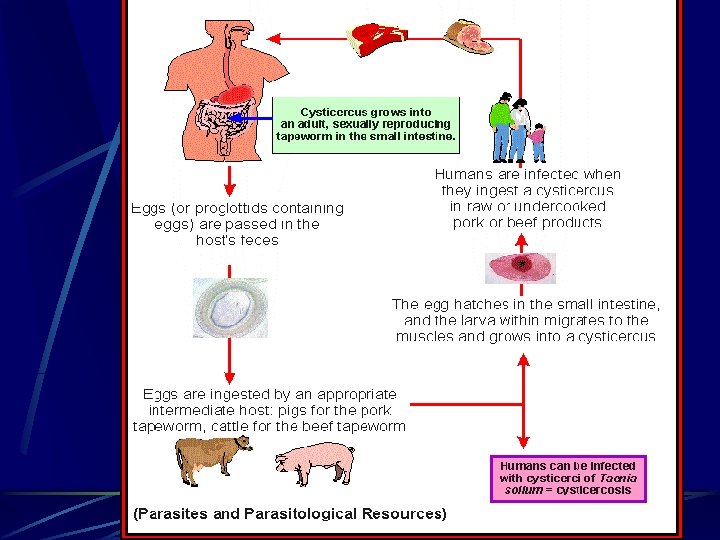
Life Cycle of Taenia solium scolex evaginates Attach to intestinal mucosa adults grivad proglottides develop into duodenum fall off and are discharged in feces In human small intestine 2 -3 months man eats cysticercus in raw pork ─────────────── In intermediate hosts 60 -70 days develop into cysticercus in all parts of the body larval migration Pig ingests eggs man gets infection onchosphere hatch in duodenum penetrate intestinal wall into blood stream
III. Pathogenesis and Clinical Manifestations 1. Taeniasis: It is caused by the adult residing in small intestine of the man. The adult irritates the small intestine causing discomforts, such as abdominal pain, anorexia, chronic indigestion, diarrhea, emaciation, eosinophilia and etc. The patient is usually no obvious symptom, only complaining passing proglottides. 2. Cysticercosis: It is caused by the cysticerci living in human tissues. The manifestations vary with the number of cysticerci and the tissues and organs involved. Cysticercosis is divided into three types.
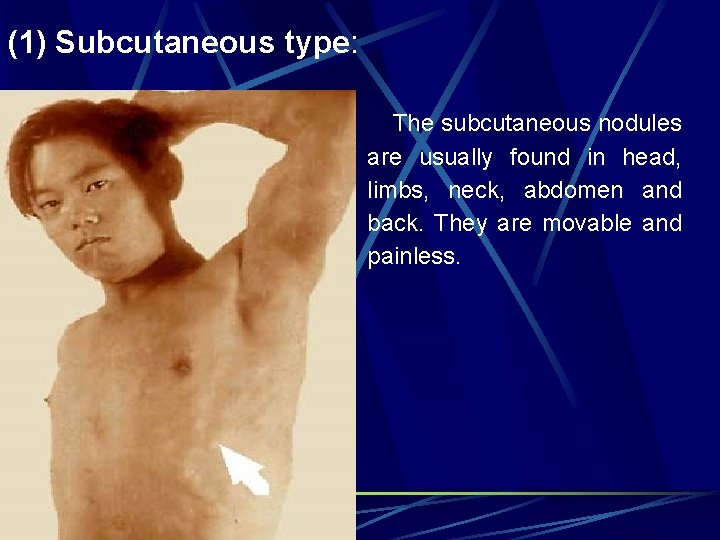
(1) Subcutaneous type: The subcutaneous nodules are usually found in head, limbs, neck, abdomen and back. They are movable and painless.
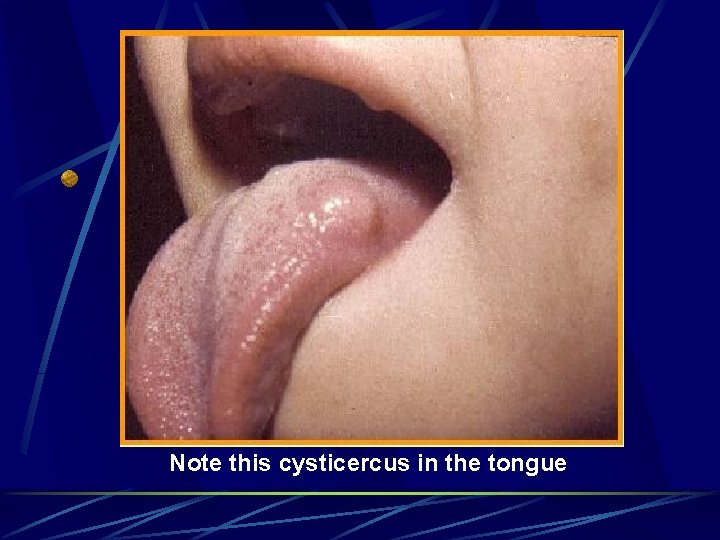
Note this cysticercus in the tongue
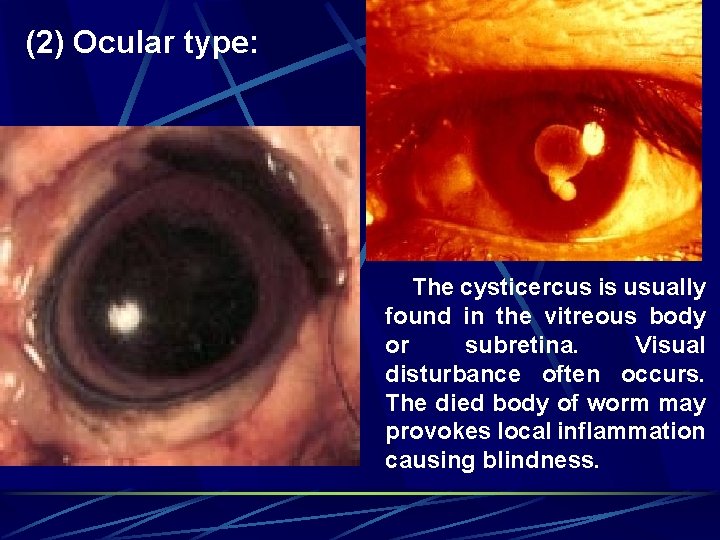
(2) Ocular type: The cysticercus is usually found in the vitreous body or subretina. Visual disturbance often occurs. The died body of worm may provokes local inflammation causing blindness.
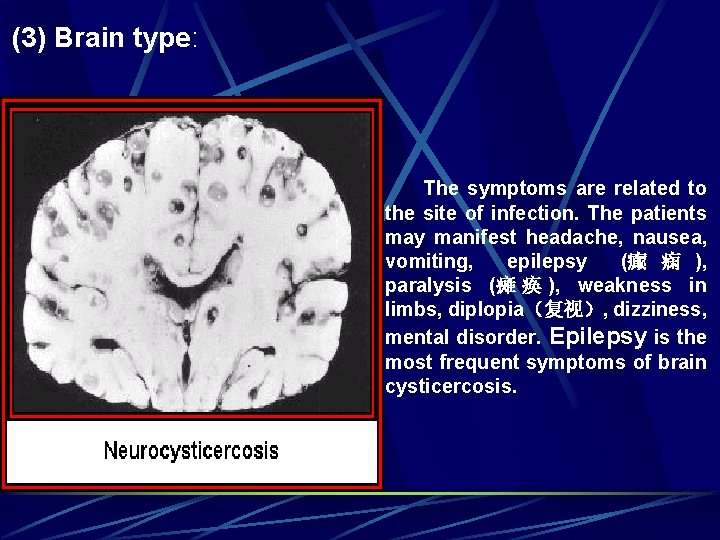
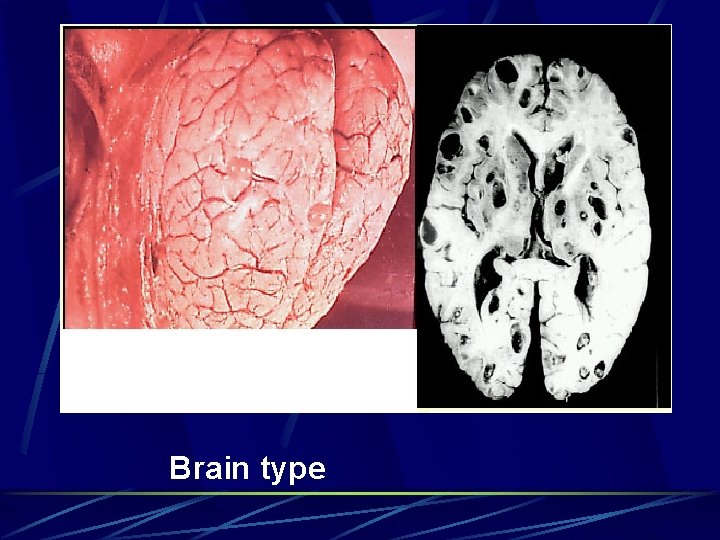
(3) Brain type: The symptoms are related to the site of infection. The patients may manifest headache, nausea, vomiting, epilepsy (癫 痫 ), paralysis (瘫 痪 ), weakness in limbs, diplopia(复视), dizziness, mental disorder. Epilepsy is the most frequent symptoms of brain cysticercosis.
Brain type
IV. Diagnosis 1. Taeniasis: Confirmative diagnosis of taeniasis is made by finding gravid proglottides or egg in stool. (1) direct fecal smear (2) brine floatation technique **(3) cellophane-tape technique 2. Cysticercosis: Biopsy of subcutaneous nodules, Xray , CT 0 r MR are used for the diagnosis of brain type and ophthalmoscope examination is used for ocular form. 3. Immunological tests are for reference only.
V. Treatment and prevention 1. Treatment of Taeniasis: (1) Chinese herb medicine: pumpkin seed and areca nut (槟榔). The recognition of a scolex in the patient’s stool after the application of taenifuge is important. When the entire worm has been expelled, therapy is successful, otherwise the strobila regrow. (2) Praziquantel may be used.
2. Treatment of cysticercosis: Surgical removal is required for ocular and superficial cysticercoses. Praziquantel may be used to treat brain cysticercosis , but the patients should take praziquantel in hospital. 3. Prevention: (1) Health education (2) Avoid eating raw bean-pork. (3)avoid pigs eating human stool. (4) sanitary inspection of slaughter and sanitary disposal of night soil. VI. Epidemiology This disease is prevalent all over the world except Muslim and Jew areas. The infection of T. solium is closely associated with the method of pig-raising and the sanitary condition.
Taenia saginata (肥胖带绦虫,牛肉绦虫或无钩绦虫) Adult worms live in human small intestine causing taeniasis. Larval stage (Cysticercus bovis) lives in cattle tissues. This disease is prevalent all over the world.
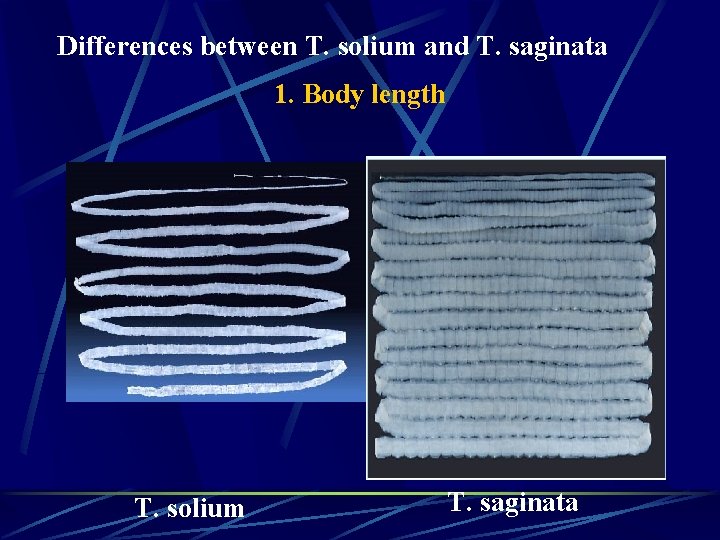
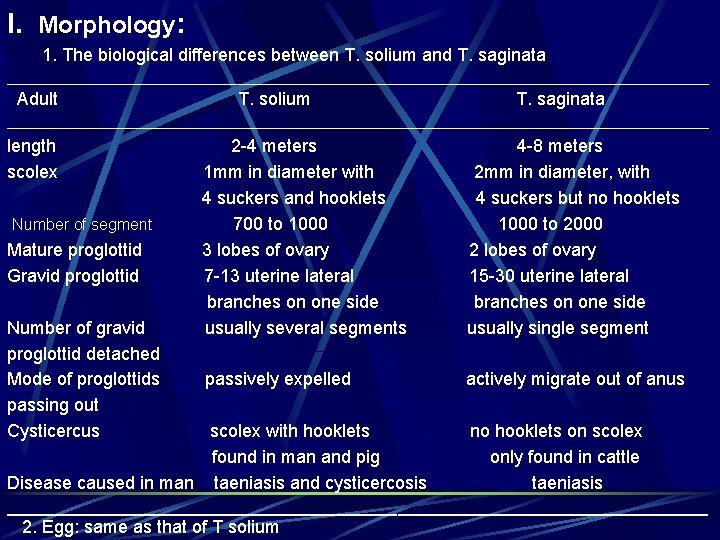
Differences between T. solium and T. saginata 1. Body length T. solium T. saginata
2. scolex T. solium T. saganita
3. Mature proglottid T. solium T. saginata
4. Gravid proglottid T. solium. T. saginata
5. cysticercus Cysticercus cellulose Cysticercus bovis
I. Morphology: 1. The biological differences between T. solium and T. saginata _______________________________________ Adult T. solium T. saginata _______________________________________ length 2 -4 meters 4 -8 meters scolex 1 mm in diameter with 2 mm in diameter, with 4 suckers and hooklets 4 suckers but no hooklets Number of segment 700 to 1000 to 2000 Mature proglottid 3 lobes of ovary 2 lobes of ovary Gravid proglottid 7 -13 uterine lateral 15 -30 uterine lateral branches on one side Number of gravid usually several segments usually single segment proglottid detached Mode of proglottids passively expelled actively migrate out of anus passing out Cysticercus scolex with hooklets no hooklets on scolex found in man and pig only found in cattle Disease caused in man taeniasis and cysticercosis taeniasis ___________________________________ 2. Egg: same as that of T solium
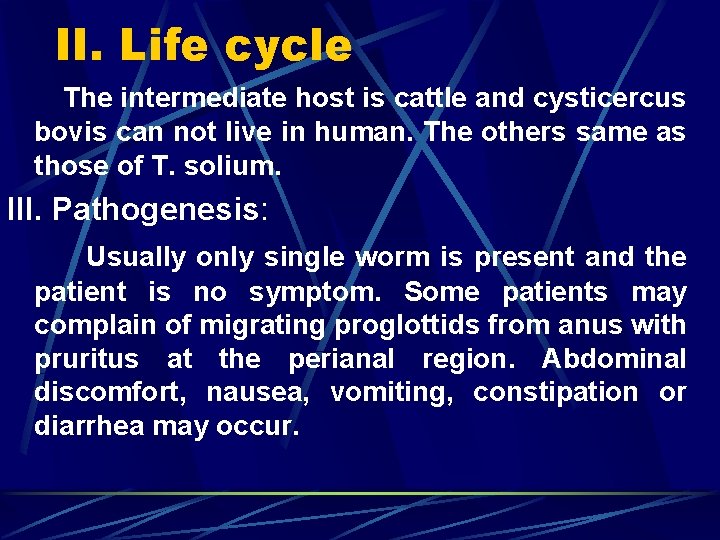
II. Life cycle The intermediate host is cattle and cysticercus bovis can not live in human. The others same as those of T. solium. III. Pathogenesis: Usually only single worm is present and the patient is no symptom. Some patients may complain of migrating proglottids from anus with pruritus at the perianal region. Abdominal discomfort, nausea, vomiting, constipation or diarrhea may occur.
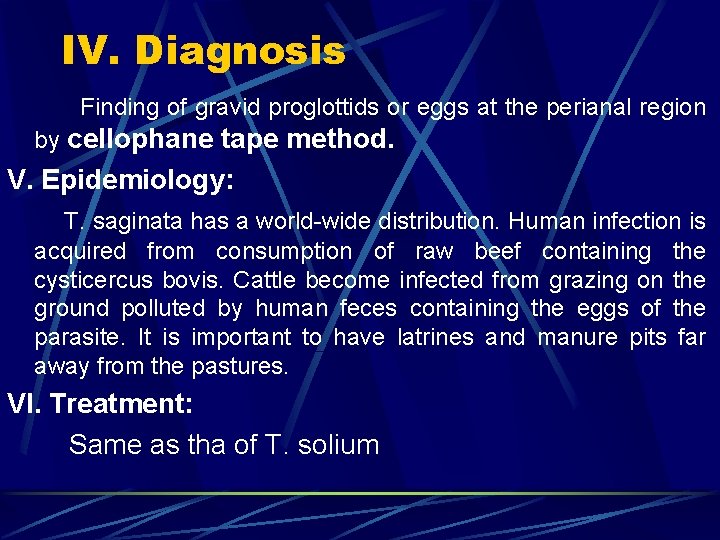
IV. Diagnosis Finding of gravid proglottids or eggs at the perianal region by cellophane tape method. V. Epidemiology: T. saginata has a world-wide distribution. Human infection is acquired from consumption of raw beef containing the cysticercus bovis. Cattle become infected from grazing on the ground polluted by human feces containing the eggs of the parasite. It is important to have latrines and manure pits far away from the pastures. VI. Treatment: Same as tha of T. solium
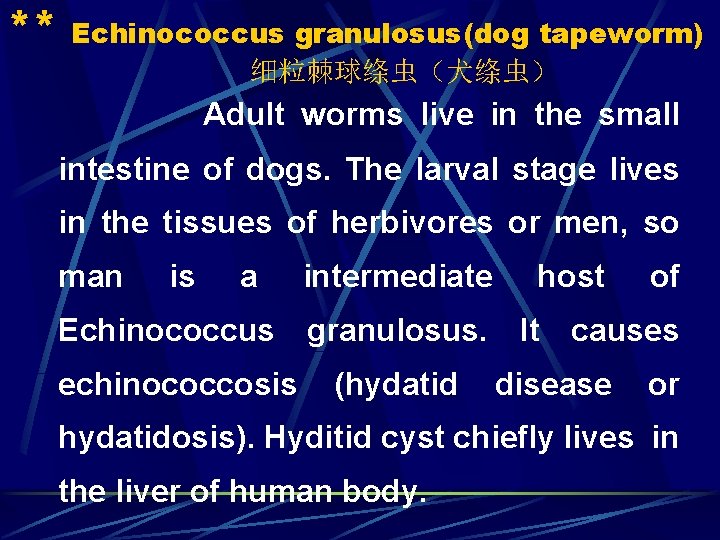
** Echinococcus granulosus(dog tapeworm) 细粒棘球绦虫(犬绦虫) Adult worms live in the small intestine of dogs. The larval stage lives in the tissues of herbivores or men, so man is a intermediate host of Echinococcus granulosus. It causes echinococcosis (hydatid disease or hydatidosis). Hyditid cyst chiefly lives in the liver of human body.
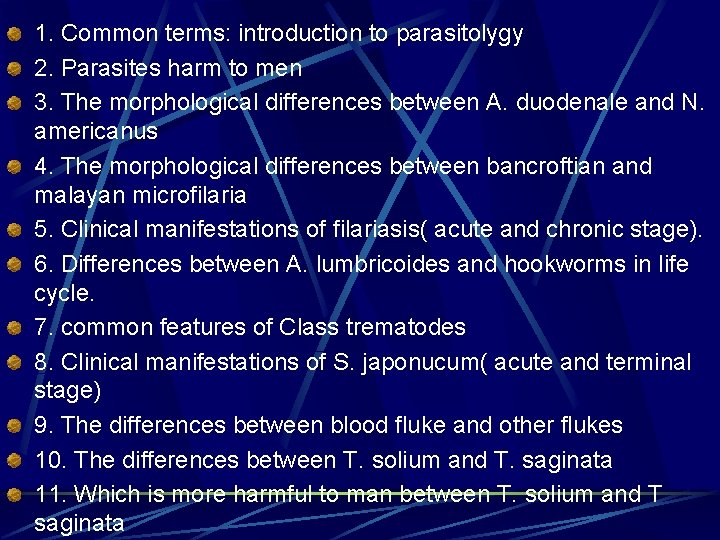
1. Common terms: introduction to parasitolygy 2. Parasites harm to men 3. The morphological differences between A. duodenale and N. americanus 4. The morphological differences between bancroftian and malayan microfilaria 5. Clinical manifestations of filariasis( acute and chronic stage). 6. Differences between A. lumbricoides and hookworms in life cycle. 7. common features of Class trematodes 8. Clinical manifestations of S. japonucum( acute and terminal stage) 9. The differences between blood fluke and other flukes 10. The differences between T. solium and T. saginata 11. Which is more harmful to man between T. solium and T saginata
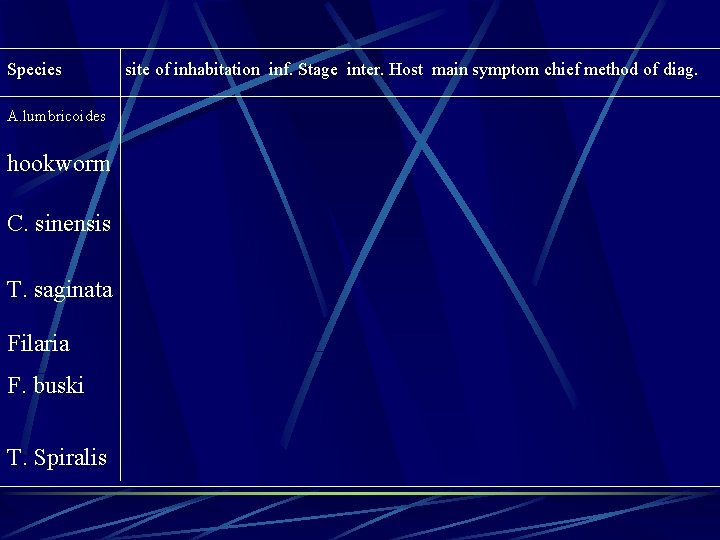
Species A. lumbricoides hookworm C. sinensis T. saginata Filaria F. buski T. Spiralis site of inhabitation inf. Stage inter. Host main symptom chief method of diag.
The end See you next time