
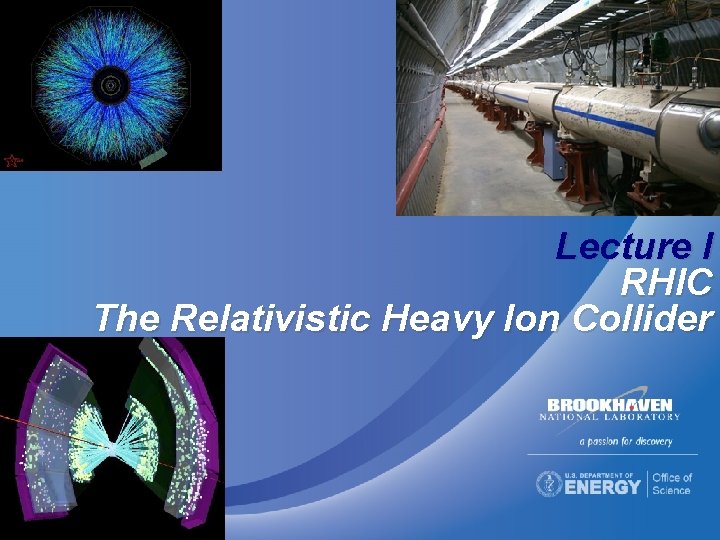
Lecture I RHIC The Relativistic Heavy Ion Collider
![A week in the life of RHIC… [66% of calendar time in store] 60](https://slidetodoc.com/presentation_image/e69899866631a0520044e52f8c495d54/image-11.jpg "A week in the life of RHIC… [66% of calendar time in store] 60")

- Slides: 59
Lecture I RHIC The Relativistic Heavy Ion Collider
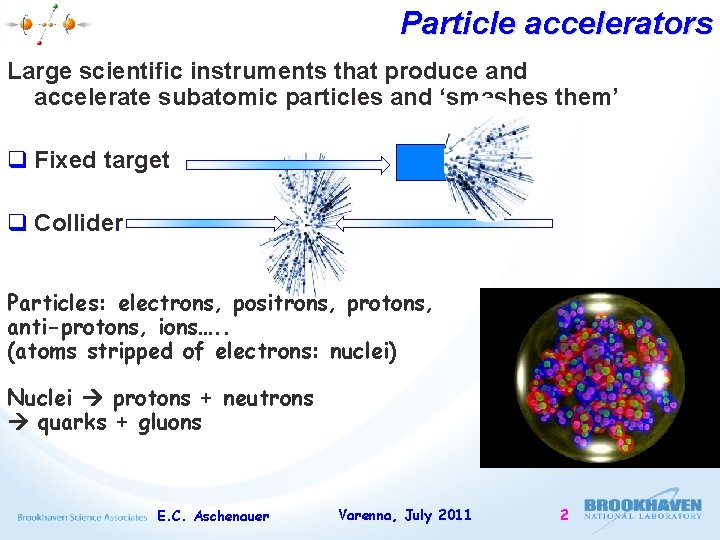
Particle accelerators Large scientific instruments that produce and accelerate subatomic particles and ‘smashes them’ q Fixed target q Collider Particles: electrons, positrons, protons, anti-protons, ions…. . (atoms stripped of electrons: nuclei) Nuclei protons + neutrons quarks + gluons E. C. Aschenauer Varenna, July 2011 2
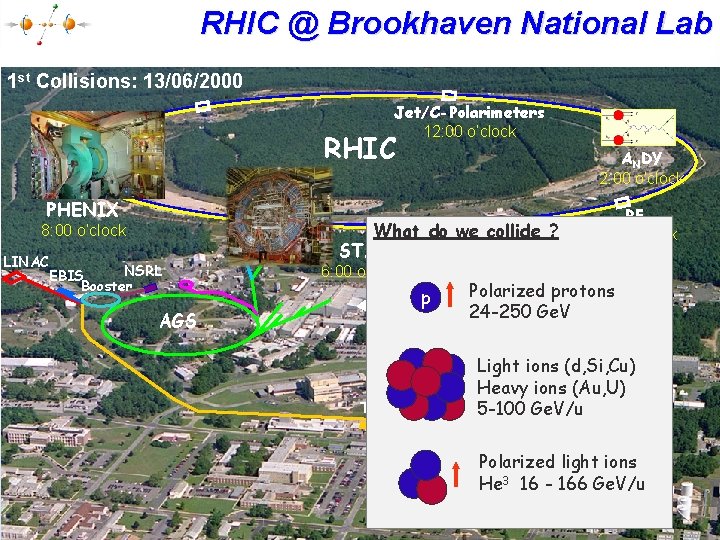
RHIC @ Brookhaven National Lab 1 st Collisions: 13/06/2000 Jet/C-Polarimeters 12: 00 o’clock RHIC PHENIX 8: 00 o’clock LINAC NSRL EBIS Booster AGS ANDY 2: 00 o’clock RF 4: 00 o’clock What do we collide ? STAR 6: 00 o’clock Polarized protons 24 -250 Ge. V ERL p Test Facility Tandems Light ions (d, Si, Cu) Heavy ions (Au, U) 5 -100 Ge. V/u Polarized light ions He 3 16 - 166 Ge. V/u E. C. Aschenauer Varenna, July 2011 3
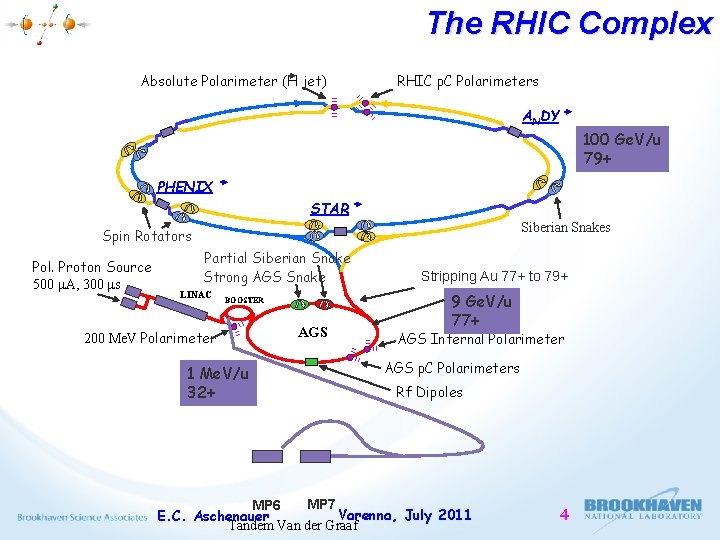
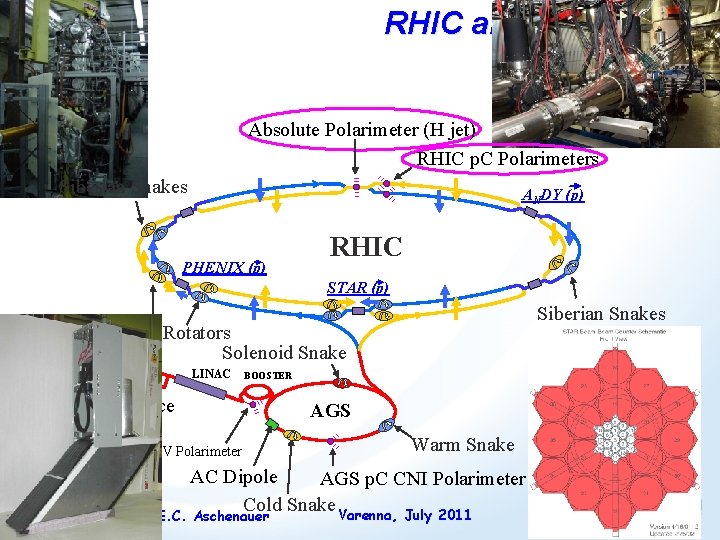
The RHIC Complex Absolute Polarimeter (H jet) RHIC p. C Polarimeters ANDY 100 Ge. V/u 79+ PHENIX STAR Siberian Snakes Spin Rotators Pol. Proton Source 500 m. A, 300 ms Partial Siberian Snake Strong AGS Snake LINAC BOOSTER 200 Me. V Polarimeter 1 Me. V/u 32+ AGS Stripping Au 77+ to 79+ 9 Ge. V/u 77+ AGS Internal Polarimeter AGS p. C Polarimeters Rf Dipoles MP 7 MP 6 Varenna, July 2011 E. C. Aschenauer Tandem Van der Graaf 4
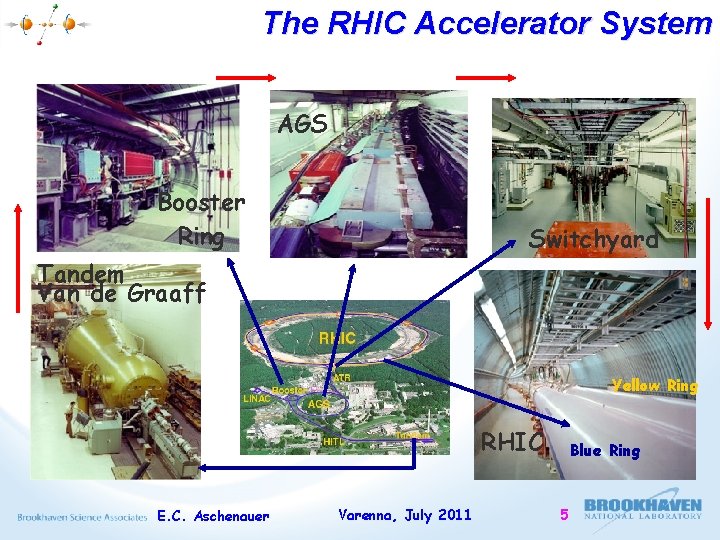
The RHIC Accelerator System AGS Booster Ring Switchyard Tandem Van de Graaff Yellow Ring RHIC E. C. Aschenauer Varenna, July 2011 Blue Ring 5
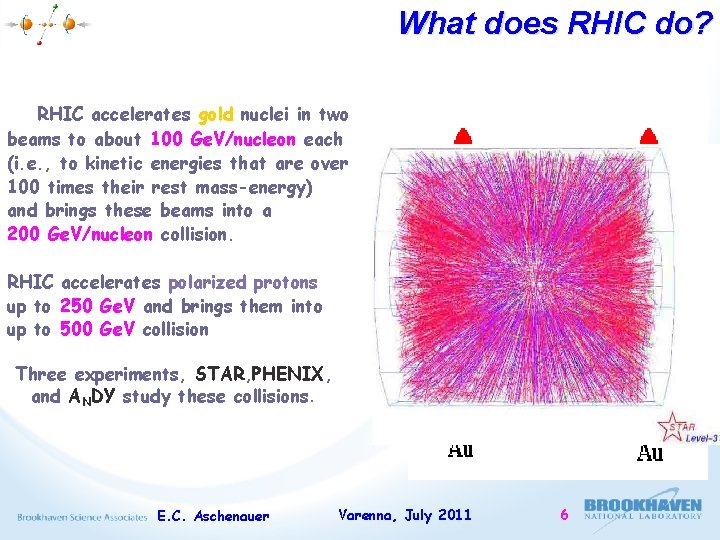
What does RHIC do? RHIC accelerates gold nuclei in two beams to about 100 Ge. V/nucleon each (i. e. , to kinetic energies that are over 100 times their rest mass-energy) and brings these beams into a 200 Ge. V/nucleon collision. RHIC accelerates polarized protons up to 250 Ge. V and brings them into up to 500 Ge. V collision Three experiments, STAR, PHENIX, and ANDY study these collisions. E. C. Aschenauer Varenna, July 2011 6
The RHIC project chronology q 1989 RHIC design q 1991 construction starts q 1996 commissioning At. R injection lines q 1997 sextant test (1/6 of the ring) q 1999 RHIC engineering/test run q 2000 first collisions q 2001 -02 Au-Au run, polarized p run q 2003 deuteron-Au run, pp q 2004 Au-Au physics run and 5 weeks pp development q 2005 …. . RHIC is also a giant engineering challenge: magnets (3000+ industry and lab built superconducting magnets) cryogenics (2 weeks to cool down to 4. 2 K) , instrumentation, etc. E. C. Aschenauer Varenna, July 2011 7
RHIC operations The operation of RHIC and its injectors is a rather challenging endeavor…. RHIC operates for ~5 -6 months/year – 24 h/day 7 days/week RHIC Shutdown 6 -7 months, for machine improvements (other programs are run by the injectors, Tandem delivering ions for industrial R&D, Booster delivering ions for NASA experiments, etc. ) q CONTROL ROOM : remote access to instrumentations and controls q Accelerator physicists, shift leaders (machine initial set-up, new developments, beam experiments) q Operations group: operation coordinator, operators (“routine’ operations, shifts 1 OC + 2 operators) q Technical support (engineers and technicians on call and/or site for system diagnosis and trouble-shooting) E. C. Aschenauer Varenna, July 2011 8
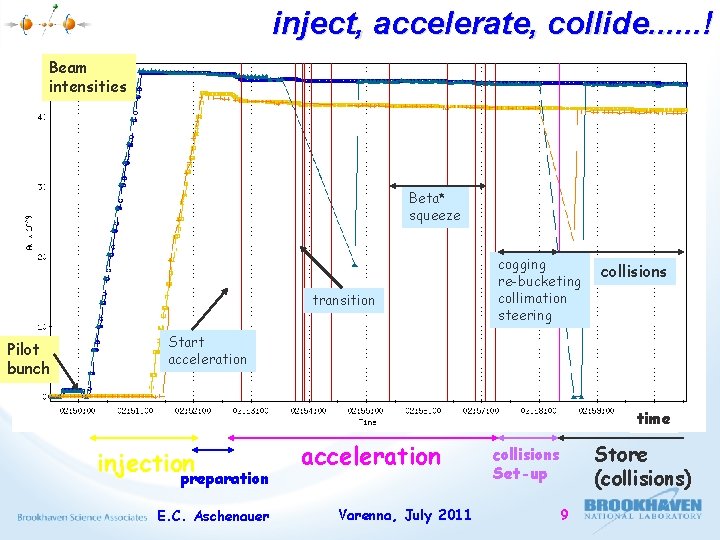
inject, accelerate, collide. . . ! Beam intensities Beta* squeeze transition Pilot bunch cogging re-bucketing collimation steering collisions Start acceleration time injection preparation E. C. Aschenauer acceleration Varenna, July 2011 Store (collisions) collisions Set-up 9
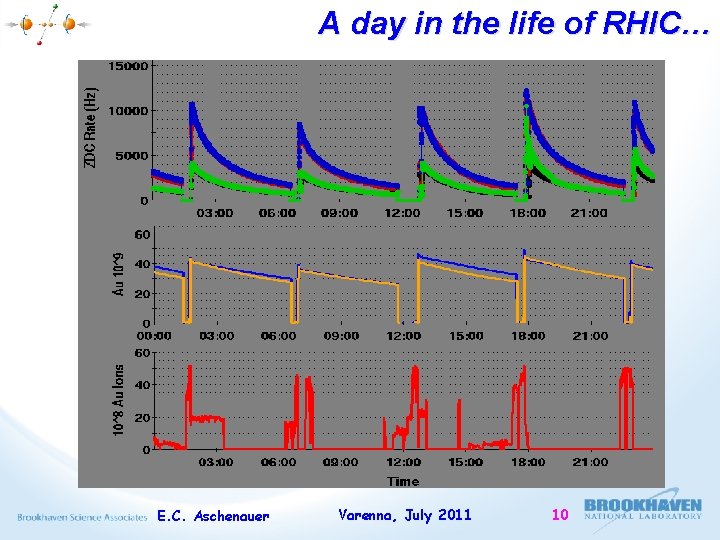
A day in the life of RHIC… E. C. Aschenauer Varenna, July 2011 10
A week in the life of RHIC… [66% of calendar time in store] 60 x 109 Au intensity Beam experiments Week 9 Feb to 17 Feb E. C. Aschenauer enhanced luminosity design luminosity Varenna, July 2011 11
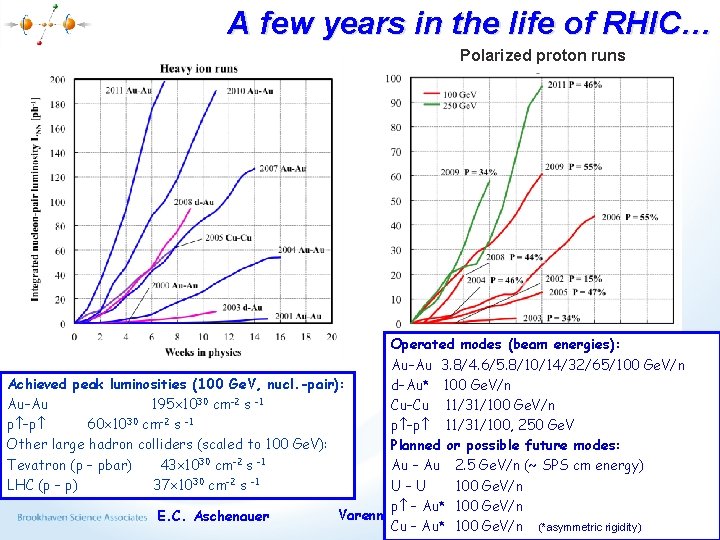
A few years in the life of RHIC… Polarized proton runs Operated modes (beam energies): Au–Au 3. 8/4. 6/5. 8/10/14/32/65/100 Ge. V/n Achieved peak luminosities (100 Ge. V, nucl. -pair): d–Au* 100 Ge. V/n Au–Au 195 1030 cm-2 s -1 Cu–Cu 11/31/100 Ge. V/n p –p 60 1030 cm-2 s -1 p –p 11/31/100, 250 Ge. V Other large hadron colliders (scaled to 100 Ge. V): Planned or possible future modes: Tevatron (p – pbar) 43 1030 cm-2 s -1 Au – Au 2. 5 Ge. V/n (~ SPS cm energy) LHC (p – p) 37 1030 cm-2 s -1 U–U 100 Ge. V/n p – Au* 100 Ge. V/n Varenna, July 2011 12 E. C. Aschenauer Cu – Au* 100 Ge. V/n (*asymmetric rigidity)
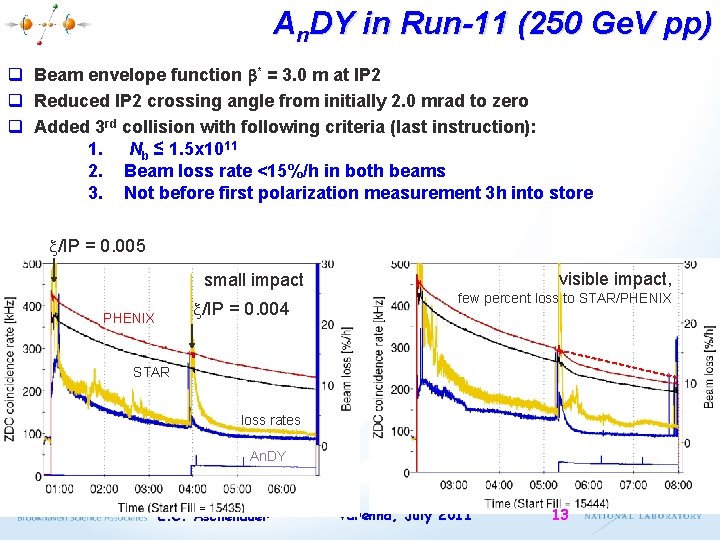
An. DY in Run-11 (250 Ge. V pp) q Beam envelope function b* = 3. 0 m at IP 2 q Reduced IP 2 crossing angle from initially 2. 0 mrad to zero q Added 3 rd collision with following criteria (last instruction): 1. Nb ≤ 1. 5 x 10¹¹ 2. Beam loss rate <15%/h in both beams 3. Not before first polarization measurement 3 h into store x/IP = 0. 005 visible impact, small impact x/IP = 0. 004 PHENIX few percent loss to STAR/PHENIX STAR loss rates An. DY E. C. Aschenauer Varenna, July 2011 13
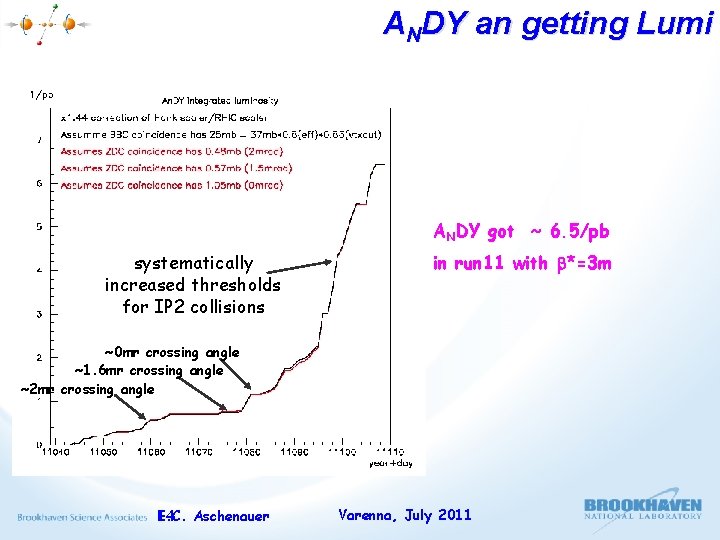
ANDY an getting Lumi ANDY got ~ 6. 5/pb systematically increased thresholds for IP 2 collisions in run 11 with b*=3 m ~0 mr crossing angle ~1. 6 mr crossing angle ~2 mr crossing angle 14 Aschenauer E. C. Varenna, July 2011
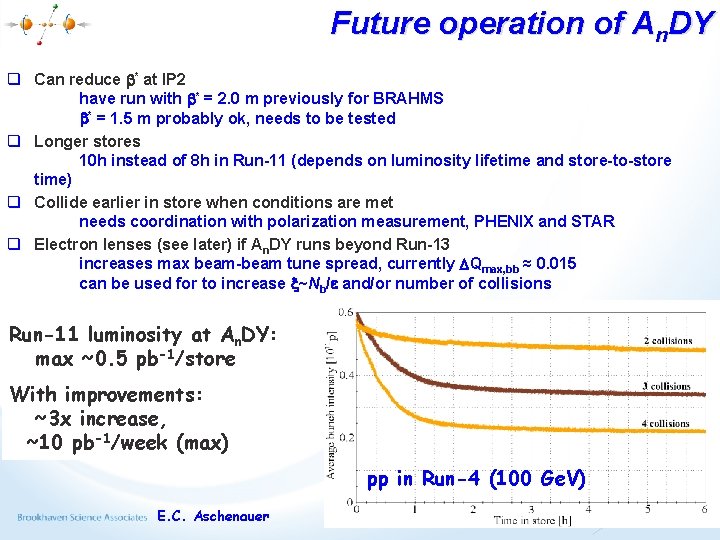
Future operation of An. DY q Can reduce b* at IP 2 have run with b* = 2. 0 m previously for BRAHMS b* = 1. 5 m probably ok, needs to be tested q Longer stores 10 h instead of 8 h in Run-11 (depends on luminosity lifetime and store-to-store time) q Collide earlier in store when conditions are met needs coordination with polarization measurement, PHENIX and STAR q Electron lenses (see later) if An. DY runs beyond Run-13 increases max beam-beam tune spread, currently DQmax, bb ≈ 0. 015 can be used for to increase x~Nb/ and/or number of collisions Run-11 luminosity at An. DY: max ~0. 5 pb-1/store With improvements: ~3 x increase, ~10 pb-1/week (max) pp in Run-4 (100 Ge. V) E. C. Aschenauer Varenna, July 2011 15
Polarized proton beams Or How to do magic with an accelerator E. C. Aschenauer Varenna, July 2011 16
What is Spin? From Google… q revolve quickly and repeatedly around one's own axis, "The dervishes whirl around without getting dizzy” q twist and turn so as to give an intended interpretation, "The President's spokesmen had to spin the story to make it less embarrassing” q a distinctive interpretation (especially as used by politicians to sway public opinion), "the campaign put a favorable spin on the story" E. C. Aschenauer Varenna, July 2011 17
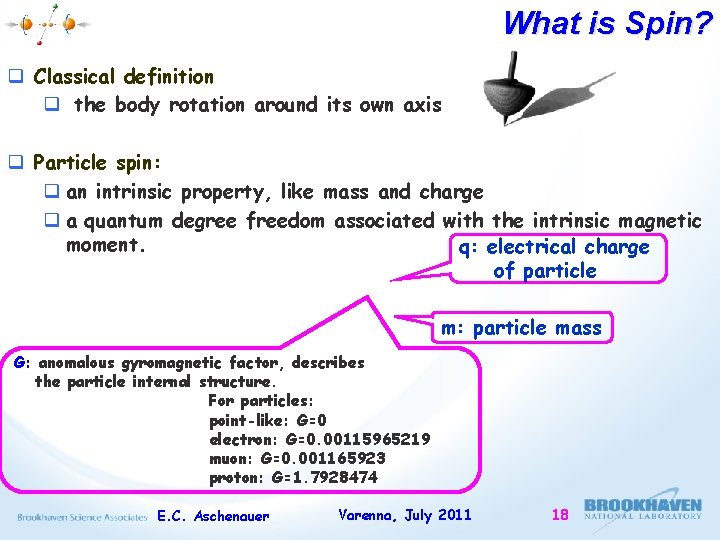
What is Spin? q Classical definition q the body rotation around its own axis q Particle spin: q an intrinsic property, like mass and charge q a quantum degree freedom associated with the intrinsic magnetic moment. q: electrical charge of particle m: particle mass G: anomalous gyromagnetic factor, describes the particle internal structure. For particles: point-like: G=0 electron: G=0. 00115965219 muon: G=0. 001165923 proton: G=1. 7928474 E. C. Aschenauer Varenna, July 2011 18
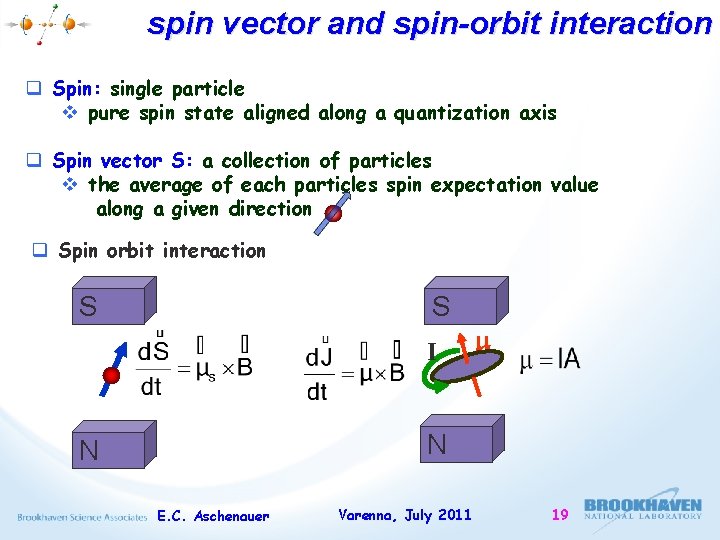
spin vector and spin-orbit interaction q Spin: single particle v pure spin state aligned along a quantization axis q Spin vector S: a collection of particles v the average of each particles spin expectation value along a given direction q Spin orbit interaction S S I N N E. C. Aschenauer Varenna, July 2011 19
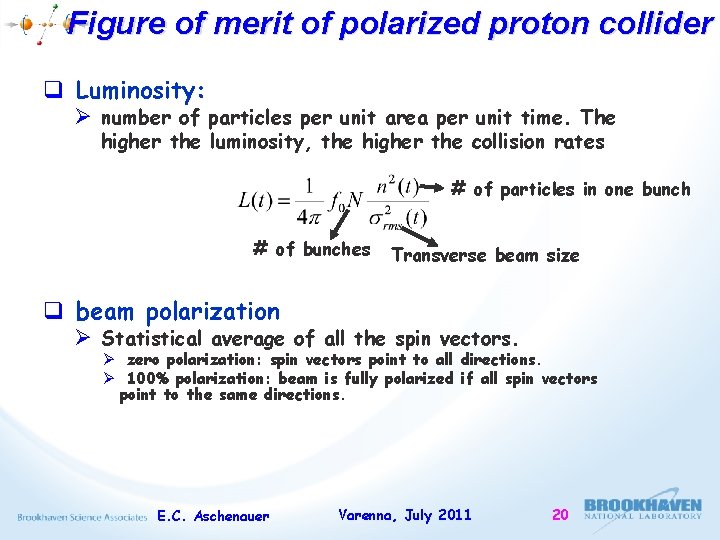
Figure of merit of polarized proton collider q Luminosity: Ø number of particles per unit area per unit time. The higher the luminosity, the higher the collision rates # of particles in one bunch # of bunches Transverse beam size q beam polarization Ø Statistical average of all the spin vectors. Ø zero polarization: spin vectors point to all directions. Ø 100% polarization: beam is fully polarized if all spin vectors point to the same directions. E. C. Aschenauer Varenna, July 2011 20
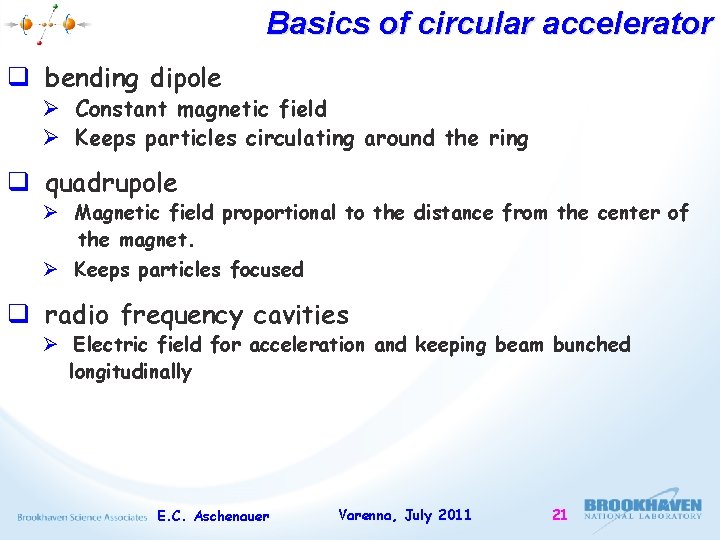
Basics of circular accelerator q bending dipole Ø Constant magnetic field Ø Keeps particles circulating around the ring q quadrupole Ø Magnetic field proportional to the distance from the center of the magnet. Ø Keeps particles focused q radio frequency cavities Ø Electric field for acceleration and keeping beam bunched longitudinally E. C. Aschenauer Varenna, July 2011 21
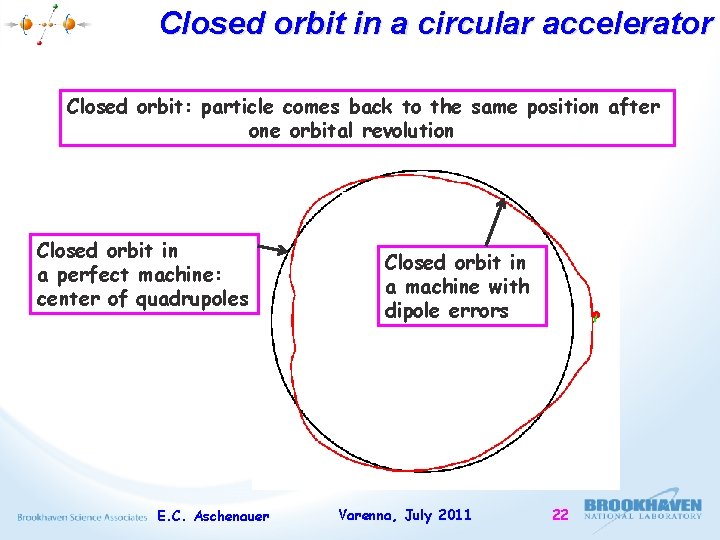
Closed orbit in a circular accelerator Closed orbit: particle comes back to the same position after one orbital revolution Closed orbit in a perfect machine: center of quadrupoles E. C. Aschenauer Closed orbit in a machine with dipole errors Varenna, July 2011 22
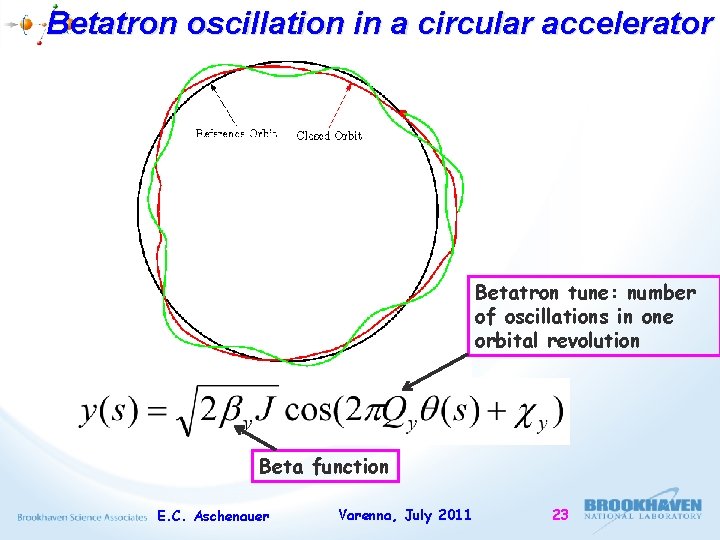
Betatron oscillation in a circular accelerator Betatron tune: number of oscillations in one orbital revolution Beta function E. C. Aschenauer Varenna, July 2011 23
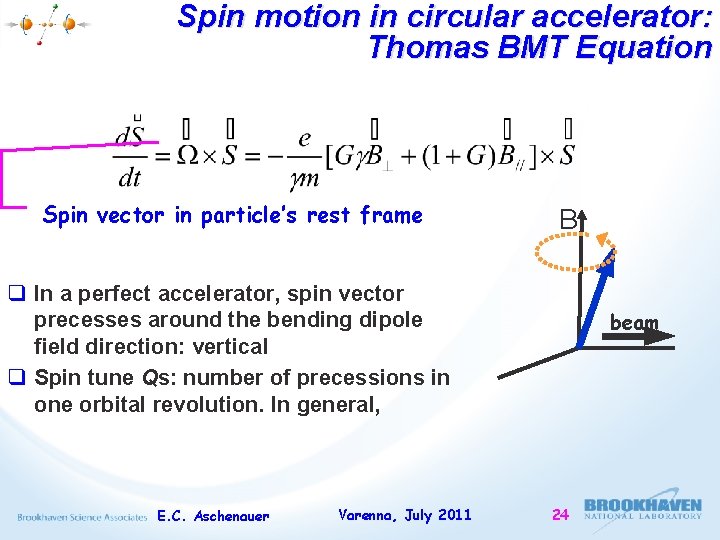
Spin motion in circular accelerator: Thomas BMT Equation Spin vector in particle’s rest frame B q In a perfect accelerator, spin vector precesses around the bending dipole field direction: vertical q Spin tune Qs: number of precessions in one orbital revolution. In general, E. C. Aschenauer Varenna, July 2011 beam 24
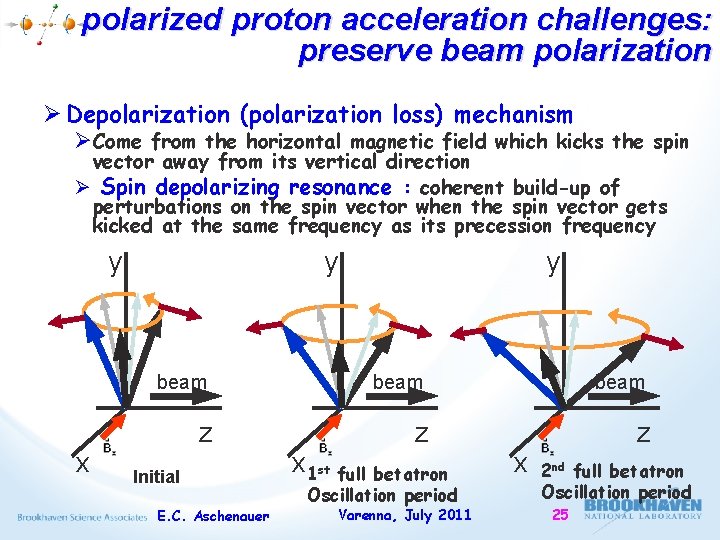
polarized proton acceleration challenges: preserve beam polarization Ø Depolarization (polarization loss) mechanism ØCome from the horizontal magnetic field which kicks the spin vector away from its vertical direction Ø Spin depolarizing resonance : coherent build-up of perturbations on the spin vector when the spin vector gets kicked at the same frequency as its precession frequency y y beam x z Initial E. C. Aschenauer y beam z x 1 st full betatron Oscillation period Varenna, July 2011 beam x z 2 nd full betatron Oscillation period 25
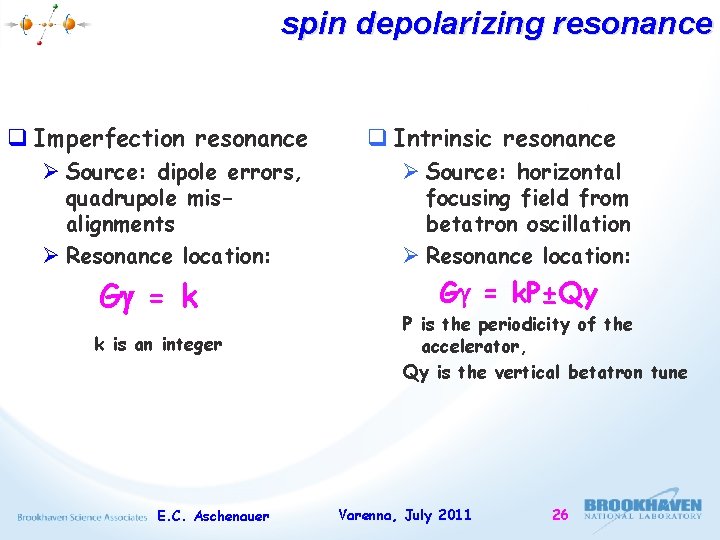
spin depolarizing resonance q Imperfection resonance Ø Source: dipole errors, quadrupole misalignments Ø Resonance location: G = k k is an integer E. C. Aschenauer q Intrinsic resonance Ø Source: horizontal focusing field from betatron oscillation Ø Resonance location: G = k. P±Qy P is the periodicity of the accelerator, Qy is the vertical betatron tune Varenna, July 2011 26
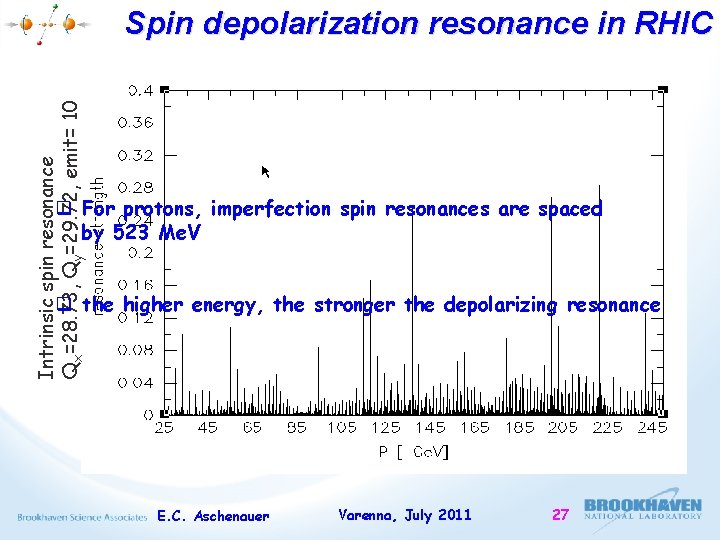
Intrinsic spin resonance Qx=28. 73, Qy=29. 72, emit= 10 Spin depolarization resonance in RHIC q For protons, imperfection spin resonances are spaced by 523 Me. V q the higher energy, the stronger the depolarizing resonance E. C. Aschenauer Varenna, July 2011 27
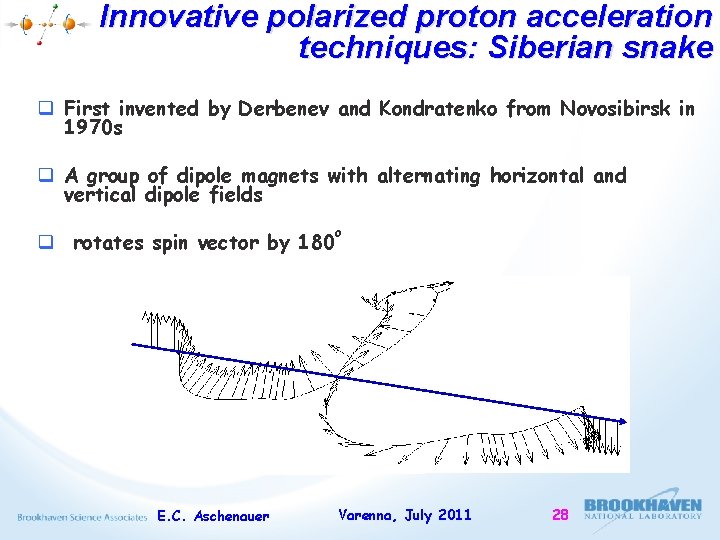
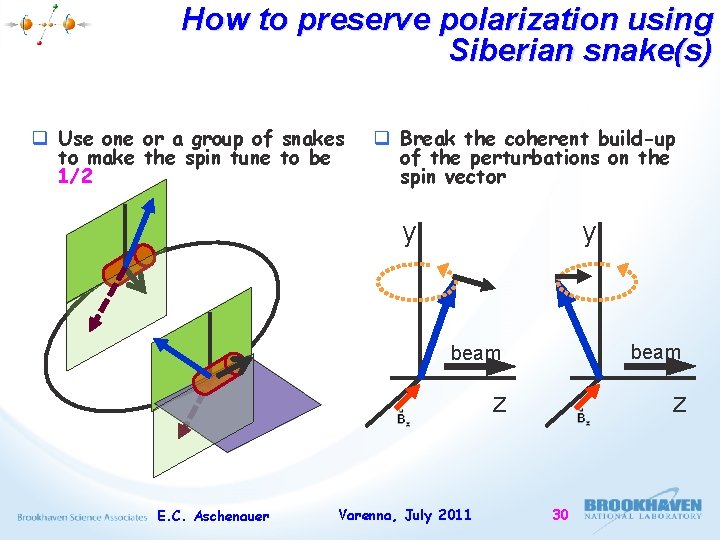
Innovative polarized proton acceleration techniques: Siberian snake q First invented by Derbenev and Kondratenko from Novosibirsk in 1970 s q A group of dipole magnets with alternating horizontal and vertical dipole fields q rotates spin vector by 180 E. C. Aschenauer o Varenna, July 2011 28
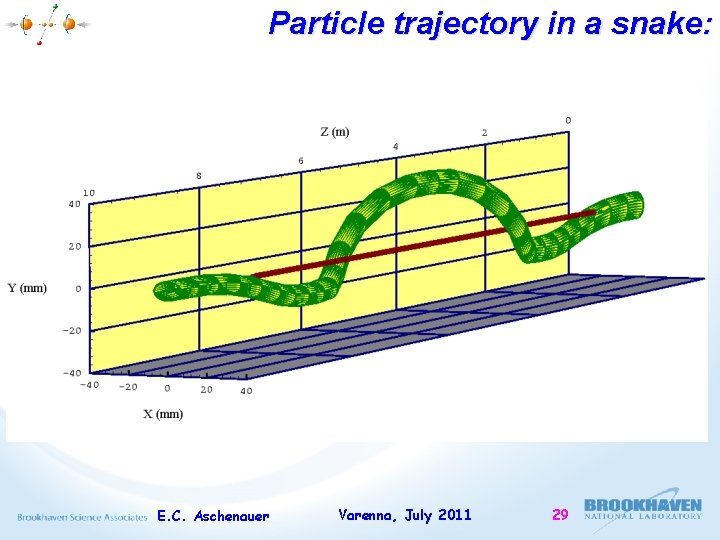
Particle trajectory in a snake: E. C. Aschenauer Varenna, July 2011 29
How to preserve polarization using Siberian snake(s) q Use one or a group of snakes to make the spin tune to be 1/2 q Break the coherent build-up of the perturbations on the spin vector y y beam z z E. C. Aschenauer Varenna, July 2011 30
Accelerate polarized protons in RHIC E. C. Aschenauer Varenna, July 2011 31
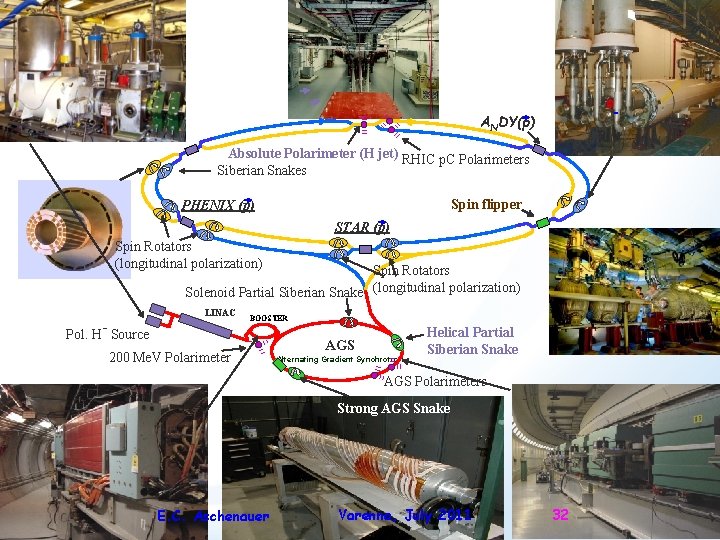
ANDY(p) Absolute Polarimeter (H jet) RHIC p. C Polarimeters Siberian Snakes Spin flipper PHENIX (p) STAR (p) Spin Rotators (longitudinal polarization) Spin Rotators Solenoid Partial Siberian Snake (longitudinal polarization) LINAC Pol. H Source BOOSTER 200 Me. V Polarimeter AGS Alternating Gradient Synchrotron Helical Partial Siberian Snake AGS Polarimeters Strong AGS Snake E. C. Aschenauer Varenna, July 2011 32
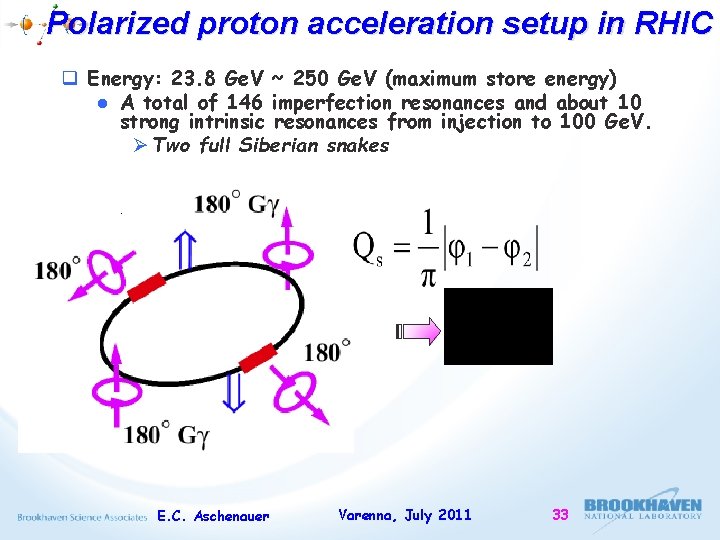
Polarized proton acceleration setup in RHIC q Energy: 23. 8 Ge. V ~ 250 Ge. V (maximum store energy) l A total of 146 imperfection resonances and about 10 strong intrinsic resonances from injection to 100 Ge. V. Ø Two full Siberian snakes E. C. Aschenauer Varenna, July 2011 33
How do we know the protons are polarized E. C. Aschenauer Varenna, July 2011 34
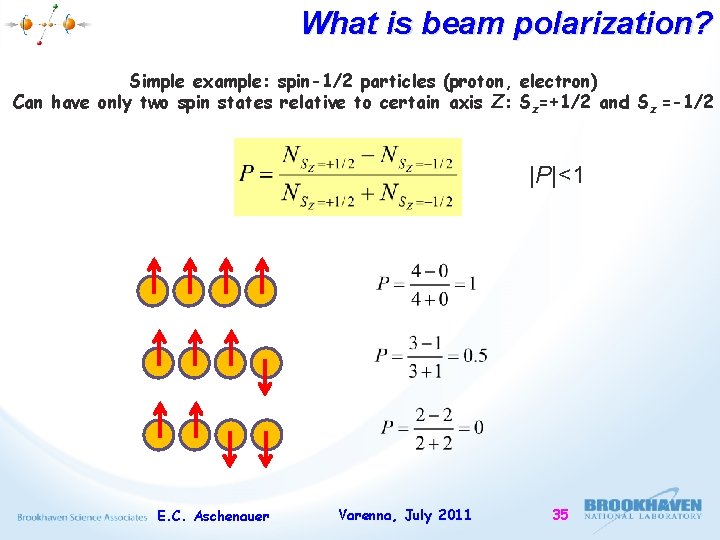
What is beam polarization? Simple example: spin-1/2 particles (proton, electron) Can have only two spin states relative to certain axis Z: Sz=+1/2 and Sz =-1/2 |P|<1 E. C. Aschenauer Varenna, July 2011 35
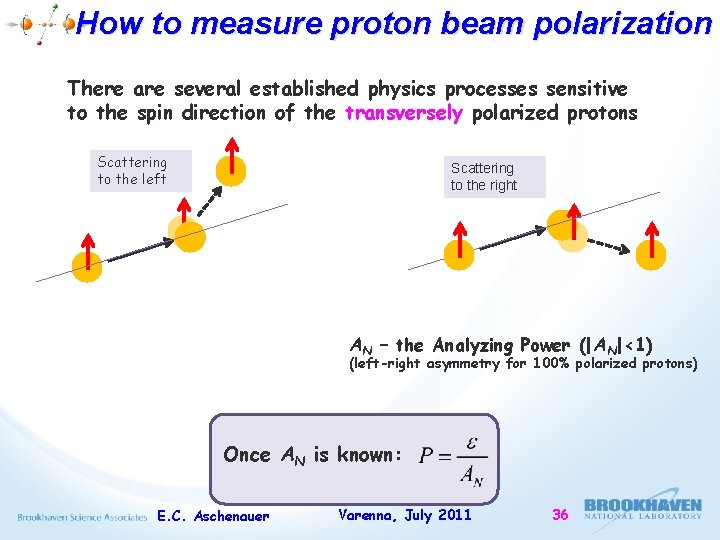
How to measure proton beam polarization There are several established physics processes sensitive to the spin direction of the transversely polarized protons Scattering to the left Scattering to the right AN – the Analyzing Power (|AN|<1) (left-right asymmetry for 100% polarized protons) Once AN is known: E. C. Aschenauer Varenna, July 2011 36
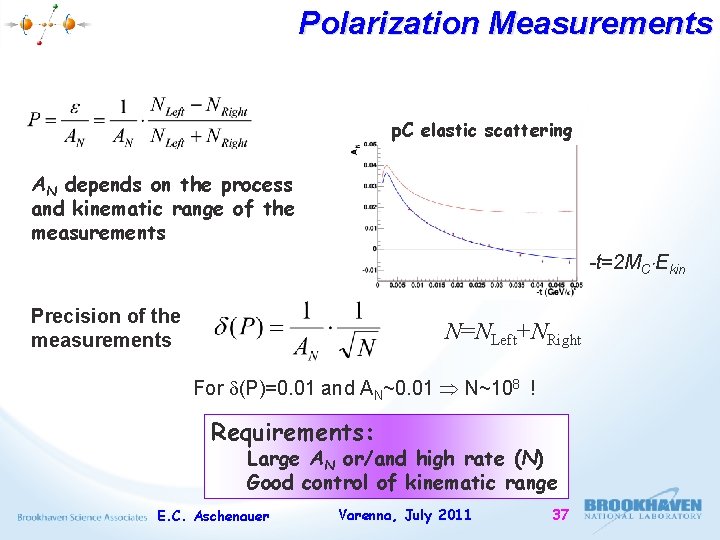
Polarization Measurements p. C elastic scattering AN depends on the process and kinematic range of the measurements -t=2 MC Ekin Precision of the measurements N=NLeft+NRight For (P)=0. 01 and AN~0. 01 N~108 ! Requirements: Large AN or/and high rate (N) Good control of kinematic range E. C. Aschenauer Varenna, July 2011 37
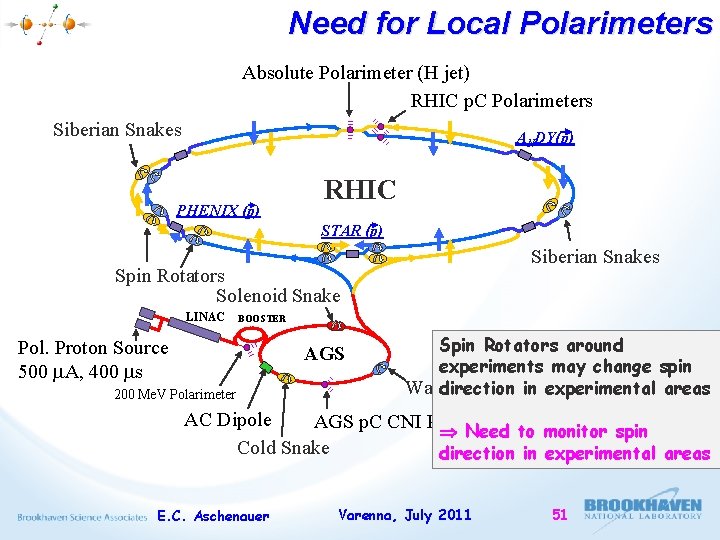
RHIC and Polarimetry Absolute Polarimeter (H jet) RHIC p. C Polarimeters Siberian Snakes ANDY (p) PHENIX (p) RHIC STAR (p) Siberian Snakes Spin Rotators Solenoid Snake LINAC Pol. Proton Source 500 m. A, 400 ms 200 Me. V Polarimeter BOOSTER AGS Warm Snake AC Dipole AGS p. C CNI Polarimeter Cold Snake Varenna, July 2011 E. C. Aschenauer 38
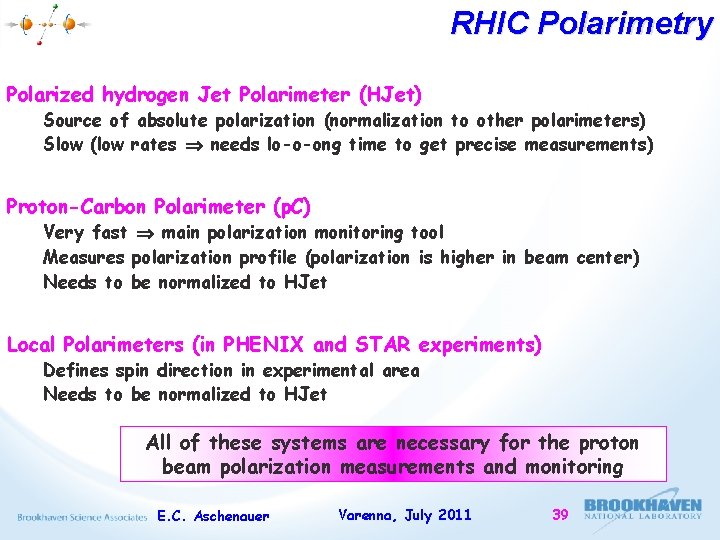
RHIC Polarimetry Polarized hydrogen Jet Polarimeter (HJet) Source of absolute polarization (normalization to other polarimeters) Slow (low rates needs lo-o-ong time to get precise measurements) Proton-Carbon Polarimeter (p. C) Very fast main polarization monitoring tool Measures polarization profile (polarization is higher in beam center) Needs to be normalized to HJet Local Polarimeters (in PHENIX and STAR experiments) Defines spin direction in experimental area Needs to be normalized to HJet All of these systems are necessary for the proton beam polarization measurements and monitoring E. C. Aschenauer Varenna, July 2011 39
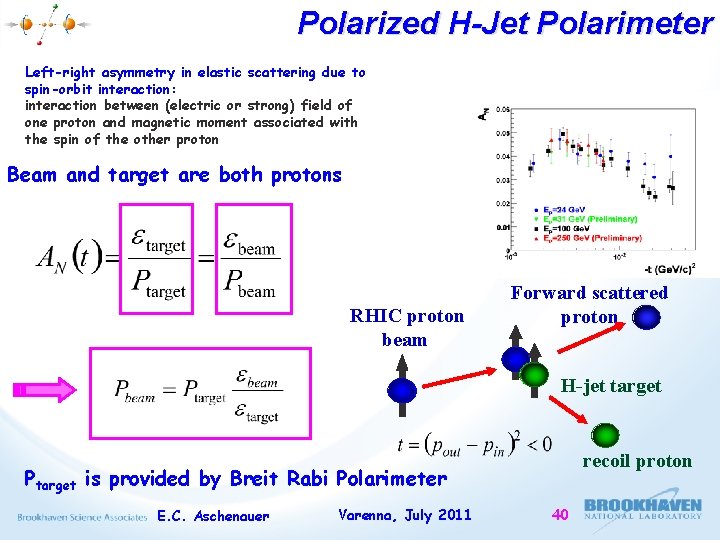
Polarized H-Jet Polarimeter Left-right asymmetry in elastic scattering due to spin-orbit interaction: interaction between (electric or strong) field of one proton and magnetic moment associated with the spin of the other proton Beam and target are both protons RHIC proton beam Forward scattered proton H-jet target recoil proton Ptarget is provided by Breit Rabi Polarimeter E. C. Aschenauer Varenna, July 2011 40
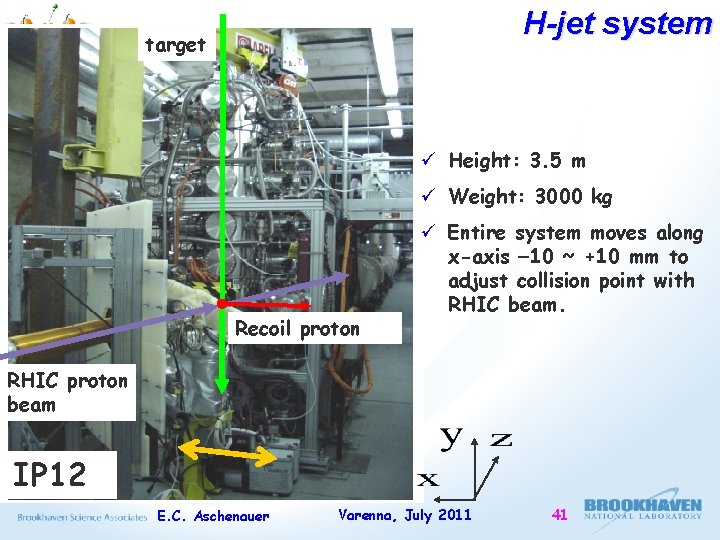
H-jet system target ü Height: 3. 5 m ü Weight: 3000 kg Recoil proton ü Entire system moves along x-axis 10 ~ +10 mm to adjust collision point with RHIC beam. RHIC proton beam IP 12 E. C. Aschenauer Varenna, July 2011 41
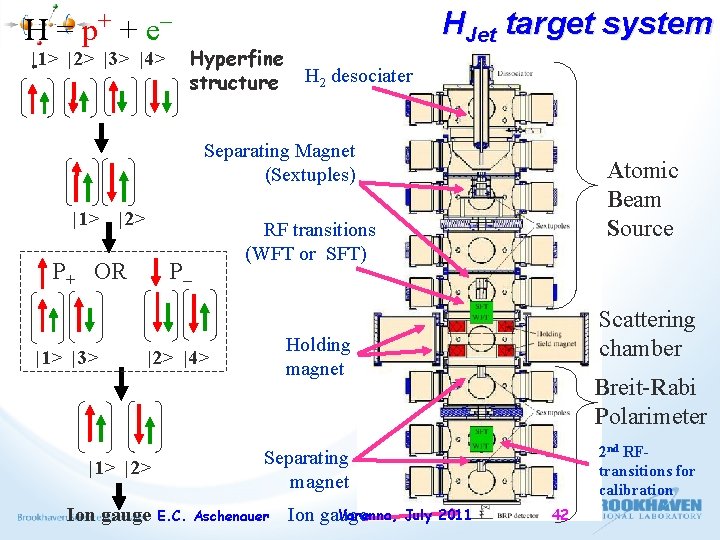
H = p+ + e |1> |2> |3> |4> Hyperfine structure HJet target system H 2 desociater Separating Magnet (Sextuples) |1> |2> P+ OR |1> |3> P RF transitions (WFT or SFT) Ion gauge Scattering chamber Holding magnet |2> |4> |1> |2> Atomic Beam Source Breit-Rabi Polarimeter 2 nd RFtransitions for calibration Separating magnet E. C. Aschenauer Varenna, Ion gauge July 2011 42
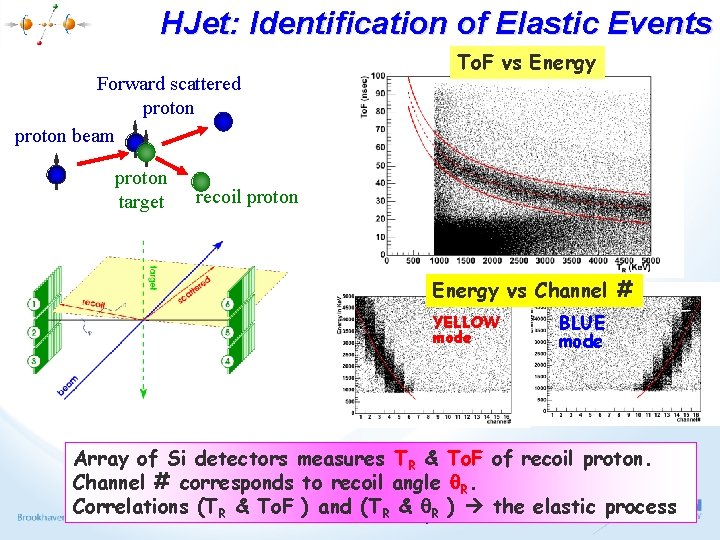
HJet: Identification of Elastic Events Forward scattered proton beam proton target To. F vs Energy recoil proton Energy vs Channel # YELLOW mode BLUE mode Array of Si detectors measures TR & To. F of recoil proton. Channel # corresponds to recoil angle R. Correlations (TR & To. F ) and (TR &July R 2011 ) the elastic process Varenna, 43 E. C. Aschenauer
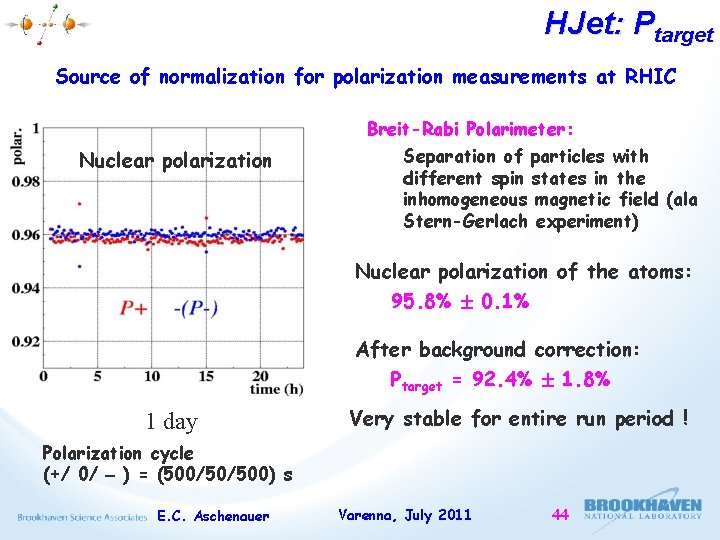
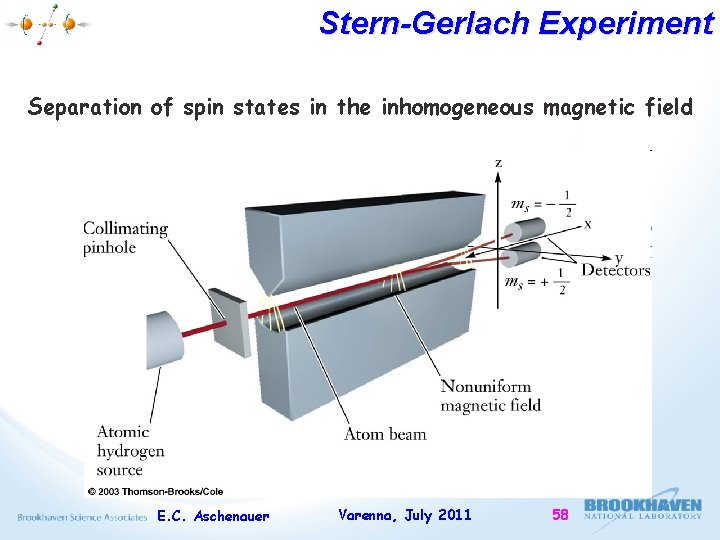
HJet: Ptarget Source of normalization for polarization measurements at RHIC Breit-Rabi Polarimeter: Nuclear polarization Separation of particles with different spin states in the inhomogeneous magnetic field (ala Stern-Gerlach experiment) Nuclear polarization of the atoms: 95. 8% 0. 1% After background correction: Ptarget = 92. 4% 1. 8% 1 day Very stable for entire run period ! Polarization cycle (+/ 0/ ) = (500/50/500) s E. C. Aschenauer Varenna, July 2011 44
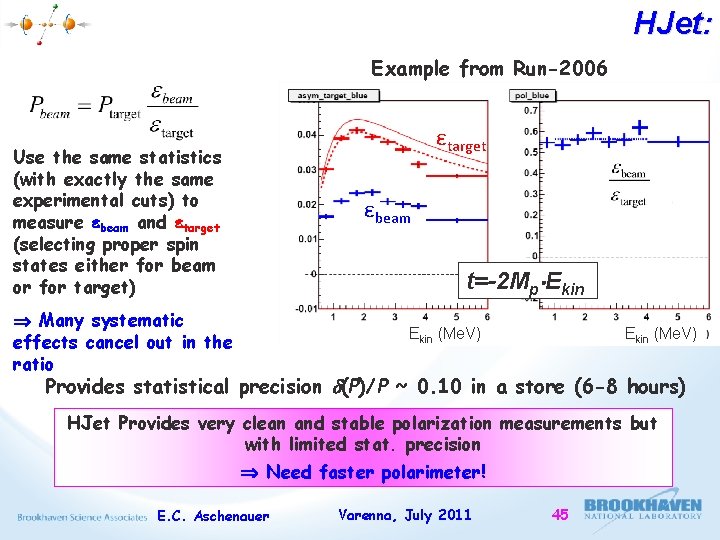
HJet: Example from Run-2006 εtarget Use the same statistics (with exactly the same experimental cuts) to measure beam and target (selecting proper spin states either for beam or for target) εbeam t=-2 Mp Ekin Many systematic effects cancel out in the ratio Ekin (Me. V) Provides statistical precision (P)/P ~ 0. 10 in a store (6 -8 hours) HJet Provides very clean and stable polarization measurements but with limited stat. precision Need faster polarimeter! E. C. Aschenauer Varenna, July 2011 45
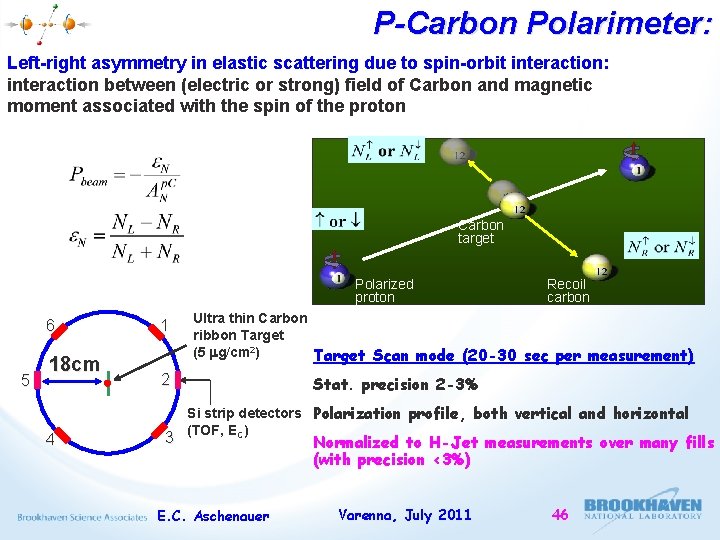
P-Carbon Polarimeter: Left-right asymmetry in elastic scattering due to spin-orbit interaction: interaction between (electric or strong) field of Carbon and magnetic moment associated with the spin of the proton Carbon target Polarized proton 6 5 18 cm 4 1 Ultra thin Carbon ribbon Target (5 g/cm 2) Target Scan mode (20 -30 sec per measurement) 2 3 Recoil carbon Stat. precision 2 -3% Si strip detectors Polarization profile, both vertical and horizontal (TOF, EC) E. C. Aschenauer Normalized to H-Jet measurements over many fills (with precision <3%) Varenna, July 2011 46
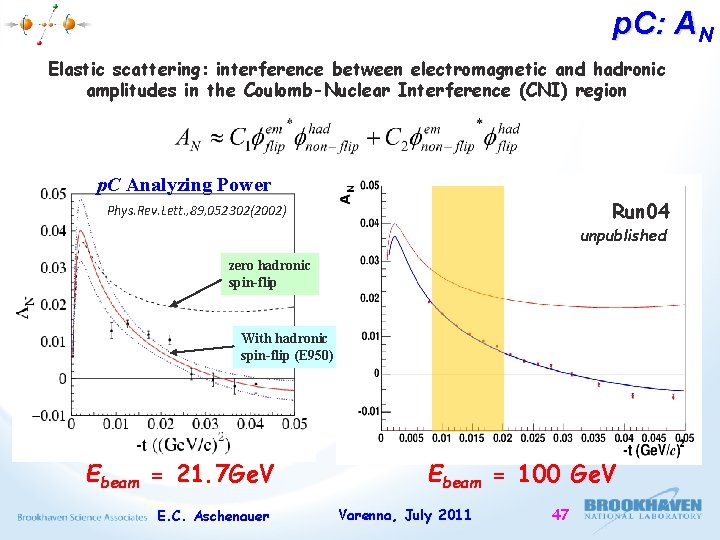
p. C: AN Elastic scattering: interference between electromagnetic and hadronic amplitudes in the Coulomb-Nuclear Interference (CNI) region p. C Analyzing Power Run 04 Phys. Rev. Lett. , 89, 052302(2002) unpublished zero hadronic spin-flip With hadronic spin-flip (E 950) Ebeam = 21. 7 Ge. V E. C. Aschenauer Ebeam = 100 Ge. V Varenna, July 2011 47
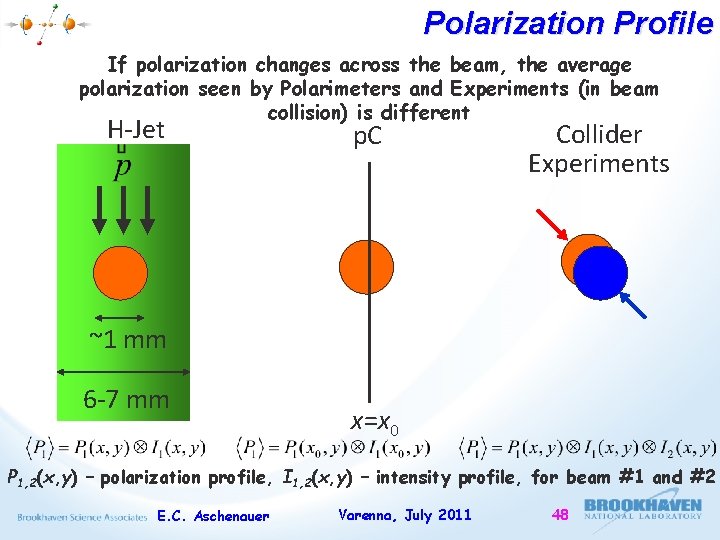
Polarization Profile If polarization changes across the beam, the average polarization seen by Polarimeters and Experiments (in beam collision) is different H-Jet p. C Collider Experiments ~1 mm 6 -7 mm x=x 0 P 1, 2(x, y) – polarization profile, I 1, 2(x, y) – intensity profile, for beam #1 and #2 E. C. Aschenauer Varenna, July 2011 48
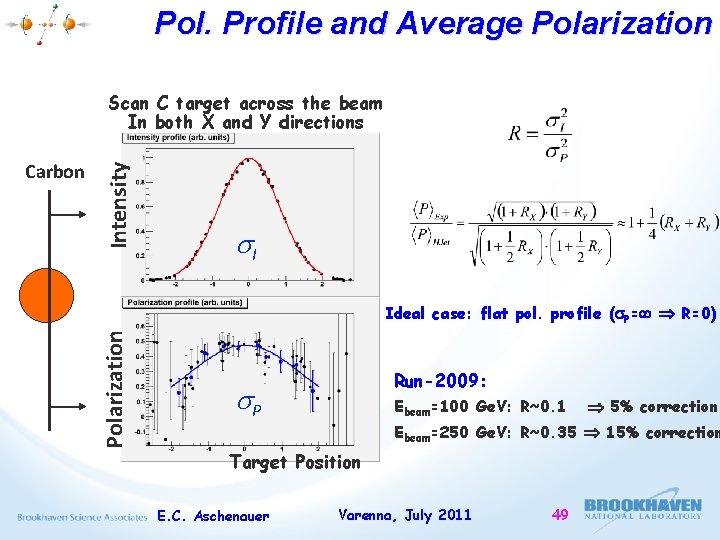
Pol. Profile and Average Polarization I Ideal case: flat pol. profile ( P= R=0) Polarization Carbon Intensity Scan C target across the beam In both X and Y directions Run-2009: P Ebeam=100 Ge. V: R~0. 1 Ebeam=250 Ge. V: R~0. 35 15% correction Target Position E. C. Aschenauer 5% correction Varenna, July 2011 49
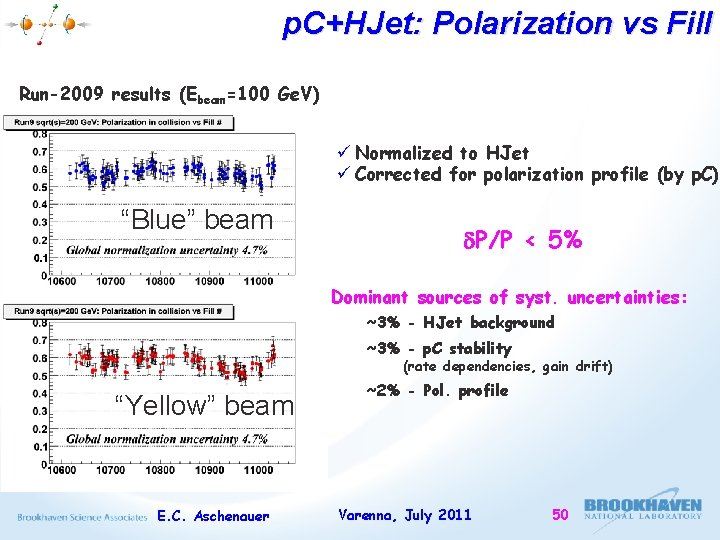
p. C+HJet: Polarization vs Fill Run-2009 results (Ebeam=100 Ge. V) ü Normalized to HJet ü Corrected for polarization profile (by p. C) “Blue” beam P/P < 5% Dominant sources of syst. uncertainties: ~3% - HJet background ~3% - p. C stability (rate dependencies, gain drift) “Yellow” beam E. C. Aschenauer ~2% - Pol. profile Varenna, July 2011 50
Need for Local Polarimeters Absolute Polarimeter (H jet) RHIC p. C Polarimeters Siberian Snakes ANDY(p) PHENIX (p) RHIC STAR (p) Siberian Snakes Spin Rotators Solenoid Snake LINAC BOOSTER Pol. Proton Source 500 m. A, 400 ms AGS 200 Me. V Polarimeter Spin Rotators around experiments may change spin Warm Snake in experimental areas direction AC Dipole AGS p. C CNI Polarimeter Need to monitor spin Cold Snake direction in experimental areas E. C. Aschenauer Varenna, July 2011 51
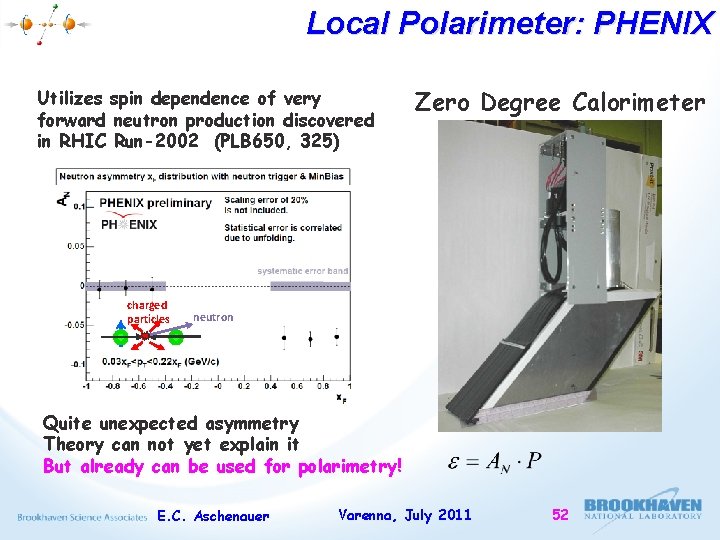
Local Polarimeter: PHENIX Utilizes spin dependence of very forward neutron production discovered in RHIC Run-2002 (PLB 650, 325) charged particles Zero Degree Calorimeter neutron Quite unexpected asymmetry Theory can not yet explain it But already can be used for polarimetry! E. C. Aschenauer Varenna, July 2011 52
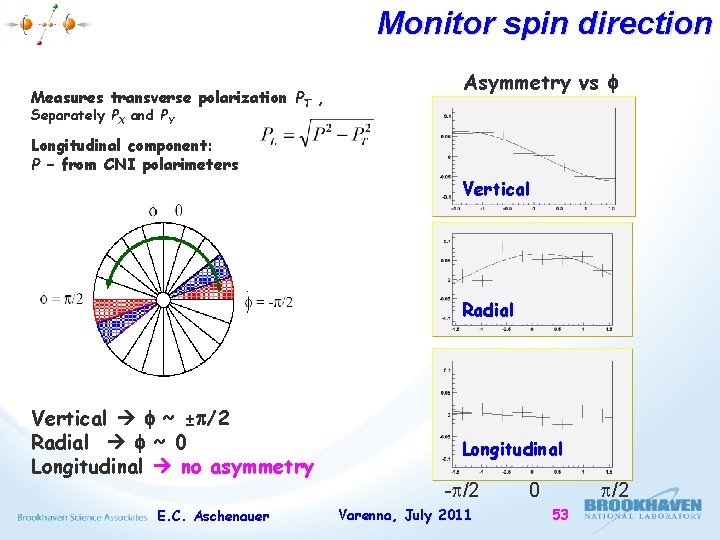
Monitor spin direction Measures transverse polarization PT , Asymmetry vs Separately PX and PY Longitudinal component: P – from CNI polarimeters Vertical Radial Vertical ~ ±p/2 Radial ~ 0 Longitudinal no asymmetry Longitudinal - /2 E. C. Aschenauer Varenna, July 2011 /2 0 53
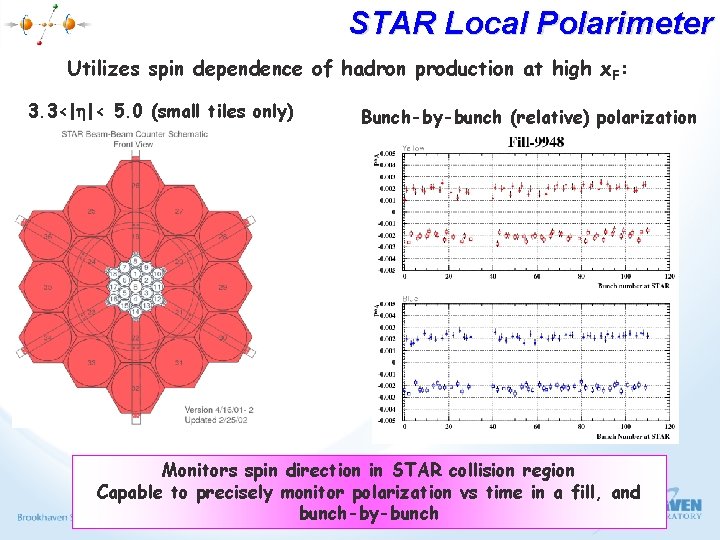
STAR Local Polarimeter Utilizes spin dependence of hadron production at high x. F: 3. 3<|h|< 5. 0 (small tiles only) Bunch-by-bunch (relative) polarization Monitors spin direction in STAR collision region Capable to precisely monitor polarization vs time in a fill, and bunch-by-bunch Varenna, July 2011 54 E. C. Aschenauer
Now we have the polarised proton beam and know what the polarisation is, what is next How do we measure things Detectors E. C. Aschenauer Varenna, July 2011 55
BACKUP E. C. Aschenauer Varenna, July 2011 56
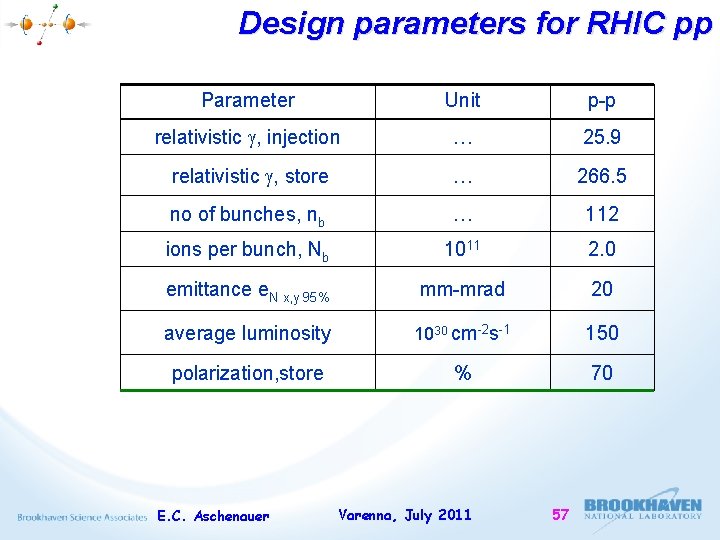
Design parameters for RHIC pp Parameter Unit p-p relativistic , injection … 25. 9 relativistic , store … 266. 5 no of bunches, nb … 112 ions per bunch, Nb 1011 2. 0 emittance e. N x, y 95% mm-mrad 20 average luminosity 1030 cm-2 s-1 150 polarization, store % 70 E. C. Aschenauer Varenna, July 2011 57
Stern-Gerlach Experiment Separation of spin states in the inhomogeneous magnetic field E. C. Aschenauer Varenna, July 2011 58
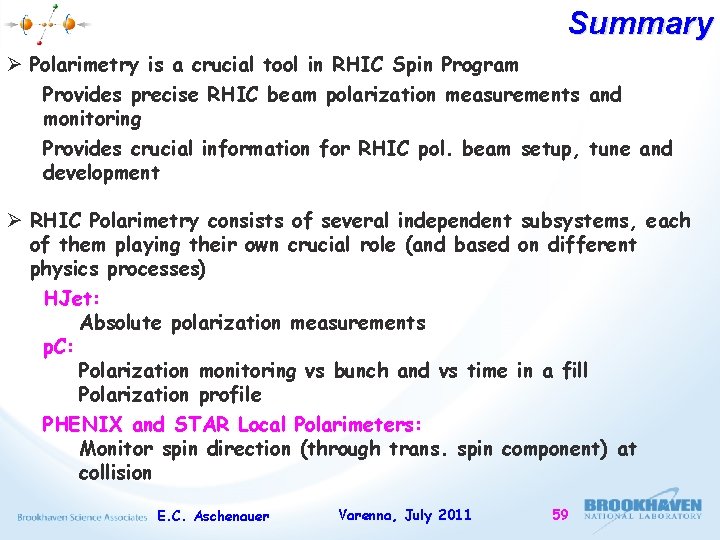
Summary Ø Polarimetry is a crucial tool in RHIC Spin Program Provides precise RHIC beam polarization measurements and monitoring Provides crucial information for RHIC pol. beam setup, tune and development Ø RHIC Polarimetry consists of several independent subsystems, each of them playing their own crucial role (and based on different physics processes) HJet: Absolute polarization measurements p. C: Polarization monitoring vs bunch and vs time in a fill Polarization profile PHENIX and STAR Local Polarimeters: Monitor spin direction (through trans. spin component) at collision E. C. Aschenauer Varenna, July 2011 59