
LECTURE FOURTEEN BENDING AND DRAWING PROCESSES Bending operation
LECTURE FOURTEEN BENDING AND DRAWING PROCESSES
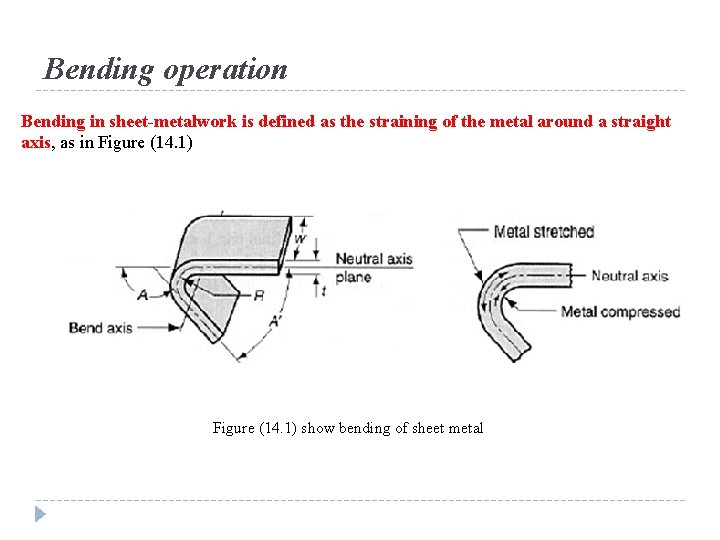
Bending operation Bending in sheet-metalwork is defined as the straining of the metal around a straight axis, as in Figure (14. 1) show bending of sheet metal

Bending operations are performed using punch and die tooling. The two common bending methods and associated tooling are V-bending, performed with a V-die; and edge bending, performed with a wiping die. These methods are illustrated in Figure (14. 2) types of bending operations
Drawing operation Drawing is a sheet-metal-forming operation used to make cup-shaped, box-shaped, or other complex-curved and concave parts. It is performed by placing a piece of sheet metal over a die cavity and then pushing the metal into the opening with a punch, as in Figure 14. 3. The blank must usually be held down flat against the die by a blankholder. Common parts made by drawing include beverage cans, ammunition shells, sinks, cooking pots, and automobile body panels.
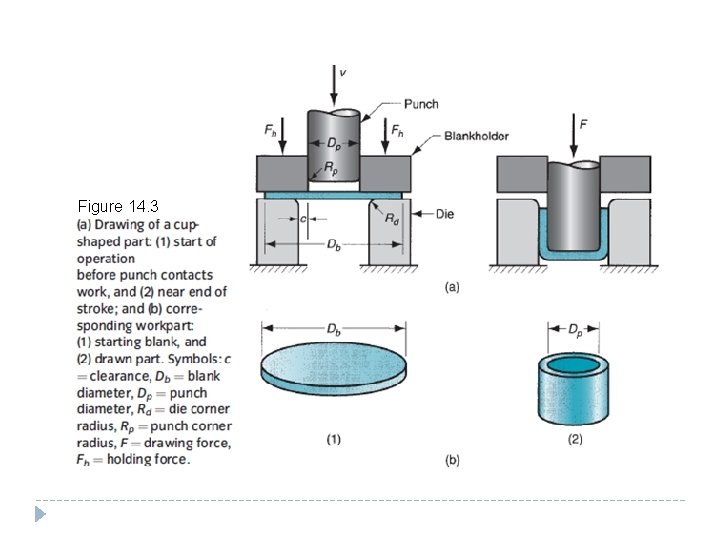
Figure 14. 3
Mechanic of Drawing of a cup-shaped part is the basic drawing operation, with dimensions and parameters as pictured in Figure 14. 3. A blank of diameter Db is drawn into a die cavity by means of a punch with diameter Dp. The punch and die must have corner radii, given by Rp and Rd. If the punch and die were to have sharp corners (Rp and Rd=0), a hole-punching operation (and not a very good one) would be accomplished rather than a drawing operation. The sides of the punch and die are separated by a clearance c. This clearance in drawing is about 10% greater than the stock thickness: c=1. 1 t The punch applies a downward force F to accomplish the deformation of the metal, and a downward holding force Fh is applied by the blankholder, as shown in the sketch.
- Slides: 6