
Lecture Date Chapter 44 Regulating the Internal Environment
- Slides: 14
Lecture Date____ • Chapter 44 • Regulating the Internal Environment
Homeostasis: regulation of internal environment • Thermoregulation – internal temperature • Osmoregulation – solute and water balance • Excretion – nitrogen containing waste
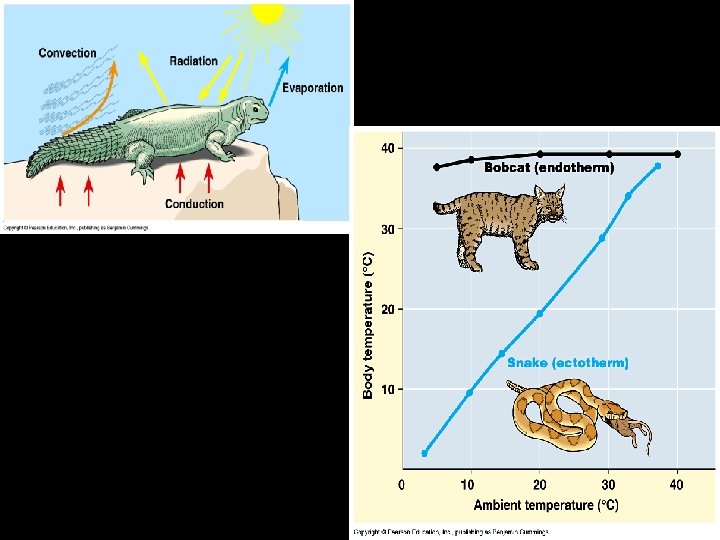
Regulation of body temperature • Thermoregulation • 4 physical processes: – Conduction ~ transfer of heat between molecules of body and environment – Convection ~ transfer of heat as water/air move across body surface – Radiation ~ transfer of heat produced by organisms – Evaporation ~loss of heat from liquid to gas • Sources of body heat: – Ectothermic: determined by environment – Endothermic: high metabolic rate generates high body heat
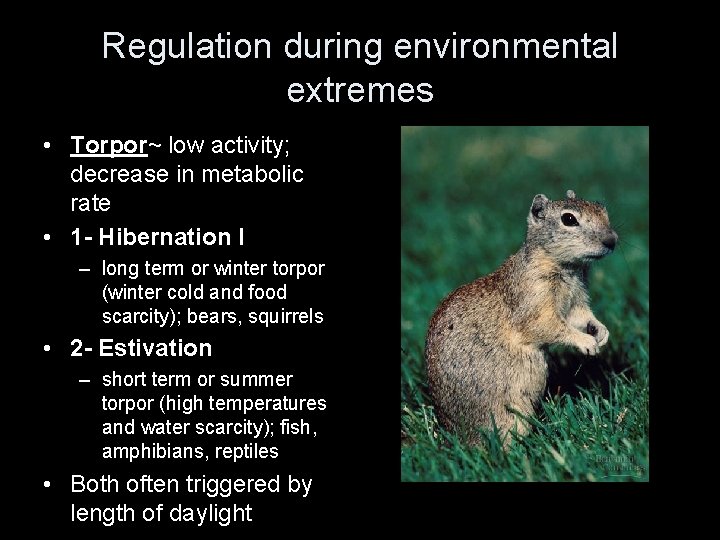
Regulation during environmental extremes • Torpor~ low activity; decrease in metabolic rate • 1 - Hibernation l – long term or winter torpor (winter cold and food scarcity); bears, squirrels • 2 - Estivation – short term or summer torpor (high temperatures and water scarcity); fish, amphibians, reptiles • Both often triggered by length of daylight
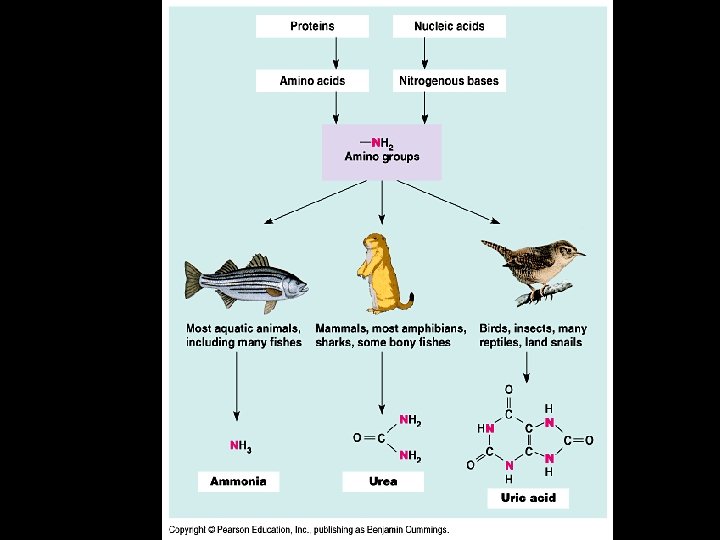
Water balance and waste disposal • Osmoregulation: – management of the body’s water content and solute composition • Nitrogenous wastes: – breakdown products of proteins and nucleic acids; ammonia-very toxic • Deamination – Ammonia: most aquatic animals, many fish – Urea: mammals, most amphibians, sharks, bony fish (in liver; combo of NH 3 and CO 2) – Uric acid: birds, insects, many reptiles, land snails
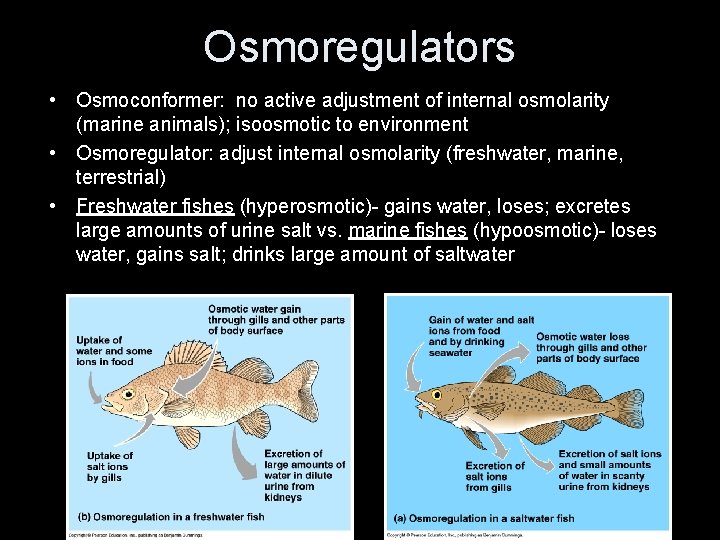
Osmoregulators • Osmoconformer: no active adjustment of internal osmolarity (marine animals); isoosmotic to environment • Osmoregulator: adjust internal osmolarity (freshwater, marine, terrestrial) • Freshwater fishes (hyperosmotic)- gains water, loses; excretes large amounts of urine salt vs. marine fishes (hypoosmotic)- loses water, gains salt; drinks large amount of saltwater
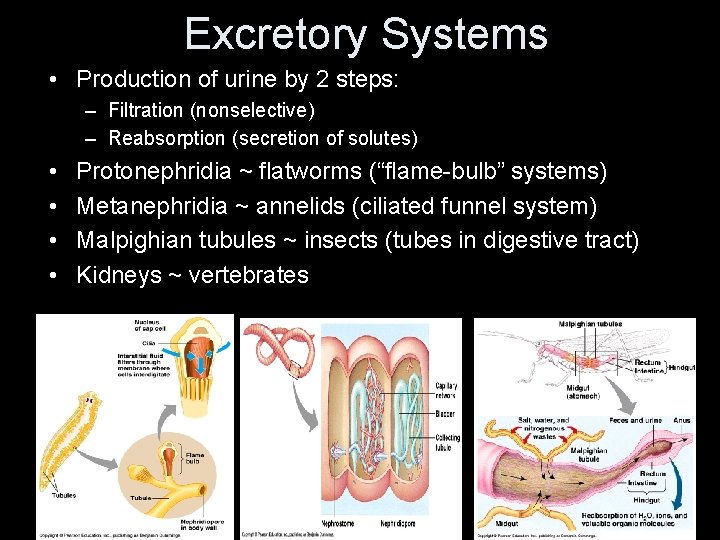
Excretory Systems • Production of urine by 2 steps: – Filtration (nonselective) – Reabsorption (secretion of solutes) • • Protonephridia ~ flatworms (“flame-bulb” systems) Metanephridia ~ annelids (ciliated funnel system) Malpighian tubules ~ insects (tubes in digestive tract) Kidneys ~ vertebrates
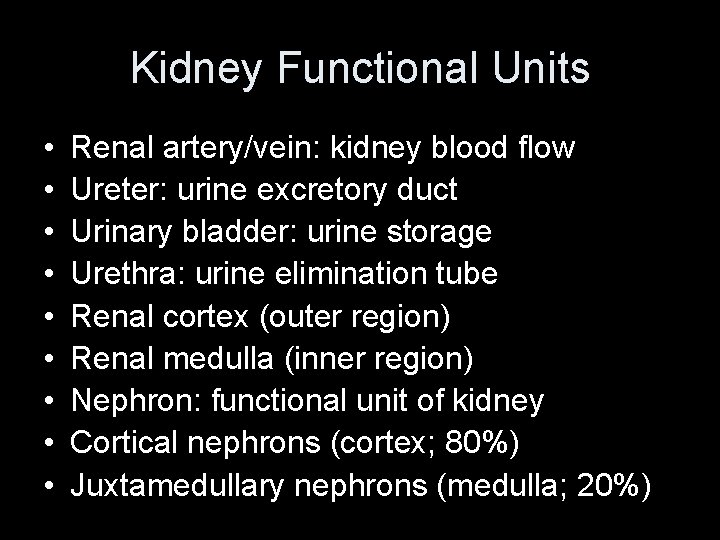
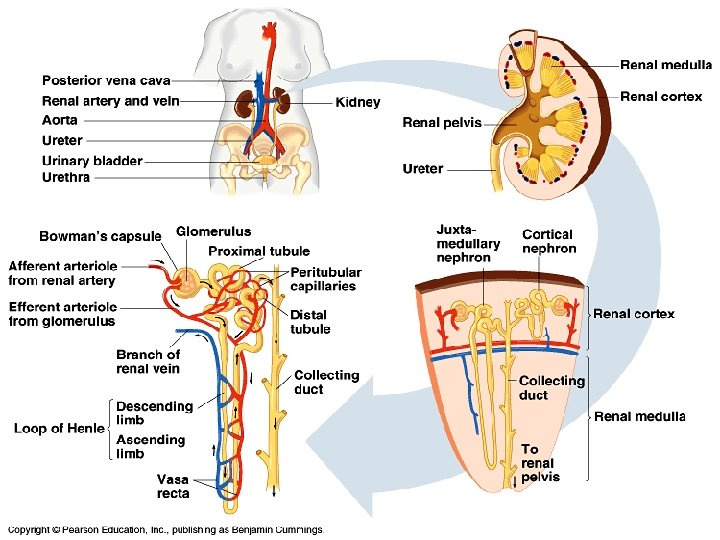
Kidney Functional Units • • • Renal artery/vein: kidney blood flow Ureter: urine excretory duct Urinary bladder: urine storage Urethra: urine elimination tube Renal cortex (outer region) Renal medulla (inner region) Nephron: functional unit of kidney Cortical nephrons (cortex; 80%) Juxtamedullary nephrons (medulla; 20%)
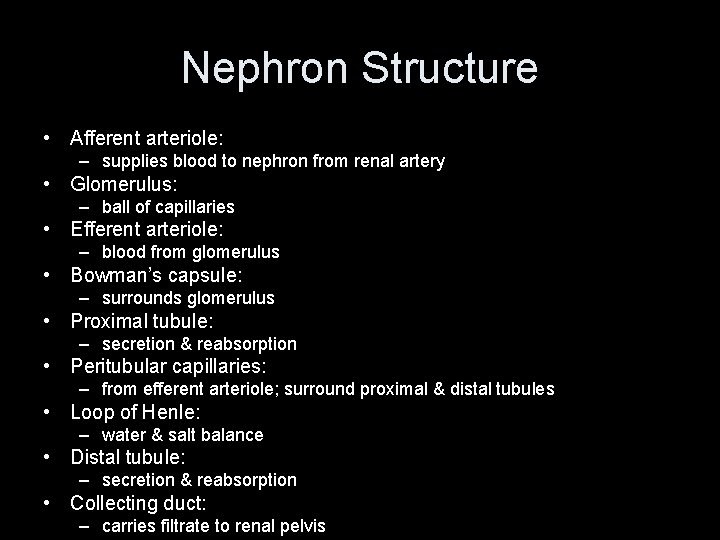
Nephron Structure • Afferent arteriole: – supplies blood to nephron from renal artery • Glomerulus: – ball of capillaries • Efferent arteriole: – blood from glomerulus • Bowman’s capsule: – surrounds glomerulus • Proximal tubule: – secretion & reabsorption • Peritubular capillaries: – from efferent arteriole; surround proximal & distal tubules • Loop of Henle: – water & salt balance • Distal tubule: – secretion & reabsorption • Collecting duct: – carries filtrate to renal pelvis
Nephron Function • Proximal tubule: – secretion and reabsorption • Loop of Henle: – reabsorption of water and salt • Distal tubule: – secretion and reabsorption • Collecting duct: – reabsorbs water, salt, some urea
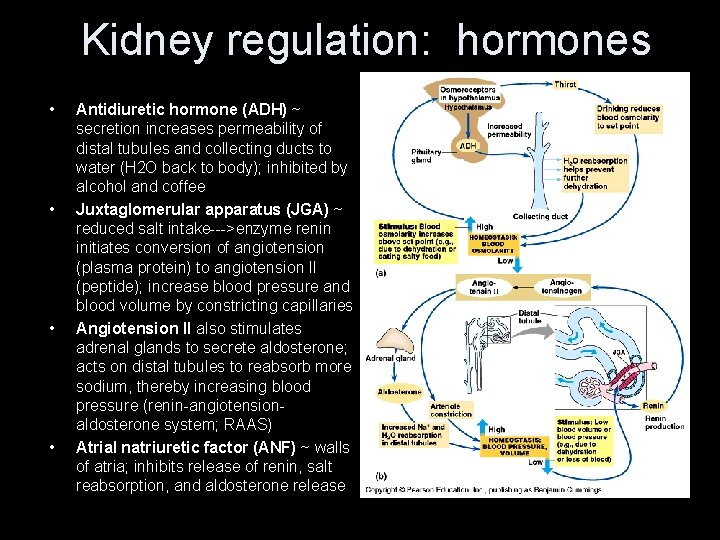
Kidney regulation: hormones • • Antidiuretic hormone (ADH) ~ secretion increases permeability of distal tubules and collecting ducts to water (H 2 O back to body); inhibited by alcohol and coffee Juxtaglomerular apparatus (JGA) ~ reduced salt intake--->enzyme renin initiates conversion of angiotension (plasma protein) to angiotension II (peptide); increase blood pressure and blood volume by constricting capillaries Angiotension II also stimulates adrenal glands to secrete aldosterone; acts on distal tubules to reabsorb more sodium, thereby increasing blood pressure (renin-angiotensionaldosterone system; RAAS) Atrial natriuretic factor (ANF) ~ walls of atria; inhibits release of renin, salt reabsorption, and aldosterone release