
Lecture by Chris Ross CHAPTER 3 NONVERBAL COMMUNICATION
Lecture by: Chris Ross CHAPTER 3: NONVERBAL COMMUNICATION
WHAT IS NONVERBAL COMMUNICATION � Nonverbal Communication => is everything that communicates a message but does not include words. Facial expression � Gestures � Dress � Timing � Position � Tone of voice � Eye contact � Smell � Etc �
WHAT IS NONVERBAL COMMUNICATION � Two Sides of Nonverbal Communication � Decoding => draw meaning from something you observe � Encoding => put your feelings into behavior through nonverbal communication
WHAT IS NONVERBAL COMMUNICATION � Two Modes of Nonverbal Communication � Static (Fixed)=> the elements of an interaction that do not change during its course. (Ex: furniture in a room) � Dynamic (Changeable) => movement and change during the course of the interaction (Ex: bodily movement or position of someone playing poker)
HOW NONVERBAL COMMUNICATION WORKS � Symbolic � Guided by Rules � Cultural � Personal � Ambiguous � Less Controlled � Continuous
HOW NONVERBAL COMMUNICATION WORKS � Symbolic � Tend to be polysemic and can be difficult to decide what their intended meanings are.
HOW NONVERBAL COMMUNICATION WORKS � Guided � Social by Rules norms can dictate what nonverbal communication you can use in situations � Rules can help evaluate a situation � Rules tend to be learned through your interactions with others
HOW NONVERBAL COMMUNICATION WORKS � Cultural � Different cultures have various levels of what nonverbal communication is appropriate. � Ex: Eye contact is not always acceptable in all cultures.
HOW NONVERBAL COMMUNICATION WORKS � Personal � You can assign your own personal meanings behind the nonverbal symbols used.
HOW NONVERBAL COMMUNICATION WORKS � Ambiguous � Many times people can be uncertain of what the nonverbal communication means. They look to other aspects of the communication event for clairity.
HOW NONVERBAL COMMUNICATION WORKS � Less Controlled � You cannot always control your physical reaction like you can your verbal reaction to an event. (Ex: you might be able to hold in vocalizing dislike for someone, but your facial expression shows the dislike). � Leakage => nonverbal communication that occurs without your full awareness and reveal how you really feel.
HOW NONVERBAL COMMUNICATION WORKS � Continuous � You always are communicating nonverbally with people whether you realize it or not.
INTERACTIONS WITH VERBAL COMMUNICATION � Nonverbal communication may repeat your verbal communication in the nonverbal format. � Nonverbal messages can be substituted for verbal messages when needed. � Nonverbal messages can emphasize a verbal message
HOW NONVERBAL COMMUNICATION WORKS � Nonverbal messages can moderate verbal messages (play down what is being said). � Nonverbal messages can contradict what is being verbally communicated.
HOW NONVERBAL COMMUNICATION WORKS � Regulators => nonverbal actions that indicate to others how you want them to behave or what you want them to do. � When you want to be left alone, you may cross your arms over your chest, look down and frown.
KENDON & FERBER’S FIVE BASIC STAGES OF A GREETING RITUAL 1. 2. 3. 4. 5. Sighting & Recognition Distant Salutation Lowering your head & Averting your gaze Close Salutation Backing Off 1. 2. 3. 4. 5. Occurs when you & another person first see each other Used to say hello w/ a wave Approach the other person, breaking eye contact Involves a type of physical contact Taking a step back or turning to the side for more open space
HOW NONVERBAL COMMUNICATION WORKS � Transmits � Attitude Emotional Information towards other person: if you show anxiety in your face, maybe the person makes you uncomfortable. � Attitude towards situation: if you fidget or cannot make eye contact it could show nervousness. � Attitude towards self: you can come across as arrogant via their facial expression, vocal tone and posture for example.
ELEMENTS OF NONVERBAL COMMUNICATION � Proxemics � Kinesics � Vocalics � Chronemics � Haptics
ELEMENTS OF NONVERBAL COMMUNICATION � Proxemics => the study of space and distance in communication
ELEMENTS OF NONVERBAL COMMUNICATION � Proxemics � Territoriality => establishment and maintenance of space you claim for personal use. (Ex: Table space in class) � Primary territory => space that you own or have principal control over (Ex: Your life).
ELEMENTS OF NONVERBAL COMMUNICATION � Proxemics � Public territory => space open to everyone but available for your sole temporary occupation (Ex: Seat on a public bus) � Personal space => space legitimately claimed or occupied by a person for the time being
ELEMENTS OF NONVERBAL COMMUNICATION � Proxemics � Body buffer zone => imaginary aura around people that they regard as part of themselves (Ex: “You’re in my bubble!”)
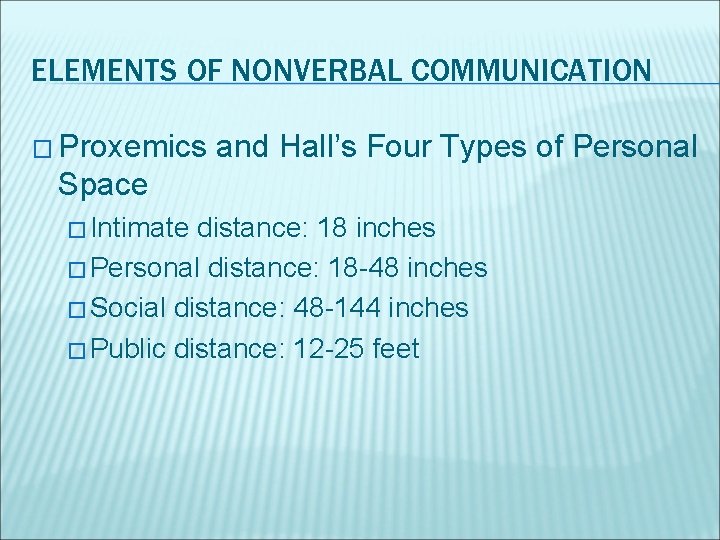
ELEMENTS OF NONVERBAL COMMUNICATION � Proxemics and Hall’s Four Types of Personal Space � Intimate distance: 18 inches � Personal distance: 18 -48 inches � Social distance: 48 -144 inches � Public distance: 12 -25 feet
ELEMENTS OF NONVERBAL COMMUNICATION � Kinesics => refers to the movement that takes place during the course of an interaction. � Posture � Gesture � Illustrators � Eye Contact
ELEMENTS OF NONVERBAL COMMUNICATION � Kinesics � Posture => position of your body during an interaction. � Conveys situation. three attitudes: about self, others and
ELEMENTS OF NONVERBAL COMMUNICATION � Kinesics � Gesture => defined as a movement of the body or any of its parts in a way that conveys an idea or intention or displays a feeling or an assessment of the situation. � Can be split broadly into two sorts: those that are not expressed in words (emblems) and those that signal something in words (illustrations).
ELEMENTS OF NONVERBAL COMMUNICATION � Kinesics � Illustrators => directly related to speech as it is being spoken and are used to visualize or emphasize its content. (Ex: Discussing how to use a baseball bat and showing the person how to swing).
ELEMENTS OF NONVERBAL COMMUNICATION � Kinesics � Eye Contact => refers to the extend to which you look directly into the eyes of another person. � Gaze => a rewarding look by one person who is looking at another.
ELEMENTS OF NONVERBAL COMMUNICATION � Vocalics => (sometimes called paralanguage) refers to vocal characteristics that provide information about how verbal communication should be interpreted and how you are feeling. � Ex: The tone you use to express anger
ELEMENTS OF NONVERBAL COMMUNICATION � Vocalics � Can use ton or pitch to emphasize parts of sentence to denote importance. � Use of rate to stress importance � Silence can be used to convey messages as well
ELEMENTS OF NONVERBAL COMMUNICATION � Vocalics � Backchannel Communication => vocalizations by a listener that give feedback to the speaker to show interest, attention or a willingness to listen. � Turn taking => when yuou hand over speaking to another person.
ELEMENTS OF NONVERBAL COMMUNICATION � Chronemics => encompasses use and evaluation or time in your interactions, including the location of events in time. � Emotions can impact chronemics. Boring lectures seem to take forever, but a meaningful conversation with a good friend can fly by.
ELEMENTS OF NONVERBAL COMMUNICATION � Haptics => study of the specific nonverbal behaviors involving touch
ELEMENTS OF NONVERBAL COMMUNICATION � Haptics/Heslin’s Functions of Touch � Functional/Professional: touch is permitted by context (Ex: Medical exam) � Social/Polite: Touch is formal (Ex: Handshake) � Friendship/Warmth: Touch is an expression of regard. � Love/Intimacy: Touch is special, only allowed with those you are close.
INTERACTING SYSTEM OF NONVERBAL COMMUNICATION 1. 2. 3. 4. Nonverbal communication is related to the words used with it. It can impact what is sad and understood. Nonverbal communication has a relationship with other nonverbal messages. Nonverbal messages can be interpreted on its context Nonverbal interpretation is affected by the relationship to the other person.
SPEAKER/ENCODER Affirming Blending Consistency Directness Emotional Clarity LISTENER/DECODER Attending Bonding Coordinating Detecting/Decoding Encouraging IMPROVING USE OF NONVERBAL COMMUNICATION
CHAPTER ASSIGNMENTS � Discussions � How does nonverbal communication regulate interactions? � How can you improve your use of nonverbal communication?
CHAPTER ASSIGNMENTS � Buddy/Group Work � Ask your friends how good they believe themselves to be at determining when other people are not telling the truth � In a group play two truths and a lie. Each person will write down two things that are true and one lie. Another person will read the statements about someone. Watch them and ask follow up questions. Can you figure out through their nonverbals if they are lying to you?
CHAPTER ASSIGNMENTS � Written � How Work do television shows use the placement of furniture to add something to the story? � If a member of another culture is breaking a rule of nonverbal communication in your culture, should you tell them? Why or why not? � Look at television or news stories involving police putting someone in a car. What percentage of the police touch the person’s head? In what other circumstances, if any, do people open the car door for someone else and then touch the person’s head who is getting in? What do you think they are trying to convey?
- Slides: 39