
Lecture 9 Xray Radiation Plan of the lecture
- Slides: 51
Lecture 9 X-ray Radiation
Plan of the lecture 1. X-radiation 2. Bremsstrahlung (Braking) X-radiation. Characteristic Xradiation 3. Interaction of X-radiation with material 4. The Application of X-radiation in medicine 5. The phenomenon of radioactivity. Types of radioactive decays 6. The law of radioactive decay
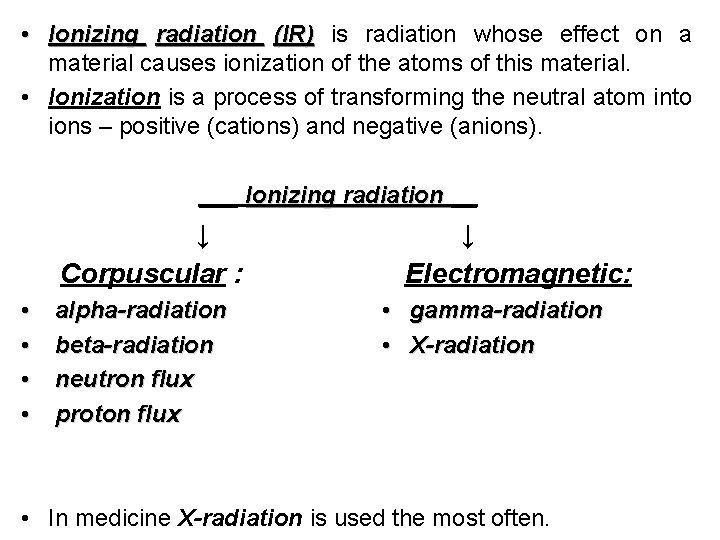
• Ionizing radiation (IR) is radiation whose effect on a material causes ionization of the atoms of this material. • Ionization is a process of transforming the neutral atom into ions – positive (cations) and negative (anions). ___ Ionizing radiation __ ↓ Corpuscular : • • alpha-radiation beta-radiation neutron flux proton flux ↓ Electromagnetic: • gamma-radiation • X-radiation • In medicine X-radiation is used the most often.
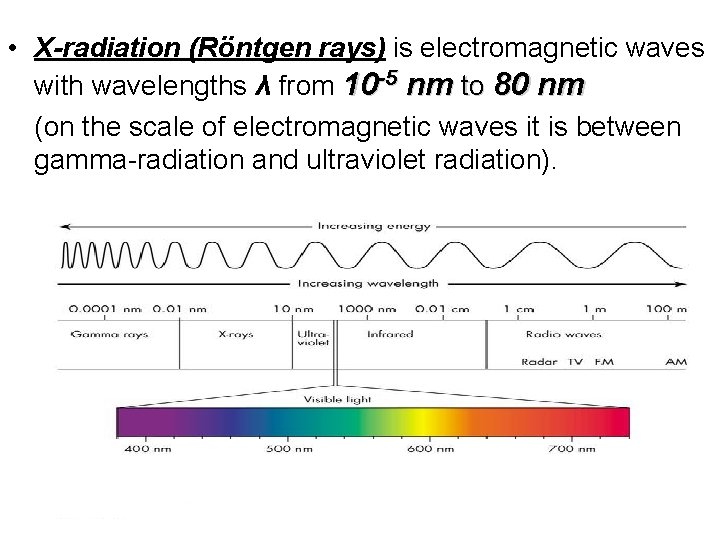
• X-radiation (Röntgen rays) is electromagnetic waves with wavelengths λ from 10 -5 nm to 80 nm (on the scale of electromagnetic waves it is between gamma-radiation and ultraviolet radiation).
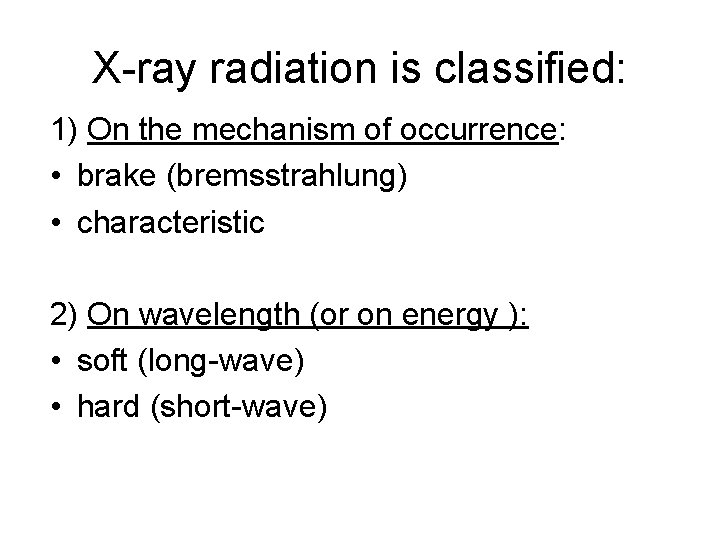
X-ray radiation is classified: 1) On the mechanism of occurrence: • brake (bremsstrahlung) • characteristic 2) On wavelength (or on energy ): • soft (long-wave) • hard (short-wave)
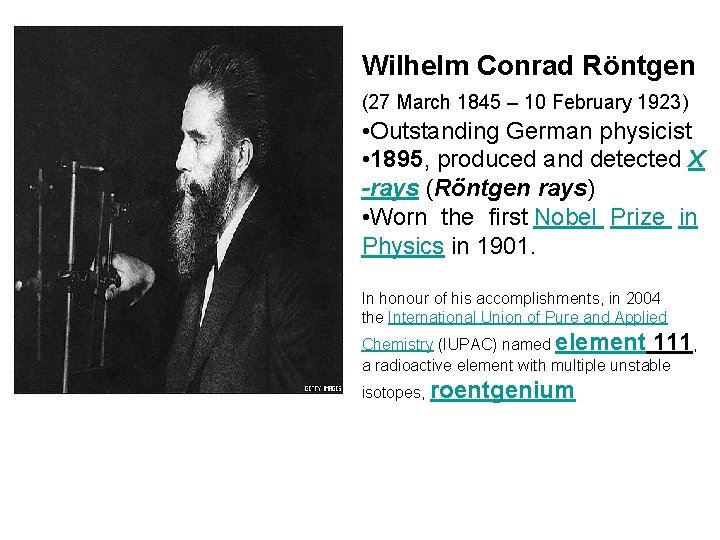
Wilhelm Conrad Röntgen (27 March 1845 – 10 February 1923) • Outstanding German physicist • 1895, produced and detected X -rays (Röntgen rays) • Worn the first Nobel Prize in Physics in 1901. In honour of his accomplishments, in 2004 the International Union of Pure and Applied Chemistry (IUPAC) named element 111, a radioactive element with multiple unstable isotopes, roentgenium
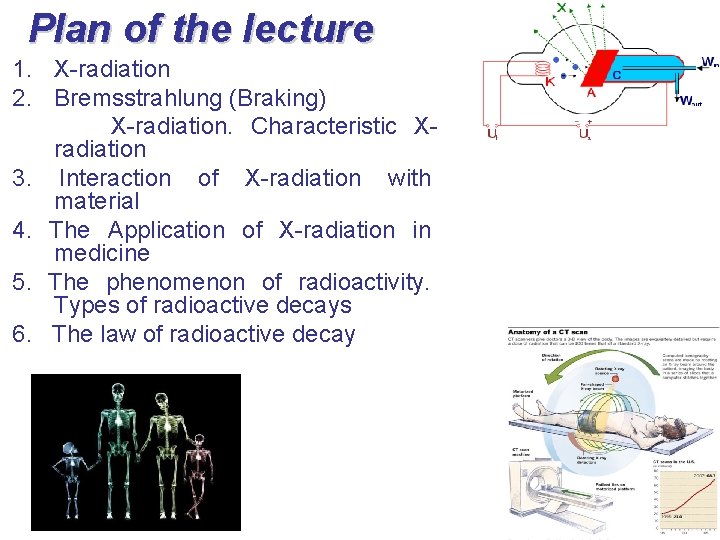
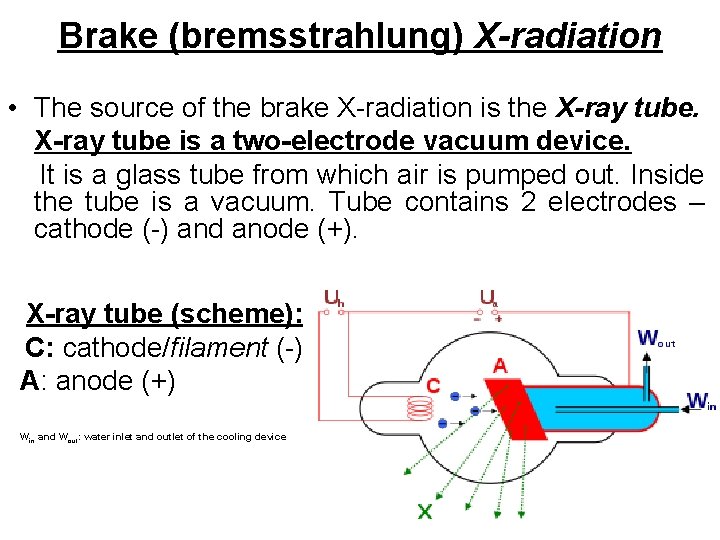
Brake (bremsstrahlung) X-radiation • The source of the brake X-radiation is the X-ray tube is a two-electrode vacuum device. It is a glass tube from which air is pumped out. Inside the tube is a vacuum. Tube contains 2 electrodes – cathode (-) and anode (+). X-ray tube (scheme): C: cathode/filament (-) A: anode (+) Win and Wout: water inlet and outlet of the cooling device
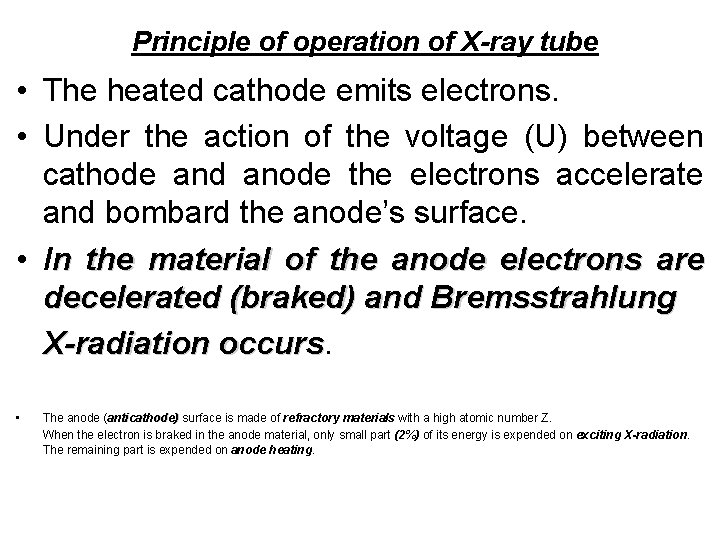
Principle of operation of X-ray tube • The heated cathode emits electrons. • Under the action of the voltage (U) between cathode and anode the electrons accelerate and bombard the anode’s surface. • In the material of the anode electrons are decelerated (braked) and Bremsstrahlung X-radiation occurs • The anode (anticathode) surface is made of refractory materials with a high atomic number Z. When the electron is braked in the anode material, only small part (2%) of its energy is expended on exciting X-radiation. The remaining part is expended on anode heating.
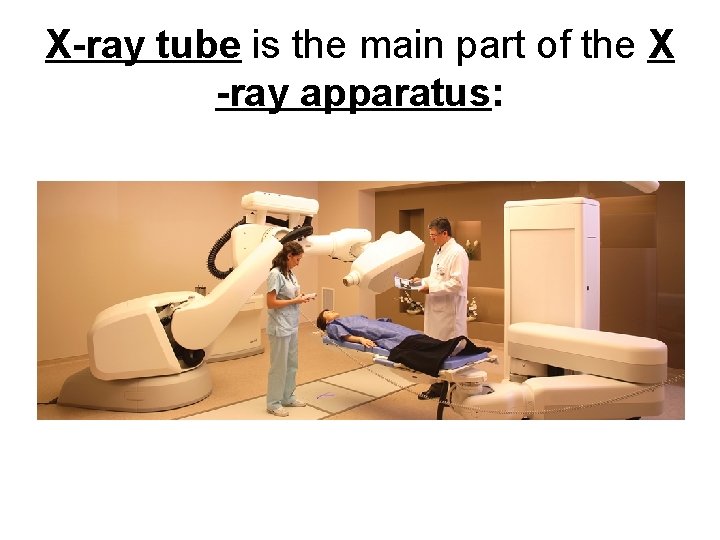
X-ray tube is the main part of the X -ray apparatus:
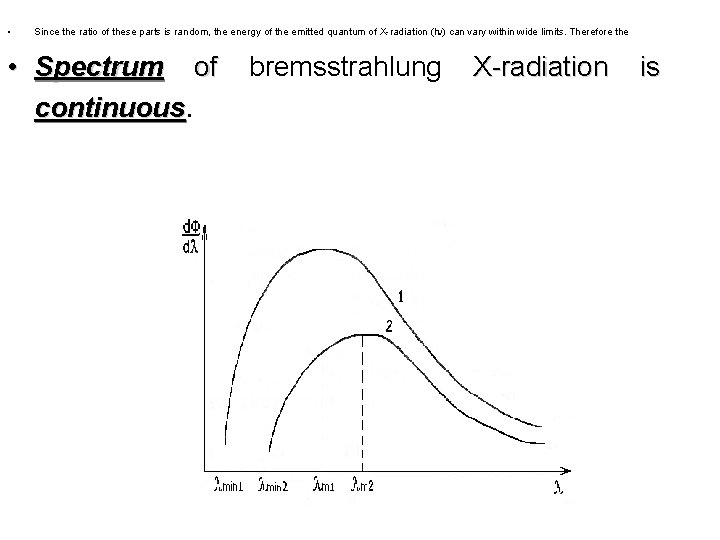
• Since the ratio of these parts is random, the energy of the emitted quantum of X-radiation (h ) can vary within wide limits. Therefore the • Spectrum of continuous. bremsstrahlung X-radiation is
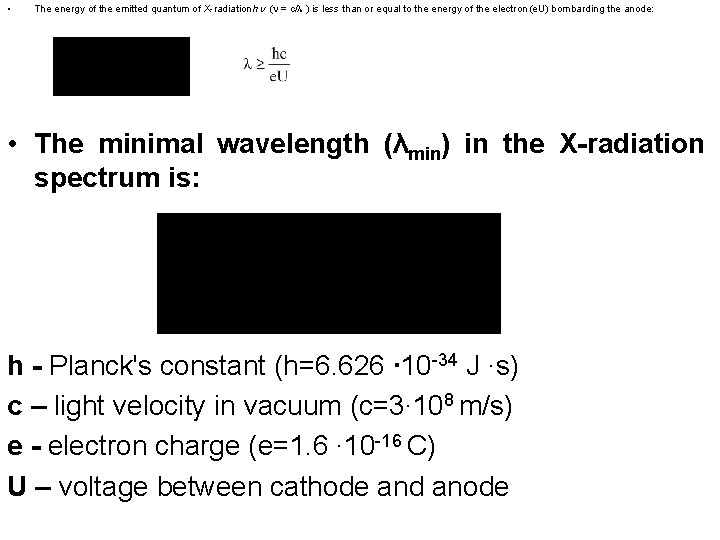
• The energy of the emitted quantum of X-radiation h ( = c/ ) is less than or equal to the energy of the electron (e. U) bombarding the anode: • The minimal wavelength (λmin) in the X-radiation spectrum is: h - Planck's constant (h=6. 626 ∙ 10 -34 J ∙s) c – light velocity in vacuum (c=3∙ 108 m/s) e - electron charge (e=1. 6 ∙ 10 -16 C) U – voltage between cathode and anode
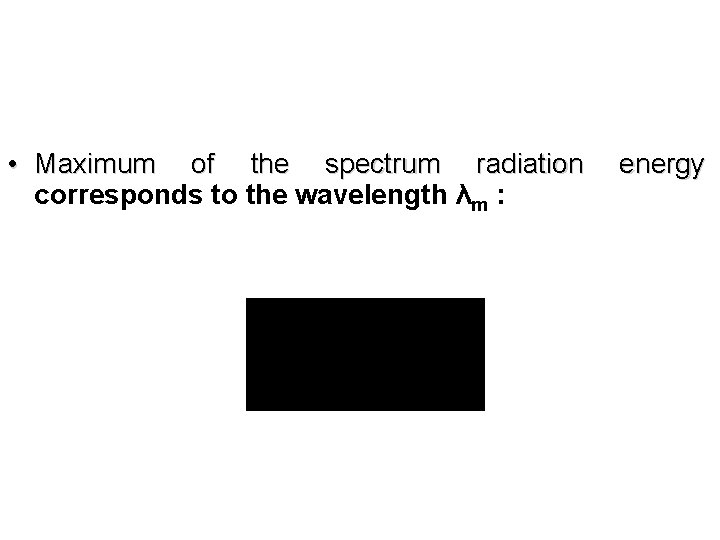
• Maximum of the spectrum radiation corresponds to the wavelength λm : energy
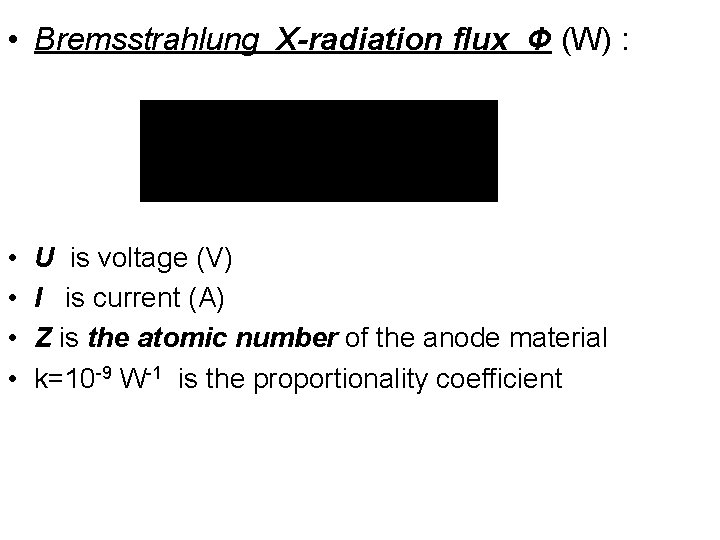
• Bremsstrahlung X-radiation flux Ф (W) : • • U is voltage (V) I is current (A) Z is the atomic number of the anode material k=10 -9 W-1 is the proportionality coefficient
• When interacting with a material the radiation penetrating capacity depends on the radiation quantum energy (E=h =hc/λ). • Shortwave radiation has higher quantum energy and penetrates a material deeper Hence, it is known as “hard radiation” • Longwave radiation is less penetrating and it is known as “soft radiation”
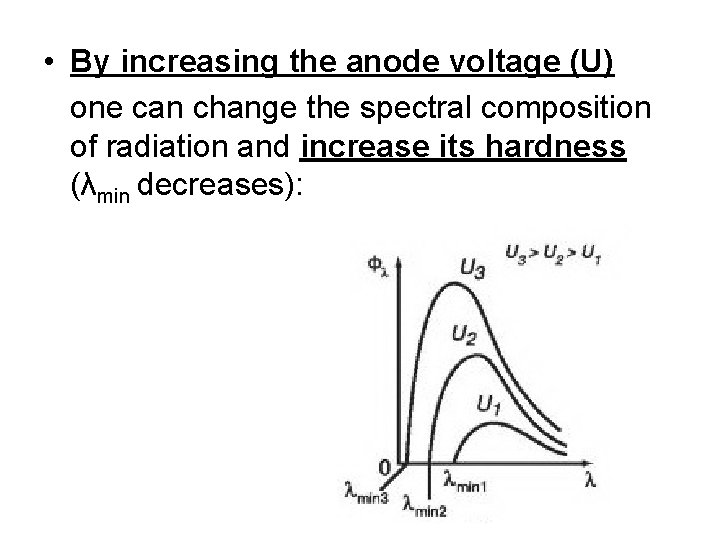
• By increasing the anode voltage (U) one can change the spectral composition of radiation and increase its hardness (λmin decreases):
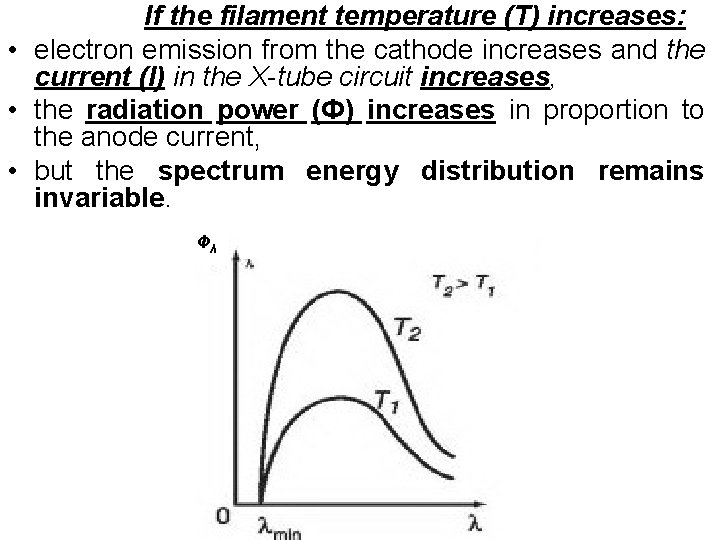
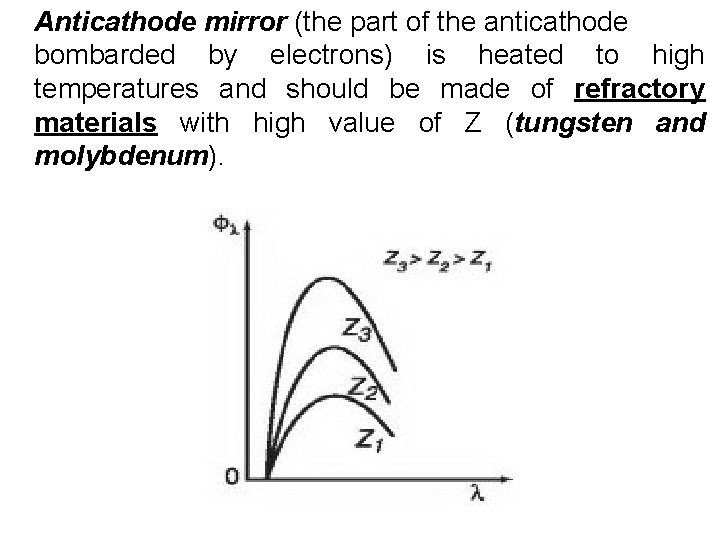
If the filament temperature (T) increases: • electron emission from the cathode increases and the current (I) in the X-tube circuit increases, • the radiation power (Ф) increases in proportion to the anode current, • but the spectrum energy distribution remains invariable. Фλ
Anticathode mirror (the part of the anticathode bombarded by electrons) is heated to high temperatures and should be made of refractory materials with high value of Z (tungsten and molybdenum).
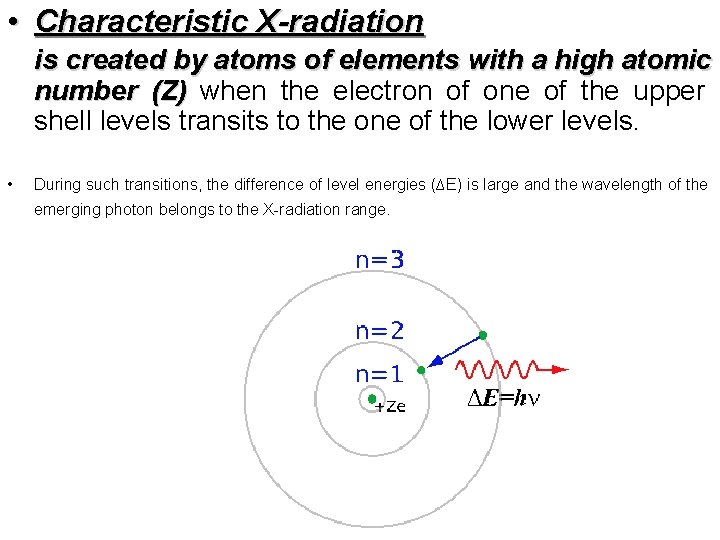
• Characteristic X-radiation is created by atoms of elements with a high atomic number (Z) when the electron of one of the upper shell levels transits to the one of the lower levels. • During such transitions, the difference of level energies (∆E) is large and the wavelength of the emerging photon belongs to the X-radiation range.
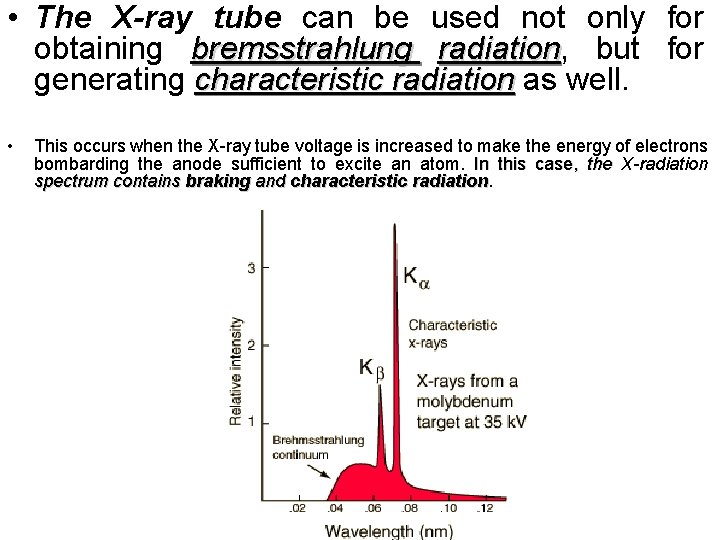
• The X-ray tube can be used not only for obtaining bremsstrahlung radiation, radiation but for generating characteristic radiation as well. • This occurs when the X-ray tube voltage is increased to make the energy of electrons bombarding the anode sufficient to excite an atom. In this case, the X-radiation spectrum contains braking and characteristic radiation
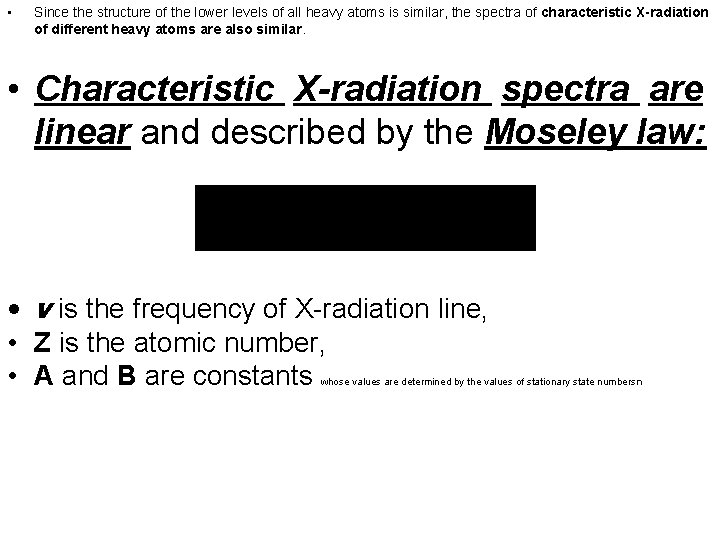
• Since the structure of the lower levels of all heavy atoms is similar, the spectra of characteristic X-radiation of different heavy atoms are also similar. • Characteristic X-radiation spectra are linear and described by the Moseley law: • ν is the frequency of X-radiation line, • Z is the atomic number, • A and B are constants whose values are determined by the values of stationary state numbers n
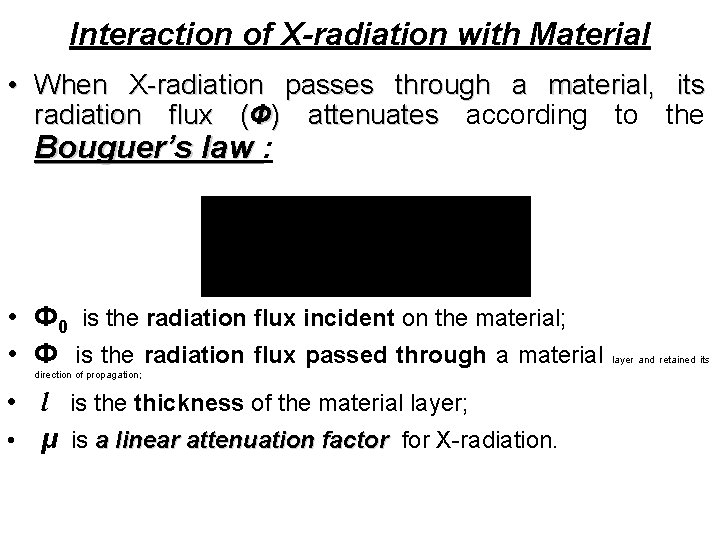
Interaction of X-radiation with Material • When X-radiation passes through a material, its radiation flux (Ф) attenuates according to the Bouguer’s law : • Ф 0 is the radiation flux incident on the material; • Ф is the radiation flux passed through a material direction of propagation; • l is the thickness of the material layer; • μ is a linear attenuation factor for X-radiation. layer and retained its
Three mechanisms of X-radiation interaction with the electron shells of the atoms: 1. coherent scattering 2. incoherent scattering (Compton effect, or Compton scattering) 3. photoeffect
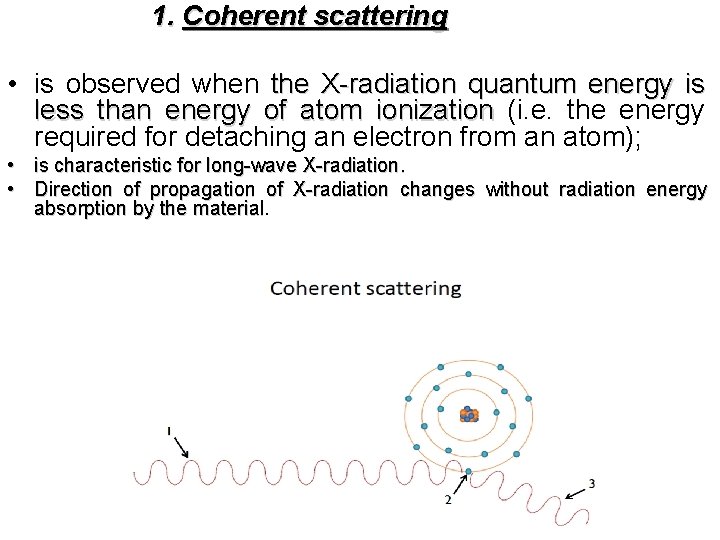
1. Coherent scattering • is observed when the X-radiation quantum energy is less than energy of atom ionization (i. e. the energy required for detaching an electron from an atom); • • is characteristic for long-wave X-radiation. Direction of propagation of X-radiation changes without radiation energy absorption by the material
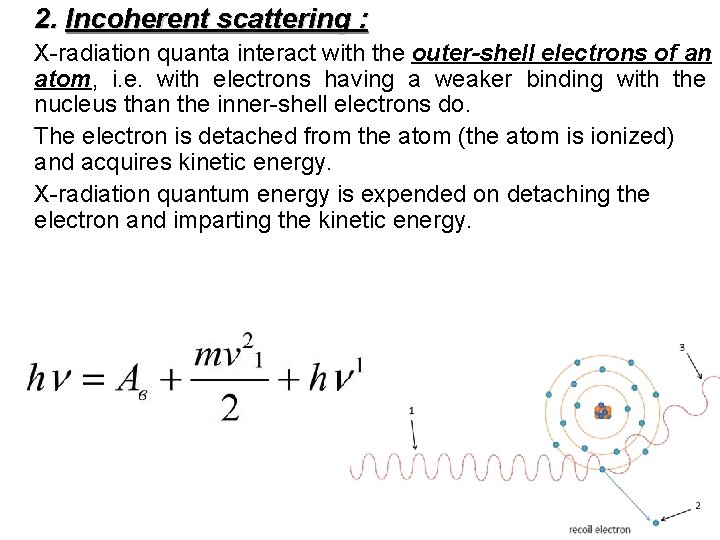
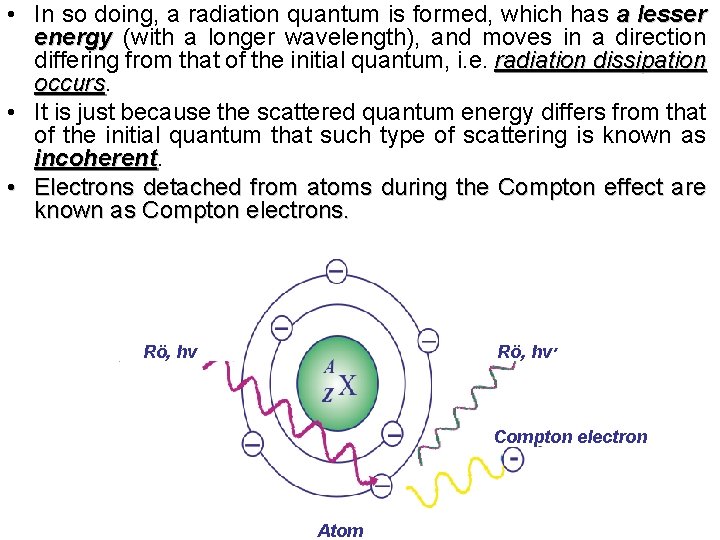
2. Incoherent scattering : X-radiation quanta interact with the outer-shell electrons of an atom, i. e. with electrons having a weaker binding with the nucleus than the inner-shell electrons do. The electron is detached from the atom (the atom is ionized) and acquires kinetic energy. X-radiation quantum energy is expended on detaching the electron and imparting the kinetic energy.
• In so doing, a radiation quantum is formed, which has a lesser energy (with a longer wavelength), and moves in a direction differing from that of the initial quantum, i. e. radiation dissipation occurs • It is just because the scattered quantum energy differs from that of the initial quantum that such type of scattering is known as incoherent • Electrons detached from atoms during the Compton effect are known as Compton electrons. Rö, hν ׳ Compton electron Atom
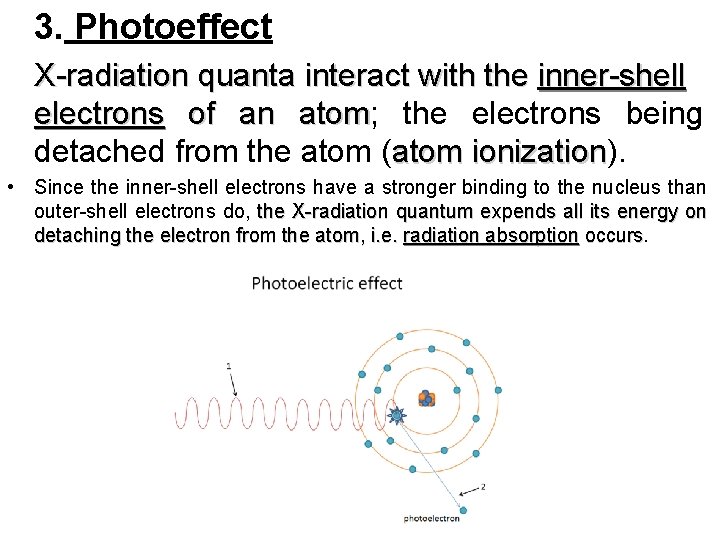
3. Photoeffect X-radiation quanta interact with the inner-shell electrons of an atom; atom the electrons being detached from the atom (atom ionization). ionization • Since the inner-shell electrons have a stronger binding to the nucleus than outer-shell electrons do, the X-radiation quantum expends all its energy on detaching the electron from the atom, i. e. radiation absorption occurs
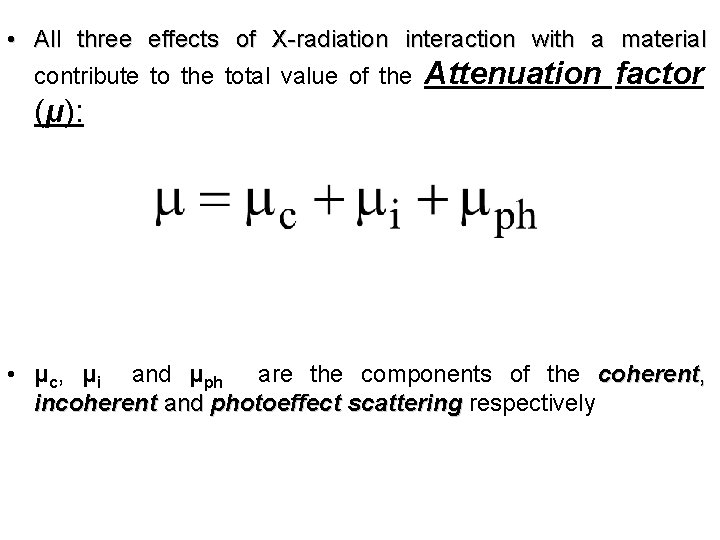
• All three effects of X-radiation interaction with a material contribute to the total value of the Attenuation factor (μ): • μc, μi and μph are the components of the coherent, incoherent and photoeffect scattering respectively
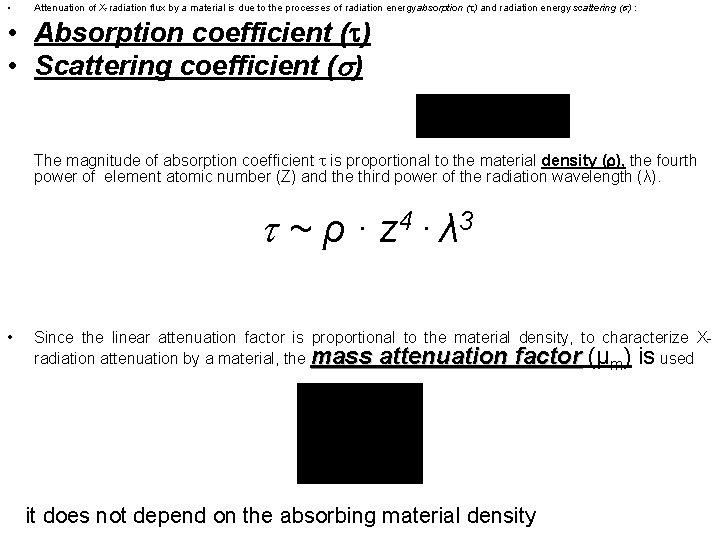
• Attenuation of X-radiation flux by a material is due to the processes of radiation energy absorption ( ) and radiation energy scattering ( ) : • Absorption coefficient ( ) • Scattering coefficient ( ) The magnitude of absorption coefficient is proportional to the material density ( ), the fourth power of element atomic number (Z) and the third power of the radiation wavelength (λ). ~ ρ ∙ z 4 ∙ λ 3 • Since the linear attenuation factor is proportional to the material density, to characterize Xradiation attenuation by a material, the mass attenuation factor (μm) is used it does not depend on the absorbing material density
Application of X-radiation in Medicine : is provided in two ways • X-ray diagnostics • X-ray therapy
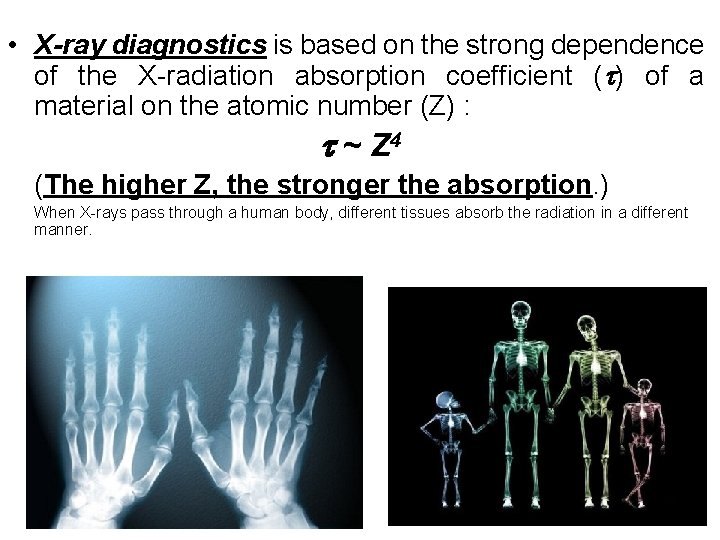
• X-ray diagnostics is based on the strong dependence of the X-radiation absorption coefficient ( ) of a material on the atomic number (Z) : ~ Z 4 (The higher Z, the stronger the absorption. ) When X-rays pass through a human body, different tissues absorb the radiation in a different manner.
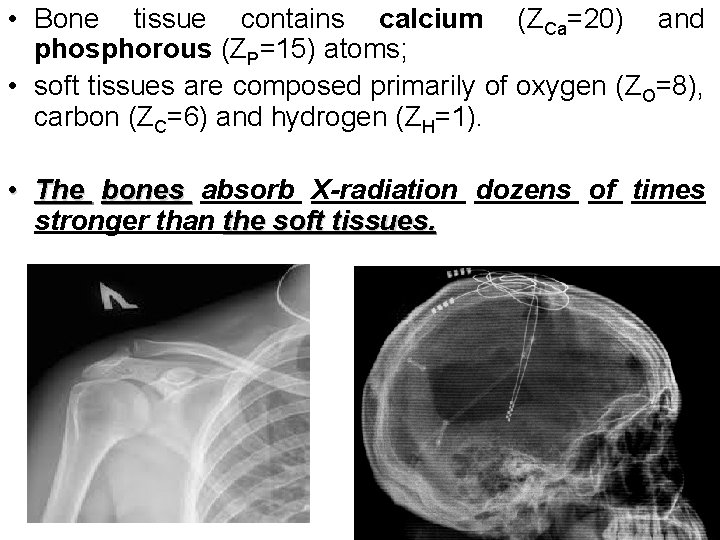
• Bone tissue contains calcium (ZCa=20) and phosphorous (ZP=15) atoms; • soft tissues are composed primarily of oxygen (ZO=8), carbon (ZC=6) and hydrogen (ZH=1). • The bones absorb X-radiation dozens of times stronger than the soft tissues.
• To register the X-rays that have passed through a human body, either photo film or special luminescent screens are used. X-ray diagnostics (X-ray examining of man’s internal organs): • roentgenoscopy (at luminescent screens), • X-ray filming, or radiography (at photo film). X-ray pictures (roentgenograms) are negatives: the organs with high density (like bone) on the X-ray roentgenogram are light, with low density (soft tissues) are dark. Negatoscope (X-ray view box) is a special luminous screen for viewing and descriptions of X-ray roentgenograms.
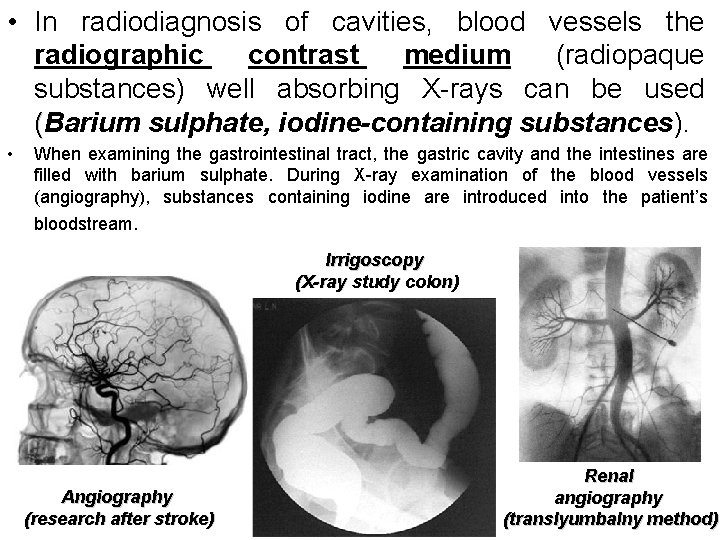
• In radiodiagnosis of cavities, blood vessels the radiographic contrast medium (radiopaque substances) well absorbing X-rays can be used (Barium sulphate, iodine-containing substances). • When examining the gastrointestinal tract, the gastric cavity and the intestines are filled with barium sulphate. During X-ray examination of the blood vessels (angiography), substances containing iodine are introduced into the patient’s bloodstream. Irrigoscopy (X-ray study colon) Angiography (research after stroke) Renal angiography (translyumbalny method)
• X-rays have an adverse (or harmful) effect on alive tissue. • Therefore, to reduce this effect, techniques employing weak radiation fluxes have been developed. • For example, electron-optical converters
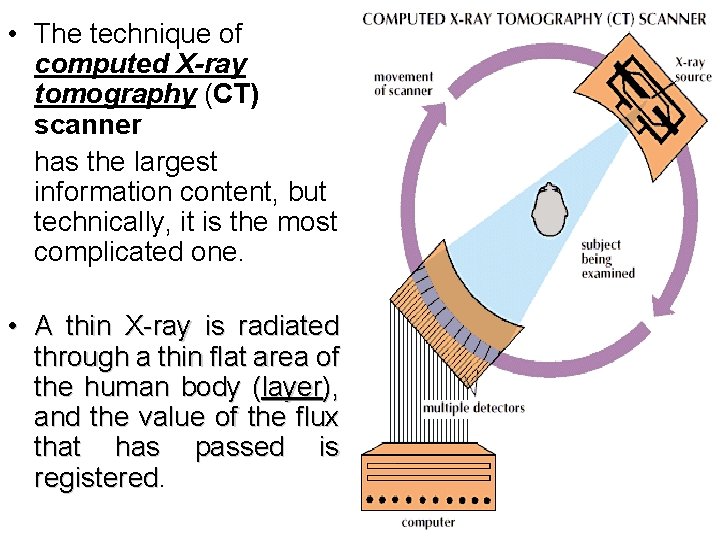
• The technique of computed X-ray tomography (CT) scanner has the largest information content, but technically, it is the most complicated one. • A thin X-ray is radiated through a thin flat area of the human body (layer), and the value of the flux that has passed is registered
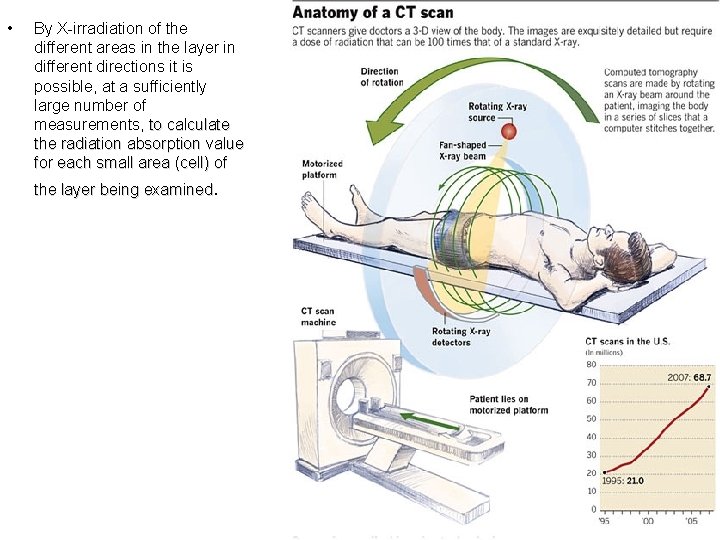
• By X-irradiation of the different areas in the layer in different directions it is possible, at a sufficiently large number of measurements, to calculate the radiation absorption value for each small area (cell) of the layer being examined.
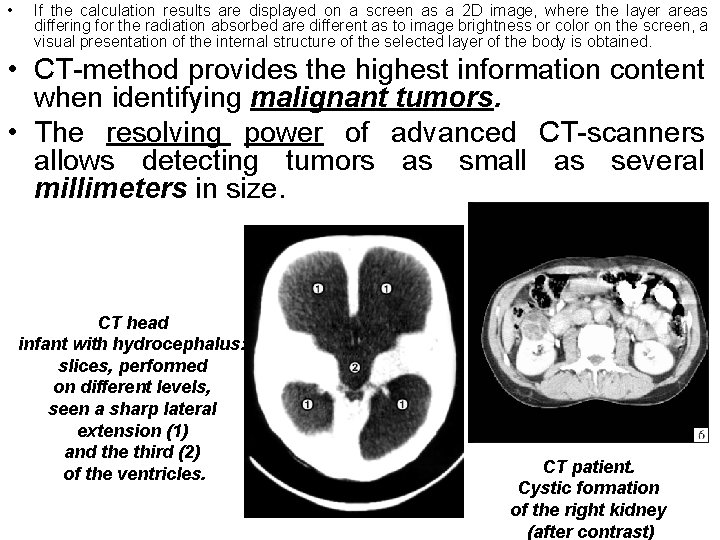
• If the calculation results are displayed on a screen as a 2 D image, where the layer areas differing for the radiation absorbed are different as to image brightness or color on the screen, a visual presentation of the internal structure of the selected layer of the body is obtained. • CT-method provides the highest information content when identifying malignant tumors. • The resolving power of advanced CT-scanners allows detecting tumors as small as several millimeters in size. CT head infant with hydrocephalus: slices, performed on different levels, seen a sharp lateral extension (1) and the third (2) of the ventricles. CT patient. Cystic formation of the right kidney (after contrast)
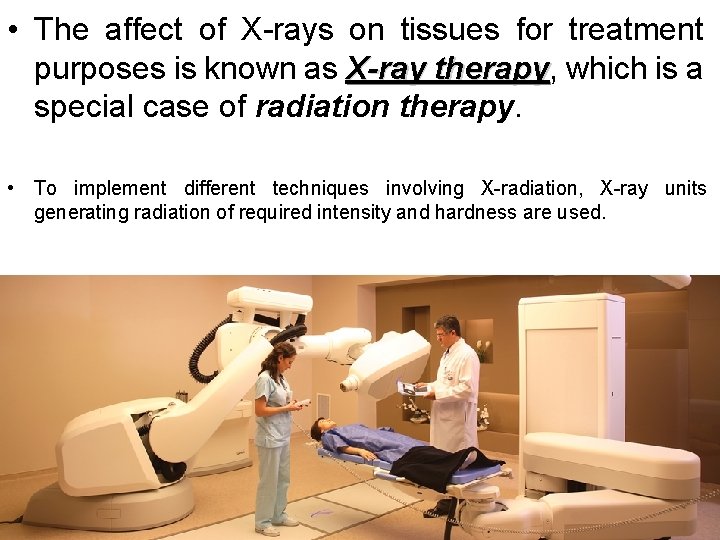
• The affect of X-rays on tissues for treatment purposes is known as X-ray therapy, therapy which is a special case of radiation therapy. • To implement different techniques involving X-radiation, X-ray units generating radiation of required intensity and hardness are used.
Radioactivity Ionizing radiation, except for X-radiation, occurs most often during radioactive decay of atom nuclei – due to the phenomenon of radioactivity. • Radioactivity is a spontaneous decay of unstable nuclei followed by emission of other nuclei or elementary particles
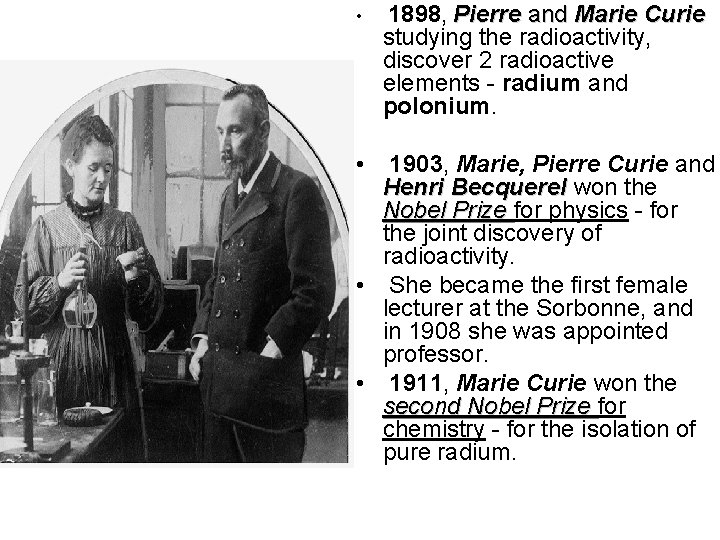
• • 1898, Pierre and Marie Curie studying the radioactivity, discover 2 radioactive elements - radium and polonium. 1903, Marie, Pierre Curie and Henri Becquerel won the Nobel Prize for physics - for the joint discovery of radioactivity. • She became the first female lecturer at the Sorbonne, and in 1908 she was appointed professor. • 1911, Marie Curie won the second Nobel Prize for chemistry - for the isolation of pure radium.
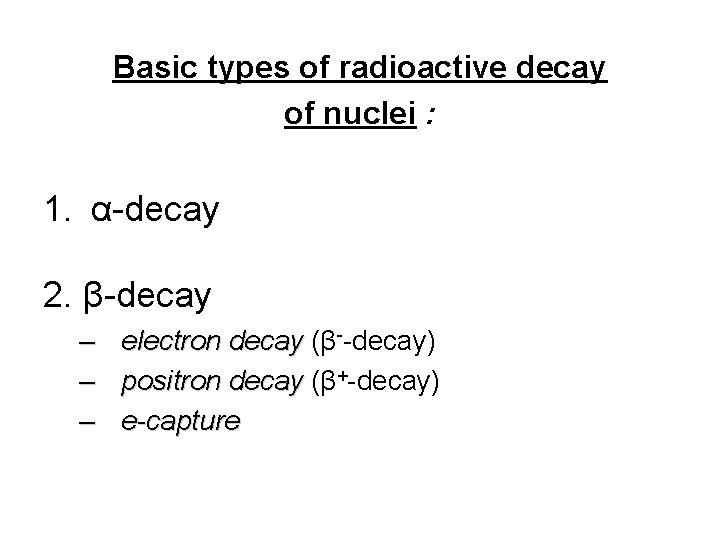
Basic types of radioactive decay of nuclei : 1. α-decay 2. β-decay – electron decay (β--decay) – positron decay (β+-decay) – e-capture
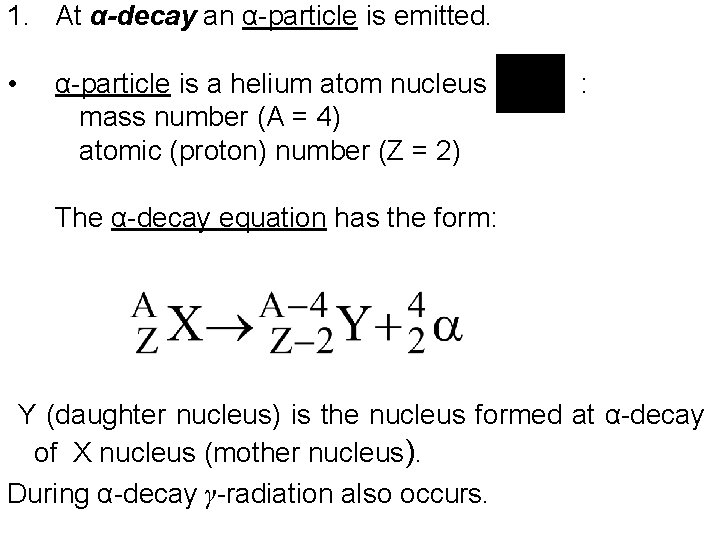
1. At α-decay an α-particle is emitted. • α-particle is a helium atom nucleus mass number (А = 4) atomic (proton) number (Z = 2) : The α-decay equation has the form: Y (daughter nucleus) is the nucleus formed at α-decay of X nucleus (mother nucleus). During α-decay γ-radiation also occurs.
2. Three types of β-decay: • • • ELECTRON decay (β--decay) POSITRON decay (β+-decay) e-CAPTURE
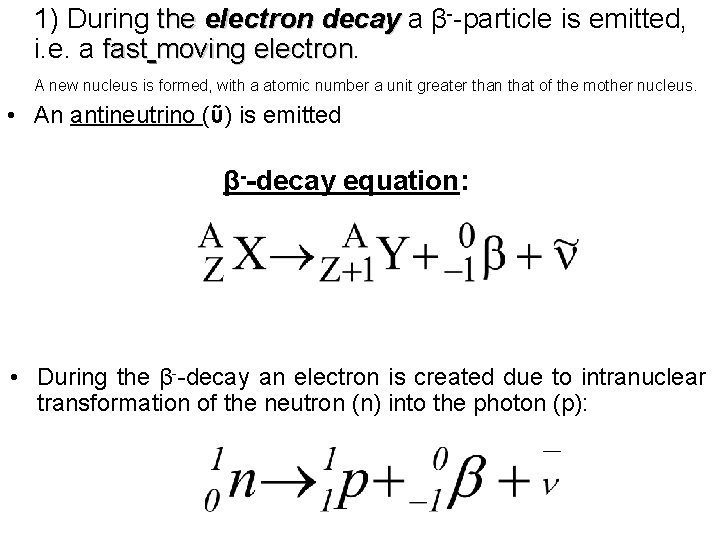
1) During the electron decay a β--particle is emitted, i. e. a fast moving electron A new nucleus is formed, with a atomic number a unit greater than that of the mother nucleus. • An antineutrino (ῦ) is emitted β--decay equation: • During the β--decay an electron is created due to intranuclear transformation of the neutron (n) into the photon (p):
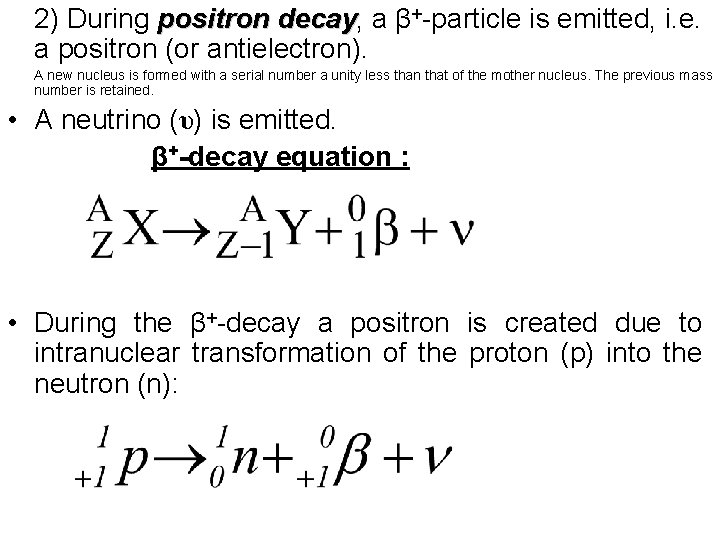
2) During positron decay, decay a β+-particle is emitted, i. e. a positron (or antielectron). A new nucleus is formed with a serial number a unity less than that of the mother nucleus. The previous mass number is retained. • A neutrino (υ) is emitted. β+-decay equation : • During the β+-decay a positron is created due to intranuclear transformation of the proton (p) into the neutron (n):
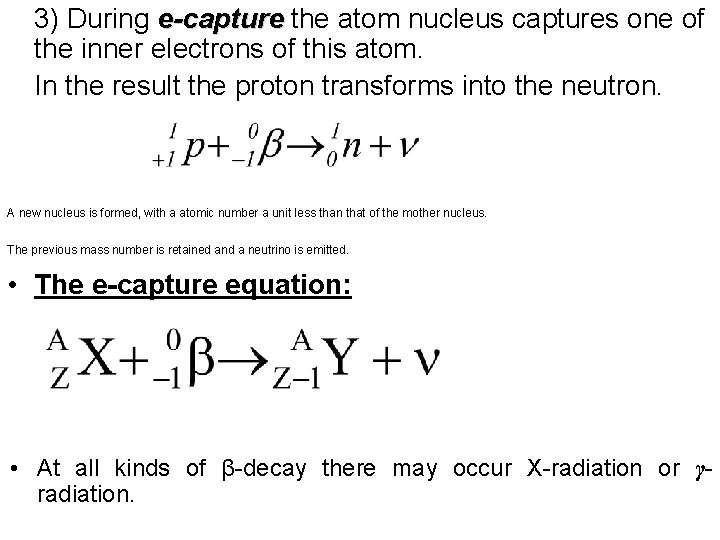
3) During e-capture the atom nucleus captures one of the inner electrons of this atom. In the result the proton transforms into the neutron. A new nucleus is formed, with a atomic number a unit less than that of the mother nucleus. The previous mass number is retained and a neutrino is emitted. • The e-capture equation: • At all kinds of β-decay there may occur X-radiation or γradiation.
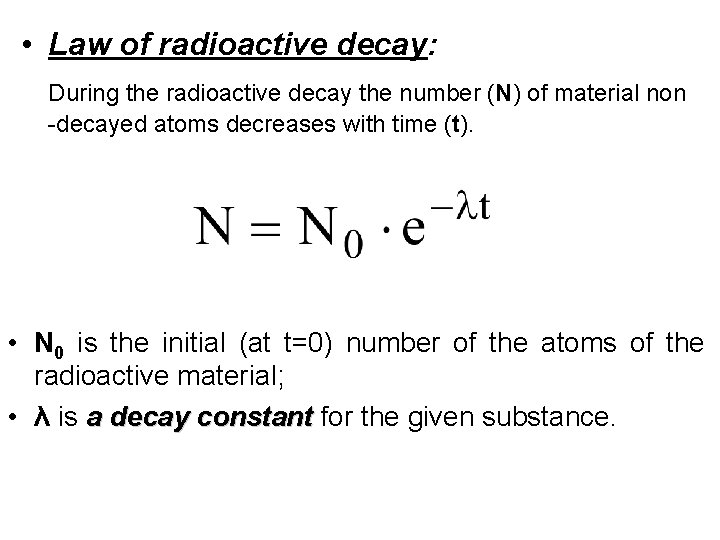
• Law of radioactive decay: During the radioactive decay the number (N) of material non -decayed atoms decreases with time (t). • N 0 is the initial (at t=0) number of the atoms of the radioactive material; • λ is a decay constant for the given substance.
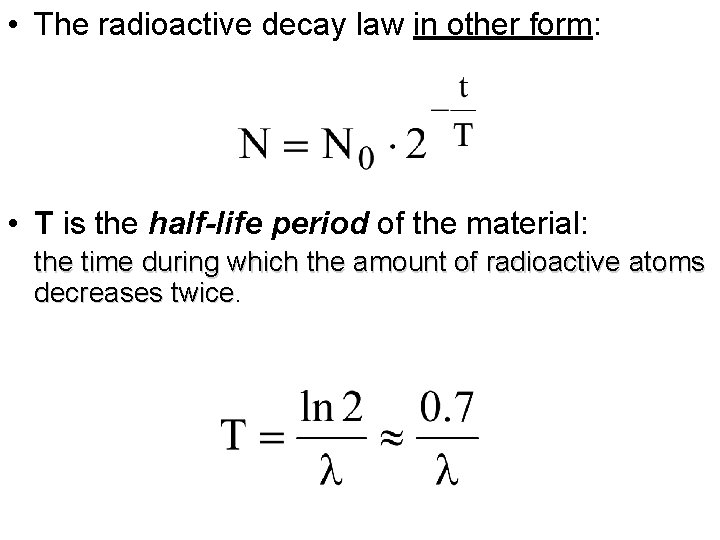
• The radioactive decay law in other form: • T is the half-life period of the material: the time during which the amount of radioactive atoms decreases twice
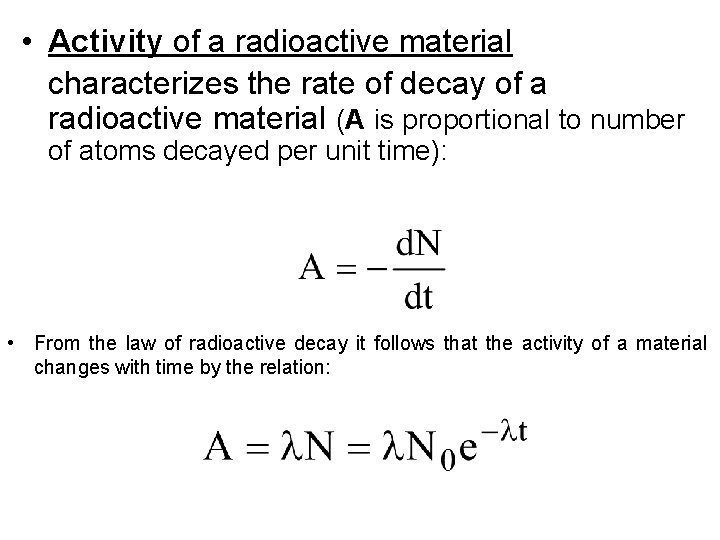
• Activity of a radioactive material characterizes the rate of decay of a radioactive material (A is proportional to number of atoms decayed per unit time): • From the law of radioactive decay it follows that the activity of a material changes with time by the relation:
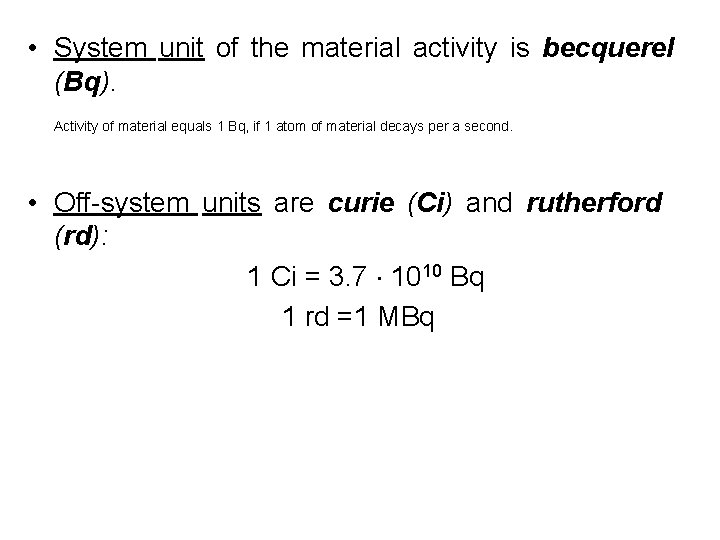
• System unit of the material activity is becquerel (Bq). Activity of material equals 1 Bq, if 1 atom of material decays per a second. • Off-system units are curie (Ci) and rutherford (rd): 1 Ci = 3. 7 1010 Bq 1 rd =1 MBq