
Lecture 9 Waves Tuesday February 14 2012 Wave
Lecture 9 – Waves Tuesday February 14, 2012
Wave Types • Transverse Waves – Medium moves in transverse direction to wave propagation • Longitudinal Waves – Medium moves in same direction as wave propagation • Surface Waves – Combination of compressional and transverse waves at interface between two mediums http: //youtu. be/2 CJJ 6 Frfu. GU
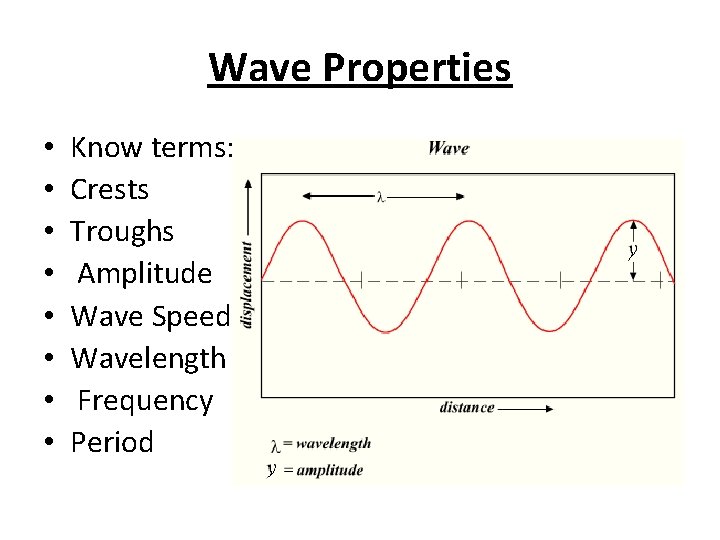
Wave Properties • • Know terms: Crests Troughs Amplitude Wave Speed Wavelength Frequency Period
Wave Phenomena • Mathematical relationship between wavelength, frequency, and speed. • Energy transport is proportional to amplitude squared. • http: //youtu. be/w. Byd. VCF 4 Dr. Y
Quantum Mechanical Understanding of Waves are actually comprised of tiny particles Electromagnetic Waves: Photons Sound and vibrational waves: Phonons also responsible for transmission of heat energy via conduction. • Fundamental equation of quantum mechanics is the Schrodinger equation – a equation involving waves!!! • •
Reflection, Refraction, Diffraction, Interference, Standing Waves • Reflection: wave bouncing off interface between two mediums • Refraction: bending of light as it passes from one medium to another • Diffraction: spreading of waves after passing through opening • Interference: http: //youtu. be/J_xd 9 h. UZ 2 AY • Standing Waves: http: //youtu. be/_S 7 -PDF 6 Vzc
Doppler Effect • Frequency of light changes when observer advancing toward, moving away from source • Lets us know universe is expanding • http: //youtu. be/Nnf. SGh 0 vp. OY • Responsible for traffic tickets
Homework • Matching • True/False • Analysis: 1 -8
Properties of Light & Physical Properties of Matter February 16, 2012
Speed of Light • Once thought to be instantaneous • Galileo tried to measure with hills, and lamps • Roemer measured eclipses of moons of Jupiter, concluded that they were 22 minutes slower because of finite light speed
Nature of Light Wave • Light exhibits all of the properties of classical waves: diffraction and interference • Can be demonstrated by the classical “doubleslit” experiment where light creates and interference pattern on a screen • However, light is still composed of particles!!! • http: //youtu. be/Df. Pepr. Q 7 o. Gc • Diffraction: http: //youtu. be/gxgfthef. Kbg
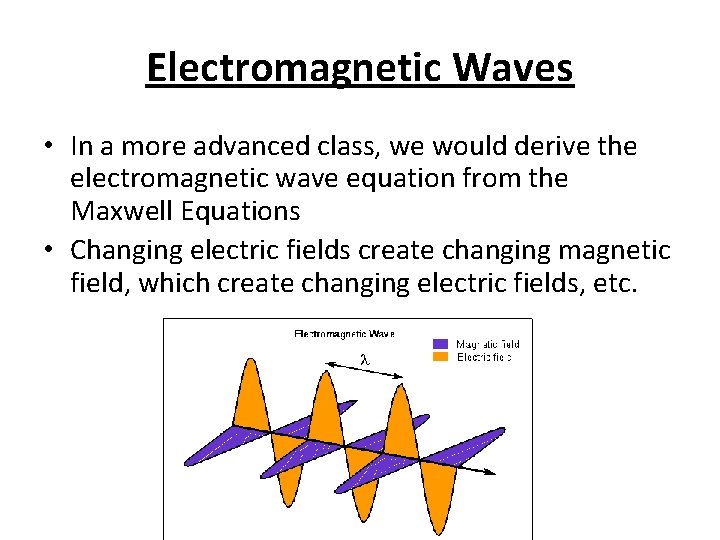
Electromagnetic Waves • In a more advanced class, we would derive the electromagnetic wave equation from the Maxwell Equations • Changing electric fields create changing magnetic field, which create changing electric fields, etc.
Electromagnetic Family • All “light” waves are manifestations of different wavelengths (frequencies) of electromagnetic waves • High frequency (short wavelength) waves have same speed as long wavelength (low frequency) waves • From high to low frequency: gamma rays, xrays, ultraviolet, visible light, infrared, microwaves, radio waves
Particle Nature of Light Understand the photoelectric effect http: //youtu. be/v 5 h 3 h 2 E 4 z 2 Q Important equation Energy = frequency * h h = Planck’s Constant – fundamental constant of nature • What are some other examples of fundamental constants? • Know difference between frequency modulation and amplitude modulation radio • Including digital modulation • •
Wave-Particle Duality • Light, electrons, matter, etc. are both waves and particles • Also, they are neither waves nor particles • One theory of how this is possible is the multiple universe theory • Consequently, electrons, etc. exist at all points in space, with exponentially decreasing probability
Homework • • Matching 1 Matching 2 True/False Analysis: 2 -6
Physical Properties of Matter and The Continuous Model February 16, 2012
States of Matter • Solid: Typically has an internal lattice structure, constant volume • Liquid: Weak bonding between molecules that allow movement while retaining constant volume • Gas: Variable volume, compressible • Plasma: electrically charged gas • Fifth state: Quark-gluon plasma: only found in particle accelerators or very early universe • Also, hybrid states, like supercritical fluid • http: //youtu. be/s-Kvo. Vzuk. Ho • http: //youtu. be/Vke. SI_B 5 Ljc
Temperatures Where Matter Undergoes Changes • This is a complex effect that depends greatly on the internal structure of the material • Cannot typically be solved analytically – often must be solved through experimental and computational methods
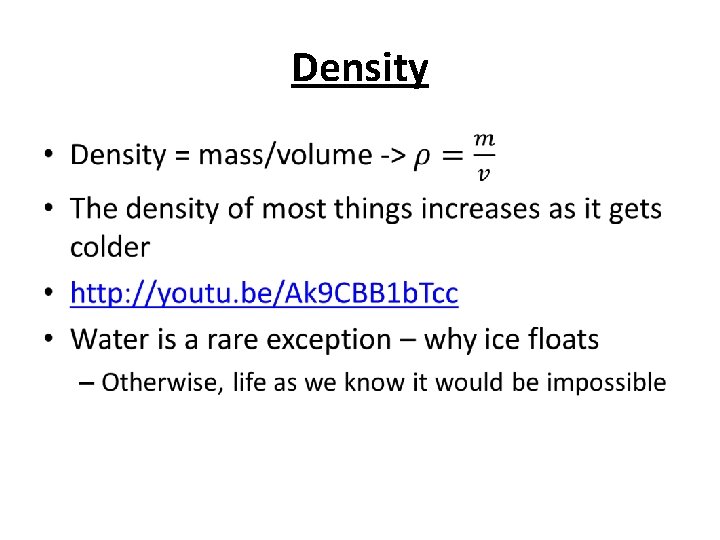
Density •
Response of Matter to Force • Matter can experience compressional forces, shear forces, tension forces, etc. • Read in the book about the difference between these types of forces • The mathematics behind a full understanding of this are very complex – requires tensor algebra, among other things
Color and Electrical Conductivity • Color – depends on color of absorbed and reflected photons • Electrical conductivity – depends on available valence bands for electron movement • Both phenomena are difficult to explain without invoking complex mathematics and advanced physics
Continuous Model of Matter • Matter is not continuous – made of discrete particles • However, the particles are so small and there are so many of them that matter “looks” continuous to a naïve observation
- Slides: 23