
Lecture 9 Stack and Queue 1 What is
![Implementing a Queue • Option 2 – Enqueue at data[rear+1] – Dequeue at data[front]](https://slidetodoc.com/presentation_image/172c1eb7cc46b51254160a63332af86d/image-21.jpg "Implementing a Queue • Option 2 – Enqueue at data[rear+1] – Dequeue at data[front]")
- Slides: 24
Lecture 9: Stack and Queue 1
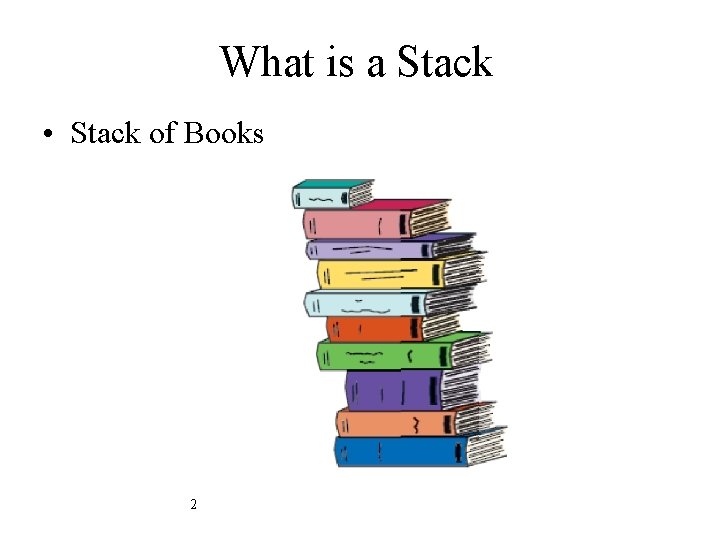
What is a Stack • Stack of Books 2
Stacks • What is a Stack? – A stack is a data structure of ordered items such that items can be inserted and removed only at one end. 3
Stacks • What can we do with a stack? – push - place an item on the stack – peek - Look at the item on top of the stack, but do not remove it – pop - Look at the item on top of the stack and remove it 4
Stacks • A stack is a LIFO (Last-In/First-Out) data structure • A stack is sometimes also called a pushdown store. • What are some applications of stacks? – Program execution – Parsing – Evaluating postfix expressions 5
Stacks • Problem: – What happens if we try to pop an item off the stack when the stack is empty? • This is called a stack underflow. The pop method needs some way of telling us that this happened. In java we use the java. util. Empty. Stack. Exception 6
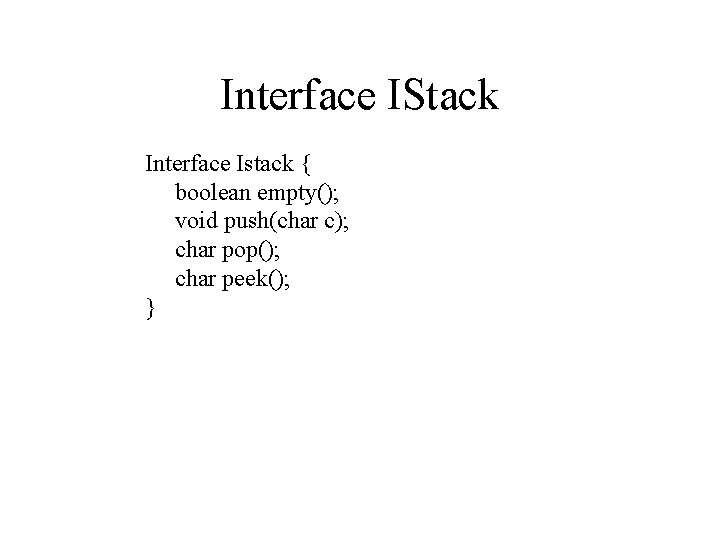
Interface IStack Interface Istack { boolean empty(); void push(char c); char pop(); char peek(); }
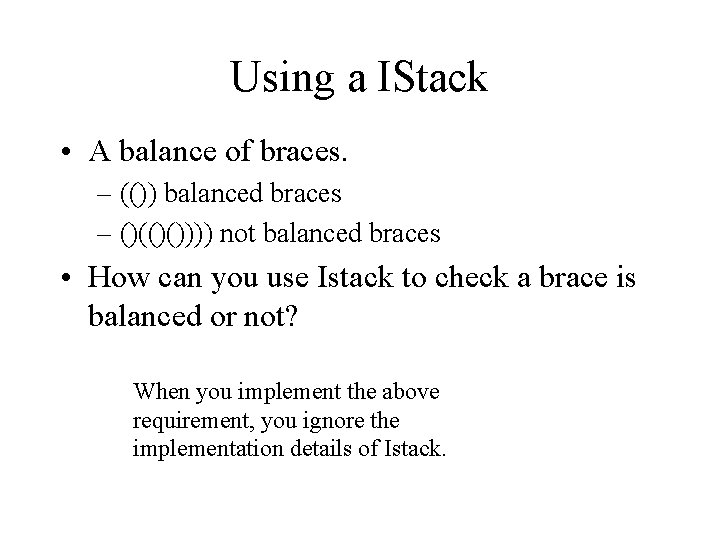
Using a IStack • A balance of braces. – (()) balanced braces – ()(()()))) not balanced braces • How can you use Istack to check a brace is balanced or not? When you implement the above requirement, you ignore the implementation details of Istack.
Implementing a Stack • There are two ways we can implement a stack: – Using an array – Using a linked list 9
Implementing a Stack • Implementing a stack using an array is fairly easy. – The bottom of the stack is at data[0] – The top of the stack is at data[num. Items-1] – push onto the stack at data[num. Items] – pop off of the stack at data[num. Items-1] 10
Implementing a Stack • Implementing a stack using a linked list isn’t that bad either… – Store the items in the stack in a linked list – The top of the stack is the head node, the bottom of the stack is the end of the list – push by adding to the front of the list – pop by removing from the front of the list 11
Reversing a Word • We can use a stack to reverse the letters in a word. • How? 12
Reversing a Word • Read each letter in the word and push it onto the stack • When you reach the end of the word, pop the letters off the stack and print them out. 13
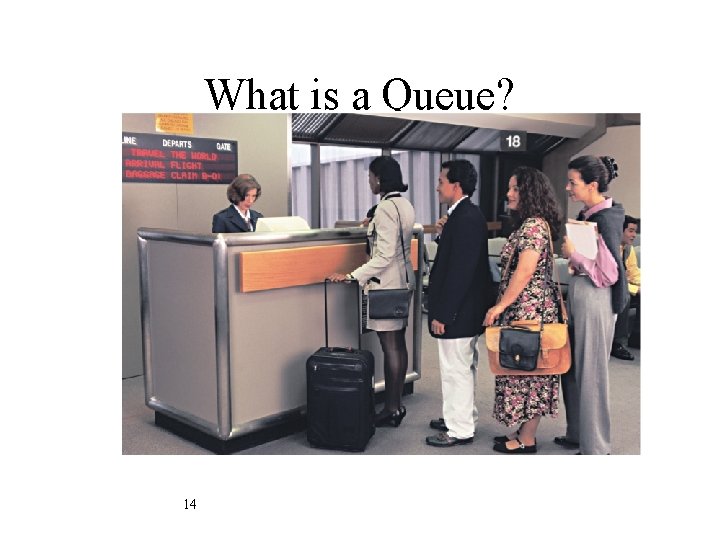
What is a Queue? 14
Queues • What is a queue? – A data structure of ordered items such that items can be inserted only at one end and removed at the other end. • Example – A line at the supermarket 15
Queues • What can we do with a queue? – Enqueue - Add an item to the queue – Dequeue - Remove an item from the queue • These ops are also called insert and get. Front in order to simplify things. 16
Queues • A queue is called a FIFO (First in-First out) data structure. • What are some applications of queues? – Round-robin scheduling in processors – Input/Output processing – Queueing of packets for delivery in networks 17
Implementing a Queue • Just like a stack, we can implementing a queue in two ways: – Using an array – Using a linked list 18
Implementing a Queue • Using an array to implement a queue is significantly harder than using an array to implement a stack. Why? – Unlike a stack, where we add and remove at the same end, in a queue we add to one end and remove from the other. 19
Implementing a Queue • There are two options for implementing a queue using an array: • Option 1: – Enqueue at data[0] and shift all of the rest of the items in the array down to make room. – Dequeue from data[num. Items-1] 20
Implementing a Queue • Option 2 – Enqueue at data[rear+1] – Dequeue at data[front] – The rear variable always contains the index of the last item in the queue. – The front variable always contains the index of the first item in the queue. – When we reach the end of the array, wrap around to the front again. 21
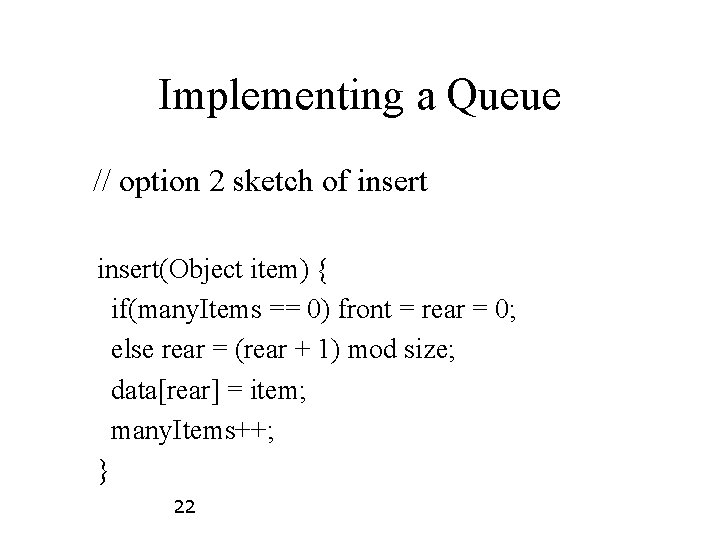
Implementing a Queue // option 2 sketch of insert(Object item) { if(many. Items == 0) front = rear = 0; else rear = (rear + 1) mod size; data[rear] = item; many. Items++; } 22
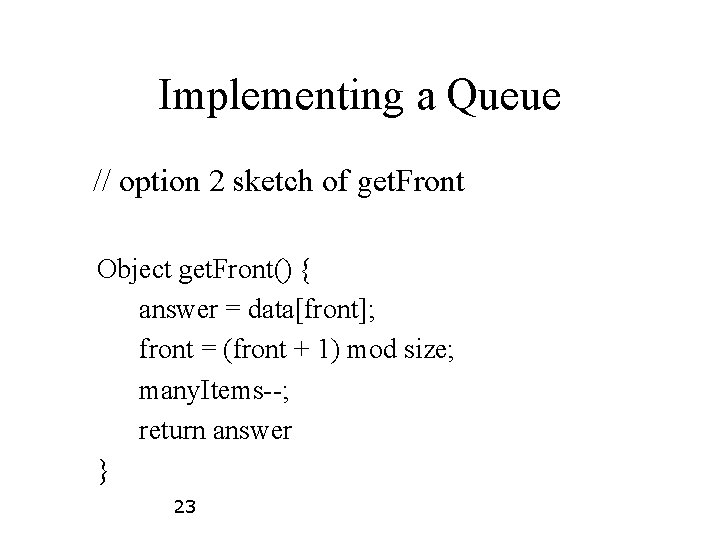
Implementing a Queue // option 2 sketch of get. Front Object get. Front() { answer = data[front]; front = (front + 1) mod size; many. Items--; return answer } 23
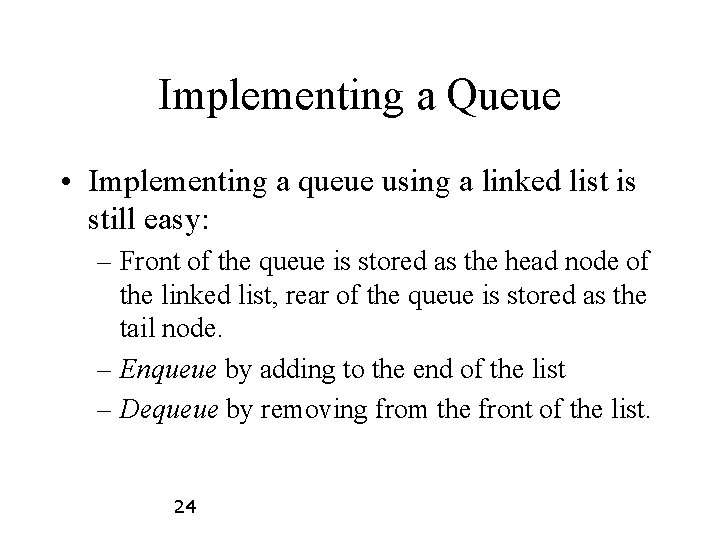
Implementing a Queue • Implementing a queue using a linked list is still easy: – Front of the queue is stored as the head node of the linked list, rear of the queue is stored as the tail node. – Enqueue by adding to the end of the list – Dequeue by removing from the front of the list. 24