
Lecture 9 Stability Cloud Development Processes that Lift
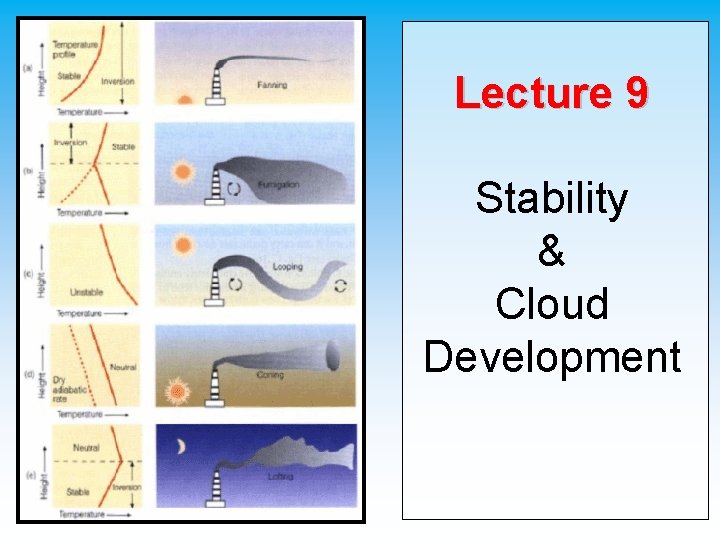
Lecture 9 Stability & Cloud Development
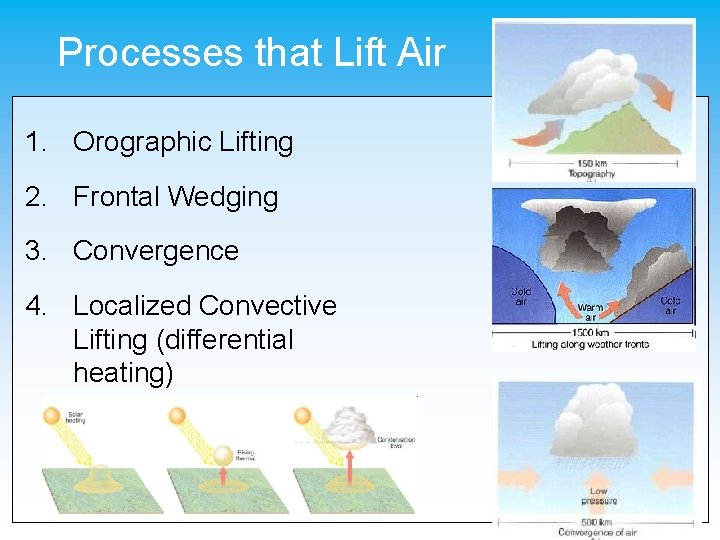
Processes that Lift Air 1. Orographic Lifting 2. Frontal Wedging 3. Convergence 4. Localized Convective Lifting (differential heating)
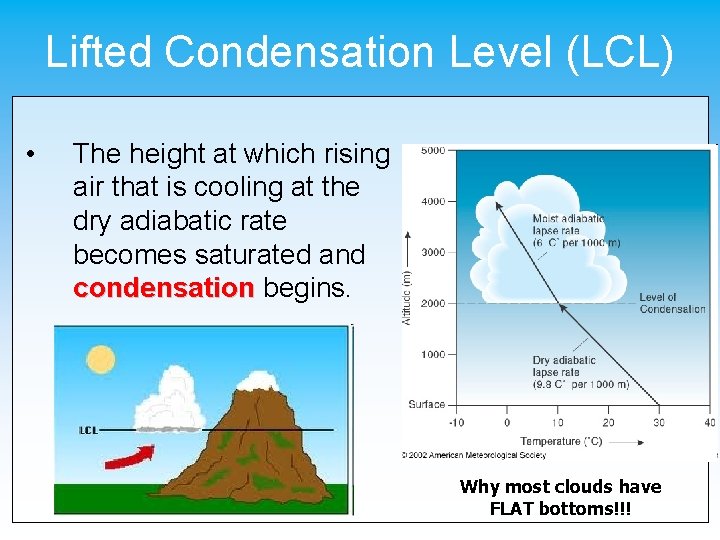
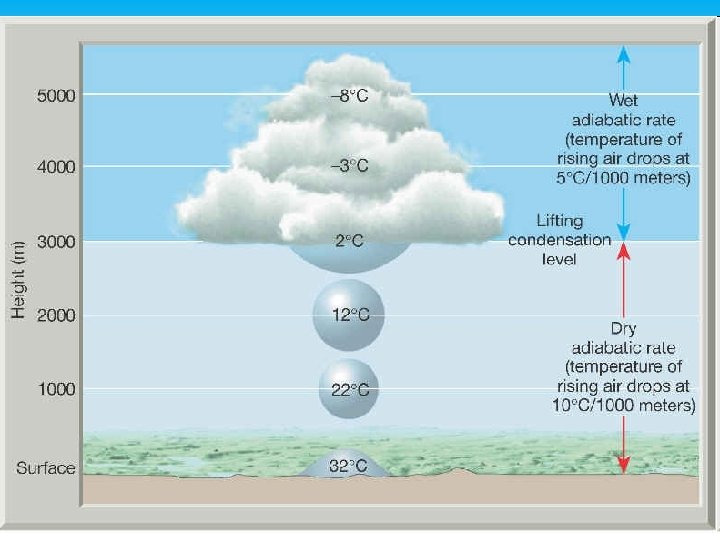
Lifted Condensation Level (LCL) • The height at which rising air that is cooling at the dry adiabatic rate becomes saturated and condensation begins. Why most clouds have FLAT bottoms!!!
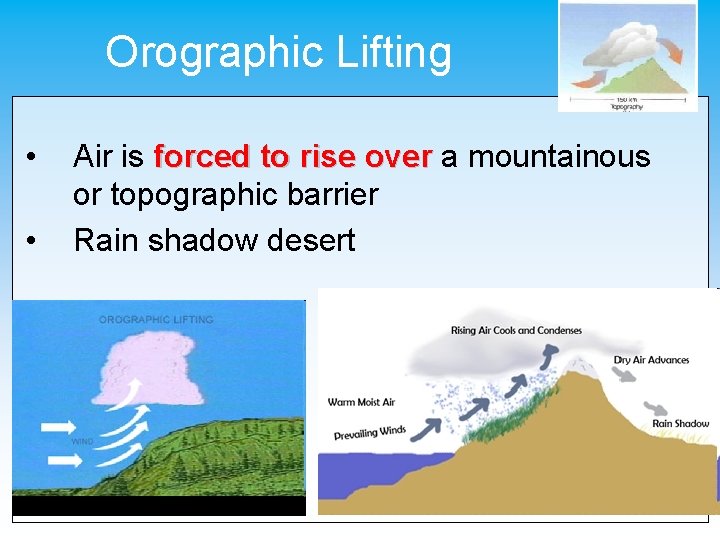
Orographic Lifting • • Air is forced to rise over a mountainous or topographic barrier Rain shadow desert
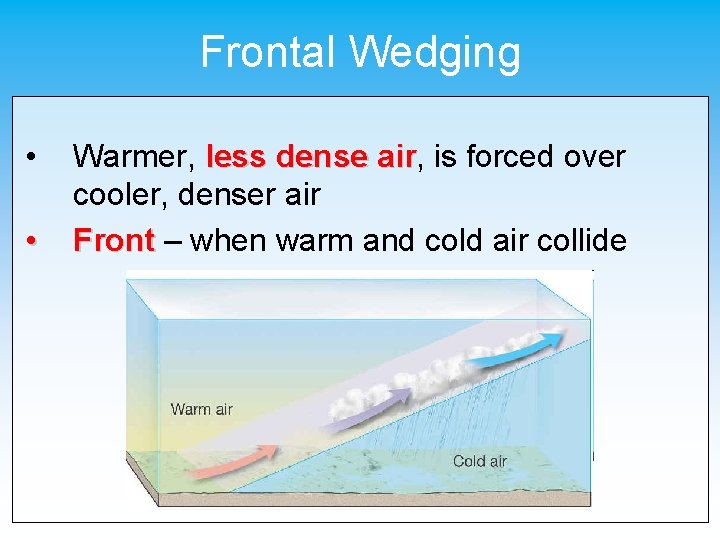
Frontal Wedging • • Warmer, less dense air, air is forced over cooler, denser air Front – when warm and cold air collide
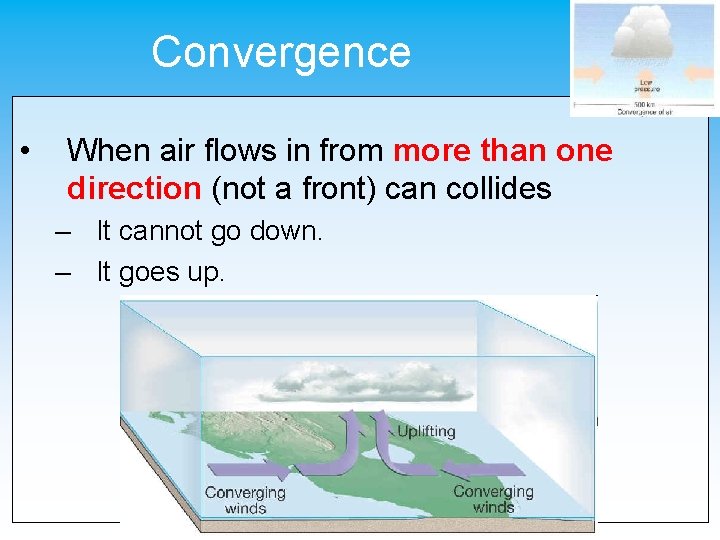
Convergence • When air flows in from more than one direction (not a front) can collides – It cannot go down. – It goes up.
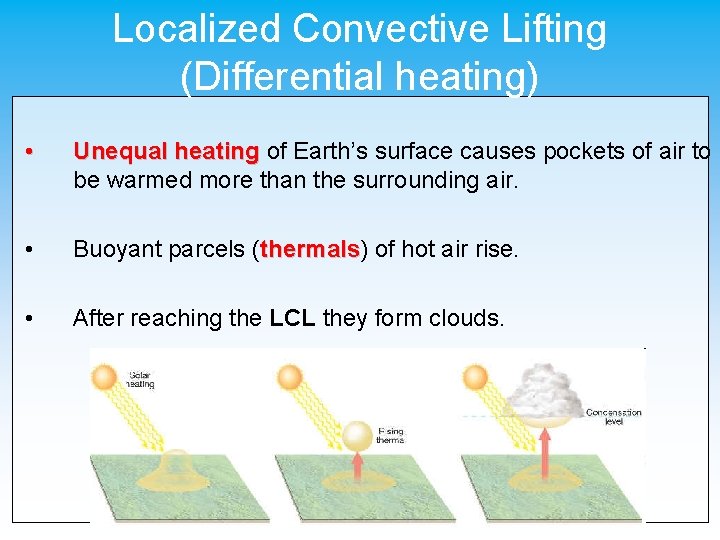
Localized Convective Lifting (Differential heating) • Unequal heating of Earth’s surface causes pockets of air to be warmed more than the surrounding air. • Buoyant parcels (thermals) thermals of hot air rise. • After reaching the LCL they form clouds.
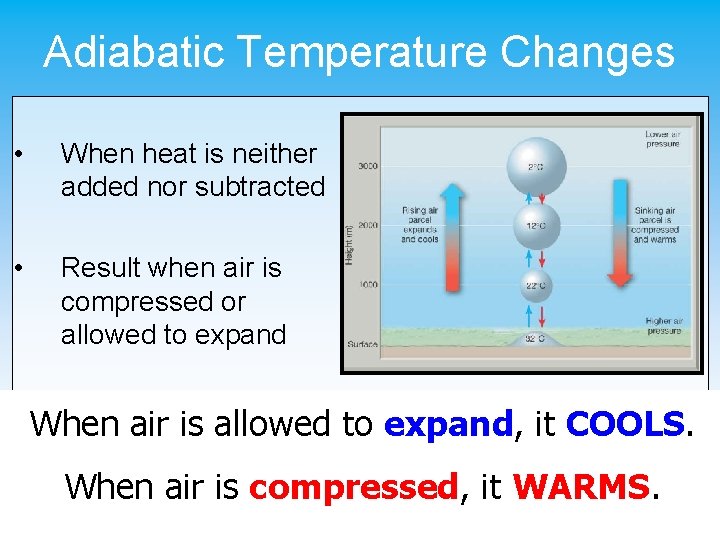
Adiabatic Temperature Changes • When heat is neither added nor subtracted • Result when air is compressed or allowed to expand When air is allowed to expand, it COOLS. When air is compressed, it WARMS.
Parcel – what is it? ? • A Parcel is an imaginary volume of air – Typically a few hundred cubic meters in volume – Acts independently of the surrounding air – It is assumed that no heat is transferred into, or out of it – HIGHLY IDEALIZED
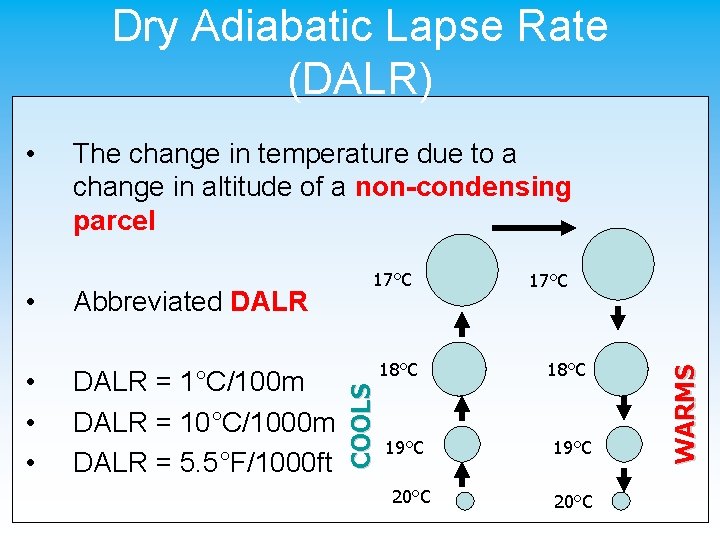
Dry Adiabatic Lapse Rate (DALR) • • • Abbreviated DALR = 1°C/100 m DALR = 10°C/1000 m DALR = 5. 5°F/1000 ft 17°C 18°C 19°C 20°C WARMS • The change in temperature due to a change in altitude of a non-condensing parcel COOLS •
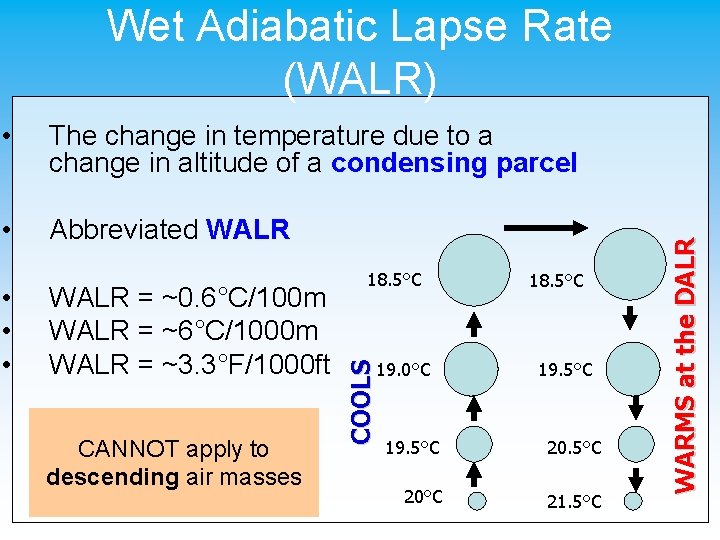
• The change in temperature due to a change in altitude of a condensing parcel • Abbreviated WALR = ~0. 6°C/100 m WALR = ~6°C/1000 m WALR = ~3. 3°F/1000 ft CANNOT apply to descending air masses COOLS • • • 18. 5°C 19. 0°C 18. 5°C 19. 5°C 20°C 21. 5°C WARMS at the DALR Wet Adiabatic Lapse Rate (WALR)
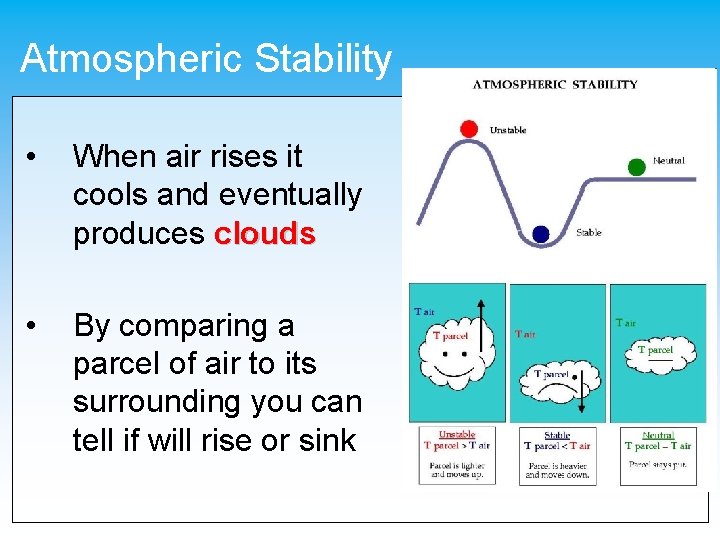
Atmospheric Stability • When air rises it cools and eventually produces clouds • By comparing a parcel of air to its surrounding you can tell if will rise or sink
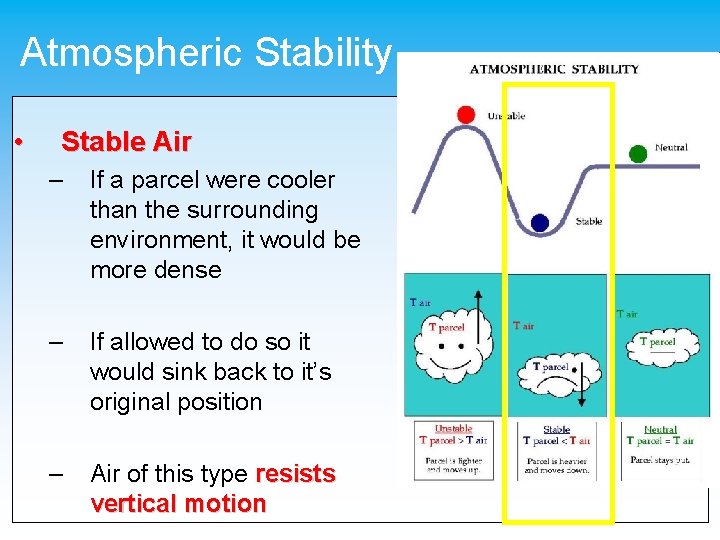
Atmospheric Stability • Stable Air – If a parcel were cooler than the surrounding environment, it would be more dense – If allowed to do so it would sink back to it’s original position – Air of this type resists vertical motion
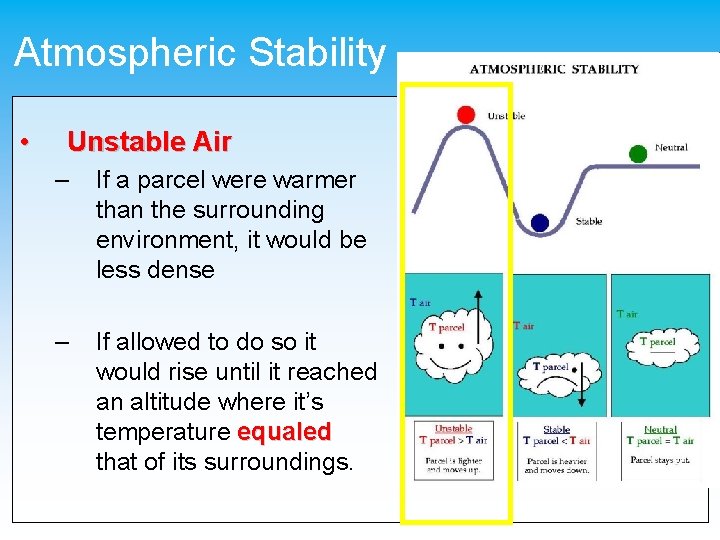
Atmospheric Stability • Unstable Air – If a parcel were warmer than the surrounding environment, it would be less dense – If allowed to do so it would rise until it reached an altitude where it’s temperature equaled that of its surroundings.
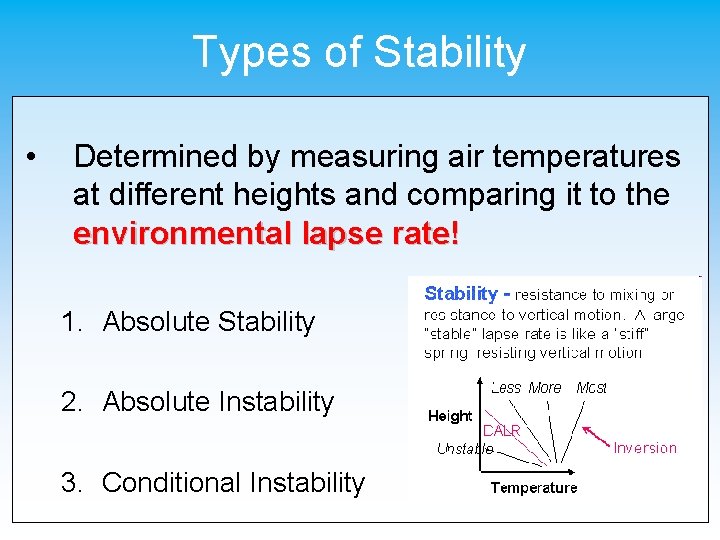
Types of Stability • Determined by measuring air temperatures at different heights and comparing it to the environmental lapse rate! 1. Absolute Stability 2. Absolute Instability 3. Conditional Instability
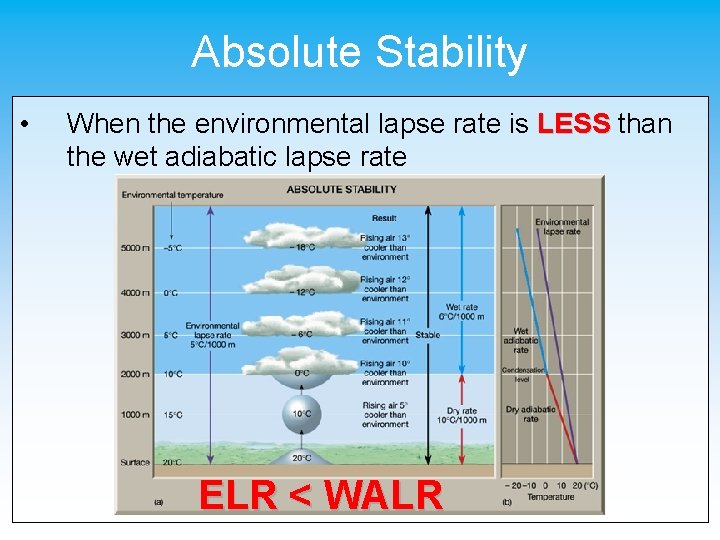
Absolute Stability • When the environmental lapse rate is LESS than the wet adiabatic lapse rate ELR < WALR
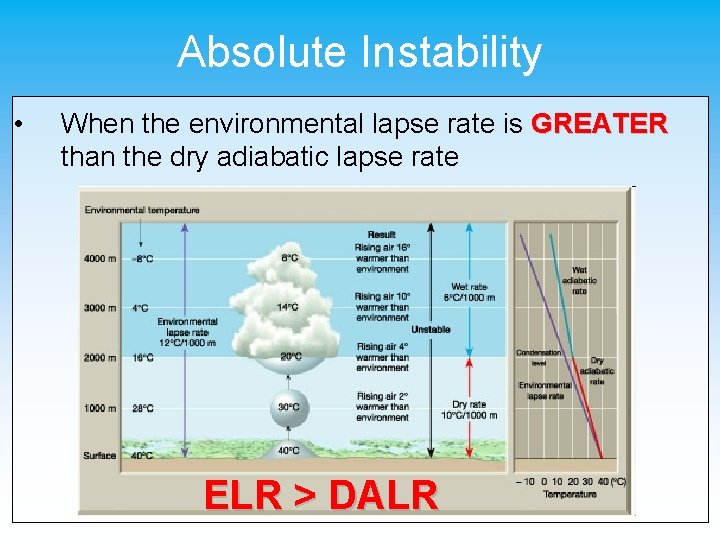
Absolute Instability • When the environmental lapse rate is GREATER than the dry adiabatic lapse rate ELR > DALR
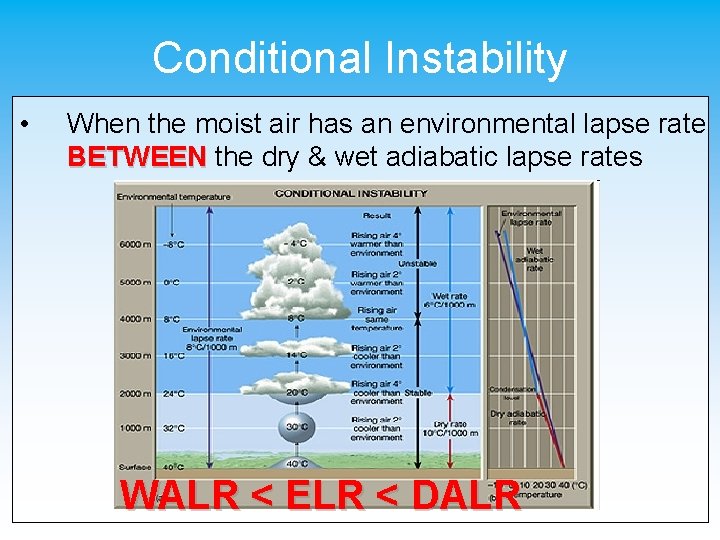
Conditional Instability • When the moist air has an environmental lapse rate BETWEEN the dry & wet adiabatic lapse rates WALR < ELR < DALR
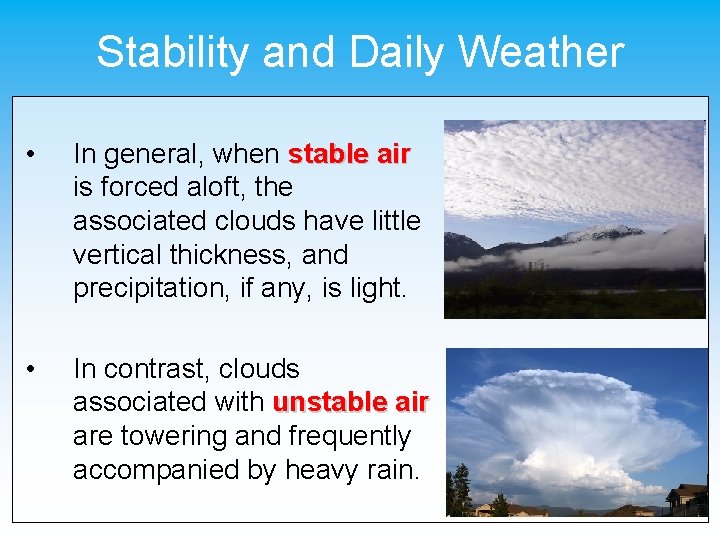
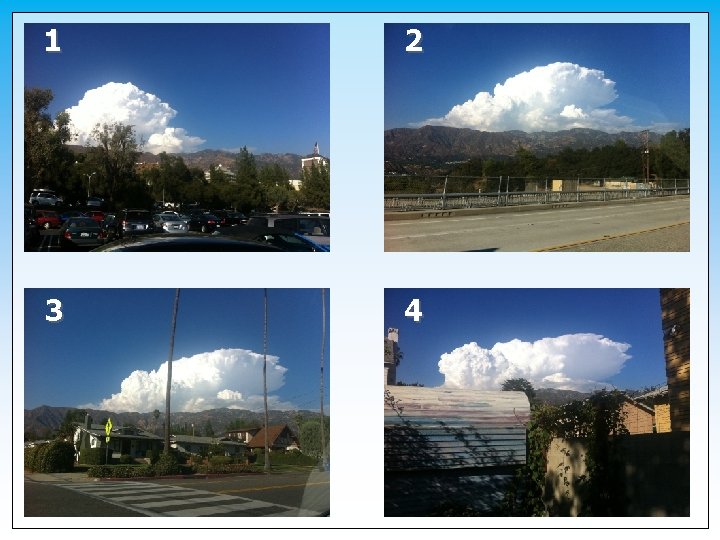
Stability and Daily Weather • In general, when stable air is forced aloft, the associated clouds have little vertical thickness, and precipitation, if any, is light. • In contrast, clouds associated with unstable air are towering and frequently accompanied by heavy rain.
1 2 3 4
How Stability Changes • Instability is enhanced by the following: 1. Intense solar heating warming the lowermost layer of the atmosphere 2. The heating of an air mass from below as it passes over a warm surface. 3. General upward movement of air caused by processes such as orographic lifting, frontal wedging, and convergence. 4. Radiation cooling from cloud tops.
How Stability Changes • Stability is enhanced by the following: 1. Radiation cooling of Earth’s surface after sunset 2. The cooling of an air mass from below as it traverses a cold surface 3. General subsidence within an air column (sinking)
Vertical Air Movement and Stability • Subsidence – the general downward motion of air – Usually Stabilizes the air since the air above is warmed – Can result in the evaporation of clouds
- Slides: 24