
Lecture 9 SOA suweilzueyou com SOA Web Service
Lecture 9 SOA核心技术 苏伟 suweilzu@eyou. com
SOA & Web Service 教育部-IBM���合改革�目 Outline § 9. 1 服务组建架构SCA § 9. 2 服务数据对象SDO § 9. 3 BPEL介绍 Lan Zhou University
SOA & Web Service 教育部-IBM���合改革�目 Outlines: § Introduction to Service Component Architecture components § Overview of SCA modules § Testing SCA applications Lan Zhou University
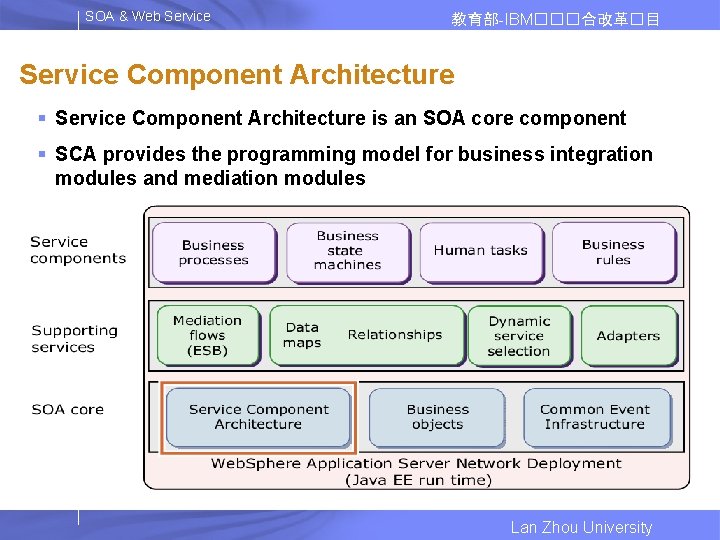
SOA & Web Service 教育部-IBM���合改革�目 Service Component Architecture § Service Component Architecture is an SOA core component § SCA provides the programming model for business integration modules and mediation modules Lan Zhou University
SOA & Web Service 教育部-IBM���合改革�目 Overview and business value of SCA § SCA is a service-oriented component model that provides a declarative, high-level method of creating relationships between services – Only the service contract is visible – Service implementation details are not considered – When services change, only the declaration is changed, not the mechanical steps in the application code § SCA provides a single service component abstraction for services that may already be implemented as business processes, Java classes, mediation flows, and so forth – Abstraction separates “business logic” from “infrastructure logic, ” allowing developers to focus on business problems, not infrastructure code § Without SCA, you must write code to communicate with the services in your SOA-based application – This is not loosely coupled, and is not easy to change – You must change application code to respond to infrastructure changes Lan Zhou University
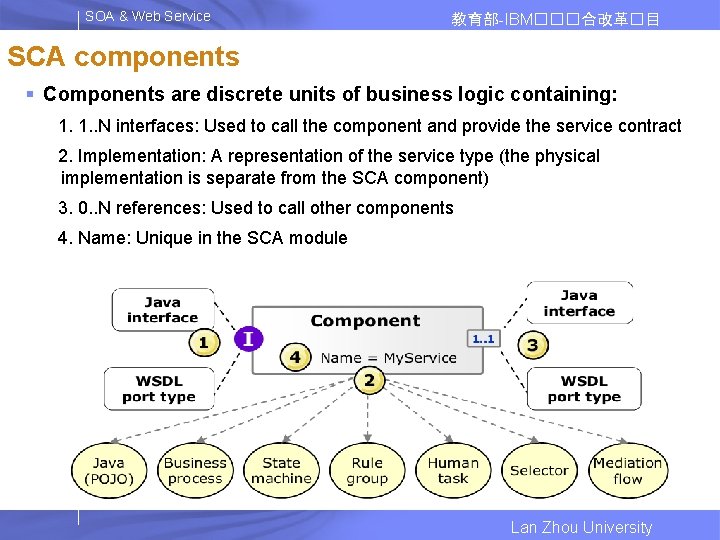
SOA & Web Service 教育部-IBM���合改革�目 SCA components § Components are discrete units of business logic containing: 1. 1. . N interfaces: Used to call the component and provide the service contract 2. Implementation: A representation of the service type (the physical implementation is separate from the SCA component) 3. 0. . N references: Used to call other components 4. Name: Unique in the SCA module Lan Zhou University
SOA & Web Service 教育部-IBM���合改革�目 SCA component interfaces: Web Services Description Language § Web Services Description Language (WSDL) provides an industry standard way of describing services in a service-oriented architecture § WSDL is a way for service providers to describe the basic format of requests to their systems, regardless of the underlying implementation § WSDL allows a provider to specify the characteristics of a service: – The name of the service and addressing information – The protocol and encoding style used to access the public operations – The operations, parameters, and data types in the service interface – The preferred interaction style: synchronous or asynchronous § WSDL documents are defined in XML – An industry standard language – Platform and technology agnostic – Capable of describing a wide range of services; Service definitions are flexible and extensible § Interface elements can be structured in one or more WSDL files Lan Zhou University
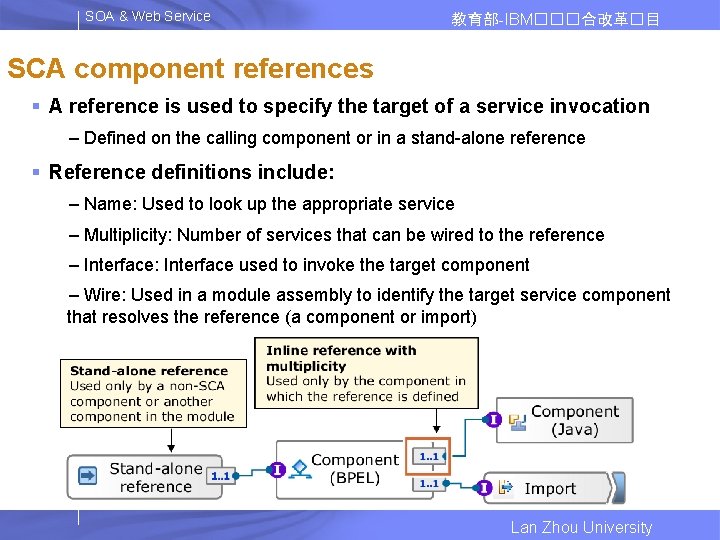
SOA & Web Service 教育部-IBM���合改革�目 SCA component references § A reference is used to specify the target of a service invocation – Defined on the calling component or in a stand-alone reference § Reference definitions include: – Name: Used to look up the appropriate service – Multiplicity: Number of services that can be wired to the reference – Interface: Interface used to invoke the target component – Wire: Used in a module assembly to identify the target service component that resolves the reference (a component or import) Lan Zhou University
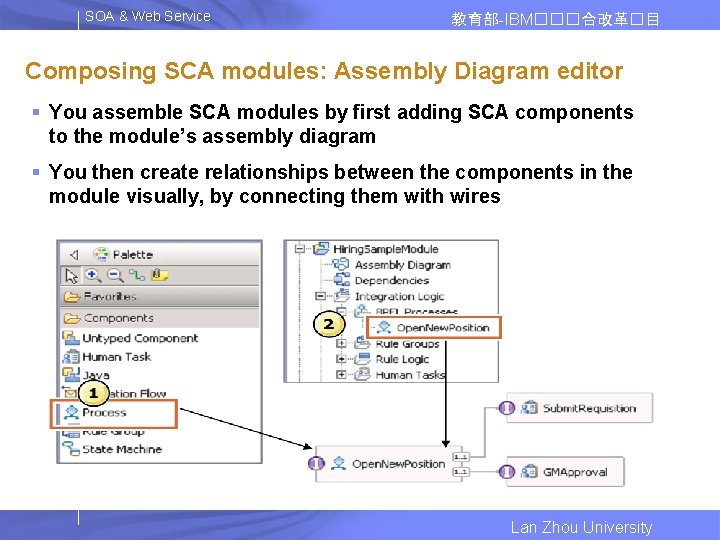
SOA & Web Service 教育部-IBM���合改革�目 Composing SCA modules: Assembly Diagram editor § You assemble SCA modules by first adding SCA components to the module’s assembly diagram § You then create relationships between the components in the module visually, by connecting them with wires Lan Zhou University
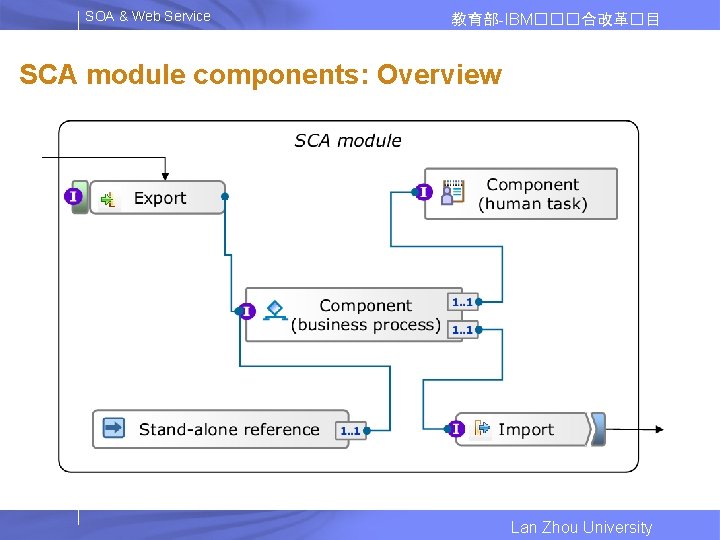
SOA & Web Service 教育部-IBM���合改革�目 SCA module components: Overview Lan Zhou University
SOA & Web Service 教育部-IBM���合改革�目 SCA module components: Exports § Exports provide access to callers outside the module § Exports separate the infrastructure details required to communicate with the service from the service implementation § Export definitions include: – Name – Target – 1. . . N interfaces – Binding (describes the communication method used by callers) – Wire (an export can only have one wire to the exposed service) Lan Zhou University
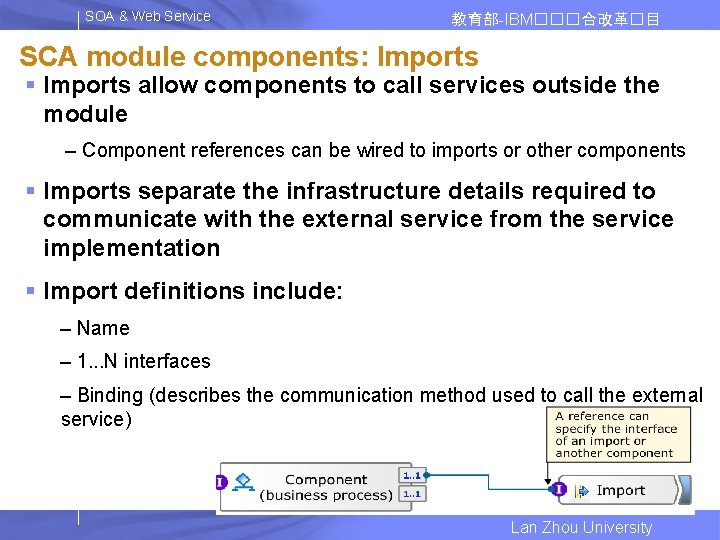
SOA & Web Service 教育部-IBM���合改革�目 SCA module components: Imports § Imports allow components to call services outside the module – Component references can be wired to imports or other components § Imports separate the infrastructure details required to communicate with the external service from the service implementation § Import definitions include: – Name – 1. . . N interfaces – Binding (describes the communication method used to call the external service) Lan Zhou University
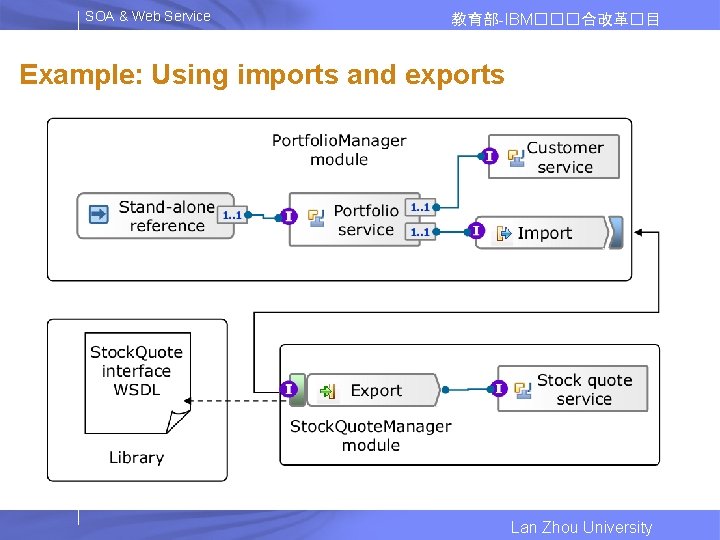
SOA & Web Service 教育部-IBM���合改革�目 Example: Using imports and exports Lan Zhou University
SOA & Web Service 教育部-IBM���合改革�目 SCA module components: Stand-alone references § A stand-alone reference: – Is defined in an sca. references file – Is used by a non-SCA component within the module to invoke an SCAcomponent interface, for example, a Java. Server Page (JSP) § Stand-alone references are defined like inline references using: – Name – Multiplicity – Interface – Wire Lan Zhou University
SOA & Web Service 教育部-IBM���合改革�目 Testing SCA components in the integrated test client § Using the integrated test client in IBM Integration Designer, you can test: – An individual module – A set of interacting modules – An individual component – A set of interacting components – A test suite § When testing components, tests are performed on interface operations – Enables you to determine whether the components are correctly implemented and the references are correctly wired § In component tests, unimplemented components or unwired references can be emulated – Modules do not need to be complete before performing tests – Emulation can be programmatic Lan Zhou University
SOA & Web Service 教育部-IBM���合改革�目 Test configurations § Test configurations control your tests § A test configuration specifies one or more modules to test, each of which may include: – Zero or more emulators for components or references in the module – Zero or more monitors for the wires in the module § When you open the integrated test client, a default test configuration is automatically created that you can immediately use for testing § The default test configuration is often all that you need for testing your modules and components – You can choose to edit and customize the default test configuration or you can create and edit one or more new test configurations – Customized test configurations can be saved and reused Lan Zhou University
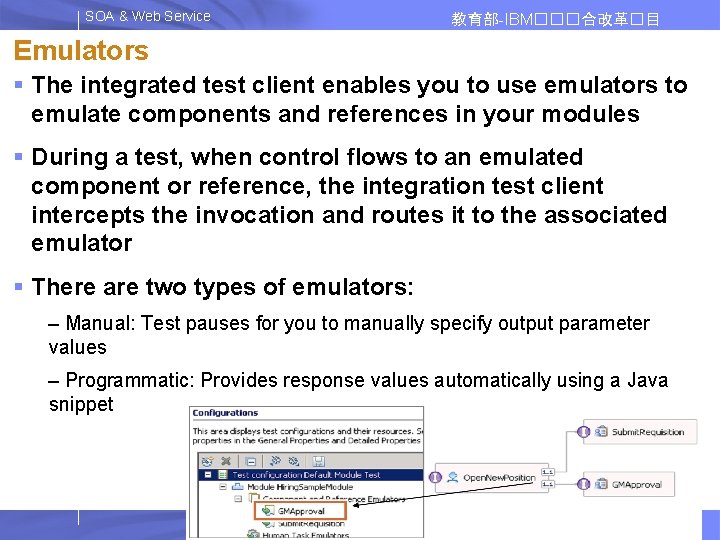
SOA & Web Service 教育部-IBM���合改革�目 Emulators § The integrated test client enables you to use emulators to emulate components and references in your modules § During a test, when control flows to an emulated component or reference, the integration test client intercepts the invocation and routes it to the associated emulator § There are two types of emulators: – Manual: Test pauses for you to manually specify output parameter values – Programmatic: Provides response values automatically using a Java snippet Lan Zhou University
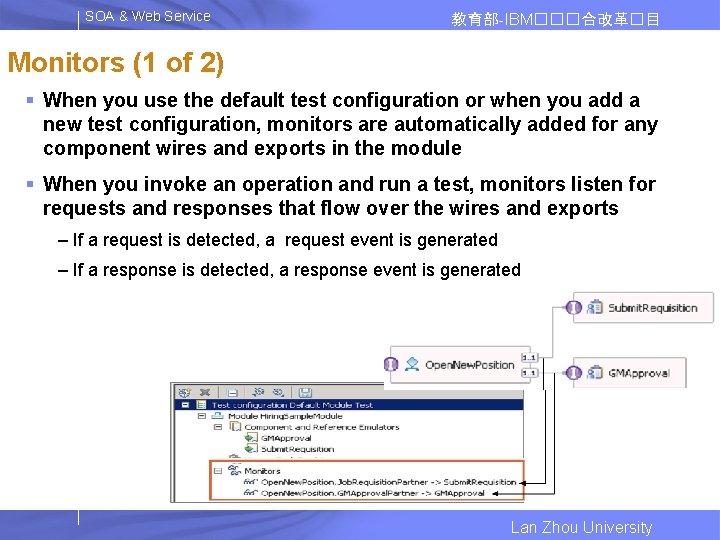
SOA & Web Service 教育部-IBM���合改革�目 Monitors (1 of 2) § When you use the default test configuration or when you add a new test configuration, monitors are automatically added for any component wires and exports in the module § When you invoke an operation and run a test, monitors listen for requests and responses that flow over the wires and exports – If a request is detected, a request event is generated – If a response is detected, a response event is generated Lan Zhou University
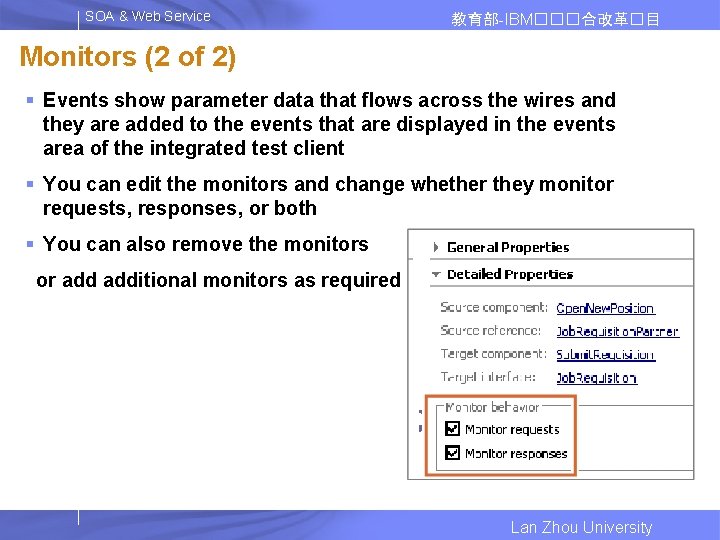
SOA & Web Service 教育部-IBM���合改革�目 Monitors (2 of 2) § Events show parameter data that flows across the wires and they are added to the events that are displayed in the events area of the integrated test client § You can edit the monitors and change whether they monitor requests, responses, or both § You can also remove the monitors or additional monitors as required Lan Zhou University
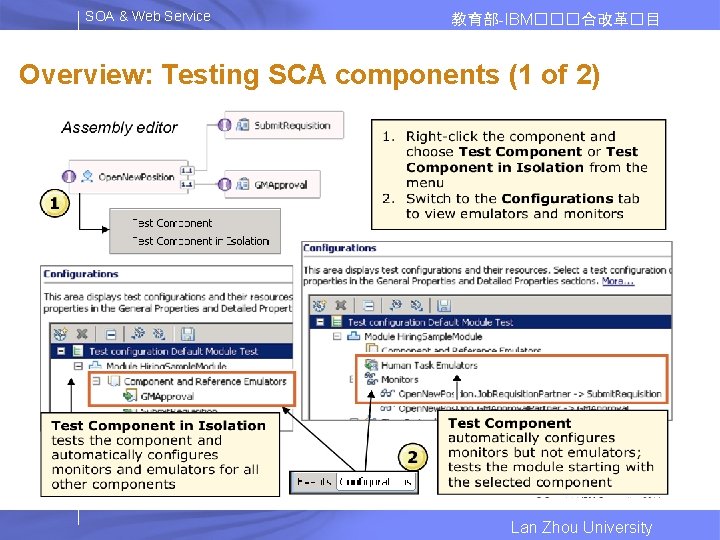
SOA & Web Service 教育部-IBM���合改革�目 Overview: Testing SCA components (1 of 2) Lan Zhou University
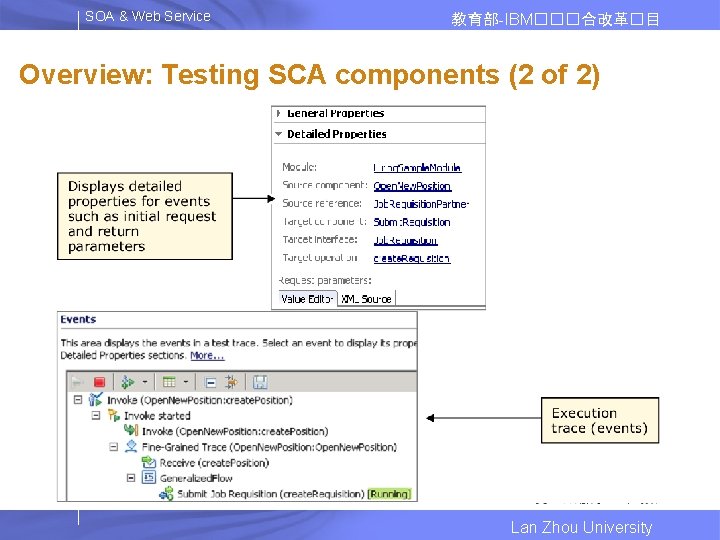
SOA & Web Service 教育部-IBM���合改革�目 Overview: Testing SCA components (2 of 2) Lan Zhou University
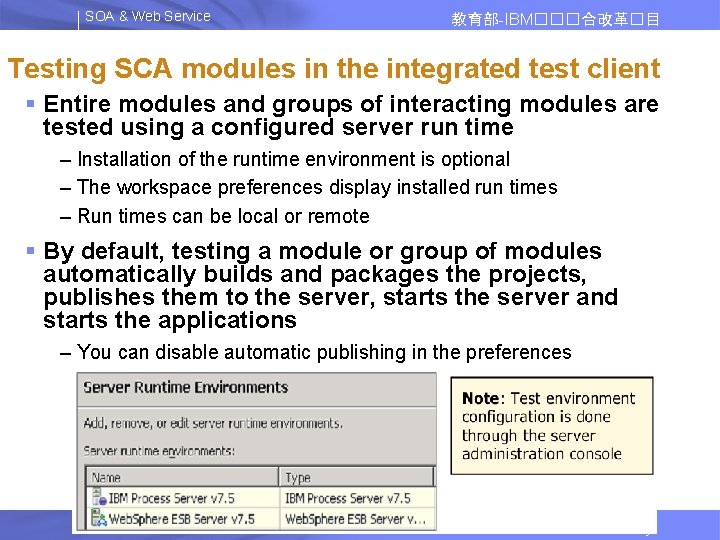
SOA & Web Service 教育部-IBM���合改革�目 Testing SCA modules in the integrated test client § Entire modules and groups of interacting modules are tested using a configured server run time – Installation of the runtime environment is optional – The workspace preferences display installed run times – Run times can be local or remote § By default, testing a module or group of modules automatically builds and packages the projects, publishes them to the server, starts the server and starts the applications – You can disable automatic publishing in the preferences Lan Zhou University
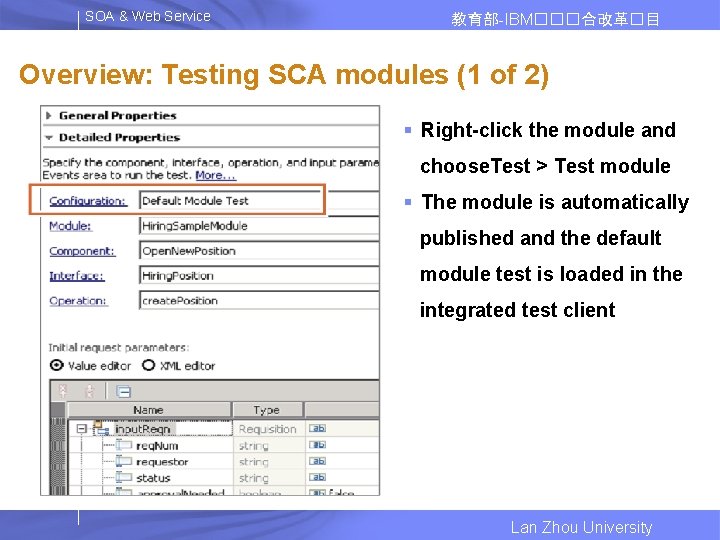
SOA & Web Service 教育部-IBM���合改革�目 Overview: Testing SCA modules (1 of 2) § Right-click the module and choose. Test > Test module § The module is automatically published and the default module test is loaded in the integrated test client Lan Zhou University
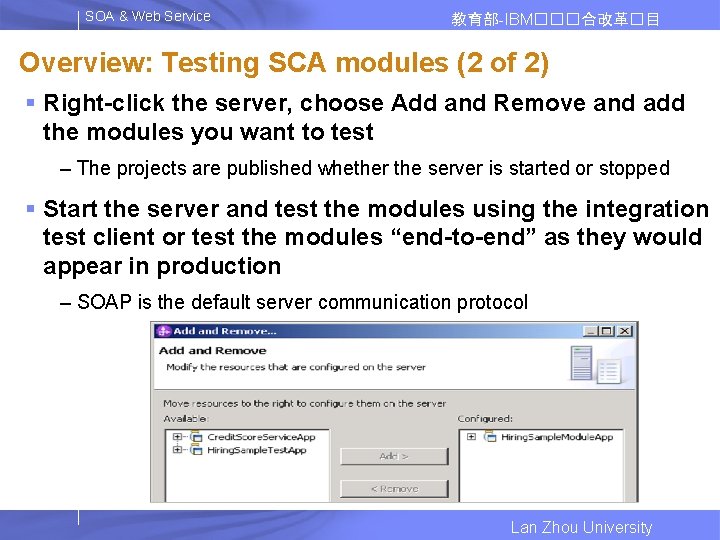
SOA & Web Service 教育部-IBM���合改革�目 Overview: Testing SCA modules (2 of 2) § Right-click the server, choose Add and Remove and add the modules you want to test – The projects are published whether the server is started or stopped § Start the server and test the modules using the integration test client or test the modules “end-to-end” as they would appear in production – SOAP is the default server communication protocol Lan Zhou University
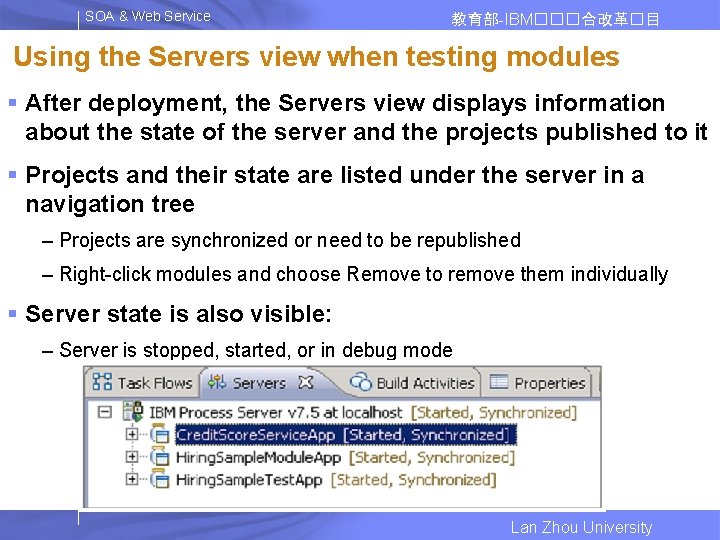
SOA & Web Service 教育部-IBM���合改革�目 Using the Servers view when testing modules § After deployment, the Servers view displays information about the state of the server and the projects published to it § Projects and their state are listed under the server in a navigation tree – Projects are synchronized or need to be republished – Right-click modules and choose Remove to remove them individually § Server state is also visible: – Server is stopped, started, or in debug mode Lan Zhou University
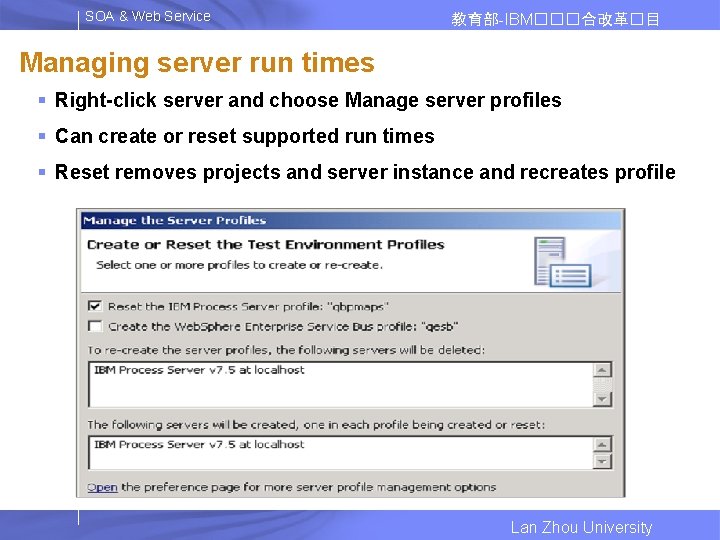
SOA & Web Service 教育部-IBM���合改革�目 Managing server run times § Right-click server and choose Manage server profiles § Can create or reset supported run times § Reset removes projects and server instance and recreates profile Lan Zhou University
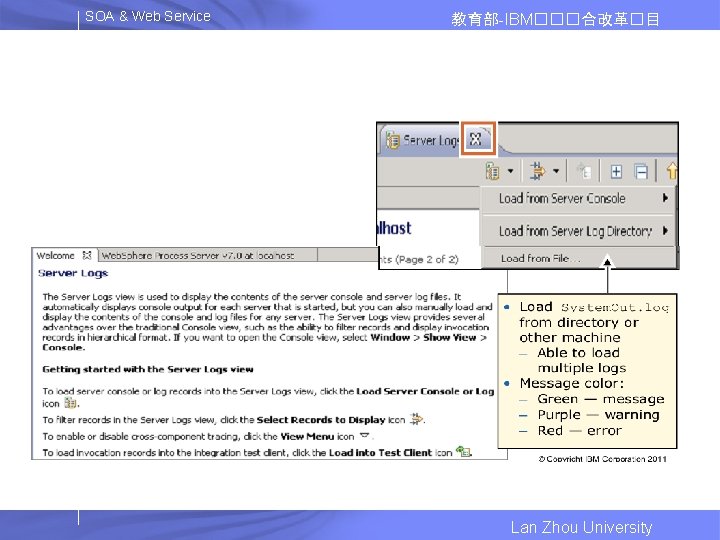
SOA & Web Service 教育部-IBM���合改革�目 Server Logs view § Server Logs view used to display server console and System. Out. log messages – Server console view also available – Filter messages by type and load invocation records – Default refresh every 5 seconds (can be changed) Lan Zhou University
SOA & Web Service 教育部-IBM���合改革�目 Lan Zhou University
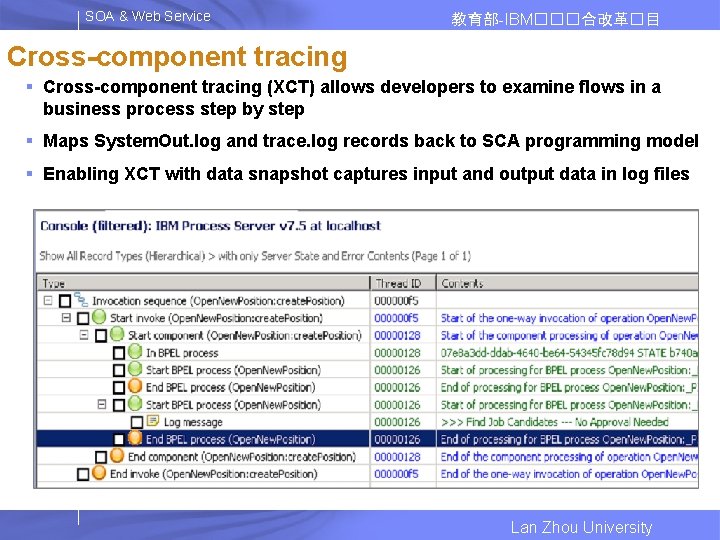
SOA & Web Service 教育部-IBM���合改革�目 Cross-component tracing § Cross-component tracing (XCT) allows developers to examine flows in a business process step by step § Maps System. Out. log and trace. log records back to SCA programming model § Enabling XCT with data snapshot captures input and output data in log files Lan Zhou University
SOA & Web Service 教育部-IBM���合改革�目 Unit summary Having completed this unit, you should be able to: § Identify the purpose and business value of using SCA § Identify and explain the function of the individual parts of an SCA component § Define the concept of a service module and explain each of the service module components § Describe how to test SCA applications in IBM Integration Designer § Describe the features available in the IBM Integration Designer test environment Lan Zhou University
SOA & Web Service 教育部-IBM���合改革�目 Introduction to Service Data Objects This unit is divided into the following topics: § Introduction to Service Data Objects § Introduction to business objects Lan Zhou University
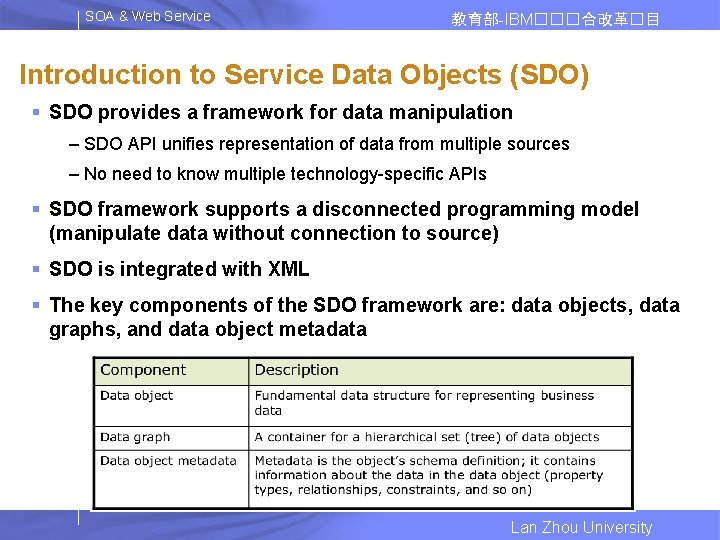
SOA & Web Service 教育部-IBM���合改革�目 Introduction to Service Data Objects (SDO) § SDO provides a framework for data manipulation – SDO API unifies representation of data from multiple sources – No need to know multiple technology-specific APIs § SDO framework supports a disconnected programming model (manipulate data without connection to source) § SDO is integrated with XML § The key components of the SDO framework are: data objects, data graphs, and data object metadata Lan Zhou University
SOA & Web Service 教育部-IBM���合改革�目 Data objects § Data objects are the fundamental structures for representing business data § A data object holds data as a set of properties § Each data object provides read and write access to properties through: – Getters and setters – XPath (XML Path Language) § Properties can be: – Primitive data types (such as strings) – Commonly used data types (such as dates) – Multivalued fields (such as arrays) – Other data objects § In memory, data objects are represented as instances of commonj. sdo. Data. Object – Objects serialized to XML Lan Zhou University
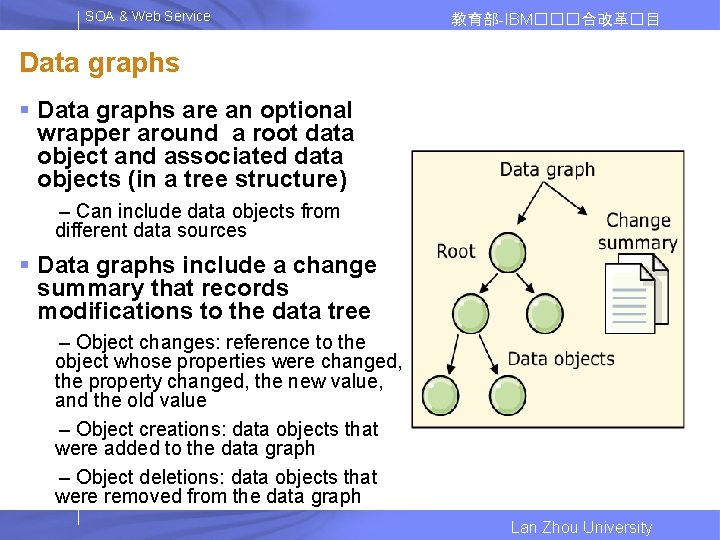
SOA & Web Service 教育部-IBM���合改革�目 Data graphs § Data graphs are an optional wrapper around a root data object and associated data objects (in a tree structure) – Can include data objects from different data sources § Data graphs include a change summary that records modifications to the data tree – Object changes: reference to the object whose properties were changed, the property changed, the new value, and the old value – Object creations: data objects that were added to the data graph – Object deletions: data objects that were removed from the data graph Lan Zhou University
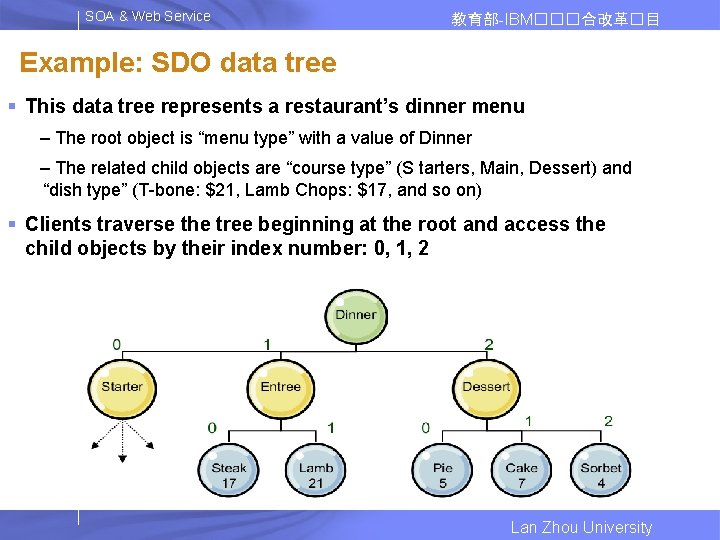
SOA & Web Service 教育部-IBM���合改革�目 Example: SDO data tree § This data tree represents a restaurant’s dinner menu – The root object is “menu type” with a value of Dinner – The related child objects are “course type” (S tarters, Main, Dessert) and “dish type” (T-bone: $21, Lamb Chops: $17, and so on) § Clients traverse the tree beginning at the root and access the child objects by their index number: 0, 1, 2 Lan Zhou University
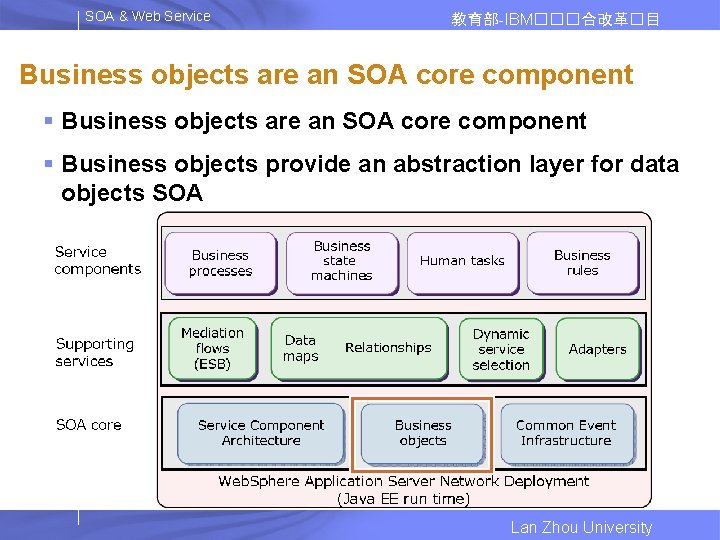
SOA & Web Service 教育部-IBM���合改革�目 Business objects are an SOA core component § Business objects provide an abstraction layer for data objects SOA Lan Zhou University
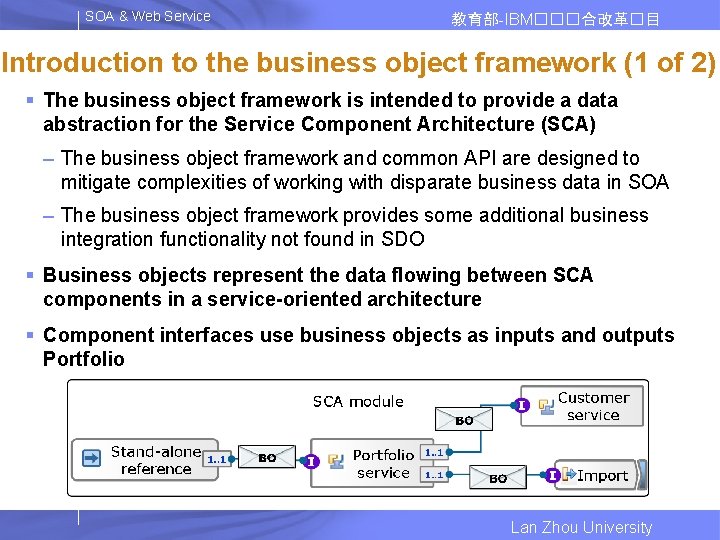
SOA & Web Service 教育部-IBM���合改革�目 Introduction to the business object framework (1 of 2) § The business object framework is intended to provide a data abstraction for the Service Component Architecture (SCA) – The business object framework and common API are designed to mitigate complexities of working with disparate business data in SOA – The business object framework provides some additional business integration functionality not found in SDO § Business objects represent the data flowing between SCA components in a service-oriented architecture § Component interfaces use business objects as inputs and outputs Portfolio Lan Zhou University
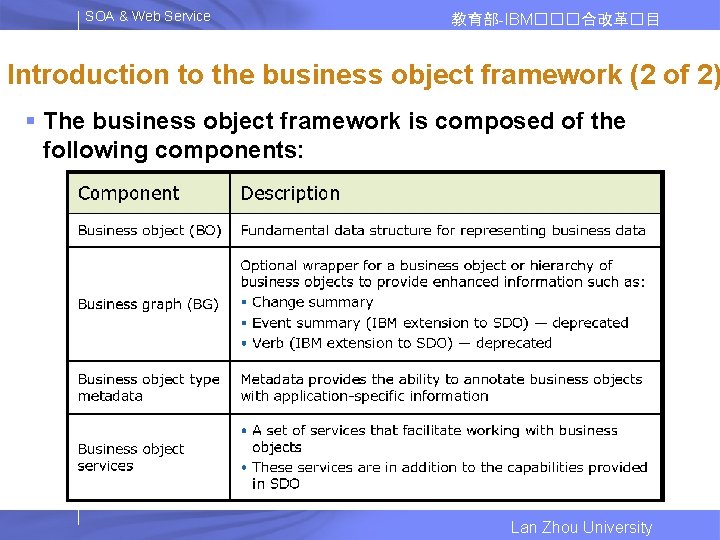
SOA & Web Service 教育部-IBM���合改革�目 Introduction to the business object framework (2 of 2) § The business object framework is composed of the following components: Lan Zhou University
SOA & Web Service 教育部-IBM���合改革�目 Business objects (1 of 3) § Business objects are the primary data structure for business data and data types defined in WSDL (interface) definitions § Business objects are modeled using XML schemas (XSD) – Can import business object schema definitions from, or export to, other systems – Support for the full XML schema data type system § At run time, business objects are represented in memory as an SDO instance using commonj. sdo. Data. Object – Created from XSD files using the business object factory – Accessible using the SDO API and Xpath § Support is provided for data object schemas from industry standards organizations – HL 7, ACORD, OAGIS, and so forth – –IBM Business Process Manager Industry Packs provide prebuilt data objects Lan Zhou University
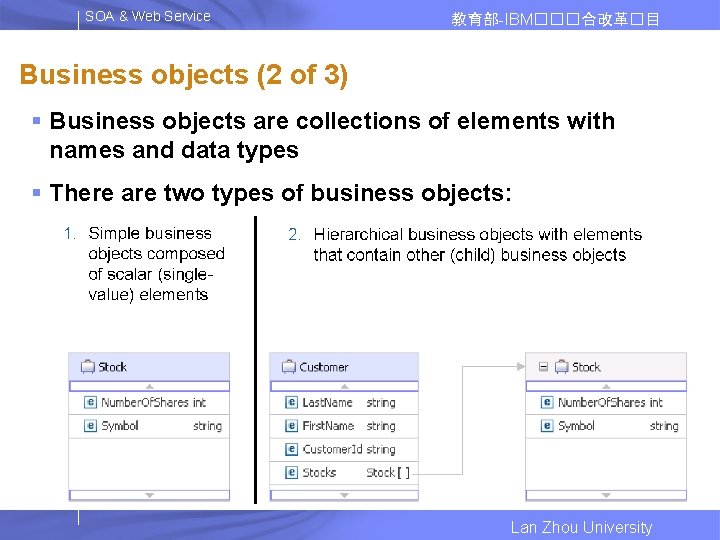
SOA & Web Service 教育部-IBM���合改革�目 Business objects (2 of 3) § Business objects are collections of elements with names and data types § There are two types of business objects: Lan Zhou University
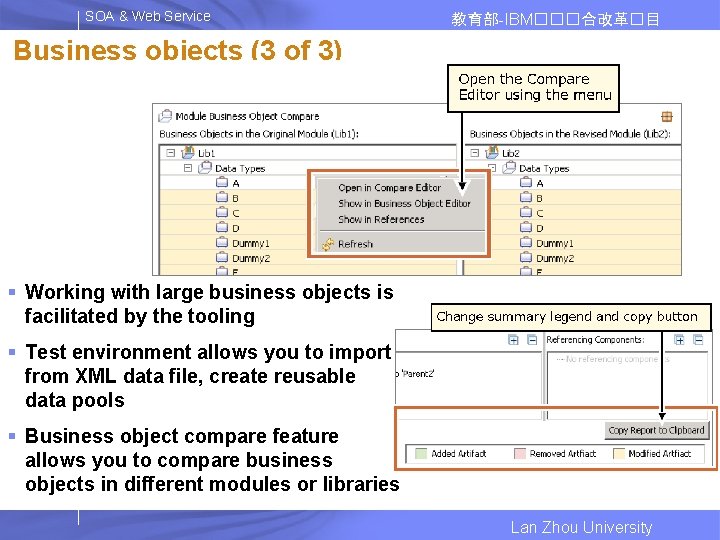
SOA & Web Service 教育部-IBM���合改革�目 Business objects (3 of 3) § Working with large business objects is facilitated by the tooling § Test environment allows you to import from XML data file, create reusable data pools § Business object compare feature allows you to compare business objects in different modules or libraries Lan Zhou University
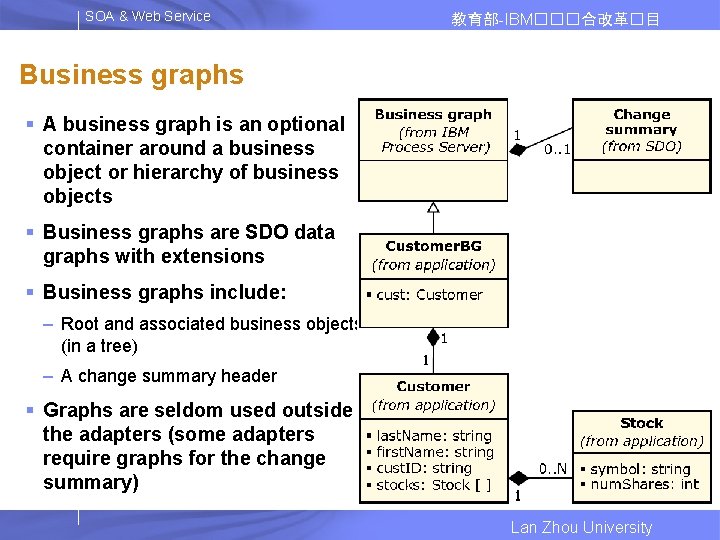
SOA & Web Service 教育部-IBM���合改革�目 Business graphs § A business graph is an optional container around a business object or hierarchy of business objects § Business graphs are SDO data graphs with extensions § Business graphs include: – Root and associated business objects (in a tree) – A change summary header § Graphs are seldom used outside the adapters (some adapters require graphs for the change summary) Lan Zhou University
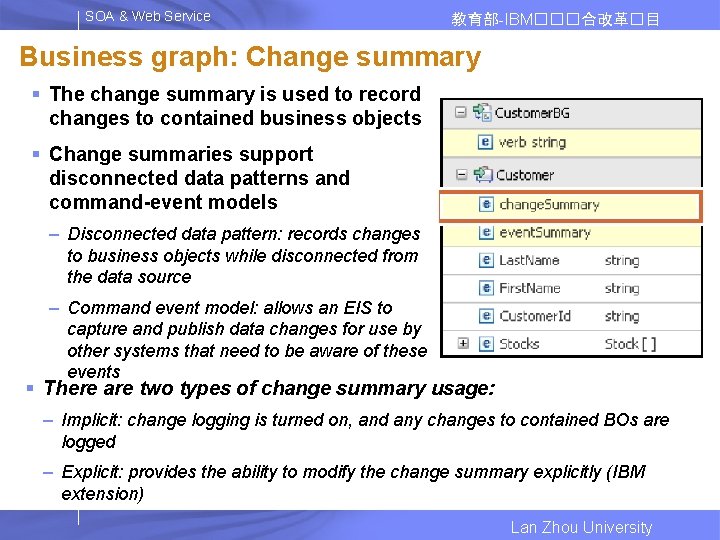
SOA & Web Service 教育部-IBM���合改革�目 Business graph: Change summary § The change summary is used to record changes to contained business objects § Change summaries support disconnected data patterns and command-event models – Disconnected data pattern: records changes to business objects while disconnected from the data source – Command event model: allows an EIS to capture and publish data changes for use by other systems that need to be aware of these events § There are two types of change summary usage: – Implicit: change logging is turned on, and any changes to contained BOs are logged – Explicit: provides the ability to modify the change summary explicitly (IBM extension) Lan Zhou University
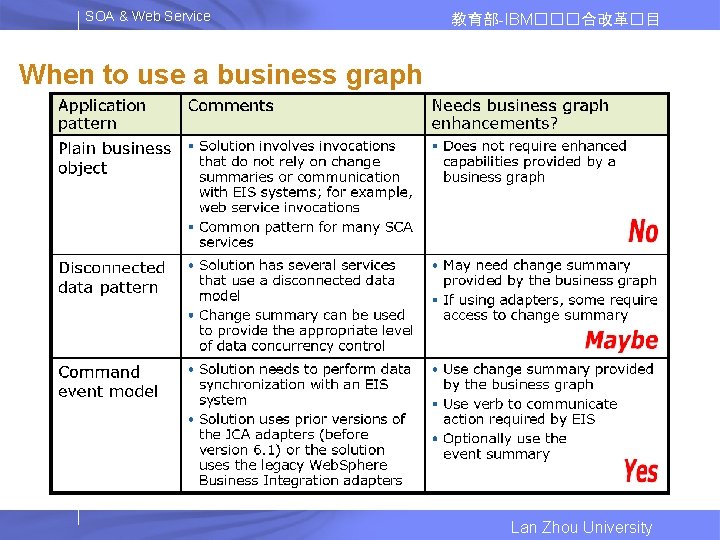
SOA & Web Service 教育部-IBM���合改革�目 When to use a business graph Lan Zhou University
SOA & Web Service 教育部-IBM���合改革�目 Data objects in IBM Business Process Manager § IBM Integration Designer – Provides support for modeling and developing integrated data objects – Business objects follow the SDO framework – Business objects are modeled using standard XSD – Run time objects are instances of commonj. sdo. Data. Object Lan Zhou University
SOA & Web Service 教育部-IBM���合改革�目 Data objects in IBM Business Process Manager § IBM Process Designer – Provides support for modeling data objects – SDO objects are not supported – Business graphs are not supported, consequently: • There are no change summaries • Disconnected data model is not supported • Command event model is not supported – Data objects are stored as XML blobs in the IBM Process Center repository – Data objects become instances of Javascript objects at run time – Data objects may be exported as XML for use in IBM Integration Designer Lan Zhou University
9. 3 BPEL介绍
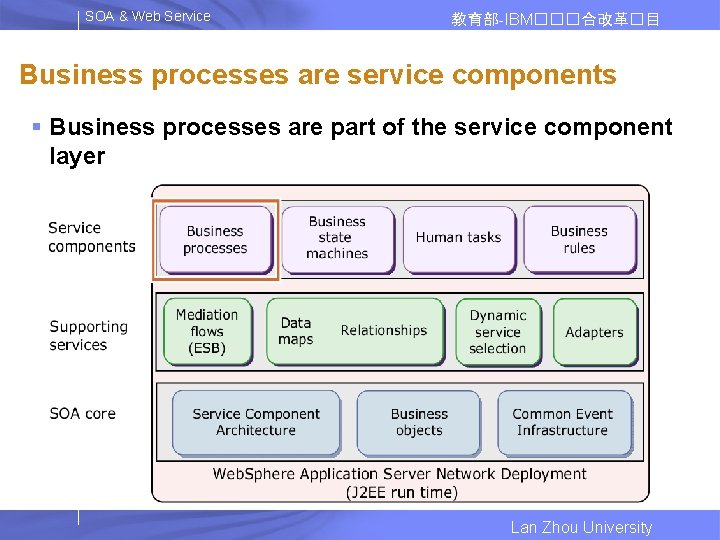
SOA & Web Service 教育部-IBM���合改革�目 Business processes are service components § Business processes are part of the service component layer Lan Zhou University
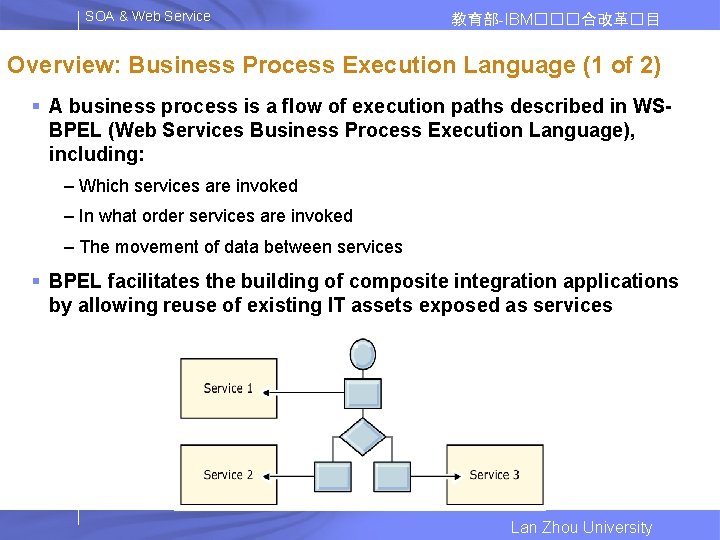
SOA & Web Service 教育部-IBM���合改革�目 Overview: Business Process Execution Language (1 of 2) § A business process is a flow of execution paths described in WSBPEL (Web Services Business Process Execution Language), including: – Which services are invoked – In what order services are invoked – The movement of data between services § BPEL facilitates the building of composite integration applications by allowing reuse of existing IT assets exposed as services Lan Zhou University
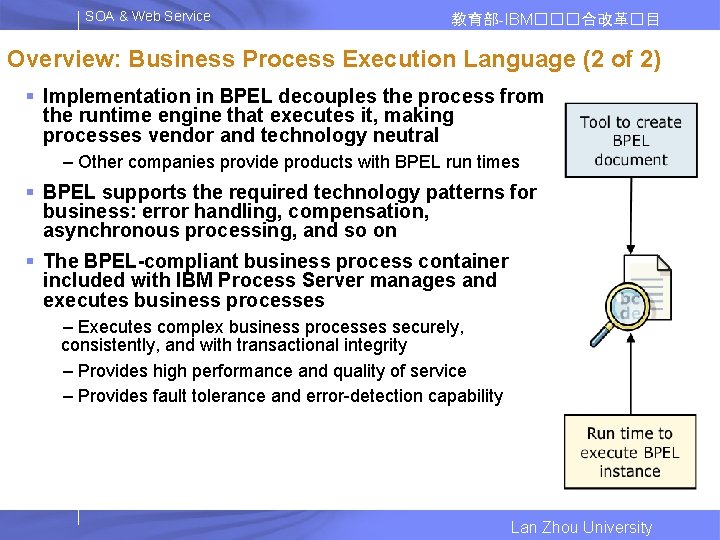
SOA & Web Service 教育部-IBM���合改革�目 Overview: Business Process Execution Language (2 of 2) § Implementation in BPEL decouples the process from the runtime engine that executes it, making processes vendor and technology neutral – Other companies provide products with BPEL run times § BPEL supports the required technology patterns for business: error handling, compensation, asynchronous processing, and so on § The BPEL-compliant business process container included with IBM Process Server manages and executes business processes – Executes complex business processes securely, consistently, and with transactional integrity – Provides high performance and quality of service – Provides fault tolerance and error-detection capability Lan Zhou University
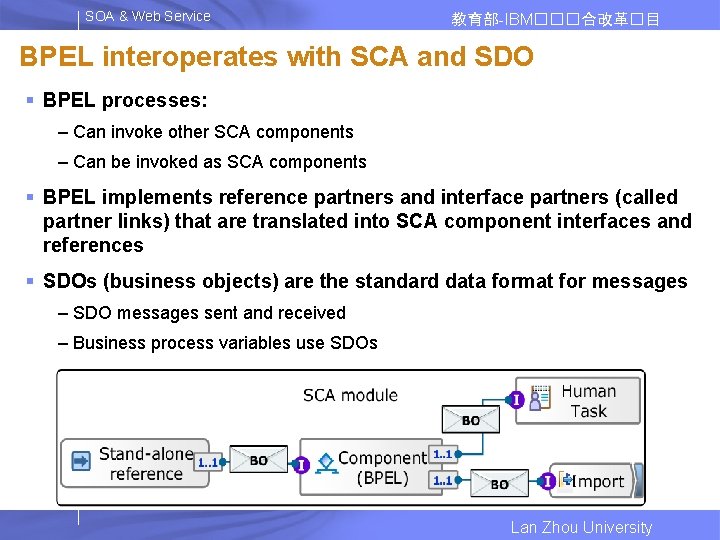
SOA & Web Service 教育部-IBM���合改革�目 BPEL interoperates with SCA and SDO § BPEL processes: – Can invoke other SCA components – Can be invoked as SCA components § BPEL implements reference partners and interface partners (called partner links) that are translated into SCA component interfaces and references § SDOs (business objects) are the standard data format for messages – SDO messages sent and received – Business process variables use SDOs Lan Zhou University
SOA & Web Service 教育部-IBM���合改革�目 Microflows versus long-running processes § Business processes are executed by IBM Process Server as either microflows (short-running) or longrunning processes – Also known as non-interruptible and interruptible processes § A microflow process is used for executing short business processes or small units of work within a larger business process (subprocesses) – Microflows complete or fail and are not persisted § A long-running process might run for hours, days, or weeks – Frequently involve components with lengthy response times such as human tasks – State of the process must be persisted Lan Zhou University
SOA & Web Service 教育部-IBM���合改革�目 Business processes in IBM Business Process Manager § Business processes may be captured in IBM Process Designer or in IBM Integration Designer § IBM Process Designer: – Captured as business process – Represented as Business Process Diagram (BPD) – Implementations only captured in one process application or toolkit – Limited implementation options – One human task client § IBM Integration Designer – Captured as BPEL process – Represented with Business Process Execution Language (BPEL) – Implementation may span several modules – May be shared in libraries – Several implementations options – Several human task clients Lan Zhou University
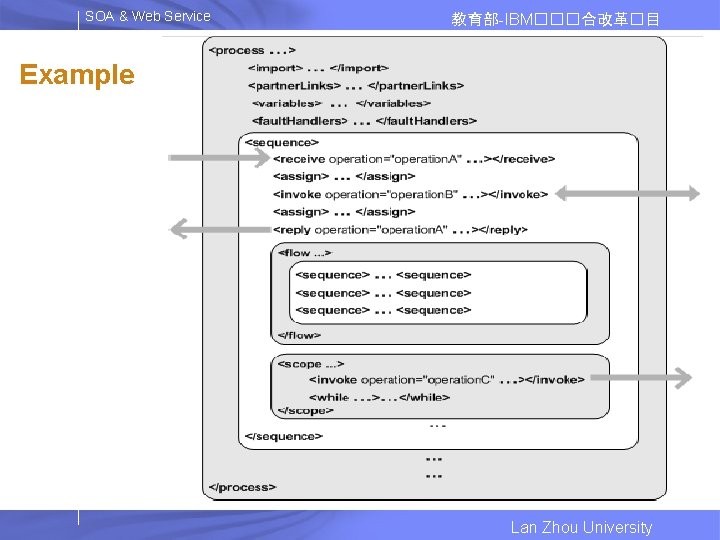
SOA & Web Service 教育部-IBM���合改革�目 Example Lan Zhou University
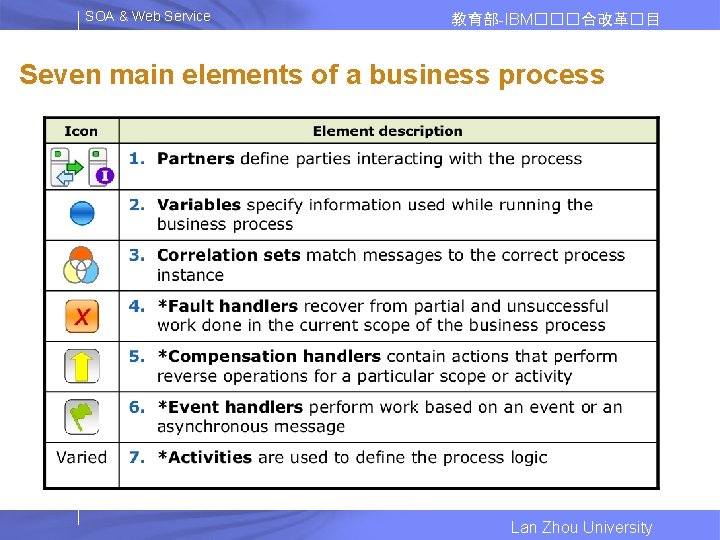
SOA & Web Service 教育部-IBM���合改革�目 Seven main elements of a business process Lan Zhou University
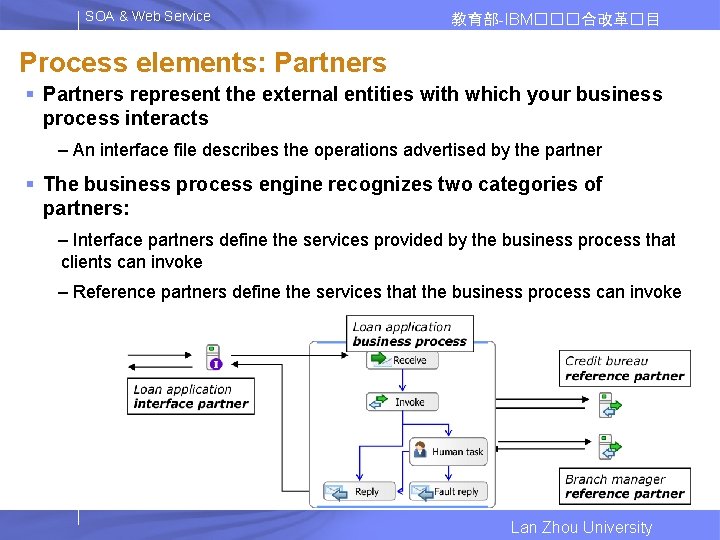
SOA & Web Service 教育部-IBM���合改革�目 Process elements: Partners § Partners represent the external entities with which your business process interacts – An interface file describes the operations advertised by the partner § The business process engine recognizes two categories of partners: – Interface partners define the services provided by the business process that clients can invoke – Reference partners define the services that the business process can invoke Lan Zhou University
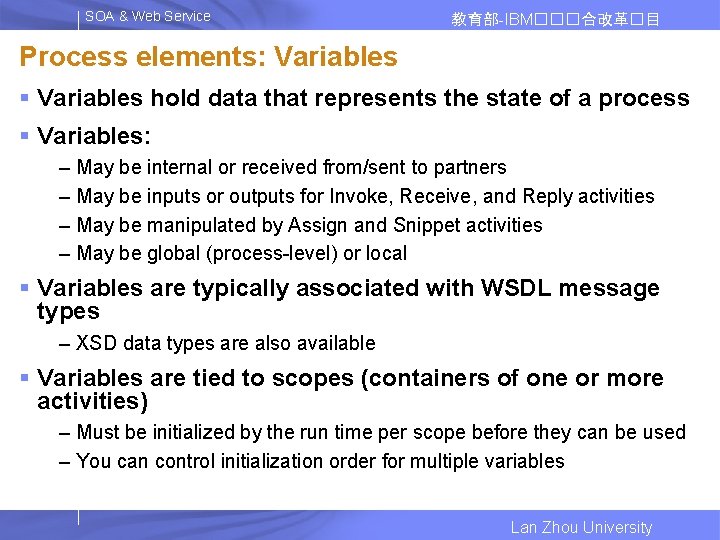
SOA & Web Service 教育部-IBM���合改革�目 Process elements: Variables § Variables hold data that represents the state of a process § Variables: – May be internal or received from/sent to partners – May be inputs or outputs for Invoke, Receive, and Reply activities – May be manipulated by Assign and Snippet activities – May be global (process-level) or local § Variables are typically associated with WSDL message types – XSD data types are also available § Variables are tied to scopes (containers of one or more activities) – Must be initialized by the run time per scope before they can be used – You can control initialization order for multiple variables Lan Zhou University
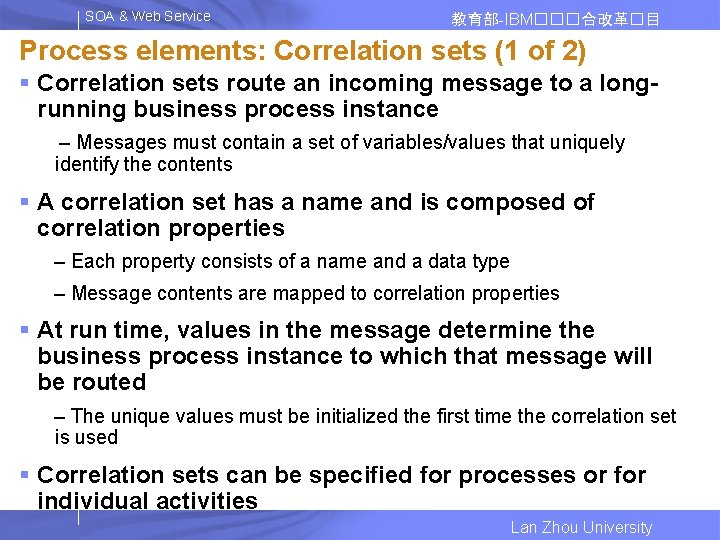
SOA & Web Service 教育部-IBM���合改革�目 Process elements: Correlation sets (1 of 2) § Correlation sets route an incoming message to a longrunning business process instance – Messages must contain a set of variables/values that uniquely identify the contents § A correlation set has a name and is composed of correlation properties – Each property consists of a name and a data type – Message contents are mapped to correlation properties § At run time, values in the message determine the business process instance to which that message will be routed – The unique values must be initialized the first time the correlation set is used § Correlation sets can be specified for processes or for individual activities Lan Zhou University
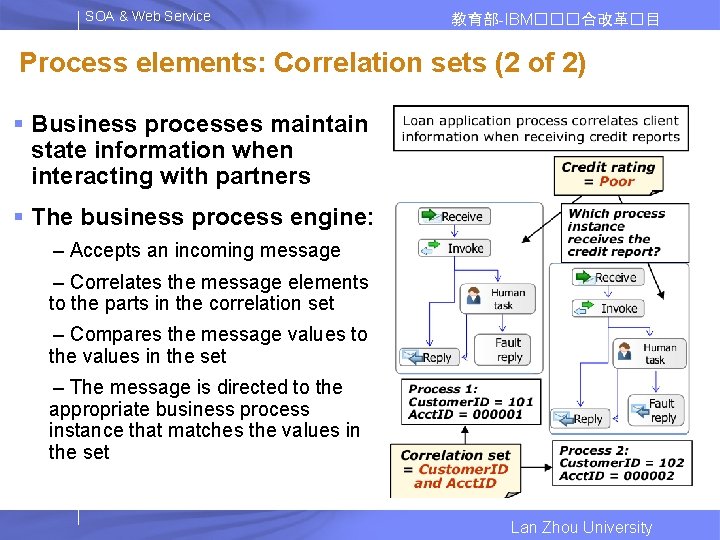
SOA & Web Service 教育部-IBM���合改革�目 Process elements: Correlation sets (2 of 2) § Business processes maintain state information when interacting with partners § The business process engine: – Accepts an incoming message – Correlates the message elements to the parts in the correlation set – Compares the message values to the values in the set – The message is directed to the appropriate business process instance that matches the values in the set Lan Zhou University
SOA & Web Service 教育部-IBM���合改革�目 Process elements: Activities § Activities are the individual business tasks that implement the larger business goal represented by the process § An activity can be: basic, structured, or associated with error processing – Basic activities do not contain other activities — human task, snippet, reply, and so forth – Structured activities are activities that contain other activities — sequence, while loop, and so forth – Activities for fault handling and compensation are activities that process expected and unexpected error conditions § BPEL also uses handlers with certain activities – Handlers contain activities that are executed based on events or during error processing (handlers are discussed later) Lan Zhou University
SOA & Web Service 教育部-IBM���合改革�目 Basic activities: Receive, reply, and invoke § The receive activity receives a message sent to a business process – Can start a new business process – Can restart an existing process – Request may be synchronous or asynchronous § The reply activity responds to a message received – Typically used as a response to a synchronous request – Can return either response message or fault message § The invoke activity calls a one-way or a request/response operation offered by a partner – Calls another service or business process Lan Zhou University
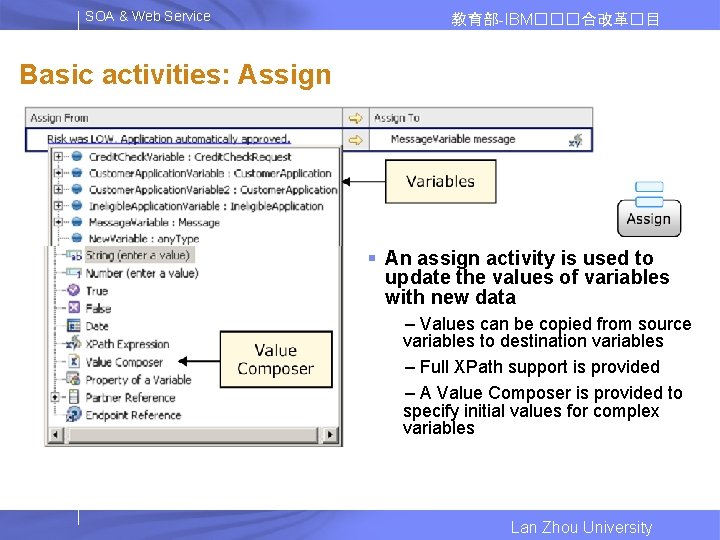
SOA & Web Service 教育部-IBM���合改革�目 Basic activities: Assign § An assign activity is used to update the values of variables with new data – Values can be copied from source variables to destination variables – Full XPath support is provided – A Value Composer is provided to specify initial values for complex variables Lan Zhou University
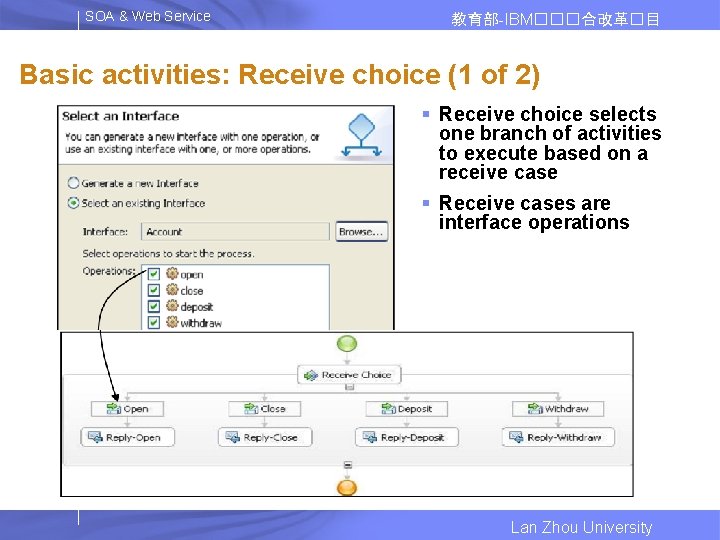
SOA & Web Service 教育部-IBM���合改革�目 Basic activities: Receive choice (1 of 2) § Receive choice selects one branch of activities to execute based on a receive case § Receive cases are interface operations Lan Zhou University
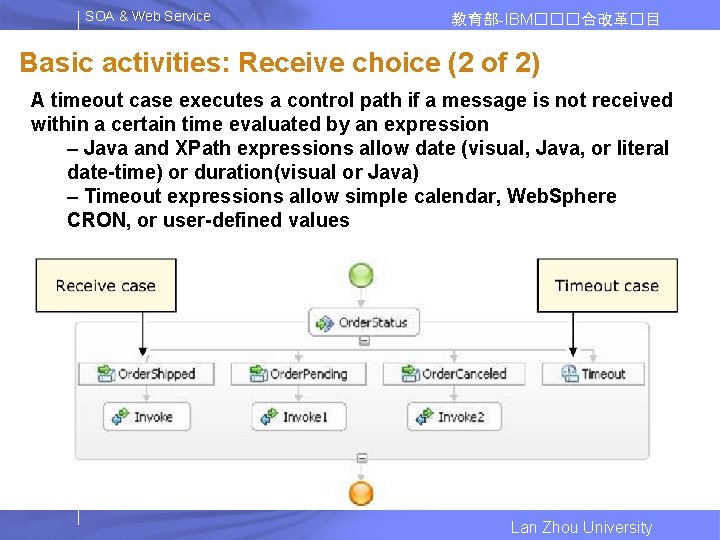
SOA & Web Service 教育部-IBM���合改革�目 Basic activities: Receive choice (2 of 2) A timeout case executes a control path if a message is not received within a certain time evaluated by an expression – Java and XPath expressions allow date (visual, Java, or literal date-time) or duration(visual or Java) – Timeout expressions allow simple calendar, Web. Sphere CRON, or user-defined values Lan Zhou University
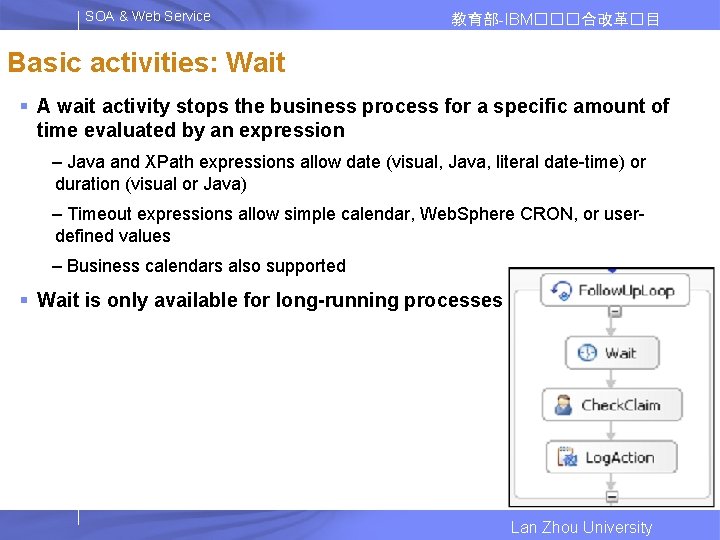
SOA & Web Service 教育部-IBM���合改革�目 Basic activities: Wait § A wait activity stops the business process for a specific amount of time evaluated by an expression – Java and XPath expressions allow date (visual, Java, literal date-time) or duration (visual or Java) – Timeout expressions allow simple calendar, Web. Sphere CRON, or userdefined values – Business calendars also supported § Wait is only available for long-running processes Lan Zhou University
SOA & Web Service 教育部-IBM���合改革�目 Basic activities: Human task § Human task activities are an IBM extension to BPEL – Human tasks are defined in the BPEL 4 People specification § Human task activities in a business process are called inline human tasks – Inline tasks send process-related messages to humans for completion – Humans can send messages to processes by being given authorization to a receive or a case in a receive choice § Assigning a task to a human involves the interaction between two editors in IBM Integration Designer – You use the process editor to compose a process that requires human interaction – You use the human task editor to configure the task § More details on human tasks are provided later in this course Lan Zhou University
SOA & Web Service 教育部-IBM���合改革�目 Basic activities: Snippets § The snippet activity allows developers to embed inline Java code in a business process § Java snippets are an IBM extension to BPEL – Java snippets are detailed in the BPELJ specification § The code executes locally in the BPEL process – Snippets in a BPEL process are compiled into a single class § Snippets are typically used for working with the contents of variables § Snippets are also used for: – Loop counters – Data validation – Data normalization Lan Zhou University
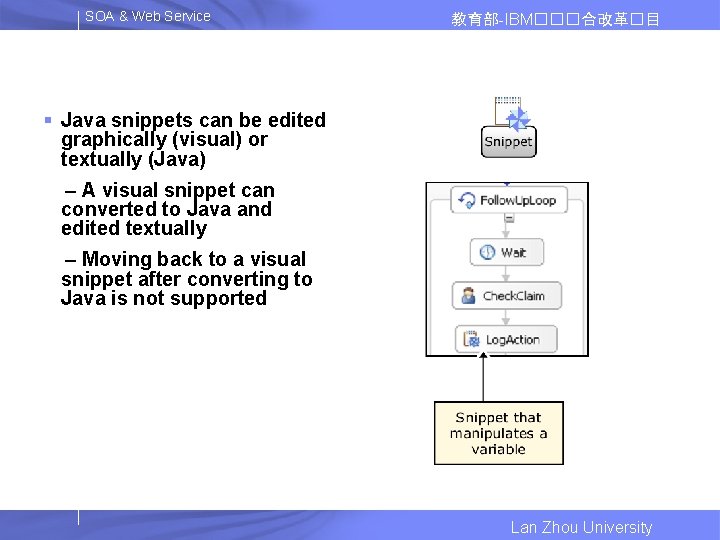
SOA & Web Service 教育部-IBM���合改革�目 § Java snippets can be edited graphically (visual) or textually (Java) – A visual snippet can converted to Java and edited textually – Moving back to a visual snippet after converting to Java is not supported Lan Zhou University
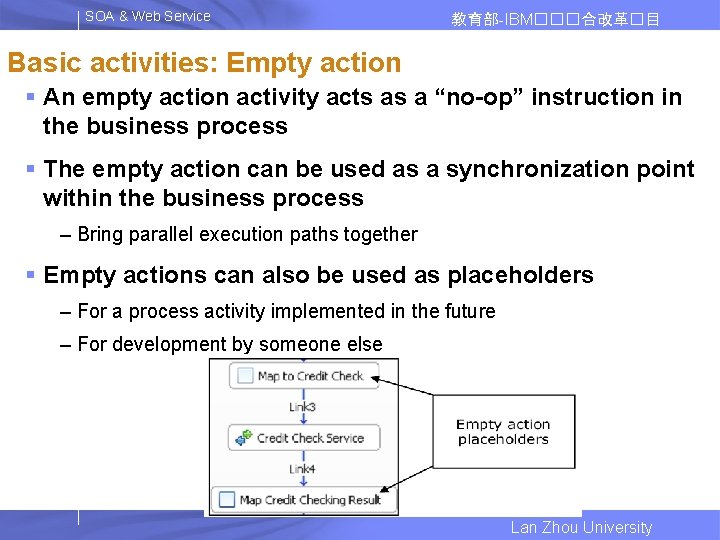
SOA & Web Service 教育部-IBM���合改革�目 Basic activities: Empty action § An empty action activity acts as a “no-op” instruction in the business process § The empty action can be used as a synchronization point within the business process – Bring parallel execution paths together § Empty actions can also be used as placeholders – For a process activity implemented in the future – For development by someone else Lan Zhou University
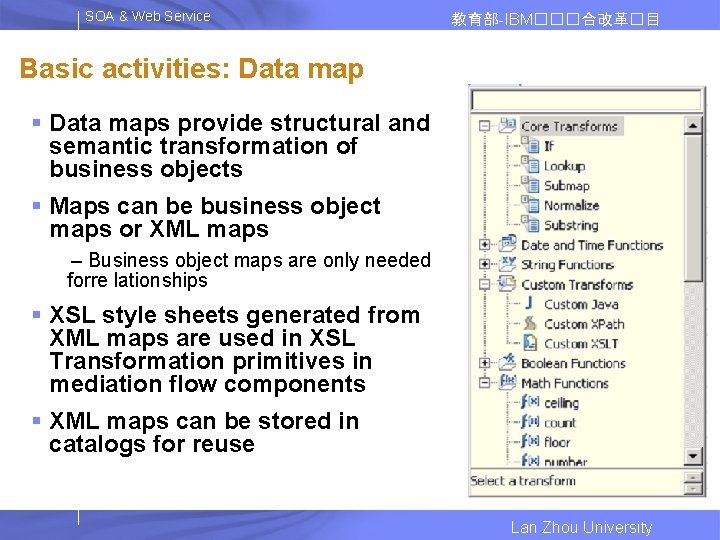
SOA & Web Service 教育部-IBM���合改革�目 Basic activities: Data map § Data maps provide structural and semantic transformation of business objects § Maps can be business object maps or XML maps – Business object maps are only needed forre lationships § XSL style sheets generated from XML maps are used in XSL Transformation primitives in mediation flow components § XML maps can be stored in catalogs for reuse Lan Zhou University
SOA & Web Service 教育部-IBM���合改革�目 Basic activities: Data map § Rich set of predefined transformations, including: – Core transforms: if, submap, lookup, normalize, substring – Date and time functions – String functions – Boolean functions – Math functions – Custom transforms Lan Zhou University
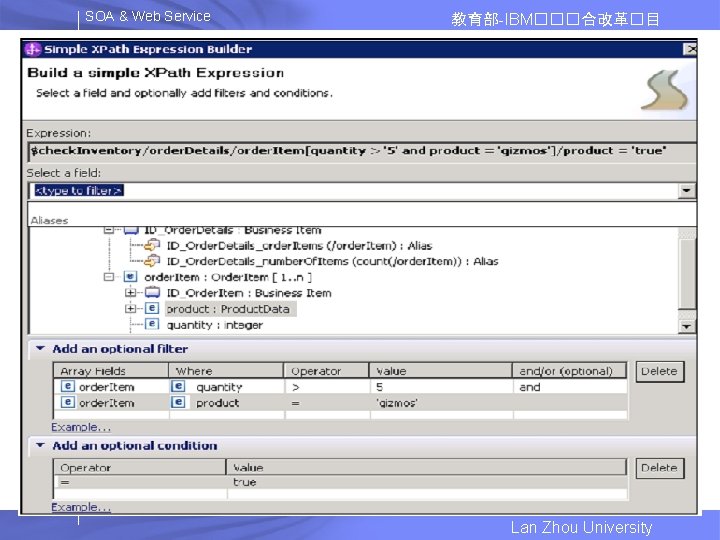
SOA & Web Service 教育部-IBM���合改革�目 Common XPath editor § When XPath expressions are used in IBM Integration Designer (as in data map parameter transformations), the graphical Xpath Expression Builder is used § The builder provides full XPath support and content assistance Lan Zhou University
SOA & Web Service 教育部-IBM���合改革�目 Lan Zhou University
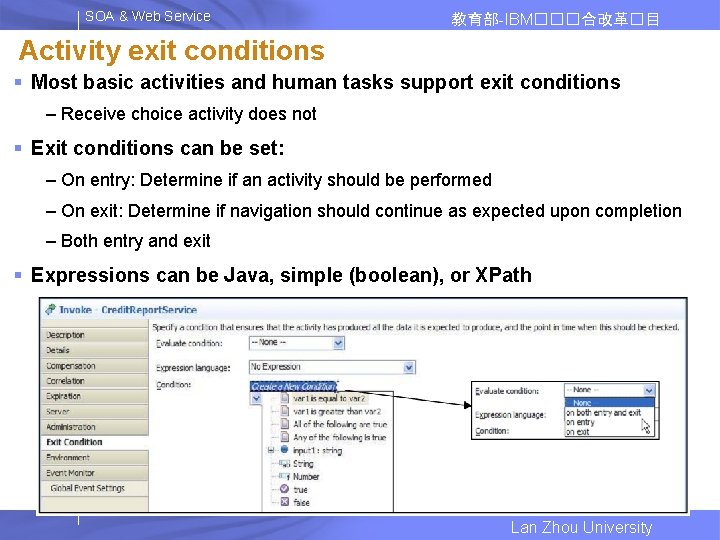
SOA & Web Service 教育部-IBM���合改革�目 Activity exit conditions § Most basic activities and human tasks support exit conditions – Receive choice activity does not § Exit conditions can be set: – On entry: Determine if an activity should be performed – On exit: Determine if navigation should continue as expected upon completion – Both entry and exit § Expressions can be Java, simple (boolean), or XPath Lan Zhou University
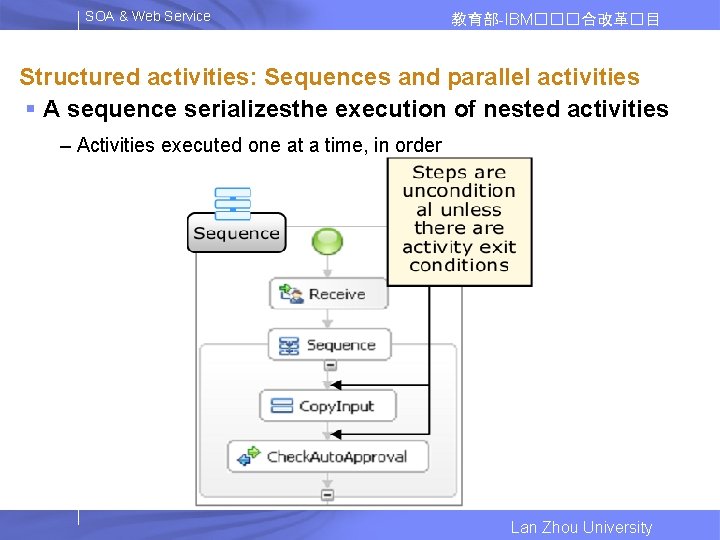
SOA & Web Service 教育部-IBM���合改革�目 Structured activities: Sequences and parallel activities § A sequence serializesthe execution of nested activities – Activities executed one at a time, in order Lan Zhou University
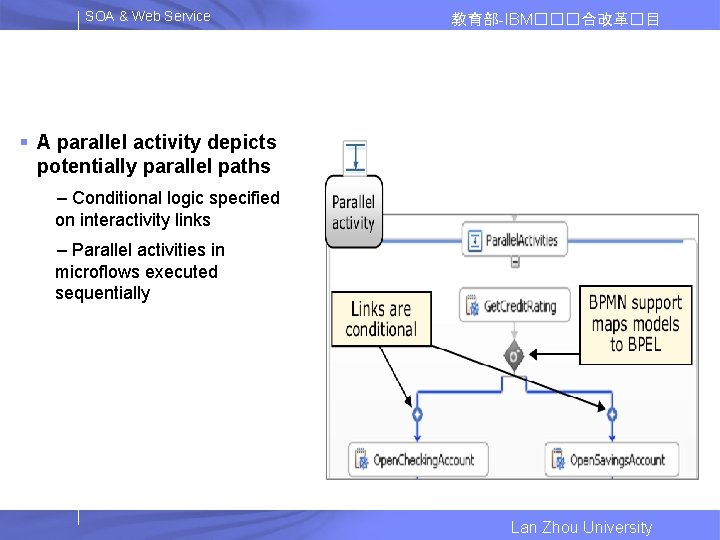
SOA & Web Service 教育部-IBM���合改革�目 § A parallel activity depicts potentially parallel paths – Conditional logic specified on interactivity links – Parallel activities in microflows executed sequentially Lan Zhou University
SOA & Web Service 教育部-IBM���合改革�目 Links and link conditions § Link conditions evaluate to true, false, or otherwise and are created using: – Java expressions (text or visual) – XPath expressions – Simple expressions (basic true, false, otherwise values) § Multiple true links in structured activities can result in parallel execution paths in a long-running process – Parallel paths can be joined with conditions – Joins use logical AND (process waits for execution from all paths), or logical OR (wait for a single path), to determine when to continue to the next activity – If none of the links evaluate to true, a join. Failure fault is raised – Join failure settings can be used to suppress the fault, skip the activity that threw it, and continue process execution Lan Zhou University
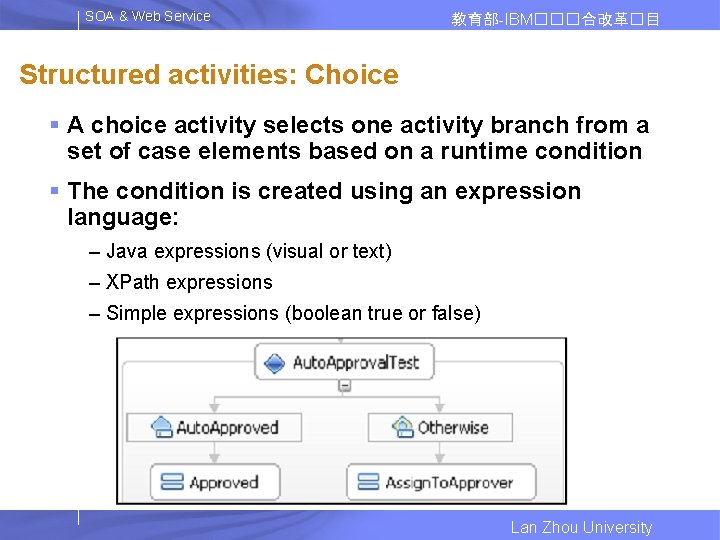
SOA & Web Service 教育部-IBM���合改革�目 Structured activities: Choice § A choice activity selects one activity branch from a set of case elements based on a runtime condition § The condition is created using an expression language: – Java expressions (visual or text) – XPath expressions – Simple expressions (boolean true or false) Lan Zhou University
SOA & Web Service 教育部-IBM���合改革�目 Structured activities: While loop § The while loop repeatedly executes the activities in its scopeas long as the condition is true § The condition is checked before the first iteration so it is possible that none of the nested activities will be executed § The condition may be created using: – Java expressions (text or visual) – XPath expressions – Simple expressions (boolean true or false) § A fault (handled or unhandled) terminates the loop – It is more efficient to end the loop by meeting the condition than by throwing an exception Lan Zhou University
SOA & Web Service 教育部-IBM���合改革�目 Structured activities: Repeat until loop § The repeat until loop executes the activities in its scope at least once and then continues to loop until the condition evaluates to true § The condition is checked at the end of each iteration so the activities run at least once § The condition may be created using: – Java expressions (visual or text) – XPath expressions – Simple expressions (boolean true or false) § A fault (handled or unhandled) terminates the loop – It is more efficient to end the loop by meeting the condition than by throwing an exception Lan Zhou University
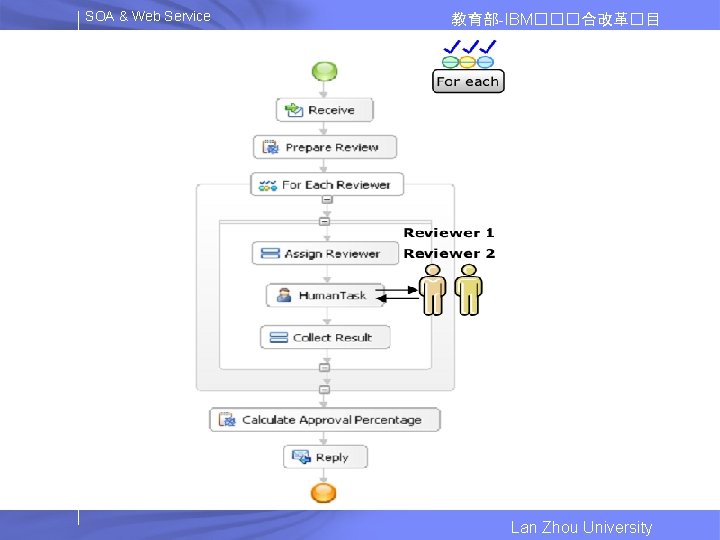
SOA & Web Service 教育部-IBM���合改革�目 Structured activities: For each § The for each activity enables the bundling of work – Requests requiring a dynamic number of reviewers – Continue after a certain number of quotes received § For each supports the Web. Sphere Business Modeler concept of arbitrary looping (repeating single activities) – Not necessary to place all repeated activities in a while loop § Within the bundle, you control: – Whether dynamic number of branches can be run serially or in parallel – Whether all branches are required for completion – Early exit criterion specifies termination after certain subset of branches Lan Zhou University
SOA & Web Service 教育部-IBM���合改革�目 Lan Zhou University
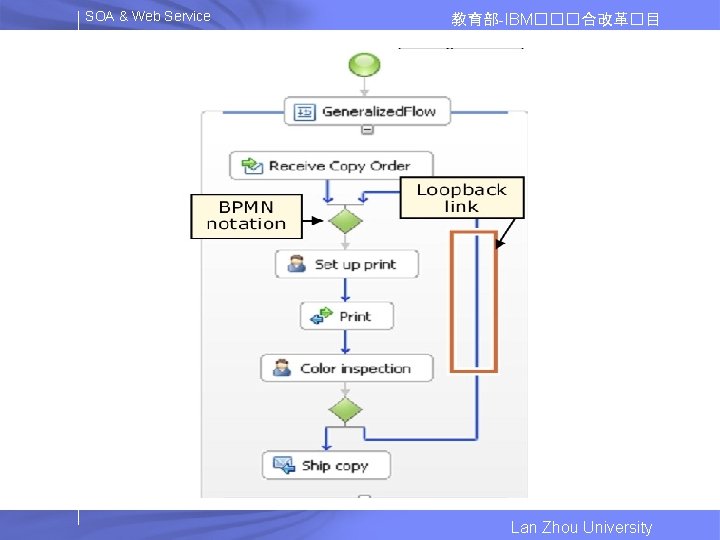
SOA & Web Service 教育部-IBM���合改革�目 Structured activities: Generalized flow (1 of 2) § Generalized flows: – Allow easy “backward” links in the process (go back to previous step) - loop back condition controls when the “back flow” occurs – Can use “catch” or “catch all” fault links instead of fault handlers – Support parallel execution paths § Generalized flows support important modeling scenarios – Model arbitrary loop logic (return to a previous activity) – Frequently used with human tasks – Example: Claims process where you need to arbitrarily jump back to redo previous activities Lan Zhou University
SOA & Web Service 教育部-IBM���合改革�目 Lan Zhou University
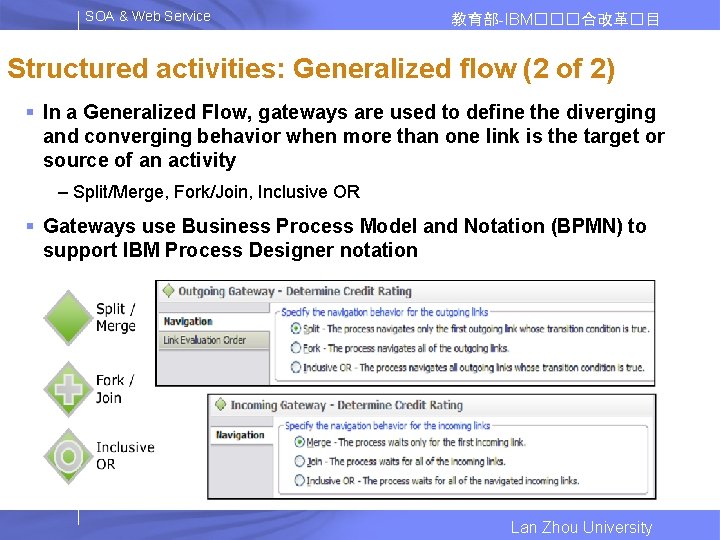
SOA & Web Service 教育部-IBM���合改革�目 Structured activities: Generalized flow (2 of 2) § In a Generalized Flow, gateways are used to define the diverging and converging behavior when more than one link is the target or source of an activity – Split/Merge, Fork/Join, Inclusive OR § Gateways use Business Process Model and Notation (BPMN) to support IBM Process Designer notation Lan Zhou University
SOA & Web Service 教育部-IBM���合改革�目 Structured activities: Scope § A scope is a behavioral container for one or more activities in your process – Encapsulates variables and correlation sets (state) § By definition, your entire process is contained within a single global scope § You can nest other scopes within the global scope, forming a hierarchy § Each scope can have its own: – Fault handlers (for expected error processing in the scope) – Event handlers (for event processing in the scope) – Compensation handlers (for unexpected error processing in the scope) – Local variables § Scopes support dynamic runtime behavior (discussed later) Lan Zhou University
SOA & Web Service 教育部-IBM���合改革�目 Thank you! Lan Zhou University
- Slides: 89