
Lecture 9 Memory Hierarchy 3 Michael B Greenwald
Lecture 9: Memory Hierarchy (3) Michael B. Greenwald Computer Architecture CIS 501 Fall 1999 CIS 501, Fall 99 MBG 1
Improving Cache Performance • Average memory-access time = Hit time + Miss rate x Miss penalty (ns or clocks) • Improve performance by: 1. Reduce the miss rate, 2. Reduce the miss penalty, or 3. Reduce the time to hit in the cache. CIS 501, Fall 99 MBG 2
Reducing Misses Techniques so far: • 1) Increasing Block Size • 2) Increasing Associativity • 3) Victim Caches CIS 501, Fall 99 MBG 3
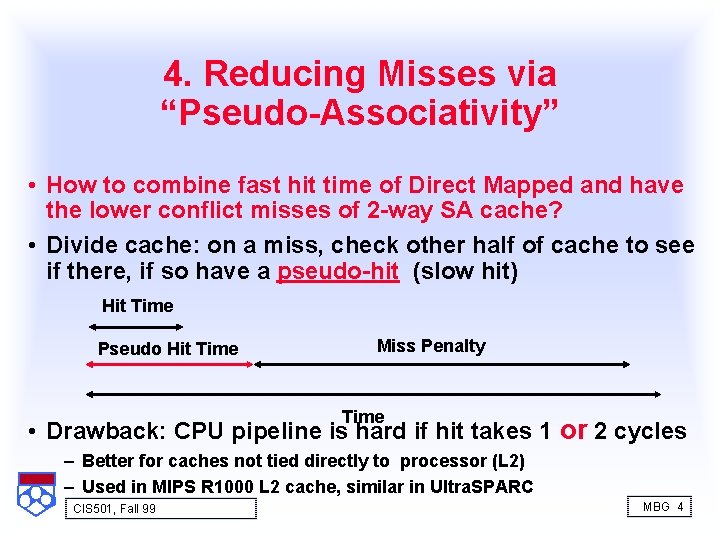
4. Reducing Misses via “Pseudo-Associativity” • How to combine fast hit time of Direct Mapped and have the lower conflict misses of 2 -way SA cache? • Divide cache: on a miss, check other half of cache to see if there, if so have a pseudo-hit (slow hit) Hit Time Pseudo Hit Time Miss Penalty Time • Drawback: CPU pipeline is hard if hit takes 1 or 2 cycles – Better for caches not tied directly to processor (L 2) – Used in MIPS R 1000 L 2 cache, similar in Ultra. SPARC CIS 501, Fall 99 MBG 4
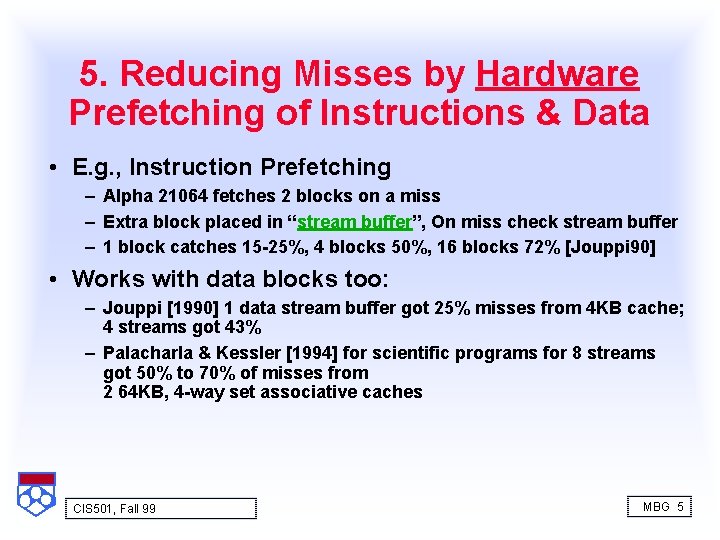
5. Reducing Misses by Hardware Prefetching of Instructions & Data • E. g. , Instruction Prefetching – Alpha 21064 fetches 2 blocks on a miss – Extra block placed in “stream buffer”, On miss check stream buffer – 1 block catches 15 -25%, 4 blocks 50%, 16 blocks 72% [Jouppi 90] • Works with data blocks too: – Jouppi [1990] 1 data stream buffer got 25% misses from 4 KB cache; 4 streams got 43% – Palacharla & Kessler [1994] for scientific programs for 8 streams got 50% to 70% of misses from 2 64 KB, 4 -way set associative caches CIS 501, Fall 99 MBG 5
5. Reducing Misses by Hardware Prefetching of Instructions & Data • Prefetching relies on having extra memory bandwidth that can be used without penalty • What if inadequate memory bandwidth? Slows down actual demand misses. If all prefetches end up being referenced, no net loss. That would require a 100% hit rate on prefetched blocks. CIS 501, Fall 99 MBG 6
6. Reducing Misses by Software Prefetching Data • Prefetch explicit blocks – Known they will be referenced. – Compiler models cache; likely cache miss. (algorithms: fixed horizon, aggressive, forestall [Kimbrel et. al. OSDI 96]) • Special instructions: – Load data into register (HP PA-RISC loads) – Cache Prefetch: load into cache (MIPS IV, Power. PC, SPARC v. 9) – Release (implemented? ) – Kimbel et. al. : outperforms demand fetching even with optimal replacement • Prefetching instructions cannot cause faults; a form of speculative execution CIS 501, Fall 99 MBG 7
6. Reducing Misses by Software Prefetching Data • Requires “non-blocking cache”: must be able to proceed in parallel with prefetch • Issuing Prefetch Instructions takes time – Is cost of prefetch issues < savings in reduced misses? – Higher superscalar reduces difficulty of issue bandwidth • Must prefetch early enough so satisfied before reference. But too early can increase either conflict or capacity misses. Timing critical. • Prefetching more important than optimizing release (intuition: if you release incorrect line, good prefetch can recover!). CIS 501, Fall 99 MBG 8
![7. Reducing Misses by Compiler/Software Optimizations • Mc. Farling [1989] reduced caches misses by](http://slidetodoc.com/presentation_image_h2/9822c41750f5249713cd32ce798814e6/image-9.jpg "7. Reducing Misses by Compiler/Software Optimizations • Mc. Farling [1989] reduced caches misses by")
7. Reducing Misses by Compiler/Software Optimizations • Mc. Farling [1989] reduced caches misses by 75% on 8 KB direct mapped cache, 4 byte blocks in software • Instructions – Reorder procedures in memory so as to reduce conflict misses – Profiling to look at conflicts(using tools they developed) • Data – Merging Arrays: improve spatial locality by single array of compound elements vs. 2 arrays – Loop Interchange: change nesting of loops to access data in order stored in memory – Loop Fusion: Combine 2 independent loops that have same looping and some variables overlap – Blocking: Improve temporal locality by accessing “blocks” of data repeatedly vs. going down whole columns or rows CIS 501, Fall 99 MBG 9
7. Reducing Misses by Compiler/Software Optimizations • Explicit management by programmer: (MP 3 D: Cheriton, Goosen, et. al. ) – Alignment: data structures start on cache line boundaries – Performance measurement: pad data to avoid conflict with instructions. – Improve both spatial and temporal locality • However, increases the total memory footprint of application although decreases instantaneous cache footprint – Cause performance degradation of TLB, etc. CIS 501, Fall 99 MBG 10
![Merging Arrays Example /* Before: 2 sequential arrays */ int val[SIZE]; int key[SIZE]; /*](http://slidetodoc.com/presentation_image_h2/9822c41750f5249713cd32ce798814e6/image-11.jpg "Merging Arrays Example /* Before: 2 sequential arrays */ int val[SIZE]; int key[SIZE]; /*")
Merging Arrays Example /* Before: 2 sequential arrays */ int val[SIZE]; int key[SIZE]; /* After: 1 array of stuctures */ struct merge { int val; int key; }; struct merged_array[SIZE]; Reducing conflicts between val & key; improve spatial locality -- both in same cache line CIS 501, Fall 99 MBG 11
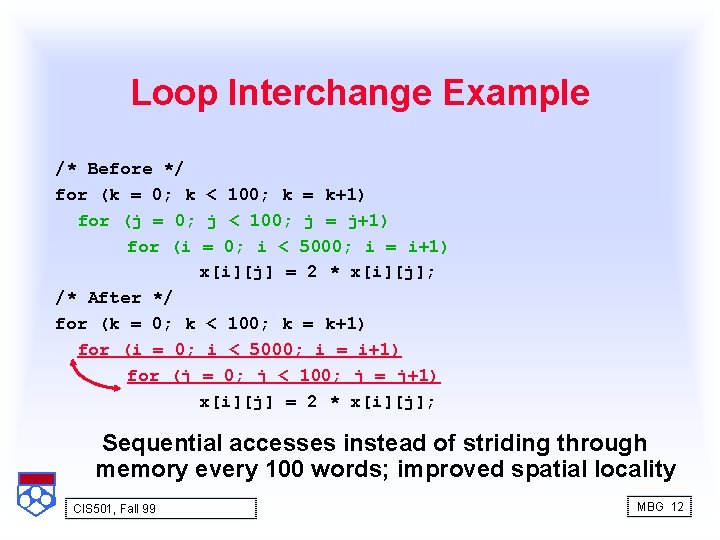
Loop Interchange Example /* Before */ for (k = 0; k < 100; k = k+1) for (j = 0; j < 100; j = j+1) for (i = 0; i < 5000; i = i+1) x[i][j] = 2 * x[i][j]; /* After */ for (k = 0; k < 100; k = k+1) for (i = 0; i < 5000; i = i+1) for (j = 0; j < 100; j = j+1) x[i][j] = 2 * x[i][j]; Sequential accesses instead of striding through memory every 100 words; improved spatial locality CIS 501, Fall 99 MBG 12
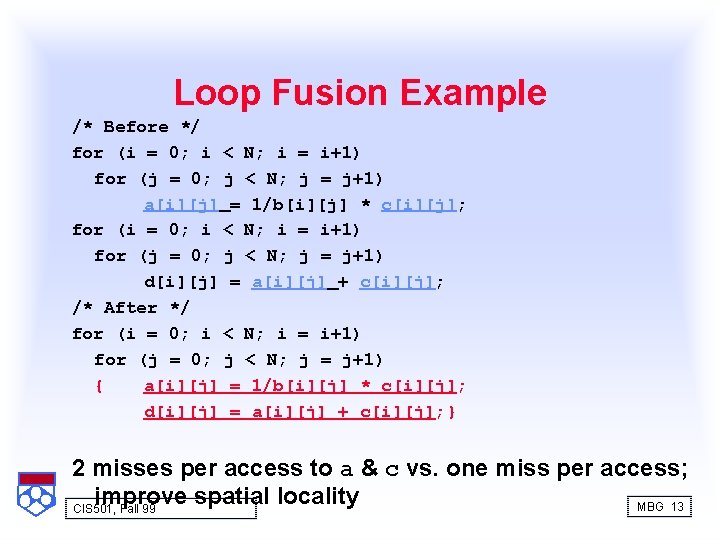
Loop Fusion Example /* Before */ for (i = 0; i < N; i = i+1) for (j = 0; j < N; j = j+1) a[i][j] = 1/b[i][j] * c[i][j]; for (i = 0; i < N; i = i+1) for (j = 0; j < N; j = j+1) d[i][j] = a[i][j] + c[i][j]; /* After */ for (i = 0; i < N; i = i+1) for (j = 0; j < N; j = j+1) { a[i][j] = 1/b[i][j] * c[i][j]; d[i][j] = a[i][j] + c[i][j]; } 2 misses per access to a & c vs. one miss per access; improve spatial locality MBG 13 CIS 501, Fall 99
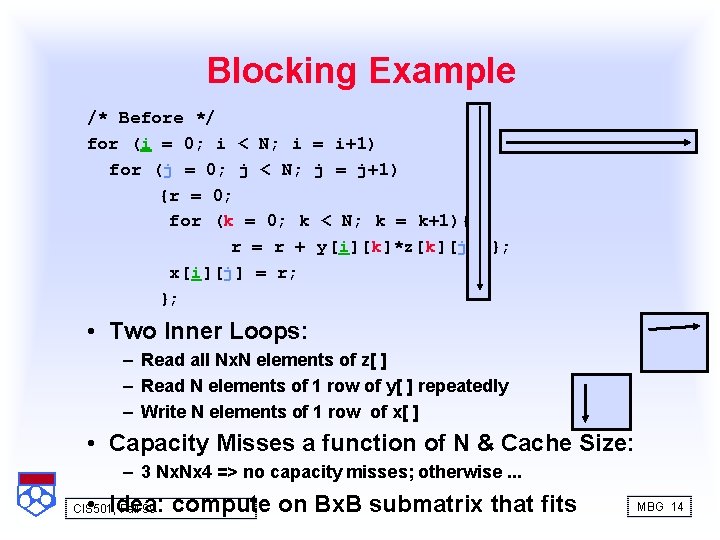
Blocking Example /* Before */ for (i = 0; i < N; i = i+1) for (j = 0; j < N; j = j+1) {r = 0; for (k = 0; k < N; k = k+1){ r = r + y[i][k]*z[k][j]; }; x[i][j] = r; }; • Two Inner Loops: – Read all Nx. N elements of z[ ] – Read N elements of 1 row of y[ ] repeatedly – Write N elements of 1 row of x[ ] • Capacity Misses a function of N & Cache Size: – 3 Nx. Nx 4 => no capacity misses; otherwise. . . • Idea: compute on Bx. B submatrix that fits CIS 501, Fall 99 MBG 14
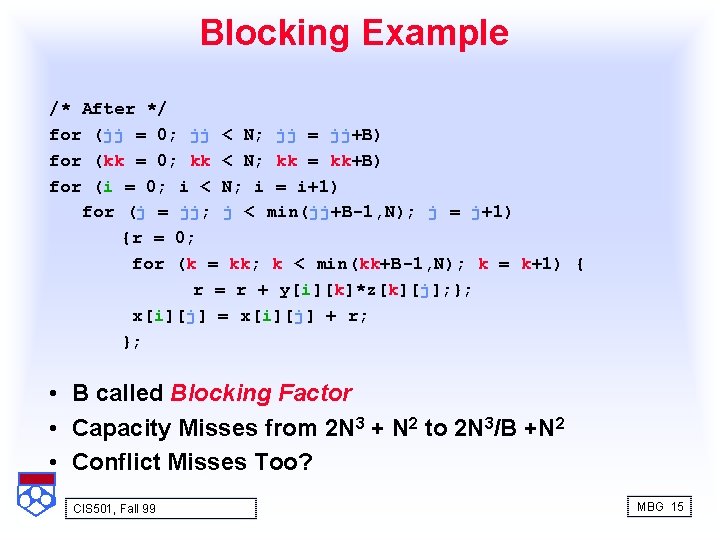
Blocking Example /* After */ for (jj = 0; jj < N; jj = jj+B) for (kk = 0; kk < N; kk = kk+B) for (i = 0; i < N; i = i+1) for (j = jj; j < min(jj+B-1, N); j = j+1) {r = 0; for (k = kk; k < min(kk+B-1, N); k = k+1) { r = r + y[i][k]*z[k][j]; }; x[i][j] = x[i][j] + r; }; • B called Blocking Factor • Capacity Misses from 2 N 3 + N 2 to 2 N 3/B +N 2 • Conflict Misses Too? CIS 501, Fall 99 MBG 15
Blocking • Can be used for registers, too, with small B. Reduces loads/stores. • Typically, blocking is used to reduce capacity misses, but small blocks can sometimes reduce conflict misses too. CIS 501, Fall 99 MBG 16
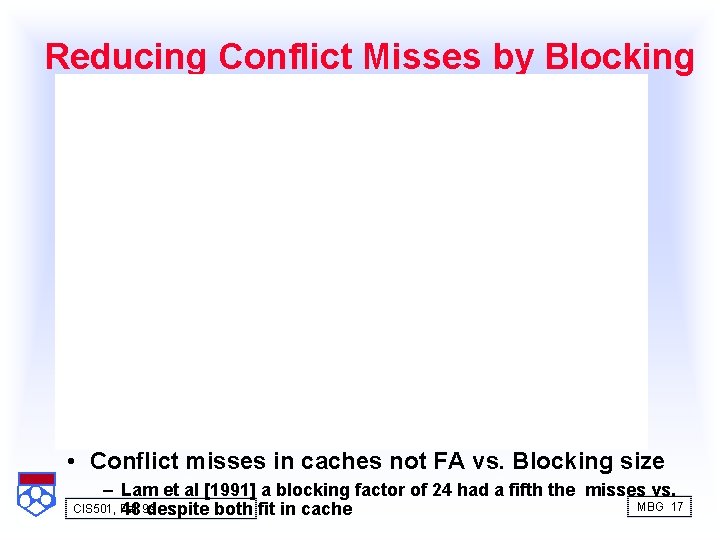
Reducing Conflict Misses by Blocking • Conflict misses in caches not FA vs. Blocking size – Lam et al [1991] a blocking factor of 24 had a fifth the misses vs. MBG 17 CIS 501, Fall 48 99 despite both fit in cache
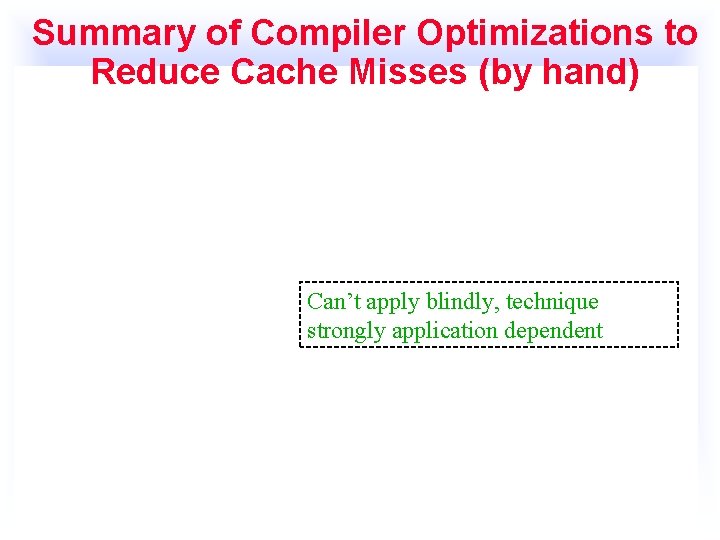
Summary of Compiler Optimizations to Reduce Cache Misses (by hand) Can’t apply blindly, technique strongly application dependent CIS 501, Fall 99 MBG 18
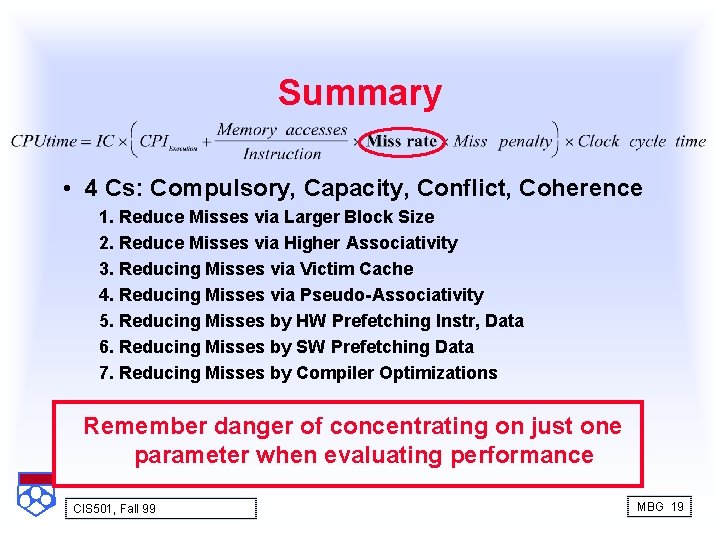
Summary • 4 Cs: Compulsory, Capacity, Conflict, Coherence 1. Reduce Misses via Larger Block Size 2. Reduce Misses via Higher Associativity 3. Reducing Misses via Victim Cache 4. Reducing Misses via Pseudo-Associativity 5. Reducing Misses by HW Prefetching Instr, Data 6. Reducing Misses by SW Prefetching Data 7. Reducing Misses by Compiler Optimizations Remember danger of concentrating on just one parameter when evaluating performance CIS 501, Fall 99 MBG 19
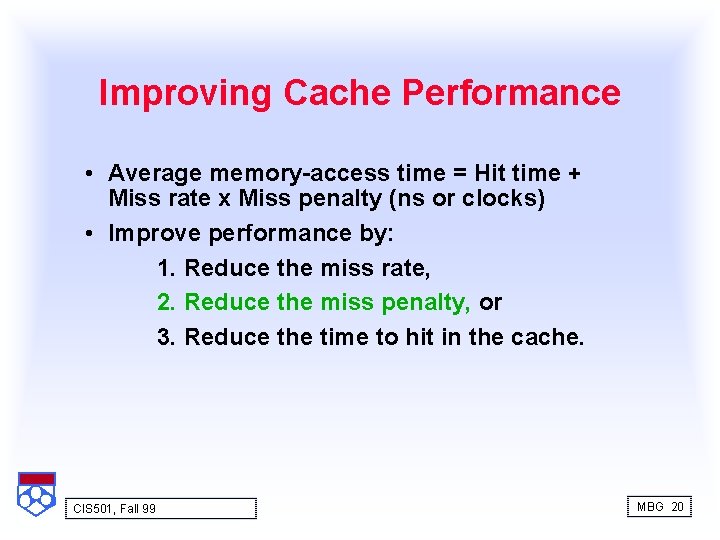
Improving Cache Performance • Average memory-access time = Hit time + Miss rate x Miss penalty (ns or clocks) • Improve performance by: 1. Reduce the miss rate, 2. Reduce the miss penalty, or 3. Reduce the time to hit in the cache. CIS 501, Fall 99 MBG 20
1. Reducing Miss Penalty: Read Priority over Write on Miss • Write through with write buffers offer RAW conflicts with main memory reads on cache misses • If simply wait for write buffer to empty, might increase read miss penalty (old MIPS 1000 by 50% ) • Check write buffer contents before read; if no conflicts, let the memory access continue • Write Back? – Read miss replacing dirty block – Normal: Write dirty block to memory, and then do the read – Instead copy the dirty block to a write buffer, then do the read, and then do the write – CPU stall less since restarts as soon as do read CIS 501, Fall 99 MBG 21
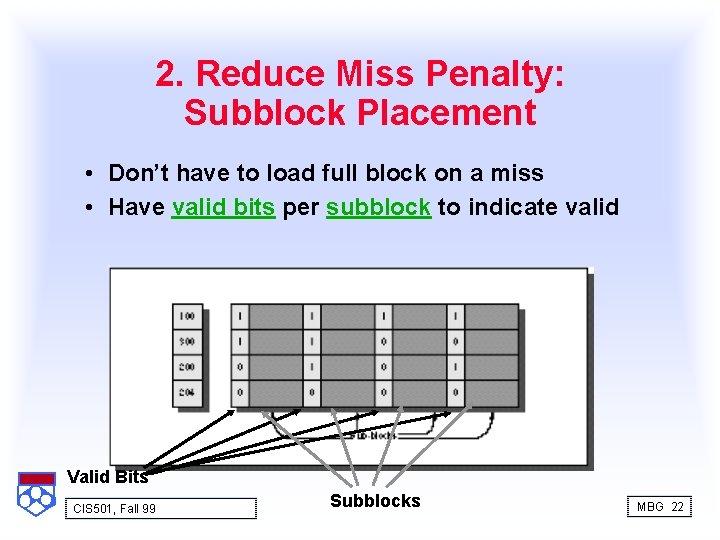
2. Reduce Miss Penalty: Subblock Placement • Don’t have to load full block on a miss • Have valid bits per subblock to indicate valid Valid Bits CIS 501, Fall 99 Subblocks MBG 22
2. Reduce Miss Penalty: Subblock Placement • Originally invented to reduce tag storage by increasing block size • This increases wasted space (fragmentation) but reduces transfer time. • Best when block size is chosen optimally and sub-block size chosen to reduce transfer time. CIS 501, Fall 99 MBG 23
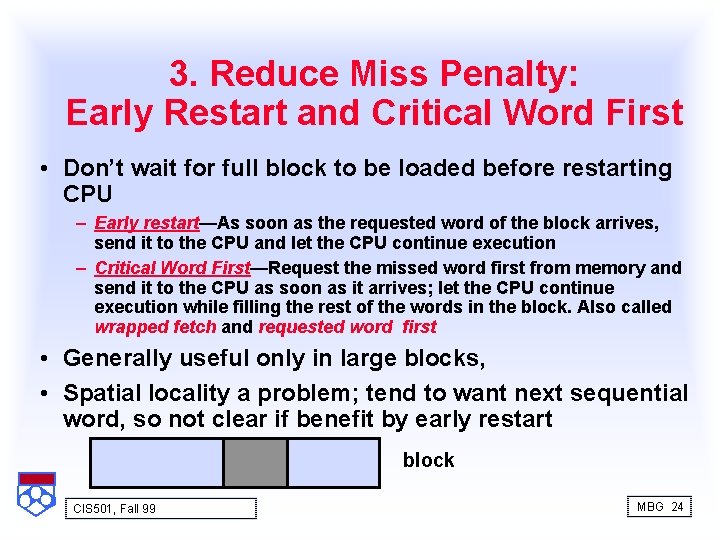
3. Reduce Miss Penalty: Early Restart and Critical Word First • Don’t wait for full block to be loaded before restarting CPU – Early restart—As soon as the requested word of the block arrives, send it to the CPU and let the CPU continue execution – Critical Word First—Request the missed word first from memory and send it to the CPU as soon as it arrives; let the CPU continue execution while filling the rest of the words in the block. Also called wrapped fetch and requested word first • Generally useful only in large blocks, • Spatial locality a problem; tend to want next sequential word, so not clear if benefit by early restart block CIS 501, Fall 99 MBG 24
4. Reduce Miss Penalty: Non-blocking Caches to reduce stalls on misses • Non-blocking cache or lockup-free cache allow data cache to continue to supply cache hits during a miss – requires out-of-order execution CPU. Can benefit Prefetch • “hit under miss” reduces the effective miss penalty by working during miss vs. ignoring CPU requests • “hit under multiple miss” or “miss under miss” may further lower the effective miss penalty by overlapping multiple misses – Significantly increases the complexity of the cache controller as there can be multiple outstanding memory accesses – Requires multiple memory banks (otherwise cannot support) – Pentium Pro allows 4 outstanding memory misses CIS 501, Fall 99 MBG 25
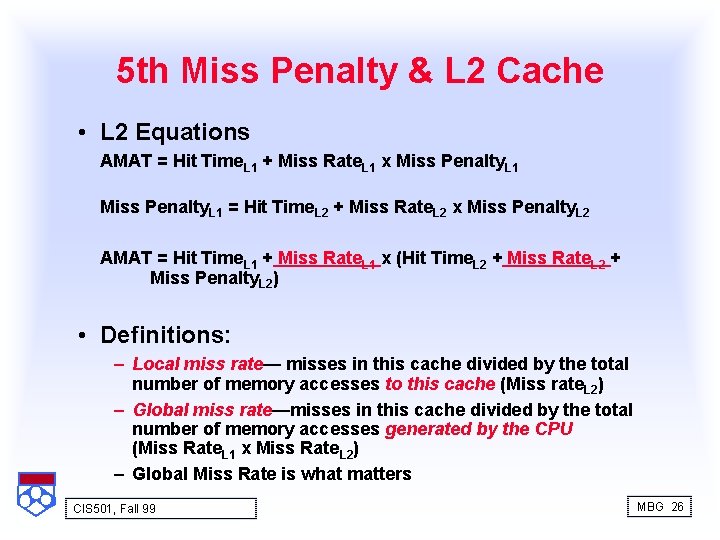
5 th Miss Penalty & L 2 Cache • L 2 Equations AMAT = Hit Time. L 1 + Miss Rate. L 1 x Miss Penalty. L 1 = Hit Time. L 2 + Miss Rate. L 2 x Miss Penalty. L 2 AMAT = Hit Time. L 1 + Miss Rate. L 1 x (Hit Time. L 2 + Miss Rate. L 2 + Miss Penalty. L 2) • Definitions: – Local miss rate— misses in this cache divided by the total number of memory accesses to this cache (Miss rate. L 2) – Global miss rate—misses in this cache divided by the total number of memory accesses generated by the CPU (Miss Rate. L 1 x Miss Rate. L 2) – Global Miss Rate is what matters CIS 501, Fall 99 MBG 26
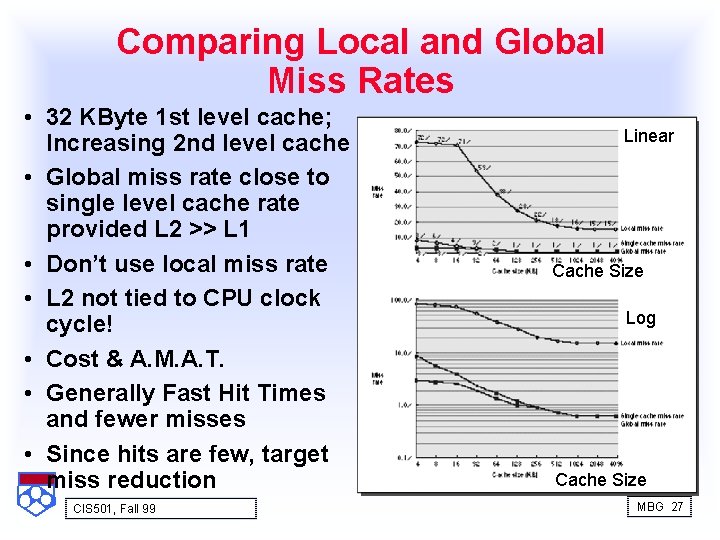
Comparing Local and Global Miss Rates • 32 KByte 1 st level cache; Increasing 2 nd level cache • Global miss rate close to single level cache rate provided L 2 >> L 1 • Don’t use local miss rate • L 2 not tied to CPU clock cycle! • Cost & A. M. A. T. • Generally Fast Hit Times and fewer misses • Since hits are few, target miss reduction CIS 501, Fall 99 Linear Cache Size Log Cache Size MBG 27
- Slides: 27