
Lecture 9 ILP Innovations Today handling memory dependences
![Out-of-Order Loads/Stores Ld R 1 [R 2] Ld R 3 [R 4] St R](https://slidetodoc.com/presentation_image_h2/f5ed2742e691ba41350936a829395f2d/image-3.jpg "Out-of-Order Loads/Stores Ld R 1 [R 2] Ld R 3 [R 4] St R")


- Slides: 14
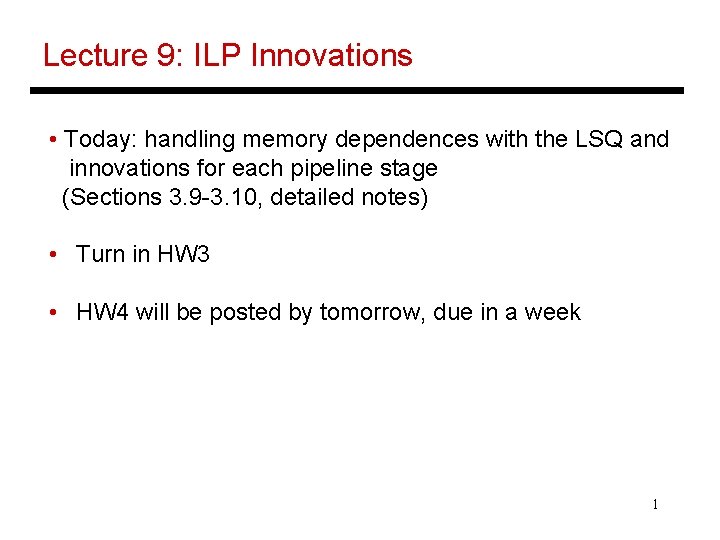
Lecture 9: ILP Innovations • Today: handling memory dependences with the LSQ and innovations for each pipeline stage (Sections 3. 9 -3. 10, detailed notes) • Turn in HW 3 • HW 4 will be posted by tomorrow, due in a week 1
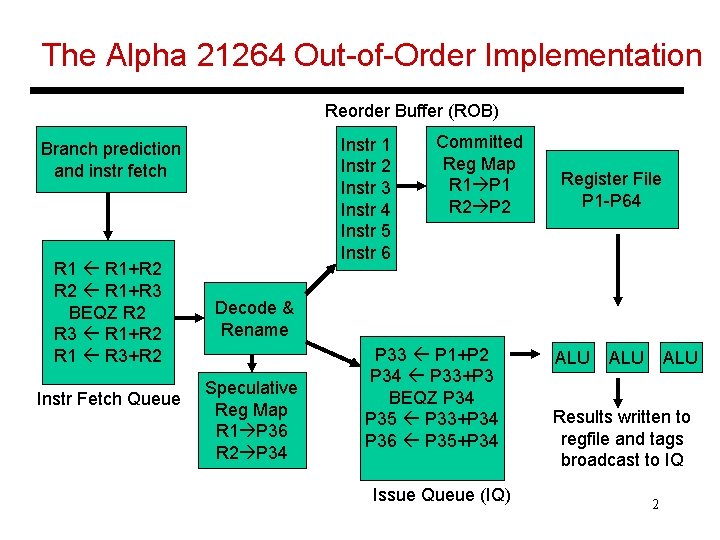
The Alpha 21264 Out-of-Order Implementation Reorder Buffer (ROB) Instr 1 Instr 2 Instr 3 Instr 4 Instr 5 Instr 6 Branch prediction and instr fetch R 1+R 2 R 1+R 3 BEQZ R 2 R 3 R 1+R 2 R 1 R 3+R 2 Instr Fetch Queue Committed Reg Map R 1 P 1 R 2 P 2 Register File P 1 -P 64 Decode & Rename Speculative Reg Map R 1 P 36 R 2 P 34 P 33 P 1+P 2 P 34 P 33+P 3 BEQZ P 34 P 35 P 33+P 34 P 36 P 35+P 34 Issue Queue (IQ) ALU ALU Results written to regfile and tags broadcast to IQ 2
Out-of-Order Loads/Stores Ld R 1 [R 2] Ld R 3 [R 4] St R 5 [R 6] Ld R 7 [R 8] Ld R 9 [R 10] What if the issue queue also had load/store instructions? Can we continue executing instructions out-of-order? 3
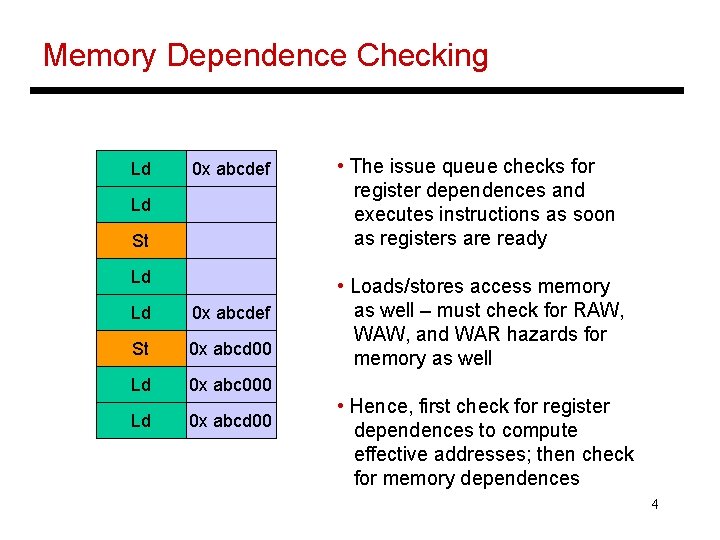
Memory Dependence Checking Ld 0 x abcdef Ld St Ld Ld 0 x abcdef St 0 x abcd 00 Ld 0 x abc 000 Ld 0 x abcd 00 • The issue queue checks for register dependences and executes instructions as soon as registers are ready • Loads/stores access memory as well – must check for RAW, WAW, and WAR hazards for memory as well • Hence, first check for register dependences to compute effective addresses; then check for memory dependences 4
Memory Dependence Checking Ld 0 x abcdef Ld St Ld Ld 0 x abcdef St 0 x abcd 00 Ld 0 x abc 000 Ld 0 x abcd 00 • Load and store addresses are maintained in program order in the Load/Store Queue (LSQ) • Loads can issue if they are guaranteed to not have true dependences with earlier stores • Stores can issue only if we are ready to modify memory (can not recover if an earlier instr raises an exception) 5
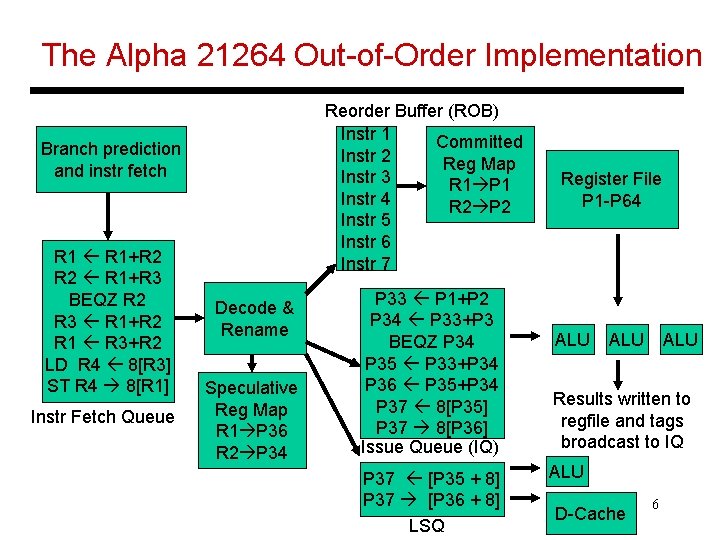
The Alpha 21264 Out-of-Order Implementation Reorder Buffer (ROB) Instr 1 Committed Instr 2 Reg Map Instr 3 R 1 P 1 Instr 4 R 2 P 2 Instr 5 Instr 6 Instr 7 Branch prediction and instr fetch R 1+R 2 R 1+R 3 BEQZ R 2 R 3 R 1+R 2 R 1 R 3+R 2 LD R 4 8[R 3] ST R 4 8[R 1] Instr Fetch Queue Decode & Rename Speculative Reg Map R 1 P 36 R 2 P 34 P 33 P 1+P 2 P 34 P 33+P 3 BEQZ P 34 P 35 P 33+P 34 P 36 P 35+P 34 P 37 8[P 35] P 37 8[P 36] Issue Queue (IQ) P 37 [P 35 + 8] P 37 [P 36 + 8] LSQ Register File P 1 -P 64 ALU ALU Results written to regfile and tags broadcast to IQ ALU D-Cache 6
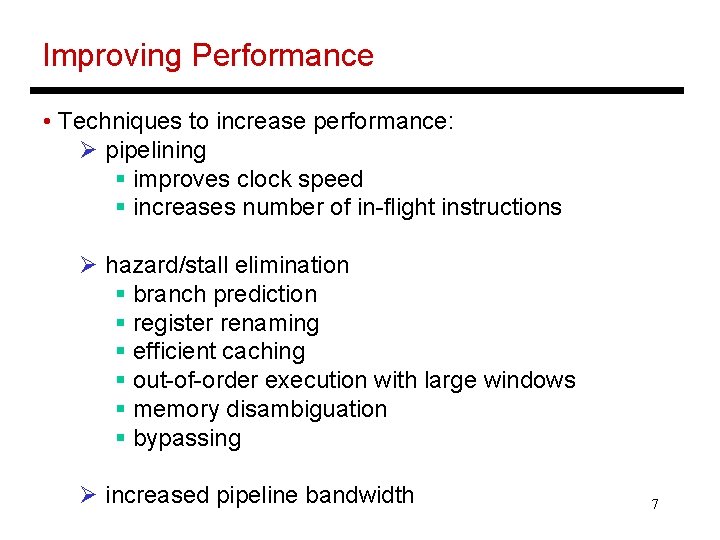
Improving Performance • Techniques to increase performance: Ø pipelining § improves clock speed § increases number of in-flight instructions Ø hazard/stall elimination § branch prediction § register renaming § efficient caching § out-of-order execution with large windows § memory disambiguation § bypassing Ø increased pipeline bandwidth 7
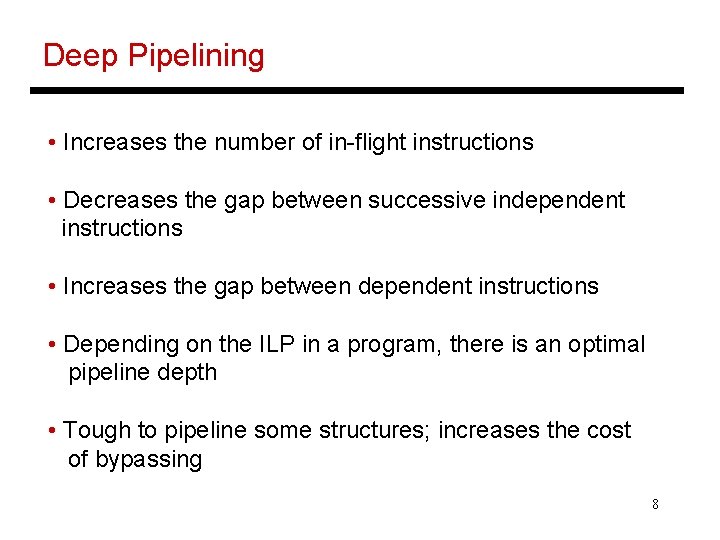
Deep Pipelining • Increases the number of in-flight instructions • Decreases the gap between successive independent instructions • Increases the gap between dependent instructions • Depending on the ILP in a program, there is an optimal pipeline depth • Tough to pipeline some structures; increases the cost of bypassing 8
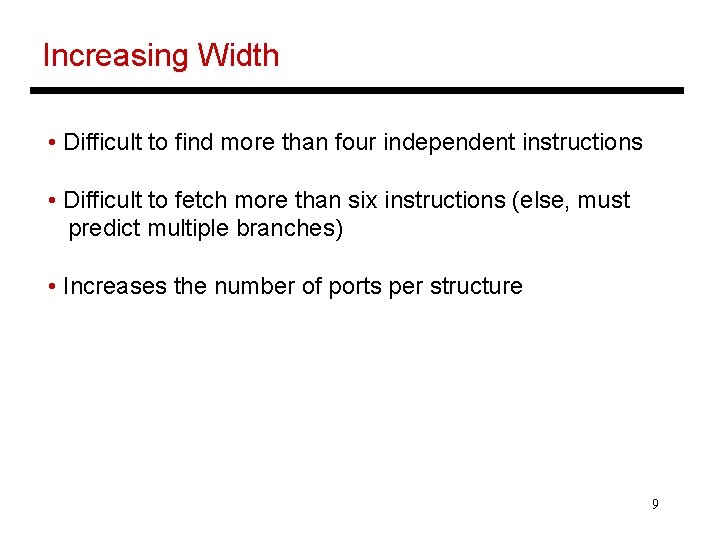
Increasing Width • Difficult to find more than four independent instructions • Difficult to fetch more than six instructions (else, must predict multiple branches) • Increases the number of ports per structure 9
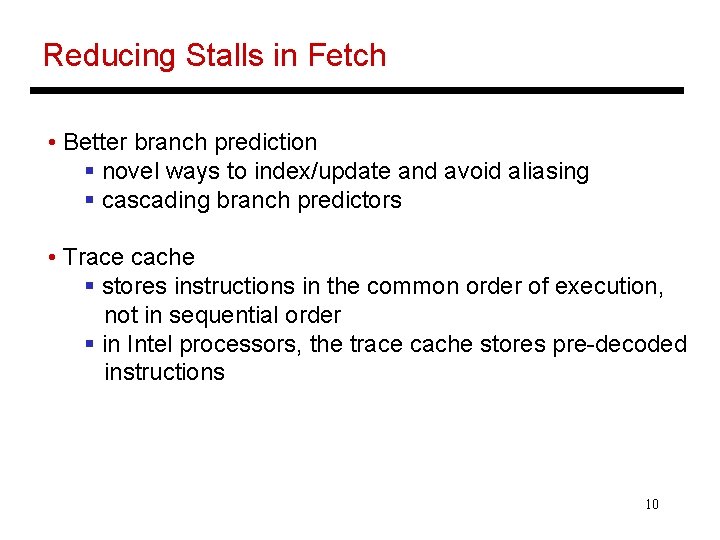
Reducing Stalls in Fetch • Better branch prediction § novel ways to index/update and avoid aliasing § cascading branch predictors • Trace cache § stores instructions in the common order of execution, not in sequential order § in Intel processors, the trace cache stores pre-decoded instructions 10
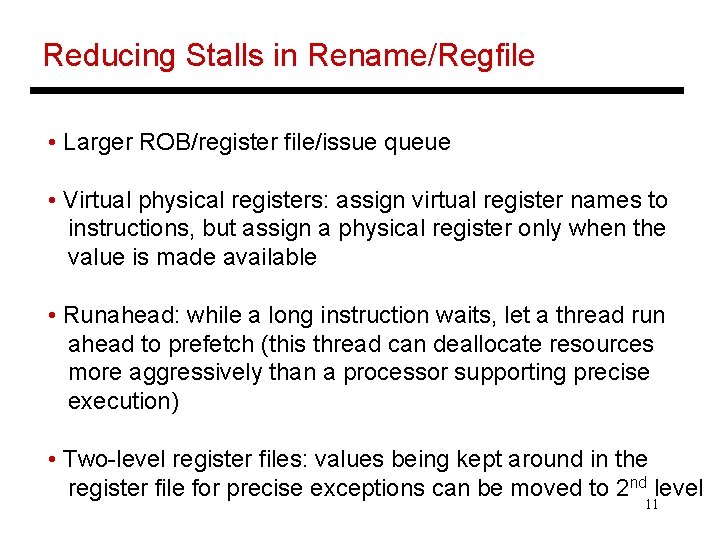
Reducing Stalls in Rename/Regfile • Larger ROB/register file/issue queue • Virtual physical registers: assign virtual register names to instructions, but assign a physical register only when the value is made available • Runahead: while a long instruction waits, let a thread run ahead to prefetch (this thread can deallocate resources more aggressively than a processor supporting precise execution) • Two-level register files: values being kept around in the register file for precise exceptions can be moved to 2 nd level 11
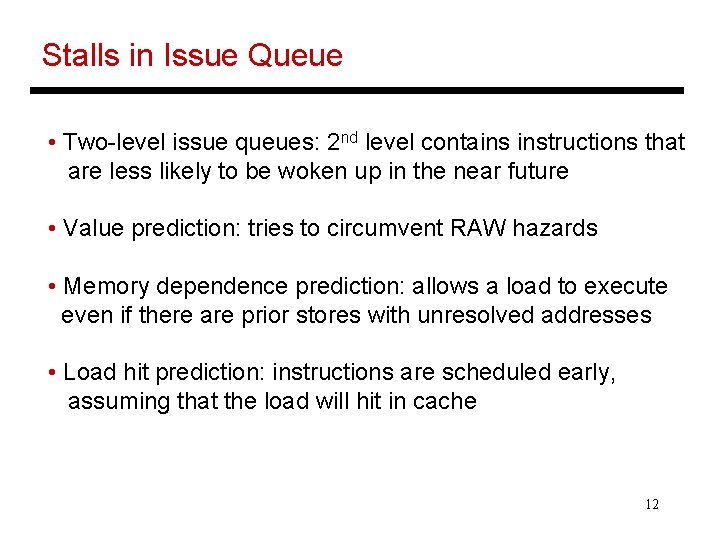
Stalls in Issue Queue • Two-level issue queues: 2 nd level contains instructions that are less likely to be woken up in the near future • Value prediction: tries to circumvent RAW hazards • Memory dependence prediction: allows a load to execute even if there are prior stores with unresolved addresses • Load hit prediction: instructions are scheduled early, assuming that the load will hit in cache 12
Functional Units • Clustering: allows quick bypass among a small group of functional units; FUs can also be associated with a subset of the register file and issue queue 13
Title • Bullet 14