
Lecture 9 Data structures cont Computing platforms Novosibirsk
Lecture 9 Data structures (cont. ) Computing platforms Novosibirsk State University of Hertfordshire D. Irtegov, A. Shafarenko 2018
Endianness • Consider a number containing > 8 bits • It takes several bytes -> it’s a data structure • It seems to be simple • But really, how to layout it in memory? • There are two logical possibilities • (and I know one illogical)
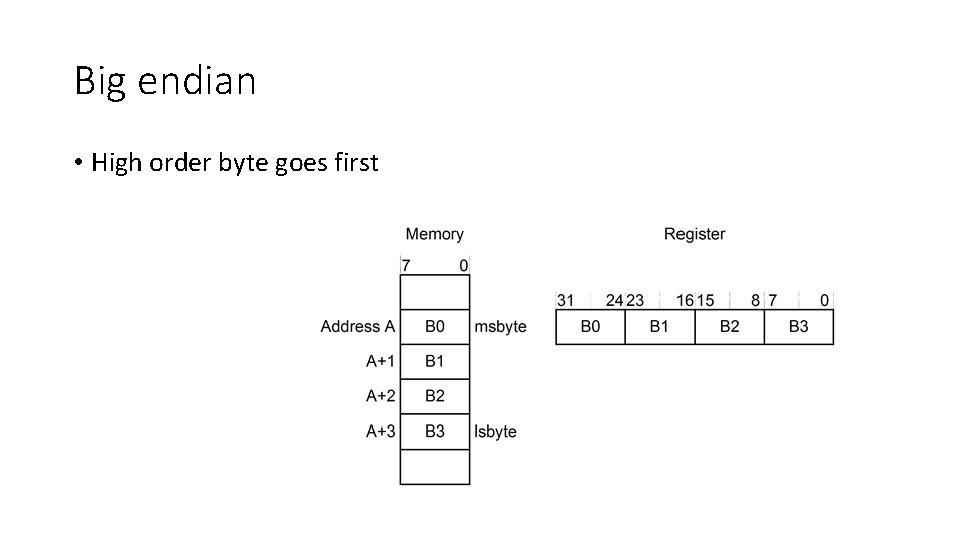
Big endian • High order byte goes first
Big endian • Most famous big-endian ISA: IBM System/360, MC 68000 • Advantage: • byte-level hex dump reads like number (higher byte on the left) • I guess that’s because European got positional numbers from Arabs, • So numbers are written in opposite order (relative to text) • Disadvantage: • • You cannot convert long * to short * Converted pointer will point to upper half of long This is probably not what you want So many C compilers give a warning when you do such a conversion

Little endian • Low order byte goes first
Little endian • Lower byte goes first (at smaller address) • Most famous little-endian ISA: DEC VAX, x 86 • Advantage: • Results of long * to short * conversion are intuitively correct • Disadvantages: • It is hard to understand numeric values in byte-level hex dump • The code with pointer conversions is not portable to big-endian computers
Mixed endian ISA • Many popular ISA, including ARM, are mixed endian • There is a bit in PSW or other configuration register, switching the CPU in big- or little-endian mode • Typically, a given OS supports only one endianness for all processes • Otherwise, it would be hard to exchange data between processes and kernel
Illogical possibility • PDP-endianness: • • • On PDP-11, 16 -bit integers are little-endian But 32 -bit integer is big endian (higher half is stored at lower address) PDP-11 was 16 -bit, but 32 -bit endianness was sort of wired in hardware MUL instruction stored 32 -bit result of 16 -bit multiplication in PDP-endian PDP-11 32 -bit successor, DEC VAX, was fully little endian
History of the term • Actually a citation from Gulliver's Travels • Oldest document using this term AFAIK is IEN 137 (Internet Experiment Note) ON HOLY WARS AND A PLEA FOR PEACE by Danny Cohen, dated 1 April 1980 https: //www. ietf. org/rfc/ien 137. txt • Indeed, endianness is a big nuisance for • network protocols • data exchange formats • software portability (pointer conversion issue)
Text strings • Text strings are byte sequences of variable size • There are two logical possibilities: • Using a terminator byte at the end of the string (example: C ASCIIZ strings) • Prepending a counter before beginning of the string (example: Pascal strings)
Terminator byte (ASCIIZ) • In C, 0 x 00 byte is used as end of string terminator • In Unix text files, ‘n’ (0 x 0 A byte) is used as end of line • In DOS/Windows text files, ’rn’ byte pair is used as end of line • This dates back to 1960 s religious wars on how to interpret ASCII standard • Advantages: • You can have strings of unlimited length • For long strings, terminator byte is cheaper (less metadata per volume of text) • Disadvantage: • You need to scan all string to find its length • But you often need to know the length, for example to allocate memory for a copy
Counter before the string • Disadvantages: • Bitness of the counter implicitly limits the size of the string • For example, in Pascal, strings are limited by 255 bytes • Long (32 -bit) counters create significant memory overhead • Advantages: • It is easy to find the size of the string • Actually, many languages (Python, Java, even C++ STL) use strings with counters
Packed structures (bit fields) • Consider a situation, when you need to store information which is not multiple of 8 bit • • Unsigned number between 0 and 63 ASCII character (it is actually 7 -bit) A set of 300 items Cd. M-8 register number • Obvious solution: round the number of bits up to multiple of 8 • Advantage: data are easy to process • Disadvantage: you lose memory
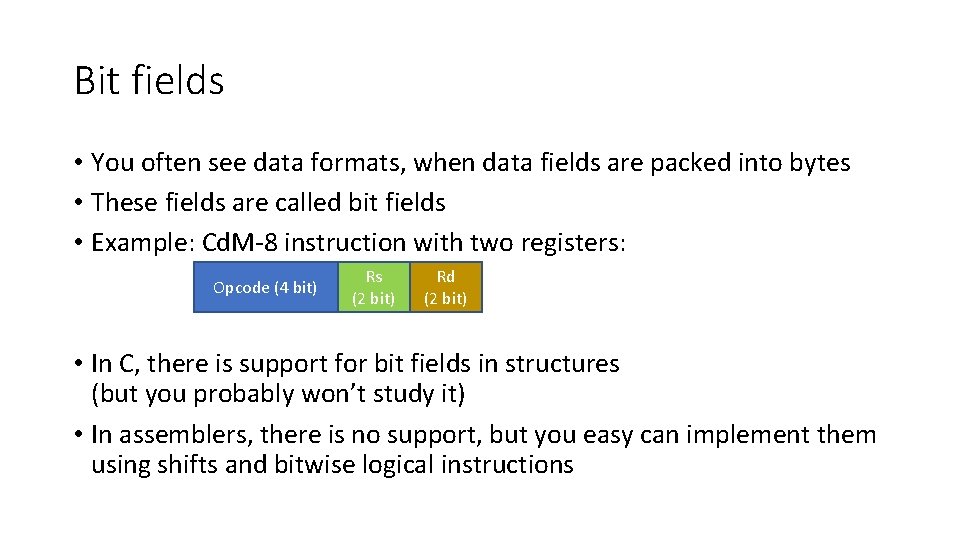
Bit fields • You often see data formats, when data fields are packed into bytes • These fields are called bit fields • Example: Cd. M-8 instruction with two registers: Opcode (4 bit) Rs (2 bit) Rd (2 bit) • In C, there is support for bit fields in structures (but you probably won’t study it) • In assemblers, there is no support, but you easy can implement them using shifts and bitwise logical instructions
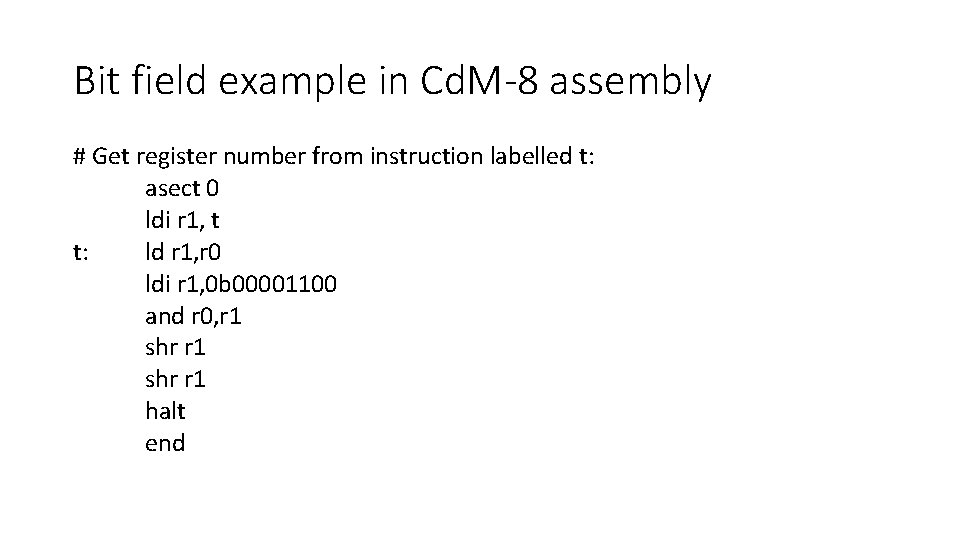
Bit field example in Cd. M-8 assembly # Get register number from instruction labelled t: asect 0 ldi r 1, t t: ld r 1, r 0 ldi r 1, 0 b 00001100 and r 0, r 1 shr r 1 halt end
Variant records • Consider a person • In University, there are two types of people: students and staff • Students have attributes: name, SRN, course (year of admission), faculty and group (in NSU, faculty and year of admission are encoded in group number) • Staff have attributes: name, payroll number, faculty or department, position • But sometimes you need a dataset, containing both students and staff
Tagged variant records • Tagged record has a tag: a field designating the record type • Tag must be placed on a fixed position in the structure, so any code working with the structure can find the tag • Variant records can be of fixed or variable length • C union is not a tagged record • But you can use struct with tags and union fields to implement a tagged record • Dynamically typed languages, like Python or Java. Script, usually have type tags attached to all values
Prefix codes • Prefix code can be seen as sequence of tagged variant records of variable size • A prefix can be seen as a record tag encoding length and structure of following data • In properly constructed prefix code, entire set of possible encoded values ("codewords") must not contain any values that start with any other value in the set • Prefix codes are important because you can uniquely decode them
Prefix codes: examples • Phone number with area code • Local phone number for stationary phones (7 digits in Novosibirsk) • Intercity call (Ru): 8 -area code-7 digit local number (maybe padded with leading 2) • No local phone number in Russia can start with 8 • International call: +Country code-area code-local number • Country codes are of variable length and actually use prefix system themselves • For example, +7 is formerly USSR numbering scheme. In 1990 s, most ex-USSR countries took their own country codes. Ru and Kz still share 7 prefix, with 76 and 77 codes for Kz, 70. . 72 unused and rest of the codes for Ru
Other examples of prefix codes • Huffman code (you will study it in C programming course) • Morse code • UTF-8 encoding • Not only prefix, but self-synchronizing • If you start decoding from wrong position (not from the prefix), you can detect this and skip to next valid prefix • Most other prefix codes do not have this property • Many machine languages • Cd. M-8 ISA has 1 -byte and 2 -byte instructions, selected by opcode • x 86 and VAX ISA have even more complex encoding schemes
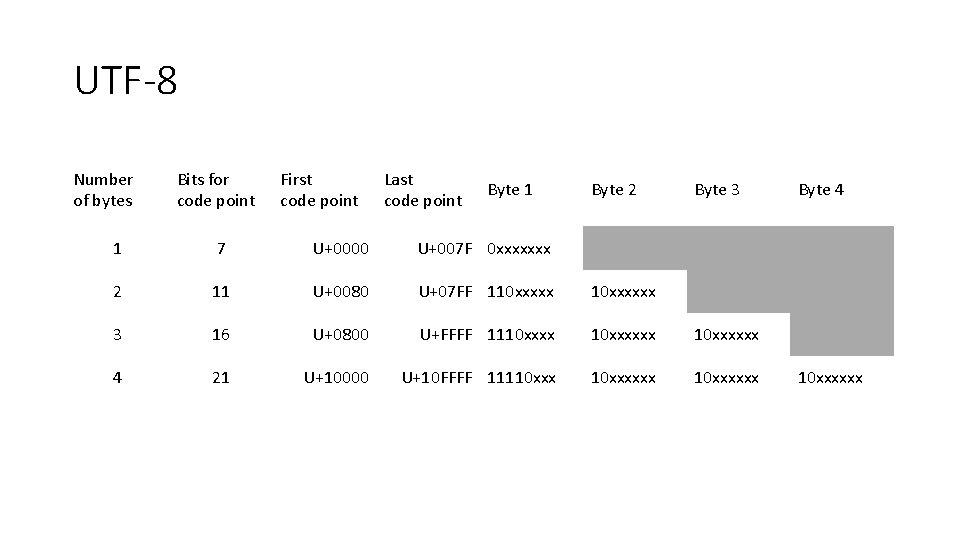
UTF-8 Number of bytes Bits for code point First code point Last code point Byte 1 Byte 2 Byte 3 1 7 U+0000 U+007 F 0 xxxxxxx 2 11 U+0080 U+07 FF 110 xxxxxx 3 16 U+0800 U+FFFF 1110 xxxxxx 4 21 U+10000 U+10 FFFF 11110 xxxxxx Byte 4 10 xxxxxx
Machine-readable languages • It is hard to draw a line between complex prefix code and a language • Machine-readable language must be uniquely decodable • Natural languages do not have this property • Prefix codes are uniquely decodable, but most of them are too simple to be considered a language • Many computer languages actually are not prefix codes you need some kind of backtracking to properly parse them • For example, in C, a + sign is an operator on its own and a prefix of ++ and += operators
Parsers • Writing lexers and parsers is rather complex task, so we won’t go into this now • You will have courses dedicated to this topic • But it is much simplier than you might think • Tools to generate parsers based on formal description of the syntax • Regular approaches to manually writing a parser • Actually, when you learn rules for describing the syntax, you probably can invent such approach yourself • Parser libraries for many languages (XML, JSON, yaml) • You have one task (parsing a text representation of set) which is actually a simple parser
- Slides: 23