
Lecture 9 clinical practice Laboratory Diagnosis of Fungal
Lecture 9 clinical practice Laboratory Diagnosis of Fungal Infections (I) By dr. Dalia Galal
Fungal Infections/ Mycoses u Superficial mycoses: n 2 types: surface and cutaneous mycoses n Skin, hair & nails. u Deep mycoses: n 2 types: subcutaneous & systemic mycoses n Range from a symptomatic infection to fatal disease u Opportunistic mycoses : Mostly systemic involvement
Sites & Types of Specimens Specimen collection depends on the corresponding disease. Very important to proceed for a final diagnosis.
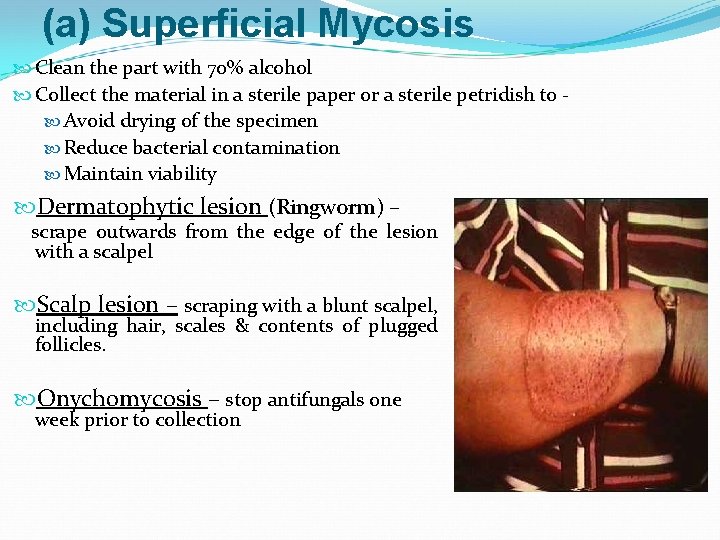
(a) Superficial Mycosis Clean the part with 70% alcohol Collect the material in a sterile paper or a sterile petridish to Avoid drying of the specimen Reduce bacterial contamination Maintain viability Dermatophytic lesion (Ringworm) – scrape outwards from the edge of the lesion with a scalpel Scalp lesion – scraping with a blunt scalpel, including hair, scales & contents of plugged follicles. Onychomycosis – stop antifungals one week prior to collection
(b) Subcutaneous Mycosis Scrapings or crusts from the superficial parts of lesions Pus aspirates Biopsy (c) Systemic Mycosis Pus Biopsy Feces Urine Sputum CSF Blood
Collection & Transport of specimen Proper collection of specimen and in adequate quantity. Early transport to the lab to avoid overgrowth of contaminant Respiratory specimens Sputum – early morning sample, after mouth wash, flakes to be used for culturing. Blood Inoculated in 2 bottles – for dimorphic fungi Cerebrospinal fluid Should be immediately processed else stored at RT or at 30°C in an incubator Centrifuge & use sediment for culture
Collection & Transport of specimen Skin, Hair & Nail Taken for dermatophytic infections Hair : with forceps Tissue & Body fluids Tissues – grind or mince before culturing Body fluids – centrifuge & use sediment for culture Urine – centrifuge & use sediment for culture
Laboratory Diagnosis Direct examination Fungal culture Serological tests Skin tests PCR & other molecular methods
1. Direct Examination Very sensitive in the diagnosis of fungal infections Wet mounts Slide & tube KOH mounts – 10 to 20% KOH – digests protein debris, dissolves keratin. DMSO can be added to KOH to hasten clearing in skin scrapings & nail clippings Calcofluor white – fluorescent stain – excellent morphology of pathogenic fungi India ink – capsulated fungi
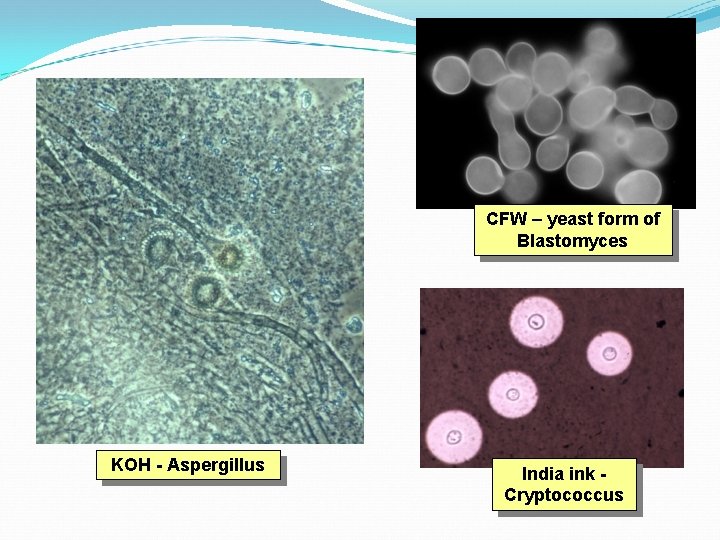
CFW – yeast form of Blastomyces KOH - Aspergillus India ink Cryptococcus
1. Direct Examination Gram stain – fungi are gram positive Histopathology Superficial infection – acute, subacute or chronic dermatitis. Subcutaneous & systemic infections – granulomatous reaction with fibrosis or pyogenic inflammation. Routine stain – Hematoxylin & Eosin (HE)
1. Direct Examination Histopathology Special stains – PAS (Per Iodic acid), GMS (Grocott Gomori Methanamine Silver), Mayer’s mucicarmine, Gridley’s stain Fluorescent- antibody staining To detect fungal Ag in clinical specimen such as pus, blood, CSF, tissue sections Special stains can detect fungus even when few organisms are present
Lecture 10 clinical practice Laboratory Diagnosis of Fungal Infections (II) By dr. Dalia Galal
2. Fungal Culture Sabouraud Dextrose Agar (SDA) Contains 2% dextrose, antibiotics (gentamicin, chloramphenicol) and cycloheximide Selective media Corn meal agar (CMA) – sporulation, chlamydospore formation Bird seed agar – cryptococcus, forms brown colonies Brain Heart Infusion (BHI) agar – dimorphic & other fastidious fungi
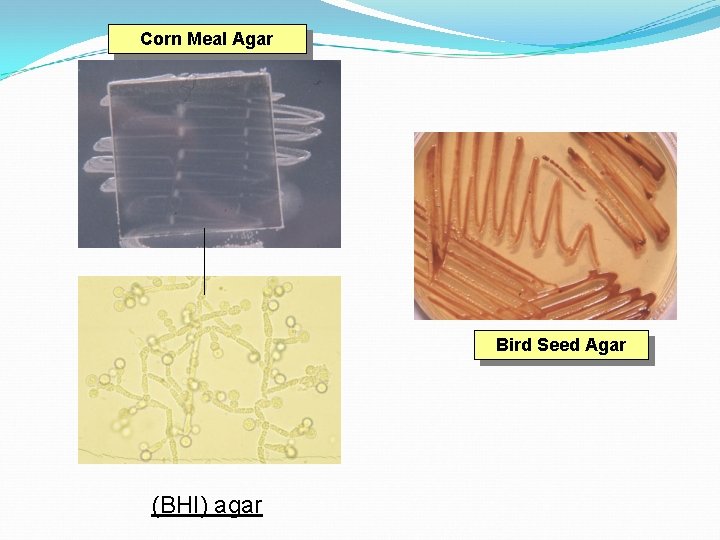
Corn Meal Agar Bird Seed Agar (BHI) agar
Fungal Culture, cont Temperature requirement Majority of fungi – 37°C Superficial mycosis – 30°C Dimorphic fungi – 25°C & 37°C Incubation time At least 4 weeks Usually positive cultures are obtained in 7 -10 days Candida & Aspergillus - 24 to 72 hrs Specimens should be cultured on agar slants: Safe Require less space More resistant to drying during prolonged incubation
Interpretation of Fungal Culture Isolation of an established pathogen like H. capsulatum or C. neoformans – evidence of infection Isolation of commensal or opportunistic fungi like Candida or Aspergillus – consider following points: 1. Isolation of same strain in all culture tubes 2. Repeated isolation of same strain in multiple specimens 3. Isolation of same strain from different sites 4. Immune status 5. Serological evidence
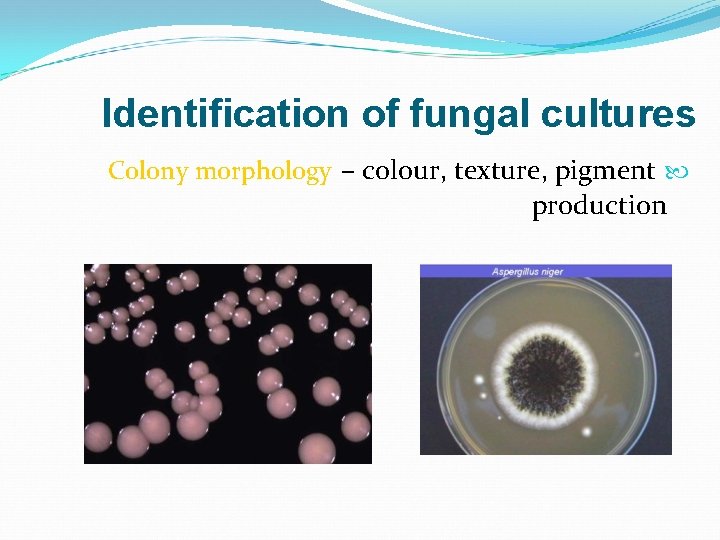
Identification of fungal cultures Colony morphology – colour, texture, pigment production
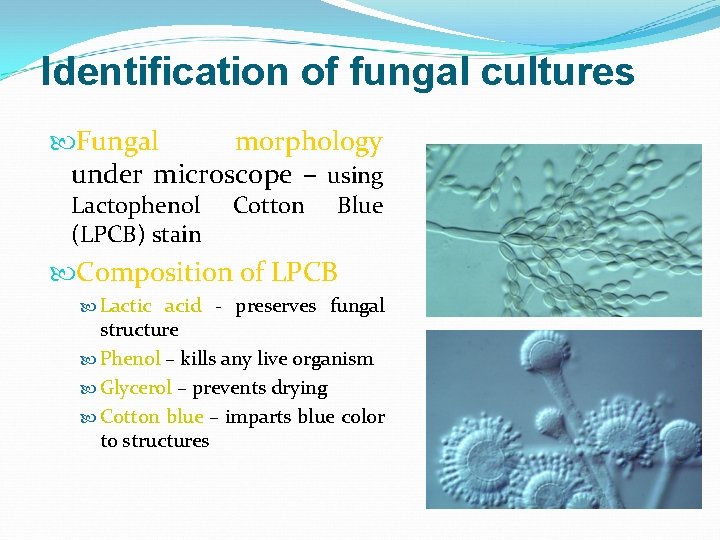
Identification of fungal cultures Fungal morphology under microscope – using Lactophenol (LPCB) stain Cotton Blue Composition of LPCB Lactic acid - preserves fungal structure Phenol – kills any live organism Glycerol – prevents drying Cotton blue – imparts blue color to structures
Identification of fungal cultures Special culture techniques – to see sporing structures & spore arrangement, CHROM agar for candida sps. Biochemicals – ability to assimilate carbon & nitrogen, sugar fermentation
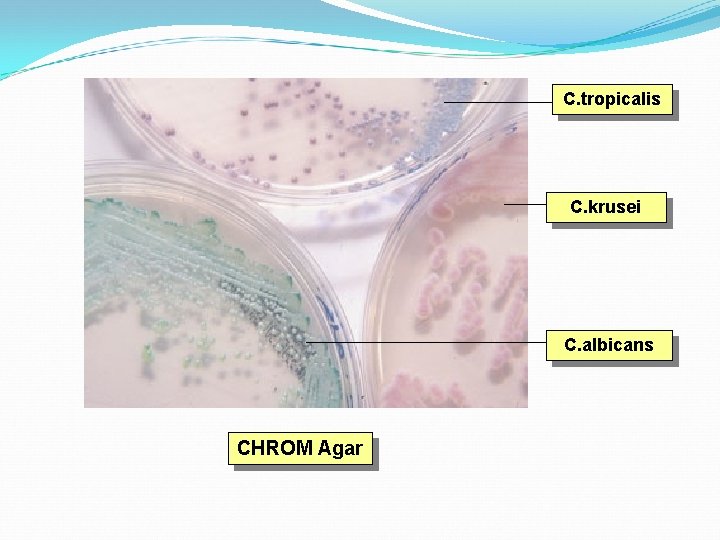
C. tropicalis C. krusei C. albicans CHROM Agar
Serology Detection of Ag or Ab in serum or body fluids Ab detection: Diagnosis of systemic & subcutaneous mycoses Assess prognosis of the disease Assess response to treatment Ag detection: Early stages of infection In patients with impaired immunity
Serological tests used in Medical Mycology Agglutination Immunodiffusion – most widely used Counter immunoelectrophoresis (CIEP) Indirect fluorescent Ab detection ELISA, RIA Delayed hypersensitivity reaction
Other Methods PCR – Polymerase Chain Reaction RFLP - Restriction fragment length polymorphism Protein electrophoresis Nucleic acid probes
- Slides: 24