
Lecture 9 Chapter03 DiscreteEvent System Simulation Jerry Banks
Lecture 9 Chapter-03 Discrete-Event System Simulation -Jerry Banks Discrete Events Simulation
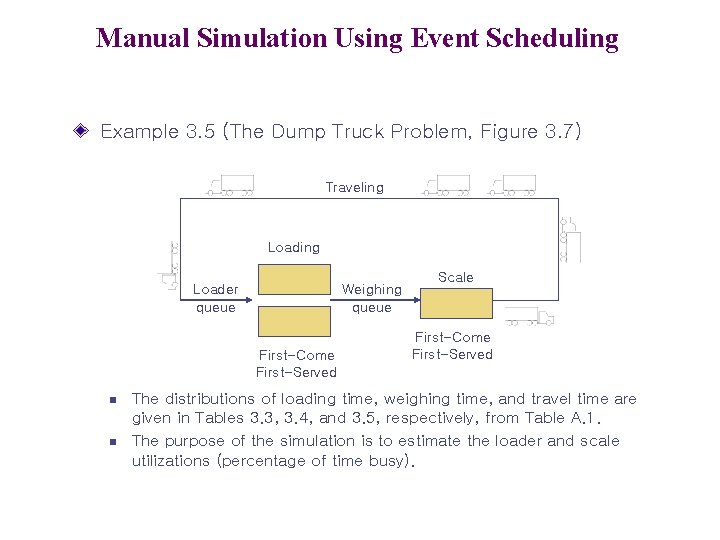
Manual Simulation Using Event Scheduling Example 3. 5 (The Dump Truck Problem, Figure 3. 7) Traveling Loader queue Weighing queue First-Come First-Served n n Scale First-Come First-Served The distributions of loading time, weighing time, and travel time are given in Tables 3. 3, 3. 4, and 3. 5, respectively, from Table A. 1. The purpose of the simulation is to estimate the loader and scale utilizations (percentage of time busy).
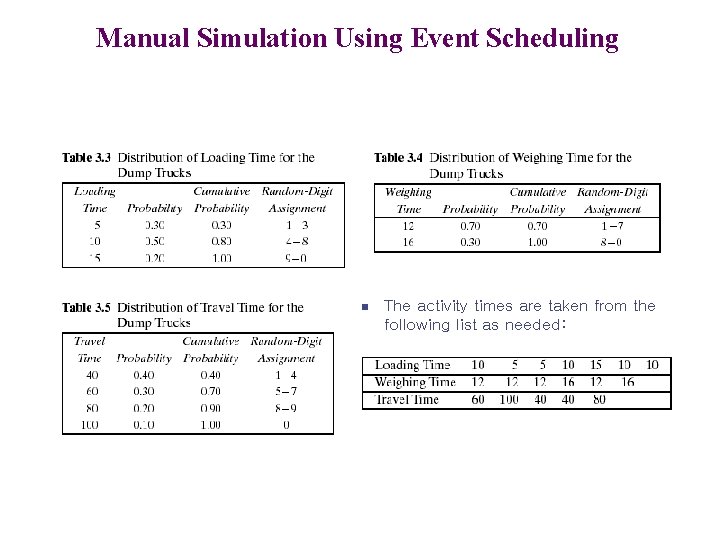
Manual Simulation Using Event Scheduling n The activity times are taken from the following list as needed:
![Manual Simulation Using Event Scheduling n n System state [LQ(t), L(t), WQ(t), W(t)] w](http://slidetodoc.com/presentation_image_h2/1db20199be3b9a8334c79b207be0a455/image-4.jpg "Manual Simulation Using Event Scheduling n n System state [LQ(t), L(t), WQ(t), W(t)] w")
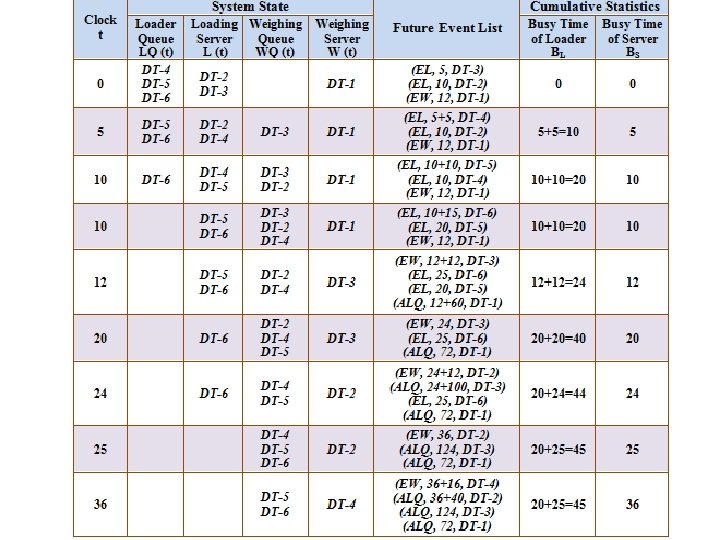
Manual Simulation Using Event Scheduling n n System state [LQ(t), L(t), WQ(t), W(t)] w LQ(t) = number of trucks in loader queue w L(t) = number of trucks (0, 1, or 2) being loaded w WQ(t) = number of trucks in weigh queue w W(t) = number of trucks (0 or 1) being weighed, all at simulation time t Event notices : w (ALQ, t, DTi ), dump truck i arrives at loader queue (ALQ) at time t w (EL, t, DTi), dump truck i ends loading (EL) at time t w (EW, t, DTi), dump truck i ends weighing (EW) at time t Entities : The six dump trucks (DT 1, … , DT 6) Activities : Loading time, weighing time, and travel time
Manual Simulation Using Event Scheduling Simulation Starting Condition: Simulation will start depending on any of the two conditions. 1. You need to use all the recourses from the beginning of the simulation. 2. It has been assumed that five of the trucks are at the loaders and one is at the scale at time 0. n
Manual Simulation Using Event Scheduling n Simulation Ending Condition: Simulation will ends depending on any of the two conditions. 1. 2. After a specific time elapsed (will be mentioned in the problem). Or When all the truck go for travel.
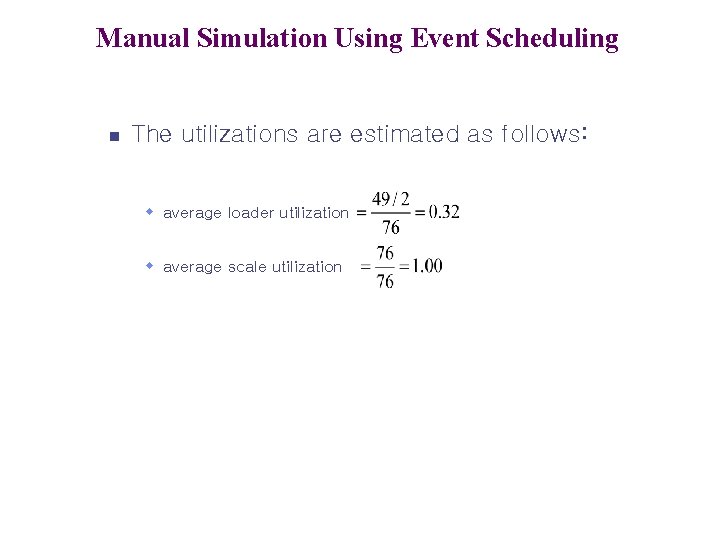
Manual Simulation Using Event Scheduling n The utilizations are estimated as follows: w average loader utilization w average scale utilization
- Slides: 8