
Lecture 9 Capital Budgeting Projects with Different Lives

Lecture 9 Capital Budgeting: Projects with Different Lives
Topics covered in this lecture 1. 2. 3. 4. 5. 6. Description of problem Known variables Solution process Decision rule Numerical example Practice question
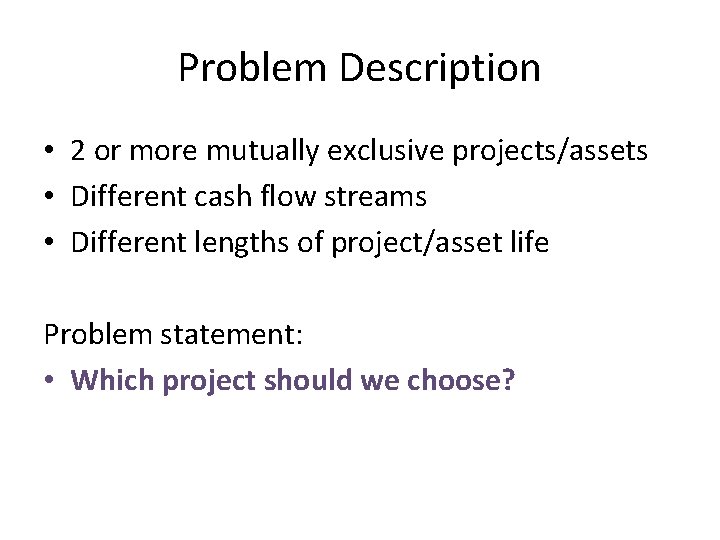
Problem Description • 2 or more mutually exclusive projects/assets • Different cash flow streams • Different lengths of project/asset life Problem statement: • Which project should we choose?
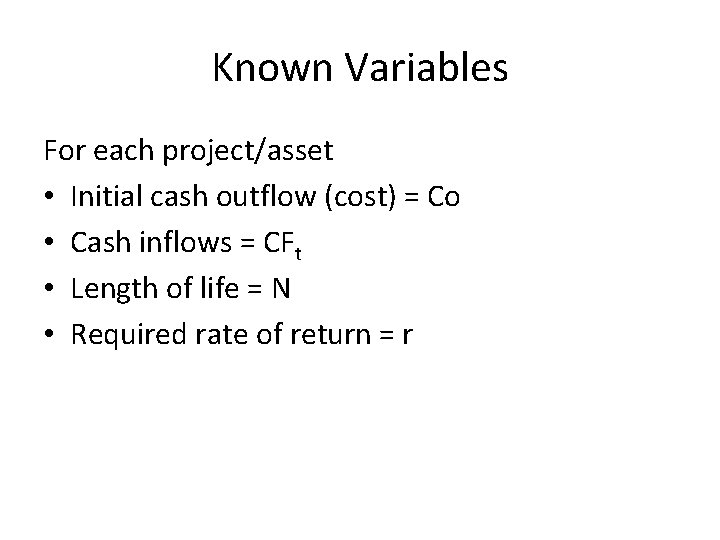
Known Variables For each project/asset • Initial cash outflow (cost) = Co • Cash inflows = CFt • Length of life = N • Required rate of return = r
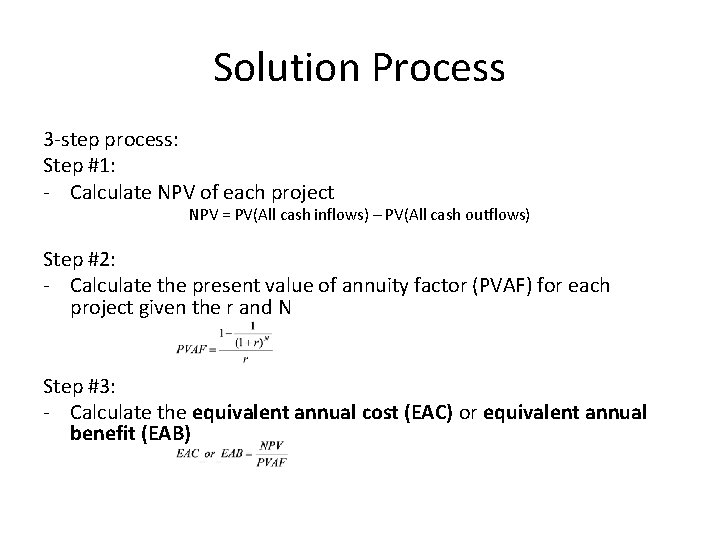
Solution Process 3 -step process: Step #1: - Calculate NPV of each project NPV = PV(All cash inflows) – PV(All cash outflows) Step #2: - Calculate the present value of annuity factor (PVAF) for each project given the r and N Step #3: - Calculate the equivalent annual cost (EAC) or equivalent annual benefit (EAB)

Decision Rule Choose the project/asset with the highest equivalent annual benefit (EAB) or the lowest equivalent annual cost (EAC)
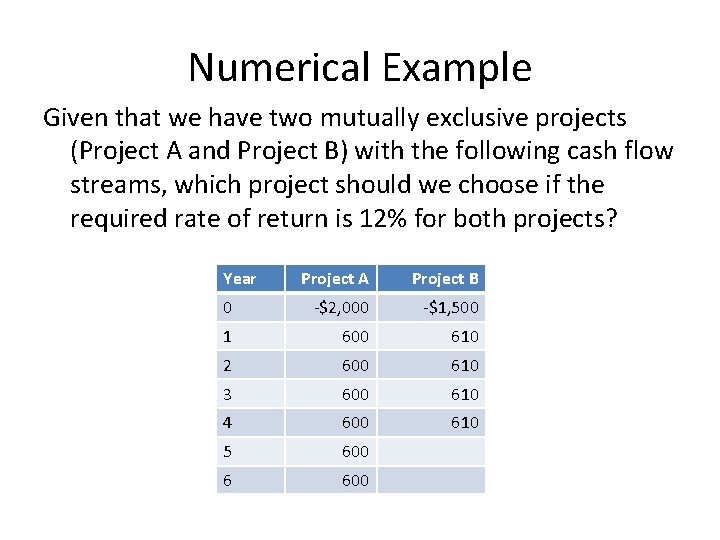
Numerical Example Given that we have two mutually exclusive projects (Project A and Project B) with the following cash flow streams, which project should we choose if the required rate of return is 12% for both projects? Year Project A Project B 0 -$2, 000 -$1, 500 1 600 610 2 600 610 3 600 610 4 600 610 5 600 6 600
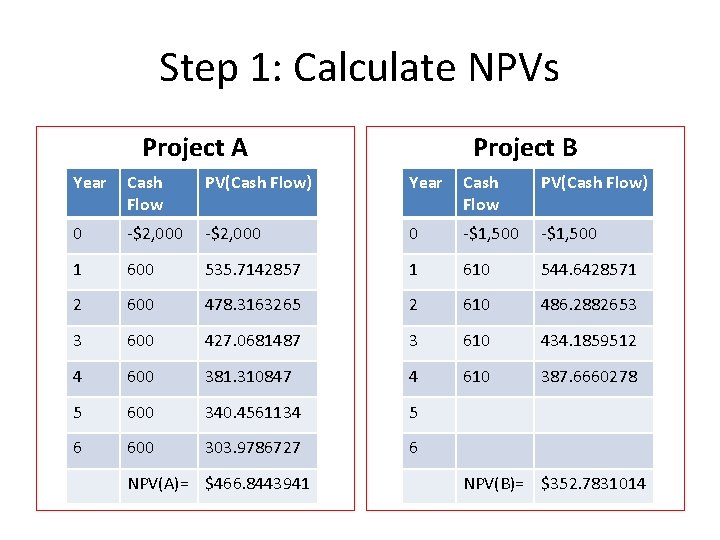
Step 1: Calculate NPVs Project A Project B Year Cash Flow PV(Cash Flow) 0 -$2, 000 0 -$1, 500 1 600 535. 7142857 1 610 544. 6428571 2 600 478. 3163265 2 610 486. 2882653 3 600 427. 0681487 3 610 434. 1859512 4 600 381. 310847 4 610 387. 6660278 5 600 340. 4561134 5 6 600 303. 9786727 6 NPV(A)= $466. 8443941 NPV(B)= $352. 7831014
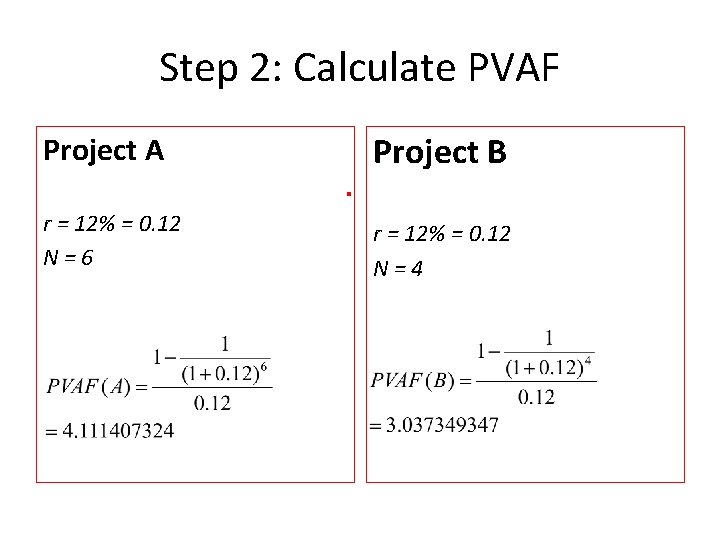
Step 2: Calculate PVAF Project A Project B r = 12% = 0. 12 N=6 r = 12% = 0. 12 N=4
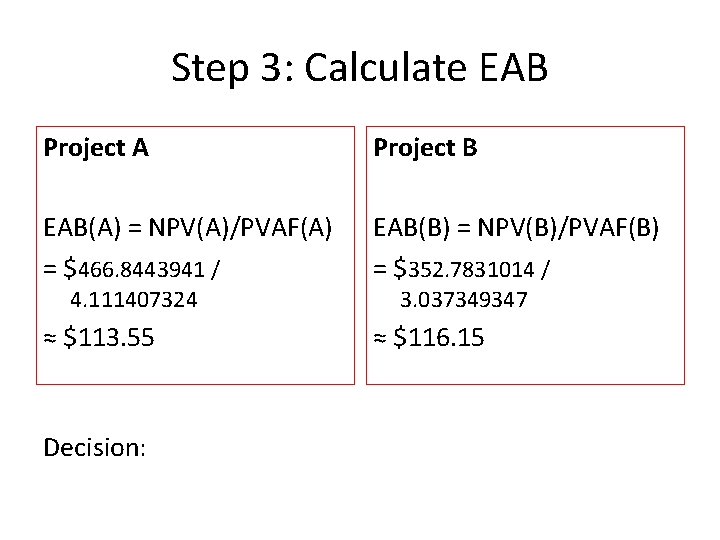
Step 3: Calculate EAB Project A Project B EAB(A) = NPV(A)/PVAF(A) = $466. 8443941 / EAB(B) = NPV(B)/PVAF(B) = $352. 7831014 / ≈ $113. 55 ≈ $116. 15 4. 111407324 Decision: 3. 037349347
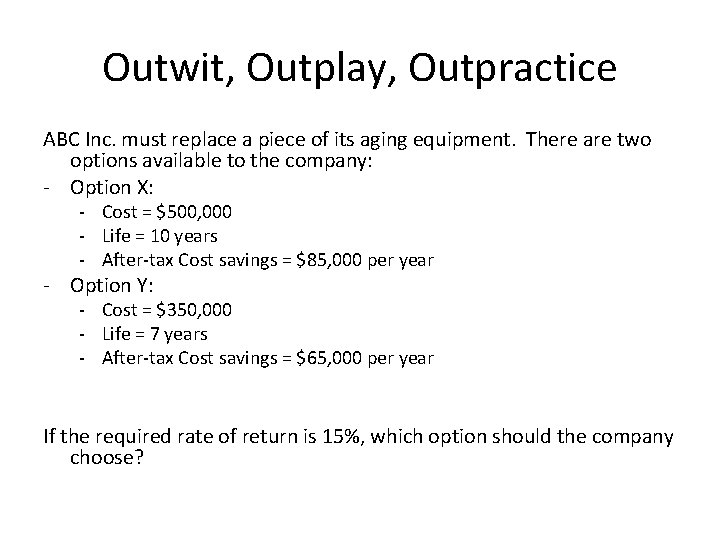
Outwit, Outplay, Outpractice ABC Inc. must replace a piece of its aging equipment. There are two options available to the company: - Option X: - Cost = $500, 000 - Life = 10 years - After-tax Cost savings = $85, 000 per year - Option Y: - Cost = $350, 000 - Life = 7 years - After-tax Cost savings = $65, 000 per year If the required rate of return is 15%, which option should the company choose?
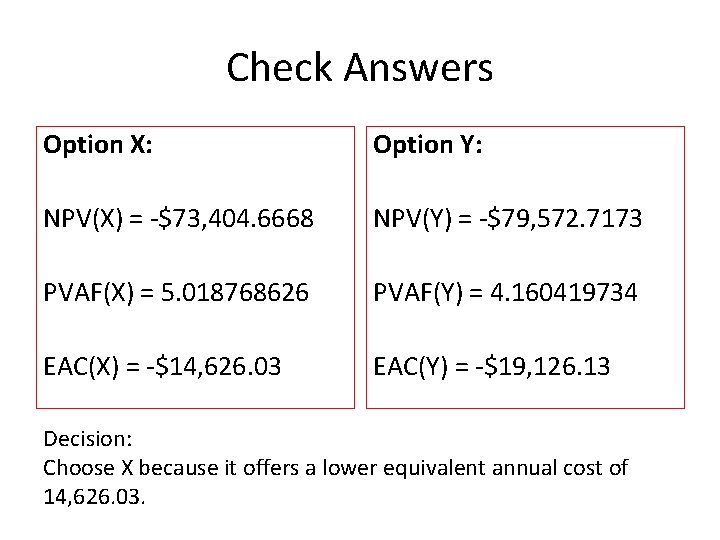
Check Answers Option X: Option Y: NPV(X) = -$73, 404. 6668 NPV(Y) = -$79, 572. 7173 PVAF(X) = 5. 018768626 PVAF(Y) = 4. 160419734 EAC(X) = -$14, 626. 03 EAC(Y) = -$19, 126. 13 Decision: Choose X because it offers a lower equivalent annual cost of 14, 626. 03.

End of lecture on capital budgeting projects with different lives
- Slides: 13